Slab Leak Detection in Anthem and Seven Hills: Hillside Slabs and Hot-Water Loops

Key Takeaways
- Slab leaks hide under the concrete foundation and often leak for months before a warm floor or high water bill reveals them.
- Hillside lots in Anthem and Seven Hills face extra risk from cut-and-fill grading, shifting soil, rocky caliche, and pressure swings.
- Recirculating hot-water loops fail first because heat, constant flow, and hard water wear down copper more quickly than cold lines.
- Early warning signs include a spiking water bill, running water sounds with everything off, warm floor spots, and musty smells.
- A simple meter test confirms whether a leak exists, then professional acoustic, pressure, and thermal detection pinpoints it precisely.
- Repair options range from spot repair to rerouting, full PEX repipe, or epoxy lining depending on pipe age and leak history.
- Detection typically costs $250 to $600, and insurance often covers resulting water damage even when the pipe repair is excluded.
- Local knowledge of Anthem and Seven Hills floor plans, HOA rules, and access challenges speeds up detection and limits damage.
In This Article
A Seven Hills homeowner near Grand Hills Drive called us last spring with a story we hear often. She noticed a warm patch on her kitchen tile one morning, then her next water bill jumped by almost forty dollars for no obvious reason. No dripping faucet, no visible puddle, just a warm floor and a meter that would not stop spinning.
That combination points to one thing on these hillside lots: a slab leak, and usually one on the hot-water side. Homes built into the foothills of Anthem and Seven Hills face a special set of problems that flatter neighborhoods do not. Graded slopes, shifting soil, rocky caliche, and recirculating hot-water loops all work together to wear pipes out more quickly.

What a Slab Leak in Las Vegas Valley Actually Is?
A slab leak is a break or pinhole in a water line that runs under or inside your concrete foundation. Since the pipe sits below the slab, the water has nowhere obvious to go, so it soaks into the soil and concrete instead of showing up as a visible drip.
That is exactly why a foundation leak can hide for months in Anthem and Seven Hills homes. The water spreads under the slab, and by the time it surfaces as a warm floor or a cracked tile, it has often been leaking for a long time. A slow slab leak can waste thousands of gallons before anyone notices.
How Water Lines Run Beneath the Foundation
When these homes were built, the plumbers ran supply lines through or under the concrete slab before the foundation was poured. Copper pipe was the standard choice for decades, especially in homes built through the 1990s and early 2000s across the foothills.
Copper lines were usually laid in a bed of sand or fill, then covered by the concrete pour. In some layouts the pipe is embedded directly in the slab, which makes any future leak harder to reach without cutting concrete.
Newer builds and remodels often use PEX, a flexible plastic tubing that resists corrosion better than copper. PEX bends around obstacles and handles the mineral-heavy local water more gracefully, which is why we recommend it for most reroutes and repipes today.
Knowing whether a home has copper or PEX changes how we approach detection and repair. A copper system on a 1998 Seven Hills build behaves very differently from a PEX system in a home remodeled five years ago.
Pressure Side vs. Drain Side Leaks
There are two very different kinds of leaks under a slab, and they show up in different ways. A pressure leak happens on the pressurized supply lines that carry clean water to your fixtures, so water actively pushes out around the clock.
A drain leak, by contrast, happens on the sewer line or drain piping that only carries water when something is running. These leaks tend to smell before they show, because wastewater seeps into the soil under the home.
Pressure leaks usually announce themselves with a spiking water bill and the sound of running water. A leaking sewer line is quieter on the meter but often brings damp spots, foul odors, and slow drains as clues.
Telling the two apart early helps us bring the right tools. Our team handles both, from pressurized supply repairs to sewer line repair and replacement when the drain side is the culprit.
Why Slab Leaks Get Worse Over Time
A slab leak almost never starts big. It usually begins as a tiny pinhole leak, often no wider than a pencil tip, where the pipe wall has thinned from corrosion or abrasion.
Water escaping under pressure slowly erodes the surrounding soil and the pipe itself. Over weeks and months, that pinhole widens into a real break, and the flow of escaping water climbs from a trickle to gallons per hour.
As the leak grows, trapped water damages flooring, warps baseboards, and can undermine the soil that supports the concrete slab. On a hillside lot, that erosion is more serious because the ground is already prone to movement.
A rough timeline looks like this: a pinhole may leak quietly for one to three months, then speed up over the next few months as erosion widens the gap. Waiting rarely saves money, since the water damage compounds the longer it runs.
Get Your Quote
Tell us what's going on and we'll get back to you. We're open 24/7.
Why Hillside Slabs in Anthem and Seven Hills Are Different
Homes built into the foothills sit on ground that was cut, filled, and graded to create a level pad. That engineered ground behaves differently than natural flat lots, and it puts extra stress on the pipes buried inside a hillside slab.
Elevation, soil movement, and rocky fill all conspire against copper lines up here. Below is a quick comparison of how these hillside factors affect buried pipes.
| Hillside Factor | Effect on Buried Pipes | Where It Shows Up |
|---|---|---|
| Cut-and-fill grading | Uneven soil settling stresses pipe joints | Anthem Country Club, Seven Hills upper lots |
| Elevation changes | Pressure swings strain supply lines | Homes near Volunteer Boulevard, Grand Hills Drive |
| Caliche and rocky fill | Abrasion and pinching of copper | Most foothill grades |
| Home age | Aging copper corrodes from the inside | 1990s and early 2000s builds |
Sloped Lots and Shifting Soil Along the Foothills
To build on a slope, crews cut into the high side and fill the low side to make a flat pad. That cut and fill process leaves two different soil types under one home, and they settle at different rates over the years.
In neighborhoods like Anthem Country Club, we often see homes where one corner has settled more than the rest. That uneven soil settling flexes the slab just slightly, but it is enough to stress the rigid copper joints buried inside.
Pipe joints are the weakest points in any system. When soil shifts, it can crack a soldered copper fitting or pull a connection loose, and that is where many hillside slab leaks begin.
This is not a defect in the home so much as a natural result of building on graded ground. It just means these homes deserve closer attention to their plumbing as they age.
Elevation Changes and Water Pressure
Homes higher up the hills, near streets like Volunteer Boulevard and Grand Hills Drive, sit at a different elevation than the water mains feeding them. That elevation difference can create pressure swings that push against the supply lines.
Municipal water pressure in parts of the valley can run high, and hillside homes sometimes feel it more. Water pressure above 80 psi puts real strain on pipe walls and fittings, speeding up wear.
A working pressure regulator at the main is the first line of defense. When that regulator fails or was never set correctly, the whole system runs harder than it should, and the hot-water loop suffers most.
We check static pressure on every slab leak call. If it reads high, correcting the regulator is part of preventing the next leak, not just fixing the current one.
Rocky Caliche and Desert Ground Conditions
Anyone who has dug in Henderson soil knows about caliche, the hard, cement-like layer common across our desert ground. Builders often backfill around pipes with rocky material that contains sharp edges and this abrasive caliche.
As the soil shifts and the pipe expands and contracts with temperature, copper rubs against those rocks and hard deposits. Over years, that abrasion wears a thin spot right through the pipe wall.
The dry desert soil also swells and shrinks with the little moisture it gets, which keeps the pipes in constant slow motion against their surroundings. A copper line pinned against a chunk of caliche will eventually give.
This is one reason we favor rerouting or PEX on repairs. Getting the vulnerable copper out of that abrasive fill removes the mechanism that caused the leak in the first place.
Age of Homes in These Communities
Much of Anthem and Seven Hills was built out through the late 1990s and 2000s, with newer phases continuing into the 2010s. Homes from that first wave of 1990s construction are now old enough that their original copper is showing its age.
Copper corrosion works from the inside out, thinning pipe walls until a pinhole forms. The hot-water lines in these older homes usually corrode first because heat speeds up the chemistry.
If a home in the older sections of Seven Hills or Anthem Country Club still has its original copper supply lines, it sits squarely in the higher-risk group. That does not mean a leak is certain, only that the odds climb each year.
We keep this history in mind on every hillside call. Knowing the build era tells us a lot before we even reach for a listening device.
Need Help in Las Vegas?
Active Plumbing serves Las Vegas and all of Las Vegas Valley.
Hot-Water Loops and Why They Fail First
Many upscale homes in Seven Hills and Anthem were built with a recirculating hot-water loop so residents never wait long for hot water. That convenience comes with a hidden cost: the hot side wears out sooner than the cold.
Heat, constant flow, and local water chemistry all gang up on the hot-water loop. When we find a slab leak in one of these homes, the hot side is the leak location more often than not.
How Recirculating Loops Work
A recirculation line runs hot water in a continuous loop from the water heater, past the fixtures, and back again. A recirculation pump keeps that water moving so a tap of hot water is ready almost instantly at every sink and shower.
The loop piping travels under the slab in most of these homes, forming a closed circle rather than a simple dead-end run. That means hot water is passing through the buried pipe far more of the day than in a home without a loop.
The comfort is real, and homeowners love the instant hot water. But the same feature that delivers that comfort also keeps the pipe under thermal and flow stress around the clock.
If a home has a loop, we take that into account during detection and when planning repairs like a recirculation pump installation or replacement.
Heat and Constant Flow Wear Down Copper
Hot water is simply harder on copper than cold water. Higher temperatures speed up the chemical reactions that thin pipe walls, a process called erosion corrosion when combined with moving water.
The velocity of water circulating through a loop adds another layer of wear. Fast-moving hot water scours the inside of the pipe, and any spot where the flow turns or narrows takes extra abuse.
Thermal expansion plays a part too. Every time hot water flows, the copper expands slightly, then contracts as it cools, and that constant movement fatigues the metal and its joints over years.
Put heat, flow, and expansion together and you have a recipe for the hot side failing first. This is why a hot side leak is a common slab leak we find in loop-equipped hillside homes.
Warm Floors and Other Hot-Loop Warning Signs
The clearest sign of a hot-loop leak is a warm floor or a distinct hot spot on the tile where there should not be one. When escaping hot water pools under the slab, it heats the concrete above it.
Homeowners often notice this walking barefoot across a kitchen or bathroom in the morning. One patch feels noticeably warmer than the surrounding floor, and that patch usually sits right over the leak.
Another tell is a water heater that runs constantly. If the tank is cycling and reheating far more than usual, it may be trying to replace hot water that is leaking out under the slab.
A spike in the gas or power bill for the water heater often shows up alongside the warm floor. When we see water heater cycling paired with a hot spot, the loop is the prime suspect.
Local Water Chemistry and Corrosion
Water delivered by the Las Vegas Valley Water District is hard and mineral heavy, drawn largely from the Colorado River system. That hard water leaves scale and speeds up corrosion, especially on the hot side.
Heat drives minerals out of the water, so they deposit as scale inside hot pipes and the water heater. Over time, scale creates rough spots and turbulence that speed up pitting in the copper wall.
Pitting is a localized form of corrosion that drills tiny craters into the metal until one breaks through as a pinhole. The mineral content in local water makes this a slow but steady process in older copper.
A water softener or conditioner reduces that mineral load and protects the whole system. Our team installs water softener systems that ease the strain hard water puts on hot-water loops. You can learn more about the water efficiency basics from the EPA as well.
Early Warning Signs Homeowners Should Watch For
The good news is that most slab leaks give off signals before they cause major damage. Knowing the slab leak signs lets a homeowner call for help while the fix is still small and affordable.
Here are the warning signs neighbors can check on their own:
- A water bill spike with no change in household habits
- The sound of running water when everything is turned off
- A warm floor or hot spot on the tile
- Cracks in flooring, damp carpet, or a musty smell
- Low water pressure that appeared out of nowhere
- A water heater that keeps cycling on the hot-water loop
Unexplained Jumps in the Water Bill
The water bill is one of the first places a slab leak shows up. Pull the last several statements and compare the gallons used, not just the dollar amount, since rates change seasonally.
A small slab leak can waste anywhere from a few hundred to a few thousand gallons per day. Even a slow leak of one gallon per minute adds up to over 1,400 gallons in a single day.
If usage climbed sharply while the household stayed the same size and habits did not change, that high water bill is a red flag. Summer irrigation can muddy the picture, so compare indoor months where possible.
Leak detection often starts with that billing history. It tells us roughly how large the leak is before we ever set foot in the home.
Sounds of Running Water With Everything Off
Late at night, when the house is quiet, a slab leak sometimes gives itself away with sound. Water escaping a pressurized pipe under the slab makes a faint hissing or trickling noise.
Homeowners describe it as a running water sound coming from the floor or a wall, even with every faucet closed. The hiss comes from water forcing its way through a small opening under pressure.
A simple quiet test helps confirm it. Turn off every fixture and appliance that uses water, then walk the house slowly and listen near floors and lower walls for that steady hissing pipe.
If the sound stays constant with everything off, water is moving somewhere it should not be. That is a strong sign to call for professional detection.
Cracks, Damp Spots, and Musty Smells
As trapped water works its way up through the slab, it leaves clues on the surface. Look for new floor cracks in tile or grout, especially ones that appeared without any impact or heavy object.
Damp carpet with no spill to explain it is another common sign. The moisture wicks up from below, leaving a patch that feels cool and never quite dries out.
A mold smell or musty odor often follows, since moisture under flooring feeds mildew growth. That smell may be strongest in a closet or corner where air does not circulate.
Any of these paired with a warm floor or high bill points firmly at the slab. Catching them early keeps a repair from turning into a flooring replacement.
The Meter Test You Can Do Today
There is a quick water meter test any homeowner can run in about fifteen minutes. It is the same first check our technicians rely on.
First, turn off every water fixture and appliance inside and outside the home. Then find the water meter, usually near the street, and note the position of the sweep hand or the leak indicator dial.
Wait fifteen to twenty minutes without using any water, then read the meter again. If the numbers moved or the leak indicator turned, water is escaping somewhere in the system.
This simple DIY check will not tell you where the leak is, but it confirms one exists. From there, professional detection pinpoints the exact spot. Our whole-home leak detection systems can even automate this kind of monitoring.
How Professional Slab Leak Detection Works
Finding a slab leak without smashing the whole floor takes the right leak detection equipment and experience. Modern electronic detection is non-invasive, meaning we locate the leak before cutting a single inch of concrete.
Accuracy here saves real money. Pinpointing a leak to within inches means one small repair instead of tearing up an entire room to find it.
Electronic Listening and Acoustic Equipment
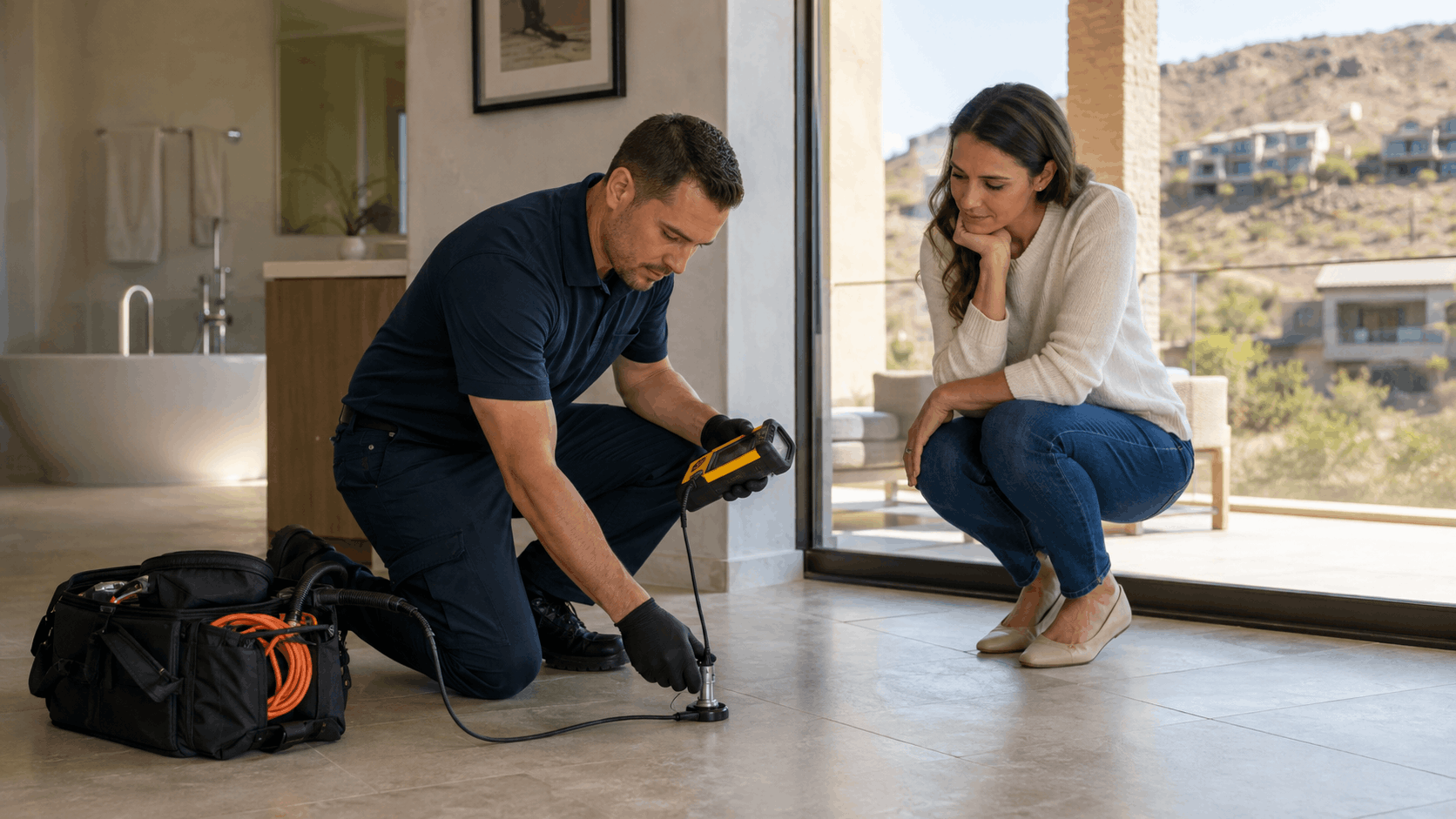
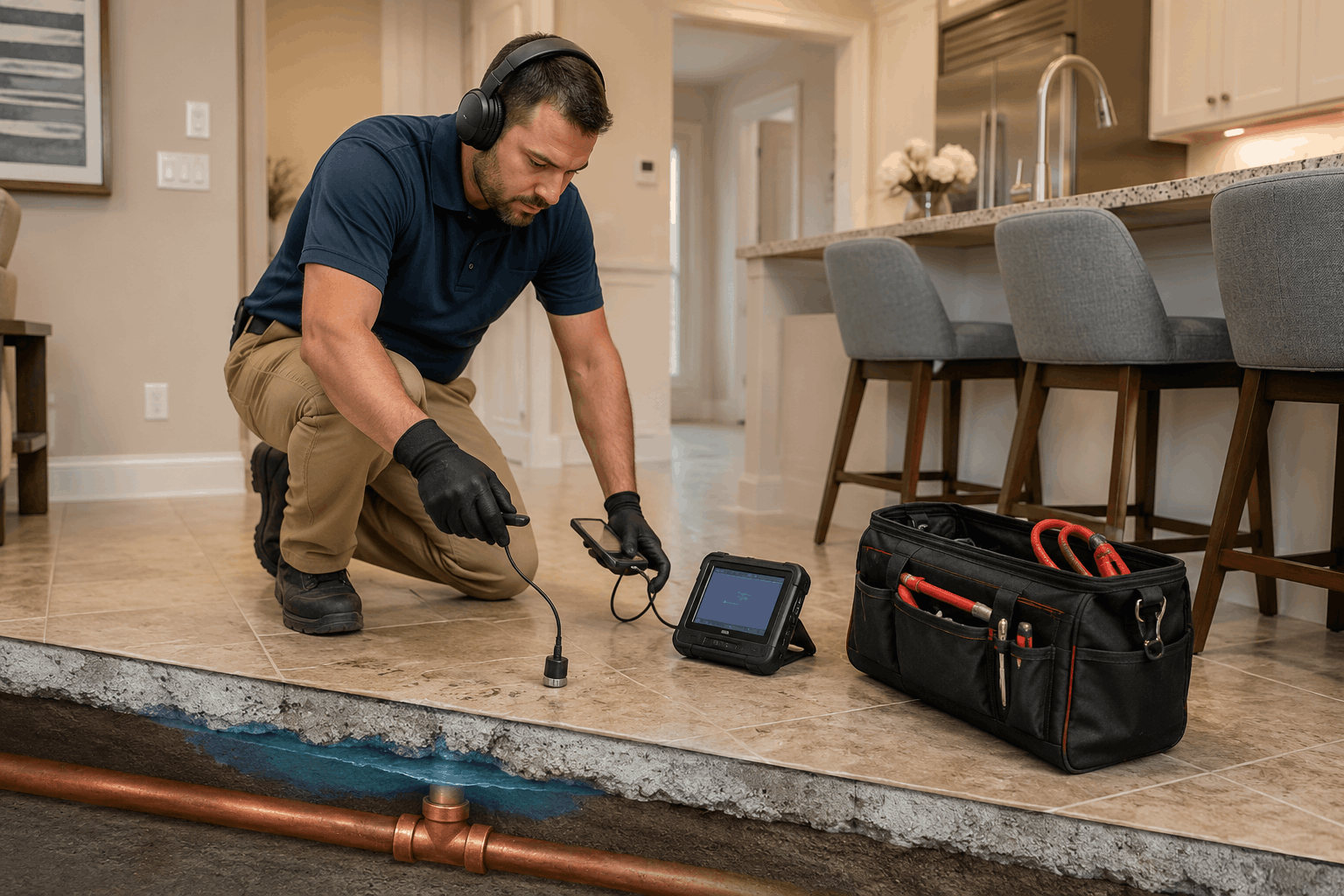
The core of slab leak work is acoustic detection. Sensitive ground microphones pick up the sound of water escaping under concrete, a sound the human ear cannot hear through a slab.
A technician moves the listening device across the floor, mapping where the escaping-water sound grows louder and softer. The loudest point usually sits directly over the leak.
By taking readings from several directions, we triangulate the leak location down to a small area. This turns a guess into a precise mark on the floor.
Our electronic leak detection service uses this method every day on hillside homes. It is the difference between a targeted fix and needless demolition.
Pressure Testing and Line Isolation
Before cutting anything, we confirm which line is leaking. A pressure test involves sealing off a section of pipe, pressurizing it, and watching whether it holds.
Line isolation lets us separate the hot and cold sides and test each independently. On a home with a recirculating loop, this hot cold split is especially useful for narrowing the search.
If the hot side loses pressure while the cold side holds, we know the leak is on the loop. That focuses the acoustic search on a much smaller stretch of pipe.
Pressure testing also verifies our repair afterward. Once the fix is in, the line should hold steady pressure with no drop.
Thermal Imaging and Moisture Meters
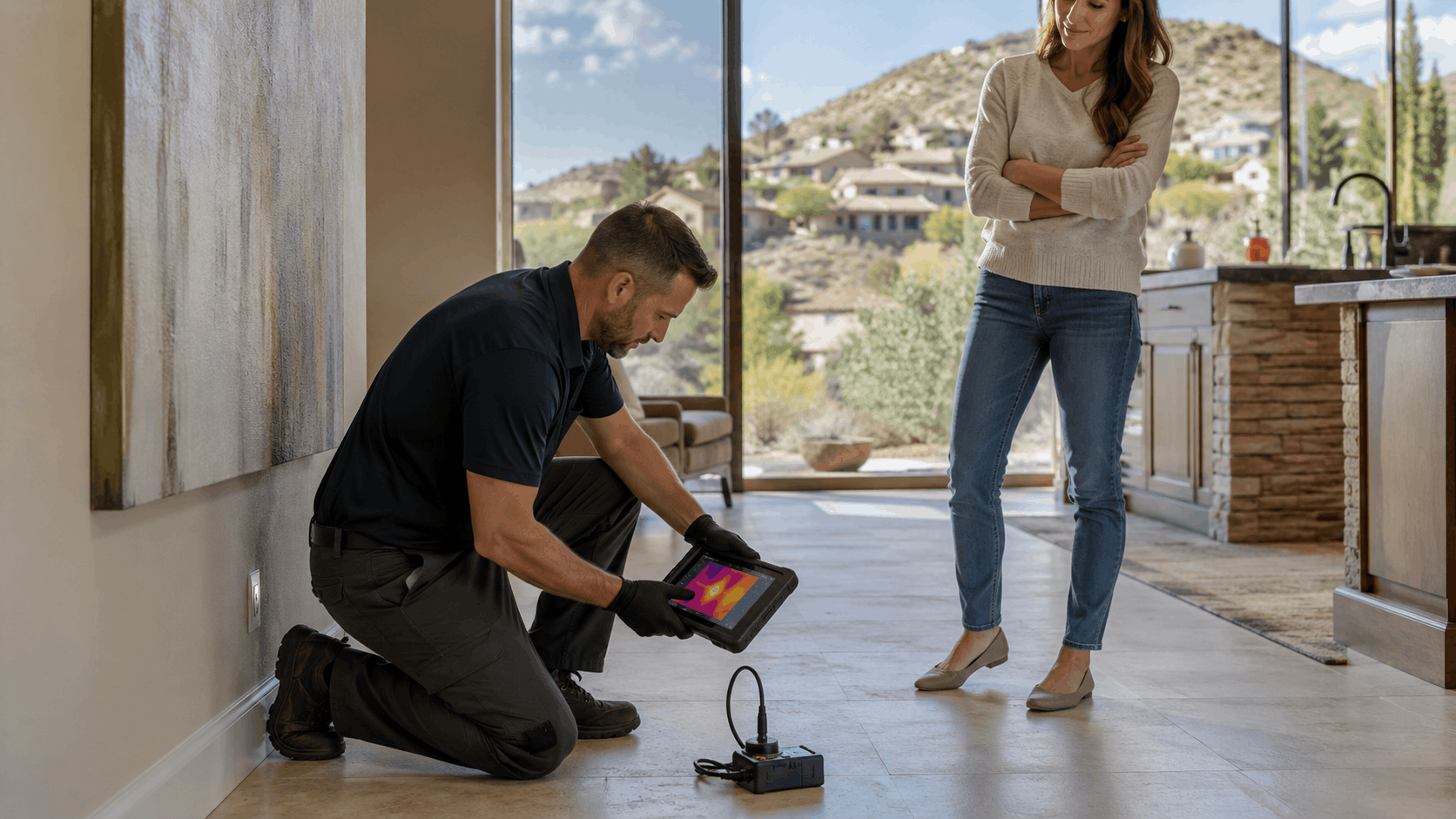
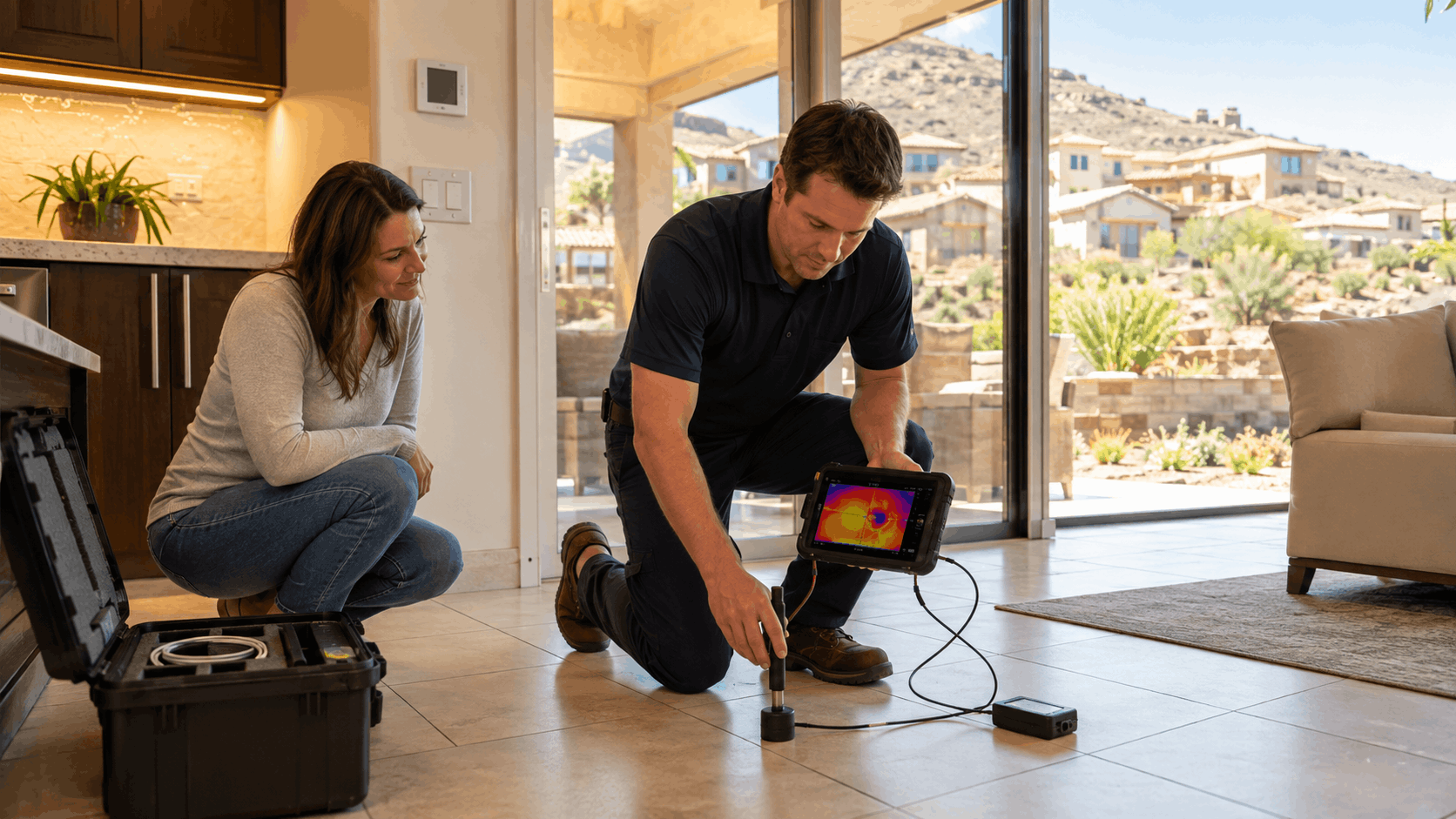
Hot-water leaks give off heat, which makes them perfect targets for thermal imaging. An infrared camera reads surface temperatures and shows a warm plume on the floor where hot water pools below.
That warm signature often outlines the leak path along the loop. It is a fast way to confirm what the acoustic gear suggests, especially on a hot side leak.
Moisture meters add another layer of confirmation. Pressing the meter to the floor reveals how far moisture has spread, which helps map the affected area.
Combining infrared, acoustic, and moisture readings gives us high confidence before opening the slab. Three methods agreeing on one spot leaves little room for error.
Why Pinpointing Matters on Hillside Homes
Accurate location matters everywhere, but it matters more on a sloped-lot slab. These foundations are thicker and reinforced in places, so every cut is harder and costlier to make and patch.
Pinpointing the leak means we open one small section instead of chasing it across the floor. That keeps demolition and restoration costs down for the homeowner.
It also protects the hillside foundation itself. The less we disturb a graded-lot slab, the lower the risk of creating new stress points in the concrete.
Minimizing damage is the whole goal of precise detection. On these homes, the money saved on restoration often exceeds the cost of detection itself.
Need Help in Las Vegas?
Active Plumbing serves Las Vegas and all of Las Vegas Valley.
Repair Options for Slab Leaks in Anthem and Seven Hills
Once we find the leak, there are several ways to fix it. The right choice for slab leak repair depends on the pipe material, the home's age, and how many leaks the system has had.
The main paths are spot repair, rerouting, full repipe, and epoxy lining. Each has a place, and we help homeowners weigh cost against long-term value.
Spot Repair Through the Slab
A spot repair means opening a small section of concrete right over the leak and fixing that single break. We make a concrete cut, expose the pipe, replace the damaged length, and patch the floor.
This works well when the system is otherwise healthy and there is just one leak. For a newer home with a single break, spot repair is often the fastest and cheapest option.
It makes less sense when a home has already had multiple leaks. If the copper is failing in one place, it is often failing in others, and repeated concrete cuts add up fast.
We are honest about that math. If a single leak is the third one this year, spot repair is usually not the smart long-term move.
Rerouting the Line Above the Slab
Rerouting abandons the failed underground section and runs a new line through the walls or attic instead. This bypass line skips the slab entirely, so the vulnerable buried pipe no longer matters.
An attic run is common on hillside homes because it avoids the abrasive caliche fill that caused the leak. The new pipe lives in accessible space where future repairs are simple.
Rerouting suits hot-water loops particularly well. Rather than fight a leak-prone buried loop, we can reroute the hot line above the slab and remove the recurring failure point.
This is our frequent recommendation for a single hot side leak in an older home. It costs more than a spot repair up front but often prevents the next several leaks.
Full Repipe for Aging Homes
When copper is failing throughout a home, a whole home repipe is the smarter long-term move. We replace all the supply lines, usually with PEX, and abandon the old copper in the slab.
A PEX repipe removes the corrosion and abrasion problems for good, since PEX resists both. For older Anthem and Seven Hills builds on their second or third leak, this often costs less over time than repeated repairs.
Repiping a home is a bigger project, but it resets the clock on the entire plumbing system. Homeowners planning to stay in the home for years usually find it worthwhile.
We walk through the numbers honestly. If aging pipes keep failing, a repipe ends the cycle rather than delaying it.
Epoxy Pipe Lining as an Option
Epoxy lining is a trenchless repair that coats the inside of existing pipes with a sealant. The epoxy bonds to the pipe wall and seals small leaks without digging up the slab.
This pipe coating can extend the life of lines that are still structurally sound but starting to leak. It is less disruptive than opening the floor in several places.
The method has limits, though. On badly corroded lines with thin walls, lining cannot restore strength, and rerouting or repiping is the better call.
We assess each system to see whether lining is a fair option or a short-term patch. Not every home is a good candidate.
Costs, Timing, and What to Expect
Homeowners always want to know two things: what will the slab leak cost, and how long will the repair take. Both depend on the leak, the home, and the chosen fix.
Here is a realistic look at pricing, the repair timeline, and how insurance may factor in.
Typical Detection and Repair Cost Ranges
Professional detection in the Henderson area generally runs a few hundred dollars, often in the $250 to $600 range depending on the home. That cost buys precise location and usually pays for itself in avoided demolition.
A spot repair through the slab often lands in the $1,500 to $4,000 range once concrete work and patching are included. Rerouting a single line tends to run $2,000 to $6,000, while a full repipe can reach $6,000 to $15,000 or more.
Several price factors move these numbers, including pipe access, slab thickness, and how much flooring must be removed and restored. Hillside homes with reinforced slabs sit toward the higher end.
Every situation is different, so we give a written estimate after detection. That estimate reflects the actual leak, not a generic guess.
How Long Repairs Take
Detection itself is usually a same day job, often finished in a couple of hours. Once we know the location, the repair time depends on the method chosen.
A spot repair can often be completed in one day, though the concrete patch needs time to cure afterward. Rerouting a line typically takes one to two days depending on the run.
A full repipe is the longest, usually two to four days for an average home. We stage the work to keep the water shutoff windows as short as possible.
We tell homeowners upfront when water will be off and for how long. Planning those windows around the household keeps disruption low.
Homeowners Insurance and HOA Rules
Many homeowners insurance policies cover the resulting water damage from a slab leak, even when they do not cover the pipe repair itself. Reading the policy or calling the carrier early is worth the time.
Documentation makes or breaks a water damage claim. Take photos of the warm floor, damp areas, and any ruined flooring, and keep every invoice from detection and repair.
HOA rules in communities like Anthem Country Club and Seven Hills can affect any exterior work or restoration visible from the street. Some require approval before landscaping or hardscape near the home is disturbed.
We help homeowners gather the documentation carriers and HOAs ask for. A clean paper trail speeds up both claims and approvals.
Preventive Steps to Avoid Future Leaks
The best repair is the leak that never happens. A working pressure regulator keeps household pressure in a safe range and protects every pipe in the home.
A water softener reduces the mineral load that drives scaling and pitting on the hot side. On homes with recirculating loops, softening the water noticeably extends the life of the copper.
Annual plumbing checks catch small problems before they become slab leaks. Testing pressure, inspecting the water heater, and listening for early leak signs are simple habits that pay off.
Leak prevention is a small investment against a large repair. Protecting the hot-water loop in particular keeps these hillside homes out of trouble.
Need Help in Las Vegas?
Active Plumbing serves Las Vegas and all of Las Vegas Valley.
Why Local Experience Matters for Henderson Hillside Homes
Slab leaks on graded lots are not generic plumbing problems. A local plumber who knows the soil, the builders, and the streets finds and fixes these leaks more quickly.
Our team at Active Plumbing works Henderson plumbing calls across the southern valley every day. We know what a Seven Hills slab hides before we walk in the door.
Familiarity With Anthem and Seven Hills Construction
Different builders used different pipe layouts and slab designs across these communities. Knowing which floor plans put the hot-water loop where speeds up detection considerably.
When we recognize a floor plan, we already have a strong idea of where the supply lines run. That construction knowledge narrows the acoustic search before the equipment even comes out.
We have worked on homes in the older Anthem sections and newer Seven Hills phases alike. That range of experience tells us which slab designs and materials to expect by neighborhood.
This familiarity is not something a crew from out of town can match. It comes only from years of working these specific streets.
Working Around HOA and Access Challenges
Anthem and Seven Hills include gated communities and homes on steep driveways. Getting a truck and equipment to the door sometimes takes planning that a local crew already understands.
Gated community access often means coordinating with a guard or gate code before arrival. We build that into scheduling so a technician is not stuck waiting at the entrance.
Steep, curving driveways up near the foothills call for careful staging of gear. Knowing the access quirks of these streets keeps the job moving.
We also respect the HOA expectations for how work is done and cleaned up. Leaving a site tidy matters in these communities.
Fast Response Across the Southern Valley
Speed limits water damage, which is why fast response matters so much with slab leaks. Every hour a pressurized leak runs, more water soaks into the slab and soil.
We cover the areas near St. Rose Parkway, Eastern Avenue, and the 215 Beltway quickly. That central positioning lets us reach Anthem and Seven Hills homes without long delays.
Our reach extends across nearby communities too, from Whitney Ranch to Lake Las Vegas. You can see the full Henderson service area on our site.
When a warm floor or spiking bill appears, getting help fast is the difference between a small repair and a flooded room. Our emergency plumbing team is ready when it counts.
Final Thoughts
Slab leaks on hillside lots in Anthem and Seven Hills come from a mix of graded soil, rocky caliche, high pressure, and hard-working hot-water loops. The hot side almost always fails first, and a warm floor plus a jumping water bill are the clearest early clues.
Catching a leak early, running the simple meter test, and calling for precise detection keeps a small pinhole from becoming a torn-up floor. If you suspect a slab leak, shut off the water and reach out. Our team is ready to pinpoint the problem and fix it right. Contact Active Plumbing today for a consultation.
Frequently Asked Questions
- How do I know if I have a slab leak or just a plumbing issue elsewhere?
- A slab leak hides under the concrete, so it shows up as a warm floor, damp carpet, or a spinning meter with no visible drip. A fixture leak, by contrast, you can see at the sink, toilet, or valve. If your meter keeps moving with every fixture off and no visible source appears, the slab is the likely culprit and needs professional detection.
- Why does the hot water side seem to leak more often?
- Heat speeds up the corrosion that thins copper pipe walls, so hot lines wear sooner than cold ones. Recirculating loops make it worse by keeping hot water moving through the buried pipe most of the day. That constant flow, thermal expansion, and mineral scaling from hard water all attack the hot side first, which is why hot-loop leaks are so common in these homes.
- How much does slab leak detection cost in the Henderson area?
- Professional detection usually runs in the $250 to $600 range, depending on the home's size, slab design, and how much testing the leak requires. That cost covers acoustic listening, pressure testing, and often thermal imaging to pinpoint the exact spot. Precise location saves far more than it costs by avoiding needless concrete demolition, so detection almost always pays for itself.
- Can a slab leak damage my home's foundation?
- Yes, a prolonged leak can undermine the soil that supports the concrete slab. On hillside lots with cut-and-fill grading, escaping water erodes the ground unevenly, which can stress and crack the foundation over time. The longer a leak runs, the greater the risk, which is why fast detection and repair matter more on sloped-lot homes than on flat ones.
- Is it better to repair the leak or reroute the pipe?
- For a single leak in an otherwise healthy system, a spot repair is often the cheapest fix. If the home has had multiple leaks or the copper is aging, rerouting the line above the slab or a full PEX repipe usually costs less over time. We weigh the pipe's condition and leak history with each homeowner to recommend the smartest path.
- Will homeowners insurance cover a slab leak?
- Many policies cover the resulting water damage even when they exclude the pipe repair itself. Coverage varies, so call your carrier early and read the policy. Document everything with photos of the warm floor, damp areas, and damaged flooring, and keep all detection and repair invoices. Good documentation gives your water damage claim the best chance of approval.
- How long does a slab leak repair take?
- Detection is usually a same-day job finished in a couple of hours. A spot repair often takes a single day plus curing time for the concrete patch. Rerouting a line runs one to two days, and a full repipe typically takes two to four days. We keep water shutoff windows as short as possible and plan them around your household.
- Do hillside homes in Anthem have more slab leak risk?
- They tend to, yes. Cut-and-fill grading causes uneven soil settling that stresses pipe joints, elevation changes bring pressure swings, and rocky caliche fill abrades copper lines. Combined with aging pipe in older sections, these factors raise the odds compared with flat lots. It does not mean a leak is certain, but it means hillside homes deserve closer plumbing attention as they age.
- Can I prevent slab leaks from happening again?
- You can lower the risk considerably. Keep a working pressure regulator so household pressure stays in a safe range, install a water softener to cut the mineral load on hot lines, and schedule annual plumbing checks. On homes with recirculating loops, softening the water especially helps protect the hot side. These simple steps extend pipe life and catch small problems early.
- Should I turn off my water if I suspect a slab leak?
- Yes, if the leak seems active and water is spreading, shut off the main to stop the flow and limit damage. Locate your main shutoff before an emergency so you can act fast. Turning off the water buys time until a technician arrives and keeps a small leak from flooding floors. Then call for professional detection to find and fix the source.
Licensed plumbing professionals serving Las Vegas and Las Vegas Valley.
Licensed in Nevada · License #0047021
Last updated on
Why trust Active Plumbing?
Founded in 1991, Active Plumbing is a licensed and insured plumber serving Las Vegas and Las Vegas Valley. All content is reviewed by our licensed technicians.

Need Help in Las Vegas?
Active Plumbing serves Las Vegas and all of Las Vegas Valley.
Related Articles

Anthem Henderson Plumber: Why Hillside Homes Have Unique Pressure Issues
Anthem hillside homes face unique water pressure issues from elevation, terrain, and the Henderson water system. Learn the causes, tests, and proven fixes.

Best Leak Detection Method in Las Vegas (Slab, Yard, Wall, and Ceiling Leaks)
Discover the most effective leak detection methods for Las Vegas homes including slab, yard, wall, and ceiling leaks. Professional techniques that save money and prevent damage.