Why the Same Plumbing Problem Costs Differently Across the Valley: Access, Era, and HOA Factors
Key Takeaways
- Plumbing prices vary across the Valley because of real physical factors, not random pricing.
- Access is the biggest cost driver - buried cleanouts, attics, and tile walls add labor time.
- Home era decides pipe material, from galvanized and cast iron downtown to modern PEX in Summerlin.
- Polybutylene pipe in some 1980s-90s Green Valley and Spring Valley homes can lead to repiping costs.
- HOA rules in communities like Summerlin and Anthem add approvals, restoration standards, and scheduling delays.
- Hard water, summer heat, and shifting soil raise repair frequency across Valley neighborhoods.
- Keeping cleanouts and shutoffs accessible and treating hard water helps keep costs predictable.
- Active Plumbing gives upfront quotes after inspecting the actual home, serving the entire Las Vegas Valley.
In This Article
Two homeowners on opposite sides of the Valley call about the exact same problem: a clogged kitchen drain that will not clear. One lives in a 1995 build in Green Valley. The other owns a newer place out in Summerlin West. Both get quotes the same afternoon. One pays a little over a hundred dollars. The other pays nearly triple. Same clog, wildly different bills. What gives?
This happens every week at Active Plumbing. A water heater swap in a garage in Enterprise is a straightforward morning job. That same swap in a second-floor attic closet in a gated Anthem community turns into a full day with extra help. The problem on paper looks identical, but the real-world conditions are anything but.
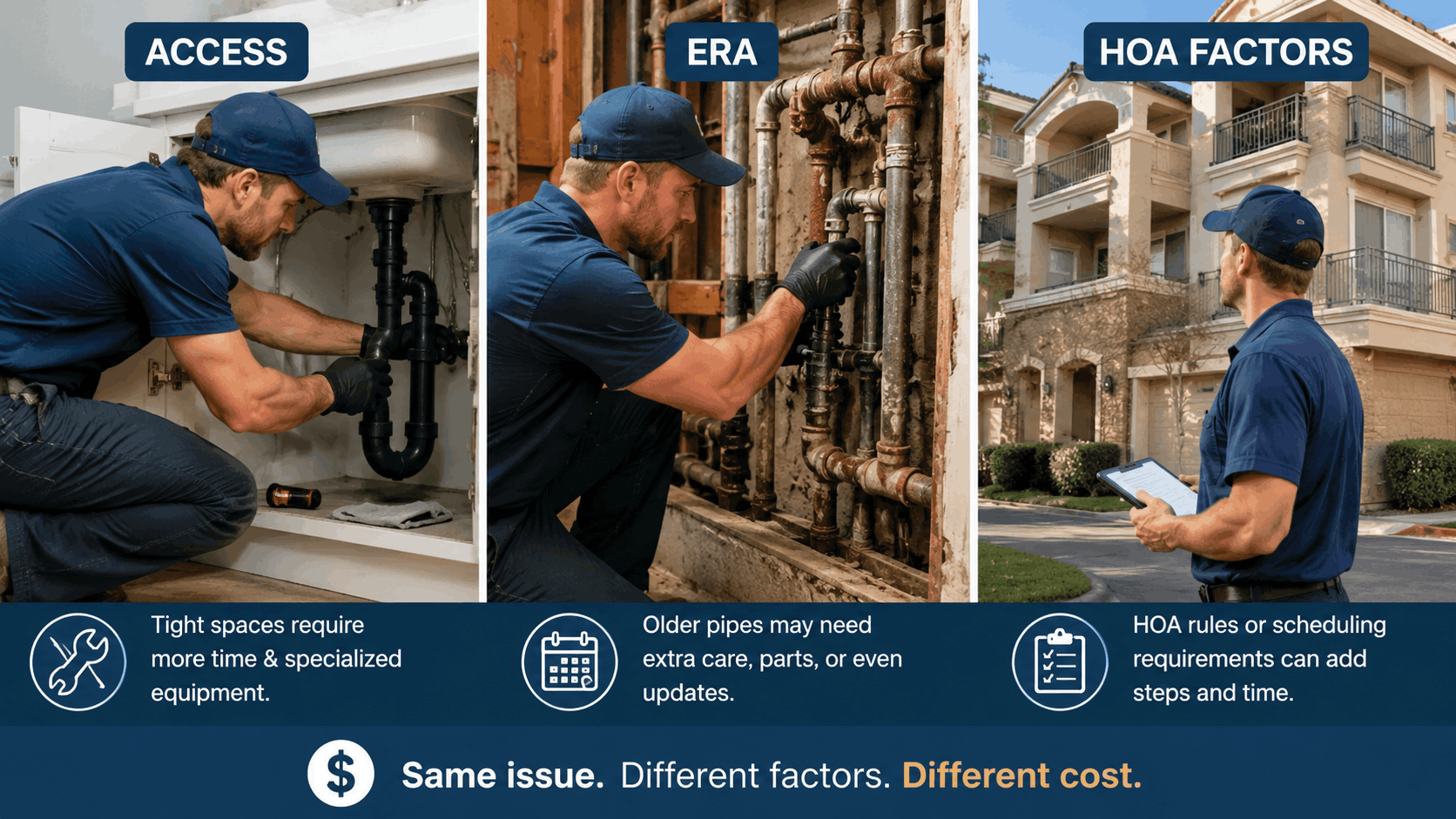
Three things explain most of the price gap: how hard it is to reach the problem, how old the home is, and what rules the HOA puts in the way. This guide breaks down each one so you can understand your own bill before it ever lands in your hands, whether you are near downtown, in Henderson, or way out in Centennial Hills.
The Truth About Plumbing Price Differences in the Valley
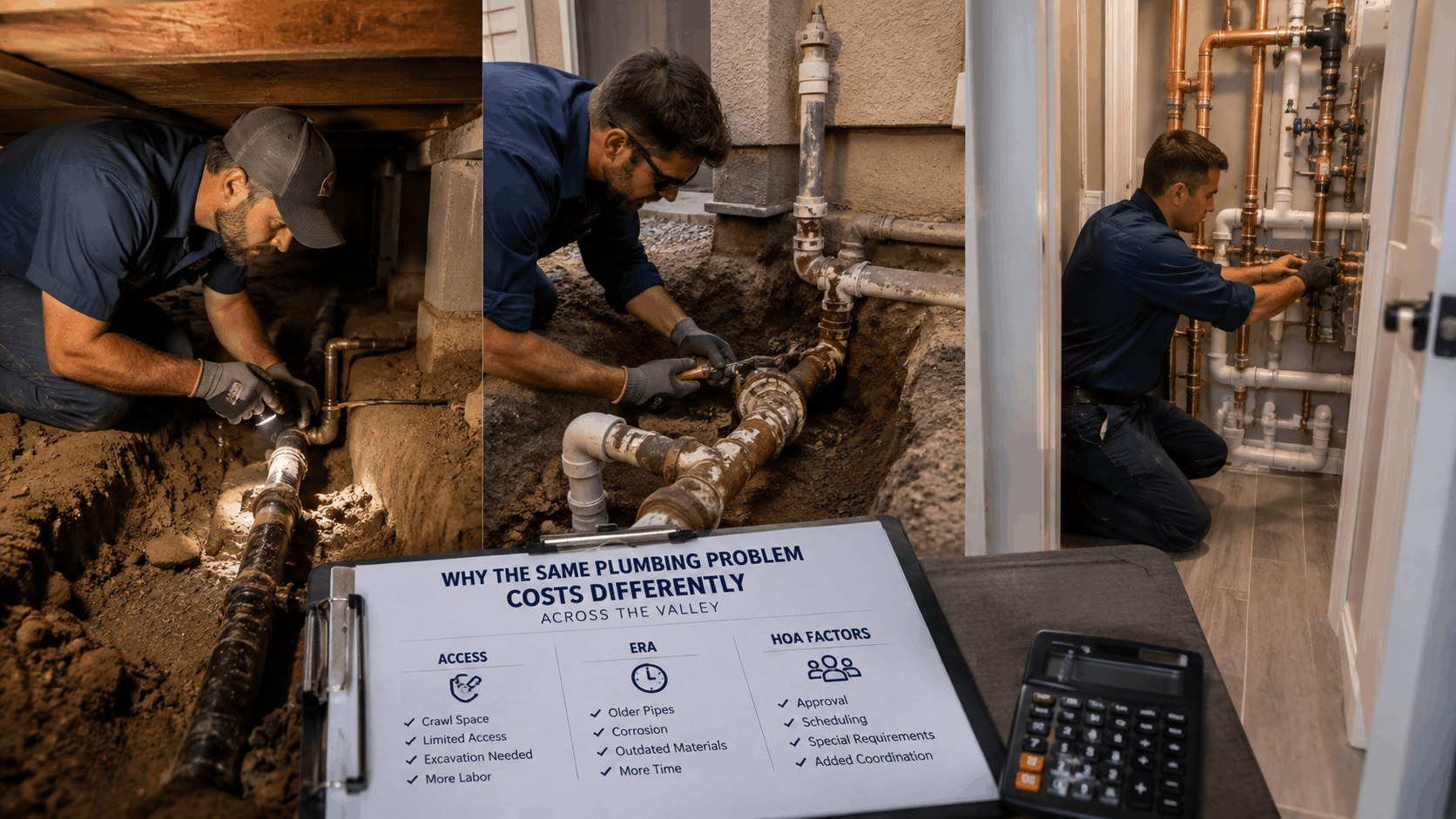
Plumbing prices are not pulled out of thin air. When the same repair costs different amounts across town, real physical factors are usually behind it. A plumber is not guessing - they are pricing the actual work in front of them.
The plumbing cost in Las Vegas for any given job comes down to three big drivers we see over and over: access, the era the home was built, and HOA requirements. Layer the Valley's hard water and desert climate on top, and you get a wide range of price factors that can make the same repair swing by hundreds of dollars.
| Cost Driver | What It Affects | Typical Impact |
|---|---|---|
| Access | Labor time to reach the pipe or fixture | Low to high |
| Home era | Pipe material and repair difficulty | Moderate to high |
| HOA rules | Approvals, restoration, scheduling | Low to moderate |
| Water and climate | Wear, buildup, failure frequency | Ongoing |
Why Two Neighbors Get Two Different Quotes
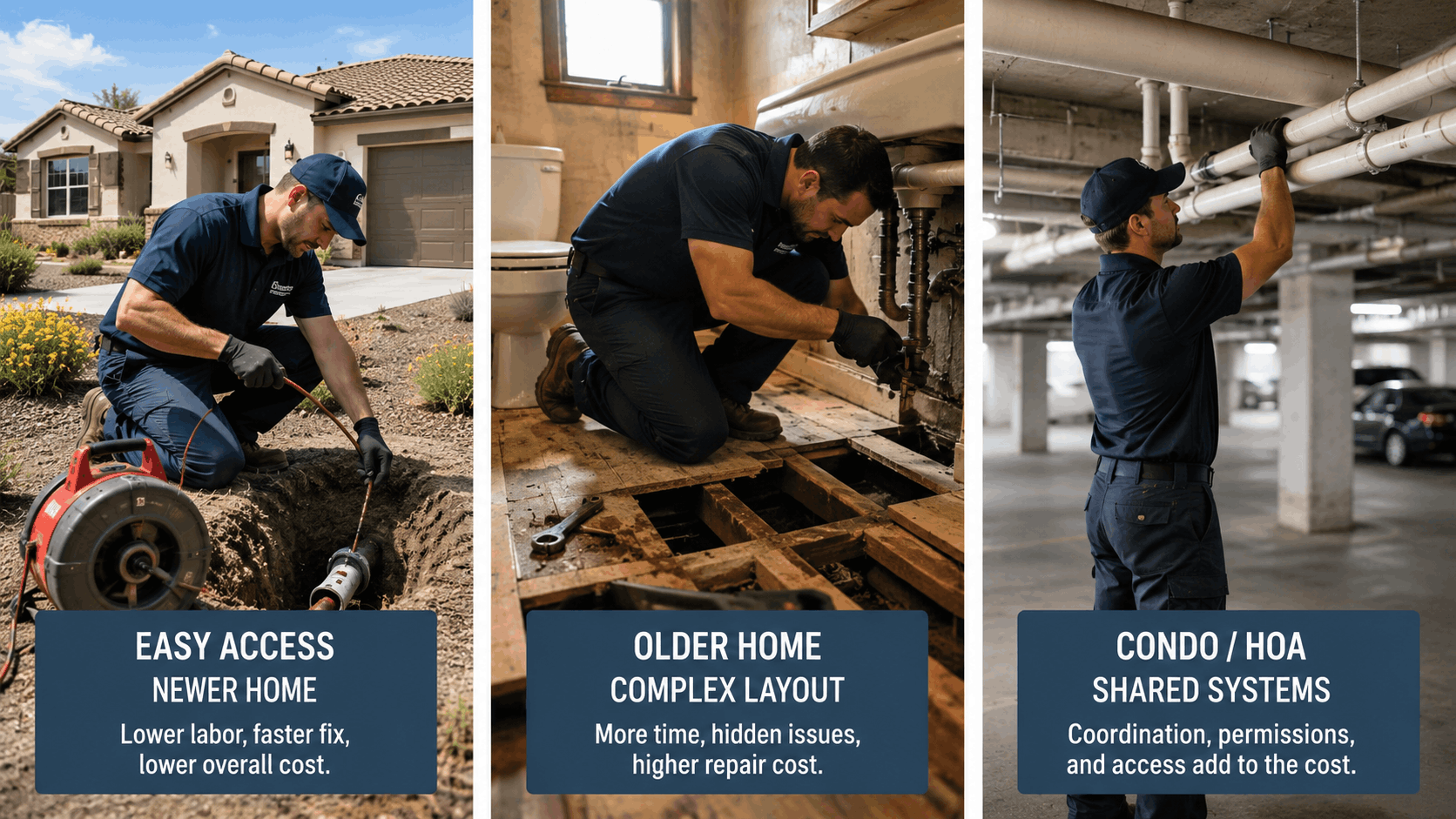
Picture two nearly identical homes a mile apart, both built by the same developer. One has a cleanout right by the driveway. The other buried its cleanout under a rock bed and a mature mesquite tree years ago. The plumbing quote for the same drain job on those two homes will not match, because one requires digging and the other does not.
We see this neighbor comparison play out all the time between streets in Spring Valley and Paradise. A shutoff valve that turns easily saves twenty minutes. A corroded one that snaps off turns a quick fixture swap into a repair job. The house next door might have newer valves and skip that headache entirely.
Layout matters too. A first-floor bathroom over a garage is easy to reach from below. The same bathroom on a second floor with tile everywhere means opening walls or floors to get to the leak. Two homes, same age, very different labor.
None of this shows up in a phone estimate. That is why a real quote needs eyes on the actual home, not just an address and a description.
What Actually Goes Into a Plumbing Estimate
A plumbing estimate is built from a few clear parts. Labor cost is usually the biggest piece, and it tracks directly with how long the job takes. The harder the access, the more hours on the clock.
Parts are the next piece. A basic faucet cartridge costs little. A full water heater, expansion tank, and updated venting costs far more. The material your home already has can force certain parts too, especially in older builds.
Access time is its own line even when people forget it exists. Crawling through a hot attic, cutting drywall, or trenching through a rock yard all add hours before the actual repair even starts. That time is real work and it belongs in the price.
Permits and code updates round it out. Some jobs, like a water heater or gas line change, require a permit and inspection through the local building department. That step protects the homeowner but adds cost and time to the final number.
How Active Plumbing Prices Jobs Across Las Vegas
Our team does not throw out a flat guess over the phone and hope it sticks. We walk the home first, look at the actual pipe, check the access path, and note the age and material of what we are working on. That is how a quote stays honest.
A written price means you hear the number before we start, not after. If reaching a slab leak means we can either spot-repair it or reroute the line, we explain both options and what each costs so you decide with full information.
We work across the whole Las Vegas Valley, from older homes near downtown to newer builds in the master-planned communities. Because we know these neighborhoods, we can often spot the likely pipe material and access issues before we even open anything up.
That local knowledge keeps surprises down. When we quote a home in Henderson versus one in North Las Vegas, we already have a strong sense of what is behind the walls based on when and how the area was built.
Get Your Quote
Tell us what's going on and we'll get back to you. We're open 24/7.
Access: How Getting to the Problem Changes the Bill
The single biggest reason two identical repairs cost different amounts is plumbing access. If a plumber can reach the pipe in five minutes, you pay for a short job. If they need to crawl, cut, or dig to get there, the clock runs longer and the bill grows.
The Valley has its own access quirks. Most homes sit on a slab, many have tight attics, and desert landscaping loves to hide cleanouts. Here is how each one plays out.
Slab-on-Grade Homes vs. Raised Foundations
Most homes across the Las Vegas Valley are built slab-on-grade, meaning the concrete floor sits right on the ground with pipes running through or under it. That foundation type is common because it works well in our dry, flat desert soil.
The trade-off shows up with a slab leak. When a water line under the concrete fails, reaching it is not simple. A plumber may need to jackhammer through flooring and slab, or reroute the line entirely to avoid tearing up your home.
Homes with a raised foundation or a real crawl space are rarer here, but they exist in some older pockets. When they do, a leak underneath is far easier to reach because a tech can get under the house instead of through it.
That single difference can move a repair from a few hundred dollars to a few thousand. The leak is the same size either way. The path to it is what drives the number.
Tight Attics, Cramped Closets, and Two-Story Access
Second-floor bathrooms are common in a two-story home, and they add real time to any repair. A leak up there often means working from above through the attic or from below through a first-floor ceiling. Neither is quick.
Attic plumbing brings its own challenge in the summer, when temperatures up there can top 130 degrees. We schedule those jobs early in the day when we can, but the heat still slows the work and demands breaks for safety.
Utility closets packed with a water heater, softener, and storage shelving are another time sink. Before we touch the actual repair, we sometimes have to empty and maneuver around everything crammed in there.
All of that is labor. A ground-floor fixture in an open garage might take an hour. The same job squeezed into a hot attic closet on the second floor can easily double.
Landscaping, Rock Yards, and Buried Cleanouts
Desert landscaping looks great and saves water, but it can bury the exact access points a plumber needs. Rock beds, pavers, and decorative boulders often sit right on top of a sewer cleanout or a main shutoff.
When a main line backs up at a home off Blue Diamond or in North Las Vegas, the first step is finding and reaching the cleanout. If it is under six inches of rock and a layer of weed barrier, that is digging time before any drain work begins.
Some older yards never had an accessible cleanout installed at all. In those cases, our drain and sewer team may need to pull a toilet or dig to reach the line, which adds cost compared to a home with a clean, open access point.
Mature trees make it worse. Roots love sewer lines, and a root-choked pipe under a big desert tree means both digging and root removal. Two homes with the same clog can price very differently based on what is planted on top of the line.
Wall Access and Finish Restoration Costs
Sometimes the pipe is behind a wall, and there is no way around opening it up. Wall access means cutting drywall or removing tile to expose the plumbing, then putting it all back after.
The finish makes a huge difference. Cutting a hole in painted drywall and patching it is cheap and fast. Cutting into a custom tile shower surround to reach a valve is a different story entirely.
Drywall repair after the plumbing is done adds its own cost, and matching tile or stone can run higher than the plumbing itself. That is why a leak behind a fancy bathroom wall costs more than the same leak behind a plain hallway wall.
We always point out when restoration is coming so the full picture is clear. The plumbing fix might be simple, but the work to reach it and close it back up is where the real money often goes.
Need Help in Las Vegas?
Active Plumbing serves Las Vegas and all of Las Vegas Valley.
The Era of Your Home: Why Age Drives Price
The decade your home was built tells us a lot before we ever look at a pipe. Home age plumbing shapes the pipe material, the layout, and how tricky a repair will be. Las Vegas construction has changed a lot over the years, and each era left its own signature behind the walls.
Knowing your build year helps everyone. It gives us a head start on what we will find and helps you understand why an older home can cost more to service than a newer one.
Older Homes Near Downtown and the Historic Neighborhoods
Homes in the older parts of town, like the John S. Park area, Huntridge, and pockets of the Arts District, often still carry their original plumbing. That usually means galvanized pipe for water and cast iron for drains.
Galvanized pipe corrodes from the inside out over decades. It narrows, rusts, and drops water pressure long before it fully fails. When we open a wall in an older Arts District home, we often find pipe so scaled up that a simple repair turns into a section replacement.
Cast iron drains have a similar story. They rust, crack, and develop rough interiors that catch debris, so a clog in an old cast iron line is rarely a one-time fix. The material itself is fragile after 60 or 70 years.
All of this raises repair costs in the historic neighborhoods. The charm of these homes is real, but so is the aging plumbing hiding behind the plaster.
1980s and 1990s Builds and Polybutylene Piping
Some homes built from the late 1970s through the mid 1990s were plumbed with polybutylene, a gray plastic pipe that was cheap and popular at the time. We still find it in parts of Green Valley and Spring Valley.
The problem is that polybutylene can fail without warning. It reacts poorly to chlorine in the water supply over time and can crack or split at the fittings, leading to leaks that seem to come from nowhere.
Once one section fails, more failures often follow. That is why a leak in a polybutylene home sometimes leads to a repiping conversation rather than a single patch. Full repiping is a bigger investment, but it ends the cycle of surprise leaks.
If you own a home from that era in Green Valley, it is worth confirming what pipe you have. Knowing early lets you plan for the cost instead of getting hit with an emergency down the road.
Newer Summerlin and Inspirada Homes
Newer master-planned communities like Summerlin and Inspirada were built with modern materials, mostly PEX piping and copper. PEX is flexible plastic tubing that resists scale and handles our water well.
These materials make many repairs simpler and cheaper. PEX has fewer fittings hidden in walls, and when a repair is needed, the connections are quick to work with. A fixture swap in a newer Summerlin West home usually goes fast.
Layout helps too. Newer homes tend to have accessible shutoffs, labeled valves, and cleanouts placed where a plumber can actually reach them. That thoughtful design cuts labor on almost every job.
It does not mean newer homes never have problems. But when they do, the modern plumbing generally keeps the repair straightforward and the bill lower than an equivalent job in an older build.
Hard Water and How Age Compounds Buildup
The Valley's hard water is tough on plumbing no matter the age, but older pipes suffer most. Minerals in the water leave scale buildup that slowly narrows pipes and coats the inside of fixtures and water heaters.
In an older home, that scale layers on top of existing corrosion. A water heater that should last a decade might fail years early because sediment builds up on the bottom and the element works harder.
We see this compounding effect constantly. A pipe that was fine at 20 years old becomes a repair risk at 30 because decades of hard water have thinned and clogged it from the inside.
Treating the water helps slow this down. A water softener reduces the scale that ages your plumbing quicker, which is one reason many Valley homeowners install one.
HOA Rules: The Hidden Cost Multiplier
HOA plumbing rules are the factor most homeowners forget until they are in the middle of a job. In a master-planned community, the association can add steps, approvals, and standards that raise both the time and cost of a repair.
None of it is meant to punish you. HOAs protect property values and shared systems. But those protections come with process, and process costs money.
Approval Requirements Before Exterior Work
Many HOAs in Summerlin and Anthem require written approval before any exterior work begins. If a sewer repair means trenching across the front yard, the association may want to sign off first.
That HOA approval step can add days to a project. For a non-emergency, you might wait for a board review before a shovel touches the ground. For exterior work, that waiting period is real and worth planning around.
Emergencies get handled quicker, of course. If a pipe bursts, our emergency plumbing team responds first and sorts the paperwork after. But planned exterior repairs almost always run through the HOA.
The cost shows up in coordination time and sometimes in required contractor documentation. Knowing your HOA's rules before you schedule saves you from a stalled job halfway through.
Shared Walls and Multi-Unit Responsibility
Condos and townhomes bring a whole different question: who owns the pipe? In a shared-wall building near The District or in Green Valley Ranch, a leak might be the owner's responsibility, the HOA's, or split between them.
Condo plumbing lines often run between units, so a leak in your wall could originate from a neighbor's fixture. Figuring out where the problem starts and who pays takes time and sometimes a few phone calls before repair even begins.
The HOA's governing documents spell out the split, usually with a line between common elements and individual units. We help homeowners identify where their responsibility ends so they are not paying for something the association should cover.
This shared setup can raise costs when access to the source means entering a neighboring unit or a common area. More coordination means more labor, even for a small leak.
Restoration and Finish Standards
HOA standards often dictate how things must look after a repair. If we trench through a landscaped common area, the HOA may require restoration to a specific standard, using approved plants or matching rock.
That restoration cost can outpace the plumbing. Replacing generic gravel is cheap. Matching a specific decorative stone and irrigation layout to HOA spec is not.
Exterior finishes matter too. Some communities require that any surface disturbed during work be returned to its original look exactly, which means more materials and more careful labor on the back end.
We factor these standards into the quote when we know the community. It is far better to price the full restoration up front than to surprise a homeowner with an HOA compliance bill later.
Scheduling Delays and Access Windows
Gated communities add a scheduling layer. Getting a crew and equipment through a gate can require advance notice, a visitor pass, or a specific access window set by the community.
Some associations limit contractor work hours to certain times of day. That can stretch a one-day job across two days if the crew has to stop when the window closes.
For a job needing a plumber and a helper plus a jetting truck or excavation gear, coordinating all of that within a tight access window takes planning. That planning is labor time that affects the final cost.
We handle these communities regularly, so we know how to schedule around the gates and rules. Still, the extra steps are a real reason a job in a gated neighborhood can cost more than the same job in an open one.
Need Help in Las Vegas?
Active Plumbing serves Las Vegas and all of Las Vegas Valley.
How the Valley's Water and Climate Add to the Equation
Beyond access, era, and HOAs, the local environment quietly shapes plumbing costs across every neighborhood. Las Vegas water is hard, the summers are brutal, and the desert soil moves. All three wear on plumbing in ways that add up over time.
These factors do not change a single repair as sharply as access does, but they explain why certain problems keep coming back and why some areas see more of certain repairs.
Hard Water From the Colorado River Source
Most of the Valley's water comes from the Colorado River through Lake Mead, and it arrives mineral-heavy. The Las Vegas Valley Water District serves some of the hardest water in the country, loaded with calcium and magnesium.
That hard water leaves mineral buildup everywhere it flows. Faucets, showerheads, valves, and water heaters all collect scale that shortens their life and adds repair frequency across the whole Valley. You can read more about local water hardness from the Las Vegas Valley Water District.
Fixtures that might last a decade elsewhere sometimes need service sooner here. A cartridge gums up, a valve sticks, or an aerator clogs, all from mineral deposits building over time.
This is why we bring up water treatment so often. Reducing the mineral load protects fixtures and pipes and cuts down the small repairs that add up year after year.
Summer Heat and Pipe Stress
Valley summers regularly push past 110 degrees, and that heat stresses exposed plumbing. Exterior pipes and hose bibs on west-facing walls take direct afternoon sun for hours.
That summer heat causes expansion and contraction that wears fittings and seals over time. A hose bib on a sun-baked wall in Enterprise or Mountains Edge fails more often than one in the shade.
Attic pipe stress is real too. The extreme heat in an unconditioned attic speeds up wear on any lines running through it, which is one more reason attic repairs both cost more and come up more often.
Simple protection helps. Insulating exposed lines and covering hose bibs reduces the heat cycling that ages them, cutting future repair costs on the exterior of your home.
Ground Movement and Slab Leaks
The desert's expansive soil shifts as it dries out and takes on moisture. That slow ground movement can stress pipes running under a slab, and areas like Centennial Hills see their share of slab leaks as a result.
When soil moves under a home, a copper line buried in the slab can rub, wear, and eventually spring a pinhole leak. Because it is under concrete, you often notice it only through a warm spot on the floor or a jump in the water bill.
Detecting these leaks takes specialized tools. Our team uses electronic leak detection to pinpoint the spot without tearing up the whole floor, which keeps the repair as targeted as possible.
The soil conditions vary across the Valley, so some neighborhoods deal with slab leaks more than others. Where the ground moves more, these repairs show up more often and factor into local plumbing costs.
Common Repairs and Why Their Prices Swing
Now let us tie it all together with real repairs. The same job can carry very different prices once you factor in access, era, and HOA rules. Here is how the big three show up on the jobs we do most.
Water Heater Replacement
A water heater replacement is a great example of price swing. In a ground-floor garage in Spring Valley, a standard swap is a clean, half-day job with easy access and simple venting.
Put that same unit in an attic install, and the cost climbs. Hauling an old tank down from the attic and a new one up, in the heat, with tight clearances, adds hours and sometimes an extra tech.
Code updates shift the price too. Newer requirements may call for an expansion tank, updated venting, a drip pan, or a seismic strap that the old install never had. Our water heater team brings the unit up to current code, which adds parts but keeps you safe and legal.
Switching to a tankless unit changes the math again, with different venting and gas needs. The base repair is the same idea, but placement and code decide the final number.
Clogged Drains and Main Line Backups
A simple sink clog is cheap almost anywhere. A main line backup is where the cost spreads wide, and it comes down to access and pipe age.
If a home has an accessible cleanout right at the surface, drain cleaning is quick. Our tech runs a cable or jetter and clears the line. No cleanout, or one buried under rock, and we spend time just reaching the entry point.
Old cast iron lines complicate things. Their rough, corroded interiors catch debris and often need repeat clearing or a camera inspection to find the real problem. A smooth PVC line in a newer home clears easier and stays clear longer.
For stubborn or grease-filled lines, hydro jetting does the heavy lifting. The clog might sound the same over the phone, but the cleanout access and the pipe material decide the price.
Slab Leak Detection and Repair
A slab leak carries one of the widest price ranges of any repair. The leak itself might be a tiny pinhole, but the fix depends entirely on the approach.
A spot repair means opening the floor and slab at one point to fix the leak directly. It is cheaper when the leak is easy to reach and the flooring above is simple to restore.
A reroute skips the slab entirely by running a new line through walls or the attic to bypass the bad section. It costs more up front but avoids repeated slab work if the old line is failing in multiple spots.
Detection is a cost of its own. Finding the exact leak under concrete takes electronic and acoustic tools before any repair starts. Two homes with the same leak can pay very differently depending on which repair path makes sense for their pipe and floor.
Fixture and Faucet Swaps
Swapping a faucet sounds like a fast, cheap job, and often it is. But older homes have a way of turning a quick faucet replacement into something bigger.
The culprit is usually the shutoff valve under the sink. In a newer home, it turns off cleanly and the swap takes 30 minutes. In an older home, a corroded shutoff valve can seize or crumble the moment you touch it.
When that happens, we have to replace the valve before finishing the faucet, which means shutting off water and adding a real repair to a simple swap. It is a common reason a quick job in a Huntridge or downtown home runs longer.
Supply lines and connections corrode the same way in older builds. Our pipe and fixture team checks these before starting so we can tell you up front whether it is a simple swap or a swap plus valve work.
Need Help in Las Vegas?
Active Plumbing serves Las Vegas and all of Las Vegas Valley.
How Homeowners Can Keep Costs Predictable
You cannot change your home's age or move your slab, but you can do plenty to keep plumbing costs from surprising you. A little prevention and a little knowledge go a long way toward smaller bills and more quickly jobs.
Here are the moves that make the biggest difference for Valley homeowners, from home maintenance habits to a few questions worth asking before work starts.
| Action | Why It Helps | Cost Impact |
|---|---|---|
| Know your pipe material and age | More accurate quotes, fewer surprises | Prevents overruns |
| Keep cleanouts and shutoffs clear | Cuts access labor time | Lowers labor cost |
| Treat hard water | Slows scale and corrosion | Fewer repairs over time |
| Confirm HOA rules early | Avoids delays and rework | Prevents rework cost |
Know Your Home's Pipe Material and Age
Learn what pipes your home has and roughly when it was built. If you have inspection reports or home records from your purchase, dig them out and note the pipe material and any past plumbing work.
This information lets us give a more accurate estimate from the start. If we know a home has polybutylene or galvanized pipe before we arrive, we plan for it instead of discovering it mid-job.
For older homes, a plumbing inspection is worth the small cost. It tells you what you are working with so you can budget for repiping or repairs before they become emergencies.
Keeping a simple folder of your home's plumbing history also helps the next owner. It turns guesswork into facts, and facts keep quotes tight.
Keep Cleanouts and Shutoffs Accessible
Access drives labor, so keeping your access points clear is one of the easiest ways to save. Find your main cleanout and your main shutoff valve, then make sure nothing blocks them.
Do not let rock beds, planters, or storage pile up over a cleanout. If landscaping already buried yours, consider having it raised to the surface so future drain work does not start with digging.
Inside, keep the area around your water heater and shutoff valves clear of stored boxes and clutter. When a plumber does not have to move your storage first, the job goes more quickly and cheaper.
Label your shutoffs while you are at it. In an emergency, knowing exactly where to cut the water can save your floors and cut the eventual repair bill.
Handle Hard Water Before It Damages Pipes
Since Valley water is so hard, treating it protects your whole system. A water softener or conditioner reduces the scale that clogs fixtures and shortens the life of your water heater.
Flushing your water heater once a year clears sediment before it builds into a problem. This simple hard water treatment step can add years to the unit and delay a costly replacement.
A salt-free conditioner is an option for homeowners who want scale protection without adding sodium. Either way, cutting the mineral load reduces the small repairs that pile up over the years.
Think of it as maintenance that pays for itself. Less scale means fewer stuck valves, longer-lasting fixtures, and lower repair frequency across the home.
Ask About HOA Rules Before Work Starts
If you live in a managed community, check your HOA rules before scheduling any exterior or shared-wall plumbing work. Knowing the approval process ahead of time keeps a job from stalling halfway through.
Ask whether pre-approval is needed for trenching, exterior repairs, or anything touching common areas. Request the restoration standards too, so the repair can be quoted and finished to spec the first time.
For condos and townhomes, confirm what the HOA covers versus what falls on you. That clarity prevents you from paying for something the association is responsible for.
We are happy to help you sort through these questions when we quote the job. A quick check up front beats a compliance surprise after the work is done.
Final Thoughts
The same plumbing problem really does cost different amounts across the Valley, and now you know why. Access decides how long the work takes, the era of your home decides what is behind the walls, and HOA rules add their own layer of steps and standards.
Layer in the Valley's hard water, brutal summers, and shifting soil, and it makes sense that a clog in a 1970s downtown home prices differently than the same clog in a newer Summerlin build. None of it is random.
The best thing you can do is know your home and keep your access points clear. When you are ready for a straight, upfront quote based on your actual home, reach out to Active Plumbing or give our team a call. We serve homes all across the Las Vegas Valley and will tell you exactly what your job takes before we start.

Frequently Asked Questions
- Why did my neighbor pay less for the same plumbing repair?
- Even identical homes can price differently. Your neighbor may have an accessible cleanout while yours is buried under rock, or their shutoff valves may be newer and easier to work with. Home age, pipe material, and HOA rules all create these gaps. The repair sounds the same, but the real conditions at each home decide the final labor and parts cost.
- How much does a water heater replacement cost in Las Vegas?
- A standard tank water heater replacement typically ranges from around $1,200 to $2,500 installed, depending on the unit and setup. Attic placement, code updates like an expansion tank or new venting, and switching to tankless all push the total higher. A garage install with easy access sits at the lower end, while a second-floor attic job costs more due to the added labor.
- Do older homes really cost more to plumb?
- Yes, generally they do. Older homes near downtown, Huntridge, and the John S. Park area often have galvanized steel water lines and cast iron drains. These materials corrode, narrow, and become fragile with age, so a simple repair can turn into a section replacement. The aging pipe plus tighter, older layouts adds both time and material cost compared to a newer home.
- What is polybutylene piping and why does it matter?
- Polybutylene is a gray plastic pipe used in many homes built from the late 1970s through the mid 1990s, including parts of Green Valley and Spring Valley. It can fail suddenly, cracking at fittings after years of exposure to chlorinated water. Because one failure often signals more to come, a leak in a polybutylene home may lead to a repiping recommendation rather than a single patch.
- Does my HOA need to approve plumbing work?
- Often yes, for exterior or shared work. Many HOAs in communities like Summerlin and Anthem require approval before trenching, exterior repairs, or work in common areas. Condos and townhomes also split responsibility between owner and association. Interior repairs inside your own unit usually do not need approval, but it is smart to confirm your community's rules before scheduling any outdoor or shared-wall job.
- Why is a slab leak so expensive to fix?
- Most Valley homes sit on a concrete slab, so a leak in a line under the floor is hard to reach. Finding it takes electronic detection tools, and the repair means either opening the slab for a spot fix or rerouting the line entirely. The pipe damage may be tiny, but the detection, access, flooring, and restoration work drive the cost up.
- How does Las Vegas hard water affect my plumbing?
- The Valley gets some of the hardest water in the country from the Colorado River. Its heavy calcium and magnesium leave scale buildup that clogs fixtures, sticks valves, and coats the inside of water heaters. Over time this shortens the life of your plumbing and adds small repairs. A water softener or yearly water heater flush helps slow the damage.
- Can I lower my plumbing repair cost?
- Yes, several ways. Keep your cleanouts and shutoff valves clear of landscaping and storage so techs spend less time on access. Know your pipe material and age for accurate quotes. Treat hard water and flush your water heater yearly to cut future repairs. Confirming HOA rules early also prevents costly delays and rework on exterior jobs.
- Do you provide upfront quotes before starting work?
- Yes. Our team walks the home, checks the actual pipe, access path, and material, then gives you a clear price before any work begins. We do not throw out a flat phone guess and hope it holds. If there are repair options, like a spot fix versus a reroute, we explain each one and its cost so you can decide with full information.
- Which Las Vegas Valley areas does Active Plumbing serve?
- We work across the whole Valley, including Summerlin, Henderson, Spring Valley, Enterprise, Paradise, Winchester, Whitney, Sunrise Manor, and North Las Vegas. That covers older neighborhoods near downtown and newer master-planned communities like Summerlin West and Mountains Edge. Because we know each area's construction era and common issues, we can quote and repair with real local knowledge behind us.
Licensed plumbing professionals serving Las Vegas and Las Vegas Valley.
Licensed in Nevada · License #0047021
Last updated on
Why trust Active Plumbing?
Founded in 1991, Active Plumbing is a licensed and insured plumber serving Las Vegas and Las Vegas Valley. All content is reviewed by our licensed technicians.

Need Help in Las Vegas?
Active Plumbing serves Las Vegas and all of Las Vegas Valley.
Related Articles
Commercial Plumbing Costs in Las Vegas: Office vs Restaurant vs Industrial
Commercial plumbing costs in Las Vegas vary by property type. See real price ranges for office, restaurant, and industrial work, plus what drives the gaps.

Does Emergency Plumbing Cost More in Las Vegas?
Yes, emergency plumbing costs more in Las Vegas. Learn why, see real price ranges, and discover how to avoid costly after-hours calls across the valley.
Plumber in Green Valley Henderson: Service Costs and Response Times for Sun City Anthem Area
Real plumbing service costs, response times, and local conditions for Sun City Anthem, Green Valley, and the wider Henderson area from Active Plumbing.