Pool and Spa Plumbing on Southern Highlands Lots, and Where It Ties Into the House
Key Takeaways
- Pool and spa plumbing ties into the house at three points: the gas supply from Southwest Gas, the potable water fill line through a backflow assembly, and an approved drainage path for backwash.
- On estate lots in the gated enclaves, the gas line must be sized to the whole load of the heater, spa, outdoor kitchen and fire features together, or the equipment underperforms.
- Southern Highlands climbs the slopes below the Spring Mountains, so pressure runs high on lower streets and lower on higher lots; the regulator gets checked first.
- The valley's water is 280 ppm, about 16 grains per gallon, categorized very hard, so scale builds in pool and spa heaters and treatment plus flushing extend equipment life.
- Homes are slab-on-grade on graded cut-and-fill slopes, and caliche makes trenching slower and dearer, so under-slab leaks often favor rerouting over breaking the slab.
- Southern Highlands is unincorporated Enterprise, so permits run through Clark County while the master association's architectural standards under NRS 116 cover exterior equipment as a separate track.
- On large lots a slow leak can run for weeks and show first as an unexplained water bill, which is why exterior and electronic leak detection matter here.
- Active Plumbing holds Nevada license NSCB #0047021, verifiable at nvcontractorsboard.com, has worked the valley since 1991, gives a written price before work, and arrives in 30 to 60 minutes.
In This Article
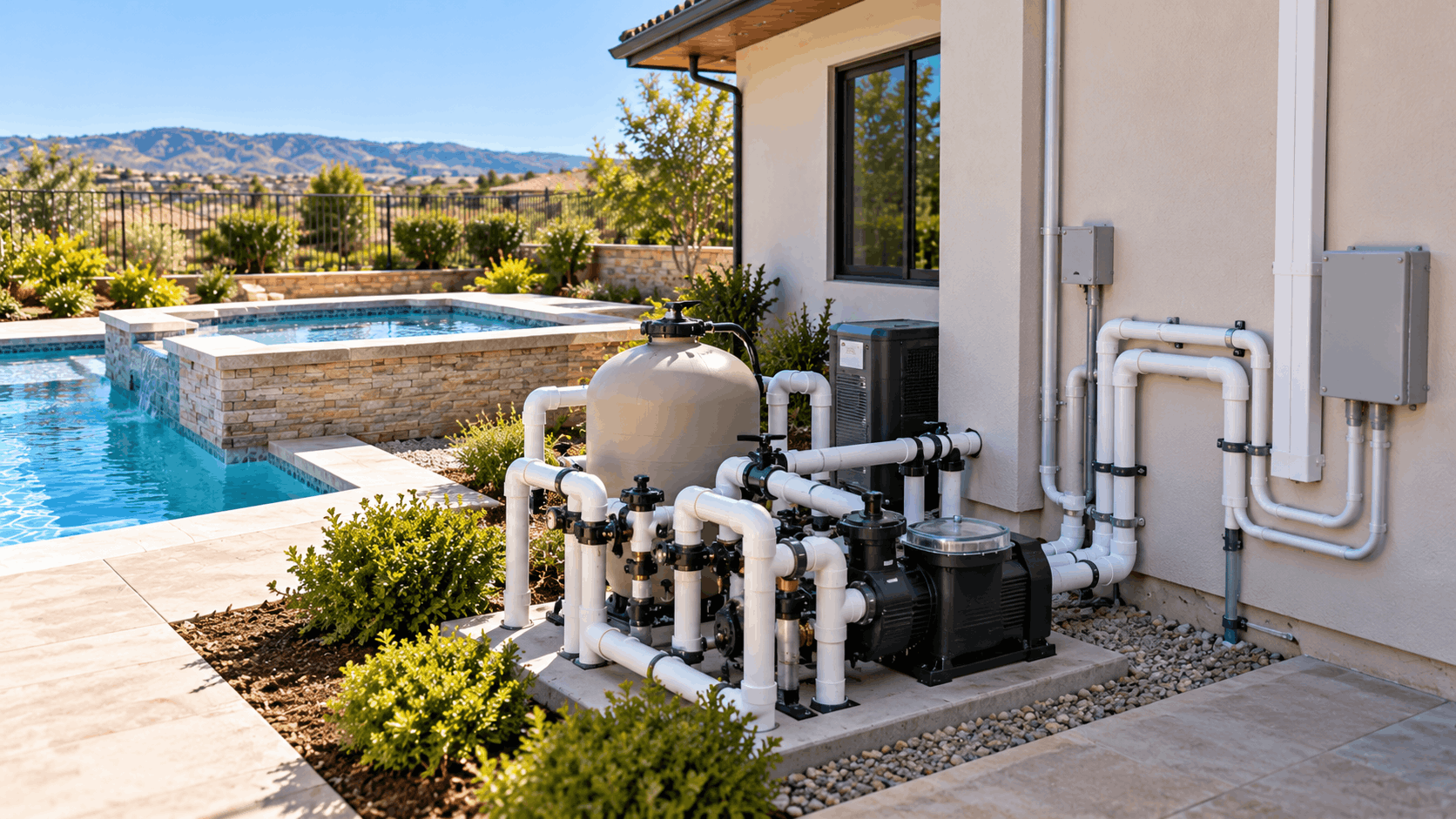
A pool or spa on a Southern Highlands lot is never a standalone system. It draws gas from the home's supply, pulls water from the same potable line that feeds the kitchen and bathrooms, and sends backwash and drain water to an approved path. Every one of those connections ties back into the house, and that tie-in is where most of the real work lives.
This community runs from flat production tract streets up onto the slopes below the Spring Mountains, so the same question gets a different answer depending on where the house sits. A fire feature on a guard-gated estate off Southern Highlands Parkway has a gas load nothing like a single pool heater on a twenty-year-old tract home near Frias Elementary. Pressure changes with elevation. Heaters scale from the valley's very hard water. The slab and the caliche under it decide what a repair costs.
How Pool and Spa Plumbing Connects Back to the House?
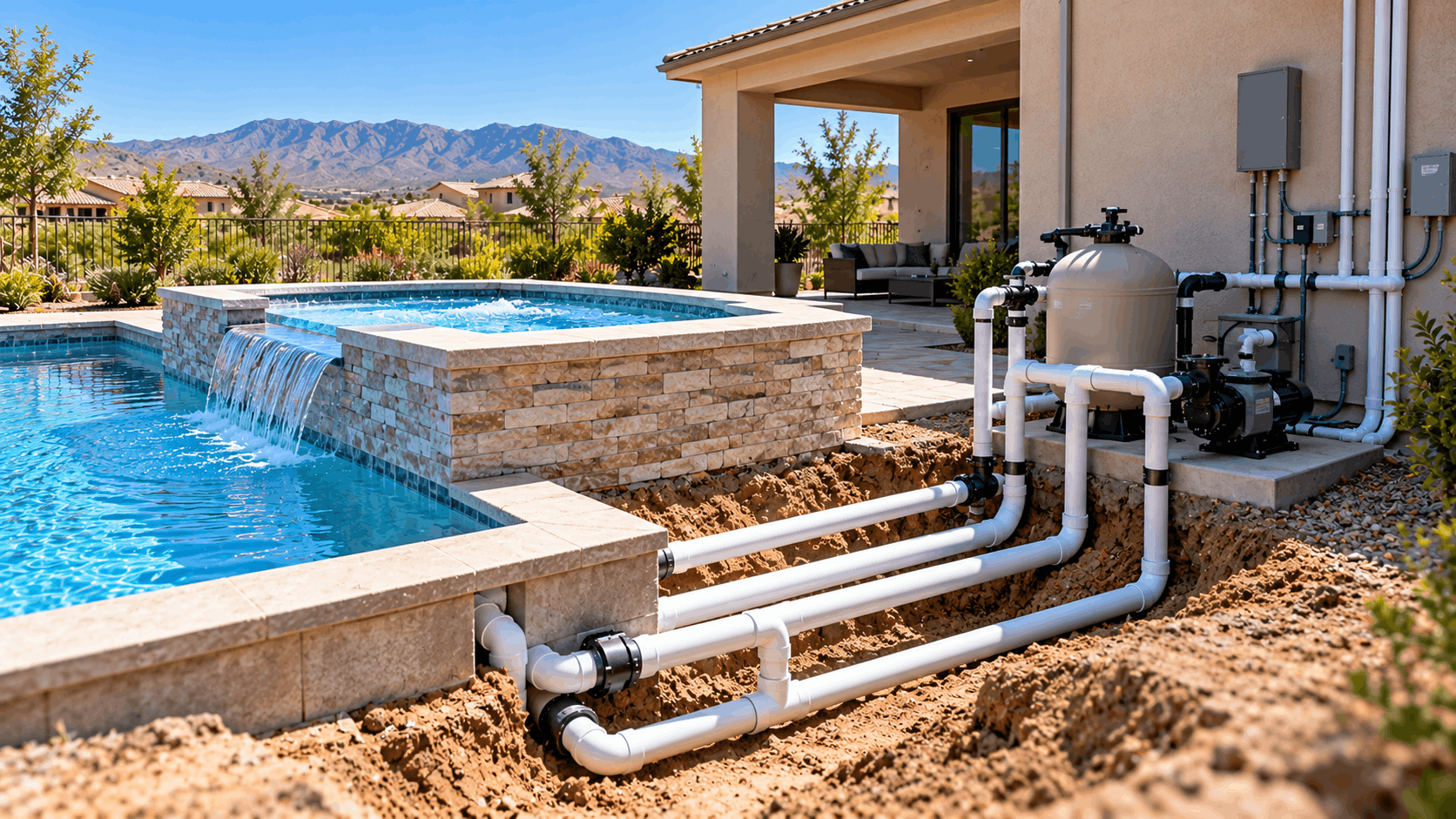
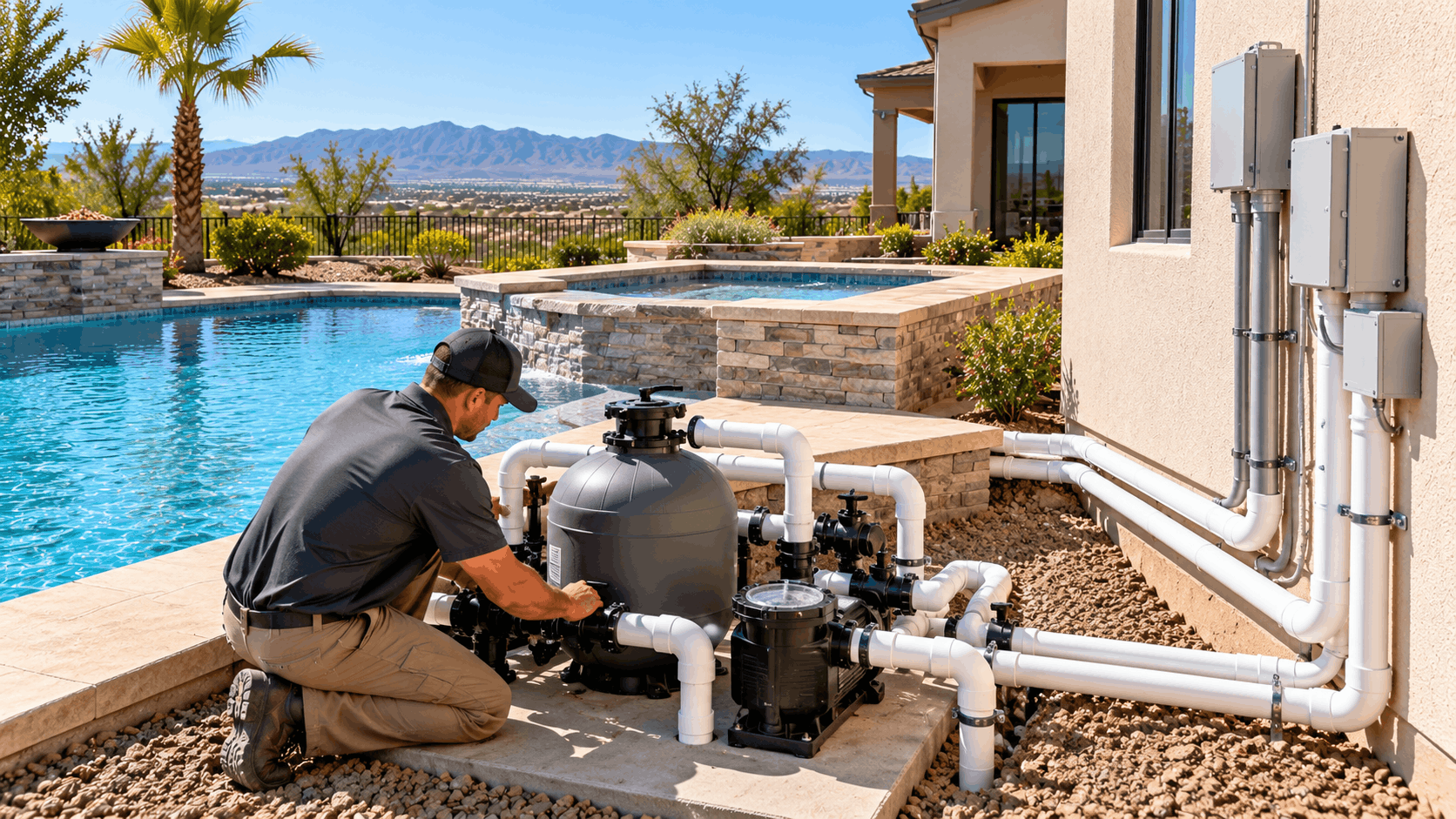
The pool and spa are the visible part, but the plumbing that makes them work reaches into systems the house already has. There are three main tie-in points, and each one answers to a different set of rules. Understanding those three before any work starts keeps a job from becoming a surprise halfway through.
The first is gas. Pool heaters, spa heaters and fire features all burn gas supplied through the home's system. The second is the potable water fill line, where the pool takes its water from the same supply that feeds the house. The third is drainage, where filter backwash and pool drain water have to reach an approved point without crossing paths with drinking water or the storm system.
Here is how the three tie-ins compare on a typical Southern Highlands lot.
| Tie-In Point | What It Connects To | Main Concern |
|---|---|---|
| Gas supply | Home gas system from Southwest Gas | Line sized to carry the heater load alongside the house |
| Potable fill line | Home drinking water supply | Backflow prevention so pool water cannot flow back |
| Drainage | Approved sewer or disposal point | No rain, surface or subsurface water to the sewer |
Get any one of these wrong and the problem usually shows up later, as an underperforming heater, a failed backflow test, or a drainage path that an inspector rejects. Treating all three as part of one connected system is how good pipe and fixture work gets planned.
The Gas Line Feeding the Heater
Natural gas in the Las Vegas Valley comes from Southwest Gas, and that is the supply a pool heater, spa heater or fire feature draws on. The equipment pad usually sits at the back of the lot, which means a long run from the gas meter at the side of the house. That run has to carry the new load without starving anything the house already uses.
On a tract home, the back-yard gas line might feed just a pool heater, and the demand is modest. The further the pad sits from the meter, the more that distance matters, because pressure drops along a run and a long line of the wrong size cannot deliver full demand at the far end. That is why the distance from the meter to the pad is part of the sizing math, not an afterthought.
When the heater and the house both draw at once, the shared line sees the combined demand. A line that was fine for the house alone can fall short once a pool heater taps in downstream. Checking the existing line capacity before adding equipment is how we avoid installing a heater that never quite performs. Our gas line work in Southern Highlands starts with that review.
The Potable Water Fill and Auto-Fill Line
The pool gets its water from the same potable supply that feeds the house, most often through an auto-fill valve that tops the pool off as water evaporates in the summer heat. That connection is convenient, but it crosses two systems that are supposed to stay separate: drinking water going one way and pool water that should never go the other.
That is why a backflow prevention assembly matters on a pool fill line. If pressure in the house supply ever drops, water can try to flow backward, and without a backflow assembly pool water with its chemicals could be pulled back toward the drinking supply. The assembly stops that reverse flow and keeps the two systems one-directional.
Backflow prevention and cross-connection control are run by the water provider, not the building department, and the right assembly for a pool fill is tested by a certified tester at installation and at least annually after that. An auto-fill valve that runs unseen on a large lot also makes a quiet leak easy to miss, which ties this connection to the leak detection work covered later.
Where Backwash and Drainage Go
Filter backwash and pool drain water are the part owners think about least and inspectors think about most. When a sand or DE filter backwashes, it pushes a volume of water out, and that water has to reach an approved point. The same goes for draining the pool for service. It cannot just run across the yard or into a storm drain.
Under the Southern Nevada Amendments to the Uniform Plumbing Code, rain, surface and subsurface water are prohibited from the sewer, and combined storm and sewer systems are not allowed in Southern Nevada. That means the drainage path for backwash is a design decision with rules behind it, not a guess made on the day. The approved point depends on the property and the provider.
Getting drainage right protects the house and the system. A backwash line that dumps against the slab, or one routed somewhere it should not go, creates both a code problem and a water problem in a community already built on graded ground. Planning the drainage side with the gas and fill connections, rather than after them, keeps the whole tie-in clean.
Get Your Quote
Tell us what's going on and we'll get back to you. We're open 24/7.
Gas Sizing on Estate Lots in the Gated Enclaves
On the larger Southern Highlands custom estates in the guard-gated enclaves, one gas run rarely feeds one thing. A single back-yard line might serve a pool heater, a spa heater, an outdoor kitchen and a set of fire features, all tapping the same supply. That changes the sizing problem completely.
The common mistake on properties of this type is sizing the line to the appliance in front of you rather than to everything that will run on it. A line that carries a pool heater fine on its own can fall short the moment the outdoor cooktop and a fire bowl light up at the same time. The fix is to calculate the whole load up front.
Here is how the demand stacks on a typical estate back-yard run.
| Equipment | Draws From | Sizing Note |
|---|---|---|
| Pool heater | Back-yard gas run | Often the largest single draw |
| Spa heater | Same run | Adds to combined demand |
| Outdoor kitchen | Same run | Cooktop and grill burners |
| Fire features | Same run | Each bowl or feature adds load |
Every new appliance changes the math, which is why adding a fire feature later can leave the whole run short if it was sized tight the first time. Planning for the full load, including what the owner might add, is the difference between a system that performs and one that frustrates.
Sizing to the Whole Load, Not One Appliance
Gas demand works like water pressure in a pipe. A line has a finite capacity, and when several appliances draw at once, they share it. Size the line to one appliance and the others pull against it, so the total available gas gets divided among demands the line was never built to carry together.
The telltale sign of an undersized run is not a dramatic failure. It shows up as an appliance that underperforms, a pool heater that struggles to reach temperature, a burner that runs low, a fire feature that will not hold a full flame. Owners often blame the appliance itself, when the real issue is a line that cannot deliver full demand under combined load.
That is why a proper load calculation looks at everything on the run together. Pool heat, a fire feature and an outdoor burner running at the same time will starve each other on a short or undersized line. Measuring the combined demand and sizing the line to it is the only way to get full performance from every piece of equipment, and our gas line services start there.
Fire Features and Outdoor Kitchens on the Same Run
On a guard-gated estate off Southern Highlands Parkway, the back yard can carry a serious collection of gas appliances. Fire bowls, an outdoor cooktop, a grill and the pool heater often tap the same back-yard gas run. Each one looked fine the day it went in, because it was probably added one at a time.
The problem builds as the list grows. Every new appliance changes the math on the shared line. A run sized for a pool heater and a grill may have no headroom left when fire features get added two years later, and nobody connects the new flicker in the heater's performance to the new fire bowls.
This is why we review the whole back-yard load before adding anything new, not just the appliance being installed. Where the existing run cannot carry the full set, upsizing or rerouting the line is the honest answer. Our gas line rerouting and upsizing handles exactly that situation on estate lots.
Gas Under the Slab Must Stay Serviceable
Southern Highlands homes are slab-on-grade, and some back-yard gas runs cross under the slab to reach the equipment pad. The Southern Nevada Amendments address this directly: gas piping under a slab must be removable without disturbing the slab, which means running it in a conduit or using a listed system built for the purpose.
The reason matters. A gas line cast straight into concrete cannot be inspected, replaced or repaired without breaking the slab, and on a finished estate that is an expensive, destructive job. Running the pipe through a conduit means it can be pulled and replaced later without touching the concrete above it.
Southern Nevada is also treated as a dry gas condition under the amendments, which shapes how these systems are built. For back-yard equipment on a slab-on-grade estate, getting the under-slab portion right at installation is what keeps a future repair from turning into demolition. Planning for serviceability up front is cheaper than earning it the hard way.
When to Call Southwest Gas First
Gas safety has one rule that comes before everything else. If anyone smells gas near the pool equipment or anywhere on the property, the first move is to leave the building. Avoid light switches and open flames on the way out, because a spark can ignite accumulated gas.
Once everyone is outside, call Southwest Gas from outside the building. Southwest Gas is the gas utility for the Las Vegas Valley, and they respond to suspected leaks. That call comes before calling a plumber, because the utility secures the supply first.
After the utility has made the situation safe, a licensed plumber handles the repair, the testing and the reconnection. We never ask a homeowner to chase down or cap a gas line themselves. Leave the building, call Southwest Gas, and let the right people handle the line.
Need Help in Las Vegas?
Active Plumbing serves Las Vegas and all of Las Vegas Valley.
Water Pressure Across the Southern Highlands Slopes
Southern Highlands climbs onto the slopes below the Spring Mountains, and that climb is the local technical story. Homes at different elevations on the same water system do not see the same pressure. A lot on the flatter ground near Cactus Avenue and a custom estate up on the higher streets can have very different incoming pressure, even though they share the system.
That difference reaches the pool directly. The auto-fill valve, the spa's jets and controls, and anything tied to the house supply all depend on incoming pressure being in the right range. Too high and the quiet damage adds up; too low and the fill trickles while upstairs fixtures suffer. The pressure regulator is the first thing to check, not the last.
Here is how pressure tends to behave across the community.
| Lot Position | Typical Pressure | What Shows Up |
|---|---|---|
| Lower streets | Can run high | Stressed connectors, auto-fill valve, equipment |
| Higher custom lots | Can run lower than expected | Weak upstairs fixtures, slow pool fill |
| Any lot | Set by the regulator | Regulator checked first on every call |
Checking incoming pressure takes about two minutes and explains more complaints in Southern Highlands than anywhere in the southwest valley. It comes before replacing a working fixture or a piece of equipment that is simply reacting to the pressure it is fed.
High Pressure on the Lower Streets
On the lower lots, incoming pressure can run high. High pressure is not an obvious problem day to day, which is exactly why it does damage nobody notices. It pushes constantly against every connector, angle stop, auto-fill valve and piece of equipment tied to the house supply.
A pressure regulator that has crept high over the years is the usual cause. These valves can drift, and when one sits too high it quietly shortens the life of everything downstream. The auto-fill valve on a pool works harder, connectors fatigue, and water heaters and fixtures take a steady beating they were not built to absorb.
The damage is cumulative rather than sudden. A connector that would last years on correct pressure fails early on high pressure. Because nothing dramatic happens at first, owners often replace failed parts one by one without ever checking the regulator that caused the failures. Testing and resetting the regulator addresses the root instead of the symptom.
Lower Pressure on the Higher Custom Lots
On the higher gated lots, the opposite happens. Pressure can be lower than an owner expects, and the complaint changes. Instead of quiet damage, the owner notices weak flow, usually at upstairs fixtures in a two-story house and at a pool fill that trickles rather than fills.
This is a function of elevation, not a fault in the equipment. The higher a home sits on the system, the lower the pressure it tends to see at the fixtures. An owner who assumes the fixtures are failing may replace them and see no improvement, because the fixtures were working correctly all along.
Where a house sits high on the system and genuinely needs more pressure, a pressure-boosting arrangement is sometimes the honest answer rather than replacing fixtures that are fine. Confirming the pressure reading first tells us whether the fix is a boost or something else entirely, which saves an owner from paying for the wrong repair.
Why the Regulator Gets Checked First Here
In a community that climbs the way Southern Highlands does, the pressure regulator is the diagnostic starting point. A high regulator and a low regulator produce two different complaints, and both trace back to the same two-minute test. Skipping that test is how a plumber ends up replacing parts that were never the problem.
Checking incoming pressure is fast and it is revealing. It tells us whether a failing connector is a victim of high pressure, whether a trickling pool fill is a low-pressure issue or a blockage, and whether the fixture an owner wants replaced is actually at fault. That read shapes everything that follows.
Because pressure explains more complaints in Southern Highlands than anywhere in the southwest valley, we check it before we touch a working fixture or piece of equipment. It is the cheapest, fastest piece of information on the job, and it keeps the repair aimed at the real cause.
Very Hard Water Through Pool and Spa Heaters
The Southern Nevada Water Authority states the valley's water is 280 parts per million, or 16 grains per gallon, categorized very hard. That figure does not stop at the house. The same water fills the pool and spa and runs through their heaters, and very hard water deposits calcium and magnesium scale wherever it goes.
In a pool or spa heater, that scale builds on the heater elements and inside the heat exchanger, the narrow passage where water gets heated. Scale narrows that passage and insulates the heating surface, so the heater has to work harder to deliver the same result. Over time it fails earlier than its rated life because it has been fighting scale the whole way.
Treatment and regular flushing are the responses that extend equipment life here. They are not luxuries on a valley this hard; they are the maintenance that keeps an expensive heater reaching its rated life instead of falling short of it.
Scale in Heaters and Heat Exchangers
Calcium and magnesium are dissolved in the water, and when water is heated those minerals come out of solution and deposit as scale. On a pool or spa heater, scale forms on the heating elements and along the walls of the heat exchanger, the narrow path the water travels while it warms.
That narrow path is where scale does the most harm. A heat exchanger is designed to move heat efficiently into flowing water, and a scale layer insulates the surface and restricts the flow. The heater burns more gas to reach temperature, runs longer cycles, and carries more thermal stress than its design intended.
The result is a heater that works harder and fails earlier than its rated life. It does not fail on a schedule, but it fails sooner than a heater fed softer water would. Flushing and descaling remove the buildup before it compounds, which is why that maintenance belongs on a very hard water valley like this one.
Recirculation Running Across a Long Estate Footprint
Custom estates in the gated enclaves often have long hot water runs with recirculation running continuously across a large footprint. That design keeps hot water quick to arrive at distant fixtures, but it also keeps hard water moving through the whole system constantly, which means scale has more surface and more hours to accumulate.
On an estate with multiple heaters and a continuous recirculation loop, scale does not build in one place. It builds across the loop, in each heater, and along the piping that carries hot water around the property. The larger the footprint, the more surface there is for calcium to settle on.
This is why the custom-home scope described in these enclaves comes with more maintenance, not less. More heaters, longer runs and continuous recirculation all add up to more places scale can take hold. A recirculation pump installation on these properties is planned with that scale load in mind.
The Unused Softener Loop in the Garage
Many Southern Highlands homes of this era were plumbed with a stubbed softener loop in the garage. The builder ran the connections so a water softener could be installed later, then left the loop capped for the owner to finish. Plenty of owners never did.
An owner who has never connected that loop is running every appliance on untreated very hard water. The water heater, the fixtures, the auto-fill valve and anything tied to the house supply all see the full 280 ppm with no softening in between. The loop was put there for a reason, and leaving it unused means the whole house takes the hard water load.
Finding an unused loop in the garage is often the quickest path to protecting the system. The plumbing is already roughed in, so completing it is a cleaner job than starting from scratch. For owners who want to address hardness, that stubbed loop is where we usually begin.
Flushing and Treatment as Maintenance
Whole-house treatment and regular heater flushing are maintenance that protects an expensive system, not optional extras. In the tract housing they extend the life of a single water heater and keep fixtures and cartridges clear. In the estates they protect multiple heaters, a long recirculation loop and the pool and spa equipment tied to the supply.
Flushing clears the scale and sediment that settle in a heater before they insulate the surface and narrow the passages. Doing it on a schedule, rather than waiting for a performance problem, keeps a heater working at its rated capacity instead of fighting buildup. On a valley this hard, that schedule matters more than it would elsewhere.
Treatment addresses the cause by reducing the hardness reaching the equipment in the first place. A whole-house water treatment setup paired with regular flushing gives both the pool and spa heaters and the home's own equipment the best shot at a full service life. Across tract and estate homes alike, it is the honest response to the water here.
Slab, Slope and Caliche on Back-Yard Lines
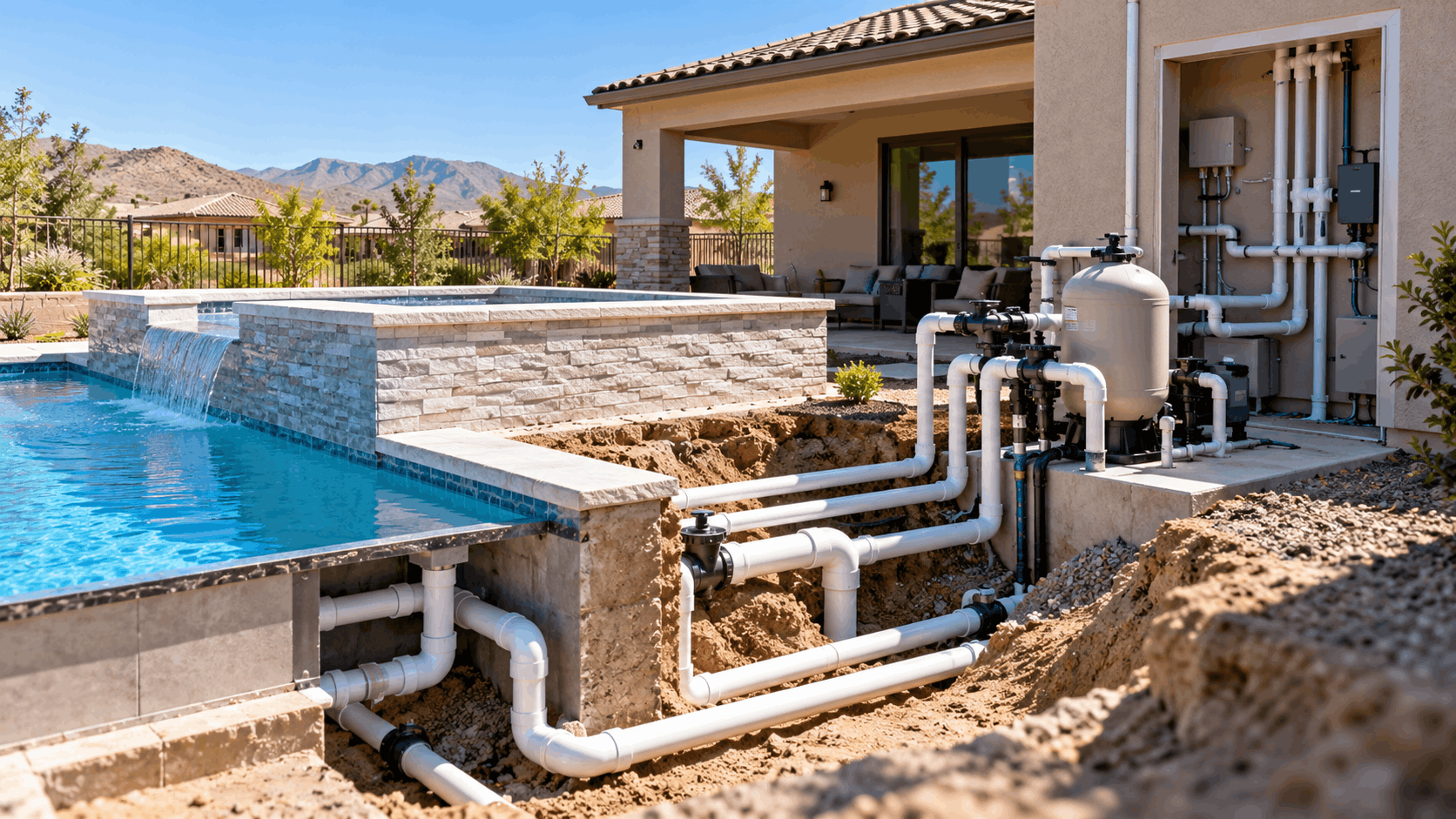
Pool and spa plumbing runs through the back yard, and in Southern Highlands that back yard sits on graded slopes and cut-and-fill ground. The homes are slab-on-grade, and the lines that feed the equipment pad and the fill often run under slab or under hardscape. All of that shapes what a repair looks like when something goes wrong.
Three conditions drive the work here. The slab makes an under-slab line inaccessible without breaking concrete. The graded slopes mean settlement over decades can pull a line out of grade. And the caliche in the ground makes any trench slower and more expensive than it would be in softer soil.
None of these means a line is doomed. They mean the repair has to account for the ground it sits in, and the smart move is often to work around the obstacle rather than through it. That decision is made on site, based on what the detection work finds.
Under-Slab Tie-Ins and the Reroute Choice
When a line feeding the equipment pad or an under-slab tie-in fails, the first fact is that it is not accessible. The pipe sits under concrete, so there is no reaching it without opening the slab or finding another route to the same two points.
That sets up the choice: break the slab to reach and repair the line, or reroute a new line around the failed section. On a finished estate with stone or hardwood floors inside, or expensive hardscape outside, breaking the surface is costly and disruptive, so rerouting usually wins. A new line run above or around the problem restores service without demolition.
Which path makes sense depends on where the line runs, what is above it and how the yard is built. Our slab leak detection and repair locates the failure first so the reroute-versus-open decision is made with facts, not guesses. On finished estate floors, rerouting is usually the answer owners prefer once they see the alternative.
Settlement on Cut-and-Fill Slopes
The community sits on graded slopes, which means exterior lines run across cut and fill ground. Where the ground was cut, it is firm. Where it was filled to level a pad or a yard, it was backfilled, and backfill that was not well compacted keeps settling for years.
That settlement is the honest mechanism behind a lot of yard and equipment line trouble. Over two decades, poorly compacted backfill settles under a buried line and pulls it out of grade. A line that was laid at a correct slope ends up sagging where the ground dropped beneath it, which stresses the pipe and its joints and can create low spots.
This is ground movement from settling fill, not soil attacking the pipe. Understanding that it is the backfill settling, not the pipe failing on its own, points to the right fix: reset the line on properly compacted bedding so it holds grade. Yard and irrigation lines on these graded lots are where this shows up most.
Caliche and What a Trench Really Costs
Caliche is a cemented calcium-carbonate hardpan common across the valley, and it is the reason trenching here costs more than owners expect. It is hard to dig through and hard to bed a pipe into evenly, so the labor and equipment on a trench go up wherever caliche sits in the path.
Caliche is also abrasive, and where a buried line runs through it the hardpan can abrade the pipe over time. That is a wear issue, not a soil that moves or swells. Caliche does not shift or crack a line; it makes the digging slower and it scrapes at pipe that sits against it.
On the higher lots in Southern Highlands, rock is a real factor in what a trench costs. More caliche and more rock mean a longer, harder excavation, which belongs in any honest discussion of repair cost here. The work is slower and dearer, but the pipe is not doomed; it just needs a trench that respects the ground.
Need Help in Las Vegas?
Active Plumbing serves Las Vegas and all of Las Vegas Valley.
Finding Hidden Leaks on Large Southern Highlands Lots
Extensive private landscape and long back-yard lines are part of what makes these estates appealing, and also what makes a leak easy to miss. A pool, spa or irrigation leak on a large lot can run for weeks before anyone sees a sign of it, because there is so much ground for the water to disappear into.
The first clue is usually financial, not visual. An unexplained water bill climbs while the yard looks fine, and the owner has no obvious wet spot to point to. That is exactly why exterior leak detection is a genuine service in this community rather than an add-on, and why we treat a rising bill with no visible cause as a reason to investigate.
Finding the leak before digging is the whole point. The tools locate the problem so the repair is targeted, which matters even more on a large lot where guessing would mean opening ground across half an acre.
The Unexplained Water Bill
A slow leak on a pool fill line, an auto-fill valve or an irrigation run rarely announces itself. On a large Southern Highlands lot, the water soaks away underground or runs off across the slope, and the first thing the owner notices is a bill that is higher than it should be.
The auto-fill valve is a common culprit because it is designed to add water automatically. When a leak downstream keeps the pool level dropping, the auto-fill keeps topping it off, so the pool looks normal while water quietly pours through the system. The meter keeps counting even though nothing looks wrong.
That is why a sudden jump in the water bill with no visible problem is worth a call rather than a wait. On these lots a slow leak can run a long time before it surfaces, and by then it has added up. Catching it when the bill first climbs keeps both the waste and the repair smaller.
Electronic and Slab Leak Detection
The point of modern leak detection is to find the leak before any digging starts. Electronic leak detection uses acoustic and related equipment to listen for and pinpoint the sound of water escaping a pressurized line, so we can mark the spot instead of opening ground to search for it.
For lines that run under hardscape or under the house, slab leak detection narrows the location further. A leak beneath a pool deck, a patio or the slab itself leaves no surface sign, so the detection step is what turns a vague suspicion into a precise location. That precision is what makes a reroute or a targeted repair possible.
On a large lot with long runs, this detection work saves far more than it costs. Without it, finding a leak would mean trenching across the yard or breaking hardscape on a hunch. With it, we open ground once, in the right place. Whole-home leak detection systems can also watch the supply continuously on properties where that makes sense.
The Shut-Off Check on Second Homes
Southern Highlands has a share of second homes and seasonally occupied property, especially in the gated enclaves. When a house sits empty for weeks at a time, a leak that would be caught quickly in an occupied home can run the entire time nobody is there.
That is what makes a shut-off check valuable on these properties. Knowing where the main shut-off is, confirming it works, and shutting the supply when the house will be empty means a failed connector or a burst line cannot run unchecked while the owner is away. It is a small step that prevents a large loss.
For an owner who splits time between homes, we walk through the shut-off and the auto-fill setup so the property can be left safely. On a lot where a leak can run for weeks before anyone notices, turning the water off when nobody is home is the cheapest insurance there is. A whole-home leak detection system adds another layer for owners who want monitoring while they are gone.
Permits, the County and HOA Approval
Southern Highlands is in unincorporated Enterprise, a township of Clark County rather than part of the City of Las Vegas, even though residents describe their address as Las Vegas. That means permits, plan check and inspections run through Clark County, not a city building department. Getting the jurisdiction right is the first step on any permitted job here.
Layered on top of the county is the association structure. The community is governed by a master association with sub-associations under Nevada Revised Statutes Chapter 116, and its architectural standards cover exterior appearance. County permits and HOA approval are two separate tracks, and on some changes both apply at once.
Treating them as separate from the start avoids a common surprise: an owner who cleared the county but never got architectural approval, or the reverse. Our work across Enterprise accounts for both tracks before any equipment goes in.
Clark County Handles Permits and Inspections
Permits, plan check and inspections for Southern Highlands run through the Clark County Department of Building and Fire Prevention. Because the community is unincorporated Enterprise, the county is the authority, not the City of Las Vegas. That holds for the gas, water and drainage work a pool and spa tie-in can involve.
The applicable code is the Southern Nevada Amendments to the Uniform Plumbing Code as codified by the county. Those amendments are expressly not code unless adopted by the jurisdiction, and the Building Official is the authority on any alternate material or method. The county adopted the 2024 Uniform Plumbing Code with Southern Nevada Amendments, effective January 11, 2026.
Because a specific permit requirement can depend on the exact address and the scope, we confirm the permit position for the property rather than quoting one valley-wide rule. The Clark County building department is where that confirmation comes from, and we handle that coordination as part of the job.
Architectural Standards on Exterior Equipment
The master association's architectural standards cover exterior appearance, which is where pool and spa equipment can run into a second approval track. A visible heater, a treatment system, or anything mounted on a street-facing elevation can require architectural approval, while work that stays inside the house usually does not.
Under NRS Chapter 116, the master association and the sub-associations beneath it both govern their own standards, so two sets of documents can apply to one change. An exterior unit might need sign-off from the sub-association and the master association, and the rules differ enclave to enclave within the community.
This is why we flag the exterior appearance question early. An owner planning a street-facing treatment system or an exterior heater location needs to know whether architectural review applies before the work is scheduled, not after. Confirming the standards with the association up front keeps a visible install from being rejected after it is in.
Backflow and Pool Fill Lines
Backflow prevention and cross-connection control are run by the water provider, not the county building department. A pool fill tied to the potable supply needs the right backflow prevention assembly so pool water cannot flow back into drinking water, which is the cross-connection the assembly exists to stop.
Under the Southern Nevada Amendments, backflow assemblies are tested by a certified tester at installation, repair or relocation, and at least annually after that, with the tester leaving certification on site. That annual test is a standing requirement for the life of the assembly, not a one-time check at install.
Because the water provider administers this program, the testing and recordkeeping answer to them rather than to the building department. We install the correct assembly for a pool fill and handle the certified testing, so the fill line meets the provider's requirements from day one and stays compliant each year after.
Access Through Guard-Gated Enclaves
Many Southern Highlands estates sit in guard-gated enclaves, and access there is not arranged at the gate on arrival. Contractor access is authorized in advance through the homeowner, who clears the visit with the gate so the crew can get in when the appointment is scheduled.
Some associations also keep vendor or insurance records, meaning a contractor may need to be on file before working inside the enclave. That is a document step separate from the job itself, and it is worth sorting before the appointment rather than discovering it at the gate.
We confirm access when the appointment is booked so there is no delay on the day. For an owner in a gated enclave, letting us know the gate procedure and any vendor record requirement up front keeps the visit on schedule. It is a small coordination step that signals the job was planned with the enclave in mind.
What Pool and Spa Tie-In Work Costs in the Area
Pool and spa tie-ins pull in several kinds of work: gas, leak detection, water treatment and backflow. The figures below are typical ranges for plumbing work in the Las Vegas Valley, presented as what to expect in the area, never as a quote or a fixed price from us. The actual price for a specific job is given in writing before work starts.
Scope differs sharply across the three kinds of property here. A production tract home with a single heater is a different job from a semi-custom with a second heater and recirculation, which is different again from a gated custom estate with multiple heaters, pool and spa gas, an outdoor kitchen and extensive irrigation. The ranges below cover the tasks a tie-in commonly touches.
| Work | Typical Range |
|---|---|
| Gas line installation (single appliance) | $300 to $800 |
| Gas line installation (new main line run) | $1,500 to $3,000 |
| Outdoor gas line installation | $500 to $2,500 |
| Electronic leak detection | $150 to $350 |
| Backflow device installation | $300 to $600 |
| Water softener installation | $800 to $2,500 |
Gas Line and Fire Feature Pricing
For the gas side of a pool and spa tie-in, the typical area ranges are as follows. Gas line installation runs $300 to $800 for a single appliance connection and $1,500 to $3,000 for a new main line run. Gas line rerouting is $500 to $2,500, and outdoor gas line installation is $500 to $2,500.
On the safety and diagnostic side, a gas safety inspection runs $75 to $150. Gas leak detection is $150 to $300, and gas leak repairs are $200 to $600. These cover the work involved when a line needs checking before a heater is added or when a suspected leak is traced and corrected.
Which of these applies depends on whether the pad needs a new connection, a longer main run, a reroute to carry a bigger load, or an outdoor run to a fire feature or outdoor kitchen. On an estate adding several appliances, more than one of these can be in play at once.
Leak Detection and Repair Pricing
For finding and fixing hidden leaks on a large lot, the typical area ranges are these. Electronic leak detection runs $150 to $350. Slab leak detection is $150 to $300, and slab leak repair is $500 to $3,000, with the repair figure reflecting how much the fix depends on where the line runs and what sits above it.
A whole-home leak detection system runs $300 to $800 for owners who want continuous monitoring, which makes particular sense on a second home that sits empty for stretches. Burst pipe repair is $200 to $800 when a line fails outright rather than leaking slowly.
The detection cost is money well spent on a large lot, because it tells us where to dig before we open any ground. On a finished estate, locating the leak precisely is what makes a targeted reroute possible instead of trenching across the yard on a guess.
Treatment, Backflow and Heater Pricing
For treatment, backflow and heater work tied to the pool and spa supply, the typical area ranges are as follows. Water softener installation runs $800 to $2,500, and whole-house water filtration runs $800 to $2,500. Backflow preventer testing is $50 to $100, and backflow device installation is $300 to $600.
On the heater side, tank water heater installation runs $800 to $1,500, and tankless water heater installation runs $1,500 to $3,500, with a pre-filter adding $150 to $300 where hard water calls for one. Recirculation pump installation runs $400 to $900, which comes up on the semi-custom and estate homes with long hot water runs.
After-hours emergency service carries a fee of $150 to $300 plus repair costs. Every one of these is a typical area range, not a quote. The job's actual price depends on the property and the scope, and it is put in writing before any work begins.
Need Help in Las Vegas?
Active Plumbing serves Las Vegas and all of Las Vegas Valley.
How Active Plumbing Handles Pool and Spa Tie-Ins
The range of property in Southern Highlands is the whole reason we start every call by establishing what kind of home we are dealing with. A tract home, a semi-custom and a gated estate are three different jobs, and the gas load, the recirculation setup and the scope follow from which one it is.
From there the work is methodical: check incoming pressure, review the gas load against all the equipment, locate any leak before digging, and confirm both the county permit track and the HOA approval track for the address. Then we put the price in writing before work starts, so the owner knows the number before anything begins.
That sequence matches the community. Pressure explains the most complaints here, gas load decides whether a heater performs, and the two permit tracks run separately. Handling all of it in order is how a tie-in on these lots goes right.
Establishing the Property Type at the First Call
The first call sets the scope. We establish whether the home is a production tract home, a semi-custom or a gated custom estate, because that answer changes nearly everything that follows. A tract home has one heater, an expansion tank, a regulator and original connectors. A semi-custom adds size, a second heater and often recirculation.
A custom estate in a gated enclave is a different proposition again: multiple heaters, long hot water runs with continuous recirculation, pool and spa gas, outdoor kitchens and fire features, and extensive irrigation. The gas load and the recirculation setup differ with each property type, so knowing which one we are looking at shapes the scope and the price from the start.
Getting this clear at the first call is not a formality. It decides how big the gas review needs to be, whether recirculation is part of the picture, and what access and approval steps apply. The owner's description of the home and the lot tells us most of what we need before we arrive.
Diagnostic, Pressure Check and Gas Load Review
On site, the diagnostic starts with incoming pressure, because on these slopes that two-minute read explains more than anything else. A high reading points to the quiet damage on the lower streets; a low reading points to the weak flow on the higher lots. Either way, it aims the rest of the work.
Next is the gas load review. We look at the whole set of equipment on the back-yard run, not just the appliance in front of us, so the line is measured against the real combined demand of the heater, the spa, the outdoor kitchen and any fire features. That is what keeps a new heater from underperforming on a line sized too tight.
When a leak is involved, we locate it before any digging, using electronic and slab detection so the repair is targeted. We also confirm access through the gate and the permit position for the address during this stage. By the time we recommend work, the pressure, the gas load, the leak location and the permit track are all known.
Licensing, Written Price and Response Window
Active Plumbing holds Nevada plumbing license NSCB #0047021, verifiable free at nvcontractorsboard.com, where classification, status, bond and workers compensation are all public record. We have been licensed and working the Las Vegas Valley since 1991, a fourth-generation family business, and some of our owners are US military veterans.
We give the customer a written price before work starts. That is how a tie-in on these lots should be handled, with the number known before anything begins rather than after. Permitted work is performed by appropriately licensed contractors, and a customer is always entitled to ask for the license number and verify it.
Technicians arrive in 30 to 60 minutes anywhere in the Las Vegas Valley, including the Southern Highlands enclaves off Southern Highlands Parkway. That response window, the license and the written price are the standing position on every job here, tract home or custom estate alike.
Getting Your Pool and Spa Tie-In Handled Right
Whether the job is a single heater connection on a tract home or a full back-yard gas, fill and drainage setup on a gated estate, the tie-in starts with a diagnostic, the pressure and gas load review, and a written price before any work begins.
Call Active Plumbing at (702) 438-3357 to schedule a visit for your Southern Highlands property, and let us know the gate procedure if your home is in a guard-gated enclave so we can confirm access when we book the appointment.
Frequently Asked Questions
- Where does pool and spa plumbing connect to my house?
- It ties in at three points. The first is the home's gas supply, which feeds the pool heater, spa heater and any fire features. The second is the potable water fill line, where the pool takes water through an auto-fill valve and a backflow assembly keeps pool water from flowing back into drinking water. The third is an approved drainage path for filter backwash and pool drain water. All three reach back into systems the house already has.
- Why does my pool heater underperform on a large lot?
- On estate lots the back-yard gas line often has to carry the pool heater, spa heater, outdoor kitchen and fire features together. If the line was sized to a single appliance, those demands starve each other when they run at once. The heater shows it as poor performance, struggling to reach temperature, rather than an obvious fault. The fix is a load calculation across all the equipment, then sizing or rerouting the line to carry the full combined demand.
- Why is my pool fill slow on a higher Southern Highlands lot?
- Homes higher on the slopes below the Spring Mountains can see lower pressure than the owner expects, because elevation on the water system affects pressure. That low pressure makes a pool fill trickle and leaves upstairs fixtures weak in a two-story house. We check the pressure regulator first, since it sets the incoming pressure. Where a house sits high and genuinely needs more, a pressure-boosting arrangement is sometimes the honest answer rather than replacing fixtures that work fine.
- Does hard water damage pool and spa heaters here?
- Yes. The Southern Nevada Water Authority states the valley's water is 280 parts per million, about 16 grains per gallon, categorized very hard. That water deposits calcium and magnesium scale on heater elements and inside the narrow heat exchanger passages. The scale insulates the surface and restricts flow, so the heater works harder and fails earlier than its rated life. Regular flushing and descaling, along with whole-house treatment, keep that from happening and protect the equipment.
- Do I need a backflow preventer on my pool fill line?
- A pool fill tied to the potable supply needs a backflow prevention assembly so pool water, with its chemicals, cannot flow back into the drinking water if house pressure drops. Backflow prevention and cross-connection control are run by the water provider, not the building department. Under the Southern Nevada Amendments, the assembly is tested by a certified tester at installation and at least annually after that, with certification left on site each time.
- Who issues permits for pool plumbing in Southern Highlands?
- Southern Highlands is in unincorporated Enterprise, a township of Clark County rather than the City of Las Vegas. Permits, plan check and inspections run through the Clark County Department of Building and Fire Prevention, under the Southern Nevada Amendments to the Uniform Plumbing Code as codified by the county. Because a specific requirement can depend on the exact address and scope, we confirm the permit position for the property rather than quoting one valley-wide rule.
- Do I need HOA approval for pool equipment?
- Often, yes. The master association's architectural standards cover exterior appearance, so a visible heater, a treatment system or anything on a street-facing elevation can need approval, while interior work usually does not. Under NRS Chapter 116, the master association and the sub-associations beneath it each have standards, so two sets of documents can apply to one change. County permit and HOA approval are separate tracks, and on exterior equipment both can apply at once.
- Why did my water bill jump without any visible leak?
- On a large lot, a leak on a pool fill, an auto-fill valve or a long irrigation run can go unnoticed for weeks. The water soaks away underground or runs off across the slope, and the auto-fill keeps topping off the pool so nothing looks wrong. The first sign is a rising bill with no obvious cause. That is exactly why exterior and electronic leak detection matter here; they find the leak before it adds up further.
- Can a leaking line under the pool deck be fixed without digging it all up?
- An under-slab or under-hardscape line is not accessible, so detection comes first. We locate the leak with electronic and slab leak detection, then choose between breaking the surface to reach it or rerouting a new line around the failed section. On finished estates with stone, hardwood or expensive hardscape, rerouting is usually the preferred path because it restores service without destroying the deck or floor above the line.
- What should I do if I smell gas near the pool equipment?
- Leave the building first. Avoid light switches and open flames on the way out, since a spark can ignite gas. Once everyone is outside, call Southwest Gas from outside the building. Southwest Gas is the gas utility for the Las Vegas Valley, and they secure the supply. Make that call before calling a plumber. After the utility has made the situation safe, a licensed plumber handles the repair and testing.
Licensed plumbing professionals serving Las Vegas and Las Vegas Valley.
Licensed in Nevada · License #0047021
Last updated on
Why trust Active Plumbing?
Founded in 1991, Active Plumbing is a licensed and insured plumber serving Las Vegas and Las Vegas Valley. All content is reviewed by our licensed technicians.

Need Help in Las Vegas?
Active Plumbing serves Las Vegas and all of Las Vegas Valley.
Related Articles

Golf Course Frontage in Southern Highlands: Where Irrigation Meets Household Plumbing
How irrigation and household plumbing connect on golf course frontage lots in Southern Highlands, from elevation pressure to hidden yard leaks, hard water and estate gas.
Which Plumbing Work Needs HOA and Design Review Approval in Southern Highlands
Interior plumbing in Southern Highlands rarely needs HOA approval, but visible or street-facing changes usually do. Here is the full breakdown, plus county permits and costs.
Whole-House Water Treatment in Southern Highlands, Sized for Large Homes
How to size whole-house water treatment for a large Southern Highlands home: the valley's 280 ppm hardness, multiple heaters, recirculation, pressure by elevation and costs.