Whole-House Water Treatment in Southern Highlands, Sized for Large Homes
Key Takeaways
- The Southern Nevada Water Authority reports valley water at 280 ppm, or about 16 grains per gallon, categorized very hard, the same across all of Southern Highlands.
- A treatment system sized for a tract home cannot keep up on an estate; higher peak flow, multiple heaters and long recirculation runs demand a larger, correctly sized system.
- Many homes of this era have a stubbed softener loop in the garage, so an owner who never connected a system is running everything on untreated hard water.
- Southern Highlands climbs, so pressure varies by elevation; the pressure regulator is the first component to check and affects how treatment performs.
- Typical valley ranges: water softener $800 to $2,500, salt-free conditioning $800 to $2,500 installed, whole-house filtration $800 to $2,500, under-sink reverse osmosis $300 to $600.
- Valley water is treated with ozone then chlorine, not chloramine, so ordinary activated carbon handles chlorine taste and odor.
- Enterprise is unincorporated Clark County, so permits run through the Clark County Department of Building and Fire Prevention, with association architectural review a separate track for visible equipment.
- Active Plumbing holds Nevada license NSCB #0047021, verifiable at nvcontractorsboard.com, gives a written price before work starts, and arrives in 30 to 60 minutes.
In This Article
Picture a custom estate on one of the higher streets in Southern Highlands. Three water heaters, a recirculation loop running day and night across a long footprint, a pool heater, an outdoor kitchen, and a softener loop stubbed into the garage wall that nobody ever connected. Every faucet, every cartridge, every heat exchanger in that house is running on untreated water that the Southern Nevada Water Authority measures at 280 parts per million. That is the quiet reason an expensive system wears out faster than it should.
Treating a large home is a different job than treating a tract house. On an estate, a system sized for a smaller home cannot keep up when several bathrooms run at once, and the water leaves the unit undertreated during peak use. The size of the equipment has to match the real demand of the house, not a generic household.
Why Southern Highlands Homes Need Whole-House Water Treatment?
Southern Highlands climbs the slopes below the Spring Mountains, and it holds everything from production tract homes on the flatter ground to guard-gated custom estates on the higher lots. One thing is the same across all of it: the water is very hard. That single fact drives more plumbing wear in this community than anything else.
Hard water is not a cosmetic nuisance here. It leaves calcium and magnesium scale through the whole system, and on a large home that means scale in multiple heaters, inside long recirculation loops, and in the narrow passages of tankless heat exchangers. The bigger the system, the more there is for scale to attack.
Whole-house water treatment in Southern Highlands is the standard answer because it protects an expensive system in the estates and extends equipment life in the tract housing. It is not a luxury add-on in this valley. It is the thing that keeps heaters, fixtures and appliances from failing before their rated life.
The Valley's Water Is 280 PPM, or 16 Grains Per Gallon
The Southern Nevada Water Authority states the valley's water is 280 parts per million, or 16 grains per gallon. That figure places it in the very hard category. It is the same across Southern Highlands whether a home sits on a lower tract street or a high custom lot, because it all comes off the same treated supply.
About 90 percent of valley water comes from Lake Mead, which is Colorado River water. The rest is groundwater. So the water reaching a Southern Highlands home is treated surface water, not well water pulled from under the yard, and that is worth knowing when an owner is deciding what a treatment system has to handle.
Very hard is a defined range, not a loose description. At 16 grains per gallon the water carries enough dissolved calcium and magnesium to build visible deposits quickly. That is why a home here shows scale that a home in a soft-water region never would, and why treatment is the normal response rather than an upgrade for the particular.
A homeowner who runs their own test kit may read a different number. That reading is their own, and it does not change the published municipal figure. The 280 ppm number is the one to plan treatment around.
What Scale Does Inside a Home
Scale builds where water sits and where it heats. Inside a water heater, calcium settles on the tank bottom and coats the elements, so the heater has to work harder to move the same heat. A tank left to scale up works harder and fails earlier than its rated life.
The damage is specific and predictable. Scale narrows the bore of supply lines over years. It clogs aerators on faucets, plugs shower heads, and builds up inside the small passages of mixing valves and cartridges. Those are the drips and weak streams an owner starts noticing a few years into living with untreated water.
It also fouls the inlet screens on dishwashers and washing machines, which is why appliances slow down or stop filling properly. And it leaves the white crusting on faucets and glass that customers call hard water stains. On a large home with many fixtures, that is a lot of surfaces for scale to reach.
Treatment does not reverse scale that is already laid down, but it stops new scale from forming. That protects the fixtures and appliances that have not failed yet, which on an estate represents a real amount of money sitting behind the walls and under the counters.
The Stubbed Softener Loop Nobody Uses
Many homes of the Southern Highlands build era were plumbed with a softener loop stubbed into the garage. It is a pair of pipes waiting for a system to be tied in. Builders put it there because the valley's water called for it.
The problem is that a loop is not a softener. An owner who bought the home and never connected a system is running every faucet, every heater and every appliance on untreated very hard water. The plumbing was ready and the step was simply never taken.
We see this often on resale homes and second homes in the gated enclaves. The owner assumes the house is treated because there is plumbing in the garage, when in fact nothing has ever been installed. The scale pattern inside the heaters tells the real story.
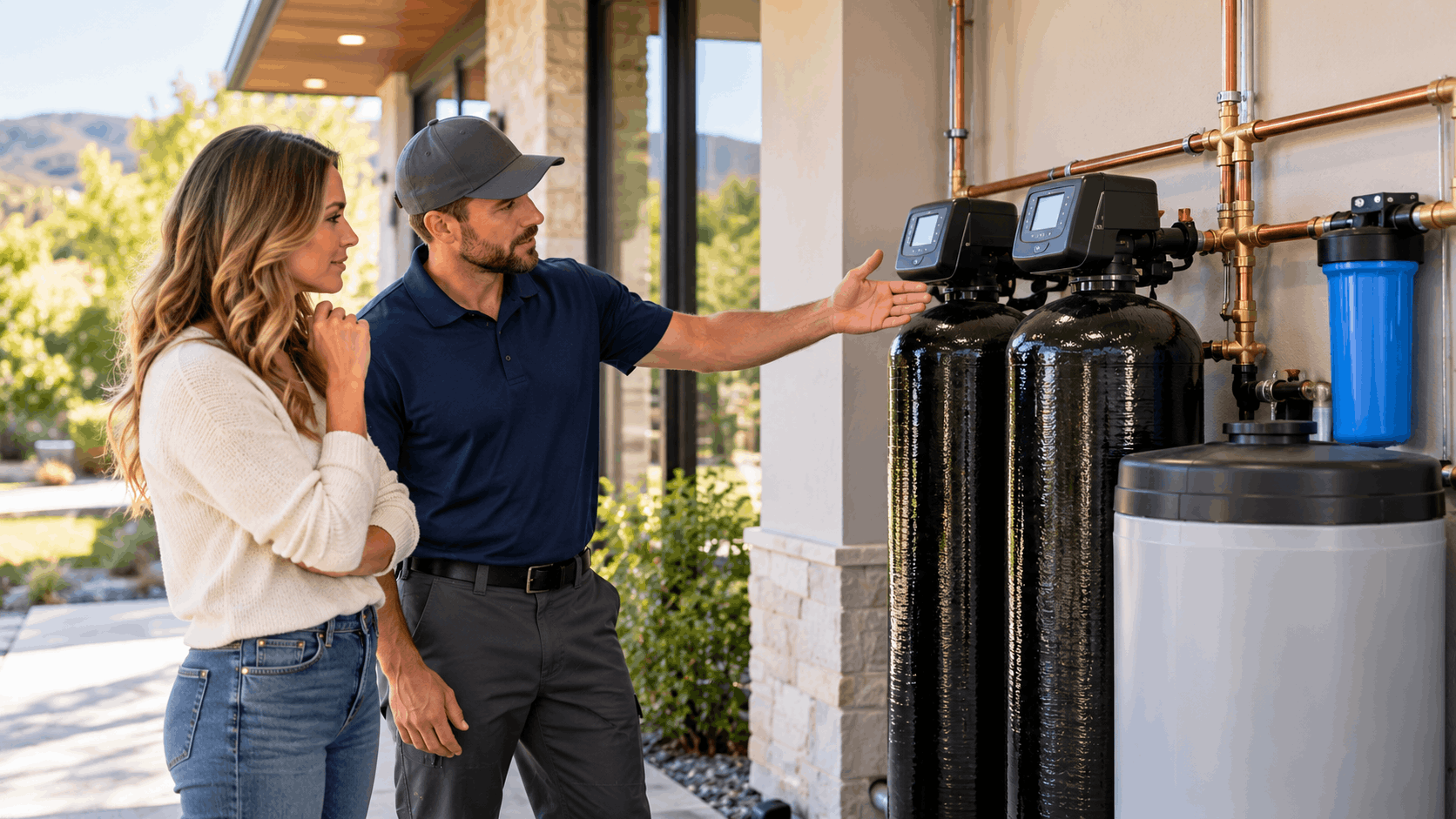
Connecting a system to an existing loop is usually a straightforward install because the rough plumbing is already in place. That is a point in the owner's favor. The loop is the opportunity, not the solution, and our water treatment team can confirm what the loop was sized for before anything is connected.
Get Your Quote
Tell us what's going on and we'll get back to you. We're open 24/7.
Sizing Treatment for a Large Home in Southern Highlands
A system that works fine on a 1,800 square foot tract home can fall short on a 6,000 square foot estate. The reason is flow. A bigger home runs more fixtures at the same time and demands more water per minute, and a unit that cannot deliver treated water at that rate sends partly treated or untreated water downstream when the house is busy.
Sizing is where a treatment job for a large home succeeds or fails. It is not just about how many people live there. It is about peak demand, the number of heaters, the length of the runs, and how the plumbing is laid out. Get it right and the system keeps up during the busiest part of the morning. Get it wrong and the owner pays for equipment that cannot do its job.
Southern Highlands makes this clear because the same community holds three very different kinds of property. The table below shows how the sizing job scales up across them.
| Property type | Typical system | Treatment sizing job |
|---|---|---|
| Production tract home | One water heater, expansion tank, regulator | Single-point treatment sized to standard household flow |
| Semi-custom home | Larger footprint, often a second heater and recirculation | Higher capacity to cover added demand and the loop |
| Custom estate | Multiple heaters, continuous recirculation, pool and outdoor gas | High-flow treatment protecting every heater and the circulating loop |
Why Size Matters More on Bigger Properties
On a large estate, several bathrooms, a laundry and a kitchen can all draw water at once. That pushes the peak flow rate well above what a smaller home ever asks for. A treatment system has a maximum flow it can handle while still doing its work, and once demand passes that point the water moves through too fast to be properly treated.
When that happens, the owner gets untreated or undertreated water during exactly the times they use the most. The system looks like it is working because water comes out of the tap, but the hardness is slipping through. Scale keeps forming in the heaters and fixtures even though a unit is installed.
This is the most common sizing mistake on big properties. Someone installs a residential-grade unit built for an average home and expects it to serve a house with three times the demand. The equipment is not defective. It is simply too small for the load.
The fix is matching the system's rated flow and capacity to the home's real peak demand. On an estate that usually means a larger unit, and sometimes more than one, so treated water keeps up no matter how many fixtures are open.
Matching the System to Household Water Use
Correct sizing starts with how the house actually uses water. The number of occupants, the number of bathrooms, how many water heaters are installed, and whether a recirculation loop runs all feed into the total demand the system has to meet. A full-time family of six places a different load than a seasonally occupied second home.
For a softener, that demand shapes the grain capacity needed. Grain capacity is how much hardness the unit can remove between regenerations. A larger household with hard water exhausts a small unit quickly, so it regenerates constantly or runs out of capacity, which again lets hard water through.
For a salt-free conditioner, sizing is about matching flow rather than grain capacity, but the principle holds. The unit has to be rated for the home's peak flow or it becomes a bottleneck and a weak point. Either way, the system is matched to the house, not pulled off a shelf.
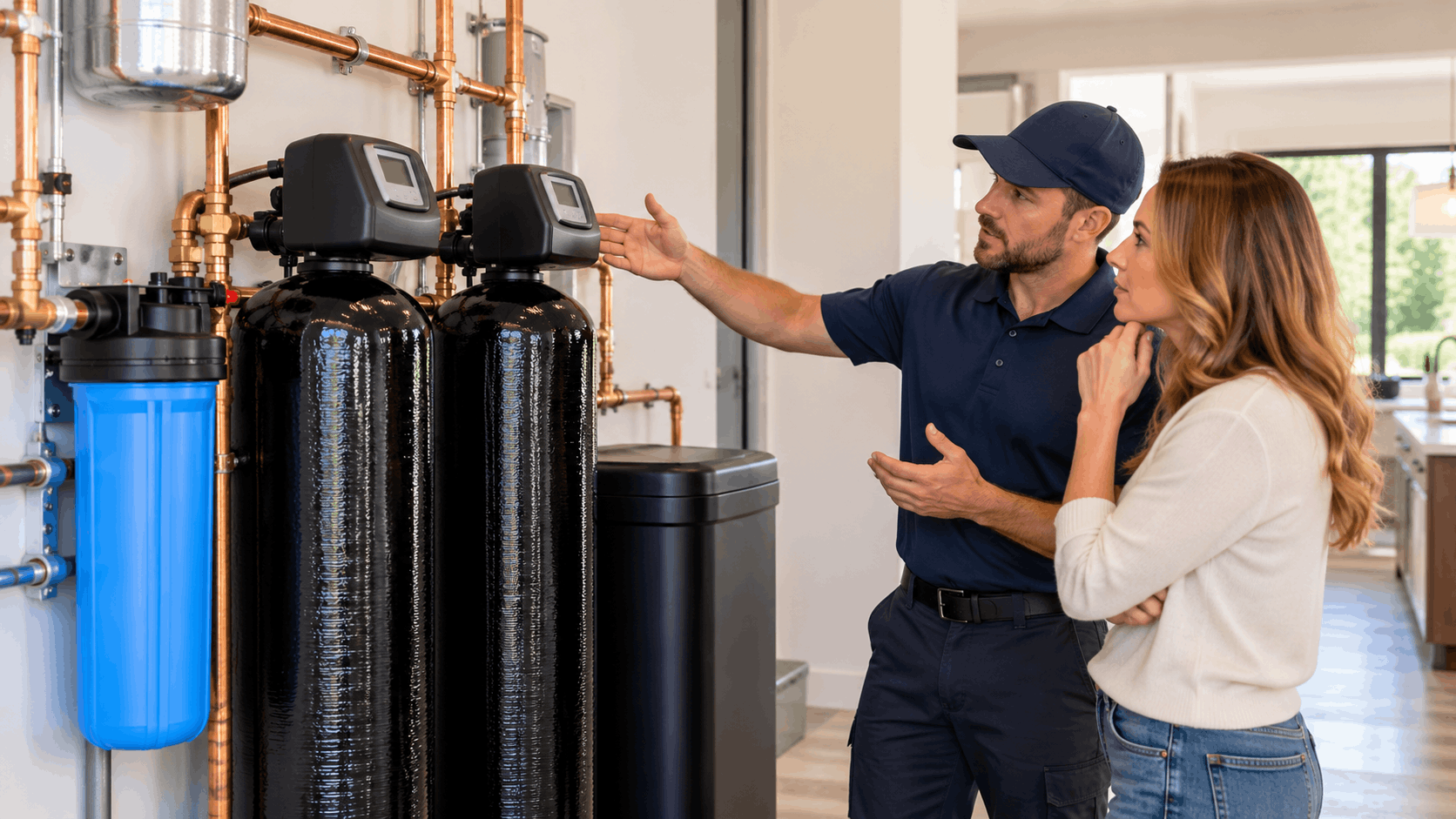
We keep the sizing honest by looking at the actual home rather than a rule of thumb. A water quality test confirms what is in the line, and a walk of the property confirms the demand. From there the right capacity follows.
Three Kinds of Property, Three Sizing Jobs
A production tract home in Southern Highlands is typically twenty to twenty-five years old with a straightforward system: one water heater, an expansion tank, a regulator, and the original angle stops and connectors. Treatment here is usually a single system sized to a standard household, often tied into that stubbed garage loop.
A semi-custom home adds size, frequently a second heater, and often a recirculation loop. That raises the total demand and gives the water more places to carry scale. The treatment system has to be sized up to cover the larger footprint and the circulating water, not just a single heater.
A custom estate in a gated enclave is a different proposition. Multiple heaters, long hot water runs with recirculation running continuously, pool and spa gas, outdoor kitchens, fire features, and extensive irrigation. The treatment job has to protect a whole network of equipment spread across a large property.
Establishing which of the three at the first call is what decides the scope and the price. It is the first question we ask, because the answer changes everything about how the system is sized and installed. A high-end Enterprise home is not treated the same way as a tract house two miles away.
Treating Multiple Heaters and Long Hot Water Runs
Estates run multiple water heaters, and in many of them a recirculation pump keeps hot water moving through a long loop so it arrives fast at distant fixtures. That loop is a benefit for comfort, but it means hard water is circulating continuously across the whole footprint of the house.
Treatment on a property like this has to protect every heater and the circulating loop, not just one point. If a system only treats part of the supply, the untreated branches keep scaling. The water feeding the heaters and the loop is where the protection matters most, because that is where heat drives scale fastest.
Continuous recirculation makes the problem worse than it looks. Water that keeps cycling past heating surfaces has more chances to drop calcium out as scale. A properly placed treatment system cuts the hardness before that water ever reaches the loop.
On these homes we also look at whether a recirculation setup is sized and controlled sensibly, because a loop running flat out all day moves a lot of hard water past a lot of hot metal. Treatment and a well-managed loop work together.

Need Help in Las Vegas?
Active Plumbing serves Las Vegas and all of Las Vegas Valley.
Your Treatment Options and What Each One Does
Owners usually come to the decision with a few terms they have heard: softener, salt-free, filtration, reverse osmosis. Each solves a different part of the problem, and on a large home more than one often makes sense together. Here is what each does in plain terms.
The water here is chlorinated, not chloraminated, which matters for the filtration choice. It is also very hard, which is why softening or scale reduction is the center of most treatment plans in this community. Drinking water taste is a separate question that reverse osmosis handles best.
The table below lines up the main options against what each one actually does for a Southern Highlands home.
| Option | What it addresses | Where it fits a large home |
|---|---|---|
| Water softener | Removes calcium and magnesium hardness | The standard response to very hard water; sized to peak flow |
| Salt-free conditioner | Reduces scale formation without removing minerals | Where an owner prefers no salt and lower maintenance |
| Whole-house carbon filtration | Chlorine taste and odor across the home | Pairs with a softener for better-tasting water everywhere |
| Under-sink reverse osmosis | Dedicated drinking water at one tap | Kitchen add-on alongside whole-house treatment |
Whole-House Water Softeners
A softener is the standard response to very hard water in the valley. It works by ion exchange, swapping the calcium and magnesium that cause scale for sodium or potassium as water passes through a resin bed. The water that leaves is soft, so it stops building scale in heaters and fixtures.
Because it removes the hardness minerals rather than just changing them, a softener gives the most complete protection against scale. That is why it is the usual recommendation for a home on 16-grain water. On a large property it has to be sized so the resin can handle the home's peak flow and still have capacity between regenerations.
Softeners regenerate periodically, flushing the resin and recharging it with the exchange minerals. A unit sized correctly for the household does this on a sensible schedule. One sized too small regenerates constantly and can still fall behind, which defeats the purpose.
For most Southern Highlands homes with a garage loop already in place, a softener is the natural fit and a clean install. It addresses the root cause of the scale rather than managing the symptoms.
Salt-Free Scale-Reduction Systems
A salt-free system is a scale-reduction approach rather than a softener. It does not remove calcium and magnesium. Instead it treats the minerals so they are far less likely to stick and form scale on surfaces. The honest framing is that it reduces scale and extends equipment life, not that it produces soft water.
Some owners prefer it because there is no salt to add, no brine discharge, and generally less maintenance. For a household that wants the minerals left in the water but still wants protection against scale, it can be the right choice.
Where scale buildup is the main concern and an owner does not want the slick feel of softened water or the salt handling, a salt-free conditioner fits. On a large home it still has to be sized to the peak flow so it is not a restriction point in the supply.
Both approaches extend the life of heaters, fixtures and appliances. The right one depends on the home, the owner's preference on salt, and how the water is used. We talk through both honestly rather than pushing one over the other.
Whole-House Filtration and Chlorine Taste
Valley water is treated with ozone first and then chlorine as it leaves the plant, and chlorination is used throughout Southern Nevada's distribution. It is not chloramine, so an owner does not need any special catalytic carbon to deal with it. Ordinary activated carbon handles chlorine taste and odor.
A whole-house carbon filter removes that chlorine taste and smell from every tap in the house, not just the kitchen. On a large home with many bathrooms, that means every shower and every faucet delivers water without the chlorine note some people notice.
Carbon filtration pairs naturally with a softener or conditioner. The softener handles scale, the carbon handles taste and odor, and together they cover the two things owners most often ask about. The filter is sized to the same peak flow as the rest of the system so it does not restrict the supply.
Carbon media is consumed over time and needs periodic replacement, which is part of the ongoing care on any filtration system. Sizing it correctly for the home means the media lasts a reasonable interval rather than exhausting quickly on a high-demand property.
Adding Point-of-Use Reverse Osmosis for Drinking Water
For drinking water specifically, an under-sink reverse osmosis system is the add-on many owners want. It forces water through a fine membrane that removes a broad range of dissolved substances, producing clean water at a dedicated tap. It works alongside whole-house treatment rather than replacing it.
On a large home, the pattern is a softener or conditioner protecting the whole system, whole-house carbon for taste, and reverse osmosis at the kitchen for the water the family drinks and cooks with. Each piece does its own job and they do not compete.
Reverse osmosis is a point-of-use system, so it treats a small amount of water very thoroughly rather than treating the whole house. That keeps it practical and affordable while still giving a high-quality drinking supply. Our reverse osmosis installation ties into the existing kitchen plumbing.
The membrane and filters in a reverse osmosis unit need periodic replacement to keep performing. That is normal maintenance, and it keeps the drinking tap delivering water as intended year after year.
Elevation and Water Pressure in Southern Highlands
Here is the local technical story that sets Southern Highlands apart. The community climbs. Homes sit at different elevations on the same water system, and those homes do not see the same pressure. That one fact explains more complaints out here than anything else in the southwest valley.
Pressure matters for treatment because flow and pressure shape how a system performs. A home with pressure that is too high is quietly wearing out everything it touches. A home with pressure that is too low produces the weak-stream complaints the owner actually calls about. Both trace back to where the house sits and to the pressure regulator.
Before any treatment plan is set, we check incoming pressure. It takes two minutes and it often explains the complaint the owner has lived with for years. Treatment and pressure are tied together more closely than most people expect.
Lower Streets See High Pressure, Higher Lots See Less
On the lower streets of Southern Highlands, incoming pressure can run high. High pressure feels great at the tap, but it quietly stresses fixtures, appliances, connectors and water heaters, and it shortens the life of everything it touches. The damage is gradual and the owner usually has no idea it is happening.
On the higher lots, pressure can be lower than an owner expects. That shows up most at upstairs fixtures in a two-story house, where water has to climb even further. The owner calls because a shower on the top floor feels weak, and the cause is elevation on the system rather than a broken fixture.
Two homes on the same water main, a few streets apart in elevation, can have very different pressure stories. That is why a one-size answer does not work in this community. The plumbing in each home is reacting to where it sits on the slope.
Understanding that pattern is the difference between fixing the real problem and replacing fixtures that were working fine. The pressure is the variable, and it is specific to this climbing community.
Why the Pressure Regulator Is the First Thing to Check
The pressure regulator is the component to check first in Southern Highlands, not an afterthought. It is the valve that controls the pressure entering the house. When it works, it holds incoming pressure at a safe level no matter what the main is doing.
A regulator that has crept high over time is doing damage nobody has noticed. The owner is not complaining, but fixtures, connectors and the water heater are all taking more strain than they should. That quiet wear is the kind of thing that ends in a burst connector or a heater failing early.
A regulator that has dropped produces the opposite: the weak-pressure complaint the owner actually picks up the phone about. Either way, checking incoming pressure takes two minutes and tells us whether the regulator is the culprit before anything expensive is considered.
Because of how this community sits on the slope, we treat the regulator as the starting point on almost every pressure call here. It explains more complaints in Southern Highlands than anywhere else in the southwest valley, and it is a quick, inexpensive thing to verify.
How Pressure Affects Treatment Performance
Flow and pressure shape how a treatment system performs. A softener, conditioner or filter is rated for a certain pressure and flow range, and running outside that range affects how well it treats and how long it lasts. Pressure that is too low can leave a home short of water once the system's own pressure drop is added in.
On a house that sits high on the system, treatment can expose a pressure problem that was there all along. Adding a system puts a small pressure drop into the supply, and on an already low-pressure home that can push upstairs fixtures below comfortable. The honest answer in that case can be a pressure-boosting arrangement rather than fighting the equipment.
On the lower streets, high pressure is the concern for the equipment. A correctly set regulator protects both the treatment system and the rest of the plumbing from running hot and hard all the time. Getting the pressure right first makes the treatment system perform as designed.
So pressure and treatment are planned together. We do not size a system in isolation. We look at where the house sits, what the regulator is doing, and whether a boost is the right call, so the finished install performs the way the owner expects.
What It Costs and What Affects the Price?
Cost is the first thing most owners want to know, so here are the typical ranges for the Las Vegas Valley up front. These are typical market ranges, not a quote, and the actual price for a specific job depends on that job. Active Plumbing gives a written price before work starts.
What moves the price on a large home is the size and complexity of the system, which is why an estate lands at the higher end of a range while a tract home sits lower. The table and the sections below break down the ranges and the drivers.
| Treatment work | Typical valley range |
|---|---|
| Water softener installation | $800 to $2,500 |
| Salt-free water conditioning, installed | $800 to $2,500 |
| Whole-house water filtration | $800 to $2,500 |
| Under-sink reverse osmosis | $300 to $600 |
| Water quality testing | $75 to $200 |
Typical Price Ranges in the Las Vegas Valley
For the Las Vegas Valley, water softener installation typically runs $800 to $2,500. Salt-free water conditioning runs $800 to $2,500 installed. Whole-house water filtration runs $800 to $2,500. Under-sink reverse osmosis runs $300 to $600 including parts and labor. Water quality testing runs $75 to $200.
These are typical ranges for the area so an owner knows what to expect, not a fixed price. A simple softener swap onto an existing garage loop in a tract home sits toward the lower end. A high-flow system for a custom estate sits toward the higher end.
If an owner also wants hardness confirmed before deciding, water quality testing is an inexpensive first step. It tells us exactly what is in that home's line and helps size the system correctly, which protects the larger investment.
Every one of these figures is a starting point for the conversation. The written price for the specific home comes after we have seen the property and confirmed the scope, and it is given before any work begins.
Why a Larger Home Costs More to Treat
A larger home costs more to treat because the system has to be bigger and the plumbing is more involved. Higher flow demand means a higher-capacity unit. Multiple heaters mean the treatment has to protect several points rather than one. Longer runs and a recirculation loop add to what the system covers.
Complexity adds labor. An estate with a mechanical layout spread across the property, or treatment that has to be placed to protect a continuous loop, takes more planning and more time to install than a single unit on a garage loop. That is what pushes an estate job toward the higher end of the range.
Pressure work can factor in too. If a high home needs a pressure-boosting arrangement to perform well with treatment added, that is additional scope. On the lower streets, correcting a regulator is a smaller item but still part of getting the install right.
None of this is padding. It is the real difference between protecting a small, simple system and protecting a large, expensive one. The price follows the size and complexity of what is being protected.
Rebates and Incentives, and Where to Confirm Them
Utility and manufacturer rebates may exist from time to time, but these programs change often. An owner should check the current program directly rather than relying on a figure that may be out of date.
Because rebates come and go and do not change the core price of the work, we point owners to confirm current offers with the utility or manufacturer at the time of the install. That way the information is accurate for that moment.
Need Help in Las Vegas?
Active Plumbing serves Las Vegas and all of Las Vegas Valley.
Associations, Gates and County Permits in Enterprise
Southern Highlands sits in the unincorporated township of Enterprise, inside Clark County rather than the City of Las Vegas. That decides which building department governs the work. On top of that, the community runs under a master association with sub-associations beneath it, so two separate tracks can apply to one install.
For a water treatment job, the county track covers permits and inspections where they apply, and the association track covers how anything visible looks from the outside. Both matter on an estate with exterior equipment, and they are handled separately. Confirming where the project stands on each before work starts keeps the job on schedule.
Southern Highlands is bounded by Interstate 15 on the east, Cactus Avenue on the north, Jones Boulevard on the west and Larson Lane on the south, with Southern Highlands Parkway running through as its spine. An address inside those lines is a Clark County address.
Clark County Handles Permits and Inspections
Because Enterprise is unincorporated Clark County, permits, plan check and inspections for Southern Highlands run through the Clark County Department of Building and Fire Prevention. This is not a City of Las Vegas matter even though residents often describe the area as Las Vegas. The county is the authority for this address.
The applicable code is the Southern Nevada Amendments to the Uniform Plumbing Code as codified by the county. Those amendments are expressly not code unless adopted by the jurisdiction, and Clark County adopts them for this area. The Building Official is the authority on any alternate method.
Permit requirements depend on the specific work, so the permit position should be confirmed for the address rather than assumed. We handle that confirmation up front so there is no surprise mid-job. Getting the county track settled early keeps the install moving.
For owners who want to understand the broader picture of county-governed work out here, our Enterprise service area page covers how we work across the township.
When Association Architectural Review Applies
Southern Highlands is governed by a master association with sub-associations under Nevada Revised Statutes Chapter 116, and the architectural standards cover exterior appearance. That means anything visible from the street can trigger a review while interior work does not.
For treatment, this matters when equipment would sit on a street-facing elevation or be visible from the common area. An exterior tankless unit, a visible treatment system or anything on a prominent wall can require approval. A softener tucked inside a garage generally does not.
Two sets of documents can apply to one change: the master association rules and the rules of the sub-association that governs the specific enclave. An owner may need to satisfy both. We flag this at the planning stage so the placement of equipment accounts for it.
Association approval and a county permit are separate tracks. Clearing one does not clear the other. Where both apply, both have to be satisfied, and planning around that from the start avoids delays.
Guard-Gated Access and Scheduling
Many of the custom estate enclaves in Southern Highlands are guard-gated. Contractor access is authorized in advance through the homeowner rather than arranged at the gate on the day. If that step is skipped, a crew can arrive and be turned away.
Some associations also keep vendor or insurance records for contractors working inside the gates. That is part of how these communities manage who comes and goes. It is worth knowing before the appointment so paperwork is in order.
Because of this, we confirm access when the appointment is booked. The homeowner authorizes entry, any vendor records are handled, and the crew arrives expected. That keeps a treatment install on schedule rather than losing a day at the gate.
For second homes and seasonally occupied properties in the enclaves, coordinating access matters even more, because the owner may not be on site. We arrange it in advance so the work happens when planned.
Protecting Estate Systems: Heaters, Recirculation and Outdoor Lines
Treatment on a large home is protecting a bigger, more expensive system than a tract house carries. An estate has multiple heaters, long hot water runs, pool and spa gas, outdoor kitchens and extensive irrigation. The parts that benefit most from treatment are the ones where heat and narrow passages meet hard water.
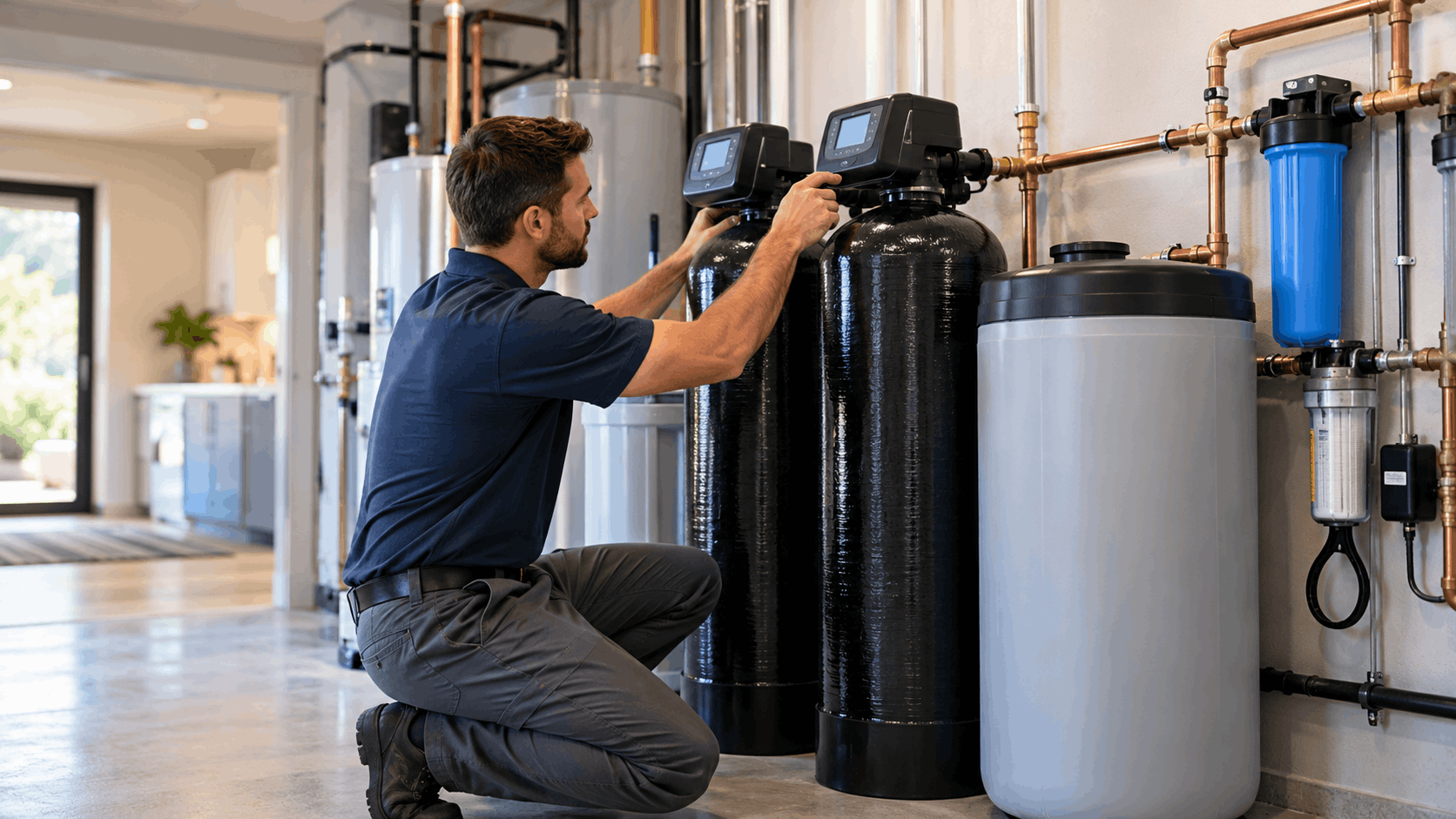
A treatment visit on a property like this should look beyond the softener. It should consider the heaters, the recirculation loop and the exterior lines, because those are where scale and leaks cost the most over time. Here is what each part needs.
Water Heaters and the Case for Regular Flushing
In both tract homes and estates, flushing a water heater is maintenance, not optional. Scale settles on the tank bottom and coats the heating surfaces, and over time that layer forces the heater to work harder to deliver the same hot water. A tank left unflushed works harder and fails earlier than its rated life.
Treatment slows the scale from forming in the first place, and flushing clears what does accumulate. Together they protect the heater. On an estate with multiple heaters, that is several expensive units being protected rather than one.
Flushing removes the sediment and scale that settle at the bottom of the tank, where it insulates the burner or element from the water it is trying to heat. Clearing it restores efficiency and takes strain off the heater. On very hard water this needs doing regularly rather than once.
We cover heater care and replacement through our water heater services, and pairing treatment with a flushing schedule is the combination that gets the most life out of a heater on 16-grain water.
Tankless Heat Exchangers and Continuous Recirculation
Scale accelerates failure in tankless units because the heat exchanger path is narrow, and hard water deposits build inside those tight passages fast. A tankless heater on untreated valley water can foul its exchanger well before its expected service life. The narrow path is exactly where scale does the most harm.
On an estate, a recirculation loop running continuously keeps hard water circulating across the whole footprint. That water passes heating surfaces over and over, giving scale repeated chances to form. The loop is comfortable for the owner but hard on the equipment when the water is untreated.
The answer is treatment plus descaling. Softening or conditioning the water before it reaches a tankless unit cuts the scale load, and periodic descaling clears what builds up inside the exchanger. Both protect the unit and keep it heating efficiently.
For owners weighing a tankless system in Southern Highlands, treatment is part of the conversation from the start, because a tankless unit on untreated 16-grain water is asking for trouble at the heat exchanger.
Long Irrigation and Yard Lines on Graded Slopes
Estates in Southern Highlands carry extensive private landscape, which means long irrigation runs. A leak on one of those lines can go unnoticed for weeks and show up first as an unexplained water bill rather than a puddle. That makes exterior leak detection a genuine service on these properties, not an add-on.
The community sits on graded slopes, so exterior lines run across cut and fill ground. Settlement over two decades can stress yard and irrigation lines where the backfill was not compacted evenly. That movement pulls lines out of grade and opens up leaks over time.
Caliche adds to the picture. Caliche is a cemented hardpan layer common across the valley, and it makes exterior excavation slower and more expensive than in softer ground. On the higher lots, rock is a real factor in what a trench costs when a buried line has to be reached.
When a water bill climbs with no visible cause, our electronic leak detection finds the leak on a long yard line before it does more damage. On a large property, that detection step saves breaking up more ground than necessary.
Need Help in Las Vegas?
Active Plumbing serves Las Vegas and all of Las Vegas Valley.
How Active Plumbing Handles a Water Treatment Install
A water treatment install in Southern Highlands follows a clear sequence. We establish the property type and check the pressure, confirm permits and gate access, size the system to the home, and give a written price before any work begins. The steps are ordered so nothing is a surprise.
Because this community holds three kinds of property and sits on a slope, the first visit does more diagnosis than a typical treatment call. What we learn there shapes the whole job.
Checking Pressure and Confirming the Property Type
Establishing which of the three property types a home is at the first call decides the scope and the price. A tract home, a semi-custom home and a custom estate each need a different sized system and a different install plan. That question comes first.
A two-minute pressure check often explains the complaint the owner called about. Given how this community climbs, incoming pressure varies by elevation, and the regulator is frequently the answer. We check pressure before planning the treatment so the system is sized against real conditions.
Water quality testing confirms what is in the line for that specific home. The valley figure is 280 ppm, but testing verifies the home's own water and helps size the system correctly. It is an inexpensive step that protects a larger investment.
With the property type, the pressure and the water confirmed, the sizing follows from facts rather than assumptions. That is what keeps a large-home system from being under or over built.
Confirming Permits, Access and Association Approval
We confirm the Clark County permit position for the address up front. Enterprise permits run through the Clark County Department of Building and Fire Prevention, and settling the permit question early keeps the job on schedule rather than pausing it mid-install.
Guard-gate access is arranged when the appointment is booked, authorized through the homeowner. For the gated enclaves, this is how a crew gets in on the day without losing time at the gate. Any vendor records an association keeps are handled at the same time.
Association approval and a county permit are separate tracks where both apply. A visible or street-facing system can need architectural review under the master association and its sub-associations, while interior work generally does not. We flag which track applies so placement and timing account for both.
Getting permits, access and approval lined up before the install day is what keeps the job moving once it starts. These are the administrative steps that trip up unprepared crews in this community.
Written Price Before Work Starts and Licensed Installation
Active Plumbing gives a written price before work begins. The owner knows the cost of the specific job before anyone starts. That is a business practice, and it means no guesswork on price for the homeowner.
The work is done by a licensed contractor. Active Plumbing holds Nevada license NSCB #0047021, verifiable free at nvcontractorsboard.com, where classification, status, bond and workers compensation are public record. The business has served the Las Vegas Valley since 1991 as a fourth-generation family plumbing company.
Technicians arrive in 30 to 60 minutes anywhere in the Las Vegas Valley, which covers Southern Highlands and the surrounding southwest valley. Permitted work is performed by the appropriately licensed contractor, and an owner is entitled to ask for and verify the license number.
From the first pressure check to the finished install, the aim is a system sized correctly for the home, installed to the local code as adopted by Clark County, with the price settled in writing first.
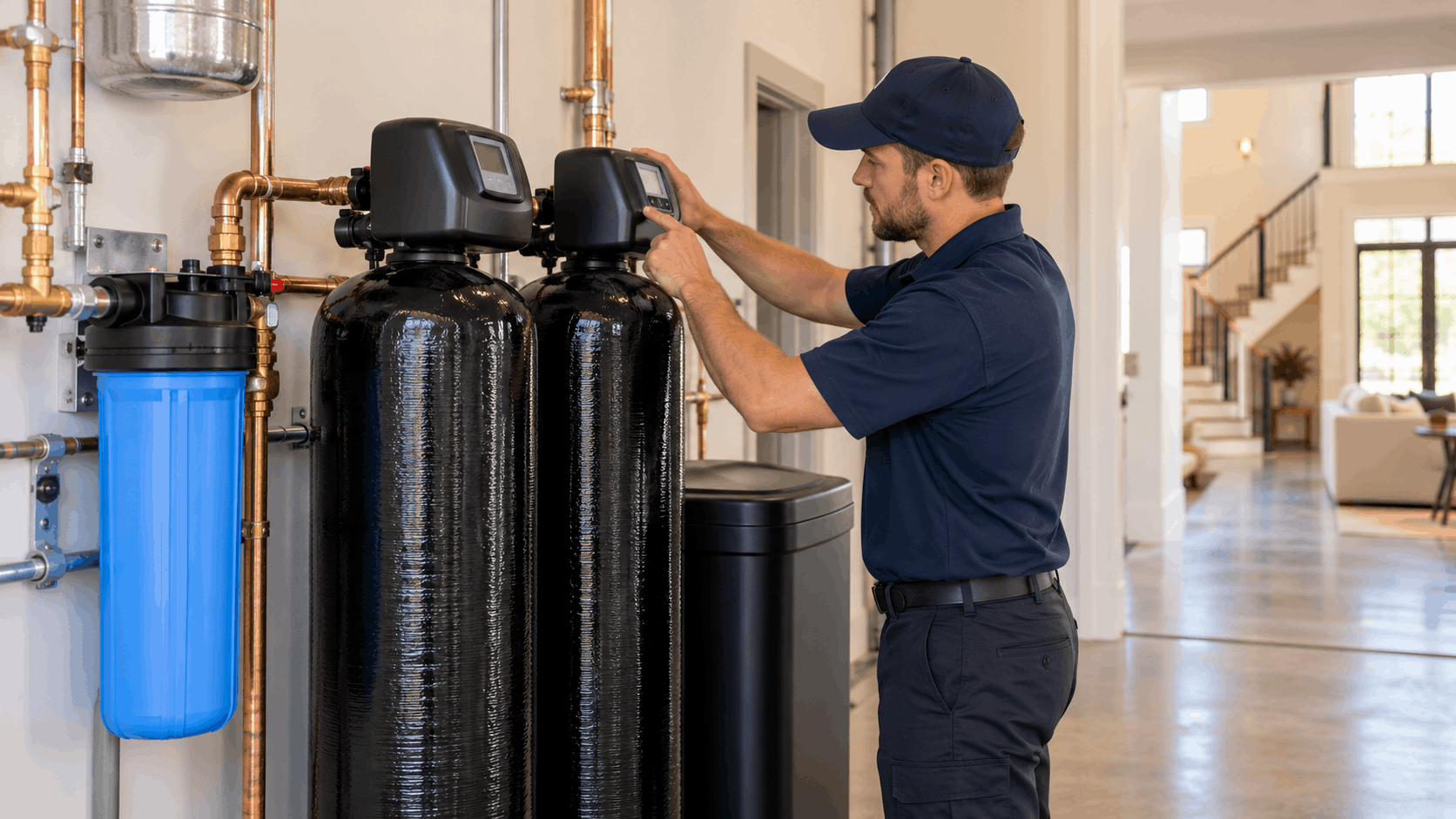
Protecting Your Southern Highlands Home Starts With a Call
A treatment system sized right for your home starts with a pressure check, a look at which of the three property types you have, and a water test to confirm what is in your line. From there we size the system, confirm the Clark County permit position and gate access, and give you a written price before any work begins.
To get started, call Active Plumbing at (702) 438-3357 and we will set up the visit, with a licensed technician arriving in 30 to 60 minutes anywhere in the valley.
Frequently Asked Questions
- How hard is the water in Southern Highlands?
- The Southern Nevada Water Authority states the valley's water is 280 parts per million, or about 16 grains per gallon, which is categorized as very hard. That figure is the same across all of Southern Highlands, from the lower tract streets to the higher custom lots, because it all comes off the same treated supply. It is the reason scale builds so quickly in heaters and fixtures here.
- How much does whole-house water treatment cost in the Las Vegas Valley?
- Typical valley ranges are: water softener installation $800 to $2,500; salt-free water conditioning $800 to $2,500 installed; whole-house water filtration $800 to $2,500; and under-sink reverse osmosis $300 to $600. These are typical ranges for the area, not a quote. The actual price for a specific home depends on the job, and Active Plumbing gives a written price before work starts.
- Does a bigger home need a bigger water treatment system?
- Yes. A larger home runs more fixtures at once, which raises the peak flow the system has to treat. Add multiple water heaters and a long recirculation loop and the demand climbs further. A system sized for an average home cannot keep up during peak use and lets hard water slip through, so an estate needs a higher-capacity system matched to its real demand.
- Is a water softener or a salt-free conditioner better for my estate?
- A softener removes the calcium and magnesium that cause scale, giving the most complete protection. A salt-free conditioner does not remove minerals; it reduces their tendency to form scale, with no salt to add and less maintenance. Both extend equipment life. The right one depends on the home, how the water is used, and the owner's preference on salt. We walk through both honestly.
- Do I need a permit or HOA approval for water treatment in Southern Highlands?
- Permits for this area run through the Clark County Department of Building and Fire Prevention, since Southern Highlands is in unincorporated Enterprise. Interior work usually avoids association review, but a visible or street-facing system can require architectural approval under the master association and its sub-associations. Those are separate tracks. We confirm both for the specific address before the install.
- Why does the water pressure in my house feel different from my neighbor's?
- Southern Highlands climbs the slopes, so homes at different elevations on the same water system do not see the same pressure. Lower streets can run high; higher lots can run lower, especially at upstairs fixtures. Your neighbor may sit at a different elevation. The pressure regulator is the first thing to check, and verifying incoming pressure takes about two minutes.
- Does Las Vegas water use chlorine or chloramine?
- Valley water is treated with ozone first and then chlorine as it leaves the plant, and chlorination is used throughout Southern Nevada's distribution. It is not chloramine. That matters for filtration because ordinary activated carbon handles chlorine taste and odor. No special catalytic carbon is needed for valley water.
- Will treatment stop my water heater from failing early?
- Treatment plus regular flushing is the combination that protects a heater. Softening or conditioning reduces the scale that forms on tank bottoms and heating surfaces, and flushing clears what does accumulate. A tank left unflushed works harder and fails earlier than its rated life. Treatment does not make a heater last forever, but it takes the main cause of early failure off the table.
- My home has a softener loop in the garage but nothing hooked up. What does that mean?
- Many homes of the Southern Highlands build era were plumbed with a stubbed softener loop in the garage. That loop is just rough plumbing waiting for a system. Without a system connected, every faucet, heater and appliance in the house runs on untreated very hard water. The good news is the plumbing is already there, so connecting a system is usually a clean install.
- Can water treatment help with the taste of my drinking water?
- Yes. A whole-house carbon filter removes chlorine taste and odor from every tap in the house. For a dedicated drinking supply, an under-sink reverse osmosis system gives a separate tap with water that has passed through a fine membrane. Both can pair with a softener, so a large home can have scale protection, better-tasting water everywhere, and clean drinking water at the kitchen.
Licensed plumbing professionals serving Las Vegas and Las Vegas Valley.
Licensed in Nevada · License #0047021
Last updated on
Why trust Active Plumbing?
Founded in 1991, Active Plumbing is a licensed and insured plumber serving Las Vegas and Las Vegas Valley. All content is reviewed by our licensed technicians.

Need Help in Las Vegas?
Active Plumbing serves Las Vegas and all of Las Vegas Valley.
Related Articles
Multiple Water Heaters and Recirculation Loops in Southern Highlands Estates: Sizing and Service
How multiple water heaters and recirculation loops are sized and serviced in Southern Highlands estates, why very hard water matters, and how each property type changes the job.
Water Heater and Recirculation Service for Southern Highlands Estates
How water heaters and recirculation systems behave across Southern Highlands' three property types, why elevation and 280 ppm hard water drive the failures, and what the work costs.
Water Heater Replacement Cost in Southern Highlands for Tract Homes and Custom Estates
Water heater replacement cost in Southern Highlands ranges from $800 to $1,500 for a tank and $1,500 to $3,500 for tankless. See what moves the price across tract homes and custom estates.