Golf Course Frontage in Southern Highlands: Where Irrigation Meets Household Plumbing

Key Takeaways
- Frontage lots put long irrigation runs and household plumbing on one supply, one meter and one pressure regulator, so a problem in the yard is often felt inside the house.
- Elevation changes pressure across Southern Highlands: lower lots near I-15 can run high and wear out connectors and heaters, while higher lots can run low at upstairs fixtures. The regulator check comes first.
- A spiking water bill with no visible cause usually points to a hidden irrigation or yard-line leak; electronic leak detection typically runs $150 to $350 in the area.
- The valley's water is 280 ppm, about 16 grains per gallon and very hard; many homes here have a stubbed garage softener loop that owners have never connected.
- Estate gas for pool heaters, outdoor kitchens and fire features must be sized to the whole load, or appliances underperform; suspected gas leaks mean leave, avoid sparks, and call Southwest Gas from outside first.
- Enterprise is unincorporated Clark County, so permits run through the Clark County Department of Building and Fire Prevention, separate from association architectural approval for exterior work.
- Active Plumbing holds Nevada license NSCB #0047021, has served the valley since 1991, arrives in 30 to 60 minutes, and gives a written price before work starts.
In This Article
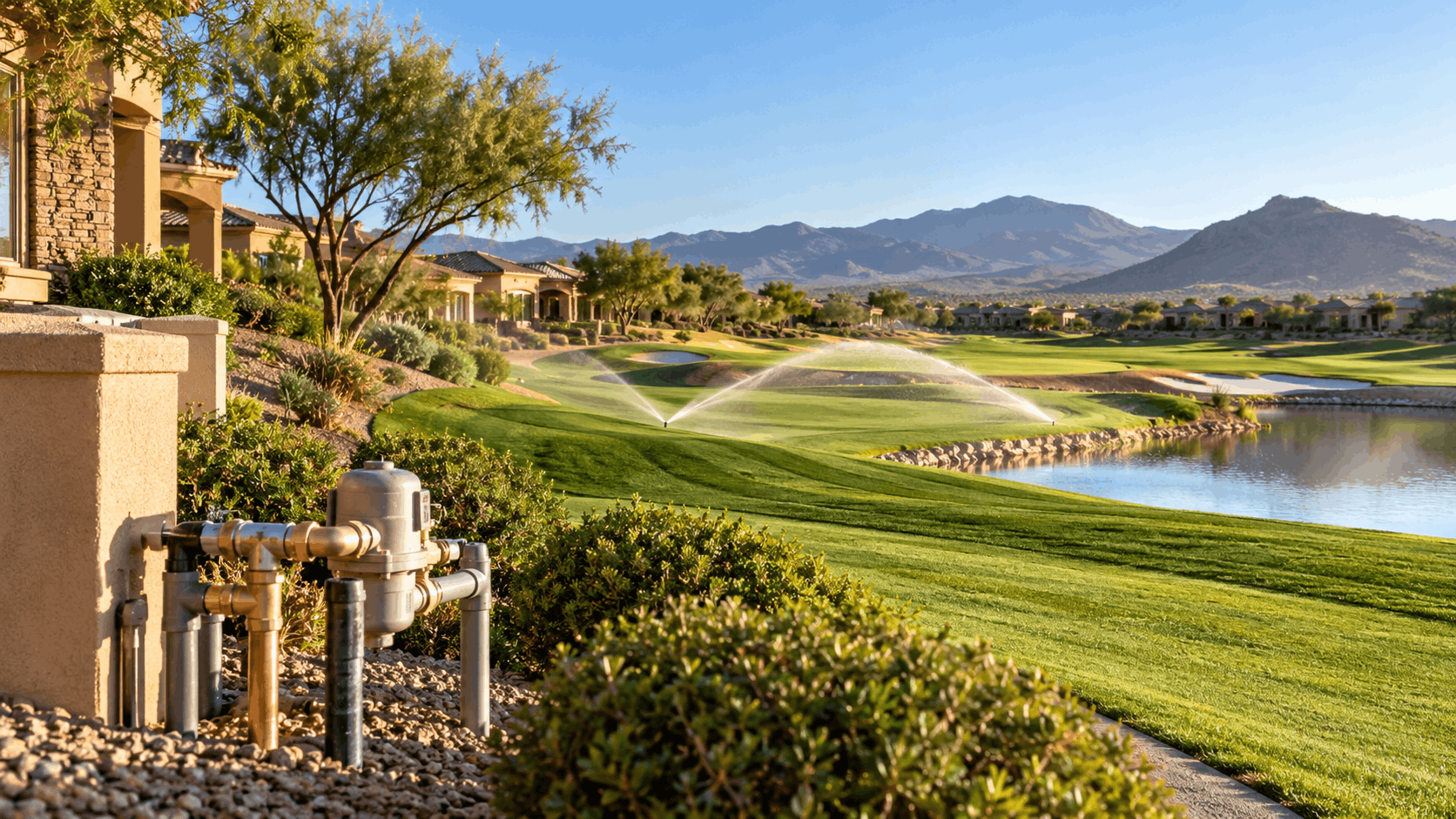
Owning a home that backs onto the Southern Highlands Golf Club comes with a view most of the valley would trade for. It also comes with a plumbing reality that an interior tract home never deals with. These lots carry long private irrigation runs across graded ground, heavy landscape watering, and pressure that shifts with where the house sits on the slope. All of that shares the same incoming supply that feeds the kitchen sink and the water heater.
That shared supply is the whole story on a frontage lot. The water your sprinklers draw and the water at your upstairs shower come through one meter and past one pressure regulator. When something goes wrong out in the yard, you often feel it inside the house, and when the regulator drifts, both the landscape and the fixtures pay for it.
Let's walk through how irrigation and household plumbing connect on these lots in Enterprise, what frontage and estate owners should watch for, and what the common jobs tend to cost here. We work these streets off Southern Highlands Parkway every week, so the details below come from the ground, not a brochure.

What Golf Course Frontage Means for Your Plumbing?
A home that fronts the Southern Highlands Golf Club almost always sits on a larger lot with more landscape than a flatland tract house. That means more irrigation plumbing in the ground, longer supply and yard lines, and more surface area where a problem can hide. The job changes the moment you add that much exterior pipe to a residential system.
On an interior tract home, the plumbing is compact and the failures are predictable: one water heater, a regulator, angle stops and connectors. On a golf course frontage lot, the irrigation side can rival the household side in size. A plumber working here has to think about both as one connected system rather than two separate ones.
That connection is what trips up owners who assume the yard and the house are independent. They are not. They draw from the same line, they sit behind the same regulator, and they live in the same very hard water. Treat them as one system and the diagnostics make sense.
Long Yard Lines and Where They Run
Frontage lots carry extensive private irrigation, and those lines run across cut and fill ground that was graded when the community was built from the late 1990s onward. The pipe snakes out to planting beds, turf zones, and the landscaped edges that face the course. On an estate lot, that is a lot of buried pipe over a lot of distance.
The problem with distance is that a leak out there does not announce itself. There is no puddle on a kitchen floor to catch your eye. A cracked fitting or a split line buried in a planting bed can weep water into the soil for weeks without anyone noticing a thing.
What usually tips the owner off is not a wet spot at all. It is the water bill. By the time the number jumps enough to raise an eyebrow, the leak has been running quietly for a billing cycle or more. That is why exterior lines deserve real attention on these lots rather than being treated as an afterthought.
The longer the run, the more joints, fittings and transitions there are, and every one of those is a potential failure point. Settlement along the run adds stress over the years. On a big frontage lot, mapping where those lines run is the first step toward finding what is wrong.
One Supply, Two Jobs
The same incoming water feeds both the house and the landscape. One meter at the curb, one main line in, and one pressure regulator doing the work for everything downstream. That single supply has two jobs: keeping the household fixtures working and feeding the irrigation system.
Because they share that supply, a problem in one area shows up in the other. If an irrigation valve sticks open or a yard line splits, you can see pressure drop at the kitchen faucet. If the regulator creeps high, both the sprinkler heads and the washing machine connectors take the strain.
This is why we never look at household plumbing in isolation on a frontage lot. A complaint about weak flow upstairs might trace back to an irrigation draw, and a soggy planting bed might trace back to a regulator that is pushing too hard. The meter and the regulator are the common thread.
Understanding that single-supply setup also helps owners make smart choices. A pressure problem solved at the regulator fixes the house and the yard at once. A whole-house water treatment decision protects every fixture and every appliance fed by that one line.
Why Frontage Homes Are a Different Scope
Southern Highlands holds three kinds of property, and the plumbing job changes completely across them. A production tract home here is twenty to twenty-five years old with a straightforward system: one water heater, an expansion tank, a regulator, original angle stops and connectors, and the failures that come with that age.
A semi-custom home adds size, often a second water heater, and recirculation to push hot water across a bigger footprint. The system grows, and so does the number of things that can need service. The failures are the same in kind but spread across more hardware.
A custom estate in a gated enclave is a different proposition again. Think multiple water heaters, long hot water runs with recirculation running continuously, pool and spa gas, outdoor kitchens and fire features, plus extensive irrigation and yard lines. A frontage estate ties all of that into one load, and each piece interacts with the others.
Establishing which type a home is at the first call decides the scope and the price. A tract home water heater swap and an estate recirculation and gas job are not the same conversation. Knowing the property type up front means the right crew, the right parts, and an accurate written price.
Get Your Quote
Tell us what's going on and we'll get back to you. We're open 24/7.
Elevation and Water Pressure in Southern Highlands
This community climbs. Southern Highlands rises onto the slopes below the Spring Mountains, bounded by Interstate 15 on the east, Cactus Avenue on the north, Jones Boulevard on the west and Larson Lane on the south. Homes on the same water system do not see the same pressure because they do not sit at the same elevation.
That single fact explains more complaints here than anything else in the southwest valley. Water pressure drops as you climb and climbs as you descend, so two houses a few streets apart can have opposite problems from the same supply. The pressure regulator is the component to check first, not last.
Here is a simple way to picture how elevation plays out across the community:
| Lot Position | Typical Pressure Behavior | What Owners Notice |
|---|---|---|
| Lower streets near I-15 and Cactus Avenue | Incoming pressure can run high | Worn connectors, failing appliances, shortened water heater life |
| Mid-slope lots | Pressure closer to expected range | Fewer pressure complaints, regulator still worth checking |
| Higher lots on the slope | Pressure can run lower than expected | Weak flow at upstairs fixtures in two-story homes |
High Pressure on the Lower Streets
On the lower lots near Interstate 15 and Cactus Avenue, incoming pressure can be high. That feels like a good thing at the faucet, but high pressure quietly stresses everything it touches. The system works harder every minute of every day whether water is flowing or not.
High pressure shortens the life of fixtures, supply connectors, appliance valves and water heaters. Braided connectors behind a toilet or under a sink are a common casualty, and the rubber in a washing machine hose does not love constant strain. The damage is slow and invisible until a connector lets go.
Water heaters feel it too. A tank under constant high pressure cycles its relief valve more often and the expansion tank works harder. None of this throws an obvious fault, which is exactly why owners miss it. The appliance just fails earlier than its rated life.
The fix is usually a properly set or replaced regulator. Bringing incoming pressure into a safe range protects the whole house at once and stops the slow bleed of failing connectors and shortened appliance life. It is one of the cheapest preventive moves a lower-lot owner can make.
Low Pressure on the Higher Lots
On homes rising onto the slopes, pressure can be lower than an owner expects. The complaint is usually specific: weak flow at upstairs fixtures in a two-story house. The downstairs shower feels fine, but the master bath on the second floor dribbles.
That is elevation at work. Every foot of rise costs pressure, and an upstairs fixture on a high lot is at the top of two elevation climbs at once: the slope and the second story. By the time water reaches that showerhead, there is not much push left behind it.
Owners often blame the fixture and replace a perfectly good showerhead or valve, then the problem stays. The fixture was working correctly all along. The honest answer on a high lot is sometimes a pressure-boosting arrangement that adds the push the elevation took away, rather than swapping hardware that is not at fault.
Before any boosting, though, the regulator gets checked. A regulator that has dropped too low produces exactly this complaint and costs far less to correct. Confirming incoming pressure first keeps the owner from paying for a boost they may not need.
The Regulator Check Comes First
Checking incoming pressure takes about two minutes with a gauge on a hose bibb. On a frontage or hillside lot in this community, that two-minute check explains more complaints than anything else. It is the starting point for nearly every pressure call we take here.
A regulator can drift in either direction as it ages. One that has crept high is doing damage nobody has noticed, wearing out connectors and appliances while the water seems fine. One that has dropped produces the weak-flow complaint the owner actually called about.
Because the symptoms point in opposite directions, guessing is a poor strategy. A gauge reading tells us immediately whether the regulator is the culprit and which way it has failed. From there the path is clear: adjust it, replace it, or move on to the next suspect.
For a frontage lot, the regulator check also clears the household system before we start chasing an irrigation problem outside. If incoming pressure is correct and a zone still misbehaves, we know the issue is downstream in the landscape plumbing rather than at the supply.
How Pressure Affects Irrigation Zones
Elevation does not just change the shower upstairs. It changes the sprinklers too. On a sloped frontage lot, zones at the top of the property behave differently from zones at the bottom because each sits at a different elevation on the same supply.
A zone near the low edge of the lot may run with plenty of pressure, throwing a strong spray. A zone high on the slope on the same system can come up weak, with heads that barely pop or cover their intended area. The difference is the climb between them.
That ties the landscape right back to the regulator. If incoming pressure drifts, both the high zones and the household fixtures move together. A regulator set correctly for the house usually keeps the irrigation zones in a workable range as well.
When a single zone acts up but the rest of the system and the house are fine, the trouble is local to that zone: a valve, a broken head, or a leak in that run. Reading the whole picture, house and yard together, keeps the diagnosis honest and saves the owner from chasing the wrong fix.

Need Help in Las Vegas?
Active Plumbing serves Las Vegas and all of Las Vegas Valley.
Finding Hidden Irrigation and Yard Leaks
On large frontage lots, a leak in a long irrigation run can go unnoticed for weeks. There is no drama, no flood, just water quietly soaking into soil out of sight. That makes exterior leak detection a genuine service on these properties rather than an upsell.
Finding a buried leak on a big lot protects two things at once: the water bill and the landscape. A line that has been running under a planting bed can drown roots and undermine grade long before anyone spots the cause. The sooner it is found, the smaller the repair.
Because these lots are so large and the plumbing so spread out, pinpointing the leak matters as much as fixing it. Digging the whole yard is not an option. Modern detection narrows the search so the repair is surgical rather than a dig-and-hope.
The Unexplained Water Bill
The classic sign here is a water bill that jumps with no visible cause. Nothing looks wrong inside. No dripping faucet, no running toilet, no wet floor. The number just climbs, and the owner cannot figure out why.
That pattern almost always points underground. A leak along a buried yard line or irrigation run keeps feeding water into the soil day and night. Because it never surfaces where anyone walks, the only evidence is the usage the meter records.
Frontage and estate lots are the most prone to this. More buried pipe, more fittings, more distance, and heavier irrigation all raise the odds that a hidden leak is the answer. The bigger the landscape, the easier it is for a leak to hide.
If the bill has spiked and the inside of the home checks out clean, the yard is the place to look. A shut-off test at the meter can confirm water is moving when nothing should be running, which is the first clue that an underground leak is in play.
Why Yard Lines Settle and Fail
The community sits on graded slopes, so exterior lines run across cut and fill ground. When these homes were built, the land was cut down in places and filled up in others to create buildable lots. Pipe laid across that fill depends on how well the backfill was compacted.
Here is the mechanism. Poorly compacted backfill settles under a pipe over the years, and as it settles it pulls the line out of grade. Over two decades of this community's life, that slow movement stresses yard and irrigation lines at joints and fittings until something cracks or pulls apart.
Settlement is different from the hardpan in the ground, and the two are worth keeping straight. Caliche is hard to dig through, but it is the settling of loose fill under the pipe that actually moves a line and breaks it. The failure is about support under the pipe, not the rock around it.
This is why older frontage lots see yard-line trouble as they age. The pipe did not fail because of water or heat. It failed because the ground beneath it shifted as the fill compacted, and the pipe went along for the ride until a joint gave out.
Electronic and Exterior Leak Detection
On a large lot, detection is what makes the repair affordable. Rather than trenching across a landscaped yard, electronic leak detection listens for the sound of water escaping a pressurized line and narrows the location down to a small area. That turns a guessing game into a targeted dig.
The equipment picks up the acoustic signature of a leak through soil and hardscape, which matters when the line runs under decorative rock, pavers or turf you would rather not tear up. On a frontage estate with protected finishes outside, pinpointing the spot saves both time and restoration cost.
Typical area ranges for this work run from $150 to $350 for electronic leak detection. For owners who want an early warning on the household side, a whole-home leak detection system typically runs $300 to $800. These are typical ranges for the area, not a quote for a specific property.
Which approach fits depends on the lot and the symptom. A spiking bill with no indoor cause points to exterior detection on the yard lines. An owner worried about catching the next leak before it runs for weeks may want a monitoring system on the main. Both start with understanding the one supply feeding the whole property.
Backflow Prevention on Irrigation
Irrigation systems require backflow prevention assemblies, and that requirement is run by the water provider, not the health district or the building department. The assembly keeps irrigation water, which can pick up fertilizer and soil contact, from flowing back into the drinking water supply.
Nevada has required builders to install these assemblies on new commercial properties since the 1990s, and the water providers run cross-connection control programs across the valley. For an irrigation system on a frontage lot, the backflow assembly is a standard part of the setup, and it sits outdoors.
Outdoors is a hard place to live here. An exterior backflow assembly faces intense UV and summer heat, which degrades the rubber internals and the finish over time. An assembly baking in the sun on a south-facing wall ages faster than one in shade, and eventually it needs service or replacement.
These assemblies must be tested by a certified tester at installation, repair or relocation, and at least annually after that, with the tester leaving certification on site. Typical area ranges run $50 to $100 for backflow testing and $300 to $600 for device installation. Confirm the current program details with your water provider, since each provider runs its own.
Very Hard Water and Your Whole System
The valley's water is very hard, and on a frontage estate that hardness shows up everywhere water sits or flows. One published figure drives it, and it does real work across the home. On these larger properties, the scale problem is multiplied by multiple heaters, continuous recirculation and tankless exchangers.
Very hard water is not a nuisance you can ignore on an expensive system. It is the single factor behind more plumbing failures in Las Vegas than anything else. On an estate with a lot of hardware fed by one supply, protecting that hardware pays for itself in equipment life.
The honest framing is that treatment here extends equipment life rather than being an optional luxury. In the tract housing it keeps heaters and fixtures going longer. In the estates it protects a large, costly system from scale across its whole footprint.
What 280 ppm Does Here
The Southern Nevada Water Authority states the valley's water is 280 parts per million, or 16 grains per gallon, categorized as very hard. That is the published figure for the whole valley, Southern Highlands included. If a home test shows a higher number, that is the owner's own reading, not the municipal figure.
Very hard water deposits calcium and magnesium scale throughout a system, and the consequences are specific. Scale builds on water heater elements and tank bottoms, which makes the heater work harder and fail earlier than its rated life. It narrows the bore of supply lines over years, cutting flow a little at a time.
It also clogs the small passages everyone touches daily. Aerators on faucets crust over, showerheads spray in uneven jets, and the fine passages inside mixing valves and cartridges foul until a faucet drips or sticks. The white crusting owners call hard water stains is the same scale on the outside of fixtures.
None of this is dramatic on day one. It accumulates. On a frontage home with a lot of fixtures and appliances, that steady buildup touches everything fed by the one supply, which is why whole-house treatment makes sense here rather than fixing one fixture at a time.
The Stubbed Softener Loop in the Garage
Many homes of this era were plumbed with a stubbed softener loop in the garage. The builder ran the supply so a softener could be added later, leaving a capped pair of lines waiting for a system. It is a common sight in Southern Highlands garages built from the late 1990s on.
The trouble is that a loop sitting unused does nothing. An owner who has never connected a softener is running every appliance in the house on untreated very hard water. The water heater, the dishwasher, the washing machine and every fixture take the full 280 ppm with no protection.
Owners are often surprised to learn the loop is there. They assume the home came with soft water because the plumbing was roughed in for it. Pointing out the capped loop in the garage and explaining what it is for is one of the simplest ways to protect an expensive system.
Connecting a softener or conditioner to that existing loop is usually straightforward because the builder already ran the lines. That makes treatment an easier add than many owners expect, and on a frontage estate with a lot of hardware to protect, it is money well spent.
Scale in Recirculation and Tankless Systems
On estates with long hot water runs, recirculation often runs continuously to keep hot water ready across a large footprint. That constant circulation is convenient, but it also means hot, hard water is moving through the system around the clock, depositing scale the whole time.
Scale builds across that large footprint in the recirculation loop, the heaters and the fittings. The more hardware and the longer the runs, the more surface area there is for calcium to settle. A big estate system gives hard water a lot of places to do its work.
Tankless heaters are the most sensitive of all. A tankless water heater moves water through a narrow heat exchanger, and that narrow path is exactly where scale does the most harm. Buildup inside the exchanger restricts flow and forces the unit to work harder, which accelerates failure.
This is why flushing is maintenance here, not an optional extra. Regular descaling clears the scale before it chokes the exchanger, and on a recirculation system it keeps the loop clear. Treatment at the supply plus periodic flushing is the combination that protects these larger systems.
Treatment Options and Typical Costs
There are a few treatment paths, and the right one depends on the home and the owner's preference. A traditional water softener removes the hardness minerals through ion exchange, typically running $800 to $2,500 installed. It is the standard answer to scale and gives the fullest protection.
Salt-free water conditioning is an alternative that changes how the minerals behave rather than removing them, typically $800 to $2,500 installed. Whole-house filtration, which also runs $800 to $2,500, handles a broader range of water quality concerns across the home. Each has its place depending on what the owner wants to solve.
For the tankless and recirculation side, tankless maintenance and descaling typically runs $150 to $250. On a frontage estate with a tankless unit, scheduling that flush as routine maintenance keeps the exchanger clear and the warranty intact. These are typical ranges for the area, not quotes.
Because many homes here already have the garage loop stubbed in, adding treatment is often simpler than owners expect. The decision is less about whether the plumbing can take it and more about which approach fits the household and the system it needs to protect.

Estate Gas for Pool Heaters, Fire Features and Outdoor Kitchens
Frontage estates in the gated enclaves often carry serious gas loads. Pool and spa heaters, outdoor kitchens and fire features all draw gas, and on these properties they may all be running at once. That changes how the gas side has to be designed and serviced.
Gas work on an estate is not the same as hooking up a single appliance. The system has to carry the whole demand, and the layout can be extensive, running from the meter out to the pool equipment, the outdoor kitchen and the fire features across a large yard. Getting the sizing right is the difference between appliances that perform and ones that sputter.
Safety sits over all of it. Gas is unforgiving of shortcuts, and estate gas work belongs with a licensed plumber who sizes and tests the system properly. We handle this through our gas line services, from load sizing to pressure testing.
Sizing Gas to the Whole Load
The common mistake on properties like these is sizing gas to the appliance in front of you instead of the whole load. A plumber hooks up the new pool heater and sizes the line for the pool heater alone, forgetting that the outdoor kitchen and the fire feature share the same supply.
The result is not an obvious fault. There is no leak, no alarm, nothing that screams a problem. Instead the appliance simply underperforms. The pool heater struggles to reach temperature, or the fire feature burns low, because there is not enough gas volume when everything runs together.
That underperformance frustrates owners because it looks like a broken appliance. They call about a weak pool heater, replace parts, and the problem stays. The real issue is upstream in the gas sizing, where the line cannot deliver the volume the full load demands.
Sizing to the whole load means adding up every appliance that could run at the same time and building the gas system to carry that combined demand. On an estate with a pool heater, spa, outdoor kitchen and fire feature, that total is substantial, and the line and meter have to match it. Done right, every appliance performs as designed.
Southwest Gas and Who Handles What
Natural gas in the Las Vegas Valley is supplied by Southwest Gas. Anything to do with the gas meter, the service to the property, gas pressure testing and gas coordination runs through Southwest Gas. They own the supply up to the meter and are the right call for supply-side matters.
Electricity in the valley comes from NV Energy. That distinction matters because owners sometimes mix the two up. NV Energy is the right contact for electric water heater running costs or an electric bill spike from a hidden hot-water leak, but not for anything on the gas side.
For gas line work past the meter, sizing the system, running new lines to pool and outdoor equipment, and pressure testing, that is plumbing work by a licensed contractor coordinated with Southwest Gas where needed. Keeping the roles straight avoids calling the wrong utility and losing time.
On an estate project, the gas coordination can involve the utility for a meter upsize if the existing meter cannot feed the full load. That is a conversation with Southwest Gas, handled alongside the plumbing work so the whole system is sized and fed correctly.
Gas Safety First
If you ever suspect a gas leak, the response is simple and firm. Leave the building. Do not flip switches, light flames or do anything that could create a spark. Get outside first.
Once you are outside and away from the structure, call the gas utility from there. Southwest Gas handles emergency gas calls and will respond to a suspected leak. Make that call before you call a plumber, because the utility secures the supply first.
We will never walk an owner through repairing, capping or reconnecting a gas line over the phone. Gas is not a do-it-yourself matter, and estate gas systems with their larger loads are no place to improvise. The safe path is utility first, then a licensed plumber for the repair.
A regular gas safety inspection is the way to stay ahead of trouble on an estate with several gas appliances. Catching a weak joint or a sizing issue during an inspection is far better than discovering it the hard way.
Typical Gas Work Costs
Gas work on a frontage estate covers a range of jobs, and the typical area ranges give an owner a sense of what to expect. Outdoor gas line installation, such as a run to a pool heater or outdoor kitchen, typically runs $500 to $2,500 depending on distance and the load.
Gas line rerouting, which comes up when a remodel or new feature changes the layout, also typically runs $500 to $2,500. The number moves with how far the line runs and how much of it crosses hard ground or finished areas. More distance and harder digging mean more labor.
Gas leak detection typically runs $150 to $300, and a gas safety inspection typically runs $75 to $150. These are typical ranges for the area, not quotes for a specific property. The actual price for a job depends on that job and comes to the owner in writing before any work starts.
On an estate, gas is rarely a single isolated job. A new fire feature might call for a reroute and a load recalculation at once. Pricing the whole scope up front, rather than one piece at a time, keeps the project honest and the system correctly sized.
Need Help in Las Vegas?
Active Plumbing serves Las Vegas and all of Las Vegas Valley.
Slab, Slope and Caliche on Frontage Lots
Homes here are slab-on-grade, built directly on a concrete slab poured on the ground. They also sit on graded slopes with caliche in the soil. Those three facts, slab, slope and hardpan, shape how under-slab failures and exterior trenching play out on a frontage lot.
Slab-on-grade means the supply and drain lines run under the concrete. When one fails, it is not in a crawl space you can reach. It is encased in the slab, which changes the whole repair conversation from a simple fix to a decision about how to reach the line.
Outside, the slope and the caliche make trenching harder than it would be in softer, flatter ground. On the higher lots especially, rock is a real factor in what a trench costs. Understanding both the slab and the ground helps an owner see why these jobs are priced the way they are.
Under-Slab Failures: Break or Reroute
An under-slab failure is not accessible, so the first step is detection to confirm it is there and pinpoint it. From there the owner faces a choice: break the slab to reach and repair the line, or reroute the line to bypass the failed section entirely.
Breaking the slab means cutting through the concrete and whatever floor covering sits on top. In a finished estate with stone or hardwood floors, that is a costly and disruptive proposition. The repair itself might be small, but the restoration of the floor afterward can dwarf it.
Rerouting avoids the slab altogether by running a new line through walls or the attic to reconnect the plumbing above the floor. On a frontage estate with protected finishes, rerouting usually wins because it leaves the stone or hardwood intact. The decision balances the cost of the reroute against the cost of breaking and restoring the floor.
We start with slab leak detection to confirm the location before anyone picks up a saw. Knowing exactly where the leak sits keeps the repair as contained as possible, whichever route the owner chooses.
What Caliche Does to Exterior Work
Caliche is a cemented calcium-carbonate hardpan common across the valley. It is a layer of soil naturally cemented into a hard, rock-like mass. On a frontage lot, it sits between a trenching crew and the pipe they need to reach or lay.
What caliche does is make excavation slower and more expensive. It is hard to trench through and hard to bed a pipe into evenly, so a dig that would be quick in soft soil takes longer and may need heavier equipment. On the higher lots, rock in the ground is a real factor in what a trench costs.
It is worth being clear about what caliche does not do. It does not shift, swell or crack pipes, and it is not an expansive soil. The ground movement that pulls yard lines out of grade comes from poorly compacted fill settling under the pipe, not from the caliche itself.
For an owner, the takeaway is practical. Any exterior job that involves digging on a frontage lot, whether a yard-line repair or a new gas run, carries more excavation labor here because of the hardpan. That is an honest part of the cost rather than a surprise at the end.
Slab Leak and Sewer Line Costs
Typical area ranges give an owner a realistic picture of these jobs. Slab leak detection typically runs $150 to $300, and slab leak repair typically runs $500 to $3,000 depending on access and whether the line is repaired in place or rerouted.
On the drain side, sewer line repair typically runs $1,500 to $5,000, and full sewer line replacement typically runs $4,000 to $12,000. The spread reflects how much pipe is involved, how deep it sits, and how much hardpan the crew has to cut through to reach it.
These are typical ranges for the area, not quotes. A specific job depends on the specific property: the length of the run, the depth, the ground, and whether finished floors or landscape have to be protected and restored. All of that is priced in writing before work begins.
On a frontage estate, the finishes often push the decision. A sewer repair under a stone driveway or a landscaped frontage costs more to restore than one under bare ground. Factoring in restoration from the start keeps the number honest rather than tacking it on later.
Associations, Gates and Permits in Southern Highlands
Southern Highlands runs under a master association with sub-associations beneath it, governed under Nevada Revised Statutes Chapter 116. It is also in unincorporated Enterprise, so permits come from Clark County. Those are two separate tracks, and on some jobs both apply at once.
An owner planning exterior work needs to understand that the association and the county are different authorities with different concerns. The association cares about how things look. The county cares about whether the work meets code. Clearing one does not clear the other.
On top of that, the guard-gated enclaves add an access step that interior tract homes never deal with. A contractor cannot simply show up at the gate. Access is arranged in advance. Sorting out association approval, county permits and gate access up front keeps a project moving.
Architectural Standards and Exterior Work
The association's architectural standards cover exterior appearance. That means anything visible from the street or affecting the look of the home can require approval before it goes in. An exterior tankless unit, a visible water treatment system, or anything on a street-facing elevation falls into that category.
Interior work does not trigger the architectural standards. Replacing a water heater inside the garage, swapping fixtures, or repiping within the walls is between the owner and the county. It is the visible, exterior changes that bring the association into the conversation.
Because the community operates under NRS Chapter 116 with a master association and sub-associations, two sets of documents can apply to one change. The master association and the sub-association for a particular enclave may both have a say. An owner should check both before assuming a change is cleared.
Association rules can change, so an owner planning visible exterior work should confirm the current requirements with their association directly. Association approval and a county permit are separate tracks, and getting the association sign-off does not replace the permit, nor the other way around.
Clark County Handles Permits and Inspections
Enterprise is an unincorporated township of Clark County rather than part of the City of Las Vegas, even though residents often describe their address as Las Vegas. That distinction decides where permits come from. For Southern Highlands, that is the Clark County Department of Building and Fire Prevention.
Permits, plan check and inspections all run through Clark County for addresses here. The applicable code is the Southern Nevada Amendments to the Uniform Plumbing Code as codified by the county. Those amendments are not code until the jurisdiction adopts them, and Clark County has done so for this area.
The Southern Nevada jurisdictions adopted the 2024 Uniform Plumbing Code with Southern Nevada Amendments, with Clark County's effective date in January 2026. The amendments cover a wide range of requirements, from water heater drain pans to backflow testing to how relief valves may drain. A licensed plumber pulling a permit here works to that adopted code.
For an owner, the practical point is that the county, not a city, governs the address. Telling a contractor the permit position is confirmed for a Southern Highlands address means confirming it with Clark County. Permit fees and current code edition details can change, so confirm those with the county when the job is planned.
Guard-Gated Access and Appointments
The guard-gated enclaves in Southern Highlands mean contractor access is authorized in advance through the homeowner rather than arranged at the gate. A plumber cannot talk their way in. The owner clears the appointment with the gate so the crew is expected and admitted.
Some associations also keep vendor or insurance records, meaning a contractor working in certain enclaves may need to be on file before the gate lets them in. That is one more reason to sort access out before the appointment rather than on the day.
We confirm access when the appointment is booked. That means asking up front whether the home is in a gated enclave, what the gate requires, and making sure the owner has cleared the crew. It avoids a wasted trip where the technician arrives and cannot get in.
For an owner, the simplest move is to mention the gate when scheduling. A few minutes clearing access ahead of time keeps the visit on schedule and the plumbing job on track, especially on an estate where the work may run across a full day.
What Irrigation and Household Plumbing Work Costs Here
Bringing the cost picture together for a frontage lot means looking at where exterior and interior work meet. The typical ranges below give an owner a sense of the numbers, and a few drivers explain why frontage jobs can land higher than the same work on an interior tract home.
Here are the typical area ranges a frontage owner is most likely to need, pulled together in one place:
| Job | Typical Area Range |
|---|---|
| Electronic leak detection | $150 to $350 |
| Slab leak detection | $150 to $300 |
| Slab leak repair | $500 to $3,000 |
| Outdoor gas line installation | $500 to $2,500 |
| Water softener installation | $800 to $2,500 |
| Tankless water heater installation | $1,500 to $3,500 (pre-filter adds $150 to $300) |
| Whole-home leak detection system | $300 to $800 |
Why Frontage Jobs Can Cost More
Several things push frontage and estate jobs higher than the same work on a compact interior lot. The first is simply distance. Long runs of irrigation and yard line mean more pipe, more fittings and more labor to reach and repair a problem out in the landscape.
The second is the ground. Caliche trenching is slower and dearer than digging in soft soil, and on the higher lots rock is a real factor in what a trench costs. Every foot of exterior digging on a frontage lot carries more labor than it would in easier ground.
The third is the slope and the scale of the system. On an estate with multiple heaters and continuous recirculation across a large footprint, there is more hardware to service and more line to work on. A job that touches the whole hot water system on an estate is a bigger job than the same category on a tract home.
The fourth is the finishes. Protected stone, hardwood and landscaped frontage have to be worked around and restored, which adds care and cost. Put together, more line, harder ground, bigger systems and protected finishes mean more labor, and labor is what moves the number.
Typical Ranges for Common Frontage Work
For the jobs a frontage owner is most likely to face, the typical area ranges are worth repeating together. Electronic leak detection typically runs $150 to $350, and slab leak repair typically runs $500 to $3,000. Those two cover the most common hidden-leak scenarios on these lots.
On the gas side, outdoor gas line installation typically runs $500 to $2,500, which covers a run to a pool heater or outdoor kitchen. Water softener installation typically runs $800 to $2,500, often simpler here because of the stubbed garage loop many of these homes already have.
For hot water, tankless water heater installation typically runs $1,500 to $3,500, with a pre-filter adding $150 to $300 where hard water calls for one. On a frontage estate, that pre-filter is worth considering given the scale load on a narrow exchanger.
Every one of these is a typical range for the area, not a quote. The actual price for a specific job depends on the specifics of that job: the distance, the ground, the system size and the finishes involved. The number for a particular property comes in writing before the work starts.
A Written Price Before Work Starts
Active Plumbing gives the customer a written price before work starts. That means an owner knows the number before anyone picks up a tool, not after. On a frontage or estate job where the scope can be large, that written price matters more, not less.
The written price is tied to the specific job. A diagnostic establishes what the work actually involves, and the price reflects that scope. It is not a guess off a phone call or a range pulled from the air. It is the number for the work in front of us.
This is a business practice, not a quote stated in advance of seeing the job. The typical ranges above help an owner plan, but the real figure depends on the property. A frontage estate with long runs and protected finishes will price differently from a tract home even for the same category of work.
Knowing the price up front also helps an owner weigh the choices, like break versus reroute on a slab leak, or softener versus conditioner on treatment. With the number in hand, the decision is theirs to make with clear information rather than a surprise at the end.

Need Help in Las Vegas?
Active Plumbing serves Las Vegas and all of Las Vegas Valley.
How Active Plumbing Handles Frontage and Estate Jobs
A Southern Highlands frontage or estate call runs differently from a standard tract-home service, and we approach it that way from the first phone call. The goal is to match the crew, the scope and the access to the property before anyone drives out.
Everything flows from establishing what kind of property it is. A tract home, a semi-custom home and a gated estate are three different jobs, and knowing which one we are dealing with shapes the diagnostic, the parts and the price. We sort that out early so the visit is productive.
From there it is a diagnostic to find the real problem, a written price for the work, and the repair itself. On these larger properties, getting the first two right saves the owner time and money on the third.
Establishing Property Type at the First Call
Establishing whether a home is tract, semi-custom or gated estate at the first call decides scope, access and price. A tract home with one water heater and a regulator is a different visit from an estate with multiple heaters, recirculation and estate gas. Knowing which guides what we bring and how long we plan for.
The questions are practical. How old is the home, how big, does it have recirculation, is there pool or outdoor gas, is it in a gated enclave. The answers paint a picture of the system before we arrive, so the technician shows up prepared rather than discovering the scope on site.
Access is part of that first call too. If the home is in a guard-gated enclave, we confirm access when the appointment is booked so the crew is cleared through the gate. That avoids a wasted trip and keeps an estate job, which may run a full day, on schedule.
Getting the property type right at the start also means the owner gets an accurate conversation from the first contact. An estate owner expects a written price, protected finishes and kept appointments, and establishing the scope early is how we meet those expectations.
Checking Pressure and the Shut-Off First
On a frontage or hillside lot, the two-minute pressure check is the starting point. Before chasing a complaint through the house or the yard, we read incoming pressure at the regulator. On this community's slopes, that single reading explains more problems than any other first step.
The pressure check clears or implicates the regulator right away. If pressure is high, we know the household stress has a source. If it is low, we know why the upstairs fixture is weak. Either way, we are working from a reading rather than a guess.
On a second home or a seasonally occupied property, a shut-off check carries real value. An unoccupied home can run a leak for weeks before anyone notices, and a quick test at the shut-off tells us whether water is moving when nothing should be. For owners away part of the year, that check is cheap insurance.
These two checks, pressure and shut-off, cost almost nothing and head off the most common and most expensive frontage surprises. A drifted regulator caught early saves a house full of connectors, and a leak caught during a shut-off test saves a billing cycle of wasted water.
Licensed, Local and Written Pricing
Active Plumbing holds Nevada license NSCB #0047021 and has served the Las Vegas Valley since 1991. We are a fourth-generation family plumbing business, and some of our owners are U.S. military veterans. The license is verifiable free at nvcontractorsboard.com, where classification, status, bond and workers compensation are all public record.
Contractor licensing in Nevada is statewide through the Nevada State Contractors Board. Any permitted plumbing work has to be done by an appropriately licensed contractor, and an owner is entitled to ask for a license number and verify it. In a market with a real unlicensed trade problem, that verification matters.
Our technicians arrive in 30 to 60 minutes anywhere in the Las Vegas Valley, including Southern Highlands. For a gated enclave, access is arranged through the homeowner when the appointment is booked, so the crew is cleared and expected when they reach the gate.
The customer gets a written price before work starts. Combined with a proper diagnostic, that means an owner knows what the job involves and what it costs before any tool comes out. That is how we handle a frontage or estate job from the first call to the finished repair.
Protect the System Behind the View
A diagnostic that reads pressure and the shut-off first, a written price before work starts, and a crew that arrives in 30 to 60 minutes anywhere in the valley is how we handle a Southern Highlands frontage or estate job. Call Active Plumbing at (702) 438-3357 to book a visit, and let us know up front if your home is in a gated enclave so we can clear access when we schedule.
Frequently Asked Questions
- Why is my water pressure different upstairs than downstairs in my Southern Highlands home?
- Southern Highlands climbs toward the Spring Mountains, so elevation affects pressure within a single home. In a two-story house, upstairs fixtures sit higher and see lower pressure than the ones downstairs, and that gap widens on the higher lots. The first step is a two-minute pressure check at the regulator, which tells us whether the regulator has drifted low or whether elevation and the second story are simply at the edge of comfortable pressure.
- My water bill jumped but I cannot find a leak. What could it be?
- On a frontage lot, a jumping bill with no visible cause usually points to a hidden irrigation or yard-line leak on one of your long exterior runs. Buried pipe can weep into soil for weeks without ever surfacing where you would notice it. Exterior leak detection listens for the escaping water and pinpoints the spot, so the repair targets a small area rather than trenching across the whole landscaped yard.
- Do I need HOA approval for exterior plumbing work in Southern Highlands?
- Architectural standards cover exterior appearance, so work that is visible from the street, like an exterior tankless unit or a visible treatment system, can require approval before it goes in. Interior work does not. Association approval and a county permit are separate tracks, and clearing one does not clear the other. Because the community has a master association and sub-associations, confirm the current requirements with your association before starting visible exterior work.
- Who issues plumbing permits for Southern Highlands?
- Southern Highlands is in unincorporated Enterprise, which is part of Clark County rather than the City of Las Vegas, even though residents often say Las Vegas. That means permits, plan check and inspections run through the Clark County Department of Building and Fire Prevention under the Southern Nevada Amendments to the Uniform Plumbing Code as codified by the county. A licensed plumber pulling a permit for your address works through Clark County.
- How hard is the water in Southern Highlands?
- The Southern Nevada Water Authority reports the valley's water at 280 parts per million, or about 16 grains per gallon, which is categorized as very hard. That scale builds on water heater elements and tank bottoms, narrows supply lines over the years, and clogs aerators, showerheads and the small passages inside mixing valves and cartridges. On a frontage estate with multiple heaters and recirculation, that hardness touches every part of the system.
- Should I connect the softener loop in my garage?
- Many homes of this era were plumbed with a stubbed softener loop in the garage, meaning the builder ran the supply so a softener could be added later. If you have never connected a system to it, every appliance in your home is running on untreated very hard water. Connecting a softener or conditioner to that existing loop is usually straightforward because the lines are already there, and it protects the whole system from scale.
- Why does my pool heater or fire feature underperform?
- On an estate, the common cause is gas sized to the appliance in front of the installer instead of the whole load. When the pool heater, outdoor kitchen and fire feature share one supply, a line sized for just one of them cannot deliver enough volume when several run together. The result shows as an appliance that underperforms rather than an obvious fault, and the fix is sizing the gas system to the combined load.
- Is backflow testing required on my irrigation system?
- Yes. Backflow prevention assemblies are required on irrigation systems, and the program is run by your water provider as part of cross-connection control. These assemblies must be tested by a certified tester at installation, repair or relocation, and at least annually after that, with the tester leaving certification on site. Outdoor assemblies also face intense UV and heat here, so they need inspection and occasional replacement over time. Confirm your provider's current program details.
- How much does leak detection and repair cost here?
- Typical area ranges are $150 to $350 for electronic leak detection, $150 to $300 for slab leak detection, and $500 to $3,000 for slab leak repair, with the repair range reflecting whether the line is fixed in place or rerouted. These are typical ranges for the area, not quotes. The actual price for your job depends on access, the ground and the finishes involved, and it comes to you in writing before any work begins.
- How fast can a plumber reach my home in Southern Highlands?
- Our technicians arrive in 30 to 60 minutes anywhere in the Las Vegas Valley, Southern Highlands included. If your home is in a guard-gated enclave, access is arranged through you as the homeowner when the appointment is booked, so the crew is cleared and expected at the gate. Mentioning the gate when you schedule keeps the visit on time and avoids a wasted trip.
Licensed plumbing professionals serving Las Vegas and Las Vegas Valley.
Licensed in Nevada · License #0047021
Last updated on
Why trust Active Plumbing?
Founded in 1991, Active Plumbing is a licensed and insured plumber serving Las Vegas and Las Vegas Valley. All content is reviewed by our licensed technicians.

Need Help in Las Vegas?
Active Plumbing serves Las Vegas and all of Las Vegas Valley.
Related Articles

Plumber in Southern Highlands with Same-Day Service
Same-day plumbing in Southern Highlands: 30 to 60 minute arrival, gated access, pressure checks across tract, semi-custom and estate homes, plus typical price ranges.
Which Plumbing Work Needs HOA and Design Review Approval in Southern Highlands
Interior plumbing in Southern Highlands rarely needs HOA approval, but visible or street-facing changes usually do. Here is the full breakdown, plus county permits and costs.
Water Heater and Recirculation Service for Southern Highlands Estates
How water heaters and recirculation systems behave across Southern Highlands' three property types, why elevation and 280 ppm hard water drive the failures, and what the work costs.