Can You Fix a Slab Leak in a Summerlin Home Without Tearing Up the Floor?

Key Takeaways
- Many Summerlin slab leaks can be fixed without demolishing the floor through rerouting, epoxy lining, or a small access opening, and the right method depends on the leak location and the pipe material.
- The pipe under a Summerlin home tracks with its village age: copper in Sun City Summerlin and The Hills, possible polybutylene in Summerlin North, possible Kitec from 1995 to 2007, and copper or PEX in newer areas.
- Early Summerlin copper is at the age where pinhole leaks begin, especially on hot and under-slab lines, and very hard water at about 280 ppm deposits scale that stresses supply lines.
- Accurate electronic and acoustic detection plus pressure testing pinpoint the leak and confirm it is a supply leak, which is what makes a floor-saving repair possible.
- Typical area ranges are slab leak detection $150 to $300, slab leak repair $500 to $3,000, and whole-house repipe $4,000 to $15,000, with a written price given before work begins.
- Summerlin spans the City of Las Vegas and unincorporated Clark County, so the permitting authority and any HOA responsibility must be confirmed from the specific address.
- Caliche makes any excavation slower and more expensive, which is one reason a no-dig reroute is often attractive here.
- Active Plumbing is a fourth-generation family business licensed since 1991, NSCB #0047021, verifiable free at nvcontractorsboard.com, with 30 to 60 minute valley-wide response.
In This Article
It usually starts quietly. A Summerlin homeowner walks barefoot across the tile one morning and feels a warm patch near the hallway. Or they hear water running with every faucet shut off. Or the water bill jumps for no reason anyone can explain. Those are the classic early signs of a slab leak, and the first question almost everyone asks is whether the floor has to come up to fix it.
The honest answer is this: many slab leaks in Summerlin can be repaired without demolishing the floor. Methods like rerouting the line through walls or the attic, lining the existing pipe, or opening one small access point let the crew stop the leak while leaving most of the floor intact. The right method depends on exactly where the leak sits and what pipe is buried under the slab, which in Summerlin changes village by village.

What a Slab Leak Is and Why Summerlin Homes Get Them?
Most homes across the Las Vegas Valley, Summerlin included, sit on slab-on-grade construction. That means the water supply lines run through or beneath a solid concrete foundation poured directly on the ground. When one of those buried supply lines springs a leak, it is called a slab leak, and because the pipe is under concrete, finding and fixing it takes a different approach than a leak you can see.
Summerlin spreads across 22,500 acres on the western edge of the valley, against the Spring Mountains and Red Rock Canyon. The village you live in tells you roughly how old your plumbing is, and age is the biggest factor in why these leaks show up. Here is a quick look at why slab leaks happen under homes here.
| Cause | What It Does | Where It Matters in Summerlin |
|---|---|---|
| Aging copper | Pinhole leaks begin on older hot and under-slab lines | Sun City Summerlin, The Hills, Summerlin North |
| Hard water scale | Scale narrows and stresses supply lines over years | Valley-wide at about 280 ppm |
| Polybutylene | Fails at fittings, a standard repipe candidate | Some early-1990s homes |
| Kitec fittings | Brass fittings restrict flow before they leak | 1995 to 2007 construction |
| Caliche | Abrades buried pipe and slows excavation | Across the valley |
What a Slab Leak Actually Is
A slab leak is a break or a pinhole in a pressurized supply line that runs under the concrete foundation. These are the lines carrying fresh water to your fixtures, both hot and cold. Because they are under pressure, even a tiny pinhole leak pushes water out steadily, hour after hour, whether anyone is home or not.
It helps to separate a slab leak from a drain leak. A drain line is not under pressure. It only carries water when something upstream is draining, so a drain leak behaves differently and shows up under different conditions. A supply slab leak runs constantly, which is why the symptoms tend to be steady rather than occasional.
In slab-on-grade construction, those supply lines sit in or just below the concrete that forms the floor of the house. That design is common across the valley because it suits the ground and the climate here. The trade-off is that when a buried supply line fails, the water has nowhere obvious to go, so it works its way up through the slab or out toward the foundation edges.
Knowing it is a supply line and not a drain is the starting point for any repair. It decides whether a no-dig approach is even on the table, which is why a proper diagnosis comes before anyone talks about opening the floor.
The Signs Homeowners Notice First
The symptom people describe most often is a warm spot on the floor. When a hot water line leaks under the slab, it heats the concrete above it, so one patch of tile or laminate feels noticeably warmer than the rest. That warm spot is one of the clearest hints that the leaking line is a hot line.
Another common tell is the sound of water running when every fixture is off. Stand in a quiet house, shut off all the taps, and listen. A faint hiss or trickle with nothing turned on points to water escaping somewhere it should not be, often under the slab.
A jump in the water bill is the one that surprises people. A pinhole leak wastes water around the clock, so the bill climbs even though nothing about the household changed. Low pressure at the fixtures can show up too, since water is bleeding off before it reaches the faucet. The LVVWD Customer Care line, 702-870-4194, can help a homeowner review unusual usage.
Over time the water can crack or lift flooring, swell baseboards, or leave damp spots on the slab edge. When a homeowner spots any mix of these signs, the smart move is to get the leak located before the damage spreads. Our electronic leak detection service is built for exactly this step.
Why Hot Lines and Older Copper Fail Under the Slab
Early Summerlin was plumbed largely in copper, and that copper is now at the age where pinhole leaks begin. The failures tend to show up first on hot lines and on under-slab runs, which take more thermal and chemical stress than the cold lines up in the walls. That is simply where the metal has been worked hardest for the longest.
Hard water is the other half of the story. The Southern Nevada Water Authority reports treated valley water at roughly 280 parts per million as calcium carbonate, which is about 16 grains per gallon, categorized as very hard. That mineral content does not stay in the water. It deposits as scale.
Scale builds up along the inside of supply lines over years, narrowing the bore and adding stress to the pipe wall. On a hot line the problem is worse, because heat drives mineral deposition faster. The combination of hot water, scale, and decades of pressure is what sets up a copper line under the slab to develop that first pinhole.
Once one pinhole appears on an aging copper system, it is often a sign that the rest of the pipe is reaching the same point. That is a major reason the repair conversation in older villages frequently moves from fixing one spot to replacing the line, which we cover further down.
How Caliche and Soil Movement Play In
Caliche is a cemented calcium-carbonate hardpan found across much of the valley. It is abrasive, and where a buried line runs through it, caliche can abrade the pipe over time. It also makes excavation slower and more expensive, because digging through a cemented layer is harder than digging through soft ground.
It is worth being clear about what caliche does not do. Caliche does not shift, swell, or crack pipes. It is not an expansive soil. That distinction matters when you are trying to understand why a line failed, because treating caliche as if it moves leads to the wrong conclusions about a repair.
What actually moves the ground is expansive clay, which swells and shrinks with moisture, along with seasonal wetting and drying. Poorly compacted backfill can settle under a pipe over time and pull the line out of grade. That settling and ground movement is what creates bellies and strain on buried lines, separate from anything caliche does.
For a slab leak repair, these soil facts shape the cost and the method more than the cause. If any digging is needed, caliche means slower, more careful excavation. That is one reason a no-dig reroute is often attractive here, since it sidesteps the hardpan entirely.
Get Your Quote
Tell us what's going on and we'll get back to you. We're open 24/7.
The Pipe Behind the Wall Depends on Your Summerlin Village
You cannot choose a repair method until you know what pipe is in the ground. The pipe material decides whether a no-dig reroute makes sense, whether lining is an option, or whether a wider repipe is the better call. In Summerlin, the pipe material tracks closely with the age of your specific village.
Summerlin grew from the oldest villages in the northeast toward the newest against the Spring Mountains. That build-out timeline is the single best clue to what is behind your walls and under your slab. Still, the pipe should always be confirmed on site rather than assumed from the year the home was built. Our Summerlin plumbing team checks the actual material before recommending anything.
Sun City Summerlin and The Hills: The Oldest Plumbing
Sun City Summerlin is the oldest village by a clear margin. The age-restricted Del Webb community developed from 1989 and holds roughly 7,700 homes, with its own community association, golf courses, and recreation centers. Its earliest phases are now around thirty-five years old.
That age puts the original copper supply right at the point where pinhole leaks begin to appear. Water heaters in these homes are typically on a second or third replacement, and the original angle stops under sinks and toilets are well past their service life. When one component is that old, the others usually are too.
The Hills is the second oldest, an original village from the early 1990s on the eastern side around the golf corridors. Homes here share the same general picture: copper supply at an age where under-slab runs and hot lines start to fail. The combination of decades of use and very hard water is what tips these lines over.
In these older villages, finding one slab leak often prompts a wider look at the whole system. If the copper is uniformly aged, repairing a single spot may only buy a little time before the next pinhole shows up somewhere else on the same tired line.
Summerlin North and the Polybutylene Question
Summerlin North villages date from the early 1990s. Copper is typical for the era, but polybutylene is present in some homes of that period, and it is worth confirming rather than assuming before any repair plan is drawn up. The right starting point is identifying the material, not guessing from the decade.
Polybutylene matters because it fails in a specific way. It tends to fail at the fittings, where the connections give out, and it is a standard repipe candidate once identified. A reroute or a whole-house repipe is usually a more sensible response to polybutylene than chasing individual leaks on a material known to keep failing.
Because some homes in this era carry copper and others carry polybutylene, two houses on the same street can need very different plans. One might be a candidate for a targeted copper repair, while the next needs a repipe conversation. That is exactly why on-site confirmation comes first.
If your home sits in the Summerlin North area, having the pipe positively identified saves you from paying for a repair approach that does not fit the material actually in your walls.
The Hills South, The Vistas and the Kitec Window
Santa Barbara in The Hills South dates to about 1997, which puts it inside the Kitec window. Homes built roughly from 1995 to 2007 may contain Kitec, and that material behaves differently from both copper and polybutylene. Its brass fittings tend to restrict flow before they leak, so reduced pressure can be an early warning rather than a wet spot.
The Vistas began development in 2000. Within it, Capri dates to the early-to-mid 2000s, and Talaverde is about 83 single-story homes built by Woodside in 2003 and 2004. These construction dates place parts of The Vistas squarely in the Kitec era as well, so the material should be checked before any repair is planned.
Kitec changes the repair math. When the fittings are the weak point and flow is already restricting, a spot repair on one section does little for the rest of the system. The material as a whole is the issue, not a single failed joint.
For homeowners in Capri at The Vistas or Talaverde, confirming whether Kitec is present is the step that drives the whole decision. It is also why our crew looks at the fittings, not just the pipe, when assessing these homes.
Summerlin South, The Ridges and Summerlin West: Newer Pipe
Summerlin South is later than the north, and newer areas were plumbed in copper and PEX, with no polybutylene question to worry about. PEX is a flexible modern supply material that has become the standard in new construction across the valley. That alone changes the repair picture compared with the older villages.
The Ridges is the guard-gated luxury village from the early 2000s, with custom estates on elevated lots around Bear's Best. These are high-value homes, and access, finishes, and the guard-gate entry all factor into how a repair is scheduled and carried out.
Summerlin West is the newest part of the community, built from the late 2010s against the Spring Mountains and still building out. Homes here carry the newest pipe, so slab leaks are far less about material age and more about any isolated fault or installation issue. The material question is simpler, but the pipe still gets confirmed on site.
Across all of these newer areas, identifying the material comes before any repipe conversation. A newer home with a single isolated leak is a very different job from an older home where the whole line is aging, and the plan should reflect which situation you are actually in.
Need Help in Las Vegas?
Active Plumbing serves Las Vegas and all of Las Vegas Valley.
Finding the Leak Before Anyone Touches the Floor
Accurate detection is the step that makes a floor-saving repair possible. If you do not know exactly where the leak is, the only option is guesswork, and guesswork means opening more concrete than necessary. Pinpointing the leak first is what lets the crew choose a targeted fix.
Modern leak detection uses non-destructive tools to find the escaping water through the slab without breaking anything open. The goal is a precise location and a clear answer on which line is leaking, so the repair plan is built on facts rather than assumptions. Our slab leak detection and repair process starts right here.
Electronic and Acoustic Detection
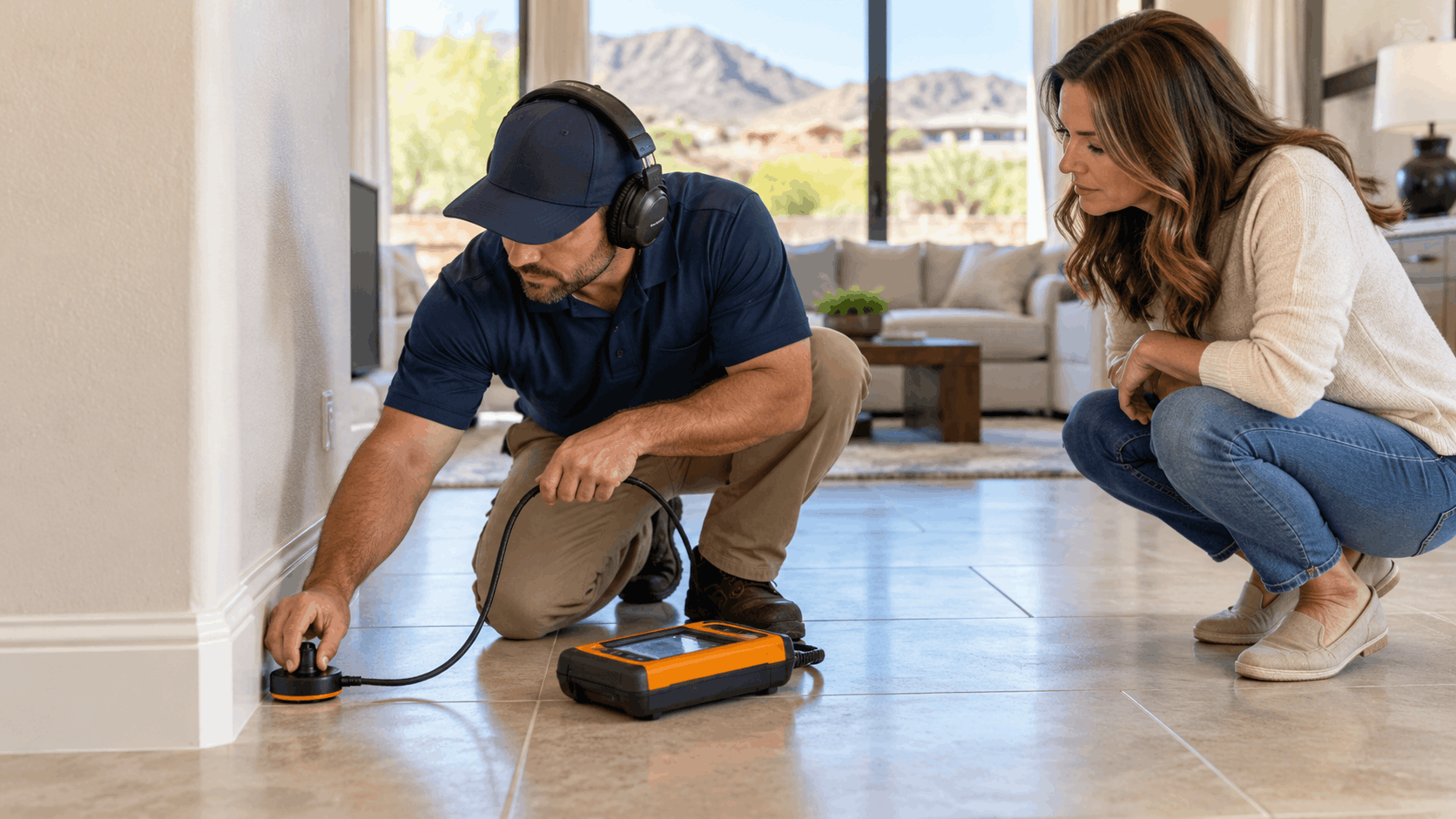
Electronic leak detection and acoustic listening equipment are the main tools for locating a slab leak. Acoustic detection works by listening for the sound of water escaping under pressure. A pinhole pushing water into the slab makes a distinct noise, and sensitive equipment can pick it up through the concrete.
By moving the listening equipment across the floor and comparing signal strength, a trained technician can narrow the leak down to a small area. This is how the crew pinpoints the leak without opening anything. The louder and clearer the signal, the closer the sensor is to the actual break.
Electronic methods add precision on top of listening. Combined, these tools tell the crew where the leak sits beneath the concrete rather than forcing them to open the floor to look. That precision is the whole reason a floor-saving repair is possible.
Getting the location right the first time protects the floor and keeps the job contained. It is far better to spend the time pinpointing than to open the slab in the wrong spot and have to patch two places instead of one.
Pressure Testing and Isolating the Line
Before any repair, the crew confirms it is dealing with a supply leak and not a drain issue. Pressure testing is how that is done. By pressurizing the supply system and watching whether it holds, a technician can verify that water is escaping from a pressurized line.
Isolating hot versus cold lines narrows it down further. If the hot line will not hold pressure while the cold line does, the crew knows the leak is on the hot side, which also lines up with a warm spot on the floor. Separating the two lines turns a vague symptom into a specific target.
This step decides whether a no-dig fix applies at all. A supply slab leak can often be rerouted or lined without major demolition. A drain problem calls for a different approach entirely, so confirming which one you have changes everything about the plan.
Skipping this test is how repairs go wrong. Pressure testing and line isolation turn guesswork into a diagnosis, and a diagnosis is what a floor-saving repair depends on.
Why Pinpointing First Protects Your Floor
Knowing the exact spot and the pipe material together lets the crew choose the least invasive repair. If the leak is in a reachable spot and the pipe is otherwise sound, a small access opening may be all that is needed. If the material is suspect, a reroute may make more sense. Either way, the decision rests on accurate detection.
Pinpointing also prevents the worst outcome, which is opening concrete in the wrong place. Every opening in a slab means a patch, a disruption, and flooring to repair afterward. The fewer and smaller the openings, the better the result for the homeowner.
The pipe material drives the choice as much as the location does. A single pinhole in good copper is a candidate for a spot repair. A pinhole in aging copper, polybutylene, or Kitec points toward a reroute or repipe, because the rest of the line is likely to follow.
This is why detection and planning happen before any tools touch the floor. The repair plan is only as good as the information behind it, and good information keeps your flooring, your schedule, and your budget intact.
The No-Dig Repair Methods That Save Your Floor
Once the leak is located and the pipe is identified, the crew can choose from several repair methods that avoid or minimize breaking the slab. Each one fits a different situation. The table below lays out the options and when each is the right call for a Summerlin home.
| Method | How It Works | Best Fit |
|---|---|---|
| Reroute | Abandon the under-slab section, run new line through walls or attic | Aging copper or suspect polybutylene |
| Epoxy lining | Seal the pipe from the inside, no slab opening along the run | Pipe suitable for coating, limited damage |
| Spot repair | Small access opening to fix one section, then patch | Single isolated pinhole in a reachable spot |
| Whole-house repipe | Replace the supply system entirely | Polybutylene, Kitec, or widely aging copper |
Rerouting the Line Overhead or Through Walls
Rerouting means abandoning the leaking under-slab section and running a new line through the walls or the attic instead. The old pipe stays in the slab, capped off, and the water takes a new path above the floor. The floor itself stays intact.
This is often the better call on aging copper or suspect polybutylene. Rather than fighting to repair a line that is likely to fail again, the crew routes around the problem entirely with fresh pipe. It avoids excavation through caliche and keeps the concrete closed.
The attic and interior walls give plenty of room to run a new line in most Summerlin homes. Because the new pipe is accessible, future service is easier too, which is a quiet long-term benefit of going overhead rather than back under the slab.
A reroute is frequently the cleanest answer when the leaking section is deep in the slab or hard to reach. It trades a difficult underground repair for a straightforward run through spaces the crew can actually get to.
Epoxy Pipe Lining From the Inside
Epoxy pipe lining seals the existing pipe from the inside. A coating is applied along the interior of the line, creating a new sealed surface that can stop a leak without opening the slab along the whole run. It is a trenchless option, which is why it appeals to homeowners trying to protect their floors.
Lining suits situations where the host pipe is still structurally sound enough to carry a coating and the goal is to seal rather than replace. It works along the length of a run without the digging a full replacement would require, which is its main advantage.
It does not suit every case. Pipe that is too far gone, or a material where the fittings are the failure point, is not a good candidate for coating. In those situations a reroute or repipe is the sounder choice, and the detection step is what reveals which camp a given home falls into.
The honest framing is that lining is one tool among several. It shines where it fits and is the wrong answer where it does not, so it is matched to the specific pipe and the specific leak rather than applied by default.
Spot Repair Through a Small Access Opening
When a single pinhole sits in a reachable spot and the rest of the pipe is sound, a spot repair is often the least invasive fix of all. The crew opens a small, targeted section of the slab directly over the leak, repairs that length of pipe, and then patches the opening.
This is far less disruptive than tearing up the whole floor. Instead of exposing an entire run, the opening is only as large as it needs to be to reach and repair the break. The flooring around it stays untouched.
Spot repair makes the most sense on otherwise good pipe with one isolated fault. In newer Summerlin homes with copper or PEX, a single leak is often exactly that, so a targeted repair handles it cleanly. The precision of the detection step is what keeps the opening small.
After the repair, the slab opening is patched and the flooring restored over it. One clean fix in one clean spot is the goal, and accurate pinpointing is what makes it achievable.
When a Full Repipe Beats Chasing One Leak
Sometimes the smartest repair is not a repair at all but a replacement. On polybutylene, Kitec, or aging copper, one pinhole often signals more on the way. In those cases a whole-house repipe is frequently the better spend than paying for one slab repair after another.
The logic is simple. If the whole line is the same age and the same material, fixing one spot leaves the rest of the system just as likely to fail. Repeated slab openings add up in both cost and disruption, and each one only addresses a symptom.
A repipe replaces the supply system with new pipe routed through accessible spaces, usually leaving the slab closed. It resets the clock on the entire system rather than on a single foot of pipe. For a home with polybutylene or Kitec, it also removes a material known to keep causing trouble.
This is exactly why identifying the material comes first. The material tells you whether you are looking at a one-off repair or a system that is reaching the end of its life, and that answer shapes where your money is best spent.

Need Help in Las Vegas?
Active Plumbing serves Las Vegas and all of Las Vegas Valley.
What Slab Leak Repair Costs in the Summerlin Area
Cost is on every homeowner's mind, so here are the typical market ranges for this work in the Las Vegas Valley. These are typical ranges for the area, not a quote, and the actual price for a specific job depends on that job. A written price is given before work begins.
| Service | Typical Range |
|---|---|
| Slab leak detection | $150 to $300 |
| Electronic leak detection | $150 to $350 |
| Slab leak repair | $500 to $3,000 |
| Burst pipe repair | $200 to $800 |
| Whole-house repipe | $4,000 to $15,000 |
Detection and Repair Price Ranges
Finding the leak is the first cost. Slab leak detection typically runs $150 to $300, and electronic leak detection typically runs $150 to $350. That spend is what buys the precise location, and it is what makes a floor-saving repair possible rather than a gamble.
The repair itself typically falls between $500 and $3,000 for slab leak repair. That is a wide band because slab leaks vary so much. A single accessible pinhole lands near the low end, while a harder-to-reach leak or one that calls for more involved work lands higher.
Where the leak sits and how it is reached are the biggest factors inside that range. A spot repair through a small opening sits differently on the scale than a job requiring more extensive access. Detection is what tells you which end of the range your situation is near.
Treating detection and repair as two connected steps helps a homeowner understand the total. The detection cost is not wasted money. It is what keeps the repair cost from ballooning through unnecessary demolition.
Reroute and Repipe Cost Compared
When one leak signals more to come, it helps to compare a repeated-repair path against a one-time replacement. A whole-house repipe typically runs $4,000 to $15,000. That is a real number, but it buys a complete new supply system rather than a single fix.
Against that, a burst pipe repair typically runs $200 to $800, and a slab leak repair runs $500 to $3,000. One repair is clearly cheaper than a repipe. The question is how many repairs you are likely to face on aging or failure-prone pipe.
On polybutylene, Kitec, or uniformly aging copper, the arithmetic can shift toward replacement. Three or four spot repairs over a couple of years can approach the cost of a repipe while leaving you with old pipe between the fixes. That is the comparison worth running.
On newer copper or PEX with one isolated fault, the opposite is true. A single repair handles it, and a repipe would be overkill. The material and the condition of the line decide which path saves money over time.
What Makes a Summerlin Slab Job Cost More
Caliche is the local factor that pushes costs up wherever digging is involved. Because it is a cemented hardpan, excavation through it is slower and more expensive than digging through softer ground. Any job that requires getting under the slab from outside feels that difference.
Flooring type matters too. Opening a slab under tile, stone, or custom finishes and then restoring it costs more than under simpler flooring. The location of the leak within the home affects access, and access affects labor.
These variables are exactly why a flat price cannot be promised in advance. The same leak under different flooring, in a different spot, on a different pipe material, produces a different number. That is normal for slab work.
For that reason, the actual price for a specific job is given in writing before work begins. The ranges here tell you what to expect for the area. The written figure for your home comes after the leak is located and the material confirmed. If a rebate or utility program is part of your plan, confirm current terms with the provider, since those change.
Permits, HOAs and Jurisdiction in Summerlin
Summerlin is unusual because it spans two permitting authorities. Getting the jurisdiction right matters before any permitted work, because filing with the wrong department causes delays. The authority is confirmed from the address, not from the name Summerlin.
On top of the city-or-county question, many Summerlin villages have active homeowner associations whose rules can affect timing. Both pieces, the government authority and the association, are worth sorting out early so the repair moves without surprises.
City of Las Vegas or Unincorporated Clark County
Summerlin North and Summerlin West lie within the City of Las Vegas, while Summerlin South is unincorporated Clark County, bounded by Charleston Boulevard, Russell Road, Hualapai Way, and the conservation area. That split is the whole reason the name alone does not tell you who governs a given home.
The City of Las Vegas runs its own building department and its own permit counter. Unincorporated Clark County runs its own. An address in Summerlin South is a county address even though residents call it Summerlin, and an address in the north or west is a city address.
Confirming the permitting authority from the address is a routine first step. Summerlin Parkway, designated State Route 613, runs from the CC 215 Beltway east to US 95 and threads through the community, but a road does not decide jurisdiction. The parcel does.
Filing with the wrong department means lost time while the paperwork is redirected. Establishing the correct authority up front avoids that, which is why our crew pins it down before quoting permitted work.
When a Slab Leak Repair Needs a Permit
Permit needs are decided by the city or county with jurisdiction over the specific address, so the permit position should be confirmed for the address rather than stated as one valley-wide rule. What applies in Summerlin North may differ from what applies in Summerlin South simply because the authority is different.
The plumbing code in force here is the 2024 Uniform Plumbing Code with the Southern Nevada Amendments, adopted across the valley's jurisdictions. The City of Las Vegas adopted it effective January 5, 2026, and Clark County effective January 11, 2026. Your building department applies that code to your address.
Work requiring a permit must be performed by an appropriately licensed contractor. A homeowner is entitled to ask for a license number and to verify it. That protects you in a market with a real unlicensed trade problem.
Because the rule depends on the exact parcel, the honest approach is to confirm the permit position for your address with the governing building department before work that needs one begins. Our crew handles that confirmation as part of the job.
HOA and Association Responsibility in Older Villages
Sun City Summerlin has its own community association, along with golf courses and recreation centers. In a community like that, when something backs up or leaks, there can be dual responsibility between the association and the homeowner, depending on what failed and where.
That shared responsibility is worth sorting out before repairs start. Who is responsible for what is set by the association's governing documents, and those documents differ from one community to the next. The answer for your home comes from your association, not from a general rule.
Association review can also add time to a project in some communities. Rather than assume a fee or a timeline, a homeowner is better served by checking directly with the association about any approval path and how long it takes.
For a slab leak inside the home on the homeowner's own supply line, the repair is usually the owner's responsibility, but confirming with the association removes any doubt. It is a small step that prevents a dispute later.

Need Help in Las Vegas?
Active Plumbing serves Las Vegas and all of Las Vegas Valley.
How Active Plumbing Handles a Summerlin Slab Leak
Our process on a slab leak is built to protect your floor and give you a clear decision. It runs in order: confirm the jurisdiction and the pipe, pinpoint the leak, lay out the floor-saving options, and give a written price before any work starts.
That sequence exists because every step depends on the one before it. You cannot pick a repair method without knowing the pipe, and you cannot quote the work without knowing the leak location. We work through it in order so the plan fits your home.
Confirming the Jurisdiction and the Pipe First
The crew confirms which department governs the address before anything else, since Summerlin spans the City of Las Vegas and unincorporated Clark County. Getting the permitting authority right from the start keeps any permitted work moving without a detour.
Next comes the pipe. Summerlin villages carry copper, polybutylene, Kitec, or PEX depending on the era, and the material is checked on site rather than assumed from the build year. Two homes built the same year can hold different pipe, so the only reliable answer is the one found on the property.
That on-site confirmation shapes the whole repair. Copper in good condition points one way, polybutylene or Kitec points another, and the detection and repair plan follows from what the pipe actually is. Skipping this step risks recommending a fix that does not match the material.
Doing jurisdiction and pipe first means the rest of the visit is grounded in facts about your specific home. It is the difference between a plan built for your house and a plan built on assumptions.
Detection, the Repair Options and a Written Price
With the pipe known, the leak is pinpointed using detection equipment so the crew knows exactly where it sits. From there, the floor-saving options are laid out for you: reroute, lining, spot repair, or repipe, with a plain explanation of which fits your situation and why.
You see the choices before any work begins. The goal is a decision you understand, not a surprise. Once the path is chosen, a written price is given before any work starts, so you know the number up front rather than after the fact.
For urgent situations, response is 30 to 60 minutes across the Las Vegas Valley, including the Summerlin villages against the Spring Mountains. A slab leak wastes water every hour it runs, so getting a technician on site quickly limits the damage and the bill. Our emergency plumbing team covers exactly these calls.
The combination of fast response, accurate detection, clear options, and a written price is how a slab leak goes from a worrying warm spot to a handled repair. Each step is there to keep you informed and your floor intact.
Licensed, Local and Verifiable
Active Plumbing is a fourth-generation family business that has served the Las Vegas Valley since 1991. The owner is Edward Schmitt, and some of the owners are US military veterans. That is real local history in a market where longevity is hard to fake.
The company holds Nevada plumbing license NSCB #0047021, along with the certifications required for the work it performs. Contractor licensing in Nevada is statewide through the Nevada State Contractors Board, and any homeowner can verify a license free.
You can check the license at nvcontractorsboard.com, where classification, status, bond, and workers compensation are all public record. Asking for and verifying a license number is a fair thing to do, and we encourage it.
Being licensed, local, and verifiable is what separates a trustworthy repair from a risk. For a job that involves opening or routing around a home's water supply, that matters. More about the company is on our about page.
Ready to Stop That Slab Leak?
If you have a warm spot on the floor, a running-water sound with everything off, or a water bill you cannot explain, call Active Plumbing at (702) 438-3357. A technician can reach your Summerlin home in 30 to 60 minutes, pinpoint the leak with detection equipment, confirm the pipe on site, and give you a written price before any work starts.
Frequently Asked Questions
- Can every slab leak be fixed without breaking the floor?
- Many can, but not all. Rerouting the line through walls or the attic, or lining the pipe from the inside, can stop a leak without demolishing the floor. Whether one of those applies depends on where the leak sits and what pipe is in the ground. Detection decides which option fits. Some leaks still call for a small access opening in the slab, which is far less than tearing up the whole floor.
- How do I know if I have a slab leak and not a drain leak?
- A supply slab leak tends to show a warm spot on the floor, the sound of running water with every fixture off, and a jump in the water bill, because a pressurized line leaks constantly. A drain issue behaves differently, since drain lines are not under pressure. Pressure testing confirms which one you have by checking whether the supply system holds pressure. That test is what tells the crew a no-dig repair is on the table.
- How much does slab leak repair cost in Summerlin?
- Typical area ranges are slab leak detection $150 to $300 and slab leak repair $500 to $3,000. The repair range is wide because leak location, access, and flooring type all affect the final number. These are typical ranges for the area, not a quote. The actual price for your specific job is given in writing before any work begins, after the leak is located and the pipe material confirmed on site.
- Is it better to reroute the line or repair the spot?
- A spot repair suits a single isolated pinhole in a reachable spot on otherwise sound pipe. Rerouting or a full repipe suits aging copper, polybutylene, or Kitec, where one leak usually signals more on the way. The pipe material is the deciding factor. On newer copper or PEX, a spot repair often handles it. On failure-prone material, routing around or replacing the line is usually the smarter long-term spend.
- Why do Summerlin copper pipes get pinhole leaks?
- Early Summerlin copper is now at the age where pinhole leaks begin, especially on hot lines and under-slab runs that take the most stress. Very hard water at about 280 parts per million, roughly 16 grains per gallon, deposits scale inside the lines that narrows the bore and stresses the pipe wall over years. Heat speeds that process, which is why hot lines tend to fail first. Once one pinhole appears, the rest of the aged line is often close behind.
- Does my Summerlin home have polybutylene or Kitec?
- Homes built before about 1995 may have polybutylene, and homes from 1995 to 2007 may have Kitec. Santa Barbara in The Hills South from about 1997 and parts of The Vistas from 2000 onward fall inside the Kitec window. But the build year is only a clue. The pipe must be confirmed on site rather than assumed, because homes of the same era can hold different materials, and the material drives the whole repair decision.
- Do I need a permit to fix a slab leak in Summerlin?
- It depends on your specific address. Summerlin North and West fall in the City of Las Vegas, while Summerlin South is unincorporated Clark County, and each runs its own permit counter under the 2024 Uniform Plumbing Code with the Southern Nevada Amendments. The permit position should be confirmed for your address rather than treated as one valley-wide rule. Work that requires a permit must be done by a licensed contractor, so filing with the correct department matters.
- Will my HOA affect a slab leak repair in Sun City Summerlin?
- Sun City Summerlin has its own community association, so there can be dual responsibility between the association and the homeowner depending on what failed and where. Who handles what is set by the association's governing documents, which differ by community. Association review can add time in some cases. Rather than assume a fee or a timeline, check directly with your association about any approval path and how long it takes before repairs begin.
- How fast can someone get to my Summerlin home?
- Response is 30 to 60 minutes across the Las Vegas Valley, including the Summerlin villages set against the Spring Mountains and near Red Rock Canyon. A slab leak wastes water every hour it runs and can keep damaging flooring and surrounding materials, so a quick arrival limits both the damage and the water bill. Getting a technician on site to locate the leak early keeps the eventual repair smaller and cheaper.
- Can a slab leak damage my foundation if I wait?
- Water running under the slab does not stop on its own, and over time it can damage flooring, swell baseboards, and harm surrounding materials while driving up the water bill. The longer it runs, the more it spreads and the larger the repair becomes. Locating and fixing it early keeps the job contained to one spot rather than letting it grow. That is why acting on a warm spot or a running-water sound promptly pays off.
Licensed plumbing professionals serving Las Vegas and Las Vegas Valley.
Licensed in Nevada · License #0047021
Last updated on
Why trust Active Plumbing?
Founded in 1991, Active Plumbing is a licensed and insured plumber serving Las Vegas and Las Vegas Valley. All content is reviewed by our licensed technicians.

Need Help in Las Vegas?
Active Plumbing serves Las Vegas and all of Las Vegas Valley.
Related Articles

5 Top Reasons Slab Leaks Happen In Las Vegas Homes
Discover the 5 main reasons slab leaks occur in Las Vegas homes, from desert soil movement to hard water damage, plus prevention tips and repair options from local experts.
Electronic Leak Detection on a Spanish Trail Estate Before Anyone Breaks Concrete
How electronic leak detection pinpoints a hidden slab leak in a Spanish Trail estate before anyone breaks concrete, plus costs, copper failures, HOA rules and permits.
Repiping a 1989 Sun City Summerlin Home Without Disturbing Finished Rooms
How to repipe an original 1989 Sun City Summerlin home through the attic and walls with minimal cutting, what it costs in the valley, and the permit and HOA tracks.