Repiping a 1989 Sun City Summerlin Home Without Disturbing Finished Rooms
Key Takeaways
- Original copper in the earliest 1989 Del Webb phases is now around thirty-five years old, the age where pinhole leaks begin, with hot lines failing first.
- In a single-story slab home, new supply lines run overhead through the attic and drop inside walls, so the old under-slab copper is abandoned in place and finished rooms stay largely intact.
- A whole-house repipe typically runs $4,000 to $15,000 in the Las Vegas Valley; the actual price is given in writing before work begins.
- The valley's very hard water at 280 ppm, about 16 grains per gallon, deposits scale that narrows pipe bore and clogs aerators and showerheads before a line finally leaks.
- Sun City Summerlin sits inside City of Las Vegas limits, so that building department permits a repipe; the 2024 code cycle took effect there January 5, 2026.
- Interior repipe work usually needs the city permit but not HOA architectural review, which applies only to exterior-facing work under NRS Chapter 116.
- Protect older homeowners by verifying the NSCB license at nvcontractorsboard.com, getting the price in writing, and refusing doorstep decisions.
- Replacing original angle stops, supply connectors, fill valves, a worn regulator, and a seized main shut-off during the repipe renews the whole system in one visit.
In This Article
Picture an original Del Webb home off Del Webb Boulevard, built in that first 1989 phase of Sun City Summerlin. It has quietly served the same couple for decades, and the copper behind its walls is the copper the builder installed. Lately a damp spot keeps showing up near a hot-water line, it gets patched, and a few months later another one appears somewhere else. That pattern has a name, and it points at the whole system rather than one bad spot.
When original copper reaches thirty-five years in very hard valley water, pinhole leaks start showing up on the hot lines first, and the under-slab runs are the hardest and most expensive to reach. At that point patching one leak at a time stops making sense. A full repipe ends the cycle, and in a finished, lived-in home it can be done with far less demolition than most owners expect.
Why 1989 Homes in Sun City Summerlin Are Reaching Repipe Age?
Sun City Summerlin is the oldest part of Summerlin by a clear margin. Del Webb began building it in 1989, and the community now holds roughly 7,700 homes across its phases. The earliest of those homes are thirty-five years old, which puts their original plumbing at the far end of what copper and its fittings were ever meant to deliver.
The water running through that copper is the other half of the story. The Southern Nevada Water Authority reports the valley's water at 280 parts per million, or about 16 grains per gallon, which is categorized very hard. Very hard water deposits mineral scale throughout a system, and inside aging copper that process works alongside normal corrosion to bring lines to the point of failure.
- The earliest phases are slab-on-grade with copper supply lines, some of them run under the slab.
- Hot lines tend to fail before cold lines, because heat speeds up the chemistry inside the pipe.
- Pinhole leaks arrive in a pattern, not as a single event, once copper reaches this age.
- Scale narrows the bore of the pipe long before a line actually weeps, so flow drops first.
- Under-slab runs are the hardest to access, which makes an early slab leak a turning point.
Copper From the Earliest Del Webb Phases
The homes built in that first wave off Del Webb Boulevard and Sun City Boulevard are single-story, slab-on-grade construction with copper supply piping. Copper was a sound, widely used material in its day, and plenty of it has lasted. The issue is not that copper was a mistake. The issue is time, and these homes have had a great deal of it.
At thirty-five years, copper reaches the stage where small pinhole leaks begin to show up. The thin wall of the tubing, worn from the inside over decades, finally gives way at its weakest spots. Hot-water lines go first because elevated temperature accelerates the internal wear, so the kitchen and bathroom hot runs are often where an owner notices the first damp patch or stain.
Under-slab runs raise the stakes. When a line buried in the concrete starts to leak, the water has nowhere obvious to go, and the first sign can be a warm spot on the floor, an unexplained jump in the water bill, or the sound of running water with every fixture off. Reaching that pipe means either opening the slab or finding another path for a new line, which is where the planning for a low-disruption repipe begins.
Because the build era is so consistent across these phases, our team has a good idea of what is likely behind the walls before we arrive. That said, the pipe always gets confirmed on site. Some homes have seen partial updates over the years, and the only way to plan the work correctly is to look at the actual system in the actual house.
How Very Hard Water Wears the System From Inside
Hard water is the single biggest driver of plumbing wear in this valley, and the figure is not a guess. SNWA publishes the valley's hardness at 280 ppm, roughly 16 grains per gallon, which sits firmly in the very hard category. That mineral load, mostly calcium and magnesium, does its damage quietly and continuously.
As water moves through the pipe, scale builds on the interior walls. Over the years this narrows the bore, so the effective diameter of a supply line shrinks even though the pipe looks the same from outside. The first thing a homeowner notices is not a leak but weaker flow, especially at the fixtures farthest from the water heater.
The same scale clogs the small passages in the system: aerators on faucets, the tiny holes in a showerhead, and the internal channels of mixing valves and cartridges. Residents often describe this as the water just not coming out like it used to, or a shower that has gone weak no matter how much the valve is opened. These are all symptoms of the mineral content working on narrow passages.
Scale and corrosion together bring a copper line to the point where it finally weeps. By then the pipe has usually been losing capacity for a long time. A repipe addresses both problems at once, replacing the worn tubing and restoring the full interior bore that scale had been eating into for decades.
Signs an Original Home Is Due
The clearest sign is a run of pinhole leaks. One leak on old copper can be bad luck. A second and a third, in different parts of the house over a year or two, is the system telling you it has reached the end. When patch repairs start stacking up, the math shifts toward replacing the whole run.
Hot lines failing first is a telling pattern. If every leak seems to land on a hot-water line while the cold side holds, that matches exactly what thirty-five-year-old copper does in this water. It is a strong indicator that the rest of the hot system is not far behind, even where it has not yet leaked.
Dropping water pressure across the whole home is another signal, though it needs a check to interpret. Weak flow can come from scale narrowing the pipes, from a failing pressure regulator, or from a line that is already compromised. A two-minute incoming pressure test during the visit separates these causes and tells us whether a regulator is also due.
The decision point is straightforward. When you are paying to open a wall and fix one spot, then doing it again a few months later, a whole-house repipe usually comes out ahead on both cost and peace. It stops the chasing, and it does it with one planned job instead of a string of emergencies.
Get Your Quote
Tell us what's going on and we'll get back to you. We're open 24/7.
Repiping Without Tearing Up Finished Rooms
The fear most owners have about a repipe is the mess. They imagine every wall opened, tile broken, and a finished home turned into a construction zone. In a single-story slab home like these, the reality is usually far gentler, because the route the new pipe takes can avoid most of the finished living space entirely.
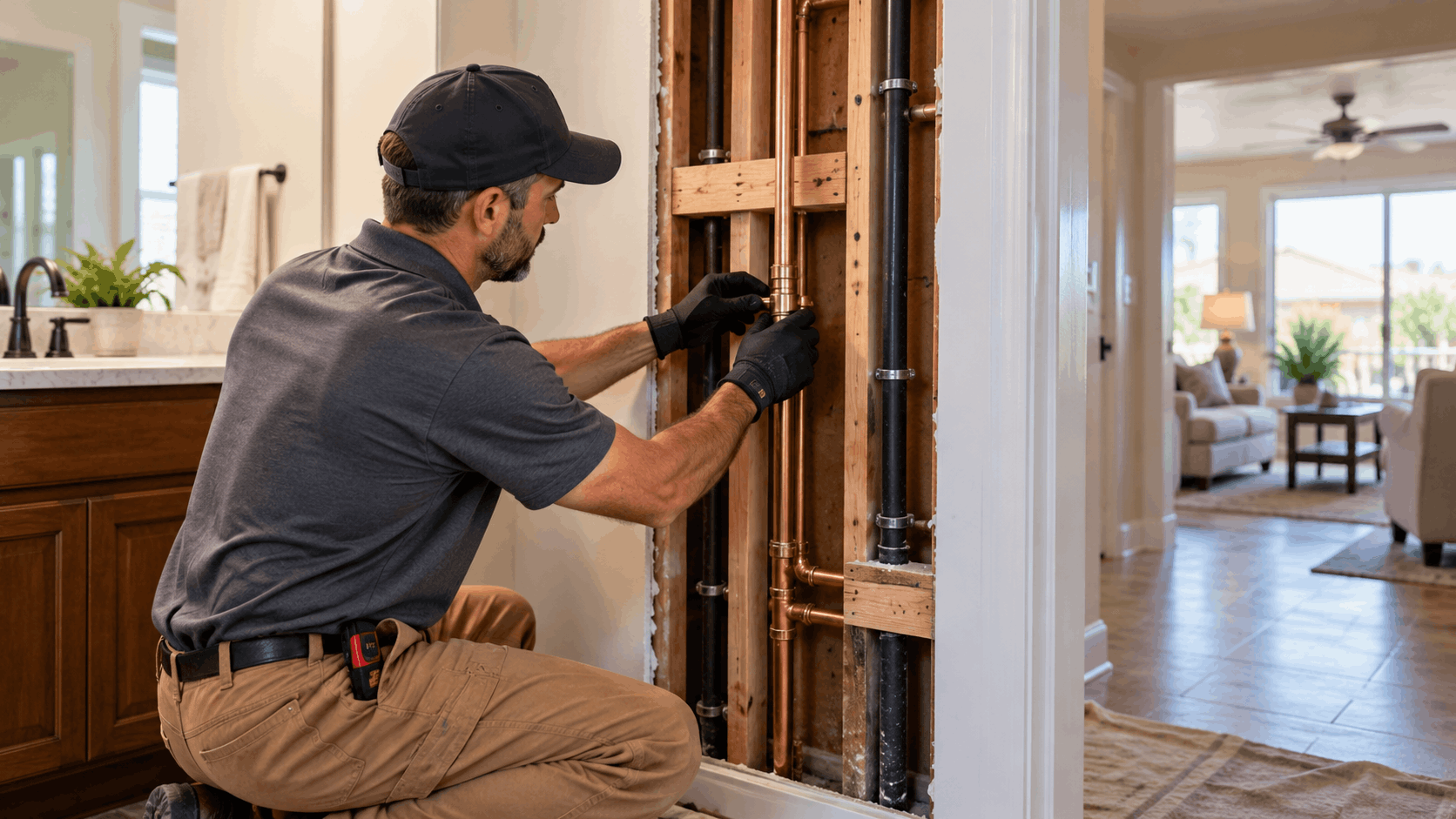
The thinking behind route choice is simple: go where there is already open space. An attic above the ceiling and the hollow interior of walls give a path for new supply lines that touches drywall only at a handful of planned points. The old failing copper, including the under-slab runs, gets abandoned in place rather than ripped out, which spares the floors.
Good planning is what makes a clean repipe possible. Before any pipe is run, the route is mapped so that access happens where it does the least harm, and the number of openings is kept small. The goal is a finished home that looks almost untouched when the water comes back on.
Running New Lines Through Attics and Interior Walls
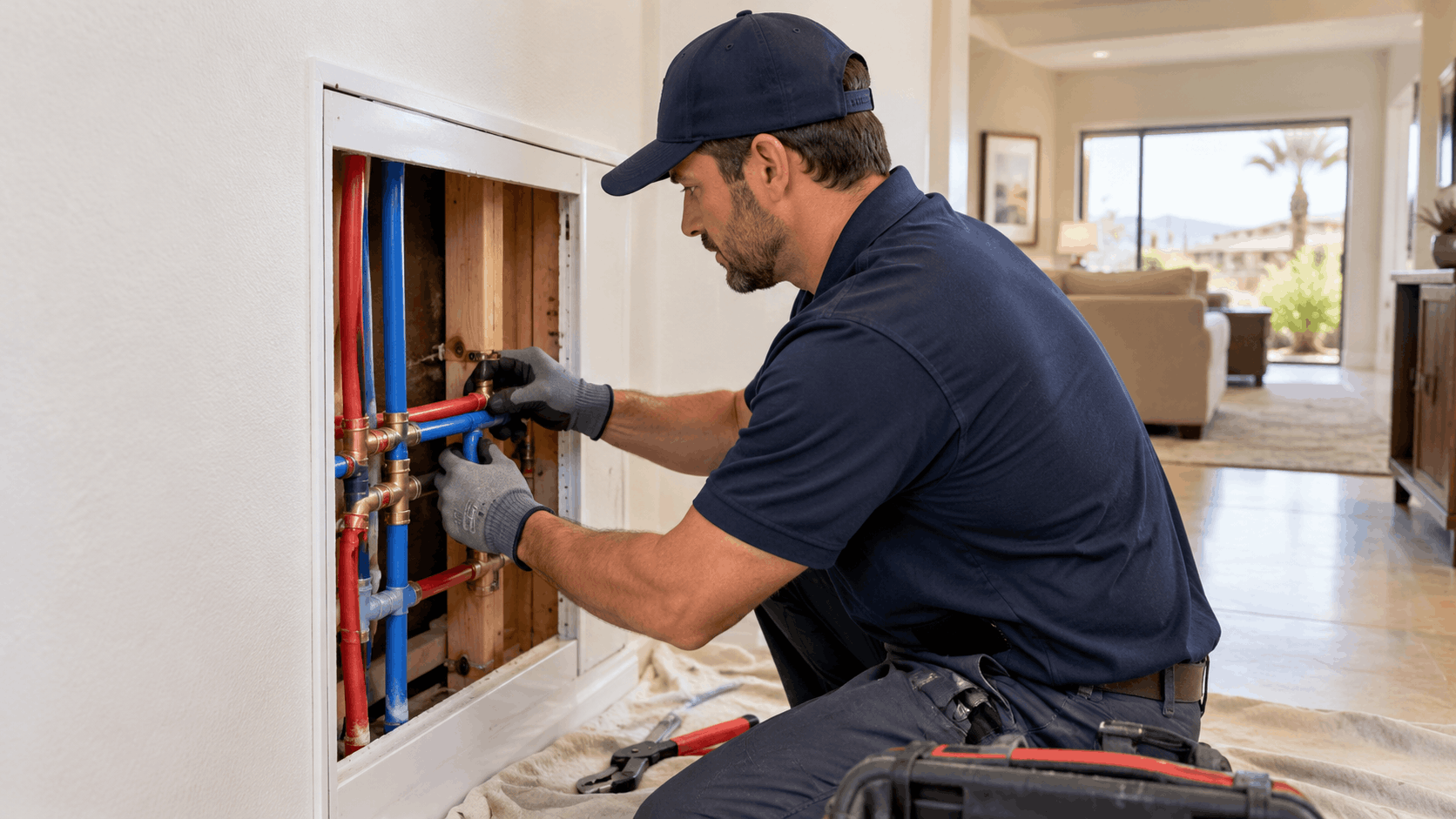
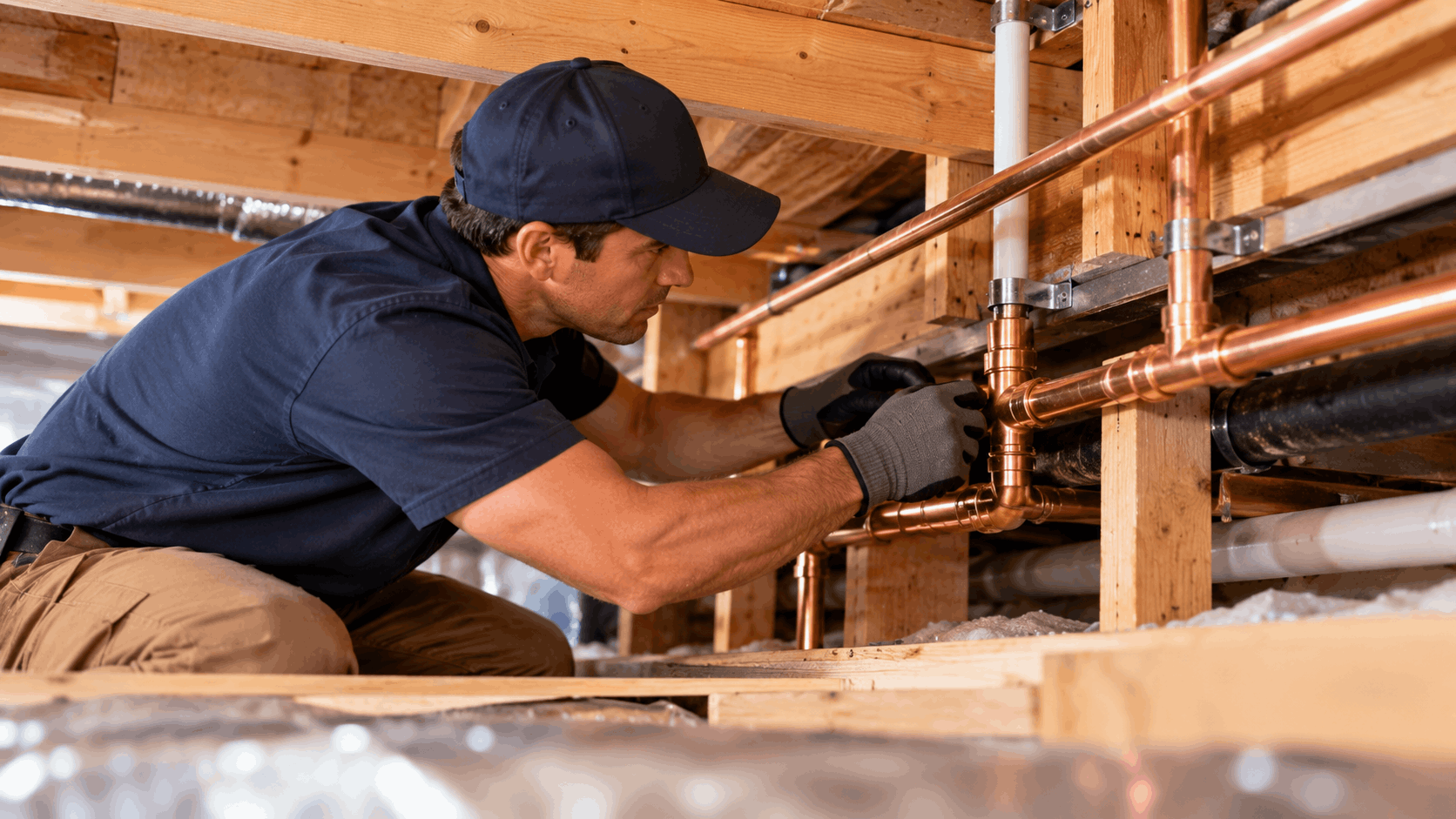
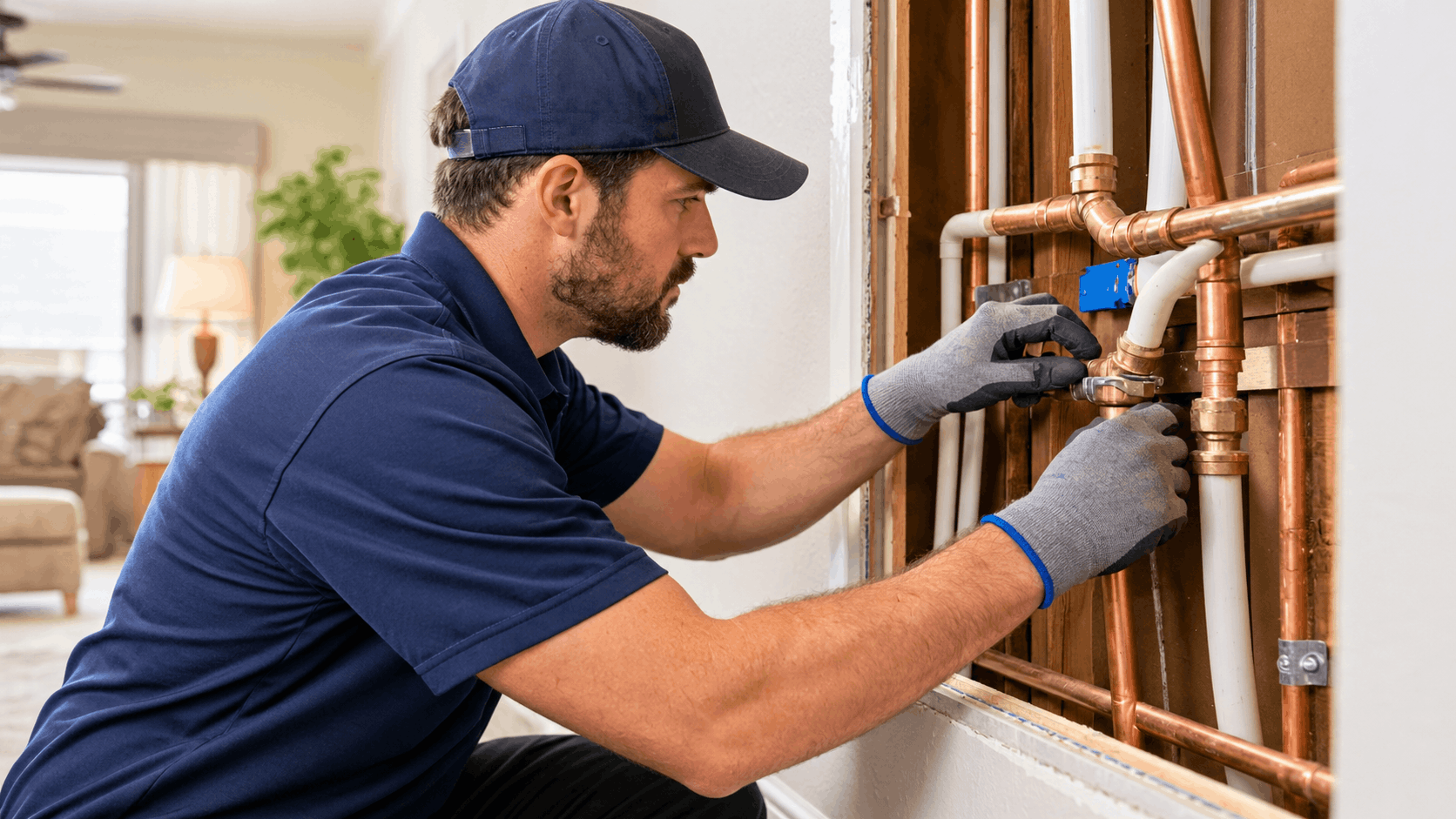
In a slab home with no second floor, the attic is the highway. New supply lines are commonly routed overhead, run across the attic, and then dropped down inside the walls to reach each fixture. This overhead approach is the core trick that keeps these jobs clean.
Running new pipe this way means the old copper buried in or under the slab never has to be dug out. It is isolated, capped, and left in place. Nobody jackhammers a finished floor, nobody breaks tile, and the concrete stays whole. The new system simply takes a different, accessible path to the same fixtures.
Modern repipes in this configuration most often use PEX, a flexible tubing that bends around framing and feeds down into walls with far fewer connections than rigid pipe. Fewer joints inside a wall means fewer future failure points, and the flexibility lets the installer work the line into tight attic and wall cavities without opening long runs of drywall.
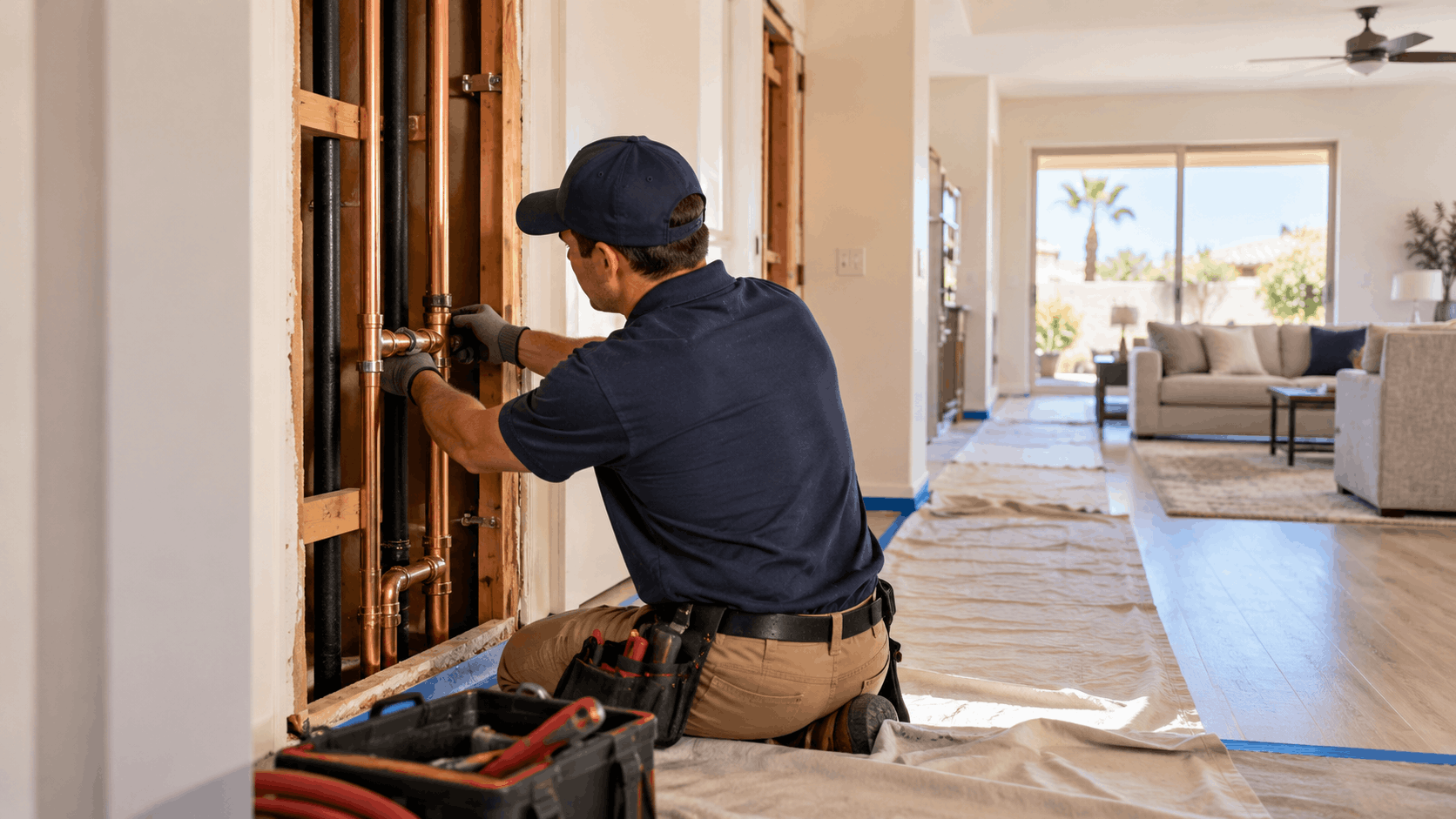
Dropping the lines inside existing walls is where a small amount of cutting comes in, and that cutting is planned to land in the least noticeable places. The attic carries the bulk of the run, and the wall only has to be opened near the fixture it feeds. This is why a whole home can be repiped while most of its rooms stay fully intact.
Minimal Access Points and Where Cuts Happen
The difference between a messy repipe and a clean one comes down to where the openings land. A thoughtful route puts access points at closets, inside the garage, behind vanities, and in other low-visibility spots so the finished living areas are protected. Cutting into the back of a closet is a very different thing from cutting into a living room wall.
Each fixture needs a connection, so some openings are unavoidable. The craft is in making them few and small. Instead of opening a long stretch of wall, an experienced installer makes a compact, deliberate cut right where the drop-down meets the fixture, then threads the new line to it. A tidy opening is quick to patch and easy to hide.
Garages and utility spaces are especially useful here because they are already working rooms. Running access through a garage wall or a laundry area keeps the knife out of the kitchen and bedrooms. Where the plumbing geography allows it, these spaces take on most of the openings.
Planning the route before cutting anything is the step that pays off most. By walking the home, confirming the pipe, and mapping where every fixture ties in, the installer can commit to the smallest set of openings that still reaches everything. That is what turns a major-sounding project into a controlled, low-impact job.
Rerouting Instead of Breaking the Slab
When the problem is an under-slab leak, there are two honest paths: break the slab to reach the pipe, or reroute a new line overhead and leave the old one behind. In a finished home, rerouting almost always causes less disruption than opening the floor.
Breaking the slab means cutting through the concrete, excavating down to the pipe, making the repair, and then restoring the floor covering on top, whether that is tile, carpet or hardwood. In a lived-in house that is dust, noise, and a floor that has to be rebuilt. For a single leak it is sometimes the right call, but for an aging system it rarely is.
Rerouting takes the same overhead path the full repipe uses. The problem line is isolated and abandoned, and a new run goes up into the attic and back down to the fixture it serves. The floor is never touched, which protects exactly the finished rooms an owner is most worried about. Our slab leak detection and repair work often leads to this conversation, because once a slab leak appears on old copper, rerouting the whole system is frequently the smarter long-term move.
The right choice still depends on the specific leak and the specific home. A single isolated failure on an otherwise sound system might be worth a targeted repair. A slab leak on a thirty-five-year-old copper system is usually a sign the whole run is at risk, and a reroute that doubles as the start of a repipe makes more sense than opening the floor for one spot.
Protecting Floors, Furniture and Finishes During the Work
A repipe is still indoor work, so how the crew treats the home matters as much as the pipe itself. Floor protection goes down along the work paths, furniture near the work gets covered, and the area is kept tidy as the job moves through the house. These are basics, and they are not optional in a home someone lives in.
In this community those details carry extra weight. Residents notice and talk about identification, tidiness, and whether the floors were protected. Work that is done cleanly in one household gets mentioned at the recreation center, and work that leaves a mess travels just as fast through the same network.
Covering finishes before cutting keeps drywall dust off furniture and surfaces, which makes the cleanup at the end quick rather than a second project. Containing the dust at each opening, rather than letting it drift through the home, is part of a professional repipe and a courtesy to a homeowner who has to live there every evening.
The access openings made for the repipe are closed, patched, and left ready for paint. Keeping those openings few and in low-visibility spots is what keeps the finish work small. A clean, well-planned route protects both the budget and the home, which is the whole point of doing it this way.
Need Help in Las Vegas?
Active Plumbing serves Las Vegas and all of Las Vegas Valley.
What a Repipe Actually Fixes in These Homes
It helps to be clear about what a new system solves, because a repipe is a meaningful investment and an owner deserves to know what they get for it. It ends the leak cycle, restores flow the scale had taken, and gives a natural chance to replace the worn small parts that always travel with aging copper.
A repipe is also the one moment when the walls are open and access is easy. That makes it the sensible time to handle the fittings and valves that are well past their service life in a thirty-plus-year-old home. Doing them now avoids paying twice to open the same wall later.
Stopping the Cycle of Recurring Leaks
The biggest thing a repipe fixes is the pattern. Replacing the full run of aging copper ends the one-pinhole-after-another cycle, rather than patching each new failure as it surfaces. Instead of living with the next leak hanging over you, the system is new and the risk resets.
Patching old copper treats the symptom. The spot that failed gets fixed, but the rest of the pipe is the same age, in the same water, and under the same wear. That is why a patch so often buys months rather than years before the next damp spot appears somewhere new.
Copper failure on a thirty-five-year-old system is a whole-system condition, not a local accident. Once the first few pinholes arrive, the material has reached its limit across the home. A repipe acknowledges that reality and replaces the worn tubing all at once, which is both cheaper and calmer than chasing leaks one at a time.
For a single-occupant or two-person older household, the value of ending the cycle is more than money. It removes the recurring stress of wondering where the next leak will show, and it takes the home out of a pattern of small emergencies. That stability is a real part of what the work buys.
Restoring Flow Lost to Scale
New pipe restores the full interior bore that scale narrowed over the years. Fixtures that had gone weak often come back to life once the system is no longer pushing water through decades of mineral buildup. The improvement is frequently obvious at the shower and the kitchen sink.
The hard-water story runs all the way to the fixture. Scale clogs aerators on faucets and the small holes in showerheads, which chokes flow at the very last inch of the system. A repipe clears the supply side, and cleaning or replacing those fixture parts at the same time finishes the job on the flow problem.
Weak flow that owners had come to accept as just how the house is often turns out to be fixable. When the pipe bore and the fixture passages are both restored, water moves the way it did when the home was new. It is one of the more satisfying before-and-after differences a homeowner notices.
A pressure check during the work confirms whether the supply pressure itself is healthy once the new pipe is in. If flow is still off after a repipe, the cause is usually at a fixture or a regulator rather than the pipe, and those are quick to sort out while access is open.
Fittings and Valves Worth Replacing at the Same Time
In a thirty-plus-year-old home, a lot of small parts are still original and well past sensible service life. Angle stops under sinks and toilets, flexible supply connectors, toilet fill valves, and washing machine hoses in this age group are all candidates to fail. Replacing them during the repipe is cheap insurance.
A seized or worn pressure regulator deserves attention while the system is open. These wear out over time and either creep too high or drop too low, which stresses the whole plumbing system and the appliances on it. Addressing a tired regulator during the repipe protects the new pipe and the fixtures alike.
The main shut-off is the valve that matters most and gets ignored longest. A thirty-five-year-old valve that has never been turned frequently will not close when it is finally needed, and an older resident may not have the strength to force it. Replacing it with one that operates easily is a small job with outsized value. Much of this fitting and valve work overlaps with our pipe and fixture services, so it folds neatly into a repipe.
Bundling these replacements into the repipe is efficient because the access and the crew are already there. Each of these parts, left original, is a future leak or a future failed shut-off waiting to happen. Handling them together means one visit instead of several, and a system that is genuinely renewed rather than partly patched.
What a Repipe Costs in the Las Vegas Valley
Cost is the first question most owners have, so here are the typical ranges for the Las Vegas Valley up front. These are typical market ranges for the area, not a quote and not a fixed price from us. The actual price for a specific home is given in writing before any work begins.
| Job | Typical Las Vegas Valley range |
|---|---|
| Whole-house repipe | $4,000 to $15,000 |
| Slab leak detection | $150 to $300 |
| Slab leak repair | $500 to $3,000 |
| Burst pipe repair | $200 to $800 |
| Water softener installation | $800 to $2,500 |
Typical Whole-House Repipe Range
A whole-house repipe in the Las Vegas Valley typically runs $4,000 to $15,000. That is a range for the area as a whole, covering everything from a compact home with one or two bathrooms to a larger home with more fixtures and a more involved route. It is not a price for any one house.
The spread in that range is wide for a reason. A repipe is not a single standard product; it scales with the size and layout of the home and with how the new lines have to be run. A small single-story home with an easy attic route sits toward the lower end, while a larger home with more bathrooms lands higher.
What stays constant is how the number is delivered. The actual price for a specific home is given in writing before work begins, so an owner and their family can read it, understand it, and decide without pressure. A verbal figure on the doorstep is not how a repipe should ever be priced.
Treating the range as a planning tool rather than a quote is the healthy way to use it. It tells you the order of magnitude to expect, helps you judge whether a bid is reasonable, and gives your family a frame for the conversation. The precise figure follows the on-site assessment.
What Pushes the Number Up or Down
The size of the home is the first lever. More square footage and longer pipe runs mean more material and more labor, which moves the figure up. A compact Del Webb floor plan with a straightforward layout is simpler and lands lower than a sprawling one.
The number of bathrooms and fixtures is the second. Every sink, tub, shower, toilet, and appliance connection is a point the new system has to reach, and each one adds work. A home with multiple bathrooms and a laundry has more tie-in points than a modest one, and the estimate reflects that count.
How much finished wall and ceiling has to be opened and then patched is the third, and it is the one a smart route controls directly. Running lines through the attic and accessible spaces keeps the openings few and small, which keeps both the cutting and the drywall patching down. That is precisely why route choice matters so much to the final cost.
Condition and extras round it out. A home that also needs a worn regulator, a seized main shut-off, or a set of aged angle stops will see those items on the estimate. None of this is guesswork once the home has been assessed; it is counted and priced, then put in writing before the work starts.
Related Work That May Appear on the Same Job
A repipe often surfaces nearby work, and knowing the typical ranges helps an owner plan. Slab leak detection runs $150 to $300, and slab leak repair runs $500 to $3,000, which come into play when an under-slab failure is what prompted the repipe in the first place.
If a line lets go before the repipe is scheduled, burst pipe repair runs $200 to $800 as an interim fix to stop the damage. On an aging copper system a burst is a strong sign the full replacement is overdue, so this is often the repair that starts the larger conversation. Our emergency plumbing team handles those stop-the-bleeding moments.
Many residents use the repipe as the moment to add treatment, and water softener installation runs $800 to $2,500. Given the valley's very hard water, a softener reduces the scale that wears fixtures and appliances and cuts down on cleaning. It is a sensible companion to a repipe, though it is a separate decision and a separate line item.
Where a resident is on a fixed income, the honest order is cheap before expensive. Flush the water heater, clean the aerators, and check the pressure first, and consider treatment through our water treatment services once a heater has already failed early. Each of these figures is a typical area range, copied as published, and the firm price for any of them comes in writing before work starts.
Permits, HOA Approval and Who Governs Your Address
Two separate approval tracks can apply to a repipe here, and they are not the same thing. One is the building permit, issued by the governing city or county department. The other is association architectural review, which only comes into play for work that affects the home's exterior appearance.
The starting point is confirming which building department governs the exact address. Summerlin as a whole spans both the City of Las Vegas and unincorporated Clark County, and the boundary is not obvious from the street. Getting this right before quoting permitted work saves a wasted trip to the wrong counter.
City of Las Vegas and the Permit Position
Sun City Summerlin itself sits inside City of Las Vegas limits, bounded by the 215 Beltway on the north, Lake Mead Boulevard on the south, North Rampart Boulevard on the east, and Summerlin Parkway on the west. That means the City of Las Vegas building department governs permits for addresses in this community.
Because broader Summerlin crosses the line into unincorporated county, it is still worth confirming the permit position for the specific address rather than assuming. Within Sun City Summerlin the answer is the city, but neighboring areas like The Pueblo and The Trails south across Lake Mead Boulevard can differ, and a careful contractor checks every time.
Permits are decided by the city or county with jurisdiction over the exact property, each running its own counter. For homes here that counter is the City of Las Vegas. Our team confirms the permit requirement for your specific address as part of planning the work, so there are no surprises once the job is underway.
Pulling the correct permit is part of doing the work right, and work that requires a permit must be performed by an appropriately licensed contractor. A repipe is substantial enough that the permit question should always be settled before the first pipe goes in, not after.
The Southern Nevada Amendments That Apply
The applicable code is the Uniform Plumbing Code with the Southern Nevada Amendments, as adopted and codified by the jurisdiction that governs the address. There is no statewide Nevada plumbing code; the Southern Nevada Building Officials write shared amendments and each city or county adopts its own version.
The valley moved to the 2024 code cycle recently. Southern Nevada's jurisdictions adopted the 2024 Uniform Plumbing Code with Southern Nevada Amendments, and the new edition took effect in the City of Las Vegas on January 5, 2026, replacing the 2018 edition. A repipe permitted now in Sun City Summerlin falls under that 2024 package.
The amendments cover practical points that bear on a repipe and the fixtures it ties into, such as flow-rate limits on faucets and showerheads and the materials permitted for certain drains. An installer working in this market builds the job to that code so it passes inspection the first time. You can read more about the plumbing code body at the International Association of Plumbing and Mechanical Officials at iapmo.org.
The amendments also make clear that the Building Official is the authority on any alternate method or material not specifically prescribed. In plain terms, if a repipe calls for an approach outside the standard text, it is the Building Official who signs off on it. That is one more reason the permit and the department matter on every job.
Association Architectural Review for Visible Work
The community association governs under Nevada Revised Statutes Chapter 116, with architectural standards covering exterior appearance. A repipe is almost entirely interior work, so most repipes do not touch anything the association reviews. The attic-and-wall routing keeps the job inside the home.
The exception is anything that lands on a street-facing elevation or changes the exterior. If a project added a visible exterior component, that element could require architectural review before it goes in. For a standard interior repipe this rarely comes up, but it is worth knowing where the line sits.
Association approval and a building permit are two separate tracks. Clearing one does not clear the other, and where both apply they each have to be satisfied. Confirm the association side with the association office, which is located at the Mountain Shadows center at 9107 Del Webb Boulevard.
For most owners in these homes, the takeaway is reassuring: interior repipe work typically needs the city permit but not architectural review. Still, if the scope grows to include anything visible from the street, checking with the association first avoids a problem later. You can learn more about Nevada's common-interest community statutes through the state at leg.state.nv.us.
Need Help in Las Vegas?
Active Plumbing serves Las Vegas and all of Las Vegas Valley.
Protecting Older Homeowners From Repipe Scams
This part matters more in Sun City Summerlin than almost anywhere, and it is written as much for the family members researching on a parent's behalf as for the residents themselves. Older homeowners are disproportionately targeted by unlicensed operators and high-pressure sales, and a repipe is exactly the kind of large job those operators chase.
The good news is that the protections are concrete and easy to use. A homeowner is entitled to ask for a license number and verify it, to receive a written price before anything starts, and to refuse any demand for an on-the-spot decision. Knowing these three things changes the whole dynamic at the door.
Verify a License Before Anyone Starts
Plumbing work in Nevada is licensed through the Nevada State Contractors Board, and a customer is entitled to ask any contractor for a license number. There is nothing rude about asking; a legitimate contractor expects it and answers without hesitation.
Verification is free and public. At nvcontractorsboard.com you can look up a license and see its classification, status, bond, and workers compensation, all public record. That one lookup tells you whether the person at your door is who they claim to be and whether they are allowed to do the work.
The valley has a real unlicensed trade problem, which is exactly why this step matters. An unlicensed operator cannot pull a proper permit, is not accountable to the board, and leaves a homeowner with no recourse when the work goes wrong. On a job the size of a repipe, that exposure is serious.
Encourage a parent or an older neighbor to make the check a habit. Before any crew starts, get the number and look it up. It takes a couple of minutes and it is the single most effective filter against the operators who prey on this community.
Get the Price in Writing First
A written, itemized price should be given before work starts, every time. A written quote can be read at leisure, set on the kitchen table, and discussed with family before anyone commits. That is a protection a verbal number can never offer.
Itemized matters as much as written. A clear breakdown shows what each part of the job costs, which makes it possible to understand the price and to compare it fairly against another bid. A single lump sum with no detail is harder to judge and easier to inflate.
No legitimate plumber needs a decision made on the doorstep. Pressure to sign now, today, before the price goes up is a classic high-pressure tactic, not a real business practice. A genuine contractor is content to leave the written price and let the household think it over.
For families helping a parent decide, the written quote is the document to ask for and the thing to review together. If a contractor will not put the price in writing before starting, that alone is reason enough to send them away.
Why This Community Is Targeted and How Referrals Protect It
Sun City Summerlin is targeted because of its demographics. Residents are 55 and over, many considerably older, and single-occupant and two-person households are common. Unlicensed operators and high-pressure sellers see that profile and go looking for it, which is why the warnings here are specific rather than abstract.
The community's own strength is also its best defense. This is an unusually well-networked place, with residents connecting constantly through clubs and the four recreation centers, from Mountain Shadows to Desert Vista to Pinnacle and Sun Shadows. Word moves fast through those circles.
That network cuts both ways, and that is the point. A contractor who does right by one household gets referred across the neighborhood, and one who does poor or dishonest work gets talked about just as quickly. Reputation is earned one clean job at a time here and spreads through the clubhouses.
For residents, the practical advice is to lean on that network and on the verification steps together. Ask neighbors who they have used, then still check the license and get the price in writing. The combination of a trusted referral and a quick independent check is hard for a scammer to get past.
Timing, Disruption and Living in the Home During the Work
A repipe is disruptive by nature because it means the water goes off for part of the job. For a single-occupant or two-person older household, setting clear expectations about how the day runs, and why the shut-off matters so much, makes the whole experience easier.
The headline is that a well-planned repipe is a controlled event, not an open-ended ordeal. Water service is managed through the day, the openings are kept few, and the schedule is set so the resident knows what to expect and when. In this community, how the day is handled is noticed as much as the pipe itself.
Scheduling That Is Actually Kept
In Sun City Summerlin, a kept appointment is worth a great deal. A resident may arrange their entire day around the visit, moving around medical appointments, meals, and activities to be home and ready. A no-show or a vague window is not a minor inconvenience here; it disrupts a carefully planned day.
Clear explanation matters more than technical shorthand. Walking a homeowner through what will happen, in plain terms, lets them plan with confidence and feel in control of the work in their own home. Jargon that leaves a resident unsure of what is coming is the opposite of helpful.
Setting the schedule in advance and honoring it is part of the service, not an afterthought. When the crew arrives when it said it would, and the day unfolds the way it was described, the resident can relax into the process. That reliability is a big part of why honest work gets referred through this neighborhood.
For family members coordinating from a distance, a clear, kept schedule also makes it possible to plan around the work, whether that means being present or checking in. Predictability serves everyone involved in the household's decision.
Water Off and Back On the Same Day
During a repipe the water is shut off while the new lines are tied in, and the aim is to have service back on by the end of the working period rather than leaving a home without water. How long the water is off depends on the scope, and the crew plans the day so the interruption is as short and predictable as the job allows.
A reliable main shut-off is central to this, and it is where these older homes often reveal a hidden problem. A thirty-five-year-old valve that has never been turned frequently will not close when it is needed, and an older resident may not have the strength to force it. Discovering that mid-job, or worse, mid-emergency, is a real risk.
Because of that, checking the main shut-off is part of the work, and replacing a seized one with a valve that operates easily is a small job with disproportionate value here. For a household where a single person may need to stop the water fast, a shut-off that actually closes is a genuine safety item, not a luxury.
Managing the water carefully through the day also limits the stretch when the household is without it. Grouping the tie-ins and planning the sequence keeps the off-period tight, so a resident is not left stranded for longer than necessary.
Drywall Patching and the Finished Result
The access openings made for the repipe do not stay open. They are patched and left ready for paint, so the home is returned to a finished state. The small, deliberate cuts made at closets, garages, and vanities are exactly the kind that patch and blend cleanly.
Keeping the openings few and in low-visibility spots is what keeps the finish work small. A handful of modest patches in out-of-the-way places is a far lighter job than repairing long runs of wall in the living areas, which is the direct payoff of planning the route through accessible space.
Patch and paint is the last phase, and it is what the homeowner sees when it is all done. Done well, the finished result shows little sign that the home was repiped at all, which is the goal from the start. The clean route and the clean close-up work together.
For an owner weighing the project, this is the reassurance that matters: the disruption is temporary and the home comes back whole. A thoughtful repipe leaves behind a renewed plumbing system and a house that looks essentially as it did before the work began.
Need Help in Las Vegas?
Active Plumbing serves Las Vegas and all of Las Vegas Valley.
How Active Plumbing Handles a Sun City Summerlin Repipe
Every repipe in these homes starts the same way for us, with the home and its plumbing looked at in person before any price or plan is set. The build era tells us what is likely, and the on-site check confirms it. From there the route, the price, and the schedule are all planned around protecting a finished, lived-in home.
On-Site Assessment and Route Planning
We confirm the pipe on site rather than assuming it from the build year. Even in these consistent 1989 phases, some homes have seen partial updates, and the only reliable way to plan is to look at the actual system in the actual house. That inspection shapes everything that follows.
Part of that visit is a check of incoming water pressure. A two-minute pressure reading tells us whether the regulator is healthy or worn, and it separates a true pressure problem from scale-narrowed pipes. It is a small step that catches a common issue in homes this age.
With the pipe confirmed and the pressure checked, we plan the least-disruptive route through the attic and accessible walls. Mapping where each fixture ties in, and where the openings will land, lets us commit to the smallest set of cuts that still reaches the whole home. That planning is what keeps the finished rooms intact.
If the assessment turns up related issues, like a seized main shut-off or a slab leak, those get noted and factored into the plan rather than discovered halfway through. A complete picture up front is how the job stays on track once it starts.
A Written Price Before Work Starts
We give the customer a written price before work starts. It is something a resident can read on their own time and talk through with family before deciding, which is exactly the kind of unhurried, documented process this community deserves.
The written price reflects the actual home, not a generic figure. After the on-site assessment, the scope is known, so the price is built on the real size, fixture count, and route of the specific house. That is why the number can be put in writing with confidence before the first pipe goes in.
Having the price in hand ahead of time also makes comparison and planning straightforward. A family member helping a parent can review it, ask questions, and weigh it against another bid without any pressure to decide on the spot. That is how the decision should be made.
This is simply how we do the work, not a promise attached to strings. The price comes first, in writing, and the work follows once the household is ready.
Licensed, Local and Quick to Respond
Active Plumbing is a fourth-generation family business that has served the Las Vegas Valley since 1991. We hold Nevada plumbing license NSCB #0047021, which anyone can verify free at nvcontractorsboard.com, along with the certifications required for the work we perform.
Being local means we know these phases, these streets, and this community. We work addresses across Summerlin and the wider valley, and we understand how an age-restricted neighborhood like Sun City Summerlin expects a job to be run. That familiarity shows up in the planning and the courtesy, not just the pipe.
When something cannot wait, our technicians arrive in 30 to 60 minutes anywhere in the Las Vegas Valley. For a household of one or two older residents, a water heater failure or a sewer backup is a situation, not an inconvenience, and a quick response matters. Our Las Vegas service area covers the community in full.
Licensed, local, and responsive is the short version, and each part is something you can check. The license is public, the service area is real, and the response window is what we hold ourselves to across the valley.
Ready to Plan Your Repipe the Right Way
Every Sun City Summerlin repipe we do begins with an on-site assessment that confirms the pipe and checks the incoming pressure, followed by a written price you can read and discuss with family before any work starts. When an emergency cannot wait, our technicians reach anywhere in the valley in 30 to 60 minutes. Call Active Plumbing at (702) 438-3357 to schedule your assessment.
Frequently Asked Questions
- Can a 1989 home be repiped without tearing out finished walls?
- Yes, in most cases. These 1989 phases are single-story, slab-on-grade homes, which lets new supply lines run overhead through the attic and drop down inside the walls to each fixture. The old failing under-slab copper is abandoned in place rather than jackhammered out. Access is limited to a few small, planned openings at closets, garages, and vanities instead of major demolition, so the finished living areas stay largely untouched.
- How much does a whole-house repipe cost in the Las Vegas Valley?
- A whole-house repipe typically runs $4,000 to $15,000 in the Las Vegas Valley. That is a typical range for the area, not a quote and not a fixed price, and it reflects everything from a compact home to a larger one with more bathrooms and fixtures. The actual price for your specific home is given in writing before work begins, after the home has been assessed on site.
- Why do the copper lines in these homes leak?
- The original copper from the earliest Del Webb phases is now around thirty-five years old, which is the age where pinhole leaks begin. The valley's very hard water, at 280 ppm or about 16 grains per gallon, wears the system from the inside, depositing scale and driving corrosion over decades. Hot-water lines fail first because heat speeds up that internal wear, which is why damp spots so often appear on hot runs.
- Do I need an HOA approval for a repipe?
- Usually not. A repipe is interior work, routed through the attic and walls, so it typically does not touch anything the association reviews. The association governs under NRS Chapter 116 with standards covering exterior appearance, so only work on a street-facing elevation would trigger architectural review. Confirm your situation with the association office at the Mountain Shadows center, and remember that association approval and a building permit are separate tracks.
- Which building department permits a repipe in Sun City Summerlin?
- Sun City Summerlin sits inside City of Las Vegas limits, so the City of Las Vegas building department governs permits for addresses in the community. Broader Summerlin spans both the city and unincorporated Clark County, so the permit position should always be confirmed for your specific address. Work requiring a permit must be done by an appropriately licensed contractor, and we confirm the permit requirement as part of planning the job.
- Should I break the slab or reroute an under-slab leak?
- In a finished home, rerouting the line overhead usually causes less disruption than opening the floor. Breaking the slab means cutting concrete and rebuilding the floor covering on top, while a reroute isolates the old line and runs a new one through the attic without touching the floor. The right choice depends on the specific leak and home, but on aging copper a reroute often doubles as the start of a full repipe.
- How long does a repipe take?
- A repipe is typically completed within a planned working window, with the water shut off during the tie-ins and back on by the end of the work. The exact timeline depends on the scope and the size of the home, including the number of bathrooms and fixtures and how the route runs. We set the schedule in advance and keep it, so the household knows what to expect and can plan their day around it.
- What should I replace at the same time as a repipe?
- In a thirty-plus-year-old home, several small parts are past their service life and worth replacing while access is open: angle stops, flexible supply connectors, toilet fill valves, and washing machine hoses. A worn pressure regulator and a seized main shut-off deserve attention too. The main shut-off especially, since a valve that has never been turned often will not close when needed, which matters a great deal in an older household.
- How do I avoid a repipe scam targeting older homeowners?
- Ask for the Nevada State Contractors Board license number and verify it free at nvcontractorsboard.com, where classification, status, bond, and workers compensation are public record. Get the price in writing before any work starts, so you can read it and discuss it with family. Refuse any demand for a decision on the doorstep; no legitimate plumber needs one. Older homeowners are disproportionately targeted, so these simple checks are genuinely protective.
- Will a repipe improve my water pressure?
- Often, yes. New pipe restores the full interior bore that scale narrowed over the years, so fixtures that had weak flow usually improve once the system is replaced. Cleaning or replacing clogged aerators and showerheads at the same time finishes the job on the fixture side. A pressure check during the work also catches a worn regulator, which can be another cause of weak flow in homes this age.
Licensed plumbing professionals serving Las Vegas and Las Vegas Valley.
Licensed in Nevada · License #0047021
Last updated on
Why trust Active Plumbing?
Founded in 1991, Active Plumbing is a licensed and insured plumber serving Las Vegas and Las Vegas Valley. All content is reviewed by our licensed technicians.

Need Help in Las Vegas?
Active Plumbing serves Las Vegas and all of Las Vegas Valley.
Related Articles
Repiping a Las Vegas Home While Living In It - The Real 3-5 Day Timeline, Walls, and Dust
The honest 3-5 day timeline for repiping a Las Vegas home while living in it - which walls open, how dust is controlled, and how families keep water running.

Water Heater Replacement Cost in Sun City Summerlin for Late 1980s and 1990s Homes
What water heater replacement really costs in Sun City Summerlin homes from 1989 to the 1990s, shaped by unit type, the 2024 code, hard water, and City of Las Vegas permits.