Electronic Leak Detection on a Spanish Trail Estate Before Anyone Breaks Concrete
Key Takeaways
- Electronic leak detection uses acoustic listening and pressure testing to pinpoint a hidden slab leak before any concrete is cut, keeping the repair small.
- Spanish Trail was built slab-on-grade from 1984, and its 1980s copper is now at the age where pinhole leaks begin, especially on hot and under-slab runs.
- Valley water is 280 ppm or about 16 grains per gallon, very hard, so scale builds inside supply lines and across long estate recirculation systems.
- On a stone or hardwood floor, rerouting a failed line around the problem is frequently better value than breaking the slab for a spot repair.
- Typical Las Vegas Valley ranges: electronic leak detection $150 to $350, slab leak detection $150 to $300, slab leak repair $500 to $3,000, whole-house repipe $4,000 to $15,000.
- Spanish Trail is in unincorporated Clark County, so permits run through the Clark County Department of Building and Fire Prevention, not the City of Las Vegas.
- Guard-gate access is authorized in advance through the homeowner, and NRS Chapter 116 and the CC&Rs decide who controls a repair in a villa or condo.
- Active Plumbing locates the leak first, gives a written price before work starts, arrives in 30 to 60 minutes valley-wide, and holds NSCB #0047021 since 1991.
In This Article
Picture a guard-gated custom home off Spanish Trail Lane. The floors are stone and hardwood, the water bill jumped for no obvious reason, and there is a warm patch near a hallway that was not there last month. The owner wants one thing before anything else happens: proof of where the leak is, not a jackhammer gambling on the wrong spot.
That is exactly the situation where finding the leak with sound and pressure before touching concrete earns its place. A located leak means a small, targeted repair. A guessed leak means a big hole in an expensive floor and a bill that climbs with every square foot of stone that comes up.
What Electronic Leak Detection Actually Does on a Slab Home?
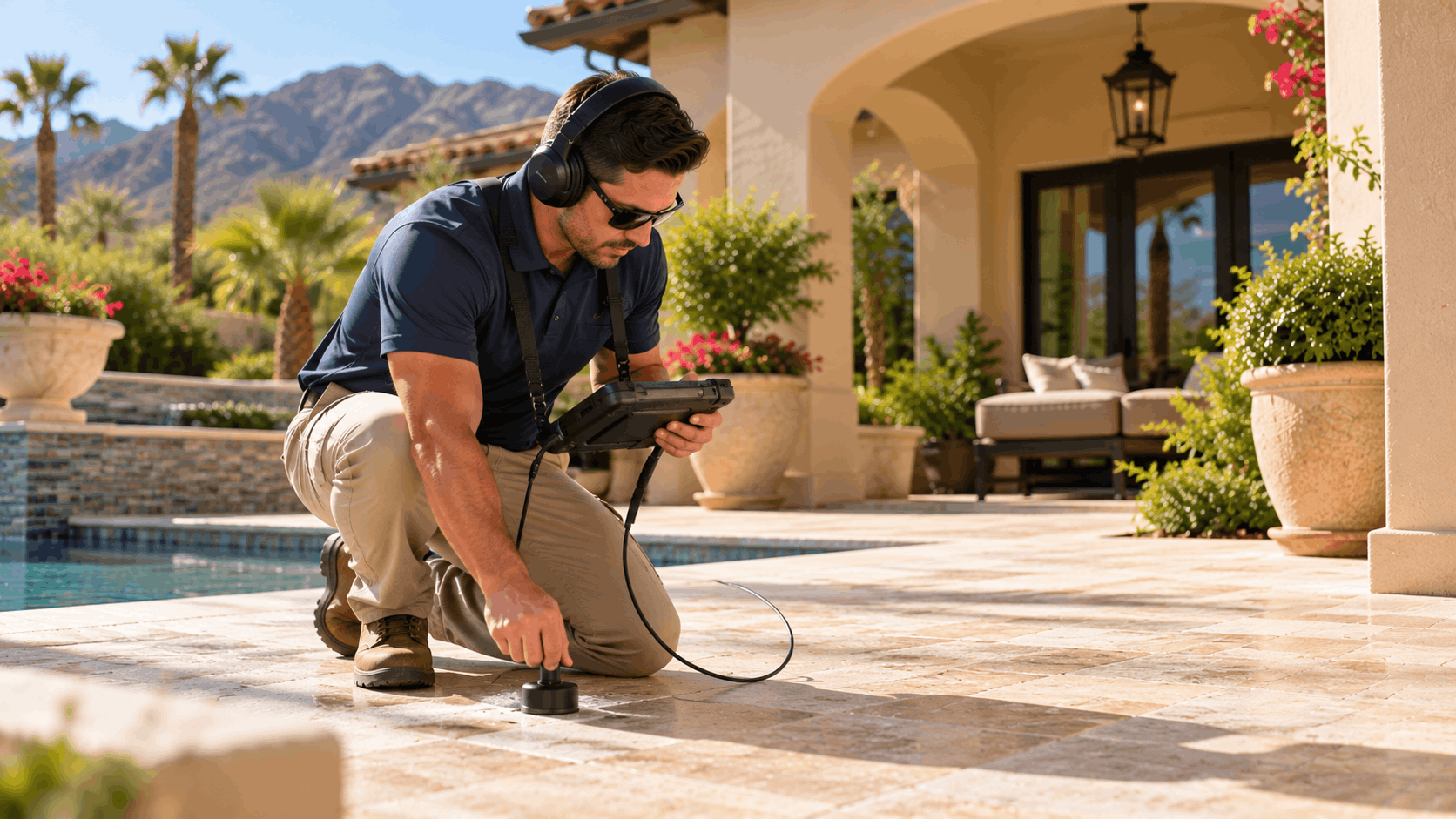
In a slab-on-grade house, the water supply lines run under or through the concrete foundation. When one of those buried lines fails, water escapes below the floor where nobody can see it. The whole point of detecting the leak electronically is to find the exact spot first, so the fix is small and the finish floor above it stays mostly intact.
Opening concrete is the expensive, disruptive part of any slab leak job. On an estate with stone, tile or hardwood, the cost of the cut and the floor restoration often dwarfs the cost of the pipe repair itself. That is why a plumber who locates the leak before lifting a tool protects both the budget and the home.
Detection is a diagnostic step, not the repair. It answers the question every owner asks: where exactly is the water coming from, and is it even a slab leak at all. Get that answer right and every decision after it gets cheaper and easier.
Finding the Leak Without Opening the Floor
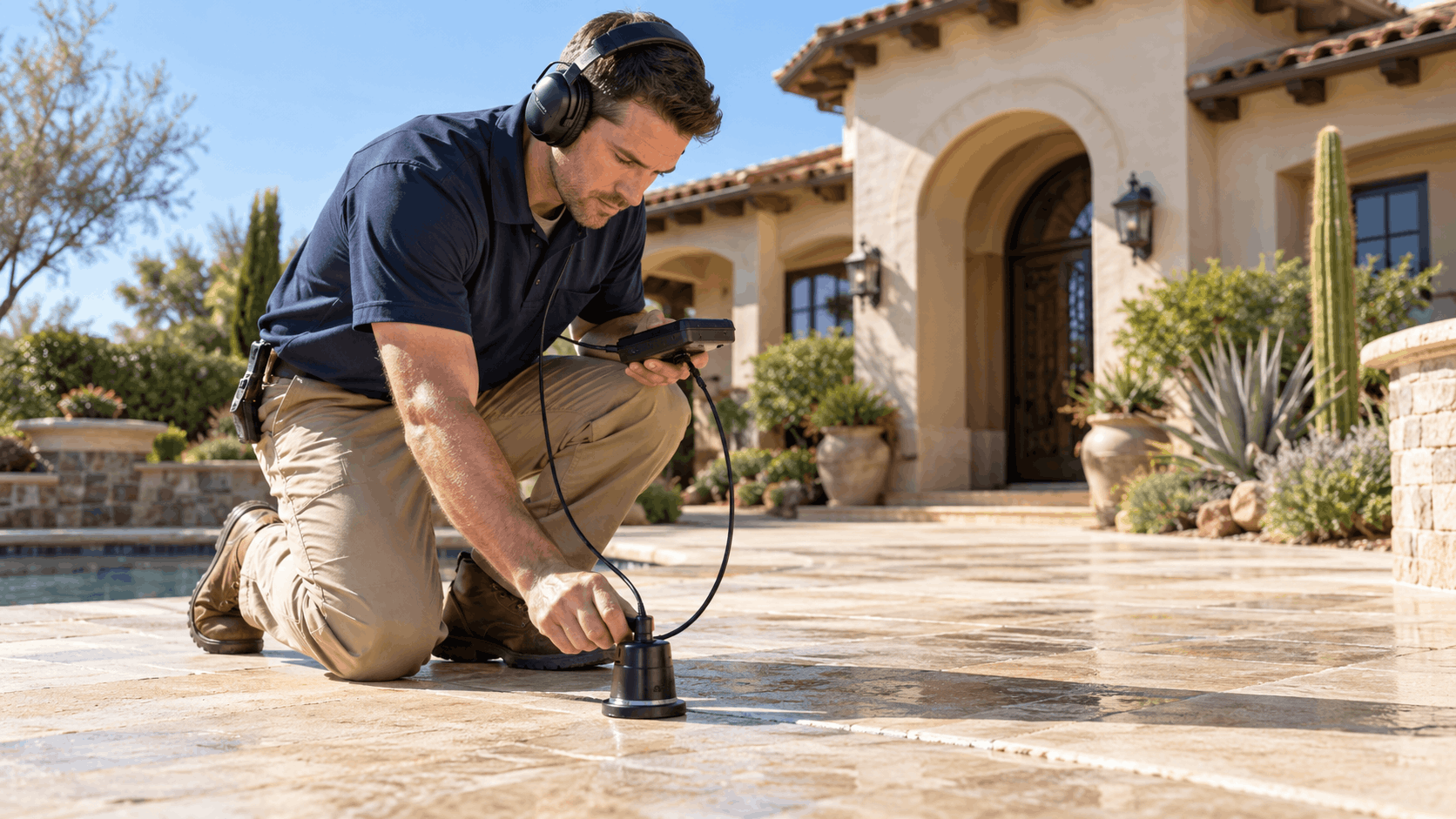
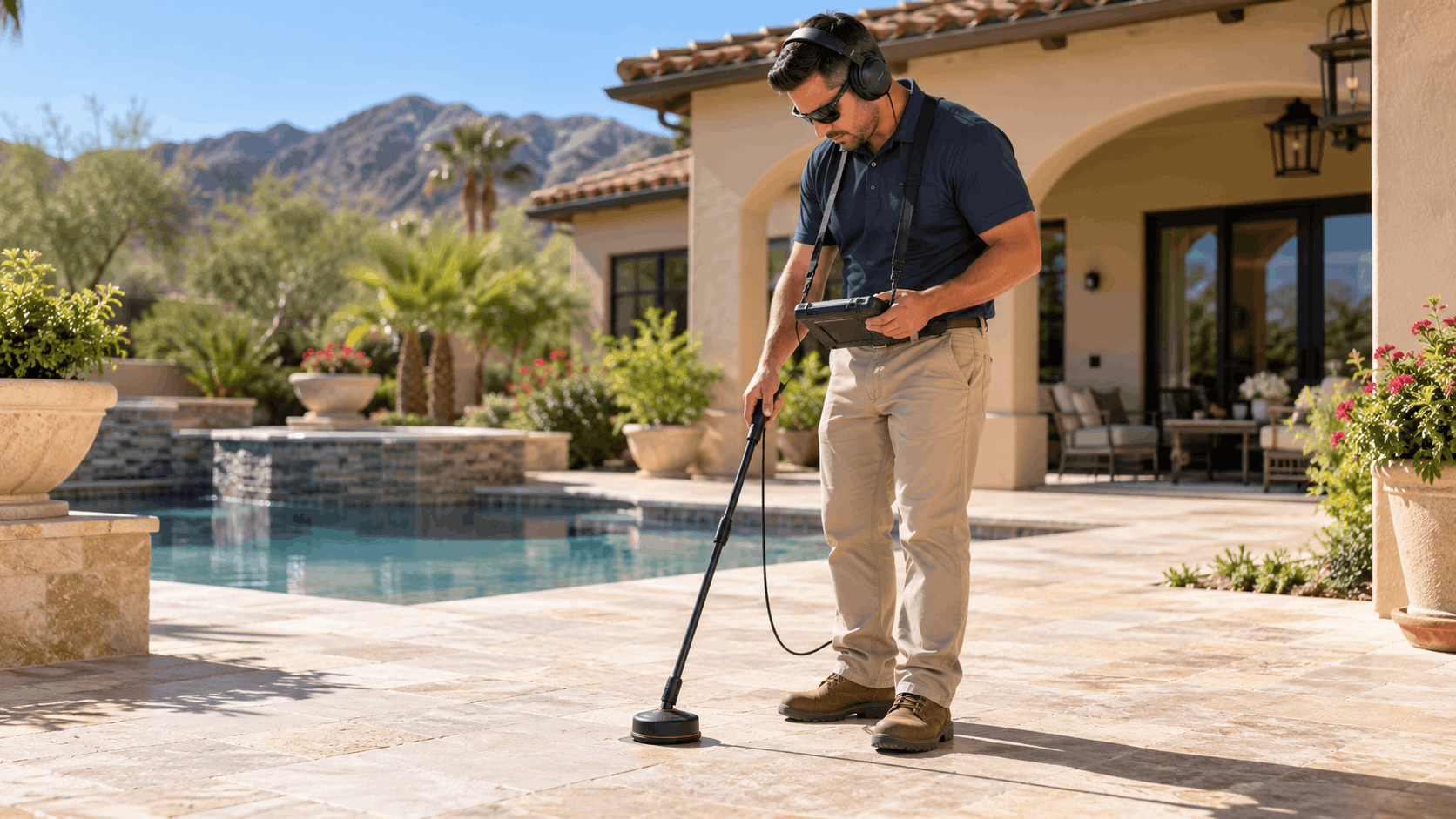
Acoustic detection is the main tool here. A failed supply line under pressure makes a distinct sound as water forces its way out through a pinhole or a split, and sensitive listening gear picks that sound up through the slab. A trained ear traces the loudest point along the run, which marks where the water is escaping.
A pressure test backs that up. The plumber isolates a section of the system, pressurizes it, and watches whether pressure holds or bleeds off. A line that will not hold pressure confirms there is an active leak in that section, and it separates the hot side from the cold side so the search narrows fast.
Together, acoustic listening and pressure testing turn a vague warm spot into a defined search area. On a long estate footprint with multiple bathrooms and recirculation, that narrowing matters, because the run could travel a long way under the slab. This is the groundwork our electronic leak detection service is built around.
None of this requires trenching or cutting to begin. The floor stays whole while the location is confirmed, which is the whole reason the method exists for high-value homes.
Pinpointing vs Guessing the Spot
There is a real difference between a located leak and a rough guess. Pinpointing means the plumber can mark a small area, often a foot or two across, where the leak sits. Guessing means opening a wide stretch of floor and hoping the pipe failure shows up somewhere inside it.
A pinpointed leak leads to a small access cut. The smaller the opening in the slab, the less concrete comes out, the less floor finish is disturbed, and the lower the restoration bill at the end. On a stone floor, every extra square foot opened is money and time spent putting that floor back.
A guess does the opposite. It risks cutting in the wrong place entirely, then cutting again once the first hole shows nothing, doubling the damage and the cost. For an owner who chose stone and hardwood on purpose, that is the outcome worth avoiding.
This is why the diagnostic comes first on every slab leak call. The marked spot decides how big the repair has to be, and a tight mark keeps the whole job small.
Confirming It Is a Leak and Not Something Else
Detection also rules things out, which saves an owner from breaking concrete for a problem that lives somewhere else entirely. A running toilet flapper, a dripping water heater, condensation on a cold line, or a leak in the irrigation system can all look like a slab leak from the symptoms alone. A proper leak diagnosis sorts them apart.
Irrigation is a common culprit on larger Spanish Trail lots, especially homes with long yard runs near the golf course common land. An irrigation leak can send a water bill up just as fast as a slab leak, but the fix is outside and has nothing to do with the foundation. Finding that out first keeps the concrete closed.
The plumber checks the obvious suspects before pointing at the slab. Fixtures get inspected, the water heater gets looked at, and the meter gets read with everything shut off to see whether water is still moving. Only when those are cleared does the under-slab search make sense.
That sequence is the honest way to protect a homeowner. Nobody should open a stone floor until the evidence says the leak is actually under it.
Get Your Quote
Tell us what's going on and we'll get back to you. We're open 24/7.
Why Slab Leaks Show Up in Spanish Trail Homes?
Spanish Trail was developed from 1984 around the 27-hole country club at 5050 Spanish Trail Lane, and the community is now roughly forty years old. Nearly every home inside the gate was built slab-on-grade, which means the supply lines run under the concrete rather than through a crawl space. That construction decision is what makes a buried leak a defined category of work here.
The copper that went in during the mid-1980s has reached the age where pinhole leaks begin. This is not a rare surprise in a community of this vintage, it is the expected arc of copper that has carried very hard water under a slab for four decades. The hot lines and the buried runs tend to go first.
Put the build era, the slab construction and the valley's water chemistry together and you get a clear picture of why detection matters so much in this specific community. The problem is predictable, which is exactly why finding it precisely pays off.
Forty-Year-Old Copper Under the Slab
Copper from the 1980s does not fail all at once. It develops pinhole leaks, tiny perforations in the pipe wall that weep slowly at first and then more steadily as the hole grows. The pipe can look fine from the outside right up until a wet spot or a sound of running water gives it away.
Hot lines tend to fail earlier than cold ones. Hot water moves faster, carries more dissolved mineral, and stresses the copper more over the years, so the hot side of an under-slab run is often where the first pinhole appears. In a custom home with a long recirculation loop, hot water is moving through that pipe far more of the day than in a smaller house.
Buried runs are the hardest to reach and the easiest to ignore until the damage is done. A pinhole in an exposed line under a sink shows itself quickly. The same pinhole in a line under the slab hides, and the water has nowhere obvious to go except into the foundation and up through the floor.
That is why a house of this era with copper supply lines belongs squarely in slab leak territory. The pipe reached the age where this failure mode is normal, and the slab hides it until detection finds it.
Very Hard Water and What Scale Does Inside the Lines
The Southern Nevada Water Authority states the valley's water is 280 parts per million, or about 16 grains per gallon, which is categorized as very hard. That is the single biggest technical fact behind plumbing wear in this market, and it works the same way inside every home in Spanish Trail.
Very hard water deposits calcium and magnesium scale throughout a system. Inside supply lines that scale narrows the bore over years, it builds on water heater elements and tank bottoms, and it fouls the small passages inside mixing valves and cartridges. In a long estate footprint with recirculation running continuously, scale has every opportunity to accumulate across a lot of pipe.
Whole-house softening or scale reduction protects a large and expensive system rather than just improving a single shower, and flushing a water heater is maintenance rather than an optional extra here. A tank left unflushed in this water works harder and fails earlier than its rated life. If treatment is on the table, our water treatment work is sized to the whole house.
Scale does not create pinhole leaks on its own, but it adds to the burden an aging copper system carries. The combination of forty-year-old pipe and very hard water is why this community sees the slab leaks it does.
Why Detection Matters Most in a House With Stone and Hardwood Floors
In a high-value custom home, the floor is often the most expensive surface in the house. Stone, large-format tile and hardwood are chosen deliberately, and they are difficult and costly to cut, patch and match. That raises the stakes on every decision about where to open the slab.
Breaking the wrong spot in a stone floor is expensive twice over. First there is the demolition of a floor that did not need to come up, and then there is the restoration, which on natural stone can mean sourcing matching material and skilled installation. A wrong guess can cost more than the plumbing repair that triggered it.
Detection first is the defense against that. By marking the exact leak location before any cut, the repair is confined to the smallest possible opening, and the finish floor above most of the run stays untouched. That is where the diagnostic earns back its cost many times over on an estate.
It also opens the door to rerouting instead of cutting at all, which on a stone-floored home is frequently the better value. More on that choice below.

Need Help in Las Vegas?
Active Plumbing serves Las Vegas and all of Las Vegas Valley.
Signs a Spanish Trail Estate May Have a Hidden Slab Leak
Owners rarely describe a slab leak in plumbing terms. They describe a bill that went up, a floor that feels warm, or a sound of water when the house is quiet. Those are the clues that call for detection before anyone touches concrete.
On a large lot with long irrigation runs and an estate-scale interior system, the symptoms can be easy to miss or easy to blame on something else. The table below lays out what owners actually notice and what it often points to.
| What the owner notices | What it often points to |
|---|---|
| Water bill climbed with no change in use | A quiet yard, irrigation or slab leak running continuously |
| A warm patch on the floor | A leak on a hot line under the slab |
| Water pressure dropping off | Water escaping from a supply line before it reaches fixtures |
| Sound of running water with everything off | Water moving through a failed line underground |
| Damp or discolored flooring | Water finding its way up through the slab |
The Unexplained Water Bill
A yard, irrigation or slab leak runs quietly, day and night, and the first place it usually shows is the water bill. Nothing changed in how the household uses water, yet the number went up, sometimes steadily over a couple of billing cycles as the leak grows.
This matters more on the larger lots in Spanish Trail, especially homes fronting the golf course with long private irrigation runs beside heavily irrigated common land. An irrigation line can leak into the ground for weeks and never show a wet spot on a surface anyone walks across. The bill is the only early warning.
Because the bill alone does not say which system is leaking, detection earns its place here too. It separates an irrigation leak outside from a slab leak under the house, so the right system gets repaired and the concrete stays closed if it should.
An owner who sees a bill jump with no explanation has a good reason to call for a look before the number climbs further. Catching it early keeps the water loss and the repair smaller.
Warm Floors, Low Pressure and the Sound of Running Water
A warm patch on an otherwise cool floor is one of the clearest signs of a slab leak on a hot line. The escaping hot water heats the concrete above it, creating a spot that feels warmer underfoot than the floor around it. On tile or stone that contrast can be easy to notice barefoot.
Dropping water pressure is another clue. When water is escaping from a supply line before it reaches the fixtures, less of it arrives where it is wanted, and showers and taps can feel weaker than they used to. A gradual loss of pressure across the house is worth taking seriously.
The sound of running water when nothing is turned on rounds out the picture. In a quiet house, especially at night, water moving through a failed underground line can be heard faintly near the leak. Owners often describe it as a hiss or a trickle they cannot place.
Any one of these on its own might be something minor. Two or three together, in a forty-year-old slab home with original copper, point toward a hidden leak that detection can confirm.
Why an Empty Second Home Changes the Risk
Spanish Trail holds a significant share of second homes, seasonal residents and managed properties alongside full-time owners. That changes the risk profile of a leak, because an empty house has nobody home to notice the warm floor, the sound, or the damp patch when it first appears.
A leak in an occupied home gets caught in days. The same leak in a seasonally empty home can run undetected for weeks, quietly damaging the slab and the flooring while the owner is elsewhere. By the time anyone arrives, a small pinhole has done large damage.
For these homes a shut-off check matters. Knowing where the main shut-off is, confirming it works, and shutting the water off when the house sits empty removes the fuel from any leak that starts while nobody is watching. It is a simple step that prevents an expensive surprise.
A whole-home leak detection system takes that protection further for a property that sits empty for stretches. It watches the water flow and can alert before a slow leak becomes a flooded floor, which is covered later in the cost section.
Break the Slab or Reroute the Line: The Real Choice
Once the leak is located, the repair comes down to two paths. Either open the slab at the marked spot and fix the pipe where it failed, or abandon the failed run and route a new line around it so the floor never gets touched. Each makes sense in different situations.
On a high-value home with stone floors, rerouting is frequently the better value, because it avoids cutting and restoring an expensive finish. On a simpler floor with a single isolated failure, a spot repair can be the quicker, cheaper option. The located leak and the floor above it decide which one fits.
Explaining that choice honestly is part of the job. An owner should understand what each path means for their floor, their timeline and their bill before anyone commits to breaking concrete.
Opening the Slab for a Spot Repair
A spot repair is the right call when the leak is a single, isolated failure and the floor above it is not a major restoration problem. The plumber makes a targeted slab cut at the pinpointed location, exposes the failed section of pipe, and repairs or replaces that short length.
The smaller the cut, the better the outcome, which is why the detection step that came first matters so much. A tight mark means a small opening, a quick repair, and a smaller patch to close afterward. The slab is then filled back and the floor finish restored over it.
The catch on an estate is the floor finish above the cut. Natural stone and hardwood are hard to patch invisibly, so even a small cut can mean a visible repair or a hunt for matching material. That reality is what often tips the decision toward rerouting instead.
Where the floor is more forgiving and the failure is a one-off, a spot repair gets the house back to normal fast. The plumber walks the owner through what the finished patch will look like before cutting anything.
Rerouting the Line Around the Problem
Rerouting means leaving the failed under-slab run in place, capped and abandoned, and running a new line to the same fixtures by another path. Often that path goes overhead through the attic or walls, or around the problem area, so the slab and the floor above it stay intact.
On a stone-floored custom home this is frequently the better value. There is no stone to cut, no slab to break, and no floor restoration to pay for afterward, which on an expensive finish can be the largest line item of the whole job. The new run becomes the permanent supply.
Rerouting also sidesteps the risk that a single pinhole is the first of several in an aging line. When copper of this era starts failing, routing a fresh line can be more durable than patching one spot and waiting for the next. For a larger run that is beyond a single spot repair, a whole-house repipe may be the better long-term answer.
The trade-off is the new line's path and any wall or ceiling access it needs. On balance, in a high-value home with finish floors, keeping the floor whole usually wins. The slab leak detection and repair service covers both paths so the owner picks with the full picture.
When Caliche Makes Exterior Work Slower and Dearer
Where a repair goes outside, caliche enters the discussion honestly. Caliche is a cemented calcium-carbonate hardpan common across the valley, and it is abrasive and slow to dig through. Trenching into it takes longer and costs more than digging in softer ground.
Caliche also makes it hard to bed a pipe into evenly. A line needs a smooth, well-supported trench bottom, and a cemented hardpan does not give one easily. Where backfill over a buried line is poorly compacted, it settles under the pipe over time and pulls the line out of grade, which is a separate problem from the hardpan itself.
None of this means a pipe is doomed by the soil. Caliche does not shift, swell or crack pipe, and it is not an expansive soil. What it does is make exterior excavation slower and dearer, which belongs in any honest conversation about the cost of a yard or irrigation repair.
For a Spanish Trail owner, that is why an exterior dig quote can run higher than expected. The ground itself is part of the cost, and a plumber who explains that up front is giving the real picture.

Guard Gates, Villas and Who Owns the Pipe
Spanish Trail is a guard-gated country club community, and that changes the logistics of every job before a wrench is turned. Contractor access, the property type, and the Nevada ownership question on attached homes all get settled at the first call, not when the van pulls up.
The community mixes custom detached homes, villas and condominiums under one gate, and those three property types are genuinely three different jobs. Establishing which one applies decides the scope, the price, and sometimes who is even entitled to authorize the work.
Getting these details sorted early is what separates a smooth estate call from a wasted trip. A plumber who knows to ask them signals real familiarity with how this community works.
Getting a Van Through the Gate
Contractor access at Spanish Trail is authorized in advance through the homeowner, not arranged at the gate on the day. The guard works from an authorization the owner provides, so without that in place ahead of time, a van can be left waiting at the entrance.
Associations of this type frequently maintain approved vendor records or require insurance documentation before a contractor comes through. That paperwork is sorted when the appointment is booked, which is why the first call covers how access will actually work for that specific home.
Inside the gate, private streets and villa courts mean the working position can be well inside the property. Parking a vehicle in a court affects more than one household, so where the van sits matters to neighbors as well as the owner.
Confirming all of this at booking avoids a failed visit. The gate is a logistics step, and handling it ahead of time keeps the appointment on schedule.
Detached Custom Home, Villa or Condominium
A detached custom home has an estate-scale system. That often means multiple water heaters, long hot water runs with recirculation, pool and spa gas, outdoor kitchens, and extensive irrigation and yard lines. A slab leak on a footprint like this can sit a long way from the fixture it feeds, which is exactly why detection matters.
A villa or attached property shares walls and often shares infrastructure. That raises a question before anything is ordered: what is the owner's separate interest and what is association-maintained. The answer changes who commissions the repair and who pays for it.
A condominium unit can sit above or below a neighbor. That turns a supply failure into a two-property problem rather than a one-property problem, because water from one unit can reach another. The scope and the people involved expand accordingly.
Establishing the property type at the first call is what sets the scope correctly. A detached estate, a shared-wall villa and a stacked condo each need a different plan, and naming which one applies comes before ordering parts or quoting work.
Who Controls the Repair Under Nevada Law
Common-interest communities in Nevada are governed by Nevada Revised Statutes Chapter 116. Under that law, the association's governing documents define what is a unit, what is a common element, and what is a limited common element. Those definitions decide who controls a given piece of plumbing.
On attached product, plumbing inside a wall or beneath a slab can sit on either side of that line depending on the document. The CC&Rs or the management company determine whether an owner can commission a repair directly or whether the association must handle it. That is not something to assume.
So on a villa or condo, confirming with the association comes before the work is authorized. An owner may control the pipe, or the association may, and the governing documents are the authority on which it is. Our team raises this question early so nobody orders work they cannot authorize.
Architectural standards also cover exterior appearance, so a visible softener, an exterior treatment system or anything mounted on a visible elevation can need approval while interior work does not. Association approval and a county permit are separate tracks where both apply.
Need Help in Las Vegas?
Active Plumbing serves Las Vegas and all of Las Vegas Valley.
Permits, Licensing and Jurisdiction for Spanish Trail
Naming the right authority is a routine first step on a permitted job here. Spanish Trail is in unincorporated Clark County, so permits and inspections run through the Clark County Department of Building and Fire Prevention, under the Southern Nevada Amendments to the Uniform Plumbing Code as codified by the county.
That matters because the valley is not one permitting authority. Getting the jurisdiction right before quoting permitted work saves confusion later, and telling an owner which department governs their address is a small thing that signals genuine local knowledge.
Licensing is a separate track from permitting, and both apply to permitted plumbing work. Here is how they break down for this community.
A Clark County Address, Not the City of Las Vegas
Residents of Spanish Trail describe their address as Las Vegas, and in everyday terms that is fine. For permitting it is not, because Spanish Trail sits in the unincorporated town of Spring Valley, west of the Strip on the south side of Tropicana Avenue near Rainbow Boulevard. That makes it a county address.
Because it is unincorporated, the City of Las Vegas building department does not govern it. The Clark County building department does. Confusing the two can send a permit application to the wrong counter and delay a job that should move quickly.
The same is true across the surrounding unincorporated areas of Spring Valley. Landmarks nearby like Charlie Frias Park on West Tropicana and Spring Valley Hospital on South Rainbow sit in the same county jurisdiction, not a city one.
Knowing this before quoting permitted work is part of doing the job right in this community. The authority is the county, full stop.
When a Leak Repair Needs a Permit
Permitted plumbing work must be performed by an appropriately licensed contractor, and the permit position should be confirmed for the specific address rather than assumed from a valley-wide rule. The Southern Nevada Amendments apply as codified by Clark County, and the Building Official is the authority on any alternate method.
Whether a given slab leak repair or reroute needs a permit depends on the scope of the work and the current county rules. Permit fees and code edition details change over time, so the right move is to confirm the permit position with the Clark County building department for the exact address before the work is scheduled.
Our team handles that confirmation as part of setting up a job, so an owner is not left guessing. The point is that the paperwork is squared away correctly for the address, under the amendments the county has actually adopted.
Doing this properly protects the owner. Permitted work by a licensed contractor is the record that the repair was done to code, which matters on a high-value home and on any future sale.
Verifying the Contractor's License
Plumbing work in Nevada is licensed by the Nevada State Contractors Board. There is no Clark County plumbing license and no statewide plumbing code, so the license is statewide through the board and the applicable code is the county's adopted amendments.
An owner is entitled to ask for a license number and to verify it free at nvcontractorsboard.com. On that site the classification, status, bond and workers compensation are all public record, so a homeowner can confirm a contractor is properly licensed before any work begins.
Active Plumbing holds Nevada license NSCB #0047021 and has been licensed since 1991. That number is verifiable on the board's site like any other, which is exactly how an owner should check any contractor they bring through the gate.
In a market with a real unlicensed trade problem, saying this plainly builds trust. A licensed, verifiable contractor is the baseline for permitted work on an estate.
What Electronic Leak Detection Costs in the Las Vegas Valley
Cost is usually the first question after the warm floor gets noticed. The figures below are typical market ranges for the Las Vegas Valley, not a quote and not a fixed price for any one job. The actual price for a specific job depends on that job and is given in writing before work begins.
Detection and repair are separate line items, and understanding both helps an owner plan. What pushes a job within these ranges on an estate is the size of the system, the floor finish involved, and whether the repair is a spot fix or a reroute.
Detection Pricing You Can Expect
For locating the leak, the typical Las Vegas Valley ranges are electronic leak detection $150 to $350 and slab leak detection $150 to $300. These cover the diagnostic work of finding and confirming the leak before any concrete is opened.
On an estate, the detection work can take longer because the system is larger. A custom home with multiple bathrooms, several water heaters and a long recirculation loop has more pipe to isolate and listen through than a small house, and that search time is part of what sets the final number.
The value of the detection step is out of proportion to its cost. Spending in this range to pinpoint the leak can save many times that in avoided floor demolition and restoration, which is why it comes first on every slab leak call.
These are typical ranges for the area. The written price for a specific home is set after the home and the situation are seen.
What the Repair Adds After Detection
Once the leak is located, the repair ranges apply. Typical Las Vegas Valley figures are slab leak repair $500 to $3,000 and burst pipe repair $200 to $800. Where the line is beyond a spot repair and the run needs replacing, a whole-house repipe runs $4,000 to $15,000.
On an estate several things push a job within or toward the top of these ranges. The floor finish is the big one, because restoring stone or hardwood over a slab cut adds cost that a simpler floor does not. The length and location of the failed run matter too, as does whether access is straightforward.
The choice between a spot repair and a reroute also shifts the number. A reroute that keeps an expensive floor intact may cost more in pipe and labor but less overall once floor restoration is counted. That trade-off is spelled out before work begins.
All of these are typical ranges for the valley, not a fixed figure. The specific price for a Spanish Trail home is provided in writing after the scope is clear.
A Whole-Home Leak Detection System as Protection
For a seasonal or managed estate that sits empty for stretches, a whole-home leak detection system is worth considering, with a typical valley range of $300 to $800. It watches the water flow and can alert before a slow leak becomes a flooded floor, which directly addresses the empty-home risk raised earlier.
On a property where nobody is home for weeks, this kind of early warning is the difference between a minor repair and major water damage to a stone floor. The system catches the failure when it starts, not when someone finally visits.
It pairs well with a confirmed, working main shut-off. Together they give an absent owner a real defense against a leak that would otherwise run unnoticed. Our whole-home leak detection system installation is one way to protect a home that is not always occupied.
For a second home behind the Spanish Trail gate, that protection can pay for itself the first time it catches a leak early.
Need Help in Las Vegas?
Active Plumbing serves Las Vegas and all of Las Vegas Valley.
How Active Plumbing Handles a Spanish Trail Leak Call
The way a Spanish Trail leak call is handled reflects everything above: the property type, the authorization, the gate, the detection before concrete, and the written price before work starts. Each of those is settled in order so the job runs smoothly from the first call to the finished repair.
Our team has worked the Las Vegas Valley since 1991, and the process below is how a call like this actually goes.
The First Call: Property Type and Authorization
The first call establishes whether the home is a detached custom house, a villa or a condominium. That single answer shapes the scope, because an estate system, a shared-wall villa and a stacked condo each need a different plan before anything is ordered.
The call also sorts out who authorizes the work and who pays. With many second homes, seasonal residents and managed properties in Spanish Trail, the person calling might be an owner who is elsewhere, a tenant or a property manager. Knowing who can authorize the repair avoids starting work nobody signed off on.
Gate access gets arranged in the same conversation. Because authorization goes through the homeowner in advance and the association may need vendor records or insurance documents, confirming access at booking keeps the appointment on track.
By the end of that first call, the scope, the decision maker and the access are all clear. That is the groundwork that lets the actual visit go cleanly.
Detection First, Then a Written Price
On site, the leak is located before any concrete is opened. The acoustic and pressure work pinpoints the spot and confirms it is a slab leak rather than an irrigation line, a running fixture or a water heater drip, so the repair plan is built on evidence.
Active Plumbing gives the customer a written price before work starts. This is a business practice, so an owner knows the number before anyone commits to cutting a floor or running a new line. It is how the job stays transparent on a high-value home.
With the leak located and the price agreed in writing, the owner chooses between a spot repair and a reroute with the full picture in front of them. There is no guessing at the scope and no surprise about the cost once the work begins.
That sequence, detection first and a written price before work, is what keeps an estate slab leak from turning into an open-ended project.
Response Across the Valley and Local Credentials
Technicians arrive in 30 to 60 minutes anywhere in the Las Vegas Valley, with gate access arranged ahead of time for a community like Spanish Trail. That response window matters when a leak is active and the owner wants it looked at before more water escapes.
Active Plumbing has worked the valley since 1991 and holds Nevada license NSCB #0047021 along with the certifications required for the work it performs. That license is verifiable free on the state board's site, the same check an owner should make on any contractor.
For other work across the community, our emergency plumbing team covers the same footprint, and the Spanish Trail service page covers gas and related work behind the gate.
Local knowledge, a verifiable license and a fast response are the baseline for estate work in a guard-gated community. They are what let the technical work above actually happen on schedule.
Protect the Floor First, Then Fix the Leak
If a warm spot, a quiet running sound or an unexplained bill has you worried about a hidden leak under your Spanish Trail home, the next step is a diagnostic that locates it before any concrete is opened, followed by a written price before work starts. Call Active Plumbing at (702) 438-3357 to arrange detection and get the access and property-type questions sorted on the first call.
Frequently Asked Questions
- What is electronic leak detection?
- It is a set of acoustic and pressure-based methods that locate a hidden leak under a slab or behind a wall without cutting first. Listening gear picks up the sound of water escaping a pressurized line through the concrete, and a pressure test confirms which section is leaking. Pinpointing the exact spot means the repair is small and targeted, protecting an expensive floor instead of opening a wide, costly hole.
- How much does electronic leak detection cost in the Las Vegas Valley?
- Typical area ranges are electronic leak detection $150 to $350 and slab leak detection $150 to $300. These are typical Las Vegas Valley figures for the diagnostic work of finding and confirming a leak, not a quote. On a larger estate system the search can take longer. The actual price for a specific home is given in writing before any work begins, once the scope is clear.
- Can a slab leak be fixed without breaking the concrete?
- Often, yes. Rerouting the failed line overhead or around the problem is frequently possible and is frequently the better value in a stone-floored custom home, because it leaves the floor intact. A spot repair, by contrast, needs a small slab cut at the pinpointed location and then floor restoration above it. Which path fits depends on the located leak, the floor finish and the condition of the run.
- Why do 1980s Spanish Trail homes get slab leaks?
- Spanish Trail was developed slab-on-grade from 1984 around the country club, with copper supply lines that are now roughly forty years old. Copper of that age reaches the point where pinhole leaks begin, especially on hot lines and buried under-slab runs. Because the pipe sits under the concrete, a pinhole hides until a warm spot, a sound of running water or a higher bill reveals it, which is where detection comes in.
- How hard is the water in Spanish Trail?
- The Southern Nevada Water Authority reports the valley's water at 280 parts per million, about 16 grains per gallon, categorized as very hard. Scale from that water builds inside supply lines and across recirculation systems, which in a long estate footprint means a lot of pipe carrying mineral deposits. Whole-house softening or scale reduction protects the system, and flushing a water heater is maintenance rather than optional in this water.
- Who authorizes a leak repair in a Spanish Trail villa or condo?
- It depends on the governing documents. Common-interest communities in Nevada fall under Nevada Revised Statutes Chapter 116, and the CC&Rs define what is a unit, a common element and a limited common element. On attached homes, in-wall or under-slab pipe can sit on either side of that line, so the CC&Rs or the management company decide whether the owner or the association controls the repair. Confirm that first.
- Which building department handles permits for Spanish Trail?
- Spanish Trail is in the unincorporated town of Spring Valley, which makes it a Clark County address even though residents call it Las Vegas. Permits and inspections run through the Clark County Department of Building and Fire Prevention, not the City of Las Vegas, under the Southern Nevada Amendments to the Uniform Plumbing Code as codified by the county. The permit position should be confirmed for the specific address.
- How does a plumber get through the guard gate?
- Access is authorized in advance through the homeowner, not arranged at the gate on the day. Associations of this type often keep approved vendor records or require insurance documentation, so this is confirmed when the appointment is booked rather than when the van arrives. Inside the community, private streets and villa courts affect where a vehicle can park, which is worked out ahead of the visit too.
- How do I know if my high water bill is a hidden leak?
- A yard, irrigation or slab leak runs quietly, day and night, and a water bill that climbs with no change in use is often the first sign. On larger Spanish Trail lots with long irrigation runs near the golf course, a leak can run for weeks without a visible wet spot. Detection rules in or out which system is involved, so the right repair happens and concrete stays closed if the leak is outside.
- How fast can a plumber reach a Spanish Trail home?
- Technicians arrive in 30 to 60 minutes anywhere in the Las Vegas Valley. For a guard-gated community like Spanish Trail, gate access is arranged ahead of time through the homeowner so the visit is not held up at the entrance. Confirming the access and the property type at booking is what lets a fast response actually reach the door on schedule.
Licensed plumbing professionals serving Las Vegas and Las Vegas Valley.
Licensed in Nevada · License #0047021
Last updated on
Why trust Active Plumbing?
Founded in 1991, Active Plumbing is a licensed and insured plumber serving Las Vegas and Las Vegas Valley. All content is reviewed by our licensed technicians.

Need Help in Las Vegas?
Active Plumbing serves Las Vegas and all of Las Vegas Valley.
Related Articles

Slab Leak Detection Cost Las Vegas: Electronic vs Acoustic Pricing
Compare electronic vs acoustic slab leak detection pricing in Las Vegas, what drives the cost, warning signs, and how to choose the right method for your home.

Spanish Hills Las Vegas Plumber: Custom Estate Service Coverage
A guide to custom estate plumbing in Spanish Hills Las Vegas, covering slab leaks, hard water, repipes, pool lines, emergencies, and choosing the right plumber.
Water Heater Replacement Cost in Spanish Trail for Multi-Unit and Custom Homes
Water heater replacement cost in Spanish Trail depends on property type, number of heaters, gate access, and very hard water. Get the typical valley ranges and what drives your price.