Galvanized Supply Lines in Winchester and What Rust-Colored Water Means
Key Takeaways
- Rust-colored water in older Winchester homes usually points to corroding galvanized steel supply lines shedding rust from the inside out.
- Winchester was built through the late 1940s to 1960s for resort corridor workers, so galvanized supply, copper and cast iron are common, and one house can hold several materials.
- The valley's water is 280 ppm, about 16 grains per gallon and very hard, which compounds corrosion and shrinks the pipe bore so pressure drops at one fixture before anything leaks.
- Start with cheap fixes like flushing the heater, cleaning aerators and checking pressure; when corrosion is widespread, a whole-house repipe runs a typical valley range of $4,000 to $15,000.
- About 68 percent of Winchester homes are rented, and under Nevada Revised Statutes Chapter 118A the landlord must maintain working plumbing and hot water.
- Winchester is unincorporated Clark County, so permits run through the Clark County Department of Building and Fire Prevention, not the City of Las Vegas.
- Plumbing work is licensed statewide by the Nevada State Contractors Board, and licenses can be verified free at nvcontractorsboard.com.
- Active Plumbing confirms the pipe on site, checks pressure and the main shut-off, gives a written price before work starts and arrives in 30 to 60 minutes anywhere in the valley.
In This Article
Turn on a tap east of the Strip and watch the water run brown or orange, and the first thought is usually that something has gone badly wrong. In most older Winchester homes, that rusty, discolored water points to one thing: corroding galvanized steel supply lines inside the walls. The pipe is shedding rust from the inside, and the color at the faucet is the early warning that the metal is breaking down.
Winchester is one of the older residential areas in the valley, built largely through the late 1940s, 1950s and 1960s as the resort corridor grew and workers needed housing nearby. Homes from that era carry galvanized steel supply on the oldest streets, copper on the later ones, and cast iron drains through much of it. Seventy years of very hard water does the rest.

What Rust-Colored Water Actually Means in a Winchester Home?
Rust-colored water is almost never about the water itself. The valley is served mostly with Colorado River water from Lake Mead, treated by the Southern Nevada Water Authority and chlorinated as it enters the distribution system. The water leaving the plant is clear. By the time it reaches a discolored tap in a seventy-year-old Winchester house, it has picked up rust and scale from the pipe it traveled through.
That is the honest read on discolored water in this part of the valley. The pipe, not the supply, is the problem. Learning to separate the common causes helps an owner or tenant know whether they are looking at the water heater, the supply lines, or something simpler like a disturbed main after street work.
Galvanized Steel Corroding From the Inside Out
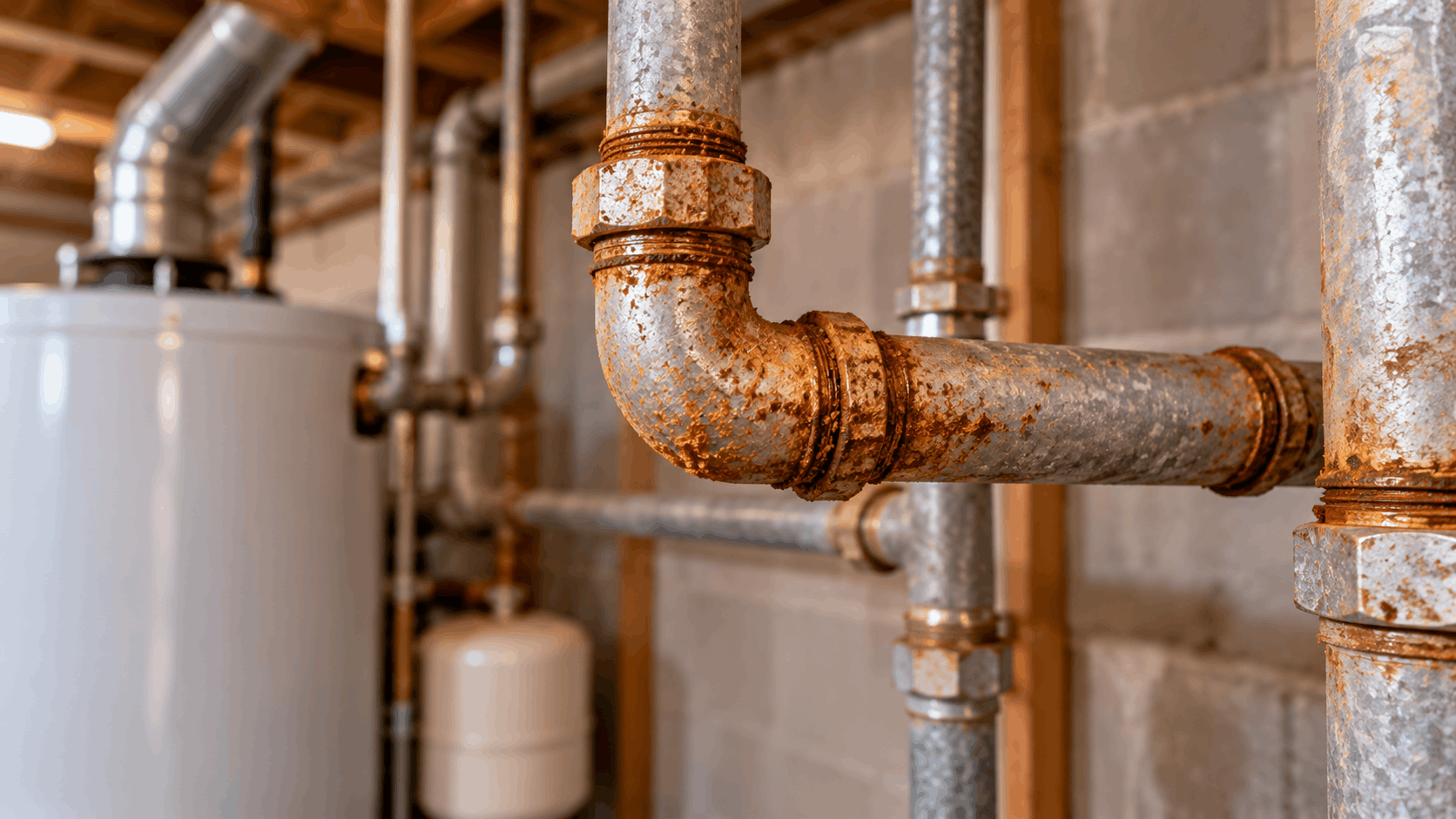
Galvanized steel pipe is steel coated with a thin layer of zinc meant to slow corrosion. That coating does not last forever. Over decades the zinc wears away, and the bare steel underneath begins to rust. The rust forms on the inside wall of the pipe where no one can see it until it shows up at the faucet.
As the steel corrodes, it does two things at once. It builds up a rough, flaky interior layer that narrows the opening water flows through, and it sheds small rust particles into the stream. Those particles are what color the water orange or brown. The galvanized steel corrosion is happening continuously, slowly, from the inside out.
In homes built from the late 1940s through the 1960s, galvanized supply is the most likely source of internal rust at the tap. This is the defining plumbing material of Winchester's oldest streets. When a house of that age runs discolored water, failing galvanized pipe is the first thing an experienced plumber looks at.
The telltale sign of galvanized trouble is that it rarely fails with a dramatic burst. It fades and discolors long before it leaks, which gives an owner time to plan a fix if they recognize what the color is telling them.
Whether It Is the Hot Side, the Cold Side, or Both
Where the rust shows up narrows the source quickly. If the discolored water appears only on the hot taps, the water heater is the prime suspect. Sediment and scale settle in the bottom of the tank, and in very hard water that layer builds fast. When the burner or element heats that sediment, it can tint the hot water and send rust-colored flakes down the hot lines.
If the rusty water shows on both hot and cold taps, that points away from the heater and toward the supply lines feeding the whole house. Both sides running discolored usually means the galvanized piping before the heater is corroding, so every fixture draws from the same rusting source.
Cold-only discoloration is less common but can point to a corroded cold main, a disturbed street line after utility work, or a specific run of galvanized on the cold side. The pattern an owner reports is genuinely useful information, so noting which taps run dirty and when helps the plumber focus the diagnosis.
Water heater sediment is its own repair path, separate from a supply line problem. Flushing the tank clears settled scale, and that alone sometimes solves hot-only discoloration. If the heater has already failed early once in this water, that history matters to the plan.
When the Color Clears and When It Does Not
The timing of the discoloration tells the story of how far the corrosion has gone. Water that runs rusty for the first minute and then clears is usually water that sat overnight in a corroded section, picking up rust while it was still. Once fresh water pushes through, the color goes. That pattern suggests corrosion that is present but not yet advanced everywhere.
Water that stays discolored no matter how long the tap runs is a different signal. Persistent rusty water means the corrosion is widespread through the lines, so there is no clean pipe for the fresh water to arrive through. The whole supply path is shedding rust, not just one stagnant stretch.
An owner can learn a lot in five minutes by running a cold tap first thing in the morning and timing how long the color takes to clear. That simple test helps sort an early-stage problem from one that has reached the point where patching no longer makes sense.
Either way, discoloration that returns day after day is not something that resolves on its own. Galvanized corrosion only moves in one direction, and the color is the visible edge of a process happening throughout the system.
Get Your Quote
Tell us what's going on and we'll get back to you. We're open 24/7.
Why Winchester Homes Are Full of Galvanized Pipe?
Winchester sits immediately east of the Strip, bordered by Sahara Avenue on the north, Boulder Highway on the east, Desert Inn Road on the south and the Union Pacific Railroad on the west. It is one of the older residential areas in the valley, and the pipe in the ground reflects when the neighborhood went up. The build era explains the plumbing better than anything else.
Galvanized steel was the standard supply material of its day, and this township was largely plumbed during that day. Understanding the age of the housing stock tells an owner most of what they need to know about what is likely behind their walls, though the pipe should always be confirmed on site before any work is quoted.
Built for the Resort Corridor in the 1940s, 50s and 60s
Winchester was developed largely through the late 1940s, 1950s and 1960s as the resort corridor grew and workers needed housing close to the Strip. The stock is modest single-family houses, duplexes and small multi-unit property, with commercial frontage along the arterials. It has more in common with neighboring Sunrise Manor than with the newer master-planned communities west of town.
That timing matters because the plumbing standards of the 1950s put galvanized steel in the walls as a matter of course. The homes were built affordably for a working population, and galvanized was the common, accepted supply material. Whole tracts went in with it.
Decades later, those same modest homes near landmarks like Winchester Park and the Las Vegas Convention Center on Paradise Road still carry much of that original pipe. A home's convenient location near the corridor also means it has usually stayed occupied and in service the whole time, so the pipe has been working hard for seventy years.
The practical result is a neighborhood where supply line corrosion and drain line failure are the defining plumbing work, rather than the fixture swaps and upgrades you see in newer areas.
Galvanized on the Oldest Streets, Copper on the Later Ones
The pattern across housing of this age in the valley is consistent. The oldest streets typically carry galvanized steel supply, and the streets built a little later carry copper, with cast iron drain, waste and vent piping running through much of it. That gives Winchester a mix that changes block by block depending on when each stretch was built.
Galvanized and copper fail differently. Galvanized narrows and rusts from the inside until pressure drops and the water discolors. Copper on the later streets, now sixty and seventy years old itself, is at the age where pinhole leaks begin, particularly on the hot lines where heat and hard water work hardest.
Cast iron drains have their own timeline. They scale, crack and separate at the joints, which shows up as repeated slow drains and recurring blockages long before anything dramatic happens. That is a separate problem from the supply side but common in the same homes.
None of this can be assumed from the build year alone. An address on one street may be all galvanized while a house two blocks over is copper, so the pipe should always be confirmed on site. The build year gets the diagnosis started, not finished.
Seventy Years of Patches and Mixed Materials
Houses this old have been altered repeatedly, and that complicates the picture. One Winchester property can hold original galvanized supply, a copper patch from a 1970s repair, something else from a later fix, and modern PEX where a bathroom was redone at some point. The plumbing is a record of every repair the house has ever had.
Those mixed pipe materials create a problem of their own. Where two dissimilar metals join, such as galvanized meeting copper, galvanic corrosion sets in at the connection. One metal corrodes faster than it would on its own, so the joint becomes a weak point and a source of rust.
This is why a plumber cannot walk a Winchester house and assume a single material throughout. The same home may have four different pipe types, each at a different stage of its life, each failing for a different reason. An accurate diagnosis starts with finding out what is actually there.
Original gas piping and meters of this age also warrant inspection rather than assumption, since they went in alongside the water lines. Anyone planning work on an old Winchester home should expect the plumbing to be a patchwork, not a clean single-material system.

Need Help in Las Vegas?
Active Plumbing serves Las Vegas and all of Las Vegas Valley.
How Very Hard Water Speeds Up the Problem Here
Old galvanized pipe is a problem on its own. The valley's very hard water makes it worse. Hardness scale and corrosion compound each other inside the pipe, so the usable opening shrinks faster than it would in a place with soft water. That interaction is why Winchester owners so often report weak pressure before they ever see a leak.
The water chemistry here is well documented, and the figure matters because it explains more plumbing failures in this valley than anything else. Pairing seventy-year-old steel with water this hard is a recipe for the symptoms owners describe.
The Valley's Water Is 280 ppm, About 16 Grains Per Gallon
The Southern Nevada Water Authority states the valley's water hardness is 280 parts per million, or about 16 grains per gallon, which is categorized as very hard. That is a single published figure for the valley, not a range, and it applies to Winchester along with the rest of the service area.
Very hard water carries a lot of dissolved calcium and magnesium. As the water moves through the system and warms up, those minerals drop out of solution and deposit as scale. That scale builds throughout a plumbing system, from the supply lines to the water heater to the small passages inside faucets and valves.
A customer who runs their own test and gets a higher number is reporting their own reading from their own home. The municipal figure for treated valley water is the SNWA number. Both can be true at once, since a reading inside a scaled-up house can differ from what leaves the plant.
For Winchester, the takeaway is simple. Every home here is on very hard water, and that is a constant working against old pipe and old equipment every single day. If you want to read more about treating it at the source, our water treatment services page covers the options.
Why One Fixture Loses Pressure Before Anything Leaks
In old galvanized supply, hardness scale compounds the corrosion, so the effective bore of the pipe shrinks over the years. The inside of a half-inch line slowly chokes down to a fraction of its original opening as rust and scale layer up on the walls. Less opening means less water can pass.
That is why the first complaint in a Winchester home is almost always weak pressure at a single fixture rather than a leak. One bathroom faucet or one shower starts delivering a weak stream while the rest of the house seems fine. The narrowest, most corroded run of pipe starves that fixture first.
Over time the pressure drop spreads as more of the system narrows. What began at one tap starts showing up at others. The pipe is telling the owner it is closing up, long before it ever gives way with a leak.
This gradual pattern is actually good news for planning. Galvanized rarely surprises an owner with a sudden burst, so the weak-pressure warning gives time to diagnose and decide on a fix before a failure forces an emergency.
Water Heaters That Scale Heavily and Fail Early
Water heaters take the hardest hit from this water. Scale builds on the heating elements and settles across the bottom of the tank, where it insulates the burner from the water it is trying to heat. The heater has to run longer and hotter to do the same job, which wears it out.
A tank left unflushed in this water works harder and fails earlier than its rated life. The scale layer never stops growing, so an unmaintained heater in Winchester is fighting the water chemistry from the day it is installed. Regular flushing clears the settled sediment and is the single best thing an owner can do to get full service life from a tank.
Tankless units are even more sensitive because the heat exchanger is a narrow passage. Scale clogs those passages quickly, which is why descaling maintenance matters so much on tankless equipment in this valley. Our water heater services cover both flushing and tankless descaling.
When a heater has already failed early once in a Winchester home, that is a strong signal to consider scale reduction. Treating the water extends equipment life here rather than being an optional upgrade.
Reading the Warning Signs Before a Pipe Gives Out
Galvanized pipe gives plenty of warning if you know what to watch for. It fades rather than bursts, so the signs are subtle at first and get harder to ignore over time. Catching them early gives an owner room to plan the fix instead of reacting to a crisis.
Here is how the common warning signs line up, what each one means, and how urgent it usually is in a Winchester home.
| Warning Sign | What It Usually Means | How Urgent |
|---|---|---|
| Pressure drops at one fixture | Scale and rust narrowing the bore at the most corroded run | Early, plan ahead |
| Pressure fading across the house | Corrosion spreading through more of the galvanized system | Diagnose soon |
| Aerators and shower heads clogging | Rust flakes and scale breaking loose from the pipe walls | Monitor, recurring |
| Rusty water in the morning that clears | Water sitting overnight in corroded lines | Early stage |
| Rusty water that never clears | Widespread corrosion with no clean pipe left | Repipe territory |
| Metallic taste and fixture staining | Dissolved rust and hard water deposits | Ongoing |
Pressure That Drops at One Tap, Then Spreads
The earliest sign of failing galvanized is pressure fading at a single fixture. The most corroded, most scaled-up run of pipe closes down first, so the faucet or shower it feeds loses flow while the rest of the house still seems normal. Owners often blame the fixture at first.
As more of the system narrows, the weak pressure spreads to other taps. What started in one bathroom turns up in the kitchen, then the laundry. That progression is the galvanized system slowly choking itself off from the inside, one run at a time.
This gradual failure is characteristic of galvanized pipe. It rarely announces itself with a dramatic burst the way a pressurized copper line might. Instead it fades, which can fool an owner into living with poor pressure for years without realizing the pipe is nearing the end.
When pressure has dropped at more than one fixture, the problem is no longer local. That is the signal to get the supply lines looked at rather than keep chasing individual faucets.
Clogged Aerators, Shower Heads and Mixing Valves
As galvanized corrodes, it sheds rust flakes and scale into the water stream. Those particles travel until they hit the first small opening and get stuck. Faucet aerators and shower heads catch them first, which is why they clog again and again in these homes.
The small passages inside mixing valves and cartridges are just as vulnerable. Rust and scale jam the works, so a shower valve that worked fine starts sticking, leaking or failing to mix properly. Cleaning or replacing the cartridge helps for a while, then the debris comes back because the source is still upstream.
Appliance inlet screens take a beating too. The small screens on dishwashers and washing machines foul with rust and scale, which chokes the water supply to the appliance and can trigger fill errors or poor performance. Owners sometimes replace a perfectly good appliance when the real problem is the water feeding it.
Repeated clogging at these small openings is a clear message that the supply line upstream is breaking down. Cleaning the fixture treats the symptom. The source is the corroding pipe.
Staining, Metallic Taste and Water That Runs Dirty After Sitting
Hard water leaves white crusting on fixtures, faucets and shower doors, which is the calcium and magnesium scale the valley's water deposits everywhere. That staining is a constant in Winchester homes and a visible sign of the water chemistry the pipe is fighting.
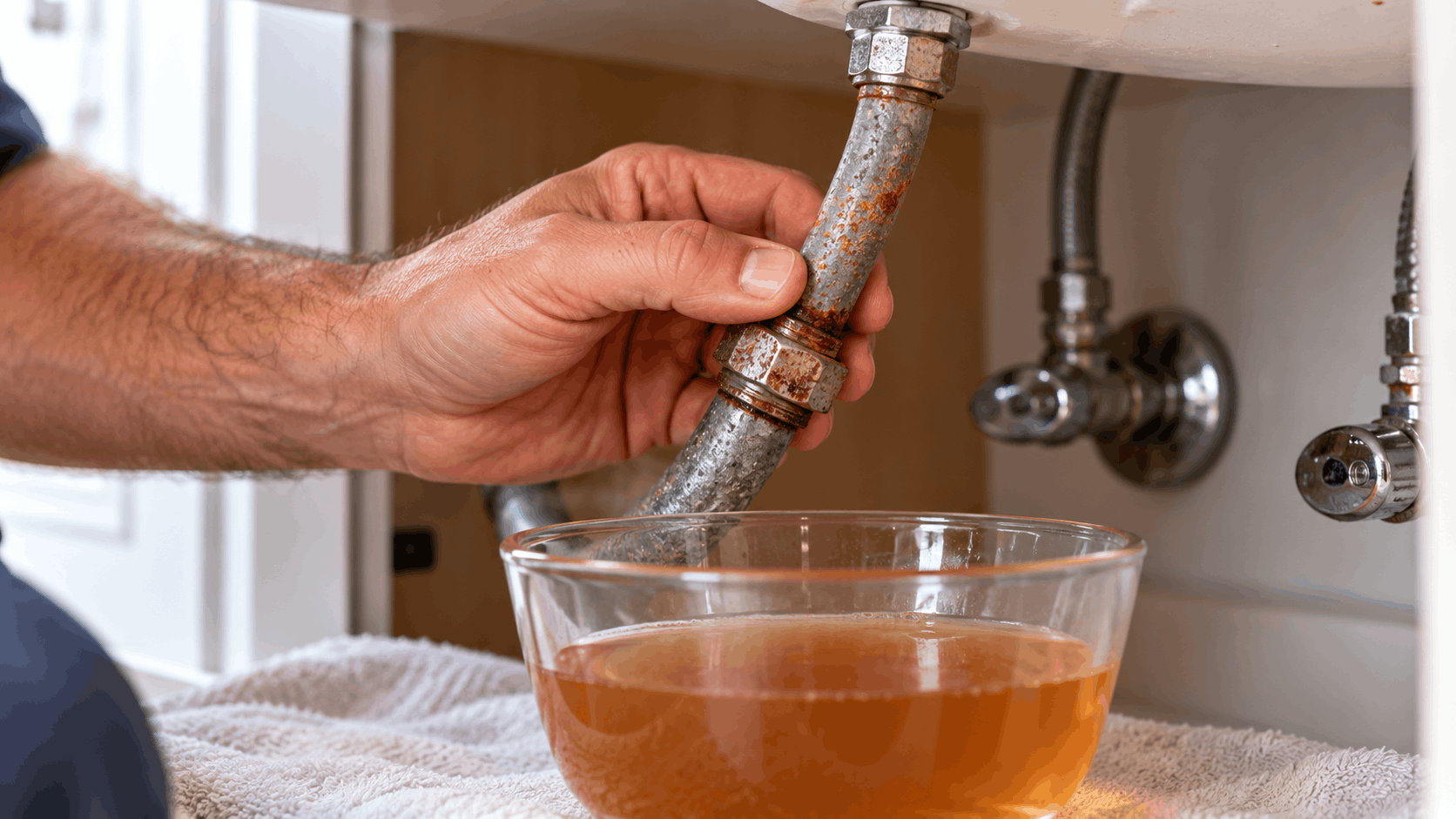
Corroding galvanized adds a metallic taste to the water and an orange or brown tint to what comes out of the tap. Dissolved rust is what the tongue picks up, and once an owner notices it, it is usually well established. The taste tends to be strongest first thing in the morning.
Water that runs discolored after sitting overnight is one of the most reliable signals. While the water sits still in corroded lines for hours, it picks up rust from the pipe walls. The first draw of the day runs dirty, then clears as fresh water pushes through.
When those stains, that taste and that morning discoloration all show up together in a seventy-year-old home, the pattern points straight at the supply lines. These are not separate problems. They are the same corroding pipe showing itself in different ways.
Diagnosing What Is Really Behind Your Walls
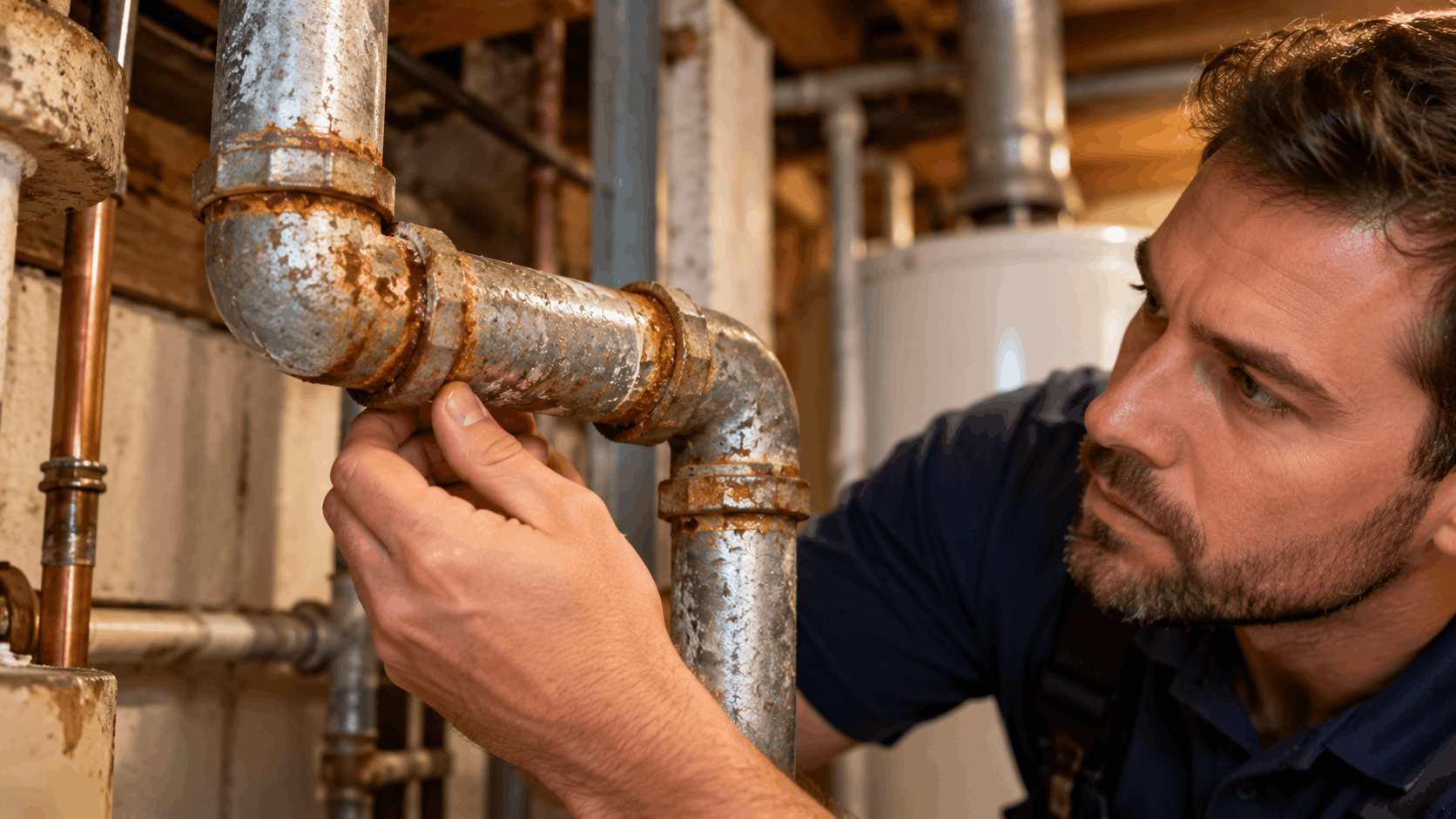
In a township where one house can hold four different pipe materials, a proper diagnosis is what separates a fix that lasts from a patch that fails again next year. Guessing from the build year is how money gets wasted on the wrong repair. The point of diagnosis is to match the work to what is actually there.
A thorough look at a Winchester home covers both the supply side and the drain side, because homes of this age usually have issues on both. Here is what a real diagnosis involves.
Why the Build Year Only Gets You Started
Knowing a house was built in the 1950s tells a plumber what is likely, not what is certain. Because these homes have been altered repeatedly over seventy years, the original plumbing may be partly replaced, partly patched and partly original. Only an on-site inspection reveals the true mix.
Confirming the material means looking at exposed pipe where it is accessible, such as under sinks, at the water heater, in the garage or in a crawl space. The color and fitting style of the visible pipe tell an experienced eye whether it is galvanized, copper or PEX, and whether dissimilar metals are joined where corrosion would concentrate.
This on-site pipe identification matters because the repair plan hinges on it. A house that is all original galvanized points toward a full repipe. A house with a couple of corroded galvanized runs feeding into copper points toward targeted work at those connections.
Skipping this step and quoting from the build year alone risks solving the wrong problem. The honest first move is to find out what is actually behind the walls.
Checking Incoming Pressure and the Main Shut-Off
A pressure test at the hose bibb shows what the house is actually receiving and reveals whether the drop an owner feels is from the street or from corroded internal lines. Low readings throughout point to supply line narrowing, while good incoming pressure that fades inside points the finger at the pipe between the meter and the fixtures.
Checking the main shut-off is just as important, and it is practical advice every Winchester homeowner should hear. A seventy-year-old valve that has never been turned frequently will not close when it is finally needed. In a one-bathroom house, that can turn a minor leak into a flooded home because there is no way to stop the water fast.
Knowing where the main shut-off is, and whether it actually closes, is genuinely useful knowledge before any emergency. If the valve is seized or will not seat fully, replacing it is a small, sensible job that pays for itself the first time a real problem hits.
These two checks, pressure and shut-off, cost little and tell a lot. They frame the whole diagnosis and often surface a safety issue the owner did not know they had.
Camera Inspection for the Drain Side
The drain side in these homes needs its own look. Cast iron drains and clay sewer laterals are common in Winchester, and after seventy years they face scaling, cracking at joints and root intrusion from mature landscape. Those problems show up as recurring slow drains and repeat blockages long before a full backup.
Repeated cabling clears a blockage but treats only the symptom. If a line is scaling, cracked or full of roots, it will clog again, and again. A sewer camera inspection is the honest diagnostic because it shows exactly what the inside of the line looks like and where the trouble is.
Seeing the actual condition of a cast iron drain or a clay lateral lets an owner make a real decision. A line with root intrusion at one joint might be cleared and spot-repaired, while a line that is scaled and separating along its length calls for sewer line repair or replacement.
This matters seasonally too. Late summer monsoon storms produce short, intense rainfall that overwhelms drainage and can back up floor drains and yard drains in older properties with tired laterals. Knowing the true condition of the line before monsoon season is far better than finding out during a storm.
Need Help in Las Vegas?
Active Plumbing serves Las Vegas and all of Las Vegas Valley.
Your Options: Cheap Fixes First, Repipe When It Is Time
Not every rusty-water call means a full repipe on day one. The honest path runs from inexpensive steps to the bigger job, and the right choice depends on how far the corrosion has gone. Starting cheap is good advice, not a sales pitch.
Here is how the options stack up, with the typical Las Vegas Valley price ranges stated plainly. These are typical ranges for the area, not a quote, and the actual price for a specific job is given in writing before work begins.
Start Cheap: Flush, Clean Aerators, Check Pressure
Before anyone talks about replacing pipe, the low-cost steps are worth doing. Flush the water heater to clear settled scale, clean the aerators and shower heads to restore flow, and check the incoming pressure to see what the house is actually getting. These steps are cheap and sometimes solve hot-only discoloration or weak flow at a single fixture.
Flushing is especially worthwhile in this water. A water heater repair runs a typical $150 to $500, and tankless maintenance and descaling runs a typical $150 to $250, both far less than a replacement. Clearing the sediment can buy years of service from a tank that was only struggling with scale.
Cleaning aerators and cartridges addresses the clogging that rust flakes cause at individual fixtures. It is a quick fix that tells you something too, since debris that returns fast means the pipe upstream is shedding rust steadily.
If a heater has already failed early once in this water, that is the point to consider scale reduction alongside the cheap fixes. Treating the cause, not just the symptom, keeps the next heater from going the same way.
When Repipe Becomes the Real Answer
There is a point where patches stop making sense. When corrosion is widespread through the galvanized, when the water runs rusty no matter how long the tap runs, and when pressure has dropped across multiple fixtures, a whole-house repipe is the real answer. Repipe and drain replacement are the defining work in Winchester for exactly this reason.
A repipe replaces the failing galvanized supply throughout the home with new material, which solves the rust, the pressure loss and the clogging all at once. Spot repairs on a system that is corroding everywhere just move the failure to the next weak run, so they become a series of expenses that never fix the underlying problem.
A whole-house repipe runs a typical valley range of $4,000 to $15,000. The spread is wide because it depends on the size of the home, the number of fixtures, how accessible the runs are and what the diagnosis finds behind the walls. That range is typical for the area, not a quote.
For a one-bathroom Winchester house on all-original galvanized, a repipe is usually the better long-term value than chasing one failed section after another. It ends the cycle rather than extending it.
Scale Reduction and Water Treatment That Extends Equipment Life
Given the valley's very hard water, softeners and scale-reduction systems extend equipment life rather than being optional luxuries. New copper or PEX installed during a repipe will last longer and perform better when the water feeding it is treated, because scale is not constantly building inside the new lines and the water heater.
A water softener installation runs a typical $800 to $2,500, and salt-free water conditioning runs a typical $800 to $2,500 installed. Softeners remove the calcium and magnesium that cause scale, while salt-free conditioning changes how the minerals behave so they deposit less. Both reduce the scaling that shortens the life of heaters and fixtures.
Treatment pairs well with a repipe because it protects the investment. Spending on new pipe and then feeding it the same untreated very hard water means the new system starts accumulating scale from day one. Treating the water keeps the new plumbing performing.
These are typical ranges for the area, and the right system depends on the household and the home. The point is that in this water, treatment is a genuine life-extender for the equipment it protects.
Renters, Landlords and Who Pays for the Fix
Winchester has a large rental share, which changes who makes the call and who authorizes the work. Getting this straight at the first contact is the difference between a completed job and a wasted visit. The person turning on the rusty tap is often not the person who pays to fix it.
Knowing the rules here helps both tenants and owners act correctly and fast when the water runs brown.
Most Homes Here Are Rented, So the Caller Is Often Not the Owner
About 68 percent of Winchester homes are rented, according to Census QuickFacts, with an owner-occupied rate of 32 percent. That means the person reporting rust-colored water is frequently a tenant, while the landlord or property manager authorizes and pays for the repair. The decision maker is often not the person in the house.
Establishing ownership at the first call saves everyone time. A tenant can gather information and describe the problem, but the work order has to come from whoever holds responsibility for the property. Sorting that out up front avoids a visit that cannot proceed because no one has authorized it.
For property managers handling several Winchester properties, rust-colored water is a signal worth acting on quickly. Old galvanized does not improve, and a unit with failing supply lines will keep generating complaints until the pipe is addressed.
Clear communication between tenant, manager and plumber keeps a rental repair moving. The tenant knows the symptom, the owner controls the decision, and the plumber needs both to do the job.
What Nevada Law Says About Working Plumbing and Hot Water
Under Nevada Revised Statutes Chapter 118A, a landlord must maintain the premises in a habitable condition, which includes working plumbing and facilities to supply hot water. A failed water heater or an unusable bathroom in a rental is the owner's responsibility, not the tenant's.
That gives a Winchester tenant a clear basis to escalate. Rusty water from corroding supply lines, lost pressure that makes a shower unusable, or a dead water heater all fall under the landlord's duty to keep the home habitable. Reporting it in writing to the landlord or property manager is the right first step.
For owners, the same rule frames the repair as an obligation rather than an option. Habitability covers working plumbing, so letting a corroded galvanized system degrade until a tenant has no reliable water is not a position the law supports.
Where a tenant and owner disagree on responsibility or timing, confirming the specifics with the relevant authority is wise, since the facts of each situation differ. The general duty to supply working plumbing and hot water is clear in the statute.
Shared Lines in Duplexes and Small Multi-Unit Property
Winchester's stock includes duplexes and small multi-unit property, where plumbing is often shared. A shared drain line or a shared water heater means one failure affects more than one household at once. When the common line backs up or the shared heater dies, every unit on it loses service.
That shared arrangement makes planned replacement cheaper than emergency replacement, in both money and goodwill. Scheduling the work when it can be coordinated across units, with notice to tenants, costs less and causes less disruption than scrambling after a failure that has already taken everyone's water.
For an owner with a duplex, the math favors acting on warning signs early. Rust-colored water or fading pressure in one unit of a shared system is a preview of what the other unit will face, since both draw through the same aging pipe.
Landlords with several Winchester properties are in the best position to plan this work across their portfolio rather than reacting one emergency at a time. Coordinated replacement protects the tenants and the property together.
Permits, Licensing and Who Governs the Work in Winchester
A detail that trips up a lot of Winchester owners is which government actually governs the work. The mailing address says Las Vegas, but the jurisdiction does not. Getting this right before quoting permitted work is a routine first step in this township.
Here is who governs the work, what code applies, and how to confirm a contractor is licensed.
Winchester Is County, Not the City of Las Vegas
Winchester is an unincorporated township of Clark County, not the City of Las Vegas, despite the Las Vegas mailing address. Permits, plan check and inspections run through the Clark County Department of Building and Fire Prevention. An owner who calls the city about a permit is calling the wrong agency.
This matters on every permitted job in the township. The correct building department for a Winchester address is the county, and establishing that before work begins avoids delays and rejected applications. Neighboring areas like Paradise and Sunrise Manor are also unincorporated county, while the actual City of Las Vegas lies elsewhere.
You can see how we cover the township on our Winchester service page. The jurisdiction point is one of those small facts that signals a contractor actually knows the area rather than treating it as a generic Las Vegas address.
For a repipe or a sewer line replacement that requires a permit, the application goes to Clark County, and the permit position should be confirmed for the specific address before work starts.
The Southern Nevada Amendments and the Building Official
Nevada has no statewide plumbing code. Clark County adopts the Uniform Plumbing Code published by IAPMO together with the Southern Nevada Amendments, as codified by the county. Southern Nevada's jurisdictions adopted the 2024 edition with those amendments, which took effect for Clark County in January 2026.
The amendments are not code unless adopted and codified by the individual jurisdiction, and they are not intended to prevent the use of any material or method not specifically prescribed, provided alternates are approved by the Building Official. The Building Official is the authority on an alternate material or method.
For a repipe, the amendments bear on material choices and how the work is done. A plumber working in Winchester works to the county's codified version of the code, and where an alternate approach makes sense, it goes through the Building Official for approval.
Because fee schedules and code edition details change over time, the specifics for a given project should be confirmed with Clark County rather than assumed. The framework, county jurisdiction under the Southern Nevada Amendments, is the stable part.
Licensed Work and Verifying a Contractor
Plumbing contractors in Nevada are licensed through the Nevada State Contractors Board, and work requiring a permit must be performed by an appropriately licensed contractor. Licensing is statewide, not issued by the county, so the right place to check is the state board.
A customer is entitled to ask for a license number and to verify it free at nvcontractorsboard.com, where classification, status, bond and workers compensation are all public record. In a market with a significant unlicensed trade problem, that verification protects the homeowner on a major job like a repipe.
Active Plumbing holds Nevada license #0047021 and has been licensed since 1991, along with the certifications required for the work it performs. That number can be checked at the board's site like any other.
Before hiring anyone for permitted work in Winchester, checking the license is a simple step that confirms the contractor is who they say they are and carries the proper coverage.
Need Help in Las Vegas?
Active Plumbing serves Las Vegas and all of Las Vegas Valley.
How Active Plumbing Handles Galvanized and Rusty Water Calls in Winchester
When a Winchester homeowner or property manager calls about rust-colored water, our approach starts with finding out what is actually there rather than quoting from the build year. These are old houses with mixed materials, and the right fix depends on an accurate read of the specific home.
Here is how our team handles these jobs from the first call through the written price.
Confirming the Pipe Before Quoting Anything
We confirm what material is actually present on site before recommending anything. That means checking the exposed pipe at the water heater, under sinks and anywhere else it is accessible, so we know whether we are looking at galvanized, copper, PEX or a patchwork of all three with dissimilar metal joints.
We check the incoming pressure and test whether the main shut-off actually closes, since a seized valve on a seventy-year-old home is a safety issue an owner should know about. These checks frame the whole diagnosis and often surface problems the owner did not realize they had.
On the drain side, we use camera inspection to see the true condition of cast iron drains and clay laterals rather than cabling blind and treating only the symptom. Seeing the inside of the line lets us recommend the right work, whether that is a spot repair or a replacement.
Only after that look do we talk about the fix. Matching the repair to what the diagnosis finds is how a Winchester job gets solved once instead of repeatedly.
A Written Price Before Work Starts
We give the customer a written price before work starts. That is how we operate on every job, from a water heater flush to a full repipe, so an owner knows the number before anyone picks up a tool.
Our technicians arrive in 30 to 60 minutes anywhere in the Las Vegas Valley, including every street in Winchester from Sahara Avenue down to Desert Inn Road. When rusty water or a failed heater stops a one-bathroom household, that response window gets help moving quickly.
For a plumbing emergency like a burst line or a sewer backup, the same approach holds. We confirm the problem, give the written price, and get the work done so the household gets its water back.
A written price up front removes the guesswork for the homeowner, the tenant and the property manager alike. Everyone sees the same number before the job begins.
Scheduling Around Resort Corridor Shift Work
Winchester houses a large share of resort corridor workers on shift patterns, so the household that needs an appointment may be asleep at midday and working overnight. We work around that with flexible scheduling and clear communication about arrival windows, because a rigid nine-to-five appointment does not fit this neighborhood.
With a significant Spanish-speaking customer base here, we keep our communication in plain language and provide itemized written quotes. A clear, itemized quote travels further than technical shorthand and makes sure the customer understands exactly what the work covers and what it costs.
Clear arrival windows matter more here than almost anywhere in the valley. A worker who gets off an overnight shift needs to know when we will show up so they can plan sleep around it, and we treat that as part of doing the job right.
The goal is a job that fits the customer's life, not one that forces the customer to rearrange everything around us. In a shift-work neighborhood, scheduling is part of the service.
Get Your Winchester Water Checked
If the water east of the Strip is running rusty, have the pipe confirmed on site, the pressure and main shut-off checked, and the drain line looked at before deciding on a fix. Call Active Plumbing at (702) 438-3357 and a technician will diagnose what is actually behind your walls and give you a written price before any work begins.
Frequently Asked Questions
- Is rust-colored water from galvanized pipes safe to drink?
- The discoloration is corrosion and scale shedding from aging pipe, not a treatment problem at the plant. EPA action levels for lead and copper apply to public water systems rather than individual homeowners, and the health goal for lead is zero. If there is any concern, confirm water quality with testing. Lead and copper testing runs a typical $75 to $150, and general water quality testing runs a typical $75 to $200 as market ranges for the area.
- Why is my water only rusty first thing in the morning?
- Water that sits overnight in corroded galvanized lines picks up rust from the pipe walls while it is still. The first draw of the day runs discolored, then often clears once fresh water pushes through. That clearing pattern suggests corrosion that is present but not yet advanced everywhere. If the water stays discolored no matter how long it runs, the corrosion is more widespread and the system has less clean pipe left.
- How long do galvanized supply lines last in Las Vegas?
- Galvanized in Winchester's oldest homes is now sixty to seventy years old, and the valley's very hard water speeds the internal narrowing as scale compounds the corrosion. Many of these lines are at or past the point where replacement makes sense. There is no fixed expiration date, since it depends on the specific home and how the system was installed and maintained, but seventy-year-old galvanized here is generally near the end of its useful life.
- Can I just replace one bad section instead of the whole house?
- Spot repairs can buy time when only one run has failed. But when corrosion is widespread through the galvanized across the house, a repipe is usually the better value, because patching one section just moves the failure to the next weak run. Past repairs also create dissimilar metal joints where galvanized meets copper, and those joints cause galvanic corrosion that becomes its own source of trouble over time.
- How much does a whole-house repipe cost in Winchester?
- A whole-house repipe runs a typical Las Vegas Valley range of $4,000 to $15,000. The spread depends on the size of the home, the number of fixtures, how accessible the pipe runs are, and what the diagnosis finds behind the walls. That is a typical range for the area, not a quote. The actual price for a specific job is given in writing before work begins, once we have confirmed what is actually there.
- I rent in Winchester. Who is responsible for fixing rusty water?
- Under Nevada Revised Statutes Chapter 118A, the landlord must maintain the premises in a habitable condition, which includes working plumbing and facilities to supply hot water. That makes rust-colored water from failing supply lines and a dead water heater the owner's responsibility, not the tenant's. Report it in writing to your landlord or property manager, since they authorize and pay for the repair. About 68 percent of homes here are rented, so this is the common situation.
- Does a water softener fix rust-colored water?
- A softener and scale reduction extend equipment life and slow the buildup of new scale, but they do not reverse corrosion that has already formed inside galvanized pipe. The rust already shedding from the pipe walls will keep coming until the pipe itself is replaced. Treatment is worth doing to protect new plumbing and your water heater, especially after a repipe. Water softener installation runs a typical $800 to $2,500 for the area.
- Do I need a permit to repipe a house in Winchester?
- Permitted work in Winchester goes through the Clark County Department of Building and Fire Prevention, because Winchester is an unincorporated township of Clark County rather than part of the City of Las Vegas, despite the mailing address. A repipe that requires a permit is a county matter. Confirm the exact permit position for your specific address, since the requirements and fees are set by the county and can change over time.
- Why does my water pressure keep dropping at just one faucet?
- Scale and corrosion narrow the galvanized bore, and the most corroded run of pipe starves the fixture it feeds first. Rust flakes and scale also clog the aerator and the cartridge at that single faucet. That is the usual early sign of failing galvanized, showing up at one tap before it spreads to others. Cleaning the aerator helps briefly, but when the debris returns fast, the pipe upstream is the real source.
- How fast can someone come out to check my water?
- Active Plumbing technicians arrive in 30 to 60 minutes anywhere in the Las Vegas Valley, including all of Winchester. When rusty water or a failed water heater stops a household, that response window gets a technician on site quickly to confirm what is happening and give you a written price before any work starts.
Licensed plumbing professionals serving Las Vegas and Las Vegas Valley.
Licensed in Nevada · License #0047021
Last updated on
Why trust Active Plumbing?
Founded in 1991, Active Plumbing is a licensed and insured plumber serving Las Vegas and Las Vegas Valley. All content is reviewed by our licensed technicians.

Need Help in Las Vegas?
Active Plumbing serves Las Vegas and all of Las Vegas Valley.
Related Articles

Las Vegas vs Henderson vs North Las Vegas Water Systems: Providers, Pressure, and What It Means for Your Pipes
Las Vegas, Henderson, and North Las Vegas share one water source but run different systems. Learn who supplies your water, why pressure varies, and what it means for your pipes.
Pinhole Leak in Copper in a Las Vegas Wall - Why Our Water Chemistry Eats Copper and What to Do Today
A pinhole leak in copper starts small but spreads fast in Las Vegas. Learn why local water eats copper, the warning signs, and what to do today.
Water Heater Replacement in Green Valley Henderson: High Water Pressure and PRV Pairing
High street pressure quietly kills water heaters in Green Valley Henderson. Learn why pairing a new unit with a PRV protects your investment, warranty, and home.