Las Vegas Water Pressure and Your Fixtures: What 80+ PSI in Henderson Does to Cartridges and Hoses
Key Takeaways
- Many Las Vegas Valley homes run 80 to 100+ PSI, well above the safe 50 to 60 PSI target, especially in hillside areas like Anthem and Seven Hills.
- Constant high pressure wears out faucet cartridges, seals, and O-rings far more quickly than normal, causing drips, squealing handles, and stiff controls.
- Braided supply hoses fail from pressure fatigue and should be replaced every 5 to 8 years, sooner behind washing machines and water heaters.
- High PSI also stresses water heaters, small appliance valves, angle stops, and causes water hammer throughout the home.
- The Valley's hard water from the Colorado River adds mineral scale that combines with pressure to roughly halve fixture lifespan.
- A ten-dollar hose bibb gauge lets homeowners test static pressure; readings above 80 PSI, especially at night, mean it is time to call a plumber.
- A properly set pressure reducing valve plus a thermal expansion tank protects every fixture at the source and prevents repeated repairs.
- Active Plumbing tests pressure, installs PRVs, and services fixtures across Henderson, North Las Vegas, Summerlin, and the Southeast Valley.
In This Article
A homeowner in Green Valley walks into the laundry room one morning and steps into an inch of water. The braided hose behind the washing machine split overnight, and by sunrise the flooring is ruined. Down the road in Anthem, another family keeps replacing the same bathroom faucet cartridge every eight months and cannot figure out why. Both problems trace back to the same hidden culprit: water pressure that runs far too high.
The Las Vegas Valley has a pressure problem, and most people never know it until something breaks. High static pressure quietly grinds down cartridges, swells rubber hose cores, and stresses every valve in the house. Combine that force with some of the hardest water in the country, and fixtures wear out at double the rate you would expect in other regions.
Let's cover how high the pressure runs across the Valley, what 80+ PSI does to cartridges and hoses, how hard water makes it worse, how to test your own pressure, and how a pressure reducing valve protects everything downstream. By the end, you will know exactly what to check and when to call for help.
How High Is the Water Pressure Across the Las Vegas Valley?
Most homeowners have no idea what their water pressure reads. They assume it is fine because water comes out of the tap with force. The problem is that too much force is a slow killer, and a lot of Valley homes run well past the safe line.
Across the region, Las Vegas water pressure commonly lands between 70 and 100 PSI at the meter. Plenty of homes we test read above 80 PSI, which is where damage starts to add up. Henderson water service in particular tends to run high because of the terrain.
- Flat, lower-lying areas often read 60 to 75 PSI
- Mid-elevation neighborhoods frequently hit 80 to 90 PSI
- Hillside communities regularly measure 95 to 110+ PSI
- Nighttime readings can spike another 10 to 20 PSI when demand drops
What the Las Vegas Valley Water District Delivers to Your Street
The Las Vegas Valley Water District and Henderson's utility system pump treated water through a network of mains, tanks, and pump stations. To keep water flowing to every home, including the ones on higher ground, they maintain pressure high enough to reach the top of each zone. That baseline is often more than a low-lying house actually needs.
Static pressure is the reading you get when no water is moving in the home. It reflects the raw force the street main pushes against your plumbing all day and all night. In many Valley neighborhoods, that static pressure sits well above the range fixtures are built to handle.
The district cannot fine-tune pressure house by house. Their job is to keep the whole zone supplied, so they set it for the highest point. Everyone below that point gets extra force whether they want it or not.
That is why pressure control is a homeowner responsibility, not something the utility handles at your meter. Once water crosses onto your property, protecting your fixtures is on you.
Why Elevation in Henderson and Anthem Pushes PSI Even Higher
Water systems rely on gravity and pumps to move water uphill. To serve homes at the top of a hill, the system has to build serious pressure at the base. That means houses lower on the slope absorb a punishing amount of force.
Communities like Anthem, MacDonald Ranch, and Seven Hills sit on grades that create big elevation pressure swings. A home partway down one of these hills can easily read 100 PSI or more at the meter. We see it every week in our Henderson service area.
Every 2.3 feet of elevation drop adds about 1 PSI of static pressure. Multiply that across a steep Anthem street and the numbers climb fast. A house 100 feet below the supply tank gets roughly 43 extra PSI from gravity alone.
This is why hillside homeowners often struggle with fixtures that fail early. The pressure they live with day to day is simply harder on plumbing than what a flatland home experiences.
The Safe Range vs. What Most Homes Actually Read
Plumbing manufacturers and building officials agree on a target: roughly 50 to 60 PSI is the sweet spot for a home. That range gives you strong flow at the tap without wearing out the parts inside. It is the pressure faucets, valves, and hoses are engineered around.
The Uniform Plumbing Code, which the Valley follows, caps water pressure at 80 PSI for residential systems. Above that number, code requires a pressure reducing valve. Yet many homes we visit read 90, 95, or even past 100 PSI with no PRV in sight.
The gap between the safe PSI range and reality is where all the damage happens. A fixture rated for 60 PSI does not fail instantly at 95, but it wears three or four times more quickly. Owners notice the failures long before they connect them to pressure.
When we test a home and see readings above 80, that is a clear signal the plumbing code threshold has been crossed. It also means the fixtures inside are living on borrowed time.
Neighborhoods Where We See the Highest Readings
Our team drives these streets every day, and certain areas stand out for extreme pressure. Green Valley, both the newer and older tracts, frequently reads in the 90s. Parts of Inspirada and Summerlin on higher ground push past 100 PSI on a regular basis.
In Summerlin, the western villages that climb toward the mountains carry noticeably higher static pressure than the flatter eastern sections. We routinely test homes there that need pressure control from day one. The same holds for the hillside pockets of Green Valley.
Inspirada, built on rolling terrain in the Southeast Valley, is another spot where high readings are the norm rather than the exception. New construction there does not protect owners from pressure any better than an older home. The force from the main is the same either way.
If you live in any of these areas, assume your pressure is high until a gauge proves otherwise. It is far cheaper to test than to keep replacing what the pressure breaks.
Get Your Quote
Tell us what's going on and we'll get back to you. We're open 24/7.
What 80+ PSI Does to Faucet and Shower Cartridges
The cartridge is the heart of a modern faucet or shower valve. It controls flow and temperature with small moving parts that fit together with tight tolerances. Those parts are exactly what high pressure destroys first.
When homeowners tell us their new faucet is already dripping or their shower handle squeals, high pressure damage is usually the reason. The force never lets up, so the wear never stops. A cartridge built for years of service can give out in months.
How a Cartridge Works and Where It Fails Under Pressure
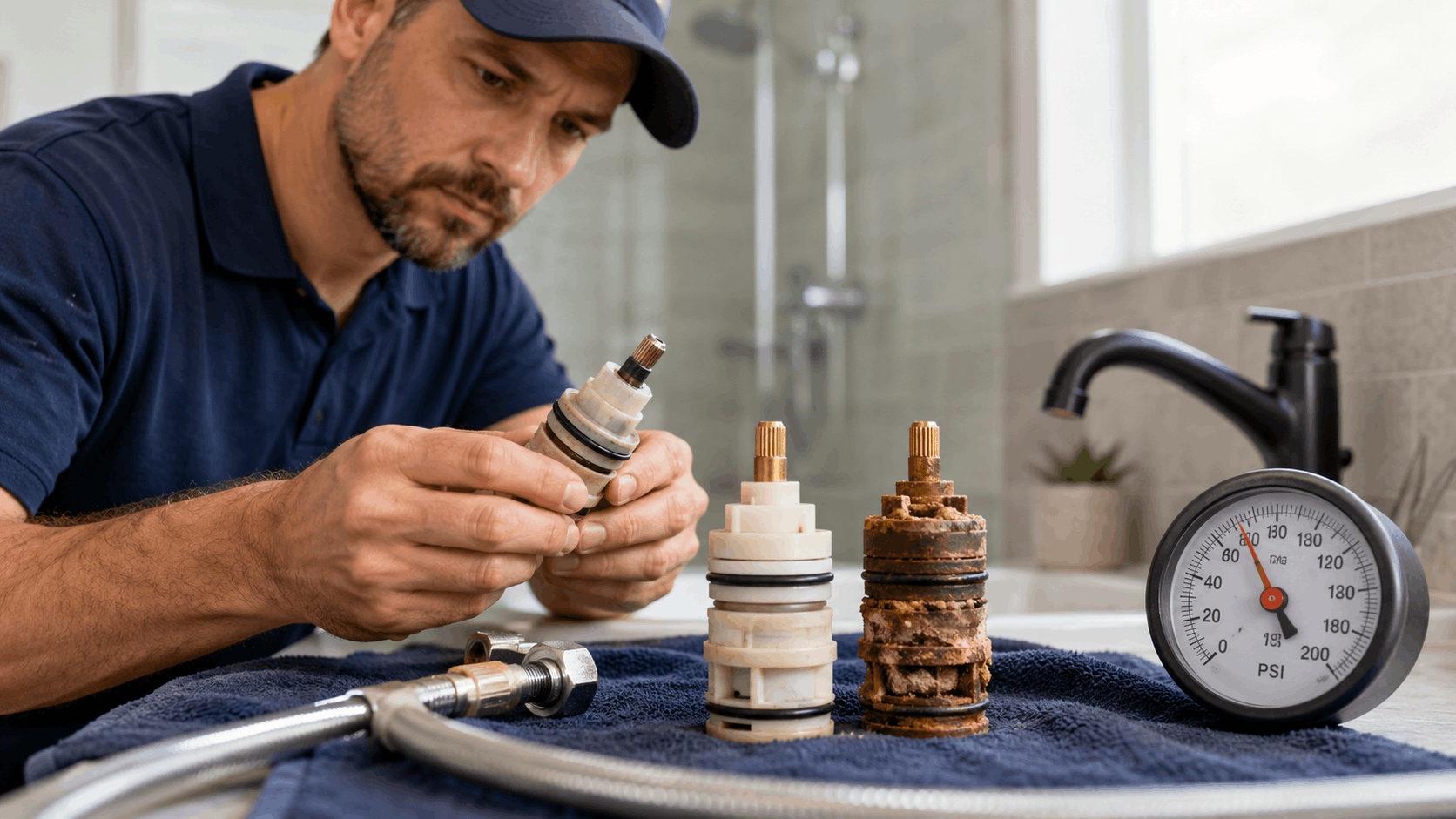
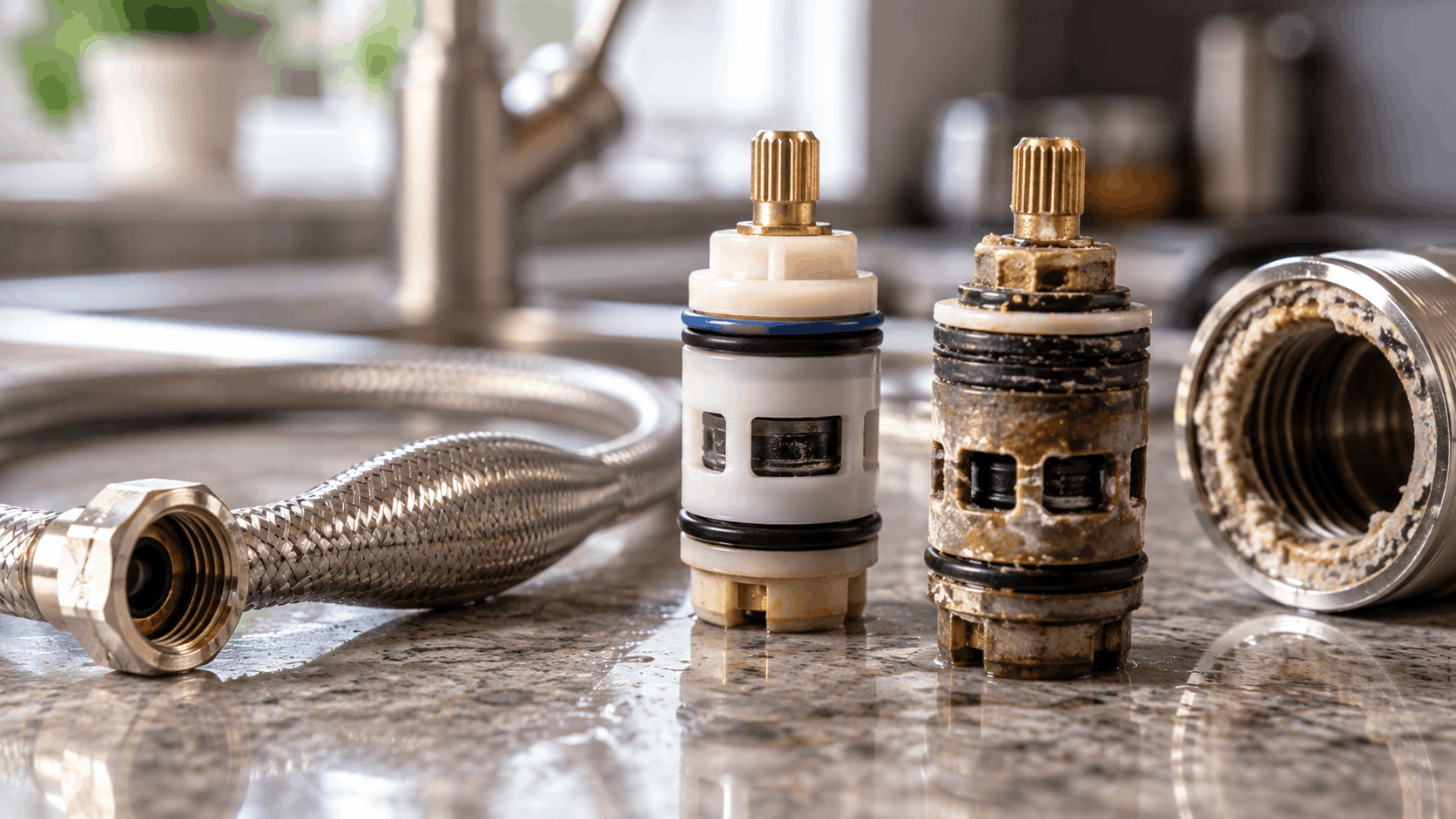
Inside most faucets and shower valves sits a cartridge with ceramic discs, rubber seals, and O-rings. Turning the handle shifts the ceramic discs to open or block the water path. When everything is sealed and aligned, you get clean flow with no leaks.
High pressure pushes constantly against those seals and discs. The O-rings compress harder than they should and lose their shape more quickly. Over time the ceramic surfaces develop tiny scratches from grit forced through at high speed.
Once the seal breaks down, water sneaks past even when the valve is closed. That is the start of cartridge failure. The part was never defective, it just took more force than it was built to handle for far too long.
Pressure also stresses the plastic and brass body around the cartridge. In extreme cases the whole valve cracks, which turns a small repair into a bigger job. Our pipe and fixture team sees this pattern in high-pressure homes constantly.
Dripping Faucets and Squealing Handles as Warning Signs
A dripping faucet is a common early warning. If the tap keeps leaking after you shut it off tight, the cartridge seals are failing. Many owners crank the handle harder, which only speeds up the damage.
A squealing handle is another red flag. That high-pitched whistle happens when water forces its way through a worn or partly blocked cartridge at high pressure. The sound tells you the part is fighting the water instead of controlling it smoothly.
Stiff handles that are hard to turn point to the same problem. Pressure and mineral buildup together make the internal parts drag. What used to move with one finger now takes a firm grip.
None of these signs fix themselves. They get worse as the pressure keeps working on the weakened parts. Catching them early usually means a simple cartridge swap instead of a full fixture replacement.
Why Newer Homes in Cadence and Skye Canyon Still See Early Failures
A lot of owners assume a brand new home means worry-free plumbing. Then a two-year-old faucet in Cadence starts dripping and they are stunned. The truth is that new construction offers no protection from unregulated pressure.
Master-planned communities like Cadence in Henderson and Skye Canyon in the northwest are built on higher ground where pressure runs strong. Builders install code-minimum fixtures, and those fixtures meet the same 60 PSI design target as everything else. Hit them with 95 PSI and they wear out just as fast as older ones.
We have replaced cartridges in homes barely out of warranty because no pressure reducing valve was set correctly. Sometimes a PRV exists but was never adjusted to the right pressure. The fixtures pay the price either way.
If you own a newer home in one of these communities, do not let the build date fool you. Test the pressure and confirm your PRV is doing its job. New parts fail on the same schedule as old ones when the force is too high.
Repair vs. Replace: When a Cartridge Is Worth Saving
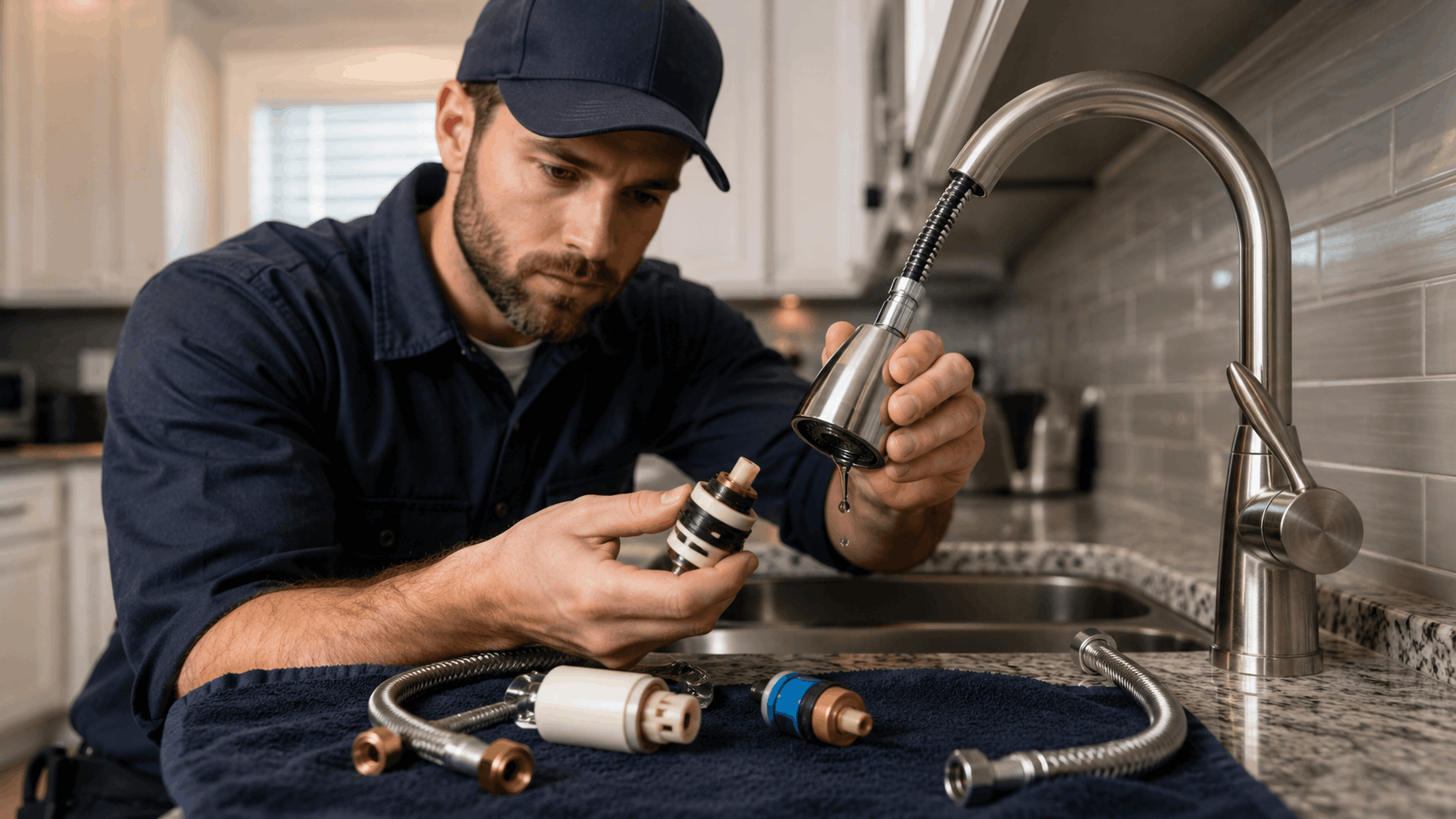
Cartridge replacement is often the smart move on a good faucet. A quality brand like Moen, Delta, or Kohler makes replacement cartridges that drop right in. If the fixture body is solid and the finish still looks good, a new cartridge brings it back to life.
The math changes with age and quality. A cheap builder-grade faucet that is a decade old may not be worth the labor of a faucet repair. By the time you factor in matching a discontinued part, a full replacement makes more sense.
We also look at how often the fixture has failed. If we are back at the same faucet every year, the real fix is not another cartridge. It is fixing the pressure feeding the whole house.
Our advice is simple: fix the pressure first, then decide on the fixture. A new cartridge in a home still running 95 PSI is a temporary patch. Solve the root cause and your repairs last the way they should.
Need Help in Las Vegas?
Active Plumbing serves Las Vegas and all of Las Vegas Valley.
Supply Hoses and Braided Lines Under Constant Strain
The flexible hoses behind your toilets, sinks, and appliances are among the most overlooked parts of a home. They sit hidden in cabinets and behind machines, quietly holding back pressurized water around the clock. When one lets go, the flooding can be severe.
A burst hose in an occupied home is bad enough. In an empty house, one failed braided supply line can dump hundreds of gallons before anyone notices. High pressure is what pushes these hoses to that breaking point.
Why Braided Steel Hoses Do Not Last Forever
A braided steel supply line looks tough, but the metal braid is only a jacket. Inside sits a rubber core that actually holds the water. The steel mesh keeps the rubber from ballooning, while the rubber does the sealing.
High pressure works that rubber core hard. Every day it flexes and holds against force it was not built to handle long term. This hose fatigue causes the rubber to swell, crack, and eventually split at a weak spot.
Once the rubber core fails, the braid alone cannot hold water back. The line either sprays through the mesh or blows out entirely. What looked like a solid steel connector becomes an open pipe.
Cheaper hoses fail sooner because the rubber is thinner and the crimps at the ends are weaker. In a high-pressure Valley home, even decent hoses have a shorter life than the packaging claims. The force simply ages them more quickly.
Washing Machine and Water Heater Hoses at the Highest Risk
Washing machine hoses take more abuse than almost any line in the house. They handle repeated on-off cycles, hot and cold swings, and full static pressure between loads. That combination makes them a top candidate for a sudden burst.
Water heater connectors face similar strain plus constant heat. Heat and pressure together break down flexible connectors more quickly than either does alone. When one fails near the tank, you get a flood in the garage or utility closet.
The scary part is timing. These failures often happen when no one is home or while the family sleeps. A washing machine hose that lets go on a weekday can flood a home for hours before anyone walks in.
We handle these calls through our emergency plumbing service more than owners expect. A quick hose swap during a normal visit is far cheaper than the water damage from a 2 a.m. burst. Pairing new hoses with a whole-home leak detection system gives even better protection.
The 5-to-8 Year Rule for Replacing Supply Lines
A good rule for supply lines is replacement every 5 to 8 years. That covers toilet lines, faucet lines, and appliance connectors. In high-pressure homes, lean toward the 5-year end of that window.
Waiting for a hose to fail is the expensive way to learn this lesson. A braided line costs a few dollars and a few minutes of labor to swap. The water damage from a burst can run into the thousands.
We recommend writing the install date on new hoses with a marker. That simple habit takes the guesswork out of your hose replacement schedule. When the date creeps past five years in a high-pressure home, it is time.
Preventive plumbing like this is the cheapest insurance you can buy. Replacing a handful of hoses on a schedule beats mopping up a flood every time. It is the kind of small maintenance that saves entire rooms.
What We Find Behind Toilets in Older Henderson Homes
Pull a toilet supply line in an older Henderson home and the story writes itself. In neighborhoods like Whitney Ranch and the older Green Valley tracts, we often find original hoses decades past their prime. Many are stiff, discolored, and ready to fail.
These homes were built before anyone thought much about pressure control. Combine aging hoses with high static pressure and you have a slow-building risk in every bathroom. The lines held on longer than they should have, which is exactly the problem.
We also see corroded connections where the hose meets the angle stop. Hard water minerals crust up the threads and hide small weeping leaks. By the time the stain shows on the wall, the damage has been going for a while.
When we work in these older tracts, we check every supply line as a matter of routine. Owners are usually surprised at how brittle their hoses have become. Replacing them is fast, cheap, and prevents a much worse call later.
Beyond Cartridges: Other Fixtures That Suffer From High PSI
Cartridges and hoses get the attention, but high pressure works on the whole house. Water heaters, small appliances, and shut-off valves all take the same beating. The force does not care which part it wears out first.
Looking at the full picture helps owners see why pressure control matters so much. One high reading at the meter affects dozens of parts throughout the home. Fixing it once protects all of them at the same time.
Water Heaters and the T&P Relief Valve
Every water heater has a temperature and pressure relief valve, called a T&P valve, as a safety device. It opens if pressure or temperature climbs too high to prevent a dangerous buildup. In a high-pressure home, it can trip when it should not.
When street pressure runs above 80 PSI, that extra force pushes on the tank all day. The T&P valve may weep or discharge water, which owners often mistake for a leak. The valve is doing its job, but the constant strain shortens the water heater lifespan.
A tank designed for a normal pressure range works much harder under high PSI. Seams and fittings fatigue quicker, and the anode rod and lining wear sooner. You end up replacing the heater years earlier than you should.
Our water heater team checks pressure whenever we service a tank. If a T&P valve keeps discharging, the fix is rarely just a new valve. It usually points back to pressure that needs to be controlled at the main.
Dishwashers, Ice Makers, and Fridge Lines
Small appliances have small, delicate water parts. A dishwasher valve, an ice maker line, and a fridge water line all use thin tubing and plastic fittings. Those parts crack under sustained high pressure.
The ice maker line behind a refrigerator is a classic failure point. It is often a thin plastic tube pushed into a fitting under full pressure. Over time the plastic gets brittle and splits, leaking behind the fridge where no one looks.
Dishwasher inlet valves fail in a similar way. The internal seals give out and the valve either leaks or sticks open. High pressure speeds up both problems well before the appliance is old.
These leaks are sneaky because they hide behind and under appliances. A slow drip can damage cabinets and flooring for weeks before it shows. Controlling pressure protects all these little connections at once.
Angle Stops and Shut-Off Valves That Seize or Weep
The little valves under your sinks and toilets are called angle stops. They let you shut off water to one fixture without killing the whole house. High pressure and hard water together are hard on them.
Over years of pressure, the internal washer in an angle stop wears and the valve starts to weep. You may find a small puddle or a mineral crust at the base. That slow shut-off valve leak often goes unnoticed until it stains the cabinet.
Worse, many old angle stops seize completely. When you finally need to shut one off in a hurry, it will not turn. Homeowners twist too hard, the valve snaps, and a small job becomes an emergency.
We replace tired angle stops during most fixture work for this reason. A fresh quarter-turn valve gives you a reliable shut-off when you need it. In high-pressure homes, having working stops is real protection against a flood.
Water Hammer and the Banging Pipes Homeowners Hear
That loud knock when you shut off a faucet or the washer stops filling is water hammer. It happens when fast-moving water slams to a stop and the energy jolts the pipes. High pressure makes that impact stronger.
Banging pipes are more than an annoyance. Each hammer shock stresses joints, fittings, and the anchors that hold pipes in place. Over time that repeated force loosens connections and can start leaks inside walls.
Homes with high pressure and no hammer arrestors get the worst of it. Fast-closing valves on modern appliances make the problem sharper. The louder the bang, the more force is being dumped into your plumbing.
Controlling pressure usually softens water hammer right away. Adding arrestors at the appliances handles the rest. Together they quiet the pipes and stop the slow damage the banging causes.
How Hard Water Makes High Pressure Even Worse
High pressure alone would be enough of a problem. In the Valley, we get to layer hard water on top of it. The two together are why local fixtures wear out sooner than in most other cities.
Hard water is not just an inconvenience for spotty glasses. It builds mineral scale inside the exact parts that pressure already stresses. That combination is a distinctly local challenge.
Why Las Vegas Water Is So Hard
Most of our tap water comes from the Colorado River by way of Lake Mead. That source is naturally loaded with dissolved minerals, mainly calcium and magnesium. Those minerals are what make water hard.
By the numbers, local water hardness often measures around about 16 grains per gallon or higher. That puts the Valley among the hardest water regions in the country. The USGS water hardness scale classifies anything over 10.5 grains as very hard.
As the water moves through your plumbing, those minerals drop out and stick to surfaces. Every fitting, valve, and heating element collects a layer over time. The hotter the water, the sooner it happens.
This is why a water softener installation is such a common upgrade here. Softening the water removes the minerals before they can build up. It is one of the better ways to protect fixtures in this region.
Scale Buildup Inside Cartridges and Aerators
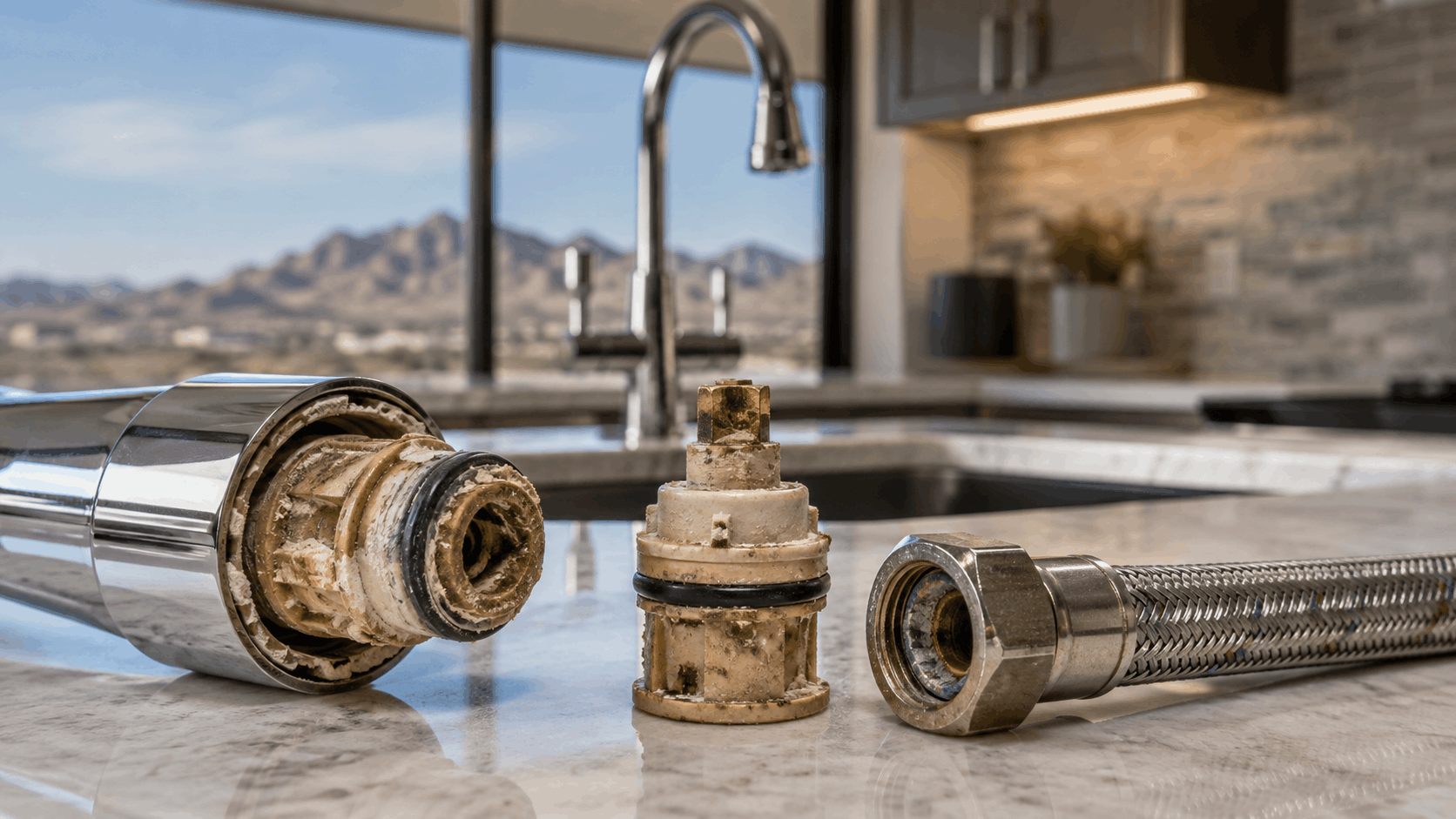
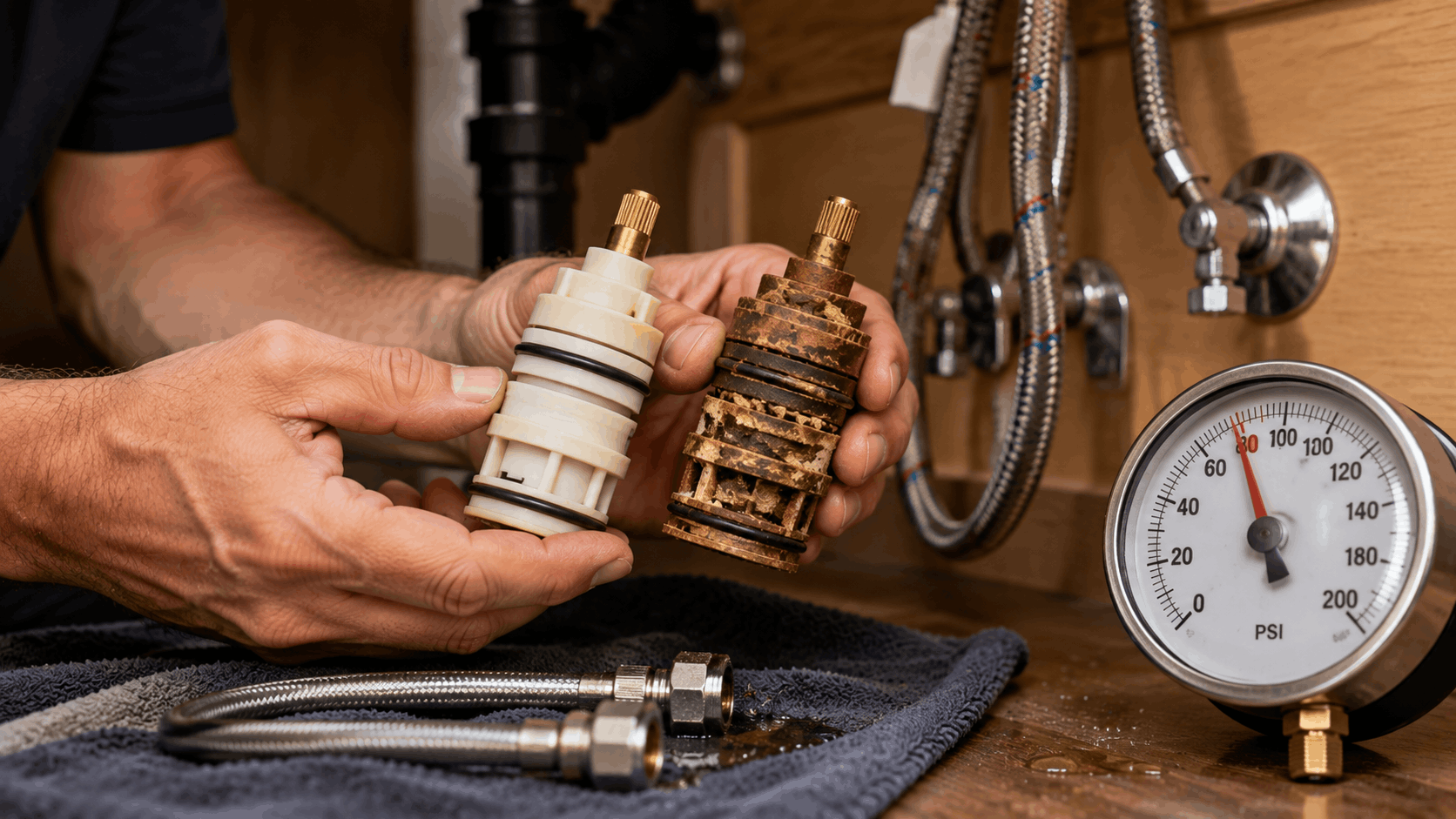
Scale buildup is the white, crusty mineral deposit hard water leaves behind. Inside a faucet cartridge, that scale coats the ceramic discs and seals. It stiffens the moving parts and gives grit for pressure to grind against.
A clogged aerator is the most visible sign. That little screen on the tip of your faucet catches mineral flakes until flow drops to a trickle. You can unscrew and soak it, but it clogs again because the source has not changed.
Shower heads suffer the same fate. Half the spray holes plug up and the water sprays sideways. Behind the wall, the shower cartridge is collecting the same scale on its internal parts.
Scale also narrows the passages inside valves, which raises the effective pressure at any restriction. So the minerals do not just clog things, they make the pressure problem worse at the same time. The two feed off each other.
The Combined Effect on Fixture Lifespan
On its own, high pressure shortens fixture lifespan. On its own, hard water shortens it too. Put them together and the combined wear can cut a fixture's life roughly in half compared to a low-pressure, soft-water region.
A faucet that might last fifteen years elsewhere may give out in seven or eight here. A water heater under high pressure and heavy scale can fail years ahead of schedule. These are not rare cases, they are the norm across the Valley.
The parts fail in a predictable pattern. Pressure stresses the seals, scale stiffens and clogs them, and the combination finishes the job. Repairs that should be occasional become a regular expense.
The good news is that both problems have clear solutions. A pressure reducing valve handles the force, and water treatment handles the minerals. Address both and your fixtures finally get to live a normal life.
Need Help in Las Vegas?
Active Plumbing serves Las Vegas and all of Las Vegas Valley.
Testing Your Home's Water Pressure the Right Way
You cannot fix a pressure problem you have not measured. The good news is that a basic water pressure test is cheap and easy. Any homeowner can get a real number in a few minutes.
Knowing your PSI reading takes the mystery out of fixture failures. If the gauge shows 95 PSI, you have your answer for the dripping faucets and the burst hose. Testing turns a guessing game into a plan.
Using a Hose Bibb Pressure Gauge at Home
The tool you need is a hose bibb gauge, available at any hardware store for around ten to fifteen dollars. It is a round dial with a female hose fitting that screws onto an outdoor spigot. That is the whole kit for a DIY pressure test.
Pick a spigot closest to where the main line enters the home for the most accurate reading. Thread the gauge on hand-tight, then open the spigot all the way. The needle jumps to your static pressure right away.
Make sure no water is running anywhere else in the house during the test. A running faucet or toilet fill will throw off the number. You want the reading with everything else off.
Write down the number and note the time of day. That single reading tells you whether you have a problem worth acting on. If the needle sits above 80, keep reading.
Testing at Different Times of Day
One reading is a good start, but pressure changes through the day. When the neighborhood uses a lot of water in the morning, pressure dips. Late at night, when demand drops, static pressure climbs.
That is why we suggest testing both morning and night. A home that reads 78 PSI at 7 a.m. might read 95 PSI at 11 p.m. The nighttime pressure is what works on your fixtures while you sleep.
Leaving a gauge on the spigot overnight is the best way to catch the peak. Some gauges have a red lazy hand that stays at the highest reading recorded. That feature captures the overnight spike even if you are not watching.
The high number is the one that matters most for fixture wear. If your peak static pressure test tops 80 PSI, your plumbing is spending part of every day over the line. That is the reading to act on.
What Reading Means You Should Call a Plumber
Use these thresholds as a simple guide. A reading in the 50 to 60 PSI range is right where you want to be. From 60 to 80 PSI you are still within code but on the higher side.
Once the gauge reads above 80 PSI, that is a high pressure warning worth acting on. At that point code calls for a pressure reducing valve, and your fixtures are taking damage. Anything over 90 or 100 PSI needs attention soon.
Wild swings between morning and night are another reason to call. Big pressure jumps often mean there is no working PRV, or the one you have has failed. Either way, a professional should confirm what is happening.
If you also see repeated fixture failures, do not wait for a perfect number. Dripping faucets, weeping valves, and a burst hose all point to pressure. When to call comes down to this: high readings plus recurring failures mean it is time.
How Our Team Diagnoses Pressure Issues on Site
When we arrive for a professional diagnosis, we start with a calibrated gauge at the main. We check static pressure with everything off, then test under flow to see how the system behaves. That gives us the full picture, not just one number.
We also look for an existing pressure reducing valve and test whether it still works. A failed PRV can pass full street pressure straight through as if it were not there. Confirming its condition is a standard part of the visit.
From there we inspect the fixtures that are failing and connect them to the readings. If your bathroom faucets keep dripping and the gauge shows 98 PSI, the cause is clear. We also check the water heater and its T&P valve for pressure stress.
The team at Active Plumbing walks you through everything we find in plain terms. You get real numbers and a straight recommendation, not a sales pitch. Then you decide how you want to move forward.
Pressure Reducing Valves and Long-Term Protection
Once you know the pressure is high, the fix is straightforward. A pressure reducing valve solves the root problem at the source. Paired with a few supporting steps, it protects every fixture in the house for years.
This is prevention that pays for itself. Instead of chasing failure after failure, you stop the cause. A single valve does more good than a decade of one-off repairs.
What a Pressure Reducing Valve Does and Where It Goes
A pressure reducing valve, or PRV, is a bell-shaped brass valve installed on the main water line. It takes the high pressure coming from the street and steps it down to a safe, steady level. Everything downstream of it lives at that lower pressure.
We install a PRV where the main line enters the home, usually near the shut-off or the meter. During PRV installation we set the outlet to a target around 55 to 60 PSI. That single adjustment brings the whole house into the safe range.
A quality PRV also smooths out the swings between day and night. The valve holds a consistent pressure even when the street spikes at 2 a.m. Your fixtures stop riding the pressure roller coaster.
For homes in higher-elevation areas, this is often the difference between constant repairs and years of quiet service. One valve on the main line protects faucets, hoses, the water heater, and every appliance at once. It is the most effective fix we install for pressure.
Adding a Thermal Expansion Tank
Installing a PRV creates what is called a closed system. Water can no longer push back out to the street through the valve. That matters because water expands when your heater warms it up.
With nowhere to go, that expanding water raises pressure inside the home and stresses the water heater. A thermal expansion tank gives that extra volume a place to flex into. It absorbs the expansion so pressure stays steady.
Skipping the expansion tank on a closed system leads to a T&P valve that constantly drips. Owners think the water heater is failing when the real issue is the missing tank. We install both together so the system works as a set.
The expansion tank is a small cylinder mounted near the water heater. It is inexpensive compared to a new tank and protects the heater you already have. When we add a PRV, we almost always recommend the expansion tank with it.
How Often a PRV Should Be Checked or Replaced
A pressure reducing valve is a mechanical part that wears out. Most have a PRV lifespan of about 10 to 15 years, sometimes less in hard water. The internal parts scale up and the valve slowly loses its ability to regulate.
A failing PRV shows itself in a few ways. Pressure may creep back up over time, or it may drop so low your flow suffers. Sometimes it fails wide open and passes full street pressure with no reduction at all.
This is why older homes with an original PRV often have high readings again. The valve did its job for years and then quietly gave out. Owners assume they are protected when they no longer are.
We recommend testing pressure every year or two, even with a PRV installed. A quick gauge check confirms the valve is still holding your target. If the number has climbed, a valve replacement restores your protection.
Our PRV and Repiping Work Around the Valley
Our team installs and replaces PRVs across the entire Valley, from Boulder City to Centennial Hills. We handle the higher-elevation homes where pressure runs hardest and the older homes where the original valve has failed. Every install includes setting the target pressure and checking for an expansion tank.
Sometimes high pressure has already damaged aging pipes to the point where repiping makes sense. When old galvanized or worn lines are leaking, a fresh install plus a PRV solves both problems together. We handle that full scope so you deal with one team.
We work throughout Las Vegas, Henderson, and the surrounding communities on this kind of protection work. Whether it is a single PRV or a larger repipe, the goal is the same. Get the pressure right so your fixtures stop failing.
If your home has never had its pressure checked, that is the place to start. We can test it, set up the right protection, and take fixture failures off your worry list. It is some of the most useful plumbing work we do.
Need Help in Las Vegas?
Active Plumbing serves Las Vegas and all of Las Vegas Valley.
When to Call Active Plumbing in Las Vegas and Henderson
Knowing when to bring in help saves money and headaches. Some problems are a quick fix, and some are a signal that the whole home needs attention. Recognizing the difference is half the battle.
Here is when it makes sense to call a Las Vegas plumber for pressure and fixture problems:
- Your gauge reads above 80 PSI at any time of day
- Faucets or valves keep failing after repairs
- You hear banging pipes or squealing handles
- A supply hose has burst or a fixture is leaking now
- Your water heater T&P valve keeps discharging water
Signs the Problem Is Bigger Than a Simple Fix
A single dripping faucet might just need a cartridge. But recurring leaks across multiple fixtures point to something bigger. When the whole house is having problems, the cause is usually upstream of any one fixture.
Watch for patterns instead of single events. If you replace one cartridge and another fails a few months later, that is a whole home issue. High pressure hits everything, so it shows up in more than one place.
Other signs include a water heater that fails early, multiple weeping valves, and hoses that keep going bad. Any of these on their own is worth a look. Several together almost always trace back to pressure.
When the problems keep coming, stop treating symptoms. A pressure test at the main tells you if one fix can solve many complaints. That is the moment to call for a real diagnosis.
What Happens During a Pressure and Fixture Inspection
A plumbing inspection with our team starts at the main line with a pressure gauge. We record static and flowing pressure and check for an existing PRV. That establishes the baseline for everything else.
Next comes the fixture check. We go through faucets, toilets, valves, and the water heater to note what is failing and why. We tie each finding back to the pressure and water quality readings so the picture makes sense.
We also inspect supply hoses and angle stops, since those are common failure points. If we find aging braided lines or seized valves, we flag them before they cause a flood. You get a clear list of what needs attention now versus later.
Then we prioritize. Safety and flood risks come first, then the root-cause fixes like a PRV, then the individual repairs. You leave the visit with a plan and honest numbers, not a pile of pressure.
Areas We Serve Across the Valley
Our team covers the whole Valley for pressure and fixture work. That includes Henderson, North Las Vegas, Summerlin, and the Southeast Valley communities where pressure runs high. Wherever the terrain drives up PSI, we are there regularly.
We work throughout neighborhoods like Aliante in North Las Vegas, Whitney, Spring Valley, Paradise, and Enterprise. From flat tracts to steep hillside streets, each area has its own pressure story. We know the local conditions because we work them every week.
For urgent problems like a burst hose or a flooding valve, our emergency plumbing team responds fast across the service area. For planned work like a PRV or fixture upgrades, we schedule at your convenience. Either way, you get the same local knowledge and honest advice.
Final Thoughts
High water pressure is the hidden reason so many Valley fixtures fail early. When your home runs above 80 PSI, cartridges wear out, hoses burst, and valves weep years before they should. Add the region's hard water and the damage speeds up even more.
The fix is simple once you know the numbers. Test your pressure, install a properly set pressure reducing valve, add an expansion tank, and replace tired hoses on a schedule. Those steps stop the failures at the source instead of chasing them one at a time.
If your fixtures keep failing or you have never checked your pressure, our team is ready to help. Call Active Plumbing or reach out through our contact page for a pressure and fixture inspection anywhere in Las Vegas or Henderson. We will give you real numbers and a straight plan to protect your home.
Frequently Asked Questions
- What is considered too high for home water pressure?
- Anything above 80 PSI is too high for a home. Plumbing code caps residential pressure at 80 PSI and requires a pressure reducing valve above that. The safe target most manufacturers design around is 50 to 60 PSI. In that range you get strong flow without wearing out cartridges, hoses, and valves. Many Valley homes read 90 to 100+ PSI, which is well past the safe line and causes early fixture failure.
- Why do my faucet cartridges keep failing so fast?
- Repeated cartridge failure almost always comes from high pressure and hard water working together. Constant force above 80 PSI wears down the ceramic discs, seals, and O-rings inside the cartridge. Then mineral scale from the Valley's hard water stiffens and clogs those same parts. A new cartridge in a home still running high pressure is only a temporary patch. Fixing the pressure at the main is the real solution to stop the cycle.
- How much does a pressure reducing valve cost to install?
- A PRV installation typically runs a few hundred dollars, with most jobs landing in a range of roughly $350 to $750. The cost depends on the valve quality, where the main line sits, and whether an expansion tank is added at the same time. Homes that need pipe modifications or a repipe cost more. It is a one-time investment that protects every fixture, so it usually pays for itself by preventing repeated repairs.
- Can high water pressure cause my supply hose to burst?
- Yes, high pressure is one of the top causes of burst supply hoses. Braided steel lines have a rubber core inside that holds the water. Constant pressure above the safe range fatigues that rubber until it swells, cracks, and splits. Washing machine and water heater hoses fail first because they also handle heat and cycling. A burst line can flood a home for hours, especially if it happens while no one is there.
- How do I test my water pressure without calling a plumber?
- Buy a hose bibb pressure gauge for about ten to fifteen dollars at any hardware store. Screw it onto an outdoor spigot near where the main line enters the home, then open the spigot fully with no other water running. The needle shows your static pressure right away. Test in the morning and again at night, since pressure climbs when neighborhood demand drops. A reading above 80 PSI means you should call for help.
- Is high water pressure covered by my home warranty?
- Coverage varies a lot by policy, so read your specific contract. Many home warranties cover the repair of a failed part like a leaking valve but deny the underlying pressure problem. Water damage from a burst hose is usually handled by homeowners insurance, not a warranty, and claims can be denied if a hose was clearly past its service life. Installing a PRV is generally considered an upgrade and paid out of pocket.
- How often should I replace the hoses behind my toilet and washer?
- Plan to replace supply hoses every 5 to 8 years. In high-pressure Valley homes, lean toward the 5-year end of that window. Washing machine and water heater hoses face the most strain, so watch those closely. Writing the install date on each new hose with a marker takes the guesswork out. A few dollars in hoses on a schedule is far cheaper than the water damage a burst line leaves behind.
- Does hard water in Las Vegas make pressure damage worse?
- Yes, and this is a distinctly local problem. Valley water comes from the Colorado River and is very hard, around about 16 grains per gallon. Those minerals form scale inside the exact cartridge and valve parts that high pressure already stresses. The scale stiffens and clogs the parts while pressure wears them down. Together they can cut a fixture's lifespan roughly in half compared to a soft-water region.
- Why is my water pressure higher at night?
- Water pressure climbs at night because neighborhood demand drops. During the day, people showering, watering lawns, and running appliances pull water from the system and lower the pressure. Late at night, almost no one is using water, so static pressure rises to its peak. That overnight spike is when your fixtures take the most stress. Testing at night, or leaving a gauge on overnight, shows your true high reading.
- Do new homes in Henderson need a pressure reducing valve?
- Many do, especially in higher-elevation communities. New construction in areas like Cadence, Anthem, and Seven Hills sits on ground where street pressure runs strong. Builders install code-minimum fixtures rated for a normal pressure range, and those parts fail fast under unregulated pressure. Some new homes have a PRV that was never set correctly. Testing your pressure is the only way to know for sure whether your new home needs one.
Licensed plumbing professionals serving Las Vegas and Las Vegas Valley.
Licensed in Nevada · License #0047021
Last updated on
Why trust Active Plumbing?
Founded in 1991, Active Plumbing is a licensed and insured plumber serving Las Vegas and Las Vegas Valley. All content is reviewed by our licensed technicians.

Need Help in Las Vegas?
Active Plumbing serves Las Vegas and all of Las Vegas Valley.
Related Articles
Henderson vs Las Vegas Water Pressure: Why Some Neighborhoods Have PRV Issues
Henderson vs Las Vegas water pressure varies by terrain, utility systems, and neighborhood age. Learn why PRV issues hit some areas harder and when to act.
Las Vegas Water Pressure Regulations: PRV Requirements by Neighborhood
Las Vegas water pressure varies by neighborhood and elevation. Learn PRV code rules, the 80 PSI limit, area-by-area requirements, testing steps, and install costs.
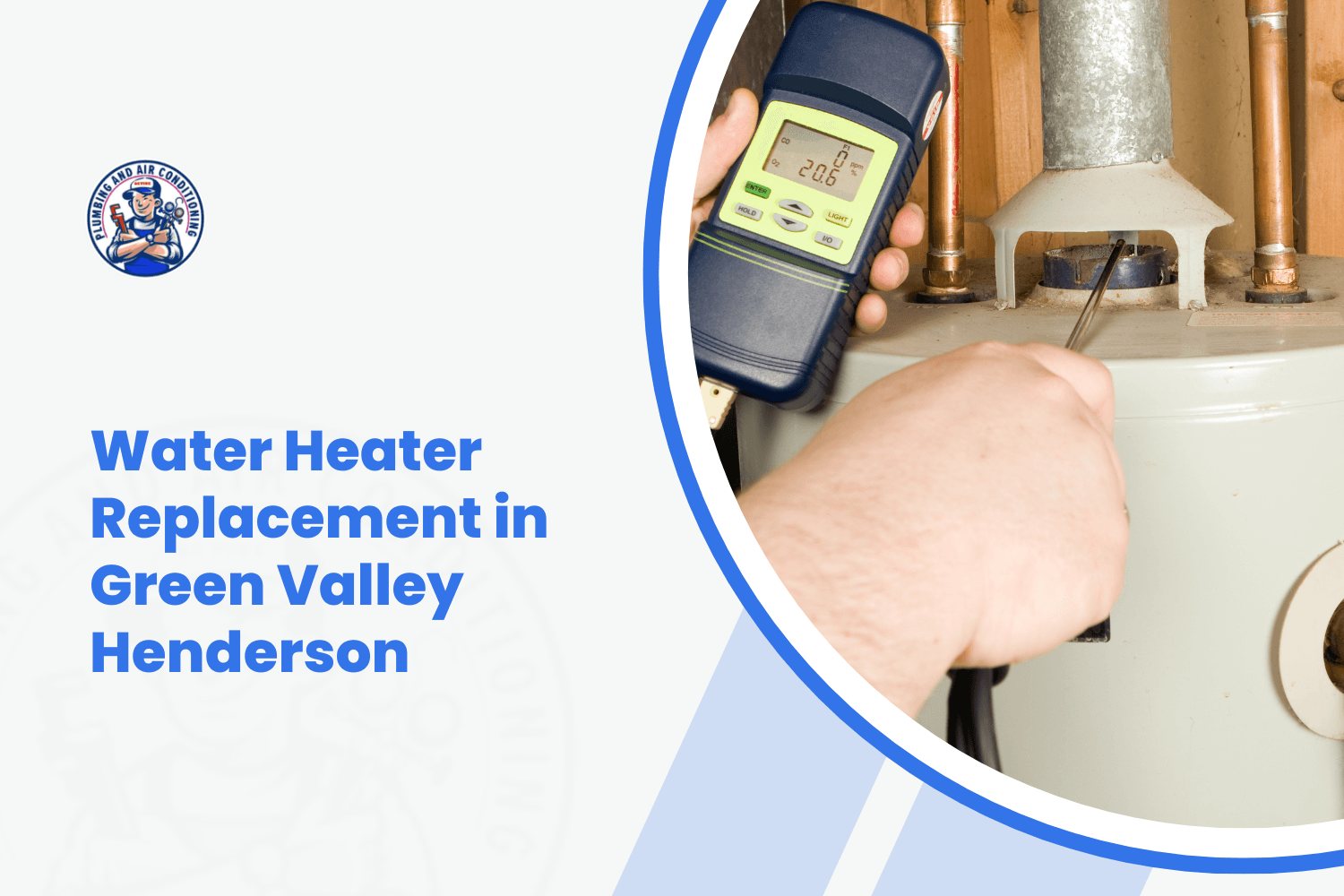
Water Heater Replacement in Green Valley Henderson: High Water Pressure and PRV Pairing
High street pressure quietly kills water heaters in Green Valley Henderson. Learn why pairing a new unit with a PRV protects your investment, warranty, and home.