Henderson vs Las Vegas Water Pressure: Why Some Neighborhoods Have PRV Issues
Key Takeaways
- Henderson and Las Vegas are served by separate water utilities with different pressure zone maps, meaning a home's pressure is shaped by terrain, infrastructure age, and which utility serves that block - not just which city it sits in.
- Hillside neighborhoods like MacDonald Ranch, Green Valley Ranch, and parts of Summerlin face higher street pressure because utilities must push water uphill, often overshooting safe pressure levels for lower-elevation homes in the same zone.
- A pressure reducing valve (PRV) is the only device standing between street pressure - which can run 80 to 120 PSI in parts of the valley - and every fixture, appliance, and supply line inside the home.
- Common signs of a failing PRV include banging pipes when appliances shut off, a dripping T&P relief valve on the water heater, and inconsistent shower pressure that varies by time of day.
- Homeowners can test their own water pressure with a $10 to $15 hose bib gauge - readings above 80 PSI mean the PRV is failing or missing, and readings above 100 PSI warrant a same-day call to a plumber.
- Las Vegas has some of the hardest water in the United States, and mineral scale buildup inside PRV diaphragms shortens valve lifespan to 7-12 years locally - shorter in homes without a water softener.
- PRV replacement on private property is the homeowner's responsibility, not the utility's or HOA's, and most like-for-like replacements in Las Vegas and Henderson do not require a permit.
- Builder-grade PRVs in newer Henderson master-planned communities like Inspirada and Cadence are hitting their replacement window, and clusters of PRV failures in these neighborhoods are a predictable pattern based on when those homes were built.
In This Article
A homeowner in MacDonald Ranch noticed it first during her morning shower - the water came out so hard it stung her skin, then dropped to a weak trickle when her husband turned on the kitchen faucet downstairs. A few miles away in older Henderson near Basic Road, a retired couple heard a loud bang inside their walls every time they shut off a faucet, a sound they had been living with for years without knowing what it meant. These are not random plumbing quirks. They are patterns that Active Plumbing sees play out across the Las Vegas Valley week after week, and they trace back to something most homeowners have never thought about - the pressure reducing valve hiding near their main shutoff.
Water pressure in the Las Vegas Valley is not a one-size-fits-all situation. Henderson and Las Vegas are served by different utility systems, built across different terrain, with infrastructure ranging from brand-new master-planned subdivisions to neighborhoods where the pipes in the ground are older than the casinos on the Strip. That combination creates wide swings in what comes out of your tap, and a failing or missing PRV is often the difference between a comfortable home and one with damaged fixtures, rattling walls, and a water heater that keeps tripping its safety valve.
Why Henderson vs Las Vegas water pressure plays out so differently across the valley, which neighborhoods see PRV problems at higher rates and why, what the symptoms look like from a homeowner's perspective, and what Active Plumbing does when we show up to diagnose and fix the problem. Whether a reader is in Summerlin, Inspirada, Rancho Drive, or Green Valley Ranch, there is something here that explains what is going on inside their walls.
How Water Pressure Works Differently in Henderson vs Las Vegas
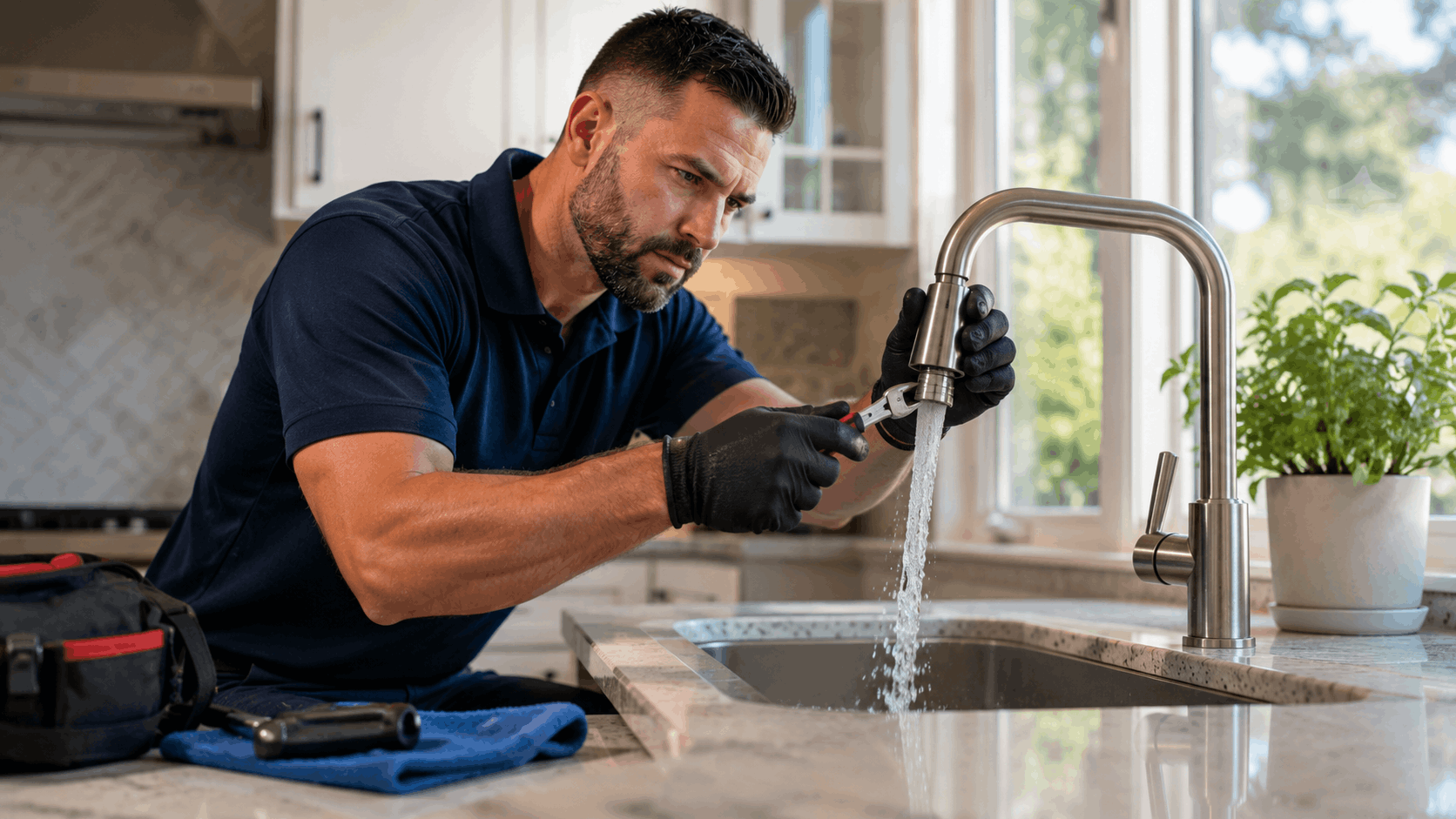
The Las Vegas Valley might look like one flat desert basin from above, but water delivery across it is anything but uniform. The Las Vegas Valley Water District (LVVWD) serves the majority of unincorporated Clark County and the City of Las Vegas, managing a network of pressure zones calibrated for different elevations. Henderson operates its own separate water utility - Henderson City Water Services - which makes its own decisions about pressure management, infrastructure schedules, and where PRVs are required. That single difference in governance explains a lot about why Henderson vs Las Vegas water pressure behaves so differently, even in neighborhoods that sit only a few blocks apart.
The table below shows the core differences between how the two systems operate and why those differences show up in your home:
| Factor | Las Vegas Valley Water District (LVVWD) | Henderson City Water Services |
|---|---|---|
| Service Area | Unincorporated Clark County, City of Las Vegas | City of Henderson only |
| Pressure Zones | Multiple zones calibrated for valley floor and western hills | Separate zone maps for hillside and basin communities |
| Infrastructure Age | Ranges from 1950s mains to new Summerlin laterals | Older core near Water Street, newer in Cadence and Inspirada |
| Treatment Plants | Alfred Merritt Smith and River Mountains Water Treatment | Henderson Water Reclamation Facility and purchased LVVWD supply |
| PRV Oversight | Private property PRVs are homeowner responsibility | Same rule - homeowner owns and maintains PRV on private property |
| Pressure Regulation Approach | Zone boundary stations reduce pressure at district level | Similar approach but independent of LVVWD zone decisions |
The Role of Elevation and Terrain in Valley-Wide Pressure Differences
Water pressure in any distribution system follows a simple physical rule: the higher the water source sits above your home, the more pressure it delivers. In the Las Vegas Valley, that means elevation is the hidden driver behind most neighborhood-level pressure variation. Homes near the base of Frenchman Mountain on the east side sit at a lower elevation than the water storage reservoirs that serve them, which can push main line pressure well above safe residential levels.
The eastern Henderson benchlands drop sharply toward the I-215 corridor, and that grade creates a natural pressure gradient. Homes at the bottom of those slopes receive more force than homes at the top of the same street. Utility engineers try to split service into pressure zones Las Vegas and Henderson each manage separately, but the zone boundaries are not always drawn with your specific block in mind.
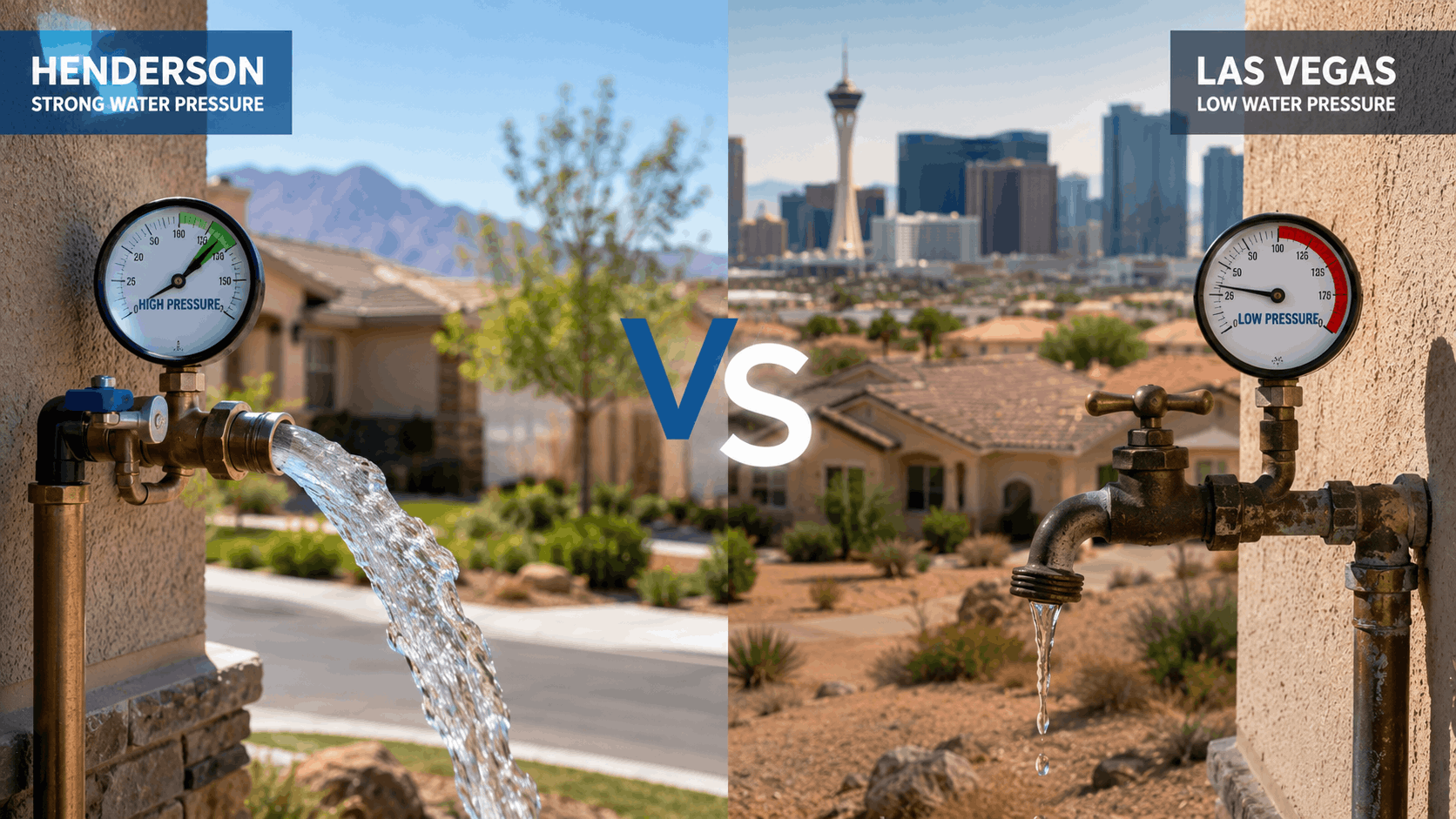
That is why two homes in the same zip code can read 55 PSI and 90 PSI on the same morning. Elevation water pressure differences of 30-40 PSI across a single neighborhood are not unusual in hilly parts of Henderson, and they explain why some homeowners get great flow while their neighbor's pipes shake.
Henderson Utilities vs Las Vegas Valley Water District - Who Controls What
This is where homeowners near the boundary between Henderson and Las Vegas regularly get tripped up. The area around Sunset Road and Warm Springs Road sits near where the two utility service territories meet, and calling the wrong utility to report a pressure concern wastes time during what can be an urgent situation.
Henderson utility operates independently from LVVWD, meaning the two systems have different pressure zone maps, different infrastructure upgrade schedules, and different staff handling service calls. A water main break on a Henderson street is Henderson's problem. A main break on an LVVWD street half a mile away is a completely separate call. Homeowners in communities near that Warm Springs Road corridor sometimes find themselves bounced between departments before getting a clear answer.
What both utilities agree on: the water utility boundary responsibility ends at the meter. Once water crosses from the street into private property, the PRV and all downstream plumbing belong to the homeowner. That water utility boundary rule is consistent across both Henderson and the LVVWD service territory.
Why Pressure Can Change Street to Street Inside the Same Zip Code
The older streets near Water Street in downtown Henderson were built when the city was still a wartime industrial settlement, and the infrastructure has been patched and updated in layers over the decades. A home two blocks from Water Street might be served by an older distribution main running at one pressure while a home in Cadence, just a few miles away, ties into a brand-new pressurized line from a recently commissioned booster station.
Booster stations pump water from lower-pressure zones up into higher-elevation neighborhoods, and the distance from that station matters. Homes closest to a booster station often see higher pressure spikes, while homes at the far end of the run see pressure drop off. In newer subdivisions like Inspirada Henderson, the booster station placements were engineered into the original development plan, but builder-grade PRVs were still installed to handle what the mains deliver.
Neighborhood water pressure in the 89002 and 89014 zip codes can vary by 20-30 PSI from one street to the next, and that is before factoring in daily demand swings. This is not a sign that something is broken - it is how the valley's geography works against a tidy engineering solution.
Get Your Quote
Tell us what's going on and we'll get back to you. We're open 24/7.
What a PRV Is and What It Does in a Home's Plumbing System
A pressure reducing valve is a small but important device that sits on a home's main water supply line, usually within a few feet of where that line enters the house from the street. Its job is straightforward: it takes whatever pressure is coming in from the municipal main and reduces it down to a safe, steady level before that water reaches any fixture, appliance, or supply line inside the home. Without one, the full force of street pressure - which can run 80 to 120 PSI in many parts of the valley - flows directly into everything in the house.
A PRV plumbing installation looks like a bell-shaped or dome-shaped fitting, typically made of brass, with an adjustment screw or nut on top that a plumber uses to set the target output pressure. Most water pressure regulators have an internal spring and diaphragm that work together to maintain that set pressure even when the incoming supply fluctuates. When those internal parts wear out, the valve either stops reducing pressure or stops flowing enough water - both of which cause noticeable problems.
The pressure reducing valve does not require electricity, filters, or cartridges. It is a purely mechanical device, which is part of why homeowners forget it exists. But that mechanical simplicity also means wear and mineral buildup are the only things that typically cause it to fail, and in Las Vegas's hard water environment, those factors work more quickly than in most cities.
Where PRVs Are Installed and Why Most Homeowners Have Never Seen Theirs
PRV location varies by how a home was built. In most single-family homes in Las Vegas master-planned communities like Summerlin or Southern Highlands, the builder tucked the PRV into the garage near the water meter entrance, sometimes inside a drywall chase or utility corner that gets stacked with storage boxes within the first year of move-in. In homes with a dedicated utility closet, it may sit alongside the water heater and main shutoff.
Some older homes have the PRV located at or near the meter box at the curb, though this placement is less common in private residential settings. Newer homes built after the early 2000s in planned communities almost always have the home water shutoff and PRV grouped together inside the garage for easier access. The problem is that "easier access" still means most homeowners never look there unless something breaks.
Active Plumbing regularly goes into homes in Summerlin plumbing service calls and finds a PRV that has never been inspected since the builder installed it 15 years ago. The valve looks fine from the outside but reads 95 PSI on the downstream gauge. That is the scenario that slowly destroys fixtures and supply lines without any obvious warning signs.
The Target Pressure Range and Why It Matters for Fixtures and Pipes
The residential water pressure range that plumbing codes and fixture manufacturers agree on is 40 to 80 PSI. In practice, most Henderson plumbers and Las Vegas plumbers aim for 50 to 60 PSI at the gauge when setting a new PRV, which gives enough force for good shower pressure and appliance performance without stressing any fittings.
Above 80 PSI, the physics start working against a home's plumbing. Washing machine hoses, refrigerator ice maker lines, and flexible supply connectors under sinks all carry pressure ratings - and most of them are not rated for sustained exposure above 80 PSI. A water pressure gauge reading of 90 or 100 PSI in a home without a functioning PRV is a ticking clock on those connections.
Water heaters feel the effect too. High incoming pressure forces the tank to work against more resistance, and the temperature-pressure relief valve - the safety device on the side of every tank - will begin to weep or drip when house pressure runs high. That dripping T&P valve is not a water heater problem. It is a pressure problem downstream from a failing or missing PRV. Active Plumbing's water heater repair calls often trace back to this exact scenario.
Need Help in Las Vegas?
Active Plumbing serves Las Vegas and all of Las Vegas Valley.
Why Henderson Neighborhoods See More PRV Problems Than Many Parts of Las Vegas
Henderson's terrain is the starting point for most of the PRV issues Active Plumbing diagnoses on the east side of the valley. The city's hillier geography - especially in communities like MacDonald Ranch, Green Valley Ranch, and the older hillside sections near Lake Las Vegas - creates pressure dynamics that flat valley neighborhoods simply do not experience at the same intensity. Here are the main reasons Henderson PRV problems show up at higher rates:
- Hilly terrain forces utilities to push water uphill, creating overpressure at lower-elevation homes within the same pressure zone
- Older infrastructure near the original Henderson townsite means aging PRVs that were installed in the 1980s and 1990s and may never have been replaced
- Henderson's independent utility decisions sometimes result in pressure zone boundaries that do not align with the actual topography of individual streets
- Builder-grade PRVs in newer master-planned communities were sized and specified to minimum code, not for the long-term mineral load in valley water
- HOA irrigation systems in communities like Seven Hills and Inspirada create demand cycles that stress PRVs differently than a standard residential-only load
- The hard water coming through Henderson's system - drawn ultimately from Lake Mead - speeds up scale buildup inside PRV diaphragms more quickly than national averages
- Elevation changes within single subdivisions in MacDonald Ranch can create 15-20 PSI differences between the highest and lowest homes on the same street
MacDonald Ranch, Green Valley Ranch, and the Hillside Pressure Problem
MacDonald Ranch sits on one of the more dramatic elevation changes in Henderson, with homes on ridge lots looking out over the valley floor. The utility must push water with enough force to reach those elevated homes, which means the mains run at higher pressure than they would in a flat neighborhood. When that pressurized water reaches homes at the lower end of the street, the force overshoots what those homes should receive.
Active Plumbing crews see Green Valley Ranch water pressure issues regularly in the hillside sections - specifically where the terrain drops toward the Paseo Verde Parkway corridor. A home on a downhill lot there can sit in a pressure zone technically designed for an average elevation, but physically receive 10 to 15 PSI more than the zone's target. That extra pressure lands entirely on the home's PRV.
MacDonald Ranch plumbing calls often involve PRVs that were set correctly at installation but have drifted over time because the spring and diaphragm have been working overtime against consistently higher inlet pressure. A valve that sees 100 PSI on its inlet 24 hours a day simply wears sooner than one seeing 75 PSI.
Older Henderson Neighborhoods Near Basic Road and Water Street
The neighborhoods surrounding Basic Road and the original Henderson downtown corridor were built when Henderson was still a company town supporting the Basic Magnesium plant. Homes from the 1970s and 1980s in this area often have galvanized supply lines that have been narrowed by decades of mineral scale, and many have original PRVs that have never been touched since installation.
A 30-year-old PRV in an old Henderson home near Basic Road is a fundamentally different problem than a failed 8-year-old valve in Cadence. The older valve may be so corroded internally that it cannot be adjusted - only replaced. And the surrounding pipe work, if it is original galvanized, may need attention at the same time because the combination of aging PRV failure and scale-restricted pipes creates pressure spikes that concentrate at every weak fitting in the system.
Active Plumbing has gone into homes on streets just off Water Street where the PRV was so old the adjustment mechanism had seized completely. The valve was neither reducing pressure nor passing adequate flow - the homeowner's symptoms were simultaneously high pressure banging and weak flow at the tap. That combination almost always points to an aging PRV that has failed in a partially closed position.
Newer Henderson Master-Planned Communities - HOA Decisions and PRV Specs
Inspirada, Cadence, and Seven Hills represent a different PRV problem than the older neighborhoods. In these communities, the infrastructure is relatively new, the pipes are in good shape, and the pressure zone engineering was done with modern tools. But the builder-grade PRV installed before the first homeowner moved in was specified to minimum code requirements, not to the 10-15 year performance standard a quality valve should meet.
Inspirada Henderson homes built between 2010 and 2018 are now hitting the window where those original PRVs are showing wear. HOA-governed landscaping and irrigation systems in Seven Hills HOA plumbing setups add demand cycles that builder-grade valves were not specifically sized for, and the valley's mineral-heavy water attacks the internal diaphragm more quickly than in cities with softer water supplies. A water softener installation can significantly extend the life of a replacement PRV by reducing the mineral load hitting that diaphragm every day.
Active Plumbing has found that in communities where all the homes were built in the same 2-3 year window, PRV failures tend to cluster. If three homes on a Inspirada street have replaced theirs this year, it is a reasonable signal that the rest of the street is close behind.
Las Vegas Neighborhoods With Their Own Pressure and PRV Challenges
Henderson does not own the PRV problem in the Las Vegas Valley. The west side, central city, and north valley all have their own pressure and infrastructure stories, and Active Plumbing serves all of them. Las Vegas water pressure neighborhoods vary widely - from the elevated homes along the Red Rock corridor in Summerlin to the flat, older streets of central Las Vegas where some homes are still running at full, unregulated street pressure. Our Las Vegas service area covers the full range of these situations.
North Las Vegas adds another layer with some of the valley's oldest water distribution infrastructure, where pressure swings during main upgrades create their own set of PRV stresses. The Strip corridor, meanwhile, operates under a completely different infrastructure regime designed for commercial high-rises - but the residential streets just behind the resort zone often deal with pressure inconsistencies that flow from those adjacent systems.
The common thread across all of these areas is that street pressure in the Las Vegas Valley is rarely steady, and a home's PRV is the only thing standing between that variable main-line pressure and every fixture, supply line, and appliance connected to the home's water system.
Summerlin and the Western Hills - High Pressure Zones Along the Red Rock Corridor
Summerlin sits at the western edge of the valley against the Spring Mountains foothills, and the elevation changes there mirror what Henderson deals with on the east side. Homes near the Red Rock National Conservation Area boundary or along Town Center Drive in the northern Summerlin villages face the same hillside pressure dynamic - the utility delivers water with enough force to serve the highest lots, and lower homes receive more than they should.
Summerlin water pressure issues tend to show up as fluctuating shower pressure and noisy pipes rather than dramatic banging, partly because the infrastructure is newer and the pipes themselves are less likely to amplify pressure waves. But the PRV wear pattern is the same. Red Rock corridor plumbing calls from Summerlin regularly involve PRVs that are 10 to 15 years old and have been managing inlet pressures of 90 to 100 PSI the entire time.
Active Plumbing serves Summerlin homeowners across the community's many villages, and the western hills section consistently shows up in our PRV service history. A home on a ridgeline lot near the 215 Beltway can read 45 PSI while a home at the base of the same hill reads 85 PSI - same zip code, same utility, dramatically different pressure reality.
Older Central Las Vegas Homes Near Rancho Drive and Maryland Parkway
Central Las Vegas plumbing in the neighborhoods around Rancho Drive and Maryland Parkway tells a story that surprises most homeowners who live there. Homes built in the 1950s and 1960s in this part of the city predate the plumbing code revisions that made PRV installation mandatory when street pressure exceeds 80 PSI. Active Plumbing has gone into homes near Maryland Parkway and found the home running at 95 to 100 PSI with absolutely nothing regulating that pressure - no PRV installed at all, ever.
These homes have often had their original fixtures replaced multiple times over the decades without anyone identifying the root cause. Faucet seats wear out fast. Supply lines need replacing every few years. The homeowner has spent thousands on fixture repairs without anyone checking the pressure behind all of it. Installing a PRV on a home that has never had one is one of the more satisfying service calls Active Plumbing makes in this part of the city.
Rancho Drive older homes also tend to have copper supply lines from the 1960s and 1970s that are in surprisingly good shape internally but are not rated for sustained high-pressure exposure. Getting pressure under control extends the useful life of that original copper significantly.
North Las Vegas Pressure Issues and Aging Distribution Lines
North Las Vegas water pressure issues come with a specific character: unpredictability. The city has some of the oldest distribution infrastructure in the valley, and as the city upgrades mains in one block, the pressure change ripples into surrounding streets that are still on the old system. Homes near Craig Road and Pecos Road, or along the older corridor between Cheyenne Avenue and Lake Mead Boulevard, often report pressure that was fine last month and now fluctuates noticeably.
Aging water mains that are being replaced in sections create temporary pressure swings that a healthy PRV handles fine. But a PRV that is already near the end of its service life cannot compensate for those swings, and it often fails under the additional stress of a nearby main replacement project. North Las Vegas plumbing service calls from this area frequently come in clusters during active water main work periods.
The homes along these corridors also tend to have older supply line configurations that were not designed for modern dishwashers, multi-head shower systems, or tankless water heaters. Adding those fixtures to a home running variable, high pressure without a functioning PRV speeds up wear across every connection in the system.
Signs Your PRV Is Failing - What Homeowners Actually Notice
Customers call Active Plumbing about PRV problems every week, but almost none of them use the phrase "pressure reducing valve" when they describe what is wrong. They say things like "my pipes bang when I turn off the dishwasher," or "my shower is fine in the morning but terrible by noon," or "the little valve on the side of my water heater keeps dripping and the plumber I called just replaced it and it is dripping again." These are PRV failure symptoms, and recognizing them saves homeowners from chasing the wrong fix for months.
The connection between a failing PRV and its downstream symptoms is not always obvious. A homeowner in Anthem Henderson dealing with a dripping water heater T&P valve may have called a water heater company, been told the heater is fine, and still has a dripping valve - because the heater company did not check the house pressure. A homeowner hearing banging in the walls may have tightened every pipe strap in the garage without solving anything. High water pressure signs operate upstream from where the symptoms appear.
The list of common symptoms below covers what Active Plumbing hears most often, and each one is worth taking seriously before the problem escalates into something more expensive.
Banging Pipes, Water Hammer, and That Knocking Sound in the Walls
Water hammer is the hydraulic shock wave that travels through a pipe system when fast-moving water is suddenly stopped. When a faucet closes, a dishwasher valve shuts, or an irrigation solenoid cuts off, the momentum of the water in the pipe has to go somewhere. If the pressure behind that water is too high, the resulting shock wave is strong enough to shake pipes, rattle fittings, and make a loud bang or knock inside the walls.
A functioning PRV keeps the water's force within a range where those shock waves are manageable. When the PRV fails and pressure climbs, water hammer gets dramatically worse. The banging in the walls becomes a symptom of PRV water hammer rather than a loose pipe strap problem, even though it sounds identical to someone who has not checked the pressure first.
Left alone, PRV water hammer is not just annoying - it is destructive. Repeated pressure shock loosens threaded fittings, fatigues copper solder joints, and can eventually split flexible supply connectors. A homeowner who has been ignoring banging pipes for two or three years while running at 95 PSI has very likely weakened every soldered fitting in the system to some degree. Active Plumbing's burst pipe repair calls sometimes start with a history of water hammer the homeowner dismissed as normal.
Dripping Pressure Relief Valves on Water Heaters
The T&P relief valve on a water heater is a safety device designed to open and release water if the tank's temperature or pressure exceeds safe limits. It is not designed to drip regularly, and when it does, many homeowners assume the valve itself is defective. Sometimes it is - but more often the T&P relief valve is doing exactly what it was designed to do, releasing pressure because the house pressure is too high for the tank to hold safely.
A failing PRV allows full street pressure into the water heater, and as the heater cycles and adds thermal expansion to that already-high pressure, the T&P valve opens to compensate. Replacing the T&P valve without fixing the PRV means the new valve will start dripping within weeks for exactly the same reason. Active Plumbing's water heater services include checking house pressure as a standard part of any water heater diagnostic because of how often this scenario plays out.
In Henderson and Las Vegas neighborhoods where home water pressure regularly runs above 80 PSI without a functioning PRV, T&P valve failure is one of the most preventable water heater problems. A $300 PRV replacement can prevent multiple T&P valve replacements and the water damage that comes when a relief valve eventually fails open.
Inconsistent Pressure at Fixtures - From Full Blast to Weak Flow
A PRV that is wearing out does not always fail completely at first. The more common early failure mode is a valve that cycles erratically - delivering high pressure at some hours and restricted flow at others. Homeowners notice this most during the morning rush when multiple fixtures run simultaneously, or when they compare their shower pressure on a weekday morning to a weekend afternoon.
Pressure fluctuations in communities like Rhodes Ranch or Anthem Henderson plumbing situations often get blamed on the utility, but when Active Plumbing tests the street pressure and finds it steady while the home pressure swings by 20 PSI throughout the day, the PRV is clearly not maintaining its set point. That cycling behavior means the internal diaphragm has started to fail intermittently - passing full pressure some of the time and restricting too much other times.
The frustrating part about this symptom is that by the time a homeowner calls a plumber, the valve may be reading fine during that specific service call. Testing pressure at multiple points in the day gives a much clearer picture, which is why Active Plumbing recommends homeowners log pressure readings at different times before the service visit if possible.
Need Help in Las Vegas?
Active Plumbing serves Las Vegas and all of Las Vegas Valley.
How to Test Your Home's Water Pressure Before Calling a Plumber
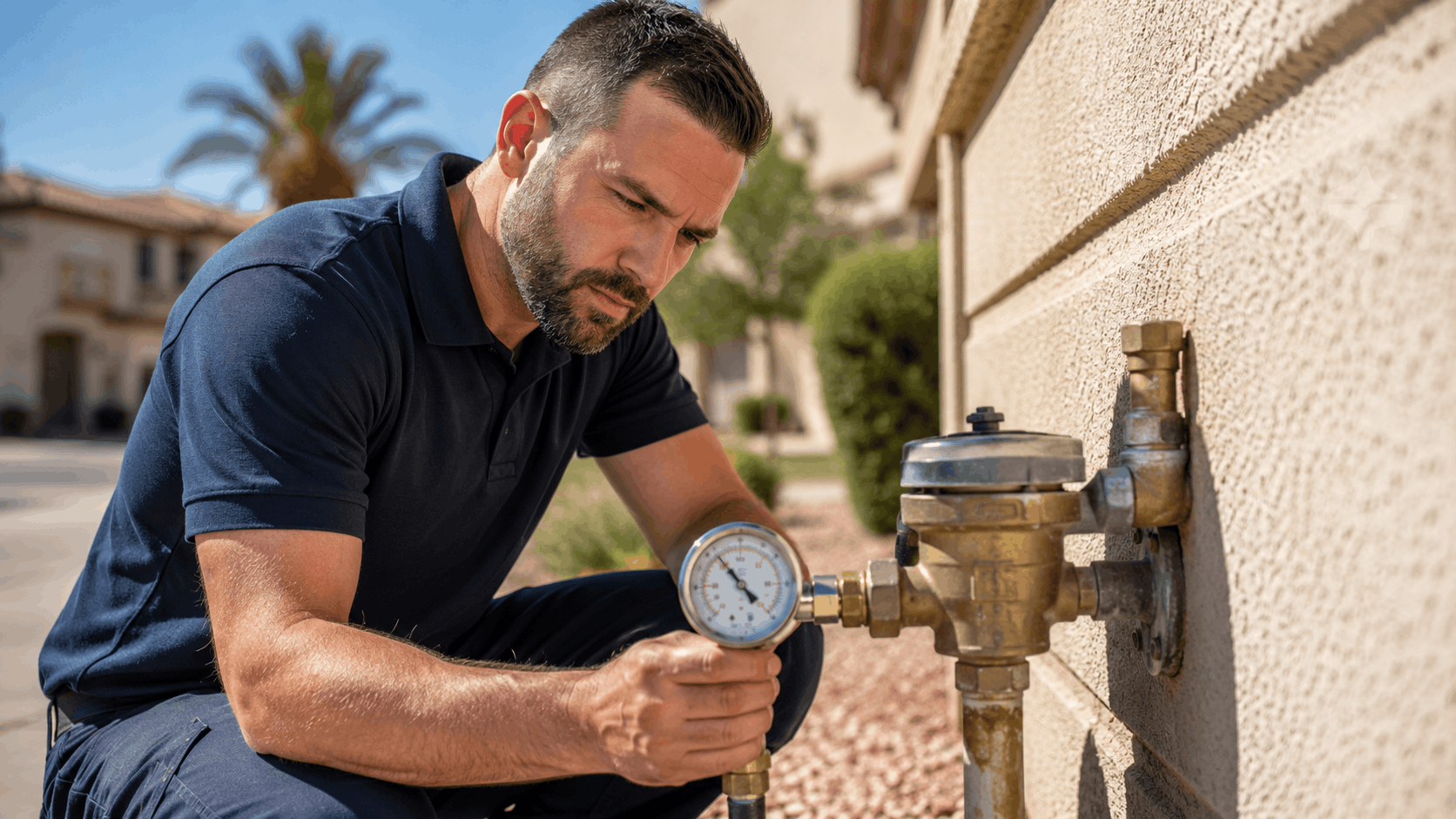
There is one simple thing every homeowner in the Las Vegas Valley can do before picking up the phone - attach a $10 to $15 pressure gauge to an outdoor hose bib and take a reading. This single step transforms a vague complaint about "weird pressure" into concrete data that helps a plumber diagnose the problem more quickly and more accurately. Hardware stores across the valley carry these gauges, and the test takes about five minutes.
The table below shows what different pressure readings mean and what the appropriate response is for each range:
| PSI Reading | What It Means | Recommended Action |
|---|---|---|
| Under 40 PSI | Low pressure - poor fixture flow, appliance performance issues | Check for PRV over-restriction, call plumber to adjust or replace |
| 40 - 60 PSI | Ideal range - good flow, safe for all fixtures and appliances | No action needed - verify reading at different times of day |
| 60 - 80 PSI | Acceptable but on the high side - monitor regularly | Have PRV inspected if reading is consistently above 70 PSI |
| 80 - 100 PSI | High - PRV is failing or missing | Call a plumber - do not run appliances with flexi-hoses unattended |
| Above 100 PSI | Dangerously high - immediate risk to supply lines and appliances | Call Active Plumbing same-day for emergency PRV service |
The 5-Minute Pressure Test Any Homeowner Can Do
The hose bib pressure gauge test is straightforward. First, turn off all water inside and outside the home - no running toilets, no dripping faucets, no irrigation running. Attach the gauge to any outdoor hose bib by threading it on hand-tight. Slowly open the bib all the way and read the gauge needle, which will settle within 10 to 15 seconds.
Write that number down, then repeat the water pressure test steps at two different times: once in the early morning before 7 a.m., and once around midday. Las Vegas water pressure reading data shows a consistent pattern - early morning numbers are highest because the valley's overall demand is lowest, and the mains are at near-peak pressure. Midday readings drop as demand across the system increases. A hose bib pressure gauge reading of 65 PSI at noon might be 85 PSI at 5:30 a.m.
Getting both numbers matters. A homeowner who only tests at noon and sees 65 PSI might think everything is fine, while their early-morning fixture hammering tells a different story. If morning readings consistently top 80 PSI, that is enough information to call Active Plumbing with confidence.
What Your Numbers Mean and When to Call Active Plumbing
Under 40 PSI and a homeowner is dealing with low flow problems - showers that trickle, appliances that take forever to fill, and potentially a PRV that has failed in the partially-closed position. Between 40 and 80 PSI is the normal window where most fixtures and appliances operate without extra wear. Above 80 PSI means the water pressure PSI ranges are in territory that most plumbing components were not designed to handle continuously.
Above 100 PSI is not a "monitor it" situation. At that level, flexible supply connectors under sinks and behind appliances are under sustained stress that can lead to sudden failure, and those failures often happen when no one is home. When to call a plumber is a clear question at that reading - the answer is today. Active Plumbing serves the entire Las Vegas Valley including Henderson, from Summerlin on the west side to the Green Valley Ranch area on the east, and same-day service is available for high-pressure situations that represent a real risk to the home.
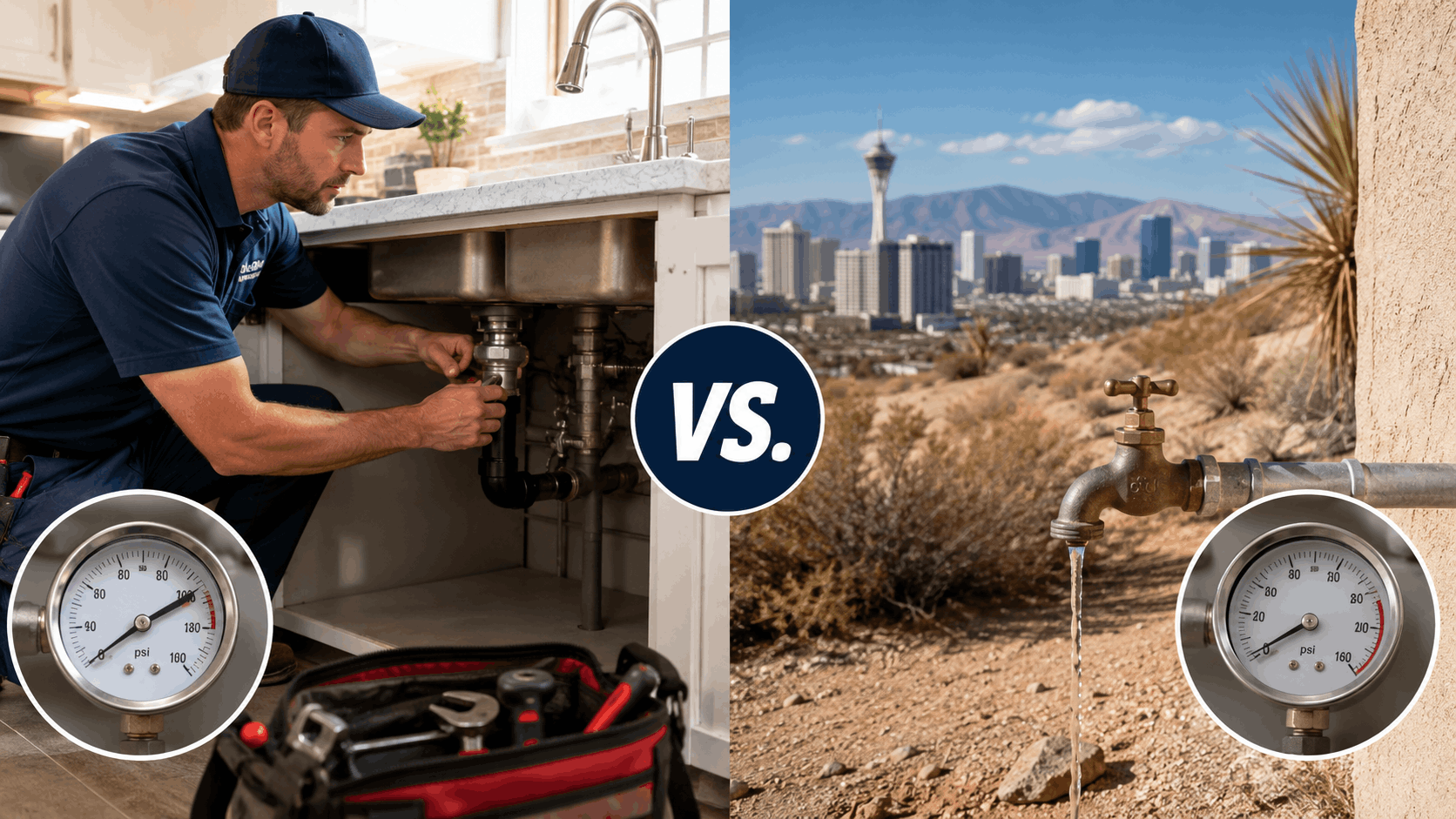
PRV Replacement and Installation - What the Job Actually Involves
One of the more common questions Active Plumbing gets before a PRV service call is: "How long will we be without water?" The answer for a straightforward PRV replacement installation on a single-family home is usually 1 to 2 hours. That includes the shutdown time, the valve swap, and the pressure testing afterward. Most homeowners are back to full water service before the service call is over.
The job is not mysterious. A plumber shuts off the main water supply, cuts out the old valve from the supply line (usually a section of copper or CPVC pipe near the main shutoff in the garage), installs a new adjustable PRV, reconnects the pipe on both sides, and restores water supply to test the installation. Setting the output pressure to the target range with a gauge on the downstream side is the final step before calling the job complete.
What can add time or complexity is the condition of the pipe surrounding the old PRV. In older homes near Rancho Drive or Basic Road in Henderson, the surrounding copper may be corroded enough that it needs to be repiped back a foot or two in each direction before a clean installation is possible. Active Plumbing quotes that additional work upfront rather than discovering it mid-job.
What Happens During a PRV Replacement Visit
The PRV replacement process starts with the plumber confirming the incoming (street-side) pressure with a gauge before touching anything. That reading tells the technician what the new valve will be working against and helps set expectations for the post-installation target. Then the main supply is shut off at the valve nearest the meter.
The old valve is cut out of the line using a pipe cutter or reciprocating saw, depending on the space available. The new adjustable PRV goes in with appropriate fittings for the existing pipe material - copper sweat fittings, push-fit connections, or threaded brass couplings depending on what the plumber finds. Once the water is restored, the outlet pressure is tested and the adjustment nut on the new valve is turned to dial the reading into the 50 to 60 PSI target range. A final walk-through of fixtures confirms consistent flow before the plumber releases the job.
The pipe and fixture services Active Plumbing provides cover everything involved in a PRV replacement visit, including any associated pipe work that comes up during the job. There are no surprises at the end of the call that were not disclosed before the work started.
Cost Ranges for PRV Work in the Las Vegas and Henderson Area
PRV replacement cost for a standard single-family home in Las Vegas or Henderson typically runs between $200 and $500. That range covers the valve itself - a quality brass adjustable PRV runs $40 to $80 in material cost - plus the labor, the pressure testing, and any minor pipe fittings needed to complete the installation. The lower end of that range applies to accessible installations with clean surrounding pipe work. The higher end applies when access is difficult, surrounding pipe needs partial replacement, or the incoming pressure is high enough to require a higher-capacity valve.
Plumber pricing Henderson and Las Vegas does not vary dramatically by city, but it does vary by the condition of what the plumber finds when the wall is opened or the utility closet is accessed. A home in Inspirada with a clearly visible PRV and clean copper on both sides is a clean, fast job. A home near Water Street in downtown Henderson with a corroded original PRV and 40-year-old galvanized pipe on the inlet side is a different scope of work entirely.
Homes with complex manifold setups, whole-house filter systems, or PRVs installed in difficult-to-reach locations can run above $500 when additional parts and labor time are needed. Active Plumbing provides clear, itemized estimates before starting any PRV work so homeowners know what the water pressure valve cost covers.
How Long a New PRV Should Last in the Las Vegas Valley's Hard Water
Las Vegas has some of the hardest water in the United States, consistently ranking among the top 25 cities for water hardness nationally. The water drawn from Lake Mead carries significant mineral content - primarily calcium and magnesium carbonate - that deposits scale inside every water-handling device in the home over time. A PRV's internal diaphragm and spring mechanism are particularly vulnerable because water flows through the valve continuously, depositing minerals on every internal surface with every gallon.
A quality brass PRV in the Las Vegas climate typically lasts 7 to 12 years under normal conditions. That range shortens toward 5 to 7 years in homes without a water softener, where the full mineral load attacks the internal parts without any treatment buffer. Homes with a water softener installation protecting the supply tend to see PRV lifespans at the longer end of that range, sometimes exceeding 12 years in well-maintained systems.
Lake Mead water quality has also varied over the years as the reservoir level has fluctuated, with lower water levels sometimes concentrating mineral content further. Hard water plumbing wear in the valley is a real, measurable factor that homeowners should account for when planning maintenance schedules. Active Plumbing recommends having PRV pressure checked every 3 to 5 years as a basic maintenance step, regardless of whether symptoms are present.
Need Help in Las Vegas?
Active Plumbing serves Las Vegas and all of Las Vegas Valley.
HOA Rules, Building Codes, and Who Is Responsible for Your PRV
One of the most frustrating situations Active Plumbing encounters is a homeowner who has been waiting weeks for their HOA or utility to fix a pressure problem that is actually their own responsibility to handle. The line between utility responsibility and homeowner responsibility in Las Vegas and Henderson is clear once you know where to look - but most homeowners do not know, and neither do many HOA management companies.
The PRV responsibility homeowner answer is consistent across both Henderson and LVVWD service areas: if the PRV is on private property - which it almost always is - it belongs to the homeowner. The utility is responsible for the main in the street and the meter itself. Everything downstream from the meter is the homeowner's domain, including the PRV, the main shutoff valve, and all supply lines. Las Vegas building code plumbing requirements reinforce this through permit and inspection rules that treat private-side plumbing as the homeowner's liability.
HOA rules add another layer that sometimes confuses the picture, particularly in communities where the HOA manages exterior landscaping systems that tie into the same supply lines as the home's interior plumbing. Understanding who owns each segment of pipe matters before any work starts.
Clark County and City of Las Vegas Plumbing Code Requirements for PRVs
Clark County and the City of Las Vegas both follow the Uniform Plumbing Code, which requires a PRV when the street pressure at the meter connection exceeds 80 PSI. That threshold exists precisely because most residential fixtures, supply lines, and appliances are rated for 80 PSI maximum. The Clark County plumbing code applies to unincorporated areas and is enforced through building permits and inspections.
The City of Henderson follows similar requirements through its own permit and inspection office, which operates separately from Clark County's building department. A Henderson building permit for any plumbing work near the main supply line will trigger an inspection that includes verifying PRV presence and function if street pressure in that zone exceeds the threshold.
The Uniform Plumbing Code Nevada adoption is consistent on one point: the PRV on private property is the homeowner's responsibility to install, maintain, and replace. LVVWD and Henderson City Water Services have no obligation to touch the valve, adjust it, or replace it, regardless of what the street-side pressure is doing. Active Plumbing pulls permits for PRV work that requires them and handles Henderson building permits on any job that involves changes to the main supply line configuration.
HOA Communities in Henderson and Las Vegas - What the Rules Say About Plumbing
Most HOA CC&Rs in communities like Anthem, Summerlin, and Seven Hills draw a clear line between what the HOA controls and what is the homeowner's responsibility. Interior plumbing - including a PRV installed on the supply line inside the garage or utility closet - generally does not require HOA approval for replacement. It is private plumbing on private property, and swapping a failing valve for a new one is a maintenance activity, not a modification.
Where Anthem Henderson CC&R rules sometimes come into play is exterior work near the meter box or at the curb. If a PRV replacement job requires opening the sidewalk, moving the meter box, or working in the utility easement near the street, the HOA and potentially the utility need to be notified. Summerlin HOA plumbing work on exterior lines near the property boundary follows similar rules. Active Plumbing handles the permit and notification requirements for any job that touches those boundary areas so homeowners are not caught between competing sets of rules.
The safest approach for any HOA homeowner considering PRV work is to have Active Plumbing confirm the valve location and the scope of work before signing anything. Most replacements are clean, interior jobs that require no HOA interaction at all.
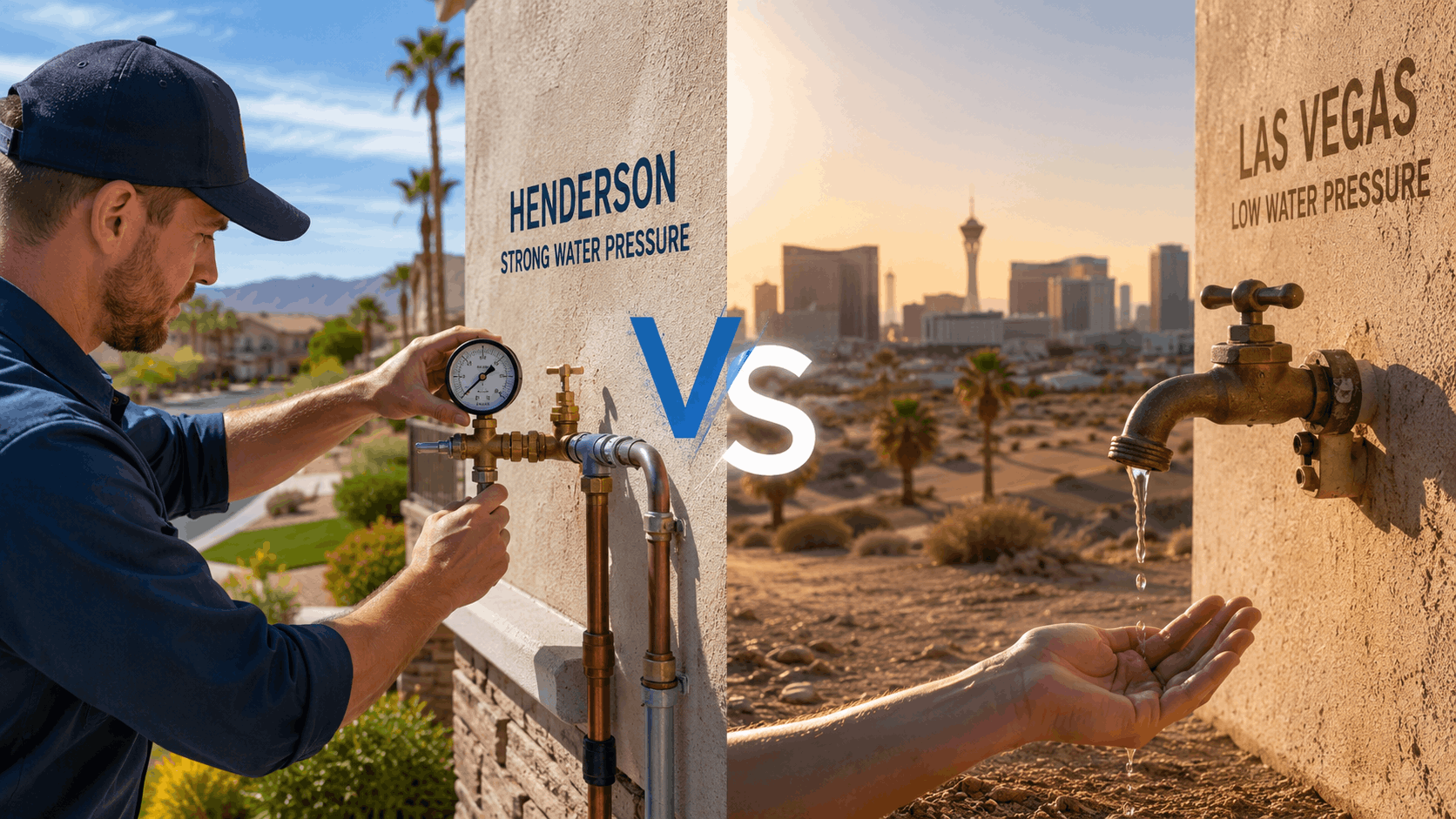
Final Thoughts
Water pressure in the Las Vegas Valley is not a background detail - it is an active force working on every pipe, fitting, supply line, and appliance in a home every single day. The difference between Henderson and Las Vegas is less about which city has "better" pressure and more about how terrain, infrastructure age, and utility decisions combine to create specific pressure challenges in specific neighborhoods. MacDonald Ranch has different pressure dynamics than Inspirada. Rancho Drive has different challenges than Summerlin. North Las Vegas has different issues than Green Valley Ranch. Each area has its own story, and a PRV is the device that either tells that story quietly in the background or lets it play out loudly in the walls.
A failing PRV is rarely a dramatic emergency at first. It tends to announce itself through small things - a shower that fluctuates, a water heater relief valve that drips, a knock inside the wall when the dishwasher shuts off. But those small signs escalate over time into supply line failures, fixture damage, and water heater issues that cost far more to fix than a PRV replacement would have. Catching the problem at the symptom stage is always better than catching it after the washing machine hose fails behind a closed laundry room door.
Active Plumbing serves homeowners across the entire Las Vegas Valley - from Summerlin and Spring Valley on the west side to Henderson's eastern communities including MacDonald Ranch, Green Valley Ranch, and the newer master-planned developments near Inspirada and Cadence. If a pressure reading, a banging pipe, or a dripping relief valve has been on the back of a homeowner's mind, this is the right time to get it checked. Contact Active Plumbing to schedule a pressure evaluation and find out exactly what is happening on the private side of the meter.
Frequently Asked Questions
- Why does my water pressure feel high in the morning but low in the afternoon?
- Street pressure in Las Vegas and Henderson follows the valley's daily demand cycle. Early morning, before most households are active, the mains run at or near their peak pressure because the system is not being drawn down. By midday and into the afternoon, widespread demand across the service area pulls pressure down noticeably. A healthy PRV smooths out those swings and delivers consistent home pressure regardless of what time it is. When the PRV wears out, pressure fluctuation morning to afternoon becomes something the homeowner actually feels at the tap, because the valve can no longer compensate for the changing inlet conditions.
- Does Henderson really have higher water pressure than Las Vegas?
- The Henderson vs Las Vegas water pressure comparison is not a simple answer. Specific zones in Henderson - particularly hillside communities like MacDonald Ranch and parts of Green Valley Ranch - do experience higher street pressure than many flat Las Vegas neighborhoods because of how the terrain forces the utility to deliver water uphill. But Henderson neighborhoods near Sunset Road and the flatter sections of the city sit at pressure levels comparable to similar Las Vegas neighborhoods. Elevation water pressure differences, not city limits, drive the real variation. A pressure comparison cities approach misses the point - what matters is the specific block and its elevation relative to the nearest pressure zone boundary.
- How do I find out if my home even has a PRV installed?
- Start in the garage near where the main water line enters the house from the street side. Look for a bell-shaped or cylindrical brass fitting, usually with an adjustment screw or nut on the flat top, installed inline on the copper or CPVC supply pipe before it branches out to the rest of the house. It is often within a foot or two of the main shutoff valve. If nothing matching that description is visible in the garage, check inside any utility closet that houses the water heater. Homes built before the mid-1980s in Las Vegas may have no PRV at all - a pressure test will confirm whether one is needed.
- Can high water pressure damage my appliances and fixtures?
- Yes, and the damage happens more quickly than most homeowners expect. Washing machine supply hoses, refrigerator ice maker lines, dishwasher inlet valves, and tankless water heater connections all carry maximum pressure ratings that typically top out around 80 PSI. Running at 90 or 100 PSI shortens the service life of every water-using appliance in the home. High pressure appliance damage often shows up as sped up fixture wear, frequent supply line failures, and washing machine hose ruptures - one of the most expensive water damage events a homeowner can experience, particularly when it happens while the house is empty.
- My neighbor just replaced their PRV - should I do mine too?
- Not automatically, but it is a useful signal. In newer master-planned communities where all homes were built around the same time - like Inspirada or Cadence in Henderson - PRVs from the same builder batch and the same installation window do tend to wear out in a similar timeframe. PRV lifespan Henderson homes in mineral-heavy water runs 7 to 12 years, so if neighbors in the same community are replacing theirs, it means the neighborhood is likely in that replacement window. Getting a pressure reading is a smarter first step than replacing it without knowing whether it is still functioning. If the gauge reads within the 40 to 80 PSI range and holds steady at different times of day, the valve may still have useful life remaining.
- How much does it cost to have Active Plumbing test my water pressure?
- A basic pressure test during a service visit is a straightforward add-on to any plumbing call. Active Plumbing serves homeowners across Las Vegas and Henderson, from the Summerlin corridor to the Green Valley Ranch area, and a pressure test is one of the first things included on any PRV-related service call. Pricing for the overall visit varies depending on the scope of what gets checked - a simple test and report is much shorter than a full PRV inspection, adjustment, and follow-up gauge reading. Contact Active Plumbing to discuss what is included in a pressure evaluation visit for a specific home's situation.
- Will replacing my PRV fix my water hammer problem?
- Often yes, but not always. Water hammer fix outcomes depend on diagnosing the actual cause first. High pressure behind a failing PRV is one of the more common drivers of pipe banging, and replacing the valve resolves it in a large percentage of cases. However, water hammer can also come from missing or loose pipe straps that let supply lines move inside the wall, air chambers that have lost their air cushion over years of use, or fast-closing solenoid valves on irrigation systems and dishwashers. A plumber should check all of these factors before deciding that PRV replacement alone will solve the banging pipes cause. Active Plumbing diagnoses before replacing.
- Does hard water in Las Vegas shorten how long a PRV lasts?
- It does, measurably. Las Vegas ranks among the hardest water cities in the United States, and the mineral scale that builds up inside a PRV diaphragm over time stiffens the rubber, restricts the spring travel, and eventually prevents the valve from modulating pressure correctly. Hard water Las Vegas PRV wear is a real factor that shortens the national average PRV lifespan of 10 to 15 years down to 7 to 12 years locally. Homes without water softener protection in areas like Anthem or Summerlin tend to replace PRVs more frequently than households that treat their incoming supply before it reaches the valve.
- Do I need a permit to replace a PRV in Las Vegas or Henderson?
- In most cases, a like-for-like PRV replacement inside the home on private property does not require a permit in Clark County or the City of Henderson. The plumbing permit Las Vegas and Henderson building permit requirements generally apply to new installations, changes to the main line configuration, or work that touches the utility easement near the meter box. A straightforward valve swap on an existing installation in the garage falls under routine maintenance in most jurisdictions. Active Plumbing confirms permit requirements for each specific job location before starting, so homeowners are never left exposed on a job that turns out to require inspection.
- What PSI should my water pressure be set to after a PRV replacement?
- Most plumbers in the Las Vegas area set a new PRV to between 50 and 65 PSI for standard single-story and two-story residential homes. The residential PRV adjustment target accounts for the pressure drop that occurs as water travels from the PRV through the home's supply lines to the farthest fixtures. Homes with long supply runs to a detached guest house or distant outdoor hose bibs sometimes benefit from being set at the higher end of that range. Going above 80 PSI defeats the purpose of having a PRV at all and puts the home back into the high-pressure damage territory that the valve was installed to prevent. Active Plumbing sets and verifies the water pressure set point with a gauge at both the outlet of the PRV and at a distant fixture before completing the job.
Licensed plumbing professionals serving Las Vegas and Las Vegas Valley.
Licensed in Nevada · License #0047021
Last updated on
Why trust Active Plumbing?
Founded in 1991, Active Plumbing is a licensed and insured plumber serving Las Vegas and Las Vegas Valley. All content is reviewed by our licensed technicians.

Need Help in Las Vegas?
Active Plumbing serves Las Vegas and all of Las Vegas Valley.
Related Articles
Las Vegas Hard Water by ZIP Code: What SNWA Data Actually Shows
See actual SNWA water hardness data by Las Vegas ZIP code. Learn your neighborhood's GPG level and what it means for your plumbing, appliances, and home.
How to Prevent Water Heater Failure in Las Vegas (Hard Water Maintenance Plan)
Learn how Las Vegas hard water wears out water heaters sooner and follow our maintenance plan to extend your unit's lifespan years.

What to Do When Your Water Shuts Off Suddenly in Las Vegas (Fast Checks)
Learn fast diagnostic steps Las Vegas homeowners can take when water suddenly shuts off - from checking meters to identifying utility outages before calling Active Plumbing.