Hose Bib and Irrigation Backflow in Las Vegas: The Freeze Nights We Do Get and Vacuum Breaker Code
Key Takeaways
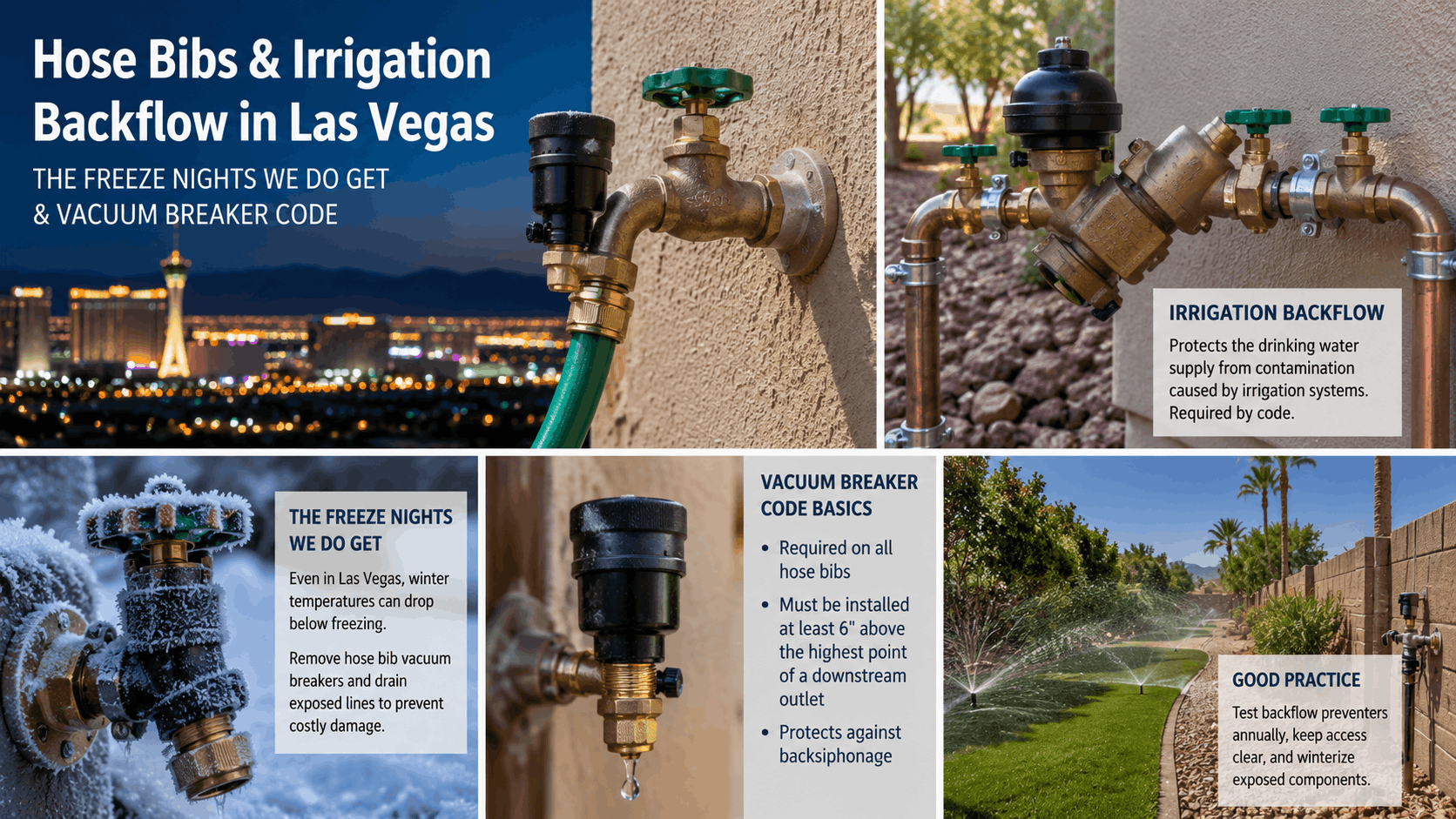
- The valley gets several freeze nights each winter, from December through February, cold enough to crack outdoor hose bibs and irrigation lines.
- Water trapped in a spigot freezes and splits the line, but the crack often stays hidden until spring when the faucet is turned back on.
- Higher neighborhoods like Summerlin West and the Red Rock foothills run colder and face more freeze cycles than the valley floor.
- Backflow protection keeps dirty yard and hose water from being sucked back into your clean drinking supply during a pressure drop.
- Clark County code requires vacuum breakers on hose bibs and testable devices on irrigation, with certified annual testing for PVBs.
- Simple freeze prep works: disconnect hoses, drain and cover spigots, insulate the backflow assembly, and shut off outdoor lines on hard nights.
- Older homes near downtown often lack vacuum breakers, while newer HOA communities usually need their annual backflow test kept current.
- Certified testers on the team handle backflow repairs, code-compliant vacuum breaker installs, and yearly testing with water provider paperwork.
In This Article
Every January, we get the same call. A homeowner near Charleston walks out to water the yard on a warm afternoon, turns the spigot, and finds water pouring out of the wall behind it. The night before dipped below freezing, and the hose bib that looked fine all winter finally showed its damage. The crack was there the whole time, hidden until the pressure came back on.
This surprises a lot of people. Las Vegas is a desert, so freezing pipes feel like a Midwest problem. But the valley gets several cold nights each winter, and outdoor plumbing takes the hit. Hose bibs, sprinkler lines, and backflow devices all sit outside where the cold can reach them.
What a Hose Bib Is and How It Fails in the Cold?
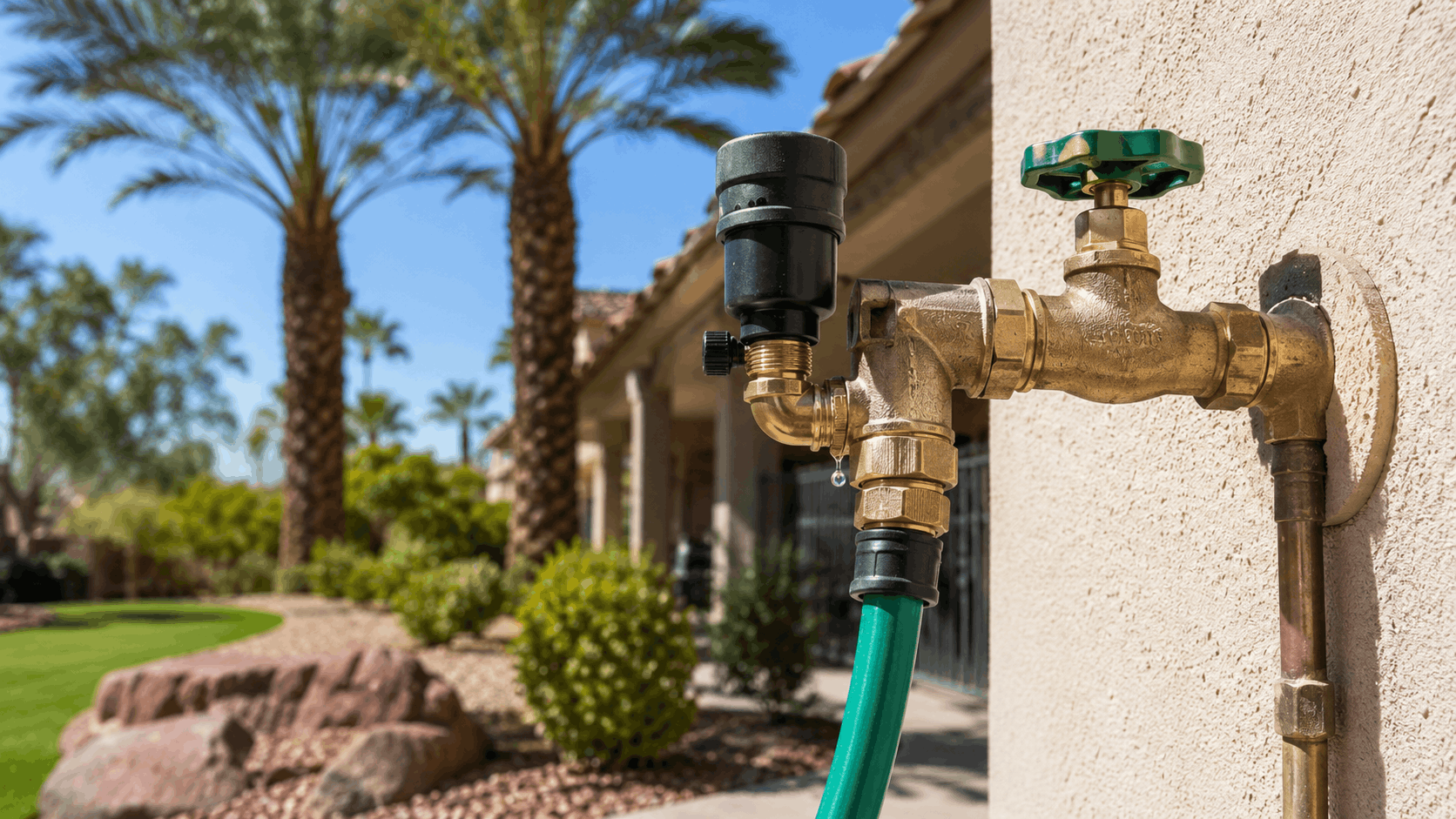
A hose bib is the outdoor faucet where you screw on your garden hose. Some people call it a spigot, a sillcock, or an outdoor tap. It pokes out of an exterior wall and connects to a water line that runs back inside the house.
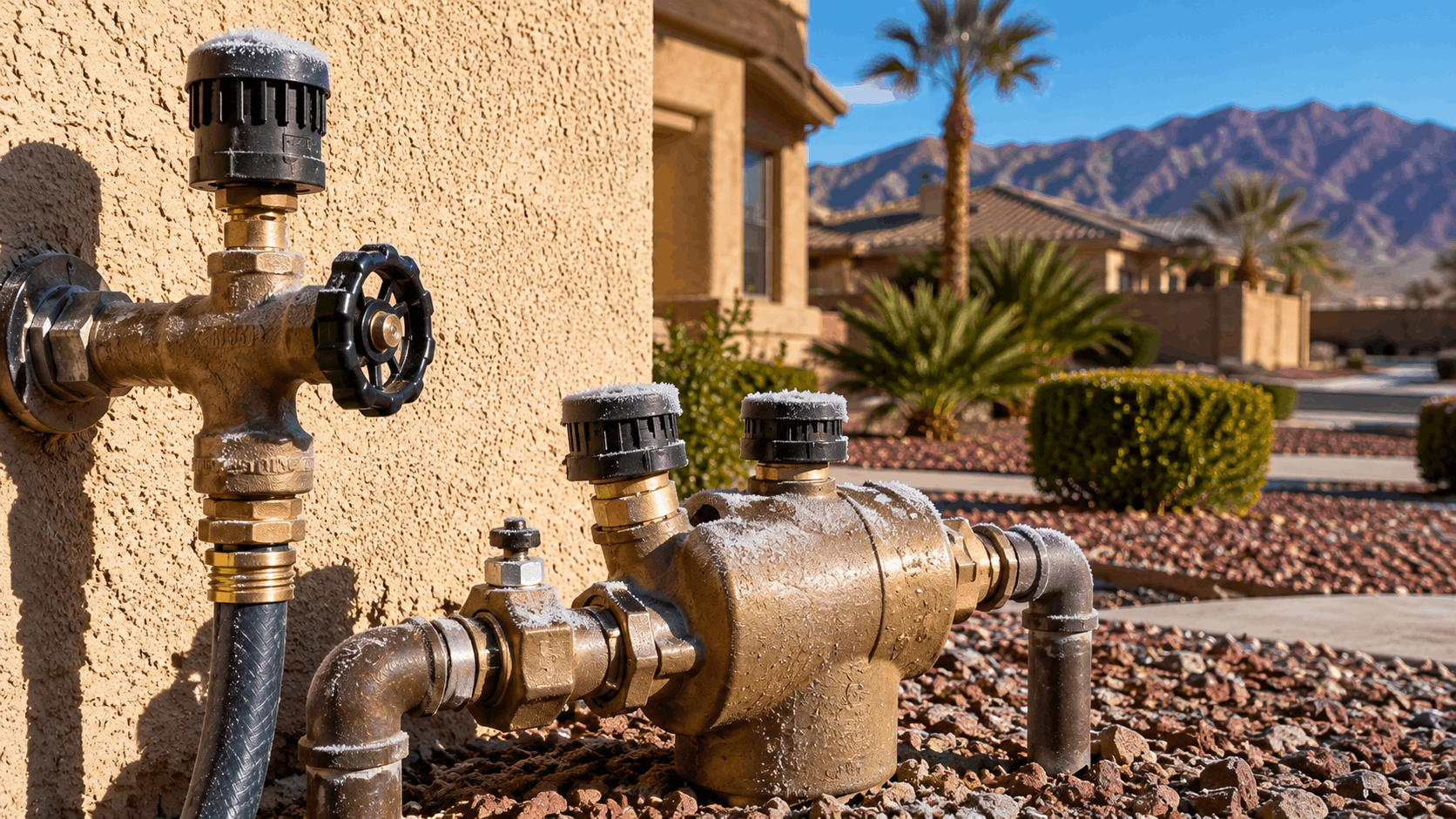
When cold weather hits, the water trapped in that fitting can freeze. Frozen water expands, and that expansion pushes hard against metal and plastic. The result is often a spigot freeze that cracks the valve body or the pipe behind it.
Here are the parts of a hose bib that fail most often in the cold:
- The valve body - the brass or metal housing that holds the water when the faucet is off
- The pipe stub behind the wall - the copper or PEX line that feeds the outdoor faucet
- The soldered or threaded joint - where two pieces meet and stress builds during a freeze
- The vacuum breaker cap - the small screw-on device that can trap water and split
Standard vs. Frost-Free Hose Bibs
Many established homes near Charleston Boulevard and Rancho Drive still have the older standard spigot. This type shuts the water off right at the outside wall, which means water sits in the exposed part of the fitting. On a freezing night, that trapped water has nowhere to go and can crack the body.
Newer builds across the valley often come with a frost-free hose bib. This design has a long stem that reaches deep into the heated wall cavity. The actual shutoff sits inside the warm part of the house, so the water drains out of the exposed section after you turn it off.
Frost-free models handle valley cold much better than an old standard spigot. Still, they are not magic. If a hose stays connected over winter, water cannot drain out and the frost-free feature stops working.
Knowing which outdoor faucet type you have tells you how much risk you carry. If you can see a small round handle right at the wall with a short body, you likely have a standard spigot that needs extra freeze protection.
Where the Crack Usually Happens
The crack almost always starts where water gets trapped and cannot move. On a standard spigot, that is inside the valve body a few inches from the wall. On any bib, it can also happen in the pipe just behind the siding.
Here is the tricky part. When water freezes and splits the metal, the faucet may still look normal from the outside. The crack sits in a spot you cannot see, and the ice actually seals it shut until things warm up.
Once spring arrives and you turn the water on, the pressure finds that split. Sometimes it is a small drip. Other times it becomes a burst pipe that soaks the wall framing before anyone notices.
That hidden leak is why so many freeze failures go undetected for weeks. Trapped water did the damage in January, but the homeowner does not see the water until March or April.
Warning Signs After a Cold Snap
After a run of cold nights, it pays to check your outdoor faucets before you trust them. A few clear signs point to freeze damage that needs attention.
Watch for low water pressure at the hose bib. If the flow feels weaker than last season, water may be escaping through a crack instead of reaching the hose. You might also notice a spigot leak that only shows up when the faucet is turned on.
A wall leak is the sign nobody wants to see. Damp drywall, a musty smell, or a soft spot on the interior wall near the outdoor faucet all point to a cracked line behind the surface. If you catch water inside the wall, shut off the supply and call for help fast.
Our team handles these freeze failures across the valley, and quick action keeps a small crack from turning into major water damage. If you spot any of these signs, our burst pipe repair crew can trace the leak and fix it.
Get Your Quote
Tell us what's going on and we'll get back to you. We're open 24/7.
How Cold Las Vegas Actually Gets?
People move here for the sun, and most days deliver. But the desert cools off fast once that sun drops behind the mountains. Clear skies and dry air let the heat escape overnight, and temperatures fall further than folks expect.
Those Las Vegas freeze nights are the reason outdoor plumbing needs attention. The valley may not see weeks of hard cold, but it does not take weeks to crack a hose bib. One bad night is enough.
Understanding the local desert winter helps homeowners plan. Freeze risk is real here, even if it looks nothing like winter in Denver or Chicago.
Winter Low Temperatures Across the Valley
From December through February, overnight lows across the valley regularly land in the 30s. Areas like Summerlin, Henderson, and North Las Vegas all see freezing temperatures several nights each winter, sometimes dropping into the high 20s.
The National Weather Service tracks these valley lows every year, and the pattern holds. You can check historical data through the National Weather Service Las Vegas office to see how often nights dip below 32 degrees.
A few hours below freezing is all it takes to damage exposed plumbing. Water starts to freeze at 32 degrees, and a hose bib holds only a small amount of water that chills fast in still night air.
Summerlin winter nights tend to run a bit colder than the central valley because of elevation. That extra chill adds up over a season and pushes more spigots past their limit.
Why Elevation and Neighborhood Matter
Not every part of the valley gets equally cold. Elevation makes a real difference from one neighborhood to the next. Higher ground cools more quickly and reaches lower temperatures overnight.
Summerlin West and the Red Rock foothills sit hundreds of feet above the Strip corridor. On a cold night, those higher spots can run several degrees colder than lower Henderson neighborhoods or the areas near the airport.
Homes in the western foothills feel elevation cold more often, which means their hose bibs and irrigation face more freeze cycles each winter. We see more freeze calls from these higher neighborhoods than from the valley floor.
If you live in Summerlin West or up toward the foothills, treat freeze protection as a yearly habit. Your address carries more risk than a home down near the lower parts of the basin.
The Overnight Freeze-Thaw Cycle
The real damage comes from the freeze-thaw pattern. A single hard night drops the temperature below freezing, then the strong desert sun warms everything back up the next day.
During that cold night, water in the hose bib freezes and expands. It pushes against the metal with enough force to start a crack. The next afternoon, the ice melts and the water flows again, but the damage is already done.
Repeat that cycle a few times over a winter and small cracks grow larger. Each freeze widens the split a little more, until the pipe cracking becomes a full failure. Overnight lows do the harm, and the daytime thaw hides it.
This is why a warm, sunny week can follow a freeze and still leave broken plumbing behind. The sun feels great, but it does not undo what happened at 4 a.m.
Need Help in Las Vegas?
Active Plumbing serves Las Vegas and all of Las Vegas Valley.
Backflow: What It Is and Why It Matters Here
Freeze damage is one problem, but there is a second reason outdoor plumbing needs care. It is called backflow, and it affects the water you drink. Every hose bib and sprinkler system connects to the same clean supply that feeds your kitchen sink.
Backflow protection keeps that connection safe. Without it, dirty yard water could travel backward into your home and the shared supply. Local water rules take this seriously, and so should homeowners.
Here is what backflow means and why the valley's water providers require protection against it.
What Backflow Actually Means
The backflow definition is simple. Water normally flows one way, from the clean supply out to your faucets and hoses. Backflow is when that water reverses direction and flows the wrong way, back toward the supply.
This usually happens during a pressure drop. If a water main breaks or a fire hydrant opens nearby, the pressure in the pipes can suddenly fall. That drop creates suction, much like sipping through a straw.
That suction is called back siphonage. It can pull water from a hose lying in a puddle, a bucket of soapy water, or a sprinkler head back into the pipe. Whatever is on the outlet end gets drawn inward.
Once that dirty water enters the line, it can reach the potable supply. A vacuum breaker stops this by letting air into the system so the backward pull breaks instead of dragging contaminated water inside.
Why Irrigation Systems Are a Risk
Irrigation backflow is a bigger concern than most people realize. Sprinkler heads sit right at ground level, surrounded by whatever is on the lawn. That includes fertilizer, weed killer, pet waste, and standing water.
Picture a yard in Aliante or Green Valley right after someone spreads fertilizer. The sprinklers run, the chemicals mix into the soil, and water pools around the heads. If a pressure drop hits at that moment, fertilizer contamination could get sucked back into the pipe.
A sprinkler system has many outlet points buried in the yard, so the risk multiplies. Each head is a place where lawn water could reverse into the line without proper protection.
This is why irrigation systems require a dedicated backflow device, not just a small hose cap. The device stands guard so nothing from the yard can travel back toward the house.
Las Vegas Valley Water District Expectations
The Las Vegas Valley Water District and other local water providers require backflow protection to guard the shared supply. Their job is to keep potable water clean for every home on the system, and one unprotected connection puts neighbors at risk.
For most homes, that means a proper backflow device on the irrigation system and vacuum breakers on outdoor hose bibs. These are not optional extras. They are a backflow requirement written into local plumbing rules.
Water providers may also ask for proof that testable devices work. That is where annual testing comes in, which we cover further down.
Meeting these expectations keeps you compliant and keeps the water safe. Our team knows what the local providers look for and can bring any property up to standard.
Vacuum Breakers and Local Plumbing Code
A vacuum breaker is the device that stops backflow. It is small, it does one job, and it does it well. When pressure drops, the vacuum breaker opens to let air in and blocks water from flowing backward.
Clark County plumbing code spells out where these devices go and which type belongs on each connection. Knowing the basics helps homeowners understand what a compliant setup looks like.
Here is a breakdown of the types, the code, and the testing that goes with them.
Atmospheric vs. Pressure Vacuum Breakers
The two main types are the atmospheric vacuum breaker and the pressure vacuum breaker. They work on the same idea but fit different jobs.
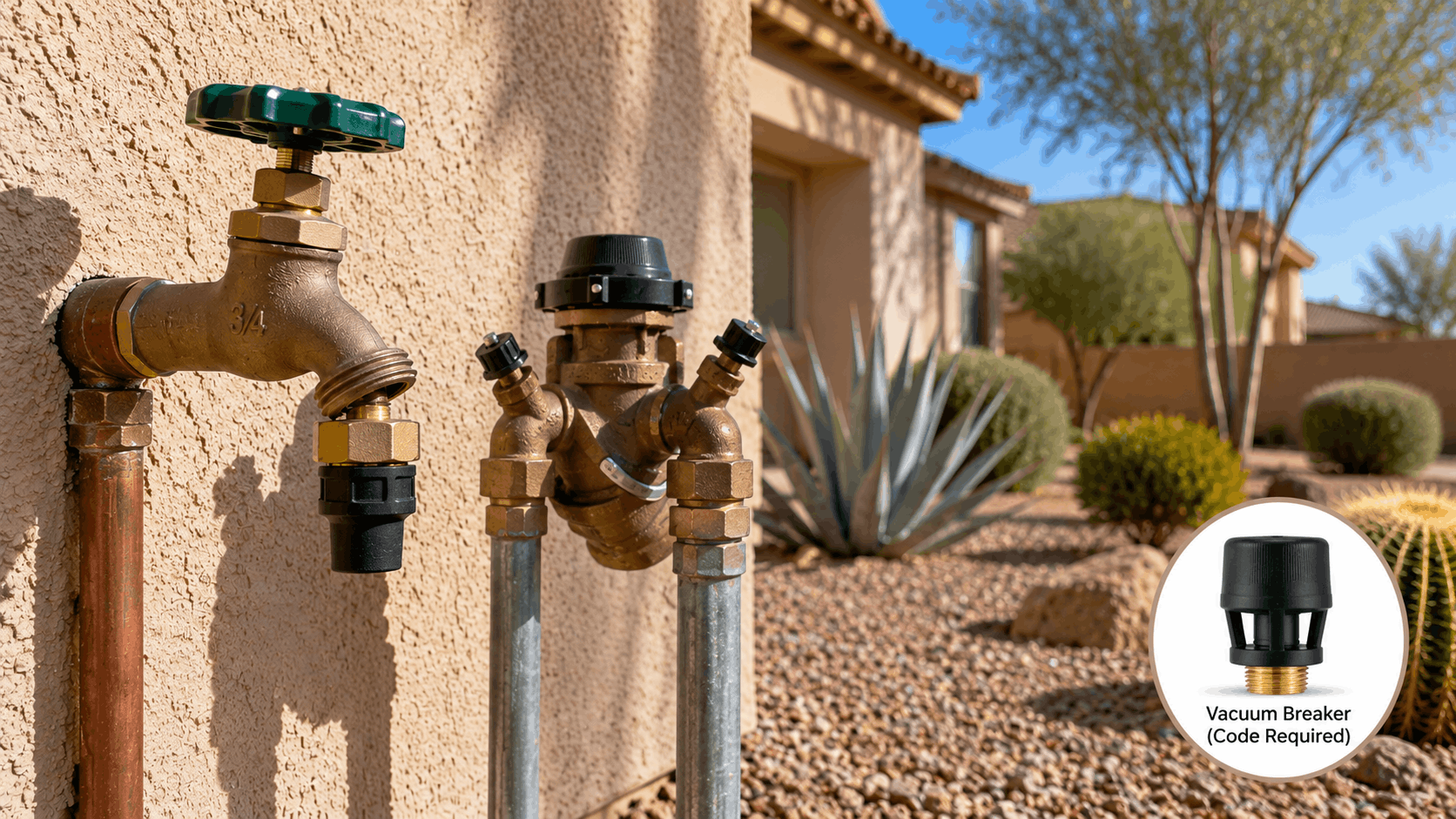
An atmospheric vacuum breaker, or AVB, is the simple type. It cannot hold pressure for long periods, so it goes on connections that are not under constant pressure. The small cap on a hose bib is an example of this style.
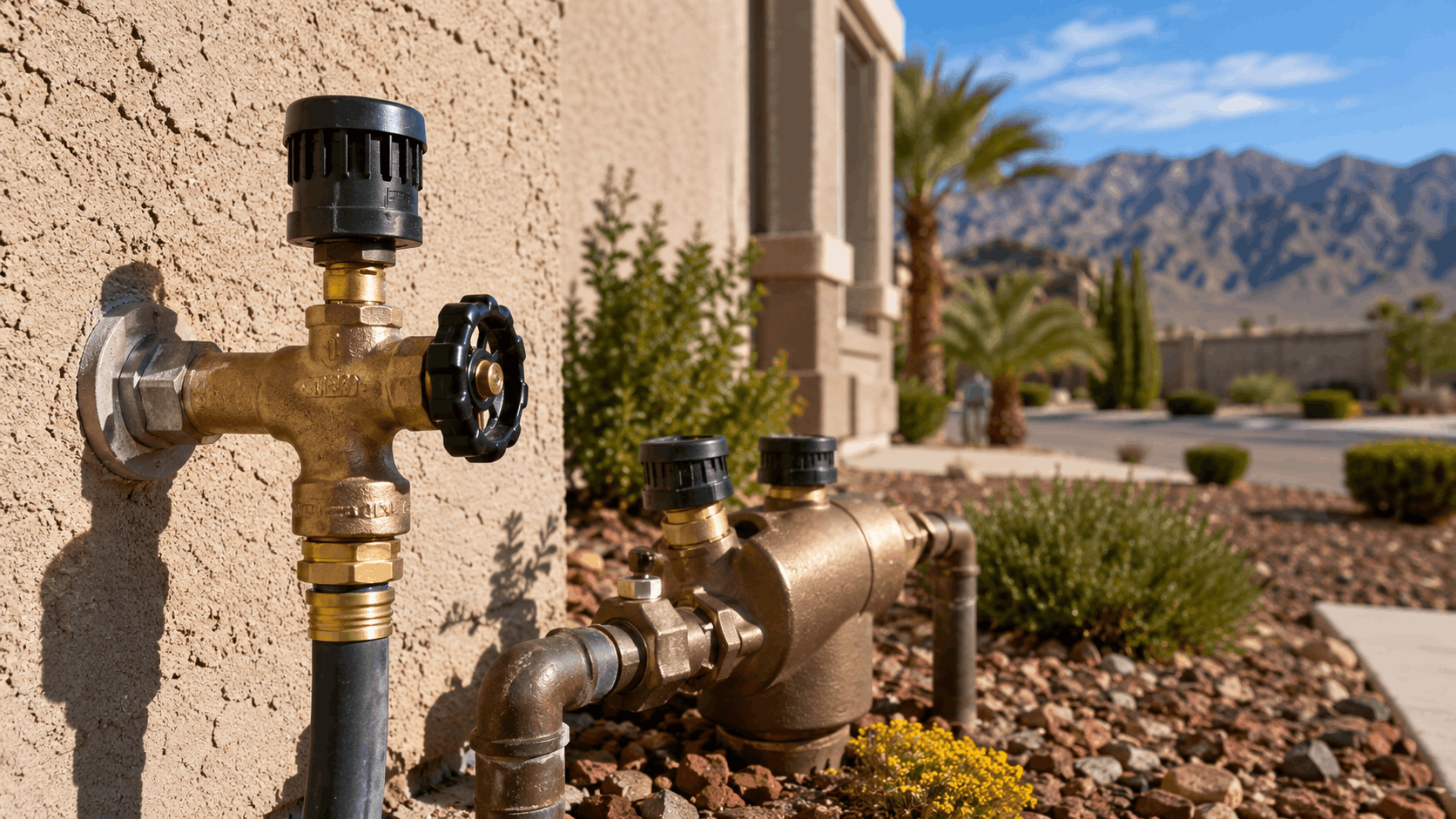
A pressure vacuum breaker, or PVB, is built to stay under pressure all the time. That makes it right for an irrigation system, where the line stays pressurized to feed the zones. A PVB sits above ground on a riser and can be tested to confirm it works.
The difference matters for code. A hose bib gets the simple AVB style, while a sprinkler system needs the testable PVB. Putting the wrong device in the wrong spot can fail an inspection.
Hose Bib Vacuum Breaker Requirements
The hose bib vacuum breaker is the small brass cap that screws onto the threads of an outdoor faucet. It costs only a few dollars and installs in seconds without tools. Once on, it stays as a permanent guard against back siphonage.
Code calls for one on outdoor spigots because a garden hose is such a common backflow risk. A hose left in a pool, a bucket, or a puddle creates the exact hazard these caps prevent. That is why the code requirement exists for nearly every outdoor tap.
Some newer frost-free bibs come with a built-in vacuum breaker already installed. If yours does, you may see a small dome on top of the faucet body. Older standard spigots usually have nothing, which is a common code gap in established homes.
The screw-on breaker is one of the easiest upgrades a homeowner can make. If your spigot lacks one, adding it brings that connection up to code cheaply.
What Clark County Code Says
Clark County adopts the Uniform Plumbing Code, which sets the rules for backflow devices across the valley. The code lays out which connections need protection and which type of device fits each situation.
Under this code, hose bibs need vacuum breaker protection and irrigation systems need a testable assembly. New construction and major plumbing work go through the Clark County building department, where an inspection confirms the devices are in place and installed right.
You can review permit and inspection details through the Clark County Building and Fire Prevention department. Any permitted plumbing job in the valley falls under their review.
For most homeowners, code compliance matters most during a remodel, a new irrigation install, or a home sale. That is when gaps get flagged and need fixing. Our team handles this work daily and knows exactly what the inspectors expect.
Annual Testing and Certification
Testable devices like a PVB need certified annual testing. Over time, the springs and seals inside a backflow assembly wear out, and a device that fails might not stop backflow when it counts.
The annual test checks that the device still holds and opens correctly. A certified tester uses a gauge kit to measure pressure across the assembly and confirm it works. The test takes only a few minutes but requires the right training and equipment.
Not just anyone can perform this test. Only a certified tester registered with the water provider can run the check and file the paperwork. Doing your own test does not count toward the requirement.
Our team includes certified testers who handle backflow testing and file the reports for you. We keep your device compliant and take the paperwork hassle off your plate.
Protecting Hose Bibs Before Freeze Nights
The good news is that freeze protection is simple and cheap. A few minutes of prep before a cold night saves you a cracked bib and a wall leak in spring. Most of this you can do yourself in a single afternoon.
Winterizing your outdoor faucets comes down to three things: drain them, cover them, and shut them off when needed. Here is how to handle each one.
Disconnect Hoses and Drain the Line
Start by removing every garden hose from every spigot. A connected hose traps water inside the bib and blocks it from draining out. This one step defeats even a frost-free faucet, so it matters more than people think.
Once the hose is off, open the spigot all the way and let it run for a moment. Then leave it open briefly so any water in the exposed section can drain out. On a frost-free bib, this lets the long stem clear so no water sits in the cold zone.
After the line drains, close the faucet again if you want, or leave it cracked on a standard spigot with a bucket underneath. The goal is to make sure no trapped water stays in the part of the fitting that sits outside the warm wall.
Do this in late fall before the first hard night, and you remove most of the freeze risk for the whole season. It costs nothing but a few minutes of your time.
Insulated Covers and Foam Wraps
An insulated cover adds a layer of protection for a couple of dollars. These foam or hard-shell caps slip over the spigot and trap a pocket of warm air around it. Hardware stores across the valley sell them for around three to five dollars each.
Foam wrap works too, especially on the pipe stub leading up to the faucet. Wrapping the exposed pipe with foam insulation slows heat loss and keeps the water above freezing longer on a cold night.
Pay extra attention to spigots on north-facing walls. Older homes near Winchester and Paradise often have outdoor faucets on the shaded north side that never see afternoon sun. Those spots stay colder and freeze first.
For homes in the Paradise and Sunset Park area, a simple foam cover on each exposed spigot goes a long way. Spigot protection like this is the cheapest insurance you can buy against a freeze crack.
Shutting Off the Interior Valve
Many homes have a dedicated shutoff valve for the outdoor lines, usually located inside near where the pipe exits the wall. Look in the garage, a utility closet, or under a nearby sink for a small valve on the line feeding the outdoor faucet.
During a hard cold snap, turning that shutoff valve off cuts water to the exposed spigot entirely. With no water in the line beyond the valve, there is nothing left to freeze and crack. Open the outdoor faucet afterward to drain what remains.
This outdoor line shutoff is the surest freeze protection available. It removes all doubt because an empty pipe cannot burst no matter how cold it gets outside.
Not every home has a separate outdoor shutoff, and some are buried or hard to find. If you cannot locate yours or you are not sure which valve controls the outdoor line, our team can identify it during a service visit and label it for future cold snap prep.
Need Help in Las Vegas?
Active Plumbing serves Las Vegas and all of Las Vegas Valley.
Winterizing Irrigation Systems in the Valley
Sprinkler systems need their own freeze prep, and the backflow device is the weak point. It sits above ground, fully exposed to the night air, and it holds water that freezes fast. A cracked backflow assembly is a common and costly winter repair.
Irrigation winterizing in the valley is lighter than in cold climates, but it still matters. Here is what to do before freeze nights arrive.
Protecting the Backflow Assembly
The backflow assembly on your irrigation system usually stands a foot or two above ground on a metal or brass riser. Because it is exposed and full of water, it is the first thing to freeze when the temperature drops.
Insulate the device with an insulated pouch, foam, or even old towels wrapped in a plastic bag to keep them dry. Cover the whole assembly including the test cocks and the pipe rising from the ground. The goal is to trap heat and block the wind.
Wind makes above ground pipe freeze quicker, so a wind-exposed corner needs extra wrapping. Bags of leaves or a purpose-built insulated cover both work well for the valley's short cold spells.
Do not fully seal a testable device forever, since you will need access for the annual test. Use a cover you can remove and replace so the backflow assembly stays both insulated and serviceable.
Draining or Blowing Out Lines
Water sitting in the sprinkler lines can freeze in the shallow parts near the surface. For most valley yards, draining the lines through the system's drain valves clears the risk. Open the valves, let the water out, and close them again.
Larger properties tell a different story. Homes near Anthem or out on the valley's edge with long runs of pipe and many zones may need a full blowout. This uses compressed air to push every drop of water out of the lines.
A blow out is the surest way to clear a big system, but it takes the right compressor and technique. Too much air pressure can damage sprinkler heads and fittings, so this job is best left to someone who knows the correct settings.
For a typical valley yard, draining the lines and protecting the backflow device covers you. For a large or complex system, a professional blowout gives full peace against a freeze. Our team can advise which your property needs.
Setting Timers for Cold Nights
Your irrigation controller can work against you on a cold night. If the timer runs a cycle at 4 a.m. when it is 28 degrees, water sprays onto walkways and driveways and freezes into ice sheets.
Adjust the irrigation timer so no cycle runs during the coldest overnight hours. Shift watering to midday or skip it entirely on nights forecast below freezing. Most modern controllers let you pause or set a freeze schedule with a few button presses.
Running water in the cold also stresses the lines and raises the chance of a freeze crack. Dry lines handle cold far better than lines that just cycled water through them.
Check your controller settings each fall as part of your winter prep. A quick change to the schedule prevents both icy paths and stressed pipes during the valley's freeze nights.
Common Problems We See in Local Neighborhoods
After years of service calls across the valley, patterns show up. The problems we find often tie directly to a home's age and its neighborhood. Here is what we run into most, sorted by area.
| Neighborhood Type | Common Issue | Typical Fix |
|---|---|---|
| Older homes near Downtown and Arts District | Outdated spigots, no vacuum breaker | Add breaker or upgrade to frost-free bib |
| HOA communities in Summerlin and Henderson | Irrigation backflow needs annual testing | Certified test and report filing |
| North Las Vegas and Aliante builds | Wind-exposed backflow assemblies | Insulation and freeze protection |
Older Homes Near Downtown and the Arts District
Established homes near downtown Las Vegas and the Arts District often carry decades-old plumbing. Many still have the original standard spigots with no vacuum breaker at all.
These old spigots do two things poorly. They trap water that freezes and cracks the body, and they offer no backflow protection for the drinking supply. Both problems are code gaps by today's rules.
The fix is usually straightforward. We add a hose bib vacuum breaker for a few dollars or replace the whole spigot with a frost-free model that includes one built in. Either way the connection comes up to current standards.
If your home in the Arts District still has original spigots, an upgrade is worth doing before the next cold snap. It solves the freeze risk and the backflow gap in one visit.
HOA Communities in Summerlin and Henderson
Newer HOA communities in Summerlin and Henderson usually have proper backflow devices on their irrigation. The builders installed them to meet code, so the hardware is there. The gap is often the annual testing.
Homeowners forget that a PVB needs a certified test every year. The device may look fine, but worn seals inside can fail without any outside sign. A skipped test means an unverified device guarding the water supply.
Some HOAs manage irrigation for shared areas, but the device serving your own yard is usually your responsibility. Check whether your Summerlin irrigation setup or Henderson backflow device has a current test on file.
Our certified testers cover these communities regularly. We handle the test, file the report with your water provider, and keep you compliant without you having to chase the paperwork.
Exposed Devices on North Las Vegas Builds
Some North Las Vegas and Aliante builds place the backflow assembly in wind-exposed spots. An open side yard or a corner with no wind break lets the cold hit the device hard on a freeze night.
Wind pulls heat away from the exposed backflow more quickly than still air. A device that might survive a calm cold night can crack when a north wind blows across it. We see these freeze failures cluster in the more open northern neighborhoods.
The fix is good insulation and a wind block. A proper insulated cover that stays dry protects the assembly through the valley's short cold spells.
Homeowners in Aliante and across North Las Vegas should check their irrigation backflow before winter. A ten-minute wrap job beats a cracked assembly and a flooded side yard in January.
Need Help in Las Vegas?
Active Plumbing serves Las Vegas and all of Las Vegas Valley.
When to Call Active Plumbing
Plenty of freeze prep is DIY, but some jobs need a licensed local plumber. Cracked lines, code upgrades, and certified testing all fall outside what a homeowner should tackle alone. Here is where our team steps in.
We work every corner of the valley, from Summerlin to Henderson to North Las Vegas, and we know the local code inside out.
Repairing a Cracked or Leaking Hose Bib
When a freeze cracks a hose bib, a repair is often the fastest path back to a working faucet. We replace the cracked spigot and check the pipe behind the wall for hidden damage from the same freeze.
In many cases we recommend a frost-free upgrade at the same time. Swapping an old standard spigot for a frost-free model with a built-in vacuum breaker solves both the freeze risk and the backflow gap in one job.
Access drives the work. A spigot on an open wall is quick, while one tucked behind landscaping or requiring wall access takes longer. We assess the situation and give a clear price before starting.
Our pipe and fixture services cover hose bib repair and spigot replacement across every valley neighborhood. We get your outdoor water back on fast.
Installing Code-Compliant Vacuum Breakers
For connections that lack backflow protection, we install code-compliant vacuum breakers. That means the right device for the right spot: a hose bib breaker for spigots and a testable PVB for irrigation.
We size and place each backflow device to meet Clark County code. On a new irrigation install or a remodel, we make sure the setup passes inspection the first time. No guesswork and no failed checks.
After installing a testable device, we can certify it on the spot. That gives you a working, compliant assembly and a test report in hand from day one.
Getting the install right the first time saves money and hassle later. Our team handles vacuum breaker install work for hose bibs and sprinkler systems throughout the valley.
Annual Backflow Testing and Reports
Testable devices need a certified test every year, and our certified testers handle it. We check that the device holds pressure, opens when it should, and stops backflow the way it is meant to.
After the test, we file the backflow test report with your water provider. That paperwork is what keeps you compliant, and we take care of it so you do not have to track deadlines or forms.
We schedule these tests to fit your calendar and can bundle them with other service to save a trip. Many valley homeowners set a yearly reminder and let us handle the rest.
Reach out through our contact page to book a backflow test, a hose bib repair, or a freeze-season checkup. We keep valley water safe and outdoor plumbing running.
Final Thoughts
Las Vegas may be a desert, but the valley gets enough freeze nights each winter to crack a hose bib or split an irrigation line. A few minutes of prep in the fall saves a costly repair in the spring.
Disconnect your hoses, cover exposed spigots, protect the backflow assembly, and shut off outdoor lines during hard cold snaps. Pair that freeze protection with proper vacuum breakers and current backflow testing, and your outdoor plumbing stays both safe and code-compliant.
When a repair, an upgrade, or a certified test is more than a DIY job, our team is ready. Call Active Plumbing or reach out online, and we will keep your hose bibs, sprinklers, and drinking water in good shape all winter long.
Frequently Asked Questions
- Does Las Vegas really get cold enough to freeze a hose bib?
- Yes. Several freeze nights hit the valley each winter, mostly from December through February. Overnight lows regularly drop into the 30s and sometimes the high 20s, which is cold enough to freeze water trapped in an outdoor faucet. A single hard night can crack a hose bib, especially an older standard spigot on an exposed north-facing wall. The desert cools fast once the sun sets, so freeze risk is very real here.
- What is a vacuum breaker and do I need one?
- A vacuum breaker is a small device that stops backflow, which is water flowing the wrong way into your clean supply. When pressure drops, it lets air in so dirty yard or hose water cannot get sucked back into the pipe. Clark County code requires them on outdoor hose bibs and irrigation systems. So yes, you need one on every outdoor connection to protect your drinking water and stay compliant with local rules.
- How often does backflow need to be tested in Clark County?
- Testable backflow devices generally need certified testing once a year in Clark County. Over time the internal springs and seals wear out, and a worn device may fail to stop backflow when it matters. The annual test confirms the assembly still holds pressure and opens correctly. Only a certified tester registered with your water provider can perform the test and file the report, so this is not a DIY check.
- Can I install a hose bib vacuum breaker myself?
- The simple screw-on type is easy to install yourself. It threads right onto the spigot outlet by hand in seconds and costs only a few dollars at any hardware store. That covers the basic code requirement for most outdoor faucets. But permanent backflow devices and irrigation PVBs should be done by a pro, since they require proper sizing, placement, and often an inspection and certified test to meet code.
- How do I protect my irrigation backflow device from freezing?
- Wrap the assembly with insulation before hard nights. Use an insulated pouch, foam, or towels sealed in a plastic bag to stay dry, and cover the whole device including the riser and test cocks. Block the wind, since exposed corners freeze fastest. For extra safety, drain the sprinkler lines through the drain valves. Keep the cover removable so you can still access the device for its yearly certified test.
- Why did my spigot only start leaking after winter?
- A freeze can crack the internal line or valve body while ice seals the split shut, hiding it all winter. The faucet looks fine until spring, when you turn it on and the pressure finds that crack. That is why a spigot leak often shows up months after the cold that caused it. If yours leaks only when turned on, or you see damp drywall nearby, a winter crack is the likely cause.
- What is the difference between a PVB and an AVB?
- Both stop backflow, but they fit different jobs. An atmospheric vacuum breaker, or AVB, cannot hold pressure for long, so it goes on connections that are not always pressurized, like a hose bib. A pressure vacuum breaker, or PVB, stays under constant pressure and suits an irrigation system that keeps the line charged. A PVB is testable and sits above ground on a riser, while a simple AVB cap does not need annual testing.
- Do newer Summerlin homes already have frost-free hose bibs?
- Many newer Summerlin homes do come with frost-free hose bibs from the builder. The long stem reaches into the warm wall cavity so water drains out of the exposed part after you shut it off. But they can still fail if a hose is left connected over winter, because the trapped water cannot drain. Always disconnect hoses in the fall, even on a frost-free bib, to keep the freeze protection working.
- How much does it cost to replace a hose bib in Las Vegas?
- Cost depends on access and the type of faucet you choose. A simple standard spigot swap on an open wall sits at the lower end, while a frost-free upgrade or a job requiring wall or landscaping access runs higher. Factors like pipe condition, the need for a vacuum breaker, and how the line is routed all affect the price. We assess your setup and give a clear quote before any work begins.
- Who is allowed to certify backflow testing in the valley?
- Only a certified tester registered with the local water provider can perform and file backflow test reports in the valley. The tester needs proper training and a calibrated gauge kit to check the device correctly. A homeowner cannot self-certify, even with the tools. Our team includes certified testers who run the test, confirm the device works, and submit the required paperwork to your water provider to keep you compliant.
Licensed plumbing professionals serving Las Vegas and Las Vegas Valley.
Licensed in Nevada · License #0047021
Last updated on
Why trust Active Plumbing?
Founded in 1991, Active Plumbing is a licensed and insured plumber serving Las Vegas and Las Vegas Valley. All content is reviewed by our licensed technicians.

Need Help in Las Vegas?
Active Plumbing serves Las Vegas and all of Las Vegas Valley.
Related Articles
Water Spraying From an Irrigation Manifold in Las Vegas: Isolating It Without Killing House Water
A spraying irrigation manifold in Las Vegas rarely means shutting off the whole house. Learn to isolate the sprinklers, stop the leak, and when to call a plumber.
Monsoon Season Sewer Backups in Las Vegas: Why August Floods Drains and What to Do First
Monsoon storms overwhelm Las Vegas drains every August. Learn why sewer backups happen, warning signs to watch, what to do first, and how to protect your home.
How North Las Vegas Homeowners Can Prevent Costly Pipe Bursts in Summer
Summer heat, hard water, and pressure spikes cause costly pipe bursts in North Las Vegas homes. Learn how to spot warning signs and prevent them.