Plumber at Lake Las Vegas with Same-Day Service
Key Takeaways
- Technicians arrive in 30 to 60 minutes across the valley, but Lake Las Vegas sits well east of Henderson via Lake Mead Parkway, so travel time is a genuine factor.
- Guard-gated access is authorized ahead of time through the homeowner or property manager, never at the gate, which keeps a same-day visit on track.
- The community holds four distinct property types: custom estates, attached villas, stacked condos and resort and village commercial work, and knowing which one decides the whole job.
- Empty second homes are the defining risk here, since a slow leak can run for weeks and cause tens of thousands in damage; leak detection with automatic shut-off is the proportionate fix.
- The late-1990s build era places much of the community in the Kitec window of 1995 to 2007, and since claim windows have passed, a scheduled PEX or copper repipe is the honest fix.
- Valley water is very hard at 280 ppm or 16 grains per gallon, which hits estate systems hardest, making whole-house treatment and scheduled maintenance worthwhile for second-home owners.
- Lake Las Vegas is inside the City of Henderson, so permits run through the City of Henderson Development Services Center, not Clark County, with exterior work also subject to association design review.
- Active Plumbing is a fourth-generation family business licensed since 1991, holding Nevada license NSCB #0047021, verifiable free at nvcontractorsboard.com.
In This Article
Calling for a plumber in a guard-gated resort community well east of Henderson's main built-up area is not the same as calling one in a standard subdivision. Lake Las Vegas sits at the far eastern edge of the city, wrapped around a 320 acre private lake, and a large share of its homes are second properties that sit empty for weeks at a time. A leak in an unoccupied estate does not announce itself. It runs until someone notices, and by then the damage is measured in tens of thousands rather than hundreds.
Same-day service here means something specific. It means getting a technician through the guard gate without delay, knowing which of four very different kinds of property is involved before anyone loads a truck, and being honest about the drive east along Lake Mead Parkway. A custom estate with multiple water heaters and continuous recirculation is a different job from a condo stacked above a neighbor, which is different again from a restaurant in MonteLago Village.
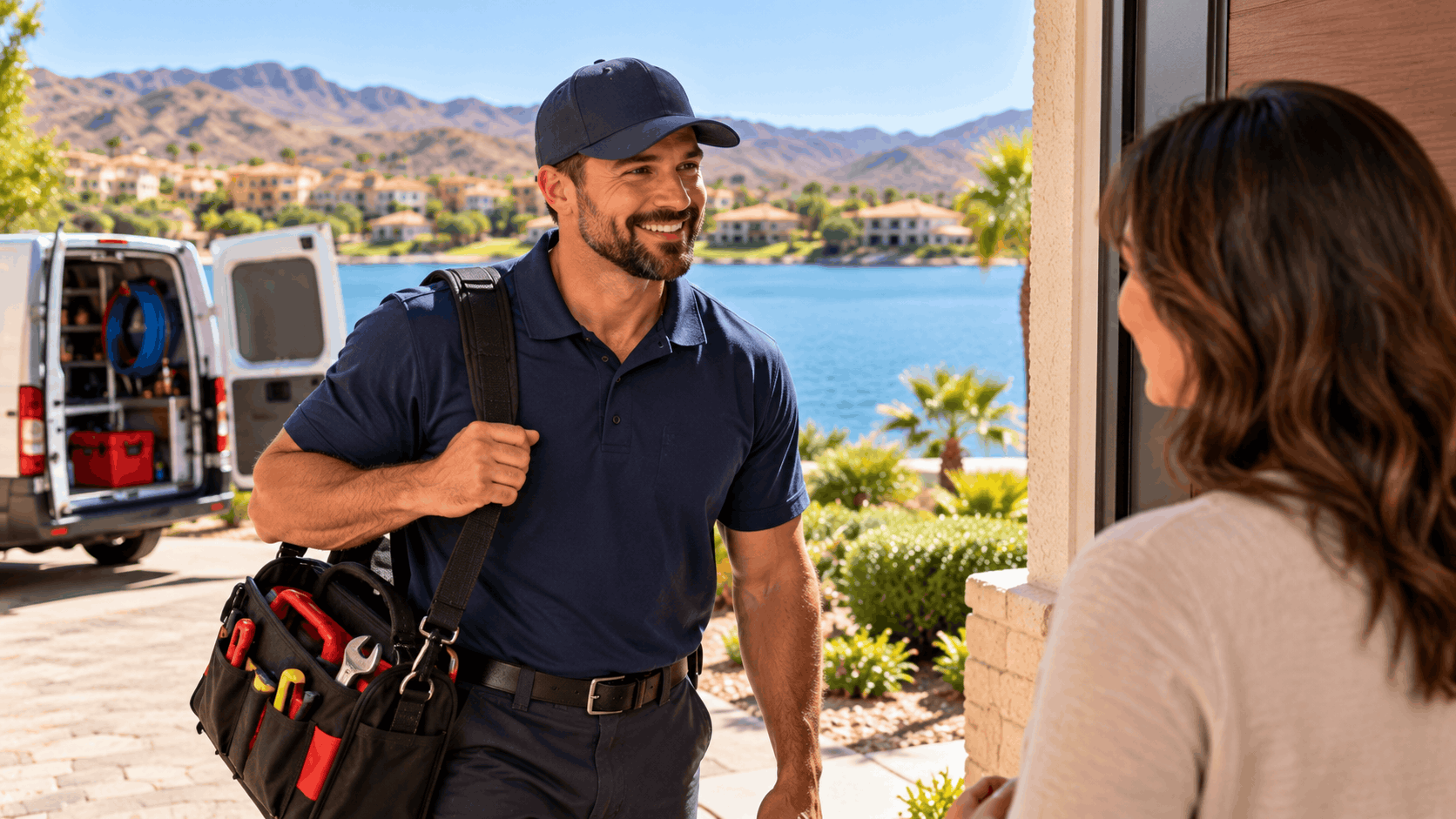
What Same-Day Service Really Looks Like at Lake Las Vegas?
A same-day plumber at Lake Las Vegas has to clear two hurdles that most Henderson calls never see: real distance and a guarded entrance. The community is the most remote part of the city, sitting well east of the main built-up area, so a crew that could reach a central Henderson home quickly still has a genuine drive ahead. On top of that, no truck rolls through the gate without authorization arranged in advance. Both factors shape what a realistic visit looks like, and being straight about them beats promising something the geography will not allow.
The table below sets out what controls timing on a Lake Las Vegas call.
| Factor | What It Means at Lake Las Vegas |
|---|---|
| Valley response window | Technicians arrive in 30 to 60 minutes across the Las Vegas Valley |
| Distance | Community sits well east of the rest of Henderson, adding genuine drive time |
| Route | Lake Mead Parkway (SR 564), then north on Lake Las Vegas Parkway |
| Gate access | Authorized ahead through the homeowner or property manager, never at the gate |
| Resort activity | Events and resort traffic can affect access at times |
| Shut-off | A documented main shut-off limits damage while a crew is en route |
Response Windows and the Drive East on Lake Mead Parkway
Our technicians arrive in 30 to 60 minutes anywhere in the Las Vegas Valley, and Lake Las Vegas is part of that service area. What makes it different is the travel time baked into the response time. The way in is Lake Mead Parkway, State Route 564, running east, then north on Lake Las Vegas Parkway into the community itself. That is a real stretch of road, and we would rather tell an owner that plainly than pretend the far east side of Henderson sits as close as a home near Whitney Ranch.
The city is currently realigning Lake Las Vegas Parkway at Galleria Drive for a new roundabout, so approach routes can shift while that work is underway. On a genuine emergency, that distance is exactly why a documented shut-off matters so much. A few minutes of water stopped at the main while a crew drives east can be the difference between a mop-up and a flooring replacement.
For owners weighing this against a closer neighborhood, the honest framing is that the window is the same valley-wide figure, but the eastern location is a real factor in how the back end of that window plays out. We serve the whole community and across Henderson, and we schedule around the drive rather than ignoring it. Knowing the route and the current roadwork is part of getting there without surprises.
Getting Through the Guard Gate Without Delay
Lake Las Vegas is a guard-gated resort community, which means guard-gated access is handled before a truck ever reaches the entrance. The gate is not the place to sort out authorization. Instead, the homeowner or the property manager clears the visit in advance with community security, so the guard already has the crew's details when they pull up. That one step keeps a same-day visit on track and prevents a technician sitting at the gate while a call chain plays out.
When an owner calls, we confirm who can authorize gate access right at the start. For a primary resident that is usually the owner directly. For a second home or a rental, it is often a property manager or a key-holder who handles access on the owner's behalf. Establishing that contact early means the authorization and the drive happen in parallel rather than one after the other.
This is where local knowledge earns its place. A plumber who does not work east Henderson regularly can lose a chunk of a same-day window at the gate. We treat the authorization step as part of dispatch, not an afterthought, because at Lake Las Vegas the gate is simply part of the job. The smoother that handoff, the faster the crew is standing at the actual problem.
When a Fast Call Matters Most in a Resort Community
Resort and event activity around MonteLago Village and the waterfront hotels can affect access at certain times, which is another reason the first call matters. When something is actively flooding, the fastest fix in the world does nothing if no one can reach the shut-off or let the crew in. A documented main shut-off that operates easily, and a key-holder who can admit a plumber quickly, are what make emergency access real rather than theoretical here.
For a second-home owner, the single most useful thing to arrange ahead of a season away is a manager or neighbor who knows where the main valve is and can turn it. We walk owners through locating and testing that valve, because a stiff or painted-over shut-off is no help in a crisis. A valve that turns freely buys time against the drive east.
When a line bursts in an occupied estate, the owner can shut the water and call. When it bursts in an empty one, the whole chain depends on someone with access noticing and acting. That is why emergency plumbing at Lake Las Vegas is as much about access planning as it is about the repair. The repair is the easy part once a crew is actually inside with the water off.
Get Your Quote
Tell us what's going on and we'll get back to you. We're open 24/7.
Four Kinds of Property, Four Different Calls
Establishing which type of property is involved on the first call decides everything that follows, from the parts on the truck to who is legally allowed to authorize the work. Lake Las Vegas holds four distinct kinds of property, and each one changes the job. There are custom and semi-custom estates, attached villas, stacked condominiums, and the resort hotels and village businesses that make up the commercial core. Guessing wrong wastes a trip, so we pin it down before anything is ordered.
The spread of property types is wider here than in most Henderson communities. A custom estate can carry an estate-scale system across a large footprint, while a villa shares walls and infrastructure with its neighbors, and a condominium stacks the plumbing of multiple owners on top of each other. Knowing which one is on the line tells us who makes the call and how far a single failure can spread.
Custom Estates With Multiple Heaters and Long Hot Water Runs
The custom estates here run on estate plumbing that looks nothing like a standard home. These are systems with multiple water heaters, long hot water runs served by recirculation that runs continuously across a large footprint, and many bathrooms fitted with high-end fixtures. When a single estate has that much pipe and that many heaters, a problem in one zone rarely tells the whole story, and the diagnostic has to account for the scale of the system.
Beyond the indoor plumbing, these properties carry pool and spa gas, outdoor kitchens, fire features and extensive irrigation across large landscaped lots. Many include a casita with its own water heater, bathroom and services, effectively a second small home on the same parcel. Each of those elements is a potential point of failure, and each one needs its own shut-off and its own attention during a check.
Continuous recirculation keeps hot water instant at distant fixtures, which owners of large estates expect, but it also keeps hot water moving through the whole loop around the clock. That design choice has real consequences for scale and wear, which the hard water section covers. For estates, a recirculation pump and the heaters it feeds are central to how the home works, so they are usually the first things we map on a new estate call.
Villas and Condos Where a Leak Becomes a Neighbor's Problem
Attached villas share walls and often share shared infrastructure, which raises the separate interest question before anything is ordered. When two homes share a wall and possibly a supply or drain run, the first thing to settle is whose system the problem actually sits in. That distinction decides who authorizes the repair and who is responsible for the cost, and getting it wrong creates friction between neighbors and the association.
Condominiums add a vertical dimension. A condo sits above or below a neighbor, so a supply failure becomes a multi-property leak the moment water finds its way through a floor assembly. A burst line on an upper unit can soak the ceiling of the unit beneath before the owner upstairs even knows. That is why a fast shut-off and quick access matter even more in stacked housing than in a detached estate.
For both villas and condos, we work to confirm the boundary of the separate interest early, because that is what tells everyone who is in charge of the fix. The master association and its sub-associations govern the common elements, while the owner is responsible for what lies inside the unit. Sorting that out at the start keeps a single leak from turning into a dispute while water is still moving.
Resort Hotels and MonteLago Village Businesses
The Westin Lake Las Vegas Resort and Spa at 101 MonteLago Boulevard, the nearby Hilton resort, and the businesses along MonteLago Village and Strada di Villaggio are commercial plumbing work from top to bottom. That means grease interceptor systems for the restaurants, commercial water heating sized for heavy demand, backflow prevention assemblies, and tenant improvement plumbing when a space changes hands or gets rebuilt. The scale and the code requirements are a different world from residential service.
Food establishments carry an added layer of oversight. Their plans are reviewed and permitted by the Southern Nevada Health District as a separate authority from the city building department, with plumbing supply lines, waste lines and fixtures all shown on the plans. A new restaurant also needs the building department's certificate of occupancy first, and the health district may run a rough plumbing inspection and a pre-final walkthrough before the final sign-off.
Grease interceptors in particular need regular service to keep fats, oils and grease out of the sewer, and the rules for them come from the sewer authority for the address rather than one agency for the whole valley. We handle grease trap pumping and commercial water heating for village tenants, and we coordinate the health district and building department steps that commercial work in this community requires.

Need Help in Las Vegas?
Active Plumbing serves Las Vegas and all of Las Vegas Valley.
Empty Second Homes: The Risk That Defines This Community
This is a resort community, and a large share of its property is second homes, seasonally occupied or rented out. That single fact changes the risk profile more than anything else about Lake Las Vegas. When a house sits empty for weeks or months, a plumbing failure has no one around to catch it, and the clock on the damage keeps running the entire time. This is the most valuable preventive conversation available in the community, and it is more relevant here than in any other part of Henderson.
Leak detection and a plan for an unoccupied property are not add-ons for these owners. They are the difference between a manageable repair and a gut renovation. An owner who sets this up before leaving for the season protects a property that may be worth well above the Henderson median value of $484,900, and often far more at the estate end.
Why a Slow Leak in an Empty House Costs Tens of Thousands
A failure in an unoccupied home runs until someone notices, and on a large estate that can be weeks. A pinhole in a supply line or a failed fitting that would be a minor fix in an occupied house becomes a catastrophe when it drips undetected into a floor, a wall cavity or a ceiling for a month. The water damage compounds the longer it runs, and in a finished high-value home the cost lands in the tens of thousands rather than the hundreds.
The math is simple and unforgiving. A slow leak that loses a gallon an hour is barely noticeable in an occupied home where someone hears a drip or spots a stain. In an empty estate, that same leak keeps going through drywall, hardwood, cabinetry and stone, and it can feed mold in the enclosed, climate-controlled spaces these homes have. By the time a manager does a walkthrough, the repair is the small part of the bill.
This is why we talk to second-home owners about catching failures early rather than just repairing them after the fact. A leak found in hours instead of weeks is a fixture call, not a restoration project. The whole preventive strategy here is built around shortening the gap between when a failure starts and when someone acts on it.
Leak Detection With Automatic Shut-Off
The proportionate response for an empty estate is leak detection with automatic shut-off, not a shelf of gadgets. A whole-home leak detection system watches the water flow and shuts the main automatically when it sees a pattern that signals a leak, such as continuous flow that should not be happening in a vacant house. Typical ranges for a whole-home leak detection system run $300 to $800, which is modest against the damage it prevents in a home that sits empty for months.
Alongside automatic protection, a documented main shut-off that operates easily is the backbone of the whole plan. If the valve is seized, painted over or buried behind storage, it does no good when a key-holder needs it in a hurry. We locate, test and document that valve so anyone with access can stop the water fast, and we flag any valve that needs replacing before it fails at the worst moment.
For targeted problems, electronic leak detection pinpoints a hidden leak without tearing open finished walls, typically $150 to $350. On a large estate with long runs and many fixtures, finding the exact point of a failure quickly is what keeps a repair contained. These tools are not luxuries here. They are the sensible answer to a house that cannot speak for itself while the owner is away.
A Pre-Season Check Before Owners Leave
A pre-season inspection before an owner leaves is one of the highest-value visits available at Lake Las Vegas. A seasonal check looks over the water heaters, the recirculation system, the fixtures, the exposed supply lines and the main shut-off, catching the small problems that would grow into disasters over an empty season. A dripping valve or a weeping fitting found in October is a quick fix. The same fault left to run until spring is a flooded floor.
Just as important is arranging a property manager or key-holder who can admit a plumber quickly if something goes wrong while the owner is across the country. Access is half the battle at a guard-gated community, and a manager who can authorize the gate and let a crew in turns a potential multi-week disaster into a same-day fix. We note that contact as part of the check so it is ready before it is ever needed.
With 20.8 percent of Henderson residents aged 65 and over and many estates held as second homes, the seasonal owner is a common profile here. A simple before-you-leave routine, a tested shut-off, a manager with keys, and automatic leak protection, covers the real risks. We would rather set an owner up for a quiet season away than meet them over a flooded estate when they return.
Kitec Pipe: A Real Candidate Behind These Walls
Lake Las Vegas was developed from the late 1990s onward, which places much of it squarely inside the Kitec window of 1995 to 2007. That makes Kitec a genuine candidate behind the walls of many homes here, not a long shot. When we work a home of that era, we check for it, because the material fails by a predictable mechanism and the honest fix is a planned repipe rather than chasing one failed fitting after another.
Kitec fails through dezincification, a slow chemical process that weakens the brass fittings from the inside. Because every fitting in the system ages together, a home with Kitec is not a question of if but when, and a scheduled replacement on the owner's terms beats an emergency one every time. We always confirm the actual pipe on site rather than assuming from the build year alone.
How to Spot Kitec at the Heater, Sinks and Manifold
Kitec is an IPEX composite pipe, built as flexible aluminum sandwiched between an inner and outer layer of plastic. It was sold in orange for hot and blue for cold, which is one of the quickest visual tells. The brass fittings at the connections are the part that fails, and the pipe itself usually carries printed markings such as Kitec, IPEX or PlumbBetter along its length.
The best places to look are near the water heater, under the sinks and at the manifold where the home's water lines are distributed. In a Lake Las Vegas home from the right era, those are the spots where the colored pipe and brass fittings show themselves most readily. An owner can often spot it with a flashlight under a bathroom sink or in the mechanical closet before a plumber ever arrives.
That said, a visual guess is only a starting point. We confirm the material on site before recommending anything, because build year points toward Kitec but does not prove it, and some homes were plumbed in copper or PEX even in that window. Confirming the actual pipe is what separates a sound recommendation from a guess, and it is a step we never skip on a home of this age.
Why Reduced Flow Is an Early Warning
Dezincification is the specific mechanism behind Kitec's reputation. Zinc leaches out of the high-zinc brass used in the fittings, and the displaced material builds up as a deposit inside the fitting. That buildup restricts the bore and weakens the fitting at the same time, so the failure is both a flow problem and a structural one. Reduced flow at a fixture is often the first symptom an owner notices, long before anything bursts.
Because the whole system was installed at once, every fitting is going through the same fitting failure process on roughly the same timeline. One restricted shower or a weak kitchen faucet is rarely an isolated event in a Kitec home. It is usually the first fitting to show its age, with the rest not far behind. That is why we treat reduced flow in a Kitec-era home as a signal to look at the whole system, not just the one fixture.
Very hard water adds to the picture, since scale and mineral deposits compound any narrowing already underway in the fittings. For an owner, the practical takeaway is that weak flow is worth investigating rather than living with. In a Kitec home it is often the early warning that the fittings are reaching the end of their service, and catching it early is what allows a planned repair instead of an emergency one.
A Scheduled Repipe Beats an Emergency One
The claim windows for Kitec have passed, with the Clark County deadline extended to March 17, 2017 and the broader settlement deadline being January 9, 2020. That means current owners carry the cost themselves, which makes the timing of the work entirely their choice. Given that, a scheduled PEX repipe or copper repipe on the owner's calendar is far better than an emergency one triggered by a failure.
In a finished high-value home, that difference is enormous. A whole-house repipe can be planned so water is restored each evening and the work moves room by room with minimal disruption to a finished interior. Typical ranges for a whole-house repipe run $4,000 to $15,000, which reflects the size and finish level of these homes. An emergency repipe, by contrast, arrives alongside flooding, drying equipment and flooring damage that can cost more than the repipe itself.
For a second-home owner, the scheduled repipe argument is even stronger, since a Kitec failure in an empty estate is the exact tens-of-thousands scenario the leak detection section warns about. Replacing aging Kitec on a planned schedule removes that risk entirely. We confirm the pipe, scope the home, and give a written price before any work starts, so an owner can plan the job rather than react to a flood.

Very Hard Water and Expensive Systems
The Southern Nevada Water Authority states the valley's water is 280 parts per million, or 16 grains per gallon, categorized as very hard. That mineral load affects every home in the valley, but it hits the expensive estate systems at Lake Las Vegas hardest, simply because there is more hard water moving through more equipment. The scale it leaves behind is the single biggest driver of plumbing wear in this community, and water treatment is the proven response.
For these homes, treatment is not an optional luxury. It extends the life of equipment that is costly to repair and replace, and it keeps the visible mineral marking off the stone, glass and polished finishes that define a high-end home. The owners who benefit most are often the ones away for a season, since treatment and maintenance protect the home whether or not anyone is in residence.
What 16 Grains Per Gallon Does to a Large System
At 280 ppm, the valley's very hard water deposits calcium and magnesium scale throughout a system, and the effects multiply across a large estate. Scale builds on water heater elements and tank bottoms, so a home with multiple heaters has several appliances all accumulating deposits at once. A tank left unflushed works harder and fails earlier than its rated life, and in an estate that means more units reaching that point.
Continuous recirculation, which keeps hot water instant across a long footprint, also keeps hot water moving through the loop constantly, giving scale more opportunity to form along the way. High-end mixing valves and cartridges are especially vulnerable, since the small internal passages clog with mineral buildup, and these premium cartridges are costly and slow to replace. Scale buildup in those parts turns a minor service into an expensive one.
The narrowest water path in the house takes the worst of it. In a tankless heat exchanger, the water flows through a tight passage where scale accelerates failure, so tankless units in hard-water homes need descaling to stay healthy. Add the white crusting on fixtures and the mineral marking on glass and stone, and the case for treatment in an estate is straightforward: there is simply more expensive equipment exposed to the same aggressive water.
Softeners, Conditioners and Whole-House Filtration
Whole-house treatment is how an owner protects an expensive system from the mineral load. A water softener removes the hardness minerals outright, and installation ranges run $800 to $2,500. For owners who prefer not to add salt or a brine discharge, salt-free conditioner systems aim to reduce scale formation instead of removing the minerals, also typically $800 to $2,500 installed. Each approach has a place depending on the home and the owner's preference.
Beyond hardness, whole-house filtration addresses taste, odor and sediment, and valley water is chlorinated, which ordinary activated carbon handles well for taste and odor. Whole-house filtration systems also run $800 to $2,500 depending on the home. For drinking water specifically, an under-sink reverse osmosis system gives high-quality water at the tap, typically $300 to $600 including parts and labor.
The finish-protection angle matters in these homes as much as the equipment angle. Very hard water leaves mineral marking on stone countertops, glass shower enclosures and polished fixtures, and in a home built around high-end finishes that marking is a constant maintenance burden. Reducing the mineral load at the source keeps those surfaces looking right and cuts the cleaning that comes with hard water. We size and recommend water treatment to match the home and the water the estate actually receives.
Maintenance That Happens Whether Owners Are Home or Not
A scheduled maintenance arrangement suits second-home owners particularly well, because it happens whether or not they are in residence. The core of that arrangement is heater flushing to clear sediment from the tanks, tankless descaling to keep the heat exchanger clear, and filter changes to keep treatment systems working. On an estate with multiple heaters, that routine is what keeps several appliances from all aging prematurely at once.
Tankless maintenance and descaling typically run $150 to $250, and the work directly protects the narrowest and most scale-prone part of the system. A tankless water heater that is descaled on schedule holds its efficiency and reaches its service life, while one left to accumulate scale in the heat exchanger struggles and fails earlier. For a home the owner only visits part of the year, a scheduled visit removes the need to remember.
The logic of scheduled maintenance is strongest exactly where the house sits empty. An owner in residence might notice a heater straining or a filter needing attention. An absent owner relies on a plan that runs on its own calendar, carried out by a crew with gate access and a manager contact. Setting that up once means the equipment is cared for through every season the owner is away, not just the months they are home.
Need Help in Las Vegas?
Active Plumbing serves Las Vegas and all of Las Vegas Valley.
Lake Proximity, Irrigation and Boundary Lines
A community built around a 320 acre private lake carries extensive common landscape and long private irrigation leak runs across large lots. That geography creates a category of plumbing problem that is distinct from indoor failures, and it introduces a question that rarely comes up elsewhere: where does an owner's system end and the common area or the community's infrastructure begin. Near a boundary or the lake frontage, settling that before work starts avoids a dispute.
Waterfront and lake-view lots also sit in a slightly more humid pocket than the dry desert around them, which is worth keeping in mind. The lake, the long irrigation runs and the shared landscape all mean that a yard leak here is not always simple, and figuring out whose pipe is leaking is often the first job before any repair begins.
Yard and Irrigation Leaks That Show Up as a Water Bill
On a large landscaped lot, an irrigation leak or a yard-line failure can run unnoticed for a long time, because the water simply soaks into planted ground rather than pooling where anyone sees it. The first sign an owner gets is often an unexplained water bill, higher than it should be with no obvious cause inside the house. By then the leak may have been running for weeks across a sprawling irrigation system.
These estates carry long private irrigation runs feeding extensive landscape, and any one of the many valves, lines and heads is a potential failure point. A cracked line underground or a stuck valve can waste a steady stream without ever showing at the surface. We trace these back to the source rather than guessing, because on a lot this size the leak is rarely where the symptom appears.
The waterfront lot sits in a more humid pocket than the surrounding desert, which can mask a slow leak that keeps the ground damp near the lake edge. That makes an unexplained bill an even more useful warning here. When an owner sees usage climb with no indoor explanation, the irrigation and yard lines are the first place to look, and catching it early keeps the waste and the repair small.
Whose System Is It: Owner, Association or Community
Where a problem appears near a boundary with the common area or near the lake frontage, establishing whose system is involved before work begins is the step that prevents trouble. A leak close to a shared landscape zone could sit in the owner's private line, in the association-maintained common system, or in the community's water infrastructure. Each one means a different responsible party and a different authorization path for the repair.
The master association and its sub-associations govern the common elements under Nevada Revised Statutes Chapter 116, while the owner is responsible for the private systems inside their own lot line. Near a boundary that line is not always obvious on the ground, which is exactly why we confirm it before digging or cutting into anything. Starting work on the wrong system creates a boundary dispute that benefits no one.
For an owner facing an unexplained bill or a damp spot near the frontage, the practical first move is to locate the leak and determine which side of the boundary it sits on. That answer tells everyone who authorizes and pays for the fix. We work that question first on any job near common area or the lake, because sorting responsibility early keeps the repair focused and keeps the owner, the association and the community out of conflict.
Backflow Prevention on Irrigation and Commercial Property
Backflow prevention assemblies are required on commercial buildings, multifamily properties and irrigation systems, and the program is run by the water provider rather than the health district or the building department. For a community with extensive irrigation and resort commercial property, that puts backflow prevention squarely on the list of recurring plumbing obligations. The Las Vegas Valley Water District's program requires these assemblies and services them, with other valley providers running their own programs.
These assemblies must be tested by a certified tester at installation, repair or relocation, and at least annually thereafter, with the tester leaving certification on site. That annual testing is not optional, and it applies to the irrigation assembly protecting an irrigation system as much as to a commercial building's device. Nevada has required builders to install backflow assemblies on new commercial properties since the 1990s.
For owners and managers here, keeping the testing current is part of staying compliant and protecting the drinking water supply from cross-connection. Backflow preventer testing typically runs $50 to $100, and installation of a backflow device runs $300 to $600. We handle the testing and installation, and we help owners track the annual schedule so a required test does not lapse on an irrigation system or a commercial property that is easy to forget about.

Permits, Design Review and Slab-on-Grade Work
Lake Las Vegas is inside the City of Henderson, which is the single most important jurisdictional fact for any permitted work here. It is not Clark County, even though it sits well east of the rest of the city. On top of the city's authority, a master association with sub-associations runs active design review, and the homes are slab-on-grade, which changes how an under-slab failure gets repaired. All three shape a job before a wrench is turned.
For an owner, that means two separate sets of rules can apply to one project, the city's and the association's, and the foundation type dictates the smartest repair approach when a line fails beneath the concrete. Knowing all three up front keeps a job from stalling partway through.
Permits Run Through the City of Henderson Development Services
Because Lake Las Vegas is inside the City of Henderson, permits, plan check and inspections run through the City of Henderson Development Services Center, not Clark County. That distinction matters, because content and contractors that lump all of eastern Henderson into county jurisdiction get it wrong. Henderson permits are a Henderson matter, handled at the city's own counter with the city's own process.
Henderson adopted the 2024 Uniform Plumbing Code with Southern Nevada Amendments, effective January 2, 2026, replacing the 2018 edition. The plan check and inspection steps follow that code as the city has codified it. Since permit fees and code edition details change, we confirm the current permit position for the specific address rather than quoting a fixed figure from memory.
Confirming the Development Services Center as the right authority for an address is a small step that signals real local knowledge. For permitted work at Lake Las Vegas, we establish the Henderson permit path at the start, so plan check and inspections are lined up correctly. Getting the jurisdiction right the first time avoids the delay of a misfiled application landing at the wrong counter.
Two Sets of Documents: City and Association
A master association with sub-associations and active design review means two sets of documents can apply to one project. Anything visible on the exterior of a home can require association approval, while interior work generally does not. A repipe inside finished walls is a city permit matter alone, but a project that changes something visible outside, such as an exterior gas line run or a visible backflow assembly, may need the association's review as well.
The sub-associations add another layer, since a particular village within Lake Las Vegas may have its own design standards on top of the master association's. That is why an owner planning anything with an exterior approval component should confirm the current rules with their specific association before assuming a timeline. Review requirements and schedules can change, and the village a home sits in affects which standards apply.
For most plumbing repairs, the practical answer is reassuring: interior work under a city permit moves without association sign-off. It is the exterior-visible elements that trigger the second set of documents. We help owners sort which category their project falls into, so an interior repair proceeds on the city's timeline and an exterior project gets the association review it needs before work starts rather than after.
Under-Slab Failures and Why Rerouting Often Wins
Homes here are built slab-on-grade, which means an under-slab leak is not accessible without breaking through the concrete and whatever finished flooring sits on top. In a high-value home with stone or hardwood over the slab, cutting into that floor to reach a failed line is destructive and expensive. That is why rerouting the affected line is frequently better value than breaking through the slab.
Rerouting runs a new line through walls or overhead to bypass the failed under-slab section entirely, leaving the finished floor intact. On a long run in a large estate, that can be far less disruptive than excavating a trench through the living space. We weigh the reroute against a direct repair case by case, because the right call depends on where the failure sits and what finishes are above it. A slab leak detection and repair job starts with pinpointing the failure, typically $150 to $300 to detect, with repair running $500 to $3,000.
Where exterior excavation is unavoidable, caliche and rock make the digging slower and dearer than in softer valley ground. Caliche is a cemented calcium-carbonate hardpan, abrasive and hard to trench through, and that difficulty belongs in any honest discussion of repair cost. Poorly compacted backfill settling under a pipe over time is also what pulls buried lines out of grade, so proper bedding and compaction matter as much as the dig itself.
What Same-Day Plumbing Work Costs Here
The price ranges below are typical for plumbing work across the Las Vegas Valley, presented so an owner knows what to expect from a same-day call at Lake Las Vegas. These are not a quote. The actual plumbing cost for a specific job depends on that job, and Active Plumbing gives the customer a written price before work starts. Figures are shown exactly as published.
| Job | Typical Valley Range |
|---|---|
| Burst pipe repair | $200 to $800 |
| Electronic leak detection | $150 to $350 |
| Slab leak detection | $150 to $300 |
| Slab leak repair | $500 to $3,000 |
| Whole-home leak detection system | $300 to $800 |
| Tank water heater installation | $800 to $1,500 |
| Tankless water heater installation | $1,500 to $3,500 |
| Water heater repair | $150 to $500 |
| Drain cleaning | $150 to $350 |
| Hydro-jetting (residential) | $300 to $600 |
| Whole-house repipe | $4,000 to $15,000 |
| After-hours emergency service fee | $150 to $300 plus repair costs |
Urgent Leak and Burst Pipe Ranges
The jobs most likely to need same-day attention are the urgent leaks. A burst pipe repair typically runs $200 to $800, depending on where the break sits and how much access it takes to reach. For a hidden failure, electronic leak detection runs $150 to $350 and locates the leak without tearing open finished walls, which matters in a home with high-end finishes.
Under-slab problems carry their own ranges. Slab leak detection typically runs $150 to $300 to pinpoint the failure beneath the concrete, and slab leak repair runs $500 to $3,000 depending on the fix and whether rerouting or direct repair is the better path. For a second home, a whole-home leak detection system at $300 to $800 is the preventive investment that catches a failure before it runs for weeks.
An after-hours fee applies to emergency calls outside normal hours, running $150 to $300 plus the repair costs. That fee reflects the urgency and the timing, and it sits on top of the actual repair range. For a flooding estate at night, a prompt response is what keeps the water damage from compounding, and the written price for the specific job is provided before work begins.
Water Heater and Drain Ranges
Water heater problems are a frequent same-day call, especially across estates with multiple units. A tank water heater cost for installation typically runs $800 to $1,500, while a tankless installation runs $1,500 to $3,500, with a pre-filter adding $150 to $300 where hard water calls for one. A water heater repair, as opposed to a full replacement, typically runs $150 to $500.
Drain cleaning for a clogged line typically runs $150 to $350, which handles most routine blockages. For heavier buildup or recurring problems, hydro-jetting a residential line runs $300 to $600 and scours the pipe walls clean rather than just punching through the clog. On a large estate with long drain runs, jetting is often the more thorough answer.
Deeper sewer problems carry larger ranges. A sewer line repair typically runs $1,500 to $5,000 depending on the length and depth of the affected section, and caliche excavation adds to that where the line runs through hardpan. For any of these, the published range is a guide to what the area charges, and the specific job gets a written price before the work starts. We handle drain and sewer services across the community.
Repipe and Treatment Ranges for Estates
The larger projects that estates eventually face carry the broadest ranges. A whole-house repipe cost typically runs $4,000 to $15,000, reflecting the size and finish level of these homes and the method, whether PEX or copper. For a Kitec home, a scheduled repipe within that range is the planned alternative to an emergency triggered by a failed fitting.
Water treatment for an estate protects the entire system from the valley's very hard water. A softener cost for installation typically runs $800 to $2,500, salt-free conditioning runs $800 to $2,500 installed, and whole-house filtration runs $800 to $2,500 as well. The right choice depends on the home and whether the owner wants minerals removed outright or scale formation reduced without salt.
For irrigation and commercial property compliance, a backflow installation of a backflow device typically runs $300 to $600, with annual testing at $50 to $100. These figures give an owner a realistic picture of the investment in protecting an expensive system and staying compliant. Every one of them is a typical area range rather than a quote, and the specific job is priced in writing before work begins.

Need Help in Las Vegas?
Active Plumbing serves Las Vegas and all of Las Vegas Valley.
How Active Plumbing Handles a Lake Las Vegas Call
Active Plumbing works a Lake Las Vegas call around the two things that make this community different: the four property types and the guard gate. From the first call to the written price, the process is built so a licensed local crew arrives ready, gets through the gate, and diagnoses the actual problem rather than guessing. Owners and managers in east Henderson can expect the same steady sequence every time.
That sequence matters most here because of the distance and the access. A call handled well on the front end saves the owner time and keeps a same-day visit on track despite the drive and the gate. The work itself is the familiar part. Getting the crew to the problem efficiently is where local experience shows.
Confirming the Property Type and Access on the First Call
On the first call, we establish which of the four property types is involved: a custom estate, an attached villa, a stacked condominium, or a resort or village business. That answer shapes everything downstream, from what the crew brings to who is allowed to authorize the work. A villa raises the separate-interest question, a condo raises the multi-property question, and a village business is commercial work with its own permitting path.
At the same time, we arrange gate authorization through the owner or the property type's manager, so the guard already has the crew's details when they arrive. For a second home or a rental, that often means coordinating with a property manager or key-holder rather than the owner directly. Settling the access contact during the first call means the authorization and the drive east happen in parallel.
Handling both the property type and the gate on the first call is what keeps the visit efficient. The crew leaves knowing what kind of system they are walking into, who authorizes the repair, and that they will clear the gate without sitting at the entrance. In a guard-gated community well east of the rest of Henderson, that preparation is the difference between a smooth same-day visit and a wasted trip.
Diagnosis and a Written Price Before Work Starts
Once the crew is on site, the work starts with diagnosis, not assumptions. We confirm the pipe rather than guessing it from the build year, because a late-1990s Lake Las Vegas home could be Kitec, copper or PEX, and the only way to know is to look. That on-site confirmation is what separates a sound recommendation from a guess, especially on a repipe decision that runs into the thousands.
The same careful approach applies to leaks, water heaters and drains. We locate the actual failure, often with electronic leak detection to avoid opening finished walls needlessly, and we identify the real cause rather than treating a symptom. On a large estate with long runs and multiple systems, finding the true source of a problem is half the job.
With the diagnosis settled, we give the customer a written price before work starts. That is a business practice the company follows on every job, so the owner or manager knows the cost before committing. For a second-home owner authorizing a repair from across the country, a written price before work begins removes any guesswork about what the job will run.
A Licensed Local Plumber You Can Verify
Active Plumbing is a fourth-generation family business that has served the Las Vegas Valley since 1991, and some of its owners are US military veterans. The company holds Nevada plumbing license NSCB #0047021, verifiable free at nvcontractorsboard.com, where classification, status, bond and workers compensation are all public record. In a market with a real unlicensed trade problem, an owner is entitled to check that number and should.
Plumbing work in Nevada is licensed by the Nevada State Contractors Board, which is statewide rather than county-specific. A licensed plumber for permitted work at Lake Las Vegas carries that state license, and the permit for the address runs through the City of Henderson. Those two authorities, the state board for licensing and the city for permits, are the ones an owner can verify.
Our technicians arrive in 30 to 60 minutes across the valley, with the drive east to Lake Las Vegas a genuine factor in how that window plays out. The license, the long valley history and the verifiable record are what an owner or manager is really checking when they vet a plumber for a high-value estate. We put all of it on the table so the verification is quick.
Protecting an East Henderson Estate Starts With the Right Call
For a same-day plumbing call at Lake Las Vegas, confirming the property type and clearing gate access on the first call is what keeps the drive east productive, and a written price before work starts means no surprises once the crew is on site. Call Active Plumbing at (702) 438-3357 to arrange a visit, a pre-season check, or a repipe you can schedule on your own terms.
Frequently Asked Questions
- Can a plumber reach Lake Las Vegas the same day?
- Yes. Our technicians arrive in 30 to 60 minutes across the Las Vegas Valley, and Lake Las Vegas is part of that service area. Being honest, the community sits well east of the rest of Henderson, reached via Lake Mead Parkway then north on Lake Las Vegas Parkway, so travel time is a real factor in that window. Arranging gate authorization through the owner or property manager ahead of time keeps a same-day visit on track rather than stalling at the entrance.
- How does the plumber get through the guard gate?
- Guard-gated access at Lake Las Vegas is authorized in advance through the homeowner or the property manager, not arranged at the gate itself. When an owner calls, we confirm who can clear the visit with community security, so the guard already has the crew's details when they arrive. For a second home or rental, that often means coordinating with a manager or key-holder. Handling the authorization during the first call means the approval and the drive east happen at the same time.
- My Lake Las Vegas home might have Kitec. What should I do?
- Look near the water heater, under sinks and at the manifold for orange and blue composite pipe with brass fittings, marked Kitec, IPEX or PlumbBetter. The community's late-1990s-onward build era places much of it in the Kitec window of 1995 to 2007. Reduced flow at a fixture is an early sign of dezincification, where zinc leaches from the brass and restricts the fitting. Since the claim windows have passed and every fitting ages together, a planned PEX or copper repipe is the honest fix.
- What happens if a leak starts while I am away for the season?
- In an empty estate a leak can run for weeks before anyone notices, with damage measured in tens of thousands rather than hundreds. That risk is the defining concern for second homes here. Leak detection with automatic shut-off stops the water when it sees continuous flow that should not be happening, a documented main shut-off that operates easily lets a key-holder act fast, and a manager who can admit a plumber quickly turns a potential disaster into a same-day fix.
- Who issues plumbing permits at Lake Las Vegas?
- Lake Las Vegas is inside the City of Henderson, even though it sits well east of the city's main area, so permits, plan check and inspections run through the City of Henderson Development Services Center rather than Clark County. Henderson adopted the 2024 Uniform Plumbing Code with Southern Nevada Amendments, effective January 2, 2026. Because fees and code details change, we confirm the current permit position for the specific address rather than quoting a fixed figure.
- Why does hard water cause so many problems in estate homes?
- The Southern Nevada Water Authority reports the valley's water at 280 parts per million, or 16 grains per gallon, categorized very hard. In an estate that mineral load hits more equipment: scale builds in multiple water heaters, in recirculation running continuously across a long footprint, in costly high-end cartridges with small internal passages, and in tankless heat exchangers where the water path is narrowest. Whole-house treatment, whether a softener, a salt-free conditioner or filtration, is the response that protects an expensive system.
- Do I need my association's approval for plumbing repairs?
- Interior plumbing work generally does not need association approval, so a repipe inside finished walls proceeds on the city permit alone. Anything visible on the exterior, however, can require design review under the master association, which governs with its sub-associations under Nevada Revised Statutes Chapter 116. A particular village may have its own standards on top of the master rules. Since requirements and timelines can change, owners should confirm the current rules with their specific association before assuming anything on an exterior project.
- Should I repair or reroute an under-slab leak?
- Homes at Lake Las Vegas are slab-on-grade, so an under-slab failure is not accessible without breaking through the concrete and the finished flooring above it. In a high-value home with stone or hardwood over the slab, rerouting the affected line through walls or overhead is frequently better value than cutting through the floor. Where exterior excavation is unavoidable, caliche, a cemented hardpan, makes the digging slower and more expensive, which belongs in any honest cost discussion.
- How much does an after-hours plumbing call cost?
- An after-hours emergency service fee typically runs $150 to $300 plus repair costs as a typical area range for the Las Vegas Valley. That fee reflects the timing and sits on top of the actual repair, which carries its own range depending on the job. These figures are typical ranges rather than a quote. The actual price for a specific job is given in writing before work begins, so an owner or manager knows the cost before committing.
- Is Active Plumbing licensed to work at Lake Las Vegas?
- Yes. Plumbing work in Nevada is licensed by the Nevada State Contractors Board, which is statewide. Active Plumbing holds Nevada license #0047021 and has been licensed since 1991, and the license is verifiable free at nvcontractorsboard.com, where classification, status, bond and workers compensation are all public record. An owner vetting a plumber for a high-value estate is entitled to check that number, and we encourage it. The permit for the address runs separately through the City of Henderson.
Licensed plumbing professionals serving Las Vegas and Las Vegas Valley.
Licensed in Nevada · License #0047021
Last updated on
Why trust Active Plumbing?
Founded in 1991, Active Plumbing is a licensed and insured plumber serving Las Vegas and Las Vegas Valley. All content is reviewed by our licensed technicians.

Need Help in Las Vegas?
Active Plumbing serves Las Vegas and all of Las Vegas Valley.
Related Articles

Emergency Plumber in Summerlin: Same-Day Service for The Trails, Summerlin South, and The Ridges
A local guide to emergency plumbing in Summerlin, covering same-day service for The Trails, Summerlin South, and The Ridges, plus prevention tips and FAQs.
Plumber in John S. Park, Las Vegas with Same-Day Service Near Charleston and Ninth
A local guide to same-day plumbing in the John S. Park Historic District near Charleston and Ninth: old galvanized and cast iron pipe, hard water, crawl spaces and city review.
Sewer Line Clog Vegas: When You Need Same-Day vs Scheduled Service
Learn when a Las Vegas sewer line clog needs same-day emergency service versus a scheduled visit, plus local causes, costs, and prevention tips from Active Plumbing.