How Much Does a Repipe Cost at Lake Las Vegas?

Key Takeaways
- A whole-house repipe at Lake Las Vegas typically runs $4,000 to $15,000, with estates at the high end and condos lower, confirmed by a written price before work starts.
- Lake Las Vegas was built from the late 1990s onward, inside the Kitec window of 1995 to 2007, so Kitec composite pipe with brass fittings is a genuine candidate here.
- Kitec fails by dezincification, and because every fitting ages together, a planned PEX or copper repipe beats chasing one failure at a time.
- Kitec claim windows have closed - Clark County March 17 2017 and the broader settlement January 9 2020 - so current owners carry the cost.
- The valley's water is 280 ppm or about 16 grains per gallon, so treatment like a softener ($800 to $2,500) protects a new system from scale.
- Many homes here are seasonally occupied second homes, so leak detection with automatic shut-off and a key-holder guard against failures that run unnoticed for weeks.
- Lake Las Vegas is inside the City of Henderson, so permits run through the Henderson Development Services Center and the master association reviews anything visible on the exterior.
- Active Plumbing holds Nevada license NSCB #0047021, verifiable free at nvcontractorsboard.com, and has served the valley since 1991.
In This Article
An owner at Lake Las Vegas pulls the cover off the cabinet behind the water heater before heading out for the season and finds orange and blue pipe feeding into brass fittings. That is Kitec, and seeing it before a long absence is one of the better moments to catch it. A whole-house repipe in the Las Vegas Valley typically runs $4,000 to $15,000, a typical market range rather than a quote, and where a specific home lands inside that span depends on the property.
Lake Las Vegas is not one kind of house. It holds custom estates wrapped around a 320 acre private lake, attached villas, stacked condominiums and resort properties, all inside a guard-gated community in the far east of Henderson. Each of those changes the scope of a repipe, and so each changes the price.
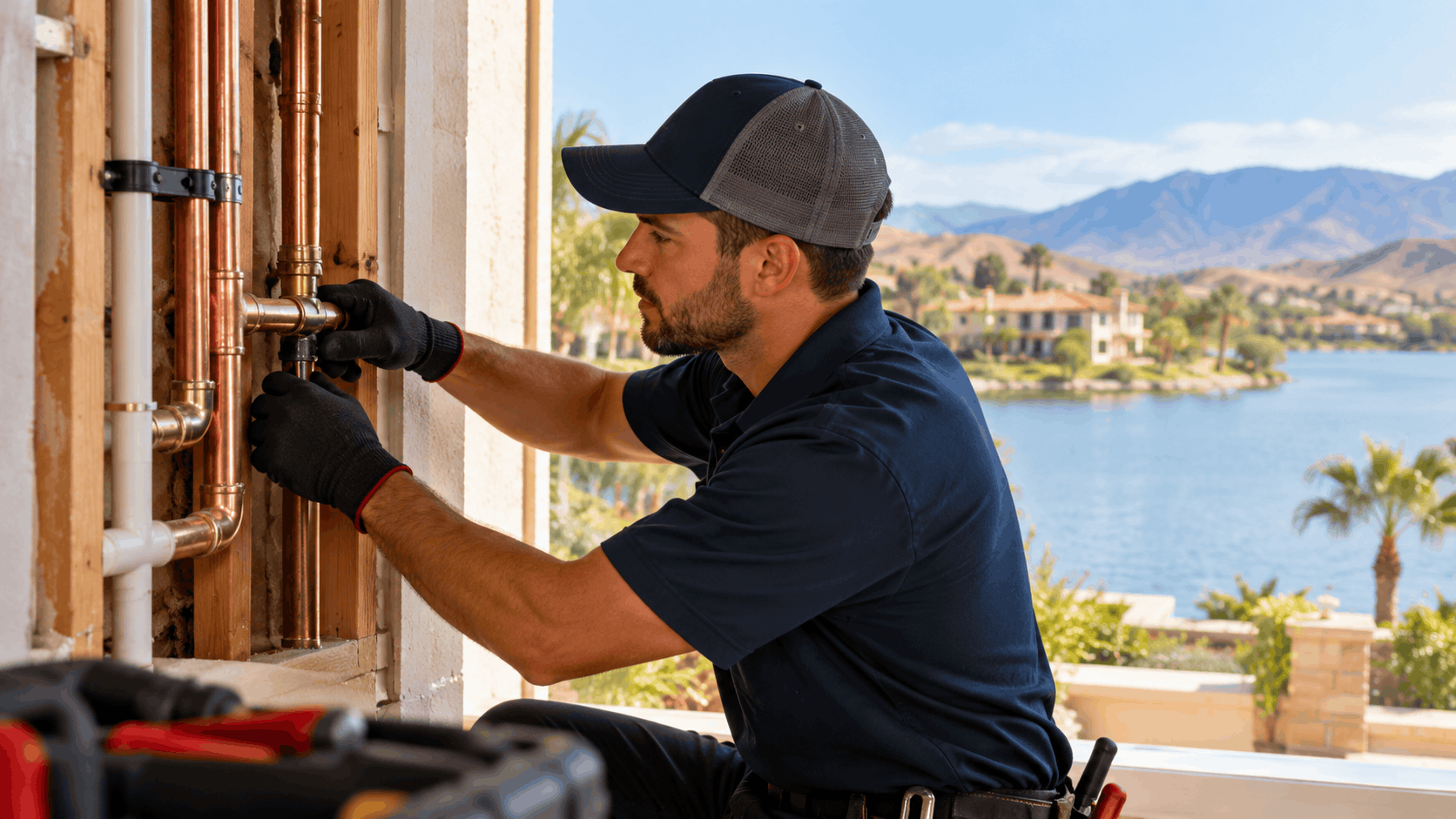
What a Repipe Costs at Lake Las Vegas?
The honest starting point is the valley-wide range. A whole-house repipe typically falls between $4,000 and $15,000, and that spread exists because a repipe on a two-bedroom condo and a repipe on a sprawling custom estate are not the same job. Lake Las Vegas holds both ends of that range inside a single zip code.
Where a property sits in the range tracks closely with its type. The four customers in this community - custom estates, villas, condominiums and resort or village commercial - each present a different system, and establishing which one applies at the first call shapes everything that follows. A planned repipe cost estimate starts there.
| Property type at Lake Las Vegas | Where it tends to land in the range | Why |
|---|---|---|
| Condominium | Lower end | Fewer fixtures, shorter runs, smaller footprint |
| Villa or attached home | Lower to middle | Shared walls and infrastructure raise the separate-interest question |
| Custom estate | Upper end | Multiple heaters, long recirculation, many baths, often a casita |
The Typical Range for a Whole-House Repipe
The typical range for a whole-house repipe in the Las Vegas Valley is $4,000 to $15,000. That figure is a typical market range for the area, copied as published, and not a price quote for any particular home. The actual price for a specific job depends on that job and is given in writing before work begins.
A range this wide is not vagueness. It reflects the real difference between a compact home with one water heater and a handful of fixtures, and a large home with several heaters, long pipe runs and dozens of connection points. Both are repipes, but they are not the same amount of work.
At Lake Las Vegas, the lake-wrapped community built from the late 1990s onward, the mix of condos, villas and estates means buyers here see the whole span. A condo owner reading the low number and an estate owner reading the high number are both reading correctly for their own home.
The way to narrow a wide range into a real figure is an on-site look at the property. A plumber counts the fixtures, measures the runs, checks the wall access and confirms the existing pipe before putting a number on paper. Our whole-house repipe service starts with exactly that walk-through.
Why Estate Homes Sit at the High End
A custom estate at Lake Las Vegas is an estate-scale plumbing system, and that is why these homes push toward the top of the range. Multiple water heaters are common, not one, because a single tank cannot feed a house of this size with any speed. Each heater is another set of connections a repipe has to address.
Long hot water runs are the other driver. On a large footprint, recirculation often runs continuously so that hot water arrives quickly at distant fixtures. That means there is more pipe in the walls, more line to replace, and a recirculation loop that has to be reconnected correctly rather than simply capped.
Then there are the fixtures themselves. Many bathrooms with high-end valves and cartridges, outdoor kitchens, pool and spa gas, and fire features all add connection points. A recirculation pump tied into a long loop is part of what keeps an estate comfortable, and it is part of what a repipe has to account for.
Many estates also carry a casita with its own services. A guest house adds a second, smaller system on the same property, with its own supply lines and sometimes its own heater. That extra scope is a real reason estate repipes land where they do, and it is a reason the first call matters so much for an accurate picture.
Villas and Condos: The Shared-Wall Question
A villa or attached property at Lake Las Vegas shares walls and often shares plumbing infrastructure with a neighbor. That raises the separate-interest question before anything is ordered. Which lines belong to this unit, which are common, and where does one owner's responsibility end? Answering that first keeps a repipe from crossing into a neighbor's property or the association's system.
A condominium adds a vertical dimension. A unit sits above or below someone else, which means a supply failure is never a single-property problem. Water finds the lowest point, so a leak in an upper unit becomes a ceiling problem for the unit below. That shared risk is part of why a planned repipe matters in stacked housing.
Access to adjoining units can change the scope and the price. If lines run through a shared chase or a common wall, the work may need coordination with the association or a neighbor before a crew can open anything. That coordination is not a delay to be surprised by - it is part of planning a repipe in shared infrastructure correctly.
Because of all this, the price on a villa or condo repipe is settled only after the separate-interest and access questions are answered. A unit that turns out to have its own clean, accessible runs lands lower. One that shares a wall with limited access sits higher. The on-site visit is where that gets sorted.
Get Your Quote
Tell us what's going on and we'll get back to you. We're open 24/7.
What Drives the Price Up or Down?
Inside the $4,000 to $15,000 band, several real repipe price factors decide where a home lands. None of them are mysterious. They come down to how much pipe there is, how many things connect to it, how hard the walls are to open and close back up, and what material goes in.
Understanding these cost drivers helps an owner read their own home before a plumber ever arrives. A large estate with many baths and a casita reads differently from a two-bath condo, and the number should reflect that honestly.
Number of Bathrooms and Fixtures
More bathrooms mean more pipe runs and more connection points, and both raise labor and material. Every sink, shower, tub and toilet is a termination that has to be cut in, sealed and tested. A five-bath estate carries far more of these than a two-bath condo, and the count drives the hours.
At Lake Las Vegas, estate fixtures often extend well past the bathrooms. Outdoor kitchens need supply lines. Pool and spa equipment needs gas and water. Fire features add their own runs. Each of these is another place where pipe has to go, and a repipe that touches the whole system has to reach all of them.
High-end fixtures add cost in a quieter way too. Premium valves and cartridges are more expensive to connect and, later, to service. When a repipe ties into fixtures like these, the work has to be clean and precise so the finished connections hold for years without trouble.
This is why a fixture count is one of the first things a plumber takes on site. It turns an abstract range into a real scope. More fixtures is not automatically a problem, but it is always more work, and the price has to show that.
Home Size and Hot Water Runs
Home size is the most direct driver of all. A large estate footprint simply contains more linear feet of pipe than a condo. Replacing the supply system in a 6,000 square foot home means pulling and running far more line than in a compact unit, and material plus labor scale with that length.
Long hot water runs compound the effect. In a big house, hot water has a long way to travel from the heater to the far bathrooms. That is why estates lean on continuous recirculation, and why there is a return loop running back through the walls on top of the supply lines. A repipe has to replace both.
A condo sits at the other end of this. Short runs, a single heater, a tight footprint - there is less line to replace, so the job takes less time and less material. The same quality of work costs less because there is less of it, not because corners get cut.
When an owner asks why an estimate came back high or low, home size is usually the honest headline. The walk-through measures the runs, and the measurement tells the story. It is the single clearest reason two Lake Las Vegas homes can land at opposite ends of the same range.
Finish Work and Wall Access
High-end finished homes need careful wall access and restoration, and that is real cost beyond the pipe. Opening a wall covered in stone, custom plaster or fine paint is slow work, and closing it back cleanly takes skill. The finish work on a luxury home can be a meaningful share of a repipe.
This is where a scheduled repipe earns its value. In a finished estate, the work can be sequenced so water is restored each evening while the job runs over several days. That beats an emergency repipe done in a hurry alongside flooded floors and damaged flooring, which turns one problem into three.
Access planning also protects the home. A good crew maps where to open walls to minimize cuts, works through access panels and cabinets where possible, and keeps restoration tidy. On a home with expensive finishes, a planned approach means fewer openings and cleaner patching than a reactive one.
The difference between a planned and an emergency repipe is sharpest in exactly these homes. A scheduled job respects the finishes and keeps the household running. An emergency job happens on the failure's terms, often with flooring already soaked and drying equipment already in the way. On an estate, planning ahead is the cheaper path.
Pipe Material Chosen for the Replacement
The honest recommendation for a repipe is PEX or copper, and the choice affects both cost and how the home behaves afterward. Both are proven supply materials that stand up far better than aging Kitec fittings, and both are standard candidates for a repipe here.
PEX is flexible, which means fewer fittings and faster installation through finished walls. It resists scale buildup well and tolerates the valley's very hard water. For many Lake Las Vegas homes, PEX keeps labor down because it threads through existing cavities with fewer openings.
Copper is rigid and long established. It carries a different cost profile and a different feel in the finished home, and some owners prefer it. The repipe material decision weighs cost, the home's layout and the owner's preference, and it is best made on site for the specific house rather than from a chart.
Either way, the material is one input among several. A plumber who looks at the home can explain how PEX versus copper changes the number and the long-term behavior, then let the owner decide with the full picture in front of them.
Need Help in Las Vegas?
Active Plumbing serves Las Vegas and all of Las Vegas Valley.
Why Lake Las Vegas Homes Need Repipes in the First Place?
A repipe does not come up at random here. It traces back to the community's build era and what the original builders put in the walls. Lake Las Vegas rose from the late 1990s onward, and that timing matters for pipe failure because it overlaps a window when a now-troubled material was widely installed.
That material is Kitec, and understanding why it fails explains why a planned repipe is the right answer rather than a patch-and-pray approach that never ends.
Kitec and the Late-1990s Build Window
Lake Las Vegas was built from the late 1990s onward, which places much of it squarely inside the Kitec window of 1995 to 2007. That overlap is why Kitec is a genuine candidate in homes throughout this community, not a long shot worth mentioning in passing.
Kitec is an IPEX composite pipe. It is built with a layer of flexible aluminum sandwiched between inner and outer plastic layers, joined with brass fittings. It was marketed as a modern alternative to copper, and plenty of homes built during the boom years received it.
Because the community grew during this exact window, a Lake Las Vegas home of the right age has a real chance of carrying Kitec behind its walls. That is not a guess about the valley in general - it is the overlap of this community's build dates with the years the pipe was sold and installed.
The pipe should always be confirmed on site rather than assumed from the build year alone. A home from this era might have Kitec, copper or something else entirely. But knowing the window tells an owner where to look and why a repipe conversation is reasonable rather than alarmist.
How to Spot Kitec in Your Home
Kitec is recognizable once you know what to look for. The pipe is a composite, with orange used for hot lines and blue for cold, feeding into brass fittings. If an owner sees that color-coded composite pipe meeting brass, Kitec is a strong possibility.
The markings help confirm it. Look for stamps reading Kitec, IPEX or PlumbBetter along the pipe. Those names identify the product directly, and finding one of them turns a suspicion into an answer.
Location matters when hunting for it. The best places to check are near the water heater, under sinks, and at the manifold where supply lines branch out to the house. These are the spots where pipe and fittings are exposed and easy to inspect without opening a wall.
An owner can do this first look themselves before calling. Seeing orange and blue pipe into brass near the heater is often enough to warrant a professional confirmation. From there, a plumber verifies it on site and explains what the specific home needs.
Dezincification and Why the Whole System Ages Together
Kitec fails by dezincification. The brass fittings are high in zinc, and over time the zinc leaches out of the brass. That leached material builds up inside the fitting, which narrows the passage and weakens the fitting at the same time.
The first symptom owners notice is reduced flow at a fixture. Water that used to come strong starts to weaken as the internal buildup restricts the bore. That is not a nuisance to live with - it is an early warning that the fittings are degrading from the inside.
The part that changes the math is that every fitting in the system ages together. They were installed at the same time, from the same material, carrying the same water. So when one fails, the others are not far behind. Fixing a single fitting while the rest keep aging is chasing failures one at a time.
That is why a planned repipe beats piecemeal repair here. Replacing the whole system in PEX or copper on a schedule ends the cycle, instead of paying for repeated emergency repairs as fitting after fitting lets go. On a finished estate especially, one planned job is far cheaper than a string of surprises.
Claim Windows Have Closed, So Owners Carry the Cost
There was a time when Kitec claims could offset the cost. Those windows have closed. The Clark County deadline was extended to March 17, 2017, and the broader settlement deadline was January 9, 2020. Both dates have long passed.
The practical result is that current owners carry the repipe cost themselves. There is no longer a claim fund to tap for a Lake Las Vegas home with Kitec. The owner cost of replacing the pipe falls on whoever owns the home now.
That reality changes how owners should think about timing. Waiting does not preserve a recovery option, because the option is gone. What waiting does is leave an aging system in the walls, inching toward a failure that will cost more to handle in an emergency than on a schedule.
For a second-home owner at Lake Las Vegas, this matters even more, because a failure in an empty house runs unnoticed. With no claim to recover and real damage risk if a fitting lets go while the house sits empty, a planned repipe is the straightforward financial call.
Very Hard Water and the Cost of Protecting a New System
A repipe alone is not the whole story on an expensive estate system. The valley's hard water keeps working on the new pipe and fixtures from the day they go in. Protecting that investment often means pairing a repipe with treatment, and that adds cost worth understanding up front.
A new system in untreated very hard water still collects scale. A water softener or conditioning system is how estate owners keep a fresh repipe and high-end fixtures working the way they should.
The 16 Grains Per Gallon Reality
The Southern Nevada Water Authority states the valley's water is 280 parts per million, or about 16 grains per gallon, categorized as very hard water. That is the published figure, and it is the single most important technical fact behind plumbing wear in this market.
Very hard water deposits calcium and magnesium scale throughout a system. It builds on water heater elements and tank bottoms, narrows supply lines over years, and clogs the small passages inside mixing valves and cartridges. On an estate with many high-end valves, that buildup reaches a lot of expensive hardware.
Tankless units feel it most sharply. The heat exchanger is a narrow passage, and scale accelerates failure there faster than almost anywhere else in the system. A home that pairs a repipe with a tankless heater has a strong reason to treat the water that feeds it.
Scale also shows on finishes. The white crusting owners describe as hard water stains marks stone, glass and polished surfaces throughout a luxury home. Treatment is the standard response in this valley, and the honest framing is that it extends equipment and fixture life rather than being an optional luxury.
Treatment Options and Their Typical Costs
There are a few routes to protecting a new system, and each carries a typical area range. Water softener installation runs $800 to $2,500. Salt-free water conditioning runs $800 to $2,500 installed. Whole-house filtration runs $800 to $2,500. These are typical ranges for the area, not quotes.
A softener removes the hardness minerals, which is the most direct way to stop scale from forming on heaters, in cartridges and inside tankless exchangers. For an estate with a lot of equipment downstream, that protection reaches the whole system.
Salt-free conditioning takes a different approach, treating the water so minerals are less able to deposit as scale without adding salt to the system. Whole-house filtration addresses taste, odor and sediment alongside the scale question. Our water treatment options cover each of these, and the right choice depends on the home and what the owner wants from the water.
Pairing treatment with a repipe is common for a reason. Once the walls are open and the system is fresh, adding protection keeps that new pipe and those new fixtures from aging early under the valley's hard water. It is cheaper to protect a new system than to repeat the scale damage in a few years.
A Scheduled Maintenance Plan for Second-Home Owners
Ongoing care is where a maintenance plan fits, and it suits second-home owners particularly well. Heater flushing, tankless descaling and filter changes all need to happen on a rhythm regardless of whether the owner is in residence. A maintenance plan handles that on schedule.
Flushing a tank heater clears the scale that settles on the bottom and elements. A tank left unflushed works harder and fails earlier than its rated life. For an estate running multiple heaters, keeping them flushed protects a real investment and avoids a cascade of early replacements.
Tankless units need descaling because their narrow heat exchangers scale fastest. Tankless descaling runs a typical $150 to $250. Done on a regular schedule, it keeps the exchanger clear and the unit running the way it was designed to.
The advantage for a seasonally occupied home is that the work does not depend on the owner being there. A manager or key-holder lets the crew in, the flushing and descaling happen, and the system stays healthy whether the house is full or empty. That is the right fit for a resort community where many homes sit idle part of the year.

Scheduling a Repipe at a Guard-Gated, Remote Community
Lake Las Vegas has practical realities that affect timing and, sometimes, cost. It is a guard-gated community in the far east of Henderson, governed by active design review, built on slab. Each of these shapes how a repipe is scheduled and run, and an honest conversation about them beats surprises mid-job.
Gate Access and Authorization
Guard-gated access off Lake Las Vegas Parkway is authorized in advance through the homeowner or manager, not arranged at the gate when the crew arrives. The guard admits visitors who are already on the list, so the gate access step happens before the appointment, not during it.
For an owner on site, that means calling ahead to clear the plumber through. For a second-home owner away for the season, it means a manager or key-holder handles the authorization. Either way, sorting it in advance keeps a scheduled repipe from stalling at the entrance.
Resort and event activity can affect access at times. The community hosts activity around Lake Las Vegas Parkway, MonteLago Village and the resorts, and that can change how traffic and entry flow on a given day. Planning around it is part of scheduling work here realistically.
None of this is a barrier, but it is a step that communities without gates do not have. Building it into the plan is exactly the kind of local detail that keeps a repipe on track at Lake Las Vegas rather than running into avoidable delays.
Distance From the Rest of Henderson
Lake Las Vegas sits well east of Henderson's main built-up area, reached off Lake Mead Parkway, State Route 564, then north on Lake Las Vegas Parkway. It is the most remote part of the city, and that distance is a genuine scheduling factor rather than a detail to gloss over.
Travel time affects how an appointment is planned and what an emergency response realistically looks like out here. A crew coming from the rest of the valley has a real drive to reach east Henderson, and being honest about that beats promising what the geography will not allow.
For a planned repipe this matters less, because the work is scheduled and the crew arrives ready for a multi-day job. For an emergency, the distance is exactly why a planned repipe and good leak detection are the better bet than relying on a fast reach to a remote address.
We serve Henderson including Lake Las Vegas, and part of serving it well is being straight about travel time. An owner planning a repipe here should expect scheduling that accounts for the drive rather than assumes it away.
Design Review and Permits Through the City of Henderson
A master association with sub-associations governs Lake Las Vegas under NRS Chapter 116, with active design review. Anything visible on the exterior can require association approval, while interior work does not. A repipe that stays inside the walls generally avoids the design review path, but anything that touches the outside may not.
Permits, plan check and inspections run through the City of Henderson Development Services Center, because Lake Las Vegas is inside the City of Henderson even though it feels like its own world. It is not Clark County and not another city - Henderson issues the permit and inspects the work.
Where exterior work is involved, two sets of documents can apply: the city permit and the association's design review. Association review can add time to a project, and the specific steps and timeline should be confirmed with the association before the work is scheduled.
For a standard interior repipe, the permit position is confirmed for the specific address through Henderson, and the association approval usually does not apply because nothing visible changes. Confirming both before quoting permitted work is a routine first step here, and it keeps the job clean from the start.
Slab-on-Grade and Rerouting Over Breaking Floors
Homes at Lake Las Vegas are slab-on-grade, which means the supply lines can run under a concrete slab. An under-slab failure is not accessible without breaking through the floor, and in a finished estate that floor is often stone or high-end tile that is costly to open and restore.
Because of that, rerouting a line is frequently better value than breaking through a finished floor to reach a failure underneath. Running a new line through walls or the attic avoids tearing up expensive flooring, and on a luxury home that choice can save a significant share of the repair cost. Our slab leak detection and repair team weighs rerouting against breaking the slab for each situation.
Caliche makes any exterior excavation slower and dearer. Caliche is a cemented calcium-carbonate hardpan that is hard to trench through and hard to bed a pipe into evenly. It is abrasive, so it wears on buried pipe where a line runs through it, and digging through it simply takes longer than softer ground.
Poorly compacted backfill over caliche settles under a pipe over time and can pull a line out of grade. When exterior work is unavoidable, the extra time and cost of working through caliche belongs in an honest discussion of the price rather than a surprise on the invoice.
Need Help in Las Vegas?
Active Plumbing serves Las Vegas and all of Las Vegas Valley.
The Empty-House Risk That Makes a Repipe Worth Doing Now
The second home nature of Lake Las Vegas changes the math on a planned repipe more than anything else. This is a resort community, and a large share of its property is seasonally occupied or rented. That single fact is why doing a repipe on a schedule, before a failure, is the smart move here.
A planned repipe plus leak detection is the most valuable preventive conversation available in this community, and it is more relevant here than in any other Henderson neighborhood.
A Failure in an Empty Estate Runs Until Someone Notices
A large share of property at Lake Las Vegas is second homes, seasonally occupied or rented out. When a house sits empty, a plumbing failure runs until someone happens to notice. On a large estate, that can be weeks.
The damage scale is the whole point. A leak that would cost hundreds to fix if caught in a minute instead runs for days or weeks in an empty house. By the time anyone sees it, the water damage can be measured in tens of thousands rather than hundreds, reaching flooring, cabinetry, drywall and finishes across the home.
A seasonal home with aging Kitec fittings is exactly the combination that turns a quiet risk into a catastrophe. Every fitting is aging toward failure, and the house that would reveal that failure fast is empty for months at a stretch.
This is why the empty-house risk reframes a repipe from a maintenance item into protection. Replacing aging pipe before a long absence removes the single biggest source of catastrophic water damage in a home no one is watching.
Leak Detection and Automatic Shut-Off
Leak detection with automatic shut-off is the direct answer to the empty-house problem. A system that senses a leak and closes the water supply stops a failure from running for weeks while the owner is away. For a seasonally occupied estate, that is proportionate protection, not a gadget.
Electronic leak detection runs a typical $150 to $350, and a whole-home leak detection system runs a typical $300 to $800. These are typical area ranges. For a home that sits empty part of the year, that cost is small next to the tens of thousands a runaway leak can cause.
A documented main shut-off that operates easily matters just as much. If a leak is found, someone needs to close the water fast, and a seized or hard-to-find main valve defeats the whole plan. Knowing where it is and confirming it turns are part of preparing an empty house.
Our whole-home leak detection system and the automatic shut-off that goes with it are built for exactly this situation. On a large estate that sits idle, they are the difference between a minor repair and a gutted interior.
A Key-Holder and a Pre-Season Check
A pre-season check before an owner leaves is a simple, high-value step. A plumber looks over the system, confirms the shut-off works, checks for early signs of trouble, and flags anything that should be handled before the house goes quiet for months.
A key-holder or property manager who can admit a plumber quickly is the other half. If a leak alert comes in or a problem surfaces, someone local needs to let a crew in through the gates without waiting for an absent owner to coordinate from another state. That access can save a house.
These steps also connect back to the repipe decision. A scheduled repipe done before a season away restores water each evening and respects the home's finishes, while an emergency repipe happens alongside drying equipment and flooring repair after a failure. For an empty-house owner, scheduling the work ahead is clearly the better path.
Put together, a repipe, leak detection, a working main shut-off and a key-holder form a complete plan for a seasonally occupied Lake Las Vegas home. Each piece covers a different part of the risk, and together they keep an empty estate from becoming a disaster while no one is home.
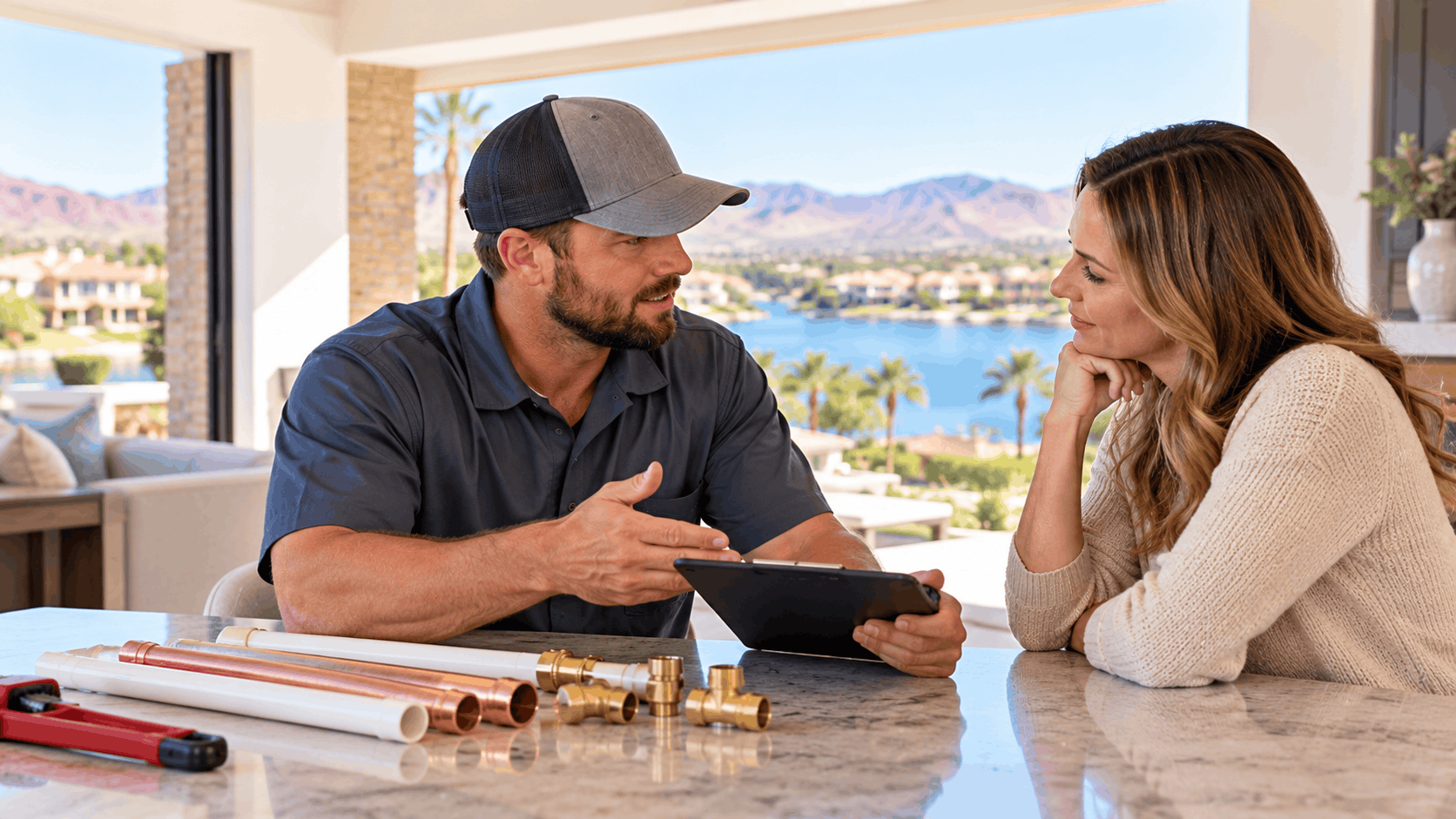
Repipe Versus Related Plumbing Costs You May Face
A repipe rarely stands completely alone. Other jobs often surface at the same time, and placing the repipe number next to those related costs helps an owner build a realistic budget. The ranges below are typical area figures, copied exactly, not quotes.
| Job | Typical range |
|---|---|
| Whole-house repipe | $4,000 to $15,000 |
| Burst pipe repair | $200 to $800 |
| Slab leak detection | $150 to $300 |
| Slab leak repair | $500 to $3,000 |
| Tank water heater installation | $800 to $1,500 |
| Tankless water heater installation | $1,500 to $3,500 |
| Tankless pre-filter | adds $150 to $300 |
| Recirculation pump installation | $400 to $900 |
| Electronic leak detection | $150 to $350 |
| After-hours emergency service fee | $150 to $300 plus repair costs |
Burst Pipe and Slab Leak Repair
Burst pipe repair runs a typical $200 to $800. Slab leak detection runs $150 to $300, and slab leak repair runs $500 to $3,000. These jobs come up before or instead of a full repipe depending on what has already failed.
A burst pipe is often the event that forces the repipe conversation. A single fitting lets go, water appears, and the repair addresses that one failure. But if the burst is a Kitec fitting, the others are aging together, so the burst is a signal rather than the whole story.
A slab leak is the under-slab version of the same problem, and it is harder to reach because the line runs below a concrete floor. Detection locates it precisely so the repair does not open more floor than needed. On a slab-on-grade estate, rerouting the line often beats breaking through finished flooring to reach it.
When a burst or slab leak points to failing Kitec throughout, the honest conversation shifts from repair to repipe. Paying for one emergency repair after another costs more over time than a single planned replacement, especially in a home with expensive finishes to protect.
Water Heater Work During a Repipe
Water heater work often pairs with a repipe on an estate. Tank water heater installation runs a typical $800 to $1,500. Tankless water heater installation runs $1,500 to $3,500, with a pre-filter adding $150 to $300 where hard water calls for one. A recirculation pump installation runs $400 to $900.
The reason these pair so often is simple. Once the system is open and the pipe is being replaced, connecting a fresh heater or recirculation pump is efficient. An aging heater scaled up by very hard water is a natural candidate to replace alongside the pipe rather than in a separate job later.
On an estate running multiple heaters and continuous recirculation, this is common. The recirculation loop is part of what a repipe touches, so tying in a new pump while the system is open makes sense. Our tankless water heater installation team handles the heater side when it comes up during a repipe.
The pre-filter note matters here too. Because the valley's water is very hard, a tankless unit benefits from a pre-filter to protect its narrow heat exchanger. Bundling that with the heater install protects the new equipment from the scale that would otherwise shorten its life.
Irrigation and Yard Line Leaks Near the Lake
Lake Las Vegas carries extensive landscape and long private irrigation runs, built as a community wrapped around a 320 acre lake. On a large landscaped lot, a yard line leak can run unnoticed and show up first as an unexplained spike on the water bill rather than as visible water.
That hidden quality is what makes irrigation leaks their own category here. A break in a buried line on a big estate lot does not announce itself the way an indoor leak does. The water soaks away quietly, and the owner learns about it from a bill that climbed for no obvious reason.
Near common area or lake frontage, the owning system has to be established first. Where a problem appears close to a boundary with association common area or near the lake itself, figuring out whose system is involved - the owner's, the association's, or the community's water infrastructure - avoids a dispute before any work begins.
After-hours emergency calls carry a service fee of $150 to $300 plus repair costs. For a remote community where a yard leak might surface at an inconvenient hour, knowing that fee structure up front is part of planning. Catching irrigation leaks early, before they become emergencies, keeps those costs down.
Need Help in Las Vegas?
Active Plumbing serves Las Vegas and all of Las Vegas Valley.
How Active Plumbing Handles a Lake Las Vegas Repipe
A repipe at Lake Las Vegas runs smoother when the right questions are answered at the start. Active Plumbing works each job from first call to finished work with the community's particular realities in mind, backed by a Nevada license and a written price before work begins.
Confirming the Property Type and the Pipe on Site
At the first call, the team establishes which of the four customer types applies: estate, villa, condo or commercial. That answer shapes everything that follows, because an estate system and a condo system are different jobs with different scopes and different prices.
For a villa or condo, the separate-interest and access questions come up right away, since shared walls and adjoining units affect what can be opened and when. For an estate, the count of heaters, baths, recirculation runs and any casita sets the scope. Getting the property type right at the start keeps the estimate honest.
The pipe itself gets confirmed on site rather than assumed from the build year. A Lake Las Vegas home of the right age might carry Kitec, copper or something else, so an on-site confirmation looks near the heater, under sinks and at the manifold before anyone commits to a plan.
That pipe inspection turns a build-era guess into a verified picture. Knowing exactly what is in the walls lets the team recommend the right material and the right scope for the specific home, not a generic plan based on when the house was built.
A Written Price Before Work Starts
The customer gets a written price before work starts. That is how the team operates on every job, including a repipe. The owner sees the number on paper before anyone opens a wall, so there is no mystery about cost once the work begins.
This matters most on a large, finished estate where the scope is substantial. A written price laid out after the on-site look means the owner can plan the project with the real figure in front of them rather than an open-ended estimate.
It also fits the second-home owner who may be approving the work from a distance. A clear written price can be reviewed and approved before a crew is scheduled, which keeps a remote owner in control of a job happening at a house they are not standing in.
The written price reflects the specific job - the property type, the fixture count, the runs, the material and the access - rather than a generic range. The typical ranges in this guide help an owner know what to expect, and the written price makes it exact for their home.
Licensed, Local, and a 30 to 60 Minute Response
Active Plumbing holds Nevada license NSCB #0047021, verifiable free at nvcontractorsboard.com. It is a fourth-generation family business that has served the Las Vegas Valley since 1991, and some of its owners are US military veterans.
Technicians arrive in 30 to 60 minutes anywhere in the Las Vegas Valley. For a remote community like Lake Las Vegas, that response window is paired with the honest reality of travel time to the far east of Henderson, which is why planned work and good leak detection serve owners here best.
Being local and licensed matters in a market with a significant unlicensed trade problem. A customer is entitled to ask for a license number and verify it with the board, where classification, status, bond and workers compensation are all public record. Checking is free and takes a minute.
The combination of a long local track record, proper licensing and a clear written price is what carries a repipe from first call to finished job at Lake Las Vegas. The team knows the gates, the distance, the slab construction and the Kitec history, and it works the job with all of that in mind.

Planning Your Lake Las Vegas Repipe
Every repipe here starts the same way: the team confirms the property type and the pipe on site, then puts a written price in front of the owner before any work starts. For a Lake Las Vegas home behind the gates, that means the gate authorization, the Henderson permit and the scope are all settled before a wall is opened.
To schedule an on-site look or ask about a repipe on your estate, villa or condo, call Active Plumbing at (702) 438-3357.
Frequently Asked Questions
- How much does a whole-house repipe cost at Lake Las Vegas?
- A whole-house repipe typically runs $4,000 to $15,000 across the Las Vegas Valley, a typical market range rather than a quote. Custom estates with multiple heaters, long recirculation runs and many baths land toward the high end, while condos with fewer fixtures and shorter runs land lower. The exact figure comes on an on-site look, and a written price is given before work starts for the specific home.
- Why does my Lake Las Vegas home have Kitec pipe?
- Lake Las Vegas was built from the late 1990s onward, which places much of it inside the Kitec window of 1995 to 2007. During those years, this IPEX composite pipe was widely installed as an alternative to copper. Look near the water heater, under sinks and at the manifold for orange hot and blue cold composite pipe feeding brass fittings, with Kitec, IPEX or PlumbBetter markings. The pipe is always confirmed on site.
- Can I still file a Kitec claim?
- No. The Clark County deadline was extended to March 17, 2017, and the broader settlement deadline was January 9, 2020. Both have passed, so current owners carry the repipe cost themselves. Because there is no longer a claim fund to recover against, waiting does not preserve any financial option. It only leaves aging fittings in the walls edging toward failure, which is why a planned repipe is the straightforward decision now.
- Should I repipe in PEX or copper?
- Both PEX and copper are the honest recommendation over failing Kitec fittings, and both are proven supply materials. PEX is flexible, installs with fewer fittings and threads through finished walls with less opening, while copper is rigid and long established. The choice affects cost and how the home behaves afterward, so it is best decided on site for the specific home, weighing the layout, the budget and the owner's preference.
- Do I need a permit to repipe in Lake Las Vegas?
- Yes. Lake Las Vegas is inside the City of Henderson, so permits, plan check and inspections run through the City of Henderson Development Services Center, not Clark County or another city. For a standard interior repipe, the permit position is confirmed for the specific address. Work requiring a permit must be performed by an appropriately licensed contractor, and the permit details are confirmed before the job is scheduled.
- Will the homeowners association need to approve the work?
- The master association governs Lake Las Vegas under NRS Chapter 116 with active design review for anything visible on the exterior. An interior repipe that stays inside the walls generally does not trigger design review, because nothing visible changes. If a job touches the exterior, association approval may apply and can add time. The specific association steps are confirmed with the association before scheduling.
- How long does a repipe take and will I lose water?
- A scheduled repipe in a finished home can be sequenced so water is restored each evening while the job runs over several days. That beats an emergency repipe done in a hurry alongside flooded floors, drying equipment and flooring repair. Planning the work ahead respects the home's finishes and keeps the household running, which matters most in a high-value estate where restoration costs add up quickly.
- What if my home sits empty for part of the year?
- Lake Las Vegas has many seasonally occupied second homes, and a failure in an empty house can run for weeks with damage in the tens of thousands. Fit leak detection with automatic shut-off, confirm a main shut-off that operates easily, and have a key-holder who can admit a plumber. Electronic leak detection runs a typical $150 to $350, and a whole-home leak detection system runs $300 to $800.
- Does hard water really affect my new pipes and fixtures?
- Yes. The Southern Nevada Water Authority reports the valley's water at 280 parts per million, or about 16 grains per gallon, categorized very hard. Scale builds on water heater elements, inside high-end cartridges and in tankless heat exchangers where the water path is narrowest. On an expensive estate system, treatment such as a softener or conditioner protects the new pipe and fixtures and extends their life.
- How do I verify Active Plumbing's license?
- Active Plumbing holds Nevada license NSCB #0047021, verified free at nvcontractorsboard.com. On that site, classification, status, bond and workers compensation are all public record, so a customer can confirm the license is current before any work begins. Checking is free and takes a minute, and in a market with a significant unlicensed trade problem, verifying a license number is a reasonable step for any owner.
Licensed plumbing professionals serving Las Vegas and Las Vegas Valley.
Licensed in Nevada · License #0047021
Last updated on
Why trust Active Plumbing?
Founded in 1991, Active Plumbing is a licensed and insured plumber serving Las Vegas and Las Vegas Valley. All content is reviewed by our licensed technicians.

Need Help in Las Vegas?
Active Plumbing serves Las Vegas and all of Las Vegas Valley.
Related Articles
Slab Leak Repair Cost in Lake Las Vegas: Granite Construction Considerations
Slab leak repair in Lake Las Vegas costs $1,500-$15,000+ depending on method. Learn why granite, caliche, and post-tension slabs raise prices for hillside homes.

Whole-House Repipe Cost in Las Vegas by Home Size - 1,500 to 4,000+ Sq Ft Real Ranges
Real whole-house repipe cost ranges in Las Vegas by home size from 1,500 to 4,000+ sq ft, plus pipe materials, permits, timelines, and local factors.

Whole House Repipe Cost in Las Vegas by Square Footage
A local guide to whole house repipe cost in Las Vegas by square footage, plus how pipe material, home age, and permits shape the final price.