Emergency Drain Cleaning Las Vegas: After-Hours Pricing for Backed-Up Mains
Key Takeaways
- Multiple drains backing up at once, gurgling toilets, and sewer odor point to a main line backup, not a simple clog.
- Root intrusion in older clay pipe, grease and wipes, hard water scale, and aging sewer lines cause most valley backups.
- After-hours main line clearing typically runs $350 to $650, with hydro jetting and camera inspections adding to the total.
- Night and weekend rates are higher because of on-call staffing and ready equipment, and Active Plumbing gives a written price before work starts.
- Stop all water use immediately, protect floors, and avoid chemical drain cleaners while waiting for the emergency crew.
- The team covers central Las Vegas, Summerlin, Henderson, and North Las Vegas, using major routes to keep response times down.
- Routine drain cleaning, mindful drain habits, root control, and periodic camera inspections prevent repeat main line emergencies.
In This Article
It is 11 p.m. in a Huntridge bungalow off Maryland Parkway. Someone flushes the toilet, and instead of draining, water rises in the tub down the hall. A gurgle comes from the kitchen sink, and a faint sewer smell drifts up from the floor drain in the laundry room. That is the moment a lot of Las Vegas homeowners realize they are not dealing with a simple clog. They have a backed-up main, and it is not going to wait until morning.
Our team at Active Plumbing has driven to hundreds of these late-night calls across the valley, from older streets near Fremont to newer builds out in Summerlin. This guide walks through how to tell a main line backup apart from a minor clog, what honest after-hours pricing looks like, and why these backups happen so often in our part of Nevada.
We will also cover exactly what happens when the truck pulls up at midnight, which neighborhoods we reach fastest, and the steps you can take to limit damage while you wait. The goal is to help you make a smart decision during a stressful night, not to sell you on anything you do not need.
How to Tell a Backed-Up Main Apart From a Simple Clog?
A single slow bathroom sink is annoying. A main line backup is a different animal, and it can flood a home fast. Knowing the difference helps you decide whether to grab a plunger or call an emergency plumber right away.
Here are the drain warning signs we tell every homeowner to watch for:
- More than one fixture backing up at the same time
- Toilets gurgling when you run other water
- Sewage or dirty water coming up in a lower drain
- A sewer smell inside or near the home
When these show up together, you are likely looking at a sewer clog in the main line, not a small blockage under one sink. Below we break down each sign so you can read your own home.
Multiple Drains Slowing Down at Once
One slow drain usually means a local problem. Maybe hair is caught in the bathroom sink trap, or grease has coated the kitchen line a few feet down. You can often clear that with a plunger or a small hand auger without calling anyone.
When you see multiple slow drains all acting up together, the story changes. If the kitchen sink, the bathroom tub, and the toilet all drain slowly or back up, the trouble is downstream where every fixture ties into the main sewer line. That shared pipe is the common thread linking all of them.
Think of your home's plumbing like tree branches feeding into one trunk. A clog in a branch affects one fixture. A clog in the trunk affects everything above it. When the main sewer line clogs, waste has nowhere to go and starts backing up into the lowest openings first.
That is your signal to stop testing drains and pick up the phone. Running more water only pushes more waste toward a pipe that cannot move it, which raises the water level inside your home.
Gurgling Toilets and Water Coming Up the Tub
A gurgling toilet is one of the clearest signs of a main line issue. When water cannot drain normally, air gets trapped in the pipe and pushes back up through the nearest fixture. The toilet often bubbles because it sits low and connects directly to the main.
You might also notice a tub backup when you flush or run the washing machine. Water and waste travel to the lowest point they can find, and a tub or shower drain on the ground floor is usually that point. Seeing dirty water pool in a tub you did not use is a red flag.
In many older Las Vegas homes, the floor drain in the garage or laundry room fills first. That drain sits at the bottom of the system, so it takes the overflow before anything else. If you spot water there, the blockage is well down the line.
These symptoms mean the clog is past the point where a plunger can help. At this stage a professional cable machine or jetter is the tool that actually clears the line.
Sewage Odor Inside or Around the Home
A sewer smell is never something to ignore. Healthy drains carry waste away and keep odors sealed behind water traps. When you catch a sewage odor inside the house, it usually means gases are backing up because waste is not flowing out.
Sometimes the smell shows up outside near a cleanout cap or over the yard where the sewer line runs. That can point to a blockage causing waste to pool underground or seep near the pipe. Either way, the smell tells you the line is not doing its job.
Beyond being unpleasant, sewer gas carries hydrogen sulfide and methane. In small amounts it is mostly a nuisance, but a strong, lasting odor means enough gas is escaping that you want the problem fixed quickly. The CDC notes hydrogen sulfide can be irritating at higher concentrations.
If the odor comes with slow drains or gurgling, treat it as part of the same main line problem. One symptom on its own may be minor, but together they paint a clear picture of a blocked main.
When the Problem Cannot Wait Until Morning
Not every drain issue is an emergency. A single slow sink with no backup can usually wait for a next-day appointment. You lose a little convenience, but there is no health risk and no flooding.
An after-hours call makes sense when sewage is entering the home, when multiple fixtures are backed up, or when you cannot use any water without something overflowing. Raw sewage on floors is a health hazard, and the longer it sits, the more damage it does to flooring, drywall, and belongings.
Homes with only one bathroom face a harder choice, since a backed-up main means no working toilet at all. In that case, even a moderate backup often justifies calling an emergency plumber rather than waiting twelve hours. Families with young kids or elderly residents usually cannot go a full night without a functioning bathroom.
When you are unsure, call and describe what you see. Our team can often tell over the phone whether you have a true emergency or something that safely holds until daylight, and we will tell you honestly either way.
Get Your Quote
Tell us what's going on and we'll get back to you. We're open 24/7.
What Causes Main Line Backups in Las Vegas Homes
Main line backups do not happen at random. Most trace back to a handful of causes, and here in the valley a few of them are especially common. Knowing the main line backup causes helps you prevent the next one.
The usual suspects behind a sewer blockage in Las Vegas include:
- Tree roots invading older clay and cast iron pipe
- Grease and wipes that never break down
- Hard water scale narrowing the pipe walls
- Aging sewer lines that sag or collapse
Each of these behaves a little differently, and our approach to clearing them changes based on the cause. Here is what we see across different parts of town.
Root Intrusion in Older Neighborhoods
Older parts of Las Vegas have mature landscaping, and those big trees come with a hidden cost underground. Root intrusion is one of the more common reasons main lines back up in established areas. Roots chase water, and a sewer line is a steady source of it.
Neighborhoods like the Historic Westside and John S. Park have homes built decades ago with clay sewer pipe or cast iron. Clay joints are exactly where thirsty roots find their way in. A tiny crack or loose joint is all a root needs to slip inside and start growing.
Once inside, roots form a fibrous mat that catches toilet paper, grease, and debris. What starts as a slow drain becomes a full blockage over a season or two. We often pull out thick root balls when we cable these older lines.
For homes with repeat root problems, cutting the roots is only a short-term fix. A sewer camera inspection shows exactly where the roots enter, which helps us decide whether spot repair or a full sewer line replacement makes more sense.
Grease and Wipes That Do Not Break Down
Kitchen grease is a slow killer for any main line. It goes down the drain as a hot liquid, then cools and hardens on the pipe walls. Over months, that grease buildup narrows the pipe like plaque in an artery until debris no longer passes.
So-called flushable wipes are just as bad, maybe worse. They do not break apart the way toilet paper does, and they snag on any rough spot in the line. A flushable wipes clog can trap grease, hair, and other waste into a solid mass that blocks the whole main.
We see this in homes across the valley, from busy family kitchens in Spring Valley to short-term rentals near the Strip where guests flush whatever they want. The pipe does not care how new the house is. Grease and wipes clog modern PVC lines just like they clog old clay ones.
The fix in these cases is often hydro jetting, which scours grease off the pipe walls instead of just poking a hole through it. A cable clears the immediate clog, but jetting restores the full diameter of the line.
Hard Water Scale and Mineral Buildup
The valley has famously hard water, and it affects more than your faucets and water heater. Over time, mineral buildup from calcium and magnesium coats the inside of drain and sewer lines. That scale creates a rough surface that grabs everything passing through.
Water served by the Las Vegas Valley Water District is among the harder supplies in the country. That hardness leaves deposits on pipe walls, fixtures, and appliances throughout the home. In drain lines, the rough scale gives grease and debris a place to cling and build.
You may notice the effects first in slow fixtures and crusty faucet aerators. Underground, the same process narrows the main line year after year. A pipe that once flowed freely slowly loses its capacity until a normal load of waste triggers a backup.
Addressing hard water at the source with a water softener installation reduces scale throughout the home. It will not undo years of buildup on its own, but it slows the process and protects both your pipes and your appliances going forward.
Aging Sewer Lines in Established Areas
Homes in older parts of town simply have older pipe. Areas near Charleston Boulevard and Huntridge were built when clay and cast iron were standard, and those materials do not last forever. An aging sewer line is prone to problems no amount of careful use can prevent.
Over decades, cast iron rusts from the inside and clay pipe cracks or shifts. A section of line can develop a belly, or sag, where waste pools instead of flowing. That low spot collects solids until it clogs, and it will keep clogging until the pipe is fixed.
In the worst cases we find a full pipe collapse, where a section has caved in and blocks the line entirely. Ground movement, root pressure, and simple age all contribute. A collapse cannot be cabled clear, since there is no open pipe left to run a tool through.
For these older lines, a camera inspection tells the real story. When we find a collapsed or badly bellied section, sewer line repair or replacement is the lasting answer rather than repeated emergency clearings.
Need Help in Las Vegas?
Active Plumbing serves Las Vegas and all of Las Vegas Valley.
After-Hours Pricing for Emergency Drain Cleaning
Cost is the first thing most people ask about when they call at night, and we get it. Nobody wants a surprise bill on top of a sewage backup. Here is an honest look at after-hours pricing so you know roughly what to expect.
The table below shows general ranges for emergency drain cleaning cost. Every home is different, but these numbers give you a realistic starting point for a weekend plumber or a late-night call.
| Service | Standard Hours | After-Hours / Weekend |
|---|---|---|
| Basic drain clear (single fixture) | $125 - $250 | $200 - $375 |
| Main line cabling through cleanout | $225 - $450 | $350 - $650 |
| Hydro jetting main line | $400 - $800 | $550 - $1,000 |
| Camera inspection add-on | $150 - $350 | $200 - $400 |
Typical Price Ranges for a Main Line Clear
A standard main line clearing price during business hours usually falls between $225 and $450 when there is an accessible cleanout. That base call covers the plumber's time, the cable machine, and clearing the blockage so water flows again. It is a common job we run.
After hours, that same main line clear typically runs $350 to $650. The higher figure reflects the premium for night and weekend service, not a different job. The actual work of cabling the line is the same regardless of the clock.
Drain cleaning cost climbs when the clog is stubborn or deep, or when the line needs jetting instead of a cable. Grease and root problems often call for hydro jetting, which costs more but does a far more thorough job. We explain which method a line needs before we start.
These are ranges, not quotes. The only way to give a firm number is to see the access points and understand the blockage, which is why we quote on site before any work begins.
Why Night and Weekend Rates Are Higher
Homeowners sometimes ask why the after-hours rate costs more than the same job at noon. The short answer is that keeping a crew ready overnight and on weekends costs money. Someone has to be on call, awake, and ready to roll when the phone rings at 2 a.m.
On-call plumbers earn premium pay for nights, weekends, and holidays, just like other emergency trades. That labor cost is built into the weekend premium. Without it, no one would be available when you need help most.
There is also the matter of stocked trucks and specialized equipment sitting ready instead of parked. Cable machines, jetters, and cameras all have to be maintained and available at any hour. That readiness is part of what an emergency call pays for.
We keep our after-hours pricing fair and predictable. The premium is a set amount, not a moving target that grows because you sound stressed on the phone.
Factors That Change the Final Bill
Several things move the price up or down on a given job. The biggest is cleanout access. When your home has an accessible outdoor cleanout, we can run our equipment straight into the line, which keeps the job quick and the cost lower.
Without a cleanout, we may have to pull a toilet or access the line another way, which adds time and cost. Homes in older neighborhoods sometimes lack a proper cleanout, so we plan for that. The depth and location of the blockage matter too, since a clog far down the line takes more cable and effort.
Whether the job needs a camera inspection also affects the total. After clearing a serious backup, a camera confirms the line is clear and reveals whether roots or a break caused the problem. That inspection is an add-on, but it often saves money by preventing a repeat call.
The clearing method changes the bill as well. Cabling is the lower-cost option for most clogs, while hydro jetting costs more but clears grease and scale far more completely. We recommend jetting only when the line actually needs it.
How Active Plumbing Quotes Emergency Jobs
Nobody should agree to work without knowing the price first. Our team gives a written price before any work begins, even at midnight. Once we see your access points and understand the blockage, we give a written price and explain what it covers.
A written price means you know the full cost before we start, not after. There is no meter running and no surprise line items added at the end. If the job turns out to need more, like jetting or a camera, we pause and get your approval before doing anything extra.
We would rather have an honest conversation about cost than shock you with a bill. During a stressful night, clear pricing is one less thing to worry about. You decide whether to proceed with all the numbers in front of you.
You can always reach us through our contact page or by phone to talk through pricing before we dispatch. We are happy to explain the ranges so there are no surprises when the truck arrives.
What Happens During an After-Hours Service Call
Knowing what to expect takes some of the stress out of an emergency service call. The process follows the same steps whether it is noon or midnight. Here is how a typical drain cleaning process plays out from the first phone call to the final check.
The First Phone Call and Dispatch
It starts when you call and describe what is happening. We ask a few quick questions: which fixtures are backing up, whether sewage is present, and how many bathrooms the home has. Those answers help us understand the severity before we head out.
From there, our emergency dispatch gives you an arrival window based on where you are in the valley. A call from central Las Vegas near Fremont gets a different window than one out in Aliante, and we tell you honestly how long it will take. We do not promise ten minutes and show up in two hours.
We also give you a few things to do while you wait, like stopping water use and clearing the area around affected drains. Those steps limit damage before the crew arrives. Simple actions in the first few minutes can save a floor.
Once you approve the visit, the nearest available truck heads your way. We keep you updated if traffic or another job shifts the timing so you are never left wondering.
Locating the Cleanout and Assessing the Blockage
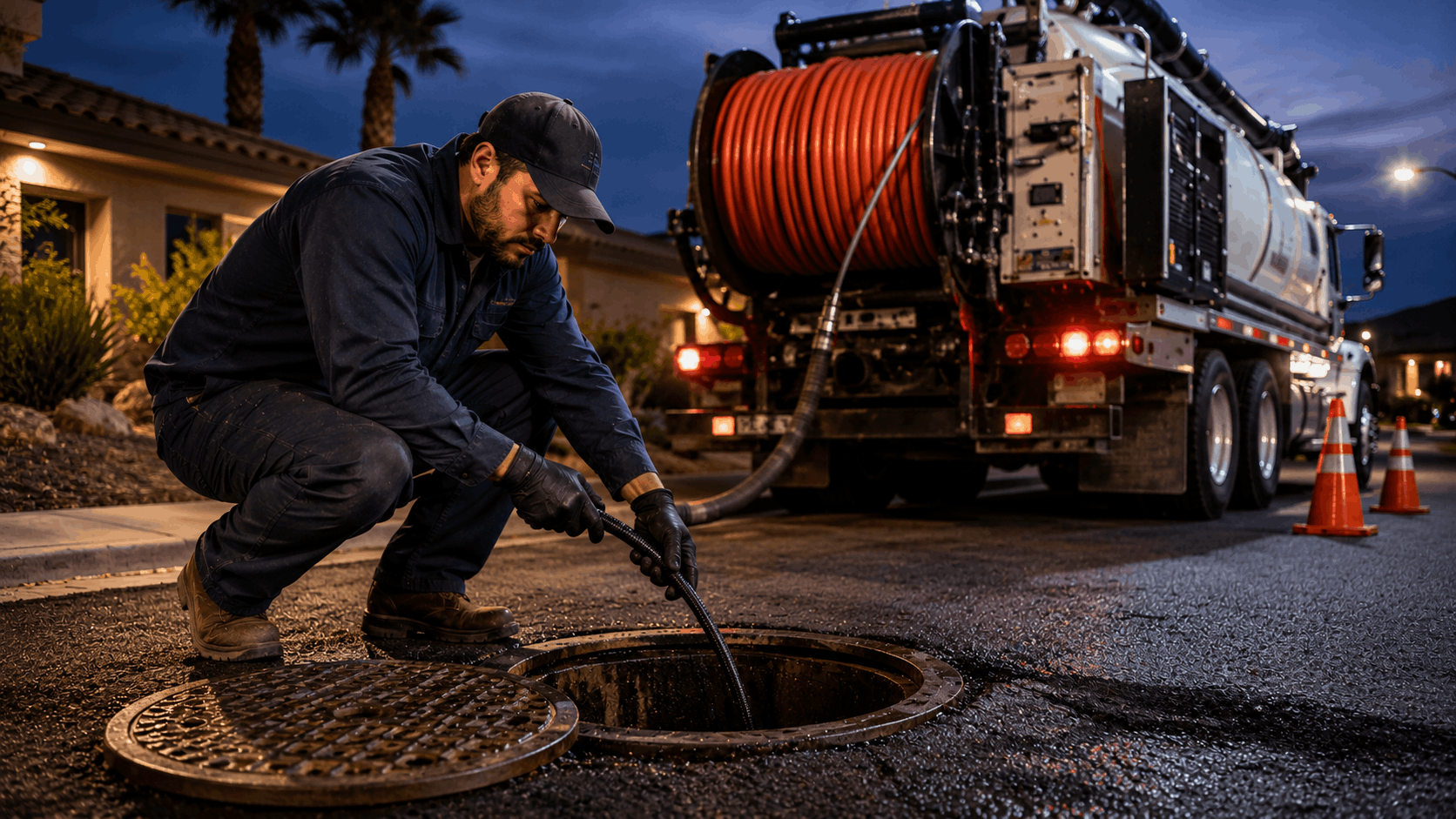
When the plumber arrives, the first job is finding the sewer cleanout. That is the capped pipe, usually outside near the home or in the yard, that gives direct access to the main line. A good cleanout makes the whole job more quickly and cleaner.
If the cleanout is buried or the home never had one, we find another safe access point. Older homes in Huntridge and the arts district sometimes require pulling a toilet to reach the line. We choose the method that clears the blockage with the least mess.
Next comes figuring out the blockage location. By feeling how the cable feeds in or by using a camera, we can tell roughly how far down the clog sits. Knowing whether it is ten feet out or forty feet out shapes how we approach it.
This assessment also hints at the cause. A clog right at a joint often means roots, while a soft blockage further down often means grease or wipes. That read helps us pick the right tool for the clear.
Clearing the Line With a Cable or Jetter
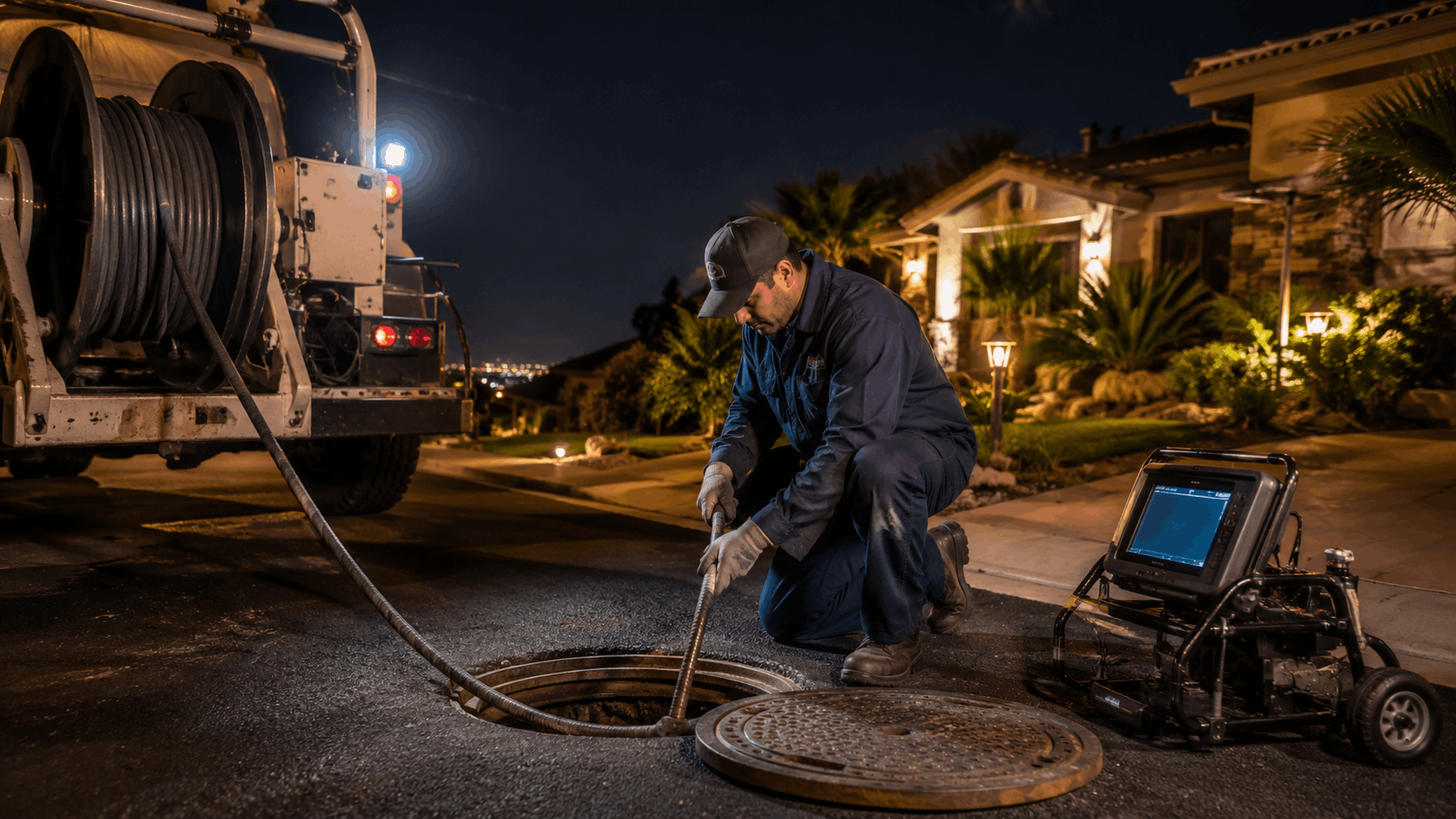
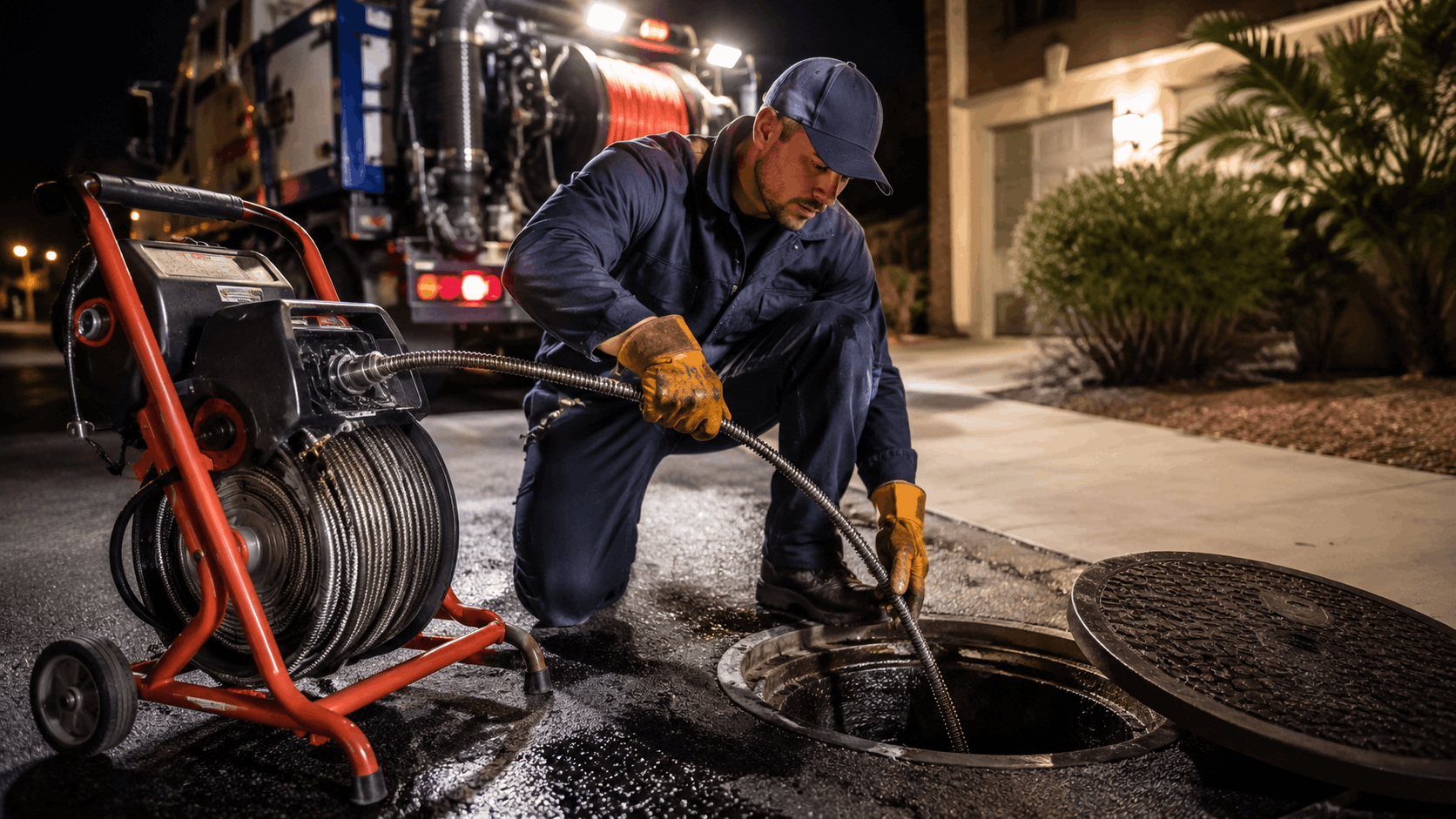
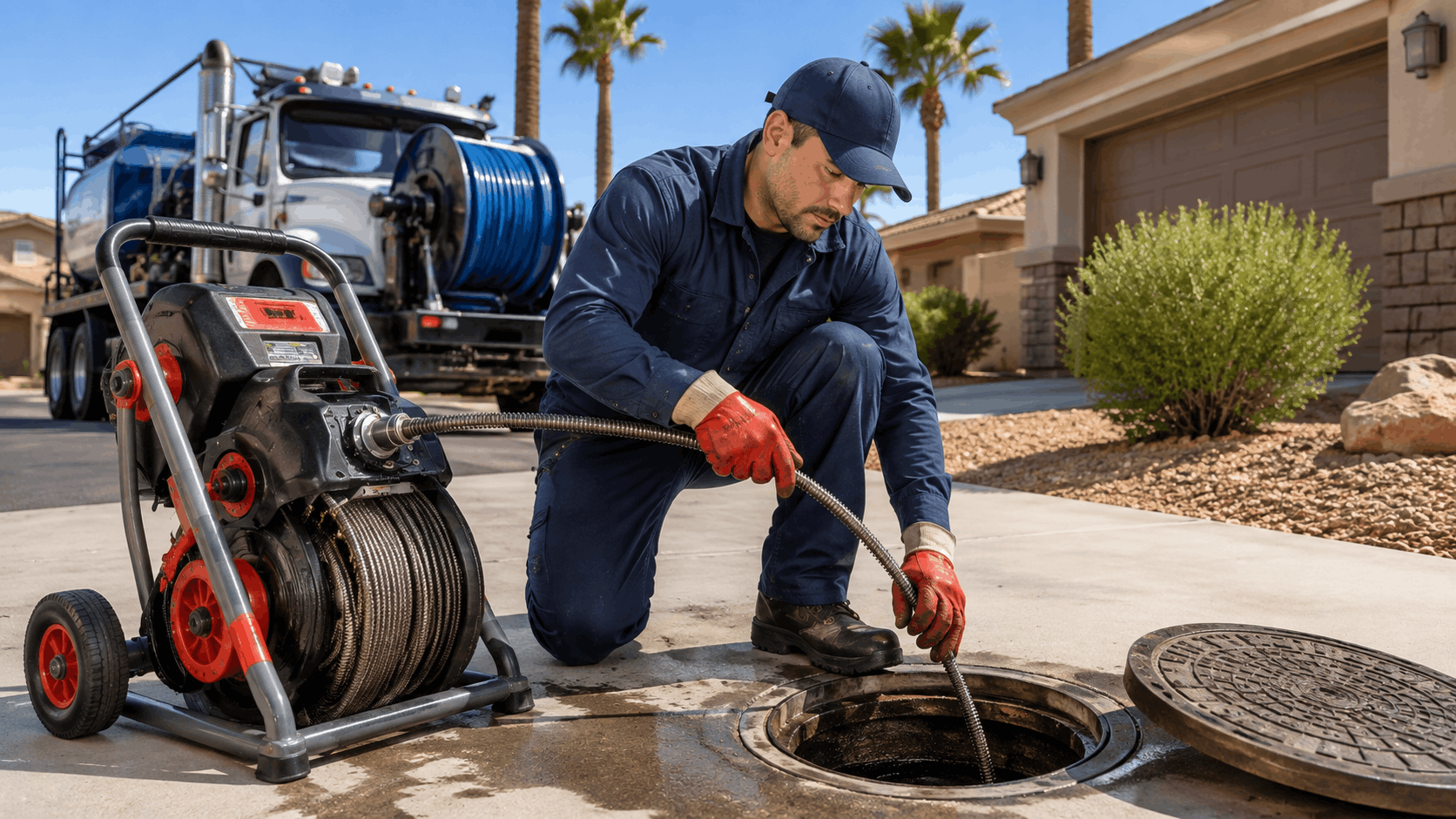
Most backups clear with a motorized cable auger, also called snaking a drain. The cable auger runs a rotating blade or head down the pipe to cut through the clog and pull it back or push it clear. For a typical root or debris clog, this restores flow quickly.
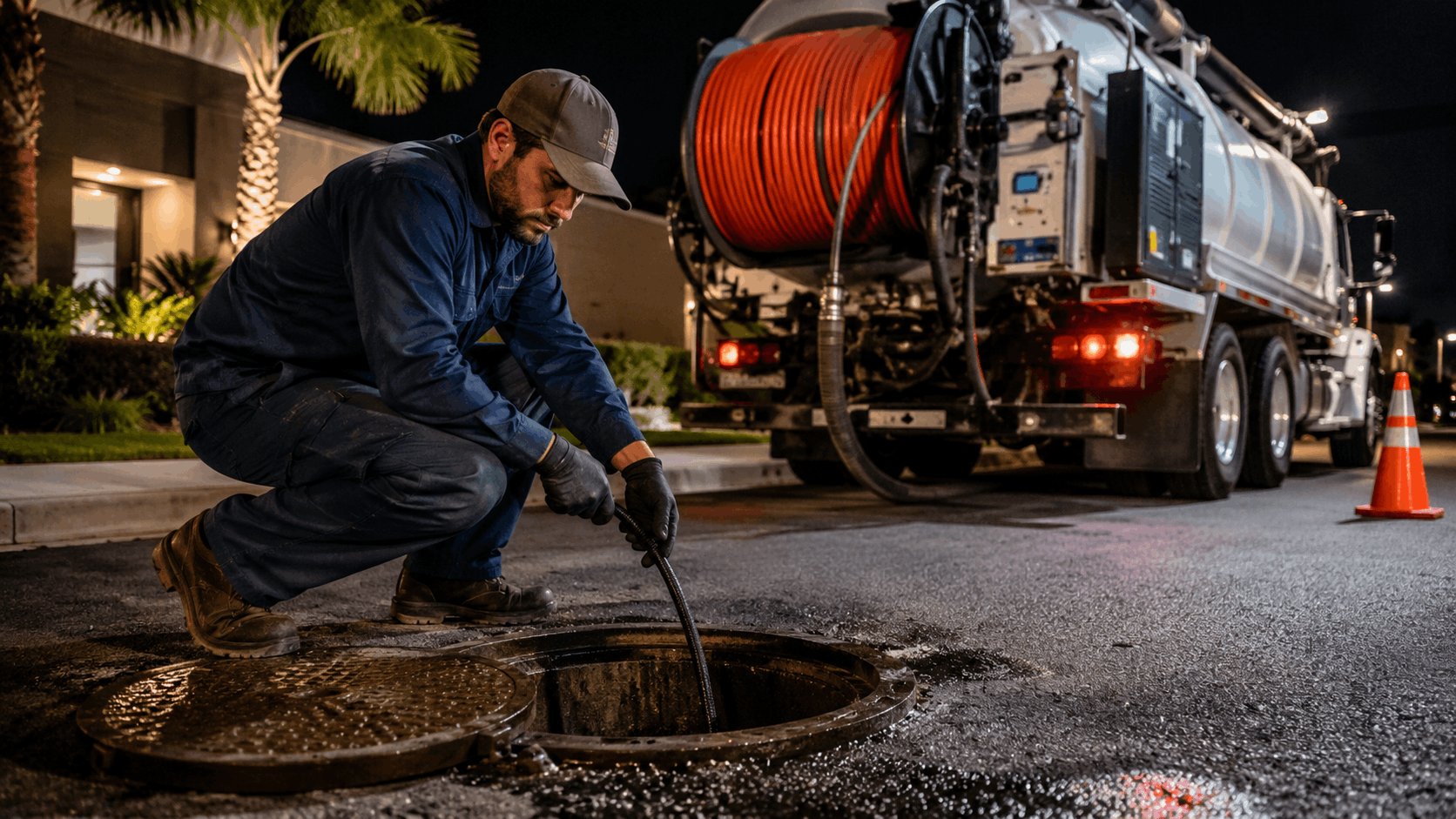
For grease, heavy scale, or recurring clogs, we often recommend hydro jetting instead. A jetter blasts high-pressure water through the line, scouring the pipe walls clean rather than just punching a hole. It leaves the pipe closer to its original diameter, which means fewer repeat backups.
The choice between cable and jetter depends on the cause and pipe condition. Cabling is quicker and cheaper for straightforward clogs. Jetting costs more but does a deeper clean, so it makes sense for grease-heavy kitchens or lines that keep clogging every few months.
In fragile old pipe, we are careful about method and pressure. On a badly corroded cast iron line, aggressive jetting can do harm, so we adjust our approach based on what the pipe can handle. Matching the tool to the pipe protects your plumbing.
Camera Inspection After the Clear
Clearing the clog is only half the story. A sewer camera inspection after the clear confirms the line is actually clean and flowing. We feed a waterproof camera down the pipe and watch the feed on a monitor in real time.
A video pipe inspection also reveals what caused the backup. We can see root intrusion at a joint, a grease coating on the walls, or a crack and belly in the pipe. That footage turns a guess into a clear diagnosis.
For a serious or repeat backup, this step is worth it. Finding a root intrusion or a bad section now lets you plan a repair before the next 2 a.m. flood. It is far cheaper to fix a known problem on your schedule than during an emergency.
We show you the footage and explain what it means in plain language. You see the same picture we do, so any recommendation to repair or replace comes with proof, not just our word for it.
Need Help in Las Vegas?
Active Plumbing serves Las Vegas and all of Las Vegas Valley.
Neighborhoods and Response Times Across the Valley
Response time matters a lot when sewage is rising. We serve homes across the Las Vegas neighborhoods, and knowing the roads helps us shave minutes off every trip. Here is how our plumber response time looks across different parts of the valley.
- Central and downtown Las Vegas: fast access via Charleston and Maryland Parkway
- Summerlin and the west: routes along the 215 Beltway
- Henderson and the southeast: Green Valley Parkway and I-215
- North Las Vegas and Aliante: I-15 and the 215 north
Central Las Vegas and Older Downtown Homes
Downtown Las Vegas and the surrounding older neighborhoods are close to our core service area. Homes near Fremont Street, Huntridge, and the arts district often have the oldest piping in the city. That means they see more root and collapse issues than newer builds.
We reach these areas quickly using Charleston Boulevard and Maryland Parkway as main arteries. Even during a weeknight, we can usually get a truck to central homes fast. Our familiarity with these older streets speeds up the whole visit.
Because we work on so many older homes here, we know what to expect before we arrive. Clay pipe, missing cleanouts, and root problems are common, so our trucks come stocked for them. For urgent calls, our arts district emergency plumbing coverage puts help within reach.
If you own a historic home near downtown, keep our number handy. These properties reward homeowners who catch problems early, and we are close enough to respond before a slow drain becomes a flood.
Summerlin and the Western Suburbs
Out west, Summerlin and Peccole Ranch feature newer construction, but new does not mean immune. Modern homes still see main line issues from grease, wipes, and hard water scale. Landscaping roots also find their way into lines here as trees mature.
The 215 Beltway makes reaching Summerlin straightforward from most directions. We use it to move between the western communities quickly, day or night. That road access keeps our response times reasonable even in the outer neighborhoods.
Homes in planned communities often have accessible cleanouts, which speeds up the job. When we roll into a Summerlin West emergency plumbing call, the modern layout usually lets us clear the main efficiently. That works in your favor on cost and time.
We also serve nearby areas like Peccole Ranch and the surrounding western suburbs. Wherever you are on the west side, a backed-up main is something we can reach and handle.
Henderson, Green Valley, and the Southeast
The southeast valley, including Henderson and Green Valley, is a big part of our coverage. Established communities here have homes ranging from twenty to forty years old, plenty old enough for main line trouble. Grease, roots, and aging pipe all show up in these areas.
We reach Henderson using Green Valley Parkway and the I-215 corridor. Those routes connect the southeast communities and keep drive times manageable. Even a late-night call from deep in Green Valley gets a realistic arrival window.
Neighborhoods near Lake Las Vegas and the Whitney Ranch area each have their own quirks, and we know the local layouts well. For fast help in the southeast, our Whitney Ranch emergency plumbing coverage keeps a crew within reach.
You can also explore our full Henderson service area to see the communities we cover. From the border with Las Vegas out to the eastern edges, the southeast is well within our range.
North Las Vegas and Aliante
The north valley keeps growing, and communities like Aliante and Centennial Hills have added thousands of homes. Even in newer subdivisions, main lines back up from the same causes as anywhere else. We serve these areas day and night.
I-15 and the 215 north give us solid access to North Las Vegas. From the Historic North Las Vegas core out to the newer edges near Aliante, we route around traffic to keep response times down. The freeway network up north actually helps us move fast.
For urgent calls, our Aliante emergency plumbing coverage means a truck is not far off. Newer homes here often have good cleanout access, which makes clearing a main quicker once we arrive.
You can see the full range of our North Las Vegas coverage to check your neighborhood. Growing communities deserve the same fast emergency help as the older parts of town, and that is exactly what we provide.
Steps Homeowners Can Take Before the Plumber Arrives
What you do in the first few minutes of a backup can save a floor or a room full of belongings. None of these steps require tools or experience. Here is how to limit damage while you wait for the crew.
Stop Using Water Right Away
The single most helpful thing you can do is stop water use entirely. That means no flushing, no running faucets, no dishwasher, and no laundry. Every gallon you send down a blocked line has to go somewhere, and that somewhere is usually your floor.
Let everyone in the home know not to use any drain. It only takes one person flushing a toilet to push sewage higher inside the house. A quick heads-up to the whole family prevents a bad situation from getting worse.
If a washing machine or dishwasher is mid-cycle, stop it. Those appliances dump a lot of water fast, and a full drain cycle can overwhelm a backed-up main in seconds. Pausing them buys you time until we arrive.
Keeping water off is the best way to prevent overflow before help gets there. It costs nothing and often makes the difference between a minor cleanup and a major one.
Protect Floors and Belongings
While you wait, move what you can away from the affected drains. Shoes, rugs, boxes, and anything stored on a garage or laundry floor should go somewhere dry. Sewage water ruins soft materials fast and carries bacteria.
Use old towels, plastic sheeting, or trash bags to contain the spread. Laying towels at doorways can keep water from creeping into other rooms. The goal is water damage prevention, buying time until the line is clear.
If sewage has already reached the floor, keep people and pets away from it. It is a health hazard, not just a mess. Wear gloves and boots if you must be near it, and wash up thoroughly afterward.
For larger backups, our sewage backup cleanup team handles the mess after the line is cleared. Protecting your flooring early makes that cleanup more quickly and less costly.
Find and Open the Main Cleanout if Safe
Many homes have a main cleanout outside, a capped pipe near the foundation or in the yard. If sewage is rising inside the house, carefully opening that cap can relieve sewer pressure. Waste may then flow out onto the ground instead of up into your home.
Only do this if you can reach the cleanout easily and safely. Wear gloves, stand back, and expect water to come out under pressure. Redirecting the overflow outside is far better than letting it fill your bathroom.
If you cannot find the cleanout or it is buried, do not force anything. Leave it alone and let our crew locate it when they arrive. Damaging the cap or the pipe only creates a bigger problem.
Tell the plumber whether you opened the cleanout when we arrive. That information helps us understand what the line has been doing and where the blockage sits.
Avoid Chemical Drain Cleaners on a Main Line
It is tempting to pour a chemical drain cleaner down a slow drain, but on a backed-up main it is a bad idea. These products rarely clear a real main line clog, and the caustic liquid then sits in the pipe. That creates a hazard for anyone working on the line.
The drain cleaner risk goes further. Harsh chemicals can damage older pipe, especially aging cast iron already weakened by corrosion. You could turn a clog into a leak or worse. The EPA classifies many drain cleaners as household hazardous waste for good reason.
When the plumber arrives to a line full of chemical cleaner, the job gets more dangerous and slower. We have to protect ourselves from splashback of caustic liquid. That can complicate what would otherwise be a straightforward clear.
Skip the chemicals and let mechanical clearing do the work. A cable or jetter physically removes the blockage without the risks that come with pouring acid or lye into your pipes.
Need Help in Las Vegas?
Active Plumbing serves Las Vegas and all of Las Vegas Valley.
Preventing Future Main Line Emergencies
Once you have lived through one backup, you never want another. The good news is that most main line emergencies are preventable with a little routine care. Here is how to prevent a sewer backup and keep your drains flowing.
Scheduled Drain Cleaning and Jetting
The most reliable way to avoid backups is routine drain cleaning before problems build up. On older lines prone to roots and grease, a scheduled cleaning every year or two keeps the pipe clear. It is far cheaper than an emergency call.
Preventive jetting goes a step further by scouring the pipe walls clean. For homes with a history of grease or scale, a periodic jetting resets the line to near its full diameter. That gives you a wide margin before anything can clog again.
We often recommend a maintenance schedule based on what we find in your line. A home with mature trees and clay pipe needs more frequent attention than a newer home with PVC. Our drain and sewer services cover both routine cleaning and jetting.
Think of it like changing your oil. A small planned expense on a schedule prevents a much larger emergency bill down the road. The lines you never think about are the ones worth maintaining.
Watching What Goes Down the Drain
Good drain habits prevent most clogs before they start. The two biggest offenders are grease and wipes, and both are easy to keep out of your pipes. A little care in the kitchen and bathroom pays off for years.
For grease disposal, let cooking grease cool and toss it in the trash instead of pouring it down the sink. Wipe greasy pans with a paper towel before washing. Even hot water and soap will not stop grease from coating your lines over time.
In the bathroom, only flush toilet paper and human waste. Flushable wipes, paper towels, and feminine products all cause clogs no matter what the packaging claims. A small trash can by the toilet solves the problem.
These habits cost nothing and protect the whole household plumbing. Teaching everyone in the home what belongs in the drain and what does not is one of the simplest ways to avoid a backup.
Root Control for Homes Near Mature Trees
If your home sits on an older tree-lined street around central Las Vegas, root control deserves attention. The same trees that shade your yard send roots toward your sewer line. Managing them keeps roots from taking over the pipe.
Root treatment products can slow regrowth after a cleaning, discouraging roots from returning to the same spot. Combined with periodic cabling or jetting, this keeps a root-prone line open. For heavy root problems, more frequent monitoring is worth it.
The lasting fix for a badly damaged line is repair or replacement of the affected section. When roots keep invading through the same cracked joint, sealing that access point solves the recurring problem. A camera inspection shows exactly where to focus.
Homes near mature landscaping in older neighborhoods should not ignore slow drains. Early action on roots is far cheaper than an emergency after the line fully blocks. We help homeowners plan the right level of root control for their property.
Camera Inspections to Catch Problems Early
A preventive camera inspection is one of the smartest moves for an older home. Running a camera through the line every few years catches cracks, sags, and root intrusion before they become full backups. You see problems while they are still small.
A sewer line check is especially worth it before buying an older home or after a first backup. The footage tells you the true condition of the pipe, so there are no surprises. That knowledge lets you budget for repairs on your own timeline.
We show homeowners the video and point out anything of concern. A minor crack today might be fine to monitor, while a growing belly might need attention soon. Either way, you make decisions with real information.
Pairing routine cleaning with periodic camera checks is the strongest defense against repeat emergencies. Our sewer camera inspection service gives you a clear picture of your line's health before trouble starts.
Final Thoughts
A backed-up main is stressful, but knowing the signs and the steps makes it manageable. When multiple drains slow, toilets gurgle, and a sewer smell fills the house, you are past the plunger stage and into emergency territory. Acting fast limits damage and protects your home.
Here in the valley, roots in older clay pipe, grease, hard water scale, and aging lines cause most backups. Honest after-hours pricing, upfront quotes, and the right clearing method turn a bad night into a solved problem. A little routine maintenance keeps the next emergency from ever happening.
When a main backs up in your home, our team is ready across Las Vegas, Summerlin, Henderson, and North Las Vegas, day or night. Reach out through our contact page or call for emergency drain cleaning, and we will give you clear pricing before any work begins.
Frequently Asked Questions
- How much does emergency drain cleaning cost after hours in Las Vegas?
- After-hours main line clearing in Las Vegas typically runs $350 to $650 through an accessible cleanout, compared to $225 to $450 during business hours. Hydro jetting costs more, often $550 to $1,000 after hours. The final total depends on cleanout access, how deep the blockage sits, and whether the line needs jetting or a camera inspection. We give a written price on site before work starts.
- How fast can a plumber reach my home at night?
- Response times vary by location, but we give an honest arrival window when you call. Central Las Vegas homes near Fremont or Huntridge usually see the fastest response. Summerlin, Henderson, and North Las Vegas take a bit longer depending on the route and traffic. We use the 215 Beltway, I-15, and Green Valley Parkway to reach the outer communities quickly, day or night.
- What is the difference between a clogged drain and a backed-up main?
- A single clogged drain affects one fixture, like a slow bathroom sink caused by hair or grease nearby. A backed-up main affects several fixtures at once, since they all share the main sewer line. When your toilet, tub, and kitchen sink all back up together, the blockage sits in the main line rather than under one drain. That calls for professional clearing.
- Is it safe to keep using water when my main is backing up?
- No. Every gallon you send down a blocked main has nowhere to go and pushes sewage higher into the home. Continued water use raises the risk of an overflow inside the house, flooding floors and ruining belongings. Stop all flushing, faucets, laundry, and dishwashing right away. Tell everyone in the home to hold off until the line is cleared.
- Do I need a camera inspection after the line is cleared?
- For a serious or repeat backup, a camera inspection is worth it. The video confirms the line is fully clear and reveals what caused the problem, whether roots, grease, a crack, or a sagging pipe. Finding the cause lets you plan a repair on your schedule instead of during the next emergency. For a one-time minor clog, it may not be necessary.
- Why are night and weekend rates higher than daytime service?
- After-hours rates cover the cost of keeping a crew on call overnight, on weekends, and on holidays. On-call plumbers earn premium pay for those hours, and stocked trucks with cable machines, jetters, and cameras have to stay ready at any time. That readiness is what lets us respond at 2 a.m. Our premium is a set amount, not a figure that grows because you sound stressed.
- Can tree roots really break my sewer line?
- Yes, and it is common in older Las Vegas neighborhoods. Roots chase the water inside sewer lines and slip through tiny cracks or loose joints in clay and cast iron pipe. Once inside, they grow into a mat that catches debris and can crack or displace the pipe entirely. Homes near mature trees in areas like the Historic Westside and John S. Park see this often.
- Should I try a chemical drain cleaner first?
- Not on a main line. Chemical cleaners rarely clear a real main blockage, and the caustic liquid then sits in the pipe. That damages older cast iron and creates a hazard for the plumber who has to work on the line. Mechanical clearing with a cable or jetter removes the clog safely. Skip the chemicals and call for professional service instead.
- What areas of the valley does Active Plumbing serve?
- We serve homes across the Las Vegas valley, including central and downtown Las Vegas, Summerlin, Peccole Ranch, Henderson, Green Valley, and North Las Vegas communities like Aliante and Centennial Hills. We also cover Spring Valley, Enterprise, Paradise, Winchester, Sunrise Manor, and Whitney. You can check our locations page to confirm coverage for your specific neighborhood, day or night.
- How can I prevent another main line backup?
- Schedule routine drain cleaning or jetting on older lines, keep grease and wipes out of your drains, and manage roots if you live near mature trees. Periodic camera inspections catch cracks and sags before they become full backups. Together these steps protect your main line and cut the odds of another 2 a.m. emergency. We can build a maintenance plan based on your home's pipe condition.
Licensed plumbing professionals serving Las Vegas and Las Vegas Valley.
Licensed in Nevada · License #0047021
Last updated on
Why trust Active Plumbing?
Founded in 1991, Active Plumbing is a licensed and insured plumber serving Las Vegas and Las Vegas Valley. All content is reviewed by our licensed technicians.

Need Help in Las Vegas?
Active Plumbing serves Las Vegas and all of Las Vegas Valley.
Related Articles
Burst Pipe Repair Cost Vegas: Emergency Response vs Standard Response Pricing
Compare emergency versus standard burst pipe repair pricing in Las Vegas, plus real cost ranges, local causes, insurance tips, and how to choose the right response tier.
Drain Cleaning Cost in Las Vegas: Snake vs Hydro Jet, Honest Price Ranges
Honest drain cleaning cost ranges for Las Vegas homeowners, comparing snake vs hydro jet pricing, when each method pays off, and how to avoid overpriced quotes.
Emergency Plumber Cost Las Vegas: After-Hours Pricing Breakdown
A clear breakdown of emergency plumber cost in Las Vegas, including after-hours pricing, fees, neighborhood factors, and smart ways to lower your bill.