Emergency Plumbing in Spring Valley and the Chinatown Corridor: Restaurant After-Hours Failures
Key Takeaways
- The Chinatown corridor along Spring Mountain Road sees frequent after-hours plumbing failures due to dense high-volume kitchens, aging buildings, and shared sewer lines.
- A common commercial kitchen failures include grease trap overflows, floor drain and mop sink backups, overnight water heater failures, and burst supply lines.
- A single night of forced closure can cost thousands in lost revenue, plus health inspection risks, water damage, and reputation harm.
- Fast response depends on both real 24/7 dispatch and a local crew that knows routes off the 215 Beltway, Decatur, and Jones.
- Preventive maintenance like scheduled grease trap pumping, routine hydro jetting, and water heater inspections stops most emergencies before they start.
- Hard water from the Las Vegas Valley Water District, summer heat, and older plaza infrastructure make corridor kitchens especially vulnerable.
- Choose a Nevada licensed plumber with commercial experience, genuine overnight availability, a local Spring Valley presence, and a written price before work starts.
- Active Plumbing provides emergency service, documentation for health and insurance, and restaurant maintenance contracts throughout Spring Valley and the corridor.
In This Article
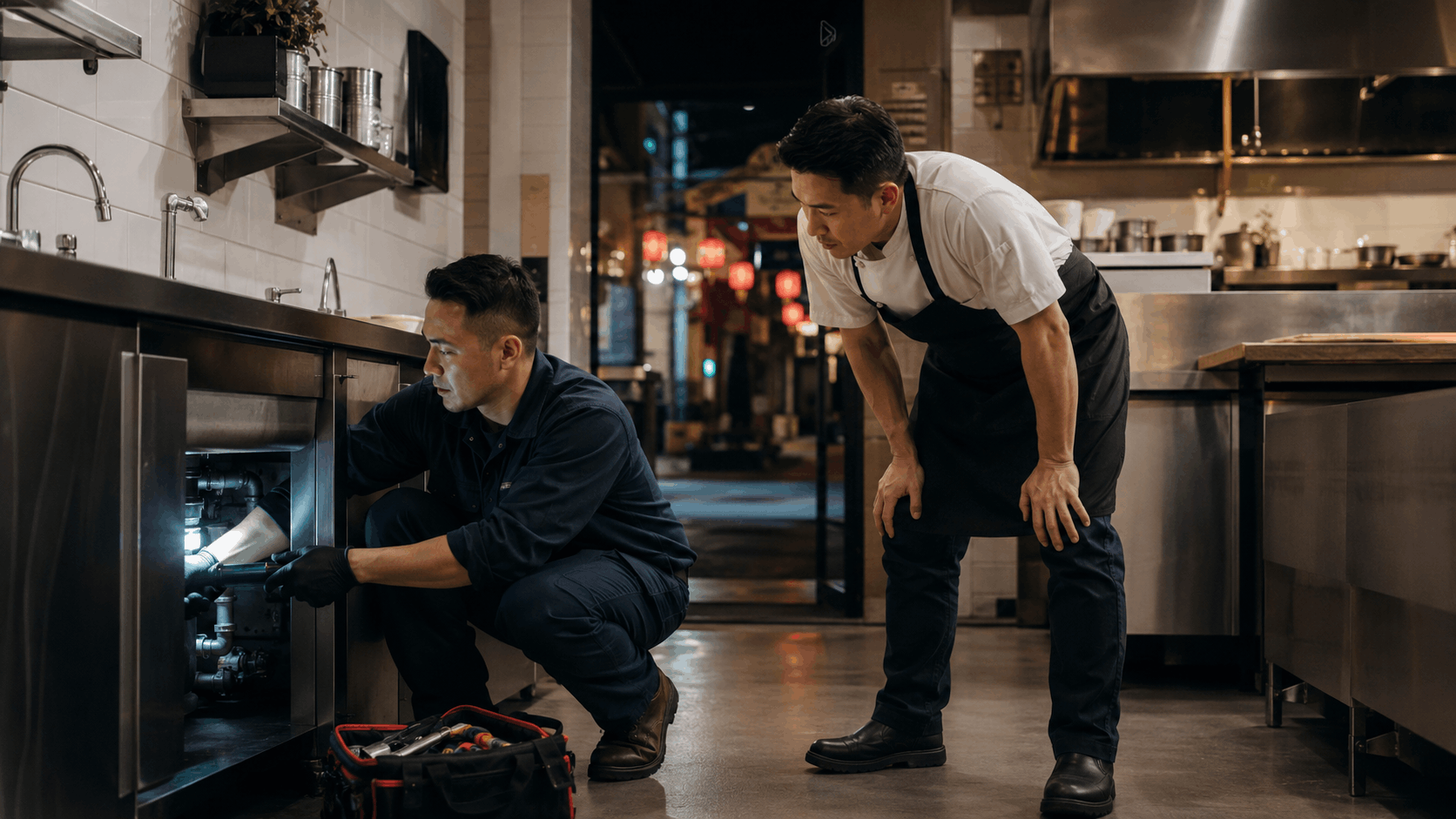
It is 7:45 on a Friday night. A busy noodle house off Spring Mountain Road is slammed, every table full, and the kitchen is running three burners deep. Then the floor drain in the dish pit stops draining. Gray water starts pooling around the line cooks' feet, and the smell hits fast. The manager grabs a mop, but the water keeps rising because the problem is not on the surface. It is somewhere down the line, and it just picked the worst possible hour to fail.
Scenes like this play out along the Chinatown corridor more often than most diners would ever guess. Heavy kitchen use, older buildings, and shared plumbing systems all stack up until something gives during service. When that happens after dark, the restaurant needs a plumber who actually answers the phone and knows how to get there fast.
Let's break down a common after-hours failures we respond to, why the Spring Valley and Chinatown area sees so many of them, what a breakdown really costs a restaurant, and how a quick response keeps a kitchen open. Our team at Active Plumbing works these streets every week, so the advice here comes from real calls, not a textbook.
Why the Chinatown Corridor Sees So Many After-Hours Plumbing Failures?
The Chinatown corridor is one of the densest dining districts in the entire Las Vegas Valley. Restaurants sit shoulder to shoulder in strip malls, sharing walls, parking lots, and often the same underground pipes. That concentration is great for hungry customers, but it puts a lot of strain on plumbing systems that were never built for this kind of volume.
Here are the main reasons this stretch of Spring Mountain Road deals with so many late-night breakdowns:
- Kitchens run at full output for hours with almost no break
- Many buildings are decades old with outdated pipes
- Multiple tenants often share a single sewer line
- Long operating hours push discovery of problems into the overnight window
When you understand how these factors combine, the pattern of restaurant plumbing failures across the Chinatown corridor starts to make a lot of sense.
High Volume Kitchens Along Spring Mountain Road
The strip mall restaurants along Spring Mountain Road do not slow down between lunch and dinner the way a suburban spot might. Many of them serve continuously from late morning until well past midnight. That means the drains and grease lines never really get a rest to let buildup settle or clear.
During peak service, a single kitchen might wash hundreds of pots, plates, and prep containers in a couple of hours. Every one of those loads carries fats, oils, and food scraps into the drain system. In a high-volume hot pot or barbecue spot, the grease load is even heavier because of all the rendered fat.
Grease lines are the first place we see trouble in these kitchens. Fat cools inside the pipe, sticks to the walls, and slowly narrows the opening until water backs up. When back-to-back service keeps pushing more grease in, the line hits its limit right in the middle of a rush.
We have pulled solid grease plugs out of lines that a restaurant swore were fine a week earlier. In a busy kitchen, a week is plenty of time for buildup to go from manageable to a full blockage.
Aging Buildings Near Jones and Rainbow
A lot of the commercial plazas between Jones Boulevard and Rainbow Boulevard have been standing for thirty or forty years. When they were built, nobody expected a single suite to house a kitchen serving four hundred covers a night. The older commercial plumbing in these buildings simply was not sized for that demand.
We often find cast iron or older galvanized pipe in these plazas. Cast iron corrodes and scales up on the inside over the decades, shrinking the usable diameter of the pipe. That leaves less room for water and waste to move, so clogs form more quickly and drain slower.
Undersized drain lines are another common issue near Jones Boulevard. A two-inch line that worked fine for a retail shop struggles badly when it has to carry the wastewater from a full commercial kitchen. The pipe is doing everything it can, but it was never meant for that job.
When a restaurant moves into one of these older suites, the plumbing behind the walls is usually the last thing on anyone's mind. It becomes a priority only when it fails, and by then the kitchen is already flooding.
Shared Sewer Lines in Multi-Tenant Plazas
Many strip malls in Spring Valley run every tenant into one shared sewer line before it reaches the city main. That setup keeps construction costs down, but it creates a hidden risk. A clog anywhere on that shared line can back up into more than one business at once.
Picture a plaza with five suites, and the restaurant at the end packs its line with grease. The blockage forms downstream of several other tenants. Now the sewage has nowhere to go, so it comes up through the lowest drains, which might be in the neighboring shop that did nothing wrong.
These multi-tenant plaza backups are some of the trickiest calls we handle. Figuring out which tenant caused the problem and where the actual blockage sits takes experience and the right camera equipment. Our team uses sewer camera inspection to find the exact spot without guessing.
Once we locate the blockage on a shared sewer line, we can clear it and advise the property owner on how to prevent a repeat. Sometimes the fix involves a maintenance plan that covers the whole plaza, not just one tenant.
Late Closing Times Mean Late Discoveries
Restaurants along the corridor famously stay open late. Some do their biggest business between 10 p.m. and 2 a.m. when other kitchens have already shut down. That schedule is great for night owls, but it changes when plumbing problems get noticed.
A slow drain that started acting up at dinner might not become a full backup until the closing crew is mopping at 1 a.m. By that hour, most plumbing companies have gone home and their phones roll to voicemail. The restaurant is stuck with a flooded floor and no one to call.
These after-hours failures are exactly why round-the-clock coverage matters so much in this part of town. A problem discovered at midnight cannot wait until 8 a.m. if the kitchen needs to open for lunch service the next day. Late night plumbing help has to actually be available late at night.
We built our dispatch around this reality. The corridor does not sleep, so neither does our emergency line.
Get Your Quote
Tell us what's going on and we'll get back to you. We're open 24/7.
The Common After-Hours Failures in Commercial Kitchens
Over the years, the same handful of problems come up again and again in commercial kitchen plumbing across Spring Valley and the Chinatown area. Knowing what tends to break helps owners spot trouble early and helps our crew arrive with the right gear.
Here are the failures we respond to most often after hours:
- Grease trap overflows and clogged interceptors
- Floor drain and mop sink backups
- Water heater failures before the morning rush
- Burst supply lines and leaking fixtures
Each of these has its own warning signs and its own fix, so it helps to understand them one at a time.
Grease Trap Overflows and Blocked Interceptors
A grease trap overflow is one of the ugliest problems a kitchen can face mid-shift. When the trap fills past capacity, it stops separating grease from water. The excess spills out onto the floor or backs up into the sinks, and everything comes to a halt.
Overflows almost always trace back to a trap that went too long between pumping. In a high-volume kitchen, a small under-sink trap can fill in a matter of weeks. Once it is full, there is no room left for new grease, so it starts coming back the way it went in.
A grease interceptor, which is the larger in-ground version, clogs fastest in busy kitchens for the same reason. It handles more flow, but it also catches far more fat. When the outlet baffle gets choked, the whole unit backs up. Regular grease trap pumping is the only real cure.
Beyond the mess, an overflowing trap is a fast path to a code violation. Health inspectors take grease handling seriously, and a spill during service can bring real consequences if it is not cleaned and corrected quickly.
Floor Drain and Mop Sink Backups
Floor drains take a beating in any commercial kitchen. Every splash, spill, and hose-down runs into them, carrying food debris and grease along for the ride. Over time that material settles in the line and starts to choke the flow.
A floor drain backup usually shows up at the worst moment, when the kitchen is busiest and using the most water. Suddenly the water has nowhere to go, so it rises up through the drain and spreads across the floor. Line cooks end up standing in dirty water while trying to keep plating food.
The mop sink is another frequent trouble spot. Staff dump mop water full of grease and grit down it all shift, and that gunk builds up in the trap below. When the mop sink and floor drains share a line, a clog in one shows up in the other.
Clearing these backups fast is what our drain and sewer services are built for. We cable or jet the line, flush out the debris, and get the floor dry so the kitchen can keep moving.
Water Heater Failures Before the Morning Rush
A commercial water heater tends to fail when nobody is watching, which usually means overnight. The restaurant closes with hot water working fine, and the opening crew arrives to find nothing but cold. Without hot water, a kitchen cannot sanitize dishes or run the dish machine properly.
No hot water is not just an inconvenience, it is a compliance problem. Health rules require hot water for handwashing and dishwashing. A kitchen that cannot meet that standard should not be serving food, so a dead heater can stop service before it even starts.
Commercial units fail for a few common reasons. Sediment and scale build up on the bottom of the tank, heating elements wear out, and old units simply reach the end of their life. In this area, hard water speeds all of that up. Our water heater services cover repair and replacement for exactly these situations.
When a heater dies before open, our crew can often repair it on the spot or swap in a replacement fast. For kitchens that cannot afford downtime, we also talk through backup planning so one failure does not close the doors.
Burst Supply Lines and Leaking Fixtures
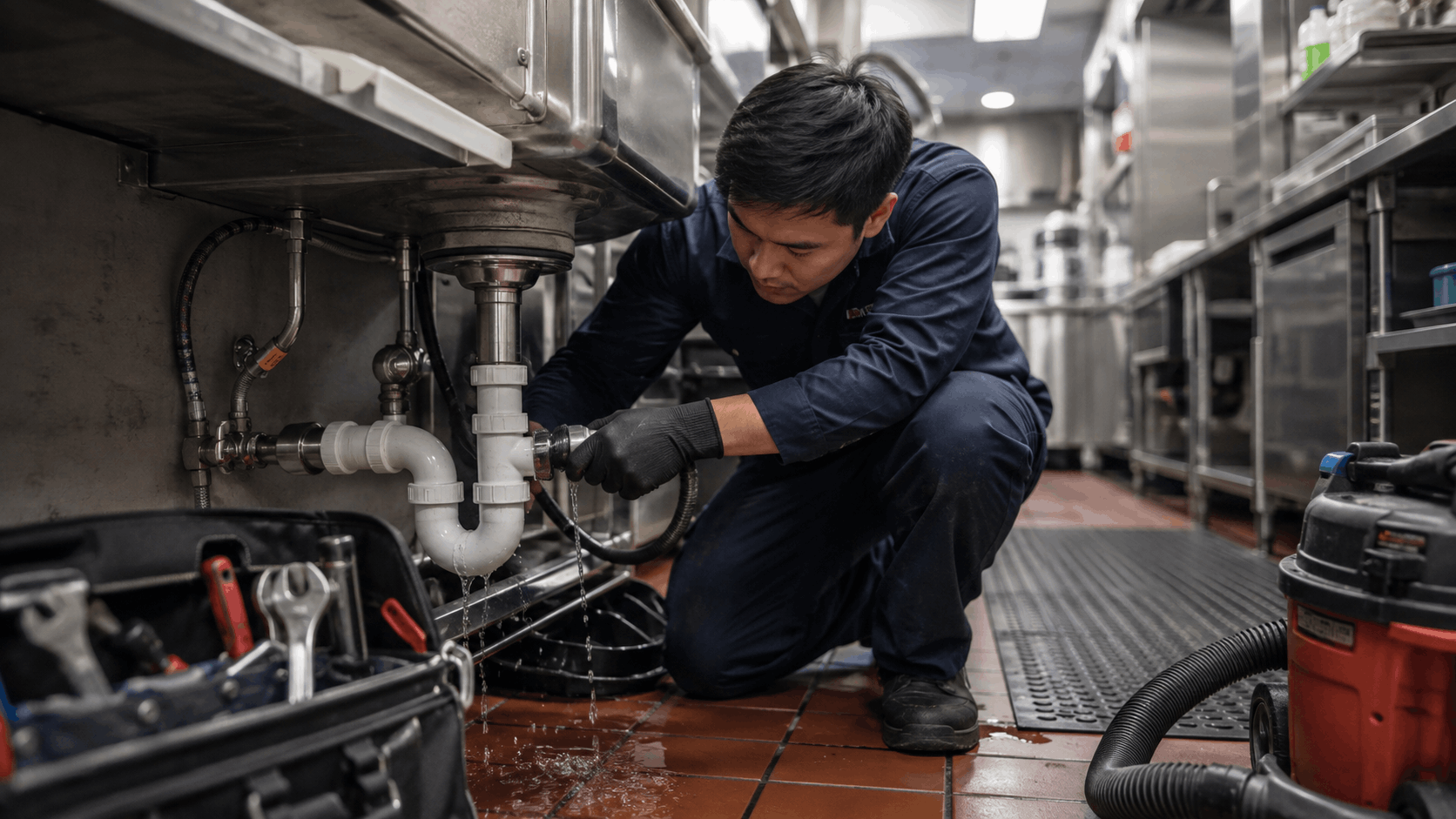
Supply lines carry water under constant pressure, so when one fails it does not drip, it sprays. A burst pipe under a prep sink or behind the dish machine can dump gallons of water into a kitchen in a short time. By the time someone finds the shutoff, the floor may already be soaked.
Dish machine hookups are a common failure point. The braided or rubber lines feeding these machines flex and wear with heat and use, and eventually one lets go. Older fixtures and worn compression fittings on prep sinks fail the same way, usually at the worst time.
The speed of the flooding is what makes these calls urgent. A backed-up drain rises slowly, but a burst supply line floods fast and can reach dining areas, storage, and electrical equipment. Fast shutoff and repair limit the damage. Our burst pipe repair service handles these emergencies day and night.
Every restaurant should know where its main water shutoff is located. When a line bursts, cutting the water is the first move, and knowing that valve's spot can save thousands in damage.
Need Help in Las Vegas?
Active Plumbing serves Las Vegas and all of Las Vegas Valley.
What a Plumbing Failure Really Costs a Restaurant
The plumber's bill is rarely the biggest cost when a kitchen goes down. The real damage comes from lost sales, regulatory risk, property damage, and the hit to a restaurant's name. Owners who see the full picture understand why fast response and prevention are worth the investment.
Lost Revenue From Forced Closures
A single lost night during a busy weekend can mean thousands of dollars in vanished sales. A corridor restaurant might turn two hundred or more covers on a Friday, and every one of those tickets disappears when the kitchen has to close. That money does not come back.
Forced closure hits harder than the raw sales number suggests. Reservations get canceled, walk-ins go to competitors, and regulars who found the doors locked may not return for weeks. The lost revenue ripples out well past the single night.
Then there is the wasted product. Prep that was done for the night, fresh seafood, cut vegetables, and marinated proteins may all spoil if the kitchen sits dark and the coolers get opened repeatedly. For a high-volume spot, that spoiled inventory adds up quickly.
When we quote an emergency call, we always frame the repair cost against what a night of closure would run. In almost every case, getting the kitchen back open fast is the far cheaper path.
Health Inspection Risks in Clark County
The Southern Nevada Health District regulates food service across Clark County, and it does not treat plumbing problems lightly. A sewage backup, an overflowing grease trap, or a non-working sink can all trigger action during a health inspection. In serious cases, the district can shut a kitchen down on the spot.
Sewage in a food prep area is a direct hazard. If an inspector arrives during or after a backup, the kitchen may be ordered closed until the problem is fixed and the area is sanitized. That closure lands on top of whatever downtime the plumbing failure already caused.
Non-working handwash and dish sinks are another shutdown trigger. Food safety rules require functioning sinks with hot water, and a kitchen that cannot provide them is out of compliance. Inspectors have little flexibility on this point.
Getting the plumbing fixed and documented quickly helps a restaurant get back into compliance and reopen. Our crew provides the paperwork owners need to show the health district that the issue was addressed.
Water Damage to Floors, Walls, and Equipment
Standing water does not just sit there, it soaks into everything it touches. Kitchen flooring, especially at seams and edges, can lift and warp after even a few hours of flooding. Drywall wicks water upward and starts breaking down, which can lead to mold if it is not dried out fast.
Expensive kitchen equipment is at real risk too. Water that reaches motors, control boards, and electrical connections can ruin a piece of gear that cost thousands. A flooded walk-in compressor or a soaked oven control panel turns a plumbing problem into an equipment replacement.
The longer water sits, the worse the damage gets. This is why stopping the flow and starting cleanup quickly matters so much. Every extra hour of standing water raises the final repair bill.
For serious flooding involving sewage, our commercial sewage cleanup service handles both the plumbing fix and the sanitary cleanup so the space is safe to use again.
Staff and Reputation Fallout
When a kitchen closes unexpectedly, the staff pays a price too. Servers and cooks scheduled for the night lose those hours and that income. Do it enough times and good employees start looking for more stable work elsewhere.
Diners remember a bad experience. A table seated and then told the kitchen has to close, or a group that shows up to locked doors, walks away frustrated. Some of them post about it, and a restaurant's reputation can take a public hit from one rough night.
Online reviews carry real weight for corridor restaurants that compete for attention. A string of complaints about closures or sanitation concerns can drag down a rating that took years to build. Recovering from that takes far longer than the plumbing repair itself.
Protecting the restaurant's name is one more reason to handle plumbing problems quietly and quickly, ideally before they ever reach the dining room. Prevention keeps the story off the review sites entirely.
How Fast Response Times Matter in Spring Valley
In a kitchen emergency, minutes decide how much damage happens and whether the restaurant opens the next day. A fast emergency response time depends on two things: a plumber who is actually available, and one who knows how to reach the location quickly. Both come easier when the company works in Spring Valley every day.
Driving Routes That Cut Response Time
Knowing the roads around the corridor makes a real difference at night. Our drivers use the 215 Beltway to move fast across the valley, then drop onto Decatur Boulevard, Rainbow, or Jones to reach the plaza. A company driving in from Henderson or the far north side simply cannot match that timing.
Traffic patterns change by the hour, and local knowledge helps our crew avoid the slow spots. We know when Flamingo backs up and which cross streets keep moving late at night. That awareness shaves minutes off arrival, and minutes matter during a flood.
Being based in the area means our trucks are often already nearby when a call comes in. A shorter starting distance is the simplest way to arrive sooner. For restaurants in the corridor, that proximity is a real advantage.
Owners can see the difference on our Spring Valley service page, which covers the neighborhoods we reach quickly around the corridor.
The First Fifteen Minutes of a Kitchen Flood
What staff do in the first fifteen minutes shapes how bad a flood gets. The first step is always to find and close the shutoff valve for the affected line or the main. Stopping the water at the source keeps the situation from getting worse while help is on the way.
Every kitchen should have its main shutoff valve marked and known to the closing crew. In a crisis, nobody wants to be hunting for a valve behind the water heater. A little planning here saves a lot of water damage later.
While waiting on the plumber, staff can move product, mats, and equipment away from the flooded area. Clearing the space protects inventory and gives our crew room to work the moment they arrive. Keeping people out of standing water near electrical gear is important for safety.
A quick call to our line puts a plumber in motion right away. We can walk staff through kitchen flood response over the phone while the truck is rolling.
Why After-Hours Coverage Is Different
There is a big gap between a real 24/7 dispatch and a company that just forwards calls to voicemail overnight. Plenty of shops advertise emergency service but only return calls in the morning. For a kitchen flooding at midnight, that is no help at all.
True after-hours coverage means a live person answers, gathers the details, and sends a crew that same hour. Our overnight plumber team is staffed and stocked to respond when the corridor is at its busiest. The restaurants here stay open late, so our support has to as well.
Weekend nights are when many of these failures happen, precisely when other companies are hardest to reach. We keep coverage running through those exact hours because that is when the demand is highest. A plumbing emergency does not respect business hours.
When an owner calls our emergency plumbing line at 11 p.m., they reach a team ready to move, not a recording.
Stocked Trucks for Common Kitchen Repairs
A fast arrival means little if the plumber has to leave for parts. Our trucks carry commercial fittings, cabling equipment, and hydro jetting gear so most kitchen repairs can be finished in one visit. That preparation avoids the return trips that stretch downtime for hours.
Grease-choked lines usually need more than a snake to clear fully. Carrying hydro jetting equipment on the truck lets our crew blast a line clean right then, restoring full flow instead of just poking a hole through the clog. Our hydro jetting and rooter service handles the toughest buildup.
Commercial kitchens use different fittings and larger lines than a home, so stocking the right parts matters. A truck loaded with the sizes and materials common to corridor kitchens can adapt to whatever it finds on site. Guesswork gets left behind.
The goal every time is a kitchen back in service before the next shift. Coming prepared is how we make that happen without extra trips.
How Active Plumbing Handles Emergency Restaurant Calls
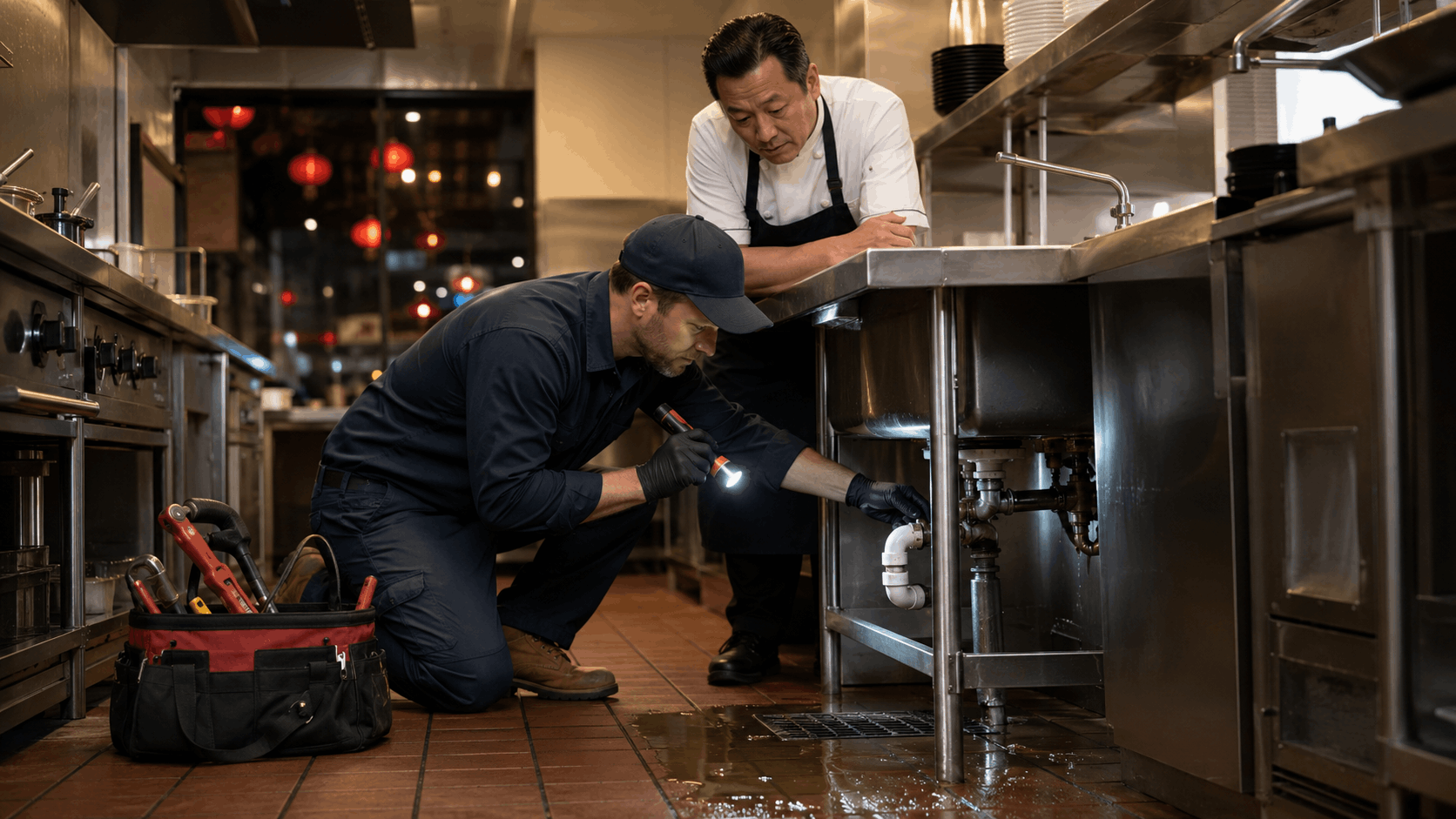
When a Chinatown corridor restaurant calls at 11 p.m., our process is built to save time from the first ring. Active Plumbing treats every emergency plumbing call as a race against water damage and lost service. Here is how our commercial service handles those late-night calls step by step:
- Diagnose the problem over the phone
- Clear drains and sewer lines fast on arrival
- Stabilize overnight, then plan a permanent fix
- Document everything for health and insurance needs
Diagnosing the Problem Over the Phone
The emergency call starts with a few focused questions. Where is the water coming from, which fixtures are affected, and has anyone shut off the supply. A quick phone diagnosis tells our crew a lot about what they are walking into.
Those details shape what equipment comes off the truck first. A grease trap overflow calls for different gear than a burst supply line. Knowing the problem ahead of time means the right tools are ready the moment the crew arrives.
We also use the call to guide staff on immediate steps. Closing a valve or clearing an area while we drive can limit the damage before we even get there. That head start often makes the difference in how the night ends.
By the time our truck reaches the plaza, the crew already has a plan. That preparation is a big part of why fast calls lead to fast fixes.
Clearing Drains and Sewer Lines Fast
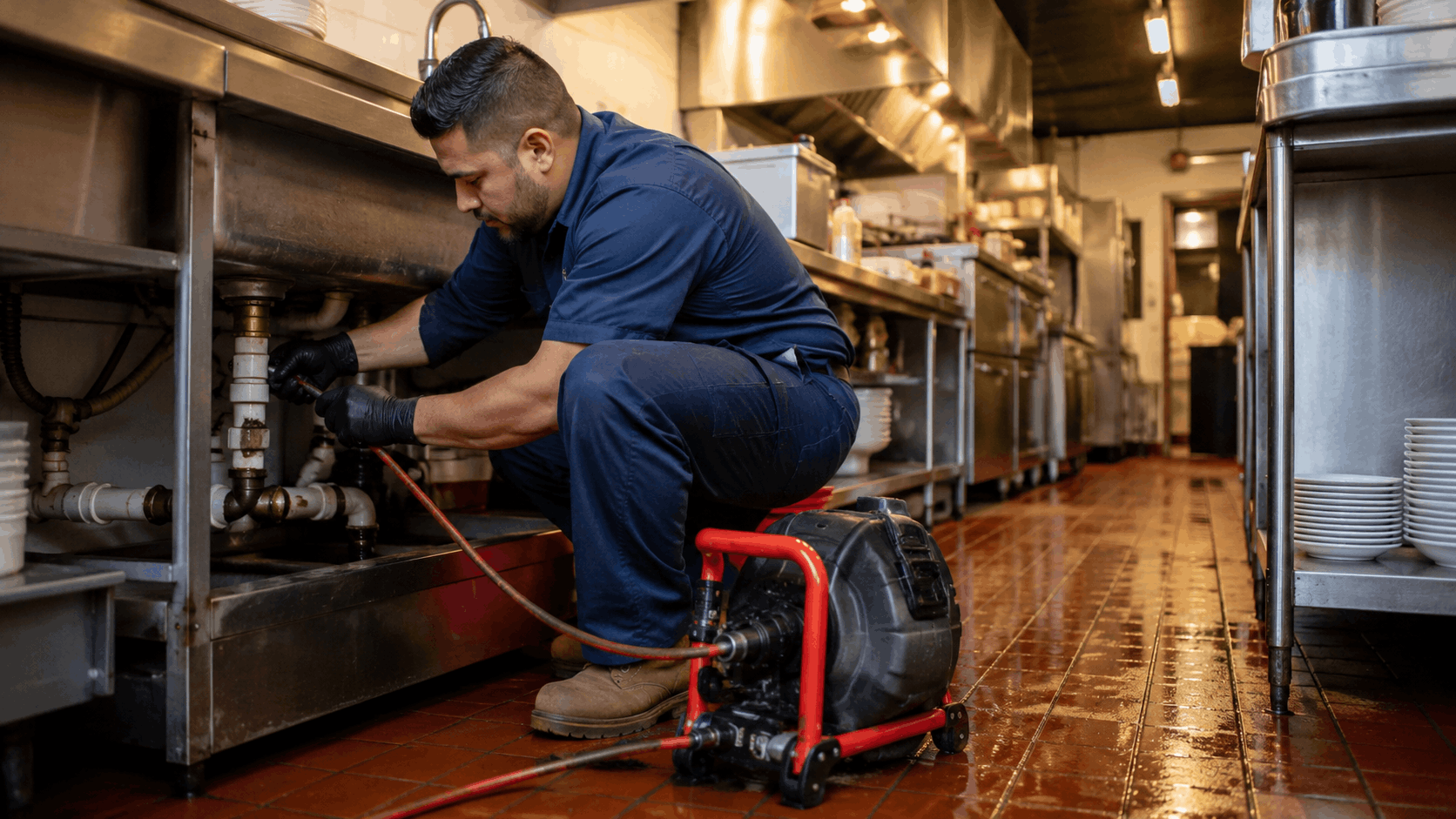
Once on site, the first priority is getting water flowing again. For most kitchen backups, that means drain cabling to break through the clog or hydro jetting to scour the line clean. The method depends on what is causing the blockage and how much buildup is present.
Cabling works well for a solid obstruction, cutting through and pulling it loose. Hydro jetting goes further by using high-pressure water to strip grease and debris off the pipe walls. For a grease-choked line, jetting restores far more of the original flow.
Sewer line clearing on a shared plaza system takes extra care to find the true blockage point. We use camera equipment to see inside the line and confirm the line is clear before we call the job done. Our sewer line repair and replacement team handles the bigger problems a camera reveals.
Getting the kitchen running again is the immediate win. Clearing the line properly also buys the restaurant time before the next problem.
Temporary Fixes vs Permanent Repairs
Not every problem can be fully solved at midnight, and that is fine. Sometimes the smart move is a temporary repair that stabilizes the kitchen overnight so it can open the next day. A stopgap that stops the flooding and restores basic function keeps the restaurant running.
A cracked fitting or a failing section of pipe might get a solid temporary seal after hours. That holds the situation together until a proper repair can be scheduled during off hours. The kitchen keeps serving in the meantime.
The permanent fix then happens on a plan, not in a panic. We schedule the real repair for a time that avoids more downtime, often before open or after close. That way the lasting solution does not cost the restaurant another night of business.
This two-step approach respects the reality of running a kitchen. We solve the emergency now and fix the root cause without shutting the doors again.
Documentation for Health and Insurance
After the work is done, paperwork matters more than most owners expect. We provide written service records that detail what failed, what we did, and when. Those records are exactly what the health district wants to see after a sewage or sink problem.
For an insurance claim, that documentation is often required. Adjusters need proof of the cause, the repair, and the timeline to process a claim for water damage or lost inventory. Clear records make that process much smoother.
Our service records also give the owner a history of the plumbing system. Over time, that history helps spot patterns and plan maintenance before the next failure. It turns a bad night into useful information.
Good documentation protects the restaurant on two fronts, compliance and cost recovery. We treat it as part of the job, not an afterthought.
Need Help in Las Vegas?
Active Plumbing serves Las Vegas and all of Las Vegas Valley.
Preventing After-Hours Failures Before They Start
The best emergency call is the one that never happens. With steady preventive maintenance, most corridor kitchens can avoid the mid-service breakdowns that cost them so much. A few routine habits keep the plumbing healthy and the doors open.
Scheduled Grease Trap Pumping
Regular grease trap pumping is the single most effective step a busy kitchen can take. How often depends on volume, but many high-output restaurants along Spring Mountain Road need service every four to eight weeks. Letting a trap fill past that window invites an overflow during service.
A good rule is to pump when the trap reaches about a quarter full of grease and solids. Waiting until it is packed leaves no margin for a busy night. A cleaning schedule takes the guesswork out and keeps the trap working the way it should.
Some owners try to stretch the interval to save money, and it almost always backfires. The cost of a scheduled pumping is small next to the cost of an overflow, a closure, and a possible violation. Consistency is the cheaper path.
Our team can set a pumping schedule matched to a kitchen's actual output. That takes one more worry off the owner's plate.
Routine Drain Line Jetting
Even with a well-maintained trap, some grease and debris always slip into the drain lines. Over months that residue builds up and narrows the pipe. Routine hydro jetting clears it out before it reaches a breaking point.
For high-volume kitchens, a hydro jetting schedule of every three to six months keeps the lines open. Slower kitchens might stretch it a bit, but the corridor's heavy traffic usually calls for the shorter interval. Regular jetting resets the pipe to near-full capacity.
The difference between reactive and scheduled jetting is night and day. Emergency jetting during a backup costs more and comes with downtime. Planned jetting happens during off hours with no disruption to service.
Think of drain buildup like plaque in an artery. Clear it on a schedule and it never gets the chance to cause a blockage at the worst moment.
Water Heater Inspections and Backups
A commercial water heater rarely dies without warning signs. A yearly water heater inspection can catch worn elements, failing valves, and heavy scale before they cause a total failure. Catching those issues early avoids the dreaded no-hot-water morning.
During an inspection, our crew checks heating elements, flushes sediment, and tests the pressure relief valve. In this area's hard water, flushing scale is especially important because buildup shortens a unit's life fast. A little maintenance stretches the years a heater lasts.
Every restaurant should also have a backup plan for the day a heater still fails. Knowing who to call and how fast a replacement can arrive keeps a dead heater from turning into a closed kitchen. Our water heater repair team responds fast to these calls.
For kitchens that cannot tolerate any downtime, we can discuss redundancy options. Planning ahead beats scrambling at open.
Training Staff to Spot Early Warning Signs
The people in the kitchen every day are the first line of defense. Trained staff can catch small problems long before they become emergencies. A little awareness goes a long way toward preventing a mid-shift disaster.
The early warning signs are simple to teach. A slow-draining sink, gurgling sounds from a drain, foul odors near the floor drains, or a small persistent leak all point to trouble building up. None of these fix themselves, and all of them get worse.
Staff training means telling the crew to report these signs instead of ignoring them. A drain that gurgles today might be a full backup by the weekend. Reporting it early lets a plumber clear it on a calm afternoon instead of during Friday service.
We are happy to walk kitchen managers through what to watch for. Empowering the staff to speak up is one of the cheapest forms of prevention there is.
Local Conditions That Make Las Vegas Kitchens Vulnerable
The desert climate and local water shape how plumbing behaves in this part of the valley. Restaurants along the corridor face challenges that kitchens in other climates never think about. Knowing these conditions helps owners plan around them.
Hard Water and Scale Buildup
Water from the Las Vegas Valley Water District is notably hard, carrying a heavy load of dissolved minerals. Those minerals leave scale behind on everything the water touches. In a kitchen, that means faucets, valves, and especially water heaters take a beating.
Hard water scale collects inside water heater tanks and on heating elements. That buildup makes the unit work harder, run less efficiently, and fail sooner. It is a big reason commercial heaters in this area have shorter lifespans than they might elsewhere.
Scale also clogs fixtures and narrows supply lines over time. Aerators clog, valves stick, and flow slowly drops. Regular descaling and, in some cases, water treatment help fight the problem. Our water treatment options can reduce the damage hard water does to a kitchen's plumbing.
For heaters, periodic flushing is the best defense against scale. It is a small task that adds real years to the equipment.
Summer Heat and Pipe Stress
Las Vegas summers are brutal, and the heat reaches the plumbing too. Extreme temperatures put stress on pipes and fittings, especially in exterior walls and rooftop lines exposed to the sun. Materials expand and contract, which wears joints over time.
Summer is also peak patio season, when many corridor restaurants push their busiest numbers. More customers mean more dishwashing, more restroom use, and more strain on the whole system. The heat and the volume hit at the same time.
Water heaters work in tough conditions during summer, often housed in hot back rooms or exterior closets. The ambient heat adds to the load. A unit already stressed by hard water has an even harder time in July and August.
Planning maintenance ahead of summer helps a kitchen ride out the busy, hot months. Catching pipe stress and heater issues in spring prevents a failure during the rush.
Older Plaza Infrastructure Between Valley View and Arville
The commercial corridors near Valley View Boulevard and Arville Street include some of the older plazas in the area. Their underground plumbing has been in the ground a long time, and the older infrastructure shows its age. Pipes here have handled decades of use.
Older systems often mix pipe materials from different eras of repair. A patchwork of cast iron, galvanized, and newer plastic can create weak points at the connections. Those transitions are common places for leaks and blockages to start.
Undersized and corroded lines in these plazas cannot always keep up with a modern high-volume kitchen. What worked for the original tenant may fall short for a busy restaurant. That mismatch drives many of the failures we see near Valley View Boulevard.
A camera inspection of these older lines is a smart move before problems escalate. Seeing the actual pipe condition lets an owner plan repairs instead of reacting to emergencies.
Grease Volume From Dense Dining Districts
The sheer concentration of restaurants in the corridor sends more grease into the shared systems than a typical area ever would. Dozens of kitchens in a small footprint all contribute fat to the same infrastructure. That grease volume overwhelms lines more quickly than in spread-out neighborhoods.
In a dining district this dense, the cumulative load on shared sewer lines is enormous. Even if each kitchen manages its own grease well, the combined output stresses the pipes downstream. It is a shared burden that no single tenant controls.
This is why maintenance across a plaza matters, not just at one restaurant. When every tenant keeps its grease in check, the whole shared system holds up better. One neglectful kitchen can cause problems for everyone on the line.
Our team understands how grease moves through these corridor systems. We help owners and property managers plan maintenance that accounts for the neighborhood, not just the single suite.
Need Help in Las Vegas?
Active Plumbing serves Las Vegas and all of Las Vegas Valley.
Choosing the Right Emergency Plumber for a Restaurant
Not every plumber is equipped to handle a commercial kitchen at midnight. When choosing an emergency service, restaurant owners should look for specific qualities that separate a real commercial plumber from a general handyman. The right choice pays off when something breaks.
Licensing and Commercial Experience
A Nevada licensed plumbing contractor is the baseline for any commercial work. Licensing means the work meets state code and the contractor carries proper insurance. A general handyman without that credential is a gamble on a job this important.
Commercial experience matters just as much as the license. Commercial kitchens use larger lines, grease interceptors, and equipment that a home plumber rarely touches. A plumber who works these kitchens knows their quirks and their common failure points.
That experience shows up in the speed and quality of the fix. Someone who has cleared a hundred grease-choked corridor lines works more quickly than someone seeing one for the first time. In an emergency, that head start counts.
Our crew brings both the credentials and the hands-on commercial background. Owners can learn more about our team on our about page.
Real 24/7 Availability, Not Just a Voicemail
Many companies claim 24/7 availability, but the test is what happens when you call at 2 a.m. A live answer and a dispatched crew mean real coverage. A voicemail and a callback in the morning mean the opposite.
Before an emergency ever happens, an owner should confirm how a company handles overnight and weekend service. Ask directly whether a plumber actually goes out at night or only takes messages. The answer tells you everything about whether they will be there.
Weekend service deserves the same scrutiny. Many failures happen on busy Friday and Saturday nights, so a company that goes quiet on weekends is not much help. Coverage has to match when the trouble actually strikes.
We built our operation around genuine round-the-clock response because that is when the corridor needs it. The line is answered by people, not machines.
Local Presence in Spring Valley
A local plumber based near the corridor holds a clear edge over one driving in from Henderson or the north valley. Distance is time, and in a flood, time is damage. A crew already working the area arrives sooner.
Local presence also means familiarity with the buildings themselves. We have worked in many of the plazas along Spring Mountain Road and know their plumbing quirks. That knowledge speeds up diagnosis when every minute matters.
Being part of the Spring Valley community means we know the streets, the traffic, and the shortcuts. That local read shaves time off every call. Owners can see our coverage on the Spring Valley West Sahara emergency plumbing page.
Choosing a nearby company is one of the simplest ways to improve response time. Proximity does a lot of the work.
Written Pricing and Clear Communication
An emergency is stressful enough without surprise costs. A written price before the work begins protects an owner from a shocking bill later. A trustworthy plumber explains the scope and the price so there are no games.
Clear communication runs through the whole call. From the phone diagnosis to the on-site explanation of the problem, an owner should always know what is happening and why. That transparency builds the trust a long-term relationship needs.
After-hours rates are normal for emergency work, and a fair company is open about them. What matters is that the numbers are explained before the wrench turns. No one should feel trapped into a price during a crisis.
We keep our pricing and communication straightforward, especially during the pressure of an emergency. An owner dealing with a flood deserves honesty, and that is what we give.
Final Thoughts
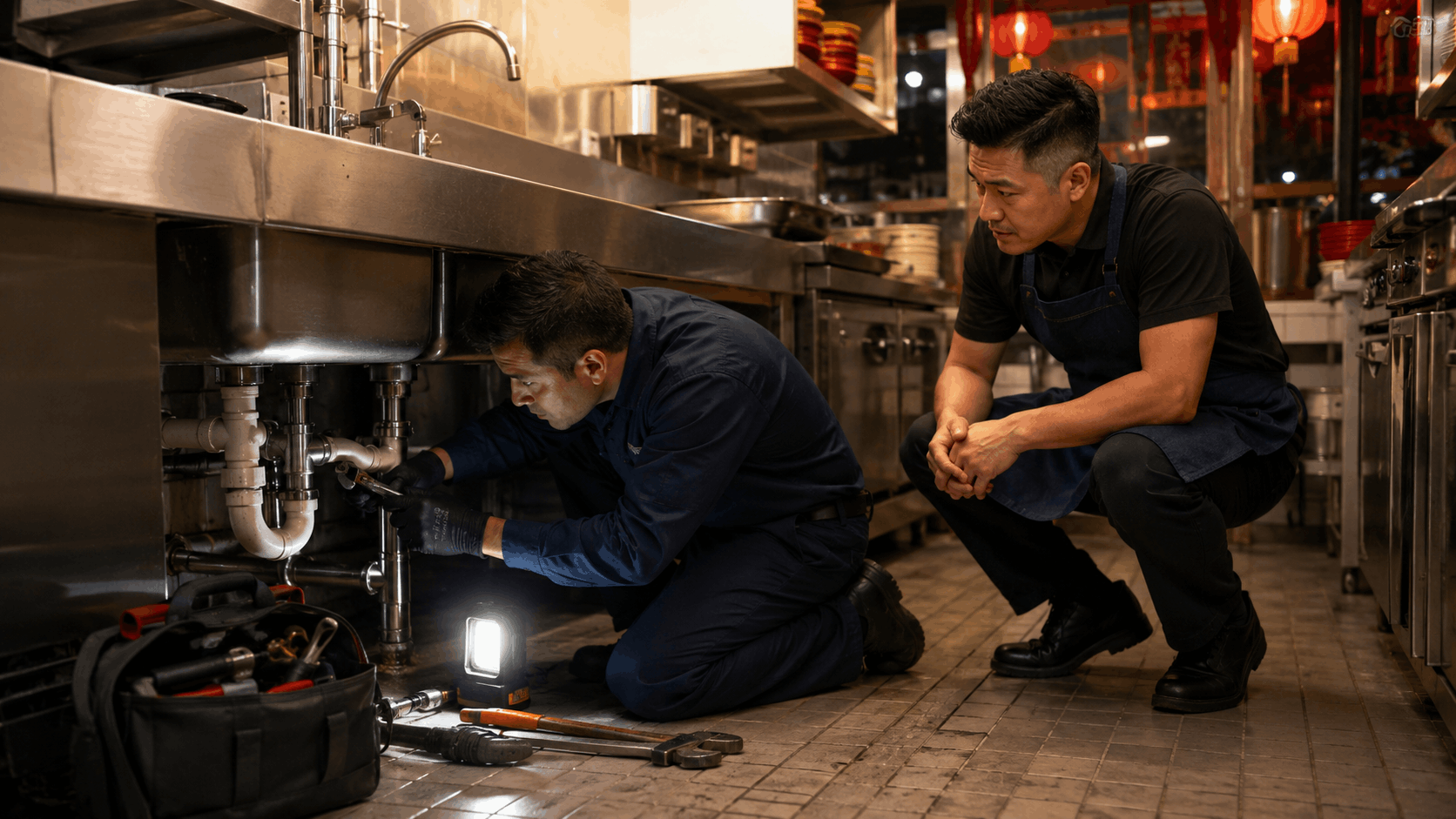
Plumbing failures along the Chinatown corridor are not a matter of if but when, given the density, the volume, and the aging buildings. The kitchens that weather them best are the ones that maintain their systems and know exactly who to call when something breaks after hours. Fast response and steady prevention keep the doors open and the health district satisfied.
Our team knows these plazas, these streets, and these kitchens because we work them every week. Whether it is a grease trap overflow at 11 p.m. or a scheduled jetting to prevent one, we are ready to help corridor restaurants stay running. If your kitchen needs emergency service or a maintenance plan, contact Active Plumbing any hour of the day or night.
Frequently Asked Questions
- How fast can a plumber reach a restaurant in the Chinatown corridor?
- Because our team works the Spring Mountain Road area daily, we can usually reach corridor restaurants within 30 to 60 minutes of an after-hours call. Actual arrival depends on the hour and where our nearest truck is, but our local base and knowledge of the 215 Beltway and side streets keep response times tight. We move the moment a call comes in.
- What should staff do before the plumber arrives?
- The first step is shutting off the water at the affected valve or the main to stop the flooding. Every closing crew should know where those valves are located ahead of time. Then move product and equipment away from the water and keep people clear of standing water near electrical gear. Call us and we can guide staff through the rest by phone.
- How much does emergency commercial plumbing cost?
- Cost depends on the job scope, the time of night, and what the repair requires. After-hours rates are typical for emergency work, and larger jobs like sewer line clearing run higher than a simple drain cable. We provide a written price on site so owners know the cost before any work begins. In most cases the repair costs far less than a night of forced closure.
- Why do grease traps overflow during dinner service?
- A grease trap overflows when it fills past capacity and can no longer separate grease from water. This almost always happens because the trap went too long between pumpings. High-volume kitchens fill traps fast, so a schedule that worked last year may be too slow now. Regular pumping matched to your kitchen's output prevents the mid-service overflow.
- Can a plumbing failure force a health inspection shutdown?
- Yes. The Southern Nevada Health District treats sewage backups and non-working sinks as serious hazards. A backup in a food prep area or a lack of hot water at the dish sink can lead to a kitchen being closed until the problem is fixed and sanitized. Fast repair and proper documentation help a restaurant return to compliance quickly.
- How often should a restaurant jet its drain lines?
- For high-volume kitchens along the corridor, we generally recommend hydro jetting every three to six months. Heavy grease output shortens the safe interval, while slower kitchens can sometimes stretch it a bit. Scheduled jetting clears buildup before it becomes a blockage, and it happens during off hours with no disruption to service.
- What causes commercial water heaters to fail overnight?
- A common causes are hard water scale on the elements and tank, worn-out heating elements, and simple age. This area's mineral-heavy water speeds up scale buildup, which shortens heater life. Units often fail overnight because they cool down and then cannot recover, leaving the opening crew with no hot water. Yearly inspections and flushing help prevent it.
- Does Active Plumbing offer maintenance contracts for restaurants?
- Yes. We set up scheduled maintenance plans covering grease trap pumping, drain line jetting, and water heater inspections matched to your kitchen's volume. These plans keep the plumbing healthy and head off the mid-service failures that cause closures. A maintenance contract is the most reliable way to avoid after-hours emergencies in the first place.
- Will the plumber provide documentation for insurance?
- Yes. Our team provides written service records detailing what failed, what we did, and when the work was performed. These records are what the health district looks for after a sanitation issue and what insurance adjusters need to process a claim for water damage or lost inventory. Good documentation protects the restaurant on both fronts.
- What areas around Spring Valley does the team serve?
- We serve the full Chinatown corridor along Spring Mountain Road, through Spring Valley, and into nearby Las Vegas neighborhoods. Our coverage reaches the plazas between Jones and Rainbow, the older corridors near Valley View and Arville, and surrounding areas. You can see our full service map on our locations page .
Licensed plumbing professionals serving Las Vegas and Las Vegas Valley.
Licensed in Nevada · License #0047021
Last updated on
Why trust Active Plumbing?
Founded in 1991, Active Plumbing is a licensed and insured plumber serving Las Vegas and Las Vegas Valley. All content is reviewed by our licensed technicians.

Need Help in Las Vegas?
Active Plumbing serves Las Vegas and all of Las Vegas Valley.
Related Articles
Active Plumbing Service Area Map: Every Las Vegas Valley Neighborhood Covered
See the full Active Plumbing service area map covering every Las Vegas Valley neighborhood, from Summerlin to Henderson to Skye Canyon, plus local plumbing tips.
Emergency Plumbing in Summerlin: Gate Codes, HOA Notification, and Our Response Protocol
A Summerlin homeowner's guide to emergency plumbing: gate codes, guard gates, HOA notification steps, our response protocol, and what to do before the plumber arrives.
What Henderson Homeowners in Green Valley Should Know About Aging Pipes
Green Valley homes from the 1980s and 1990s are hitting the age where pipes fail. Learn the warning signs, pipe materials, and repair options for aging Henderson plumbing.