Tips & Advice
What Henderson Homeowners in Green Valley Should Know About Aging Pipes

Key Takeaways
- Many Green Valley homes built in the 1980s and 1990s now have pipes 30 to 44 years old, right when failures cluster.
- Polybutylene gray pipe fails without warning and should be fully replaced rather than patched.
- Watch for rusty water, dropping pressure, ceiling stains, and rising water bills as early signs of aging pipes.
- Henderson's hard water and desert climate speed up scale buildup and pipe corrosion.
- Spot repairs work for isolated leaks, but repeated leaks or polybutylene call for a full repipe.
- PEX often outperforms copper in Henderson's hard water and costs less to install.
- A whole-home repipe in Henderson typically runs $4,000 to $15,000 and takes two to four days.
- Water softeners, regular inspections, and knowing your main shutoff extend pipe life and limit damage.
In This Article
It usually starts small. A homeowner off Green Valley Parkway turns on the shower and the water trickles out weaker than it did last year. A few weeks later, the water heater in the garage fills a bucket with brown, metallic-smelling water. These are the kinds of calls our team gets almost every week from folks living in the older parts of Henderson.
Green Valley is one of the most established master-planned communities in the Las Vegas Valley. Many of the homes here were built decades ago, and the plumbing inside those walls has been working nonstop ever since. That plumbing does not last forever, and the desert conditions around Henderson wear it down faster than people expect.
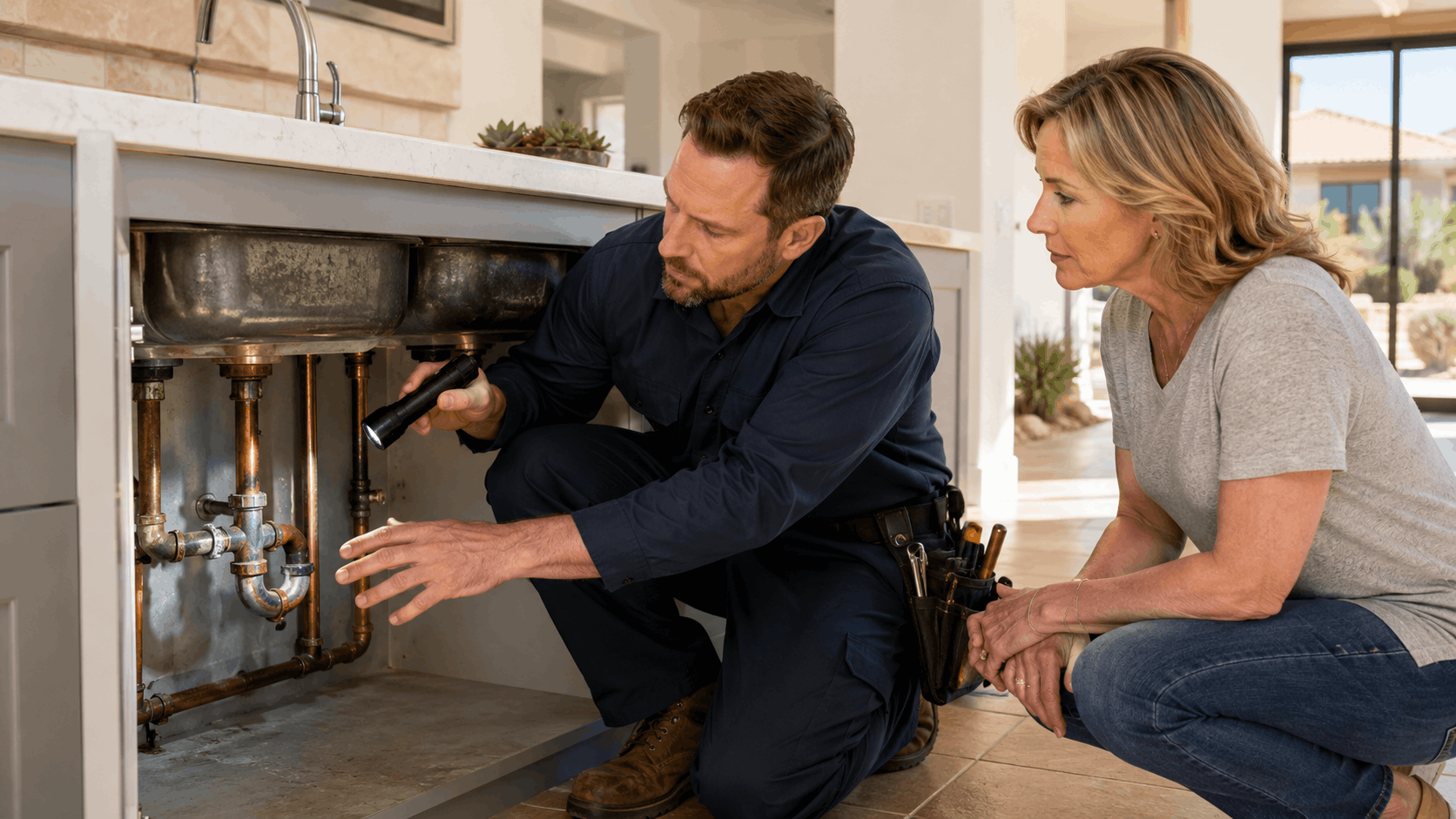
Why Green Valley Homes Are Reaching the Age Where Pipes Fail?
Green Valley did not exist as a neighborhood until 1978, when its first homes opened. Once construction started, it grew fast, filling in the land between Sunset Road and the hills above Henderson. That timeline matters, because plumbing has a shelf life, and a lot of these homes have now hit the point where original pipes start to give out.
The Green Valley history is tied directly to the plumbing risk homeowners face today. When a home passes the 30 to 40 year mark, aging pipes become the norm rather than the exception. Home age is the single best predictor of whether you will deal with a pipe problem soon.
| Neighborhood Era | Approximate Build Years | Home Age in 2024 | Plumbing Risk Level |
|---|---|---|---|
| Early Green Valley core | 1978-1988 | 36-46 years | High |
| Green Valley Ranch expansion | 1994-2007 | 17-30 years | Moderate to High |
| The District and later infill | 2004-2010 | 14-20 years | Low to Moderate |
When Green Valley Neighborhoods Were Built
The oldest streets near Green Valley Parkway and Sunset were part of the original late-1970s and 1980s homes push that turned raw desert into suburban blocks. Builders moved quickly to meet demand as families poured into Henderson looking for space and newer schools. Those first houses are now sitting squarely in the 36 to 44 year range.
Through the late 1980s and 1990s, the community pushed south and east toward what would later become Green Valley Ranch. Homes from this stretch are hitting the 30 to 40 year mark, right when plumbing failures tend to cluster. We see a steady stream of calls from these exact pockets every month.
The District came much later, opening in the mid-2000s as a walkable retail and residential hub. Homes built around that time have newer plumbing and far fewer problems. Knowing which building wave your home came from gives you a rough idea of what is running behind your walls.
If you are not sure when your house was built, check your property records through the Clark County Assessor. That single date tells you a lot about your risk before a plumber ever steps inside.
How Long Different Pipe Materials Last
Pipe lifespan depends heavily on the material a builder chose. Copper is the long-distance runner, often lasting 50 to 70 years under good conditions. In hard-water areas like Henderson, though, copper can wear out faster than that upper number suggests.
Galvanized steel was common in older construction and typically lasts 40 to 50 years. The catch is that galvanized steel corrodes from the inside, so it often fails on the low end of that range in the desert. Many Green Valley homes with galvanized lines are already living on borrowed time.
Polybutylene is the shortest-lived of the bunch, with a practical lifespan of only 10 to 15 years before failures become common. Homes that still have it are well past that window. If your house was built in the late 1980s or early 1990s, this material is a real possibility.
Matching your home age against these ranges gives you a quick self-assessment. A 1985 home with original galvanized or polybutylene is due for attention, plain and simple.
The Nevada Climate Factor
Henderson sits in a high desert with some of the hardest water in the country. Hard water is loaded with calcium and magnesium that settle inside pipes as scale, narrowing them year after year. That mineral buildup is one of the biggest reasons local pipes age faster than the same pipes would in a wetter climate.
The desert climate also puts pipes through wide temperature swings. Summer heat and cooler winter nights cause metal to expand and contract, stressing joints and fittings over time. Repeated movement slowly loosens connections that were once watertight.
Pipe corrosion speeds up when hard water meets metal that is already stressed. Copper develops pinholes, galvanized steel rusts through, and older joints start to weep. The combination of mineral-heavy water and desert heat is hard on any plumbing system.
You can read more about local water quality from the Las Vegas Valley Water District, which reports on the mineral content Henderson homes deal with every day. That data explains why our crews see so much scale buildup in this valley.
Get Your Quote
Tell us what's going on and we'll get back to you fast.
The Pipe Materials Found in Older Green Valley Houses
Not every home has the same pipes, and the difference matters. The pipe materials in a Green Valley house tell us how urgent the situation is and what repair path makes sense. Copper, galvanized steel, and polybutylene each behave very differently as they age.
Here is a quick breakdown of what we commonly find:
- Copper - durable but vulnerable to pinhole leaks from hard water.
- Galvanized steel - rusts internally and chokes off water flow.
- Polybutylene - the gray pipe that fails suddenly and without warning.
Polybutylene: The Gray Pipe Problem
Polybutylene is a soft, flexible plastic pipe that is usually gray, though it can also be black or blue. Builders across the country used it heavily from the late 1980s into the mid-1990s because it was cheap and easy to install. A number of Green Valley homes from that era have it running through the walls and ceilings.
The problem is that polybutylene reacts badly to the chlorine and minerals in city water. Over time the pipe becomes brittle from the inside, developing tiny cracks that a homeowner cannot see. This is why gray pipe failures often show up as a sudden burst rather than a slow drip.
Because the damage builds silently, there is rarely a warning before a line lets go. We have responded to flooded hallways where the homeowner had no idea anything was wrong the day before. When a burst pipe happens with polybutylene, it tends to be dramatic.
Most plumbers, including our team, recommend replacing polybutylene entirely rather than patching it. Fixing one section does nothing for the rest of the brittle system waiting to fail.
Galvanized Steel and Interior Rust
Galvanized steel pipe was coated with zinc to resist corrosion, but that coating breaks down after a few decades. Once it does, the bare steel underneath starts to rust from the inside out. Homeowners rarely notice because the damage is hidden within the pipe wall.
As rust flakes build up, they narrow the inside of the pipe like plaque in an artery. That is a common cause of low pressure in older Green Valley homes, especially on hot-water lines. A shower that used to blast now dribbles because the passage has shrunk.
Rusty water is the other telltale sign of failing galvanized steel. When you turn on a tap after the water has sat overnight, you may see a brown or yellow tint. That color comes from corrosion inside the pipe itself.
Galvanized systems that show these symptoms are usually near the end of their life. At that point, our team often recommends a full replacement of the affected lines with modern materials.
Copper and What Wears It Down
Copper pipe is the material many homeowners hope they have, and for good reason. It holds up well in Henderson and resists most kinds of corrosion better than steel. Copper installed in the 1990s is often still in decent shape today.
Still, copper is not immune to trouble. Hard water damage builds scale on the inside, and acidic or aggressive water can eat at the metal from within. Over the years, this leads to pinhole leaks, which are tiny holes that spray a fine mist behind walls.
Pinhole leaks are sneaky because they release very little water at first. A homeowner might notice a faint musty smell or a small stain long before finding the source. Left alone, one pinhole often signals more on the way.
When copper starts developing repeated pinholes, spot repairs stop being worth it. Our crews look at the overall condition of the copper before deciding whether to patch or replace.
How to Tell What You Have
Homeowners can often identify their pipe material with a quick look. Start near the water heater in the garage, where the incoming and outgoing lines are usually exposed. Copper looks like a shiny or dull reddish-brown metal, similar to a penny.
Galvanized steel is a dull silver-gray and is magnetic, so a fridge magnet will stick to it. Polybutylene is plastic and flexible, usually gray, and connected with metal or plastic crimp fittings. Checking under a bathroom or kitchen sink is another easy pipe inspection spot.
If you spot gray plastic anywhere, take a photo and note where it is. That single detail helps a plumber understand your risk before an appointment. Our pipe and fixture team can confirm the material and check the hidden runs you cannot see.
When in doubt, do not guess and hope for the best. A short inspection gives you real answers about what is behind your walls and how much life it has left.

Need Help in Las Vegas?
Active Plumbing serves Las Vegas and all of Las Vegas Valley.
Warning Signs of Aging Pipes to Watch For
Most pipe failures give off warning signs before they turn into emergencies. The trick is knowing what to look for. Catching these plumbing problems early often means a small repair instead of a flooded room.
Here are the symptoms Green Valley homeowners report most often:
- Discolored water from the tap.
- Dropping water pressure at showers and faucets.
- Stains and damp spots on ceilings, walls, or floors.
- Rising water bills with no change in usage.
Discolored or Rusty Water
Brown, yellow, or reddish water is one of the clearest signals of trouble. In older Henderson homes, that color usually comes from rust inside galvanized pipes. A metallic taste along with the color points the same direction.
Pay attention to when the discoloration shows up. If it appears mostly on the first draw in the morning, corrosion inside your own pipes is the likely cause. Water that clears after running for a minute suggests the buildup is inside your home rather than the city main.
Occasional cloudy water after utility work is usually harmless and clears on its own. Persistent rust-colored water is different and worth investigating. It tells you the pipe walls are actively breaking down.
Water quality problems that keep returning rarely fix themselves. When rusty water becomes a regular event, it is a strong sign that aging pipes need attention.
Dropping Water Pressure
Weak showers and slow-filling tubs frustrate homeowners across Green Valley. When pressure drops gradually over months or years, internal pipe buildup is often to blame. Scale and rust shrink the passage until only a fraction of the water can get through.
A sudden pressure drop points to something different, often a leak somewhere in the system. If one fixture is weak while others are fine, the problem may be local to that line. Low pressure across the whole house usually means a bigger issue.
Slow flow can also come from clogged aerators or a failing pressure regulator. A plumber can rule those out quickly before looking deeper. It helps to note which faucets are affected and whether hot or cold is worse.
Ignoring falling pressure lets the underlying buildup keep growing. What starts as a mild annoyance can end in a fully blocked or burst line down the road.
Stains, Spots, and Damp Spots
Water stains on a ceiling or wall are one of the first visible signs of a hidden leak. A yellow or brown ring that slowly grows means water is escaping somewhere above or behind it. These stains often show up long before you hear any dripping.
Warped flooring and soft, spongy spots underfoot are another warning. Wood floors buckle and laminate lifts when moisture seeps in from a leaking pipe. Damp baseboards or a musty smell in one room point to the same problem.
Hidden leaks are tricky because the water often travels before it surfaces. A stain in the hallway might come from a pipe several feet away. Finding the true source takes the right tools and experience.
Our team uses electronic leak detection to pinpoint these problems without tearing open every wall. Catching water damage early keeps the repair small and the cost down.
Rising Water Bills Without Reason
A sudden jump in your water bill is a quiet but reliable clue. If your habits have not changed but the Las Vegas Valley Water District bill climbed, water is going somewhere it should not. A slow leak can waste hundreds of gallons before you ever see a wet spot.
Compare a few recent bills to spot the trend. Two or three months of steady increases with no explanation deserve a closer look. Even a small underground leak adds up fast over a billing cycle.
You can test for a hidden leak by checking your meter. Turn off every fixture, note the meter reading, wait an hour, and check again. Movement with everything off means water is escaping somewhere.
A slow leak that shows up on the bill is often easier to fix if caught early. Waiting usually means both a higher bill and more damage to repair.
Hidden Damage Aging Pipes Can Cause
The scariest part of aging pipes is the damage you cannot see. A small leak that goes unnoticed for months can lead to serious structural and health problems. Water damage, mold, and slab leaks all cost far more than the original pipe repair would have.
Here is what ignored pipe problems can turn into:
- Slab leaks beneath the foundation.
- Mold growth inside walls and under floors.
- Ruined drywall, flooring, and cabinets.
Slab Leaks Under the Foundation
Many Green Valley homes are built on concrete slab foundations with pipes running underneath. When one of those buried lines springs a leak, the water has nowhere to go but into the ground and up through the slab. This is what plumbers call a slab leak, and it is one of the toughest problems to catch.
Signs of a slab leak include warm spots on the floor, the sound of running water when everything is off, and unexplained cracks in the foundation. Sometimes the first clue is a section of tile that stays damp or a carpet that feels wet. By then, water has often been leaking for a while.
Left alone, a slab leak can cause real structural damage. Constant moisture undermines the soil under the foundation and can shift the slab itself. That leads to cracked walls, sticking doors, and repairs that run into the thousands.
Our crews locate slab leaks with listening equipment and pressure testing before opening any concrete. Finding the exact spot means we fix only what needs fixing and spare the rest of your floor.
Mold and Air Quality
Hidden moisture from a leaking pipe is a perfect breeding ground for mold. Once water settles inside a wall cavity, mold can start growing within a day or two. The desert air outside does nothing to stop it once the moisture is trapped inside.
Mold growth inside walls often goes unnoticed until the smell becomes obvious. That musty odor is the mold releasing spores into the air your family breathes. Poor air quality from hidden mold can trigger allergies, coughing, and other health complaints.
The longer a leak feeds the moisture, the wider the mold spreads. What begins as a small patch behind a bathroom wall can travel through insulation and framing. Remediation gets expensive fast once it reaches that stage.
Stopping the leak at the source is the only real fix for moisture-driven mold. Once the water is gone, the affected materials can be dried out or replaced before the problem grows.
Damage to Floors, Walls, and Cabinets
Slow leaks are especially cruel to the parts of your home you paid the most for. Drywall soaks up moisture and starts to sag, crumble, and stain. A leak behind a wall can ruin a whole panel of drywall before anyone notices.
Wood and laminate flooring swell and warp when water works underneath them. Boards cup, edges lift, and the finish bubbles away. Once flooring absorbs enough water, it usually has to be pulled up and replaced entirely.
Cabinets take a beating too, especially the ones under kitchen and bathroom sinks. Particleboard bases swell and fall apart after repeated exposure to a slow drip. Cabinet damage is common in older Green Valley homes with aging supply lines.
All of this comes back to the same point: a pipe repair is cheap compared to what happens when the leak keeps running. Fixing the source early protects the finishes that make your house feel like home.
Need Help in Las Vegas?
Active Plumbing serves Las Vegas and all of Las Vegas Valley.
Repair Versus Repipe: Making the Right Call
One of the biggest questions homeowners ask us is whether they need a small fix or a full repipe. The answer depends on the pipe material, the number of problems, and the age of the system. Making the right plumbing decision saves money and prevents repeat headaches.
When a Spot Repair Is Enough
Sometimes a single problem really is just a single problem. If a copper line develops one leak from an accidental nail or a stray impact, a spot repair fixes it cleanly. The rest of the system may have plenty of life left.
Spot repairs make sense when the surrounding pipe is in good shape and the material is sound. A newer copper or PEX system with one isolated failure is a good candidate. In those cases, replacing a short section restores everything without a big project.
The cost savings of a targeted repair are real when the situation calls for it. There is no reason to repipe a whole house for one bad joint. Our team is honest about when a small fix is the smart move.
The trouble comes when homeowners keep patching a system that is failing all over. At some point the repeat repairs cost more than doing the job right once.
Signs You Need a Full Repipe
Repeated leaks in different spots are the clearest sign a full repipe is due. When you fix one line and another fails a few months later, the whole system is telling you it is worn out. Chasing leak after leak wastes money and patience.
Polybutylene is a repipe situation almost by default. Because gray pipe fails without warning and cannot be trusted, replacing all of it is the only reliable solution. The same goes for galvanized steel that has rusted throughout.
Widespread corrosion, low pressure across the whole house, and rusty water at multiple fixtures all point the same direction. These are system-wide problems, not isolated ones. A whole-home repipe resets the clock with fresh, reliable material.
Our crews assess the full system before recommending a repipe. We would rather show you the evidence than push a big job you do not need.
Modern Pipe Options: PEX and Copper
When it is time to replace, PEX and copper are the two main choices for Green Valley homes. PEX piping is a flexible plastic that resists scale buildup and handles hard water well. It installs faster, costs less, and needs fewer connections, which means fewer places to leak.
Copper remains a trusted option that many homeowners prefer for its long track record. Copper repipe work costs more and takes longer, but the material is rigid and time-tested. Some buyers and HOAs still favor it for that reason.
Choosing between these replacement materials comes down to budget, preference, and the layout of the home. In the hard water of Henderson, PEX has a real advantage against scale and pinhole leaks. Many of our Green Valley repipes now use PEX for that reason.
You can read general guidance on pipe materials from the EPA drinking water program. Our team walks each homeowner through the pros and cons before any work begins.
Cost and Time Ranges to Expect
Repipe cost varies with home size, number of bathrooms, and material choice. As a general range, a whole-home repipe in the Henderson area often falls between $4,000 and $15,000. Larger homes with copper land at the higher end, while smaller PEX jobs come in lower.
A single spot repair is far cheaper, usually a few hundred dollars depending on access. Slab leak repairs cost more because of the concrete work involved. Every plumbing estimate should spell out exactly what is included.
Project timeline matters too. A spot repair often wraps up in a few hours, while a full repipe typically takes two to four days for an average home. Larger houses or difficult access can stretch that a bit.
We give clear, written estimates before starting so there are no surprises. Knowing the numbers up front helps homeowners plan the work with confidence.
How Active Plumbing Helps Green Valley Homeowners
Our team has worked on hundreds of homes across Henderson, from the original streets near Green Valley Parkway to the newer builds around The District. We know the pipe materials common to each era and the problems the desert brings. As a local Green Valley plumber, we focus on honest assessments and lasting repairs.
Here is how Active Plumbing supports homeowners dealing with aging pipes:
- Camera inspections and leak detection to find hidden trouble.
- Full and partial repiping with minimal damage to your home.
- Coverage across the entire Henderson area with fast response.
Camera Inspections and Leak Detection
Finding a problem before tearing into walls saves everyone time and money. Our crews run camera inspections through drain and sewer lines to see exactly what is happening inside. A sewer camera inspection shows blockages, cracks, and root intrusion in real time.
For pressurized supply lines, we use electronic and acoustic leak detection to locate hidden leaks. These non-invasive methods pinpoint the exact spot without guesswork. That means we open only the small area we need to reach.
A full pipe assessment gives homeowners a clear picture of their system. We show you what we find and explain what it means in plain language. No scare tactics, just the facts about your pipes.
This approach lets homeowners make informed choices about repair or replacement. Seeing the actual condition of a line removes the guesswork from a big decision.
Repiping With Minimal Disruption
A repipe sounds intimidating, but a careful crew keeps the mess to a minimum. We plan each repiping service to limit the number of wall and ceiling openings. Strategic access points mean less drywall to patch when the job is done.
We have repiped homes near Green Valley Ranch and out toward Anthem, working around families and their schedules. Most whole-home projects finish in a few days with water restored each evening when possible. Careful protection of floors and furniture keeps your home livable during the work.
Modern PEX makes low-disruption repipes easier because it bends around framing without dozens of joints. That flexibility often means fewer holes and faster completion. Homeowners are usually surprised how clean the process can be.
When the pipes are replaced, we clean up thoroughly and leave clear notes on what was done. Our goal is a finished job that looks like we were barely there.
Serving the Whole Henderson Area
We are a Henderson plumber in the true sense, covering the neighborhoods people actually live in. From The District and Green Valley Ranch to Whitney Ranch and beyond, our trucks know these streets. Local service means shorter drive times and faster help when a pipe fails.
We also serve the surrounding valley, including Lake Las Vegas and the communities out toward Anthem. Wherever you are in Henderson, we can usually get a technician out quickly. Emergencies do not wait, and neither do we.
Years of working these specific neighborhoods gives us a head start on every call. We often know the common pipe material for a street before we arrive. That local knowledge speeds up diagnosis and repair.
Whether you need a quick fix or a full repipe, our team treats your home like our own. Reliable, honest work is what keeps Green Valley families calling us back.
Need Help in Las Vegas?
Active Plumbing serves Las Vegas and all of Las Vegas Valley.
Simple Steps to Extend the Life of Your Pipes
A few good habits can add years to your plumbing and prevent surprise failures. Pipe maintenance is far cheaper than emergency repairs. These simple steps make a real difference in a hard-water city like Henderson.
Managing Hard Water With a Softener
Hard water is the number one enemy of pipes in the Las Vegas Valley. A water softener removes much of the calcium and magnesium that cause mineral buildup inside your lines. Softer water means less scale coating the inside of your pipes and fixtures.
The benefits reach beyond the pipes themselves. Softened water is easier on water heaters, faucets, and appliances, extending their life too. Many homeowners notice their fixtures stay cleaner and last longer.
Our team handles water softener installation sized to your household. We help you choose a system that matches your water usage and budget. Proper sizing keeps the softener running efficiently for years.
In a valley with water this hard, a softener is one of the smartest investments a homeowner can make. It slows the aging process that shortens pipe life across the region.
Scheduling Regular Inspections
Older homes benefit from a plumbing inspection every couple of years. A regular maintenance schedule catches small problems before they grow into big ones. For homes over 25 years old, this check is well worth the time.
During an inspection, a plumber looks at exposed pipes, checks water pressure, and tests for leaks. Any early signs of corrosion or scale get flagged before they cause damage. It is the plumbing version of a routine checkup.
Catching a weakening line during an inspection lets you plan a repair on your terms. That beats scrambling during a middle-of-the-night flood. Planned work is always cheaper and less stressful than an emergency.
We recommend inspections especially for homes with older galvanized or any polybutylene. Those materials deserve a closer eye given how they age in this climate.
Knowing Your Main Shutoff
Every homeowner should know where the main water shutoff is located. When a pipe bursts, turning off that valve stops the flood in seconds. Fumbling to find it during an emergency costs precious minutes and gallons.
In most Green Valley homes, the main shutoff sits near the front of the house or in the garage. There is also a curbside valve near the meter that shuts off water from the street. Learn both locations before you ever need them.
Test the water valve once or twice a year to make sure it turns freely. Valves that sit untouched for years can seize up right when you need them. A quick turn keeps it working and ready.
This bit of emergency prep can be the difference between a minor cleanup and a major loss. If your valve is stuck or leaking, our emergency plumbing team can replace it before trouble strikes.
Final Thoughts
Green Valley is full of well-loved homes that have been standing for three and four decades. The plumbing inside many of them is now at the age where problems show up. Knowing your pipe material, watching for warning signs, and acting early are the best ways to protect your home.
Discolored water, weak pressure, unexplained stains, and rising bills all deserve attention. Catching a small leak beats dealing with mold, slab damage, or ruined floors later. When repairs pile up or polybutylene is in the walls, a repipe is often the wiser long-term choice.
If your Henderson home is showing any of these signs, our team is ready to take a look. Call Active Plumbing or reach out to us to schedule an inspection or consultation. We will give you honest answers and a clear plan for your aging pipes.
Frequently Asked Questions
- How old are pipes in most Green Valley homes?
- Many Green Valley homes were built in the 1980s and 1990s, so their pipes are now 30 to 44 years old. That age puts them right in the window where galvanized steel and polybutylene commonly fail. Copper from that era may still work but often carries hard-water scale. If your home dates to this period, having the plumbing checked is a smart move.
- Do Green Valley homes have polybutylene pipes?
- Some do, especially houses built in the late 1980s and early 1990s when the gray pipe was popular. You can check for it near the water heater or under sinks, where it appears as flexible gray plastic tubing. Polybutylene fails without warning and cannot be trusted long term. If you find it, we recommend planning a full replacement rather than waiting for a burst.
- How much does a full repipe cost in Henderson?
- A whole-home repipe in the Henderson area generally runs between $4,000 and $15,000. The final price depends on the size of the home, the number of bathrooms, and whether you choose PEX or copper. Smaller homes with PEX sit at the lower end, while larger copper jobs cost more. We provide a written estimate so you know the exact figure before any work starts.
- Why is my water pressure so low?
- Low water pressure in older homes usually comes from mineral and rust buildup narrowing the inside of the pipes. Corrosion in galvanized steel is a frequent cause in Green Valley houses. A hidden leak or a failing pressure regulator can also drop pressure. A plumber can test the system and pinpoint whether buildup, a leak, or a fixture is to blame.
- Is rusty water dangerous to drink?
- Rusty water is usually more of a nuisance than a serious health hazard, but it signals a real plumbing problem. The brown or yellow color comes from corroding iron pipes inside your home. It can stain fixtures and give water a metallic taste. If discoloration is frequent or persistent, have the pipes inspected, since it points to lines that are breaking down.
- How long does a repipe take?
- Most whole-home repipes take two to four days for an average Henderson house. PEX installs faster than copper because it needs fewer joints and bends around framing. Larger homes or difficult access can add a day. Our crews restore water each evening when possible so your household stays functional during the project.
- Does hard water in Henderson damage pipes?
- Yes, Henderson has some of the hardest water in the country, and it takes a toll on pipes. The calcium and magnesium form scale that narrows the lines and stresses fittings. Over time this mineral buildup shortens the life of pipes, water heaters, and fixtures. A water softener is one of the best ways to slow that damage and protect your plumbing.
- Should I choose PEX or copper for a repipe?
- Both work well, but PEX has real advantages in Henderson's hard water. It resists scale, costs less, installs faster, and has fewer joints that can leak. Copper is rigid and time-tested, which some homeowners and HOAs prefer. For most Green Valley repipes, we lean toward PEX, though we walk each homeowner through the trade-offs before deciding.
- How do I find a hidden slab leak?
- Watch for warm spots on the floor, the sound of running water when everything is off, unexplained damp carpet, and a jump in your water bill. These signs suggest a pipe leaking beneath the concrete slab. Plumbers confirm it using listening equipment and pressure testing to locate the exact spot. That precision means we open only the small area needed to make the repair.
- How often should older homes get a plumbing inspection?
- Homes over 25 years old should have a plumbing inspection every two years or so. Houses with galvanized steel or polybutylene may benefit from yearly checks given how those materials age. Regular inspections catch corrosion, scale, and small leaks before they cause damage. It is a low-cost habit that helps you plan repairs on your schedule instead of during an emergency.
A
Licensed plumbing professionals serving Las Vegas and Las Vegas Valley.
Licensed in Nevada · License #0047021
Last updated on
Why trust Active Plumbing?
Founded in 1991, Active Plumbing is a licensed and insured plumber serving Las Vegas and Las Vegas Valley. All content is reviewed by our licensed technicians.

Need Help in Las Vegas?
Active Plumbing serves Las Vegas and all of Las Vegas Valley.
Related Articles
Tips & Advice
Drain and Sewer Service in Henderson Green Valley: Slab-Era ABS and Root Barriers
A local guide to drain and sewer service in Henderson's Green Valley, covering slab-era ABS pipe, tree root intrusion, root barriers, camera inspections, and repair options.
Cost Guides
Plumber in Green Valley Henderson: Service Costs and Response Times for Sun City Anthem Area
Real plumbing service costs, response times, and local conditions for Sun City Anthem, Green Valley, and the wider Henderson area from Active Plumbing.
Tips & Advice
Water Heater Replacement in Green Valley Henderson: High Water Pressure and PRV Pairing
High street pressure quietly kills water heaters in Green Valley Henderson. Learn why pairing a new unit with a PRV protects your investment, warranty, and home.