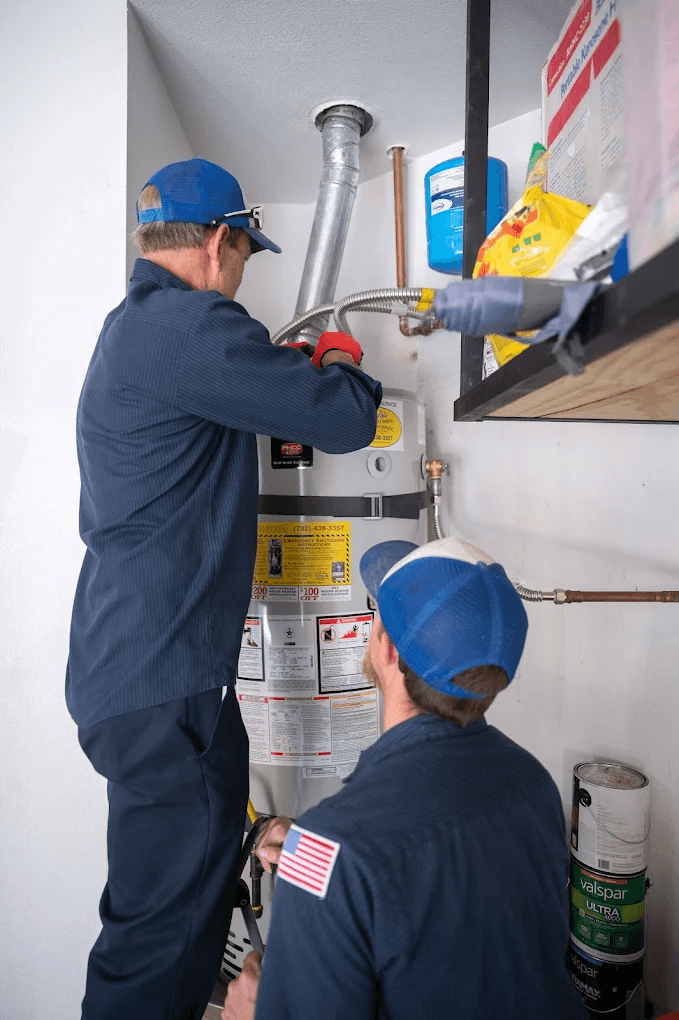
The Southern Nevada Water Authority reports valley water at about 280 parts per million, roughly 16 grains per gallon, which is very hard. In a tank, that mineral load settles as sediment on the bottom, where it insulates the burner or lower element and makes the heater work harder. A tank left unflushed fails earlier than its rated life. In a tankless unit, the same minerals scale the narrow heat exchanger passages and trigger flow and overheat error codes.
On a gas tank, no hot water usually points to the pilot, thermocouple or gas control valve. On an electric tank, it is usually an element, a thermostat or a tripped high-limit switch. Popping or rumbling means sediment. Rusty hot water or a sulfur smell points to the anode rod. A drip from a fitting or the relief valve is a repair, while a leak from the tank shell means the steel has failed and Tank Water Heater Installation is the answer. Scale-related tankless faults often call for Tankless Maintenance & Descaling rather than new parts.
Active Plumbing is a fourth-generation family business serving the valley since 1991, licensed under #0047021 and insured. We work on gas and electric tanks and tankless units, explain the cause before we touch anything, and follow up after the job. If you smell gas near the heater, leave the house, avoid switches and flames, and call Southwest Gas from outside first. For everything else, call (702) 438-3357 any hour.