Las Vegas vs Henderson vs North Las Vegas Water Systems: Providers, Pressure, and What It Means for Your Pipes
Key Takeaways
- Water provider follows city lines: Las Vegas Valley Water District, City of Henderson Utility Services, and North Las Vegas Utilities each serve their own areas.
- All three cities draw from Lake Mead and the Colorado River, so hard water at about 16 grains per gallon is common everywhere in the valley.
- Healthy home water pressure sits between 40 and 80 PSI, and readings above 80 PSI stress joints, valves, and appliances.
- Elevation drives pressure differences, so hillside Henderson homes in Anthem and MacDonald Highlands often need a pressure reducing valve.
- Older central Las Vegas homes near downtown and the Historic Westside often have galvanized pipe that corrodes, while newer Henderson and Aliante builds use PEX or copper.
- Hard water scale shortens water heater life and clogs fixtures, so softeners or conditioners protect plumbing across all three cities.
- Desert heat, rare winter freezes, and monsoon sediment each stress local plumbing in different seasons.
- Call a professional for high pressure, failed regulators, hidden leaks, burst pipes, or repiping in older homes.
In This Article
A family moves from a two-story home in Summerlin over to a newer build in Henderson, and within a week they notice something odd. The kitchen faucet that used to blast water now feels a little softer, and the master shower runs stronger than it ever did back west. Nothing is broken. The water just behaves differently, and that difference comes down to who supplies it and how it reaches the house.
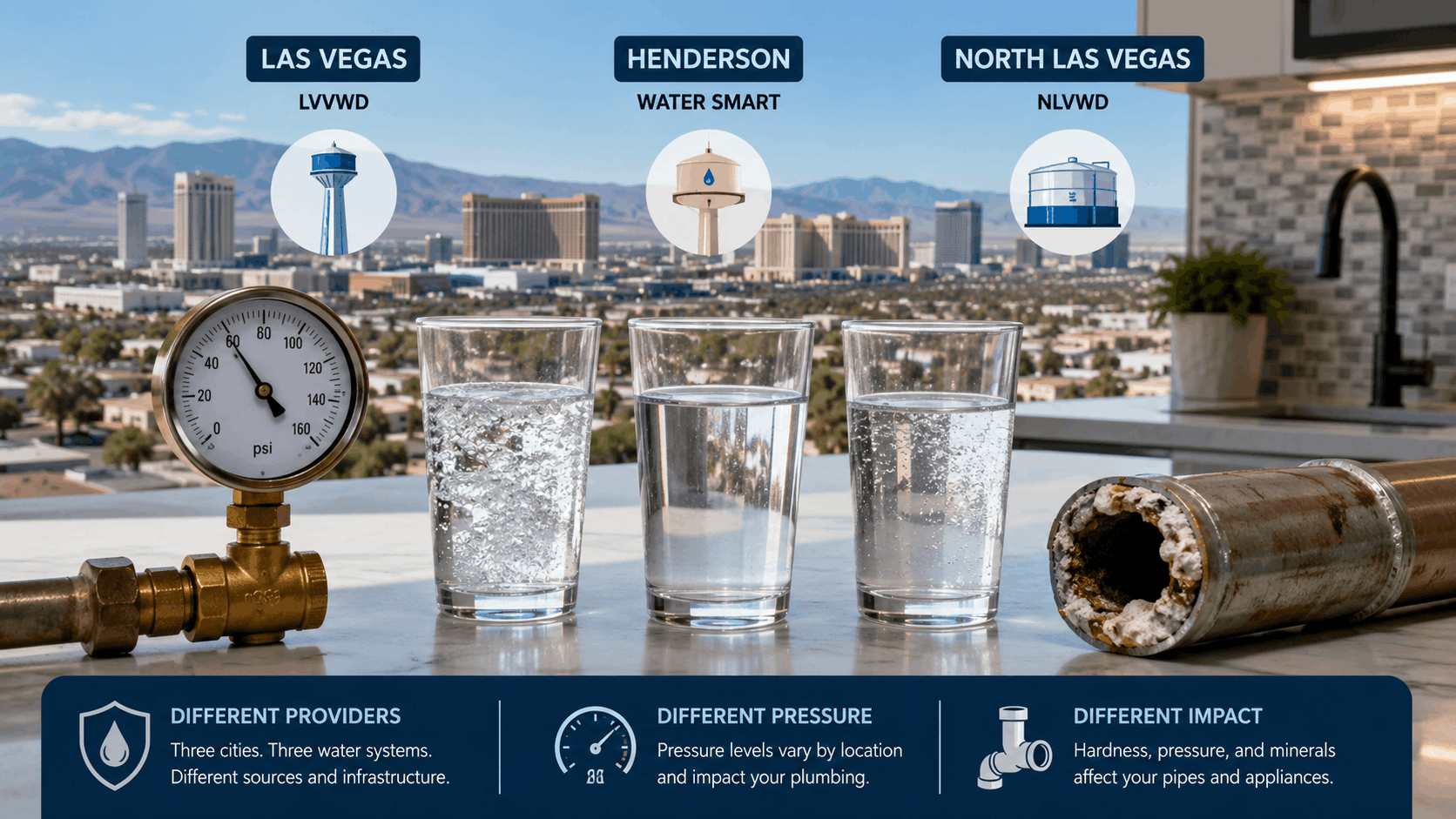
Across the Las Vegas Valley, three cities run three different water systems. Las Vegas, Henderson, and North Las Vegas each pull from the same lake but deliver water through separate districts, different pressure zones, and pipes that vary by neighborhood and build year. Those choices show up in your faucets, your water heater, and the long-term health of your plumbing.
Our team at Active Plumbing breaks down who runs the tap in each city, why pressure swings from street to street, how hard water wears on fixtures, and what all of it means for the pipes inside your home. We work these neighborhoods every day, from the Arts District downtown to Aliante up north, and the patterns are clear once you know where to look.
Who Supplies Water in Each City?
The first thing to know is that your water provider follows city lines, not zip codes or general area names. A home in Green Valley is served differently than one in Spring Valley, even though they sit only a few miles apart. Knowing your provider tells you who to call for billing, service starts, and outage questions.
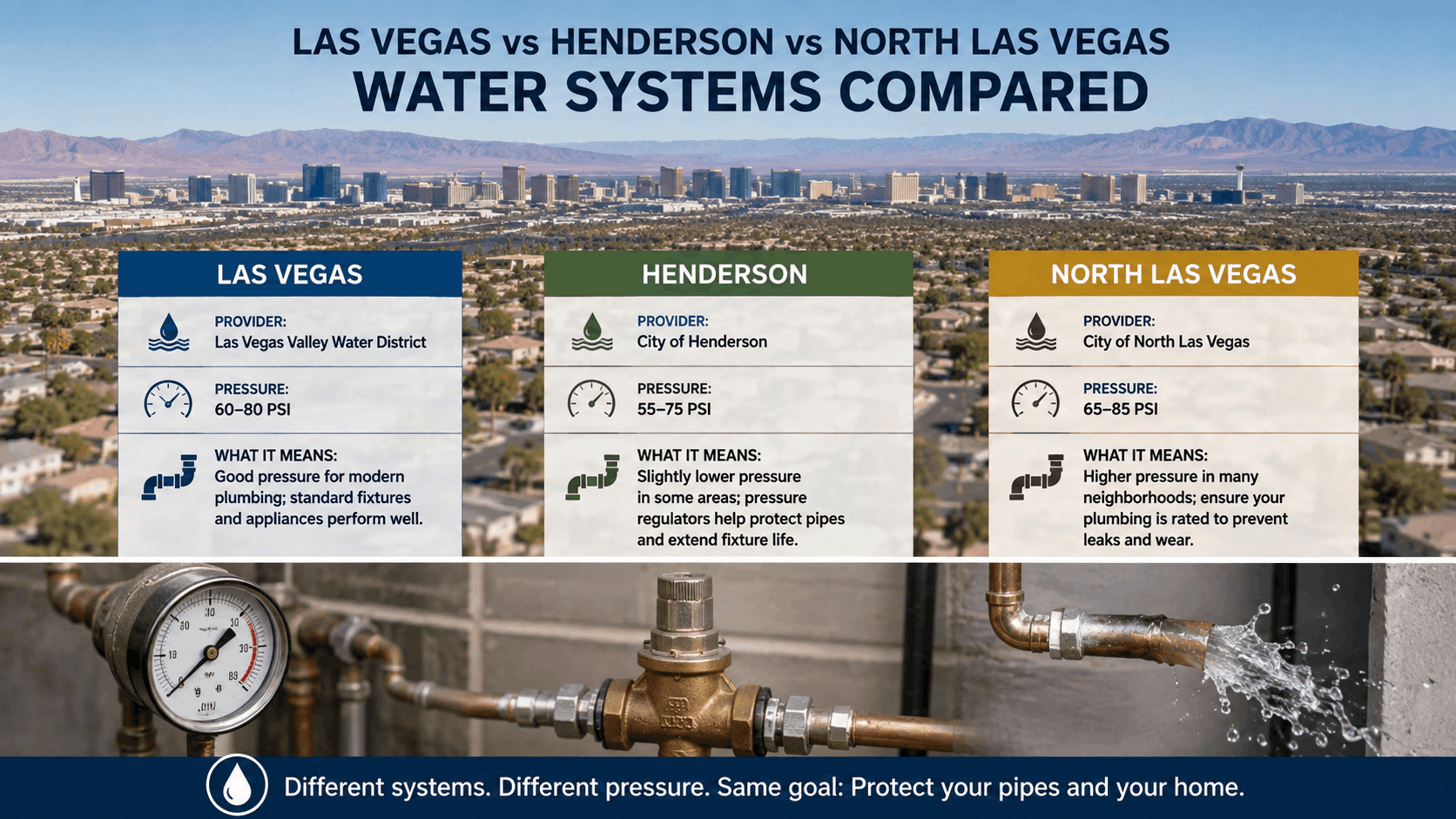
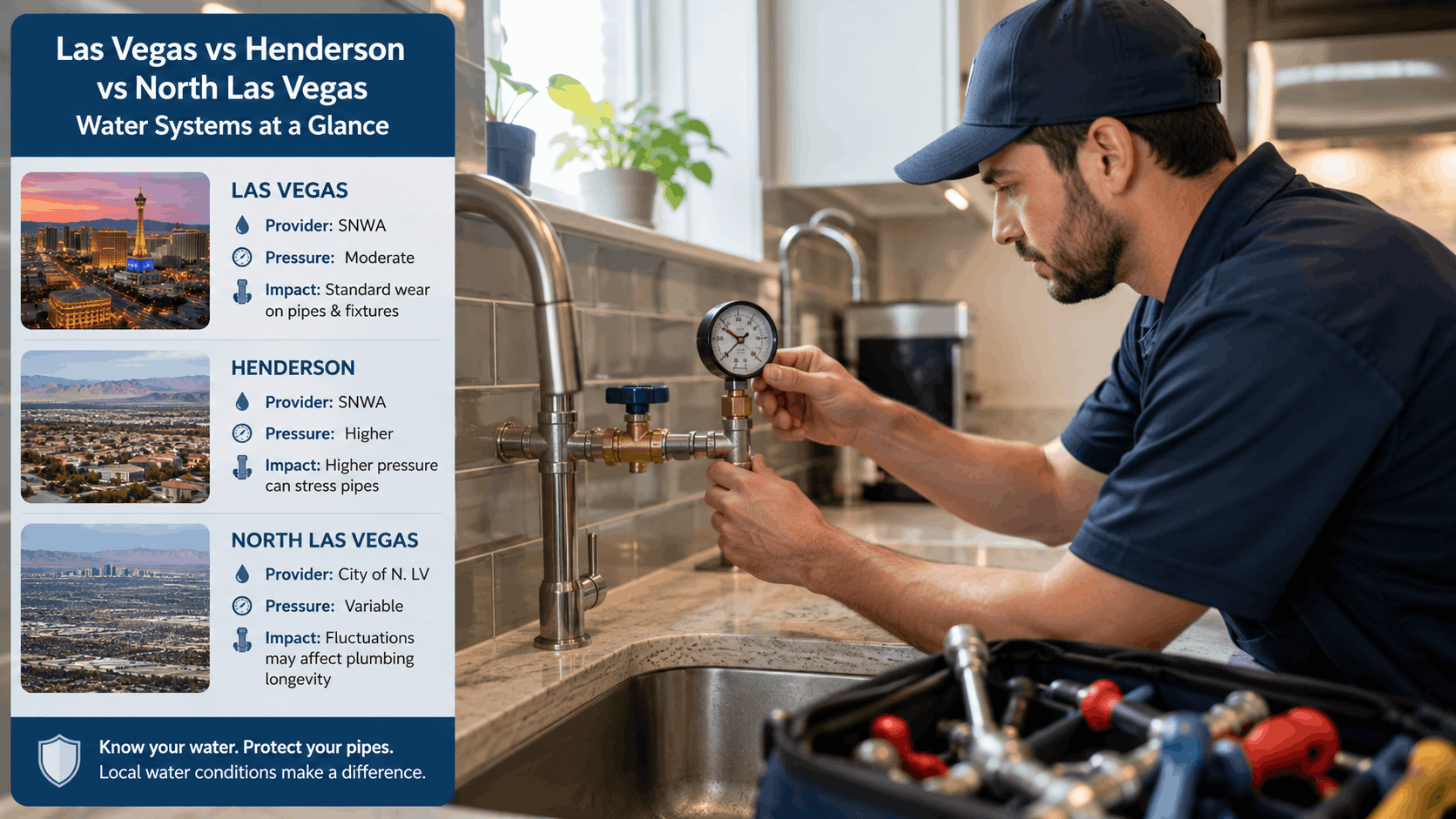
All three cities draw from the same source at Lake Mead, but each runs its own local distribution. Here is a quick reference for the three main systems and their general coverage.
| City / District | Water Provider | Example Coverage Areas | Primary Source |
|---|---|---|---|
| Las Vegas | Las Vegas Valley Water District | Summerlin, Spring Valley, central valley | Lake Mead / Colorado River |
| Henderson | City of Henderson Utility Services | Green Valley, Anthem, Inspirada | Lake Mead / Colorado River |
| North Las Vegas | City of North Las Vegas Utilities | Aliante, Craig Ranch, Tule Springs | Lake Mead / Colorado River + wells |
Las Vegas Valley Water District and City Service Areas
Most homes inside the City of Las Vegas and large parts of the unincorporated county get water through the Las Vegas Valley Water District. This is the largest provider in the region, and it covers a wide stretch that includes Summerlin, Spring Valley, and much of the central valley near downtown.
If you live in a community like Peccole Ranch, Rancho Sereno, or the neighborhoods off West Sahara, this is almost certainly the district billing you. The water provider handles meter reads, main line breaks in the street, and the pressure that arrives at your property line.
The district serves hundreds of thousands of connections, so pressure and delivery can vary based on where you sit in its network. A hillside home in Summerlin West gets treated very differently than a flat lot in Spring Valley. We see that play out in service calls all the time, and it shapes how a home's plumbing holds up over the years.
For homeowners in these areas, our Summerlin plumbing team deals with district water conditions daily, so we know the local quirks street by street.
City of Henderson Utility Services
Henderson runs its own show. The City of Henderson Utility Services department supplies water to communities like Green Valley, Anthem, Inspirada, and Whitney Ranch, and it manages both billing and field service inside city limits.
That means if you move from a Las Vegas Valley Water District home into Green Valley, your bill comes from a different agency and your service contacts change. New residents often call the wrong utility their first month because they assume one provider covers the whole valley.
Henderson's system also has to account for a lot of elevation change, especially up toward Anthem and the MacDonald Highlands area. The utility uses pressure zones and booster stations to push water uphill, which affects how strong your flow feels at home.
Homes around Whitney Ranch and the Lake Las Vegas corridor sit in some of the more interesting pressure spots in the city, and we service those neighborhoods regularly.
North Las Vegas Utilities and Service Boundaries
The City of North Las Vegas Utilities Department covers the northern edge of the valley, including Aliante, the Craig Ranch area, and the fast-growing Tule Springs and Elkhorn zones. This is a younger system in many parts because so much of North Las Vegas was built out in the last two or three decades.
Newer development shapes the whole experience here. Main lines tend to be more modern, and the layout reflects planned communities rather than the patchwork you find in older central neighborhoods.
Because construction has moved so quickly, the utility keeps expanding capacity as new subdivisions come online. That growth can affect flow during peak demand, which we cover more below.
For homes near Aliante and the surrounding master-planned areas, the plumbing story is very different from what a downtown Las Vegas bungalow deals with.
Where the Water Comes From: The Colorado River and Groundwater
Here is the shared thread across all three cities. Roughly 90 percent of the valley's water comes from the Colorado River, stored and pulled from Lake Mead. The Southern Nevada Water Authority manages that regional supply and treatment before it reaches each local system.
Groundwater from wells makes up the smaller remaining share and acts as a supporting supply, more common in certain parts of North Las Vegas. But the dominant source is river water for nearly every home in the region.
That single source is why hardness and mineral content look so similar across the valley, no matter which city you live in. You can read more about the regional supply directly from the Southern Nevada Water Authority, which coordinates the Lake Mead intake and treatment for all three cities.
Get Your Quote
Tell us what's going on and we'll get back to you. We're open 24/7.
Water Pressure Differences Across the Valley
Pressure is where homeowners feel the difference most. Two houses on the same source can deliver wildly different flow depending on elevation, pressure zone, and the age of the local main lines. That is why your Henderson shower might feel stronger than your old Summerlin one.
Water pressure is measured in PSI, and the valley's varied terrain creates real swings from neighborhood to neighborhood. Let us walk through what drives those numbers.
How Elevation Shapes Pressure in Henderson and the Hills
Elevation is the biggest factor in local pressure. Water utilities divide their networks into pressure zones so that homes at different heights all get workable flow. As you climb toward Anthem or MacDonald Highlands, the system uses booster stations to lift water up the grade.
The tricky part is that a home near the bottom of a pressure zone can receive much higher pressure than one near the top. Gravity does the work, so lower-elevation houses in a zone often see readings that push past the comfort range.
We have measured homes in the foothills coming in above 90 PSI simply because of where they sit relative to the tank feeding them. That extra force wears on fittings more quickly than most owners realize.
Henderson's hillside communities feel this the most, which is why so many of them come with a pressure regulator already installed. When those regulators age out, the pressure climbs and the trouble starts.
Typical PSI Ranges Homeowners Should Expect
For most homes, a healthy PSI range sits between 40 and 80. That window gives you strong showers and quick-filling tubs without stressing your plumbing. Anywhere in that band is generally comfortable and safe.
Once readings climb above 80 PSI, you move into high water pressure territory. That is when fixtures, hoses, and joints start taking abuse, and small leaks become more likely over time.
Many valley homes, especially in older or lower-elevation lots, run higher than owners expect. We regularly find houses sitting at 85 to 100 PSI that the owner assumed were fine because the water simply felt strong.
A quick check with a pressure gauge tells the whole story. If you are above 80, it is worth addressing before it costs you a burst hose or a failed valve.
Why North Las Vegas Homes Sometimes See Lower Flow
North Las Vegas has grown more quickly than almost any part of the valley, and that growth affects water flow in certain neighborhoods. When a new subdivision fills up quickly, peak demand can pull pressure down during busy morning and evening hours.
Newer main lines are generally sized well, but demand in booming areas like Tule Springs and Elkhorn keeps rising as more homes connect. During heavy-use windows, some residents notice softer flow than they get at midday.
This is usually a delivery pattern, not a home defect. The city continues to add capacity, and flow tends to even out as infrastructure catches up with the rooftops.
Still, if a specific fixture runs weak all day long, the problem is more likely inside your home, such as a clogged aerator or a partly closed valve. Our North Las Vegas plumbers can tell the difference between a supply issue and a household one quickly.
How to Test the Pressure at Your Own Home
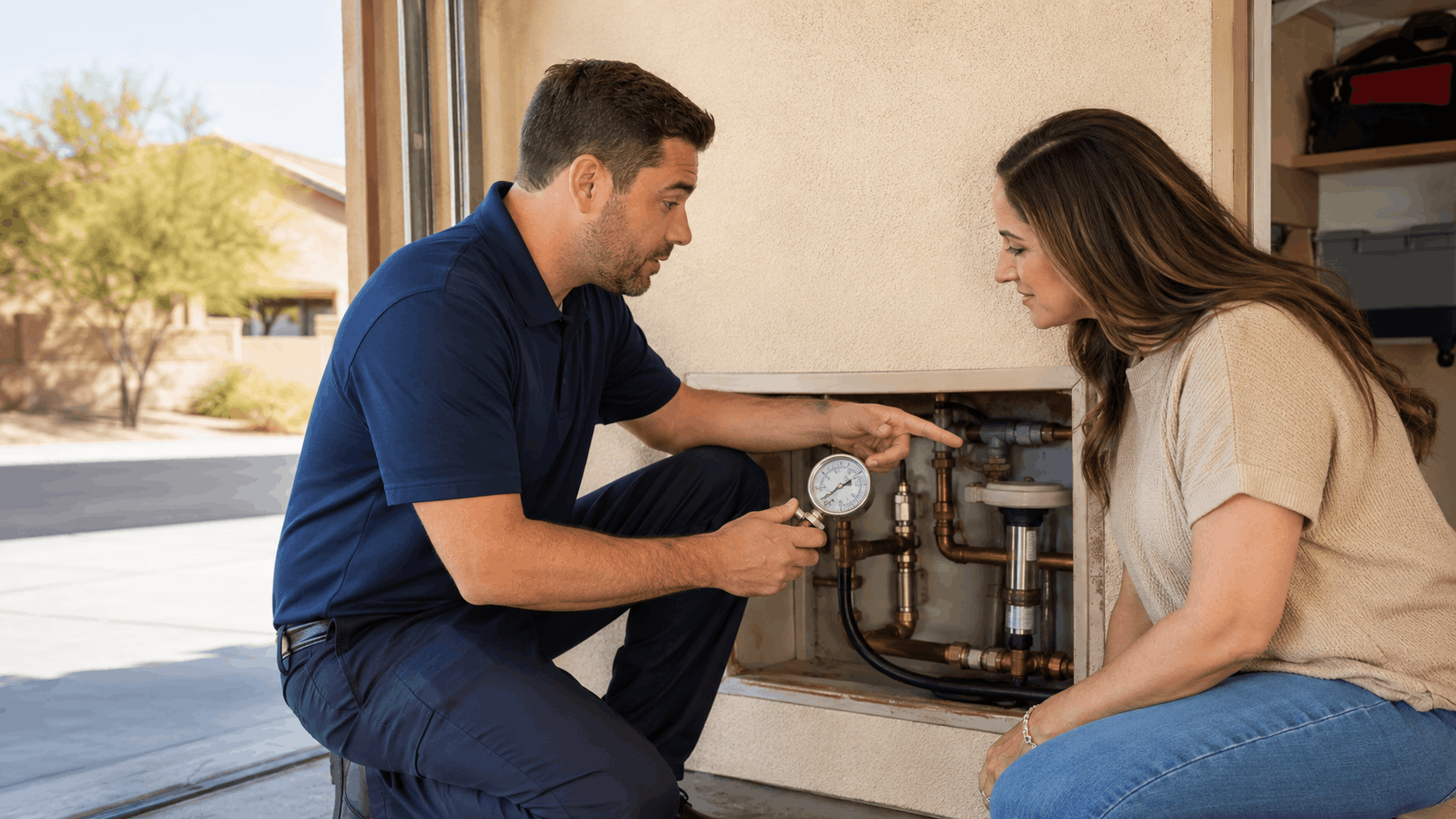
Testing your own pressure is simple and takes five minutes. Buy an inexpensive pressure gauge that screws onto a hose bib, available at any hardware store for around 10 to 15 dollars. Choose an outdoor spigot closest to where the main water line enters the house.
Turn off any water use inside, thread the gauge onto the hose bib, and open the valve fully. Read the dial. Anything from 40 to 80 PSI is normal, and readings above 80 signal a problem worth fixing.
For a fuller picture, test in the early morning and again in the evening. Big swings between readings can point to a failing regulator or pressure-zone issues.
If your water pressure testing shows numbers over 80, or the needle jumps around, that is the moment to call a professional. A gauge tells you there is a problem, but it will not tell you exactly where.

Need Help in Las Vegas?
Active Plumbing serves Las Vegas and all of Las Vegas Valley.
Hard Water and Mineral Content in Southern Nevada
If you have lived in the valley for any length of time, you already know the water is hard. White crust on the faucet, spots on the glasses, and a film in the shower are daily reminders. That hardness is the same story across all three cities because they share one source.
Let us look at why the water runs so hard here and what it does to the plumbing you rely on every day.
Why Valley Water Runs So Hard
Hard water comes from dissolved minerals, mainly calcium and magnesium, that the Colorado River picks up as it flows through rock and soil. By the time that water reaches Lake Mead and your tap, it carries a heavy mineral load.
Water hardness is measured in grains per gallon, and Southern Nevada regularly tests in the range of about 16 grains per gallon or higher. Anything above about 10 grains is considered very hard, so the valley sits well past that mark.
Because every city pulls from the same river, the mineral content stays similar from Summerlin to Aliante to Green Valley. You cannot dodge hard water by picking a different neighborhood.
You can confirm local mineral levels through your utility's annual water quality report or by contacting the Las Vegas Valley Water District, which publishes hardness data for its service area.
Scale Buildup in Water Heaters and Fixtures
Hard water leaves scale, and scale is hard on equipment. Inside a water heater, minerals settle to the bottom of the tank and bake into a crusty layer that forces the unit to work harder and burn more energy.
That scale buildup shortens water heater life. A tank that might last 12 years in a soft-water region often needs replacement sooner here, especially without regular flushing. We see plenty of valley heaters fail early for exactly this reason.
Fixtures suffer too. Aerators clog, shower heads spray sideways, and valves get stiff as mineral deposits collect in the tiny passages. Fixture clogs are one of the more common calls we run across all three cities.
For homeowners with a tankless unit, regular tankless maintenance and descaling keeps the heat exchanger clear and protects the warranty. Skipping it in this water all but invites trouble.
Do Softeners Make Sense for Each City?
Given how hard the water is, a water softener makes sense for most valley homes regardless of city. A softener removes the calcium and magnesium that cause scale, protecting your heater, fixtures, and pipes over the long haul.
Salt-based systems are the traditional choice and work very well against valley hardness. Salt-free conditioners are an alternative that changes how minerals behave rather than removing them, which appeals to owners who want less maintenance.
Nevada has softener regulations that homeowners should know before installing. There are rules around brine discharge in some areas to protect the water supply, so it pays to confirm what is allowed locally before buying a system.
Our team handles both approaches, from a full water softener installation to salt-free water conditioning, and we help match the right one to your home and city rules.
How Water Systems Affect Your Home's Pipes
Now we connect the dots. Provider, pressure, and hardness all combine to determine how your plumbing pipes hold up. High pressure and heavy minerals are a tough pairing, and older pipe materials make it worse.
Pipe corrosion, hidden leaks, and material choice all trace back to these water system factors. Here is how it plays out inside real homes.
What High Pressure Does to Joints and Valves
Pressure above 80 PSI puts constant strain on every fitting in the house. Threaded joints, supply valves, and rubber washers all feel that force day and night, and high pressure damage builds up slowly until something gives.
Angle stops, the small shutoff valves under sinks and toilets, are common casualties. They wear out sooner under high pressure, and a failed angle stop can leak behind a cabinet for weeks before you notice.
Running toilets are another sign. When incoming pressure is too high, fill valves struggle to seal, and the toilet cycles on its own. Owners often blame the toilet when the real culprit is system pressure.
At the extreme, high pressure contributes to burst pipes and blown supply hoses, especially the braided lines behind washing machines. Keeping pressure in the 40 to 80 range prevents most of this damage.
Corrosion and Scale in Older Central Las Vegas Homes
Older neighborhoods near downtown and the Historic Westside often still have galvanized pipe, a steel pipe with a zinc coating that was standard decades ago. Over time that coating breaks down and the steel underneath corrodes from the inside out.
Galvanized pipe combined with hard water is a slow disaster. Rust and scale narrow the interior of the pipe, choking flow and staining the water. Homes in the Arts District and surrounding central areas frequently show these symptoms.
Signs of interior corrosion include brownish water at first draw, weak flow that gets worse over years, and pinhole leaks that pop up in random spots. Once one section fails, others usually follow.
If you own an older central home and deal with recurring leaks, our Arts District plumbing team can assess whether corrosion has reached the point where repiping makes more sense than repeated patches.
Pipe Materials Used in Newer Henderson and Aliante Builds
Newer construction tells a happier story. Homes built in the last two decades across Henderson, Aliante, and other planned communities typically use PEX or copper pipe, both of which handle hard water far better than old galvanized steel.
PEX is a flexible plastic tubing that resists scale and corrosion and has become the standard in new builds. It does not rust, tolerates minor freezes better than rigid pipe, and installs with fewer joints that can leak.
Copper pipe remains a durable choice and shows up in many mid-era and higher-end homes. It holds up well, though it can develop pinhole leaks over long periods in aggressive water conditions.
Buyers of newer homes in areas like Inspirada or Tule Springs can generally expect modern materials, but a quick inspection during purchase confirms what is actually behind the walls. It is worth knowing before you close.
Warning Signs Your Pipes Are Struggling
Your plumbing usually warns you before it fails outright. Discolored water, especially brown or rusty tints at first draw, points to corrosion inside the pipes or the water heater. Clear water that turns cloudy and settles is a different, usually harmless, issue.
Water hammer, that banging or knocking sound when you shut off a faucet, signals high pressure or loose lines. Persistent banging is worth investigating because it stresses joints every time it happens.
Low flow that steadily worsens, recurring leaks in the same area, and damp spots on walls or ceilings are all leak signs that deserve attention. Catching them early saves thousands in water damage.
For hidden problems, our electronic leak detection pinpoints trouble inside walls and slabs without tearing the house apart. Early detection is always cheaper than repair after a flood.
Need Help in Las Vegas?
Active Plumbing serves Las Vegas and all of Las Vegas Valley.
Pressure Regulators and Why They Matter
The pressure regulator is one of the most overlooked parts in a home, yet it protects everything downstream of it. In a valley with big elevation swings and pockets of high pressure, this device does quiet, important work.
Let us cover what it does, who needs one, and how to tell when it has failed.
What a Pressure Reducing Valve Does
A pressure reducing valve, or PRV, lowers the incoming water pressure to a safe level before it reaches your fixtures. If the city delivers 100 PSI to your property line, the PRV knocks it down to a comfortable 60 or 65 inside the house.
The PRV usually sits near the main shutoff, often where the water line enters the home or just past the meter. It is a bell-shaped brass fitting with an adjustment screw on top.
By controlling water pressure, the PRV protects your water heater, fixtures, supply lines, and appliances from the constant strain of excess force. It is a small part that prevents a long list of expensive problems.
Not every home has one, and that is often the root of pressure complaints. If your readings run high and you cannot find a regulator, it may be missing or buried.
Which Neighborhoods Most Often Need One
Higher-elevation Henderson areas need PRVs most often. Homes in Anthem, MacDonald Highlands, and other hillside communities sit in pressure zones where incoming force can easily exceed the safe range, so regulators are common and frequently required by code.
Lower-elevation lots inside any pressure zone also benefit, since gravity pushes extra pressure toward the bottom of the grade. That is true in parts of Henderson and in some older Las Vegas pockets as well.
Local plumbing code requires a PRV when incoming pressure exceeds 80 PSI, which covers a lot of valley homes. If your builder or a prior owner skipped it, the house may be running hot without anyone realizing.
When we service homes in the Henderson foothills, checking the regulator is one of the first things we do because so many depend on it.
Signs a Regulator Has Failed
A failed PRV shows itself in a few ways. A common is a pressure spike, where readings climb well above where the valve should hold them. Suddenly your showers feel harsh and your toilets run.
Noisy pipes and water hammer often follow a failing regulator, since the device can no longer smooth out the incoming force. You may also notice fluctuating flow that surges and drops for no clear reason.
PRVs do not last forever. Most need replacement somewhere in the 7 to 12 year range, sometimes sooner in this hard water because minerals gum up the internal parts.
If you suspect a bad regulator, a pressure test confirms it fast. Our team handles regulator replacement across the valley and can restore safe pressure the same visit in most cases.
Seasonal and Climate Challenges in the Valley
The desert climate throws its own curveballs at local plumbing. Blistering summers, occasional freezing nights, and monsoon storms each stress the water system in different ways. Knowing the seasonal pattern helps you stay ahead of trouble.
Here is how the calendar affects your pipes across Las Vegas, Henderson, and North Las Vegas.
Summer Heat and Higher Water Demand
Summer is peak season for water use. When temperatures climb past 105 degrees, irrigation systems run hard across every neighborhood, and that summer demand can pull pressure down during morning and evening watering windows.
Heat also punishes outdoor plumbing directly. Sun-baked hose bibs, exposed valves, and above-ground irrigation lines degrade sooner in relentless UV, and rubber washers dry out and crack sooner than they would in a milder climate.
We field more outdoor leak calls in July and August than any other months. A hose bib that held fine all winter starts weeping once the heat and constant use take their toll.
Checking outdoor fixtures at the start of summer catches small problems before they waste water during the hottest, most expensive months to run a leak.
Winter Cold Snaps and Exposed Pipes
Freezing is rare here, but it happens. A few nights each winter dip below 32 degrees, and that is enough to threaten exposed pipes, outdoor lines, and backflow devices that sit above ground without insulation.
Backflow assemblies on irrigation systems are especially vulnerable because they stick up out of the ground with little protection. A hard freeze can crack the brass and split the internals, leading to a spray of water when things thaw.
Freeze protection is simple. Wrap exposed hose bibs with insulated covers, disconnect garden hoses before cold nights, and insulate any irrigation backflow that stands exposed.
Homes with plumbing in unconditioned garages or against exterior walls face the most risk. A little preparation on the handful of cold nights each year prevents a costly burst.
Monsoon Season and Sediment in the Water
Monsoon season brings sudden storms in late summer, and those storms sometimes stir up the water system. Heavy runoff and utility line flushing can push sediment through the mains, causing temporary discoloration at the tap.
That sediment is usually harmless and clears within a few hours, but it can clog aerators and screens as it passes through your fixtures. An aerator clog after a storm is a common and easy fix.
If your water turns cloudy or tan after a monsoon, run a cold tap for a few minutes and let it clear. Then unscrew and rinse any aerators that feel weak afterward.
Should discoloration linger for days rather than hours, that points to a problem inside your own pipes rather than the city supply, and it is worth a professional look.
Need Help in Las Vegas?
Active Plumbing serves Las Vegas and all of Las Vegas Valley.
When to Call a Local Plumber and How Active Plumbing Helps
Some plumbing tasks are fine to handle yourself. Cleaning an aerator, wrapping a hose bib, or reading a pressure gauge are all easy DIY jobs. Other issues cross the line into work that needs a licensed local plumber.
Anything involving the main line, gas, sewer, or hidden leaks is professional territory. Here is how our Active Plumbing team addresses the specific problems this valley creates.
Pressure Testing and Regulator Service
We test pressure at homes across all three cities and pinpoint exactly where a reading falls outside the safe range. A proper plumbing inspection checks pressure at multiple points and times, not just one quick spot check.
When a PRV is missing or failed, we handle PRV installation and replacement to bring your home back into the 40 to 80 PSI window. That single fix protects your water heater, fixtures, and supply lines from years of strain.
For hillside Henderson homes especially, regulator service is routine work for us. We know which neighborhoods run hot and check for the right setup automatically.
If your showers feel harsh or your toilets run on their own, pressure testing is the fastest way to find the cause and solve it for good.
Repiping and Corrosion Repair for Older Homes
Older central Las Vegas homes with galvanized lines eventually reach the point where patching no longer pays. When corrosion has spread through the system, repiping replaces the failing steel with modern PEX or copper.
Galvanized replacement restores flow, clears up discolored water, and stops the cycle of recurring pinhole leaks. Homes near downtown and the Historic Westside are frequent candidates for this work.
We assess how far the corrosion has gone before recommending anything. Sometimes a targeted corrosion repair handles the problem, and sometimes a full repipe is the smarter long-term move.
Either way, we walk you through the options honestly so you can decide based on your home and budget, not a sales pitch.
Water Softener and Filtration Installation
Given the valley's hard water, softener and filtration setups protect homes in Henderson, North Las Vegas, and the central valley alike. A softener cuts scale, and filtration handles taste, odor, and specific contaminants.
We size and install both salt-based and salt-free systems, matching the choice to your water, your city's discharge rules, and your maintenance preferences. Hard water treatment done right pays for itself in longer fixture and heater life.
For homeowners concerned about specific contaminants, we also offer PFAS screening to test what is actually in the water before choosing a system.
The goal is simple: stop scale from wrecking your plumbing and improve the water you drink and bathe in every day.
Emergency Leak and Burst Pipe Response
When a pipe bursts, minutes matter. Water spreads fast and damage compounds quickly, so rapid response limits what a leak can ruin. Our emergency plumber team responds across the valley to stop the flow and start repairs.
Whether it is a blown washing machine hose, a slab leak, or a cracked line after a freeze, quick action protects floors, drywall, and belongings. The sooner the water stops, the smaller the repair bill.
Our burst pipe repair service handles the immediate crisis and the lasting fix, not just a temporary patch.
Save our number before you need it. When water is spreading across a floor at 2 a.m., you want a local team that answers and knows your neighborhood.
Final Thoughts
The three cities share one source at Lake Mead but deliver water through separate systems, different pressure zones, and pipes that vary by neighborhood and age. Those differences explain why your faucets behave one way in Summerlin and another in Henderson.
Hard water is a constant across the valley, high pressure is common in many areas, and older central homes carry the added burden of aging galvanized pipe. Knowing your provider, your pressure, and your pipe material puts you ahead of most problems.
If you want your pressure checked, a regulator serviced, hard water tackled, or an aging home repiped, our Active Plumbing team works these streets every day. Contact us or call for a consultation, and we will help protect the pipes inside your home.
Frequently Asked Questions
- Which city has the hardest water: Las Vegas, Henderson, or North Las Vegas?
- All three cities pull from the same Colorado River source stored in Lake Mead, so water hardness is very similar and generally high across the entire valley. Local testing typically shows about 16 grains per gallon or more, which counts as very hard. You cannot escape hard water by choosing a different city here, since the mineral content comes from the shared regional supply.
- What is a normal water pressure for a valley home?
- A normal water pressure sits in the 40 to 80 PSI range, which gives strong flow without stressing your plumbing. Readings above 80 PSI signal a problem and put extra strain on joints, valves, and appliances. If your pressure runs high or swings widely between morning and evening, that usually points to a missing or failing pressure regulator worth addressing.
- How do I find out who my water provider is?
- Your water provider follows city boundaries. Las Vegas homes use the Las Vegas Valley Water District, Henderson uses City of Henderson Utility Services, and North Las Vegas uses the City of North Las Vegas Utilities Department. The fastest way to confirm is to check a recent utility bill, which names your provider directly, or contact the utility for your address to verify service.
- Does my home need a pressure regulator?
- Your home likely needs a pressure regulator if incoming pressure exceeds 80 PSI, which is common in higher-elevation and pressure-zone areas like Anthem and the Henderson foothills. Local code requires a PRV above that threshold. Test your pressure with a hose bib gauge first. If readings run high or you cannot locate an existing regulator, have a professional check it.
- Why is my water sometimes cloudy or discolored?
- Cloudy water is usually trapped air that clears from the bottom of the glass up and is harmless. Discolored or brown water often comes from sediment stirred up by monsoon storms or utility line flushing, and it typically clears within hours. If discoloration lingers for days or appears at every tap, that may point to corrosion inside your own pipes.
- Can hard water really damage my pipes and water heater?
- Yes. Hard water leaves scale that collects in water heaters, forcing them to work harder and fail years earlier than they should. Scale also clogs aerators, shower heads, and valves, shortening fixture life throughout the home. Over long periods, mineral buildup narrows pipe interiors and reduces flow. A softener or conditioner slows this damage and protects your plumbing investment.
- Are water softeners allowed in Southern Nevada?
- Water softeners are allowed, but Nevada has softener rules and discharge restrictions in some areas to protect the water supply. Before installing a salt-based system, check local regulations on brine discharge for your city and property. Salt-free conditioners avoid discharge concerns and are a common alternative. Our team helps confirm what is permitted for your address and installs the right system.
- Why do my pipes bang or make noise?
- Banging pipes, known as water hammer, usually come from high pressure, loose lines, or a failing pressure regulator. When water shuts off suddenly, excess pressure sends a shock through the pipes that produces the knocking sound. Persistent noise stresses joints over time. Testing your pressure and checking the regulator normally identifies the cause, and securing loose lines resolves the rest.
- Do newer North Las Vegas homes have better plumbing than older Las Vegas homes?
- Generally yes, from a material standpoint. Newer North Las Vegas builds in areas like Aliante and Tule Springs typically use PEX or copper, which resist hard water corrosion far better than the galvanized steel found in older central Las Vegas homes. Aging galvanized lines corrode from the inside, causing discolored water and leaks, while modern PEX and copper hold up much longer.
- When should I call a plumber instead of fixing it myself?
- Simple tasks like cleaning aerators, wrapping hose bibs, or reading a pressure gauge are safe DIY jobs. Call a plumber for anything involving the main line, gas, sewer, hidden leaks, high pressure, or a failed regulator. If water is spreading, pressure runs above 80 PSI, or a repair keeps returning, professional service saves money and prevents bigger damage down the road.
Licensed plumbing professionals serving Las Vegas and Las Vegas Valley.
Licensed in Nevada · License #0047021
Last updated on
Why trust Active Plumbing?
Founded in 1991, Active Plumbing is a licensed and insured plumber serving Las Vegas and Las Vegas Valley. All content is reviewed by our licensed technicians.

Need Help in Las Vegas?
Active Plumbing serves Las Vegas and all of Las Vegas Valley.
Related Articles
Henderson vs Las Vegas Water Pressure: Why Some Neighborhoods Have PRV Issues
Henderson vs Las Vegas water pressure varies by terrain, utility systems, and neighborhood age. Learn why PRV issues hit some areas harder and when to act.
Las Vegas Hard Water by ZIP Code: What SNWA Data Actually Shows
See actual SNWA water hardness data by Las Vegas ZIP code. Learn your neighborhood's GPG level and what it means for your plumbing, appliances, and home.
Las Vegas Water Pressure and Your Fixtures: What 80+ PSI in Henderson Does to Cartridges and Hoses
High water pressure across the Las Vegas Valley quietly destroys faucet cartridges and supply hoses. Learn how to test your PSI and protect your fixtures.