Tips & Advice
Pinhole Leak in Copper in a Las Vegas Wall - Why Our Water Chemistry Eats Copper and What to Do Today
Key Takeaways
- Early signs of a copper pinhole leak include water stains, bubbling paint, a musty smell, a hissing sound in walls, and a rising water bill.
- Las Vegas water from Lake Mead is hard, alkaline, and chlorinated, which corrodes copper from the inside through pitting corrosion.
- Hot water lines, upstairs bathroom walls, and slab-adjacent runs are the most common leak spots in valley homes.
- The moment you suspect a leak, shut off the main valve, dry the area, document the damage for insurance, and call a plumber before opening the wall.
- Plumbers use acoustic listening, thermal cameras, moisture meters, and pressure testing to pinpoint leaks with minimal cutting.
- Repair options range from a spot fix ($350-$850) to a full copper or PEX repipe ($6,000-$15,000), with PEX resisting local corrosion better.
- Water softeners, a pressure reducing valve, moderate water heater temperatures, and regular inspections slow future corrosion.
- Older homes in Green Valley, Henderson, downtown Las Vegas, and two-story homes with upstairs bathrooms see the most copper failures.
In This Article
A homeowner in Summerlin walks past the guest bathroom and notices a faint brown ring on the wall near the baseboard. It was not there last week. The paint feels slightly soft under a fingertip, and there is a musty smell that will not go away no matter how much the room gets aired out. That small water stain is often the first sign of a pinhole leak in a copper pipe hidden inside the wall.
Here in the Las Vegas Valley, copper pipes do not always fail because they are old or poorly installed. Our local water chemistry is hard on copper, and it slowly eats these pipes from the inside out. Homes across Summerlin, Green Valley, Henderson, and older parts of Las Vegas all deal with the same problem.
What a Pinhole Leak in Copper Actually Looks Like
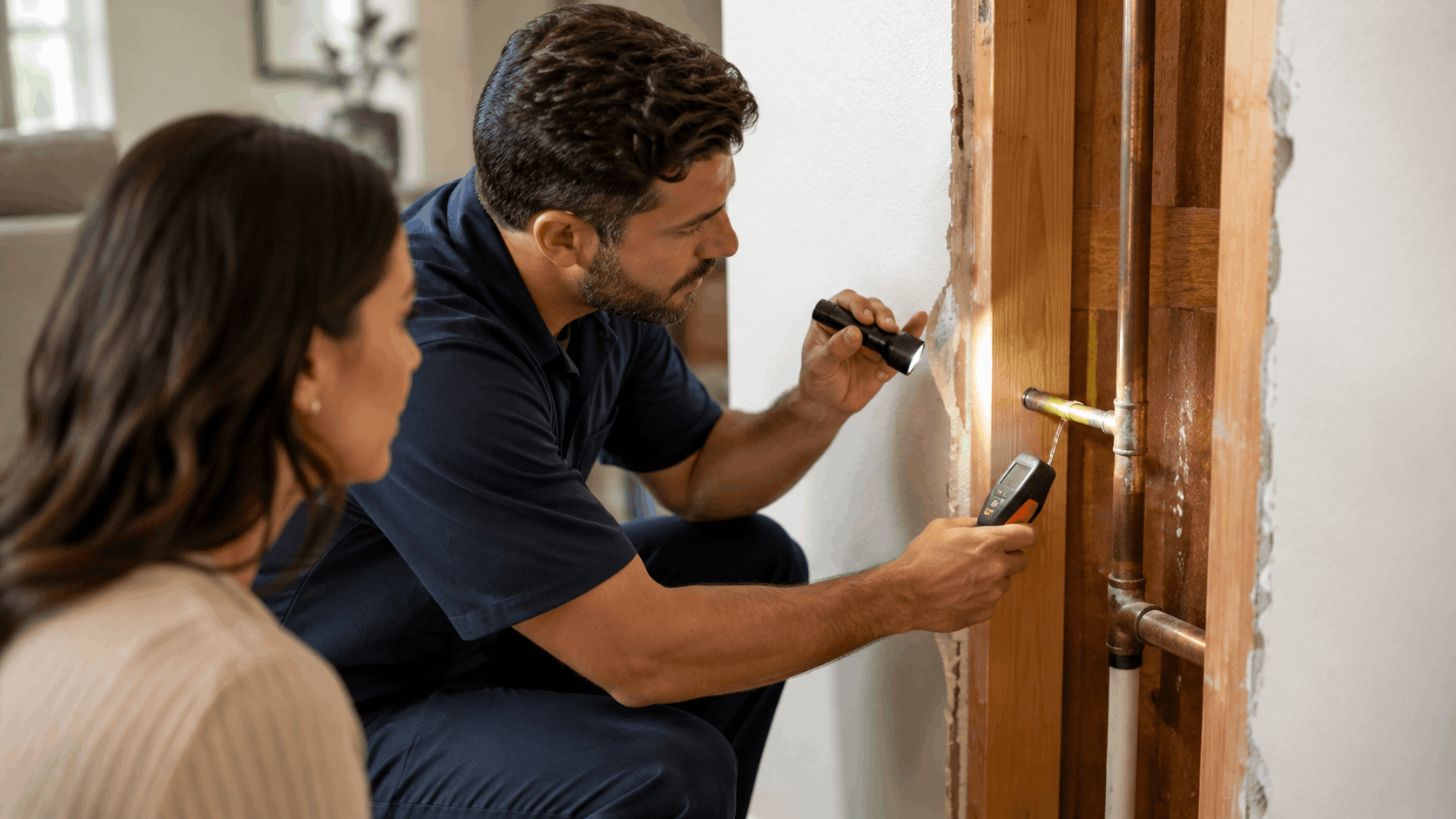
A pinhole leak rarely announces itself with a burst of water. It starts small and quiet, which is exactly why it does so much damage before anyone notices. Catching the early signs can save a homeowner thousands in drywall and flooring repairs.
Here are the main clues we tell people to watch and listen for around the house.
- Discoloration or brown rings on walls and ceilings
- Bubbling or peeling paint that feels soft to the touch
- A faint hissing sound behind a wall when taps are off
- A musty or damp smell that lingers in one room
- A water bill that jumps for no clear reason
- Green or white crust on any copper you can see
The Small Green or White Stains on Walls and Ceilings
The earliest sign of a slow copper leak is usually a stain that shows up on drywall or a ceiling. It often starts as a light brown or yellow ring, sometimes with a faint greenish tint from copper minerals in the water. Many homeowners assume it is an old stain and paint over it, only to watch it return weeks later.
A pinhole leak in copper pipe releases only a tiny amount of water at first, so the drywall soaks it up slowly. This creates a water stain that spreads outward instead of dripping down. The area may feel cool and damp compared to the surrounding wall.
Bubbling paint is another red flag. When moisture builds behind the paint layer, it lifts away from the drywall and forms small blisters. If you press on bubbling paint and it feels spongy, there is likely water trapped behind it.
We have opened walls in Peccole Ranch and found a pinhole no wider than a needle behind a stain the size of a dinner plate. The stain is always bigger than the leak, which is why the damage adds up fast.
Sounds, Smells, and Higher Water Bills
Some copper leaks give themselves away by sound before any stain appears. Stand in a quiet room with all the faucets off and listen near the walls. A soft hiss or a faint trickle inside the wall often means water is escaping a pressurized line.
A musty smell is another common warning of a hidden leak. Even in our dry desert climate, water trapped inside a wall cavity feeds mildew and creates that damp, earthy odor. If one room or closet always smells musty, moisture is usually the reason.
Your water bill can also expose a leak you cannot see or hear. A pinhole that runs day and night wastes gallons around the clock. When a homeowner tells us their bill from the utility climbed 20 or 30 percent with no change in habits, we start looking for a hidden leak right away.
Reading your meter is a simple test. Turn off every water fixture in the house, then check the meter. If the dial keeps moving, water is going somewhere it should not.
Blue-Green Corrosion on Exposed Copper
You do not always need to open a wall to see the problem. Look at the copper pipes you can already see, like the lines under a kitchen sink, in the garage, or near the water heater. Greenish or bluish crusty buildup on those pipes is a warning sign.
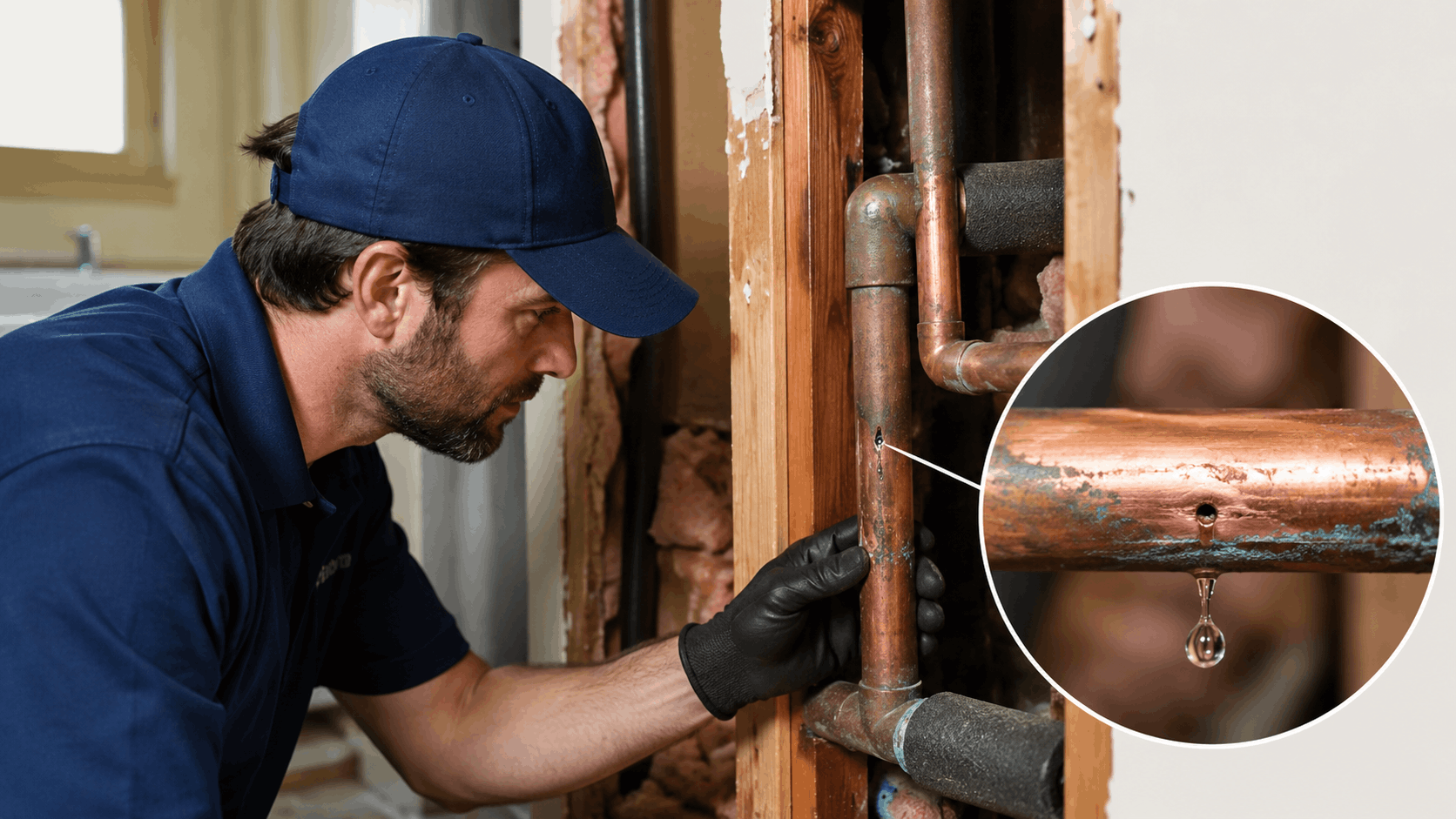
That blue-green crust is called verdigris, and it forms when copper reacts with water and air over time. When we spot copper corrosion on exposed lines, it usually means the same reaction is happening inside the walls where you cannot see it.
White chalky deposits around a fitting point to slow weeping as well. Even a joint that looks dry but has mineral crust around it may be leaking a trace amount of water. These small signs on visible copper tell us how the hidden pipes are aging.
If the copper under your sinks already shows heavy corrosion, it is worth having the rest of the system checked before a pinhole opens up inside a wall.
Where These Leaks Hide in Valley Homes
Pinhole leaks tend to show up in the same spots across local tract homes. Hot water lines fail first because heat speeds up corrosion, so leaks near the water heater and under bathroom sinks are common. The hot side of a system almost always wears out before the cold side.
Upstairs bathroom walls are another trouble zone, especially in two-story homes throughout Henderson and the west side. A wall leak on the second floor can travel down through the framing and show up as a stain on a first-floor ceiling.
Slab-adjacent runs also cause headaches. In many valley homes, copper lines run through or near the concrete slab, and a pinhole there can go unnoticed for months. Warm spots on the floor or the sound of running water near the slab are worth checking.
We have found leaks tucked behind showers, inside laundry room walls, and above garages. Knowing these hot spots helps our crews find the problem faster during a service visit.
Get Your Quote
Tell us what's going on and we'll get back to you fast.
Why Las Vegas Water Chemistry Eats Copper
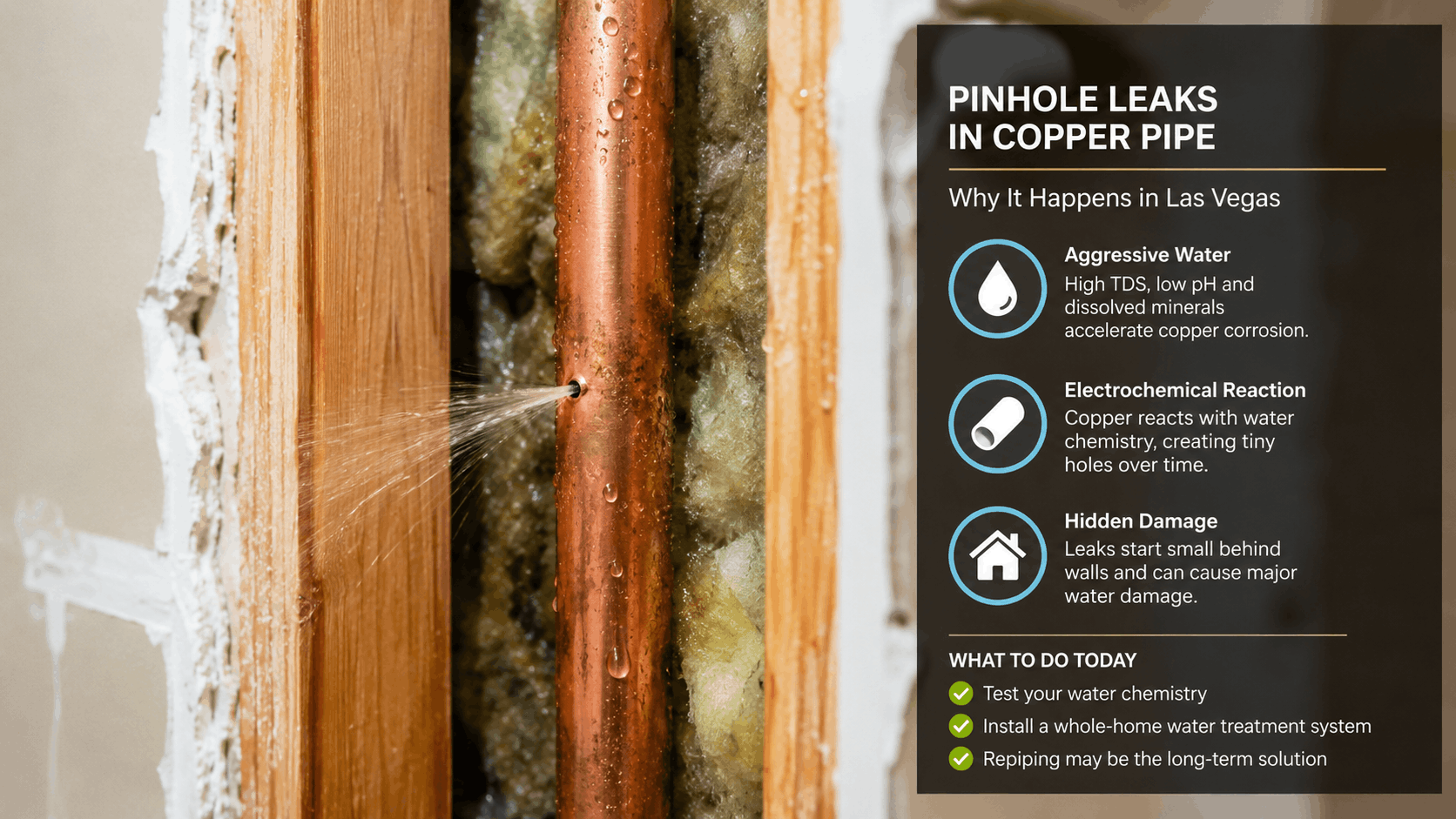
Copper is a strong metal, so why does it fail so often here? The answer comes down to our water chemistry. The combination of hard water, high pH, and desert heat creates conditions that corrode copper faster than in many other parts of the country.
Here is a plain-language breakdown of what is happening inside your pipes.
| Factor | What It Does to Copper |
|---|---|
| Hard water minerals | Builds scale and creates pockets where corrosion starts |
| High pH (alkaline water) | Reacts with copper surfaces and speeds pitting |
| Chlorine and byproducts | Attacks the protective inner layer of the pipe |
| Fast water velocity | Wears thin spots and worsens pitting corrosion |
| Heat and pipe age | Accelerates every reaction above on hot lines |
Hard Water and High Mineral Content From the Colorado River
Most of the valley's tap water comes from Lake Mead, fed by the Colorado River. That water carries a heavy load of dissolved minerals, mainly calcium and magnesium. These minerals are what make our water so hard.
As hard water moves through copper pipes, it leaves scale behind. That scale coats the inside of the pipe and creates uneven surfaces. Where scale builds in patches, small gaps form underneath, and those gaps become spots where corrosion takes hold.
According to the U.S. Environmental Protection Agency, water hardness is measured by mineral content, and our valley water ranks among the harder supplies in the nation. The higher the calcium and magnesium, the more scale a pipe collects over time.
This mineral buildup does more than corrode copper. It also shortens the life of water heaters and clogs fixtures, which is why so many local homes benefit from water treatment.
High pH, Chlorine, and Disinfection Byproducts
Our tap water tends to run alkaline, meaning it has a higher pH. Water treated and delivered by the Las Vegas Valley Water District is safe to drink, but that alkaline chemistry interacts with the copper inside your walls in ways that promote corrosion.
Chlorine is added to keep the water safe from bacteria, and that is a good thing for health. Inside copper pipes, though, chlorine and its disinfection byproducts can wear away the thin protective film that normally shields the metal. Once that film breaks down, the bare copper is exposed to attack.
The combination of high pH and chlorine hits the interior surface of the pipe hardest. Over years, this steady chemical exposure thins the copper from the inside, where no one can see it happening.
You can review your local water quality in the annual report published by the water district, which lists pH levels and treatment chemicals used across the valley.
Pitting Corrosion and Turbulent Flow
Pitting corrosion is the main way pinhole leaks form. Instead of the whole pipe wearing thin evenly, corrosion concentrates in tiny spots. Each pit digs deeper until it punches all the way through the pipe wall, creating a pinhole.
Fast water velocity makes pitting worse. When water rushes through pipes that are undersized or full of sharp fittings, it creates turbulence that scours the pipe walls. That turbulence strips away protective layers and exposes fresh metal to corrosion.
Installation matters too. Leftover soldering flux inside a joint is acidic and eats at the copper from within. A rushed install decades ago can leave flux residue that quietly corrodes a pipe for years.
Sharp elbows and tight turns concentrate flow and speed erosion at those points. This is why so many leaks show up right at or near a fitting rather than in the middle of a straight run.
Heat, Age, and Thin Type M Copper
Desert heat plays a big part in copper failure here. Hot water lines corrode faster than cold ones because heat speeds up every chemical reaction. In a valley where summer temperatures push past 110 degrees, attics and wall cavities get brutally hot, and pipes running through them take a beating.
Pipe age is another factor. Many homes built through the 1990s and 2000s are now reaching the point where copper starts to pit and fail. Twenty to thirty years of hard water exposure is often all it takes here.
Type M copper is thinner than Type L, and it was widely used in residential construction to save money. That thinner wall gives corrosion less material to chew through before a pinhole forms. Homes plumbed with Type M copper tend to see leaks sooner.
When you combine thin pipe, aging homes, and constant heat on the hot water side, you get the pattern our crews see across the valley every week.
Need Help in Las Vegas?
Active Plumbing serves Las Vegas and all of Las Vegas Valley.
What to Do Today When You Find a Leak
The moment you suspect a leak, your goal is to limit the damage. Water spreads fast, and drywall, flooring, and cabinets soak it up quickly. A calm, quick response can turn a major repair into a minor one.
Here is the plan we walk homeowners through when they call us in a panic.
Shut Off the Water at the Main Valve
The first step is to stop the flow of water. Find your main shutoff valve and close it. In most valley homes, the main shutoff sits near the front hose bib, in the garage, or in a box near the property line.
Turn the valve clockwise until it stops. If it is a lever-style valve, turn it a quarter turn so it sits crosswise to the pipe. This cuts water to the entire house and stops the leak from feeding more moisture into the wall.
It helps to know where your water valve is before an emergency ever happens. Take a minute this week to locate it and make sure it turns freely, since old valves can seize up. A stuck main shutoff during a leak wastes precious time.
If you cannot find or turn the main valve, the water district can shut off service at the meter, but that takes time. Knowing your own shutoff keeps you in control.
Move Belongings and Reduce Moisture
Once the water is off, clear the area around the leak. Move furniture, boxes, and anything that can be damaged away from the wet spot. Pull rugs and lift items off a wet floor so they do not wick up more water.
Next, work on drying the area. Set up fans and open windows to push air across the damp drywall. A dehumidifier speeds things up if you have one. Even in our dry climate, water inside a wall can linger and lead to mold if it is not dried out.
Mold prevention matters because a warm, damp wall cavity is a perfect place for it to grow. Getting air moving within the first day or two makes a real difference. The faster the area dries, the less chance you have of a bigger cleanup later.
Do not seal up a wet wall or cover it back up until it has fully dried and the leak is fixed. Trapping moisture only makes the water damage worse.
Document Damage for Insurance
Before anyone starts repairs, take photos and video of the damage. Capture the stained wall, any wet flooring, and the ruined belongings. Good documentation supports an insurance claim later.
Write down when you first noticed the problem and what you saw. Note the date, the location in the house, and the steps you took to stop the water. These details help your insurer understand the timeline.
Keep receipts for anything you buy to manage the emergency, like fans or a shop vacuum. Save any invoices from the plumbing repair as well. Thorough water damage documentation makes the claim process smoother.
Insurers often treat a sudden leak differently from a slow one, so clear records showing you acted fast can help your case. We are happy to provide a written report of what we find during the repair.
Call a Local Plumber Before You Open the Wall
It is tempting to grab a drywall saw and start cutting to find the leak yourself. We strongly advise against it. Cutting into a wall without knowing the pipe path can hit the wrong spot, damage other lines, or even nick electrical wiring.
Our team traces the leak first using detection tools, so we open drywall only where the pipe actually is. This saves you from a wall full of unnecessary holes. Professional electronic leak detection pinpoints the problem before any cutting begins.
A plumber in Las Vegas who knows local homes can also tell whether this is a one-off pinhole or a sign of system-wide failure. That guidance shapes whether you patch one spot or plan a larger fix. Guessing on your own often leads to repeat leaks.
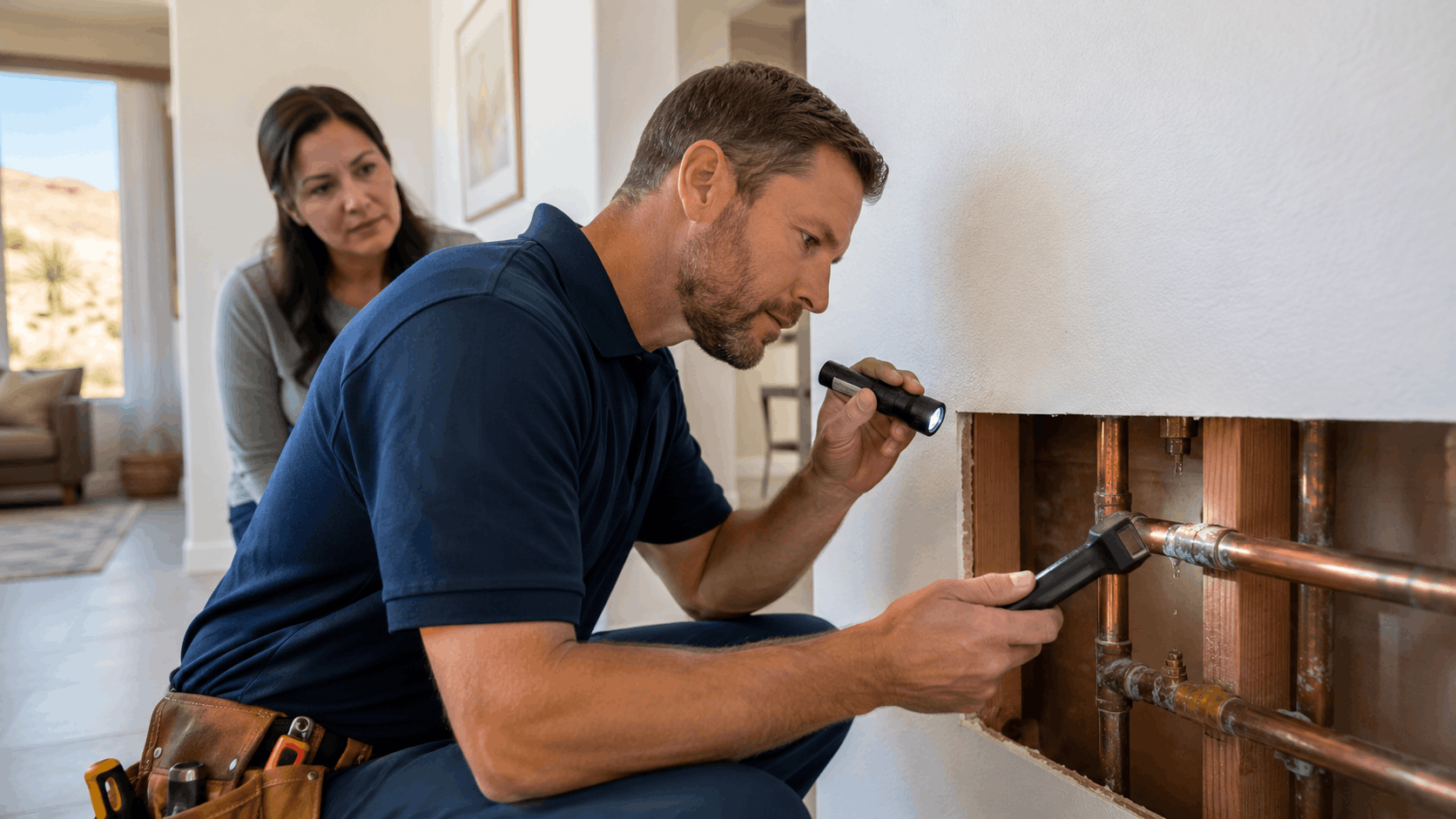
When water is running behind a wall, our emergency plumbing team can get to your home fast and take over the leak response so you are not fighting it alone.
How Plumbers Find the Exact Leak Inside a Wall
Homeowners often worry that finding a hidden leak means tearing up half the house. It does not. Modern leak detection tools let us pinpoint a pinhole to a small area, so the repair stays contained.
Here are the methods our crews use to locate a leak without guesswork.
- Acoustic listening gear that hears water escaping a pipe
- Thermal cameras that spot temperature changes from moisture
- Moisture meters that read dampness inside drywall
- Pressure testing to confirm which line is failing
- Small, targeted access cuts once the spot is confirmed
Acoustic Listening Equipment
Water escaping a pressurized copper line makes a specific sound. Acoustic leak detection uses sensitive microphones that pick up that hiss even through drywall. Our technicians move the listening device along the wall until the sound peaks.
This method works because a pinhole under pressure creates a steady, high-frequency noise as water sprays out. Trained ears paired with the right equipment can follow that sound to within inches of the source.
In a quiet house, acoustic gear is remarkably accurate. We often locate a leak this way before ever touching the wall. It is one of the least invasive tools we carry.
Background noise can interfere, so we usually do this work when the house is calm. The payoff is a precise location that keeps the repair small.
Thermal Cameras and Moisture Meters
Thermal imaging reads surface temperature. A hot water leak shows up as a warm streak on the wall, while a cold water leak often reads as a cool patch. The camera turns these temperature differences into a clear image of where moisture is spreading.
Moisture meters back up the thermal reading. We press the meter against the drywall and it measures how much water is present. High readings map out the wet zone and confirm the leak's edges.
Together, these tools narrow the search to a small area before any cutting. Thermal imaging shows the big picture, and the moisture meter zeroes in on the exact wet spot.
This combination is especially useful in two-story homes, where water can travel down framing and surface far from the actual pinhole. The tools help us tell the difference between the leak and the damage.
Pressure Testing the System
Sometimes we need to confirm which line is losing water. A pressure test does that. We isolate a section of pipe, pressurize it, and watch the gauge. If the pressure drops, that section is leaking.
Pipe isolation lets us test the hot and cold sides separately. This tells us whether the pinhole is on a hot line, a cold line, or both. Since hot lines fail more often here, this step often confirms our suspicion quickly.
A pressure test also reveals whether there is more than one leak. In older homes with widespread corrosion, we sometimes find several pinholes at once. Knowing the full picture helps a homeowner decide between a spot fix and a repipe.
This diagnostic step prevents the frustration of fixing one leak only to have another appear next month.
Minimal Access Cutting to Confirm
Once the tools point to a spot, we make one small, clean cut in the drywall to confirm the leak. This targeted repair approach keeps the opening as small as possible, often just a few inches wide.
We would rather cut a neat square we can patch easily than tear open a long stretch of wall. Precise detection is what makes that possible. The less drywall we remove, the less you pay to have it patched and painted later.
When we open the wall, we verify the pinhole with our own eyes before repairing it. This confirms the diagnosis and lets us check the surrounding pipe for other weak spots.
Our goal is always the smallest access needed to fix the problem right. A skilled crew treats your home like it matters, because it does.
Repair Options: Spot Fix, Repipe, or PEX Conversion
Once the leak is found, the next question is how to fix it. There are three main paths, and the right one depends on the age of your pipes and how widespread the corrosion is. We walk every homeowner through the trade-offs.
Here is how the options compare.
| Option | Best For | Typical Range |
|---|---|---|
| Spot repair | A single isolated pinhole | $350 - $850 |
| Full copper repipe | Widespread corrosion, staying with copper | $8,000 - $15,000 |
| PEX repipe | Homeowners wanting corrosion resistance | $6,000 - $12,000 |
Spot Repair of a Single Pinhole
A spot repair replaces a short section of copper where the pinhole is. We cut out the bad piece and solder in a new copper section or a compression coupling. This is the fastest and cheapest fix.
Spot repair makes sense when the leak is truly isolated and the rest of the system looks healthy. In a newer home with one bad joint, it is often all you need. Our pipe and fixture services handle these repairs cleanly.
The catch is that a pinhole caused by water chemistry rather than a single defect is often the first of many. If we patch one spot and the pipe is old and thin everywhere else, another leak may follow within months.
We are always honest about this. A spot fix can be the right call, but we will tell you if we think it is only a temporary patch on a failing system.
Full Copper Repipe
A whole house repipe replaces every supply line. Choosing fresh copper for a repipe gives you brand-new pipe with full wall thickness, which resets the clock on corrosion. Some homeowners prefer copper for its long track record and feel.
The process involves opening walls at key points, running new lines, and connecting them to your fixtures. In an occupied home, we plan the work to keep water off for as little time as possible, often restoring service by the end of each day.
A copper repipe is more disruptive than a spot fix, but it solves the problem across the whole house. You stop chasing individual leaks and start fresh. For homes riddled with pinholes, this is often the smarter long-term move.
Keep in mind that new copper still faces the same hard water chemistry. Pairing a copper repipe with water treatment helps it last longer.
Switching to PEX Piping
Many valley homeowners choose PEX piping when they repipe. PEX is a flexible plastic tubing that does not corrode the way copper does. Since our water chemistry is the root of the problem, a corrosion resistant material sidesteps it entirely.
PEX handles the hard water, high pH, and chlorine here without pitting. It also flexes, which means fewer joints and fittings where leaks tend to start. Installation is often faster than copper, which can lower the labor cost.
Because PEX runs in long flexible lines, we can sometimes route it with fewer wall openings than copper requires. That means less drywall repair for you. It has become a popular choice across Henderson and Summerlin for exactly these reasons.
Copper still has its fans, and both materials are code-approved. We lay out the pros and cons so you can pick what fits your home and budget.
Cost, Timeline, and Permits in Clark County
A single spot repair usually runs a few hundred dollars and takes a couple of hours. A full repipe is a bigger project, generally landing in the thousands and taking two to four days depending on the size of the home and pipe material.
PEX repipes often cost less than copper because the material and labor are cheaper. Copper repipes cost more but appeal to those who want the traditional metal. Exact repipe cost depends on the number of bathrooms, the home's layout, and how accessible the pipes are.
A repipe requires a Clark County permit, and the work must pass inspection through the local building department. This protects you by making sure the job meets code. Our team pulls the permits and handles the inspection scheduling so you do not have to.
We give clear written estimates up front. No surprise charges, just a straight breakdown of what the repair or repipe will cost.
Need Help in Las Vegas?
Active Plumbing serves Las Vegas and all of Las Vegas Valley.
How to Protect Copper Pipes From Future Pinhole Leaks
If you keep your copper or install new copper, you can slow future corrosion with a few smart moves. Since the local water is the root cause, most protection focuses on treating that water and easing the stress on your pipes.
These steps add years to a plumbing system in our valley.
Whole-House Water Softeners and Conditioners
A whole-house water softener removes much of the calcium and magnesium that make our water hard. With fewer minerals, less scale builds inside your copper, which means fewer pockets where corrosion starts.
Softened water also protects your water heater, fixtures, and appliances. Many homeowners notice cleaner glassware and softer skin as a bonus. The real win for your pipes is slower pitting over time.
Our water softener installation service sizes the right system for your household. Proper sizing matters, because a unit that is too small will not keep up with a busy home.
For those who prefer not to use salt, a salt-free conditioning option reduces scale without adding sodium. Both approaches help copper last longer against our hard water.
Managing Water Pressure
Water pressure that runs too high is hard on pipes. Aggressive flow scours the inside of copper and worsens pitting. A pressure reducing valve keeps the pressure in a safe range, usually between 50 and 70 psi.
Many valley homes receive water at higher pressure than the pipes should handle. A pressure reducing valve installed at the main line tames that flow before it stresses your plumbing. It also protects fixtures, hoses, and appliances.
If you hear banging pipes or notice faucets that blast water, your pressure may be too high. We can test it with a simple gauge during a visit. Correcting high water pressure is one of the cheapest ways to extend pipe life.
A worn-out pressure reducing valve can also cause pressure to creep up over time, so it is worth checking every few years.
Lowering Hot Water Temperature
Heat speeds copper corrosion, so a scalding-hot water heater works against your pipes. Setting the water heater to a moderate temperature, around 120 degrees, slows corrosion on the hot lines while still giving you plenty of hot water.
Lower hot water temperature also reduces the risk of scalding and trims your energy bill. It is a small adjustment with several benefits. Most heaters have a simple dial or digital setting you can change.
Since hot lines fail first in valley homes, easing the heat load helps the pipes most at risk. Over years, that lower temperature can push back the day a pinhole forms.
If your water heater is old or struggling, our water heater services team can check it and dial in the right setting.
Regular Plumbing Inspections
A periodic plumbing inspection catches small problems before they become emergencies. We recommend a check every couple of years, and yearly for homes over 20 years old across the older parts of the valley.
During an inspection, we look at exposed copper for corrosion, test water pressure, and check for early signs of leaks. Preventive maintenance like this often spots a weak joint before it opens into a pinhole.
For extra protection, a whole-home leak detection system can alert you the moment water starts running where it should not. These systems can even shut off the main automatically.
Regular checks give homeowners a clear picture of their plumbing's health. Knowing what to expect lets you plan a repipe on your schedule instead of during a 2 a.m. emergency.

Which Las Vegas Neighborhoods See the Most Copper Leaks
Our crews notice clear patterns across the valley. The neighborhoods that see the most copper failures share one thing in common: homes old enough for the water chemistry to have done its damage. Here is where we get the most calls.
Older Tract Homes in Green Valley and Henderson
Green Valley is full of homes built in the 1990s, and many now sit right in the danger zone for copper pinholes. Homes along Green Valley Parkway and the surrounding streets often reach the 25 to 30 year mark where copper starts to pit.
Henderson in general has a large stock of 1990s homes with original copper plumbing. As these houses age, we field more leak calls from these neighborhoods each year. The pattern is predictable once you know the build dates.
We serve these areas often, and our Henderson plumbing team knows the local home styles well. That familiarity helps us find leaks faster in these tract layouts.
If your Henderson home is around three decades old and still has its original copper, it is a good time for an inspection.
Summerlin and the West Side
Summerlin has many newer builds, but the same water chemistry still applies. Even a home that is only 15 or 20 years old can develop a pinhole if the copper is thin or the water pressure runs high. Newer does not mean immune.
We watch for leaks in Summerlin West and the surrounding master-planned villages. The hard water here does not care how new the neighborhood looks. Corrosion still works away inside the walls.
Homeowners on the west side should watch the same signs as everyone else: stains, musty smells, and rising water bills. Catching a leak early is just as important in a newer Summerlin home.
Our crews cover Peccole Ranch, the Vistas, and other west-side communities, so help is never far away.
Central and Older Downtown Properties
Homes near the downtown core and along Charleston Boulevard are among the oldest in the valley. Many have plumbing that has been patched over the decades, and copper sections in these houses often show heavy corrosion.
The Arts District and surrounding older neighborhoods have character, but their aging pipes need attention. We see everything from original copper to mixed materials pieced together over the years.
In these central properties, a leak can hide behind old plaster or thick walls, making detection tools even more useful. We take extra care in older homes to keep the repair contained.
If you own an older downtown Las Vegas property, keep an eye on exposed copper and act fast on any stain.
Two-Story Homes With Upstairs Bathrooms
Two-story homes across the valley cause some of the worst hidden leaks. A pinhole in an upstairs bathroom wall can leak for weeks, with water traveling down through the framing before it surfaces on a first-floor ceiling.
By the time the stain appears downstairs, the water has already soaked insulation, framing, and drywall on two levels. This is why upstairs bathroom leaks so often lead to the biggest repair bills.
We tell owners of two-story homes to check upstairs bathroom walls and the ceilings directly below them regularly. Any soft spot or discoloration deserves a closer look.
Fast leak detection matters most in these homes, since the damage compounds the longer it goes unnoticed.
Why Homeowners Trust Active Plumbing for Copper Leak Repairs
Choosing who to call when water is running behind a wall is a big decision. Here is what sets our team apart when it comes to copper leak repair in valley homes.
- Deep local knowledge of how valley water behaves in copper
- Non-invasive detection before any cutting
- Honest advice on spot fix versus repipe
- Fast response when water is actively running
Local Knowledge of Valley Water Conditions
Years of work across Summerlin, Henderson, Green Valley, and central Las Vegas taught our team exactly how local water behaves inside copper. We have seen the same corrosion patterns in home after home. That experience helps us find leaks faster.
A local plumber who understands the water chemistry here can predict where leaks are likely to form. We know the hot lines fail first and the fittings corrode before the straight runs. This lets us check the right spots right away.
General plumbing advice from other regions does not always apply to our valley. The water conditions here are specific, and our approach reflects that. We plumb for the water we actually have.
That local focus is why homeowners across the valley call us when copper starts to fail.
Non-Invasive Detection First
We commit to finding the leak with the least cutting and the least mess. Our acoustic gear, thermal cameras, and moisture meters let us pinpoint a pinhole before we touch a wall. Minimal damage is the goal on every job.
Nobody wants a plumber punching random holes hoping to find a leak. That is not how we work. We locate first, then cut one small, clean access point.
This approach saves you money on drywall repair and keeps your home livable during the fix. It also shows respect for your space. We clean up after ourselves and leave the smallest footprint we can.
Precise detection is the difference between a tidy repair and a torn-up wall.
Honest Repair Recommendations
When we find a leak, we lay out your real options. If a spot fix is genuinely enough, we say so. If the pipe is old and failing across the house, we tell you that too, along with an honest quote for a repipe.
We never push a bigger job than a home needs. Our aim is to help you make the right call for your budget and your timeline. You get the information, and you decide.
This honesty builds trust, and trust is why our customers call us back and refer their neighbors. We would rather earn a lasting relationship than oversell a single visit.
Clear written estimates mean no surprises when the bill arrives. You know the cost before we start.
Fast Response for Active Leaks
When water is running behind a wall, every minute counts. Our crews reach homes across the valley quickly to stop the damage. Fast burst pipe and leak response is part of what we do.
We cover Summerlin, Henderson, Enterprise, North Las Vegas, and the central valley, so help is usually close. A quick arrival means less soaked drywall and a smaller repair.
If you are staring at a growing stain right now, do not wait. Shut off your main and call us so we can take over the emergency.
A prompt response today can save you thousands in damage tomorrow.
Need Help in Las Vegas?
Active Plumbing serves Las Vegas and all of Las Vegas Valley.
Final Thoughts
A pinhole leak in copper starts small, but the water chemistry here means it is rarely a one-time fluke. Hard water from Lake Mead, high pH, chlorine, and desert heat all work together to eat copper from the inside out.
Catch the early signs like stains, musty smells, and a rising water bill, then shut off your water, dry the area, document the damage, and call a plumber before opening any wall. From there, a spot fix, a copper repipe, or a switch to PEX can put the problem behind you. Water treatment and pressure control help your pipes last longer.
If you have spotted a water stain or heard water running behind a wall, reach out to Active Plumbing today. Contact our team for leak detection and copper repair anywhere across the Las Vegas Valley, and let us help you stop the damage before it spreads.
Frequently Asked Questions
What causes a pinhole leak in copper pipe?
Pinhole leaks come from pitting corrosion, where tiny spots inside the pipe corrode until they punch through the wall. In the valley, hard water minerals, high pH, chlorine, and fast water velocity all drive this process. Leftover soldering flux and sharp fittings create weak points too. Over years, these factors combine to open a pinhole, usually on a hot water line first.
Why is Las Vegas water so hard on copper?
Our tap water comes from the Colorado River through Lake Mead, and it carries heavy calcium and magnesium that make it very hard. The water also runs alkaline with a high pH, and it is treated with chlorine. Add relentless desert heat that speeds every reaction, and copper corrodes faster here than in many other regions. That mix is why local homes see so many pinhole leaks.
How do I know if I have a leak inside my wall?
Watch for brown or greenish water stains, bubbling paint, and soft spots on drywall. Listen for a faint hiss behind the wall when all taps are off. A musty smell in one room and an unexplained jump in your water bill are strong clues too. If you turn off every fixture and your meter still moves, water is escaping somewhere hidden.
How much does it cost to fix a pinhole leak?
A single spot repair typically runs $350 to $850, depending on access and location. If the corrosion is widespread and a repipe makes more sense, expect $6,000 to $12,000 for PEX or $8,000 to $15,000 for copper. The final number depends on your home's size, number of bathrooms, and how reachable the pipes are. We provide a clear written estimate before any work begins.
Should I repair the pipe or repipe the whole house?
One isolated pinhole in an otherwise healthy system can be handled with a spot repair. But when the leak comes from water chemistry and the pipe is old and thin everywhere, one pinhole often signals many more to come. If we find multiple weak spots during pressure testing, a repipe usually saves money over chasing repeated leaks. We give you the honest picture so you can decide.
Is PEX better than copper in Las Vegas?
For our water, PEX has a real advantage because it does not corrode the way copper does. The hard water, high pH, and chlorine that eat copper here do not affect PEX. It also flexes, which means fewer joints where leaks start. Copper is still code-approved and has its fans, but many valley homeowners choose PEX for its corrosion resistance during a repipe.
Can a water softener stop copper leaks?
A water softener slows the corrosion process by removing the calcium and magnesium that build scale inside pipes. Less scale means fewer pockets where pitting starts, so a softener can extend the life of your copper. It cannot undo damage that has already happened, though. If your pipes are already thin and pitted, a softener helps new copper more than old.
Does homeowners insurance cover a pinhole leak?
Most policies cover sudden and accidental water damage, which can include a pinhole that bursts and floods a wall. Slow leaks that went unnoticed for a long time are often excluded as maintenance issues. That is why fast action and good documentation matter. Take photos, note when you found it, and keep repair invoices so you can show the damage was sudden and you responded quickly.
How long does copper pipe last in Las Vegas homes?
Copper can last 50 years or more in mild water, but our valley conditions cut that short. Many local homes see copper start to pit and leak at 20 to 30 years, especially on hot water lines. Thinner Type M copper fails even sooner. If your home is from the 1990s or 2000s with original copper, it is wise to have it inspected.
Do I need a permit to repipe in Clark County?
Yes, a whole-house repipe requires a permit and an inspection through the local building department. The permit makes sure the work meets code and protects you and future owners. Our team pulls the permits and schedules the inspection as part of the job, so you do not have to handle the paperwork. We manage the process from start to finish.
Frequently Asked Questions
- What causes a pinhole leak in copper pipe?
- Pinhole leaks come from pitting corrosion, where tiny spots inside the pipe corrode until they punch through the wall. In the valley, hard water minerals, high pH, chlorine, and fast water velocity all drive this process. Leftover soldering flux and sharp fittings create weak points too. Over years, these factors combine to open a pinhole, usually on a hot water line first.
- Why is Las Vegas water so hard on copper?
- Our tap water comes from the Colorado River through Lake Mead, and it carries heavy calcium and magnesium that make it very hard. The water also runs alkaline with a high pH, and it is treated with chlorine. Add relentless desert heat that speeds every reaction, and copper corrodes faster here than in many other regions. That mix is why local homes see so many pinhole leaks.
- How do I know if I have a leak inside my wall?
- Watch for brown or greenish water stains, bubbling paint, and soft spots on drywall. Listen for a faint hiss behind the wall when all taps are off. A musty smell in one room and an unexplained jump in your water bill are strong clues too. If you turn off every fixture and your meter still moves, water is escaping somewhere hidden.
- How much does it cost to fix a pinhole leak?
- A single spot repair typically runs $350 to $850, depending on access and location. If the corrosion is widespread and a repipe makes more sense, expect $6,000 to $12,000 for PEX or $8,000 to $15,000 for copper. The final number depends on your home's size, number of bathrooms, and how reachable the pipes are. We provide a clear written estimate before any work begins.
- Should I repair the pipe or repipe the whole house?
- One isolated pinhole in an otherwise healthy system can be handled with a spot repair. But when the leak comes from water chemistry and the pipe is old and thin everywhere, one pinhole often signals many more to come. If we find multiple weak spots during pressure testing, a repipe usually saves money over chasing repeated leaks. We give you the honest picture so you can decide.
- Is PEX better than copper in Las Vegas?
- For our water, PEX has a real advantage because it does not corrode the way copper does. The hard water, high pH, and chlorine that eat copper here do not affect PEX. It also flexes, which means fewer joints where leaks start. Copper is still code-approved and has its fans, but many valley homeowners choose PEX for its corrosion resistance during a repipe.
- Can a water softener stop copper leaks?
- A water softener slows the corrosion process by removing the calcium and magnesium that build scale inside pipes. Less scale means fewer pockets where pitting starts, so a softener can extend the life of your copper. It cannot undo damage that has already happened, though. If your pipes are already thin and pitted, a softener helps new copper more than old.
- Does homeowners insurance cover a pinhole leak?
- Most policies cover sudden and accidental water damage, which can include a pinhole that bursts and floods a wall. Slow leaks that went unnoticed for a long time are often excluded as maintenance issues. That is why fast action and good documentation matter. Take photos, note when you found it, and keep repair invoices so you can show the damage was sudden and you responded quickly.
- How long does copper pipe last in Las Vegas homes?
- Copper can last 50 years or more in mild water, but our valley conditions cut that short. Many local homes see copper start to pit and leak at 20 to 30 years, especially on hot water lines. Thinner Type M copper fails even sooner. If your home is from the 1990s or 2000s with original copper, it is wise to have it inspected.
- Do I need a permit to repipe in Clark County?
- Yes, a whole-house repipe requires a permit and an inspection through the local building department. The permit makes sure the work meets code and protects you and future owners. Our team pulls the permits and schedules the inspection as part of the job, so you do not have to handle the paperwork. We manage the process from start to finish.
A
Licensed plumbing professionals serving Las Vegas and Las Vegas Valley.
Licensed in Nevada · License #0047021
Last updated on
Why trust Active Plumbing?
Founded in 1991, Active Plumbing is a licensed and insured plumber serving Las Vegas and Las Vegas Valley. All content is reviewed by our licensed technicians.

Need Help in Las Vegas?
Active Plumbing serves Las Vegas and all of Las Vegas Valley.
Related Articles

Tips & Advice
Best Leak Detection Method in Las Vegas (Slab, Yard, Wall, and Ceiling Leaks)
Discover the most effective leak detection methods for Las Vegas homes including slab, yard, wall, and ceiling leaks. Professional techniques that save money and prevent damage.
Maintenance
Water Heater Anode Rod Replacement: Why Vegas Hard Water Eats Them in 18 Months
Las Vegas hard water destroys anode rods in 18 months instead of years. Learn the warning signs, replacement costs, and how to protect your water heater long term.
Tips & Advice
Why Kitec Fittings Fail: Dezincification Chemistry Meets Las Vegas Water
Kitec fittings fail fast in Las Vegas because dezincification meets hard, hot valley water. Learn the warning signs, risks, and repipe options.