How-To Guides
Water Spraying From an Irrigation Manifold in Las Vegas: Isolating It Without Killing House Water
Key Takeaways
- Most Las Vegas homes have a dedicated irrigation shutoff, so you can stop a spraying manifold without killing water to the whole house.
- Common local causes include cracked PVC, failed solenoid valves, hard water buildup, UV damage, and high city water pressure.
- Find your irrigation shutoff near the front hose bib, side yard, or backflow device before an emergency happens.
- Isolate a leak by closing the irrigation valve, setting the controller to off or rain mode, relieving pressure, then testing an indoor faucet.
- If you cannot find an irrigation valve, use the water main at the meter box as a last resort and cap the broken line to restore house water.
- Keep PVC caps, primer and cement, Teflon tape, and a hacksaw in the garage for quick temporary fixes.
- Repeat leaks often point to high pressure, a failing backflow device, or aging underground lines that need a plumber.
- Adding isolation valves lets you shut off one zone without stopping the whole yard or the house.
In This Article
It is 7 a.m. on a July morning near Summerlin, and a homeowner walks out to grab the paper. Instead of quiet, they hear hissing. Water is shooting three feet into the air from a cluster of pipes and valves near the side of the house. The instinct is to run inside and shut off everything, but that leaves the family with no water for showers, coffee, or flushing toilets before work.
The good news is that most Las Vegas homes are built so the sprinklers run on their own branch. That means a homeowner can stop the spray at the irrigation manifold without killing water to the whole house. It just takes knowing which valve to turn.
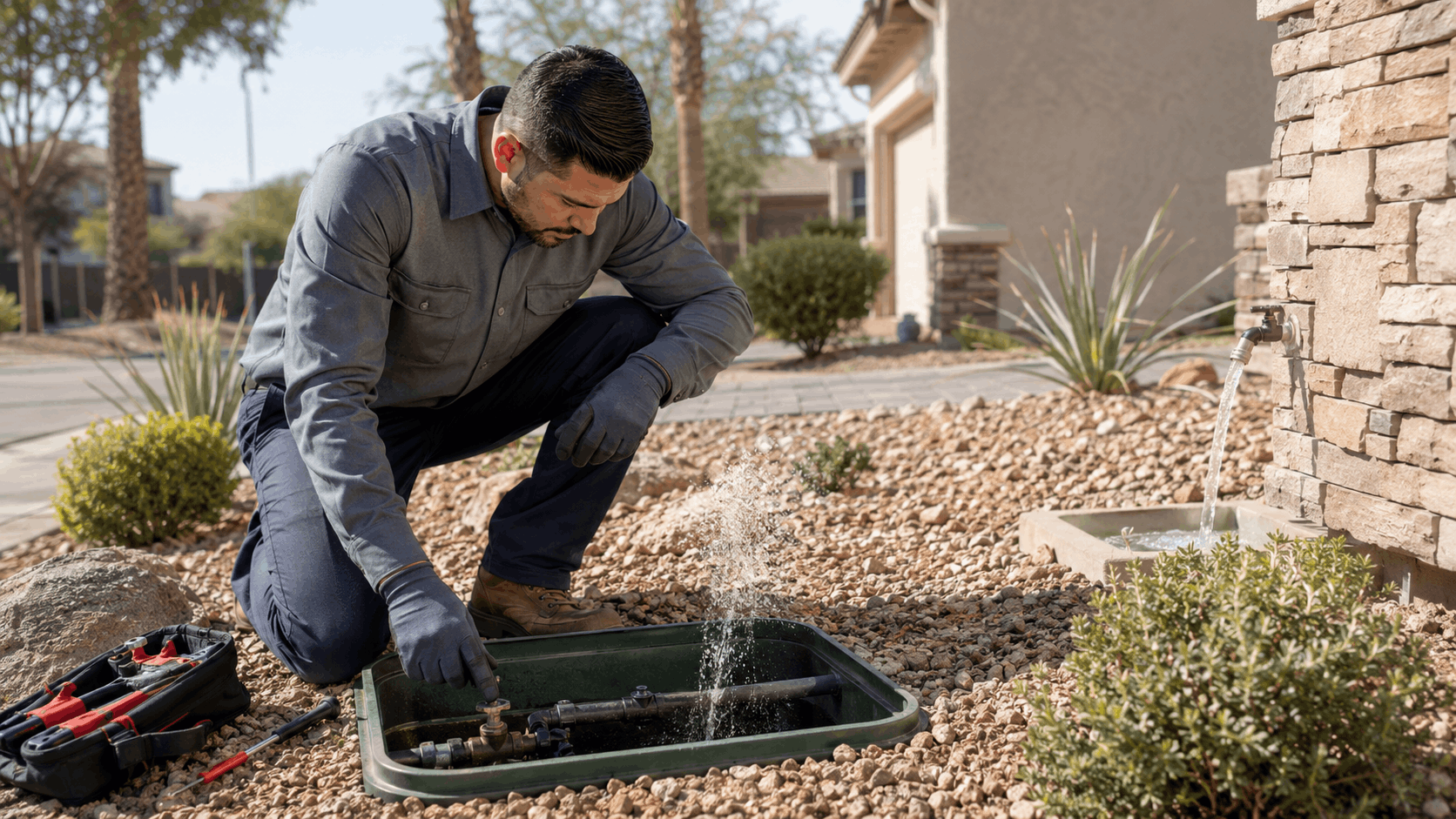
What an Irrigation Manifold Is and Why It Springs Leaks in Las Vegas?
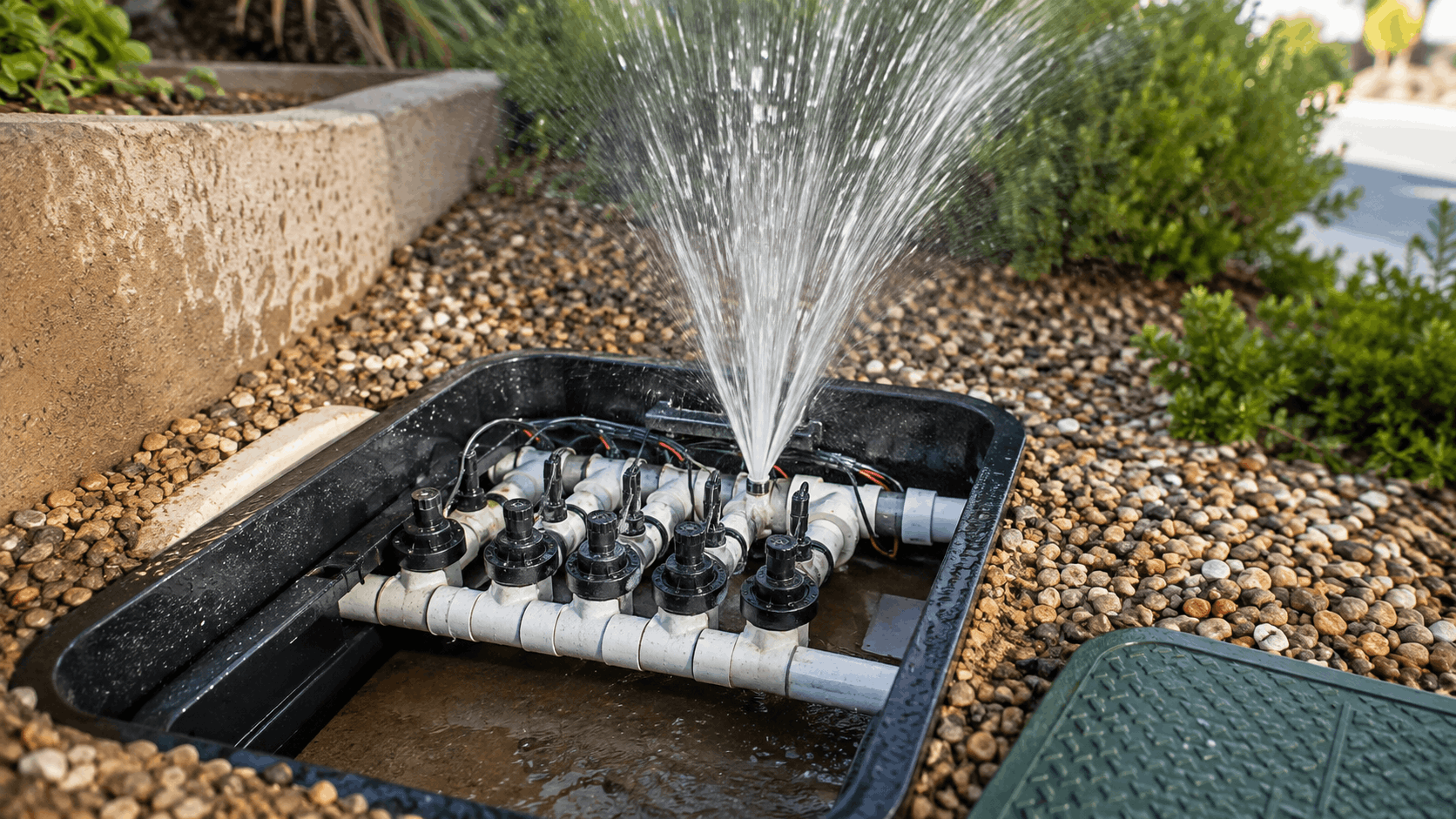
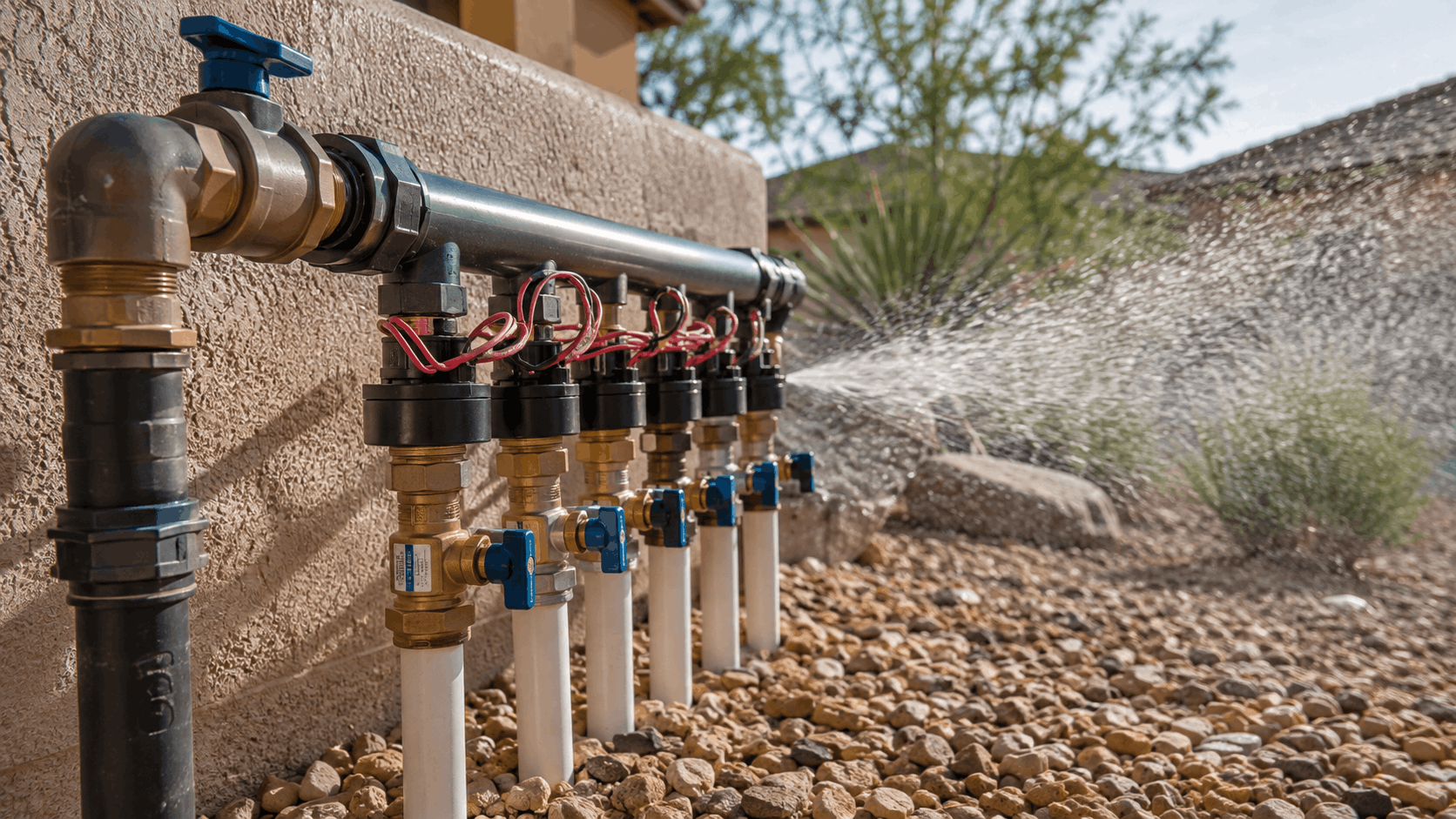
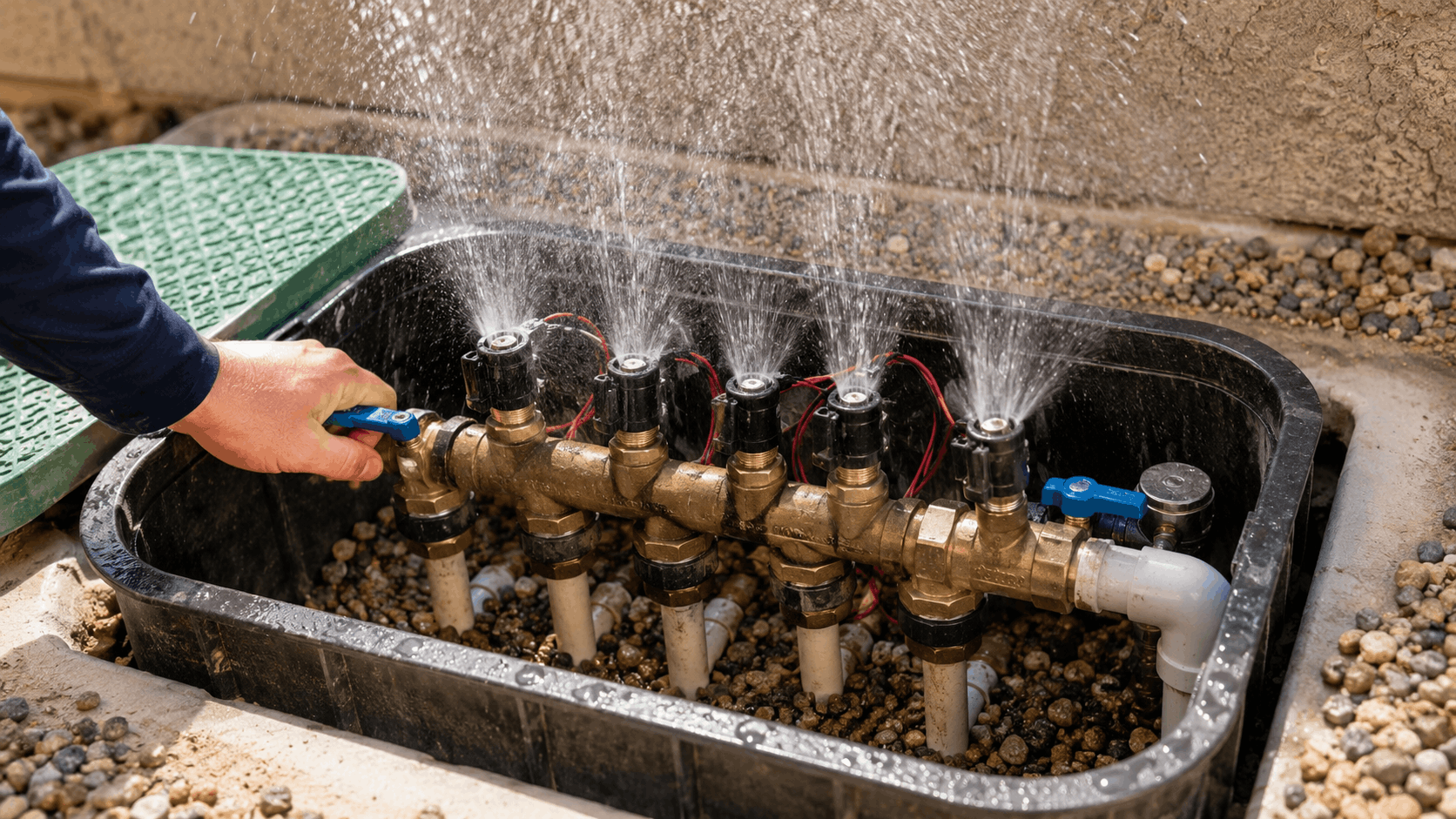
The irrigation manifold is the control hub for your sprinkler system. It is that grouping of valves, pipes, and wires usually sitting in a plastic box in the ground or mounted along a wall. Each valve on the manifold feeds a different watering zone in the yard.
When one of those parts cracks or a seal gives out, water sprays instead of feeding the lawn. Here in the valley, this happens more than people expect. The reasons come down to sun, heat, and the minerals in our water.
- The manifold routes water from the main line out to each sprinkler zone.
- Each sprinkler valve opens and closes based on the controller schedule.
- Las Vegas water carries hard minerals that build up inside valves and fittings.
- Direct sun and 110 degree summers break down plastic parts fast.
How the Manifold Connects to Your House Water
Water enters your property from the main water line at the meter box near the street. From there it usually splits. One path heads into the home for faucets, showers, and appliances, while another branch feeds the irrigation system.
The irrigation branch typically passes through a backflow device, then reaches a dedicated irrigation shutoff. After that shutoff, the line runs to the manifold where the zone valves sit. Each valve controls the flow to a set of sprinkler heads.
Because the sprinkler path splits off before it reaches your indoor plumbing, you can close the irrigation shutoff and stop the sprinklers while the house stays wet. That split is what makes it possible to fix a spraying manifold without a cold shower in your future.
Once a homeowner pictures this layout, the panic drops. The manifold is not tied to your kitchen sink. It is a separate arm of the same tree, and you can cut that one arm off at the right spot.
Why Desert Heat and Hard Water Wear Parts Out
The Mojave sun is hard on plastic. UV damage slowly makes poly tubing and exposed PVC brittle, chalky, and weak. A fitting that looked fine two years ago can snap with a light bump once the sun has cooked it.
Then there is our water. Las Vegas water is famously hard, loaded with calcium and other minerals from the Colorado River supply. That buildup collects inside solenoid valves and threaded joints, wearing out seals and forcing parts to stick or crack.
Summer heat makes it worse. When afternoon temperatures push past 110 degrees, PVC expands and contracts every day. Over a few seasons that stress leads to cracked PVC and split fittings, often right at the manifold where several parts meet.
We see the pattern all over town. Homes with manifolds sitting in full sun on a west-facing side yard fail years sooner than shaded ones. A little shade or a valve box cover buys a lot of extra life.
Common Failure Points We See Around the Valley
After years of service calls from Henderson to North Las Vegas, the same parts show up on our repair list again and again. The most common is the solenoid valve, the electric part that opens each zone. Minerals and heat cause it to stick open or leak around the diaphragm.
Glued PVC joints are next. A weak or aged glue joint at the manifold cracks and starts a steady spray. These are common on manifolds installed by the original builder more than a decade ago.
Threaded risers and adapters also give out. The threads crack from UV damage or a bad Teflon seal, and you get a leaking fitting right at the base of a valve. Sometimes the whole sprinkler zone stops working because water escapes before it reaches the heads.
None of these are rare. If a manifold is more than eight to ten years old in our climate, one of these failures is usually just a matter of time.
Get Your Quote
Tell us what's going on and we'll get back to you fast.
Finding the Right Shutoff So You Don't Lose Water Inside
The whole point is to stop the sprinkler system at its own valve, not at the house main. Most homes across the valley have a dedicated irrigation shutoff valve for exactly this reason. Finding it before an emergency saves a lot of stress later.
Take a walk around the property on a calm day and locate this valve now. When water is spraying, you do not want to be hunting for it while your yard floods. A little scouting today keeps your house water on during the next leak.
The Difference Between the House Main and the Irrigation Valve
The house main controls every drop of water going into your home. Close it, and faucets, toilets, and the shower all go dry. That is the last thing you want on a work morning.
The irrigation valve is different. It sits on the irrigation branch, which splits off after the backflow device. This valve only controls water heading to the sprinklers.
In most Las Vegas homes, closing the irrigation valve stops the manifold spray while the house main stays fully open. The two are separate on purpose so a landscaper can work on sprinklers without shutting down the household.
Knowing which is which is the difference between a minor fix and a bad morning. Trace the pipe. The valve on the line running toward the yard and the backflow device is your irrigation shutoff.
Where Builders Put the Irrigation Shutoff in Local Homes
Builders tend to hide these valves in a few predictable spots. Look first near the front hose bib, since irrigation lines often tie in close to that outdoor faucet. Many Summerlin and Henderson homes place the shutoff right there.
The side yard is another common location. Walk the path along the house and look for a valve on a pipe running low to the ground, often near the backflow preventer sticking up out of the dirt.
The backflow device itself usually has test cocks and small shutoff valves built in. On homes near the older Charleston-area streets east of downtown, the setup may look aged and corroded, but the shutoff is often mounted right at that assembly.
If your home has an HOA in a community like Summerlin West, the irrigation setup is fairly standard and easy to spot along the side yard. Older custom homes vary more, so give yourself time to look.
How to Tell If You Have a Dedicated Sprinkler Line
Not sure if your sprinklers run on their own line? There is a simple test. Turn off every water fixture inside the house, then go watch the water meter at the box near the street.
If the meter dial is still, turn on a sprinkler zone. If the meter starts spinning while nothing indoors is running, water is flowing to the irrigation branch. That confirms a dedicated line feeding the manifold.
You can also do it the other way. Close what you believe is the irrigation shutoff, then check that an indoor faucet still runs. If the house has water but the sprinklers will not turn on, you found the right valve.
The Las Vegas Valley Water District can confirm meter details for your address if you are unsure. Most homes built in the last few decades in the Las Vegas Valley do have a separate line.
What to Do If There Is No Separate Shutoff
Some older or budget-built homes tie the irrigation straight into the main with no dedicated valve. On a shared line like this, stopping the sprinklers means shutting the house down too.
That is inconvenient and, during a leak, means going without water inside while you work outside. It also makes future landscaping or repairs harder than they need to be.
The fix is adding an isolation valve on the irrigation branch. A plumber taps in a ball valve where the sprinkler line splits off, giving you a dedicated shutoff going forward. It is a small job with a big payoff.
Our team installs these regularly, and homeowners almost always wish they had done it sooner. The next time a fitting blows, they close one valve and the house never notices.
Need Help in Las Vegas?
Active Plumbing serves Las Vegas and all of Las Vegas Valley.
Step-by-Step: Isolating the Manifold Without Killing House Water
Here is the order of operations to isolate irrigation and stop the sprinkler leak while keeping indoor water on. Follow these steps calmly and in sequence. The goal is to shut off the valve feeding the manifold, then confirm nothing else was affected.
| Step | Action | Result |
|---|---|---|
| 1 | Close the irrigation ball or gate valve | Water stops feeding the manifold |
| 2 | Set the controller to off or rain mode | Zones stop trying to open |
| 3 | Relieve pressure at a downstream valve | Line drains and spray stops fully |
| 4 | Test an indoor faucet | Confirms house water is still on |
Turn Off the Irrigation Ball Valve or Gate Valve First
Start at the dedicated shutoff you located earlier. If it is a ball valve, the handle turns a quarter turn. When the lever sits crosswise to the pipe, the valve is closed.
If it is a gate valve with a round wheel handle, turn it clockwise, which most people remember as righty tighty. Keep turning until it stops firmly. Do not force it past the natural stopping point or you may snap an old stem.
Watch the manifold as you close the valve. The spray should slow and then stop within a few seconds as the flow cuts off. If it does not, you may be at the wrong valve, so trace the pipe again.
Older gate valves in sun-baked side yards sometimes seize up. If the handle will not budge, do not crank hard enough to break it. Move to the controller and pressure relief steps, then call for help.
Shut Down the Controller So Zones Stop Cycling
Even with the shutoff closed, the sprinkler controller keeps trying to run its schedule. Set the timer to the off position or switch it to rain mode. This tells the solenoid valves to stop opening.
Rain mode is handy because it pauses watering without erasing your program. When repairs are done, you flip it back and your schedule returns. On older dial timers, simply turning the dial to off works the same way.
Stopping the controller matters because an open valve downstream of a leak can keep water moving even after you close the main irrigation valve. Cutting power to the zones removes that variable while you work.
It also protects the solenoids. Running them dry or against a closed line repeatedly can burn out the coils, turning a simple fix into a valve replacement.
Relieve Pressure and Confirm the Spray Has Stopped
With the shutoff closed, some water may still sit in the line under pressure. Open a downstream drain or the manual bleed screw on one of the manifold valves to relieve pressure and bleed the line.
Many solenoid valves have a small bleed screw on top. Loosen it a quarter turn and you will hear water release. Once the trickle stops, the line is drained and the manifold should be dry.
Look closely at the crack or broken fitting. It should no longer be spraying or dripping under pressure. If water still weeps steadily, the shutoff may not be fully closed or there is a second source feeding the line.
Give it a minute or two to settle. A properly isolated manifold goes quiet and dry, which tells you it is safe to inspect or wait for a plumber without more water loss.
Check That Indoor Faucets Still Run
Now for the reassuring part. Walk inside and turn on a kitchen or bathroom faucet. If water flows with normal house water pressure, you did it right. The sprinklers are off and the home never lost supply.
Flush a toilet and run the tub too, just to be thorough. Full pressure at every indoor fixture confirms you closed only the irrigation branch and left the house main untouched.
If an indoor faucet has gone dry, you likely closed the house main by mistake. Reopen that valve, then go back and find the correct irrigation shutoff before trying again.
This final check is what separates a smooth fix from a rough one. It confirms the family can shower and make coffee while the yard waits for repair.
Emergency Steps If You Can't Find the Irrigation Shutoff
Sometimes water is gushing and there is no time to trace pipes. When flooding threatens the house or foundation, stopping the water fast beats stopping it perfectly. Here is how to handle a true emergency shutoff.
If you cannot find any irrigation valve, the water main becomes your backup. It is a blunt tool, but it stops everything, including the leak. Use it, then work on a smarter fix once the flood is under control.
Using the Main Shutoff as a Last Resort
The main shutoff is usually at the meter box near the street or sidewalk. Lift the lid and you will see the meter and a valve, often with a lever or a nut you turn with a meter key or a wrench.
Turn the main valve until it stops to shut off all water to the property. Yes, the house goes dry too, but a flooding yard at 110 degrees is worse than a temporary inconvenience.
There is also a shutoff where the water line enters the home, often near the front hose bib or in the garage. Closing that stops the house but not the irrigation, so for a sprinkler leak the meter valve is the safer bet.
Once the water is off, you have time to breathe. Call a plumber, or move to capping the broken line so you can restore house water. For urgent flooding our emergency plumbing team is available around the clock.
Capping the Broken Line Temporarily
If you can reach the broken riser or fitting, a temporary cap can stop the spray so you can turn house water back on. Cut the damaged section cleanly with a hacksaw below the crack.
Thread on a matching cap or push a plug into the pipe. For threaded parts, wrap the threads with Teflon tape first for a better seal. For glued PVC, a cap set with primer and cement holds until a full repair.
With the broken line capped, you can reopen the main water. The house gets water back and the sprinklers stay off at the capped spot. This buys days if needed while you schedule a proper repair.
Keep in mind a cap is a stopgap, not a fix. The zone it feeds stays dry until a plumber rebuilds the manifold or replaces the fitting the right way.
Protecting Your Home and Foundation From Runoff
A spraying manifold can dump hundreds of gallons before it is stopped. All that water runoff pooling against the slab is a real problem in our region. Desert soil and the clay layers underneath swell when soaked, then shrink as they dry.
That swelling and shrinking can shift a foundation over time. Push water away from the house with a broom, a shop vac, or by digging a quick channel toward the street or a drain.
Watch the stucco too. Water splashing against the base of a wall soaks into it and can cause staining, cracking, or mold behind the surface. Keep the spray and pooling as far from the home as you can.
If water reached the garage, a patio slab, or under the house, mention it when you call. Trapped moisture in our soil does not drain quickly, and catching it early prevents bigger structural headaches.
Need Help in Las Vegas?
Active Plumbing serves Las Vegas and all of Las Vegas Valley.
Tools and Parts That Make the Job Easier
A few basic irrigation repair parts kept in the garage turn a frantic morning into a manageable one. You do not need a pro kit, just the essentials to cap a line or make a temporary patch. Pros carry more for lasting repairs.
Stocking up costs little and pays off the first time a fitting blows on a Sunday. Here is what we recommend keeping on hand and what we bring for a permanent fix.
Basic Supplies Worth Keeping in the Garage
Start with an assortment of PVC caps and plugs in common sizes like half inch and three quarter inch. These let you stop a spraying line fast. Add a small can of PVC primer and PVC cement for gluing caps onto cut pipe.
A hacksaw or PVC cutter handles clean cuts on the damaged section. Rough or angled cuts make for weak joints, so a proper cutter helps. Keep a utility knife nearby to trim burrs off the pipe edge.
Teflon tape is a must for any threaded connection. A few wraps on the male threads seals the joint and prevents the slow leaks that plague sun-baked risers. A cheap roll lasts through many repairs.
Toss in an adjustable wrench and channel-lock pliers for tightening fittings and turning stubborn valve handles. With these few items, most homeowners can stop a leak long enough to schedule real work.
Why We Add Isolation Valves at Each Manifold
The single best upgrade we install is an isolation valve setup at the manifold. Adding a small valve per zone or a shutoff on the manifold means you can close one leak without stopping the whole yard.
Picture a leak on the front zone. With a zone shutoff, you close that one valve, water the back yard normally, and keep the house running. Without it, the entire irrigation branch has to go off.
These valves also make future repairs faster and cheaper. A plumber isolates the exact section that needs work rather than draining the whole system. Less downtime, less water waste.
For homes across Spring Valley and Enterprise where yards run big, per-zone shutoffs are worth every penny. Our team can add them during a repair or as a standalone upgrade.
Choosing Parts That Handle Vegas Sun and Pressure
Not all parts survive our climate equally. For pipe, schedule 40 PVC is the standard we trust because it handles pressure and holds up better than thin-wall pipe. Above ground, look for UV rated fittings that resist sun damage.
For shutoffs, a brass valve outlasts plastic every time. Brass shrugs off heat and pressure swings that crack cheaper valves. Spending a bit more here means years between replacements.
Exposed lines should be shielded from direct sun when possible. A valve box, a cover, or even routing the pipe in shade slows UV breakdown dramatically. We often reroute a sun-exposed line during repairs.
Choosing the right materials is the difference between a fix that lasts five years and one that fails again next summer. In this climate, the cheapest part is rarely the smartest.
When a Manifold Leak Points to a Bigger Problem
Sometimes a spraying manifold is not just a worn fitting. It is a symptom of something upstream, like high water pressure, a failing backflow device, or aging underground lines. Spotting these signs early saves money and repeat repairs.
If you keep patching leaks and they keep coming back, the system is telling you something. A plumbing inspection can pinpoint the real cause instead of chasing one crack after another.
High Water Pressure That Blows Out Fittings
City water pressure across the valley often runs high, sometimes well above what irrigation parts are built to take. Anything over about 80 psi puts stress on fittings, valves, and glued joints.
Without a pressure regulator, that high water pressure hammers the weakest point until it splits. If your manifold keeps failing at different spots, pressure is a likely suspect. So is a repair that blows out again within weeks.
A plumber can test static pressure at a hose bib in minutes. If it reads high, installing or adjusting a pressure regulator protects the whole system, indoors and out. It is a small device that prevents a lot of damage.
Homes on higher ground or near main supply lines often see the worst of it. Regulating pressure is one of the most cost-effective fixes we make for repeat irrigation trouble.
Backflow Device Problems and Local Testing Rules
The backflow preventer keeps sprinkler water from flowing back into your drinking supply. When it fails, it can leak from its relief port or spray from a cracked body, which people sometimes mistake for a manifold leak.
Backflow devices require regular backflow testing under rules tied to the Southern Nevada Water Authority and the Las Vegas Valley Water District. A device that fails testing or leaks needs prompt attention from a certified tester.
Symptoms of a bad backflow device include water dripping from the bell-shaped relief valve or a steady leak at the assembly during watering. Freezing nights in winter also crack these units, so damage is not only a summer issue.
If the leak is at the backflow assembly rather than the valve manifold, that is a different repair. Our team handles both and keeps the work compliant with district requirements.
Repeat Leaks That Signal Aging Underground Lines
When leaks keep popping up at new spots along a buried line, the pipe itself may be at the end of its life. Older homes near the Charleston corridor or east of the Strip sometimes have brittle underground line from decades of sun exposure and mineral wear.
A repeat leak is the classic warning sign. You fix one section, and a month later another gives out a few feet away. At that point, patching costs more over time than a line replacement.
Underground PVC that was installed shallow or in full sun before backfilling degrades faster. So does poly tubing that has baked near the surface. Replacing the run with schedule 40 PVC at proper depth ends the cycle.
We assess the age and condition of the buried line during a repair. If it is time for replacement, we lay it out so the next twenty years are leak free rather than a game of whack-a-mole.
Need Help in Las Vegas?
Active Plumbing serves Las Vegas and all of Las Vegas Valley.
Why Homeowners Across the Valley Call Active Plumbing
When a manifold sprays, homeowners want it stopped fast and fixed right the first time. That is what Active Plumbing does across Las Vegas neighborhoods, from quick shutoffs to full irrigation repair and isolation valve installs.
As a local Las Vegas plumber, our team knows the water conditions, the common builder setups, and the code rules that apply here. We show up ready for our climate, not guessing at it.
Fast Response for Spraying Leaks and Floods
A spraying leak wastes water by the minute and can threaten a foundation. That is why we move quickly as an emergency plumber for homes across the valley. When water is gushing, minutes matter.
We serve Summerlin West and the surrounding Summerlin communities, along with Whitney Ranch in Henderson and neighborhoods throughout Spring Valley. We know the routes and the typical setups in each area.
Our crews come equipped to isolate the leak, stop the water loss, and either patch it on the spot or plan the full repair. No leaving you with a spraying yard while a part gets ordered.
If you are watching water shoot into the air right now, call us and we will talk you through the shutoff while a truck heads your way. Fast help is the whole point.
Permanent Fixes That Stop Repeat Calls
Anyone can slap on a cap. We aim for a permanent repair that keeps you from calling again next month. That often means a manifold rebuild with fresh valves, quality fittings, and proper glue joints.
We add isolation valves so a future leak stays contained to one zone. We check and correct water pressure with a regulator when needed. Fixing the root cause is how the problem stays gone.
For homes with tired underground lines, we recommend replacement over endless patching when it makes financial sense. We lay it out honestly so you can decide with real numbers in front of you.
The goal is simple. Fix it once, fix it right, and let you forget about the manifold for a long time.
Work That Meets Local Code and Water District Rules
Irrigation and backflow work has to match Clark County code and water district requirements. We handle repairs so they stay compliant, including backflow compliance where a device is involved.
That matters because a botched backflow setup can risk your drinking water and put you crosswise with the water district. We do it to standard the first time so there are no surprises.
Our familiarity with local rules also means faster, cleaner work. We are not learning the requirements on your dime. If you want a broader look at your system, our whole home leak detection options catch trouble before it floods.
From a single cracked fitting to a full system overhaul, we keep everything up to the standards this valley requires.
Final Thoughts
A spraying irrigation manifold looks scary, but it rarely means you have to shut off water to the whole house. Most Las Vegas homes have a dedicated irrigation shutoff that stops the sprinklers while the family keeps showers and coffee flowing.
Locate that valve now, before an emergency. Know where your controller and main shutoff are too. With a few caps and some Teflon tape in the garage, you can stop most spraying leaks long enough to breathe.
When the leak points to pressure problems, a failing backflow device, or aging lines, that is the time to bring in a plumber. Active Plumbing serves homeowners across Summerlin, Henderson, Spring Valley, and the rest of the valley with fast response and lasting repairs. Contact our team or call today to stop the spray and fix it for good.
Frequently Asked Questions
- Can I shut off my sprinklers without turning off water to my whole house?
- Yes, in most Las Vegas homes you can. Sprinklers usually run on a dedicated irrigation branch with its own shutoff valve, separate from the house main. Find that valve, often near the front hose bib, side yard, or backflow device, and close it. The manifold stops feeding while indoor faucets keep full pressure. Test a kitchen tap afterward to confirm the house never lost water.
- Where is the irrigation shutoff valve on most Las Vegas homes?
- Look in three common spots. First, near the front hose bib, since irrigation often ties in close to that outdoor faucet. Second, along the side yard on a low pipe running toward the yard. Third, at or near the backflow preventer sticking up out of the ground. Summerlin and Henderson homes usually follow these patterns, while older Charleston-area homes may have aged assemblies that still hide the shutoff nearby.
- Why is water spraying from my irrigation manifold?
- Usually it is one of a few things. A cracked PVC fitting or glued joint that failed from heat and UV damage is common. A bad solenoid valve stuck open or leaking around its diaphragm is another. High water pressure with no regulator can blow out weak parts. Our 110 degree summers and hard water speed all of these along, especially on manifolds sitting in full sun.
- How do I stop the leak if I can't find any irrigation valve?
- Head to the water main at the meter box near the street and turn the valve until it stops. That shuts all water to the property, including the leak. The house goes dry temporarily, which is far better than a flooded yard. Once the water is off, cap the broken line with a matching cap and Teflon tape, then reopen the main to restore house water.
- Will turning off the controller stop the spraying?
- It helps but may not be enough on its own. Setting the controller to off or rain mode stops the zones from cycling open on schedule. If the leak is a solenoid valve stuck open, that can slow or stop it. But a physical crack in a pipe or fitting under pressure will keep spraying until you close the irrigation shutoff valve and relieve the line pressure.
- How much does it cost to repair an irrigation manifold in Las Vegas?
- Costs vary with the damage. A simple cap or single fitting repair often runs on the lower end, while replacing a solenoid valve costs a bit more. A full manifold rebuild with new valves, fittings, and isolation valves lands higher, especially if a pressure regulator or backflow work is added. We give clear estimates up front so you know the range before any work starts.
- Is a leaking backflow device an emergency?
- It depends on the leak. A slow drip from the relief valve during watering can often wait a short time for a scheduled repair. A steady spray, a cracked body, or a device that failed required testing needs quick attention. Because the backflow preventer protects your drinking water, do not ignore a significant leak. A certified tester should inspect and repair it promptly to stay compliant.
- Should I add an isolation valve to my sprinkler system?
- In most cases, yes. An isolation valve or per-zone shutoff lets you close off one leak without stopping the whole yard or the house. When a fitting blows, you turn one valve, keep watering other zones, and keep indoor water on. It also makes future repairs faster and cheaper. For homes with large yards, this small upgrade pays for itself quickly.
- Can high water pressure cause my sprinkler lines to burst?
- Absolutely. City pressure across the valley often runs high, sometimes above 80 psi, which is more than many irrigation parts are built to handle. That pressure stresses fittings and joints until they crack. If your manifold keeps failing at different spots, or a repair blows out within weeks, high pressure is a likely cause. A pressure regulator brings it into a safe range and protects the whole system.
- How fast can Active Plumbing get to a spraying leak?
- We treat spraying leaks as urgent because they waste water and can threaten a foundation. Our crews respond quickly to homes across Summerlin, Henderson, Spring Valley, Enterprise, and the greater Las Vegas Valley. When you call, we can often talk you through the shutoff right away while a technician heads to your address. Response times depend on your location and the day, but stopping the flood fast is always the priority.
A
Licensed plumbing professionals serving Las Vegas and Las Vegas Valley.
Licensed in Nevada · License #0047021
Last updated on
Why trust Active Plumbing?
Founded in 1991, Active Plumbing is a licensed and insured plumber serving Las Vegas and Las Vegas Valley. All content is reviewed by our licensed technicians.

Need Help in Las Vegas?
Active Plumbing serves Las Vegas and all of Las Vegas Valley.
Related Articles
How-To Guides
Best Drain Cleaning Method for Las Vegas Hard Water Buildup
Las Vegas hard water ranks among the harshest in the US. Learn which drain cleaning methods actually work on mineral scale - and when to call a professional.
How-To Guides
Burst Water Heater in a Las Vegas Garage: Flood Control, Drywall, and Insurance Documentation Steps
A step-by-step Las Vegas guide to a burst garage water heater: stop the flood fast, protect drywall, dry the space, and build a clean insurance claim.
How-To Guides
Water Heater Replacement Same Day Las Vegas: Stock and Install Timelines
Learn how same-day water heater replacement works in Las Vegas, from local stock and realistic install timelines to permits, neighborhood factors, and prep tips.