Hydro Jetting Cost for Las Vegas Restaurants: Grease Lines, Frequency & Contracts
Key Takeaways
- One-time hydro jetting for a Las Vegas restaurant typically costs $350 to $1,200 depending on line size, grease severity, and access.
- Hydro jetting scours grease off pipe walls with up to 4,000 PSI, while snaking only pokes a hole that reclogs fast.
- Hard water from the Las Vegas Valley Water District bonds with grease and hardens buildup more quickly than in most cities.
- High-volume Strip and Fremont Street kitchens often need jetting monthly to quarterly; mid-size spots every 3 to 6 months; cafes twice a year.
- Frequency contracts lock in lower per-visit rates, add priority emergency response, and prevent costly dinner-rush backups.
- Slow drains, gurgling, and sewer smells are warning signs a grease line needs jetting before it fully backs up.
- Regular jetting supports Southern Nevada Health District compliance and helps avoid backup-related shutdowns and fines.
- Grease trap pumping and hydro jetting are separate tasks that work together to keep the whole drain system clear.
In This Article
It's 7:30 on a Friday night. A steakhouse just off Las Vegas Boulevard is slammed, tickets are piling up, and then the dish pit floor drain starts backing up. Grey water pools around the line cooks' feet. The kitchen manager is on the phone with us before the appetizers even hit the tables.
We get calls like this almost every weekend across the valley. Grease lines clog at the worst possible time, and the fix during a rush costs far more than a planned cleaning would have. That gap between an emergency and a scheduled visit is where restaurant owners lose real money.
What Hydro Jetting Actually Does for Restaurant Grease Lines?
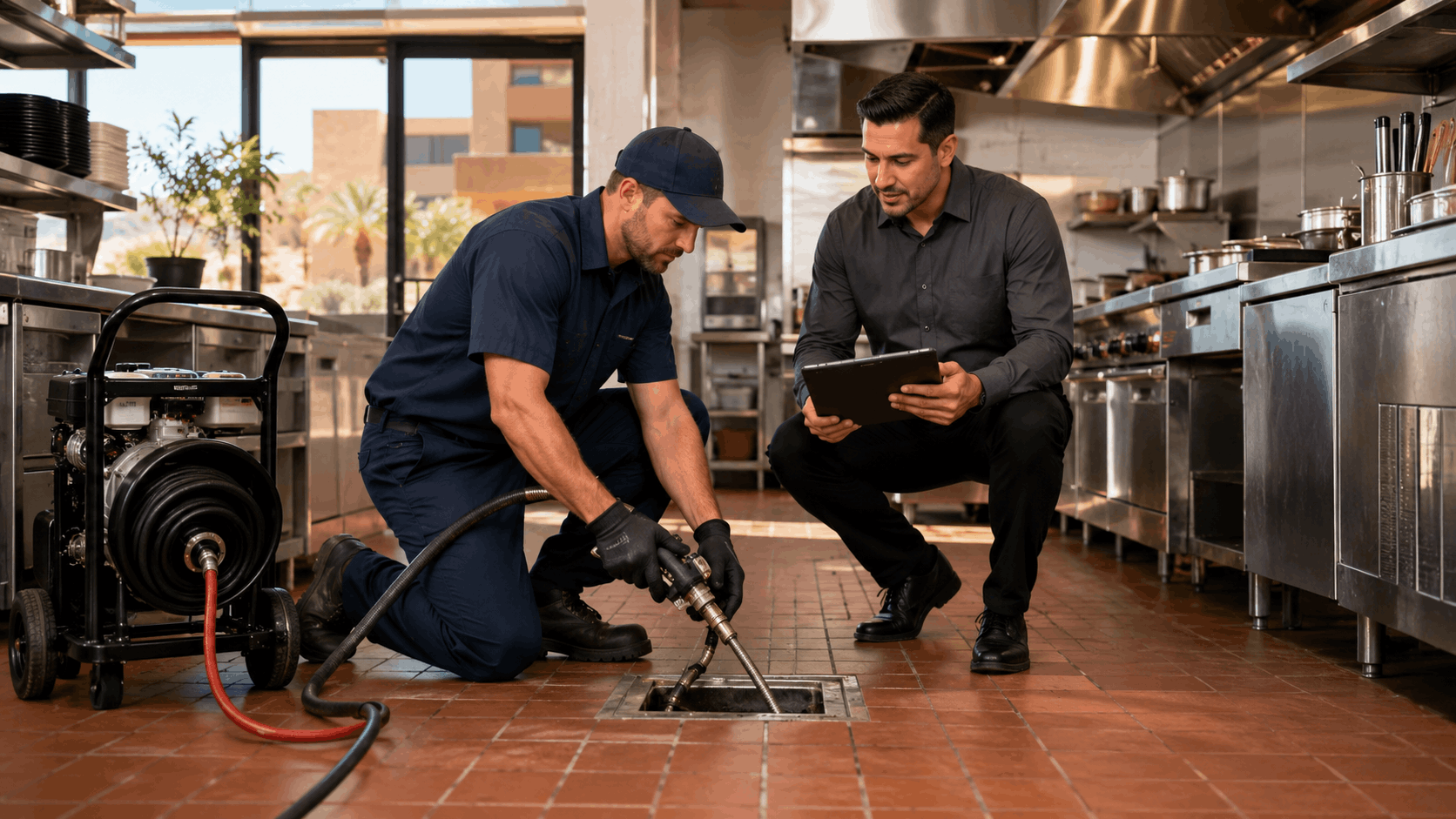
Hydro jetting is drain cleaning with high-pressure water instead of a metal cable. A specialized hose feeds a nozzle down the line, and jets of water blast the pipe walls clean from top to bottom.
For restaurant plumbing, that difference matters a lot. Kitchen drains do not clog with a single object the way a home toilet does. They clog with layers of hardened grease, food solids, and soap scum that coat the entire inside of the pipe. Hydro jetting is the only method that strips all of that off at once.
When we service grease lines, we are not just clearing one spot. We are restoring the pipe to something close to its original inside diameter so it drains at full speed again.
How High-Pressure Water Clears a Grease-Coated Pipe
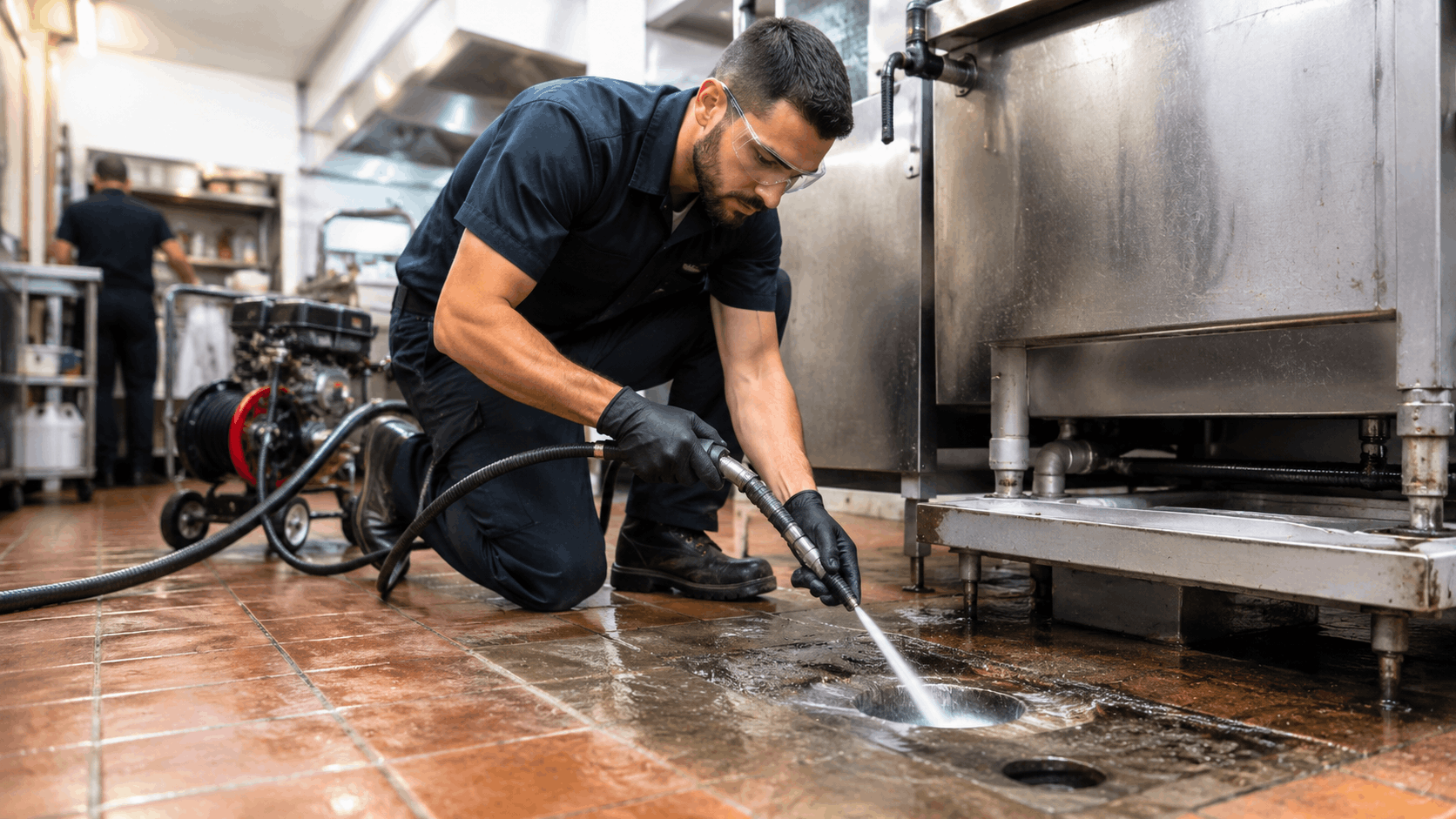
A commercial jetting unit pushes water at pressures up to 4,000 PSI. That water pressure is what separates jetting from every other cleaning method. It does not just push through a clog - it scours the pipe walls in every direction.
The nozzle has forward jets to cut through the blockage and rear-facing jets that pull the hose forward while scrubbing the walls behind it. As it travels down the line, it peels grease off the pipe like paint off a wall. The debris gets flushed downstream toward the main and out.
This kind of pipe cleaning reaches every inch of the interior surface. A greasy 4-inch line that has narrowed to the size of a garden hose can come back to full flow in a single pass. That is why kitchens see such a dramatic difference right after a proper jetting run.
The pressure gets dialed to the line. A cast-iron main takes more force than a smaller PVC branch line, and our team adjusts the nozzle and PSI to match the pipe so the clean is thorough without stressing the material.
Why Snaking Falls Short in Commercial Kitchens
Cable snaking has its place, but greasy kitchen drains are not it. A snake is a metal cable with a cutting head that spins through the line. In a grease-coated pipe, it punches a hole through the blockage and pulls back a chunk of gunk.
The problem is what it leaves behind. The grease buildup coating the rest of the pipe walls is still there. Water drains through the small opening the snake made, but that opening closes back up fast as more grease flows in and sticks to the existing layer.
We have seen kitchens on high-volume routes snake the same line every two weeks and wonder why it keeps failing. The drain cleaning was never complete. It cleared a path but never cleaned the pipe. That cycle costs more over a year than jetting would.
For a busy commercial kitchen, a full clean is the only thing that lasts. Jetting removes the grease that a snake leaves in place, which is why the results hold for months instead of days. Our hydro jetting and rooter service is built specifically for this kind of buildup.
The Line Types We See in Vegas Restaurants
A typical Las Vegas restaurant has more than one line that carries grease and food waste. The grease waste line runs from the kitchen sinks and prep areas, usually through a grease trap or interceptor, before joining the main. This is the line that clogs most often.
Then there are floor drains. These catch mop water, spills, and overflow throughout the kitchen and dish pit. They tie into the same system, and when they gurgle or back up, it usually means a downstream grease line is restricted.
Finally there is the main sewer line that carries everything out to the city connection. When a main clogs, every drain in the building slows or backs up at once. Jetting scope changes depending on which lines are involved.
Knowing the layout helps us quote accurately and clean efficiently. A single floor drain clean is a quick job. A full grease waste line plus the main sewer run is a larger project, and we scope the visit around what a kitchen actually has under the slab.
Get Your Quote
Tell us what's going on and we'll get back to you. We're open 24/7.
Hydro Jetting Cost Ranges for Las Vegas Restaurants
Restaurant owners always want a number first, so here it is. Hydro jetting cost for a Las Vegas restaurant usually falls between $350 and $1,200 for a one-time service, depending on the line and the severity of the grease.
That range covers most kitchens across the valley. Restaurant pricing shifts based on line size, how many drains need service, and whether the job runs during business hours or overnight. Below is a breakdown of what a typical visit looks like.
| Service Type | Typical Price Range | What It Covers |
|---|---|---|
| Single floor drain jetting | $250 - $450 | One drain, light to moderate buildup |
| Grease waste line jetting | $400 - $750 | Main kitchen line, moderate to heavy grease |
| Full main sewer line jetting | $650 - $1,200 | Longer runs, larger diameter, heavy buildup |
| Emergency / after-hours jetting | $800 - $1,800+ | Same-day or overnight backup during service |
| Camera inspection add-on | $150 - $350 | Verifies the line is clear after jetting |
| Recurring contract visit | $250 - $600 | Lower per-visit rate on a scheduled plan |
Typical Price Range for a One-Time Service Call
A one-time service call for a single floor drain in a smaller kitchen usually runs $250 to $450. That covers a light to moderate clean where the grease has not fully hardened into the pipe walls yet.
A grease waste line, the workhorse line from your three-compartment sink, typically lands in the $400 to $750 range. This is a common single service we do for restaurants, and the price range reflects how much grease has built up since the last cleaning.
Full main sewer line service sits at the high end, $650 to $1,200. These lines are longer, wider, and carry the heaviest loads. When a main has not been jetted in a year or more, expect the top of that range because the buildup is thick and takes multiple passes.
The low end of every price range assumes good access and manageable grease. The high end reflects long lines, heavy hardening, and tight cleanout access. A quick site look lets us pin down the number instead of guessing.
What Drives the Price Up or Down
Several pricing factors move the final number. Line length is a big one - a 30-foot branch line costs less to clean than a 90-foot run to the street. More pipe means more time and more passes with the nozzle.
The number of drains matters too. Jetting one floor drain is straightforward, but a kitchen wanting every floor drain, the prep sinks, and the main all cleaned in one visit is a larger job priced accordingly. Grease severity plays in as well, since a line neglected for two years takes far longer than one on a regular schedule.
Access points affect cost more than owners expect. If there is a clean, accessible cleanout near the grease line, the job goes fast. If our team has to pull a toilet or access the line from the roof, that adds labor and time.
After-hours scheduling is the last big variable. Overnight and weekend work carries premium rates because it protects your service hours. Many owners still choose it because losing a dinner rush costs far more than the after-hours upcharge.
Emergency vs. Scheduled Jetting Costs
There is a real price gap between an emergency call and a planned cleaning. A backup during a Friday dinner rush is emergency plumbing, and it comes with same-day dispatch, priority routing, and premium labor. Those calls often run $800 to $1,800 or more.
A scheduled service booked days in advance during a slow afternoon or overnight costs a fraction of that. There is no rush premium, and we can plan the crew and equipment around your kitchen's downtime. The pipe gets the same thorough clean either way.
The math almost always favors scheduled service. When a line backs up mid-shift, you are paying emergency rates plus losing table turns, comping meals, and sometimes sending staff home early. Overnight cleaning avoids all of that. Our emergency plumbing team is available when a backup hits, but staying ahead of it costs less.
This is exactly why so many restaurants move to a recurring plan after their first emergency. One dinner-rush backup usually convinces an owner that a planned schedule is the cheaper path.
Camera Inspection Add-On Costs
A sewer camera inspection pairs naturally with jetting. After we clean the line, we can run a camera down it to confirm the pipe is genuinely clear and not just partly opened. This add-on usually runs $150 to $350.
The camera does two things. It verifies the clean was complete, and it flags problems you cannot see otherwise - cracks, root intrusion, bellied pipe, or corrosion inside older cast iron. Catching those early saves a much bigger repair later.
For a restaurant that has never had its lines scoped, the first camera inspection is worth every dollar. It gives you a baseline of your entire drain system so you know what you are working with. Our sewer camera inspection service is often bundled with jetting for exactly this reason.
On a recurring contract, we do not camera every visit. A periodic check every few cleanings is usually enough to keep an eye on pipe health without adding cost to every appointment.
Need Help in Las Vegas?
Active Plumbing serves Las Vegas and all of Las Vegas Valley.
Why Grease Lines Clog Quicker in Las Vegas Kitchens?
Grease lines clog everywhere, but they clog more quickly here. Local conditions in the Las Vegas valley speed up the buildup in ways that surprise a lot of restaurant owners who moved their operation from another state.
Between the water chemistry, the sheer volume of tourist traffic, and the age of some buildings, a Las Vegas grease clog forms quicker than the industry averages suggest. That changes how often kitchens here need to clean.
Hard Water From the Las Vegas Valley Water District
Water across the valley comes largely from the Colorado River through the Las Vegas Valley Water District, and it is some of the hardest water in the country. It carries heavy loads of calcium and magnesium minerals.
Those minerals matter for grease lines. When mineral-heavy hard water mixes with fats and oils inside a pipe, the two bond into a hardened, cement-like deposit. This is why grease in Las Vegas kitchens does not stay soft and flushable for long.
The mineral buildup makes the grease cling tighter to pipe walls and hardens it more quickly. A greasy line that might stay open six months in a soft-water city can restrict in three or four months here. Owners often notice their drains slowing sooner than they did back home.
There is no way to change the city water, but knowing it works against you helps set a realistic cleaning schedule. Kitchens that account for hard water and clean on time avoid the surprise backups.
High-Volume Kitchens on the Strip and Fremont Street
Nothing fills a grease line more quickly than a high-volume kitchen that never stops cooking. Casino restaurants along the Strip and the downtown spots on Fremont Street run from early morning through late night, seven days a week.
That nonstop volume means grease pours into the lines around the clock. A buffet on Las Vegas Boulevard or a busy bar-and-grill near the Fremont Street Experience can send more fats down the drain in a week than a suburban cafe sees in a month.
These kitchens also tend to run fry stations, flat-tops, and heavy saute lines all at once. The combined grease load is enormous. Lines that serve this kind of operation need attention on a tight cycle or they will back up, usually at the worst possible hour.
We service a lot of these high-traffic corridors, and the pattern is consistent. The busier the kitchen, the shorter the safe interval between cleanings. Volume, not just menu, drives the schedule.
Older Buildings in Arts District and Downtown
Pipe age plays a role too. Many restaurants in the Arts District and older Downtown buildings run on cast-iron pipe that has been in the ground for decades.
Cast iron corrodes from the inside over time. The interior walls get rough and pitted, and that rough surface grabs grease far more readily than smooth modern PVC. Every ridge becomes a spot for buildup to anchor and grow.
Older lines are also often narrower than current code would require, so they have less room to spare before a restriction turns into a backup. A newer restaurant that moves into a renovated older building frequently inherits these lines without realizing it.
For these spots, a camera inspection is a smart first step. It shows the true condition of the cast iron, and it helps us set a cleaning schedule that accounts for the extra roughness. Sometimes it also reveals that a section of sewer line repair or replacement is the better long-term fix.
Grease Trap Habits That Make It Worse
Even a good line clogs fast when the grease trap is neglected. The trap is supposed to catch fats before they reach the line, but a full or poorly maintained trap lets grease pass straight through.
We see this across suburban strip centers in Summerlin and Henderson where a kitchen pours pan fats down the drain and skips regular trap pumping. The grease that should have been captured ends up hardening in the line instead.
Staff habits matter as much as equipment. Scraping plates into trash instead of the sink, wiping greasy pans before washing, and keeping the trap on a pumping schedule all slow down how fast the line fills. Poor habits can cut a line's clean interval in half.
Regular grease trap pumping works hand in hand with jetting. The trap protects the line, and jetting cleans what still gets through. Kitchens that keep both on schedule have the fewest backups.
How Often Restaurants Should Schedule Hydro Jetting
There is no single answer for every kitchen. Jetting frequency depends on how much grease your operation produces, which comes down to volume and menu. The goal of a cleaning schedule is to jet the line before it clogs, not after.
Here is how we think about restaurant maintenance intervals for different types of kitchens across the valley. These are starting points we refine after seeing how a specific line behaves.
High-Volume Kitchens: Monthly to Quarterly
Fry-heavy and buffet-style kitchens near the Strip usually need jetting every one to three months. These operations push serious grease volume, and their lines fill fast no matter how careful the staff is.
A high-volume fry kitchen running baskets all day is the most demanding case. For these, monthly service is often the safe interval. It sounds frequent, but it is far cheaper than the alternative of a mid-shift backup on a Saturday night.
Buffets and large-format casino kitchens usually land in the six-to-twelve-week window. The exact number depends on menu and how well the grease trap is maintained. We set the interval based on what the line looks like when we open it the first few times.
Once we have jetted a busy kitchen two or three times, we know exactly how quickly it reloads. From there we lock in a monthly service or quarterly cycle that keeps the line clear without over-servicing.
Mid-Size Restaurants: Every Three to Six Months
A steady neighborhood restaurant with normal but not extreme traffic usually does well on a quarterly to twice-a-year schedule. Think of a family sit-down spot in Green Valley or a popular local eatery in Spring Valley.
These mid-size restaurants produce a moderate grease load. Three to six months between cleanings keeps the line comfortably clear for most of them. The menu tips the interval one way or the other - more fried and saute items mean cleaning closer to the three-month end.
Kitchens in Green Valley and similar suburban areas also tend to have newer PVC lines, which resist grease better than old cast iron. That buys a little more time between visits compared to an older downtown building with the same volume.
Quarterly is a comfortable default for a lot of these restaurants. We adjust after watching the line, stretching to six months if it stays clean or tightening up if grease is building more quickly than expected.
Low-Grease Menus and Cafes: Twice a Year
Not every food business runs a grease-heavy kitchen. Coffee shops, bakeries, sandwich spots, and other low-grease menus produce far less fat, so they can stretch to a twice-yearly clean.
A cafe that mostly serves espresso, pastries, and cold items barely loads its lines with grease at all. Twice a year is usually plenty to clear soap scum, coffee grounds, and the light buildup these operations create.
Bakeries fall into a similar category, though butter and shortening add a little more grease than a straight coffee shop. Even so, two cleanings a year keeps most of them running clear. We watch the line and confirm the interval fits.
The point is to match the schedule to the actual grease load. Paying for monthly service at a low-grease cafe wastes money, and skipping cleanings entirely at a fry kitchen invites a backup. The right interval sits in between for every operation.
Warning Signs You Waited Too Long
Even with a schedule, watch for warning signs between visits. A slow drain in the dish pit or a floor drain that takes longer than usual to clear is the first hint that a line is restricting.
Gurgling is another tell. When a floor drain or sink burbles as water goes down, air is getting trapped behind a partial blockage. That sound means the line is narrowing and a backup is coming if nothing changes.
A sewer smell in the kitchen is a serious flag. It often means grease is trapping waste in the line and gases are pushing back up through the drains. When staff notice odors, the line usually needs jetting soon rather than later.
If you see standing water around a floor drain, hear repeated gurgling, or catch a persistent sewer smell, do not wait for the next scheduled visit. Those signs mean the line is close to failing, and an early clean beats an emergency call every time.
Need Help in Las Vegas?
Active Plumbing serves Las Vegas and all of Las Vegas Valley.
Frequency Contracts: How They Lower Long-Term Costs
Paying per emergency is the most expensive way to run a restaurant's plumbing. A frequency contract flips that around by scheduling cleanings before problems start, at a lower rate than one-off calls.
A good maintenance agreement is not just cheaper cleanings. It is a whole approach that keeps your kitchen out of crisis mode. Here is how the cost savings actually work.
How Contract Pricing Works
Contract pricing is built around flat, recurring rates. Instead of paying full price every time you call, you commit to a set schedule and lock in a lower per-visit cost. Bundling the visits is what brings the price down.
A single one-off grease line jetting might run $500 to $750. On a recurring service plan, that same visit often drops to the $250 to $600 range because we can route it efficiently and plan the crew ahead of time.
A written price also removes surprises from your budget. You know what plumbing costs each quarter or month, which makes planning far easier for a restaurant running on tight margins. No more scrambling to cover an unexpected emergency invoice.
Locked pricing protects you as rates rise too. When you sign a plan, your per-visit cost holds for the contract term even if general service prices go up. That predictability is a big part of why owners stick with these agreements.
What a Good Maintenance Plan Includes
A solid maintenance plan covers more than just showing up to jet a line. It should include scheduled jetting on the interval that fits your kitchen, whether that is monthly, quarterly, or twice a year.
Priority emergency response is another piece. Contract customers go to the front of the line when something does go wrong, and often at a reduced emergency rate. That priority response can mean the difference between a 30-minute wait and a lost dinner service.
Periodic camera checks round out a good plan. Instead of scoping every visit, we run a camera every few cleanings to watch the pipe's condition and catch developing problems early. It keeps you ahead of a major repair.
The best plans also keep records. We track when each line was cleaned, what condition it was in, and how fast it reloads. That history helps fine-tune the schedule and gives you documentation that matters for inspections.
Avoiding Health Code and Backup Fines
A backed-up kitchen is a health hazard, and the Southern Nevada Health District takes it seriously. A sewage backup during an inspection can mean an immediate shutdown until the problem is fixed.
Clean lines are a big part of passing health code checks. When drains flow freely and there are no odors or standing water, one whole category of inspection risk disappears. Staying ahead of clogs keeps you compliant on that front.
A forced closure costs far more than any cleaning. Beyond the lost revenue of being shut, there are re-inspection fees, staff you still have to pay, and the reputation hit of a public health violation. Backup prevention is cheaper than any of that.
A frequency contract essentially insures against that scenario. By keeping the lines clear on a schedule, you remove a common cause of a drainage-related health violation before an inspector ever walks in.
The Cost of Skipping Regular Service
Skipping regular service feels like saving money until the line fails. Then the real cost shows up all at once. A dinner-rush backup means an emergency after-hours call at premium labor rates, often triple a scheduled visit.
That is only the beginning. You lose sales for every table you cannot seat while the kitchen is down. You comp meals for guests already affected, and you may send staff home mid-shift and lose their labor for the night.
Downtime compounds fast. A single Saturday night backup at a busy restaurant can wipe out thousands in revenue between lost sales and emergency cost. Compare that to a couple hundred dollars for a planned cleaning, and the choice is obvious.
The restaurants that treat jetting as routine maintenance almost never see these disasters. The ones that wait until a line fails end up paying the emergency premium over and over. A contract turns an unpredictable crisis into a small, planned line item.
What to Expect During a Restaurant Jetting Visit
If you have never had a line jetted, the process is simpler than you might think. Knowing how a service visit runs helps you understand what you are paying for and how it affects the kitchen.
Here is the jetting process from the moment our team arrives to the final cleanup, including timing and how we work around your service hours.
Inspection and Access Setup
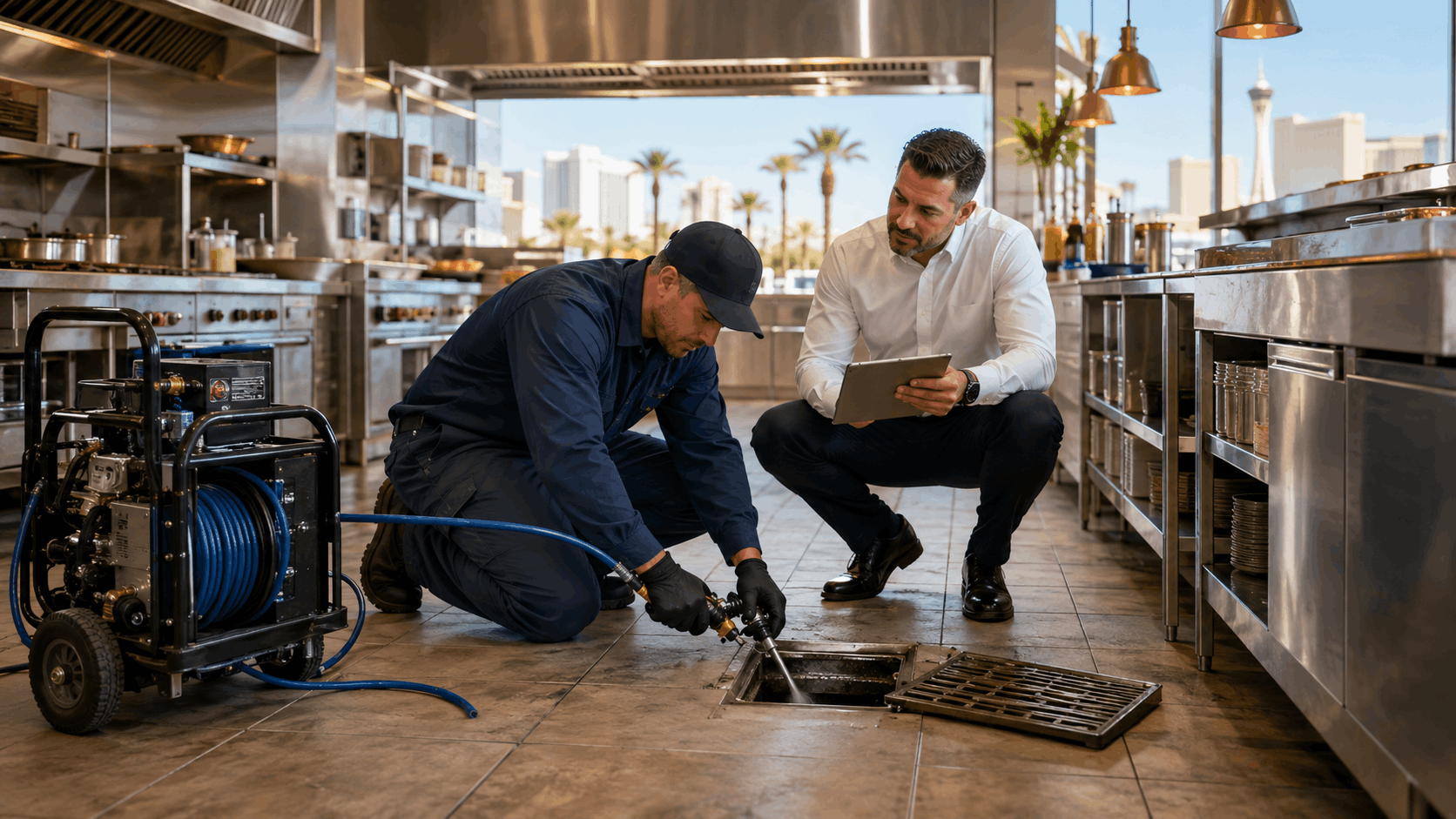
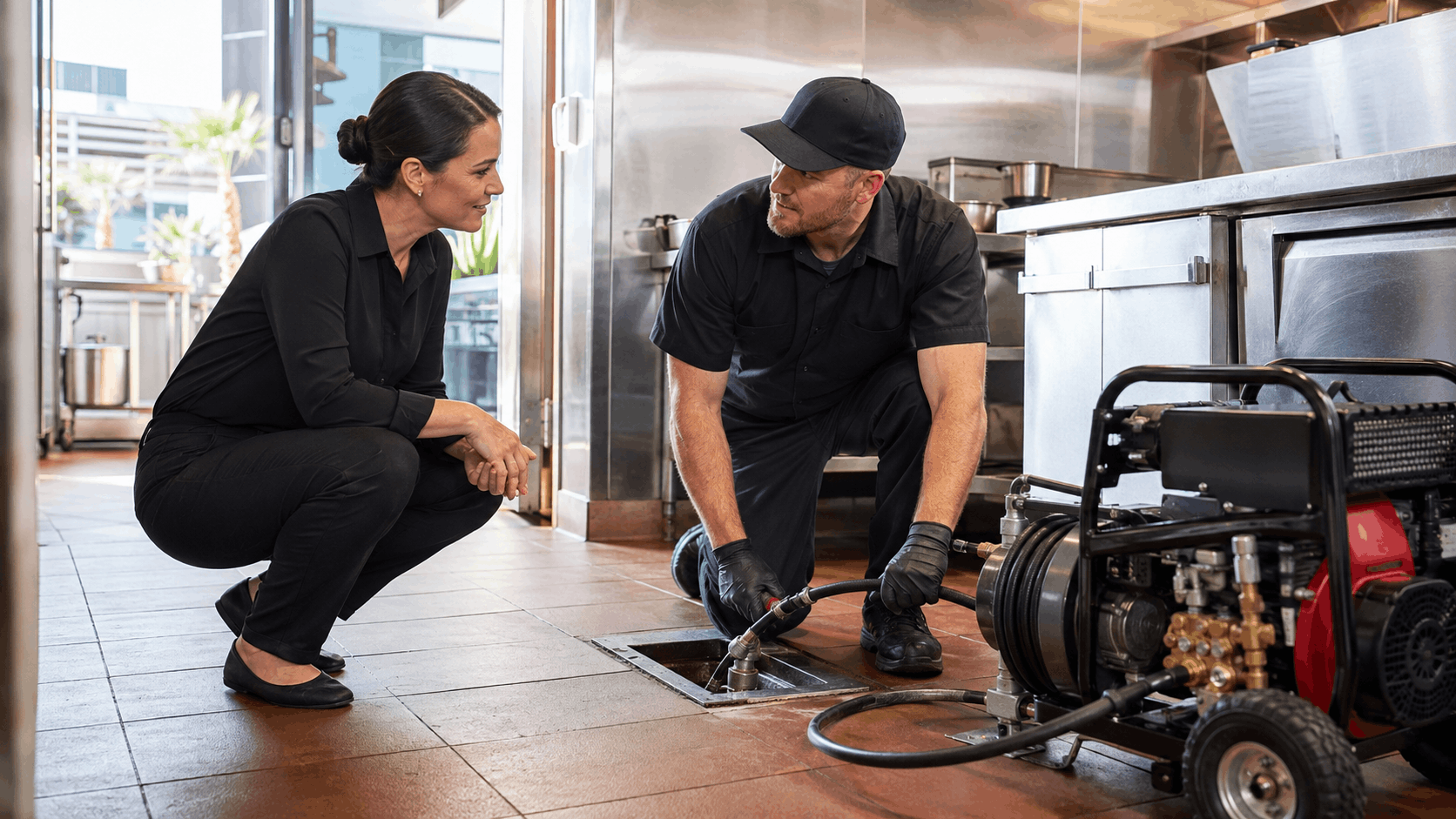
Every visit starts with locating the right access point. Our team finds the cleanout that serves the grease line or main, which is usually near the kitchen or just outside the building. Good line access makes the whole job more quickly.
Before jetting, we assess the line. Sometimes that means a quick camera look to confirm where the clog sits and how bad the buildup is. That inspection tells us which nozzle to use and how much pressure the pipe can handle.
We also protect the work area. Jetting moves debris and water, so the crew sets up to contain any mess and keep it away from food prep zones. In a working kitchen, keeping the area clean is part of the setup.
Once the cleanout is open and equipment is staged, the actual cleaning goes quickly. Most of the skill is in the setup - reading the line correctly so the jetting run does the job right the first time.
The Cleaning Run and How Long It Takes
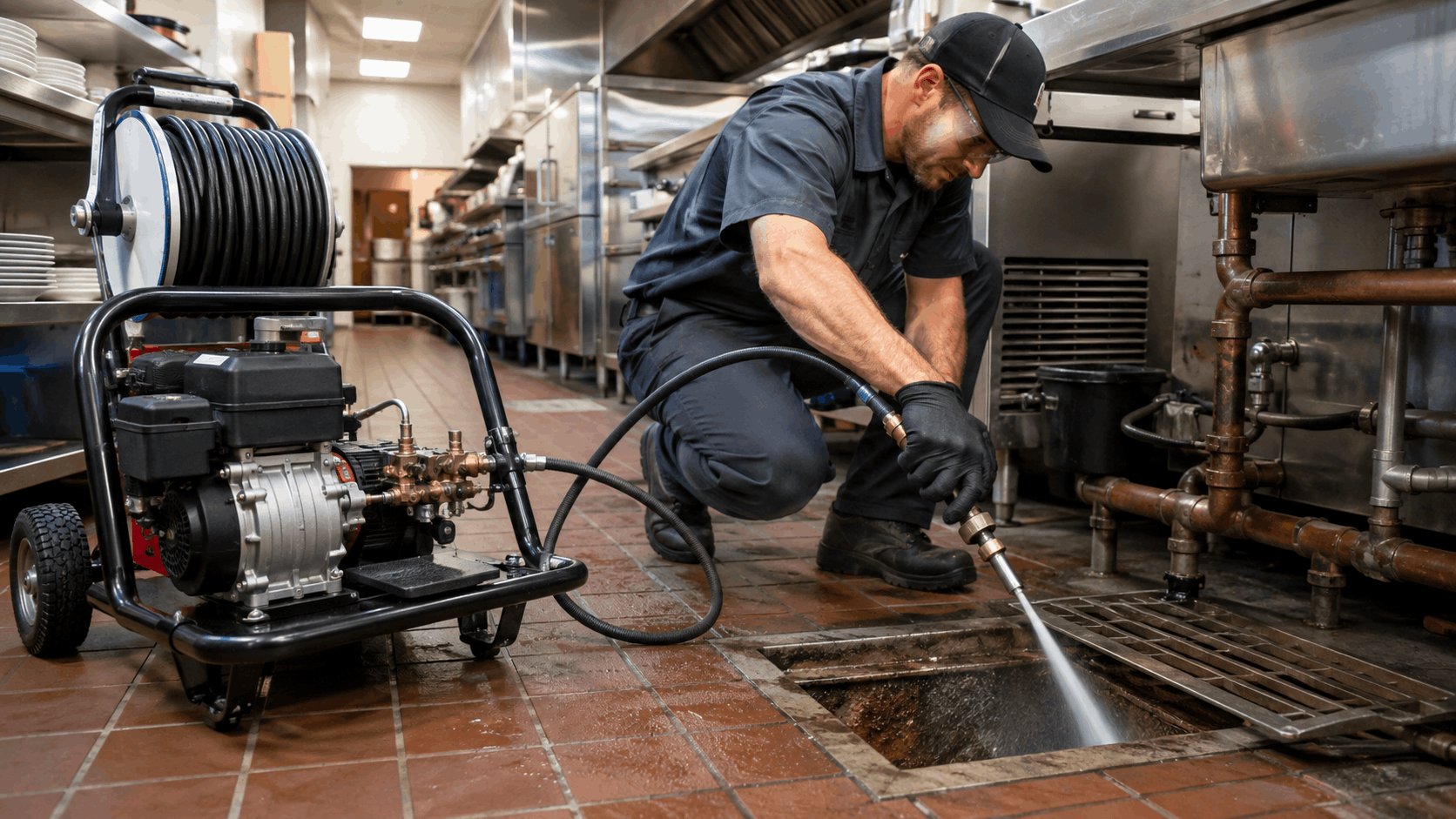
Job length depends entirely on the scope. A single floor drain clean can be done in 30 to 45 minutes. A grease waste line usually takes one to two hours, and a full main line with heavy buildup can run several hours.
During the cleaning run, the nozzle travels the full length of the line and back, sometimes in multiple passes. Heavy grease often needs two or three passes to strip it all off the walls. We do not stop until the water runs clear and the line flows at full speed.
Off-hours scheduling shapes the timeline too. When we work overnight or before opening, we have the whole kitchen to ourselves and can move fast without dodging staff. That often makes the job quicker than squeezing it between lunch and dinner.
We give an honest time estimate up front based on the line and its condition. A kitchen that has been on a schedule cleans more quickly because there is less buildup. A neglected line takes longer, which is another reason regular service pays off.
Post-Jetting Camera Verification
After the clean, a camera confirms the result. We run the camera down the line to verify it is genuinely clear from end to end, not just opened at the clog point. This camera verification is your proof the job was done right.
The camera also spots trouble. It reveals cracks, root intrusion, corroded cast iron, or a bellied section where water pools. Catching pipe damage now, while we are already on site, lets you plan a repair before it becomes an emergency.
For older buildings especially, this line inspection is worth doing periodically. Cast-iron lines in Downtown and Arts District restaurants can hide serious deterioration that only a camera reveals. Knowing about it early saves a much larger bill later.
We show you what the camera sees. If there is a problem, you get a clear picture of it and honest advice on whether it needs attention now or can wait. No surprises and no pressure.
Minimizing Downtime During Business Hours
Keeping your kitchen running is the priority around scheduling. Whenever possible, we book jetting during slow periods - a mid-afternoon lull, before opening, or overnight after close. That keeps downtime near zero during business hours.
For kitchens that cannot spare any interruption, overnight work is the cleanest option. The crew comes in after the last cover, cleans the lines, verifies with camera, and is gone before the morning prep team arrives. Service is never touched.
When a job has to happen during open hours, we work section by section to keep as much of the kitchen usable as possible. Coordinating with your manager on timing makes a real difference in how smoothly it goes.
The whole point of scheduled service is avoiding the forced downtime of an emergency. A planned visit on your terms beats a backup on the busiest night of the week every single time.
Need Help in Las Vegas?
Active Plumbing serves Las Vegas and all of Las Vegas Valley.
How Active Plumbing Serves Las Vegas Restaurants
Active Plumbing has worked on kitchens all over the valley, from casino restaurants to neighborhood diners. Restaurant service is different from residential work, and our team knows the difference.
We bring commercial equipment, real knowledge of local conditions, and service plans built around how each kitchen actually operates. Here is what that looks like across the Las Vegas area.
Coverage From the Strip to Henderson and Summerlin
Our service area spans the whole valley. We work restaurants on the Strip and Downtown, out to Henderson and Green Valley, west into Summerlin, and through Spring Valley, Paradise, and the surrounding neighborhoods.
That coverage means we know the local quirks. We know which older Downtown buildings run on tired cast iron, which Summerlin strip centers have newer lines, and how the hard water hits kitchens everywhere in between.
Being local also means fast response. When a contract customer in Henderson or a restaurant near Fremont Street has a backup, we are not driving in from another county. Our crews are already working these areas every day.
Wherever your kitchen sits in the valley, we can put it on a schedule and respond when something goes wrong. The full service area covers restaurants across Las Vegas and every surrounding community.
Equipment Built for Commercial Grease Lines
Commercial grease lines demand real jetting equipment, not the small units used for home drains. Our trucks carry high-capacity jetters that push the pressure and water volume a commercial line needs to come fully clean.
We match the jetting nozzle to the job. Different nozzles handle grease, roots, and hard scale, and a rotating grease nozzle strips a fat-coated pipe far better than a general-purpose head. Using the right one is what makes a clean last.
Larger diameter lines - the 4-inch and 6-inch mains under many restaurants - need equipment that a home unit simply cannot drive. Our gear is built for that scale, which is why we can clean a heavy main in one visit instead of barely denting it.
That commercial capability is the difference between a line that stays clear for months and one that clogs again in weeks. For grease line work, the equipment matters as much as the technique.
Custom Contracts for Every Kitchen Size
No two kitchens are the same, so we build each service plan around the specific restaurant. We look at your volume, your menu, and your line layout, then set an interval and scope that fits.
A fry-heavy Strip kitchen gets a different custom contract than a Spring Valley cafe. One might need monthly grease line jetting with quarterly camera checks, while the other runs fine on a twice-yearly clean. We size the plan to the kitchen.
We also adjust as we learn your line. If a kitchen cleans slower than expected, we can stretch the interval and save you money. If it reloads fast, we tighten it to prevent backups. The plan flexes to reality.
The goal is simple - keep your lines clear at the lowest reasonable cost, on a schedule that fits your operation. Reach out to our team and we will put together a plan for your kitchen size and grease load.
Final Thoughts
Grease lines in Las Vegas restaurants clog more quickly than most owners expect, thanks to hard water, nonstop volume, and older pipes in places like the Arts District. Hydro jetting is the only cleaning method that truly restores a greasy line, and getting it on a schedule is far cheaper than paying emergency rates.
A one-time jetting runs $350 to $1,200 for most kitchens, but a frequency contract lowers the per-visit cost and prevents the dinner-rush backups that cost thousands in lost sales. Match the cleaning interval to your kitchen's volume, watch for slow drains and odors between visits, and keep the grease trap on schedule.
If your kitchen is due for a cleaning or you want to stop reacting to backups, talk to Active Plumbing about our drain and sewer services. Call us for a consultation and we will scope your lines, give you an honest price, and set up a plan that keeps your kitchen running clean.
Frequently Asked Questions
- How much does hydro jetting cost for a Las Vegas restaurant?
- Most one-time restaurant jetting runs between $350 and $1,200. A single floor drain sits at the low end, a grease waste line lands in the middle, and a full main sewer line reaches the top. Line length, grease severity, drain count, and access all move the price. After-hours emergency work costs more, while a recurring contract lowers the per-visit rate below a one-off call.
- How often should a restaurant get grease lines jetted?
- It depends on volume and menu. High-volume fry and buffet kitchens near the Strip often need service every one to three months. Mid-size neighborhood restaurants in areas like Green Valley usually do well every three to six months. Low-grease spots like coffee shops and bakeries can stretch to twice a year. We set the exact interval after seeing how fast your specific line reloads.
- Is a frequency contract cheaper than paying per visit?
- Yes. A recurring plan locks in a lower per-visit rate because we can route and schedule efficiently. A one-off grease line clean might run $500 to $750, while the same visit on a contract often drops to $250 to $600. Contracts also include priority emergency response at reduced rates, which slashes the cost of the backups that hit kitchens without a schedule.
- Does hydro jetting damage restaurant pipes?
- Jetting is safe for healthy pipes. We adjust the water pressure to match the line, so a sturdy main takes more force than a smaller branch. The risk only shows up in pipes already badly corroded or cracked. That is why we often run a camera first, especially in older Downtown and Arts District buildings, to flag weak spots before cleaning and avoid trouble.
- Can jetting be done during business hours?
- Yes, though we prefer to work around your service. When possible we schedule during a mid-afternoon lull, before opening, or overnight after close so downtime stays near zero. For kitchens that cannot spare any interruption, overnight work is the cleanest option - we clean, verify, and leave before the prep team arrives. During open hours we work in sections to keep the kitchen usable.
- How long does a jetting job take?
- A single floor drain takes about 30 to 45 minutes. A grease waste line usually runs one to two hours. A full main line with heavy buildup can take several hours and multiple passes. Lines on a regular schedule clean more quickly because there is less grease, while neglected lines take longer. We give an honest time estimate up front based on your line's condition.
- What are the signs a grease line needs jetting?
- Watch for slow floor drains and sinks that take longer than usual to clear. Gurgling from drains means air is trapped behind a partial clog. A sewer smell in the kitchen signals grease trapping waste in the line. Standing water around a floor drain is a late warning. Any of these means the line needs jetting soon, before it turns into a full backup.
- Does jetting replace grease trap cleaning?
- No, they are separate jobs and both matter. Jetting cleans the drain lines themselves, stripping hardened grease off the pipe walls. Grease trap pumping empties the interceptor that catches fats before they reach the line. A neglected trap lets grease pass straight into the pipes, so the two work together. Keeping both on schedule is what prevents backups across the whole system.
- Will regular jetting help pass a health inspection?
- It helps a lot. Clean lines that drain freely with no odors or standing water remove a common cause of drainage-related violations. A sewage backup during a Southern Nevada Health District inspection can trigger an immediate shutdown. Staying ahead of clogs with scheduled jetting keeps that risk off the table and supports overall compliance, which protects your revenue and reputation.
- Do you serve restaurants outside the Strip?
- Absolutely. We cover the entire valley - Henderson, Summerlin, Spring Valley, Paradise, North Las Vegas, and every neighborhood in between. Our crews work these areas daily, so response stays fast wherever your kitchen sits. Whether you run a diner in Green Valley or a bakery in Summerlin, we can set up a cleaning schedule and respond quickly if a line backs up.
Licensed plumbing professionals serving Las Vegas and Las Vegas Valley.
Licensed in Nevada · License #0047021
Last updated on
Why trust Active Plumbing?
Founded in 1991, Active Plumbing is a licensed and insured plumber serving Las Vegas and Las Vegas Valley. All content is reviewed by our licensed technicians.

Need Help in Las Vegas?
Active Plumbing serves Las Vegas and all of Las Vegas Valley.
Related Articles
Commercial Water Heater Installation Cost for Las Vegas Restaurants and Salons: Sizing, Code, and Recovery Rates
Real commercial water heater installation costs for Las Vegas restaurants and salons, plus sizing math, recovery rates, and Clark County code you need before you buy.
Drain Cleaning Cost in Las Vegas: Snake vs Hydro Jet, Honest Price Ranges
Honest drain cleaning cost ranges for Las Vegas homeowners, comparing snake vs hydro jet pricing, when each method pays off, and how to avoid overpriced quotes.
Sewer Camera Inspection Cost in Las Vegas - and When It's Free With Service
Sewer camera inspection cost in Las Vegas runs $125-$400, and it is often free with a repair. See price factors, warning signs, and when the fee is waived.