Burst Pipe Repair Cost in Las Vegas - Wall, Slab, and Attic Scenarios Priced
Key Takeaways
- Where a pipe bursts drives the cost most - wall repairs are cheapest, attic jobs mid-range, and slab leaks the most expensive due to concrete and flooring work.
- Hard water corrosion, rare freezing nights, shifting desert soil, and high street pressure are the main reasons valley pipes fail.
- Catch hidden leaks early by watching for water-bill spikes, wet stains, running-water sounds, and low pressure to keep repairs small.
- A simple in-wall repair often runs $400 to $900, while slab leaks with flooring restoration can reach $6,000 or more.
- Knowing your main shutoff location and acting fast is the single biggest way to limit water damage and lower the final bill.
- Homeowners insurance usually covers sudden, accidental bursts but not slow leaks or neglect, and documentation strengthens claims.
- Prevention like pressure regulators, pipe insulation, and water softening costs far less than a repair.
- Fast same-day local response across the valley limits mold and restoration costs on any burst pipe scenario.
In This Article
It is nearly midnight in Summerlin, and a homeowner walks into the kitchen for a glass of water. Instead of a quiet tile floor, they find a thin sheet of water spreading toward the hallway, soaking into the baseboards. Somewhere behind the wall or under the slab, a pipe has given way, and every minute it stays open, the damage climbs.
That scene plays out across the valley more often than most people think, from older homes near Huntridge to newer builds in Mountains Edge. The panic is real, but the first question homeowners ask us is almost always the same: what is this going to cost? The honest answer depends heavily on where the pipe broke.
What Actually Causes Pipes to Burst in Las Vegas Homes?
People assume burst pipes are a cold-climate problem, and that freezing is the only culprit. In the Las Vegas Valley, the story is more complicated. Our plumbing fails for several reasons, and the cause often shapes the repair cost.
Here are the main reasons we see pipes give out across the valley:
- Mineral buildup from hard water eating through older metal lines
- A handful of freezing nights each winter cracking exposed pipes
- Shifting desert soil stressing lines under concrete slabs
- High municipal water pressure straining fittings and joints
Knowing which of these caused the break matters. A single frozen line is a different job than a corroded system that is failing in more than one spot. Our team looks at the root cause before quoting, because a cheap patch on a dying pipe rarely holds.
Hard Water and Corroded Pipes in Older Neighborhoods
The Las Vegas Valley Water District delivers some of the hardest water in the country. That water carries heavy loads of calcium and magnesium, and over years those minerals coat and corrode the inside of metal pipes. For homeowners near Huntridge and the older east side, this is the quiet killer behind a lot of burst pipe causes.
Galvanized steel pipe was standard in many homes built before the 1970s. Hard water corrosion attacks that galvanized coating from the inside, thinning the walls until a weak spot ruptures. We have pulled sections of pipe from Huntridge homes that looked solid on the outside but were nearly closed shut with rust and scale.
Copper is more resistant, but it is not immune. Aggressive water chemistry and years of mineral scale can pit copper lines and cause pinhole leaks that grow into full breaks. When we see hard water corrosion in one section, we know the rest of the Las Vegas plumbing in that home is aging on the same timeline.
This is also why a water softener installation often pays for itself in these neighborhoods. Softer water slows the scaling that leads to the next burst, protecting both the pipes and the water heater.
Winter Cold Snaps and Freezing Nights
The desert gets cold at night, and every winter brings a few evenings below freezing. Most homeowners never think about it until a pipe in the attic or an exterior wall cracks after a 28-degree night. Frozen pipes are a real seasonal problem here, just less predictable than in colder states.
Water expands as it freezes, and that expansion puts enormous pressure on a closed section of pipe. The break often does not show until the ice thaws and water starts pouring through the crack. That delay is why so many winter freeze calls come the morning after a cold night, not during it.
Homes at higher elevations feel this most. Neighborhoods in Summerlin and Mountains Edge sit hundreds of feet above the valley floor, and those extra degrees of cold matter. Uninsulated pipes in attics, garages, and along outside walls are the usual victims.
We tell folks in Summerlin West and the surrounding foothills to insulate exposed lines before December. A few dollars of pipe wrap is far cheaper than a burst attic line and a soaked ceiling.
Shifting Soil and Slab Movement
The ground under many valley homes is not as stable as it looks. Desert soil here includes expansive clays that swell when wet and shrink when dry. That constant movement stresses the water and drain lines running under a concrete slab foundation.
Over years, slab movement can pull joints apart or crack a pipe that was fine when the house was built. We see this pattern in parts of Henderson and North Las Vegas where certain developments sit on more reactive soil. A pipe does not have to be old to fail if the ground keeps shifting around it.
These foundation pipes are the hardest to reach, which makes them the most expensive to fix. When soil movement is the cause, a single spot repair may not be the end of it, because the same forces are still acting on the rest of the line. That is when rerouting the pipe becomes worth a serious look.
An electronic leak detection visit helps us pinpoint the break without tearing up the whole floor first. Precision here saves the homeowner real money on concrete work.
High Water Pressure From the Street
Parts of the valley receive municipal water at pressures higher than home plumbing is designed to handle comfortably. Anything above roughly 80 psi puts steady strain on pipes, fittings, and appliance connections. Over time that pressure works loose joints and blows out weak spots.
A pressure regulator, sometimes called a PRV, sits where the main line enters the home and keeps household pressure in a safe range. Many older homes never had one installed, and some newer ones have regulators that have failed without anyone noticing. High pressure is a slow form of pipe strain that shortens the life of the whole system.
We often test static water pressure during a service call, and it surprises people how high the reading can climb overnight when demand drops. If your faucets bang or your toilets run hard, pressure may be part of the problem. Fixing it is one of the cheapest ways to prevent a future burst.
Managing water pressure protects far more than pipes. It also extends the life of your water heater and every valve and hose in the house.
Get Your Quote
Tell us what's going on and we'll get back to you. We're open 24/7.
Wall Burst Pipe Repair Cost in Las Vegas
A pipe that bursts inside a wall is one of the more common calls we get, and the cost has two parts. There is the plumbing repair itself, and there is the work to open and rebuild the wall. Both add to the final number.
Here is a realistic look at wall pipe repair cost across the valley:
| Scenario | Typical Cost Range | What It Includes |
|---|---|---|
| Simple in-wall repair (interior) | $400 - $900 | Access, pipe fix, basic patch |
| In-wall repair with drywall and paint | $700 - $1,600 | Plumbing plus texture and paint match |
| Exterior wall with stucco/insulation | $1,200 - $2,800 | Plumbing, insulation, stucco patch |
| Section repipe after multiple failures | $2,500 - $6,000+ | New PEX or copper run, full restoration |
These ranges assume normal access and no major water damage cleanup. Once mold or soaked framing enters the picture, the total climbs. The numbers below explain what drives each line item.
Typical Price Range for In-Wall Repairs
For a straightforward in-wall leak on an interior wall, most homeowners in the valley spend somewhere between $400 and $900 on the plumbing portion. That covers locating the break, cutting a clean access opening, and repairing or replacing the damaged section of pipe. It assumes the pipe is reachable without moving cabinets or fixtures.
What makes a job land at the low end is easy access and a clean break in modern PEX or copper. A supply line that split at a joint behind open drywall is quick work for our crew. The pipe repair itself might take under an hour once the wall is open.
Prices rise when the leak sits behind tile, near electrical, or high up on a wall. Every obstacle adds labor time, and labor is the largest part of any in-wall pipe repair. Getting an upfront estimate before the wall is opened helps avoid surprises.
Our burst pipe repair team gives a clear quote once we confirm the location and pipe type. That way the homeowner knows the number before any cutting begins.
Access and Drywall Costs That Add Up
The plumbing fix is often the smaller half of a wall repair. Cutting into drywall, patching the hole, matching the wall texture, and repainting all stack onto the bill. A tidy drywall patch with texture and paint commonly runs $300 to $800 depending on the size of the opening.
Texture matching is trickier than people expect. Valley homes use everything from knockdown to orange peel finishes, and blending a patch so it disappears takes skill. A rushed patch that stands out means the homeowner ends up repainting a whole wall to hide it.
Larger openings mean more materials, more drying time between coats, and more labor. If we have to open several feet of wall to trace a leak, the wall access and finish work grows quickly. This is why accurate leak location matters so much - a smaller hole means a smaller repair.
We aim to open the least amount of wall needed to reach the break cleanly. Using leak detection tools first keeps the drywall patch cost down and the finished repair invisible.
Exterior Wall Pipes and Insulation Factors
Breaks in an exterior wall cost more than interior ones, and the reason is what is packed inside that wall. Exterior walls carry insulation, and in many valley homes the outside surface is stucco. Both have to be dealt with when the pipe is repaired.
Older homes near the Arts District often have exterior wall pipes that freeze or corrode, and the stucco repair alone adds real cost. Matching stucco texture and color on an older facade is specialty work, and it may need to cure before painting. That extends the timeline beyond the plumbing fix.
Wet insulation is another factor. Soaked fiberglass or blown-in insulation loses its value and can hold moisture against framing, so it usually needs removal and replacement. Skipping that step invites mold and rot later.
Homeowners in the Arts District and nearby older Las Vegas neighborhoods should budget more for exterior wall breaks. The plumbing may be simple, but the restoration around it is what drives the number up.
When One Pipe Points to a Bigger Problem
Sometimes a single burst is a warning, not an isolated event. If a home has aging galvanized or early copper pipe and one section fails from corrosion, the rest is likely close behind. Patching that one spot may buy only a few months before the next leak.
In those cases we walk the homeowner through the math of a repipe versus repeated patches. Replacing a section or the whole run of aging pipes with modern PEX costs more upfront. But it ends the cycle of surprise leaks and repeated drywall repairs.
We look at the pipe material, the number of past leaks, and the water chemistry before recommending a repipe. For a house that has already had two or three failures, replacement is usually the cheaper path over five years. Throwing good money at a dying system rarely ends well.
Our pipe and fixture services include full and partial repipes with clear pricing. We help homeowners decide when a patch is fine and when it is time to replace.

Need Help in Las Vegas?
Active Plumbing serves Las Vegas and all of Las Vegas Valley.
Warning Signs a Pipe Has Burst Behind Your Walls
The sooner a hidden leak is caught, the smaller the repair and the water damage. Behind a wall, a burst pipe can run for days before anyone notices. Learning the early warning signs saves both money and stress.
Watch for these clues that a pipe may have burst out of sight:
- An unexplained jump in the monthly water bill
- Wet spots, stains, bubbling paint, or a musty smell
- The sound of running water when everything is off
- A drop in water pressure or rusty, discolored water
Any one of these is worth investigating. Together they strongly suggest an active leak inside the walls or under the floor. Acting on the first sign is far cheaper than waiting for water to come through the ceiling.
Sudden Spikes on Your Water Bill
A hidden leak shows up on the bill before it shows up on the wall. If a household's water use has not changed but the bill jumps 30 or 50 percent, water is going somewhere it should not. That high water bill is often the earliest sign of a burst pipe behind drywall or under a slab.
Homeowners can confirm it with a simple water meter test. Turn off every fixture and appliance that uses water, then check the meter. If the dial or digits keep moving with everything off, water is escaping somewhere in the system.
The Las Vegas Valley Water District meter usually sits in a box near the front curb. Reading it before bed and again in the morning, with no water used overnight, gives a clear answer. Any movement means an active leak worth chasing down.
We use that same meter test to verify a leak before we start looking. It tells us there is real water loss and helps rule out a billing error.
Wet Spots, Warping, and Musty Smells
The visible clues are easy to miss until they are obvious. Look for stained or discolored drywall, paint that bubbles or peels, and baseboards that warp or pull away from the wall. These wall stains mean water has been sitting behind the surface.
A musty or earthy smell is another red flag. That mold odor comes from moisture feeding mildew inside the wall cavity, and it often shows up before any visible stain. If a room smells damp for no reason, there is likely water where it should not be.
Warped drywall feels soft or spongy when pressed. Flooring near the wall may buckle or lift as it absorbs moisture from below. All of these point to a leak that has been running long enough to soak the surrounding materials.
The longer these signs are ignored, the more the restoration will cost. Catching a leak at the first stain keeps the repair to a small patch instead of a full wall rebuild and mold treatment.
The Sound of Running Water With Everything Off
One of the most reliable signs is sound. Stand in a quiet house with every faucet, toilet, and appliance off, and listen. A faint hissing, trickling, or running water sound usually means water is moving through a break in the line.
That sound can travel through walls and floors, so its source is not always where it seems. A hiss in the hallway might trace back to a break under the slab several feet away. This is where guessing wastes money and precise tools save it.
Our team uses acoustic leak detection equipment to trace that sound to its exact origin. Sensitive microphones pick up the noise of water escaping a pressurized pipe, even through concrete. That lets us open one small spot instead of exploring the whole wall.
If you hear water running with the house shut down, do not wait. Call for whole-home leak detection before the hidden flow does more damage.
Low Pressure or Discolored Water
A sudden drop in water pressure can point to a compromised line somewhere in the system. When a pipe breaks, water escapes before it reaches the faucet, and pressure at the tap falls. If pressure drops across the whole house at once, a main line issue is likely.
Discolored or rusty water is another warning, especially in homes with older galvanized pipe. When corrosion has thinned a line to the point of failure, it often sheds rust into the water first. Brown or cloudy water at the tap deserves attention.
Sometimes low pressure and discoloration show up together, which strengthens the case for a failing pipe. Air in the lines, sputtering faucets, or debris in aerators can accompany a break. These symptoms are the plumbing equivalent of a check-engine light.
We check pressure and water quality as part of diagnosing a suspected burst. Those readings help us decide whether the problem is one bad section or a system that needs broader work.
Slab Leak and Under-Slab Burst Pipe Repair Cost
Of the three scenarios, a pipe that bursts under the concrete slab is the most involved and the most expensive. The water line runs beneath the foundation, so reaching it means getting through the floor. That is why slab leak cost sits well above wall and attic repairs.
A slab job has several stages, and each adds to the total. Detection, concrete cutting, the actual pipe repair, and floor restoration all factor in. The good news is that early action keeps every stage smaller and cheaper.
The sections below break down what a homeowner can expect to pay and where the real cost lives in an under-slab repair.
Cost to Locate and Cut Into the Slab
Finding a slab leak precisely is the first expense, and it is money well spent. Electronic leak detection and acoustic listening pinpoint the break so the crew cuts in one place instead of guessing. Slab leak detection typically runs $200 to $600 depending on how complex the layout is.
Once the spot is marked, the concrete has to come out. Cutting and jackhammering through a slab, then digging to reach the pipe, is heavy labor. The concrete cutting cost and excavation commonly add $1,000 to $3,000 before the pipe is even repaired.
The depth of the pipe and the type of flooring above it change the number. A pipe under bare concrete in a garage is far easier than one under tile in a living room. Every layer above the slab adds time and care.
Accurate detection is what keeps this stage from spiraling. The less concrete we open, the less it costs to cut, repair, and later restore the floor.
Spot Repair Versus Rerouting the Line
Once the pipe is exposed, there are two paths. A spot repair fixes the single break in place, which is fastest and cheapest when the rest of the line is sound. For a one-time failure in otherwise healthy pipe, a spot fix often makes the most sense.
The other option is a pipe reroute. Instead of leaving the line under the slab, the crew abandons the buried section and runs a new pipe overhead through walls and the attic. This avoids future digging if the same line fails again.
Rerouting costs more upfront, often $2,000 to $5,000 for a typical run, but it can be the smarter buy. On homes with shifting soil or aging pipe, a reroute ends the risk of repeated slab digs. We weigh the age of the plumbing and the cause of the break before recommending one over the other.
For a home that has had more than one slab leak, rerouting usually wins on total cost. Paying once to move the line beats paying repeatedly to open the floor.
Flooring and Restoration Costs After the Fix
The pipe repair is only part of the slab bill. After the concrete is patched, the flooring that was cut away has to be restored. Tile, hardwood, or carpet replacement over the patched slab often adds $1,000 to $4,000 or more, depending on the material.
Matching existing flooring is the challenge. In Green Valley Ranch homes with continuous tile through the main living areas, we cannot always replace a single section invisibly. Sometimes a larger area has to be redone so the repair blends in.
Hardwood and specialty tile raise the restoration cost further. Discontinued patterns may force a bigger replacement than the actual leak required. This is a real concern for homeowners who want the finished floor to look untouched.
We factor slab patch and flooring restoration into the estimate from the start. Homeowners deserve to see the full picture, not just the plumbing line item, before deciding how to proceed.
Why Slab Leaks Get Worse the Longer You Wait
A slab leak does not improve on its own, and waiting almost always costs more. Water trapped under the foundation erodes soil, saturates the slab, and can lead to foundation issues over time. What starts as a minor line break can become a structural concern.
Ongoing slab leak damage also drives up water bills month after month. Every gallon lost under the floor is a gallon the homeowner pays for. Those charges add up fast on a leak that runs for weeks.
There is a health angle too. Constant moisture under and around the slab feeds mold and can affect indoor air. The foundation risk and the mold risk both grow the longer the leak stays open.
Early action is the cheapest path with slab leaks, full stop. The moment warm floors, pooling water, or unexplained bills point to the slab, it pays to call right away.
Need Help in Las Vegas?
Active Plumbing serves Las Vegas and all of Las Vegas Valley.
Attic and Overhead Burst Pipe Repair Cost
Attic and ceiling pipe breaks are a frequent winter call across the valley. When a cold night cracks a line running through the attic, the water finds its way down through the ceiling. These overhead pipe jobs have their own quirks in valley homes.
The upside is that attic access is often easier than reaching under a slab. The downside is that a burst overhead can dump water across a wide area of ceiling before anyone notices. Restoration is usually the larger part of the bill.
Here is what shapes attic pipe repair cost and how to keep it in check.
Standard Attic Repair Pricing
For a burst line in the attic, the plumbing repair itself often runs $400 to $1,200. Reaching the pipe usually means working in a tight, hot space, but it beats cutting through concrete. Access is generally simpler than slab work, which keeps the labor portion reasonable.
The variable is where the pipe sits and how the attic is built. Lines buried under deep blown-in insulation or behind ductwork take longer to reach. A pipe running along an open truss is quick, while one boxed into a soffit is not.
Most attic plumbing repairs are same-day jobs once the break is located. The crew can often reach the line, cut out the damaged section, and splice in new pipe within a couple of hours. The ceiling restoration is what stretches the timeline.
Our team handles attic repairs across the valley and gives an attic repair price before starting. Knowing the number upfront lets the homeowner plan for the restoration that follows.
Ceiling Damage and Insulation Replacement
When an attic pipe bursts, gravity carries the water straight into the ceiling below. Soaked drywall sags, stains spread, and in bad cases a section of ceiling can collapse. Ceiling repair is often the biggest single cost in an attic job.
Wet insulation compounds the problem. Blown-in insulation soaks up water like a sponge and loses its value once saturated. It has to be removed and replaced, and doing so is messy, dusty work that adds labor.
Drying the space thoroughly matters before any rebuild. Sealing up a damp ceiling traps moisture and invites mold in the cavity. We make sure the framing and remaining insulation are dry before restoration begins.
Between drywall, texture, paint, and new insulation, ceiling restoration can rival or exceed the plumbing cost. Catching the leak early, before the ceiling is fully soaked, keeps this part smaller.
Insulating Attic Pipes to Prevent Repeat Breaks
The cheapest fix for attic pipe bursts is prevention. Wrapping exposed attic lines in foam pipe insulation costs very little and shields them from freezing temperatures. For a few dollars per foot, a homeowner can avoid a repeat break and another soaked ceiling.
In colder pockets of the valley, heat tape adds another layer of protection. Heat tape is a low-wattage cable that keeps a pipe just above freezing on the coldest nights. Combined with insulation, it is strong freeze protection for vulnerable lines.
Higher-elevation communities feel the cold most. Homes in Anthem and along the southern ridgelines see more freezing nights than the valley floor, so their attic pipes need extra care. A little prevention there goes a long way.
We often add pipe insulation while we are already in the attic for a repair. It is a small step that protects against the next cold snap and saves a future service call.
Second-Story Homes and Harder Access
Multi-level homes add another wrinkle to overhead repairs. In a two-story house, a burst second-story pipe may break inside a floor cavity rather than an open attic. Reaching it can mean opening a ceiling from below and working in tight quarters.
Newer subdivisions across the valley are full of two- and three-story homes. The extra height and complexity raise labor time, which raises cost. A leak that would be simple in a single-story attic becomes a bigger project between floors.
Water from an upper-floor break also travels farther before it is seen. It can run down through walls and appear on a lower level, complicating both diagnosis and restoration. Tracing the true source takes care and the right tools.
Our crews are equipped for multi-level access and know how to minimize the openings needed. The goal is always to reach the break with the least disruption to the finished home.
What Drives the Final Bill Up or Down
Every burst pipe is a little different, and several variables move the total in any of the three scenarios. Understanding these factors helps a homeowner estimate their own situation before the truck arrives. It also explains why two similar-sounding jobs can carry very different prices.
Pipe material, timing, water damage, and permits all play into the plumbing estimate. Some of these are within a homeowner's control, and some are not. Knowing which is which helps keep the repair cost factors manageable.
Here is how each one shifts the final number up or down.
Pipe Material and Age of the Plumbing
The type of pipe in the wall or slab affects both difficulty and price. Modern PEX is flexible and quick to repair, which keeps labor low. Copper is more durable but takes more time to cut and solder cleanly.
CPVC sits in the middle, easy to work with but more brittle than PEX over time. Old galvanized steel is the toughest to repair, because it corrodes, seizes at fittings, and often crumbles when disturbed. A galvanized system may force a partial replacement rather than a simple patch.
Age matters as much as material. A newer PEX vs copper repair on a ten-year-old home is straightforward, while a fifty-year-old galvanized run is a project. The older and more corroded the system, the higher the cost climbs.
We identify the pipe material before quoting so the estimate reflects reality. That honesty avoids mid-job surprises when an old line turns out worse than it looked.
Emergency and After-Hours Calls
Timing changes the price. A burst pipe at 2 a.m. or on a holiday weekend carries a higher emergency plumber cost than a scheduled daytime repair. After-hours rates reflect the immediate response and the crew coming out at odd hours.
That said, some situations cannot wait until morning. Water pouring into a home does more damage every hour it runs, and a quick response often saves more than the after-hours rate costs. Stopping the flow fast protects flooring, drywall, and belongings.
The single best money-saving move is knowing where the main shutoff is. Turning off the main the moment a pipe bursts stops the water and limits damage before we arrive. That one action can cut a restoration bill dramatically.
Our emergency plumbing team answers calls around the clock across the valley. When a burst can't wait, fast local response keeps the total lower.
Extent of Water Damage and Restoration
The plumbing repair is frequently the smaller half of the bill. Once water has soaked into floors, walls, and belongings, drying, mold treatment, and rebuilding drive the cost. Water damage restoration can easily exceed the pipe fix itself.
Professional drying with fans and dehumidifiers prevents mold from taking hold. If moisture lingers, mold remediation becomes necessary, and that is specialized work. The wider the water spread, the more of the home needs attention.
This is why early detection and a fast shutoff matter so much to the final number. A leak caught in an hour affects a small area, while one that ran overnight can involve multiple rooms. The damage footprint drives the restoration budget.
We focus first on stopping the water and drying the space correctly. Handling moisture properly up front avoids a far larger mold bill down the road.
Permits and Building Department Rules
Some repairs require a permit, and that affects both timing and cost. A simple in-place pipe fix usually does not, but rerouting lines, repiping, or altering the system often does. Permits keep the work up to code and protect the homeowner at resale.
Depending on the address, that permit comes through Clark County or the City of Las Vegas building department. Each has its own process and fees, and inspections add a step to the timeline. A permitted job takes longer but carries documented proof of code compliance.
The Clark County Building and Fire Prevention department sets the standards for much of the valley. We pull the right permits so the repair is legal and inspected.
Skipping a required permit can cause trouble later, from failed home sales to insurance disputes. We handle the paperwork so the homeowner does not have to navigate it alone.
Need Help in Las Vegas?
Active Plumbing serves Las Vegas and all of Las Vegas Valley.
Insurance, Prevention, and Choosing a Local Plumber
Beyond the repair itself, homeowners need to handle the money side and guard against the next burst. Insurance can cover a lot, prevention costs little, and the right plumber makes the whole process smoother. This section covers all three.
A sudden burst is stressful enough without fighting a claim or hiring the wrong crew. Knowing what your homeowners insurance covers and how to prevent the next failure puts you in control. It also helps you pick a company that knows valley conditions.
Here is how to handle the aftermath and avoid a repeat.
When Homeowners Insurance Covers a Burst Pipe
Most homeowners insurance policies cover sudden, accidental water damage, and a burst pipe usually qualifies. If a line splits without warning and floods a room, the resulting damage is often a covered water damage claim. That can include drying, restoration, and sometimes ruined belongings.
What insurers resist covering is slow leaks and neglect. A pipe that dripped for months, or damage tied to deferred maintenance, is frequently denied. Carriers expect homeowners to maintain their plumbing and act on obvious problems.
Documentation makes or breaks an insurance claim. Photos of the burst, the water damage, and the repair, plus a plumber's written report, strengthen the case. The Insurance Information Institute offers plain-language guidance on what standard policies include.
We provide detailed reports and photos that homeowners can hand straight to their adjuster. Clear documentation speeds approval and reduces disputes.
Simple Steps to Prevent the Next Burst
Preventing a burst is far cheaper than repairing one. Installing a pressure regulator keeps household water pressure in a safe range and protects every pipe and fitting. It is one of the highest-value upgrades in a home with high street pressure.
Insulating exposed pipes is the next step. Lines in attics, garages, and along exterior walls should be wrapped before winter to prevent freeze damage. In older homes, addressing hard water with treatment slows the corrosion that leads to failures.
Every homeowner should know where the main shutoff valve is and how to operate it. In a burst emergency, closing that valve fast is the single most effective way to limit damage. Test it once so it is not stuck when you need it.
A whole-home leak detection system adds another layer, alerting you to a leak before it floods. Combined, these steps make the next burst far less likely and far less costly.
What to Look for in a Las Vegas Plumbing Company
Not every plumber understands valley conditions, and that knowledge matters here. A licensed plumber in Las Vegas should know the hard water, the expansive soil, and the freeze pockets at higher elevations. That local experience shapes better repairs.
Look for proper Nevada licensing, upfront written estimates, and clear explanations of the work. A company that quotes before cutting and stands behind its repairs is worth choosing. Vague pricing and pressure tactics are red flags.
Active Plumbing works across the entire valley, from Summerlin to Henderson, and we know how local water and soil affect pipes. Our team has repaired burst lines in older Huntridge galvanized systems and newer slab foundations alike. That range of experience informs every estimate we give.
You can learn more about our team and service area before you call. We are happy to explain our approach and answer questions upfront.
How a Same-Day Response Limits Your Costs
With a burst pipe, speed is money. The sooner a plumber arrives and stops the water, the less damage spreads and the lower the total. A same-day plumber can mean the difference between a small patch and a full-room restoration.
We respond quickly across the valley, from Centennial Hills in the northwest to Henderson in the southeast. Local crews mean short drive times, which matters when water is running. Every minute saved is damage avoided.
Fast response also limits the mold risk that follows standing water. Getting the space dry within the first day keeps mold from taking hold. That single factor can cut thousands off a restoration bill.
Homeowners in Henderson and the surrounding communities can reach us any time a pipe gives out. Quick action is the cheapest insurance against a large repair.
Final Thoughts
A burst pipe is stressful, but the cost is manageable when you understand it. Wall repairs are usually the most affordable, attic breaks fall in the middle once ceiling restoration is added, and slab leaks sit at the top because of the concrete and flooring work involved. Where the pipe broke drives the number more than anything else.
The smartest moves are the simple ones. Know where your main shutoff is, act on the first warning sign, insulate exposed pipes before winter, and address hard water and high pressure before they cause a failure. Prevention here in the desert costs a fraction of a repair.
When a pipe does burst, fast local help keeps the damage and the bill in check. Active Plumbing serves homeowners across the valley with a written price before work starts and around-the-clock response. Contact our team or call for a consultation the moment you spot trouble, and we will help you stop the water and plan the repair.
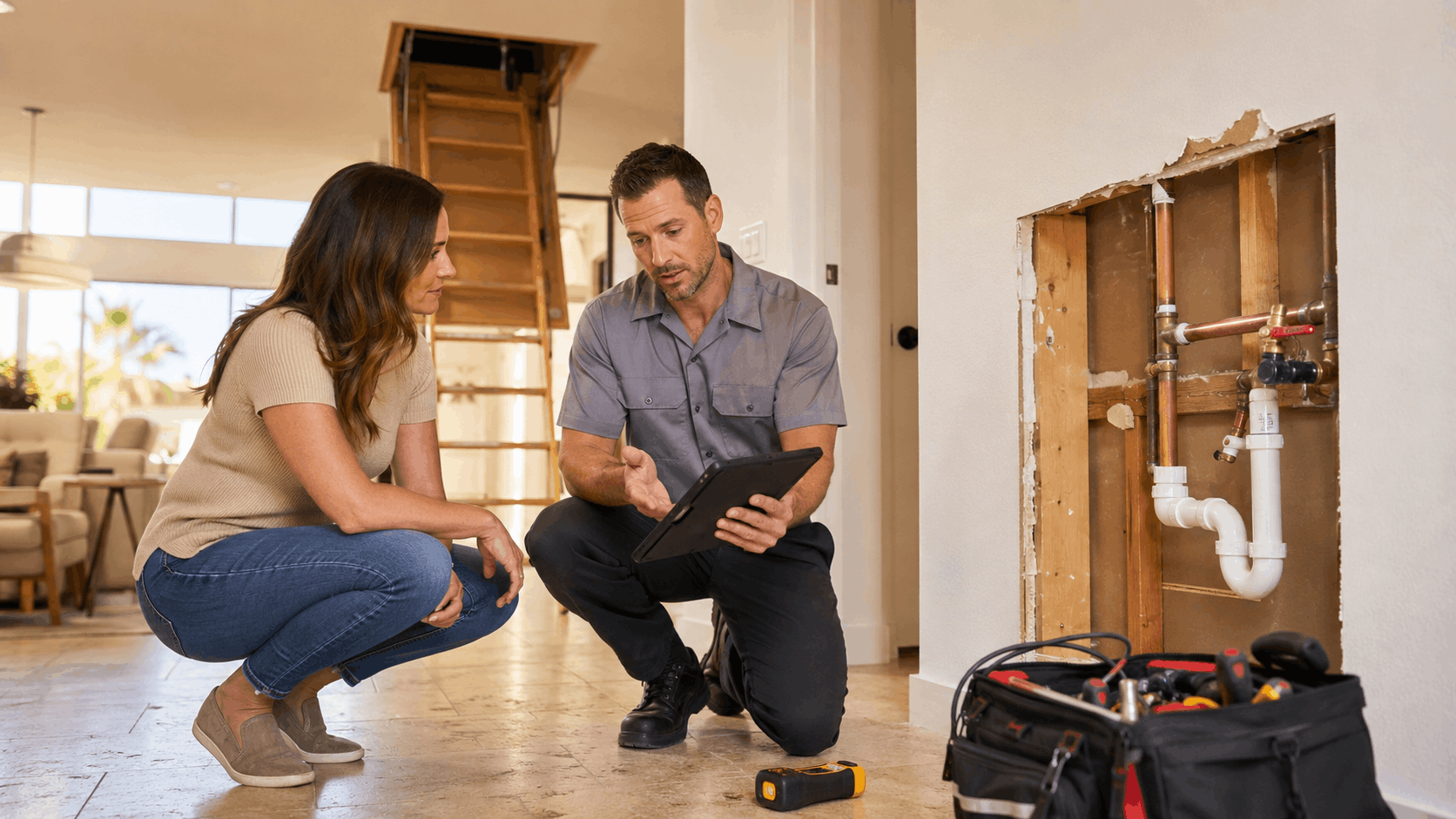
Frequently Asked Questions
- How much does burst pipe repair cost in Las Vegas on average?
- Across wall, slab, and attic scenarios, most burst pipe repairs in the valley run from around $400 for a simple in-wall fix to $6,000 or more for a slab leak with flooring restoration. The wide range reflects where the pipe broke, the pipe material, and how much water damage occurred. Attic and ceiling jobs typically fall in between. An onsite estimate gives the most accurate number.
- Which is more expensive to fix - a wall, slab, or attic pipe?
- Slab leaks are almost always the most expensive because reaching the pipe means cutting through concrete, then restoring the floor above it. Wall repairs are usually the cheapest, especially on interior walls with easy access. Attic breaks fall in the middle, since access is simpler but ceiling and insulation restoration add up. The buried location of slab pipes is what drives their higher cost.
- What should I do the moment I find a burst pipe?
- First, shut off the main water valve to stop the flow, since that limits damage more than anything else. If water is near outlets or the electrical panel, cut power to that area at the breaker for safety. Move belongings out of the water, then call a licensed plumber right away. Fast action keeps both the damage and the repair bill smaller.
- Does homeowners insurance pay for a burst pipe in Las Vegas?
- Usually yes, when the burst is sudden and accidental rather than the result of long-term neglect. Most policies cover the resulting water damage, including drying and restoration, but not the worn-out pipe itself. Slow leaks and deferred maintenance are commonly denied. Good documentation, including photos and a plumber's report, gives your claim the best chance of approval.
- How long does a burst pipe repair take?
- A simple in-wall repair often takes a few hours, plus drying and finish time for the drywall. An attic pipe fix is usually same-day, though ceiling restoration can extend a day or two. Slab leaks are the longest, sometimes spanning several days once concrete cutting, the repair, patching, and flooring are all done. The restoration stage often takes longer than the plumbing itself.
- Can I repair a burst pipe myself?
- A homeowner can safely shut off the main, drain the line, and apply a temporary clamp or wrap to slow a small leak until help arrives. Permanent repairs, especially on copper, galvanized, or in-wall and slab lines, call for a licensed plumber. DIY fixes on pressurized lines often fail and can worsen the damage. Anything involving the slab, the main, or code compliance needs a professional.
- Do I need a permit to repair a burst pipe in Las Vegas?
- A basic in-place repair generally does not require a permit, but larger work often does. Rerouting a line, repiping a section, or altering the plumbing system usually needs a permit through Clark County or the City of Las Vegas building department. Permitted work is inspected and code-compliant, which protects you at resale. We handle the permit process as part of jobs that require it.
- How do I know if it is a slab leak or something else?
- Telltale signs of a slab leak include warm or hot spots on the floor from a leaking hot water line, unexplained pooling water on the slab, and a jump in the water bill with no clear cause. You may also hear running water with everything off. A drop in pressure can accompany it. Electronic leak detection confirms whether the break is truly under the slab.
- Is it worth rerouting a pipe instead of repairing it?
- Rerouting is often worth it when a slab line has failed more than once or the plumbing is aging on reactive soil. Instead of cutting the floor again, the crew runs a new pipe overhead through walls and attic, ending the cycle of slab digs. It costs more upfront but saves money over repeated repairs. For a one-time break in sound pipe, a spot repair is usually the better value.
- How can I stop pipes from bursting during a Las Vegas cold snap?
- Before freezing nights, wrap exposed pipes in attics, garages, and along exterior walls with foam insulation, and add heat tape in colder high-elevation spots. Let a faucet drip slightly on the coldest nights to relieve pressure. Keep the garage door closed and open cabinet doors under sinks to let warm air reach the pipes. Knowing your main shutoff location rounds out the plan.
Licensed plumbing professionals serving Las Vegas and Las Vegas Valley.
Licensed in Nevada · License #0047021
Last updated on
Why trust Active Plumbing?
Founded in 1991, Active Plumbing is a licensed and insured plumber serving Las Vegas and Las Vegas Valley. All content is reviewed by our licensed technicians.

Need Help in Las Vegas?
Active Plumbing serves Las Vegas and all of Las Vegas Valley.
Related Articles
Burst Pipe Repair Cost Vegas: Emergency Response vs Standard Response Pricing
Compare emergency versus standard burst pipe repair pricing in Las Vegas, plus real cost ranges, local causes, insurance tips, and how to choose the right response tier.
Trenchless Pipe Bursting vs Pipe Lining vs Open Trench in Las Vegas Caliche Soil
Compare trenchless pipe bursting, pipe lining, and open trench sewer repair in Las Vegas caliche soil, with costs, timelines, and how to pick the right method.
Whole-House Repipe Cost in Las Vegas by Home Size - 1,500 to 4,000+ Sq Ft Real Ranges
Real whole-house repipe cost ranges in Las Vegas by home size from 1,500 to 4,000+ sq ft, plus pipe materials, permits, timelines, and local factors.