A Late Night Burst Pipe Call Off Desert Inn Road in Paradise Palms
Key Takeaways
- When a pipe bursts at night, close the main water shutoff first, cut power to the flooded area, protect restored floors, and leave gas lines alone.
- Paradise Palms homes built 1960 to 1964 carry aging copper that fails at pinholes, worsened by the valley's very hard water at 280 ppm and mixed restoration materials.
- Palmer and Krisel post-and-beam homes have little or no attic, so repairs route through walls and soffits, which takes more time and planning than a conventional house.
- Electronic leak detection and camera inspection pinpoint failures so the crew opens only what it must, protecting original terrazzo, beams and decorative block.
- Burst pipe repair typically runs $200 to $800 in the valley, plus a $150 to $300 after-hours fee; a whole-house repipe runs $4,000 to $15,000.
- Paradise is unincorporated Clark County, so permits run through the county, and the Historic Neighborhood Overlay affects only equipment visible from the street.
- Prevention steps include whole-house water treatment, insulating exposed lines against freeze and heat, planning a repipe ahead, and installing a leak detection system with automatic shutoff.
- Active Plumbing arrives in 30 to 60 minutes valley-wide, gives a written price before work starts, and is licensed NSCB #0047021, verifiable at nvcontractorsboard.com.
In This Article
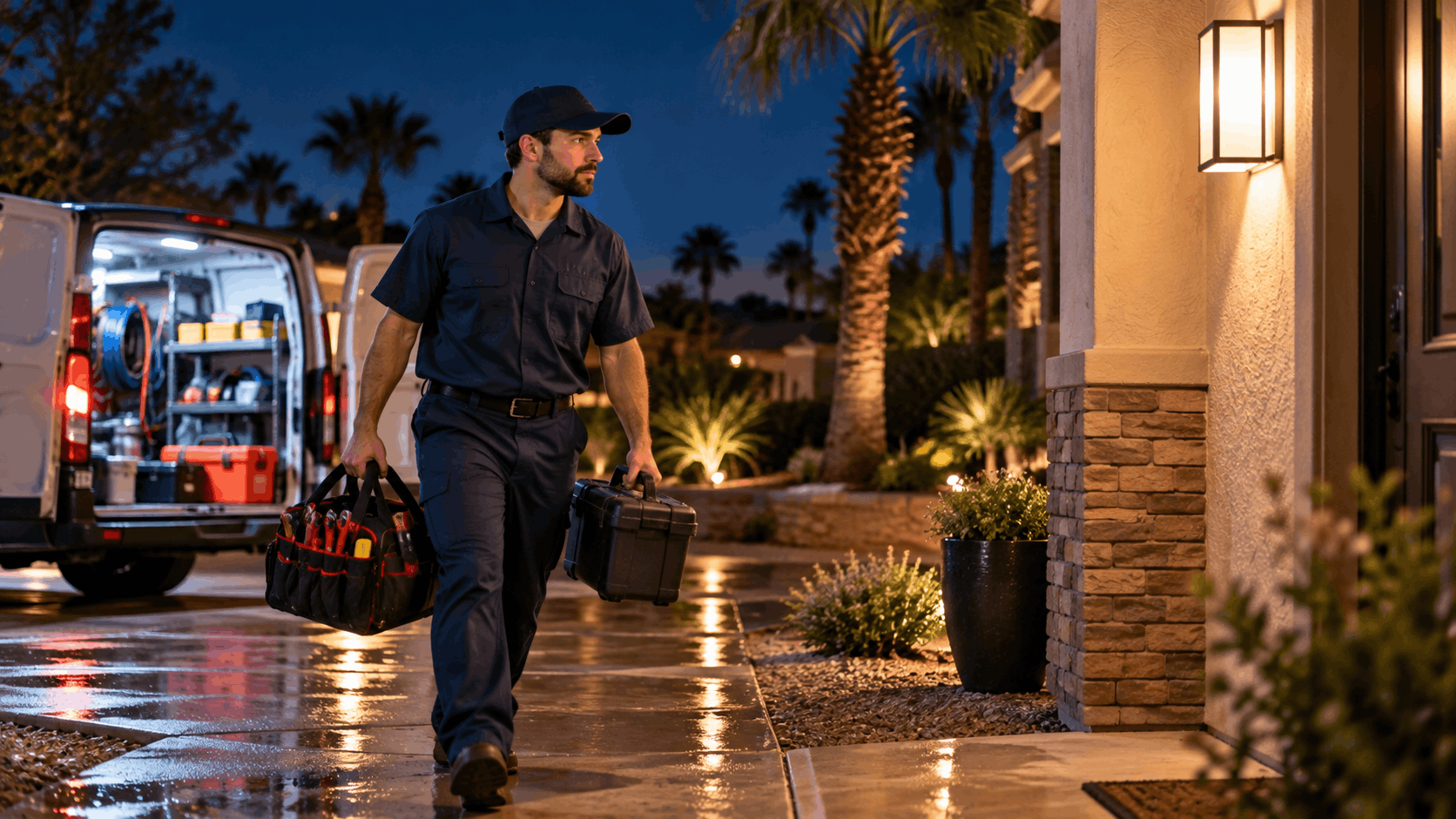
It is past midnight in a Paradise Palms home near the Las Vegas National Golf Club, and a sound no homeowner wants to hear starts somewhere inside a wall. By the time anyone wakes up, water is spreading across a terrazzo floor that took a weekend of careful restoration to bring back. A burst supply line does not wait for business hours, and in these mid-century homes it rarely does its damage in a convenient spot.
A late night burst pipe in this neighborhood is a different animal than the same failure in a newer tract house. The homes here were built between 1960 and 1964, they carry copper of that era, and their post-and-beam design gives a plumber far fewer places to run a new line. When a line lets go overnight, the first few minutes decide whether the owner is cleaning up a wet floor or replacing restored finishes.
The First Five Minutes When a Pipe Bursts at Night
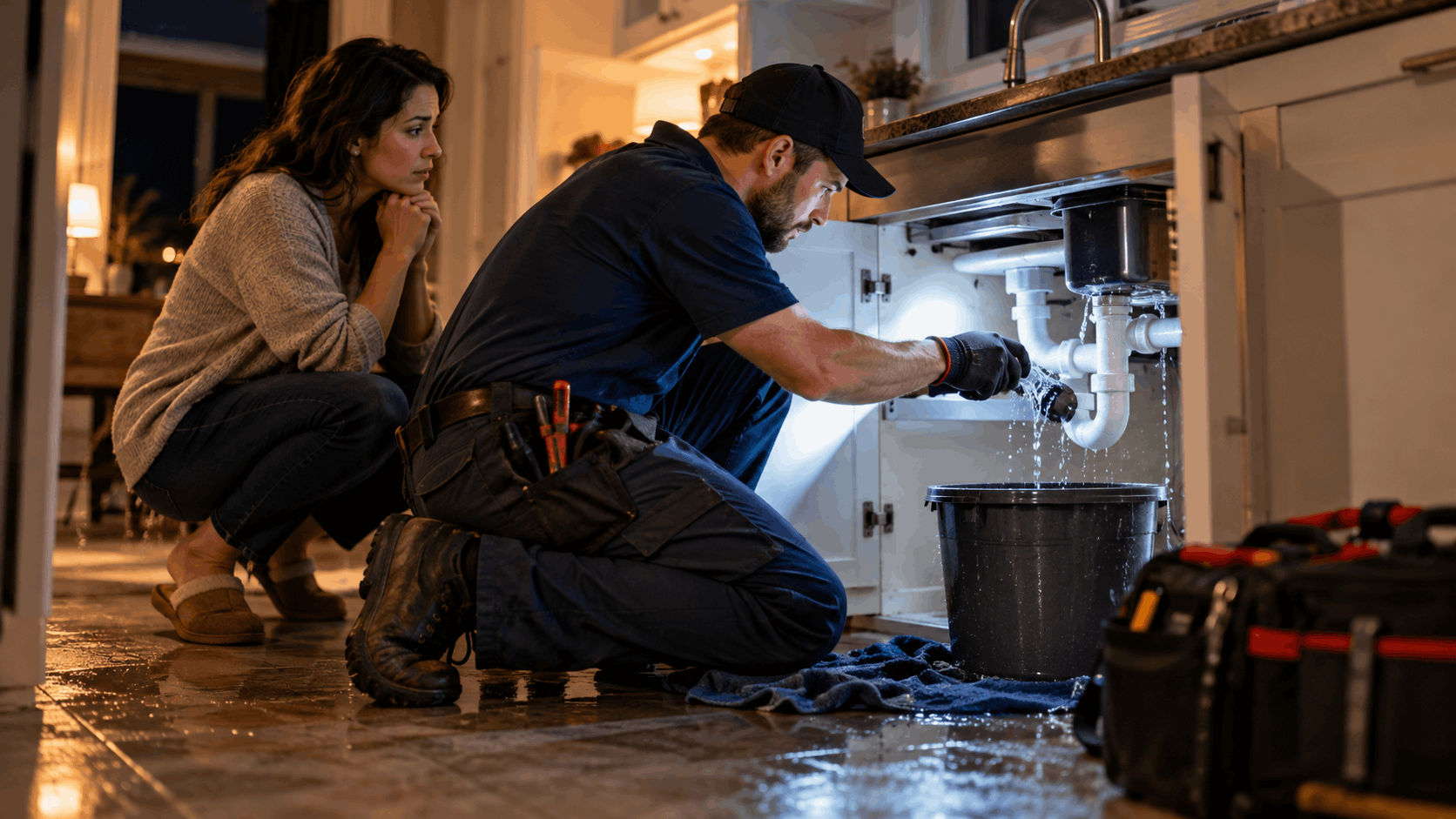
When a supply line fails, water does not pour at a trickle. A 1/2-inch line under household pressure moves a lot of water fast, and in a slab-on-grade home it spreads across the floor instead of draining away. The goal in the first few minutes is simple: stop the flow, remove the electrical danger, and get water off the finishes before anyone picks up a phone.
Panic wastes the minutes that count. Having a clear sequence in mind, and knowing where your main shutoff is before an emergency ever happens, is the single thing that limits the damage. Here is the order to work in.
| Step | Action | Why It Matters |
|---|---|---|
| 1 | Close the main water shutoff | Stops the source faster than chasing the leak |
| 2 | Cut power to the flooded area at the panel | Removes the shock hazard from water near outlets |
| 3 | Move water away from floors and finishes | Protects restored terrazzo and period flooring |
| 4 | Leave gas lines alone and call a licensed plumber | Gas work is never a DIY emergency task |
Find and Close the Main Shutoff
On a slab-on-grade home like those in Paradise Palms, the main water shutoff is usually where the supply line enters the house, often near the front hose bibb, in a garage, or at the water meter box out near the curb. Knowing its location in advance is worth more than any tool in the house. In the middle of a flood is not the time to go hunting for a valve you have never touched.
Closing that valve stops the water at its source, which matters far more than finding the exact spot where the pipe failed. A burst line inside a wall or under the slab keeps feeding water as long as the system is pressurized, so cutting supply at the main is the fastest way to end the flood. Turn the valve clockwise until it stops, or on a quarter-turn ball valve, rotate the lever a quarter turn so it sits across the pipe.
If the interior valve is stuck or you cannot find it, the meter box at the curb has a shutoff the water provider uses. It often needs a meter key or a wrench, and the lid can be heavy, so keeping a key on hand is smart in an older home. Once the water is off, open a few faucets at a low point in the house to drain the remaining pressure and slow the leak at the break.
In these homes the shutoff is the whole game in the first minute. Every extra minute the water runs is more that soaks into the slab, the walls and the flooring, so practice finding and turning your main valve on a calm day. It is a two-minute exercise that saves hours of cleanup.
Kill Power to the Flooded Area
Water and electricity are a dangerous pair, and a flooded floor in an older home often sits right next to outlets, baseboards and appliance connections. Before anyone wades in to mop up, the power to that area needs to come off. Standing water that reaches an energized outlet or a plugged-in appliance can carry a lethal charge.
Head to the electrical panel and switch off the breakers feeding the flooded rooms. If you cannot tell which breakers cover that area, and you can reach the main breaker without standing in water, shutting off the main is the safe choice. Never touch a panel while standing in or on wet ground, and if the panel itself is wet, stay clear and call for help.
If a burst has brought down or damaged an electrical line, or you see sparking, that is a job for the utility. NV Energy supplies electricity across the valley, and a compromised line is their call to make, not something to approach yourself. Keep everyone well back from any downed or arcing wire until the professionals arrive.
Once the area is de-energized, you can move through it safely to deal with the water. This single step prevents the worst outcome of a night flood, and it takes under a minute at the panel. Electrical safety comes before cleanup every time.
Protect the Floors and Finishes First
Paradise Palms owners spend real time and money restoring original finishes, and a burst pipe threatens exactly those features. Original terrazzo, polished concrete and period flooring are hard or impossible to replicate, so the minutes after a burst are about keeping water away from them. Once the supply is off and the power is safe, the cleanup becomes damage control.
Grab towels, blankets, a wet-dry vacuum, anything that moves water or soaks it up. Push the water toward a door, a tiled area or a drain and away from the materials you most want to protect. If furniture or rugs sit in the path, lift them onto something dry so wicking does not spread the damage further.
Standing water that sits on or seeps under restored flooring causes the real loss, because trapped moisture stains, lifts and encourages mold long after the visible water is gone. Getting the surface dry quickly and moving air across it with fans limits that secondary damage. Open windows if the weather allows and keep air circulating until the area is genuinely dry.
This is also where a quick photo pass helps. Document the water and any affected finishes before you move things, since that record matters for insurance on a restored home. Protecting the finishes first is what separates a bad night from a ruined restoration.
What Not to Touch
During a water emergency it is tempting to start pulling at anything that looks involved, but gas lines are off limits. A plumber is the right person for any gas work, and a homeowner should never attempt to repair, cap or reconnect a gas line, even in a crisis. The risks of getting it wrong are far worse than a flooded floor.
If you smell gas at any point during a burst pipe situation, treat it as the priority. Leave the building right away, avoid light switches and anything that could spark, and do not use open flames. Those small electrical arcs are enough to ignite gas, so the safe move is simply to get out.
Once you are outside and clear of the building, call Southwest Gas, the natural gas supplier for the valley, before you call a plumber. They handle the gas side of the emergency first. Only after the gas hazard is addressed does the plumbing repair come back into the picture.
For the water side of things, our emergency plumbing team handles the burst itself. Keep the gas and water responses separate in your mind: gas smell means evacuate and call the utility, water means shut the main and call a plumber. Mixing the two up is where people get hurt.
Get Your Quote
Tell us what's going on and we'll get back to you. We're open 24/7.
Why Pipes Burst in Paradise Palms Homes?
Paradise Palms is Clark County's first master-planned community, laid out from 1960 by Irwin Molasky and Merv Adelson around the golf course that opened in 1961 as the Stardust Country Club. The roughly 1,000 homes here were built mostly between 1960 and 1964, and the pipe in the ground and in the walls reflects that era. When a line bursts off Desert Inn Road at night, the cause usually traces back to the age and chemistry working on sixty-five-year-old plumbing.
These are not random failures. A specific set of conditions makes burst pipes more likely in this neighborhood, and understanding them helps an owner know whether one failure is a fluke or a warning. Each of the following plays a part.
Sixty-Five-Year-Old Copper Supply Lines
Homes built here between 1960 and 1964 typically carry copper supply lines of that era, and sixty-five-year-old copper is well past the age where trouble starts. Copper is a durable material, but it does not last forever, and decades of water flowing through it eventually thin the walls and open pinhole leaks. A pinhole can weep for weeks or it can give way suddenly, which is what turns into a night flood.
Hot water lines fail first and fastest. Heat accelerates the chemistry that attacks copper from the inside, so the hot side of a sixty-year-old system is usually the first to show pinholes and bursts. That is why so many late night failures trace to a hot line in a wall or near the water heater rather than a cold run.
The pattern with aging copper is telling. One pinhole leak is often the first of several, because the whole system shares the same age, the same water and the same wear. When a plumber finds one failure in an original copper line, the honest conversation includes whether the rest of the system is close behind.
This is the core reason burst pipes cluster in a neighborhood like this one. The homes went up in the same few years with the same copper, so they age into the same failure window together. A line that has lasted six decades has earned its rest, and the smart move is planning for replacement before the next one lets go at 2 a.m.
Hard Water Scale Inside the Lines
The Southern Nevada Water Authority reports the valley's water at 280 parts per million, or about 16 grains per gallon, which puts it firmly in the very hard category. That hardness is the single biggest driver of plumbing wear across Las Vegas, and Paradise Palms is no exception. Calcium and magnesium in the water deposit scale on the inside of pipes year after year.
Over decades, that scale narrows the bore of the supply lines. A pipe that started with a full opening gradually loses interior diameter to mineral buildup, which raises pressure and turbulence inside the line. On an already thinning sixty-year-old copper wall, that added stress is exactly what pushes a weak spot into a burst.
Hot lines take the worst of it again. Scale forms faster in hot water, so the hot side of an old system collects buildup quicker and feels the extra stress sooner. The combination of thinning copper and scaling bore is why hot lines so often fail first in these homes.
Treating the hard water does not reverse damage already done, but it slows the process on the lines you keep and protects anything you replace. That is why a conversation about water treatment belongs alongside any burst pipe repair here, especially in a home where the owner has installed period-correct fixtures worth protecting.
Mixed Materials From Decades of Restoration
Many Paradise Palms houses have been renovated repeatedly as owners restore them, and that history leaves a patchwork behind the walls. One home can hold original 1960s copper, later repairs in other materials, and modern PEX where a bathroom was redone. Each generation of work left its own material in place, and the joints where they meet are a known weak point.
Where dissimilar metals connect, galvanic corrosion sets in. When two different metals touch in the presence of water, one corrodes faster than it would alone, eating away at the joint over time. A copper line tied into another metal without the right fitting can corrode at that connection until it leaks or bursts.
This makes diagnosis in these homes a real skill rather than a guess. A plumber has to know what is likely behind the wall based on the era, then confirm what is actually there, because the mix changes from house to house and even room to room. Assuming the whole house is original copper, or assuming a prior owner's repipe covered everything, leads to surprises.
For an owner, the takeaway is that a burst at a joint may point to a mismatched repair from years past rather than general pipe failure. Identifying those dissimilar-metal connections during a repair is part of fixing the underlying problem instead of just the symptom. It is one more reason the work here rewards experience with mid-century homes.
Winter Nights Still Freeze Exposed Lines
Residents who assume the desert never freezes get a surprise on the coldest nights of the year. Winter nights in the valley can drop below freezing, and exposed or poorly insulated lines are at risk when they do. A hose bibb, a garage line, or a run of pipe on an exterior wall without insulation can freeze overnight.
When water freezes it expands, and that expansion is what cracks or bursts a pipe. The failure often does not show until the ice thaws and water starts flowing through the new crack, which is why a freeze on a cold night can turn into a flood the next morning. The line held while frozen, then let go as it warmed.
Older homes are more exposed to this because original insulation on outdoor and garage lines may be thin or gone. Sixty years of weather and remodels leave gaps, and a line that was once protected can end up bare. That is enough for a hard freeze to do damage in a neighborhood people think of as too warm to worry about.
The fix is cheap compared to the repair. Insulating exposed lines and covering hose bibbs before a cold snap prevents most freeze bursts, and it is worth doing in the fall. We cover that in the prevention section, because a frozen line is one of the most avoidable late night failures in these homes.
Need Help in Las Vegas?
Active Plumbing serves Las Vegas and all of Las Vegas Valley.
How the Mid-Century Construction Changes the Repair
About 400 of the homes here were designed by Palmer and Krisel, the Southern California modernist firm known for their Palm Springs tract work, and built between 1960 and 1964. Their post-and-beam design is beautiful, and it also makes a burst pipe repair a different job than the same fix in a conventional house. The construction decides where a plumber can and cannot run a new line.
A crew that understands this before quoting gives an accurate price. One that treats a Palmer and Krisel home like an ordinary pitched-roof house will be wrong on the day and will tear open more than it needs to. Here is how the construction shapes the work.
Little or No Attic to Work In
Palmer and Krisel homes are post-and-beam with exposed beams, flat or low-pitch roofs, and minimal attic space. In a conventional 1960s house with a pitched roof, a plumber runs new supply lines through the attic, which is the fast and clean route for most repairs and repipes. That route simply is not there in most of these homes.
Without an accessible attic, the overhead path that a repair would normally take is off the table. A plumber cannot drop new lines down from above when there is no above to work in. That one difference changes the entire approach to a burst pipe repair or a reroute in this neighborhood.
Ceiling-mounted and attic-mounted equipment is frequently not an option either, which matters when a repair involves relocating anything. The flat roof structure limits what can go overhead and how, so solutions that work elsewhere do not transfer here. A plumber has to plan around the structure rather than fighting it.
The practical result is that the repair takes more thought up front. The lack of attic access is the first thing an experienced crew considers before quoting, because it determines the route, the time and the cost of the whole job. Skipping that step is how a quote goes wrong.
Routing Through Walls and Soffits Instead
With no attic to use, a repair or reroute here is planned through walls, soffits and whatever other routes the house allows. That path takes longer than an attic run and has to be mapped before a price is given. Every wall opened is a wall that has to be closed and finished afterward, so the route is chosen to open as little as possible.
Soffits and the space around existing chases give a plumber somewhere to run new pipe without tearing through a beam or a finished wall. Finding those paths is where local experience with these homes pays off, because the layout repeats across Palmer and Krisel plans. A crew that has worked these houses knows where the usable routes tend to be.
This planning is why a careful walkthrough before the work starts matters so much. The route decides the labor, the drywall repair and the time on site, and all of that feeds the price. A plumber who maps the run first can give a real number instead of a guess that falls apart once a wall is open.
For an owner, understanding this explains why a repair in these homes is not a quick in-and-out. The extra care protects the house and gets the pricing right. A whole house repipe in a post-and-beam home follows the same logic on a larger scale, routed through walls and soffits rather than overhead.
When the Burst Is Under the Slab
These homes are slab-on-grade, so a line that runs under the concrete is not accessible without going through the slab. When the burst is below the floor, the choice comes down to detection followed by either breaking the slab to reach the pipe or rerouting the line around the problem. Neither is trivial, and the right answer depends on the house.
In a home with original terrazzo or polished concrete that an owner has restored, breaking the slab is a far worse outcome than in an ordinary tract house. The flooring cannot simply be patched back to match, so cutting into it destroys part of what makes the home valuable. That is what pushes the recommendation toward rerouting whenever it is feasible.
Rerouting runs a new line through walls and soffits to bypass the failed under-slab section entirely, leaving the restored floor intact. It is more planning and sometimes more pipe, but it protects the finish that matters most. Accurate detection makes rerouting possible by pinpointing the failure so the bypass is designed correctly.
This is why slab leak detection and repair is genuinely valuable in these homes rather than an upsell. Knowing exactly where the under-slab line failed is the difference between a clean reroute and a torn-up floor. The detection pays for itself by saving the slab.
Protecting Exposed Beams and Period Finishes
The repair plan has to account for the exposed beams, decorative block and restored features that give these homes their character. Owners here have spent years and real money preserving original details, so a plumber cannot treat the interior as disposable the way a crew might in a gut remodel. Every opening is chosen with the finishes in mind.
Exposed beams are structural and visual at once, so routing around them rather than through them protects both the look and the strength of the house. Decorative block accents and period features need the same care, because damaging them during a repair creates a loss the owner feels long after the pipe is fixed. The route is planned to leave those elements alone.
This respect for the architecture is part of why local knowledge matters in Paradise Palms. The neighborhood's residents are organized and preservation-minded, and a contractor who protects finishes and explains the route before starting earns referrals across the community. Word travels fast among owners who talk to each other.
The bottom line is that a burst pipe repair here is as much about what stays intact as what gets fixed. Protecting the restoration is built into the plan from the first walkthrough. That is the standard these homes deserve.
Finding the Burst Without Tearing Up the House
In a restored mid-century home, the worst way to find a leak is to start opening walls and floors and hope. The right tools pinpoint the failure so the crew opens only what it has to, which protects the terrazzo, the beams and the block that make these homes special. Good diagnosis is what keeps a repair surgical instead of destructive.
Here is how the main diagnostic methods compare for an aging Paradise Palms home.
| Method | Best For | What It Finds | Typical Range |
|---|---|---|---|
| Electronic leak detection | Pressurized supply lines | The location of a hidden leak | $150 to $350 |
| Slab leak detection | Under-slab supply failures | The spot of an under-floor leak | $150 to $300 |
| Camera inspection | Cast iron drains and sewer lines | Cracks, scale and root intrusion | Varies by job |
Electronic and Acoustic Leak Detection
Electronic leak detection uses sensitive equipment to listen for and locate the sound of water escaping a pressurized line. Acoustic sensors pick up the specific signature of a leak through walls, floors and slab, narrowing the location down to a small area. That turns a repair from an exploratory dig into a targeted opening.
The value in a restored home is obvious. Instead of guessing and opening several feet of wall or slab, a plumber works from a known point and exposes just the failed section. Electronic leak detection typically runs $150 to $350 in the valley, and in these homes that cost buys back far more than it spends by protecting finishes.
The method works on both supply leaks inside walls and under-slab failures, which is exactly the range of problems these sixty-year-old systems produce. A pinhole in a hot line behind drywall and a cracked line under terrazzo both show up to the right equipment. Pinpointing them first is what keeps the repair contained.
Our electronic leak detection service is the first step on most hidden leaks here. Finding the leak accurately is half the job in a home where every opening matters. The detection guides everything that follows.
Camera Inspection for Aging Lines
For homes with cast iron drains and old copper, a camera inspection is the honest diagnostic rather than running a cable through the line again and again. Housing from 1960 to 1964 in this valley typically carries cast iron drain, waste and vent piping, and sixty-five-year-old cast iron scales, cracks and separates at joints. A camera shows exactly what is happening inside.
Repeated cabling clears a blockage for a while but tells you nothing about why it keeps coming back. A camera reveals the real condition: scale narrowing the pipe, a crack at a joint, or roots pushing in from mature landscape. Sewer laterals of this age are candidates for root intrusion after sixty years of established trees and plantings.
The inspection also answers the bigger question after a burst or a recurring drain problem. It shows whether one failure is isolated or a sign of more to come, which lets an owner decide between a spot repair and a larger fix with real information. Guessing without the camera leads to repeat visits and surprises.
A sewer camera inspection is the diagnostic these aging drain and sewer lines call for. On a home this old, seeing inside the pipe beats cabling it blind every time. It turns guesswork into a clear picture.
Why Detection Is Worth It on Restored Homes
The case for spending on detection comes down to what is at stake under the floor. In a standard tract house, breaking a slab to reach a leak is an inconvenience. In a Paradise Palms home with original terrazzo or polished concrete, it can destroy a finish the owner spent years restoring, and that loss cannot be undone.
Accurate location changes the whole repair decision. When a plumber knows exactly where an under-slab line failed, rerouting around it becomes a clean option that leaves the floor whole. Without that precise spot, the only path may be cutting the slab in the wrong place or opening a wide area to search, both of which are worse outcomes here.
The economics favor detection in these homes more than almost anywhere. A detection fee is small next to the cost and heartbreak of replacing an irreplaceable floor, so the math is easy. Owners who have restored their homes understand this intuitively, which is why detection is a routine first step rather than a hard sell in Paradise Palms.
Detection also protects the beams, block and period features above the floor by keeping the repair contained. The whole point is to open as little as possible, and that starts with knowing precisely where to open. On a restored mid-century home, that precision is the most valuable part of the job.
What a Late Night Burst Pipe Repair Costs in the Valley
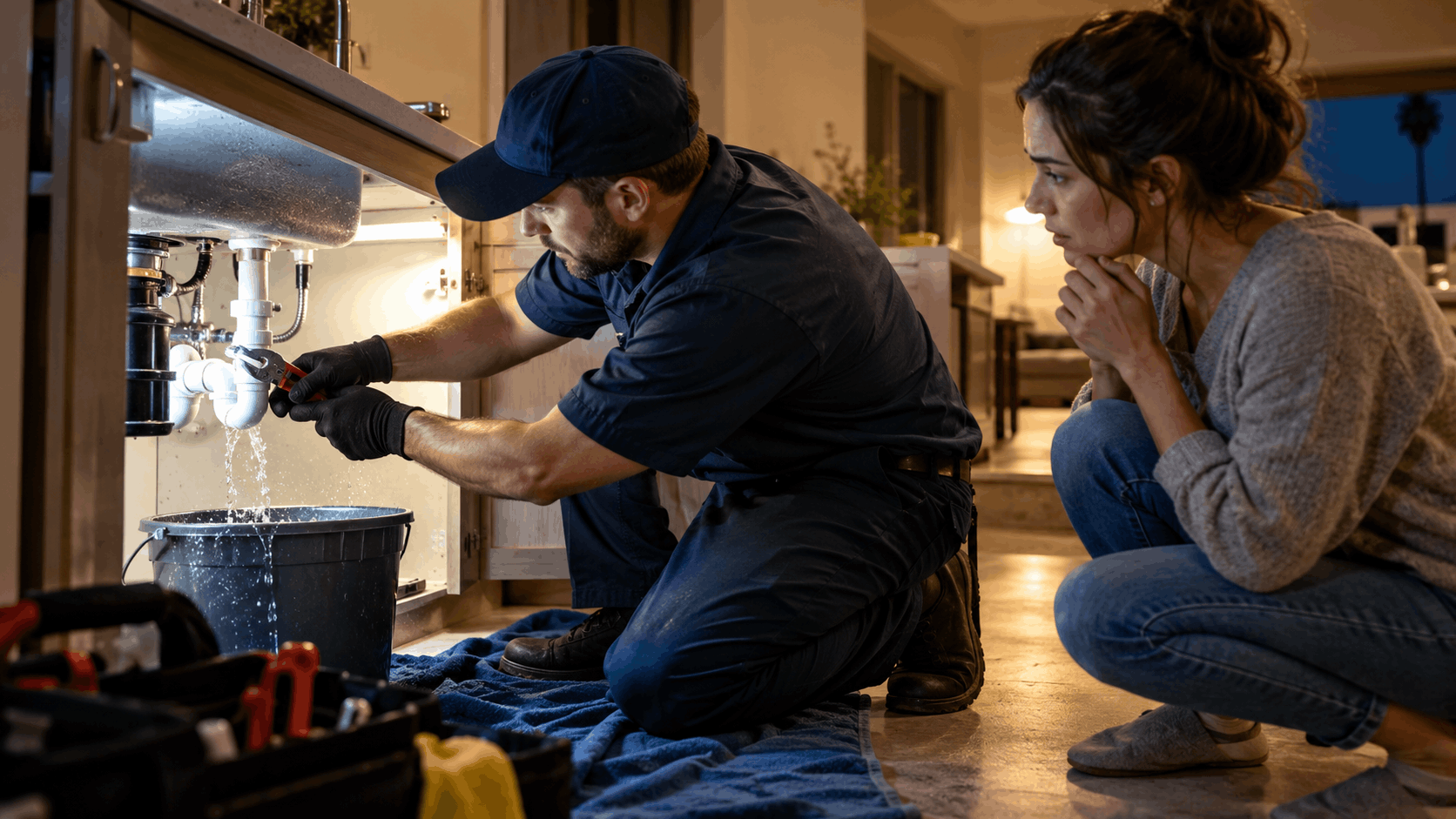
Nobody wants to think about price while water is on the floor, but knowing the typical ranges ahead of time helps an owner make a clear-headed decision when the moment comes. The figures below are typical ranges for plumbing work across the Las Vegas Valley, not a quote for any specific job. The actual price for a given repair is set by that repair and given in writing before work begins.
| Service | Typical Valley Range |
|---|---|
| Burst pipe repair | $200 to $800 |
| Electronic leak detection | $150 to $350 |
| Slab leak detection | $150 to $300 |
| Slab leak repair | $500 to $3,000 |
| After-hours emergency fee | $150 to $300 plus repair costs |
| Whole-house repipe | $4,000 to $15,000 |
Burst Pipe Repair and Leak Detection Ranges
Burst pipe repair in the valley typically runs $200 to $800, depending on where the break is and how much has to be opened to reach it. A straightforward accessible break lands at the lower end, while a failure buried in a wall or behind restored finishes sits higher because of the work to reach and restore it.
Finding the leak is often a separate step with its own cost. Electronic leak detection typically runs $150 to $350, and slab leak detection runs $150 to $300. On a hidden or under-slab failure, that detection comes first so the repair is targeted rather than exploratory, which usually saves money overall by limiting what gets opened.
When the burst is under the slab, slab leak repair typically runs $500 to $3,000. The wide range reflects the difference between a simple reroute and a repair that requires reaching the line through concrete. In a restored home, the reroute end of that range is often both cheaper in finish damage and the better long-term outcome.
These figures are starting points, not promises. The specific job sets the final number, which is why a written price before work starts matters more than any range on a page. The ranges tell you the neighborhood you are in; the written price tells you the actual cost.
The After-Hours Service Fee
A burst pipe at midnight is an emergency call, and emergency calls carry a service fee on top of the repair. In the valley, after-hours emergency calls typically run a service fee of $150 to $300 plus the cost of the repair itself. That fee covers the off-hours response that gets a plumber to your flooded home when the flood will not wait until morning.
It helps to understand what the fee buys. A late night response means a technician leaves for your home outside normal hours to stop the damage, which is exactly when a burst pipe does its worst. Waiting until business hours while water runs is almost always the more expensive choice once you add up the damage.
The fee is separate from and additional to the repair ranges above. So a nighttime burst pipe repair combines the emergency fee with the repair cost, and detection if the leak is hidden. Knowing that ahead of time lets an owner weigh the call without sticker shock at 2 a.m.
For most burst pipes, the choice is clear. The emergency fee is small against the cost of hours more water across a restored floor. Stopping the damage fast is where the real savings live, and our 24/7 emergency plumbing exists for exactly these nights.
When a Repair Becomes a Repipe
Sometimes a single burst is not a single problem. When aging copper is failing throughout a home, patching one break just moves the next failure down the line, and a whole-house repipe becomes the sensible answer. A repipe in the valley typically runs $4,000 to $15,000, a wide range that reflects home size and complexity.
In Paradise Palms, the construction pushes that cost toward the upper part of the range. Routing new lines through walls and soffits instead of an attic takes more labor and more finish repair than a conventional house, so the same square footage costs more to repipe here. That is a function of the post-and-beam design, not an upsell.
A camera inspection and the overall condition of the copper guide the repair-versus-repipe decision. If one pinhole is the first of many showing up across the system, spending repeatedly on spot repairs is throwing money at a problem that needs a full fix. The repipe ends the cycle of midnight failures.
The decision is specific to each home and each system's condition. For some owners a targeted repair is right; for others a planned repipe saves money and stress over the next few years. An honest look at the whole system, not just the one burst, is how that call gets made.
What Drives the Final Number Here
Several factors specific to these homes move the final price. Access is the first: a break behind a restored wall or beam costs more to reach and repair than one in an open, accessible spot. The post-and-beam layout and the lack of attic access shape how much has to be opened.
Routing is the second. Running new or replacement line through walls and soffits rather than overhead adds labor and drywall repair, and the path chosen to protect finishes affects the time on site. More careful routing to save terrazzo or beams costs more in labor but saves far more in avoided finish damage.
Slab work and outdoor excavation drive cost too. An under-slab failure that needs the concrete opened is a bigger job than an accessible repair, and any excavation outside runs into caliche. Caliche is a cemented hardpan that is hard to trench through, which makes exterior digging slower and more expensive than in softer ground.
All of this is why the specific job sets the figure rather than any chart. The ranges above frame the expectation, and the written price before work starts gives the real number once a plumber has seen the access, the route and the condition of the lines. No two burst pipes in this neighborhood price out exactly alike.
Need Help in Las Vegas?
Active Plumbing serves Las Vegas and all of Las Vegas Valley.
Permits, Jurisdiction and Licensing for Paradise Palms
Before any permitted work starts, an owner should know who governs their address and what the neighborhood's historic status means for the job. Paradise Palms sits in a specific jurisdiction with its own building department, and the historic overlay adds a wrinkle for anything visible from the street. Getting this right up front avoids problems later.
This Is Unincorporated Clark County
Everyone calls these addresses Las Vegas, and socially that is correct, but Paradise is unincorporated Clark County rather than the City of Las Vegas. The address on the Strip side of town is a county address even though residents describe it as Las Vegas. That distinction decides which counter governs the work.
Permits, plan check and inspections for a Paradise Palms address run through the Clark County Department of Building and Fire Prevention. The city of Las Vegas building department does not govern here, so quoting city rules or city permits for one of these homes would be wrong. The county is the authority for this neighborhood.
Establishing the correct jurisdiction before quoting permitted work is a routine first step in this market. Telling an owner that the county counter governs their address is a small thing that signals real local knowledge. It also ensures the paperwork goes to the right place the first time.
For a burst pipe, a simple repair in the same location often does not require a permit, while a reroute, a repipe or work that alters the system may. The permit position should be confirmed for the specific address rather than assumed. Our Paradise service area page covers the neighborhoods the county governs.
The Historic Neighborhood Overlay and Visible Equipment
In 2017 Paradise Palms became the first neighborhood in Clark County to adopt a Historic Neighborhood Overlay, and the county later extended it to cover hundreds more homes across more than 240 acres west of Eastern Avenue and south of Desert Inn Road. That overlay shapes what an owner can do with anything visible on the exterior.
For most plumbing, the overlay changes nothing. Interior repairs and repipes do not alter the character of a designated neighborhood, so fixing a burst pipe inside the house carries no special historic hurdle. The work happens behind the walls and leaves the street-facing appearance untouched.
The consideration is narrow but real for exterior equipment. An exterior tankless unit, a softener or treatment system on a visible elevation, a new water heater enclosure, or a change to a street-facing feature sits in a neighborhood with an overlay and preservation-minded neighbors. Those visible installations deserve a check before mounting.
The rule of thumb is simple. Confirm with Clark County before mounting equipment where it can be seen from the street, and plan visible installations with the overlay in mind. Inside the house, the repair proceeds like any other; outside and in view, a quick confirmation keeps the work in line with the neighborhood's status.
Who May Do the Work
Plumbing work in Nevada is licensed by the Nevada State Contractors Board. Work that requires a permit must be performed by an appropriately licensed contractor, which protects owners in a market with a real unlicensed trade problem. A homeowner is entitled to ask for a license number and to verify it.
Verification is free and public. A license is confirmed at nvcontractorsboard.com, where the classification, status, bond and workers compensation are all on the record. Checking before hiring takes a minute and tells you whether the contractor is legitimate and properly covered for the work.
This matters more on an older, restored home than almost anywhere. A burst pipe repair that goes wrong in a Palmer and Krisel house can damage finishes that cannot be replaced, so the person doing the work should be qualified and accountable. A verified license is the baseline, not a bonus.
Contractor licensing is statewide through the Nevada State Contractors Board, not a county function. So the same license verification applies to a Paradise address as to any other in Nevada. Asking for the number is a fair and smart question for any permitted job.
The Code That Applies Here
Nevada has no statewide plumbing code. Clark County adopts the Uniform Plumbing Code published by IAPMO together with the Southern Nevada Amendments, and that is the code that governs a Paradise Palms address. The Southern Nevada jurisdictions adopted the 2024 edition with amendments, replacing the 2018 editions, with the county's effective date in January 2026.
The amendments are not code until the individual jurisdiction adopts and codifies them, and Clark County has done exactly that for this area. They cover specifics that matter in this valley, from fixture flow rates to how a relief valve drain may be run inside a building. A plumber working here works to that adopted code.
The amendments also leave room for alternate materials and methods, with the Building Official as the authority on approving them. They are not intended to prevent the use of a material or method not specifically prescribed, provided the Building Official approves the alternate. On an older home where original conditions complicate a standard approach, that flexibility matters.
For an owner, the practical point is that the rules are set by the county's adoption of the Uniform Plumbing Code with the Southern Nevada Amendments, and a licensed contractor works to them. Confirming the current requirements for a specific job with the county is the right step when a repair gets complex. The code is the framework the whole repair sits inside.
Preventing the Next Burst After the Water Is Back On
Once the water is back on and the floor is dry, the smart move is lowering the odds of a repeat. The causes of a burst in these homes are known, which means most of them can be managed. A few targeted steps turn a reactive owner into one who sleeps through the night.
Treating the Hard Water That Scales the Lines
The valley's water at 280 ppm, about 16 grains per gallon, is very hard, and that hardness scales the inside of pipes and stresses aging copper. A whole-house softener or scale-reduction system slows that process, extending the life of the lines you keep and protecting anything new you install. In this valley, treatment extends equipment life rather than being an optional luxury.
A water softener typically runs $800 to $2,500 installed, and a salt-free scale-reduction system falls in a similar range. The choice between them depends on the household and preferences, but both address the mineral buildup that narrows and stresses the lines. On a sixty-year-old system, slowing the scale buys time.
In Paradise Palms there is an extra reason to treat the water. Owners here install period-correct and high-end fixtures during restoration, and hard water scale fouls the cartridges and narrow passages in exactly those fixtures. Whole-house treatment protects a restoration investment, which is a stronger argument here than almost anywhere in the valley.
Treatment is one of the few prevention steps that helps the whole house at once. It protects pipes, water heaters and fixtures together by cutting the mineral load at the source. Our water treatment service sizes a system to the home and the hardness here.
Insulating and Protecting Exposed Lines
The freeze bursts that catch desert residents off guard are among the most preventable failures. Insulating exposed and garage lines before winter keeps them above freezing on the coldest nights, so a hard freeze cannot crack them. Pipe insulation is inexpensive and goes on in an afternoon.
Focus on the lines most at risk. Hose bibbs, exposed exterior runs and garage-located pipe are the ones that freeze, because they lack the thermal protection of lines inside heated walls. Covering hose bibbs and wrapping exposed pipe handles the common failure points before the first cold snap.
Summer heat is the other seasonal stress on exposed lines. Extreme summer temperatures raise incoming water temperature and stress outdoor and garage-located equipment, and hose bibbs, backflow assemblies and exposed lines face intense UV and heat degradation. Insulation and shade help here too, protecting lines from the heat as well as the cold.
The point is that these homes face both ends of the temperature range. Protecting exposed lines against winter freezes and summer heat is a seasonal habit that prevents a category of failures entirely. It costs little and saves a midnight emergency.
Planning a Repipe Before the Next Failure
When aging copper is giving way repeatedly, waiting for the next burst is the expensive path. A planned repipe through walls and soffits, scheduled on your terms, beats an emergency call at midnight every time. It ends the cycle of patching one leak while the next one forms.
Planning matters more in post-and-beam homes because the work takes more thought. Routing new lines without an attic requires mapping the path through walls and soffits, protecting beams and finishes, and sequencing the drywall repair. None of that is a job to rush at 2 a.m., which is exactly what an emergency repipe would be.
A scheduled repipe lets an owner protect the restoration properly. The crew can plan the route to open as little as possible, work around period features, and finish cleanly, because there is no flood driving the pace. That care is hard to deliver in an emergency and easy to deliver on a planned job.
A camera inspection and an honest look at the copper's condition tell an owner whether that time has come. If the system is failing in more than one place, planning the repipe now avoids the next flood and the finish damage that comes with it. It is the difference between control and crisis.
Leak Detection Systems and Automatic Shutoffs
Technology now catches a failure before it floods a floor. A whole-home leak detection system monitors the water and can shut off the supply automatically when it senses an abnormal flow, like a burst line running unchecked overnight. These systems typically run $300 to $800 installed.
The value at night is the whole point. A burst that starts at 2 a.m. can run for hours before anyone wakes up, and that is where the worst damage happens. An automatic shutoff cuts the water the moment it detects the failure, turning a potential flood into a minor event you deal with in the morning.
In a restored home, that protection is worth real money against the finishes at stake. The cost of the system is small next to replacing terrazzo or repairing water-damaged beams, so the math favors installation for owners with serious restorations. It is insurance that acts instead of just reimbursing.
These systems pair well with the other prevention steps. Treating the water slows the wear, insulation prevents freezes, and detection catches whatever still gets through. Our whole-home leak detection system gives aging Paradise Palms homes a safety net for the midnight failure.
Need Help in Las Vegas?
Active Plumbing serves Las Vegas and all of Las Vegas Valley.
How Active Plumbing Handles a Late Night Burst Call
When the water is on the floor and the clock reads past midnight, the response needs to be fast, careful and clear about the cost. Here is how our team approaches an after-hours burst pipe call in Paradise Palms, from the drive out to the written price.
Response Across the Valley
Our technicians arrive in 30 to 60 minutes anywhere in the Las Vegas Valley, and that includes Paradise Palms off Desert Inn Road. A burst pipe does not wait, so neither do we. Getting a plumber to a flooding home quickly is what limits the damage to floors and finishes.
The neighborhood's location near the Las Vegas National Golf Club at 1911 East Desert Inn Road is well within that window. Whether the address is in the original overlay section or the larger expanded area west of Eastern Avenue, the response time holds. We know the streets here and how to reach them fast.
That window matters most at night, when a slow response means hours more water across a restored floor. Arriving inside 30 to 60 minutes is the difference between stopping the damage early and cleaning up a far bigger mess. Speed is the first job on an emergency call.
Diagnosis and a Written Price First
Once on site, the team locates the burst, protects the finishes, and gives a written price before any work starts. That means the owner knows the number before anyone opens a wall, so there are no surprises when the invoice comes. The price is in writing, in hand, before the repair begins.
Diagnosis comes first because it decides the repair. Using electronic detection to pinpoint a hidden or under-slab leak lets the crew plan the most targeted fix, which on a restored home often means a reroute that saves the slab. Finding the problem accurately is what makes a contained repair possible.
Protecting the finishes runs alongside the diagnosis from the first minute. Original terrazzo, exposed beams and decorative block are treated as the irreplaceable features they are, and the repair is planned to leave them intact. The written price reflects that careful approach, and the owner agrees to it before work moves forward.
A Fourth-Generation Local Team
Active Plumbing is a fourth-generation family plumbing business that has served the Las Vegas Valley since 1991. That history means real experience with the valley's mid-century homes, its very hard water and its caliche ground, the exact conditions a Paradise Palms burst pipe involves. Some of the owners are US military veterans.
The company is licensed through the Nevada State Contractors Board, NSCB #0047021, verifiable free at nvcontractorsboard.com. That license, the classification and the coverage behind it are all public record, so an owner can confirm them before anyone sets foot in the house. Licensing is stated plainly because it should be.
Working these homes rewards the kind of local knowledge that comes from decades in the valley. Understanding post-and-beam construction, the 1960 to 1964 copper, and the historic overlay before quoting is what separates an accurate job from a guess. That experience is what we bring to a late night call off Desert Inn Road.
Stop the Damage Fast on a Paradise Palms Burst
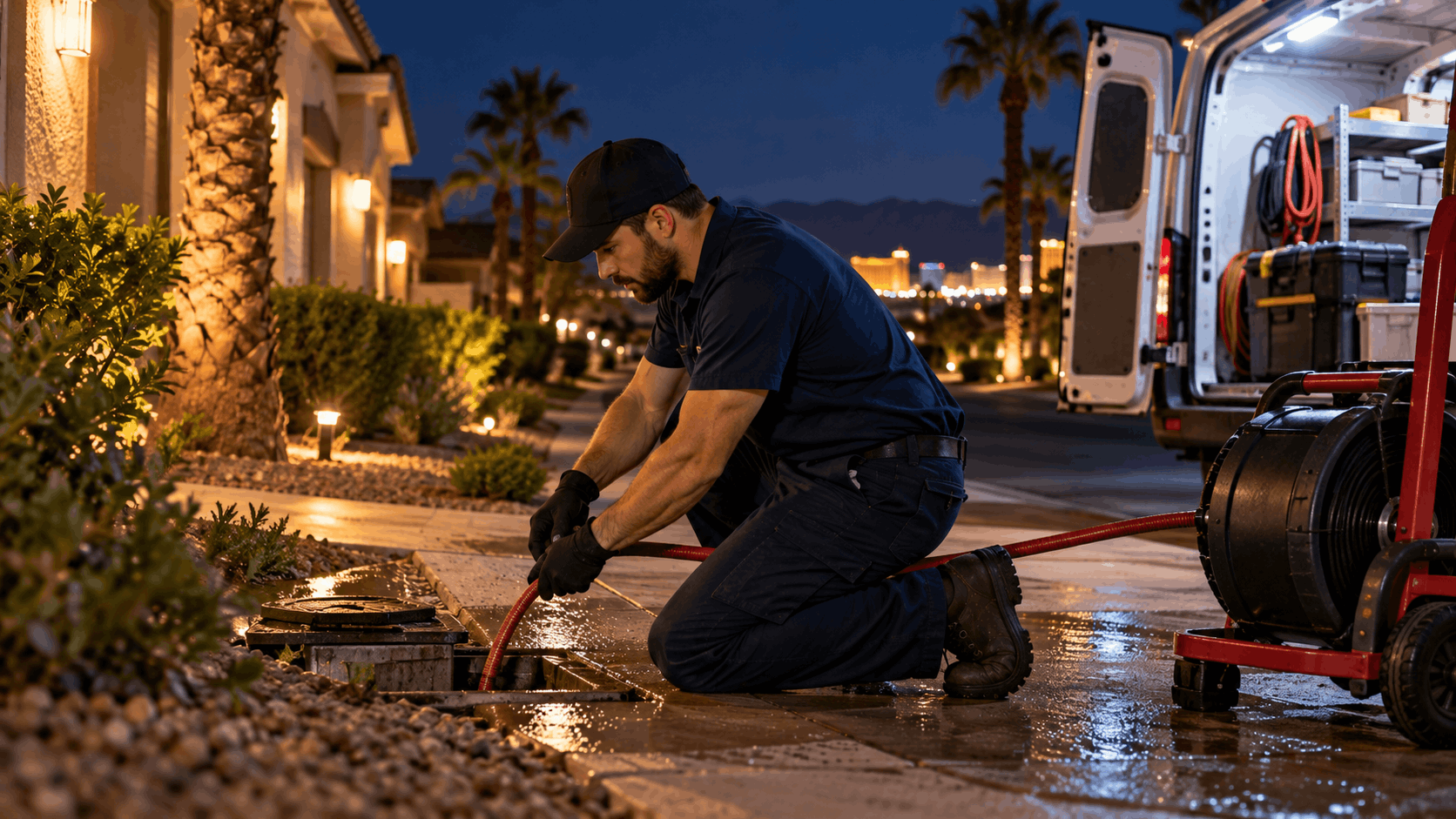
A burst pipe at night in a restored mid-century home is a race against the water, and the owners who come through it best are the ones who shut the main fast and get a qualified plumber there quickly. Our team locates the burst, protects your terrazzo and beams, and puts the price in writing before anyone opens a wall.
If a line has let go off Desert Inn Road, call Active Plumbing at (702) 438-3357 for an after-hours response across the valley. You can also reach us through our contact page to plan a repipe or add leak detection before the next midnight failure.
Frequently Asked Questions
- What should I do first when a pipe bursts at night?
- Close the main water shutoff first, usually near the front hose bibb, the garage, or the meter box at the curb, because stopping the source matters more than finding the leak. Then cut power to the flooded area at the breaker panel to remove the shock hazard. Move water away from your floors and finishes, and call a licensed plumber. Leave gas lines alone, and if you smell gas, get out and call Southwest Gas first.
- How much does burst pipe repair cost in Las Vegas?
- Burst pipe repair in the valley typically runs $200 to $800 as an area range, depending on where the break is and how much has to be opened to reach it. A late night call adds an after-hours service fee of $150 to $300 plus the repair cost. These are typical ranges, not a quote. The specific job sets the final number, which is given in writing before work starts.
- Why do pipes burst in older Paradise Palms homes?
- Homes built from 1960 to 1964 carry copper supply lines that have reached the age where pinhole leaks and bursts begin, especially on hot lines. The valley's very hard water at 280 ppm scales the inside of those lines over decades, stressing the thinning copper. Mixed materials from repeated restorations create galvanic corrosion at dissimilar-metal joints. And desert winter nights can still freeze exposed or poorly insulated lines, a common cause of a late night burst.
- Can you fix a burst pipe without breaking my slab or beams?
- Often, yes. Electronic detection pinpoints the leak so the repair stays targeted, and for under-slab failures, rerouting a new line through walls and soffits can bypass the problem and leave restored flooring intact. In post-and-beam homes the route is planned to protect exposed beams and period finishes. Some under-slab failures still require opening the slab, but accurate detection makes a reroute possible far more often than guesswork would.
- How fast can a plumber get to Paradise Palms at night?
- Our technicians arrive in 30 to 60 minutes anywhere in the Las Vegas Valley, and that includes Paradise Palms addresses off Desert Inn Road near the Las Vegas National Golf Club. At night that window matters most, since a burst pipe runs for as long as it takes someone to arrive and shut it down. Getting there quickly is what keeps the damage to floors and finishes contained.
- Do I need a permit to repair a burst pipe in Paradise Palms?
- Paradise is unincorporated Clark County, so permits, plan check and inspections run through the Clark County Department of Building and Fire Prevention, not the city of Las Vegas. A simple repair in the same spot often does not need a permit, while a reroute or repipe may. Confirm the permit position for your specific address, and remember that work requiring a permit must be done by a contractor licensed through the Nevada State Contractors Board.
- Does the historic overlay affect my plumbing repair?
- Interior work does not change the character of the neighborhood, so fixing a burst pipe inside the house carries no special historic hurdle. The consideration is for anything visible from the street, like an exterior tankless unit, a treatment system on a visible elevation, or a new water heater enclosure. Those installations sit in a Historic Neighborhood Overlay, so confirm with Clark County before mounting equipment that can be seen from the street.
- Should I repipe after one burst pipe?
- Not always. A single burst can be an isolated failure, or it can be the first of many in aging copper. A camera inspection and an honest look at the system's condition show whether the rest of the lines are close behind. If copper is giving way throughout, a whole-house repipe runs $4,000 to $15,000 in the valley and ends the cycle of midnight failures. If the system is otherwise sound, a targeted repair may be the right call.
- Will a water softener help prevent future bursts?
- Treating the valley's very hard water at 280 ppm reduces the scale that narrows and stresses your lines over time, slowing the wear on aging copper and protecting any new pipe you install. A softener typically runs $800 to $2,500 installed, and a scale-reduction system falls in a similar range. In Paradise Palms it also protects the period-correct and high-end fixtures owners install during restoration, which hard water scale fouls quickly.
- Who do I call if I smell gas during a water emergency?
- Leave the building right away, avoid light switches and anything that could spark, and do not use open flames, since a small arc can ignite gas. Once you are outside and clear of the building, call Southwest Gas, the natural gas supplier for the valley, before you call a plumber. Address the gas hazard first and the plumbing repair second. Never try to repair, cap or reconnect a gas line yourself.
Licensed plumbing professionals serving Las Vegas and Las Vegas Valley.
Licensed in Nevada · License #0047021
Last updated on
Why trust Active Plumbing?
Founded in 1991, Active Plumbing is a licensed and insured plumber serving Las Vegas and Las Vegas Valley. All content is reviewed by our licensed technicians.

Need Help in Las Vegas?
Active Plumbing serves Las Vegas and all of Las Vegas Valley.
Related Articles

Burst Pipe in a Las Vegas Two-Story: The Upstairs-to-Downstairs Damage Clock
A burst pipe upstairs floods the rooms below fast. Learn the minute-by-minute damage clock, first response steps, and how Active Plumbing handles two-story emergencies across the Las Vegas valley.
Water Heater Replacement Cost in Paradise Palms for 1960s Palmer and Krisel Homes
Water heater replacement cost in Paradise Palms runs $800-$1,500 for tank and $1,500-$3,500 for tankless. See why 1960s Palmer and Krisel homes change the job.
A Weeknight Burst Pipe Call in Green Valley South
A weeknight burst pipe in Green Valley South? Learn how to stop the water fast, why pipes fail in this Henderson neighborhood, repair options, and typical costs.