Main Line Clogs in East Valley Golf Pockets of Stallion Mountain and What a Camera Finds
Key Takeaways
- Multiple fixtures backing up at once, a gurgling toilet when the washer drains, and the lowest drain flooding first all point to the main line rather than a single clogged fixture.
- A clog that returns within weeks usually signals a structural defect like a belly, root intrusion or crack, which is the reason to put a camera in before clearing it again.
- Stallion Mountain homes were built across the 1980s and 1990s, so the whole drain system ages together, and golf frontage with heavy irrigation draws roots toward any crack or loose joint.
- Caliche does not shift or crack pipe; poorly compacted backfill settles under the line over time and pulls it out of grade, creating a belly where waste pools and catches solids.
- A sewer camera separates a soft blockage a cable or jetter can clear from a collapsed pipe, belly or cracked joint that needs repair, and locates the defect and its depth before any slab is broken.
- In this gated, attached community, NRS Chapter 116 and the CC&Rs decide whether shared pipe is the owner's or the association's responsibility, so confirm before work begins.
- Typical valley ranges: drain cleaning $150 to $350, hydro-jetting $300 to $600, sewer line repair $1,500 to $5,000, full replacement $4,000 to $12,000; a written price comes before work starts.
- Stallion Mountain is in unincorporated Clark County, so permits run through the Clark County Department of Building and Fire Prevention, and gate access must be arranged in advance when booking.
In This Article
It usually starts small in a Stallion Mountain home near the golf course. The guest bathroom shower drains slower than it used to. Then the toilet gurgles when the washing machine empties, and one morning the lowest drain in the house backs up while someone runs the kitchen sink. Those signs point past a single clogged fixture and toward the main line that carries everything out of the house.
Stallion Mountain is a gated golf course community in the east valley, developed through the 1980s and 1990s around the Stallion Mountain Golf Club at 5500 East Flamingo Road. It sits in unincorporated Clark County rather than the City of Las Vegas or Henderson, so the rules, the permits and the access all work a little differently than they do on the older streets a mile away.
What a Main Line Clog Looks Like in a Stallion Mountain Home?
A single slow sink is one thing. A main line clog is another, and the difference matters because it changes the whole repair. When the main line that leaves the house is blocked, waste water has nowhere to go, so it starts to back up through the lowest openings it can find.
The main line is the shared path for every drain in the home. Branch lines from each sink, tub and toilet feed into it. When a branch clogs, you see trouble at one fixture. When the main line clogs, you see trouble everywhere at once, and that pattern is the clearest early tell that the problem is bigger than a hair ball in a trap.
Reading the symptoms correctly saves money. A homeowner who recognizes a whole-house backup can skip the cycle of pouring chemicals down one drain and instead ask for the right diagnosis. Our drain and sewer team sees these patterns constantly across the east valley.
Multiple Fixtures Backing Up at Once
The signature of a main line clog is several fixtures acting up together rather than one. Flush a toilet and the nearby shower drain bubbles. Run the washing machine and a toilet starts to gurgle as air pushes back through the trap. These are not separate problems. They are one blockage downstream showing itself at every opening above it.
A gurgling toilet is the classic warning. Water draining from one fixture needs somewhere to go, and when the main line is restricted it forces air back up through the next lowest water seal it can find. That bubbling and glugging sound means the line cannot vent and drain the way it should.
A single sink that drains slowly on its own is rarely the main line. That points to a local clog in that fixture's trap or branch. The main line announces itself when the trouble spreads, when running water in one room causes a reaction in another. That whole-house backup pattern is what separates a quick branch cleaning from a job that needs a camera.
If multiple drains are sluggish at the same time, stop running water and make the call. Continuing to use fixtures only pushes more waste into a line that cannot clear it, which turns a slow drain into an overflow on the floor.
The Lowest Drain Floods First
Water follows gravity, and a blocked main line sends backed-up waste to the lowest point in the system first. In the slab-on-grade homes common across Stallion Mountain, that is usually a floor drain, a ground-floor shower, or the lowest tub. That fixture floods while higher drains still seem fine, which confuses homeowners who expect the trouble where they last used water.
Understanding this geography helps you locate the problem. If the lowest fixture in the house is the one overflowing, the blockage is almost always in the main line past that point, not in the branch serving a bathroom upstairs. The low drain is simply the escape route the water finds first.
In a slab home there is no basement and no crawlspace to catch the overflow, so the water comes up onto finished flooring. That makes a lowest-fixture backup more than a nuisance. It can mean sewage on tile or carpet in minutes, which is why fast diagnosis matters more here than in a home with a basement sump to buy time.
When a floor drain or the lowest shower is the first to flood, treat it as a main line event until proven otherwise. That single clue points the diagnosis toward the buried line under the slab rather than any branch inside the walls.
Clogs That Come Back After a Snake Clears Them
A clog that clears and returns within weeks is telling you something. Grease and paper that a cable removes stay gone for a good while. When the backup comes right back, the cause is usually structural, something inside the pipe that keeps catching debris no matter how often you clear it.
A recurring clog in an older line often means roots have found a crack, a joint has shifted, or the pipe has sagged into a low spot where waste pools. A snake punches a hole through the blockage and restores flow for a day or a week, but the defect is still there, collecting the next round of solids that pass by.
This is the moment a camera earns its cost. Clearing a repeat backup over and over without looking inside is spending money to treat a symptom. A video inspection shows exactly why the clog keeps forming, so the next dollar goes toward a fix that lasts instead of another temporary clearing.
If your main line has backed up twice in a season, do not book a third snaking blind. Ask for a sewer camera inspection first so the real problem gets named before more money goes down the drain.
Get Your Quote
Tell us what's going on and we'll get back to you. We're open 24/7.
Why Main Lines Clog in These East Valley Golf Pockets?
Stallion Mountain is an unusual address for this part of the valley. It is a gated, association-governed community built around a golf course, surrounded by much older and more price-sensitive east-valley housing. The work here looks more like Green Valley than like the streets a mile away, and the reasons main lines fail reflect that specific setting.
Several factors stack up in these golf pockets: the age of the buried drain lines, the constant irrigation that comes with golf frontage, the way caliche soil was trenched and backfilled, and the valley's very hard water. None of these alone dooms a line, but together they explain why main line trouble is a recognizable category of work in this community.
Knowing why a sewer line fails here changes how you respond to the first symptom. A homeowner who understands the build era and the setting can plan ahead instead of reacting after water damage.
Thirty-Plus-Year-Old Lines and Aging Build Materials
Homes across Stallion Mountain were built through the 1980s and 1990s, which means the original drain lines in the ground are now decades old. Drain pipe does not last forever. Joints loosen, materials fatigue, and the inside surface roughens over time, giving waste more to catch on than it did when the pipe was new.
The important point about build era is that the whole system ages together. The drain line was installed in one pass when the house went up, so when one section shows a problem, the rest of the line is the same age and has lived through the same conditions. A single spot failure is often a preview of the pipe's overall condition rather than an isolated flaw.
This community also straddles both of the valley's problem supply materials, with polybutylene in the earlier phases and Kitec appearing at the opening of the later window, and copper in between. Those are supply-side issues rather than drain-line ones, but they are a reminder that a 1980s and 1990s house carries aging plumbing throughout. An owner weighing a repipe can read more on our whole-house repipe page.
For the main line specifically, age means the diagnosis should look at the full run, not just the spot that backed up. A camera that travels the length of the line shows whether a single defect is the problem or whether the pipe has reached the end of its service life everywhere at once.
Golf Frontage, Heavy Irrigation and Root Intrusion
Homes fronting the course sit beside heavily irrigated common land, and many carry private irrigation of their own. That means a lot of water moving through the soil around the house on a steady schedule, year after year. Roots follow moisture, and constant irrigation keeps the ground around a buried line damp enough to draw them in.
Roots do not break into a sound, sealed pipe out of nowhere. They find the small openings that already exist: a hairline crack, a loose joint, a spot where the pipe has shifted. Once a root reaches a defect, it grows inside toward the water and nutrients in the waste stream, and it keeps expanding.
Inside the line, a root mass acts like a net. It catches paper, grease and solids that would otherwise pass straight through, building a blockage that returns after every clearing because the roots grow back. On a golf-front lot, a yard or irrigation leak can also run unnoticed on a landscaped property and show first as an unexplained water bill rather than anything visible above ground.
Where a problem appears near the boundary with common area, it is worth establishing whose system is involved before work begins. A line near the edge of a golf-front lot can sit close to association-maintained irrigation, and sorting that out early avoids a dispute between an owner and the association.
Settling Backfill and Bellies in the Line
Caliche is a cemented calcium-carbonate hardpan common across the valley. It is abrasive and hard to trench through, and it is hard to bed a pipe into evenly. When a drain line was installed through caliche, the trench had to be cut into this hardpan and the pipe laid on backfill.
The honest mechanism is in the backfill, not the caliche itself. Poorly compacted fill settles under the pipe over time and pulls a section out of grade. That creates a low spot, a belly, where the line dips below the steady downhill slope that waste needs to flow freely.
A belly collects standing water and the solids that settle out of it. Waste pools in the dip instead of running through, and the sediment builds into a blockage that forms again and again. Caliche does not shift, swell or crack pipe, and it is not expansive soil. What creates a belly is the fill settling under the line after installation, so the pipe loses its grade and sags.
A belly is a structural finding, not something a snake fixes for good. A cable clears the pooled debris and flow returns briefly, but the dip is still there and refills. That is why confirming a belly on camera changes the plan from repeated cleaning to a targeted repair or reroute.
Very Hard Water and Scale Buildup
The Southern Nevada Water Authority states the valley's water is 280 parts per million, or about 16 grains per gallon, categorized as very hard. That hardness is the single most common driver of plumbing wear across the valley, and it does not stop at the water heater and the fixtures.
Very hard water leaves calcium and magnesium scale behind wherever it moves and sits. On the supply side it builds on water heater elements and inside mixing valves. On older drain and sewer lines, mineral deposits give debris a rough surface to cling to, so paper and grease grab hold where a smooth pipe would let them pass.
Scale narrows the usable passage inside a line over the years, the same way it narrows the bore of a supply pipe. In an aging main line that already has roots, a belly or a loose joint, scale buildup is one more thing working against clean flow, and it compounds the other causes rather than acting alone.
Many homeowners manage hardness at the supply side with a softener or conditioner, which protects heaters and fixtures. On the drain side, the practical answer is keeping the line clear with the right cleaning method and catching structural defects early with a camera before scale and debris combine into a stubborn blockage. Our water treatment options address the supply side of the hardness problem.

Need Help in Las Vegas?
Active Plumbing serves Las Vegas and all of Las Vegas Valley.
What a Sewer Camera Actually Finds?
In a slab-on-grade home, the main line runs under the floor and out through the yard, out of sight the whole way. You cannot judge the inside of a buried pipe from the surface, and guessing leads to breaking concrete in the wrong place. A sewer camera removes the guessing by sending a video feed down the actual line.
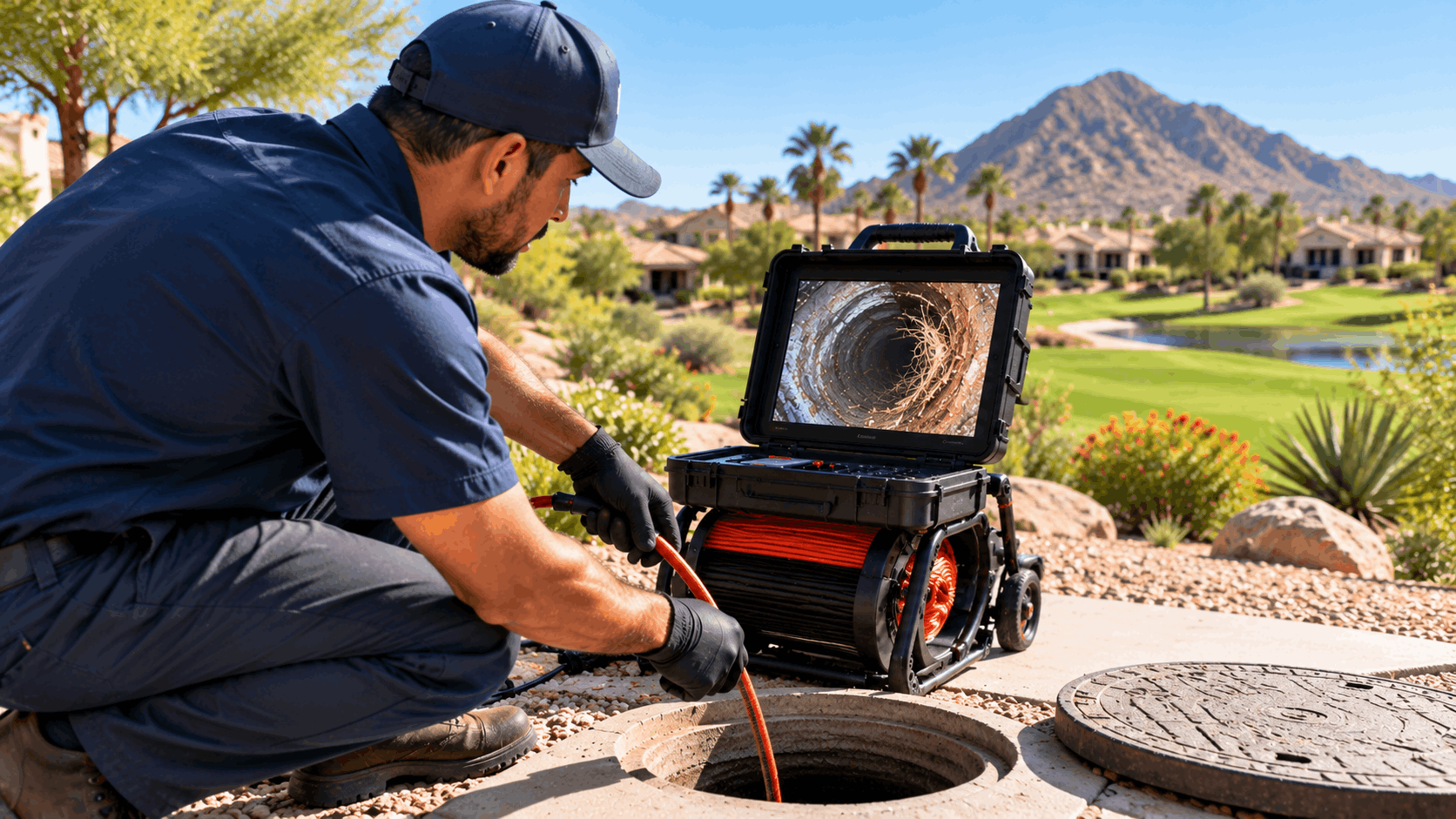
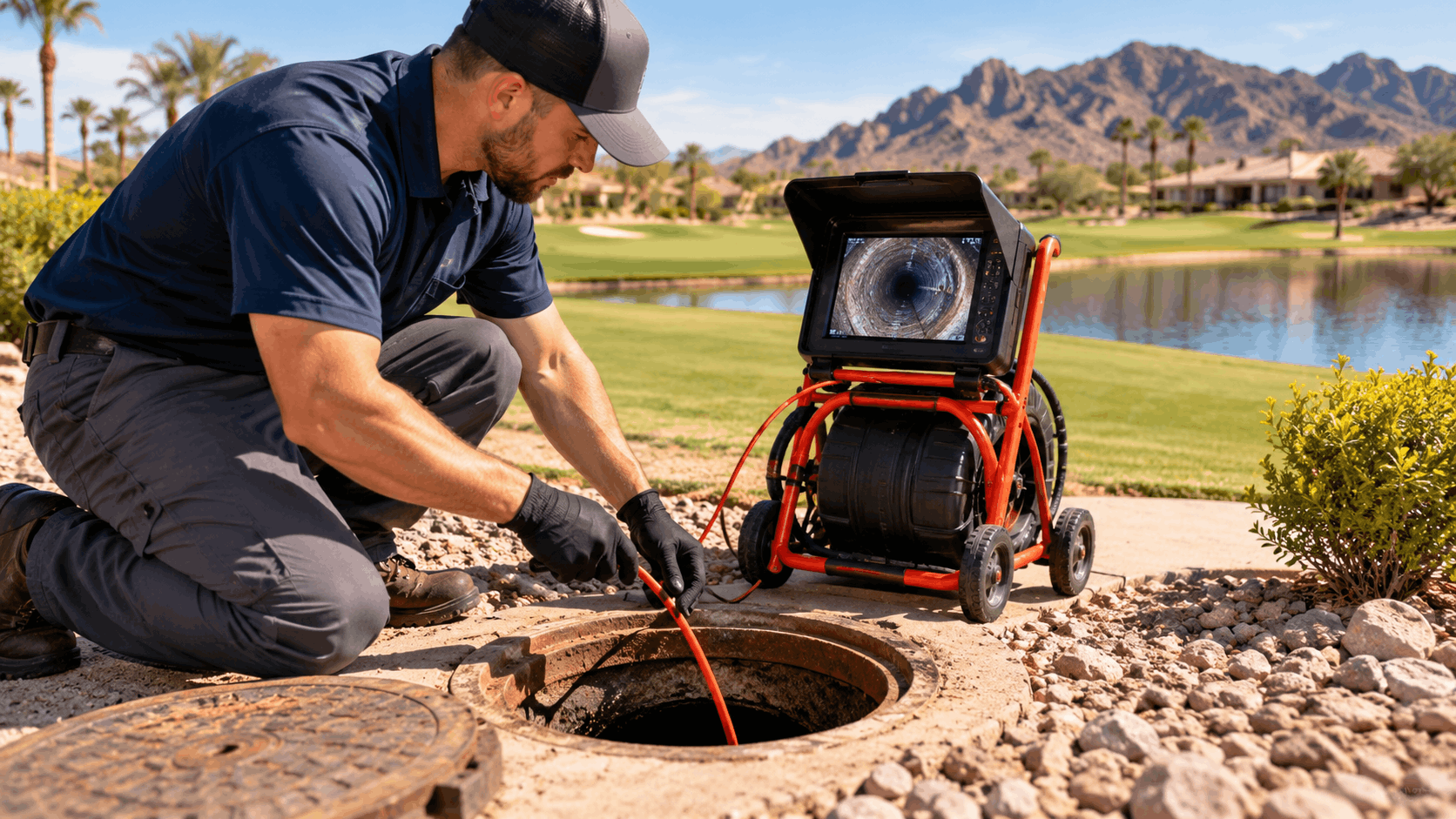
The inspection is simple in concept. A waterproof camera on a flexible cable travels down the drain, and a monitor shows the inside of the pipe in real time. The operator watches for exactly what is causing the backup, then locates it from above so the next step is precise rather than exploratory.
This is why diagnosis comes before any repair. A camera turns a hidden problem into something the homeowner can see and understand, and it makes sure any money spent on breaking a slab or trenching through caliche goes to the right spot.
Roots, Grease and Scale Versus a Collapsed Pipe
The first thing a camera settles is whether the blockage is soft or structural. A soft blockage, grease, paper, roots that have intruded through a joint, or scale buildup narrowing the passage, is something a cable or a jetter can clear. A structural failure, a cracked or collapsed pipe, is not something cleaning fixes.
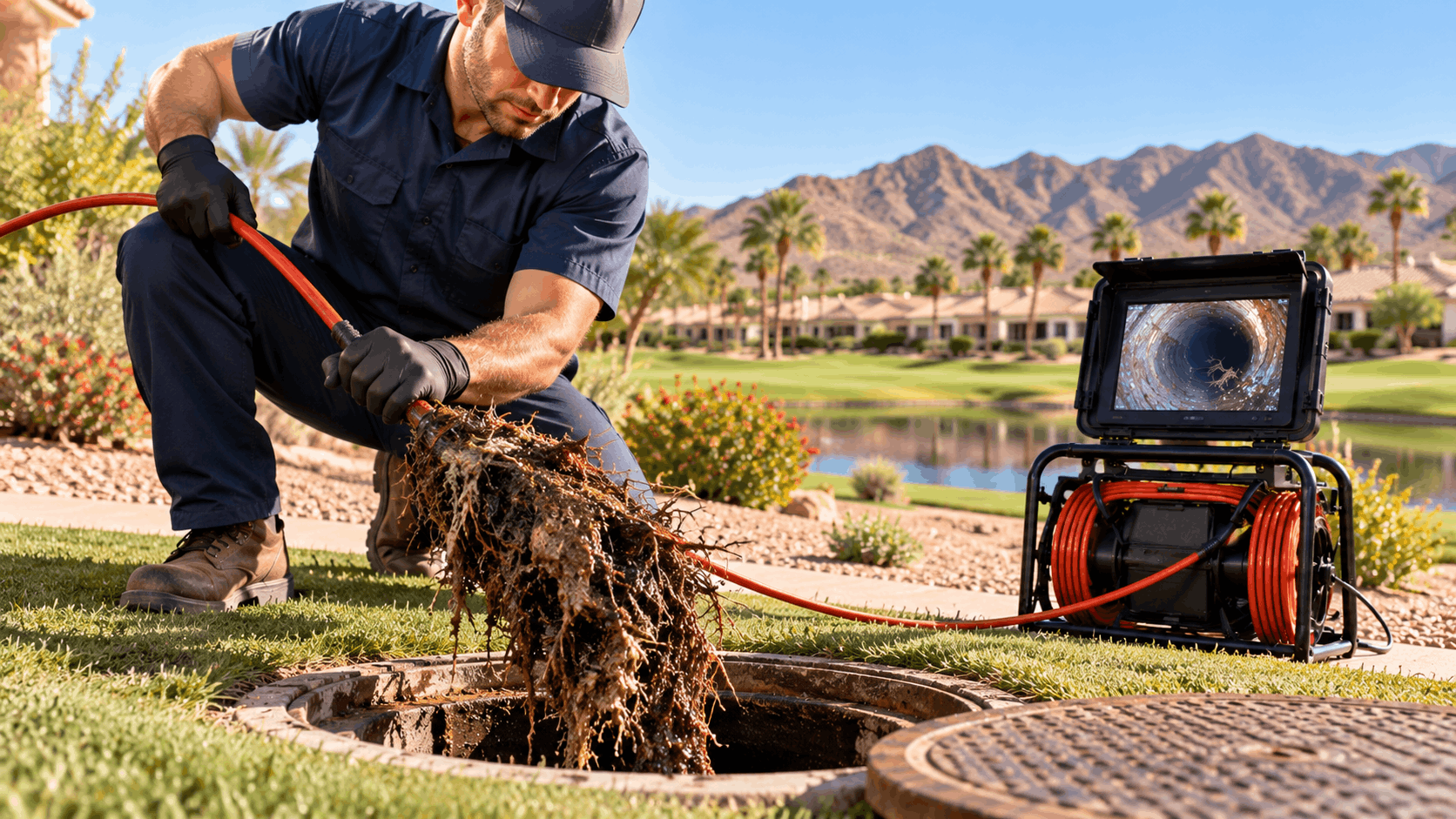
On screen, grease shows as a greasy coating or a soft dam the camera can sometimes push through. Roots appear as fine hair-like growth or a thick mat reaching in from a joint. Scale looks like a hardened, often white buildup lining the pipe wall. Each of these tells the team a cleaning method will likely restore flow.
A collapsed pipe looks completely different. The camera reaches a point where the pipe is crushed, broken, or simply ends in debris and soil, and it cannot pass. That is a hard stop that no amount of snaking or jetting will reopen, because the pipe itself has failed and must be repaired or replaced.
Making this distinction up front saves a homeowner from paying for repeated cleanings on a line that was never going to stay clear. The camera draws the line between a drain cleaning job and a sewer repair job, and that single answer shapes everything that follows.
Bellies, Offsets and Cracked Joints
Beyond blockages, the camera reveals the defects that cause clogs to keep coming back. A belly shows as standing water the camera travels into where the pipe should be running downhill, a clear sign the line has lost its grade and now dips into a low spot that collects waste.
An offset joint appears where one section of pipe has shifted out of alignment with the next, leaving a ledge or a gap where sections meet. That ledge catches solids and gives roots an entry point. A cracked pipe shows as a visible split or fracture in the wall, often with roots threading in or soil visible behind the break.
These are the findings that change the plan from cleaning to repair. A clean line with a soft blockage gets jetted and sent on its way. A line with a belly, an offset or a crack needs the defective section addressed, because cleaning only buys time before the same debris collects at the same flaw.
Seeing these problems on camera also lets the homeowner make an informed choice. Rather than being told a line is bad, the owner watches the actual defect on the monitor and understands why a repair is the honest recommendation instead of another temporary clearing.
Locating the Problem and How Deep It Is
Finding a defect on camera is only half the value. The other half is knowing exactly where it sits and how deep, so any excavation or slab work targets the right spot. The camera head carries a transmitter that can be located from the surface with a receiver.
The operator walks the receiver over the ground until it pinpoints the camera head, then marks the location and reads the depth. That tells the team precisely where the problem is before anyone breaks concrete or digs. In a slab home, this is the difference between opening one small, correct section of floor and guessing across a room.
Depth matters for cost and method too. A shallow defect in the yard is a different job than a deep line under the slab or one that runs well below grade through caliche. Knowing the depth up front lets the team plan the excavation and give the owner an accurate written price rather than a surprise once the digging starts.
Locating also informs whether a repair, a reroute or a replacement makes the most sense. A single defect in an accessible spot may be a spot repair. A deep problem under the slab in a line that is failing throughout may point toward rerouting around the slab instead of tunneling under it.
A Recording the Owner and the Association Can Keep
A camera inspection produces documented footage, and in a community like Stallion Mountain that record carries real weight. Where a property is attached, a leak or blockage may involve shared lines, an upstairs unit, or common area, and prompt documented diagnosis helps more than one party understand what is going on.
In stacked or attached product, a main line problem affects more than one home, so a video record showing exactly where the defect sits and whose section it falls in supports a clear conversation with neighbors and the association. It replaces finger-pointing with a shared picture of the actual pipe.
For an owner dealing with an insurance claim after a backup, documented footage of the cause is equally useful. It shows what happened and why, which supports the claim far better than a verbal description after the fact. The recording becomes part of the paper trail for the home.
Keeping the footage also helps the next service call. If a line is cleaned now and watched for recurrence, a future inspection can be compared against the first to see whether a defect has worsened. That history is valuable to an owner, a property manager or an HOA managing several units.
Who Owns the Pipe in a Gated, Association-Governed Community
Before any main line repair in Stallion Mountain, one question comes first: who owns the pipe. In a gated, association-governed community with attached product, the answer is not automatically the homeowner. Getting this right protects an owner from paying for work that was never theirs to pay for.
Attached homes and shared stacks change both who pays and who authorizes the work. A branch line serving a single unit is usually the owner's, while pipe inside a shared wall or a common stack may belong to the association. The governing documents decide, and they should be checked before the first repair dollar is spent.
This community mixes owner-occupiers with a meaningful rental and investor-owned share, so calls come from owners, tenants and property managers alike. Establishing who authorizes the work and who pays belongs in the first conversation, every time.
Unit, Common Element and Limited Common Element
Under Nevada Revised Statutes Chapter 116, the governing documents of a common-interest community define what counts as the unit, what is common element, and what is limited common element. Those three categories decide responsibility, and they are not the same from one community to the next.
In plain terms, the unit is generally what the owner controls and maintains. Common element is shared property the association maintains. Limited common element is shared property reserved for the use of one or a few units, and responsibility for it varies by the documents. Pipe can fall into any of these depending on where it runs.
For plumbing, this matters a great deal. Pipe inside a wall or a shared stack is frequently not the owner's to repair, while the branch and fixtures serving a single unit usually are. A main line blockage that sits in a shared stack may be the association's responsibility even though the symptom shows up inside one owner's home.
Because NRS 116 points to the governing documents rather than setting one rule for everyone, the only reliable answer is the one in that community's CC&Rs. An owner should not assume control of a line until the documents confirm it, because the ownership line drawn on paper decides who writes the check.
Why Attached Homes Need the CC&Rs Checked First
For attached homes, checking the CC&Rs before work begins is simple protection. An owner who assumes the pipe is theirs can pay for a repair that was the association's responsibility, and recovering that money afterward is far harder than confirming responsibility in advance.
The CC&Rs, or the management company that administers them, can confirm which side of the line a given section of pipe falls on. A quick check before scheduling turns a guess into a known answer, and it tells everyone involved who authorizes the work and who pays for it.
This is where a documented camera inspection pays off again. Footage that shows exactly where the defect sits helps the management company apply the governing documents to the real situation, rather than relying on a vague description of where the clog might be.
For an investor with several units in the community, this step is part of managing the portfolio. The same pipe and equipment questions recur across units, which suits a survey and a phased plan with responsibility sorted up front rather than repeated emergency repairs where ownership is argued after the fact.
When a Clog Affects Units Above and Below
In stacked product, a main line problem rarely stays inside one home. A shared stack carries waste from units above and below, so a blockage low in that stack can back up into more than one unit at once, affecting neighbors who did nothing to cause it.
That shared geometry makes prompt, documented diagnosis useful to several parties at the same time. A camera inspection that identifies the blockage in the shared stack tells every affected owner and the association what the problem is and where it sits, so the right responsible party can act quickly.
Speed matters more in stacked product because the damage spreads. A clog that overflows into a lower unit causes damage to a home other than the one where the problem started, and the longer it goes undiagnosed, the more units and more finishes are at risk.
When a backup affects units above or below, treat it as a shared-system event from the start. Involving the management company early, with documented diagnosis in hand, keeps the repair moving and keeps the question of responsibility grounded in evidence rather than assumption.

Clearing the Line: Snaking, Hydro-Jetting or Repair
Once the camera has shown the cause, the right fix follows the finding. A soft blockage, a scale-and-grease buildup, and a structural defect each call for a different approach, and matching the method to the problem is what keeps the line clear instead of clogging again next month.
There is a logical order here. Mechanical clearing handles soft blockages and roots. High-pressure jetting scours the walls clean of grease and scale. Structural defects, the bellies, breaks and collapses, move past cleaning into repair, reroute or replacement. The camera tells the team which category a given line falls in.
Understanding the options helps a homeowner follow the recommendation. When you know what each method does and does not solve, a repair quote reads as a plan rather than a pitch.
Cabling for a Soft or Root Blockage
A mechanical snake, or cable, is the right first step for a soft blockage or a root intrusion. The cable feeds down the line with a cutting head that chews through paper, soft masses and root growth, punching an opening and restoring flow. For a straightforward clog in an otherwise sound pipe, cabling is often all a line needs.
On roots, cabling cuts back the growth that has reached into the pipe, which clears the immediate blockage. What it does not do is remove the crack or joint that let the roots in. The roots grow back toward the water, so cabling a root intrusion buys months rather than a permanent fix unless the entry point is addressed.
In an older line, cabling also has limits against hardened scale and against structural defects. A cable restores flow through a soft blockage but cannot rebuild a sagging pipe or clean a mineral-coated wall the way high-pressure water can. Knowing those limits is why a camera comes first.
Used in the right situation, cabling is fast, effective and the least disruptive option. For a one-off backup caught early, it is frequently the whole job. For a recurring clog, it is a first step that the camera should follow to confirm nothing structural is driving the repeat.
Hydro-Jetting Scale and Grease From the Walls
Where a line is coated with grease and scale, high-pressure water does what a cable cannot. Hydro-jetting sends water through a specialized nozzle at high pressure, scouring the buildup off the pipe wall and flushing it out, which returns the line closer to its full original bore.
This matters especially in very hard water lines. With valley water at 280 ppm, scale accumulates inside older pipe over the years, narrowing the passage and giving debris a rough surface to grab. Jetting strips that buildup back to the wall rather than just boring a hole through the center the way a cable does.
Jetting also handles grease more thoroughly than cabling. A cable can punch through a grease dam, but grease re-coats the walls and rebuilds the blockage. High-pressure water cuts the grease off the pipe surface and carries it away, so the line stays clear longer before the next buildup begins.
Jetting is best used on a line the camera has confirmed is structurally sound. On a cracked or collapsed pipe, high-pressure water is not the answer, which is one more reason the inspection comes before the method is chosen. On a sound but scaled line, jetting is the cleaning that actually lasts.
When a Belly or Break Means Repair or Reroute
When the camera shows a belly, an offset, a crack or a collapse, cleaning is no longer the fix. A structural finding means repair, reroute or replacement, because the pipe itself has failed and no amount of clearing restores a sound line. Repeat cleaning on a broken pipe is money spent to delay the inevitable.
In these slab-on-grade homes, an under-slab failure is not accessible without breaking concrete. The conversation becomes detection followed by either opening the slab at the located defect or rerouting the line around the slab entirely. In a house with aging pipe throughout, a reroute or a planned replacement is often the more honest recommendation than patching one spot. Sewer line repair and replacement covers both paths.
Caliche shapes the cost of any outdoor work. Because it is a cemented hardpan, it makes exterior excavation slower and more expensive than digging in softer ground, and that belongs in any honest discussion of repair cost. A trench through caliche takes more time and equipment than the same trench elsewhere.
For a line that has reached the end of its service life everywhere at once, a targeted spot repair leaves an identically aged system all around it. In that case, a planned replacement or reroute addresses the whole line rather than chasing one failure after another. The camera and the locate together tell the team which approach fits the specific pipe.
Cleanouts and Easy Future Access
A cleanout is an access point built into the drain system that lets a plumber reach the main line quickly without going through a fixture or the roof vent. On an older main line, a properly placed cleanout turns future service from a hunt into a routine visit.
Many homes in this build era have limited or poorly placed cleanout access, which slows down every service call. Adding or relocating a cleanout gives the camera and the cable a direct path into the line, so a future backup gets diagnosed and cleared faster and with less disruption inside the home.
On a line that has shown it will need periodic attention, good access is part of keeping it maintainable. A cleanout installation is a routine part of managing an aging main line, and it pays for itself the first time a backup gets handled from the cleanout instead of pulling a toilet.
Where exterior work like a new cleanout box would be visible, remember that association architectural standards may apply to how it looks from outside. That is a scheduling consideration rather than a reason to skip the access, and it is covered further below.
Need Help in Las Vegas?
Active Plumbing serves Las Vegas and all of Las Vegas Valley.
What Camera Inspections and Main Line Work Cost in the Las Vegas Valley
Homeowners want to know what the work costs before they commit, and that is fair. The figures below are typical market ranges for plumbing work in the Las Vegas Valley. They are not a quote and not a fixed price from us. The actual price for a specific job depends on that job and is given in writing before work begins.
The ranges split naturally into diagnosis and clearing on one side and repair and replacement on the other. What moves the final number in a community like Stallion Mountain is depth, caliche excavation, slab access, and whether the fix is visible enough to need association review.
| Service | Typical Valley Range |
|---|---|
| Drain cleaning | $150 to $350 |
| Hydro-jetting (residential lines) | $300 to $600 |
| Cleanout installation | $250 to $600 |
| Sewer line repair | $1,500 to $5,000 |
| Full sewer line replacement | $4,000 to $12,000 |
| Sewage backup cleanup | $500 to $3,000 |
| After-hours emergency service fee | $150 to $300 plus repair costs |
Diagnosis and Clearing Ranges
For clearing a line, drain cleaning runs $150 to $350 in the valley. That covers cabling a soft blockage or a root intrusion back to clear flow, the right first step for a line the camera shows is structurally sound.
Hydro-jetting for residential lines runs $300 to $600. The higher cost reflects the specialized equipment and the deeper clean, scouring grease and scale off the pipe wall rather than boring through the center. On a scaled older line in hard-water country, that thorough clean is often the better value because it lasts longer between service calls.
Cleanout installation runs $250 to $600. Adding an access point is an investment in faster future service, especially on a main line that has already shown it needs periodic attention. The range reflects where the cleanout goes and how much excavation reaching the line requires.
These figures are typical ranges for the area, not a fixed price. The specific number for a given home comes in writing after the line is seen and the work is scoped.
Repair and Replacement Ranges
When the camera finds a structural defect, the work moves into repair territory. Sewer line repair runs $1,500 to $5,000 in the valley, covering a targeted fix at a located defect such as a cracked section or an offset joint. Full sewer line replacement runs $4,000 to $12,000 for a line that has failed along its length.
Where a backup has already caused damage, sewage backup cleanup runs $500 to $3,000. In a slab home there is no basement to contain an overflow, so cleanup can be a real line item when a main line clog reaches the floor before it is cleared.
After-hours emergency calls carry a service fee of $150 to $300 plus repair costs. A main line backup that floods the lowest drain on a weekend is a genuine emergency, and our emergency plumbing team handles those calls across the valley.
Every one of these is a typical range, copied as published. The written price for a specific job reflects that job, its depth, its access and its soil conditions, and it is given before any work starts.
What Makes the Price Move in This Community
Several factors push a main line job toward one end of its range in Stallion Mountain. Depth is the first. A shallow defect in the yard is a simpler dig than a deep line under the slab, and the camera locate tells the team the depth before any price is set.
Caliche excavation is the second. Because caliche is a cemented hardpan, trenching through it is slower and more expensive than digging in softer ground, and any exterior repair that crosses it costs more time and equipment than the same work elsewhere in the country.
Slab access is the third. An under-slab failure that cannot be reached without breaking concrete, or that argues for a reroute around the slab, is a bigger job than an accessible exterior repair. The decision between opening the slab and rerouting shapes both the cost and the timeline.
The fourth is association review. If the fix shows on the outside of the home, architectural standards may require approval, which affects timing more than price. All of these factors are confirmed in a written price before work begins, so the owner sees the number for their specific job rather than a range.
Permits, Access and HOA Approval in Stallion Mountain
A main line job in a gated Clark County golf community carries a few practical hurdles that affect timing. Three stand out: which authority issues the permit, how a contractor gets through the gate, and whether the fix is visible enough to need association review. Sorting these out early keeps the job on schedule.
None of these are obstacles so much as steps that have to happen in the right order. Permit and association approval run on separate tracks, and gate access is arranged ahead of the appointment rather than at the booth. Knowing that up front prevents a wasted visit.
Clark County Handles Permits for This Address
Stallion Mountain sits in unincorporated Clark County, not the City of Las Vegas and not Henderson, even though residents describe the area as Las Vegas. That means permits, plan check and inspections run through the Clark County Department of Building and Fire Prevention rather than a city building department.
This distinction matters because the valley is not one permitting authority. An address in a city is governed by that city's building department, while an unincorporated address like this one is a county matter. Naming the right authority is the first step on any permitted work, and it is confirmed for the specific address rather than assumed.
Clark County adopted the 2024 Uniform Plumbing Code with Southern Nevada Amendments, effective for the county in January 2026. A main line repair or replacement that requires a permit falls under that code and the county's process, and the permit position should be confirmed for the exact property before work is scheduled. You can read more about serving this area on our Sunrise Manor location page.
Work requiring a permit must be performed by an appropriately licensed contractor, and a homeowner is entitled to verify a contractor's license. Knowing the correct department for the address up front keeps the permitted side of the job moving without a false start at the wrong counter.
Getting Through the Gate on the Day
Stallion Mountain is gated, which changes how a service call is scheduled. Contractor access is authorized in advance through the homeowner or the management company, not arranged at the gate on the day of the appointment. A truck that shows up unannounced at the gate can be turned away.
Confirming how access works when the appointment is booked is the difference between a job that runs to time and a wasted slot. For an owner-occupant, that may mean leaving a name at the gate or providing a code. For a tenant-occupied or investor-owned unit, it may mean coordinating through the property manager.
Because this community has a meaningful rental and investor-owned share, the person who authorizes access is not always the person in the home. Sorting out who provides gate access, along with who authorizes and pays for the work, belongs in the first call so the appointment is set up to succeed.
For a property manager handling several units here, establishing a standing access process makes every future call smoother. That planning turns gate access from a recurring hassle into a routine step handled before the technician leaves the shop.
When the Fix Shows on the Outside of the Home
Where an association governs, architectural standards cover the exterior appearance of the home. A main line fix that shows on the outside, a visible reroute, an exterior cleanout box, or any equipment mounted outside, may require association review before it goes in, while interior work does not.
Association approval and a county permit are separate tracks. One does not stand in for the other. An exterior repair may need both the county's permit for the plumbing work and the association's sign-off on how it looks, and those two processes run on their own timelines.
This is where a reroute versus an under-slab repair can intersect with the association. A reroute that runs new pipe along an exterior path may trigger architectural review that an under-slab repair would not, which factors into both the plan and the schedule.
Because association rules and review timelines change, an owner should confirm current requirements with the association or management company, and the permit position with Clark County, for the specific property. Starting both tracks early keeps a visible exterior fix from stalling while one approval waits on another.
Need Help in Las Vegas?
Active Plumbing serves Las Vegas and all of Las Vegas Valley.
How Active Plumbing Diagnoses a Main Line in Stallion Mountain
When a main line call comes in from Stallion Mountain, the approach is the same every time: see the problem before deciding on a fix. That means a camera first, a clear plan built on what it finds, and a written price before any work starts. Here is how a call actually runs.
The community's mix of owner-occupiers, tenants and property managers means the first conversation sorts out who authorizes the work, who pays, and how gate access is arranged. With those settled, the diagnosis drives everything that follows.
Camera First, Then a Clear Plan
The line is inspected with a camera so the owner sees the cause before any decision is made. In a slab-on-grade home where the main line is buried under the floor, that video feed is the only honest way to know whether the problem is a soft blockage or a structural defect.
Watching the inspection, the owner sees for themselves whether it is roots, grease, scale, a belly or a break. That separates a cleaning job from a repair job on the spot, so the recommendation reads as what the camera showed rather than a guess.
The camera head is located from the surface so the team knows exactly where and how deep any defect sits. That precision keeps a slab from being opened in the wrong place and keeps a trench through caliche as short and targeted as possible.
With the cause named and located, the plan writes itself. A sound line gets the right cleaning method. A defective line gets a repair, a reroute or a replacement scoped to the exact problem, with the footage kept for the owner, a property manager or the association. Our sewer camera inspection service is built around that camera-first approach.
A Written Price Before Work Starts
Before work begins, the customer gets a written price. That is a business practice, not a figure pulled from a range. Once the line has been seen on camera and the job is scoped, the owner knows the number for their specific job in writing before anyone starts cutting, cabling or digging.
This matters most on a main line job because the cost swings with depth, caliche, slab access and whether exterior work needs association review. A written price built on the camera findings reflects those specifics rather than a guess made from the curb.
For a tenant-occupied or investor-owned unit, a written price also gives the property manager or owner a document to work from when responsibility is shared with an association. It turns the cost into something that can be reviewed and approved rather than a verbal estimate.
The written price covers the job as scoped. If the camera and locate reveal something unexpected once work is underway, the honest path is to show the owner what changed before proceeding, keeping the number tied to the actual work.
Licensed, Local and Quick to Respond
Active Plumbing holds Nevada license NSCB #0047021, verifiable free at nvcontractorsboard.com, where classification, status, bond and workers compensation are all public record. The company has been licensed and working the valley since 1991, a fourth-generation family plumbing business, with some owners who are US military veterans.
Technicians arrive in 30 to 60 minutes anywhere in the Las Vegas Valley, which matters when a main line backup is flooding the lowest drain in a slab home with no basement to buy time. A fast arrival limits the damage a backup can do before the line is cleared.
The company works across the east valley and the whole valley, from Sunrise Manor and the gated communities around the Stallion Mountain Golf Club to Henderson and Las Vegas. For the main line specifically, the drain and sewer services page lays out the full range of clearing and repair options.
Verifying a license is a simple protection in a market with a significant unlicensed trade problem. A homeowner can check the number before any truck arrives, which is exactly the kind of confirmation an owner in a gated community deserves before letting a contractor through the gate.
Get Your Main Line Diagnosed Before You Break Ground
If drains across your Stallion Mountain home are slow, or a backup has returned after a clearing, the next step is a camera in the line, not another guess. Call Active Plumbing at (702) 438-3357 and we will inspect the main line, show you the cause, and give you a written price before any work begins.
When you book, let us know how gate access is handled through you or your management company so a technician can reach the home without delay. Our team arrives in 30 to 60 minutes anywhere in the valley, license NSCB #0047021, verifiable free at nvcontractorsboard.com.
Frequently Asked Questions
- How do I know if my main sewer line is clogged?
- Watch for multiple fixtures backing up at once rather than a single slow drain. A toilet that gurgles when the washing machine drains, several sluggish drains at the same time, and the lowest fixture or floor drain flooding first all point to the main line. A single slow sink is usually a branch clog. When running water in one room reacts in another, the problem is the shared main line, and it is time to stop using water and call.
- What does a sewer camera inspection show?
- A camera travels the buried line and shows the inside on a monitor in real time. It reveals roots growing in through joints, grease coating the walls, hardened scale narrowing the passage, bellies where the pipe sags, offset joints, cracked pipe and full collapses. Most important, it tells the difference between a soft blockage a cable or jetter can clear and a structural problem that needs repair, so money goes toward the right fix instead of repeated cleanings.
- Why does my main line keep clogging after it was cleared?
- A clog that returns within weeks usually means a structural defect, not grease or paper. A belly where the pipe has sagged collects waste and refills after every snaking. Roots that intruded through a crack grow back toward the water. An offset joint keeps catching solids. A cable punches a hole and restores flow briefly, but the defect stays. That is exactly why a camera inspection matters after a repeat backup, so the real cause gets named and fixed.
- Does being on the golf course make root problems worse?
- Homes fronting the Stallion Mountain Golf Club sit beside heavily irrigated common land and often carry private irrigation too. That steady moisture keeps the soil around a buried line damp, and roots follow water. They do not break into sound pipe, but they find any existing crack or loose joint and grow inside toward the waste stream. Once in, a root mass catches debris and rebuilds a blockage after each clearing, so golf-front lots do see more root intrusion.
- Who pays for a main line repair in an attached Stallion Mountain home?
- It depends on where the pipe runs. Under Nevada Revised Statutes Chapter 116, the CC&Rs define what is the unit, what is common element and what is limited common element. Pipe inside a shared wall or a common stack may be the association's responsibility, while the branch serving a single unit usually is the owner's. Do not assume the pipe is yours. Confirm with the governing documents or the management company before work begins so you do not pay for the association's responsibility.
- How much does a sewer line repair cost in Las Vegas?
- Typical valley ranges are sewer line repair $1,500 to $5,000 and full sewer line replacement $4,000 to $12,000. Clearing a line runs less: drain cleaning $150 to $350 and hydro-jetting $300 to $600 for residential lines. These are typical market ranges for the area, not a quote. The actual number depends on depth, caliche excavation, slab access and the specific defect, and it is given in writing before any work starts.
- Do I need a permit to repair my sewer line?
- Permitted work does require a permit, and for Stallion Mountain that runs through the Clark County Department of Building and Fire Prevention, because the community sits in unincorporated Clark County rather than the City of Las Vegas or Henderson. The specific permit position should be confirmed for your exact address. Permitted work must be done by an appropriately licensed contractor, and if the fix shows on the outside, association architectural review may apply on a separate track from the county permit.
- Can a clog be under my slab, and what happens then?
- Yes. Homes in Stallion Mountain are slab-on-grade, so the main line runs under the floor. An under-slab failure is not accessible without breaking concrete or rerouting the line around the slab. A camera locates the defect and its depth first, so any slab work targets the right spot. Caliche, the cemented hardpan common across the valley, makes any outdoor excavation slower and more expensive, which factors into both the plan and the written price.
- How does hard water affect my sewer and drain lines?
- The Southern Nevada Water Authority reports valley water at 280 ppm, about 16 grains per gallon, categorized very hard. That hardness leaves calcium and magnesium scale wherever water moves and sits. In older drain lines, scale builds on the walls and narrows the passage, and the rough surface gives paper, grease and debris something to catch on. Combined with roots or a belly in an aging line, scale compounds the clogging, which is why jetting the walls clean often lasts longer than cabling alone.
- How fast can a plumber get to Stallion Mountain?
- Active Plumbing technicians arrive in 30 to 60 minutes anywhere in the Las Vegas Valley, including the gated communities around the Stallion Mountain Golf Club. Because the community is gated, arrange gate access with the homeowner or management company when you book, since contractor access is authorized in advance rather than at the gate. Sorting out access, along with who authorizes and pays for the work, in that first call keeps the appointment on schedule.
Licensed plumbing professionals serving Las Vegas and Las Vegas Valley.
Licensed in Nevada · License #0047021
Last updated on
Why trust Active Plumbing?
Founded in 1991, Active Plumbing is a licensed and insured plumber serving Las Vegas and Las Vegas Valley. All content is reviewed by our licensed technicians.

Need Help in Las Vegas?
Active Plumbing serves Las Vegas and all of Las Vegas Valley.
Related Articles
How Caliche Soil Shapes Every Underground Pipe Decision in the Las Vegas Valley
Caliche soil shapes every buried pipe decision in the Las Vegas Valley. Learn how this hardpan affects trenching, pipe materials, sewer and water lines, and cost.
Sewer Line Clog Vegas: When You Need Same-Day vs Scheduled Service
Learn when a Las Vegas sewer line clog needs same-day emergency service versus a scheduled visit, plus local causes, costs, and prevention tips from Active Plumbing.
Sewer Line Repair in Paradise and Winchester: 60s-70s Clay Pipe Root Intrusion Capital of the Valley
Paradise and Winchester's 60s-70s clay pipes are root intrusion magnets. Learn the warning signs, camera inspection, repair options, and costs from Active Plumbing.