Water Heater Replacement in a Green Valley Home Off Sunset Road
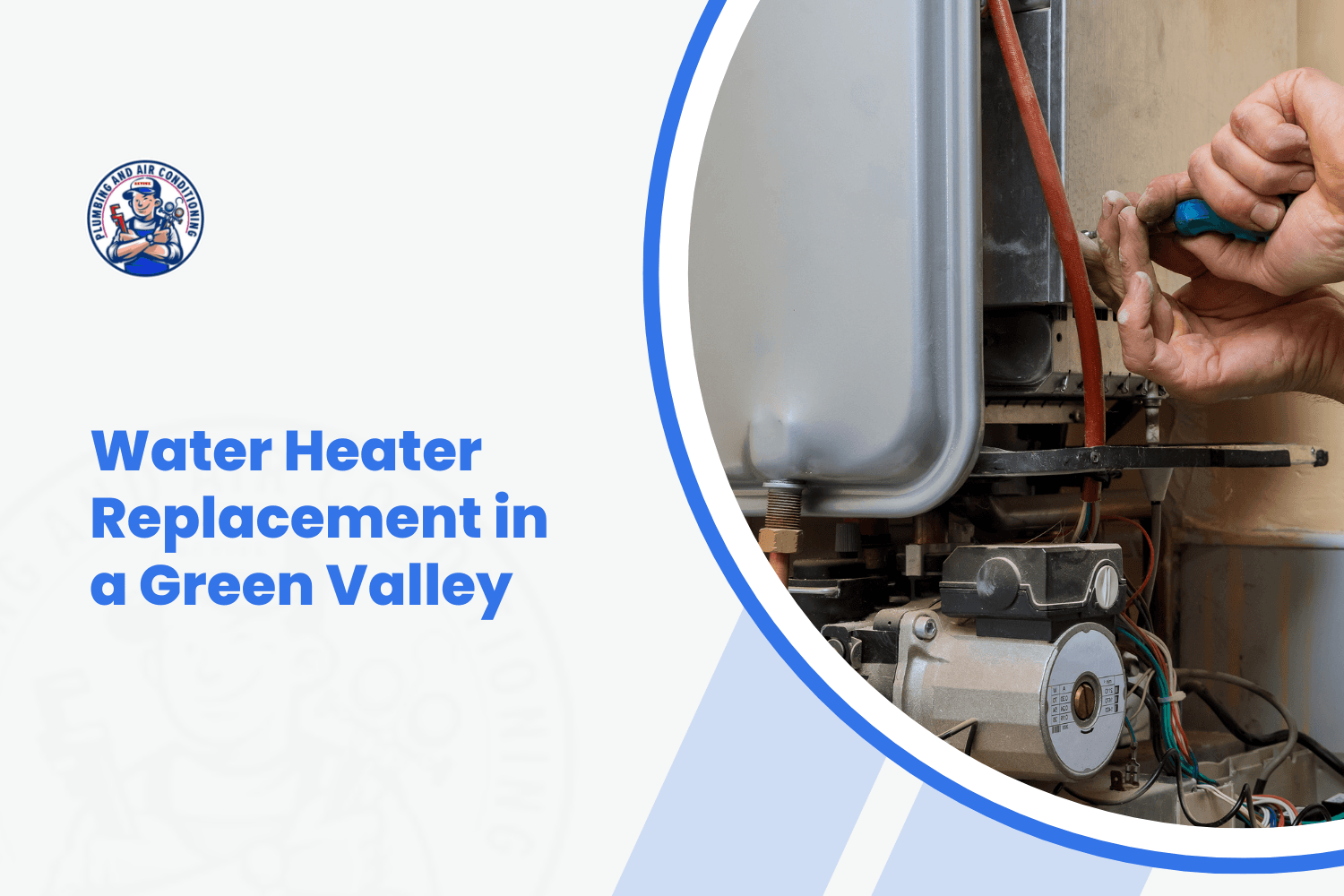
Key Takeaways
- Green Valley sits inside the City of Henderson, so permits and inspections run through the Henderson Development Services Center, not Clark County or Las Vegas.
- The valley's very hard water at 280 ppm, about 16 grains per gallon, builds scale on elements and tank bottoms so an unflushed tank fails earlier than its rated life.
- Typical ranges are tank installation $800 to $1,500 and tankless $1,500 to $3,500, with a pre-filter adding $150 to $300 where hard water calls for one.
- Henderson adopted the 2024 Uniform Plumbing Code with Southern Nevada Amendments effective January 2, 2026, which sets drain pan and relief valve drain rules at replacement.
- Tankless units have a narrow heat exchanger where hard water accelerates failure, so a pre-filter or softening plus descaling at $150 to $250 keeps them healthy.
- The federal Section 25C heat pump water heater credit ended after December 31, 2025 and is not available for 2026 installs.
- In mature Green Valley homes the expansion tank, pressure regulator and original angle stops often fail around the same age as the heater and should be checked at replacement.
- Active Plumbing holds Nevada license NSCB #0047021, has been licensed since 1991, gives a written price before work, and arrives within 30 to 60 minutes valley-wide.
In This Article
It usually starts with a cold shower. A Green Valley homeowner off Sunset Road turns the tap expecting hot water and gets nothing but a chill, or walks into the garage and finds a quiet puddle spreading out from the base of the tank. Either way, the water heater has reached the end, and the question becomes what to put in its place and what the job involves.
Green Valley is Henderson's original master-planned community, built from 1978 onward, so the homes here are mature and so are a lot of the heaters tucked into their garages and closets. The valley's very hard water is working against every one of those tanks, and that shapes both how long they last and what a smart replacement should include.
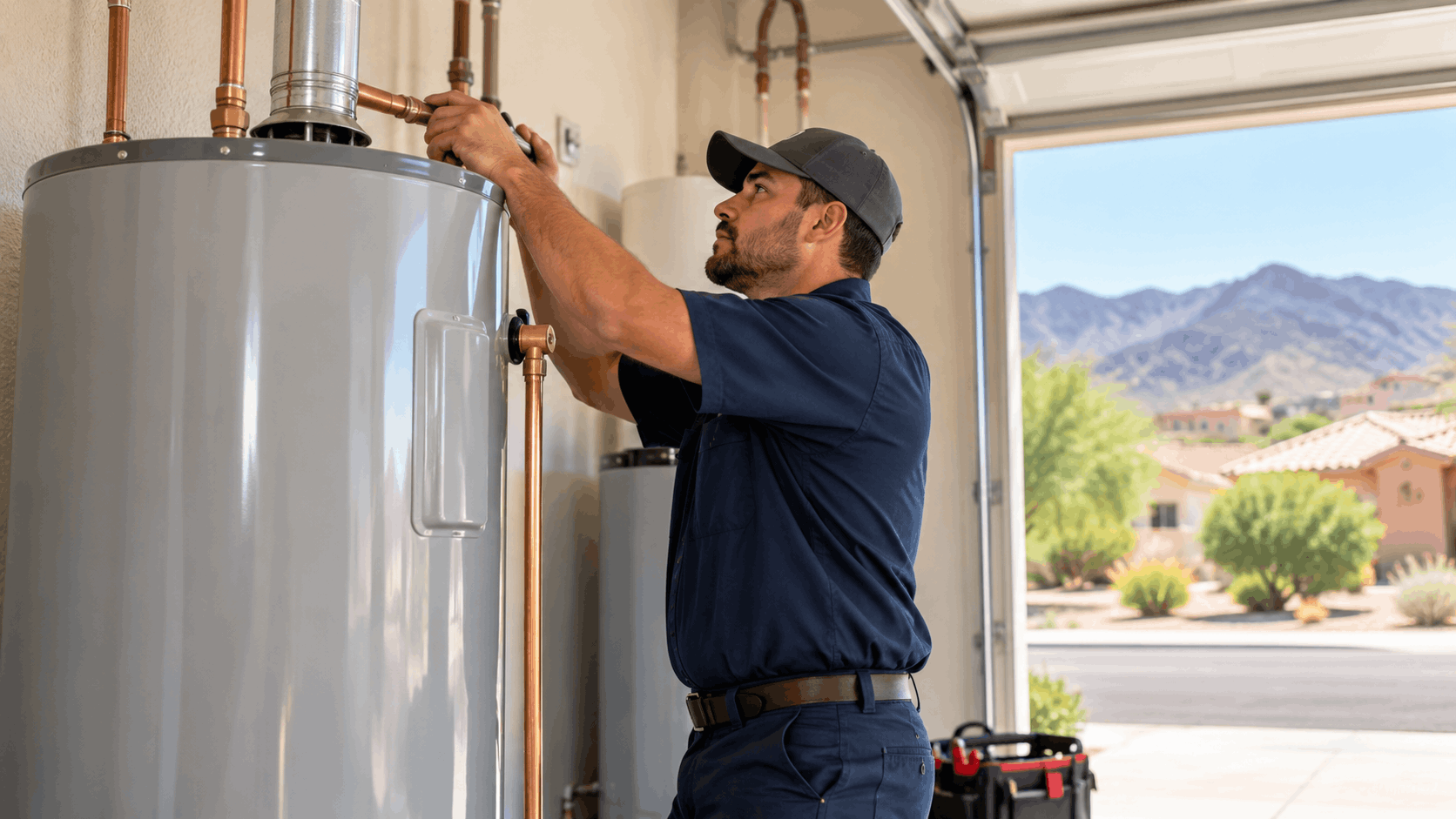
Why Green Valley Water Heaters Wear Out Off Sunset Road?
Water heaters fail for two reasons in this neighborhood, and both come down to time and water chemistry. The community has aged into its forties, and the water running through every tank carries a heavy mineral load that never lets up. Put those together and you get a predictable pattern of failures across the streets off Sunset Road.
A replacement does more than restore hot water. Done right, it brings an aging install up to the current Southern Nevada Amendments, swaps out tired supporting parts, and gives the homeowner a chance to set the new unit up to handle the hard water scale that killed the old one. Understanding the water heater lifespan in Green Valley Henderson helps a homeowner plan instead of react to a flooded garage.
Hard Water Scale on Elements and Tank Bottoms
The Southern Nevada Water Authority reports the valley's water hardness at 280 parts per million, or about 16 grains per gallon, which is categorized as very hard. That is not a vague figure or a range, it is the published number for the water coming into every Green Valley home. Most of that water starts as Colorado River water from Lake Mead, treated and sent out to the distribution system.
Very hard water means dissolved calcium and magnesium are riding along in every gallon. When that water heats inside a tank, those minerals drop out of solution and settle as scale buildup on the bottom of the tank and across the heating elements. The layer grows a little thicker every year that the tank goes without a flush.
That scale acts like an insulating blanket between the burner or element and the water it is trying to heat. The unit has to run longer and hotter to get the same result, so an unflushed tank in very hard water works harder and fails earlier than its rated life. Regular flushing is the single best habit a Green Valley owner can keep to push a tank toward the full life it was built for.
The Age of Green Valley Heaters Near Sunset Road
Green Valley started in 1978 as the first master-planned community in the valley, spread across roughly 7,100 acres of Henderson. The earliest phases are now well past forty years old, and even the middle phases have seen several decades of daily hot water. That build span matters because a water heater rarely lasts the life of the house.
Along Green Valley Parkway, Valle Verde Drive, Pecos Road and the streets branching off Sunset Road, a lot of homes are on their first or second heater. Some owners who bought recently may not even know how old the tank is, and in this mature community that original or first-replacement unit is often sitting well past its rated life already.
A heater that old is living on borrowed time, especially with the mineral load it has been fighting since day one. The practical takeaway is simple: if a Green Valley homeowner does not know the age of their tank and it looks original, it is worth a look before it decides the timing for them. Catching an original water heater before it leaks beats cleaning up after it lets go.
Warning Signs a Replacement Is Coming
Homeowners describe the signs in plain terms. Rust-colored water from the hot tap often means corrosion inside the tank. Popping, rumbling or crackling from the unit is sediment noise, the sound of scale shifting on the tank bottom as the burner fires underneath it. Those two together usually mean the tank has aged internally.
No hot water at all can point to a failed element, a bad thermostat or a pilot and gas control problem, and some of those are a repair rather than a full replacement. A rusty hot water complaint that comes and goes can sometimes be chased down, but when rust is steady it usually means the tank itself is going.
The one sign that ends the debate is water pooling at the base of the tank. A leaking tank is not something to patch, because the steel shell has given way and it only gets worse. Add the age test to all of this: a unit past its rated life with any of these symptoms is a replacement candidate, while a younger unit with a single fixable fault may be worth repairing. Our water heater services team sorts repair from replacement on site.
Supporting Equipment That Fails With It
A water heater does not live alone. In a mature Green Valley home, the parts around the tank have aged right alongside it, and replacement time is the right moment to check them. Skipping that check often means a second service call within months when a tired part gives out.
The expansion tank is a common culprit. It absorbs the pressure spike when water heats and expands, and when the bladder inside fails it does so silently. The first clue is often a relief valve that starts to drip, which owners mistake for a faulty valve when the real issue is a dead expansion tank.
The pressure regulator on the main line can creep high over the years, pushing the whole system above safe pressure and stressing the new heater from the day it goes in. High incoming pressure is worth checking on any older home here. Finally, the original angle stops and flexible connectors feeding the heater are often decades old and well past sensible life, and a new tank deserves fresh shutoffs and supply lines rather than brittle originals.
Get Your Quote
Tell us what's going on and we'll get back to you. We're open 24/7.
Permits and the City of Henderson for a Green Valley Replacement
The first thing to get right on any Green Valley job is jurisdiction. Green Valley sits inside the City of Henderson, not Clark County and not the City of Las Vegas. That means the City of Henderson permit and inspection path runs through the City of Henderson Development Services Center, and a contractor who assumes county rules for this Green Valley jurisdiction is at the wrong counter.
The permit position for a water heater replacement should be confirmed for the exact address, because the right path depends on the city that governs it. The table below lays out who handles what for a Green Valley replacement.
| Item | Who handles it in Green Valley |
|---|---|
| Permit and plan check | City of Henderson Development Services Center |
| Inspection | City of Henderson |
| Plumbing code | Uniform Plumbing Code with Southern Nevada Amendments, as adopted by Henderson |
| Contractor licensing | Nevada State Contractors Board |
| HOA approval (exterior work) | The property's association, under NRS Chapter 116 |
Why Jurisdiction Is the First Thing to Get Right
An address off Sunset Road in Green Valley is a Henderson address. Residents sometimes describe the whole valley as Las Vegas, but for permits and inspections the city line is what counts. Getting this wrong at the start slows a job and puts paperwork in front of the wrong office.
Because this is a Henderson address, permits, plan check and inspections all run through the City of Henderson Development Services Center. That is a different counter from the Clark County office that handles unincorporated areas like Spring Valley or Enterprise. The distinction is not a formality, it changes which forms, fees and inspectors apply.
Establishing the correct jurisdiction before quoting permitted work is a routine first step, and for a home near Sunset Road that means confirming Henderson up front. Our team that handles plumbing in Henderson works these streets regularly and confirms the permit path for the specific address before anything else.
The Code That Applies in Henderson
Henderson adopts the Uniform Plumbing Code published by IAPMO together with the Southern Nevada Amendments. Nevada has no statewide plumbing code, so the rules that apply are whatever the local jurisdiction has adopted and codified. The amendments themselves state plainly that they are not code unless adopted by the individual jurisdiction.
In the most recent cycle, Southern Nevada's jurisdictions adopted the 2024 UPC with Southern Nevada Amendments, replacing the 2018 editions. For Henderson the new code took effect on January 2, 2026. That means a replacement done today in Green Valley follows the 2024 code as Henderson has adopted it.
The amendments also allow alternate materials or methods not specifically prescribed, provided the Building Official approves them. For a homeowner, the practical point is that the rule applying to their job is the Henderson version of the code, and the Building Official is the authority on anything outside the standard path. A licensed contractor who works Henderson jobs already knows these amendment details.
Drain Pan and Relief Valve Rules at Replacement
Two amendment points come up on almost every replacement. First, a water heater drain pan is required where a leak would cause damage, such as a heater in an attic or over a floor-ceiling assembly. The pan must be at least 1-1/2 inches deep with a drain of not less than 3/4 inch running to a visible, approved location, and the relief valve may not discharge into the pan.
Second, the relief valve drain from the temperature and pressure valve has approved materials. When it runs inside a building it can be galvanized steel, hard-drawn copper, CPVC, PP, a listed flexible corrugated connector, or a listed drain tube to the exterior. An air gap to a floor sink, mop sink or funneled floor drain is also allowed.
These rules matter at replacement because an older install may not meet the current standard. The T&P valve discharge and the pan are exactly the kind of items that get brought up to code when a new unit goes in. Confirming the right configuration for the specific placement is part of a proper replacement rather than an afterthought.
HOA Approval in Association-Governed Tracts
Many Green Valley tracts are governed by associations operating under NRS Chapter 116. Those associations set architectural standards that cover the exterior appearance of a home, and that is where a water heater replacement can intersect with the HOA.
For a standard interior tank swap in a garage or closet, HOA approval is generally not needed because nothing visible from outside changes. The unit goes in where the old one was, and the exterior of the home looks the same as it did the day before.
The picture changes with exterior equipment. A wall-mounted tankless unit on an outside wall, or a visible water treatment system, can trigger an architectural review in an association-governed tract. An owner planning that kind of install should confirm the requirement with their association before scheduling the work, since review can add time to the project.
Need Help in Las Vegas?
Active Plumbing serves Las Vegas and all of Las Vegas Valley.
What Water Heater Replacement Costs in This Part of Henderson
Cost is the question every homeowner asks first, so here are the typical Las Vegas Valley ranges up front. These are typical ranges for the area, not a quote, and the actual price for a specific job is given in writing before work begins. Several factors specific to a Green Valley home can move a water heater replacement cost up or down.
Understanding the tank installation price and what drives Henderson plumbing cost helps a homeowner budget honestly. The table collects the relevant ranges in one place.
| Work | Typical range |
|---|---|
| Tank water heater installation | $800 to $1,500 |
| Tankless water heater installation | $1,500 to $3,500 |
| Pre-filter where hard water calls for one | adds $150 to $300 |
| Water heater repair | $150 to $500 |
| Tankless maintenance and descaling | $150 to $250 |
| Recirculation pump installation | $400 to $900 |
| Water softener installation | $800 to $2,500 |
| After-hours emergency service fee | $150 to $300 plus repair costs |
Typical Price Ranges for Tank and Tankless
For a standard tank replacement in a Green Valley home, tank water heater installation typically runs $800 to $1,500. That covers the straightforward swap most homes here need, where the new unit goes in the same spot as the old one.
A tankless install is a bigger project, with tankless water heater installation typically running $1,500 to $3,500. Where the valley's hard water calls for one, a pre-filter cost adds $150 to $300 to help protect the unit. That pre-filter is often worth it here, as the next section explains.
Not every hot water problem is a replacement. Water heater repair typically runs $150 to $500, and when a younger unit has a single fixable fault, a repair is the right call. The on-site check decides which path fits, and a written price follows before any work starts.
What Pushes the Price Up or Down
Several cost factors explain why two Green Valley homes can get different quotes. Tank size is the first: a larger family home needs a larger unit than a two-bedroom. Fuel type matters too, since a gas heater and an electric heater have different connection requirements.
Bringing an older install up to the current Southern Nevada Amendments is a real driver. If the existing setup lacks a required drain pan, or the relief valve drain needs updated materials, that code upgrade work is part of doing the job properly and it affects the total.
Supporting parts add to it as well. An expansion tank replacement where the old one has failed, a new pressure regulator where pressure has crept high, or fresh angle stops and connectors all show up in the price. Code-required venting adjustments on a gas unit can also move the number. None of these are upsells, they are the parts that keep a new heater running safely.
After-Hours and Emergency Replacement
When a tank lets go on a weekend or in the middle of the night, an after-hours fee applies: a service fee of $150 to $300 plus repair costs. That covers the response outside normal business hours, and it is worth understanding when it makes sense to pay it.
If the tank is actively leaking and flooding a garage or closet, that is a case for emergency replacement or at least an emergency shutoff and water control. Letting water run for a day because it is a Sunday can cause far more damage than the after-hours fee. Our emergency plumbing team handles those calls.
If there is no active leak and the issue is simply no hot water, many homeowners can shut the water and gas off to the unit and wait for business hours to avoid the weekend service premium. The deciding factor is whether water is escaping. Active leaking means call now, a cold tank with no leak usually can wait until morning.
Rebates and the Expired Federal Credit
The federal Energy Efficient Home Improvement Credit, Section 25C credit, offered 30 percent up to $2,000 a year for heat pump water heaters. It applied only to equipment placed in service by December 31, 2025. The One Big Beautiful Bill Act ended it, so it is not available for 2026 installs and should not be counted on.
That means a homeowner shopping for a heat pump water heater rebate at the federal level in 2026 will not find the old credit. Planning a budget around it would lead to disappointment, so it is better left out of the math entirely for new installs this year.
A utility rebate from a provider or a manufacturer rebate may still exist and these programs change often. Anyone hoping to offset part of the cost should check the current program directly before buying, since the terms and amounts are updated. You can verify federal credit details through the IRS.
Tank vs Tankless for a Green Valley Home
The tank vs tankless decision comes down to up-front cost, how the home uses hot water, and crucially, the valley's very hard water. That hardness changes the maintenance picture for both types but hits a tankless water heater hardest, so hard water maintenance belongs at the center of the choice.
Here is how the two compare for a typical Green Valley home.
| Factor | Standard tank | Tankless |
|---|---|---|
| Up-front cost | $800 to $1,500 | $1,500 to $3,500 |
| Hard water maintenance | Regular flushing | Descaling plus pre-filter or softening |
| Descaling cost | Included in flush | $150 to $250 |
| Hot water supply | Limited to tank size | On demand |
How a Standard Tank Replacement Works Here
For most Green Valley homes, replacing a tank water heater is a straightforward swap. The old unit comes out, the new one goes in, connections and venting are made up to code, and hot water is back. The lower up-front cost is the main draw, and a tank handles the typical household load well.
The catch is maintenance. In very hard water, sediment and scale build on the elements and the tank bottom, so tank flushing on a regular schedule is not optional here if the owner wants the unit to reach its rated life. Skipping it is exactly how the old heater wore out early.
A flushing habit is cheap insurance. Draining the sediment out once a year keeps the burner or element working against water instead of a crust of minerals. For a homeowner who prefers simplicity and a lower install cost, a well-maintained tank is a solid choice in this neighborhood.
Tankless and the Scale Problem in the Heat Exchanger
A tankless unit heats water on demand through a narrow heat exchanger, and that narrow passage is exactly where very hard water causes trouble. Scale deposits inside the exchanger restrict flow and accelerate failure faster than in a roomy tank, so hard water is a bigger issue for tankless here than almost anywhere with soft water.
The answer is to get ahead of the scale. A pre-filter, or whole-house softening, cuts the mineral load reaching the exchanger. On top of that, regular tankless descaling keeps the passage clear, and that maintenance typically runs $150 to $250.
A pre-filter adds $150 to $300 to the install where hard water calls for one, which in this valley it usually does. A tankless unit can be a great fit for a Green Valley home that wants endless hot water, as long as the owner commits to the hard water maintenance it needs. Our tankless water heater installation work includes setting that protection up from the start.
Recirculation and Wait Time in a Larger Home
Green Valley has plenty of larger semi-custom homes, and in those the master bath or a far bathroom can sit a long way from the heater. That means a long wait and a lot of wasted water before hot arrives at the tap. A recirculation pump solves that.
A recirculation system keeps hot water moving in a loop so it is ready at the fixture quickly, cutting the hot water wait that frustrates owners of bigger homes. Recirculation pump installation typically runs $400 to $900, and it pairs well with either a tank or tankless setup.
For a sprawling semi-custom home off Sunset Road with a long run to the far bathroom, the convenience is real and the water savings add up over time. Our recirculation pump installation service fits these layouts. It is worth raising at replacement time since the plumbing is already open.
Softening or Scale Reduction to Protect the New Unit
In this valley, a water softener or a scale-reduction system extends equipment life rather than being an optional luxury. The honest framing is that treating the water protects the investment in a new heater, whether tank or tankless, by slowing the scale that killed the last one.
Water softener installation typically runs $800 to $2,500, and salt-free conditioning runs a similar $800 to $2,500 installed. Either approach cuts the mineral load reaching the heater, the fixtures and the supply lines, which is why they extend equipment life across the whole home.
One caution for Green Valley: a treatment system mounted outside or anywhere visible may need HOA architectural approval in an association-governed tract, so confirm that with the association first. Our water treatment team handles the install and can advise on placement. For scale reduction, the goal is simply fewer minerals hitting the new unit.
Need Help in Las Vegas?
Active Plumbing serves Las Vegas and all of Las Vegas Valley.
Desert and Slab Conditions That Affect the Job
The physical setting of a Green Valley home shapes how a replacement goes. These are slab-on-grade homes in a low-rainfall desert with extreme summer heat, big day-to-night swings, and caliche in the ground. Each of those conditions touches the work in a specific way.
A garage water heater is the norm here, and the desert conditions around it affect sizing, setup and any outdoor work the job involves. Knowing the local ground and climate means fewer surprises on install day.
Garage and Interior Placement in Slab Homes
Because Green Valley homes are built on a concrete slab, there is no basement to put a heater in. The unit almost always sits in the garage install location or in an interior closet. That placement is standard, and it shapes the drain pan and venting details of the new install.
On slab-on-grade construction, where the heater sits determines whether a drain pan is required and where its drain runs. A unit in a spot where a leak would cause damage needs the pan and the 3/4 inch drain to a visible location that the amendments call for.
The drain pan placement and venting path get confirmed for the exact spot during the on-site check. An interior closet install has different considerations from a garage install, particularly around combustion air and venting for a gas unit. Matching the setup to the location is part of a clean replacement.
Summer Heat and Incoming Water Temperature
Southern Nevada summer heat is extreme, and it does more than make the garage uncomfortable. It raises the incoming water temperature coming into the home, which changes how hard a new unit has to work and factors into how it is sized and set up.
A garage is one of the hottest spots in a Green Valley home in July and August, so garage equipment faces real heat stress. A water heater living there contends with high ambient temperature on top of its normal workload, which is worth accounting for when choosing and configuring the unit.
Sizing a replacement with the local climate in mind means the household gets steady hot water without the unit being pushed past what it was built for. A plumber who works these homes every day sets the temperature and sizing with the desert conditions already in the picture rather than treating them as an afterthought.
Freeze Risk and Caliche on Exterior Work
Residents are often surprised that the desert freezes, but winter nights can drop low enough to freeze exposed or poorly insulated lines. Freeze protection for any exposed plumbing tied to the heater, such as lines running through an unconditioned space, is worth a look during a replacement.
Where a job involves any exterior excavation, caliche comes into play. Caliche is a cemented calcium-carbonate hardpan common across the valley. It is hard to trench through and hard to bed a pipe into evenly, which makes exterior digging slower and more expensive than in softer ground.
It is worth being clear about what caliche does and does not do. It makes excavation harder, and it is abrasive against buried pipe, but it does not move, shift or crack lines. For a straightforward interior heater swap there is usually no digging at all, but where exterior line insulation or any outside trenching is needed, the caliche belongs in an honest conversation about cost and timing.
Gas Safety and Fuel Type in Green Valley
Fuel type and safety matter on any gas water heater replacement. Green Valley is in the Southwest Gas service area, and knowing which utility handles what keeps the job and the gas safety side straight. The one rule that never bends: a suspected gas leak is a safety situation, not a DIY repair.
Who Supplies Gas and Electricity Here
Natural gas in the Las Vegas Valley is supplied by Southwest Gas, and electricity by NV Energy. That split decides which utility a given issue relates to. Any gas line work, gas pressure testing or gas coordination for a gas heater involves Southwest Gas.
For an electric or heat pump unit, the running cost shows up on the NV Energy bill rather than a gas bill. That is also why a hidden hot-water leak on an electric system can spike the electric bill, as the unit keeps reheating water that is escaping.
Knowing the fuel type of the existing heater and which utility serves it keeps the replacement coordinated with the right company. A gas heater swap stays on the Southwest Gas side for anything touching the gas supply, while an electric unit stays with NV Energy for the power side.
What to Do If You Smell Gas
If anyone smells gas, the response is the same every time. Leave the building. Do not flip light switches or use anything that could spark, and avoid open flames. Once outside, call the gas utility from a safe distance before calling a plumber.
That order matters. A suspected gas leak is handled by the utility first because it is a safety emergency, not a plumbing repair to work through at the appliance. Getting everyone out and making the call from outside is the priority.
A plumber handles the heater and its connections once the situation is safe, but never while a gas smell is present and unaddressed. These safety steps come before anything else, and no one should try to find, cap or fix a gas line themselves. Call Southwest Gas from outside the moment a leak is suspected.
Converting Fuel Type at Replacement
Some owners use a replacement as the moment to switch between gas and electric. A fuel conversion is more involved than a straight swap, because it means adding gas or electrical infrastructure the home may not already have in the right place.
Going from electric to gas, or adding a gas line for a new unit, involves a gas line connection. Gas line installation for a single appliance connection typically runs $300 to $800, with larger runs costing more. That work needs a licensed hand and proper coordination with the gas side. Our gas line installation service handles it.
Going the other way to an electric water heater or a heat pump unit involves electrical work instead. Either conversion is doable, but it adds scope and cost beyond a like-for-like replacement. The right choice depends on what the home already has and what the owner wants going forward.
Need Help in Las Vegas?
Active Plumbing serves Las Vegas and all of Las Vegas Valley.
How Active Plumbing Handles a Green Valley Replacement
Active Plumbing runs a Green Valley job the same careful way every time, from the first call to the finished install. The water heater install process is built around confirming the details before work starts and giving the customer a written price they can see up front.
Confirming the Address and the Right Counter
The first step is confirming the Henderson address. Because Green Valley is inside the City of Henderson, the permit and inspection path has to route through the Henderson Development Services Center, not a county office. Getting this right at the start keeps the permit path clean.
That confirmation is quick but it matters, since an address off Sunset Road is a Henderson address even when the owner thinks of it as Las Vegas. Establishing jurisdiction before quoting permitted work is routine on every Green Valley job.
Technicians arrive within 30 to 60 minutes anywhere in the Las Vegas Valley, so a Green Valley homeowner is not waiting all day for someone to look at a failing tank. The address and the right counter get sorted up front so nothing stalls later.
Diagnosis and a Written Price Before Work
Once on site, the technician checks the failing unit and the supporting parts around it. That means looking at the tank, the expansion tank, the pressure regulator and the angle stops, so the full picture is clear before anyone commits to the fix. This on-site assessment is how repair gets sorted from replacement.
After the diagnosis, the customer gets a written price before work starts. That is a business practice, not a guarantee, and it means the homeowner sees the number and agrees to it before any wrenches turn. No surprises halfway through the job.
The written price reflects what the specific job actually needs, including any code-required items like a drain pan or updated relief valve drain that an older install might be missing. Seeing it in writing lets the owner make the call with the full cost in front of them.
Licensing You Can Verify
Plumbing work in Nevada is licensed by the Nevada State Contractors Board. Work that requires a permit must be performed by an appropriately licensed contractor, and a customer is entitled to ask for a license number and verify it.
Active Plumbing holds Nevada license NSCB #0047021 and has been licensed since 1991. That license is verifiable free at nvcontractorsboard.com, where classification, status, bond and workers compensation are all public record.
Checking a license before hiring is smart anywhere, and it matters in a market with a real unlicensed trade problem. A homeowner can confirm the license directly at the Nevada State Contractors Board in a minute.
A Fourth-Generation Local Team
Active Plumbing is a fourth-generation family plumbing business that has served the Las Vegas Valley since 1991. Some of its owners are US military veterans, and the business is owned by Edward Schmitt. That is a long run of working the same valley.
Being a family business rooted here means the team knows the neighborhoods, not just the city name. The crew works Henderson streets like Green Valley Parkway and Valle Verde Drive regularly, so the conditions in these homes are familiar ground.
That local team knowledge shows up in the small things: knowing the build eras along the streets off Sunset Road, knowing the water that wears tanks out here, and knowing the Henderson permit counter. It is the difference between a contractor guessing and one who has driven these streets for decades.
Getting Your Green Valley Replacement Handled
A failing water heater off Sunset Road does not have to turn into a flooded garage or a week of cold showers. Active Plumbing confirms the Henderson address and permit path, checks the failing unit and its supporting parts on site, and gives a written price before any work begins.
Call (702) 438-3357 to schedule a Green Valley water heater replacement, and a technician can be there within 30 to 60 minutes anywhere in the valley.
Frequently Asked Questions
- How much does water heater replacement cost in Green Valley?
- Typical area ranges are tank installation $800 to $1,500 and tankless $1,500 to $3,500, with a pre-filter adding $150 to $300 where hard water calls for one. These are typical ranges for the Las Vegas Valley, not a quote. The actual price depends on the specific job, including any code upgrades or supporting parts, and a written price is given before work starts.
- Do I need a permit to replace a water heater in Henderson?
- Permits are decided by the jurisdiction with authority over the address, and Green Valley is inside the City of Henderson, not Clark County or the City of Las Vegas. That means the permit path runs through the City of Henderson Development Services Center. The permit position for a water heater replacement should be confirmed for the specific address, which is a routine first step on any Green Valley job.
- How long does a water heater last with Green Valley's hard water?
- The valley's water is very hard at 280 parts per million, about 16 grains per gallon, so calcium and magnesium scale build on the elements and tank bottom. An unflushed tank works harder and fails earlier than its rated life because of that scale. Regular flushing clears the sediment and helps the unit reach the full life it was built for, which is the single best maintenance habit here.
- Should I switch to tankless in my Green Valley home?
- Tankless costs more up front, $1,500 to $3,500 versus $800 to $1,500 for a tank, and its narrow heat exchanger makes very hard water a bigger issue. To keep a tankless healthy here, a pre-filter or whole-house softening plus regular descaling at $150 to $250 is the plan. If endless hot water appeals and the owner commits to that maintenance, tankless can be a good fit in a Green Valley home.
- Does my HOA need to approve a water heater replacement?
- An interior tank swap in a garage or closet usually does not need HOA approval, since nothing visible from outside changes. An exterior tankless unit on an outside wall or a visible water treatment system can require architectural approval in an association-governed tract under NRS Chapter 116. Confirm the requirement with your association before scheduling any exterior work, as review can add time to the project.
- Is there still a federal tax credit for a heat pump water heater?
- No. The federal Section 25C credit, which offered 30 percent up to $2,000 a year for heat pump water heaters, applied only to equipment placed in service by December 31, 2025, and it ended. It is not available for 2026 installs. Utility or manufacturer rebates may still exist and change often, so check the current program directly before counting on any savings.
- Why is my new water heater making popping noises?
- Popping or rumbling comes from sediment and scale settling on the tank bottom, a direct result of the valley's very hard water at 280 ppm. As the burner or element heats the water, trapped minerals pop and crackle. Flushing the tank on a regular schedule clears that sediment, and whole-house softening or scale reduction cuts how fast it comes back, keeping the unit quieter and more efficient.
- Can you replace a water heater the same day?
- Many tank replacements can be handled quickly once the failing unit and the jurisdiction are confirmed. Technicians arrive within 30 to 60 minutes anywhere in the valley, so an assessment happens fast. For a failure on a weekend or at night, an after-hours call carries a service fee of $150 to $300 plus repair costs, which is worth paying when a tank is actively leaking and causing damage.
- What else should be checked when replacing a heater here?
- In a mature Green Valley home, it is worth checking the expansion tank, the pressure regulator and the original angle stops at the same time. The expansion tank can fail silently and show up as a dripping relief valve, the regulator can creep high and stress the new unit, and decades-old shutoffs are past sensible life. These parts often fail around the same age as the heater, so addressing them together avoids a repeat call.
- Is a gas or electric water heater better for my home?
- It depends on the existing setup. Gas units run on Southwest Gas supply, while electric and heat pump units affect the NV Energy bill. A straight replacement of the same fuel type is simplest. Switching fuel types adds gas line or electrical work, such as a single appliance gas connection at $300 to $800, which raises the scope and cost. The right choice follows what the home already has.
Licensed plumbing professionals serving Las Vegas and Las Vegas Valley.
Licensed in Nevada · License #0047021
Last updated on
Why trust Active Plumbing?
Founded in 1991, Active Plumbing is a licensed and insured plumber serving Las Vegas and Las Vegas Valley. All content is reviewed by our licensed technicians.

Need Help in Las Vegas?
Active Plumbing serves Las Vegas and all of Las Vegas Valley.
Related Articles
Water Heater Replacement Cost in Sun City Summerlin for Late 1980s and 1990s Homes
What water heater replacement really costs in Sun City Summerlin homes from 1989 to the 1990s, shaped by unit type, the 2024 code, hard water, and City of Las Vegas permits.
Water Heater Replacement in Green Valley Henderson: High Water Pressure and PRV Pairing
High street pressure quietly kills water heaters in Green Valley Henderson. Learn why pairing a new unit with a PRV protects your investment, warranty, and home.
Water Heater Replacement in a The Hills Home Off Hillpointe Road
Why homes in The Hills near Hillpointe Road are on their second or third water heater, how hard water shapes the job, 2024 code rules, permits, and how a replacement runs.