Safety & Prevention
Burst Pipe in a Las Vegas Two-Story: The Upstairs-to-Downstairs Damage Clock
Key Takeaways
- Water from an upstairs burst pipe follows gravity and floor joists, so downstairs damage can appear several feet from the actual break.
- The damage clock moves fast: ceiling stains in five minutes, soaked drywall and ruined flooring within an hour, and mold risk in 24 to 48 hours.
- The first steps are to shut off the main water valve, cut power to wet areas at the breaker, document everything, and call a plumber right away.
- Hard water, high pressure, summer heat, aging copper and CPVC, and rushed PEX fittings all raise burst risk in valley two-story homes.
- Older homes near Green Valley and East Charleston face corrosion risk, while newer Summerlin and Skye Canyon builds tend to fail at fittings.
- Prevention includes a pressure regulator, water softener, pipe insulation, leak detectors with auto shut-off, and regular inspections.
- Homeowner insurance usually covers sudden and accidental burst pipe damage, but slow, neglected leaks may be denied.
- Fast action lowers the total bill dramatically, and Active Plumbing responds quickly across Las Vegas and Henderson around the clock.
In This Article
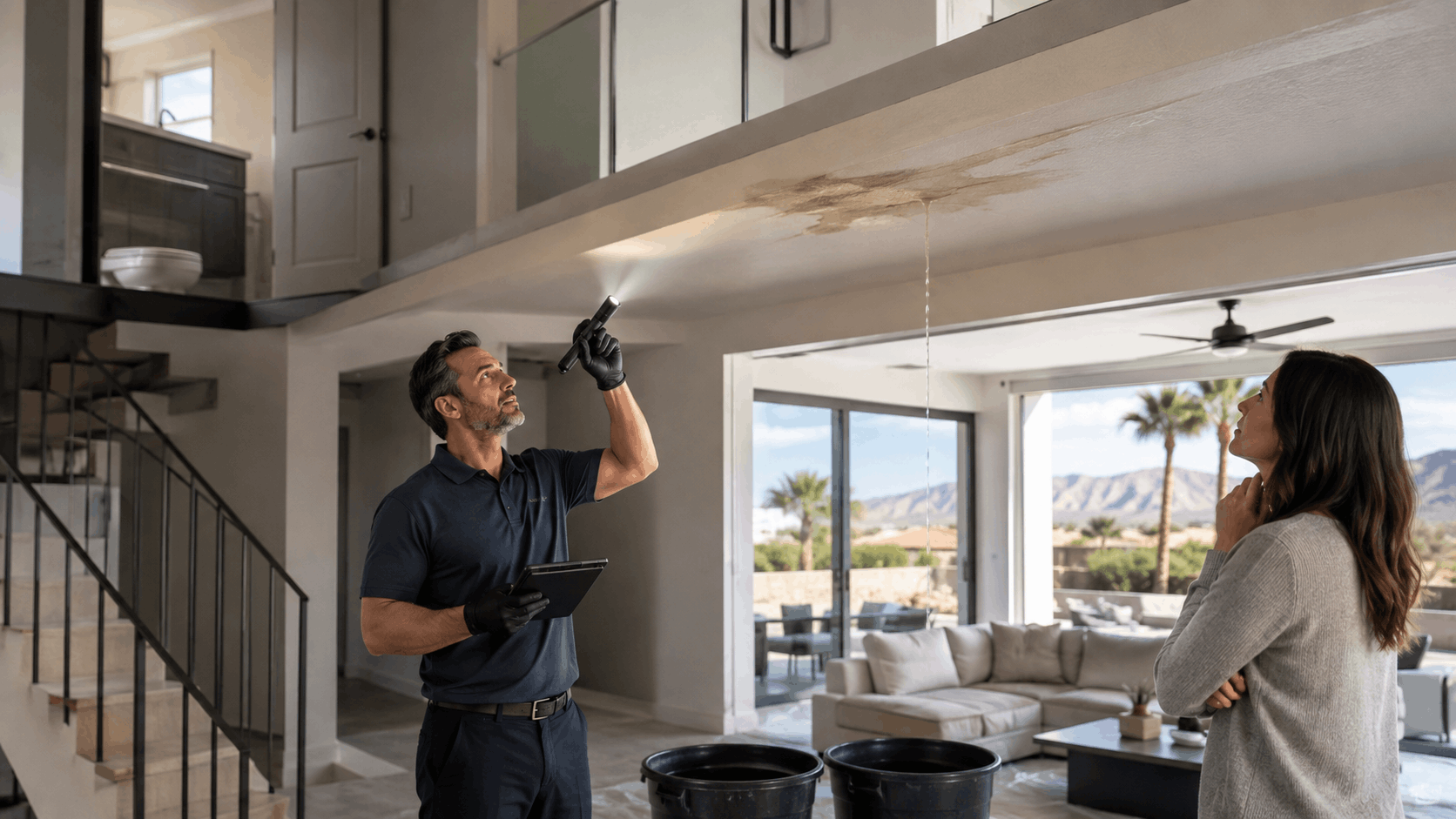
It usually starts with a sound. A homeowner in Summerlin West is watching TV downstairs when they hear a soft drip, then a faster tap-tap-tap coming from the ceiling above the couch. Within minutes, a brown ring spreads across the drywall and water starts running down the light fixture. That upstairs bathroom or laundry line just failed, and now the clock is running.
We get these calls across the valley every week, from Henderson to Aliante. A burst pipe in a Las Vegas two-story is one of the fastest-moving home emergencies there is, because water upstairs does not stay upstairs. It follows gravity straight into the rooms below, soaking drywall, flooring, and framing on the way down.
How Water Travels in a Two-Story Las Vegas Home?
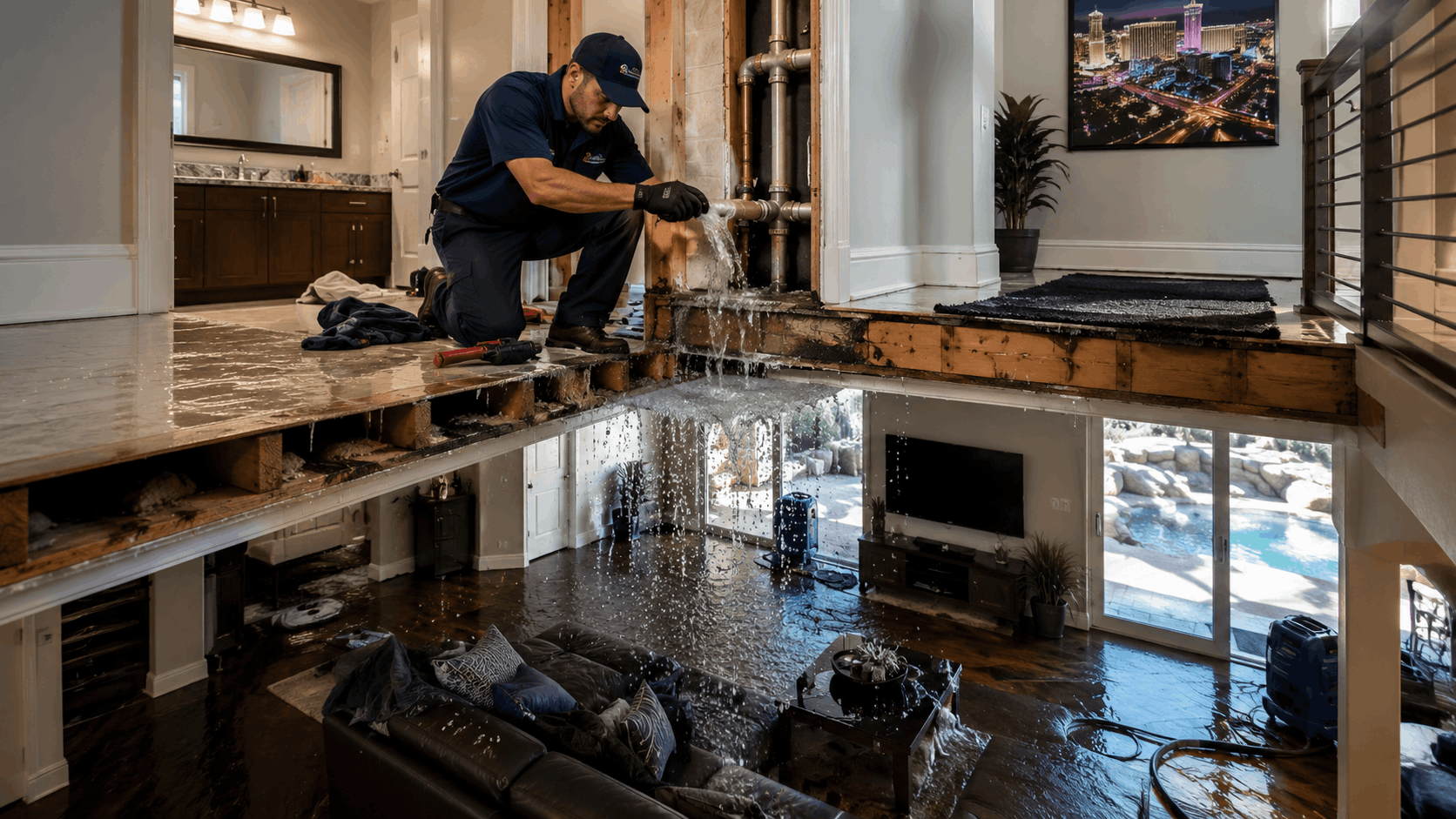
The reason a leak upstairs turns into a downstairs disaster comes down to simple physics. Water always looks for the lowest point, and in a two-story home, that means the floor below. Once a burst pipe lets go, the water finds gaps between floor joists and drops fast.
Two-story water damage spreads wider than most people expect. A single supply line failure in an upstairs Las Vegas home can wet a 200-square-foot area downstairs before anyone even finds the source.
Why Gravity Turns a Small Leak Into a Big Problem
When a pipe bursts on the second floor, water does not spread out evenly. It runs across the subfloor until it hits the fastest downward path, then it pours through. That path is often a gap around a plumbing penetration, an electrical box, or a seam between sheets of subflooring.
The water flow tends to follow the floor joists like little channels. It travels sideways along the bottom of the joists before dropping through the drywall ceiling below. That is why the wet spot downstairs frequently shows up several feet away from the actual pipe break upstairs.
Light fixtures and can lights are the worst offenders. They give water a ready-made hole to escape through, which is why so many homeowners first notice a drip coming right out of a ceiling light. By the time it reaches that point, gallons have already soaked into the framing.
Once water breaks through the ceiling, it fans out across the downstairs floor. It runs under baseboards, into wall cavities, and toward the lowest corner of the room. A small upstairs leak can easily become a wide downstairs flood in under an hour.
Common Pipe Locations in Valley Two-Story Builds
In newer Summerlin and Aliante homes, most upstairs supply lines run through interior walls and across the second-floor framing to reach bathrooms, laundry rooms, and sometimes a wet bar. Builders route them to keep pipes out of exterior walls, but that also puts them directly above finished downstairs living space.
The second floor plumbing in these master-planned communities often serves two or three upstairs bathrooms clustered near each other. When one line fails, it sits right above a great room, kitchen, or entryway. That is the geometry that makes these leaks so costly.
Older Green Valley builds tend to have supply lines running through the attic and dropping down to fixtures. The horizontal runs across the attic floor sit above ceilings, so a failure there rains straight down into the rooms below. Attic-routed lines also face heat swings that stress fittings.
Knowing where these lines run helps our team trace a leak fast. When we arrive at a two-story call, we already have a mental map of how a given neighborhood was likely plumbed based on its build era.
Materials That Fail: CPVC, PEX, and Copper
Three pipe materials dominate valley homes, and each fails in its own way. CPVC becomes brittle over time, especially where it has been exposed to heat, and it can crack at a fitting with little warning. We see CPVC failures often in homes built in the late 1990s and early 2000s.
PEX is common in newer Summerlin and Skye Canyon builds. It handles pressure well, but the crimp fittings and connections can leak if they were rushed during construction. A bad PEX fitting can drip for months before it lets go completely and floods a ceiling.
Copper pipe is durable but not immune. In older homes, our hard water slowly eats away at copper from the inside, thinning the walls until a pinhole leak forms. Those pinholes often start small and grow, and copper can also fail at soldered joints that corrode over the years.
Each material calls for a different repair approach. Part of the job is matching the fix to the pipe already in the wall, which is why identifying the material quickly matters so much during a burst pipe repair.
How Las Vegas Water Conditions Speed Pipe Failure
Our water is famously hard. The Las Vegas Valley Water District draws heavily from the Colorado River, which carries a high load of dissolved minerals like calcium and magnesium. That hard water is tough on every pipe and fitting in the house.
Over time, mineral buildup coats the inside of pipes and collects at fittings and valves. This scale narrows the pipe, raises internal pressure, and puts extra stress on the weakest joints. On copper, the mineral content also speeds up the corrosion that leads to pinhole leaks.
Water heaters take a heavy hit too, since scale settles at the bottom of the tank and around connections. A homeowner who ignores hard water for a decade often ends up with several stressed fittings at once. Managing that buildup with a water softener installation is one of the best long-term defenses.
The bottom line is that valley water quietly ages plumbing faster than in many other cities. That is a big reason burst pipes are more common here than newcomers expect.
Get Your Quote
Tell us what's going on and we'll get back to you fast.
The Damage Clock: What Happens Minute by Minute
Once a pipe upstairs lets go, the water damage timeline moves fast. Every minute the water runs, it reaches deeper into the home and adds to the repair bill. Understanding the pace of burst pipe damage helps a homeowner act with urgency instead of standing there frozen.
Flooding from a second-floor line is different from a first-floor leak because the water is falling and spreading at the same time. Here is what that clock looks like from the first drip onward.
The First 5 Minutes: Ceiling Staining and Drips
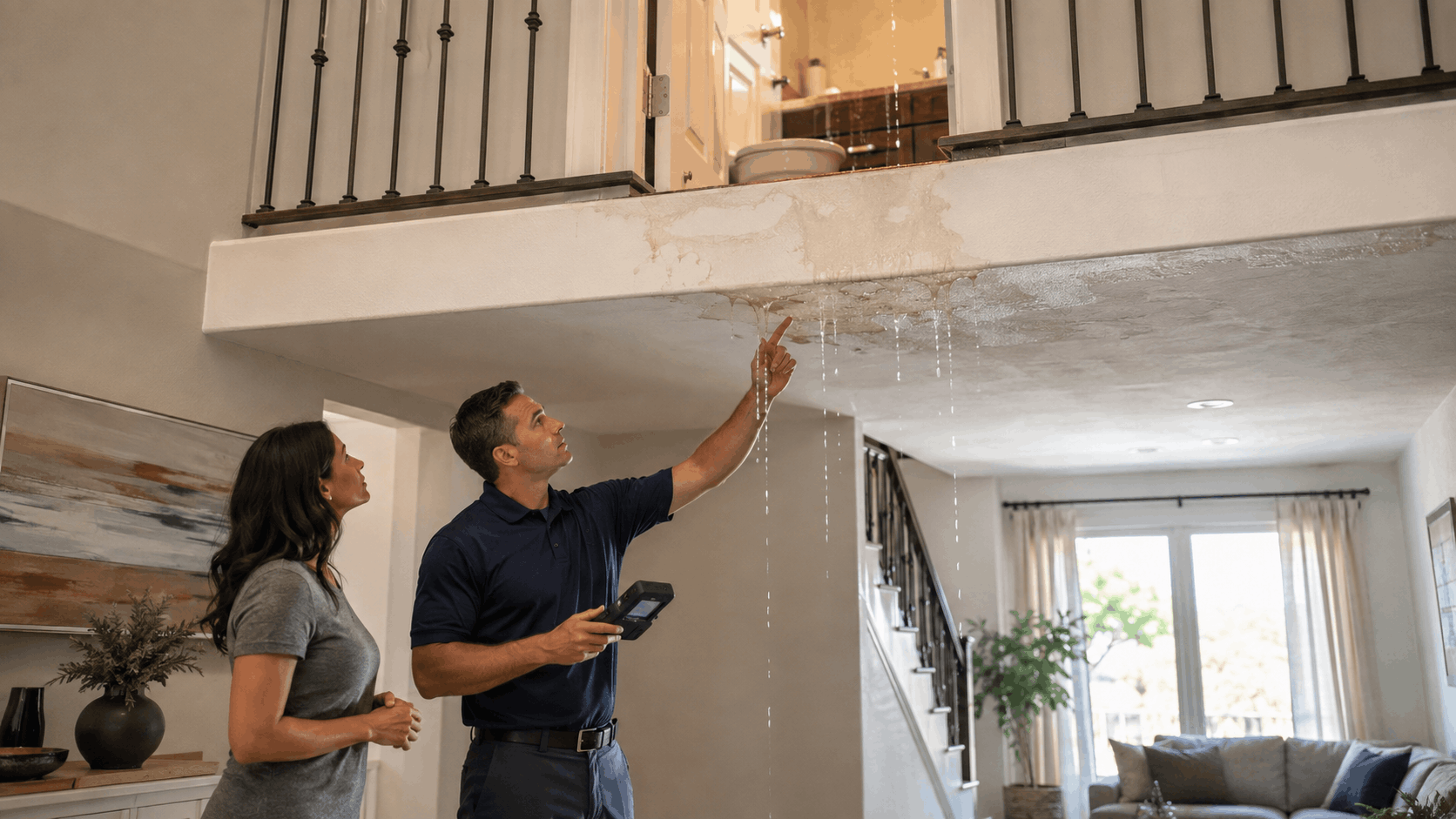
The earliest sign downstairs is almost always a ceiling stain. A faint discoloration appears, then darkens and grows as the drywall soaks up water. Within a few minutes, the first drips begin, often from a seam, a light fixture, or the lowest sag point.
These first signs are the moment to move. If a homeowner catches the leak here and shuts off the water, the damage might stay limited to a ceiling patch and some paint. The difference between five minutes and twenty-five minutes is enormous.
A wet ceiling also starts to bulge as it holds water. That bulge is a warning that a large pocket has formed above the drywall. If it is not drained carefully, it can collapse and dump gallons all at once onto whatever sits below.
Homeowners who notice ceiling stains without an obvious source should still treat it as urgent. A slow drip that has been building behind the ceiling can turn into a fast flood the moment the drywall gives way.
Hour One: Soaked Drywall and Ruined Flooring
Within the first hour, drywall damage becomes serious. Drywall acts like a sponge, swelling and losing strength as it absorbs water. Ceilings sag, wall seams separate, and paint blisters and peels along the wet areas.
Downstairs flooring damage depends on the surface. Laminate swells and lifts at the seams and is usually a total loss once it gets wet. Water also wicks under it fast, spreading well beyond the visible puddle.
Tile handles surface water better, but the water runs along the grout lines and pools underneath, soaking the subfloor and any wood below. Carpet soaks through to the pad and then the subfloor, holding moisture that is hard to fully dry and quick to grow odor.
By the end of hour one, a burst pipe upstairs has often affected the ceiling, at least one wall cavity, and a section of downstairs flooring. What began as a single stain is now a multi-surface repair job.
24 Hours In: Mold Risk and Structural Concerns
People assume the desert is too dry for mold, but that is a dangerous myth inside a wet wall. Mold growth can begin within 24 to 48 hours when framing and drywall stay damp. The cavity behind the wall traps humidity and creates the exact conditions mold needs.
Soaked framing is the bigger long-term worry. When floor joists, wall studs, and subflooring absorb water, they can swell, warp, and lose strength. Repeated or prolonged wetting leads to real structural damage that goes well beyond cosmetic repairs.
At this stage, drying has to reach inside the walls and above the ceiling, not just the visible surfaces. Simply wiping up standing water and repainting leaves moisture hidden in the cavities. That trapped moisture is what feeds mold and rot for weeks afterward.
This is why fast professional response matters. Stopping the water quickly and getting drying equipment in place inside the first day keeps a burst pipe from becoming a mold and framing problem.
Beyond a Day: Electrical and Long-Term Damage
After a full day, electrical hazards climb the list of concerns. Water that runs through ceiling fixtures, outlets, and wall cavities can reach wiring and junction boxes. Energized circuits near wet materials create a shock and fire risk that most homeowners underestimate.
Subfloor damage becomes obvious over the following days. Wood subflooring that stayed wet warps and cups, leaving floors that feel soft, uneven, or spongy underfoot. In bad cases, the subfloor has to be cut out and replaced along with the finished flooring above.
Lingering odor is another sign the water was never fully dried. A musty smell that will not go away points to moisture still trapped in framing, insulation, or under floors. That smell often means mold has already taken hold out of sight.
Every one of these problems ties back to how long the water ran and how fast it was dried. The homeowners who fare best are the ones who stop the clock early and bring in help before hidden damage sets in.
Need Help in Las Vegas?
Active Plumbing serves Las Vegas and all of Las Vegas Valley.
First Steps a Homeowner Should Take Right Away
When water is coming through the ceiling, the goal is simple: stop the flow and protect people and property. A few emergency steps in the first minutes can cut the total damage dramatically. Here is the burst pipe response we walk homeowners through on the phone.
None of these steps require plumbing skills. They just require knowing where things are and staying calm enough to act fast.
Finding and Closing the Main Shut-Off Valve
The single most useful thing a homeowner can do is shut off water at the main. In most Las Vegas homes, the main shut-off valve sits in the garage, near the front of the house, or at an exterior wall close to the water heater. Some homes have it in a box near the property line by the street.
To close it, turn the valve clockwise until it stops. If it is a lever-style valve, rotate it a quarter turn so it sits crosswise to the pipe. That single move to water shut off cuts supply to the entire house and stops the source.
It helps to find and test this valve before an emergency ever happens. Older valves can be stiff or corroded from hard water, and a valve that will not budge during a flood makes a bad situation worse. We recommend every homeowner locate theirs today and note it for the whole family.
If the main will not turn or cannot be found fast, shutting off the valve under the affected upstairs fixture can help. But the whole-house main is always the surest way to stop everything at once.
Cutting Power to Affected Areas Safely
Water and electricity are a dangerous mix, so electrical safety comes right after the water is off. If water is dripping through light fixtures or near outlets, do not touch switches or stand in the puddle to reach anything electrical. Water can carry current from a compromised fixture.
The safe move is to shut off power to the affected rooms at the breaker panel. Flip the breakers that feed the wet areas, or shut off the main breaker if there is any doubt about which circuits are involved. Only do this if the panel and the floor in front of it are dry.
Never reach into standing water to unplug something or reset a breaker. If the breaker panel itself is wet or you cannot reach it safely, stay clear and wait for professionals. The safety guidance from OSHA on water and electrical hazards is clear that the risk is real, not theoretical.
Once power is off to the wet zones, it is far safer to move around and start protecting belongings. Keep it off until a plumber and, if needed, an electrician can confirm the area is safe.
Moving Belongings and Documenting Damage
With water and power handled, the next job is limiting losses and building a record. Move furniture, rugs, electronics, and anything valuable out of the wet area or up off the floor. Even a few inches on blocks can save a couch or a wood table leg.
Before too much cleanup happens, take photos and video of everything. Capture the ceiling, the dripping fixture, the wet flooring, damaged items, and standing water. Good insurance documentation is what supports a fair claim later.
Do not throw away damaged items right away unless they are a hazard. Adjusters often want to see them, and a pile of ruined laminate or a soaked rug helps prove the extent of the loss. Set them aside rather than hauling everything to the curb.
Soak up what water you can with towels and buckets to protect belongings and slow the spread. Keeping a simple written log of when the leak started and what you did also helps both the plumber and the insurance process.
When to Call a Plumber Versus Wait
There is rarely a good reason to wait on a burst pipe. Every minute the water sits, hidden damage grows behind walls and under floors. Calling an emergency plumber fast almost always costs less than waiting to see how bad it gets.
When calling, tell us it is a two-story home with water coming through the ceiling, whether you have shut off the main, and which room is affected. That lets our team arrive ready with the right tools and parts. The faster we can locate and stop the source, the less gets ruined.
Our emergency plumbing team takes these calls around the clock across the valley. A burst pipe does not keep business hours, and neither do we.
If you are unsure whether it counts as an emergency, err on the side of calling. It is much easier to talk through a smaller issue over the phone than to undo the damage from a leak that ran all night.
Why Two-Story Homes Across the Valley Face Higher Risk
Not every neighborhood carries the same burst pipe risk. Build era, pipe material, and local conditions all shape how likely a failure is. A Las Vegas two-story sits in a category of its own because the water has a full floor to fall through.
The table below shows how neighborhood risk shifts depending on where and when a home was built.
| Area / Condition | Common Pipe Type | Main Risk Factor |
|---|---|---|
| Green Valley, East Charleston (older) | Copper, early CPVC | Aging pipes, corrosion, pinhole leaks |
| Summerlin, Skye Canyon, Inspirada (newer) | PEX | Rushed fittings, connection leaks |
| Valley-edge and higher elevations | All types | Winter freeze in uninsulated attics |
| Valley-wide (summer) | All types | High pressure and heat stress |
Older Homes Near Green Valley and East Charleston
Older two-story homes near Green Valley and along East Charleston tend to have the oldest plumbing in the area. Many were built with copper or early CPVC that has now spent decades soaking in hard water. Those aging pipes are thin, brittle, and prone to sudden failure.
In these homes, we often find pinhole leaks in copper and cracked CPVC fittings in the attic. A pipe that has held for 25 years can let go in a single week once corrosion reaches a critical point. The failures rarely give much warning.
Water pressure that was fine when the house was new can also become too much for tired pipes. Combine aging pipe material with valley hard water, and older two-story homes carry a real risk of a ceiling flood.
Homeowners in these established neighborhoods benefit most from a plumbing inspection before something bursts. Catching a weak section early is far cheaper than repairing the water damage after it fails.
Newer Builds in Summerlin, Skye Canyon, and Inspirada
Fast growth means fast construction, and that shows up in newer master-planned communities. Homes in Summerlin, Skye Canyon, and Inspirada mostly use PEX, which is a solid material when installed well. The weak point is usually the connections, not the pipe itself.
When homes go up quickly, fittings can get rushed or under-crimped. A slightly loose PEX connection may hold for a year or two before it starts to weep and then fails. Because these lines often run above finished second-floor living space, the leak lands downstairs.
We service a lot of these newer neighborhoods and know where the plumbing tends to be routed. Our coverage in Summerlin West and surrounding communities means we can respond quickly when a young home springs a leak.
A newer home is not automatically safe from a burst pipe. It just tends to fail at the fittings rather than from age, which is why connection checks matter even on recent builds.
Winter Cold Snaps and Attic Pipe Freezing
Las Vegas is not known for freezes, but they happen, especially near the valley edges and at higher elevations. On the coldest desert nights, temperatures can dip low enough to freeze water in an uninsulated attic. Frozen pipes expand and can split.
The real damage often shows up when the pipe thaws. The split lets go once the ice melts, and water pours out while everyone is asleep or away for the day. Attic-routed lines in older builds are especially exposed to this.
A winter freeze does not need to last long to do harm. A single hard cold snap can be enough to crack a line that has never had a problem before. Homes with pipes in exterior walls or unconditioned attic space face the highest odds.
Simple insulation on exposed attic and exterior-wall pipes goes a long way here. It is a small step that prevents a very expensive winter surprise.
Summer Heat and Pressure Swings
Summer brings its own stress. Extreme heat raises the temperature of water sitting in attic lines and expands the pipe material. That heat stress, day after day, wears on fittings and joints across the whole system.
Water pressure swings make it worse. If the incoming pressure runs high, every fitting in the house feels it, and the upstairs supply lines take the brunt. High pressure combined with heat is a recipe for a summer failure.
We often see leaks spike during the hottest months for exactly this reason. Homes without a working pressure regulator are the most likely to have a fitting give out under the strain.
Managing pressure keeps the whole system calmer. It is one of the most effective ways to reduce burst risk in a valley two-story, no matter the neighborhood.
Need Help in Las Vegas?
Active Plumbing serves Las Vegas and all of Las Vegas Valley.
How Active Plumbing Responds to a Burst Pipe Call
When a two-story burst pipe call comes in, our goal is to stop the water, find the break, and fix it with as little cutting as possible. Emergency plumbing on a two-story home takes a careful hand, since the source and the damage are often on different floors. Here is how our team works a burst pipe repair from arrival to handoff.
We treat these calls as the emergencies they are, because the damage clock is still running the whole time.
Locating the Break Without Tearing Up the Whole House
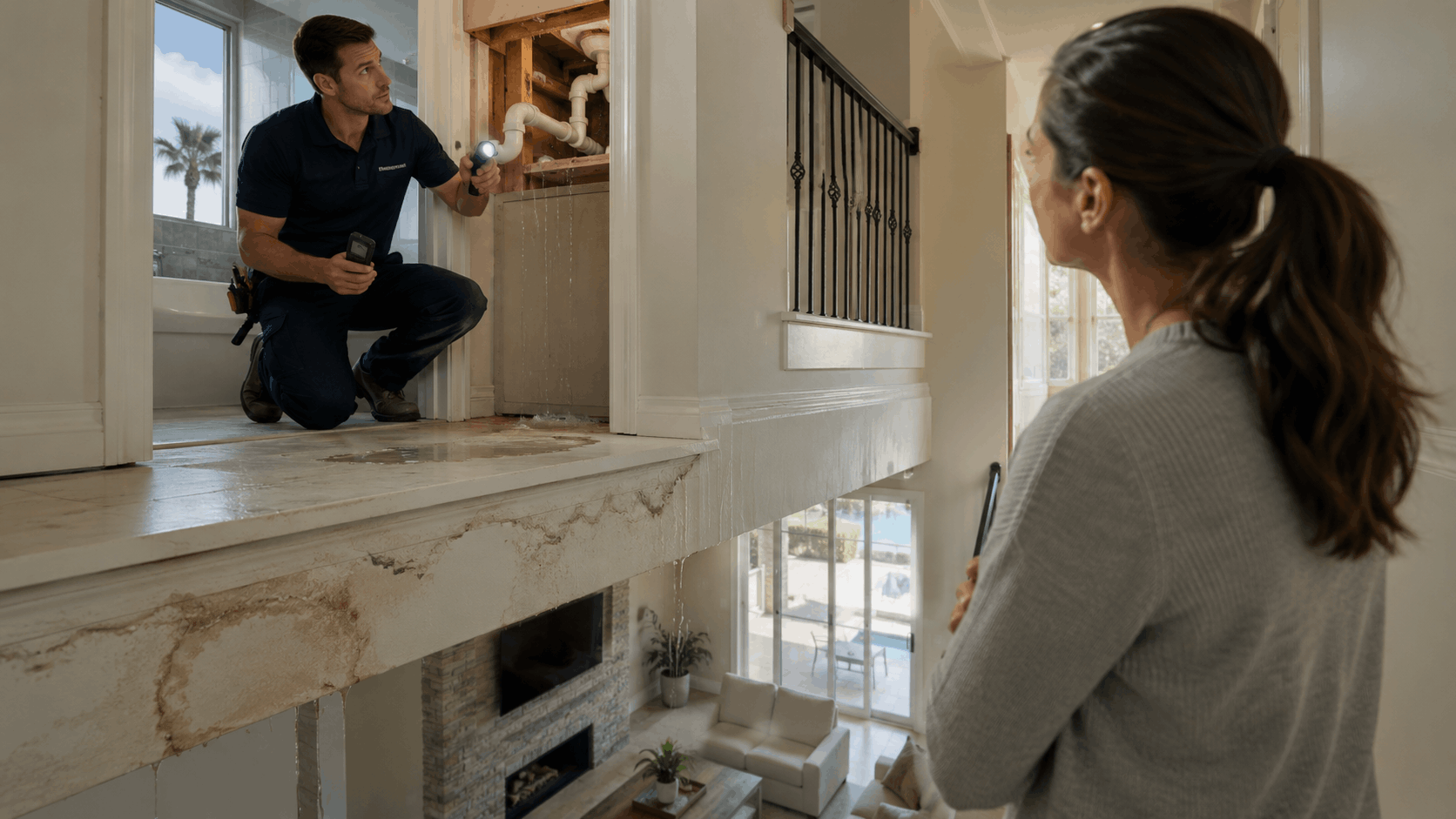
The first job on arrival is finding the actual break. Because water travels along joists, the wet ceiling spot rarely sits right under the failed pipe. Guessing wrong means cutting drywall in the wrong place and doing damage for nothing.
We use leak detection tools to pinpoint the source before we cut. Acoustic listening equipment, moisture meters, and electronic leak detection help us trace water back to its origin. That pipe location work saves the homeowner from a wall full of unnecessary holes.
Once we know where the break is, we open only the area we need to reach it. A precise access cut is far easier to patch than a whole torn-out ceiling. This approach keeps restoration smaller and cheaper.
For homes with a history of leaks, we may recommend a whole-home leak detection system so the next failure gets caught the instant it starts.
Repairing or Replacing the Failed Section
With the break exposed, we decide between a targeted repair and a section replacement. A single clean crack or a bad fitting can often be repaired quickly with the right coupling or new joint. Matching the fix to the existing pipe material keeps it reliable.
When we find that the surrounding pipe is corroded, brittle, or riddled with mineral scale, a spot fix will not hold for long. In those cases, a re-pipe of the failed section is the smarter move. Replacing a run of tired pipe prevents another burst a few feet away next month.
Our team explains the options and the reasoning before doing the work. A homeowner should understand why we recommend a repair versus a partial re-pipe. That transparency matters as much as the wrench work.
All pipe and fixture work is part of our core pipe and fixture services, so we carry what these repairs typically require.
Coordinating With Water Restoration Crews
Stopping and fixing the leak is only half the recovery. The soaked drywall, framing, and flooring still need to be dried out properly. That is where water restoration and drying crews come in, and we help coordinate that handoff.
Once the plumbing is repaired, restoration teams set up fans, dehumidifiers, and moisture monitoring to dry the structure from the inside out. Getting that equipment running fast is what stops mold from taking hold in the days after a flood. The two jobs work best in tandem.
We make sure the plumbing side is documented clearly for the restoration crew and the insurance process. A clean record of what failed and what we fixed keeps everyone on the same page.
The homeowner ends up with a coordinated recovery instead of a confusing scramble between separate companies. Stopping the water first, then drying thoroughly, is the order that saves the most.
Response Times Across Las Vegas and Henderson
Speed is everything with a burst pipe, so our routing is built around fast response times. From the northwest communities out to Henderson, we position our crews to reach homes quickly. Cutting even fifteen minutes off arrival can spare a whole room.
We cover the full valley, including Las Vegas, Summerlin, Enterprise, North Las Vegas, and the Henderson communities around Green Valley and Lake Las Vegas. Knowing the surface streets and the fastest routes at any hour helps us beat the clock.
When a homeowner calls, we give an honest arrival window and keep them updated. In the meantime, we coach them through shutting off the water so the damage stops before we even pull up.
Local knowledge is a real advantage on emergency calls. Driving these neighborhoods every day means we are not fumbling with directions while a ceiling drips.
Preventing the Next Burst Pipe
The best burst pipe is the one that never happens. A handful of prevention steps suited to valley conditions can add years to a plumbing system. Good pipe maintenance is far cheaper than water damage repair.
These measures target the exact things that stress pipes here: pressure, hard water, heat, and the occasional freeze.
Installing a Pressure Regulator and Water Softener
Two upgrades address the biggest local stressors at once. A pressure regulator keeps incoming water at a safe level, usually around 60 to 70 psi, so fittings do not take constant strain. If your pressure runs high, a regulator is one of the best investments to prevent burst pipe failures.
A water softener tackles the hard water that ages every pipe in the valley. By reducing the calcium and magnesium load, it slows the mineral buildup that narrows pipes and corrodes copper. Softened water extends the life of pipes, fixtures, and the water heater.
Together these two devices calm the whole system. Lower pressure and softer water mean less stress on the exact joints that tend to fail. Our water treatment options cover the softening side for valley homes.
Homeowners who add both often see fewer leaks and longer intervals between repairs. It is protective plumbing that pays for itself over time.
Insulating Attic and Exterior Wall Pipes
For the rare desert freeze, pipe insulation is cheap insurance. The pipes that need protection most are those in the attic, in exterior walls, and anywhere exposed to cold outside air. Foam sleeves slipped over these lines hold in warmth on the coldest nights.
Attic pipes deserve special attention because that space gets both very hot in summer and cold in winter. Insulating them helps with both extremes, reducing heat stress and freeze risk at the same time. Homes near the valley edges gain the most.
It is a quick project, but it should be done before the first cold snap, not during it. Checking insulation each fall is a simple habit that heads off winter emergencies. A little foam beats a flooded ceiling every time.
If you are unsure which pipes are exposed, our team can point them out during a routine visit. We know where valley builders tend to run vulnerable lines.
Adding Leak Detectors and Auto Shut-Off Valves
Smart devices can stop a leak before it becomes a flood. A leak detector placed under sinks, near the water heater, or in the laundry room sounds an alarm the moment it senses moisture. That early warning can mean catching a drip before it soaks a ceiling.
An auto shut-off valve goes a step further. It monitors flow and pressure and can automatically cut the water when it detects an abnormal pattern, like a pipe running continuously. For a two-story home, this can stop a burst upstairs line while everyone is asleep or away.
These systems pair well with the whole-home leak detection we install. Together they give a home a built-in guard against the exact overnight failures that cause the worst damage.
For homeowners who travel or have upstairs bathrooms over living space, this technology is worth strong consideration. It turns a potential disaster into a minor event.
Scheduling Regular Plumbing Inspections
Routine checks catch problems while they are still small. A plumbing inspection lets a professional spot corroded fittings, worn connections, high pressure, and early signs of trouble before they fail. Preventive maintenance is how homeowners avoid the emergency call entirely.
During an inspection, we check pressure, look at exposed pipe and fittings, test shut-off valves, and flag anything aging or stressed. On older homes near Green Valley or East Charleston, that means paying close attention to tired copper and early CPVC.
We usually recommend a check every couple of years, or sooner for older homes or those with a history of leaks. Catching one weak fitting during an inspection can prevent thousands in water damage. It is a small cost for real protection.
Booking an inspection is simple, and the peace it brings is worth it. You can reach our team through our contact page to set one up.
Need Help in Las Vegas?
Active Plumbing serves Las Vegas and all of Las Vegas Valley.
What to Expect on Costs and Insurance
Money is on every homeowner's mind during a flood, so it helps to know what to expect. Repair cost depends on the break, the material, and how much water damage followed. Water damage insurance can cover a lot, but the details matter.
Here is a realistic look at costs and how the claim process usually works in the valley.
Typical Repair Cost Ranges in the Valley
A straightforward burst pipe repair, where we access one spot and fix a single break, often runs in the few hundred dollar range for the plumbing work itself. The price climbs with harder-to-reach breaks, difficult access, and after-hours emergency response.
Section re-pipes cost more, since we are replacing a run of pipe rather than fixing one point. Depending on length and access, that can range from several hundred to a few thousand dollars. Homes with widespread aging pipe sit at the higher end of that range.
The plumbing repair is usually only part of the total. Drywall, flooring, and restoration drying add their own costs, and those often exceed the plumbing bill when the water ran a long time. That is why stopping the leak fast has such a big effect on the final number.
Every home is different, so we give a clear estimate once we see the break. Honest pricing up front is part of how we work.
What Homeowner Insurance Usually Covers
Most homeowner policies cover sudden and accidental water damage, which is exactly what a burst pipe is. If a pipe fails without warning and floods the downstairs, insurance coverage typically applies to the damage and cleanup. That is good news for the majority of these calls.
The tricky part is the difference between sudden damage and gradual damage. If an adjuster decides the leak was slow and ongoing due to neglect, coverage can be reduced or denied. Long-term seepage that a homeowner ignored is treated differently from a pipe that suddenly bursts.
Policies also usually cover the resulting damage, like ruined drywall and flooring, more readily than the pipe repair itself. Reading your specific policy helps you know what to expect. The Insurance Information Institute offers plain-language guidance on how water damage claims are handled.
Keeping up with maintenance also protects your coverage. A home with documented care is harder to deny on a neglect argument.
Filing a Claim and Working With Your Adjuster
A smooth insurance claim starts with good documentation. The photos, video, and notes taken during the emergency become your evidence. Save receipts for any emergency work and keep damaged items until the adjuster has seen them.
When you file, describe the event as sudden and accidental, because that is what a burst pipe is. Provide your timeline of when it started and what you did to limit the damage. Prompt action actually strengthens a claim by showing you acted responsibly.
A plumber's report helps enormously here. Our documentation of what failed, why, and what we repaired gives the adjuster a clear professional record. That report can be the difference in getting a claim approved smoothly.
Stay organized and keep every piece of paperwork together. An adjuster moves faster when the file is complete and consistent.
How Fast Action Lowers Your Total Bill
Everything in this article circles back to one point: fast response reduces cost. The sooner the water is shut off and the sooner drying begins, the less damage there is to repair. Minutes really do translate to dollars with a burst pipe.
A leak caught in five minutes might mean a ceiling patch and some paint. The same leak running for hours can mean new flooring, gutted walls, mold remediation, and structural repairs. The plumbing fix barely changes, but the total bill can multiply many times over.
This is also why prevention pays. A pressure regulator, a leak detector, or a caught weak fitting can head off the entire expense. Spending a little on protection beats spending a lot on recovery.
When it does happen, calling right away is the cheapest choice you can make. Speed is the homeowner's best tool against a rising repair bill.
Final Thoughts
A burst pipe in a Las Vegas two-story is a race against the clock. Water upstairs falls fast, and the difference between a quick response and a slow one is the difference between a paint touch-up and a gutted downstairs.
Know where your main shut-off is, keep your pressure and hard water in check, and act the moment you see a ceiling stain. Those simple habits protect your home before trouble ever starts.
When the worst does happen, our team is ready across Las Vegas, Henderson, Summerlin, and the whole valley. Call Active Plumbing or reach out through our contact page for emergency help or to schedule a plumbing inspection, and let us help you stop the damage clock.

Frequently Asked Questions
- How fast can a burst pipe upstairs damage the downstairs?
- Very fast. Within the first five minutes, water reaches the downstairs ceiling and starts staining and dripping. By the end of hour one, drywall is soaked and flooring is often ruined. After 24 hours, mold and framing damage begin. The speed is why shutting off the water immediately and calling a plumber right away makes such a huge difference in the final repair.
- Where is the main water shut-off in a Las Vegas home?
- In most valley homes, the main shut-off valve sits in the garage, near the front exterior wall, or close to the water heater. Some homes have it in a box near the property line by the street. Turn it clockwise or a quarter turn on a lever valve to stop all water. Find and test yours today so you are not searching during a flood.
- Can I turn on my ceiling lights if water is dripping through them?
- No. Water dripping through a fixture can carry electrical current, so touching switches or standing in the puddle is dangerous. Shut off power to the affected rooms at the breaker panel first, but only if the panel and floor around it are dry. Never reach into standing water to reset a breaker. When in doubt, stay clear and wait for professionals.
- How soon does mold start after a pipe burst in the desert?
- Even in our dry climate, mold growth can begin within 24 to 48 hours inside a wet wall or ceiling. The cavity traps humidity and creates the exact conditions mold needs, no matter how dry the outdoor air is. Surface drying is not enough. Proper drying has to reach inside the walls and framing, which is why fast professional cleanup matters so much.
- What causes pipes to burst in Las Vegas two-story homes?
- Several local factors combine. Hard water from the Colorado River causes mineral buildup and corrosion that thins pipes over years. High water pressure and summer heat stress fittings, especially on upstairs supply lines. Aging copper and early CPVC in older homes fail from wear, while rushed PEX fittings in newer builds can leak. Occasional winter freezes crack exposed attic pipes.
- Will my homeowner insurance cover a burst pipe?
- Usually yes. Most policies cover sudden and accidental water damage, which is exactly what a burst pipe is. The resulting damage to drywall and flooring is often covered too. However, damage from a slow, long-ignored leak may be treated as neglect and denied. Keeping up with maintenance and documenting the event with photos strengthens your claim significantly.
- How much does burst pipe repair cost in the valley?
- A single-point burst pipe repair often runs in the few hundred dollar range for the plumbing work, with after-hours calls and hard-to-reach breaks costing more. Section re-pipes range from several hundred to a few thousand dollars. Remember that drywall, flooring, and drying add to the total, often exceeding the plumbing bill. Stopping the leak fast keeps those extra costs down.
- Should I call a plumber or a restoration company first?
- Call a plumber first. The immediate priority is stopping the water at its source, and that is a plumbing job. A restoration company dries and repairs the damage, but drying while water is still leaking accomplishes nothing. Once we stop and repair the leak, we help coordinate with drying crews so the two efforts work together smoothly.
- How can I prevent a burst pipe in the future?
- Install a pressure regulator to keep water pressure safe and a water softener to slow the hard-water corrosion that ages pipes here. Insulate attic and exterior-wall pipes before winter cold snaps. Add leak detectors and an auto shut-off valve for early warning. Finally, schedule regular plumbing inspections so weak fittings get caught before they fail.
- How fast can Active Plumbing reach my two-story home?
- Our crews are positioned across the valley to respond quickly, from the northwest communities through Summerlin and Enterprise out to Henderson. When you call, we give an honest arrival window and coach you through shutting off the water so the damage stops before we arrive. Knowing the local streets and fastest routes at any hour helps us beat the clock on emergency calls.
A
Licensed plumbing professionals serving Las Vegas and Las Vegas Valley.
Licensed in Nevada · License #0047021
Last updated on
Why trust Active Plumbing?
Founded in 1991, Active Plumbing is a licensed and insured plumber serving Las Vegas and Las Vegas Valley. All content is reviewed by our licensed technicians.

Need Help in Las Vegas?
Active Plumbing serves Las Vegas and all of Las Vegas Valley.
Related Articles
Cost Guides
Burst Pipe Repair Cost Vegas: Emergency Response vs Standard Response Pricing
Compare emergency versus standard burst pipe repair pricing in Las Vegas, plus real cost ranges, local causes, insurance tips, and how to choose the right response tier.
Seasonal
How North Las Vegas Homeowners Can Prevent Costly Pipe Bursts in Summer
Summer heat, hard water, and pressure spikes cause costly pipe bursts in North Las Vegas homes. Learn how to spot warning signs and prevent them.
Cost Guides
Trenchless Pipe Bursting vs Pipe Lining vs Open Trench in Las Vegas Caliche Soil
Compare trenchless pipe bursting, pipe lining, and open trench sewer repair in Las Vegas caliche soil, with costs, timelines, and how to pick the right method.