A Weeknight Burst Pipe Call in Green Valley South
Key Takeaways
- Shut the main water valve first, usually at ground level on the exterior or at the curb-side meter on slab homes in Green Valley South, since there is no basement to check.
- Pipes burst here from aging polybutylene fittings, scale from very hard 280 ppm water, occasional freezing winter nights on exposed lines, and under-slab failures from slab-on-grade construction.
- Green Valley South is in the City of Henderson under ZIP codes 89014 and 89074, so permits come from Henderson at 240 S. Water Street, not Clark County or Las Vegas.
- Henderson adopted the 2024 Uniform Plumbing Code with Southern Nevada Amendments under Title 15, effective January 2, 2026; confirm permit needs with the Development Services Center at 702-267-3640.
- Burst pipe repair typically runs $200 to $800, slab leak repair $500 to $3,000, and a whole-house repipe $4,000 to $15,000, with a $150 to $300 after-hours fee plus repair costs.
- Caliche, a cemented hardpan, is abrasive and slow to cut, which drives up trenching time and cost on any buried repair, though it does not swell or crack pipes.
- Active Plumbing holds Nevada license NSCB #0047021, has served the valley since 1991, arrives in 30 to 60 minutes, and gives a written price before work starts.
In This Article
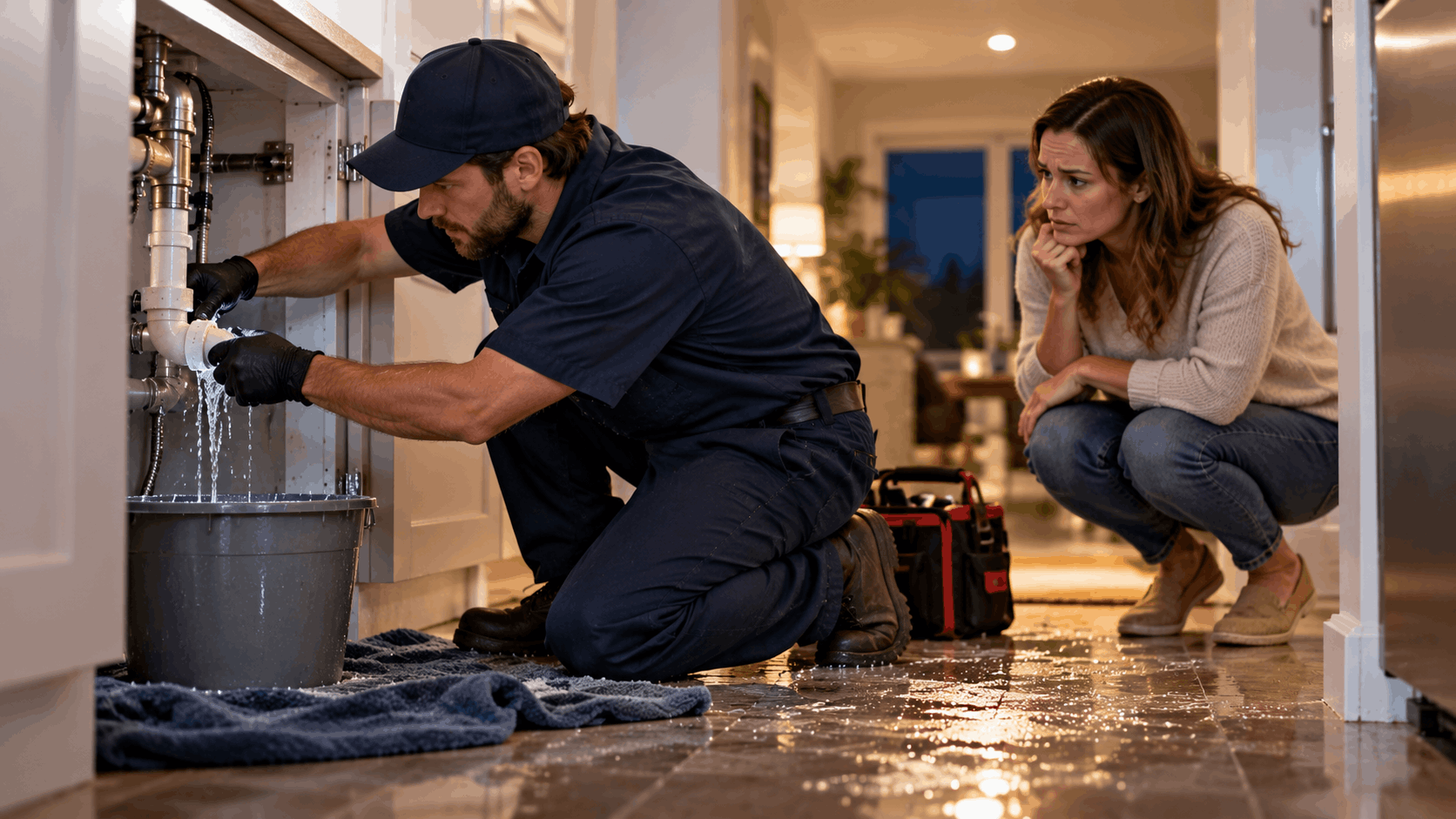
It is 9pm on a Tuesday in Green Valley South. The kids are finally asleep, and a parent walking down the hall hears something that stops them cold: water running where no faucet is open. A wet spot is spreading on the ceiling, or the carpet near a wall has gone soft and cold. A pipe has let go, and the clock is now running on water damage.
A burst pipe after dark feels like a disaster, but the first few minutes decide how bad it gets. There are calm, clear steps any homeowner can take to cut the water, protect the house, and hold the line until a plumber arrives. None of them require tools or training.
The First Five Minutes When a Pipe Bursts After Dark
When water is actively pouring out, every minute matters. The goal in those first five minutes is simple: stop the flow, keep people safe around electricity, and start containing the mess. You do not need to find the break yet. You need to kill the water feeding it.
Here is the fast version anyone in a Green Valley South home can follow, in order, before help arrives.
| Step | Action | Why it matters |
|---|---|---|
| 1 | Shut the main water valve | Stops all water feeding the burst at once |
| 2 | Cut power to any flooded room if safe | Keeps water away from live outlets and fixtures |
| 3 | Open the lowest faucets in the house | Drains pressure and remaining water from the lines |
| 4 | Move valuables and start containing water | Limits damage to floors, furniture and belongings |
| 5 | Call a licensed emergency plumber | Gets the break found and repaired properly |
Work through that list and you will have the situation under control long before a technician pulls up. The sections below explain each step so you know what you are doing and why.
Find and Shut the Main Water Valve
The single most important move is shutting the main water valve. Most homes in Green Valley South are slab-on-grade, which means there is no basement to run down to. That actually makes the search simpler, because the main shutoff is almost always at or near ground level on the exterior of the house or in the front landscaping.
Look first along the exterior wall facing the street, often near a hose bibb or where the water line enters the home. The valve is usually a round wheel handle or a straight lever. If it is a lever, a quarter turn until it sits across the pipe shuts it off. If it is a round wheel, turn it clockwise, and keep turning until it stops.
There is also a curb-side shutoff at the water meter box near the sidewalk, usually under a metal or plastic lid flush with the ground. That one often needs a meter key or a wrench to turn the valve a quarter turn. On a slab home with no basement to check, knowing both of these locations before an emergency saves you the worst five minutes of the whole ordeal.
Once the main is closed, the sound of running water should fade within a few seconds. If it does not, you may have turned a partial valve or an irrigation valve by mistake, so keep looking for the main that controls the whole house. Getting the water shutoff right is what ends the flooding.
Kill Power to the Affected Area Safely
Water and electricity are a dangerous pair, and a burst pipe can push water toward outlets, light fixtures and appliances. If water is near any electrical point in a flooded room, cutting power to that area protects everyone in the house. NV Energy supplies electricity across the valley, and your home's breaker panel is what you use to do this safely.
If you can reach your breaker panel without stepping through standing water, switch off the breakers that feed the flooded room. Many panels are labeled by room or by circuit, which makes this quick. When in doubt, and if the main panel itself is dry and safe to reach, you can shut off the main breaker to kill power to the whole home.
Never stand in water to reach a panel or an outlet. If the only path to the breakers runs through standing water, or if water is already dripping onto fixtures and outlets, leave it alone and wait for a professional. No belonging in the house is worth an electric shock.
Once power is off to the wet area, you can move around that space more safely to contain water and rescue items. This is the step that separates a messy night from a trip to the emergency room, so treat it with respect and err on the side of caution.
Drain the Lines and Protect Belongings
With the main shut off, there is still water sitting in the pipes above the break. Opening the lowest faucets in the house lets that water drain out of the system instead of continuing to leak from the burst. Start with the lowest fixtures you have, such as a tub spout, a laundry faucet or an outdoor hose bibb, then open a few upstairs faucets to break the vacuum and let the lines empty faster.
While the lines drain, turn to the belongings. Lift anything off the wet floor that water can ruin: rugs, electronics, boxes, photos and furniture legs. Even a few inches of elevation on furniture blocks or foil can save a cabinet or a sofa frame.
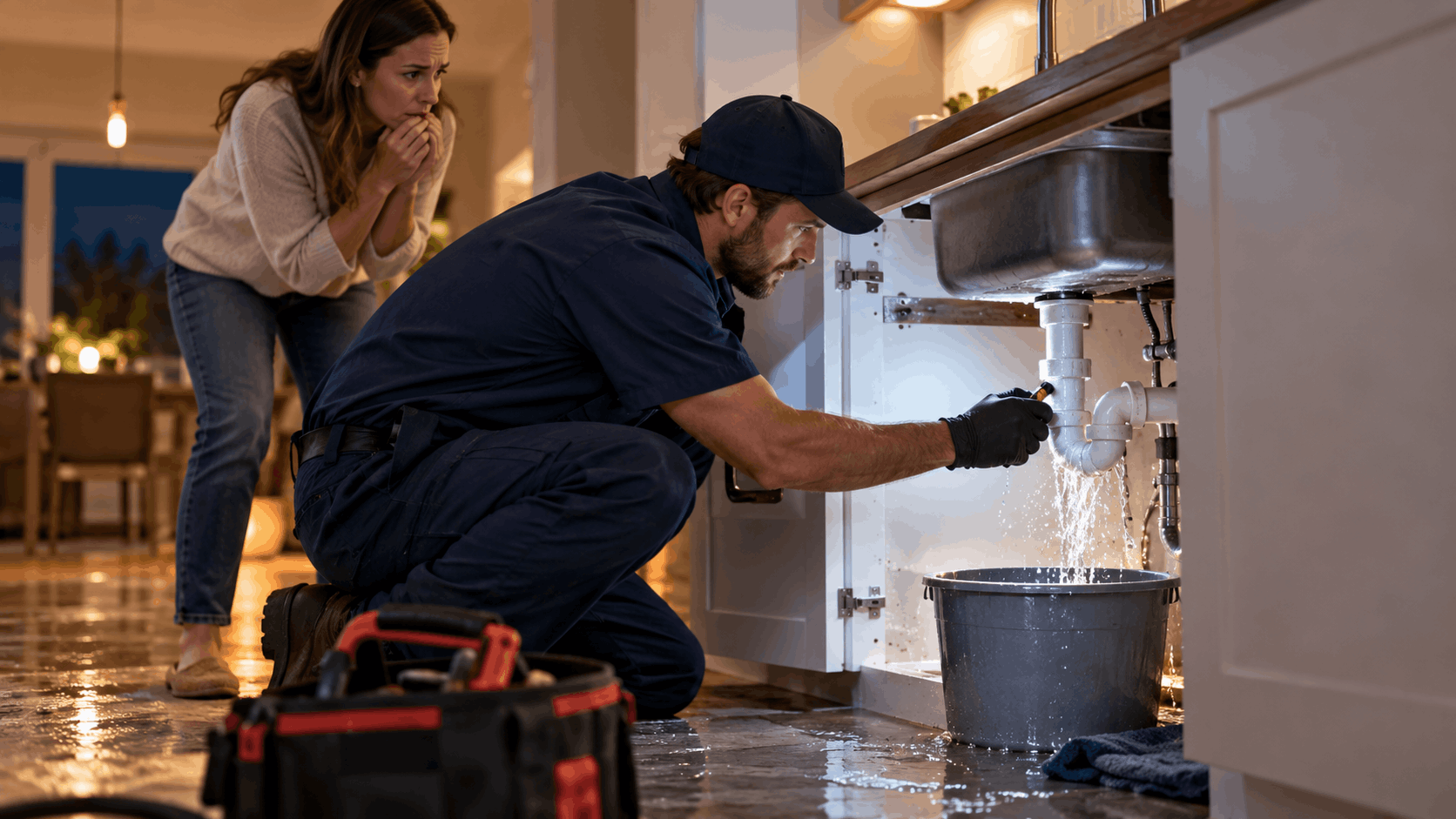
Then start containing the water itself. Towels, buckets, a wet-dry shop vacuum and a mop all help, and placing a bucket directly under a ceiling drip keeps water from spreading across the whole room. If water is coming through a ceiling, a small hole poked at the lowest point of a bulging patch lets it drain into a bucket rather than collapsing a larger section later.
Move air through the space if you can do so safely, since drying quickly limits mold risk in our dry climate. These containment steps buy time and lower the final repair bill while you wait for the plumber to arrive and find the break.
What Not to Touch on a Gas Water Heater or Line
If the burst is near the water heater or any gas appliance, add one more safety check. Should you smell gas, hear a hissing near a gas line, or suspect a leak of any kind, stop what you are doing and treat it as a gas emergency rather than a plumbing one.
The correct response is to leave the building right away. Do not flip light switches, do not light anything, and do not use anything that could create a spark on your way out. Get everyone outside to fresh air first.
From outside, call Southwest Gas, which supplies natural gas across the Las Vegas Valley, and let them respond before anyone goes back in. Only after the gas situation is cleared should you call a plumber for the water side of the problem.
Never attempt to repair, cap or reconnect a gas line yourself. That work belongs to licensed professionals, and our team handles gas safely as part of our gas line services once the utility has made the area safe.
Get Your Quote
Tell us what's going on and we'll get back to you. We're open 24/7.
Why Pipes Burst in Green Valley South Homes?
A burst pipe rarely comes out of nowhere. In Green Valley South, the causes trace back to when the homes were built, the water flowing through them, and the desert conditions outside. Knowing which one is at work helps you understand whether you are facing a one-time fix or a bigger pattern.
Green Valley South is a later phase within the Green Valley master planned community, which American Nevada Company broke ground on in 1978. The build era, the water chemistry and the climate each leave a fingerprint on how pipes fail here. Here is what actually drives the calls.
The Build Era and Polybutylene Supply Lines
Polybutylene supply piping was installed widely across the country in the late 1970s and 1980s, a window that overlaps the Green Valley build era. That makes polybutylene plausible in older Green Valley South homes, and it is a material with a well-known weakness.
Polybutylene is a gray or sometimes blue plastic pipe that becomes brittle over time and tends to fail at its fittings. The connections crack and weep before they let go entirely, which is why a poly system often produces one leak, then another, then another. A single burst in a poly home is frequently the first of several.
The important caveat is that build year alone never confirms the pipe. Polybutylene has to be verified by inspection at the water meter, at the water heater connection, and at any accessible stub where the pipe is visible. Two homes on the same street built the same year can have different plumbing if one was repiped at some point.
If an inspection does turn up polybutylene, the conversation shifts from patching to planning. A system that fails repeatedly at fittings is usually a whole-house repipe candidate, which we confirm only after seeing what is actually behind the walls.
Very Hard Water and Scale Inside the Lines
The water in Green Valley South is very hard. The Southern Nevada Water Authority publishes the hardness directly at 280 parts per million, or about 16 grains per gallon, which is categorized as very hard. That number explains more plumbing wear in this area than almost anything else.
Very hard water deposits calcium and magnesium scale throughout a system. Over years, that scale narrows the bore of supply lines and clogs the small passages inside mixing valves and cartridges. A narrower pipe carries water at higher pressure and stress, and an aging line under extra stress is more likely to fail at a weak point.
Scale also builds on water heater elements and tank bottoms, fouls aerators and shower heads, and leaves the white crusting on fixtures that homeowners call hard water stains. In a tankless unit, where the heat exchanger is a narrow passage, scale accelerates failure even faster.
One local detail worth knowing: Green Valley South receives its water through the City of Henderson utility, not the Las Vegas Valley Water District. Henderson is one of SNWA's purveyor member agencies, and roughly 90 percent of that water comes from Lake Mead. The hardness is the same very hard figure regardless, and it is the quiet driver behind a lot of pipe wear here.
Winter Nights and Exposed Lines
People assume the desert never freezes, and that assumption catches residents off guard. Southern Nevada has large day-to-night temperature swings, and winter nights can still drop below freezing. When they do, exposed or poorly insulated lines are at risk.
The common weak spots are the lines you can see from outside or in unconditioned spaces. Hose bibbs on exterior walls, irrigation lines, and the supply runs inside a garage all sit outside the home's heated envelope. On a cold night, water in those lines can freeze, expand, and split the pipe or crack a valve.
The burst often does not show itself until the next morning when temperatures climb and the ice thaws. Water that was locked in the frozen section suddenly flows again and pours out of the crack, which is why a freeze on a weeknight can turn into a flood by breakfast.
A few dollars of foam insulation on exposed bibbs and garage lines before a cold snap prevents most of these. It is one of the cheapest forms of protection a homeowner can do, and it matters more here than the desert reputation suggests.
Under-Slab Supply Line Failures
Because slab-on-grade construction is standard across this part of Henderson, under-slab supply line failures are their own category of problem. These homes sit directly on a concrete slab, and some of the water lines run beneath or within that slab.
A burst under the slab behaves differently than one in a wall. Instead of water spraying into a room, it is trapped under the concrete and finds its way up through the floor or out at the edges. The signs are subtler: a warm spot on the floor from a hot line, an unexplained jump in the water bill, the sound of running water with every tap closed, or a persistently damp patch of flooring.
These are commonly called slab leaks, and they are harder to spot and harder to reach than an open burst in a wall. Left alone, they can undermine flooring and feed moisture problems, so finding them quickly is the priority.
Because the water is hidden under concrete, pinpointing the exact spot takes specialized equipment rather than guesswork. That keeps the repair targeted instead of tearing up an entire floor, which is where slab leak detection and repair earns its keep.
Need Help in Las Vegas?
Active Plumbing serves Las Vegas and all of Las Vegas Valley.
How We Find the Break Fast on a Night Call
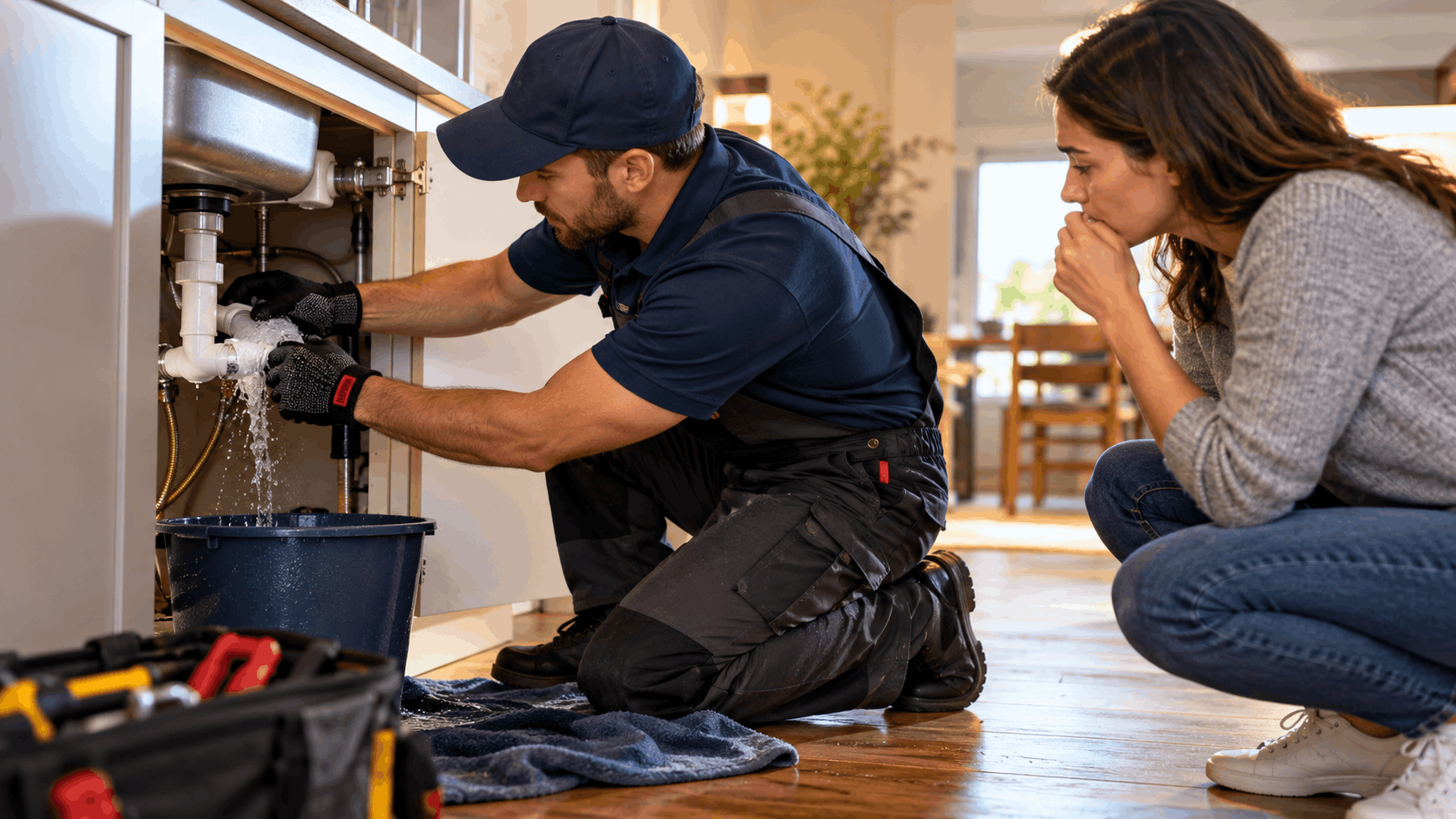
Stopping the water is the homeowner's job in the first five minutes. Finding the break is ours. On a weeknight call, the goal is to locate the failure precisely, confirm what the pipe is made of, and get as much water back to the family as safely possible overnight.
A fast, accurate diagnosis keeps the repair small. The difference between a clean spot repair and a torn-apart room often comes down to how well the break was located before anyone cut into anything.
Reading the Signs: Walls, Ceilings and Slab
The first diagnostic tool is observation. Visible water tells part of the story, but where and how it shows up points to where the break actually sits. Water staining a ceiling or running down the inside of a wall usually means a supply line failure in that wall or the floor above.
A slab home speaks differently. A warm spot on the floor is a strong clue that a hot water line under the slab has failed, since the escaping hot water heats the concrete above it. A cold damp patch suggests a cold line instead, and either one can appear far from the source as water travels along the slab before surfacing.
The water meter is a quiet witness. With every fixture in the home shut off, a meter that is still creeping or spinning confirms water is leaving the system somewhere, even when nothing is visible. That single test often tells us whether the leak is active and roughly how large it is.
Reading these signs correctly narrows the search before any detection gear comes out. It is the difference between opening one small section of wall or floor and chasing a leak blindly across a house.
Electronic and Slab Leak Detection
When the break is hidden, electronic leak detection does the pinpointing. Acoustic listening equipment picks up the sound of water escaping under pressure, even through concrete, and specialized sensors help trace the line's path and narrow the leak to a small area.
On slab homes in Green Valley South, this is what keeps a repair from becoming a demolition. Rather than cutting open a large stretch of floor hoping to find the break, the equipment locates it within a tight zone so the opening is kept as small as the repair allows. That saves flooring, saves time, and saves money.
The same approach applies to leaks buried in walls or under cabinets. Electronic tools confirm the exact location before anyone picks up a saw, which is especially valuable at night when you want the problem solved without tearing up half the house in the dark.
These methods are why our electronic leak detection matters so much on a slab home. Finding the break precisely is half the job, and it is the half that protects your floors and your budget.
Isolating the Line to Restore Partial Water
Nobody wants to go a full night with the main shut off and no water anywhere in the house. Once the failed section is located, we can often isolate just that line rather than leaving the whole home dry.
By closing off or capping the damaged branch, we can restore water to the rest of the home while the full repair is scheduled. That might mean a working kitchen and one bathroom overnight even though the failed line stays shut until the proper fix is done. For a family with kids, that difference is a real comfort.
Isolation also lets us do the repair properly rather than rushing a permanent fix in poor overnight conditions. A temporary isolation plus a scheduled complete repair often produces a better result than a hurried patch at midnight.
We walk the homeowner through exactly what is on and what is off before we leave, so there are no surprises. The plan is always to leave the house functional and safe until the repair is finished.
The Repair Options Once the Break Is Found
With the break located and confirmed, the next question is how to fix it. The right path depends on the pipe material, where the break sits, and whether the failure looks like a one-off or the start of a pattern. There is no single answer that fits every home.
Our job is to lay out the realistic options honestly so the homeowner can decide with full information. Here are the paths that come up most in Green Valley South homes.
Spot Repair of a Single Burst
When a burst is a genuine one-off, a spot repair is the clean answer. This applies most often to copper and PEX systems, where a single failure at a specific point does not signal a wider problem with the rest of the piping.
A spot repair means cutting out the damaged section and splicing in a new piece with proper fittings. For copper, that involves soldering or pressing in a new length. For PEX, it means cutting the bad section and joining fresh pipe with crimp or expansion fittings. Either way, the repair is limited to the failed spot.
The access determines how disruptive it is. A burst in an accessible wall cavity or above a dropped ceiling is quick to reach. A burst behind finished drywall means opening a small section of wall, which is patched and refinished afterward.
For a sound system with one failure, a spot repair restores the home with minimal cost and disruption. It is the right call when inspection confirms the rest of the piping is in good shape and the burst was isolated.
When One Burst Means a Repipe Is Coming
Polybutylene changes the math. Because poly fails repeatedly at its fittings, one burst in a poly system is often a warning rather than an isolated event. Patching a single fitting on a poly line frequently just moves the next failure down the pipe.
When inspection confirms polybutylene throughout the home, a whole-house repipe is the standard candidate. Replacing the entire supply system with modern pipe ends the cycle of recurring leaks instead of chasing one fitting after another. It is a bigger project up front, but it solves the underlying material problem for good.
A repipe reroutes new supply lines through walls, ceilings or attic space, connecting fresh pipe to every fixture. The old poly is abandoned or removed, and the home gets a clean, reliable system. We only recommend this after confirming the pipe is poly and assessing the full scope on site.
If that is the direction, we explain exactly what the pipe and fixture work involves and give a written price before anything starts. A repipe is a decision, not a surprise, and the homeowner always sees the cost first.
Rerouting Under-Slab Lines
A break under the slab presents a choice. One option is to cut into the concrete, make an in-place repair, then patch the slab and flooring. The other is to abandon the failed under-slab line and reroute a new line overhead through the attic and down the walls, bypassing the slab entirely.
Cutting the slab gets to the original line directly, but it means breaking concrete, repairing the floor, and the mess that comes with it. If the rest of the under-slab piping is sound and the break is isolated, an in-place repair can make sense.
Rerouting avoids tearing up the floor and takes the line out of the slab, which can be the better long-term move if under-slab lines are aging or if multiple failures are likely. The tradeoff is running new pipe through the structure and patching walls rather than concrete.
Both have their place, and the right call depends on the pipe's condition, the location of the break, and the home's layout. We walk through the tradeoffs so the homeowner understands why one approach fits their situation better than the other.
Materials We Work On and Match
Copper and PEX dominate repairs in Green Valley South homes, and both are materials we work on routinely. Copper has been widespread across the valley's middle decades of construction, while PEX is standard in newer and repiped homes. A clean repair matches the existing system or transitions to new pipe with proper fittings.
Polybutylene, as covered above, is the material that tends to drive repipes rather than spot repairs. Where it is present, it is the exception that changes the plan.
Kitec belongs to a later window than the original Green Valley build era, so in a neighborhood of this age it would only appear through a prior remodel or repipe rather than as original material. If it turns up, it is a sign the home was worked on at some point, and inspection settles what is actually there.
The constant across all of this is that material is confirmed on site, never assumed from the build year. Two homes of the same vintage can hold different pipe, and the repair plan follows what we actually find behind the wall or under the slab.
Permits, Code and Who Governs Work in Green Valley South
Here is where local knowledge saves a homeowner real trouble. Green Valley South residents often say they live in Las Vegas, but the jurisdiction that regulates plumbing work here is the City of Henderson. That distinction changes who issues the permit, which code applies, and who to call with a question.
Getting the jurisdiction right before any permitted work begins is a routine first step, and it is one that separates a contractor who knows this area from one who does not.
This Is Henderson, Not Las Vegas
Green Valley South is a neighborhood inside the Green Valley master planned community, in the City of Henderson, Clark County. Henderson is its own incorporated city, separate from Las Vegas and from unincorporated Clark County. Addresses here fall under ZIP codes 89014 and 89074, though the ZIP for a specific address should be confirmed with USPS since ZIP boundaries do not follow neighborhood lines.
Because this is Henderson, building permits are issued by the City of Henderson, not Clark County. The Building Permits counter is at 240 S. Water Street, Henderson. Content that tells a Green Valley South homeowner to go to Clark County for a permit is simply wrong, and that error can delay a job.
Green Valley Parkway runs as the north-south spine of the neighborhood, with landmarks like the Galleria at Sunset, Green Valley Park on North Pecos Road, and the Paseo Verde Library on South Green Valley Parkway all sitting within Henderson's boundaries. Everything plumbing-related here routes through the city, from permits to the water utility.
Knowing you are in Henderson is the foundation for everything that follows. The permit counter, the code edition, and the utility all flow from that single fact about where the address sits.
When a Burst Repair Needs a Permit
Not every burst repair triggers a permit, but some do. Henderson states that a plumbing permit is a separate permit required for new plumbing and larger modifications of existing plumbing systems. A simple spot repair on a single line may be treated differently than a whole-house repipe or a rerouted under-slab line.
Henderson does not publish a plain-language checklist spelling out exactly which jobs need a permit. Because of that, the permit position for a specific water heater swap, repipe or sewer lateral replacement should be confirmed with the Development Services Center at 702-267-3640 before it is quoted to a homeowner.
The Development Services Center can also be reached at cohpermits@cityofhenderson.com, and the counter runs a four-day week, 7:30am to 5:30pm Monday through Thursday excluding holidays. Items submitted after 4:30pm are not processed the same day, which is worth knowing if timing matters.
We handle this confirmation as part of the job so the homeowner is not left guessing. The point is that the permit answer is tied to the specific work and the specific address, and it gets checked rather than assumed.
The Code That Applies Here
Henderson has adopted the 2024 Uniform Plumbing Code together with the Southern Nevada Amendments and Henderson-specific amendments under Title 15 of the municipal code. Henderson records an effective date of January 2, 2026 for these codes, which is the date that governs a Henderson address rather than the county's January 11 date.
The Southern Nevada Amendments are shared across Clark County, Henderson, Las Vegas, North Las Vegas, Boulder City, Pahrump and Mesquite, but each jurisdiction adopts separately. For a burst repair that touches the water heater, a couple of code points come into play. Section 507.5 of the amendments requires a water heater drain pan where leakage could cause damage, with a minimum depth of one and one half inches and a drain of not less than three quarters of an inch to an approved location.
Henderson also publishes standard installation details for earthquake strapping of water heaters, document P-105 under the 2024 codes. If a burst near the heater means the unit gets touched or replaced, these requirements apply.
Code edition details and effective dates change, so the position that governs a specific job is confirmed with the Development Services Center before it is cited. Our water heater services account for these local requirements whenever a heater is part of the picture.
HOA and the Green Valley South Owners Association
Green Valley South Owners Association No. 1 is a real master association covering homes in this area. Interior burst repairs are usually well within an owner's rights, since the work is inside the home and does not alter the exterior.
Where the association can matter is visible exterior work or trenching that crosses common area landscaping. Running a new line that surfaces on an outside wall, or digging across shared landscaping to reroute a buried line, may call for approval. The current governing documents and any architectural submittal form should be requested directly from the association or its manager before scheduling that kind of visible work.
State law backs the owner's basic rights here. NRS 116.2111 provides that a unit owner may make improvements or alterations that do not impair structural integrity or mechanical systems, and that an association may not unreasonably restrict reasonable access to the unit or charge a fee for service providers to enter the community.
One more thing to know: the City of Henderson does not enforce HOA rules. That responsibility sits with the state's Office of the Ombudsman for Owners in Common-Interest Communities. So the city handles the permit, the association handles any exterior approval, and the two are separate tracks.
Need Help in Las Vegas?
Active Plumbing serves Las Vegas and all of Las Vegas Valley.
What a Weeknight Burst Pipe Repair Typically Costs
Cost is the question on every homeowner's mind the moment the water stops. The honest answer is a range, because the price depends on where the break is, what the pipe is made of, and how much access the repair takes. Below are the typical ranges for plumbing work in the Las Vegas Valley, presented as typical area ranges rather than a quote.
The actual price for a specific job is given in writing before any work begins. These figures help you know what to expect going in.
| Service | Typical Las Vegas Valley range |
|---|---|
| Burst pipe repair | $200 to $800 |
| Electronic leak detection | $150 to $350 |
| Slab leak detection | $150 to $300 |
| Slab leak repair | $500 to $3,000 |
| Whole-house repipe | $4,000 to $15,000 |
| After-hours emergency service fee | $150 to $300 plus repair costs |
Burst Pipe Repair and Leak Detection Ranges
For a straightforward burst, burst pipe repair typically runs $200 to $800 in the Las Vegas Valley. That covers locating the failure, cutting out the damaged section, and splicing in new pipe with proper fittings on an accessible line.
When the leak is hidden, detection is its own line item because it protects the rest of the house. Electronic leak detection typically runs $150 to $350, and it is what keeps a repair targeted rather than exploratory.
For a slab home, slab leak detection typically runs $150 to $300 to pinpoint a break under the concrete. The repair that follows, slab leak repair, typically runs $500 to $3,000 depending on access and whether the line is repaired in place or rerouted.
These are typical area ranges, not a fixed price for your job. The specific cost depends on where the break sits and what it takes to reach it, which is why a written price comes after the diagnosis rather than over the phone.
When the Job Grows to a Repipe
If inspection reveals polybutylene that is failing at its fittings, the job can grow from a patch to a repipe. A whole-house repipe typically runs $4,000 to $15,000 in the Las Vegas Valley, which is a wide range because homes vary so much.
What pushes a job toward the higher end is size and complexity. A larger home with more bathrooms, more fixtures and longer pipe runs costs more than a compact single-story. Two-story homes add difficulty because lines must run between floors, and tight or finished walls mean more drywall to open and patch.
Access drives a lot of the number too. A home with an accessible attic for routing new lines is simpler than one where pipe must snake through finished ceilings and walls. The finish work of patching and restoring everything afterward is part of the total.
A repipe is an investment, but for a poly system it ends the recurring leaks rather than paying for one patch after another. The scope and price are confirmed after on-site inspection, and the written figure comes before work starts.
After-Hours Fees and Why Caliche Adds Cost
A weeknight burst that cannot wait until morning is an after-hours call, which carries a service fee of $150 to $300 plus repair costs. That fee reflects the off-hours response and is separate from the repair itself.
Any job that requires digging in Green Valley South runs into caliche. Caliche is a cemented calcium-carbonate hardpan common across the valley, and the Las Vegas soil series here puts a hard, indurated lime layer as shallow as a few inches down. It is abrasive and slow to cut, and engineering studies describe its removal as the greatest problem it creates, driving expense and construction delay.
For plumbing, that means trenching for a sewer lateral, a water service, or a rerouted buried line takes more time and heavier equipment than it would in soft ground. A hand dig can be impractical, and the extra labor and machine time show up in the price of any buried repair.
Caliche is hard to cut, but it does not swell, shift or crack pipes. It is not an expansive soil. What actually moves a buried line over time is poorly compacted backfill settling under the pipe, which is why proper trench restoration and compaction matter as much as the pipe itself. Our sewer and buried line work accounts for these conditions.
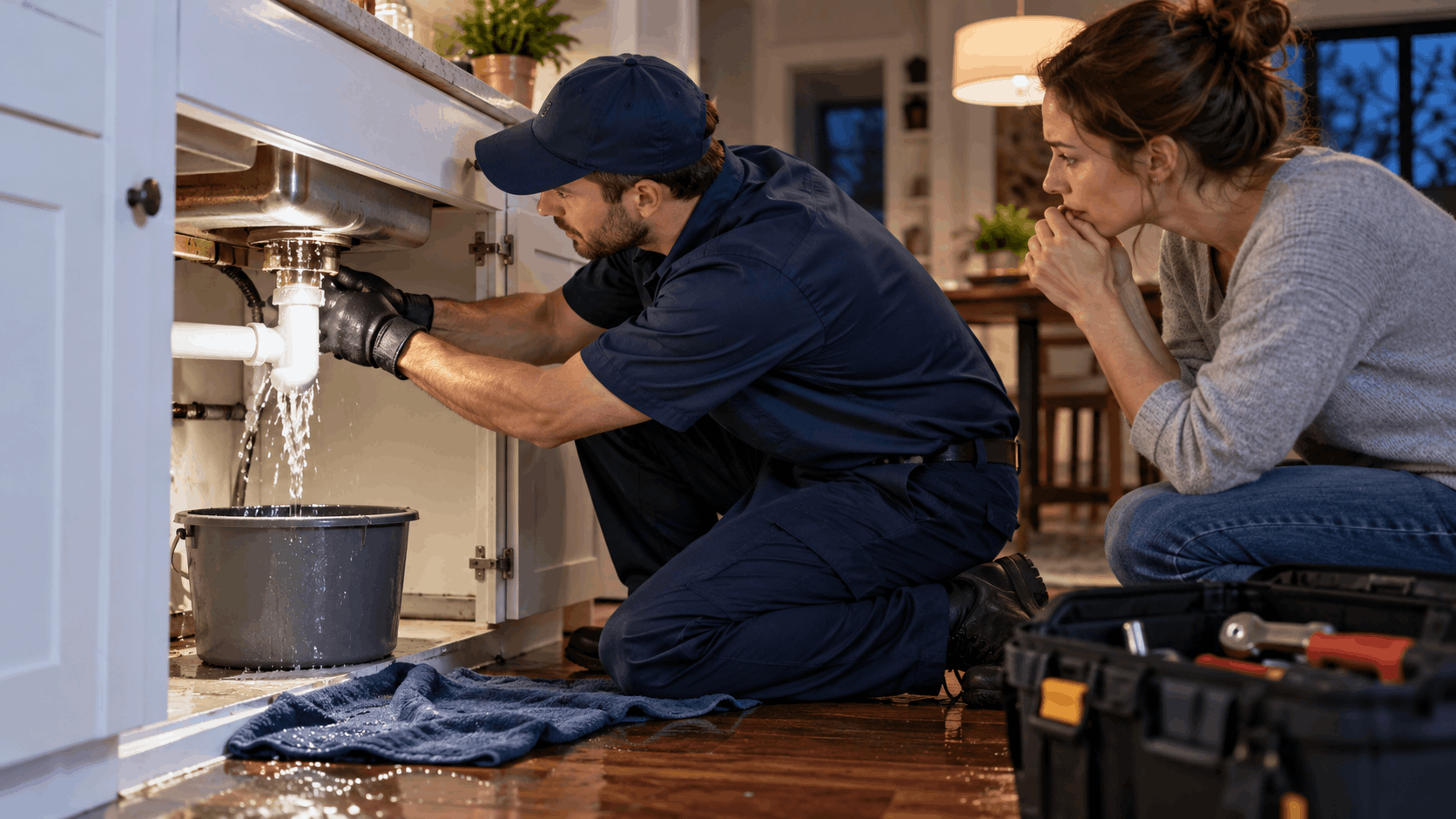
Preventing the Next Burst in Your Home
Once the current emergency is handled, the goal shifts to not repeating it. The three biggest levers in Green Valley South are the hard water, the exposed lines in winter, and knowing your own shutoff. Each one is within a homeowner's reach.
None of these are exotic. They are practical steps tied directly to the local conditions that cause bursts here.
Dealing With Hard Water Before It Damages Pipes
Since the water here is very hard at 280 ppm, managing scale is one of the most effective things a homeowner can do. A whole-house water softener removes the calcium and magnesium that build scale throughout the system, protecting supply lines, valves, the water heater and fixtures.
Salt-free scale-reduction systems are another option, conditioning the water so minerals are less likely to deposit as hard scale. Either approach slows the buildup that narrows pipes and stresses aging lines over the years. In this valley, these systems extend equipment life rather than being optional luxuries.
For the water heater specifically, regular flushing clears the sediment and scale that collect at the bottom of the tank. A tank left unflushed works harder and fails earlier than its rated life, and flushing is a simple maintenance task that pays off here far more than in soft-water regions.
Addressing the water chemistry is the long game against pipe wear. Our water treatment options are a direct response to the hardness that SNWA publishes for the area, and they protect the whole system rather than one fixture at a time.
Protecting Exposed and Garage Lines in Winter
Because desert winter nights can still freeze poorly protected pipe, insulating exposed lines before a cold snap is cheap protection. The targets are the lines outside the home's heated space: hose bibbs, irrigation lines, and the supply runs in the garage.
Foam pipe insulation sleeves slip over exposed runs and bibbs in minutes. Insulated covers made for outdoor faucets add another layer of protection for the most vulnerable points. These are inexpensive items from any hardware store and easy to install yourself.
On the coldest nights of the year, letting a faucet drip slightly keeps water moving so it is less likely to freeze solid in a vulnerable line. Disconnecting garden hoses before winter also prevents water from backing up and freezing at the bibb.
These steps take an afternoon once a year and head off the kind of freeze-thaw burst that floods a garage overnight. For a desert that most people assume never freezes, a little preparation goes a long way.
Knowing Your Shutoff and Checking Older Supply Lines
The best time to find your main shutoff is before you ever need it. Walk the exterior of the home, locate the main valve and the curb-side meter valve, and make sure everyone in the household knows where they are and how to close them. In the panic of a burst, that knowledge is worth more than any tool.
Test the valve occasionally to make sure it actually turns and seals, since a valve that has not moved in years can seize. If it is stiff or will not close fully, having it serviced now beats discovering the problem mid-flood.
For older Green Valley South homes, having the supply lines inspected is a smart move, especially if polybutylene is suspected. An inspection at the meter, the water heater connection and any accessible stub confirms what the pipe actually is, which tells you whether you are living with a material prone to repeat failures.
Catching a poly system before it bursts lets you plan a repipe on your schedule rather than reacting to a 9pm flood. Knowing your shutoff and knowing your pipe are the two pieces of knowledge that turn an emergency into a manageable event.
Need Help in Las Vegas?
Active Plumbing serves Las Vegas and all of Las Vegas Valley.
How Our Team Handles a Burst Pipe Call in Green Valley South
When you call about a burst pipe, you want to know how fast help arrives, what it will cost, and whether the company is legitimate. Here is exactly how Active Plumbing works a weeknight burst call in this part of Henderson.
Our Response Window Across the Valley
Our technicians arrive in 30 to 60 minutes anywhere in the Las Vegas Valley, and that includes Green Valley South. Whether the address is near Green Valley Parkway, close to the Galleria at Sunset, or over by the Paseo Verde Library, we know the routes and reach the home quickly.
A burst pipe does not keep business hours, which is why a fast response window matters on a weeknight. The sooner we arrive, the sooner the water is controlled and the damage stops spreading. Our 24/7 emergency plumbing is built for exactly this kind of after-dark call.
Knowing the neighborhood matters more than it sounds. A plumber who already understands that Green Valley South is Henderson, that the homes are slab-on-grade, and that older ones may hide polybutylene shows up ready to diagnose rather than orient. That local familiarity shortens the whole visit.
We serve the full valley, and Henderson is squarely within our coverage. Green Valley South homeowners get the same response window as anywhere else we work.
Diagnosis and a Written Price Before Work Starts
Once we arrive, we find the break, confirm the pipe material on site, and lay out the repair options. Whether that is a spot repair, a reroute, or a repipe after an inspection, we explain what each path involves so the homeowner can make an informed call.
Then we give a written price before any work begins. The homeowner knows the cost up front rather than finding out at the end. That written number is a business practice we stand behind, and it means no surprises once the job is done.
This order matters: diagnosis first, price second, work third. Pricing a repair before the break is even located would be a guess, and nobody should pay for a guess. Finding the problem precisely is what lets us quote it accurately.
For hidden leaks, that diagnosis leans on tools like slab leak detection so the written price reflects the real scope rather than worst-case assumptions.
Licensed, Local and Easy to Verify
Active Plumbing is a fourth-generation family business that has served the Las Vegas Valley since 1991. We hold Nevada plumbing license NSCB #0047021, which anyone can verify free at nvcontractorsboard.com, where classification, status, bond and workers compensation are all public record.
Licensing in Nevada is statewide through the Nevada State Contractors Board, not issued by any city or county. In a market with a real unlicensed trade problem, being able to check a license number before anyone enters your home is worth doing. We encourage it.
For Green Valley South, we handle the jurisdiction correctly, treating the address as the City of Henderson it is. That means the right permit counter, the right code edition, and the right utility, rather than defaulting to Clark County or Las Vegas assumptions.
Four generations of plumbing in this valley means we have seen the build eras, the pipe materials and the soil conditions that define Green Valley South. That experience is what you are hiring when you call.
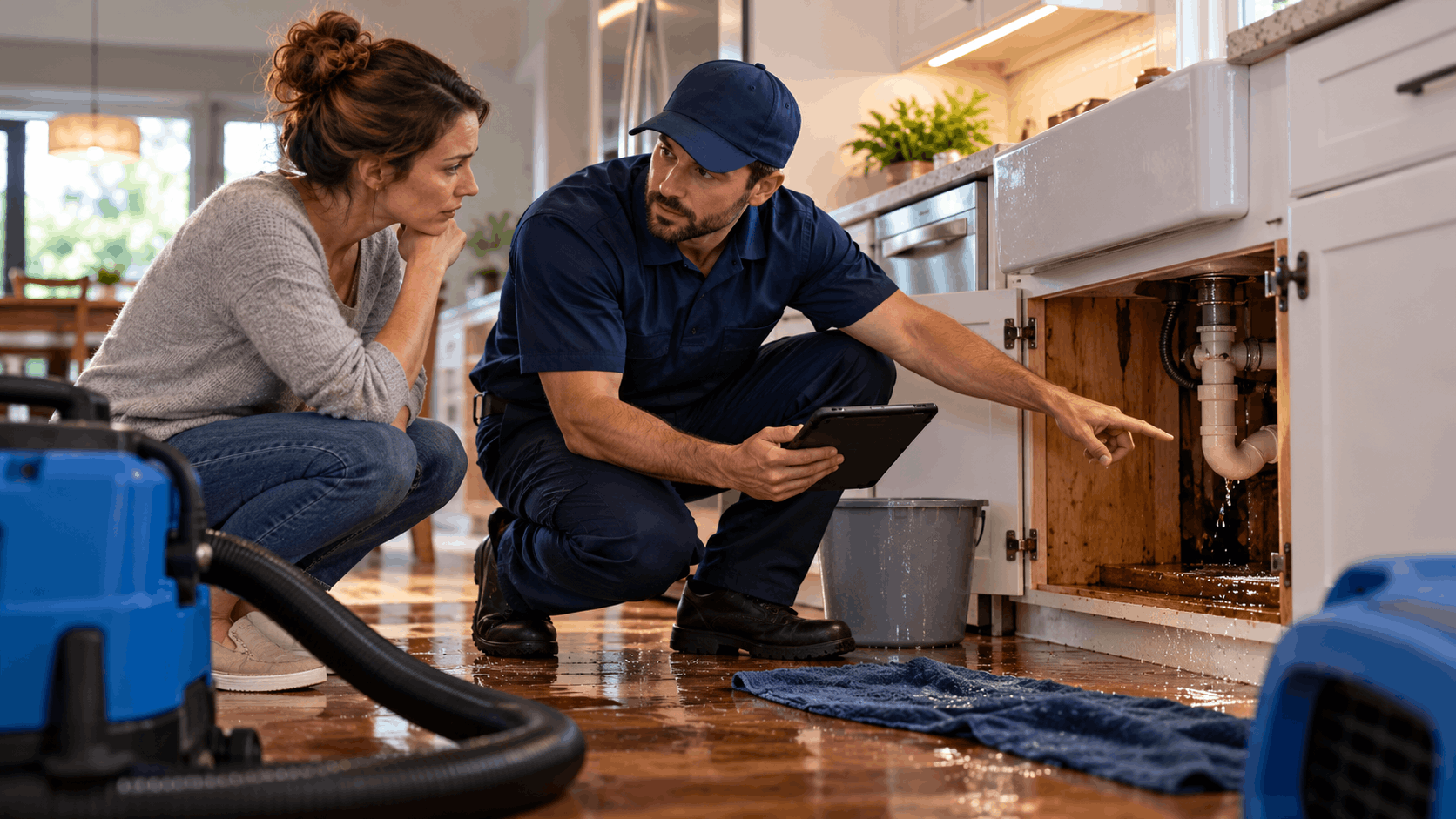
Getting Your Water Back Under Control
A burst pipe on a weeknight is stressful, but it is a solvable problem once the water is off and the right help is on the way. Shut the main, protect the house, and call in a licensed pro who knows that Green Valley South is Henderson and knows what is likely behind these walls.
We find the break, explain your options, and give you a written price before any work starts, with technicians reaching Green Valley South in 30 to 60 minutes. Call Active Plumbing at (702) 438-3357 when a pipe lets go, and verify our license, NSCB #0047021, anytime at nvcontractorsboard.com. For more on local water conditions, the Southern Nevada Water Authority publishes the valley's hardness figures, and the City of Henderson handles permits for your address.
Frequently Asked Questions
- What should I do first when a pipe bursts at night?
- Shut the main water valve first, since that stops all water feeding the burst at once. On a slab home like most in Green Valley South, the main is usually at ground level on the exterior or at the curb-side meter, with no basement to check. Next, cut power to flooded rooms if you can reach the panel safely without standing in water. Then open the lowest faucets to drain the lines and call a plumber.
- How fast can a plumber get to Green Valley South on a weeknight?
- Our technicians arrive in 30 to 60 minutes anywhere in the Las Vegas Valley, and that includes Green Valley South. Whether the address is near Green Valley Parkway, the Galleria at Sunset, or over by Cornerstone Park, we know the routes and respond quickly. A fast response window matters most on a weeknight burst, because the sooner the water is controlled, the less damage spreads through the home overnight.
- How much does burst pipe repair cost here?
- Burst pipe repair typically runs $200 to $800 in the Las Vegas Valley for a straightforward break on an accessible line. A weeknight call that cannot wait until morning carries an after-hours emergency service fee of $150 to $300 plus the repair costs. These are typical area ranges, not a quote. The actual price depends on where the break sits and what it takes to reach it, and we give a written price before work starts.
- Why do pipes burst in Henderson if it rarely freezes?
- Cold is only one cause here. Older Green Valley South homes may have polybutylene supply lines that fail at their fittings over time, often producing one leak after another. Very hard water at 280 ppm deposits scale that narrows pipes and stresses aging lines. And while the desert rarely freezes, winter nights can still drop below freezing and crack exposed hose bibbs and garage lines. Any of these can cause a burst without a hard freeze.
- Does a burst pipe repair need a permit in Henderson?
- Henderson requires a plumbing permit for new plumbing and larger modifications of existing systems, so a whole-house repipe is more likely to need one than a simple spot repair. The city does not publish a plain-language checklist of which jobs qualify, so the permit position for a specific job should be confirmed with the Development Services Center at 702-267-3640. Remember this is Henderson, not Clark County, so permits come from the City of Henderson at 240 S. Water Street.
- How do I know if my home has polybutylene pipe?
- Polybutylene is plausible in older Green Valley South homes because it was installed widely in the late 1970s and 1980s, overlapping the Green Valley build era. But build year alone never confirms it. The pipe has to be checked by inspection at the water meter, at the water heater connection, and at any accessible stub where it is visible. Polybutylene is usually a gray or blue plastic, and only a physical look settles whether your home actually has it.
- Will one burst mean I need a whole-house repipe?
- Not always. A single burst in copper or PEX usually gets a clean spot repair, since those materials do not signal a wider problem from one failure. But polybutylene fails repeatedly at its fittings, so one burst in a poly system often points to more failures ahead and makes a whole-house repipe the standard candidate. Which path fits your home is confirmed after inspection of the actual pipe behind the walls.
- What is a slab leak and why is it common here?
- A slab leak is a break in a water line running beneath or within the concrete slab the home sits on. Slab-on-grade construction is standard across this part of Henderson, which makes under-slab supply line failures their own category of problem. Instead of spraying into a room, the water is trapped under the concrete and shows up as a warm floor spot, a running meter or a damp patch. Electronic slab leak detection pinpoints it without tearing up the whole floor.
- Why does trenching for a pipe cost more in Green Valley South?
- Caliche is the reason. It is a cemented calcium-carbonate hardpan common across the valley, and the local soil puts a hard lime layer as shallow as a few inches down. Caliche is abrasive and slow to cut, and removing it is the greatest cost it creates, driving up trenching time and equipment needs. Any buried repair, like a sewer lateral or a rerouted water line, takes more labor and heavier machinery here than it would in soft ground.
- Who do I call if I smell gas near my water heater?
- Leave the building right away. Do not flip light switches, light anything, or do anything that could create a spark on your way out. Once everyone is outside, call Southwest Gas, which supplies natural gas across the Las Vegas Valley, and let them respond before anyone goes back in. Only after the gas situation is cleared should you call a plumber for the water side. Never try to repair, cap or reconnect a gas line yourself.
Licensed plumbing professionals serving Las Vegas and Las Vegas Valley.
Licensed in Nevada · License #0047021
Last updated on
Why trust Active Plumbing?
Founded in 1991, Active Plumbing is a licensed and insured plumber serving Las Vegas and Las Vegas Valley. All content is reviewed by our licensed technicians.

Need Help in Las Vegas?
Active Plumbing serves Las Vegas and all of Las Vegas Valley.
Related Articles
Burst Pipe in a Las Vegas Two-Story: The Upstairs-to-Downstairs Damage Clock
A burst pipe upstairs floods the rooms below fast. Learn the minute-by-minute damage clock, first response steps, and how Active Plumbing handles two-story emergencies across the Las Vegas valley.
What Henderson Homeowners in Green Valley Should Know About Aging Pipes
Green Valley homes from the 1980s and 1990s are hitting the age where pipes fail. Learn the warning signs, pipe materials, and repair options for aging Henderson plumbing.
Water Damage Claims in Spring Valley and What Insurance Covers on a Burst Pipe
Most Spring Valley homeowner policies cover sudden water damage from a burst pipe but not the pipe repair itself. Here is what is covered, why pipes fail here, and how to file.