Water Heater Replacement Cost in Paradise Palms for 1960s Palmer and Krisel Homes
Key Takeaways
- Tank water heater installation runs $800 to $1,500 and tankless runs $1,500 to $3,500 in the Las Vegas Valley, with a hard water pre-filter adding $150 to $300.
- Palmer and Krisel homes are post-and-beam with flat roofs and little attic, so lines and venting run through walls and soffits, adding labor and cost.
- Homes built 1960 to 1964 carry aging era copper and cast iron, and restored homes often mix materials, so connections are inspected before a new heater goes on.
- Valley water is 280 ppm, about 16 grains per gallon, very hard, so scale shortens heater life and fouls fixtures unless treatment and flushing are in place.
- Paradise is unincorporated Clark County, so permits run through the Clark County Department of Building and Fire Prevention, and the historic overlay affects visible exterior equipment.
- Slab-on-grade homes with restored terrazzo make rerouting the preferred fix over breaking the slab, and caliche makes exterior excavation slower.
- Active Plumbing holds Nevada license NSCB #0047021, has served the valley since 1991, and gives a written price before work starts with a 30 to 60 minute arrival window.
In This Article
A homeowner on one of the streets ringing Las Vegas National Golf Club notices the hot water fading fast in a bathroom they spent two years restoring. The water heater in the closet is original to the era, and now it is failing. The first question they ask is simple: what will this cost, and why does their 1960s home seem to complicate it?
Here is the direct answer. In the Las Vegas Valley, tank water heater installation typically runs $800 to $1,500, and tankless water heater installation typically runs $1,500 to $3,500, with a pre-filter adding $150 to $300 where hard water calls for one. Those are typical area ranges, not a quote. The real number for a specific Paradise Palms home is set in writing before any work begins.
What pushes these homes outside the ordinary is their build. The Palmer and Krisel plans that shaped much of Paradise Palms are post-and-beam with flat or low-pitch roofs and little accessible attic, so the easy routes a plumber normally uses are gone. Add sixty-five years of era copper and cast iron, very hard water, and a historic overlay, and the job needs real planning. This guide walks through all of it.
What Water Heater Replacement Costs in Paradise Palms?
Water heater work in the valley falls into clear price bands, and knowing them up front helps a Paradise Palms owner judge any quote. These are typical ranges for the area, copied exactly, not a fixed price from us. The actual figure for a specific home near the golf course depends on access, the pipe behind the heater, and where the unit can physically go.
The ranges that apply to most heater jobs are these. Tank water heater installation runs $800 to $1,500. Tankless water heater installation runs $1,500 to $3,500, with a pre-filter adding $150 to $300 where hard water calls for one. Water heater repair runs $150 to $500, tankless maintenance and descaling runs $150 to $250, and recirculation pump installation runs $400 to $900.
| Service | Typical Las Vegas Valley Range |
|---|---|
| Tank water heater installation | $800 to $1,500 |
| Tankless water heater installation | $1,500 to $3,500 |
| Tankless hard water pre-filter | $150 to $300 |
| Water heater repair | $150 to $500 |
| Tankless maintenance and descaling | $150 to $250 |
| Recirculation pump installation | $400 to $900 |
| After-hours emergency service fee | $150 to $300 plus repair costs |
In a conventional tract home, these ranges land where you expect. In a Paradise Palms home around Desert Inn Road and Eastern Avenue, the routing and the aging pipe can move the labor portion of a quote. That is why the written price matters more here than a ballpark figure ever could.
Tank Water Heater Installation Ranges
A straight tank swap sits in the $800 to $1,500 range for most homes. That covers removing the old unit, setting the new one, making the water and gas or electric connections, and bringing the install up to current requirements. On a decades-old heater, the surrounding fittings and shutoff valves have often aged alongside the tank, so a fair quote accounts for what the new unit ties into rather than just the tank itself.
Repair runs $150 to $500 and makes sense when the tank itself is sound and the failure is a part. A thermocouple, a gas valve, a heating element, or a thermostat can be replaced, and on a younger heater that is money well spent. The calculation changes on an older unit where the tank is the weak point.
Once a tank is well past its rated life, repair becomes a short-term patch. A sixty-plus-year-old home has often had its heater replaced at least once, but even a twelve-year-old tank in this water is working against heavy scale. When the tank bottom is corroded or the unit is leaking from the shell, replacement is the honest recommendation because a repair will not hold.
Our team looks at the age, the condition of the tank, and the cost of the specific repair against a new install. If the repair is more than a fraction of a replacement and the tank is old, putting money into a new unit protects the home better. For water heater services in Paradise, that judgment is made on site, not over the phone.
Tankless Installation and the Hard Water Pre-Filter
Tankless water heater installation runs $1,500 to $3,500, a higher number than a tank for good reasons. A tankless unit heats water on demand through a narrow heat exchanger, and installing one often means gas line and venting changes that a tank does not require. In a flat-roof Paradise Palms home, that venting work is part of why the number sits where it does.
The pre-filter add of $150 to $300 is not an upsell here, it is a response to the water. The Southern Nevada Water Authority reports valley water at about 280 parts per million, or roughly 16 grains per gallon, which is categorized very hard. That calcium and magnesium is exactly what scales inside a tankless heat exchanger.
Because the heat exchanger is a narrow passage, scale accelerates failure there faster than it does in a roomy tank. A pre-filter and planned descaling keep that passage clear. Skipping both in this water shortens the life of the most expensive part of the unit, so we treat the pre-filter as standard rather than optional when installing a tankless water heater in the valley.
The payoff is a unit that lasts the way it should and keeps delivering continuous hot water. For a restored home where the owner wants the install done once and done right, the pre-filter protects the investment they just made in the heater.
Add-Ons That Change the Number
A recirculation pump runs $400 to $900 and solves the wait for hot water in a longer run of pipe. In a mid-century home with the heater in a garage or closet at one end, a bathroom at the far end can take a while to warm up. A pump moves hot water through a loop so it arrives faster, and recirculation pump installation is often scheduled alongside a heater replacement.
Tankless maintenance and descaling runs $150 to $250 and is the ongoing care a tankless unit needs in this water. Descaling flushes the scale out of the heat exchanger before it builds up enough to choke the flow. In very hard water, this is the service that keeps a tankless unit on its rated life rather than failing early.
An older home's existing setup pushes a quote in both directions. If the gas line, venting, and connections are in good shape and sized right, the job is cleaner and the number lands lower in the range. If they need upsizing, rerouting, or replacement sections, the labor climbs.
None of these add-ons are guessed in advance. The on-site look tells us which ones a given home actually needs, and the written price reflects that specific house rather than a generic bundle.
Get Your Quote
Tell us what's going on and we'll get back to you. We're open 24/7.
Why Palmer and Krisel Homes Cost More to Replace a Heater?
About 400 of the homes in Paradise Palms were designed by Palmer and Krisel, the Southern California modernist firm, and built between 1960 and 1964. Their signature post-and-beam construction, with exposed beams and flat or low-pitch roofs, is beautiful and well worth preserving. For a plumber, it is also a real constraint that changes how a heater gets replaced.
In a conventional pitched-roof house from the 1960s, a plumber has an accessible attic to run new supply lines and venting through. That attic is the default path, and it keeps labor down. Palmer and Krisel homes have little or no accessible attic, so that default path simply does not exist here.
When the easy route is gone, the work moves into walls, soffits, and other planned paths. That takes longer and costs more than the same job on a standard tract house, and an accurate quote reflects it. A plumber who prices a Paradise Palms heater like a conventional home will be wrong on the day the crew arrives.
Little or No Attic Space for Routing
The minimal attic space in these homes is the single biggest reason labor runs higher. New supply lines and new venting have to find a route, and when there is no attic to drop them through, they run through wall cavities, soffits, and chases instead. Each of those routes is slower to open, work in, and close back up cleanly.
On a repipe or a heater change that needs new line, this is where the hours go. A pitched-roof home lets a plumber run pipe overhead in an afternoon. A flat-roof post-and-beam home can turn the same length of pipe into a multi-day planning exercise around beams and finishes.
Venting a combustion appliance has the same problem. A gas unit needs a vent path that works with the structure, and without an attic to route through, that path has to be mapped before the quote is firm. This is why we walk the home first rather than assume a route.
The upside of planning it properly is a clean install that respects the architecture and the restored finishes. Owners who have spent years on their homes understand that a careful route through walls and soffits is worth more than a fast, messy one.
Where the Heater Can Actually Go
Ceiling-mounted or attic-mounted equipment is frequently not an option in these homes, which rules out a placement a plumber might default to elsewhere. In a flat-roof house with no attic, there is no overhead cavity to hide a unit. Placement has to be planned around the structure that actually exists.
That usually means a garage, a closet, or an existing mechanical space, wherever the original builder put the heater. Working with that footprint keeps the job sane and avoids cutting into beams or finished ceilings. It also tends to keep the venting and connections shorter, which helps the number.
When an owner wants to move the heater or switch to a tankless unit on an exterior wall, that is a design decision, not an assumption. We look at what the structure allows and what the overlay permits before recommending a spot. Guessing a location and discovering mid-job that it will not work is exactly what drives bad quotes.
Every Paradise Palms home has its own quirks from sixty-five years of ownership and renovation. Confirming where the unit can go on site is how we keep the install predictable and the price honest.
Venting on a Flat Roof Structure
Venting a replacement unit has to work with a flat roof rather than a conventional attic, and that shapes both the unit chosen and the labor. A gas water heater needs a safe vent path to the exterior, and a flat roof changes how that path is built compared with a home that has an attic and a sloped roof to work with.
This is one reason the unit type matters. A direct-vent or power-vent configuration may suit a flat-roof home better than a traditional atmospheric vent, depending on the space. Matching the unit to the venting reality here avoids forcing a design that the structure fights.
The labor to run and seal venting through a flat roof assembly is more involved than dropping a flue into an attic. That work has to be done right the first time, because a flat roof penetration that leaks shows up as a bigger problem down the line. We plan it before the quote so the price covers the real venting job.
For owners weighing their options, the venting constraint often nudges the tank-versus-tankless decision. A tankless unit's venting needs are different again, and that is folded into the recommendation rather than treated as an afterthought.
Need Help in Las Vegas?
Active Plumbing serves Las Vegas and all of Las Vegas Valley.
Sixty-Five Years of Pipe Behind the Heater
Housing from 1960 to 1964 in this valley typically carries copper supply of that era and cast iron drain, waste, and vent piping. That is what sits behind a Paradise Palms water heater, and its condition can turn a simple swap into a larger job. A heater does not live in isolation, it ties into the pipe around it.
Sixty-five-year-old copper is well past the age where pinhole leaks begin, and cast iron scales, cracks, and separates at joints over that span. Many of these homes have also been renovated repeatedly by owners restoring them, so one property can hold original copper, later repairs, and modern PEX all at once. None of that shows until a plumber opens the connections.
The honest approach is to inspect the pipe the new heater will connect to before setting the unit. Finding aging copper or a corroded joint at the shutoff after the new tank is in is the kind of surprise that undoes a clean install. We check first so the quote reflects the pipe, not just the heater.
Aging Copper on the Hot Side
Copper from the early 1960s has had sixty-five years to thin and corrode from the inside. The hot side runs harder than the cold, and pinhole leaks tend to show up on hot lines first, often right near the heater where temperatures are highest. That makes the connections at the heater a prime spot to inspect.
Very hard water plays into this. Scale narrows the bore of supply lines over the years and adds to the stress on aging copper. A line that was fine for decades can start to weep at exactly the moment a new, higher-performing heater is pushing hot water through it.
Before a new unit goes on, we look at the copper at the connection points for signs of thinning, green corrosion, or old repairs. Catching a failing section here means it gets handled during the install rather than becoming an emergency a month later. For recurring drips elsewhere in the home, electronic leak detection pinpoints the source without guesswork.
The goal is a new heater connected to sound pipe. A strong unit tied to a failing copper stub is only as reliable as that stub, so the inspection protects the whole install.
Mixed Materials From Past Renovations
Decades of owner restorations leave a patchwork behind the walls. One Paradise Palms home can carry original 1960s copper, later repairs in other materials, and modern PEX where a bathroom or kitchen was redone. That mix is normal in a neighborhood where owners restore and renovate over many years.
Where dissimilar metals meet, galvanic corrosion sets in at the joint. Copper joined directly to a different metal without the right fitting corrodes faster at that connection. A plumber watches for those joints during a heater swap because they are a known weak point in a mixed-material home.
The fix is often a proper dielectric connection or a short section of correct material to tie things together cleanly. Catching a corroding dissimilar-metal joint near the heater during the install keeps it from becoming a leak later. This is the kind of detail that separates a planned job from a rushed one.
Because no two restored homes here have the same history, the only way to know what is behind the heater is to open it and look. We confirm the materials on site rather than assuming from the build year, and the plan adjusts to what we find.
What This Means for the Quote
Connecting a new heater to aging pipe sometimes needs short sections of replacement at the connections. That is not padding, it is the difference between an install that lasts and one that leaks. An honest quote accounts for the pipe the new unit ties into, not just the unit on the invoice.
When the existing copper and fittings at the heater are sound, the connection work is quick and the number stays low in the range. When we find thinned copper, a corroded joint, or a bad dissimilar-metal connection, replacing those short sections during the install is the right call. Doing it now costs less than coming back after a failure.
If the inspection reveals widespread pipe problems rather than a localized issue, that is a different conversation about a larger scope. In some older homes, a whole-house repipe is the better long-term answer than piecemeal repairs. We lay that out plainly rather than surprising an owner mid-job.
The written price captures all of this before work starts. An owner knows what the heater costs, what the connection work costs, and why, so there are no mid-job surprises on the final number.
Very Hard Water and Your Restoration Investment
The Southern Nevada Water Authority states the valley's water is 280 parts per million, or 16 grains per gallon, categorized very hard. Most valley homes, Paradise Palms included, are served with Colorado River water from Lake Mead treated by SNWA. That hardness is the single biggest driver of plumbing wear in this market, and it matters even more in a restored home.
Scale from that hard water builds on water heater elements and tank bottoms, clogs aerators and shower heads, and fouls the small passages inside mixing valves and cartridges. In a Paradise Palms home where the owner has installed period-correct or high-end fixtures, that scale lands on exactly the parts they spent the most on. Treatment here protects a restoration, not just the water.
This is why whole-house treatment is a stronger argument in this neighborhood than almost anywhere else in the valley. The honest framing is that in this water, softeners and regular flushing extend equipment life rather than being optional luxuries.
How Scale Shortens a Heater's Life
Inside a tank, scale settles on the bottom and coats the heating elements. That layer acts like insulation, so the heater has to work harder and run longer to deliver the same hot water. An unflushed tank in this water works harder and fails earlier than its rated life.
On a new install, flushing is the maintenance that keeps that scale from accumulating. Draining the sediment out of the tank on a regular schedule clears the scale before it bakes onto the elements and the tank bottom. In 280 ppm water, this is not a nice-to-have, it is how a tank reaches its full life.
Tankless units feel this even more sharply because the heat exchanger is a narrow passage. Scale accelerates failure there, which is why descaling is part of owning a tankless unit in the valley. The pre-filter slows the buildup and the descaling clears what gets through.
When we set a new heater in a Paradise Palms home, we talk through the flushing or descaling schedule the unit will need. A heater installed without a maintenance plan in this water is a heater set up to fail early, and that defeats the point of replacing it.
Protecting High-End and Period Fixtures
Owners restoring these homes often install period-correct or high-end fixtures, and hard water scale fouls the cartridges and narrow passages inside exactly those fixtures. A pressure-balanced shower valve, a fine faucet cartridge, or a rain shower head all rely on small internal passages that calcium happily clogs. The nicer the fixture, the more it has to lose to scale.
That is the argument for whole-house treatment in this neighborhood. Softening or conditioning the water before it reaches the fixtures protects the spend an owner made on them during restoration. It is cheaper to treat the water than to keep rebuilding fouled cartridges in expensive valves.
The white crusting customers describe as hard water stains is the visible version of the same problem. On restored tile, period fixtures, and polished surfaces, that crusting is a constant battle without treatment. Reducing the scale at the source keeps restored finishes looking the way the owner intended.
For a home that doubles as a preservation project, treatment ties directly to the investment. We frame water treatment around protecting the fixtures and the heater, because in this water that is what it actually does.
Treatment Options and Their Ranges
A whole-house water softener installation runs $800 to $2,500, and salt-free water conditioning runs $800 to $2,500 installed. A softener removes the calcium and magnesium through ion exchange, while a salt-free system reduces scale buildup without removing the minerals. Both cut the scale that fouls heaters and fixtures, and the right choice depends on the home and the owner's preference.
Whole-house filtration also runs $800 to $2,500, and an under-sink reverse osmosis system for drinking water runs $300 to $600 including parts and labor. Ordinary activated carbon handles the chlorine taste and odor in valley water, so treatment here is about hardness and taste rather than exotic needs.
Placement carries a caution in Paradise Palms. A softener or conditioning tank mounted where it is visible from the street sits in a designated historic overlay neighborhood, so visible exterior equipment should be confirmed with Clark County first. Interior or concealed placement avoids the issue entirely.
We plan treatment placement with the overlay in mind, favoring a garage, utility area, or concealed spot. That keeps the home's street-facing character intact while still protecting the plumbing and fixtures inside.
Permits, the County Counter, and the Historic Overlay
Everyone calls a Paradise Palms address Las Vegas, and socially that is right. For permits, it is not. Paradise is unincorporated Clark County, not the City of Las Vegas, so the work runs through the county, and the Historic Neighborhood Overlay adds a layer that affects anything visible on the exterior.
Getting the jurisdiction right before quoting permitted work is a routine first step here. A plumber who tells an owner the county governs their address, and that the overlay applies to street-facing equipment, is showing they actually work this neighborhood. Those two facts shape where equipment can go and who signs off on the job.
Clark County Handles the Permit
The Clark County Department of Building and Fire Prevention governs permits, plan check, and inspections for Paradise Palms addresses. Even though residents and mail call it Las Vegas, the county counter is the authority, not the city. Large populated areas like Paradise are unincorporated Clark County rather than any city.
Permitted plumbing work has to be performed by an appropriately licensed contractor and inspected by the county. A water heater replacement that requires a permit goes through that county process, and the permit position should be confirmed for the specific address before work is scheduled. We handle that confirmation as part of the job.
The code the county applies is the Uniform Plumbing Code with the Southern Nevada Amendments, as adopted and codified by Clark County. Those amendments are expressly not code unless the jurisdiction adopts them, and the Building Official is the authority on any alternate material or method. That is the framework every permitted job here runs under.
For an owner, the practical takeaway is simple. The rule that applies to their heater depends on Clark County, and we confirm the permit requirement for their exact address rather than guessing from a valley-wide assumption.
Exterior Equipment and the Overlay
In 2017 Paradise Palms became the first neighborhood in Clark County to adopt a Historic Neighborhood Overlay, later expanded to cover far more of the community across more than 240 acres west of Eastern Avenue and south of Desert Inn Road. For plumbing, the consequence is narrow but real. Interior work does not change the character of the neighborhood, but visible exterior equipment does.
An exterior tankless unit, a softener or treatment system on a visible elevation, or a new water heater enclosure all sit in a designated overlay neighborhood with preservation-minded neighbors. Mounting equipment where it can be seen from the street should be confirmed with Clark County before the work goes in. That confirmation protects the owner from a problem after the fact.
Interior replacements are a different matter. Swapping a heater inside a garage or closet does not touch the exterior character, so it does not raise the same overlay question. The line is visibility from the street, and we plan placement with that line in mind.
Residents here are organized and actively preservation-minded, and they talk to each other. Respecting the overlay and the architecture is how a contractor earns referrals across this neighborhood rather than a complaint.
Current Drain Pan and Relief Valve Rules
The 2024 Southern Nevada Amendments, adopted across the valley's jurisdictions in 2025, require a water heater drain pan where a leak would cause damage, such as an attic, a floor-ceiling assembly, or similar location. The pan must be at least 1-1/2 inches deep with a drain of not less than 3/4 inch to a visible approved location, and no relief valve discharge into the pan. Readily accessible tankless and point-of-use heaters are an exception.
The relief valve drain inside a building is allowed in specified materials: galvanized steel, hard-drawn copper, CPVC, PP, flexible corrugated connectors, or a listed drain tube running to the exterior. An air gap to a floor sink, mop sink, or funneled floor drain is also permitted. These are the approved paths for discharging a relief valve safely.
These are the general requirements, described here so an owner knows what to expect. They are not the final say over the Building Official, who remains the authority on alternate materials and methods. The specifics for a given install are confirmed against the code as the county applies it.
On a replacement, we set the pan and the relief valve drain to meet these requirements for the home's configuration. Getting it right at install is what passes inspection and protects the home if the heater ever leaks.
Need Help in Las Vegas?
Active Plumbing serves Las Vegas and all of Las Vegas Valley.
Slab-on-Grade and the Golf Course Lots
Paradise Palms homes are slab-on-grade, like most of the valley, and many lots front Las Vegas National Golf Club. Both facts change the stakes on heater and supply work. A slab hides the under-slab lines, and golf course frontage adds yard and irrigation work alongside the house system.
In a home with restored terrazzo, polished concrete, or period flooring an owner has spent years on, a slab problem is a far worse outcome than in an ordinary tract house. That reality shapes how we approach any supply line issue connected to a heater job. The flooring is part of the restoration, and protecting it is part of the plan.
Why Breaking the Slab Is a Last Resort Here
A failed under-slab supply line is not accessible without opening the slab, and in a Paradise Palms home that slab may carry restored terrazzo or polished concrete. Breaking that floor destroys work the owner spent years and real money on. So the conversation starts with detection and a choice between breaking the slab or rerouting the line.
Rerouting is usually the obvious recommendation in these homes. Running a new line through walls or soffits avoids the floor entirely and saves the finish. It costs more in pipe routing but far less than the loss of a restored terrazzo floor, so the math favors the reroute.
This connects directly to heater and supply work. If the line feeding a heater runs under the slab and fails, rerouting keeps the floor intact while restoring the supply. Accurate detection makes that possible, which is why slab leak detection and repair is genuinely valuable in this neighborhood rather than a formality.
We find the leak precisely first, then present the owner with the reroute option and what it protects. In a restored home, that choice is usually easy once the alternative to the floor is clear.
Caliche and Exterior Excavation
Caliche is a cemented calcium-carbonate hardpan common across the valley, and it makes exterior excavation slower and more expensive than softer ground. It is hard to trench through and hard to bed a pipe into evenly. When a heater job touches an exterior supply line or a yard line, caliche belongs in any honest discussion of cost.
Over time, poorly compacted backfill settles under a pipe and pulls it out of grade, which is how bellies and failures develop. That is the mechanism, and it is about the backfill and ground movement, not the caliche itself moving. Caliche is abrasive and it slows the dig, but it does not shift or swell.
For an owner, the practical effect is that exterior digging here takes longer and costs more. A line that would be a quick trench in soft soil becomes a slower job through hardpan. We price that honestly rather than pretending the ground is easy.
When exterior work is part of a heater or supply job, we factor the caliche into the time and the quote. Knowing the ground is part of giving an accurate number in this part of the valley.
Yard Lines Along the Las Vegas National Frontage
Many Paradise Palms lots front Las Vegas National Golf Club at 1911 East Desert Inn Road, which adds irrigation and yard line work alongside the house system. When a heater or supply job is scheduled on one of these lots, the yard side often needs attention too. The golf course frontage means more exterior plumbing to consider.
Irrigation lines, hose bibbs, and backflow assemblies on the exterior face intense UV and summer heat here, which degrades them over the years. On a lot that backs the course, those exterior lines are part of the home's plumbing picture. Bundling the work when a crew is already on site is often the efficient move.
Exterior excavation on these lots runs into the same caliche that makes any valley dig slower. So yard line work along the course carries the same ground considerations as the rest of the exterior. We scope it together with the house system rather than treating it as a separate afterthought.
For owners on the golf course frontage, planning the heater, the supply, and the yard lines as one visit saves repeat trips. That coordination is part of working a neighborhood where the lots and the house system connect.
Tank Versus Tankless for a Mid-Century Home
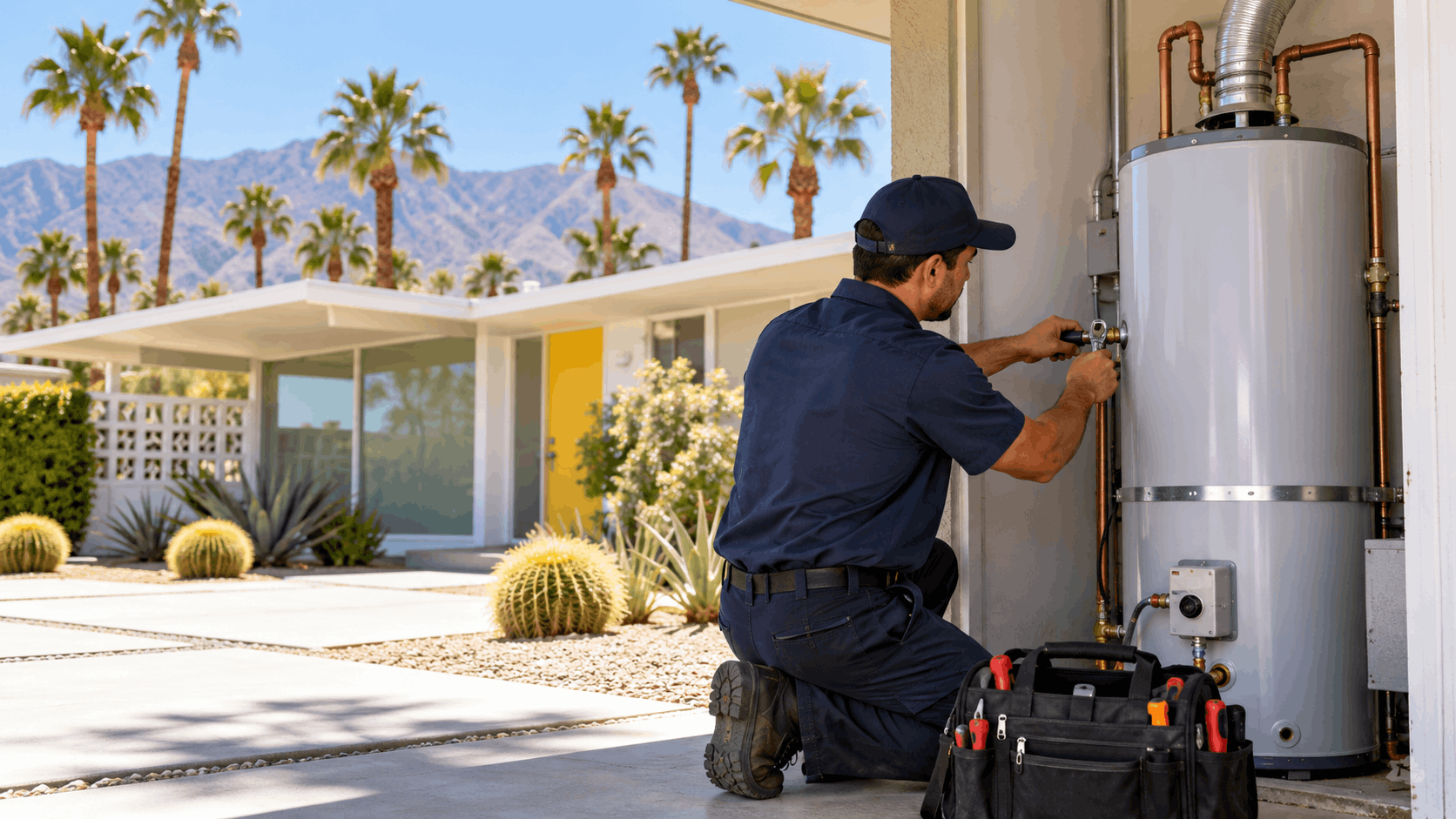
Choosing between a tank and a tankless replacement in a Paradise Palms home comes down to the constraints of a flat-roof, limited-attic house and very hard water. Both work here, and the right answer depends on the home and how the owner uses it. The cost difference is real, so it is worth laying out plainly.
A tank install runs $800 to $1,500 and a tankless install runs $1,500 to $3,500. The venting and space realities of these mid-century homes push the decision in ways they would not in a conventional house. Here is how we weigh it for a 1960s Palmer and Krisel home.
When a Tank Still Makes Sense
A tank is the lower-cost install at $800 to $1,500, and for many of these homes it is the straightforward choice. If the original heater lived in a garage or closet, dropping a new tank into that same footprint is clean and predictable. The venting and connections are already roughed for a tank, which keeps labor down.
The 2024 amendments require a drain pan where a leak would cause damage, and a tank install includes meeting that requirement for the home's layout. Setting the pan and the relief valve drain correctly is part of the standard tank job. In a garage or closet, that is usually simple to accomplish.
A tank also stores hot water, so it handles a burst of simultaneous demand without the sizing math a tankless unit needs. For an owner who wants a reliable, familiar replacement at the lower cost, the tank is often the practical answer. It is the default for good reason in these homes.
The trade-off is the tank's footprint and its need for regular flushing in hard water. If space is tight or the owner wants to free up the closet, that is where tankless enters the conversation.
When Tankless Earns Its Higher Price
Tankless installation at $1,500 to $3,500 earns its higher cost partly through space savings, which matter in a home with no attic and tight mechanical areas. A tankless unit mounts on a wall and takes a fraction of a tank's footprint. In a Palmer and Krisel home where space is at a premium, reclaiming a closet or corner has real value.
Tankless also delivers continuous hot water on demand, which suits a household that runs out of hot water with a tank. There is no reheating a tank, so a long shower or back-to-back use does not drain a reserve. For the right home, that is worth the higher install.
The catch is the water. Scale accelerates failure in the narrow heat exchanger, so a tankless unit here needs a pre-filter at $150 to $300 and regular descaling at $150 to $250. Without both, the most expensive part of the unit scales up and fails early in this water.
When an owner commits to the pre-filter and the descaling schedule, a tankless unit in a mid-century home can be an excellent fit. We make sure that commitment is understood up front, because tankless in valley water without maintenance is a false economy.
Running Costs and the Right Utility
Running costs tie to the right utility, and it is worth knowing which is which. Natural gas in the valley is supplied by Southwest Gas, so gas line work, gas pressure testing, and gas coordination all relate to Southwest Gas. An electric or heat pump unit's running costs tie to NV Energy, which supplies electricity.
That distinction matters when comparing operating cost. A gas heater's bill shows up on the Southwest Gas side, while an electric or heat pump unit's running cost shows on the NV Energy side. Getting the utility right keeps the comparison honest when an owner weighs the options.
On incentives, the federal Energy Efficient Home Improvement Credit under Section 25C applied only to equipment placed in service by December 31, 2025. It ended after that, so it should not be counted on for a new install in 2026. Any current utility or manufacturer rebate should be checked against the live program before relying on it.
We lay out the running-cost picture and the utility that applies so an owner compares tank and tankless on real numbers. Gas line work that comes with a gas heater is handled through our gas line services and coordinated with Southwest Gas where needed.
Need Help in Las Vegas?
Active Plumbing serves Las Vegas and all of Las Vegas Valley.
How Active Plumbing Handles a Replacement in Paradise Palms
A heater replacement in a 1960s Palmer and Krisel home is a planned job, not a parts swap. We approach it by confirming what is actually in the home, mapping a route that respects the architecture, and setting a written price before any work starts. That sequence is what keeps the install predictable in a home where the structure and the pipe both carry surprises.
Active Plumbing is a fourth-generation family plumbing business that has served the Las Vegas Valley since 1991. Working this neighborhood means knowing the county counter, the overlay, the post-and-beam construction, and the very hard water before the crew arrives. Here is how a replacement runs.
On-Site Diagnostic and Route Planning
The job starts with a look in person. We confirm the pipe material on site rather than assuming it from the build year, because a restored Paradise Palms home can hold original copper, later repairs, and modern PEX in the same walls. Knowing what the new heater connects to shapes everything that follows.
Then we plan the route. In a flat-roof, limited-attic home, new line and venting run through walls and soffits, so we map that path before quoting. A route planned around the beams and finishes keeps the install clean and avoids cutting into features an owner has restored.
We also check where the unit can actually go. Ceiling and attic mounting are frequently off the table here, so placement is confirmed against the structure rather than assumed. That means the garage, a closet, or the existing mechanical space, wherever works with the home.
By the time we quote, we know the pipe, the route, and the placement. That diagnostic is why the price holds up on the day the crew arrives rather than shifting mid-job.
A Written Price Before Work Starts
Active Plumbing gives the customer a written price before work begins. It reflects the specific home, the specific pipe, and the specific route, not a valley-wide figure pulled from a chart. An owner sees what the heater costs, what any connection work costs, and why.
This is a business practice, not a guarantee, and it is how we keep a Paradise Palms job free of mid-work surprises. The typical ranges in this guide tell an owner what to expect across the valley. The written price turns those ranges into the real number for their house.
Because the diagnostic comes first, the written price already accounts for the things that move a quote here. The flat roof, the aging copper, the overlay placement question, and the caliche on exterior work are all folded in before the owner signs. Nothing about the home is left to be discovered later.
That up-front clarity is what owners in this preservation-minded neighborhood value. They ask informed questions, and a written price they can read and understand answers them before the work starts.
Licensed, Local, and Verifiable
Plumbing work in Nevada is licensed by the Nevada State Contractors Board. Active Plumbing holds Nevada license NSCB #0047021 and has been licensed since 1991. That license is verified free at nvcontractorsboard.com, where classification, status, bond, and workers compensation are all public record.
Our technicians arrive within 30 to 60 minutes anywhere in the Las Vegas Valley, including Paradise Palms off Desert Inn Road and Eastern Avenue. In a market with a significant unlicensed trade problem, a customer is entitled to ask for a license number and verify it, and we say so plainly.
In restored homes, we protect finishes as we work. The terrazzo, the period fixtures, and the restored surfaces an owner spent years on are treated as part of the job to protect, not obstacles to push past. Respecting the architecture is how this neighborhood judges a contractor.
For scheduling a replacement, owners across Paradise and the wider valley can reach us directly. Our service to Paradise covers the full range of heater, pipe, and treatment work these mid-century homes need.

Ready to Replace Your Paradise Palms Water Heater?
A heater replacement in a restored mid-century home deserves the on-site diagnostic and the written price that match the actual house, not a chart. Call Active Plumbing at (702) 438-3357 to schedule a look at your home.
We confirm the pipe, map the route through your post-and-beam structure, and hand you a written price before any work starts, with license NSCB #0047021 verifiable free at nvcontractorsboard.com.
Frequently Asked Questions
- How much does water heater replacement cost in Paradise Palms?
- Tank water heater installation typically runs $800 to $1,500, and tankless water heater installation runs $1,500 to $3,500, with a hard water pre-filter adding $150 to $300 where one is needed. Those are typical ranges for the Las Vegas Valley, not a quote. In a 1960s Palmer and Krisel home, the real number depends on routing, placement, and the pipe behind the heater, and it is set in writing for the specific house before work begins.
- Why is replacing a heater more expensive in a Palmer and Krisel home?
- These homes are post-and-beam with flat or low-pitch roofs and little or no accessible attic, so the easy overhead route a plumber normally uses is gone. New lines and venting instead run through walls, soffits, and other planned paths, which takes longer and adds labor. Ceiling and attic mounting are frequently not options, and venting has to work with a flat roof structure, all of which pushes the time and the price above a conventional pitched-roof house.
- Do I need a permit to replace a water heater here?
- Paradise is unincorporated Clark County, not the City of Las Vegas, so permitted work runs through the Clark County Department of Building and Fire Prevention for plan check and inspections. Residents call the address Las Vegas, but the county counter governs the work. The permit requirement should be confirmed for your specific address before work is scheduled, and we handle that confirmation as part of setting up the job.
- Does the Historic Neighborhood Overlay affect my water heater?
- Interior replacements do not change the character of the neighborhood, so swapping a heater inside a garage or closet does not raise an overlay question. Visible exterior equipment is different. An exterior tankless unit, a softener on a visible elevation, or a new enclosure sits in a designated overlay neighborhood, so visible mounting should be confirmed with Clark County first. We plan placement to keep street-facing character intact.
- Should I switch to tankless in a 1960s home?
- Tankless offers real space savings in a home with no attic and tight mechanical areas, plus continuous hot water on demand. The trade-off is the higher install at $1,500 to $3,500 and the very hard water. Scale accelerates failure in the narrow heat exchanger, so a tankless unit here needs a pre-filter at $150 to $300 and regular descaling at $150 to $250. With that maintenance committed to, it can be an excellent fit.
- Why does very hard water matter for a new heater?
- The Southern Nevada Water Authority reports valley water at 280 parts per million, or roughly 16 grains per gallon, which is very hard. That mineral content builds scale on a tank's elements and bottom, so an unflushed tank works harder and fails earlier than its rated life. Regular flushing on a tank, or descaling and a pre-filter on a tankless unit, is what keeps a new heater reaching the life it is rated for in this water.
- Do I need to replace pipe when I replace the heater?
- Not always, but it is checked. Homes from 1960 to 1964 carry era copper that is past the age where pinhole leaks begin, and restored homes often mix original copper with later repairs and PEX, creating galvanic corrosion at dissimilar-metal joints. We inspect the connections on site before setting the new unit. If the copper or a joint near the heater is failing, short replacement sections are included so the new heater ties into sound pipe.
- Is there still a federal tax credit for a heat pump water heater?
- The federal Energy Efficient Home Improvement Credit under Section 25C applied only to equipment placed in service by December 31, 2025, and it ended after that date. It should not be counted on for a new install in 2026. Utility or manufacturer rebates may still exist but change often, so any current program should be checked directly before relying on it. We can point you to the live program to confirm what is available now.
- Who do I call about gas line work for a gas water heater?
- Gas line work, gas pressure testing, and gas coordination for a gas water heater relate to Southwest Gas, which supplies natural gas in the valley. NV Energy supplies electricity, so it is the right contact only for electric or heat pump running costs. If you ever suspect a gas leak, leave the building, avoid switches and flames, and call the gas utility from outside first, then call a plumber once you are safely away.
- How fast can a plumber reach Paradise Palms?
- Our technicians arrive within 30 to 60 minutes anywhere in the Las Vegas Valley, including Paradise Palms near Desert Inn Road and Eastern Avenue. For after-hours emergencies, calls carry a service fee of $150 to $300 plus repair costs. A failing heater that is leaking is worth a fast call, because catching it early protects the surrounding floor and the restored finishes many of these homes carry.
Licensed plumbing professionals serving Las Vegas and Las Vegas Valley.
Licensed in Nevada · License #0047021
Last updated on
Why trust Active Plumbing?
Founded in 1991, Active Plumbing is a licensed and insured plumber serving Las Vegas and Las Vegas Valley. All content is reviewed by our licensed technicians.

Need Help in Las Vegas?
Active Plumbing serves Las Vegas and all of Las Vegas Valley.
Related Articles
Water Heater Replacement Cost in Spanish Trail for Multi-Unit and Custom Homes
Water heater replacement cost in Spanish Trail depends on property type, number of heaters, gate access, and very hard water. Get the typical valley ranges and what drives your price.

Water Heater Replacement Cost in Sun City Summerlin for Late 1980s and 1990s Homes
What water heater replacement really costs in Sun City Summerlin homes from 1989 to the 1990s, shaped by unit type, the 2024 code, hard water, and City of Las Vegas permits.
Water Heater Replacement Cost in The Lakes for 1980s and 1990s Homes
Water heater replacement cost in The Lakes: tank $800-$1,500, tankless $1,500-$3,500. See what 1980s-90s homes need, how hard water and City of Las Vegas permits factor in.