Sewer Line Repair in Paradise and Winchester: 60s-70s Clay Pipe Root Intrusion Capital of the Valley
Key Takeaways
- Homes built in Paradise and Winchester during the 1960s and 70s were plumbed with vitrified clay pipe that is now past its 50-60 year lifespan.
- Mature mesquite, ash, and mulberry trees chase water into cracked bell-and-spigot joints, making this the root intrusion capital of the valley.
- Recurring backups, gurgling toilets, sewer smells, wet yard spots, and a strip of extra-green grass are the top warning signs of root trouble.
- A sewer camera inspection pinpoints roots, offset joints, and collapse, and locates the pipe's depth and path so no one digs blind.
- Repair options range from hydro jetting and CIPP lining to pipe bursting and full dig-and-replace, priced from a few hundred to over $20,000.
- Sewer work in Clark County usually needs a permit and inspection, which Active Plumbing handles as part of the job.
- Root barriers, foaming treatments, smart tree placement, and upgrading clay to PVC are the best ways to stop roots long term.
- Active Plumbing offers upfront written quotes, trenchless equipment that saves your yard, and fast emergency response across the valley.
In This Article
It usually starts with a slow bathtub. Then the toilet gurgles when the washing machine drains. A homeowner near Maryland Parkway and Flamingo grabs a plunger, plunges for twenty minutes, and gets nowhere. By the next morning, wastewater is pooling in the shower. If that scene sounds familiar, you live in one of the toughest sewer neighborhoods in the valley.
Paradise and Winchester hold some of the oldest housing stock in Las Vegas. Many of these homes went up during the 1960s and 70s, back when clay pipe was the standard sewer material. Add decades of thirsty mesquite and mulberry trees, shifting desert soil, and short clay joints, and you get the perfect storm for root intrusion. That is why our team calls this part of town the clay pipe root capital of the valley.
Why Paradise and Winchester Homes Are Root Intrusion Hot Spots?
Drive the streets between Boulder Highway and Maryland Parkway and you see it right away. Modest single-story homes, wide mature trees, and yards that were landscaped fifty years ago. Under those yards sits clay pipe that has been fighting roots for decades.
The combination of old pipe material, big trees, and moving soil makes the Paradise Winchester area a magnet for root intrusion. Here is a quick look at how the local conditions stack up against newer parts of town.
| Factor | Paradise & Winchester (60s-70s homes) | Newer Valley Homes (post-2000) |
|---|---|---|
| Sewer pipe material | Vitrified clay pipe | PVC |
| Joint type | Short bell-and-spigot, 2-3 ft lengths | Long glued PVC sections |
| Tree maturity | 40-60 year old mesquite, ash, mulberry | Younger, smaller trees |
| Typical pipe age | 50-60+ years | Under 25 years |
| Root intrusion risk | Very high | Low |
The 60s and 70s Building Boom and Vitrified Clay Pipe
When the tracts near Maryland Parkway and Flamingo filled in during the 1960s, builders used vitrified clay pipe for almost every sewer line. It was cheap, easy to get, and stood up well to the corrosive stuff that flows through a sewer. For its day, it was a sound choice.
The problem is time. Vitrified clay pipe was never made to last more than about 50 to 60 years, and most 1960s homes in these neighborhoods have blown past that mark. The material gets brittle, the joints loosen, and the whole line starts to break down section by section.
We see this pattern on almost every clay line we camera in the older parts of Paradise. A pipe that looked fine on the surface hides dozens of small cracks and gaps once the lens goes in. Owners are often shocked to learn the line under their front yard is older than they are.
That age is the root of everything else in this article. Once clay reaches the end of its life, roots and soil do the rest of the damage in short order.
Mature Landscaping and Thirsty Trees
Half the charm of the streets near Winchester Park is the shade. Big mesquite, ash, and mulberry trees line the yards and hang over the sidewalks. Those same trees are why our phones ring.
In the desert, the only steady water source underground is often the sewer line itself. A cracked clay joint leaks a little moisture and nutrients into the soil, and tree roots grow straight toward it. A mature mulberry can send roots 30 or 40 feet in search of that water.
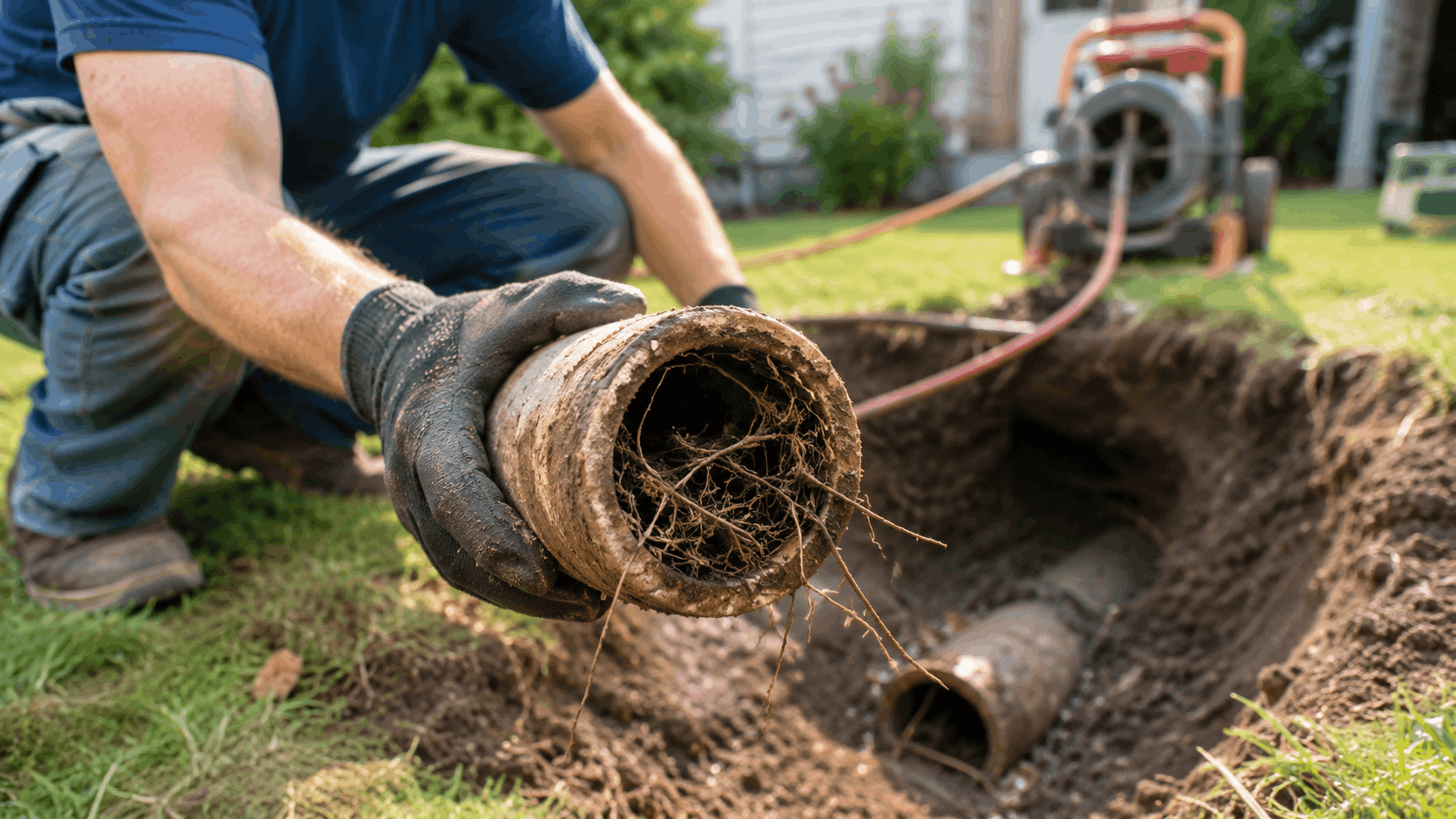
Once a fine root hair finds a gap in a joint, it slips inside and starts to swell. Over a season or two, a single root turns into a thick mat that catches paper and grease. That is the root blockage that finally backs up the whole house.
The bigger and older the tree, the more aggressive the roots. On lots near Winchester Park, we routinely pull root balls the size of a basketball out of a 4-inch line.
Clay Joint Gaps That Let Roots In
Clay pipe comes in short pieces, usually 2 to 3 feet long, joined with a bell-and-spigot fitting. One end flares out, the next slides in, and the joint is sealed with mortar or a gasket. That means a typical sewer run has dozens of these joints.
Every one of those pipe joints is a weak point. As the ground shifts and the mortar ages, the bell and spigot connection cracks and pulls apart. Even a gap the width of a pencil is enough for a root to enter.
Cracked clay does not heal itself. Once a joint separates, it keeps opening wider with each season of soil movement and each root that pushes through. Water leaks out, roots grow in, and the cycle speeds up.
This is why root problems in clay lines almost always come back after a simple cleaning. The joints that let the roots in are still there, still open, still inviting the next round of growth.
Desert Soil Movement Around Paradise
The soil under much of Paradise is not stable. Expansive clay-heavy dirt swells when it gets wet and shrinks when it dries out, and our extreme desert temperature swings make that worse. That constant movement puts stress on rigid clay pipe.
Near Paradise Road and the older blocks off Desert Inn, we often find pipe settling where a section has dropped and created a belly. Wastewater pools in that low spot instead of flowing, which invites both clogs and root growth.
Soil movement also shears joints apart. A pipe that was laid dead level in 1968 can have several offset joints today, each one pulled slightly out of line by decades of shifting ground. Those offsets are prime entry points for roots.
You cannot stop the desert soil from moving. What you can do is know that old clay in this area is under constant strain, which makes regular inspection smart for any older home.
Get Your Quote
Tell us what's going on and we'll get back to you. We're open 24/7.
Warning Signs Your Clay Sewer Line Has Root Trouble
Roots rarely block a line overnight. They give you months of small hints first. Catching those sewer warning signs early is the difference between a routine cleaning and raw sewage on the bathroom floor.
Here are the signals we tell every Paradise and Winchester homeowner to watch for:
- Multiple slow drains at the same time
- Gurgling toilets when other fixtures run
- Backups that return every few months
- Sewer odors indoors or in the yard
- Soggy or sunken patches over the sewer path
- One strip of unusually green grass
Slow Drains and Gurgling Toilets
One slow sink is usually a local clog. When several drains slow down at once, that points to the main line, not a single trap. A root mass in the main slows everything upstream of it.
Gurgling is another tell. When you flush and the shower drain bubbles, air is being forced past a partial blockage in the main line. That gurgling toilet is trying to breathe around a restriction.
A main line clog behaves differently than a fixture clog. If the lowest drains in the house, like a downstairs tub or floor drain, back up first, the trouble is in the main sewer line.
When we hear both slow drains and gurgling from a homeowner near Flamingo, roots in the clay line are our first suspect. A quick camera run usually confirms it.
Recurring Backups That Keep Coming Back
A line that clogs every few months has a real problem, not a fluke. A recurring backup almost always means root intrusion in the sewer line. The roots grow back between cleanings and choke the pipe again.
We see this constantly in older Winchester rentals. A landlord snakes the line, it flows for a while, then it backs up on the next tenant. The snake shaves the roots but leaves the base, and they regrow fast.
If you are paying for repeat clogs two or three times a year, the math stops making sense. That money is better spent on a camera inspection and a real fix that stops the cycle.
Roots follow the seasons. Backups that spike in spring, when trees push new growth, are a strong clue that roots are the culprit in your clay line.
Sewer Smells and Wet Spots in the Yard
Your sewer line is a sealed system. If you smell sewer gas inside the house or out in the yard, that seal is broken somewhere. A crack or open joint lets gas escape.
Wet spots are the other half of this sign. When a clay line leaks, wastewater seeps into the surrounding soil and creates soggy patches even when it has not rained. On a dry desert lot, a mystery wet spot stands out.
Trace the wet ground and it often lines up with the sewer path from the house to the street. That pipe leak is feeding the soil below. Left alone, the surrounding dirt washes out and the pipe can collapse.
A sewer smell plus a wet yard is a combination we treat as urgent. It usually means the line is not just clogged but actually broken.
Lush Green Patches Over the Line
Sewage is fertilizer. When a line leaks underground, the grass directly above it gets a steady feed of water and nutrients. The result is one strip of lawn that is greener and taller than everything around it.
On the dry lots common near Boulder Highway, this stands out fast. If a single green ribbon runs from your house toward the street cleanout, that is a classic yard sign of a leaking line.
The same goes for a patch of weeds thriving in an otherwise bare spot. Plants chase the nutrients from the sewage leak and flourish right over the break.
It is easy to write off as a sprinkler quirk. But when the green stripe follows the sewer route, it is worth a look before the leak turns into a full backup.
Need Help in Las Vegas?
Active Plumbing serves Las Vegas and all of Las Vegas Valley.
How a Camera Inspection Finds the Real Problem
Guessing at a sewer problem is expensive. A sewer camera inspection takes the guesswork out. Our team sends a waterproof camera down the line and watches the video in real time to see exactly what is wrong.
Here is what a proper video diagnosis of clay pipe damage tells us:
- Where root masses are and how bad they are
- Cracks, gaps, and offset joints
- Sags or bellies holding standing water
- Sections that have partly or fully collapsed
- The exact depth and path of the pipe
What a Sewer Camera Shows
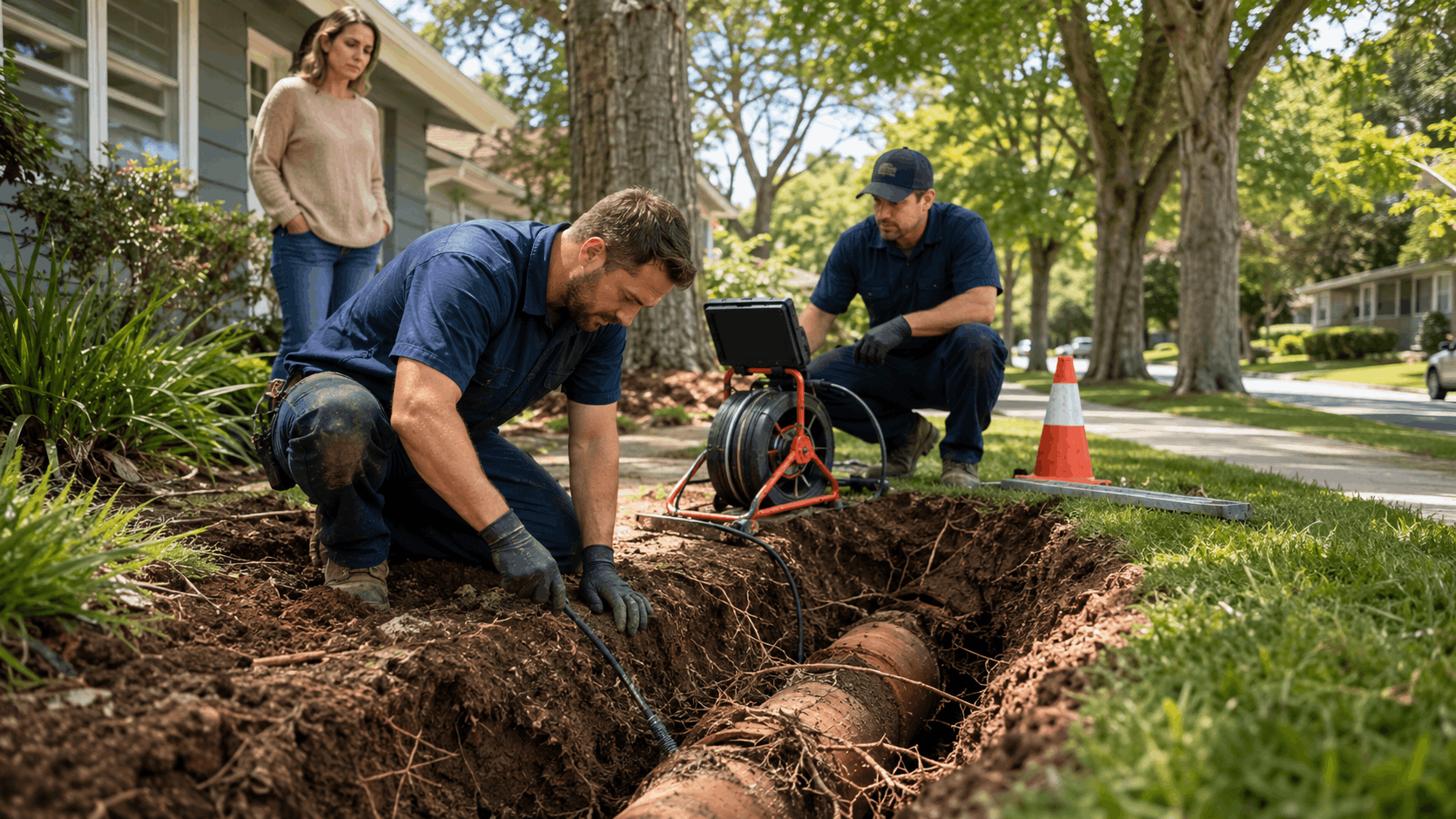
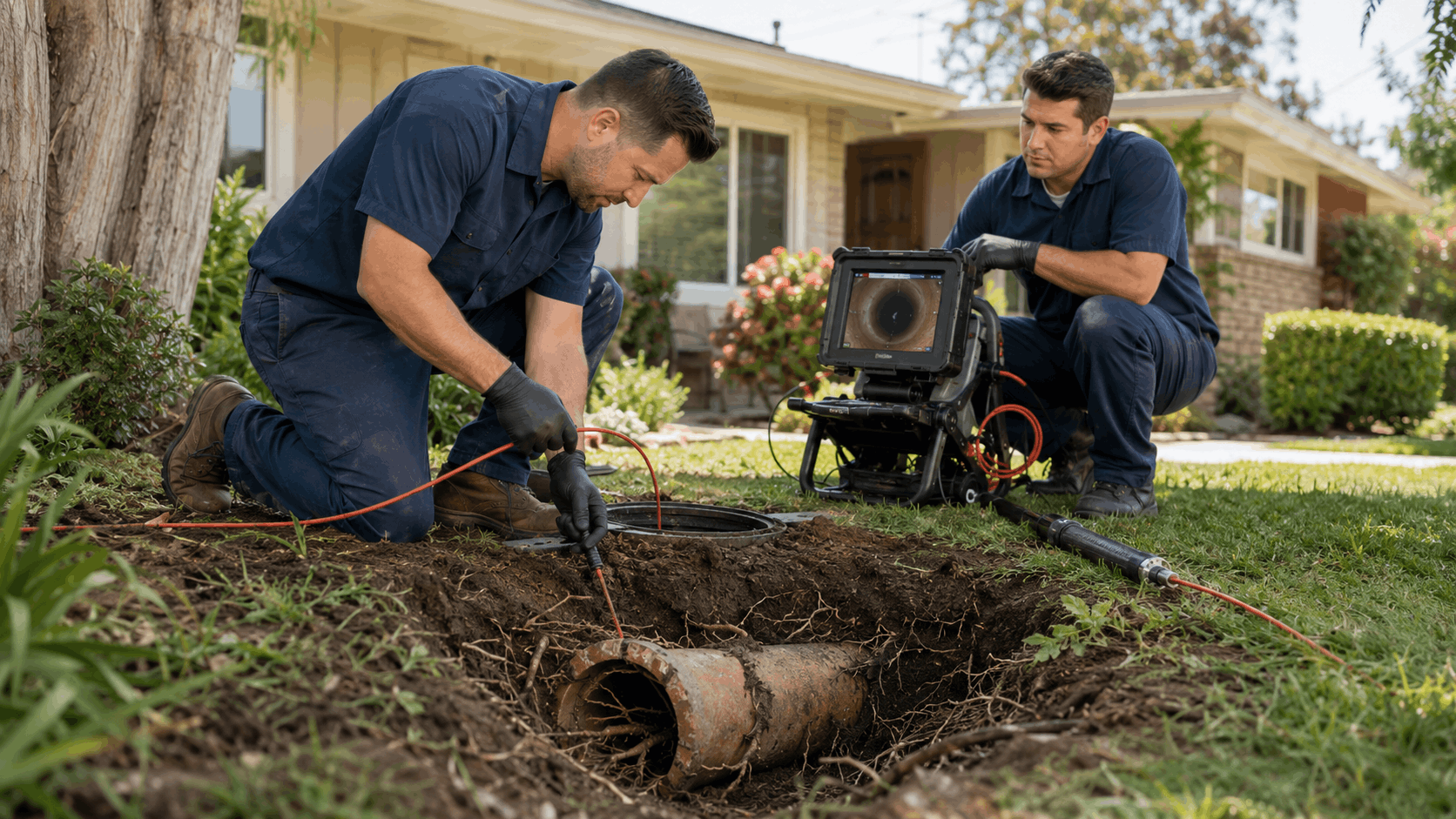
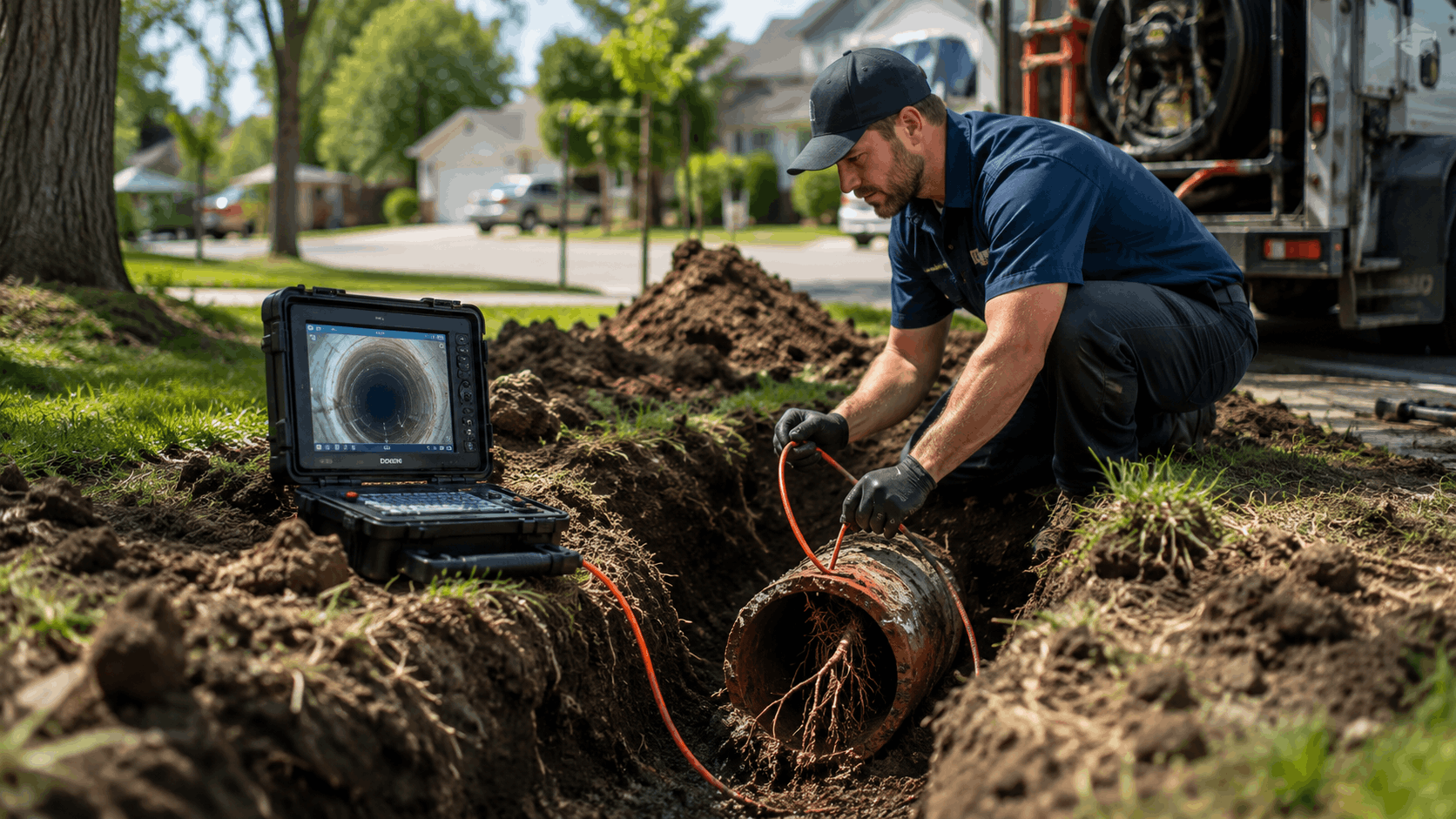
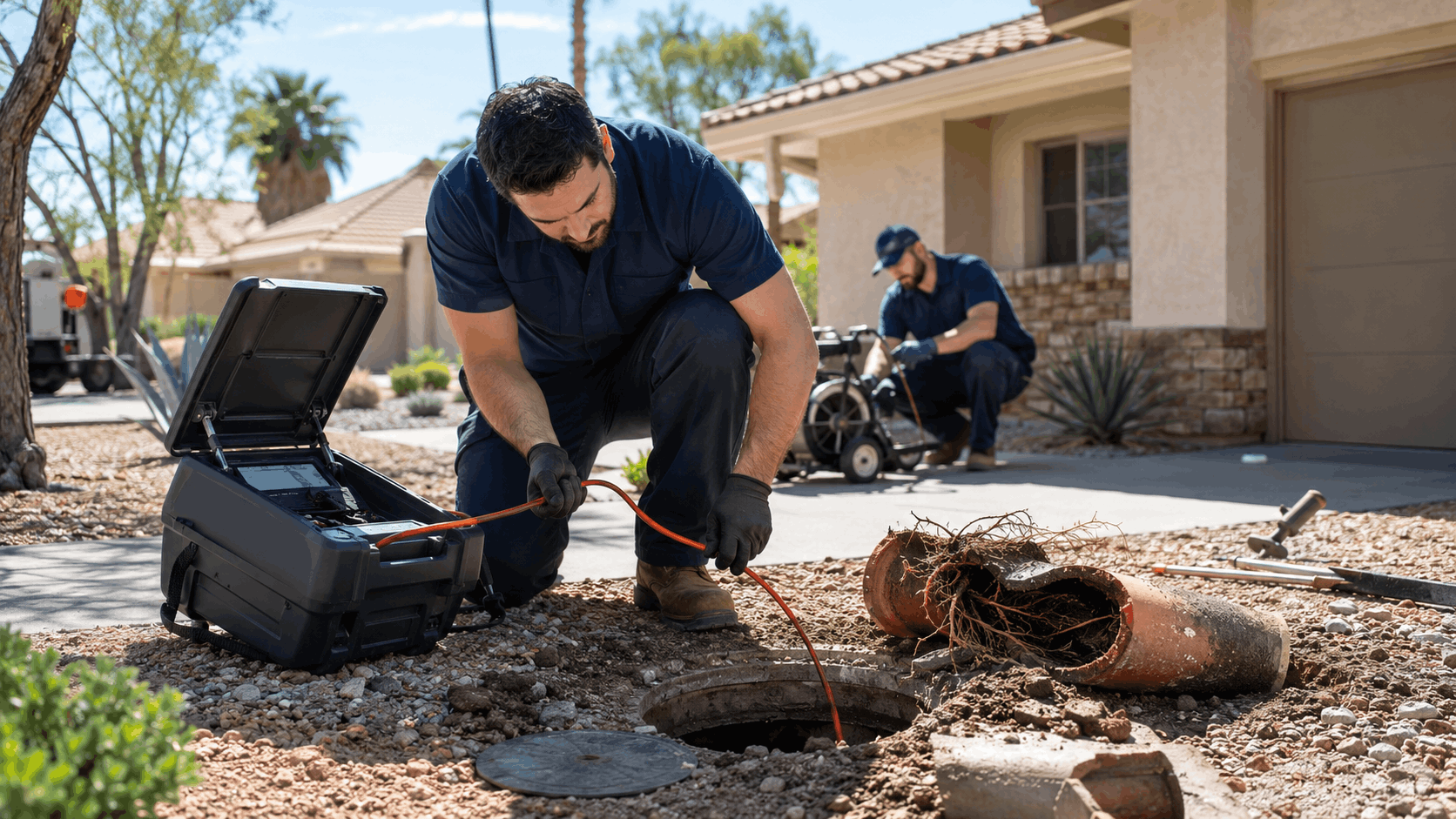
The camera head has a light and lens that feed a live picture to a monitor. As it travels down the clay line, we see the inside of the pipe foot by foot. Root intrusion shows up as white hair-like strands or thick brown mats.
We also spot offset joints, where one pipe section has shifted out of line with the next. That misalignment is both a snag point and a root entry. On the screen it looks like a ledge or step inside the pipe.
Worst case, the camera reveals pipe collapse, where a section has caved in and dirt is visible. That changes the whole repair plan. No amount of cleaning fixes a collapsed pipe.
Seeing the damage with our own eyes means we recommend only what the pipe actually needs. No upselling, no scare tactics, just what the video shows.
Locating the Depth and Path of the Line
The camera also carries a transmitter. From above ground, our team uses a locator to mark the exact spot and depth of any problem. We paint or flag the route right on the yard.
That line locating matters because nobody wants a crew digging blind across a Paradise front yard. Knowing the pipe depth before we start means we dig in one precise spot instead of tearing up the whole lawn.
Depth also drives the repair choice. A line 3 feet down under grass is a very different job than one 8 feet down beneath a driveway. Mapping the sewer path first lets us give an honest quote.
For homeowners planning landscaping or an addition, this map is handy well beyond the repair. It shows exactly where the line runs so nothing gets planted or built on top of it.
Telling Root Intrusion From a Full Break
Not every clay problem needs the same fix. The inspection tells us whether you are dealing with simple root intrusion or a genuine pipe break. That distinction changes everything about the repair scope.
If the pipe walls are sound and only roots are the issue, a cleaning followed by lining may solve it. If the camera shows a shattered or collapsed section, cleaning is pointless and replacement is the call.
This is why we never quote a sewer repair sight unseen. Two homes on the same street can need completely different work depending on what the video reveals.
Getting the scope right up front saves money. It stops homeowners from paying for a full dig when a spot repair would do, or wasting cash on cleaning a line that needs to come out.
Recording Footage for Insurance and HOA Records
We save the video from every inspection. That footage is proof of the pipe's condition on a specific date. For an insurance claim, having recorded evidence of root damage or a break strengthens your case.
Several Winchester communities and HOAs also want documentation before approving yard work. The saved inspection video and locate map satisfy those HOA records without extra hassle.
If you are buying an older home near Maryland Parkway, a recorded inspection is smart due diligence. It shows the true state of the sewer line before you sign.
We are glad to hand over a copy of the footage. It is your line and your record, and it helps with claims, sales, and future repairs.
Repair Options for Root-Damaged Clay Pipes
Once we know what the clay line looks like, there are several ways to fix it. The right sewer repair option depends on how bad the damage is and what sits on top of the line. Our drain and sewer team walks each homeowner through the choices.
Hydro Jetting and Root Cutting
The first step for a root-clogged line is often clearing it out. A mechanical cutter blade spins through the pipe and shears off the root mass. Then hydro jetting follows with high-pressure water to scour the walls clean.
Hydro jetting hits the pipe with water at up to 4,000 psi. That blasts away roots, grease, and buildup far better than a basic snake. After a good jetting, the line flows like new for a while.
The catch is that root cutting and drain cleaning are short-term fixes. They remove what is inside but leave the cracked joints that let roots in. On a clay line, the roots usually grow back within a year or two.
Still, jetting has its place. It buys time, clears an active backup fast, and preps the pipe for lining. We often jet a line clean before we line or inspect it.
Trenchless Pipe Lining (CIPP)
Cured-in-place pipe lining, or CIPP, is a trenchless way to fix clay from the inside. We pull a resin-soaked liner into the old pipe, inflate it, and cure it hard. The result is a new seamless pipe within the old one.
The big win with pipe lining is no big dig. We access the line through the existing cleanout, so the yard, driveway, and mature trees stay untouched. For tight lots near Winchester Park, that is a huge advantage.
A cured liner seals every cracked joint and gap in the clay. With no more openings, roots have nowhere to enter. A quality CIPP liner is rated to last 50 years or more.
Lining works best when the old pipe still holds its shape. If a section has fully collapsed, there is nothing to line against, and we move to bursting or a dig.
Pipe Bursting to Replace the Old Line
Pipe bursting is another trenchless method, and it fully replaces the old clay. A bursting head is pulled through the existing line, breaking the clay outward while dragging a new HDPE pipe in behind it.
This gives you a brand new seamless pipe with only two small access pits, one at each end. There is minimal digging compared to trenching the whole run. The new line has no joints for roots to invade.
Bursting shines when the old clay is too far gone to line but the path is clear enough to pull through. It is a common choice for the fully degraded lines we find in 60s-era Paradise homes.
Because it replaces rather than coats the pipe, bursting also lets us upsize the line if needed. A home that has outgrown a small old sewer can get more capacity in the process.
Traditional Dig-and-Replace
Sometimes there is no way around excavation. When a section has collapsed under a driveway or a root ball has crushed the pipe near a big tree, we open the ground and swap the pipe. This is the classic sewer line repair and replacement approach.
Dig and replace is the most invasive method, but it is also the most certain. We can see and fix every foot of the affected run. For a collapsed pipe, it is often the only real option.
The downside is disruption. Removing concrete, digging a trench, and restoring the surface takes time and adds cost. That is why we reserve full excavation for cases where trenchless will not work.
Even then, we keep the dig as small as the locate map allows. Precise locating means we open only the section that needs it, not the whole yard.
Need Help in Las Vegas?
Active Plumbing serves Las Vegas and all of Las Vegas Valley.
What Sewer Repair Costs in Paradise and Winchester
Cost is the first question most homeowners ask, and they deserve a straight answer. Sewer repair pricing swings a lot based on the method and the site. Here are honest ranges we quote around the valley.
| Repair Method | Typical Cost Range | Best For |
|---|---|---|
| Hydro jetting / root cutting | $350 - $900 | Clearing an active clog |
| Camera inspection | $150 - $400 | Diagnosis |
| Spot repair | $1,500 - $4,000 | One bad section |
| CIPP pipe lining | $80 - $250 per foot | Cracked but intact pipe |
| Pipe bursting | $100 - $300 per foot | Degraded full runs |
| Full dig-and-replace | $6,000 - $20,000+ | Collapsed lines |
Cost of Cleaning vs. Lining vs. Full Replacement
Cleaning is the cheapest option up front, usually a few hundred dollars. But on a root-filled clay line it is a repeat cost, so those bills add up over a few years.
Lining lands in the middle. Most CIPP jobs on a standard home run run several thousand dollars total, depending on length. For a pipe that is cracked but still holding shape, it is often the best value.
Full replacement is the biggest ticket, from around $6,000 to well over $20,000 for a long or deep line. It also gives you the longest life and ends the root problem for good.
The lining price versus replacement cost tradeoff usually comes down to pipe condition. A camera inspection is what tells us which way makes sense for your line.
Factors That Change the Price
Several things push a quote up or down. Pipe depth is a big one. A line 3 feet down costs far less to reach than one 9 feet deep. Length matters too, since lining and bursting are priced by the foot.
Concrete removal adds real money. If the line runs under a driveway, patio, or sidewalk, we have to break it out and pour it back. That surface work can add thousands to a dig job.
Access is another cost factor. A clear front yard is quick. A backyard line boxed in by fences, mature trees, and a pool takes more labor and care.
Every one of these shows up on our written quote line by line. No homeowner should get a surprise once the work starts.
Permits and Clark County Requirements
Sewer work in this area goes through the Clark County building department. Most repairs that open the ground or replace a line need a permit and a final inspection. That protects you and keeps the work up to code.
A Clark County permit adds a modest fee and a little time, but it is not optional for real sewer work. Skipping it can cause trouble when you sell the home later.
Our team pulls the sewer permit and schedules the inspection as part of the job. You do not have to chase paperwork or figure out county rules on your own.
You can read the county's guidance on building and permitting directly through the Clark County Building and Fire Prevention department. It spells out what needs a permit and why.
Financing and Emergency Repair Situations
A major sewer repair is rarely in the budget. That is why we offer financing options so the cost can be spread out instead of paid all at once. It keeps a big job from becoming a crisis.
Emergency repairs work a little differently on price. When sewage is actively backing up, the job needs fast action, sometimes after hours. That urgency can affect the total.
Our emergency plumbing team can stop an active backup first, then plan the permanent fix once the mess is under control. Two steps, clear pricing for each.
If you are staring at raw sewage right now, do not wait on financing questions. Get the line cleared, protect your home, and we will sort the payment plan afterward.
Preventing Root Intrusion Before It Wrecks Your Line
The best sewer repair is the one you never need. On older clay lines you cannot make roots disappear, but you can slow them way down. A little root prevention saves a lot of money.
Here is what we recommend for homes with aging clay pipe in Paradise and Winchester.
Yearly Camera Checks and Preventive Jetting
An annual camera check is cheap insurance for an old clay line. It catches small root masses while they are still easy to clear, long before a backup floods the house.
Pairing that inspection with preventive jetting keeps the pipe walls clean. Clearing roots once a year on a schedule beats an emergency clearing at 2 a.m. every time.
Think of it like a dental cleaning for your sewer. Regular preventive maintenance stops small problems from turning into big ones. It also gives us a year-over-year record of how the line is holding up.
For rentals and older homes near Winchester Park, we often set up a yearly service so nobody has to remember to call. The line gets checked and cleaned before trouble hits.
Smart Tree Choices Near the Sewer Path
Trees are the number one cause of clay pipe failure here, so tree placement matters. Avoid planting aggressive, water-seeking species like mulberry, ash, and willow anywhere near the sewer line.
On these older lots, keep any new tree at least as far from the line as the tree will grow tall. A tree that reaches 40 feet should sit at least that far from the pipe. Roots spread as wide as the canopy or more.
If you love a spot near the sewer path, choose slow-growing, desert-friendly plants with shallow roots. Cactus, agave, and small shrubs are far safer over a sewer run than a shade tree.
Before you plant anything big, get the line located. Knowing exactly where the pipe runs lets you landscape around it instead of over it.
Root Barriers and Foaming Treatments
A physical root barrier is a solid sheet placed in the ground between a tree and the sewer line. It redirects roots down and away from the pipe. Installed right, a barrier gives real protection for years.
Chemical control is the other tool. A foaming treatment sent through the line coats the pipe walls and kills root tips on contact without harming the tree above. The foam reaches the top of the pipe where roots enter.
Foaming works best as a follow-up after jetting a line clean. Clear the roots first, then apply the foam to slow the regrowth. Repeated once or twice a year, it keeps roots knocked back.
Neither method is a permanent cure on cracked clay, but together they buy years of quieter service. For a homeowner not ready to reline or replace, root control is a smart stopgap.
Upgrading Clay to Modern PVC
The one true fix for the joint-gap problem is getting rid of the clay. Replacing an old line with modern PVC or HDPE ends root intrusion for good. New pipe has smooth walls and sealed joints roots cannot enter.
A PVC pipe upgrade is a bigger investment than cleaning or foam, but it is a one-time fix. Once the clay is gone, the recurring backups and yearly jetting go with it.
Because trenchless lining and bursting both create a jointless new pipe, you can often make this upgrade with minimal digging. The old headaches leave, the yard stays mostly intact.
For anyone planning to stay in an older Paradise or Winchester home for years, upgrading the sewer is money well spent. It is the difference between managing a problem forever and solving it once.
Need Help in Las Vegas?
Active Plumbing serves Las Vegas and all of Las Vegas Valley.
Why Homeowners Trust Active Plumbing for Sewer Work
Sewer work is not a job to hand to just anyone. It calls for the right gear, honest advice, and someone who knows the ground under these neighborhoods. That is the work our team does every day.
Years Working the Streets of Paradise and Winchester
We have run cameras and cleared roots on clay lines all across these neighborhoods. From the blocks off Boulder Highway to the older tracts near Desert Inn Road, we know what sits under these yards.
That local experience shows up in quicker diagnoses. When a homeowner near Maryland Parkway describes gurgling drains and a spring backup, we already have a strong idea of what the camera will find.
Knowing the area also means knowing the soil and the tree types that cause trouble here. We have seen the same mesquite and mulberry roots wreck line after line.
Whether your home is in Paradise or Winchester, our crew has likely worked the street next to yours.
Straight Answers and Written Prices
Nobody likes surprise bills, least of all on a sewer job. We give a clear diagnosis based on what the camera shows and a written quote before any work begins. What we quote is what you pay.
If a simple cleaning will solve your problem, we say so. We do not push a full replacement on a line that only needs lining or a spot fix. Honest service keeps neighbors calling us back.
We walk you through the options in plain language, not plumber jargon. You get the pros, cons, and price of each so you can make the call that fits your home and budget.
A written price before work begins is how we have built trust in these neighborhoods. The quote covers the work, the permit, and the cleanup.
Trenchless Equipment That Saves Your Yard
Many lots in Paradise and Winchester are tight, with mature trees, block walls, and little room to dig. Our trenchless equipment lets us fix lines with minimal digging on those crowded urban lots.
With CIPP lining and pipe bursting gear, we repair most lines through the existing cleanout and a small pit or two. Your driveway, lawn, and old shade trees stay where they are.
The right sewer tools also mean less time on site. A trenchless job that would take a week of trenching often wraps in a day or two.
For homeowners who dread the thought of a torn-up yard, trenchless is the reason to call. It gets the line fixed without the wreckage.
Fast Response for Backups and Emergencies
A sewer backup is not something that waits until Monday. When sewage is coming up in the shower, you need help quickly. Our emergency response covers homes across the valley, day and night.
We can reach most Paradise and Winchester addresses fast, clear the active backup, and stop the damage. Speed matters when wastewater is spreading across your floors.
Once the immediate mess is handled, we camera the line and lay out the permanent fix. First we stop the crisis, then we solve the cause.
You can reach our team any time through our contact page when a backup hits. Fast service is part of the job.
Final Thoughts
The clay sewer lines under Paradise and Winchester are living on borrowed time. Fifty-plus years of thirsty tree roots, shifting desert soil, and cracked bell-and-spigot joints have earned this area its reputation as the root intrusion capital of the valley.
The good news is you are not stuck reacting to backups forever. A camera inspection shows exactly what your line needs, and options from jetting to trenchless lining to full replacement can match any situation and budget.
If your home near Maryland Parkway, Winchester Park, or Boulder Highway has slow drains, repeat clogs, or a mystery green stripe in the yard, get it looked at before it turns into a flood. Call Active Plumbing or reach out through our contact page for a straight answer and an upfront quote on your sewer line.
Frequently Asked Questions
- How do I know if roots are in my sewer line?
- The top signs are backups that keep returning every few months, multiple slow drains at once, gurgling toilets, and sewer smells. A single strip of extra-green grass over the sewer path is another clue. These sewer symptoms point to root intrusion, but the only way to confirm it is a camera inspection that shows the root mass and where it entered the clay pipe.
- Why do so many Paradise and Winchester homes have clay pipes?
- These neighborhoods filled in during the 1960s and 70s building boom, when vitrified clay pipe was the standard sewer material across the valley. It was cheap and durable for its time. That clay pipe history is why nearly every older home near Maryland Parkway and Flamingo has a clay line, and why root intrusion is so common in this part of Las Vegas today.
- Can roots be removed without replacing the pipe?
- Yes, but only for a while. Root cutting and hydro jetting clear the roots out and restore flow, so the line works again fast. The catch is that root removal is a temporary fix. The cracked joints that let roots in are still open, so the roots usually grow back within a year or two on a clay line unless you line or replace it.
- How much does sewer line repair cost in Las Vegas?
- It varies with the method. A cleaning or jetting runs roughly $350 to $900. CIPP lining costs about $80 to $250 per foot, and pipe bursting around $100 to $300 per foot. A full dig-and-replace can run from $6,000 to over $20,000. Depth, pipe length, and concrete removal are the biggest factors that change the final repair cost.
- Is trenchless repair better than digging?
- For most jobs, yes. Trenchless lining and bursting fix the line through small access points, so your yard, driveway, and mature trees stay intact and the work finishes more quickly. The tradeoff is that trenchless needs the old pipe to be in workable shape. When a section has fully collapsed, traditional excavation is the more reliable choice for that portion of the line.
- Do I need a permit for sewer work in Clark County?
- Most sewer repairs that open the ground or replace a line need a permit and a final inspection through the Clark County building department. Simple cleaning usually does not. A sewer permit keeps the work up to code and protects you when you sell the home. Our team pulls the Clark County permit and schedules the inspection as part of the job so you do not have to.
- How long does a clay pipe last?
- Vitrified clay pipe typically lasts about 50 to 60 years before it gets brittle and the joints separate. Most Paradise and Winchester homes were plumbed in the 1960s and 70s, which means those clay lines are now past their prime. If your home is that age and still on the original line, the pipe is living on borrowed time.
- Will my homeowners insurance cover root damage?
- Coverage varies a lot by policy. Some plans cover sudden damage but exclude slow wear or root intrusion, while others offer a sewer line rider. A recorded camera inspection helps a root damage claim by documenting the condition and cause with dated video. Check your policy and, if you file, provide that footage. We are glad to hand over a copy for your insurance records.
- How long does a full sewer repair take?
- It depends on the method. Hydro jetting and cleaning take a few hours. CIPP lining and pipe bursting often finish in one to two days. A full dig-and-replace can take several days to a week, more if concrete has to be removed and repoured. We give a project timeline with the written quote so you know what to expect before we start.
- What can I do to stop roots from coming back?
- Root prevention comes down to a few steps. Get yearly camera checks and preventive jetting, avoid planting thirsty trees near the sewer path, and use root barriers or foaming treatments to slow regrowth. The only permanent fix is upgrading the clay to modern PVC or HDPE, which seals every joint so roots have no way in. That is the long-term fix for aging clay lines.
Licensed plumbing professionals serving Las Vegas and Las Vegas Valley.
Licensed in Nevada · License #0047021
Last updated on
Why trust Active Plumbing?
Founded in 1991, Active Plumbing is a licensed and insured plumber serving Las Vegas and Las Vegas Valley. All content is reviewed by our licensed technicians.

Need Help in Las Vegas?
Active Plumbing serves Las Vegas and all of Las Vegas Valley.
Related Articles
Drain Cleaning in Downtown Las Vegas and John S. Park: Original Cast Iron and Clay Laterals
A local guide to drain cleaning in Downtown Las Vegas and John S. Park, covering original cast iron and clay laterals, warning signs, cleaning methods, and repair options.
Peccole Ranch Plumber: 1990s Home Common Pipe Issues
A local plumber's guide to common pipe issues in 1990s Peccole Ranch homes, from polybutylene and copper leaks to slab leaks, sewer roots, and water pressure problems.
How to Choose Between Trenchless and Traditional Sewer Repair in Las Vegas
Trenchless or traditional sewer repair in Las Vegas? Compare costs, timelines, soil factors, and when each method fits your home from Active Plumbing.