Tips & Advice
How Caliche Soil Shapes Every Underground Pipe Decision in the Las Vegas Valley
Key Takeaways
- Caliche is a natural calcium carbonate cement layer that behaves like concrete and sits under most Las Vegas Valley yards, varying in depth block to block.
- Hand tools are useless in dense caliche, so crews rely on jackhammers, rock-tooth trenchers, and excavators, which drives up labor and equipment cost.
- Proper sand bedding and backfill protect pipes from sharp caliche rubble that can wear through pipe walls over time.
- PVC suits sewer lines, PEX flexes well for water supply, and copper can corrode with the valley's hard water and soil chemistry.
- Camera inspections and electronic leak detection pinpoint problems so crews dig one targeted spot instead of tearing up the whole yard.
- Buried pipe work costs more here because of extra breaking time, heavy equipment, Clark County permits, and surface restoration.
- Homeowners should watch for soggy spots, slow drains, and rising water bills, and always call 811 before any dig.
- Active Plumbing inspects the site and explains soil conditions before quoting, serving neighborhoods from Spring Valley to Henderson and Summerlin.
In This Article
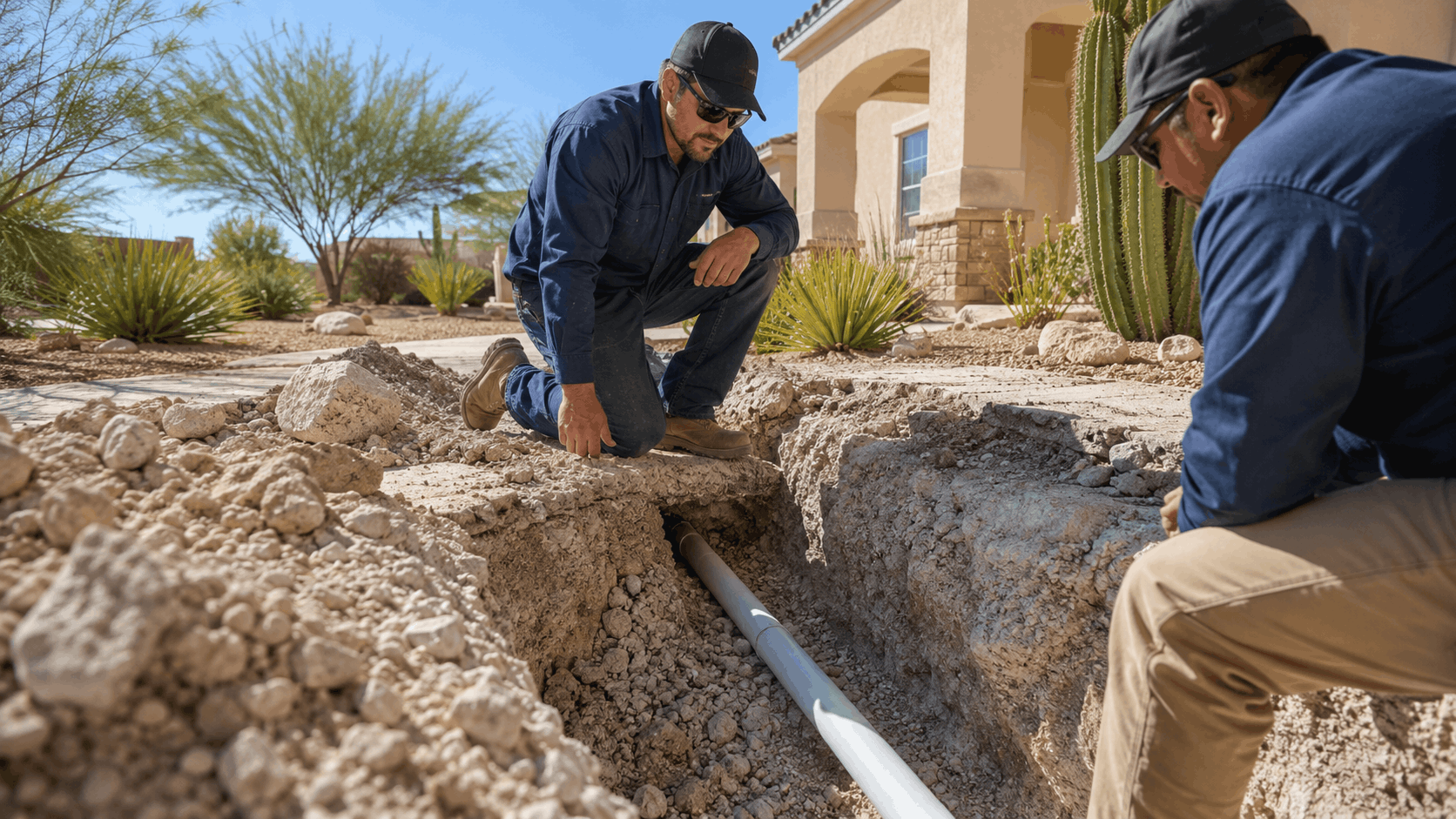
A homeowner off Town Center Drive near Summerlin called our office last spring with a story we hear all the time. Her landscaper started digging a trench for a new drip line and hit something that felt like solid rock about a foot down. His shovel bounced. He tried a pick. After two hours, he had moved maybe three inches of dirt and given up.
What he ran into was caliche. It is the buried layer that quietly controls almost every underground pipe decision across the Las Vegas Valley. From the materials crews pick to the tools they bring to the price you pay, this stubborn soil shapes the whole job.
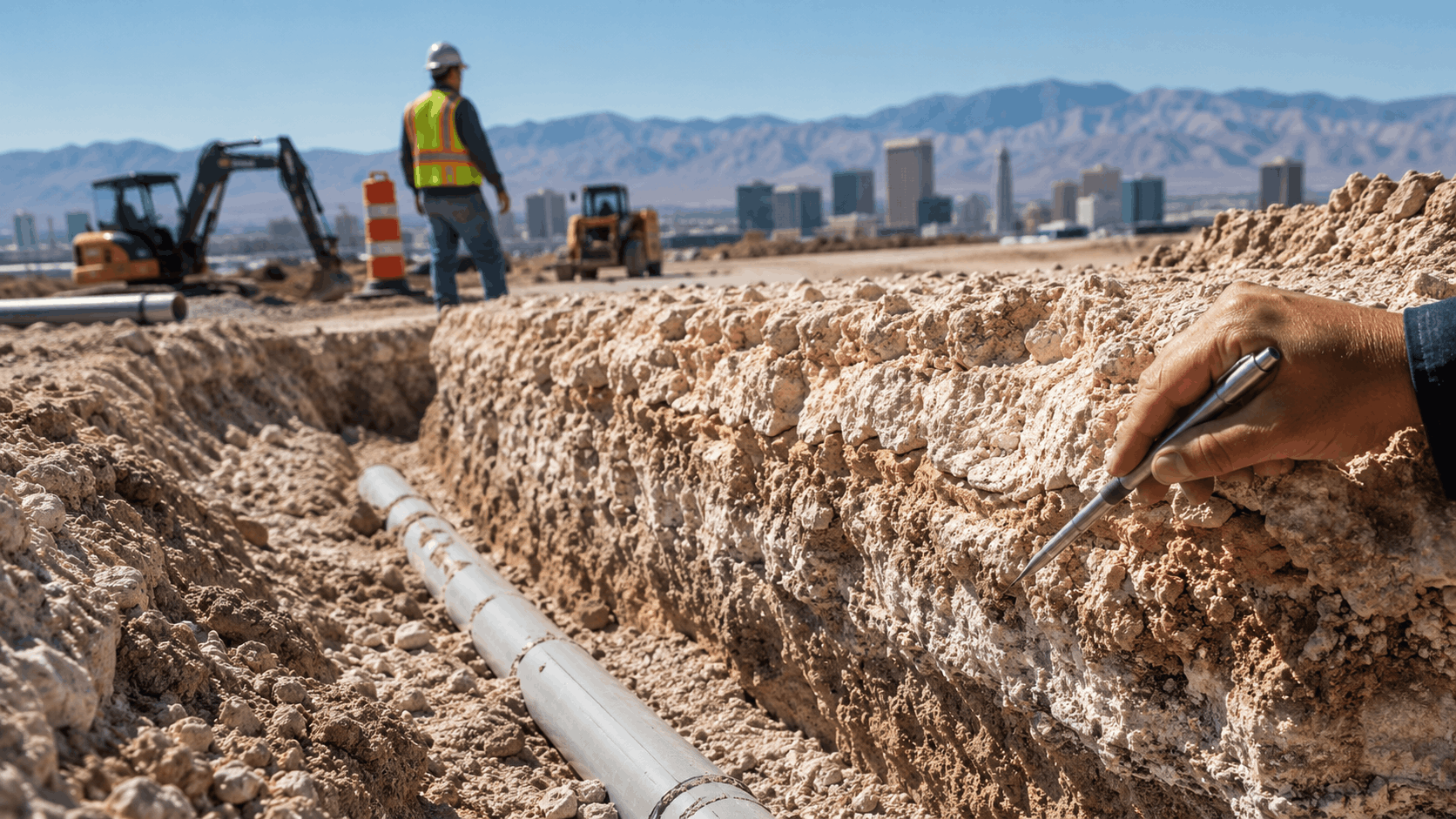
What Caliche Soil Actually Is and Why the Valley Is Full of It?
Most folks moving here from wetter states have never heard the word caliche until a crew says it during a dig. Then they hear it a lot. It is the reason a simple trench turns into a half-day fight in so many neighborhoods.
Caliche soil is common across the Las Vegas Valley because of our dry climate and slow water movement underground. Getting a clear picture of the hardpan under your yard helps you understand why your crew is working so hard.
- It can be as thin as a crust or as thick as several feet.
- It sits at different depths from lot to lot.
- It ranges from crumbly to nearly solid rock.
The Concrete-Like Layer Under Your Yard
Caliche is a natural cement made mostly of calcium carbonate. Over centuries, rainwater carries dissolved minerals down into the soil, then the desert heat pulls that water back up and evaporates it. What stays behind is a mineral crust that binds sand and gravel together.
Do that for thousands of years and you get a hardpan layer that behaves like a slab of low-grade concrete. In some spots it crumbles when you strike it. In others it holds together so tightly that a standard trencher just skips across the top.
The dry climate here is exactly why caliche forms so well. Wetter regions flush those minerals deeper and keep them from setting up. Our valley traps them near the surface, which is why calcium carbonate deposits show up in yard after yard.
That mineral chemistry also explains why our tap water is so hard. The same calcium and magnesium that cement the ground end up in the pipes, and both facts start with the geology under the whole region.
Where Caliche Runs Thickest Across the Valley
Caliche is everywhere, but it is not the same everywhere. Some of the densest, shallowest layers we run into sit near Henderson, out in the northwest around Centennial Hills, and in older parts of the east side of town.
Homes near the McCullough foothills and up along the higher ground toward the Spring Mountains often have caliche within a foot or two of the surface. Those elevated lots tend to have less loose topsoil sitting on top of the hardpan.
What surprises people is how much it changes block to block. We have worked two houses on the same street in Henderson where one had loose sandy soil to four feet and the neighbor hit rock-hard caliche at eight inches.
That is why we never assume. A crew that quotes your job based only on the general area is guessing. Real numbers come from checking your specific lot near Centennial Hills or wherever your home sits.
How Deep It Sits and Why That Matters
Caliche can show up inches below your grass or several feet down. That soil depth changes everything about a buried pipe job. A shallow layer means a crew fights it from the first shovel. A deep layer might let them dig easy for a while, then slam into it.
Pipe depth is set by code and by function. Sewer lines need to sit deep enough to keep a steady slope. Water lines need cover to protect them from heat and the odd winter freeze. When the required pipe depth lands right inside a thick caliche band, the work gets slow and costly.
Depth also decides whether rerouting is even practical. Sometimes moving a line a few feet sideways drops it into softer ground and saves hours. Other times the hardpan runs so wide that there is no easy path around it.
Knowing the depth before work starts lets our team plan the right equipment and give an honest timeline. Guessing at depth is how weekend projects turn into week-long headaches.
Why Local Soil Reports Rarely Tell the Full Story
A soil survey gives a general read on what to expect in an area. It is a useful starting point. But those maps paint with a broad brush and cannot show what sits under one specific backyard.
We have seen reports call for moderate soil, only to have the excavation reveal a two-foot caliche slab that no map mentioned. Nature does not read the survey. Conditions shift with old washes, buried construction debris, and how the lot was graded decades ago.
That gap between the report and the real dig is why on-site experience counts for so much. A crew that has broken caliche in Spring Valley and North Las Vegas can read the ground as they go and adjust fast.
Before any serious excavation, our team looks at the site, checks access, and factors in what we already know about that neighborhood. That real-world knowledge beats a generic survey every time.
Get Your Quote
Tell us what's going on and we'll get back to you fast.
How Caliche Changes the Way Crews Dig Trenches
Trenching in normal dirt is straightforward. Trenching through caliche is a whole different job. The hard layer decides which tools show up, how long the work takes, and how much muscle and machinery it takes to reach a pipe.
Once homeowners see what caliche digging actually involves, the cost and timeline of excavation start to make a lot more sense. Here is what changes when the hardpan gets in the way.
- Hand tools become close to useless.
- Heavy breakers and rock teeth do the real work.
- Some jobs shift to trenchless methods entirely.
Why a Standard Shovel Won't Cut It
Hand digging works fine in loose desert sand. Hit a dense caliche layer and a shovel simply stops. The blade bounces off, the handle jolts your arms, and an hour of sweat gets you almost nowhere.
We meet plenty of DIY homeowners who started a sprinkler or drain project on a Saturday and called us by Sunday. They swing a pick until their hands blister and barely dent the hard soil. It is one of the most common frustrations in the valley.
The problem is that caliche does not loosen the way clay or sand does. It fractures in chunks, and only if you hit it hard enough with the right tool. A hand tool cannot deliver that force in a controlled way.
This is not a knock on anyone's effort. The material is just built to resist exactly what a shovel does. Recognizing that early saves a weekend and a lot of sore muscles.
Jackhammers, Rock Saws, and Heavy Equipment
To break caliche, crews reach for real power. A pneumatic jackhammer or electric breaker is often the first tool out of the truck for tight or shallow work. It fractures the hardpan so it can be scooped out in pieces.
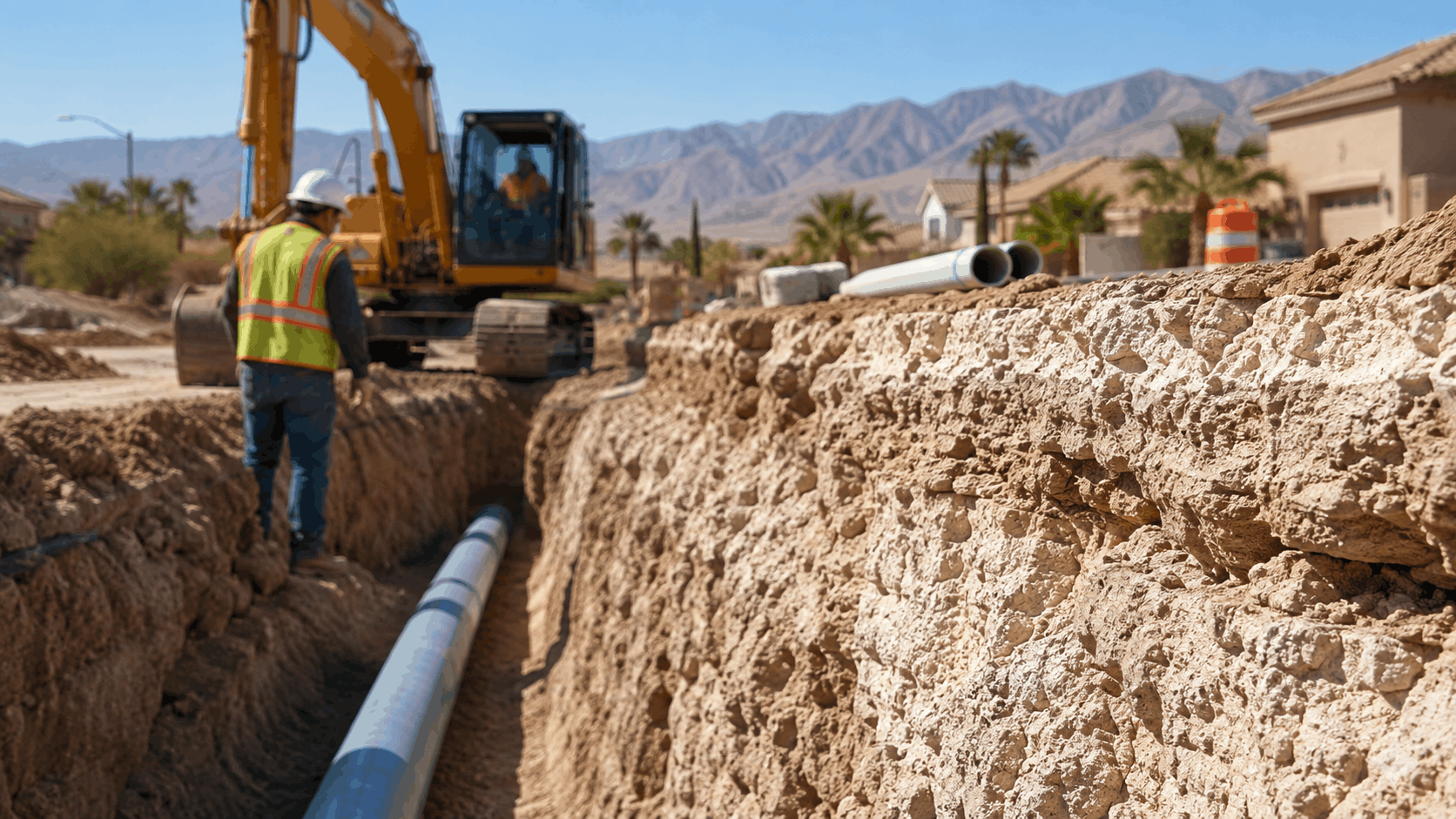
For longer runs, a trencher fitted with carbide rock teeth does the heavy lifting. Those teeth chew through the mineral cement where a standard trench chain would stall. On big jobs, a mini excavator with a hydraulic breaker attachment moves things along faster.
Which tool gets used depends on the depth, the length of the run, and how tight the yard is. A narrow side yard in a Summerlin HOA community might only allow a handheld breaker. An open lot in Enterprise can take larger machines.
All of that equipment costs money to run and takes skill to operate near existing lines. That is part of why breaking caliche adds to a bid. The gear is doing work that no person could do by hand.
Trenchless Methods That Sidestep the Worst Digging
Not every job needs a long open trench. Trenchless methods can replace or install pipe with far less surface digging. Pipe bursting pulls a new line through the path of an old one while breaking the old pipe outward.
Directional boring drills a horizontal path underground and pulls pipe through it, often from just two small access pits. Both approaches protect driveways, mature landscaping, and hardscape that would otherwise get torn up.
These methods shine in the valley because they cut down on how much caliche a crew has to remove. Less open trench means less breaking, less backfill, and less surface repair afterward.
They do have limits, though. In extremely dense or thick hardpan, boring heads slow down and pipe bursting can struggle. Our team weighs the soil conditions on your lot before recommending a trenchless route over a traditional dig.
How Digging Time Affects Your Timeline
In soft soil, a crew might open a 40-foot trench in a few hours. Push that same trench through solid caliche and the project timeline can easily double, sometimes more. Breaking, clearing, and hauling the rubble all add hours.
A straightforward water line swap that would take a day in loose ground can stretch to two or three days when the hardpan is thick. Trench time is the single biggest variable we watch on valley jobs.
Weather plays a part too. Summer heat near 110 degrees forces crews to pace themselves and start early, which stretches the calendar. Nobody works a jackhammer at full speed in July afternoon sun.
We give realistic windows up front so you are not left guessing. Setting that expectation before work starts is fairer than promising a fast finish and running into rock. For urgent breaks, our emergency plumbing team plans around the soil from the first call.
Need Help in Las Vegas?
Active Plumbing serves Las Vegas and all of Las Vegas Valley.
Choosing the Right Pipe Material for Caliche Ground
The soil does not just affect how you dig. It affects what you bury. Sharp caliche rubble, mineral-heavy water, and dry ground all push certain pipe materials ahead of others for long-term durability.
Picking the right pipe material for the valley means thinking about the trench itself, not just the water inside the pipe. Here is how the common choices stack up.
| Material | Best Use | Caliche Ground Notes |
|---|---|---|
| PVC | Sewer and drain lines | Affordable and corrosion-proof, but needs sand bedding to avoid rubble damage |
| PEX | Water supply lines | Flexible, handles ground shift well, resists mineral buildup inside |
| Copper | Water supply lines | Durable but can corrode with certain soil chemistry and hard water |
| Cast iron | Older sewer lines | Common in older homes, prone to rust and cracking over decades |
Why Bedding and Backfill Matter So Much
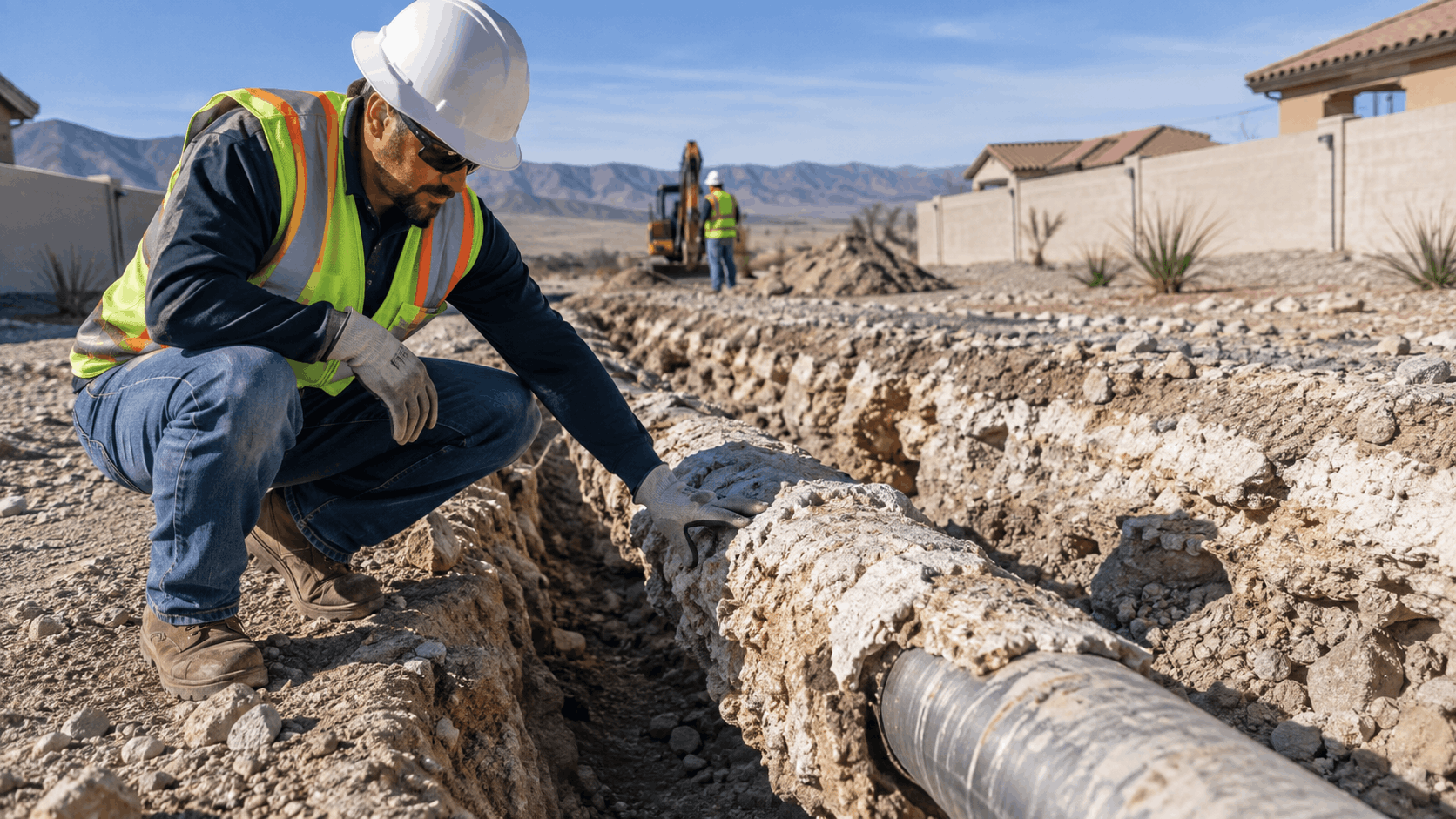
When you break caliche, you do not get smooth dirt. You get jagged, angular rubble with sharp edges. Drop a pipe straight onto that and those edges press into the pipe wall under the weight of the backfill.
Over time, a sharp point can wear through PVC or dent softer metal. That is why proper pipe bedding is one of the most important steps in the whole job. Crews line the trench floor with clean sand before the pipe goes in.
Sand backfill also goes over and around the pipe, cushioning it from the rubble that fills the rest of the trench. This sand jacket lets the pipe flex slightly without getting cut or crushed.
Skipping this step to save time is a common shortcut that comes back to bite homeowners. A line bedded on raw caliche can fail years earlier than one cushioned correctly. We never leave a pipe sitting on sharp rock.
PVC, PEX, and Copper Under Desert Conditions
PVC is the workhorse for sewer and drain line material in the valley. It does not corrode, it handles waste well, and it is affordable. Its main weakness is that it can crack under point pressure, which is exactly why bedding matters so much in rocky ground.
PEX has become a favorite for water supply lines. It flexes, which helps it handle the slight ground movement that caliche and desert soil can cause. It also resists the interior scaling that hard water leaves behind.
Copper is strong and time-tested, and many older homes still run it. The catch is that certain soil chemistry and our mineral-heavy water can slowly corrode copper from both sides over the decades.
There is no single right answer for every home. The choice depends on whether it is a supply or waste line, the age of the house, and what the trench soil looks like. Our team matches the material to the actual conditions on your property.
Corrosion, Minerals, and Hard Water in the Valley
Las Vegas has some of the hardest water in the country. The same calcium carbonate that cements our soil rides through the pipes and leaves scale behind. Inside the line, that buildup narrows the flow over time.
On the outside, soil chemistry matters too. Some ground conditions speed up corrosion on buried metal pipe, especially where moisture and minerals sit against copper or old galvanized steel.
This double pressure, hard water inside and reactive soil outside, is why so many valley homeowners eventually look at plastic supply lines or add treatment. A water softener installation reduces the scale that shortens the life of pipes and fixtures.
When we plan a buried line, we think past day one. The goal is a pipe that survives decades of our specific water and soil, not just one that passes inspection this week.
Matching Material to Code and Water District Rules
Buried pipe is not a free-for-all. The Las Vegas Valley Water District and local building code set standards for what materials and depths are allowed. Those rules exist to protect the water supply and your home.
Approved materials, minimum burial depths, and connection methods all have to meet spec. A line that ignores code can fail an inspection, get red-tagged, and cost far more to fix than doing it right the first time.
Different jurisdictions in the valley have their own quirks too. What passes in unincorporated Clark County might read slightly differently in the City of Henderson. Knowing those details is part of the job.
Our licensed team keeps up with these standards so your buried pipe passes inspection and stays legal. You can review the current rules directly through the Las Vegas Valley Water District before starting any project.
Sewer and Drain Line Decisions Shaped by Caliche
Sewer and drain work is where caliche causes some of the biggest headaches. These lines depend on precise slope and depth, and carving that into hardpan is a real test of skill and equipment.
The hard layer affects how a line drains, why older ones fail, and how crews decide between a small repair and a full replacement. Here is how those decisions play out.
| Situation | Caliche Challenge | Typical Approach |
|---|---|---|
| New sewer install | Cutting exact slope through hard ground | Careful trenching with grade checks |
| Old line failure | Aging clay or cast iron under stress | Camera inspection then targeted dig |
| Single break | Costly access to reach one spot | Spot repair if the rest is sound |
| Widespread damage | Repeated digs get expensive | Full line replacement or bursting |
Keeping the Right Slope Through Hard Ground
A sewer line drains by gravity, so it needs a steady downward fall, usually about a quarter inch per foot. Too flat and waste sits in the pipe. Too steep and water races ahead of the solids and leaves clogs.
Carving that exact grade through caliche is tough. In soft soil, a crew shaves the trench bottom to the right slope quickly. In hardpan, every inch of adjustment means more breaking and clearing.
Crews use laser levels and grade rods to hold that slope while fighting the rock. It takes patience because you cannot just scoop out a high spot in caliche the way you can in dirt.
Getting the sewer slope right the first time is worth the extra effort. A line laid at the wrong grade in hard ground is a nightmare to redo, so precision up front saves major cost later.
Why Older Neighborhoods See More Line Failures
Homes near the east side and older parts of central Las Vegas were often built with clay pipe or cast iron. Both were standard in their day, but both age poorly under valley conditions.
Clay pipe cracks and lets roots in at the joints. Cast iron rusts from the inside until the walls thin and break. Add decades of subtle soil movement from the surrounding hardpan and those old lines take a beating.
We see a steady stream of failures in these established areas near Sunrise Manor and the historic core. The pipes simply reached the end of their service life, and the soil stress finished the job.
If your home dates to the 1970s or earlier, the original sewer material is worth checking. A sewer line repair or replacement before a full collapse is far easier than dealing with a backup emergency.
Camera Inspections Before Anyone Digs
Nobody wants to dig a blind hole in caliche and hope they find the problem. That is why we run a sewer camera down the line first. A small waterproof camera on a flexible cable shows the exact condition and location of the trouble.
The inspection reveals cracks, root intrusion, bellies, and blockages, and it marks how far down the line they sit. That means the crew digs one precise spot instead of trenching the whole yard.
In hard soil, that precision is a huge cost saver. Every foot of caliche you do not have to break is money and time kept in your pocket. A camera pass often pays for itself many times over.
Our sewer camera inspection gives you a clear look at what is actually wrong before a single tool touches the ground. No guessing, no unnecessary digging.
Spot Repair Versus Full Replacement
When a sewer line fails, the question is whether to patch one section or replace the whole run. In easy soil the math is simple. In caliche, the cost of access changes the equation.
A spot repair makes sense when the camera shows the rest of the line is solid and only one section broke. Digging one hole, even through hardpan, beats replacing a good pipe.
But if the line is old clay or corroded cast iron with problems in several places, repeated digs into caliche add up fast. At that point a full line replacement or pipe bursting often costs less over time.
We lay out both options with honest numbers so you can decide. The right call depends on the pipe's age, the number of problem spots, and how hard the soil is to reach in your yard.
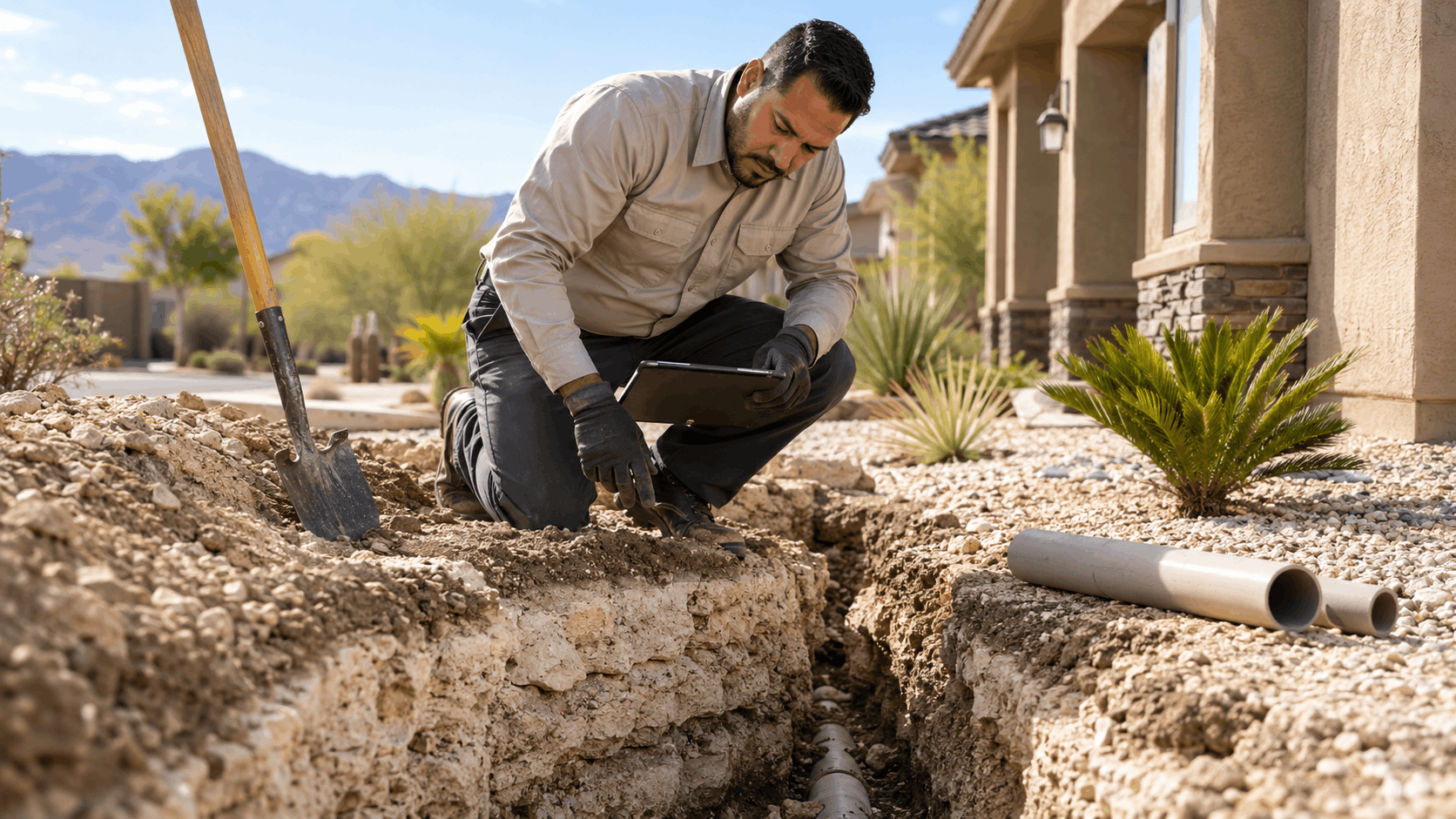
Water Line Installation and Repair in Rocky Soil
Water supply lines bring their own set of caliche challenges. They have to sit at the right depth, survive temperature swings, and stay findable when a leak develops underground.
Running or fixing a water line or water main through hardpan takes planning to protect your yard and your budget. Here is what shapes those water line decisions.
Burial Depth for Desert Temperature Swings
Water lines need enough cover to protect them from surface heat and the occasional freeze. In most of the valley, that means burying supply lines deep enough that ground temperature stays stable.
Higher elevation areas like Summerlin see colder winter nights than the valley floor. Homes up in Summerlin West can get hard frosts that lower-lying neighborhoods rarely feel, so proper burial depth matters more up there.
The tricky part is that the required depth often lands right in the caliche band. Getting a water line down to a safe, code-legal depth means breaking through hardpan to reach it.
Cutting corners on depth to avoid the rock is a mistake. A shallow line bakes in summer heat and risks freezing in a cold snap. We dig to the proper depth even when the caliche fights back.
Locating a Leak Under Hardpan
An underground water leak in caliche is a special kind of frustrating. You cannot just dig around until you find it. Breaking hardpan blindly across a whole yard would cost a fortune.
Instead, we use electronic leak detection tools that listen for the sound of escaping water and pinpoint the break. Acoustic sensors and pressure testing narrow the location to a small area.
That precision means the crew breaks caliche in one targeted spot rather than tearing up the entire yard. In hard soil, that difference can save thousands of dollars and days of work.
Our electronic leak detection finds the problem first so the dig stays small. Guessing where a buried leak sits is exactly how yards get destroyed unnecessarily.
Protecting Landscaping and Driveways During Access
Valley homes, especially in HOA communities, often have careful desert landscaping, decorative rock, pavers, and concrete. Digging through caliche near those features takes a plan to limit damage.
Before breaking ground, we map the shortest path to the pipe that avoids the most hardscape. Sometimes that means choosing an access point that adds a few feet of trench but saves a paver patio or mature plantings.
Trenchless methods help here too. Boring under a driveway instead of cutting through it can spare a homeowner an expensive concrete repair on top of the plumbing bill.
We treat your yard like it matters, because it does. Protecting the landscaping and hardscape during access is part of doing the job right, not an afterthought once the pipe is fixed.
When Repiping Beats Repeated Repairs
If an old water line keeps springing leaks, each repair means another dig into caliche. At some point, chasing leaks costs more than replacing the line altogether.
Aging galvanized steel is a common culprit. It corrodes from the inside, and once one section goes, others usually follow within a few years. Patching a line like that is throwing good money after bad.
A whole-house repipe swaps out the failing line for modern material in one planned project. Yes, it is a bigger job up front, but it ends the cycle of repeated hard-soil digs.
We help homeowners run the numbers. If you have had two or three leaks on the same old line, repiping usually wins over time. One good dig beats five bad ones.
Need Help in Las Vegas?
Active Plumbing serves Las Vegas and all of Las Vegas Valley.
How Caliche Affects Underground Pipe Costs in Las Vegas
Buried pipe work costs more in the valley than in soft-soil regions, and caliche is the main reason. Homeowners deserve to know where that money goes instead of just seeing a bigger number.
Breaking down the pieces of pipe repair cost and excavation cost makes the bid easier to trust. Here is how Las Vegas plumbing prices come together on a buried job.
| Cost Piece | Why It Adds Up in Caliche |
|---|---|
| Labor | Extra hours breaking and clearing hard rock |
| Equipment | Breakers, trenchers, and excavator rental |
| Permits | Clark County and city fees for buried work |
| Restoration | Backfill, compaction, and surface repair |
Labor and Equipment Add Up Fast
The biggest cost driver in caliche is time. A trench that takes three hours in soft soil can take a full day in hardpan. Those extra labor hours land right on the bill.
Equipment adds to it. Jackhammers, rock-tooth trenchers, and mini excavators all cost money to run or rent. Soft-soil regions rarely need that much machinery for a residential pipe job.
There is also wear and tear. Breaking caliche is hard on tools and blades, and that maintenance cost gets folded into what local crews charge. It is a real expense, not padding.
This is why an identical pipe repair can cost noticeably more here than in, say, a sandy coastal town. The pipe is the same. The ground around it is the difference.
Permits and Inspection Fees to Expect
Most buried pipe work in the valley needs a permit. Clark County and the individual cities require them for sewer and water line jobs to keep the work up to code.
Permit and inspection fees vary by the scope of the job and the jurisdiction. A simple repair may carry a modest fee, while a full sewer replacement runs higher because it involves more inspection steps.
These fees are not optional, and skipping them creates trouble at resale and with the water district. A pulled permit protects you if anything goes wrong down the line.
You can check current requirements through Clark County Building and Fire Prevention. Our team handles the permit process so you are not stuck deciphering it alone.
Restoring the Surface After the Dig
The dig is only part of the job. After the pipe is in, the trench has to be backfilled and compacted properly so the ground does not settle and sink later.
Then comes surface restoration. If the trench crossed concrete, pavers, or a driveway, that hardscape needs replacing. Concrete replacement in particular adds real cost, since it involves forming, pouring, and curing.
Desert turf and decorative rock have to be put back too. In HOA communities, the finished look often has to match the neighborhood standard, which takes extra care.
A fair quote includes these restoration steps up front. Beware of a low bid that ignores what it takes to put your yard back together after the caliche is out.
How Our Team Keeps Quotes Honest
We do not throw out a number over the phone for buried work. Instead, we come look at the site, check access, and factor in what we know about the soil in your neighborhood.
Where it helps, we run a camera or leak detection first so the scope is clear before we price it. That way the quote reflects the actual job, not a guess that balloons later.
We also explain the soil conditions in plain terms so you understand why the bid looks the way it does. Nobody likes a mystery invoice, especially on a hard-soil dig.
That upfront approach is the value of hiring a local crew. Active Plumbing has worked this ground for years, and that experience shows up as an honest quote you can plan around. Reach out through our contact page to get started.
What Homeowners Can Do Before Calling a Plumber
You do not have to sit and wait for a buried pipe to fail. A few simple habits help you catch problems early and prepare for any dig through caliche. These homeowner tips put you back in control.
Spotting pipe problem signs and prepping the yard before work starts makes any buried pipe job smoother. Here is where to focus your attention.
Warning Signs of a Failing Underground Line
Buried lines usually warn you before they fail completely. A soggy or unusually green patch in an otherwise dry desert yard often means a water line is leaking below.
Slow drains across multiple fixtures point toward a sewer line problem rather than a single clog. If every drain in the house gurgles or backs up, the trouble is likely underground.
A jump in your water bill with no change in habits is another red flag. Water escaping from a buried leak still runs through your meter and shows up as a rising water bill.
Foul smells near the yard, cracking in a slab, or pooling water all deserve attention too. Catching these warning signs early means a smaller repair before the caliche dig gets bigger.
Marking Utilities and Sprinkler Lines First
Before anyone breaks ground, call 811 for utility marking. This free service flags buried gas, power, and communication lines so a dig does not hit something dangerous or expensive.
In the valley, that step is not optional. Striking a gas line in caliche is a serious hazard, and hitting a power line can be deadly. The 811 call protects everyone on site.
Beyond the public utilities, map your own irrigation lines. Drip and sprinkler pipe is easy to slice through during a dig, and those lines are not marked by the 811 crew.
Knowing where your sprinkler valves and drip lines run helps the crew route the trench around them. A little prep here saves you from a surprise irrigation repair on top of the plumbing work.
Questions to Ask Any Local Contractor
Not every plumber is set up for caliche. When you compare crews, ask directly about their experience with hard soil in the valley. A blank stare is a bad sign.
Ask what equipment they bring for breaking hardpan. A crew that only owns hand tools and a light trencher will struggle. You want to hear about breakers, rock-tooth trenchers, or trenchless options.
Ask how they handle surface restoration and whether it is included in the bid. Ask to see proof of licensing and insurance too. In Nevada, a licensed plumbing contractor is your protection if something goes wrong.
You can verify a license through the Nevada State Contractors Board. These contractor questions quickly separate the crews who know this ground from the ones who do not.
How Active Plumbing Approaches Valley Jobs
Our process starts with a look at the actual site. We check access, factor in the soil we expect for your area, and use cameras or leak detection when it saves you a needless dig.
From there we lay out the plan, the timeline, and the cost in plain language. You know what tools we are bringing and why before we ever break caliche.
We serve neighborhoods across the whole valley, from Spring Valley to Henderson and out to the newer edges of town. That range means we already know the soil quirks of most areas we work.
When the job wraps, we backfill, compact, and restore the surface so your yard looks right again. Active Plumbing treats each home like it belongs to a neighbor, because in this valley, it usually does.
Need Help in Las Vegas?
Active Plumbing serves Las Vegas and all of Las Vegas Valley.
Final Thoughts
Caliche is the quiet force behind almost every buried pipe decision in the Las Vegas Valley. It shapes how crews dig, which pipes last, how sewer and water lines are laid, and what the whole job costs.
The homeowners who come out ahead are the ones who understand the ground before work starts. Knowing why the hardpan matters helps you plan, budget, and pick the right crew with confidence.
If you have a buried pipe project, a stubborn drain, or a leak somewhere in the yard, our team is ready to help. Call Active Plumbing or reach out through our contact page for an on-site look and an honest quote built around your actual soil.
Frequently Asked Questions
What is caliche soil and why is it a problem for pipes?
Caliche is a natural cement layer made mostly of calcium carbonate that hardens over centuries in dry climates. It behaves like low-grade concrete underground. That makes digging trenches slow and difficult, and its sharp rubble can damage pipe walls without proper sand bedding. For buried pipe work, caliche adds time, equipment, and cost compared with softer soil regions across the country.
How deep is caliche in the Las Vegas Valley?
It varies a lot. Caliche can sit just inches below the surface or several feet down, and it changes from one lot to the next. Higher-elevation areas near Henderson and Centennial Hills often have shallow, dense layers. We have seen two homes on the same street with completely different depths, which is why on-site inspection beats any general soil map.
Does caliche make plumbing repairs more expensive here?
Yes. The hard layer takes extra hours to break, and crews need jackhammers, rock-tooth trenchers, or excavators to get through it. That added labor and equipment raise the cost compared with soft-soil areas. Surface restoration, like replacing concrete or desert landscaping, adds more. A buried repair that is cheap elsewhere often costs noticeably more in the valley because of the ground.
Can pipes be installed without heavy digging through caliche?
Sometimes. Trenchless methods like directional boring and pipe bursting install or replace lines with far less surface digging, which protects driveways and landscaping. They also cut down on how much caliche must be removed. The catch is that very dense or thick hardpan can slow boring heads and limit these methods. We check the soil on your lot before recommending a trenchless route.
What pipe material lasts longest in Las Vegas soil?
It depends on the line. PVC is the standard for sewer and drain work because it does not corrode, though it needs sand bedding in rocky ground. PEX flexes with soil movement and resists interior scale, making it a strong water-line choice. Copper is durable but can corrode with our hard water and certain soil chemistry. Proper bedding matters as much as material.
Do I need a permit for buried pipe work in Clark County?
Most buried sewer and water line jobs require a permit and inspection through Clark County or your city building department. The fees vary by scope. Permits keep the work up to code and protect you at resale and with the water district. Skipping them creates problems later. Our team handles the permit process so the job stays legal and inspected from start to finish.
How do plumbers find an underground leak without digging up my yard?
We use electronic leak detection tools that listen for escaping water and pinpoint the break, plus pressure testing to narrow the location. For sewer lines, a camera inspection shows the exact spot and depth of the trouble. Both methods let the crew break caliche in one targeted area instead of tearing up the whole yard, which saves major cost in hard soil.
Why do older Las Vegas neighborhoods have more sewer problems?
Homes near the east side and older central Las Vegas were often built with clay or cast iron pipe. Clay cracks and lets roots in at the joints, and cast iron rusts until the walls fail. Decades of subtle soil movement from surrounding hardpan add stress. Those materials simply reach the end of their service life, which is why we see steady failures in established areas.
How long does a caliche pipe job usually take?
It depends on depth, length, and soil density. A trench that takes a few hours in soft ground can take a full day or more in thick caliche, and larger jobs can stretch to two or three days. Summer heat slows crews too. We give realistic windows up front so you are not left guessing once the rock shows up.
How do I get a quote from Active Plumbing?
Reach out through our contact page or give us a call. For buried pipe work, we come look at the site, check access, and factor in the soil we expect for your neighborhood. When it helps, we run a camera or leak detection first so the scope is clear. Then we explain the soil conditions and give an honest, upfront quote you can plan around.
Frequently Asked Questions
- What is caliche soil and why is it a problem for pipes?
- Caliche is a natural cement layer made mostly of calcium carbonate that hardens over centuries in dry climates. It behaves like low-grade concrete underground. That makes digging trenches slow and difficult, and its sharp rubble can damage pipe walls without proper sand bedding. For buried pipe work, caliche adds time, equipment, and cost compared with softer soil regions across the country.
- How deep is caliche in the Las Vegas Valley?
- It varies a lot. Caliche can sit just inches below the surface or several feet down, and it changes from one lot to the next. Higher-elevation areas near Henderson and Centennial Hills often have shallow, dense layers. We have seen two homes on the same street with completely different depths, which is why on-site inspection beats any general soil map.
- Does caliche make plumbing repairs more expensive here?
- Yes. The hard layer takes extra hours to break, and crews need jackhammers, rock-tooth trenchers, or excavators to get through it. That added labor and equipment raise the cost compared with soft-soil areas. Surface restoration, like replacing concrete or desert landscaping, adds more. A buried repair that is cheap elsewhere often costs noticeably more in the valley because of the ground.
- Can pipes be installed without heavy digging through caliche?
- Sometimes. Trenchless methods like directional boring and pipe bursting install or replace lines with far less surface digging, which protects driveways and landscaping. They also cut down on how much caliche must be removed. The catch is that very dense or thick hardpan can slow boring heads and limit these methods. We check the soil on your lot before recommending a trenchless route.
- What pipe material lasts longest in Las Vegas soil?
- It depends on the line. PVC is the standard for sewer and drain work because it does not corrode, though it needs sand bedding in rocky ground. PEX flexes with soil movement and resists interior scale, making it a strong water-line choice. Copper is durable but can corrode with our hard water and certain soil chemistry. Proper bedding matters as much as material.
- Do I need a permit for buried pipe work in Clark County?
- Most buried sewer and water line jobs require a permit and inspection through Clark County or your city building department. The fees vary by scope. Permits keep the work up to code and protect you at resale and with the water district. Skipping them creates problems later. Our team handles the permit process so the job stays legal and inspected from start to finish.
- How do plumbers find an underground leak without digging up my yard?
- We use electronic leak detection tools that listen for escaping water and pinpoint the break, plus pressure testing to narrow the location. For sewer lines, a camera inspection shows the exact spot and depth of the trouble. Both methods let the crew break caliche in one targeted area instead of tearing up the whole yard, which saves major cost in hard soil.
- Why do older Las Vegas neighborhoods have more sewer problems?
- Homes near the east side and older central Las Vegas were often built with clay or cast iron pipe. Clay cracks and lets roots in at the joints, and cast iron rusts until the walls fail. Decades of subtle soil movement from surrounding hardpan add stress. Those materials simply reach the end of their service life, which is why we see steady failures in established areas.
- How long does a caliche pipe job usually take?
- It depends on depth, length, and soil density. A trench that takes a few hours in soft ground can take a full day or more in thick caliche, and larger jobs can stretch to two or three days. Summer heat slows crews too. We give realistic windows up front so you are not left guessing once the rock shows up.
- How do I get a quote from Active Plumbing?
- Reach out through our contact page or give us a call. For buried pipe work, we come look at the site, check access, and factor in the soil we expect for your neighborhood. When it helps, we run a camera or leak detection first so the scope is clear. Then we explain the soil conditions and give an honest, upfront quote you can plan around.
A
Licensed plumbing professionals serving Las Vegas and Las Vegas Valley.
Licensed in Nevada · License #0047021
Last updated on
Why trust Active Plumbing?
Founded in 1991, Active Plumbing is a licensed and insured plumber serving Las Vegas and Las Vegas Valley. All content is reviewed by our licensed technicians.

Need Help in Las Vegas?
Active Plumbing serves Las Vegas and all of Las Vegas Valley.
Related Articles
Tips & Advice
Sewer Line Repair in Paradise and Winchester: 60s-70s Clay Pipe Root Intrusion Capital of the Valley
Paradise and Winchester's 60s-70s clay pipes are root intrusion magnets. Learn the warning signs, camera inspection, repair options, and costs from Active Plumbing.
Tips & Advice
Tree Roots in Las Vegas Sewer Lines: Mulberry and Olive Roots vs Your Clay Joints in Older Neighborhoods
Mulberry and olive roots invade clay sewer joints in older Las Vegas homes. Learn the warning signs, camera diagnosis, and repair options that stop backups for good.
Cost Guides
Trenchless Pipe Bursting vs Pipe Lining vs Open Trench in Las Vegas Caliche Soil
Compare trenchless pipe bursting, pipe lining, and open trench sewer repair in Las Vegas caliche soil, with costs, timelines, and how to pick the right method.