Multiple Water Heaters and Recirculation Loops in Southern Highlands Estates: Sizing and Service
Key Takeaways
- Southern Highlands spans tract, semi-custom and custom estate homes, and the hot water setup and sizing change completely across them.
- Large estates use multiple water heaters and continuous recirculation loops to deliver hot water fast across long runs, which also speeds scale buildup.
- The valley's water is 280 ppm, about 16 grains per gallon and categorized very hard, so scale is the single biggest cause of heater and fixture failures here.
- Elevation changes incoming pressure across the community, so the pressure regulator is the first component to check on any complaint.
- Many homes have a stubbed softener loop in the garage that was never used, leaving every appliance running on untreated hard water.
- Southern Highlands is in unincorporated Enterprise, so permits run through the Clark County Department of Building and Fire Prevention, and HOA approval is a separate track for exterior equipment.
- Typical area ranges are $800 to $1,500 for a tank heater install, $1,500 to $3,500 for tankless, and $400 to $900 for a recirculation pump, with a written price given before work begins.
- Gas to pool heaters, outdoor kitchens and water heaters must be sized to the whole load, and any gas smell means leaving and calling Southwest Gas from outside first.
In This Article
Picture a custom estate off Southern Highlands Parkway, up on one of the higher lots below the Spring Mountains. The owner turns on the shower in the far primary bathroom and waits, and waits, while the water runs cold for close to a minute. Downstairs, a second heater that was supposed to carry the kitchen and laundry side never seems to keep up when two people are getting ready at once.
That scene plays out across Southern Highlands because the homes here are not one size. Production tract housing on the flatter ground, semi-custom homes with more square footage, and guard-gated custom estates all sit inside one master-planned community. The plumbing job changes completely across that range, and so does the way hot water gets made and moved.
Why Southern Highlands Estates Need More Than One Water Heater?
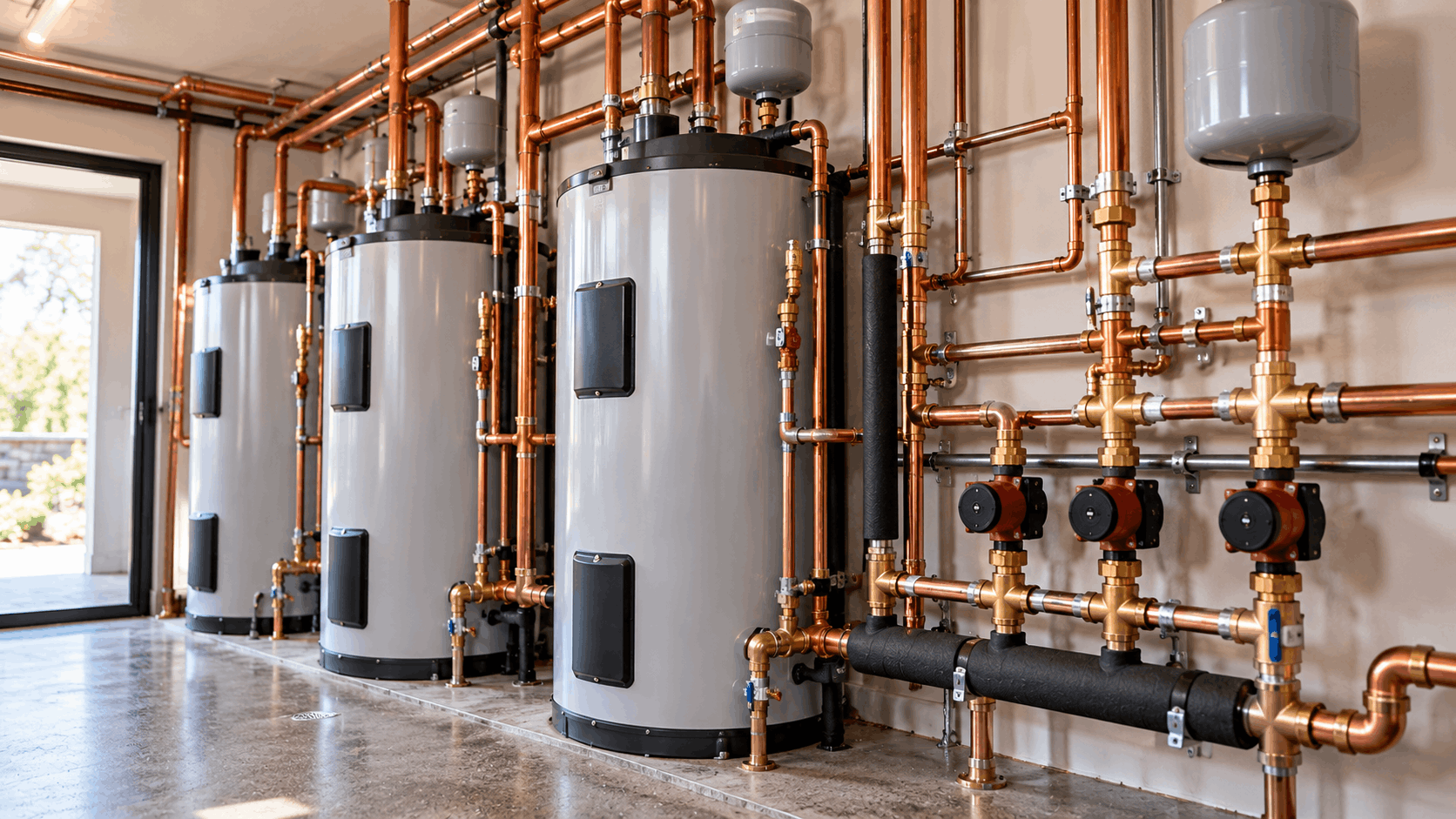
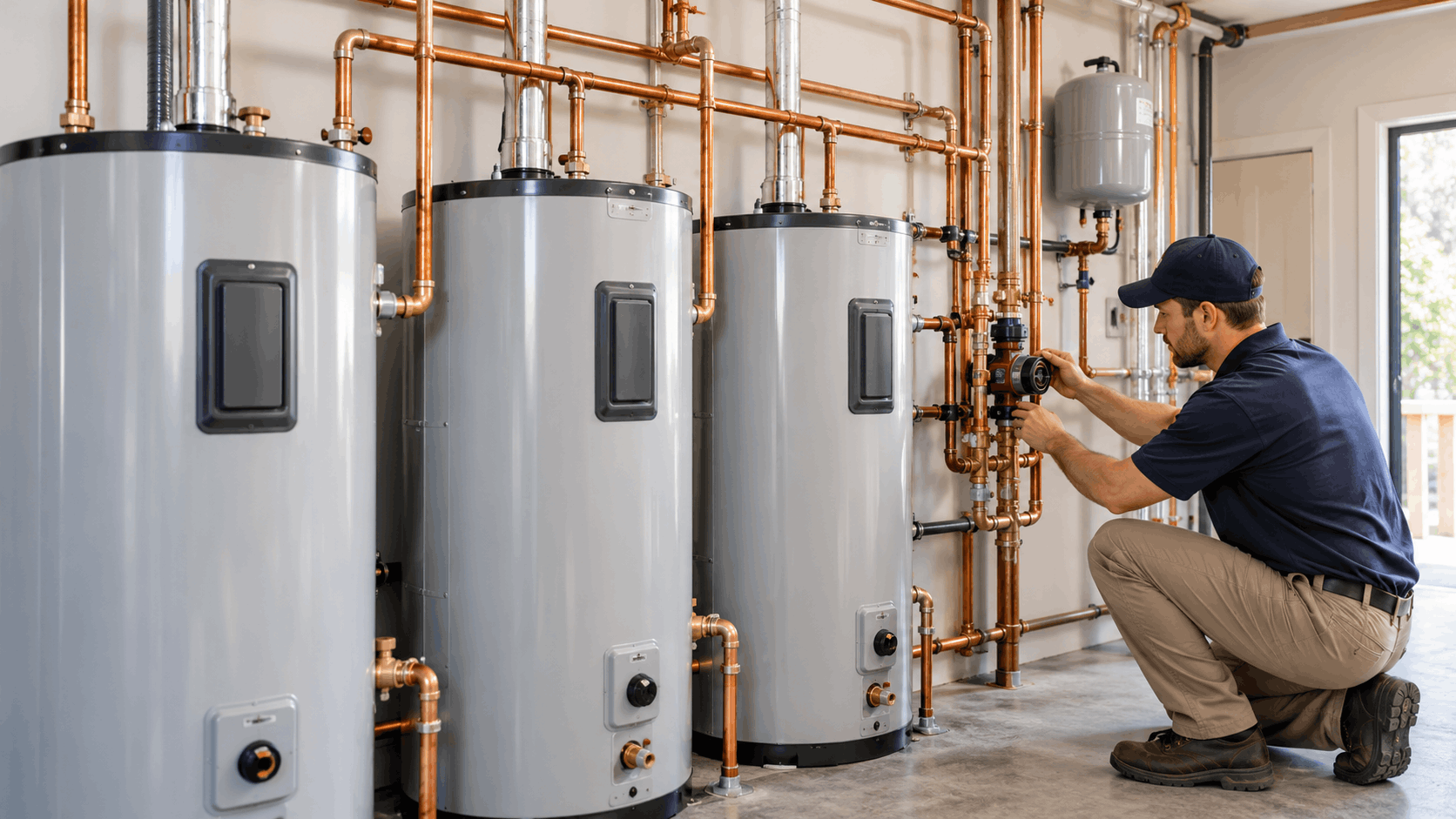
Larger homes in Southern Highlands draw hot water in several places at the same time. A single heater sized for a modest house cannot feed three bathrooms, a kitchen, a laundry room and an outdoor feature all running together. That is the simple reason builders installed multiple water heaters in the bigger properties across this community.
The layout makes it worse. A sprawling estate puts a lot of distance between the heater and the far corners of the house. The further the fixture sits from the heater, the longer the wait for hot water and the more water wasted down the drain while someone waits. Builders answered that with more than one heater and a recirculation loop that keeps hot water ready near the fixtures.
Hot water demand is the real driver here, not square footage on its own. A home with two owners and light use needs less than a full estate hosting guests, running a pool spa and a laundry that never stops. Getting the number and size of heaters right starts with understanding how the house actually gets used.
The Three Property Types and Their Hot Water Setups
A production tract home in Southern Highlands is typically twenty to twenty-five years old with a straightforward setup. It has one water heater, an expansion tank, a pressure regulator, and the original angle stops and connectors. The failures that come with that age are predictable, and the service is usually a single-heater job.
A semi-custom home adds size and often a second heater. These properties frequently include recirculation to handle the longer distances between the heater and the far bathrooms. The scope grows because there is more pipe, more fixtures and a loop to service rather than a simple heater swap.
A custom estate in a gated enclave is a different proposition. These homes carry multiple heaters, long hot water runs with recirculation running continuously, pool and spa gas, outdoor kitchens and fire features, and extensive irrigation. The owner expects a written price, protected finishes and kept appointments. Establishing which type of property is involved at the first call decides the scope and the sizing from the start, which is why our water heater services start with that question.
Long Hot Water Runs in a Large Footprint
A large estate spreads the plumbing out. When the water heater sits in the garage and the primary suite is at the far end of a two-story home, the hot water has a long way to travel. Every foot of pipe between the heater and the tap holds water that has gone cold while nobody used it.
That is why someone standing at the far fixture waits so long. The cold water sitting in the line has to be pushed out before the hot arrives. In a compact house that takes a few seconds. In a wide estate layout it can feel like forever, and it wastes a surprising amount of water each day.
Builders have two tools for this problem. The first is placing more than one heater so no fixture is too far from a source. The second is running a recirculation loop that keeps hot water moving through the pipes so it is there the moment the tap opens. Most larger homes here use a combination of both.
Where Builders Placed Heaters and What That Means Years Later
Most heaters in Southern Highlands homes sit in the garage, with some interior placements in larger properties. Garage placement is convenient for the original build, but it has a downside in this climate. Summer heat in the valley raises incoming water temperature and stresses equipment sitting in a hot garage, so that location works harder in July than a conditioned interior spot would.
Where the original builder put the heater also decides how easy service and replacement will be years later. A heater tucked into a tight closet or an attic space is harder to reach, harder to drain for a flush and harder to swap when it fails. On the estate side, an interior or upstairs heater raises the stakes because a leak there can damage finished space below.
That original placement matters every time we scope a replacement. Access, clearance, the route for the drain line and the condition of the surrounding finishes all come from decisions made twenty years ago. We account for all of it before quoting so there are no surprises once the old unit comes out.
Get Your Quote
Tell us what's going on and we'll get back to you. We're open 24/7.
Sizing Multiple Water Heaters for an Estate
Sizing multiple heaters for a large home means matching output to real hot water demand, not guessing from bedroom count. The goal is enough capacity for the busiest moment of the day without wasting energy heating water nobody uses. Both undersizing and oversizing cause problems, so the number has to fit the house.
Undersized heaters run out of hot water when several fixtures draw at once, which is exactly the complaint estate owners call about. Oversized equipment costs more to buy and more to run, and it scales just the same in the valley's hard water. The right answer counts the fixtures that can run together and sizes to that peak.
| Property Type | Typical Hot Water Setup | Main Sizing Concern |
|---|---|---|
| Tract home | One heater, expansion tank, regulator | Single-source capacity for the household |
| Semi-custom home | Second heater, recirculation | Covering longer runs and added fixtures |
| Custom estate | Multiple heaters, continuous recirculation | Peak simultaneous demand across the footprint |
Counting the Real Demand, Not Just the Bathrooms
Real sizing starts with total simultaneous demand. In a large estate, you can have multiple showers running, the kitchen sink and dishwasher going, a laundry cycle underway and an outdoor fixture all at the same time. Each of those pulls hot water, and the heaters have to supply all of them at once during a busy morning.
Counting fixtures is only the first step. What matters is how many of them realistically run together on the household's busiest day. A home with a full crew of guests and several bathrooms in use behaves very differently from the same house with two quiet owners.
We walk the property and count the hot water draws, then size the heaters to that peak load rather than a rule of thumb. That is how a home ends up correctly set up with two or three heaters feeding different zones. Each heater carries its part of the house so no single unit gets overwhelmed when demand spikes.
Tank vs Tankless in a Large Home
Tank and tankless each have a place in a large estate, and the valley's water chemistry weighs on the choice. A tank heater stores hot water and heats it with elements or a burner, and in very hard water scale settles on the elements and the tank bottom over time. A tankless unit heats on demand through a narrow heat exchanger, and that narrow passage scales fast in hard water because the water path is where mineral buildup hits hardest.
Tankless saves space and only runs when there is a draw, which appeals in homes where floor space is at a premium and demand is intermittent. Tanks deliver a large slug of hot water instantly and handle big simultaneous draws well, which suits an estate with several bathrooms firing at once. Neither comes with a promised lifespan, and both depend heavily on whether the home treats its water.
The honest answer in an estate is that the choice depends on the demand pattern, the layout and whether treatment is in place. Many large homes end up with a mix, or with tankless units protected by a pre-filter where hard water calls for one. Our tankless water heater installation work always factors in the hard water before we recommend a path.
Elevation and Pressure Affect the Whole System
Southern Highlands climbs. The community rises onto the slopes below the Spring Mountains, and homes at different elevations on the same water system do not see the same incoming pressure. That single fact explains more complaints here than anywhere else in the southwest valley.
On the lower streets, incoming pressure can run high. High pressure quietly stresses fixtures, appliances, connectors and water heaters, and it shortens the life of everything it touches without the owner noticing. On the higher lots, pressure can be lower than an owner expects, especially at upstairs fixtures in a two-story house, and that is often the complaint that prompts the call.
The pressure regulator is the first component to check in this community, not an afterthought. A regulator that has crept high is doing damage nobody has noticed, and one that has dropped produces the low-pressure complaint directly. Checking incoming pressure takes two minutes. Where a house sits high on the system, a pressure-boosting arrangement is sometimes the honest answer rather than replacing fixtures that are working correctly.
Drain Pans and Code Requirements for Estate Installs
The Southern Nevada Amendments to the Uniform Plumbing Code, as codified by Clark County, require a water heater drain pan where a leak would cause damage. That covers attic installs, floor-ceiling assemblies and similar locations, which come up often in estate homes where a heater sits above finished living space. The pan protects the home from a slow leak turning into a ceiling full of water.
The code sets the details. The pan must be at least 1-1/2 inches deep, with a drain line not less than 3/4 inch running to a visible, approved location. The relief valve must not discharge into the pan, with an exception for readily accessible tankless and point-of-use heaters.
Relief valve discharge inside a building has its own material list under the amendments: galvanized steel, hard-drawn copper, CPVC, PP, flexible corrugated connectors or a listed drain tube to the exterior, unless the listing prevents it. An air gap to a secondary washer port, floor sink, mop sink or funneled floor drain is also allowed. These rules apply as adopted by Clark County, and we build every estate install to meet them.
Need Help in Las Vegas?
Active Plumbing serves Las Vegas and all of Las Vegas Valley.
How Recirculation Loops Work and Why They Run Continuously Here
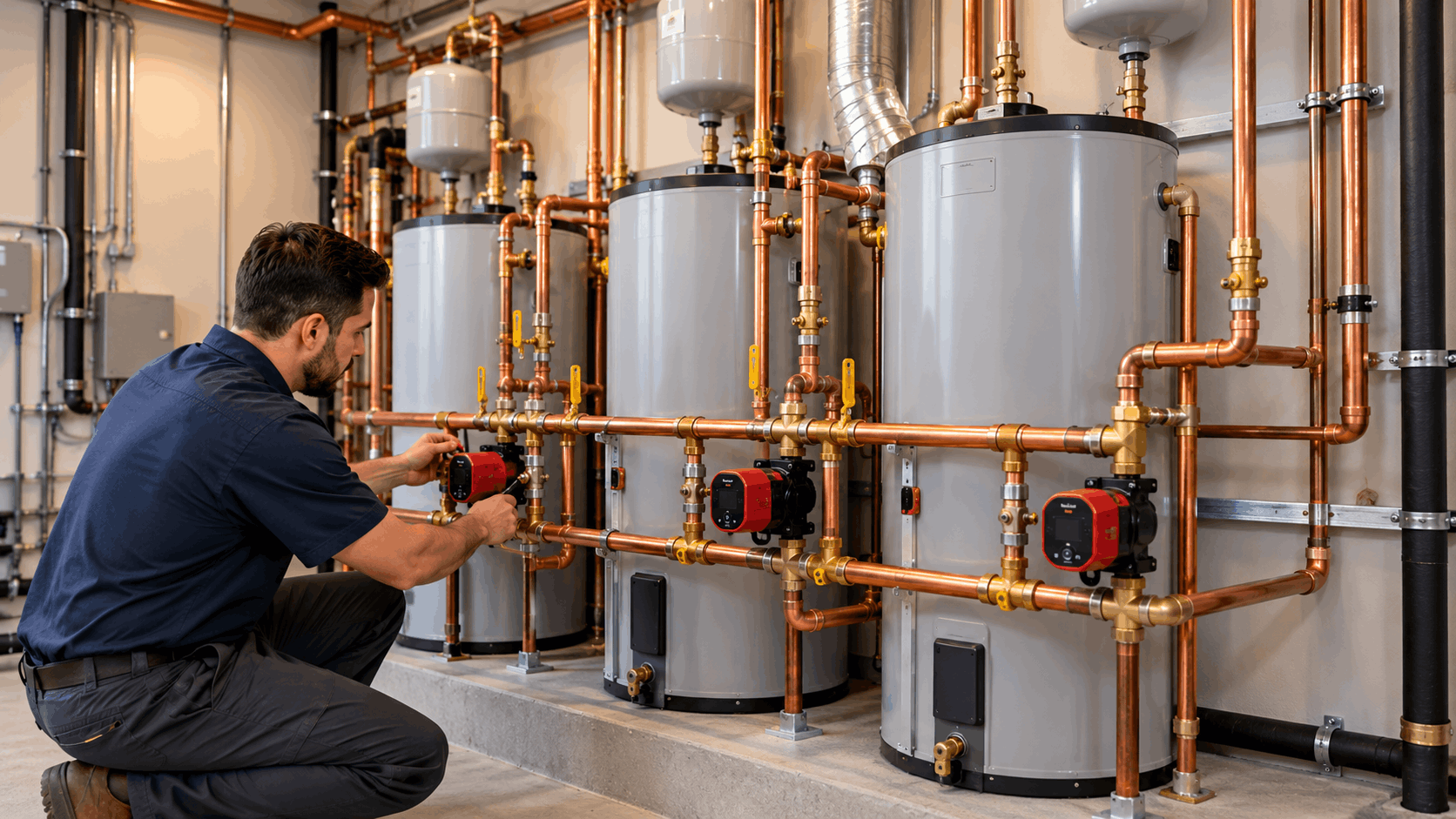
A recirculation loop keeps hot water moving through the pipes so it is ready at the tap. Instead of hot water sitting still and going cold between uses, a pump circulates it through the system. In a large home that is the difference between hot water arriving right away and a long cold wait.
Continuous operation keeps that hot water ready across a long estate footprint at all hours. That convenience comes with a maintenance trade-off. Constant flow through the valley's very hard water speeds up scale buildup in the loop and in the heaters feeding it, so a continuously running system needs more attention than one that only runs on a schedule.
What a Recirculation Loop Actually Does
In plain terms, a recirculation pump keeps hot water circulating through a dedicated return line or the existing piping. Without it, the hot water in the pipe cools down every time a fixture goes unused for a while. The next person to open that tap gets the cooled water first, then waits for fresh hot to travel from the heater.
With a pump running, hot water is always close to the fixture. A far bathroom delivers hot water quickly instead of running cold for a minute. That is the whole point of the system, and it is why builders install it in homes where the heater sits a long way from the farthest taps.
The pump itself is a modest piece of hardware, but it does a lot of work in a large home. When it fails or clogs, the symptom is the return of that long cold wait the owner thought they had solved. Our recirculation pump installation and service work focuses on keeping that delivery fast.
Continuous Recirculation Across a Large Estate
Custom estates often run recirculation continuously because the footprint is so large. A scheduled or on-demand loop might not keep up with a home where hot water could be called for in any wing at any time. So the pump runs, and hot water stays ready everywhere.
That constant flow carries a cost in this water. Every gallon circulating through the loop is very hard water at 280 parts per million, and moving it through the pipes and heaters around the clock accelerates scale buildup along the way. The loop that keeps an estate comfortable is also the loop that scales the fastest.
The long footprint multiplies the effect. More pipe means more surface area for mineral deposits, and continuous operation means the water never stops depositing them. That is why an estate with continuous recirculation needs a maintenance plan, not just an install and a walk away.
Dead Legs, Stagnation and Low-Use Lines
Large homes have low-use lines. A guest bathroom that rarely sees traffic, a bar sink, an outdoor fixture that runs only in season, all can become dead legs where water sits stagnant for long stretches. In a sprawling estate there are more of these spots than in a compact house.
Stagnation in low-use lines is a recognized concern in large plumbing systems. The Southern Nevada Water Authority notes that while Legionella sits at low concentrations in source water, it can grow in biofilm inside the pipes of large systems such as hotels, hospitals and high rises under the right conditions. Temperature management and recirculation design are legitimate concerns in large systems here.
For a residential estate, the practical point is simpler than the commercial version, and the residential risk should not be overstated. Good recirculation design, keeping hot water hot and not leaving long stretches of stagnant line, is sound practice in a big home. We factor dead legs and stagnation into how we design and service these loops.
Very Hard Water and What It Does to Multiple Heaters and Loops
The valley's water is very hard, and that single fact explains more plumbing failures in Southern Highlands than anything else. In a home with multiple heaters and a continuous loop, hard water has many more surfaces to attack and many more hours to do it. Connecting the water chemistry to treatment is the practical path to protecting an expensive system.
The damage is specific and predictable. Scale builds on heater components, narrows passages, clogs small openings and crusts fixtures. The fix is also specific: treatment that reduces scale, and regular maintenance that removes what does form.
280 PPM and 16 Grains: The Valley Figure
The Southern Nevada Water Authority states the valley's water is 280 parts per million, or 16 grains per gallon, categorized as very hard. That is the published figure, and it is the one that applies to every home in Southern Highlands on the municipal supply.
Calcium and magnesium scale from that hard water is the single biggest cause of plumbing failures in this valley. It deposits throughout a system, settling wherever water sits or passes through a narrow spot. In a home with several heaters and a loop, there are many such spots.
If a homeowner runs their own test and gets a higher number, that is their reading on their water. The municipal figure is 280 ppm, about 16 grains per gallon, and that is what we size treatment and plan maintenance around.
Scale in Heaters, Heat Exchangers and Recirculation Systems
Scale builds on water heater elements and tank bottoms, where it insulates the heat source from the water and makes the unit work harder. In a tank, that layer of mineral sits where the heat enters, forcing longer run times to reach temperature. The harder a heater works, the sooner it fails.
In a tankless unit, scale collects in the narrow heat exchanger, which is the tightest passage in the whole system. A continuously running recirculation loop spreads scale throughout its length as hard water circulates around the clock. The same minerals foul cartridges inside mixing valves and clog aerators and shower heads at the fixtures.
An unflushed tank works harder and fails earlier than its rated life because of that insulating scale layer. With multiple heaters and a continuous loop in play, the buildup happens across more equipment at once. That is why maintenance matters more in these homes than in a simple single-heater house.
The Stubbed Softener Loop Many Homes Never Used
Many homes of this era in Southern Highlands were plumbed with a softener loop stubbed out in the garage. The builder ran the pipe so an owner could connect a treatment system later. The loop is there waiting, but it does nothing until something gets connected to it.
An owner who has never used that loop is running every appliance on untreated very hard water. The water heater, the dishwasher, the washing machine, every fixture and the recirculation loop all take the full 280 ppm with no reduction. Years of that take a toll on expensive equipment.
A whole-house softener or a scale-reduction system connected to that loop protects the system and extends equipment life. In an estate with multiple heaters and continuous recirculation, that protection applies to a lot of costly hardware at once. Our water treatment work ties straight into that stubbed loop where the builder left it.
Flushing and Descaling as Maintenance, Not an Option
In this water, flushing a tank heater and descaling a tankless unit are ongoing maintenance, not a luxury. Flushing clears the mineral sediment that settles in a tank before it bakes onto the bottom and insulates the heat source. Descaling runs a solution through a tankless heat exchanger to dissolve the buildup in that narrow passage.
These tasks matter more when several heaters and a continuous loop are in play. Each heater needs its own attention, and the loop itself carries scale throughout its length. Skipping maintenance on one unit in a multi-heater home still leaves that unit working harder and failing sooner.
Tankless maintenance and descaling and tank flushing are the standard responses to the valley's water. The honest framing is that in Southern Highlands they extend equipment life rather than being optional. A system this large represents a real investment, and routine maintenance is how an owner protects it.
Estate Gas, Pool Heaters and Outdoor Features
On the larger lots, gas does more than feed the furnace and the water heaters. Pool and spa heaters, outdoor kitchens and fire features all draw gas, and they draw it alongside the indoor appliances. Sizing the gas supply to that whole load is what keeps everything running the way it should.
Gas safety stays general here. We never walk a homeowner through repairing, capping or reconnecting a gas line, because that is work for a licensed professional. What matters for the owner is knowing the gas is sized correctly and knowing exactly what to do if they ever smell gas.
Sizing Gas to the Whole Load
Gas to pool heaters, outdoor kitchens, fire features and water heaters must be sized to the whole load, not to one appliance in isolation. The common mistake on properties of this type is sizing a line to the appliance in front of you and ignoring everything else drawing from the same supply. The result shows up as an appliance that underperforms rather than an obvious fault.
When a pool heater runs slow or an outdoor burner never gets hot enough, undersized gas is often the hidden cause. Each appliance competes for the available gas, and if the line cannot deliver enough for all of them at once, they all suffer. The pool heater is frequently the first to complain because it demands so much.
Correct sizing adds up the total demand of everything that can run together, then sizes the pipe to supply it. On an estate with a pool, a spa, an outdoor kitchen and multiple water heaters, that total is substantial. Our gas line installation work sizes to the full load so no appliance gets starved.
Southwest Gas Is the Gas Utility Here
Natural gas in the Las Vegas Valley is supplied by Southwest Gas. For anything involving the gas supply, gas coordination, a gas pressure matter or the gas bill, Southwest Gas is the utility to contact. That is true across Southern Highlands and the rest of the valley.
NV Energy supplies electricity, not gas. NV Energy is the right call for electric matters, such as the running cost of an electric or heat pump water heater, or an electric bill spike from a hidden hot-water leak. Keeping the two straight saves an owner time when something goes wrong.
For the plumbing side of gas work, such as sizing and installing lines for pool heaters and outdoor features, we handle the installation and coordinate with Southwest Gas as needed. The owner does not have to sort out which utility does what on a gas project.
What to Do if You Smell Gas
If anyone smells gas near a pool heater, an outdoor kitchen or anywhere on the property, the steps are the same every time. Leave the building. Do not touch light switches or anything that could spark, and avoid open flames.
From outside the building, call Southwest Gas. Report the smell and let them respond before anyone goes back in. The utility handles the gas emergency first, and that comes before any plumbing call.
Once the gas utility has made the situation safe, a licensed plumber can address the line or appliance that caused the problem. The order matters: safety first through the utility, then the repair. Never try to find or fix a gas leak yourself.
Need Help in Las Vegas?
Active Plumbing serves Las Vegas and all of Las Vegas Valley.
Servicing an Under-Slab or Hidden Leak in an Estate
Homes in Southern Highlands are slab-on-grade, built on graded slopes over cut and fill ground, in soil that includes caliche. All three of those conditions shape how a leak gets serviced when a heater line, a recirculation line or a yard line fails. The first step is almost always detection, because the leak is usually hidden.
Finding the leak before touching anything saves the finished floors and keeps the repair contained. Once the location is known, the owner has a real choice about how to fix it. Our slab leak detection and repair work starts with pinpointing the source.
Slab-on-Grade and the Reroute Decision
Because these homes sit on a slab, an under-slab line is not accessible without breaking into the concrete. When a supply line or recirculation line under the slab leaks, the owner faces a choice: break the slab to reach the pipe, or reroute the line through the walls and attic to bypass the failed section.
In a finished estate with stone or hardwood floors, breaking the slab means destroying expensive flooring and then repairing it. That is why rerouting usually makes more sense in these homes. A reroute abandons the leaking under-slab section and runs a new line overhead or through accessible space, leaving the finished floors untouched.
The right call depends on the specific leak, the floor finishes and the layout. We locate the leak first with electronic leak detection, then lay out both options with the owner. In most finished estates the reroute wins because it protects the floors the owner paid a lot for.
Long Irrigation and Yard Lines on Graded Slopes
Southern Highlands sits on graded slopes, so exterior lines run across cut and fill ground. Settlement over two decades can stress yard and irrigation lines as the fill beneath them shifts and the pipe gets pulled out of grade. On a large estate with extensive private landscape, there is a lot of buried line exposed to that movement.
A leak in a long irrigation run can go unnoticed for weeks. The water soaks into the ground away from the house, so there is no puddle inside and no obvious sign. The first thing an owner usually notices is an unexplained jump in the water bill.
That makes exterior leak detection a genuine service here, not an add-on. Finding a buried irrigation or yard-line leak takes equipment and know-how, because the leak is out of sight across a large property. For a seasonally occupied home, this matters even more, since a leak can run a long time before anyone is there to notice.
How Caliche Changes Exterior Excavation
Caliche is a cemented calcium-carbonate hardpan common across the valley. It is abrasive and hard, which makes trenching through it slower and more expensive than digging in softer ground. It also abrades buried pipe where a line runs through it.
Caliche is not an expansive soil and it does not shift, swell or crack pipes. What pulls lines out of grade here is seasonal ground movement and poorly compacted backfill settling under the pipe over time. That settlement is the mechanism behind sagging yard and irrigation lines, not the caliche itself moving.
On the higher lots in Southern Highlands, rock is a real factor in what a trench costs. Hard ground means more time, more equipment and a dearer excavation. We account for the caliche and the slope when we plan any exterior dig so the price reflects the real conditions on that lot.
Permits, Associations and Access in Southern Highlands
Water heater and recirculation work in Southern Highlands can involve two separate approval tracks. One is the county permit for the plumbing work itself. The other is association approval for anything that affects the home's exterior appearance. They run independently, and both can apply to one project.
On top of that, many parts of the community are guard-gated, so access has to be arranged in advance. Sorting out jurisdiction, association rules and gate access before the appointment keeps the job moving. It is also a sign of a contractor who actually knows this community.
Enterprise Is Unincorporated Clark County
Southern Highlands sits in Enterprise, an unincorporated township of Clark County, not the City of Las Vegas. Even though residents describe the area as Las Vegas, the address is a county address. Permits, plan check and inspections run through the Clark County Department of Building and Fire Prevention.
That matters because the rule that applies depends on which authority governs the address. An owner should confirm the permit position for their specific address rather than assuming a city rule applies. For Southern Highlands, that confirmation goes to Clark County.
Knowing the correct jurisdiction before quoting permitted work is a routine first step for us on every job here. We handle the Clark County side and tell the owner exactly where their permit stands. Our work across Enterprise is built around that county process.
Master Association and Architectural Standards
The community is governed by a master association with sub-associations beneath it, organized under Nevada Revised Statutes Chapter 116. Architectural standards cover exterior appearance, which brings plumbing into the picture whenever equipment would be visible from outside.
An exterior tankless unit, a visible treatment system or anything on a street-facing elevation can require association approval. Interior work generally does not, because it changes nothing an association governs on the outside. So a tankless unit mounted inside the garage is one situation, and the same unit on an exterior wall facing the street is another.
Association approval and a county permit are separate tracks. Clearing one does not clear the other, and both can apply to a single change. An owner should confirm with their association what the architectural standards require before placing any equipment on a visible elevation, and we plan the work around both tracks.
Guard-Gated Access for Service Calls
In the guard-gated enclaves, contractor access is authorized in advance through the homeowner rather than arranged at the gate. The guard will not simply wave a truck through, so the owner needs to clear the visit ahead of time. That one step prevents a wasted trip and a delayed appointment.
Some associations keep vendor or insurance records for contractors working inside the gates. Where that applies, having the paperwork in order ahead of the visit keeps everything smooth. It is part of working professionally in these communities.
The practical point is to confirm access when the appointment is booked. We ask about the gate, the authorization and any vendor requirements up front so the technician reaches the door without a holdup. Estate owners expect kept appointments, and sorting access in advance is how that happens.
What This Work Typically Costs in the Las Vegas Valley
The figures below are typical market ranges for plumbing work in the Las Vegas Valley. They are not a quote and not a fixed price from us. The actual price for a specific job depends on that job, and we give a written price before work begins.
Estate jobs land toward the higher end of these ranges because of the scale involved. Multiple heaters, long recirculation runs, access constraints and caliche excavation all add work. The ranges give an owner a sense of what to expect before we look at the property.
| Job | Typical Range |
|---|---|
| Tank water heater installation | $800 to $1,500 |
| Tankless water heater installation | $1,500 to $3,500 (pre-filter adds $150 to $300) |
| Commercial water heater installation | $1,500 to $6,000+ |
| Recirculation pump installation | $400 to $900 |
| Water heater repair | $150 to $500 |
| Tankless maintenance and descaling | $150 to $250 |
Water Heater and Recirculation Pump Ranges
Tank water heater installation typically runs $800 to $1,500. Tankless water heater installation typically runs $1,500 to $3,500, with a pre-filter adding $150 to $300 where hard water calls for one. Commercial water heater installation typically runs $1,500 to $6,000 and up for larger capacity.
Recirculation pump installation typically runs $400 to $900. Water heater repair typically runs $150 to $500 depending on the fault and the part. Tankless maintenance and descaling typically runs $150 to $250.
These are typical area ranges, not a quote. An estate with multiple heaters will involve more than one of these line items, since each unit is its own install or service. The written price we provide reflects the actual scope on the specific property.
Treatment, Leak Detection and Gas Ranges That Apply
Water softener installation typically runs $800 to $2,500, and whole-house water filtration typically runs $800 to $2,500. These apply when an owner connects treatment to that stubbed garage loop to protect the heaters and loop from scale.
For hidden leaks, electronic leak detection typically runs $150 to $350. Slab leak detection typically runs $150 to $300, and slab leak repair typically runs $500 to $3,000, depending on whether the fix is a reroute or a slab break.
On the gas side, gas leak detection typically runs $150 to $300. Gas line installation typically runs $300 to $800 for a single appliance connection and $1,500 to $3,000 for a new main line run, such as feeding a pool heater or outdoor kitchen on a larger lot.
What Pushes an Estate Job Higher Within the Range
Several things move an estate job toward the top of these ranges. Multiple heaters mean multiple installs or services on one visit. Long recirculation runs mean more pipe to service and more scale to clear across the loop.
Access is another factor. A heater in a tight attic space or a property behind guard gates adds time and coordination. Caliche excavation on the higher lots raises trench cost, and adding treatment at the same time as other work bundles more into the project.
None of this is guesswork at the counter. We look at the property, scope the real work and put the price in writing before anything starts. The owner sees the full figure before committing, so there are no surprises when the invoice comes.
Need Help in Las Vegas?
Active Plumbing serves Las Vegas and all of Las Vegas Valley.
How Active Plumbing Handles Multi-Heater and Recirculation Work
Our approach to these homes starts with understanding the system before touching it. A multi-heater estate with continuous recirculation is not a single-heater swap, and treating it like one leads to missed problems. We establish what we are working with first, then scope the job.
That diagnostic feeds a written price, and the licensing and response that back every call. Estate owners expect a clear scope, a firm number and kept appointments, and that is how we work across the southwest valley.
The First-Call Diagnostic and Pressure Check
On the first call we establish the property type and the system layout. Tract home, semi-custom or custom estate tells us immediately how many heaters, whether recirculation is involved and how far the runs reach. That shapes everything that follows.
We check incoming water pressure and the regulator, because in Southern Highlands that two-minute check explains so many complaints. A regulator crept high is quietly damaging the heaters and connectors, and a regulator dropped low produces the low-pressure complaint on the higher lots. We read the pressure before assuming anything else.
Then we inspect the heaters and the recirculation loop before scoping the work. We look at scale, connections, the pump, the drain pan and the overall condition of the system. Only after that do we lay out the job, so the scope matches the real state of the home.
A Written Price Before Work Starts
We give the customer a written price before work starts. The owner sees the full figure for the scoped work before committing, so there is no guessing and no moving target once the job is underway.
That written price fits what estate owners expect. In a finished custom home, the owner wants protected finishes, kept appointments and a clear number, not a vague estimate and a crew that shows up whenever. The written price is how we set that expectation at the start.
It is a business practice, not a guarantee, and it covers the work we scoped on the property. If something unexpected comes to light behind a wall or under a slab, we talk it through before proceeding rather than surprising the owner with it later.
Licensed, Local and Reachable Across the Southwest Valley
Active Plumbing holds Nevada plumbing license NSCB #0047021, verifiable free at nvcontractorsboard.com, where classification, status, bond and workers compensation are all public record. Contractor licensing in Nevada is statewide through the Nevada State Contractors Board.
We are a fourth-generation family plumbing business that has served the Las Vegas Valley since 1991. That history means we have worked across the valley's build eras and know what the original builders put in homes of every age, including the stubbed softener loops and twenty-year-old systems common in Southern Highlands.
Technicians arrive in 30 to 60 minutes anywhere in the Las Vegas Valley. Whether the home sits in Enterprise, nearby Spring Valley or across in Henderson, we are reachable across the southwest valley and beyond.
Protecting Your Estate's Hot Water System Starts With a Call
A multi-heater home with continuous recirculation in Southern Highlands rewards careful work: the right diagnostic, a pressure check at the regulator, and a written price before anything starts. When your far bathroom runs cold too long, a heater cannot keep up, or you want the system protected from the valley's hard water, call Active Plumbing at (702) 438-3357 and we will scope the job for your property.
Frequently Asked Questions
- Why does my estate have two or three water heaters?
- Large homes draw hot water in several places at once, and they have long runs between the heater and the far fixtures. Builders installed multiple water heaters so the house can supply several showers, the kitchen and laundry together without running out. They often added a recirculation loop as well, so hot water reaches far bathrooms quickly instead of running cold for a minute first.
- How much does it cost to replace a water heater or add a recirculation pump?
- Typical area ranges are tank water heater installation $800 to $1,500 and tankless water heater installation $1,500 to $3,500, plus $150 to $300 for a pre-filter where hard water calls for one. Recirculation pump installation typically runs $400 to $900. These are typical ranges, not a quote. We provide a written price for your specific job before work begins.
- Why does hot water take so long to reach my far bathroom?
- In a large estate footprint, the hot water travels a long way from the heater, and the cold water sitting in that line has to clear before hot arrives. A recirculation loop keeps hot water ready near the fixture to solve that. If delivery is still slow, the loop or pump may need service, or that fixture may sit on a line the loop does not serve.
- How often should multiple heaters and a recirculation loop be flushed?
- Flushing tanks and descaling tankless units are ongoing maintenance in the valley's very hard water, and they matter more with several heaters and a continuous loop. Each heater and the loop itself collect scale, so the whole system needs regular attention. An unflushed tank works harder and fails earlier than its rated life, which is why routine maintenance protects a large investment.
- Do I need a water softener if my home has a softener loop in the garage?
- The stubbed loop means the builder prepped the home for treatment, but it does nothing until a system is connected to it. Without one, every appliance runs on untreated 280 ppm water, scaling the heaters, the loop and the fixtures. Connecting a whole-house softener or scale-reduction system to that loop extends equipment life across the whole system.
- Should I check water pressure before replacing fixtures or a heater?
- Yes. Southern Highlands climbs, so elevation changes incoming pressure across the community, and the regulator is the first thing to check. High pressure on the lower streets quietly damages heaters and connectors. Low pressure on the higher lots, especially at upstairs fixtures, sometimes needs a pressure-boosting arrangement rather than replacing fixtures that are working correctly.
- Do I need HOA approval to install an exterior tankless unit or treatment system?
- Architectural standards cover exterior appearance, so anything on a street-facing elevation, such as an exterior tankless unit or a visible treatment system, can require association approval, while interior work generally does not. Association approval and a Clark County permit are separate tracks, and both can apply. Confirm with your association what the standards require before placing equipment on a visible elevation.
- Who issues the permit for water heater work in Southern Highlands?
- Southern Highlands is in Enterprise, an unincorporated township of Clark County, so permits, plan check and inspections run through the Clark County Department of Building and Fire Prevention, not the City of Las Vegas. The permit position should be confirmed for your specific address. We handle the county process and tell you where your permit stands before the work starts.
- Is tank or tankless better for an estate in this water?
- Tankless saves space and runs on demand, but its narrow heat exchanger scales fast in very hard water. Tanks deliver large simultaneous draws well, but scale collects on the elements and the tank bottom. There is no single answer. The choice depends on your demand pattern, the home's layout and whether treatment is in place to control scale.
- What should I do if I smell gas near my pool heater or outdoor kitchen?
- Leave the building right away. Do not touch light switches or anything that could spark, and avoid open flames. From outside, call Southwest Gas, the valley's gas utility, and let them respond before going back in. Once the utility has made the situation safe, a licensed plumber can address the line or appliance that caused it.
Licensed plumbing professionals serving Las Vegas and Las Vegas Valley.
Licensed in Nevada · License #0047021
Last updated on
Why trust Active Plumbing?
Founded in 1991, Active Plumbing is a licensed and insured plumber serving Las Vegas and Las Vegas Valley. All content is reviewed by our licensed technicians.

Need Help in Las Vegas?
Active Plumbing serves Las Vegas and all of Las Vegas Valley.
Related Articles
Water Heater Replacement in Centennial Hills: Two-Story Recirculation and Sizing
A local guide to water heater replacement in Centennial Hills two-story homes, covering sizing, recirculation, tank vs tankless, permits, and real cost ranges.
Water Heater Replacement Cost in Southern Highlands for Tract Homes and Custom Estates
Water heater replacement cost in Southern Highlands ranges from $800 to $1,500 for a tank and $1,500 to $3,500 for tankless. See what moves the price across tract homes and custom estates.
Water Heater Service in Southern Highlands and Mountains Edge: 2000s-Build Original Units Hitting End of Life
Original 2000s water heaters across Southern Highlands and Mountains Edge are failing together. Learn the warning signs, repair vs replace, and local service.