Cost Guides
Whole-House Repipe Cost in Las Vegas by Home Size - 1,500 to 4,000+ Sq Ft Real Ranges

Key Takeaways
- PEX whole-house repipes range from about $4,500 for small single-story homes to $25,000+ for custom estates, with copper running roughly double.
- Home size, fixture count, one versus two stories, and restoration scope are the biggest factors that move a repipe quote.
- Las Vegas hard water from the Colorado River corrodes copper and galvanized pipe faster, making repipes common in older valley homes.
- PEX usually performs best in local hard water and desert heat, lasting 40 to 50 years, while copper suits those who prefer metal.
- A whole-house repipe requires a plumbing permit through Clark County or your city, plus rough-in and final inspections that protect resale value.
- Most repipes take two to six days depending on home size, and families can usually stay home with short daily water shutoffs.
- Avoid the cheapest bid - unpermitted work and vague quotes that skip drywall restoration often cost more later.
- Active Plumbing offers upfront flat pricing, permitted work, careful restoration, financing, and a workmanship warranty across the valley.
In This Article
A homeowner in Summerlin recently called us after spotting a small water stain spreading across her hallway ceiling. When we opened the wall, we found what we see all over the valley - aging copper pipe with tiny pinhole leaks, worn down by years of hard water. She asked the question every homeowner eventually asks: how much does it cost to just replace all the plumbing at once?
That is a fair question, and the honest answer depends on a few things. Home size matters most, but pipe material, the number of bathrooms, and how your house was built all move the number. A 1,500 square foot single-story home in Spring Valley is a very different job than a 4,000 square foot two-story near The Ridges.

What a Whole-House Repipe Actually Means
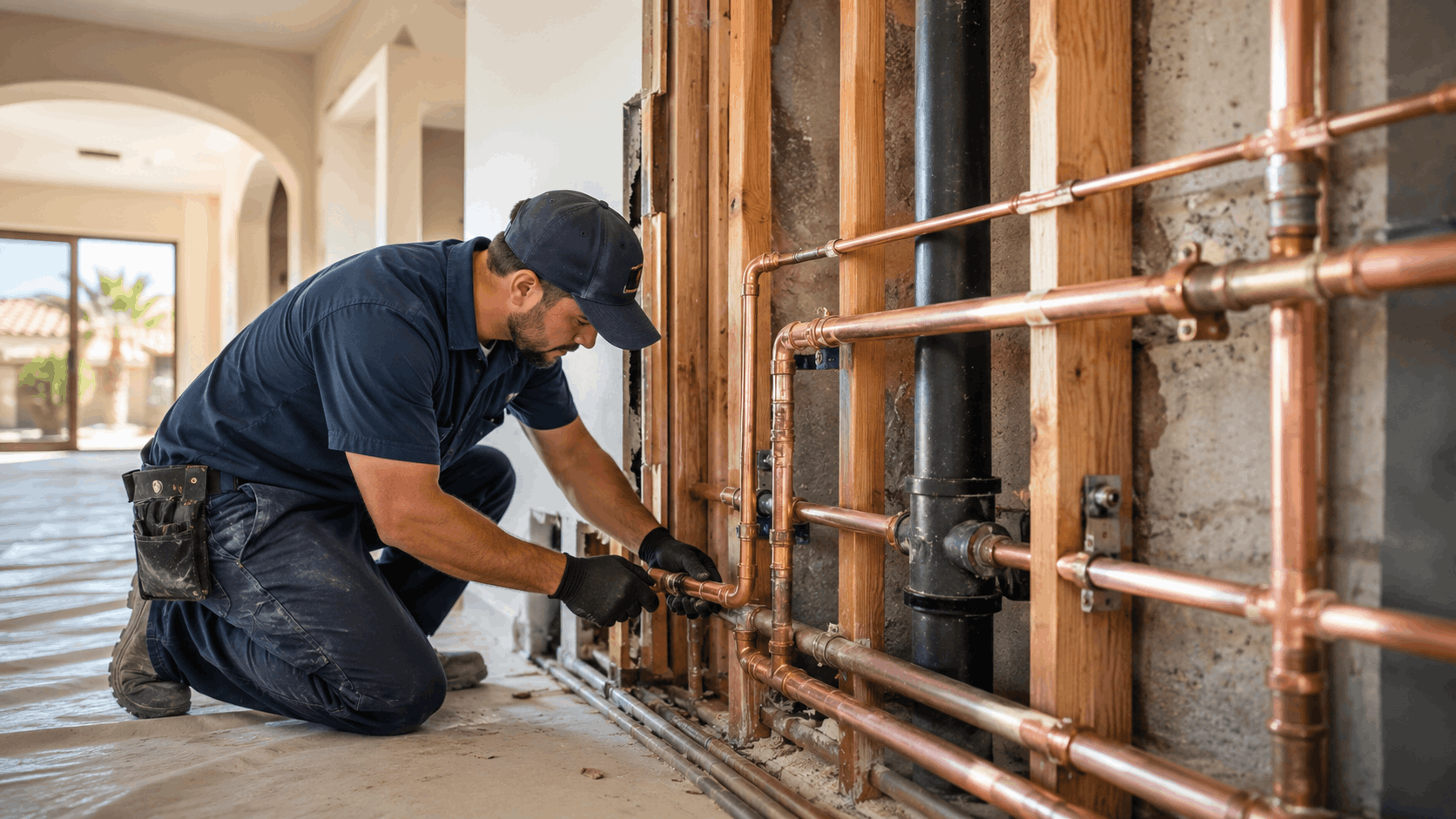
A whole-house repipe means replacing the water pipes running through your home with new material. Instead of patching one leak at a time, a crew swaps out the old pipe network and connects everything back to your fixtures.
Las Vegas homes need this more often than people expect. The valley has a lot of homes built in the 1970s through the early 2000s, and the plumbing in those homes was not built for decades of mineral-heavy water. Repiping gives you a fresh start with modern material.
| What Repiping Includes | What It Does Not Include |
|---|---|
| New hot and cold supply lines | Sewer main under the yard |
| Connections to sinks, showers, tubs | Appliance replacement |
| New shutoff valves at fixtures | Drain line replacement (unless quoted) |
| Wall access and basic patching | Full remodel or tile work |
Replacing Supply Lines vs. Drain Lines
Most repipe quotes cover supply lines. These are the pressurized pipes that carry fresh water to your faucets, showers, and appliances. When people say their home needs repiping, they almost always mean these supply lines, since that is where pinhole leaks and pressure problems show up.
Drain lines are a separate system. They carry used water and waste away from the home by gravity, and they are usually made of different material like ABS or cast iron. A standard repipe does not touch drains unless you ask for it or an inspection shows a problem.
If your drains are also failing, that is a different scope of work. Our team handles those through our drain and sewer services, and we can bundle it with a repipe when it makes sense. Knowing the difference up front keeps your quote clear and honest.
When a homeowner calls about slow drains and low pressure at the same time, we check both systems. That way nobody pays for a repipe expecting the drains fixed too, only to find out later they were separate jobs.
Signs a Las Vegas Home Needs Repiping
Pinhole leaks are the biggest red flag. These are tiny holes that form in copper pipe, often behind walls or in the slab, and they leave water stains, bubbling paint, or a musty smell. One pinhole leak usually means more are coming.
Low water pressure is another sign. When mineral buildup narrows the inside of old pipes, your shower turns weak and two fixtures cannot run at once. Rusty or discolored water in the morning points to corroding galvanized pipe.
Some homeowners hear knocking or notice their water bill creeping up from hidden leaks. If you keep calling for spot repairs every few months, that is your home telling you the whole system is worn out.
We also see homes where a slab leak drives up the water bill without any visible sign inside. Our electronic leak detection can pinpoint those before they cause bigger damage.
Why Local Water Conditions Speed Up Pipe Wear
Las Vegas has some of the hardest water in the country. The Las Vegas Valley Water District draws most supply from the Colorado River, which is heavy with calcium and magnesium. That hard water leaves scale inside every pipe it touches.
Over the years, that scale eats away at copper and galvanized pipe from the inside. It also builds up and chokes the flow, which is why older homes feel like the pressure keeps dropping. The minerals do not care how well the pipe was installed.
Galvanized steel pipe, common in homes built before the 1970s, corrodes the fastest here. Copper lasts longer but still develops pinhole leaks after two or three decades in this water. A water softener installation can slow future wear on new pipes.
We tell homeowners that the water itself is the reason repipes are so common across the valley. It is not bad luck or bad plumbing. The mineral load simply works against metal pipe year after year.
Full Repipe vs. Spot Repair
A spot repair fixes one failing section. If you have a single leak and the rest of your plumbing is newer, a targeted fix is the smart, cheaper move. There is no reason to replace a whole system that is still in good shape.
The math changes when leaks keep coming. If you are patching copper every few months, those repair bills add up fast, and each one comes with wall damage and cleanup. At some point a full repipe costs less than a string of repairs.
Age is the other factor. Homes past the 25 to 30 year mark with original copper or galvanized pipe are usually better served by a full repipe. You get new material, a warranty, and years without another leak call.
Our team gives an honest recommendation either way. If a spot repair solves your problem, we will say so. We only suggest a full repipe when the pipe condition and repair history point that direction.
Get Your Quote
Tell us what's going on and we'll get back to you fast.
Repipe Cost by Home Size in Las Vegas
Home size drives repipe cost more than any other single factor. Bigger homes have more pipe, more fixtures, and more wall openings, which means more labor and material. Below are real price ranges we see across the valley.
These numbers cover PEX repipes with standard restoration. Copper runs higher, and complex layouts push toward the top of each range. Use them to estimate, then get a written quote for your exact home.
| Home Size | Typical PEX Range | Typical Copper Range |
|---|---|---|
| 1,500 - 2,000 sq ft | $4,500 - $8,000 | $8,000 - $13,000 |
| 2,000 - 3,000 sq ft | $6,500 - $11,000 | $11,000 - $18,000 |
| 3,000 - 4,000 sq ft | $9,000 - $15,000 | $16,000 - $25,000 |
| 4,000+ sq ft | $14,000 - $25,000+ | $24,000 - $40,000+ |
1,500 to 2,000 Sq Ft Homes
These are the most common homes we repipe. Many are single-story homes in North Las Vegas, older Spring Valley tracts, and neighborhoods off Rancho and Charleston. They usually have two bathrooms, a kitchen, and a laundry hookup.
A PEX repipe on a home this size typically runs $4,500 to $8,000. The lower end applies to simple one-story layouts with easy attic access. The higher end shows up when the home has extra fixtures or a tricky slab situation.
Because these homes are usually single-story, crews can run new lines through the attic and drop down to fixtures. That keeps wall openings and labor time reasonable. Homes in older Spring Valley often still have original galvanized pipe, which makes the repipe overdue.
We often finish these projects in two to three days. For a family tired of weak showers and constant leaks, it is a manageable job with a big payoff.
2,000 to 3,000 Sq Ft Homes
Mid-size homes make up a huge share of the valley, especially in Henderson and Summerlin. These homes often have three bathrooms, a larger kitchen, and sometimes a wet bar or extra hose bibs outside.
Expect a PEX repipe here to land between $6,500 and $11,000. Every added bathroom means more pipe runs, more shutoff valves, and more wall access points. That is the main reason the range climbs from the smaller homes.
Two-story versions of these homes cost more than single-story ones of the same square footage. The upstairs fixtures require vertical pipe runs and more careful wall work. Communities in Summerlin often mix both layouts within the same tract.
These jobs usually take three to four days. We plan the water shutoff windows around the family's schedule so daily life stays as normal as possible.
3,000 to 4,000 Sq Ft Homes
Larger two-story homes with four or more bathrooms fall in this bracket. We see plenty of them in newer Henderson developments, Summerlin's inner villages, and gated tracts around the valley. Longer pipe runs and multiple bathrooms drive the cost.
PEX repipes on these homes generally run $9,000 to $15,000. Copper can climb well past $20,000. The second floor adds vertical runs, and each extra bathroom stacks on more material and labor.
These homes often have features like a master soaking tub, dual vanities, an outdoor kitchen line, and a pool equipment hookup. Each of those adds to the pipe map. A thorough walkthrough before quoting keeps surprises off the final bill.
Plan for four to six days on a home this size. The extra day or two covers the additional fixtures and the more involved wall restoration on two levels.
4,000+ Sq Ft Homes and Custom Estates
Custom estates are their own category. Properties near The Ridges in Summerlin or around Lake Las Vegas often have complex plumbing layouts, casitas, multiple water heaters, and long runs across sprawling floor plans.
Repipes on these homes start around $14,000 for PEX and can run past $40,000 for copper on the largest estates. The pricing reflects the sheer amount of pipe, high-end fixtures, and careful restoration these homes demand.
Many of these properties also have detached structures and outdoor living areas plumbed for kitchens and bars. Homeowners near Lake Las Vegas frequently want matching material quality throughout, which pushes toward copper or premium PEX.
These projects can take a week or longer. We assign a larger crew and coordinate closely with the homeowner and any HOA to keep the work clean and on schedule.
Need Help in Las Vegas?
Active Plumbing serves Las Vegas and all of Las Vegas Valley.
What Drives the Price Up or Down
Two homes of the same size can get very different bids. The repipe pricing factors below explain why. When you understand them, you can read a quote and know exactly what you are paying for.
Labor cost is the biggest variable in most repipes. More fixtures, more floors, and more wall work all add hours. Here are the main things that move the number.
- Number of fixtures - each sink, shower, tub, and hose bib needs its own connection
- Home layout - single-story versus two-story changes pipe runs and access
- Foundation type - slab-on-grade homes need more wall access than crawl spaces
- Pipe material - copper costs roughly double PEX in most cases
- Restoration scope - drywall patching, texture, and paint add to the total
- Permit and inspection - required for legal, resale-safe work
Number of Bathrooms and Fixtures
Every fixture in your home is an endpoint for a water line. Each bathroom typically has a sink, toilet, and shower or tub, and each one needs new pipe and a shutoff valve. A three-bathroom home has far more connections than a two-bathroom home.
Kitchens add their own fixtures too. A sink, dishwasher, ice maker line, and pot filler all count. Outdoor lines like hose bibs and pool equipment feeds add even more pipe runs to the plan.
This is why fixture count matters as much as square footage. A compact home packed with bathrooms can cost more than a larger home with fewer fixtures. Our team counts every fixture during the walkthrough so the quote reflects your real home.
If you plan to add fixtures later, tell us during the quote. It is often cheaper to rough in for a future bathroom while the walls are already open.
Slab Foundation vs. Crawl Space Access
Most valley homes sit on a slab foundation. That means the pipes were originally poured into or run under the concrete. During a repipe, crews reroute new lines through walls and the attic instead of jackhammering the slab.
That rerouting means opening walls at strategic points for wall access. More access points mean more patching afterward. Slab homes are standard here, so crews are used to this method, but it does add labor compared to a crawl space home.
Homes with a crawl space or basement are easier in some ways, since pipes are reachable from below. Those are rare in the valley, though. Most of what we repipe near Sunrise Manor, Enterprise, and the older parts of Las Vegas is slab construction.
A good crew minimizes wall openings by planning the pipe route carefully. Fewer holes means faster restoration and a lower final bill.
One Story vs. Two Story Layouts
A single-story home lets crews run most new pipe through the attic and drop straight down to fixtures. That is efficient and keeps labor lower. Two-story homes are a different story.
On a two story home, water has to travel up to the second floor and back down. That means vertical pipe runs inside walls and more coordination between floors. Upstairs bathrooms often sit above downstairs living space, which adds careful wall work.
Those extra pipe runs add both material and hours. A two-story home usually costs 15 to 30 percent more to repipe than a single-story home of the same square footage. The added complexity is real, not padding.
We map the whole vertical layout before starting. Knowing where every riser goes keeps the job moving and the wall openings to a minimum.
Drywall Repair and Restoration
Opening walls is part of every repipe. What happens after matters just as much. Some low bids leave you with open holes and a pile of drywall dust, which means hiring another contractor to finish.
A complete quote should spell out the drywall repair scope. That includes patching holes, matching the wall texture, and priming or painting. Texture matching is an art in Las Vegas homes, since knockdown and orange peel finishes are everywhere.
Full restoration adds to the total, but it saves you the hassle of coordinating a second trade. When you compare bids, check whether restoration is included or listed as an extra. That single line item can explain a big price gap between two quotes.
Our team handles patching and texture as part of the job. We protect floors and furniture, then leave the walls ready for your final paint color.
Pipe Material Options and Their Costs
The pipe material you choose affects both the price and how long the system lasts. The three common options are PEX, copper, and CPVC. Each behaves differently in our hard water and desert heat.
Below is a quick comparison to help you weigh cost against longevity. After the table, we break down each material for valley conditions.
| Material | Relative Cost | Expected Lifespan | Hard Water Performance |
|---|---|---|---|
| PEX | Lowest | 40-50 years | Excellent - resists scale |
| Copper | Highest | 50+ years | Good but scales over time |
| CPVC | Moderate | 40-50 years | Good - resists corrosion |
PEX Piping for Las Vegas Homes
PEX is flexible plastic tubing, and it has become the go-to choice for repipes across the valley. It handles hard water very well because minerals do not stick to it the way they cling to copper. That resistance to scale is a big deal here.
PEX also costs less to install. It bends around corners, so crews need fewer fittings and can run it faster. That lower labor time is why PEX repipes come in well under copper on every home size.
The flexibility helps in another way too. PEX handles temperature swings and slight movement without cracking, which suits our hot summers. Most homeowners we work with choose PEX for the balance of price and performance.
Modern PEX carries strong manufacturer warranties. Paired with a water softener, it can outlast the original copper it replaces by a wide margin.
Copper Repiping Costs
Copper is the traditional choice, and it still has fans. It is rigid, proven, and some homeowners simply trust metal pipe. Copper repiping costs roughly double PEX because the material is pricier and the install takes longer.
Durability is copper's strong suit. It handles high heat and lasts 50 years or more when water conditions are kind. The catch is that our hard water is not kind, and copper still develops pinhole leaks over the decades.
Some older HOA communities or historic homes prefer or require copper for consistency. If your neighborhood has material rules, check before choosing. Copper is a solid pick when budget allows and you want a fully metal system.
We install both PEX and copper. When a homeowner is set on copper, we make sure they understand the higher cost and the reality that valley water still works on it slowly.
CPVC and Other Options
CPVC is a rigid plastic pipe that resists corrosion and hard water. It sits between PEX and copper on price. It was popular in certain building eras and still shows up in valley homes today.
The trade-off is that CPVC becomes brittle as it ages, especially with heat exposure. It can crack if bumped hard years down the line. That fragility is why many crews, including ours, lean toward PEX for full repipes now.
CPVC still has its place for certain repairs or code situations. It joins with solvent cement rather than crimp fittings, which some inspectors and homeowners are familiar with. It is a reasonable middle option in specific cases.
When we quote a repipe, we explain where CPVC could fit and why we usually recommend PEX instead. The goal is matching the material to your home and budget, not pushing one product.
Which Material Lasts Longest in Our Climate
In desert climate conditions with mineral-heavy water, PEX often gives the best real-world pipe lifespan for the money. It does not corrode and scale does not cling to it, so flow stays strong for decades. Expect 40 to 50 years from a quality PEX repipe.
Copper can technically last longer, but our hard water shortens that in practice. The pinhole leaks that bring homeowners to us usually happen in copper after 25 to 35 years in valley water. Adding a softener extends any material's life.
Heat plays a role too. Attic temperatures here soar in summer, and PEX handles that better than aging CPVC. That is another reason PEX has taken over for full repipes.
Our advice for most valley homes is PEX with a water softener. That combination fights the exact conditions that wear out pipes here. For homeowners who want metal, copper remains a fine long-term choice.
Permits, Inspections, and Local Code
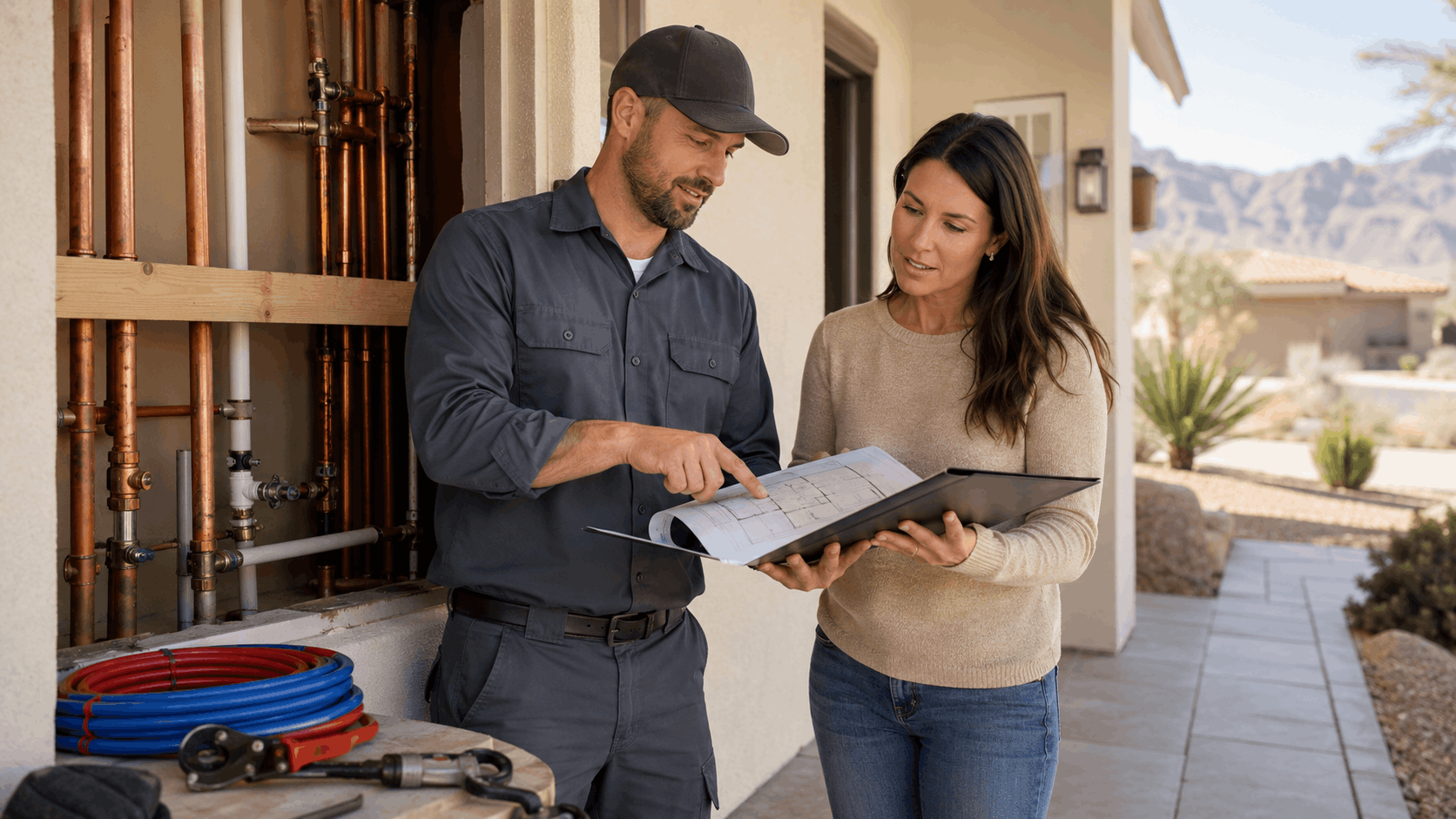
A whole-house repipe requires a plumbing permit in the Las Vegas area. Skipping the permit might save a little now, but it causes real problems at resale and can leave unsafe work hidden in your walls.
Permitted work gets inspected, which means a second set of eyes confirms the job meets code. Here is how the process works locally.
| Step | Who Handles It | What Happens |
|---|---|---|
| Pull permit | Licensed plumber | Application filed with the building department |
| Rough-in inspection | County/city inspector | New pipe checked before walls close |
| Final inspection | County/city inspector | System pressure tested and approved |
| Permit closed | Building department | Work recorded on the property |
Permits Through Local Building Departments
Where your home sits decides which building department issues the permit. Homes in unincorporated areas go through Clark County. Homes inside city limits go through the City of Las Vegas, or the cities of Henderson or North Las Vegas.
A licensed plumber pulls the permit on your behalf. That is part of the service, and it should be listed in your quote. You can review current requirements on the Clark County Building and Fire Prevention site.
Permit fees vary by jurisdiction and project value, usually a few hundred dollars. That fee is small next to the cost of the repipe, and it buys you inspected, code-legal work. A contractor who wants to skip the permit is a warning sign.
Our team handles the permit paperwork start to finish. Homeowners do not have to figure out which department covers their address or fill out forms themselves.
Inspection Steps During a Repipe
Two inspections happen on most repipes. The rough-in inspection comes first, after the new pipe is run but before the walls are closed. The inspector checks the material, connections, and support.
During rough-in, the system is pressure tested to prove there are no leaks. The inspector wants to see that everything is done right while it is still visible. Only after this passes do crews patch the walls.
The final inspection happens once restoration is done and fixtures are reconnected. The inspector confirms the finished system works and meets code. When it passes, the permit is closed and recorded.
This two-step process protects you. It catches mistakes before they get sealed inside a wall. We schedule and meet every inspection so the timeline stays on track.
HOA Rules in Summerlin and Henderson
Many valley neighborhoods have an HOA, and HOA rules can affect a repipe. Some communities in Summerlin and Henderson require advance notice for work, limit crew hours, or have rules about parking and dumpsters.
A few HOAs care about material choices for consistency, especially in higher-end tracts. Others need to coordinate a community water shutoff if lines are shared. Knowing this before the job avoids delays and fines.
We work in gated communities across the valley, from Summerlin West to Henderson's newer villages. Our team helps homeowners handle HOA notice and scheduling so the project stays smooth.
If your community has an architectural or work-approval process, start it early. That paperwork can take longer than the repipe itself, so we flag it during the quote.
Why Permitted Work Protects Resale Value
When you sell your home, unpermitted work becomes a problem. Buyers, agents, and inspectors ask about major plumbing changes. A repipe done without a permit can scare off buyers or force you to redo the work legally.
Permitted work shows up in county records. That paper trail proves the plumbing was replaced correctly and inspected. It adds real resale value and confidence for the next owner.
Insurance is another reason. Some claims tied to plumbing can be denied if the work was never permitted. Doing it right the first time protects you long after the crew leaves.
We never cut this corner. Every repipe we do is permitted and inspected, and we hand you the closed permit records when the job is done.
Need Help in Las Vegas?
Active Plumbing serves Las Vegas and all of Las Vegas Valley.
How Long a Repipe Takes and What to Expect
The repipe timeline depends mostly on home size and material. Homeowners want to know how long they will deal with a water shutoff and crews in the house. The good news is most projects wrap up faster than people fear.
Below is what a typical project duration looks like and how daily life goes during the work.
Typical Timeline by Home Size
A 1,500 to 2,000 square foot single-story home usually takes two to three days. That covers running the new pipe, the rough-in inspection, wall patching, and the final inspection. Simple layouts move fast.
Mid-size homes of 2,000 to 3,000 square feet run three to four days. The extra bathrooms and any second floor add time. Larger homes of 3,000 to 4,000 square feet take four to six days.
Custom estates over 4,000 square feet can take a week or more. The sheer amount of pipe and the careful restoration on high-end finishes stretch the schedule. We give a firm day estimate in every written quote.
Inspection scheduling can add a day here or there, since we work around the building department's availability. We plan for that so the estimate stays realistic.
Living in the Home During the Work
Most families stay in the home during a repipe. Water gets shut off for stretches during the day while crews connect lines, then restored by evening in most cases. We coordinate those windows around your routine.
There is noise and some dust from the wall access work. We use drop cloths and plastic to protect furniture and floors. Bathrooms may be out of use for short periods as fixtures get reconnected.
We try to keep at least one bathroom and the kitchen usable overnight whenever the layout allows. Clear communication each morning tells you which areas will be affected that day.
For homeowners who prefer to be away, a repipe is a fine time for a short trip. Either way, we secure the home and keep the work zones tidy.
Cleanup and Wall Restoration Stages
Once the new pipes pass the rough-in inspection, restoration begins. Crews patch the drywall openings, then apply texture to match the surrounding wall. Las Vegas homes often have knockdown or orange peel finishes that take skill to blend.
After texture cures, the patches get primed. Cleanup happens throughout, not just at the end, so dust does not spread through the house. We haul away old pipe and debris as part of the job.
Final paint is sometimes left to the homeowner so the color matches exactly, or we include it if agreed in the quote. Either way, the walls are left smooth and ready.
We do a final walkthrough with you. That way you can point out anything before we consider the job complete and close the permit.
Scheduling Around Valley Heat
Summer heat shapes how we schedule. Attic work gets brutal by midday in July and August, so crews often start early to handle the hottest tasks before the attic bakes. That keeps the work safe and the pace steady.
Water shutoffs matter more in summer too. Nobody wants to go a full afternoon without water when it is 110 degrees outside. We keep shutoff windows short and restore service by the hottest part of the day when possible.
Outdoor line work also gets scheduled for cooler morning hours. Homeowners in Enterprise and North Las Vegas know how quickly the afternoon sun turns a driveway into a griddle.
Winter and spring are easier windows, so some homeowners plan repipes for the cooler months. If your project is not urgent, that timing can make the whole process more comfortable.
Saving Money Without Cutting Corners
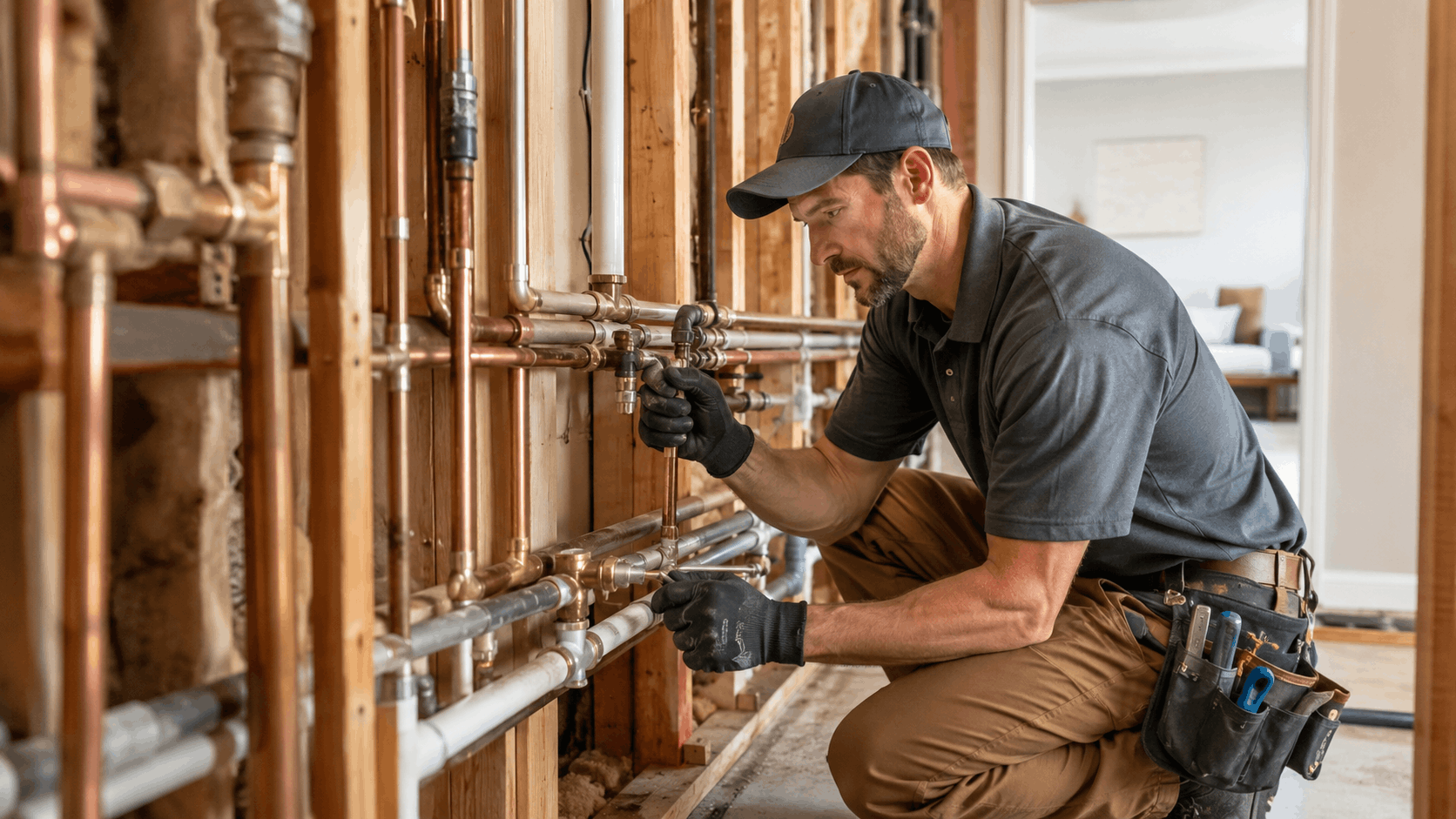
You can save money on a repipe without gambling on cheap, unpermitted work. The trick is spending smart, not skipping the parts that protect your home. Here is how our team helps homeowners keep the repipe budget in check.
Good planning and a few smart bundles often save more than chasing the lowest bid ever could.
Getting Accurate Written Quotes
Always get a written quote, not a number over the phone. A detailed bid lists the pipe material, fixture count, permit fees, restoration scope, and warranty. When everything is spelled out, you can compare bids fairly.
Vague estimates are a red flag. If a quote just says a lump sum with no breakdown, you do not know what is included. That is often where surprise charges hide, especially around drywall and permits.
Get at least two or three written estimates for a job this size. Look for consistency in scope, not just the bottom number. A slightly higher bid that includes restoration may cost less than a cheap one that does not.
Our written quotes lay out every line item. You will see exactly what you are paying for before any work starts, with no vague filler.
Bundling Repairs During the Project
Since the walls are already open and crews are on site, a repipe is a smart time to knock out related work. Swapping old fixtures, valves, or a tired water heater costs less in labor when combined with the repipe.
Many homeowners add fixture swaps for faucets and shower valves during the job. It is far cheaper than a separate service call later. Our pipe and fixture services pair naturally with a repipe.
An aging water heater is another common add-on. If yours is near the end of its life, replacing it during the repipe saves a trip charge and gets everything running fresh at once. Our water heater services cover both tank and tankless options.
We point out sensible bundles during the quote. There is no pressure - just a heads up on where combining work saves you money.
Financing and Payment Options
A repipe is a real expense, and not everyone can pay the full amount at once. We offer financing and payment plans so homeowners can spread the cost over time. That keeps a needed repair from turning into an emergency.
Financing is popular for larger homes where the bill runs higher. Instead of draining savings, homeowners make monthly payments while enjoying leak-free plumbing right away. Repairs do not wait for a better budget month.
We walk you through the options during the quote so you can pick what fits. There is no obligation to finance, and paying outright is always fine too.
The goal is making a proper, permitted repipe reachable. Ask our team about current payment plans when you request your estimate.
Why the Cheapest Bid Can Cost More Later
A cheap bid is tempting, but it often costs more in the end. Underqualified installers cut corners, skip the permit, or use fewer wall access points and rush the connections. Those shortcuts show up as leaks and failed inspections later.
Unpermitted work is the biggest hidden cost. If it fails or you go to sell, you may pay to redo the entire job legally. That erases any savings from the low bid and then some.
Vague quotes that leave out restoration are another trap. You save on paper, then pay a drywall contractor separately. Add it up and the cheap bid was never cheap.
We price fairly and stand behind the work. A repipe done right once, with a permit and a warranty, beats a bargain that fails in a few years.
Why Homeowners Choose Active Plumbing for Repipes
Homeowners across the valley call Active Plumbing for their Las Vegas repipe because we do the job right and treat the home with care. We are a local plumber that knows valley homes, valley water, and valley code.
Here is what sets our repipe work apart.
Local Experience Across the Valley
Our team has repiped homes from North Las Vegas to Henderson and throughout Summerlin. We know the older galvanized pipe common near North Las Vegas and the copper systems in the tracts built through the 1990s and 2000s.
That local experience means we quote accurately and hit fewer surprises. We have seen how homes in Spring Valley, Enterprise, and Sunrise Manor were built, so we plan pipe routes that fit each style of construction.
We also know the hard water here inside and out. Every recommendation we make accounts for the mineral load that wears pipes down. That knowledge comes from hundreds of jobs across the same neighborhoods you drive through daily.
When you call, you get a crew that works this valley every day, not a company that treats your home like just another address on a list.
Upfront Quotes With No Surprises
We give upfront quotes with flat pricing. Before any work starts, you get a detailed written estimate that lists material, labor, permit, and restoration. The number we quote is the number you pay.
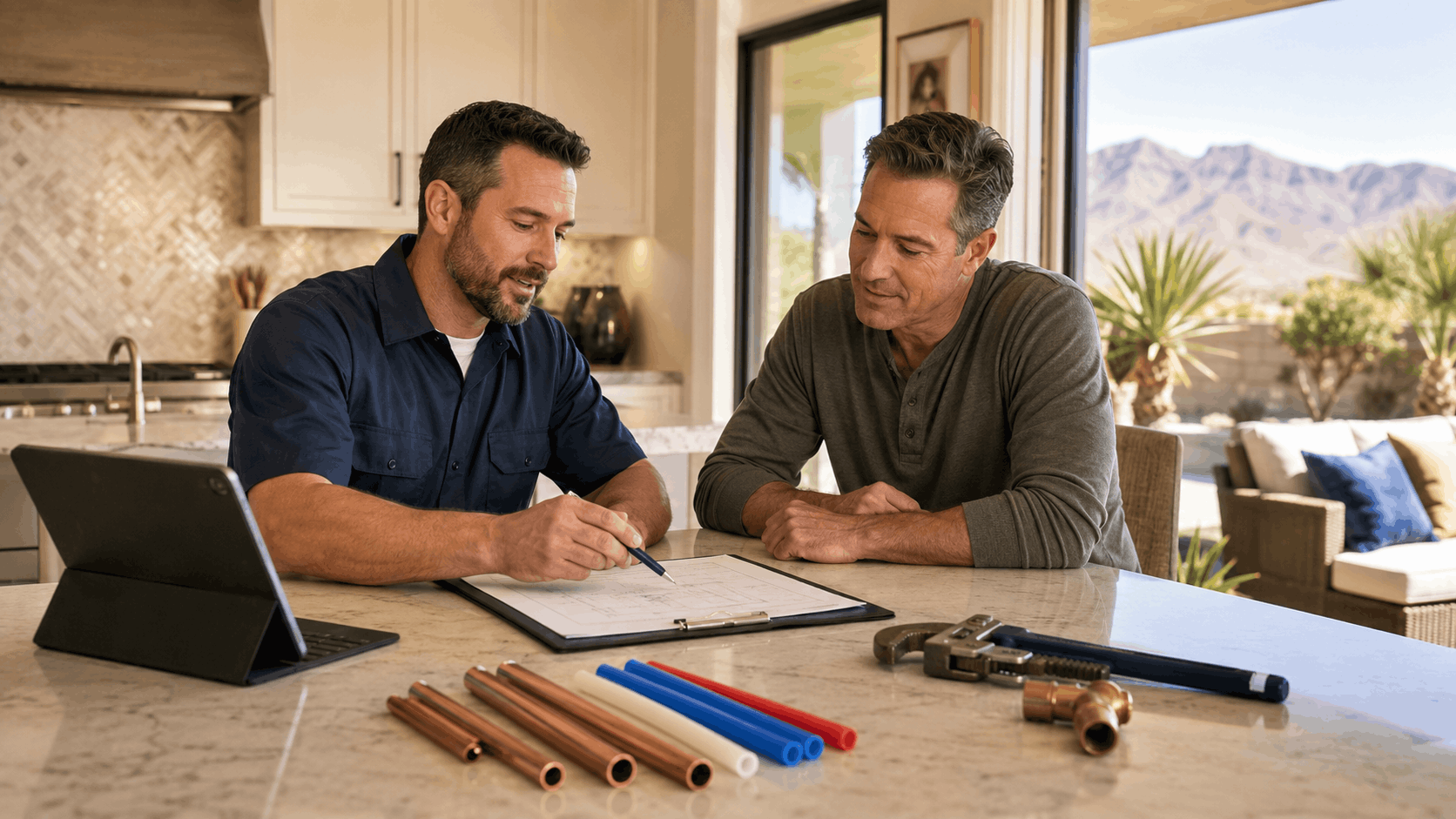
Our estimator walks you through the whole quote in plain language. If you have questions about why a two-story adds cost or why PEX beats copper here, we answer them right there. No pressure and no fine print.
Flat pricing means no meter running against you. You know the full cost before the first wall opens, which makes budgeting and financing simple.
That transparency is why so many homeowners feel comfortable moving forward. You can reach out through our contact page to set up a free repipe estimate.
Clean Work and Careful Restoration
A repipe means opening walls, and we take that seriously. Our crews protect floors, cover furniture, and contain dust before any cutting begins. We treat your home like we would want ours treated.
Restoration is part of the job, not an afterthought. We patch drywall, match the texture, and leave the walls ready. Las Vegas knockdown and orange peel finishes are our daily work, so blends look right.
We clean as we go and haul away all the old pipe and debris. When we leave, you should not be able to tell there was a construction crew in the house, aside from fresh water flowing.
That care shows in the final walkthrough. We fix anything that is not right before calling the job done.
Warranty and Follow-Up Support
Our repipes come with a workmanship warranty on top of the manufacturer's pipe warranty. If something related to our install needs attention, we come back and make it right. That is what standing behind the work means.
We also stay available after the job. Questions come up, and homeowners can call us long after the crew has packed up. Follow-up support is part of being a real local company, not a one-and-done contractor.
Because we are based here, we are easy to reach for any future plumbing needs too. Many repipe customers become long-term clients for water heaters, softeners, and repairs.
That ongoing relationship is the point. We want to be the plumber you trust for years, not just for one job.
Need Help in Las Vegas?
Active Plumbing serves Las Vegas and all of Las Vegas Valley.
Final Thoughts
A whole-house repipe is a big project, but the cost is predictable once you know your home size and material. Smaller single-story homes often land between $4,500 and $8,000 with PEX, while large estates can run well past $25,000. Home size, fixture count, layout, and material set the final number.
PEX handles our hard water and desert heat well and usually offers the best value, though copper remains a solid choice for those who want metal. Whatever you choose, a permitted, inspected repipe protects your home and its resale value.
If you are seeing pinhole leaks, weak pressure, or rusty water, do not wait for a bigger failure. Call Active Plumbing or reach out through our website for a free, detailed repipe quote. Our team will walk your home, explain your options, and give you an honest number with no surprises.
Frequently Asked Questions
How much does a whole-house repipe cost in Las Vegas?
Most repipes in the valley run from about $4,500 for a small single-story home with PEX up to $40,000 or more for a large custom estate in copper. Home size and pipe material set the final price. A typical mid-size Henderson or Summerlin home usually lands between $6,500 and $15,000. A written quote gives you an exact number for your home.
How long does a repipe take for an average home?
An average valley home takes about two to four days. A 1,500 to 2,000 square foot single-story home is usually two to three days, while a 2,000 to 3,000 square foot home runs three to four days. Larger two-story homes take four to six days, and custom estates can need a week or more. Inspection scheduling may add a day.
Is PEX or copper better for Las Vegas water?
For our hard water, PEX often performs better in daily use. Minerals do not stick to PEX, so it resists the scale that clogs and corrodes copper over time. Copper is durable and proven but still develops pinhole leaks after a few decades in valley water. Most homeowners here choose PEX for the balance of price and longevity, especially with a water softener.
Do I need a permit to repipe my home?
Yes. A whole-house repipe requires a plumbing permit through Clark County or your city's building department. A licensed plumber pulls the permit and schedules the rough-in and final inspections. Permitted work protects your home's resale value and keeps insurance valid. Skipping the permit can cause serious problems when you sell, so our team always handles it properly.
Can I stay in my home during the repipe?
Most families stay home during the work. Water gets shut off for stretches during the day while crews connect the new lines, then it is usually restored by evening. There is some noise and dust, and a bathroom may be briefly out of use. We coordinate shutoff windows around your schedule and keep at least one bathroom usable when the layout allows.
Does repiping include drywall and paint repair?
It depends on the quote. Our repipe quotes include patching the wall openings and matching the texture, since Las Vegas homes use knockdown and orange peel finishes. Final paint is sometimes left to the homeowner for an exact color match, or we include it if agreed up front. Always check whether restoration is listed, since that line item explains big price gaps between bids.
How do I know if my home needs repiping?
Watch for pinhole leaks, water stains, or bubbling paint on walls and ceilings. Low water pressure, rusty or discolored water in the morning, and repeated leak repairs all point to worn-out pipe. Homes over 25 to 30 years old with original copper or galvanized pipe are common repipe candidates. If you keep calling for spot fixes, a full repipe is likely the smarter move.
Will a repipe raise my home's value?
Yes, a permitted repipe helps at resale. New plumbing removes a major concern for buyers and home inspectors, and the closed permit records prove the work was done to code. Homes with fresh, inspected plumbing sell with more confidence and fewer negotiation hurdles. Unpermitted plumbing work, on the other hand, can scare buyers off or force costly corrections before closing.
Are there financing options for a repipe?
Yes. We offer financing and payment plans so homeowners can spread the cost over time instead of paying all at once. This is popular for larger homes where the bill runs higher. Financing lets you get leak-free plumbing right away while making manageable monthly payments. Paying outright is always fine too. Ask our team about current options when you request your estimate.
How long do new pipes last in the desert climate?
Quality PEX typically lasts 40 to 50 years in valley conditions because it resists scale and handles heat well. Copper can last 50 years or more in ideal water but often develops pinhole leaks here after 25 to 35 years due to hard water. Adding a water softener extends the life of any material. For most valley homes, PEX with a softener gives the best long-term result.
Frequently Asked Questions
- How much does a whole-house repipe cost in Las Vegas?
- Most repipes in the valley run from about $4,500 for a small single-story home with PEX up to $40,000 or more for a large custom estate in copper. Home size and pipe material set the final price. A typical mid-size Henderson or Summerlin home usually lands between $6,500 and $15,000. A written quote gives you an exact number for your home.
- How long does a repipe take for an average home?
- An average valley home takes about two to four days. A 1,500 to 2,000 square foot single-story home is usually two to three days, while a 2,000 to 3,000 square foot home runs three to four days. Larger two-story homes take four to six days, and custom estates can need a week or more. Inspection scheduling may add a day.
- Is PEX or copper better for Las Vegas water?
- For our hard water, PEX often performs better in daily use. Minerals do not stick to PEX, so it resists the scale that clogs and corrodes copper over time. Copper is durable and proven but still develops pinhole leaks after a few decades in valley water. Most homeowners here choose PEX for the balance of price and longevity, especially with a water softener.
- Do I need a permit to repipe my home?
- Yes. A whole-house repipe requires a plumbing permit through Clark County or your city's building department. A licensed plumber pulls the permit and schedules the rough-in and final inspections. Permitted work protects your home's resale value and keeps insurance valid. Skipping the permit can cause serious problems when you sell, so our team always handles it properly.
- Can I stay in my home during the repipe?
- Most families stay home during the work. Water gets shut off for stretches during the day while crews connect the new lines, then it is usually restored by evening. There is some noise and dust, and a bathroom may be briefly out of use. We coordinate shutoff windows around your schedule and keep at least one bathroom usable when the layout allows.
- Does repiping include drywall and paint repair?
- It depends on the quote. Our repipe quotes include patching the wall openings and matching the texture, since Las Vegas homes use knockdown and orange peel finishes. Final paint is sometimes left to the homeowner for an exact color match, or we include it if agreed up front. Always check whether restoration is listed, since that line item explains big price gaps between bids.
- How do I know if my home needs repiping?
- Watch for pinhole leaks, water stains, or bubbling paint on walls and ceilings. Low water pressure, rusty or discolored water in the morning, and repeated leak repairs all point to worn-out pipe. Homes over 25 to 30 years old with original copper or galvanized pipe are common repipe candidates. If you keep calling for spot fixes, a full repipe is likely the smarter move.
- Will a repipe raise my home's value?
- Yes, a permitted repipe helps at resale. New plumbing removes a major concern for buyers and home inspectors, and the closed permit records prove the work was done to code. Homes with fresh, inspected plumbing sell with more confidence and fewer negotiation hurdles. Unpermitted plumbing work, on the other hand, can scare buyers off or force costly corrections before closing.
- Are there financing options for a repipe?
- Yes. We offer financing and payment plans so homeowners can spread the cost over time instead of paying all at once. This is popular for larger homes where the bill runs higher. Financing lets you get leak-free plumbing right away while making manageable monthly payments. Paying outright is always fine too. Ask our team about current options when you request your estimate.
- How long do new pipes last in the desert climate?
- Quality PEX typically lasts 40 to 50 years in valley conditions because it resists scale and handles heat well. Copper can last 50 years or more in ideal water but often develops pinhole leaks here after 25 to 35 years due to hard water. Adding a water softener extends the life of any material. For most valley homes, PEX with a softener gives the best long-term result.
A
Licensed plumbing professionals serving Las Vegas and Las Vegas Valley.
Licensed in Nevada · License #0047021
Last updated on
Why trust Active Plumbing?
Founded in 1991, Active Plumbing is a licensed and insured plumber serving Las Vegas and Las Vegas Valley. All content is reviewed by our licensed technicians.

Need Help in Las Vegas?
Active Plumbing serves Las Vegas and all of Las Vegas Valley.
Related Articles
Cost Guides
40 vs 50-Gallon Water Heater Cost in Las Vegas: Real Installed Prices and When the Bigger Tank Pays Off
Real installed prices for 40 vs 50-gallon water heaters in Las Vegas, plus how to pick the right size for your household, energy costs, and hard water.
Cost Guides
Repipe vs Reroute After a Las Vegas Slab Leak: The Second-Leak Statistics That Decide It
A Las Vegas slab leak forces a choice: reroute or repipe. See how second-leak statistics, real cost ranges, and local water conditions decide the smart fix.

Cost Guides
Whole House Repipe Cost in Las Vegas by Square Footage
A local guide to whole house repipe cost in Las Vegas by square footage, plus how pipe material, home age, and permits shape the final price.