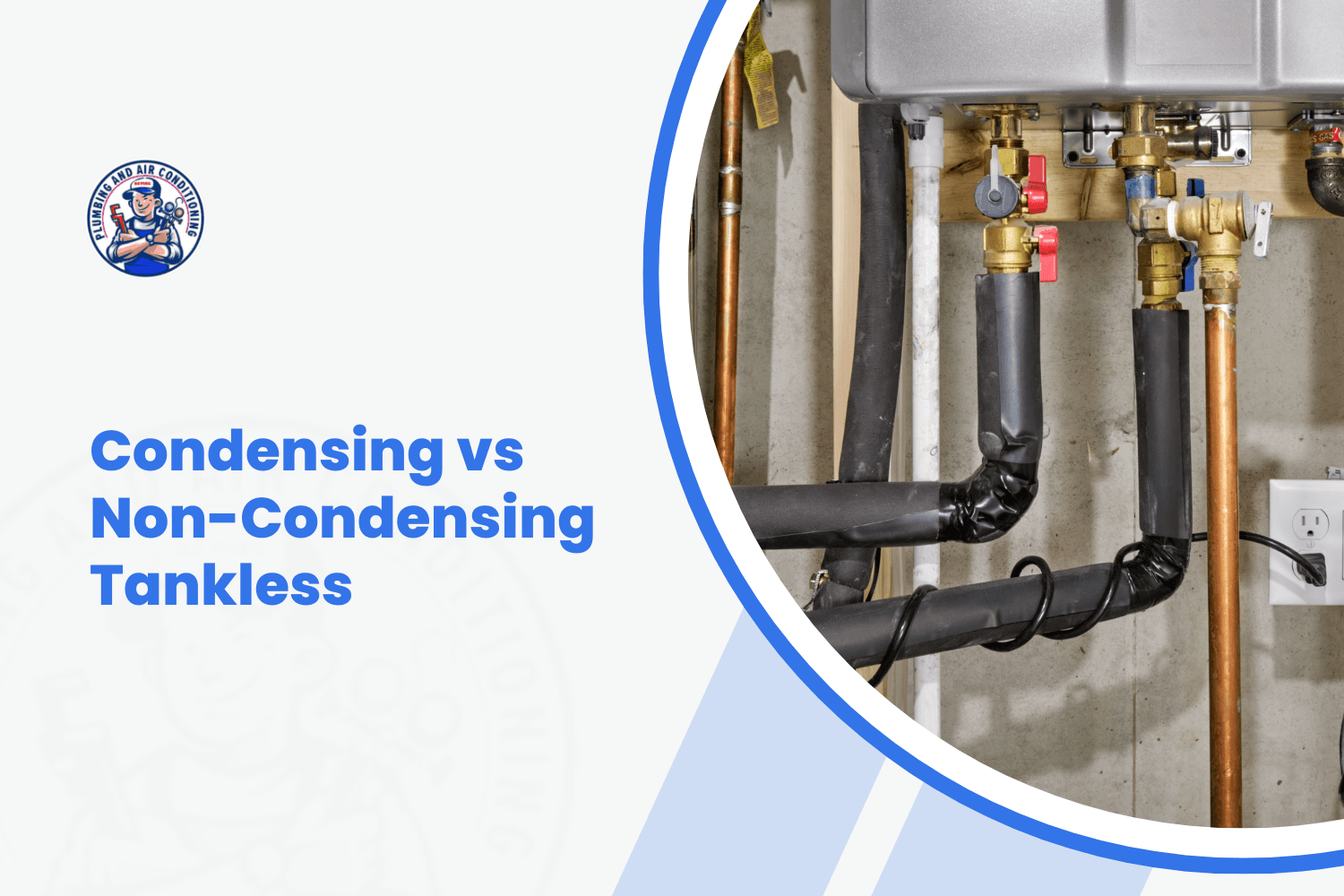
Condensing vs Non-Condensing Tankless for Las Vegas Homes: Venting, Cost, Hard-Water Scaling
Key Takeaways
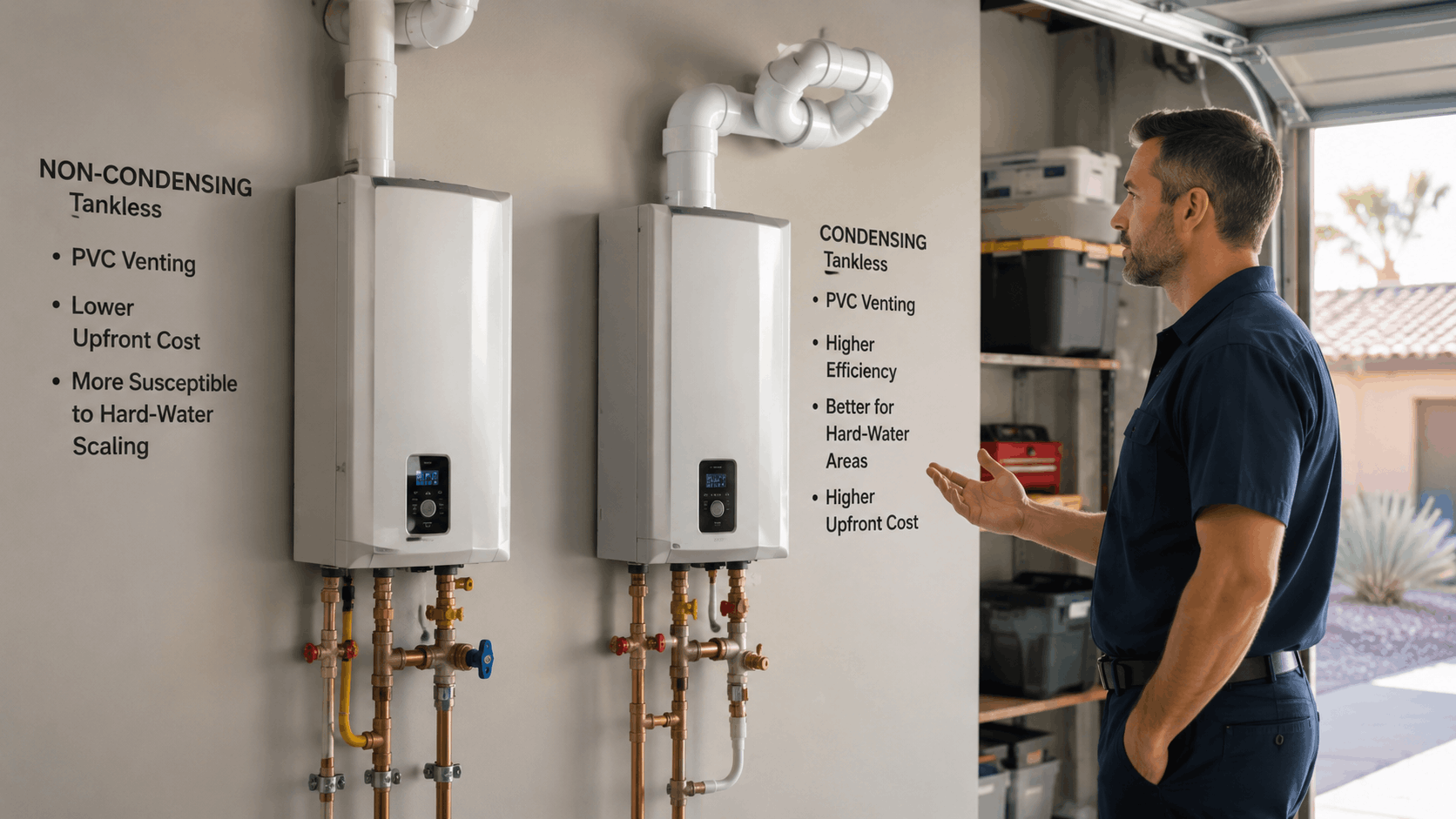
- Non-condensing tankless units cost less upfront and need stainless steel metal venting, while condensing units cost more but use cheaper PVC venting and run more efficiently.
- Condensing units add a second heat exchanger that reaches 90 to 98 percent efficiency but produces acidic condensate that requires a drain and often a neutralizer.
- Most Valley tankless installs run $2,500 to $5,500 depending on venting, gas line upsizing, and electrical needs.
- Las Vegas water tests around about 16 grains per gallon, so scaling is the top threat to any tankless heat exchanger here.
- A water softener or scale conditioner plus a yearly descaling flush is the best way to protect a tankless unit in this hard water.
- Condensing units make sense for long-term owners and new builds, while non-condensing fits tighter budgets and homes with existing metal venting.
- Gas water heater work in Clark County and the City of Las Vegas requires a permit and inspection, which protects safety and resale value.
- With proper maintenance a tankless unit lasts 15 to 20 years, but neglect in hard water can cut that below 10 years.
In This Article
Last July, a homeowner off Town Center Drive in Summerlin called us on one of those 112-degree afternoons. Her 12-year-old tank heater had quit, and a house full of family was in town for the weekend. She wanted hot water back fast, but she also wanted to make the right long-term choice this time around.
That call sums up a question we hear all summer across the Valley. Should you go with a condensing or a non-condensing tankless unit? The answer depends on three local factors: how the unit vents, what it costs to install and run, and how our brutal hard water treats the inside of the heat exchanger.
How Tankless Water Heaters Work in Las Vegas Homes?
A tankless water heater skips the big storage tank entirely. Instead of keeping 40 or 50 gallons hot around the clock, it fires up only when you turn on a faucet. That is why people call it on-demand water heating.
Cold water flows through the unit, passes over a heat exchanger, and comes out hot within seconds. When you shut the tap off, the burner shuts off too. More Valley homeowners are switching for a few clear reasons:
- No standing tank losing heat in a hot garage all summer
- Hot water that does not run out during back-to-back showers
- A much smaller footprint that frees up floor space
- A longer service life when maintained, often 15 to 20 years
There are two main styles of tankless water heater on the market, and the difference matters here more than most cities. Let us set them up before comparing them in detail.
The Difference Between Tank and Tankless Models
A traditional tank heater stores gallons of hot water and reheats them on a cycle. Even when nobody is home, it burns gas to keep that water warm. In a Las Vegas garage that hits 120 degrees, the tank fights the ambient heat and still loses energy day and night.
Tankless vs tank comes down to storage versus flow. A tankless model heats water only as it moves through the unit, so you get hot water on demand without a reserve sitting idle. There is no tank to corrode, leak, or flood a garage floor after a decade.
The space savings help a lot in smaller homes. In condos near the Arts District or older single-story houses around Henderson, a wall-mounted tankless unit clears out the closet or corner a bulky tank used to fill. That extra room matters when square footage is tight.
We also see fewer catastrophic leaks with tankless setups. A failed tank can dump 50 gallons onto the floor at once. A tankless unit does not hold that volume, so the flood risk drops sharply.
What Makes a Unit Condensing or Non-Condensing
The split between condensing and non-condensing comes down to how each one handles exhaust heat. When gas burns, it produces hot exhaust gases that still carry usable warmth. What the unit does with that leftover heat defines its type.
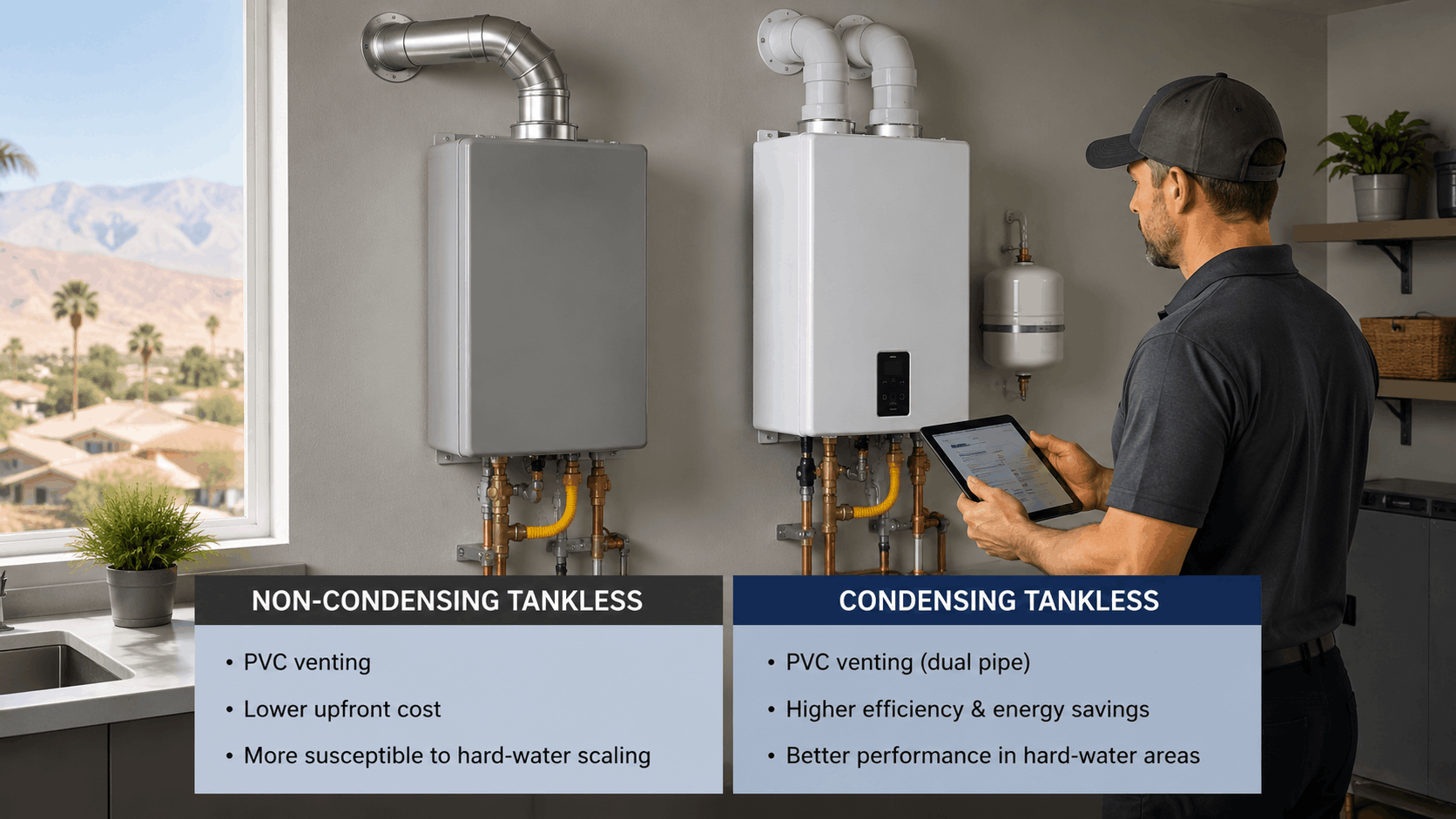
A non-condensing unit sends that hot exhaust straight outside. The gases leave at 300 degrees or more, so a good chunk of energy escapes with them. It works fine, but it wastes some of the heat you paid for.
A condensing tankless unit adds a secondary heat exchanger. That second exchanger captures heat from the exhaust before it leaves, using it to pre-warm the incoming cold water. The exhaust cools down so much that water vapor condenses out of it, which is where the name comes from.
That extra step pushes efficiency higher, often into the mid-90 percent range. It also changes how the unit vents and drains, which we cover in the next section. The tradeoff is a higher purchase price and a bit more install work.
Why Local Homeowners Are Making the Switch
Most upgrades we do start with a failure. A tank heater near the 12-year mark starts leaking, rusting at the base, or running lukewarm. Rather than replace like for like, owners ask what a tankless upgrade would cost.
Remodels drive a lot of the switch too. In older neighborhoods like Paradise Palms, homeowners updating a mid-century home want to reclaim closet space and modernize the plumbing at the same time. A water heater replacement fits naturally into that scope.
Energy savings and endless hot water seal the deal for many. Families tired of the last shower running cold see the appeal fast. Our water heater services team handles the full evaluation so owners know their options before spending a dime.
A Las Vegas plumbing upgrade also helps at resale. Buyers see a newer tankless system as a plus, and a properly permitted install shows the home was cared for. That matters in a competitive market.
Get Your Quote
Tell us what's going on and we'll get back to you. We're open 24/7.
Venting Requirements: The Biggest Install Difference
If you take one thing away from this guide, make it this. Venting is where condensing and non-condensing units split the most, and it drives both the install cost and where the unit can physically go.
Exhaust venting has to match the temperature of the gases leaving the burner. Hotter exhaust needs tougher, pricier materials. Cooler exhaust opens the door to cheaper piping and more flexible placement. Here is the quick comparison:
| Factor | Non-Condensing | Condensing |
|---|---|---|
| Exhaust temperature | Around 300°F or higher | Around 100 to 150°F |
| Vent material | Stainless steel (Category III) | PVC or polypropylene |
| Vent material cost | Higher | Lower |
| Condensate drain needed | No | Yes |
| Placement flexibility | Limited | Greater |
Non-Condensing Units and Metal Venting
Non-condensing units run hot exhaust, so they need stainless steel venting rated as Category III. Standard PVC would melt or warp under that heat, which is a real safety hazard. The metal pipe handles the temperature safely.
That stainless steel venting costs more per foot than plastic. On a typical job the vent material alone can add several hundred dollars to the total. The longer the run, the bigger that number climbs.
Placement gets tricky in tight spaces. In older Charleston Heights homes with cramped attics and low rooflines, routing rigid metal vent to an exterior wall or roof takes planning. Sometimes the ideal spot for the unit does not line up with a short, safe vent path.
We measure every run before quoting so there are no surprises. A vent that has to snake around trusses or make several bends costs more in both material and labor than a straight shot through a nearby wall.
Condensing Units and PVC Venting
Because a condensing unit pulls so much heat from the exhaust, the gases leave cool enough for PVC venting. Sometimes we use polypropylene, but either way the material costs far less than stainless steel. That savings offsets part of the unit's higher price.
Cooler condensate exhaust also means more placement freedom. PVC is lighter, easier to route, and can travel longer horizontal runs. That flexibility helps when the best mounting spot sits away from an exterior wall.
We install a lot of condensing units in garages and interior closets across the Valley. The plastic vent lets us reach a sidewall or roof penetration without the constraints heavy metal pipe brings. Homeowners appreciate being able to tuck the unit where it makes sense.
That said, the vent still has to slope correctly and terminate to code. Cool exhaust carries moisture, so the piping has to drain any condensation back toward the unit or a drain. We handle that pitch during install.
Condensate Drainage and Local Code
Condensing units create a byproduct non-condensing units do not: liquid condensate. That water is mildly acidic, so it cannot just dump onto a garage slab or into the yard. It needs a proper condensate drain.
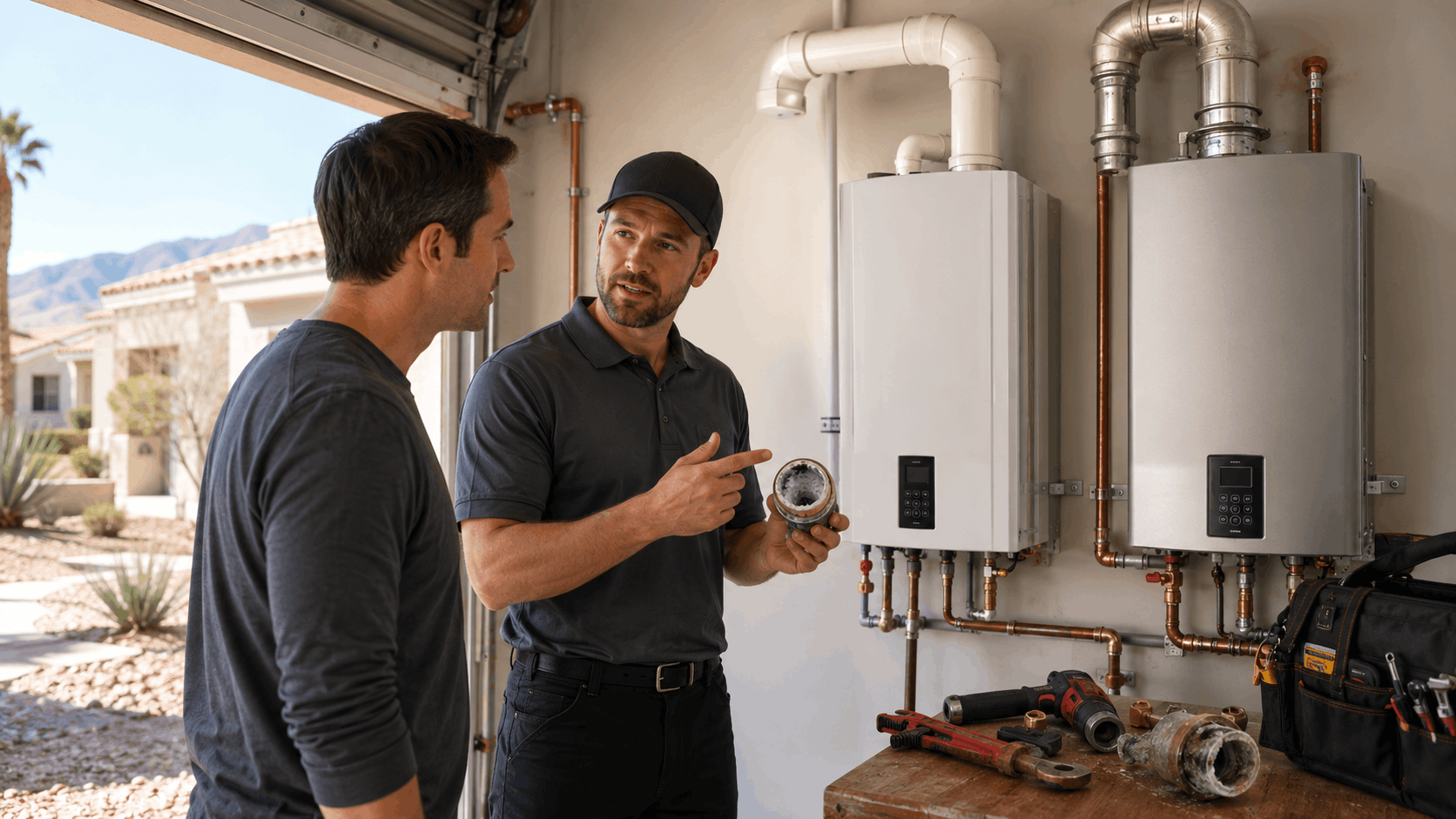
In many cases we add a neutralizer cartridge that raises the pH before the water enters the drain line. This protects your plumbing and satisfies inspectors. It is a small component, but skipping it causes problems down the road.
Clark County permitting expects this to be done right. A Clark County permit for gas water heater work means an inspector will look at the vent, the gas connection, and the condensate handling. Doing it to code the first time avoids failed inspections and callbacks.
We size and route the drain during the initial assessment. If the unit sits far from an existing drain, a condensate pump may be needed to move the water where it belongs. We plan for that before the crew shows up.
Retrofit Challenges in Older Valley Homes
Swapping a tank for a tankless is rarely a straight one-for-one exchange. In homes near Winchester or the Sunrise Manor state streets, the old tank vent often does not match what a tankless needs. Rerouting that vent takes time and materials.
A retrofit tankless job may mean cutting a new vent penetration through a wall or roof. The old tank flue was sized and placed for a very different appliance. We rarely reuse it as-is.
Condensing retrofits add the drain question on top. If there is no nearby drain for the condensate, we run a new line or install a pump. That venting retrofit and drain work is the main reason a tankless install costs more than a like-for-like tank swap.
None of this should scare a homeowner off. It just means the right plan matters. We walk the space, check the vent path and drain options, and lay out exactly what the retrofit involves before any work starts.
Need Help in Las Vegas?
Active Plumbing serves Las Vegas and all of Las Vegas Valley.
Cost Comparison for Las Vegas Homeowners
Cost is where the rubber meets the road. Tankless cost splits into three buckets: the unit itself, the install labor and materials, and what you pay to run it every month.
Below are realistic Valley ranges. Your exact water heater install price depends on your home's layout, existing venting, and whether the gas line needs work.
| Cost Factor | Non-Condensing | Condensing |
|---|---|---|
| Unit price | $700 - $1,300 | $1,300 - $2,300 |
| Typical installed total | $2,500 - $4,000 | $3,500 - $5,500 |
| Efficiency (energy factor) | 0.80 - 0.85 | 0.90 - 0.98 |
| Vent material cost | Higher (stainless) | Lower (PVC) |
| Estimated lifespan | 15 - 20 years | 15 - 20 years |
Upfront Unit and Installation Costs
The unit price gap is real. A non-condensing tankless price often lands between $700 and $1,300, while a condensing model runs $1,300 to $2,300. That is before any labor.
Installation cost narrows the gap a little. Non-condensing units need pricey stainless steel venting, which adds material cost. Condensing units use cheaper PVC but require a condensate drain, which adds a bit of labor.
All in, most Valley homeowners see a non-condensing install land between $2,500 and $4,000. A condensing install typically runs $3,500 to $5,500. Gas line or electrical upgrades push either number higher.
We give a firm quote after seeing the space. A straightforward garage swap costs far less than a retrofit that needs new venting and a rerouted gas line. Our tankless water heater installation pricing spells out each line item so there are no surprises.
Efficiency Ratings and Monthly Bills
Here is where condensing units earn their keep. A non-condensing unit runs around 80 to 85 percent efficient. A condensing model reaches 90 to 98 percent, meaning more of the gas you burn actually heats your water.
That energy efficiency shows up on your monthly bill. Southwest Gas rates apply year-round, and a more efficient unit uses less gas for the same hot water. The gap widens in a big household that runs a lot of hot water.
Summer usage patterns shift things a bit here. Incoming water is warmer in July, so the heater works less than it does in January. Still, over a full year the efficiency difference adds up to real dollars.
For a family of four, a condensing unit might save $10 to $20 a month on gas compared to non-condensing. That number depends on habits, but it is a steady saving that compounds over the unit's life.
Rebates, Warranties, and Payback Period
Utility and manufacturer rebates come and go, so it pays to check what is active before you buy. Some high-efficiency condensing units qualify for rebates that shrink the price gap. We help owners find current offers during the quote.
Warranties often favor condensing models slightly, with longer heat exchanger coverage on premium units. Both types usually carry warranties in the 12 to 15 year range for the exchanger. Registering the unit and keeping maintenance records protects that coverage.
The payback period is the real deciding number for many. If a condensing unit costs $1,200 more upfront and saves $15 a month, that is roughly six to seven years to break even. After that, the savings are pure gain.
So the math favors condensing for anyone staying in the home long term. For a shorter stay, the payback may never fully arrive, which is why we ask how long owners plan to keep the house.
Hard Water and Scaling: The Las Vegas Factor
Every tankless conversation in this Valley has to address hard water. Our water is some of the hardest in the country, and it wears down tankless units more quickly than in most cities. Scale buildup is the number one killer of these heaters here.
Both condensing and non-condensing units scale up. Understanding why and what to do about it protects thousands of dollars in equipment.
Why Las Vegas Water Is So Hard
Most of our water comes from the Colorado River through Lake Mead. That source is loaded with dissolved calcium and magnesium picked up along the way. The Las Vegas Valley Water District delivers water that regularly tests around about 16 grains per gallon.
For context, anything above 10 grains per gallon counts as very hard. We are well past that line. That high mineral content is why you see white crust on faucets and spotty glassware all over the Valley.
Different parts of the Valley see slightly different hardness, but none of it is soft. Homes in Summerlin, Henderson, and the northwest all deal with the same mineral load. No neighborhood escapes it.
Those minerals do not just spot your dishes. Inside a tankless heat exchanger, they turn into hard scale that chokes the unit. That is the core problem we design around.
How Scaling Damages Tankless Heat Exchangers
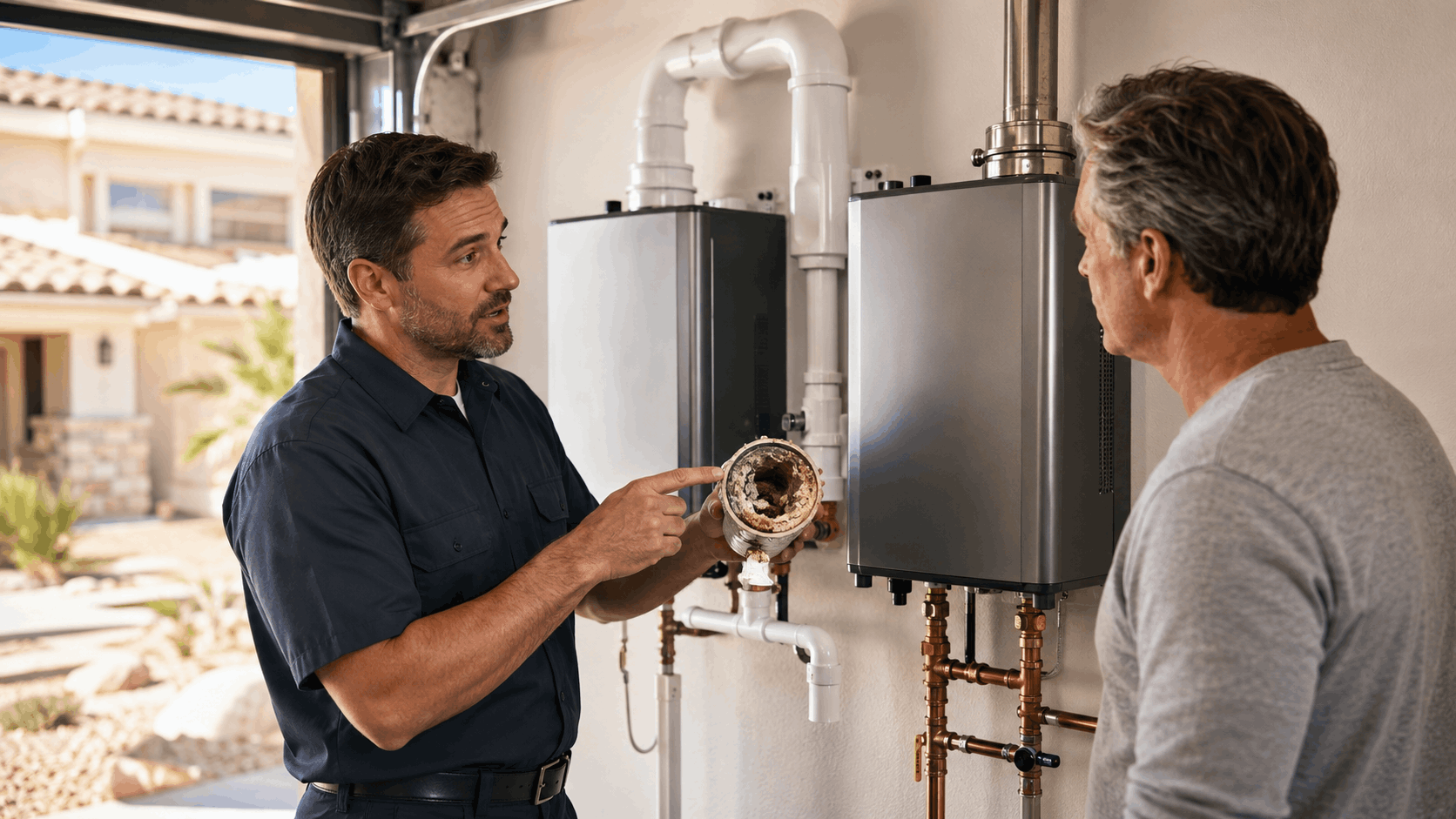
Tankless units heat water in narrow passages inside the heat exchanger. When hard water flows through and gets hot, calcium precipitates out and sticks to those walls. Over time that calcium buildup forms a hard crust.
Heat exchanger scaling causes two big problems. It insulates the metal so the burner has to work harder, cutting efficiency. It also narrows the passages, which drops your flow rate and can trigger error codes.
Condensing units carry extra risk here because they have two exchangers. Both the primary and secondary can scale, so there is more surface area to protect. Neglect a condensing unit in hard water and it can lose performance fast.
Left alone, heavy scale shortens the unit's life dramatically. A heater rated for 20 years might fail in half that time without protection. That is why scale management is not optional in this Valley.
Water Softeners and Scale Filters
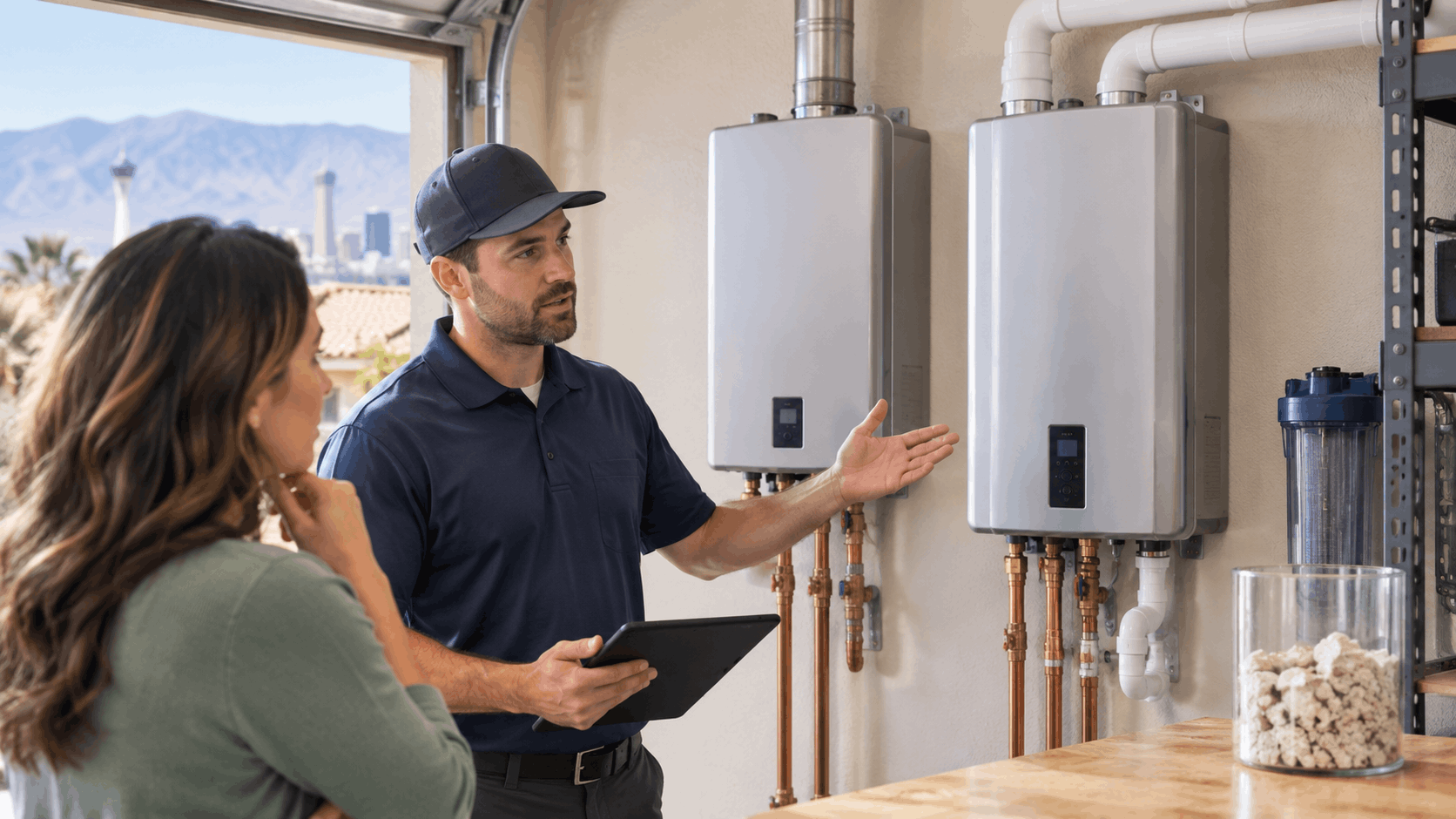
The best defense is treating the water before it reaches the heater. A whole-home water softener removes the calcium and magnesium that form scale. It protects the tankless unit, plus your fixtures, dishwasher, and pipes.
For homeowners who prefer not to add salt, a salt-free scale filter or conditioner changes the minerals so they do not stick as easily. It is not a true softener, but it cuts scaling noticeably. Our water softener installation team sizes the right system for each home.
In fast-growing areas like Aliante and Centennial Hills, we install a lot of softeners alongside new tankless units. Pairing the two protects the investment from day one. It also makes the whole house more comfortable.
A softener does add its own upkeep, mainly refilling salt. But that small chore beats replacing a scaled-out heater years early. The math favors treatment every time in water this hard.
Descaling Schedule and Maintenance
Even with a softener, we recommend descaling a tankless heater regularly. In Las Vegas water, that means a flush once a year at minimum. Homes without a softener may need a tankless flush every six to nine months.
A flush service circulates a descaling solution through the heat exchanger to dissolve mineral buildup. The tech isolates the unit, hooks up a pump, and runs the solution for about 45 minutes to an hour. Then they clean the inlet filter and check the system.
Valley homes need this more often than most of the country simply because our water is harder. What might be a two-year interval elsewhere becomes yearly here. Our tankless maintenance and descaling service keeps units running at full output.
Skipping the flush is a common mistake we see. Owners forget the unit exists until it throws an error code. A simple yearly appointment prevents most of those calls.
Need Help in Las Vegas?
Active Plumbing serves Las Vegas and all of Las Vegas Valley.
Which Type Fits Your Home Best
Choosing tankless comes down to matching the unit to your budget, home layout, and hot water habits. There is no single right answer for everyone. Here are the decision points that matter most for your home water needs.
Sizing for Household Demand
Tankless units are rated by flow rate in gallons per minute. You size the unit to the number of fixtures that might run at once. A shower plus a kitchen sink plus a dishwasher adds up quickly.
A large home in Summerlin with multiple bathrooms needs a higher flow rate than a downtown condo. Big families running back-to-back showers and laundry demand a unit that can keep up. Undersizing leads to lukewarm water during peak use.
Our cooler winter incoming water also affects unit sizing. When the source water is colder, the heater has to raise the temperature more, which cuts usable flow. We size for the worst-case winter demand, not the easy summer numbers.
A small condo or one-bathroom home can run a compact unit and stay happy. Matching flow rate to real demand is the first step we take on every quote. Guessing here leads to complaints later.
When a Condensing Unit Makes Sense
A condensing unit is the pick for homeowners staying put long term. The higher efficiency pays back over years, so the longer you own the home, the more the savings add up. Condensing benefits shine in that scenario.
New builds and major remodels also favor condensing. When walls are already open, running the PVC vent and condensate drain is easy and cheap. You capture the efficiency gains without the retrofit hassle.
High-usage households get more from an efficient water heater too. A big family that runs a lot of hot water sees a larger monthly saving than a single occupant. More gas burned means more to save.
If your home has no existing metal vent to reuse, condensing often wins on total cost. Since you are venting from scratch anyway, the cheaper PVC route makes sense. We weigh all of this during the assessment.
When Non-Condensing Is the Smarter Pick
Non-condensing units win on purchase price. For a tighter budget, the lower unit cost gets you endless hot water without the premium. Non-condensing benefits are real for cost-conscious owners.
Homes with existing metal venting already in place are strong candidates. If the vent path already handles hot exhaust, you skip some install work. That can shrink the cost gap between the two types.
Shorter-term owners also lean this way. If you plan to sell in a few years, you may never reach the payback point on a condensing unit. A budget water heater that works well makes more sense then.
Smaller households with modest hot water use see less benefit from the efficiency bump. When the monthly gas savings are small, the extra upfront cost is harder to justify. We are honest with owners when non-condensing is the smarter buy.
Professional Installation and Permits in the Valley
A tankless install is not a weekend DIY project. Gas, venting, and condensate all have to be right for safety and for resale. Proper permitting protects you when it comes time to sell.
Here is what a professional tankless installation covers, and what our team handles for local homeowners.
| Install Step | What It Involves |
|---|---|
| Assessment | Sizing, vent path, gas line, drain review |
| Permit | Pulled with Clark County or City of Las Vegas |
| Gas line | Upsized if needed for the higher demand |
| Venting | Metal for non-condensing, PVC for condensing |
| Inspection | Final sign-off by the building department |
Permits and Inspection Requirements
Gas water heater work requires a permit in our area. Depending on your address, that means a Clark County permit or a City of Las Vegas permit. The permit triggers an inspection once the work is done.
An inspector checks the gas connection, venting, and condensate handling. This inspection confirms the install meets code and is safe to run. It protects you and any future owner of the home.
Skipping permits causes real trouble at resale. An unpermitted water heater can hold up a sale or force expensive corrections during escrow. Buyers and their inspectors flag it fast.
We pull the right permit for every job and schedule the inspection. Owners never have to chase paperwork with the building department. It is part of a proper install, not an add-on.
Gas Line and Electrical Considerations
Tankless units fire hard when running, so they often need more gas than a tank heater. That frequently means a gas line upgrade to a larger diameter pipe. Undersized gas lines starve the unit and hurt performance.
Condensing units also need electrical power for their controls and fans. Many installs require a dedicated circuit to run the unit safely. Older homes may not have that outlet nearby.
Homes near the Huntridge area and other older parts of the Valley commonly need both upgrades. The original plumbing and electrical were built for smaller loads. Our gas line rerouting and upsizing crew handles the pipe side.
We check both gas and electrical during the assessment. If an upgrade is needed, it goes in the quote upfront. That way there are no mid-job surprises that stall the install.
How Active Plumbing Handles Local Installs
Our process starts with a home visit and a full assessment. We measure the space, check the vent path, review the gas line, and confirm drain options. Then we lay out the best unit for your needs and budget.
From there, Active Plumbing pulls the permit, schedules the crew, and completes the install to code. We handle venting, gas, condensate, and the final inspection. The homeowner gets a working system and clean paperwork.
We serve the whole Valley, from Henderson and Green Valley to Spring Valley and the northwest. Our trucks cover these neighborhoods every day, so we know the local homes and their quirks.
After the install, we set up a maintenance plan built for our hard water. That local install service does not end when the unit turns on. We stay with you to keep it running for years.
Need Help in Las Vegas?
Active Plumbing serves Las Vegas and all of Las Vegas Valley.
Long-Term Care to Protect Your Investment
A tankless unit can last 15 to 20 years, but only with care in our conditions. Hard water shortens that lifespan without maintenance. Here is how to protect either type of unit.
Annual Flushing and Filter Cleaning
The yearly flush is the single most important maintenance task. Circulating descaling solution through the heat exchanger clears out mineral buildup before it chokes the unit. Skip it in this water and performance drops fast.
Cleaning the inlet filter goes hand in hand with the annual flush. That small screen catches sediment and debris before they enter the unit. A clogged filter cuts flow and can trigger errors.
Homeowners can handle a few simple checks between service visits. Look at the unit for leaks, listen for odd noises, and watch water temperature at the tap. Note any error codes on the display.
Leave the actual flush and internal work to a pro. It requires the right pump, solution, and know-how to do safely. Our annual service covers the flush, filter, and a full system check.
Watching for Warning Signs
Scaling shows itself before the unit fails outright. A common sign is temperature fluctuation, where water swings between hot and cold. That often means scale is restricting flow inside the exchanger.
Error codes are the unit's way of asking for help. Many tankless heaters flash a code when they detect low flow, ignition trouble, or overheating. Write the code down and share it with your plumber.
Other red flags include reduced hot water pressure, a rumbling or crackling sound, and water that never gets as hot as it used to. These point to buildup or a component wearing out. Catching them early keeps repairs small.
When you see these signs, call a plumber rather than waiting. A minor flush and cleaning costs far less than a failed heat exchanger. Our water heater repair team diagnoses the issue and fixes it fast.
Extending Lifespan with Water Treatment
The real secret to a long-lived tankless unit here is combining descaling with water treatment. A softener or scale conditioner stops most buildup before it starts. Regular flushing handles whatever slips through.
Together, those two steps can push a unit past a decade of strong performance. Homes with a softener and yearly flushes routinely hit the full 15 to 20 year lifespan. Homes with neither often replace units far sooner.
Water treatment protects more than the heater. It saves your fixtures, dishwasher, washing machine, and pipes from the same scale. The whole house benefits from softer water.
We build a care plan around your specific setup and water. Pairing the right treatment with the right flush schedule is how you get your money's worth. In water this hard, that combination makes all the difference.
Final Thoughts
Both condensing and non-condensing tankless units work well in Las Vegas homes. Non-condensing costs less upfront and reuses metal venting when it exists. Condensing costs more but runs more efficiently and vents with cheaper PVC, which pays off for long-term owners.
Whatever you choose, our hard water is the deciding factor for longevity. Pair the unit with a softener and a yearly flush, and it will serve you for a decade or more. Skip that care and even the best unit fails early.
If your tank heater is aging or you want to compare tankless options for your home, our team is ready to help. Call Active Plumbing or reach out for a consultation. We will assess your home, walk you through the choice, and handle the install and permits from start to finish.
Frequently Asked Questions
- Is a condensing or non-condensing tankless better for Las Vegas?
- Both work well here, so the right pick depends on your situation. Condensing units cost more upfront but run more efficiently and pay back over time, making them ideal for long-term owners and new builds. Non-condensing units cost less and suit tighter budgets or homes with existing metal venting. Venting, budget, and how long you plan to stay decide it. We help you weigh all three.
- How much does a tankless water heater cost to install here?
- Most Valley installs land between $2,500 and $5,500. A non-condensing unit typically runs $2,500 to $4,000 installed, while a condensing model runs $3,500 to $5,500. Your final price depends on venting, whether the gas line needs upsizing, and any electrical work. A simple garage swap costs less than a retrofit that needs new venting and a drain line. We quote firmly after seeing the space.
- How often should I descale a tankless heater in Las Vegas?
- Our water is very hard, so we recommend a flush at least once a year. Homes without a water softener may need descaling every six to nine months. Colorado River water tests around about 16 grains per gallon, which builds scale fast inside the heat exchanger. Regular flushing keeps flow and efficiency up. A softener stretches the interval and protects the whole home.
- Does hard water void my tankless warranty?
- Hard water itself does not void coverage, but neglecting maintenance can. Many manufacturers require proof of regular descaling and, in hard-water areas, water treatment to honor a heat exchanger claim. Skipping flushes and running scaled-up water gives the maker grounds to deny a claim. Keep service records and consider a softener. That documentation protects your warranty and your investment.
- Can I use PVC venting for my tankless unit?
- Only condensing units allow PVC or polypropylene venting. Their exhaust cools to around 100 to 150 degrees, which plastic handles safely. Non-condensing units run exhaust near or above 300 degrees, so they require stainless steel Category III venting. Using PVC on a non-condensing unit is a serious safety hazard. We match the vent material to the unit type on every install.
- Do I need a permit to install a tankless heater in Clark County?
- Yes. Gas water heater work requires a permit in Clark County and the City of Las Vegas. The permit triggers an inspection that checks the gas connection, venting, and condensate handling for safety. Skipping the permit can cause problems at resale, holding up a sale or forcing corrections during escrow. We pull the correct permit and schedule the inspection for every job.
- Will a water softener help my tankless heater last longer?
- Absolutely. A softener removes the calcium and magnesium that form scale inside the heat exchanger. Less scale means better flow, higher efficiency, and a longer life. In water as hard as ours, a softener is one of the best investments you can make for a tankless unit. It also protects your fixtures, dishwasher, and pipes at the same time.
- How long does a tankless water heater last in Las Vegas?
- With proper care, expect 15 to 20 years. Without maintenance in our hard water, that can drop to under 10 years as scale damages the heat exchanger. The difference comes down to yearly flushing and water treatment. Homes that pair a softener with regular descaling reach the full lifespan. Neglected units fail early and need replacement sooner.
- Can I replace my old tank heater with a tankless in one day?
- Often, yes, if the venting and gas line are straightforward. A same-day swap is realistic when the vent path is short and the gas line is already sized right. Jobs that need new venting, a condensate drain, gas line upsizing, or a dedicated circuit can stretch into a longer timeline. We tell you the expected schedule after the assessment.
- Which uses less gas, condensing or non-condensing?
- Condensing units use less gas. They run at 90 to 98 percent efficiency versus 80 to 85 percent for non-condensing, because a second heat exchanger captures leftover exhaust heat. For a busy household on Southwest Gas, that can save $10 to $20 a month. Over the unit's life, the savings add up and offset the higher upfront cost for long-term owners.
Licensed plumbing professionals serving Las Vegas and Las Vegas Valley.
Licensed in Nevada · License #0047021
Last updated on
Why trust Active Plumbing?
Founded in 1991, Active Plumbing is a licensed and insured plumber serving Las Vegas and Las Vegas Valley. All content is reviewed by our licensed technicians.

Need Help in Las Vegas?
Active Plumbing serves Las Vegas and all of Las Vegas Valley.
Related Articles
Best Water Heater Option for Las Vegas Homes: Tank vs Tankless
Compare tank vs tankless water heaters for Las Vegas homes. Costs, hard water effects, lifespan, permits, and which option fits your neighborhood best.
Tankless Water Heater Installation Cost in Las Vegas: Gas Line Upsizing, Venting, and Permit Line Items
A clear breakdown of tankless water heater installation cost in Las Vegas, including gas line upsizing, venting, permits, and hard water factors for valley homes.

Tankless Water Heater Scale Buildup: Why Vegas Units Fail at 5 Years Without Descaling
Las Vegas hard water causes scale buildup that fails tankless units at five years. Learn the warning signs, descaling schedule, and treatment options to protect yours.