Angle Stop and Supply Line Replacement Cost: The $15 Part That Floods $50,000 of Las Vegas Home
Key Takeaways
- Angle stops and supply lines are cheap parts, but when they fail while nobody is home, they can flood a house for tens of thousands of dollars.
- A single valve and supply line replacement runs about $125 to $250, while a whole-home upgrade of 6 to 12 fixtures often costs $600 to $1,500.
- Las Vegas hard water from the Colorado River, desert heat, and pressure swings wear these parts out years more quickly than in most regions.
- Watch for rust, white mineral crust, dripping fittings, stuck valve handles, and bulging supply hoses as early warning signs of failure.
- Brass quarter-turn valves and braided stainless steel supply lines last far longer than cheap plastic parts against local water.
- Do a yearly under-sink inspection, replace supply lines every 5 to 8 years, and know where your main water shutoff is before an emergency.
- Water softeners cut mineral damage and smart leak detection systems can automatically shut off water to prevent a flood.
- Insurance may deny claims tied to leaks you knew about, so proactive replacement is the safest and cheapest protection.
In This Article
A couple in Summerlin left for work on a Tuesday morning, just like any other day. When they came home nine hours later, water was seeping out from under the garage door. A braided supply line under their upstairs bathroom sink had burst around lunchtime, and it pumped water into the house for hours while nobody was there to shut it off.
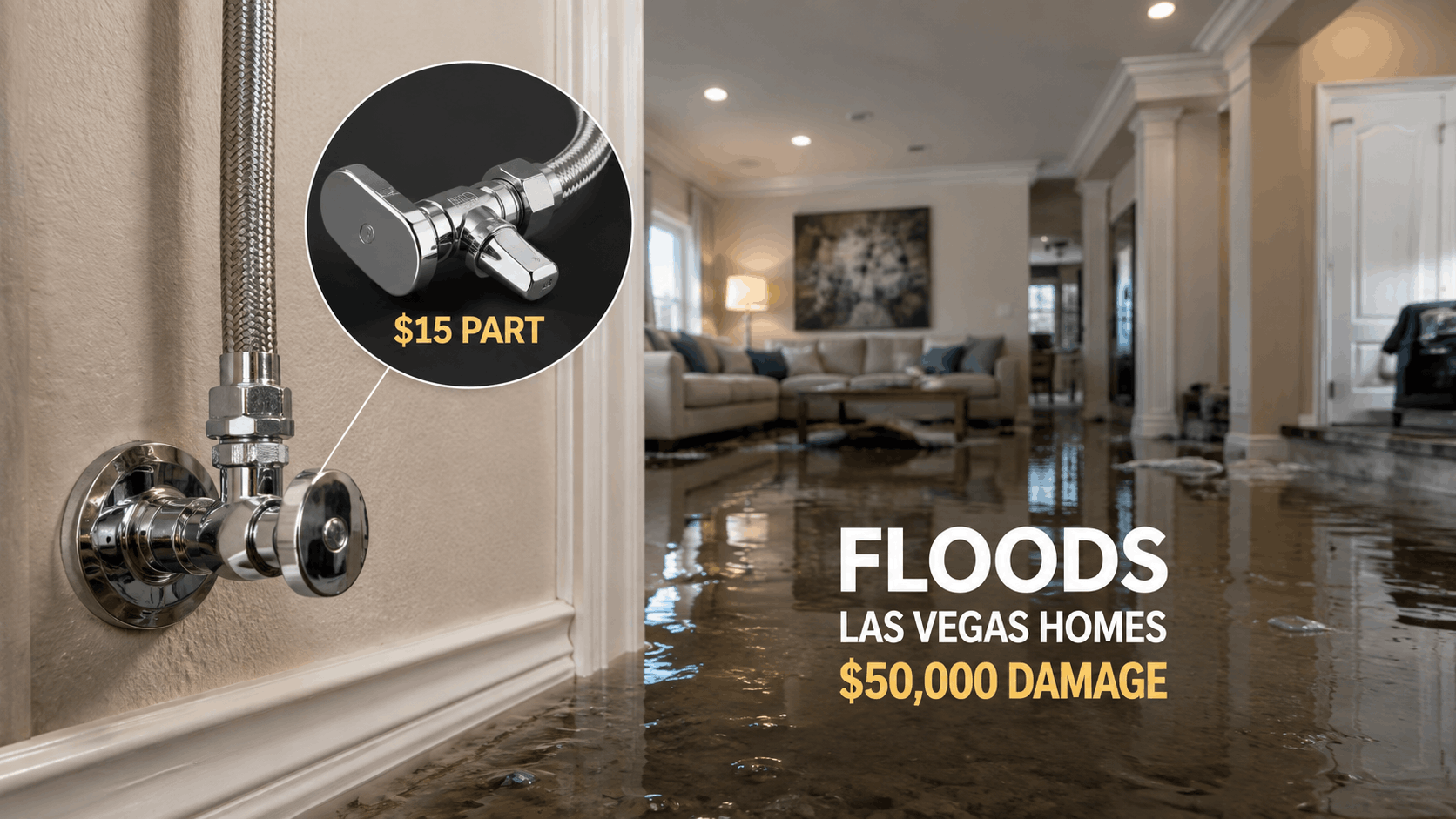
The part that failed cost about $15 at the hardware store. The damage came to just under $50,000 once you counted ruined flooring, soaked drywall, warped cabinets, and the mold that started growing behind the walls. That is not a rare story in the Las Vegas Valley. We see it more often than most homeowners would believe.
If you own a home anywhere from Henderson to North Las Vegas, this is one of the cheapest repairs you can make to avoid the biggest bill of your life.
What an Angle Stop and Supply Line Actually Do?
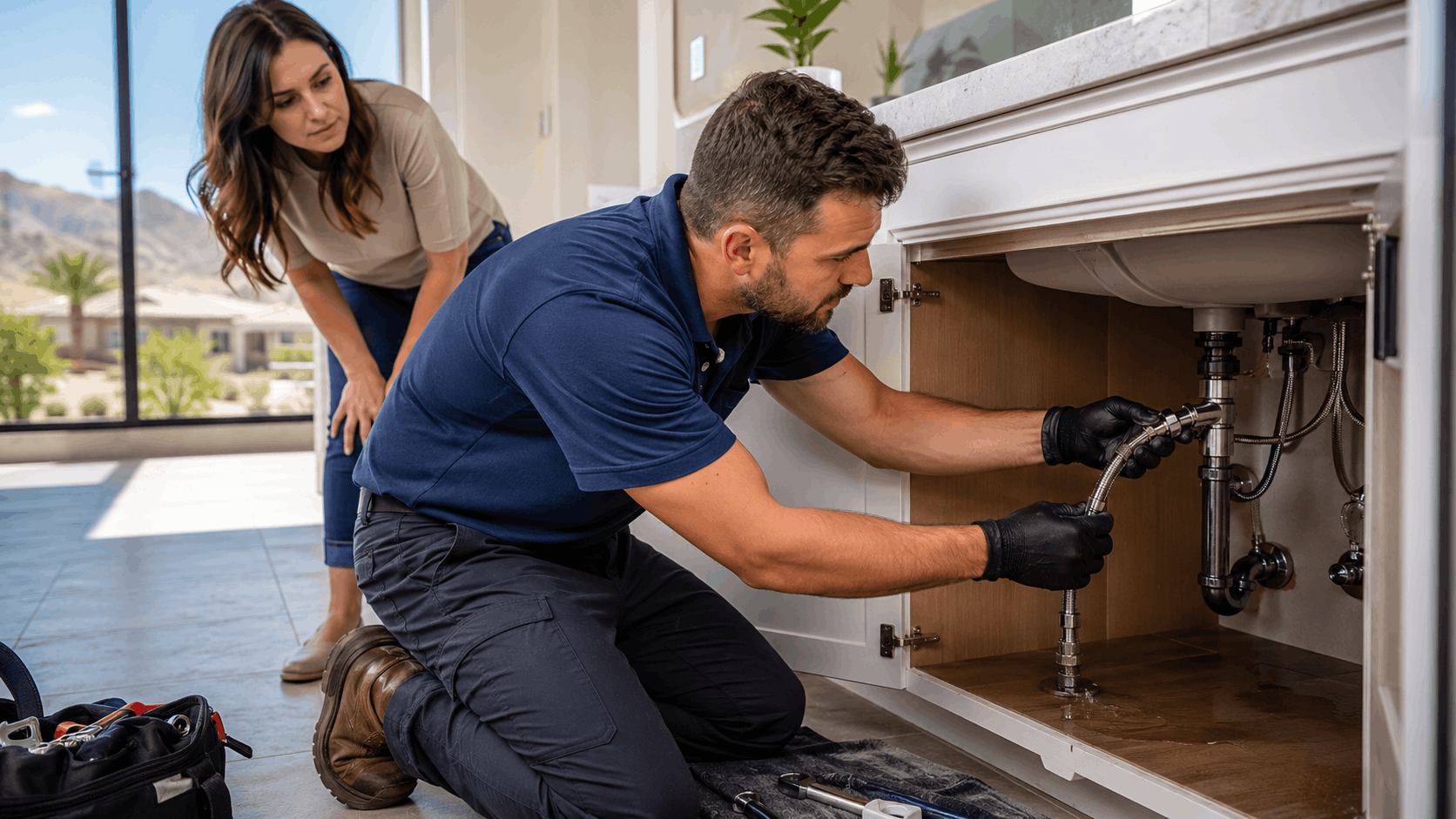
Most people never think about these parts until water is running across the floor. They sit tucked under sinks and behind toilets, quietly doing their job for years. Then one day a rubber washer gives out or a valve corrodes through, and the trouble starts.
Every fixture in your home relies on this small system to bring water in and shut it off when needed. Here is what they are and why they matter:
- The angle stop valve controls water flow to one fixture
- The supply line carries water from the valve up to the faucet or toilet
- The shutoff valve lets you stop water at that fixture without killing the whole house
The Angle Stop: The Little Valve Under Every Sink and Toilet
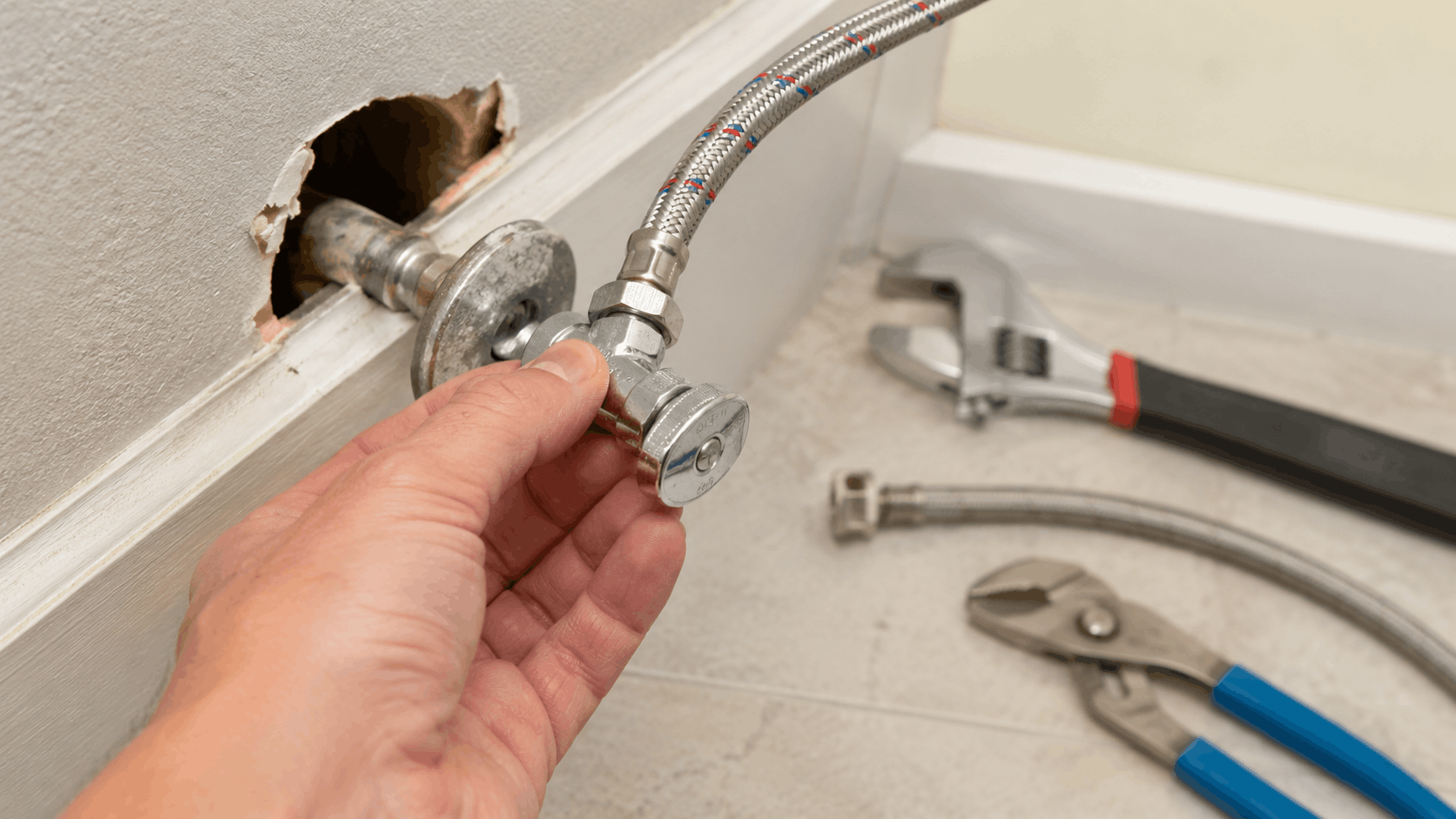
The angle stop is that small oval or football-shaped valve you see poking out of the wall under your sink or behind your toilet. It gets its name because it turns the water flow at a 90-degree angle, from the pipe in the wall up to the fixture. Some are the older multi-turn style with a round handle, and some are the newer quarter-turn valve style with a lever.
Its job is simple but matters a lot. This is the fixture shutoff that lets you cut water to a single toilet or sink so you can make repairs without shutting down water to the entire home. When it works, you never think about it.
The quarter-turn versions are far more reliable. You move the lever a quarter turn and the water stops, with no worn-out rubber packing to fail. The old multi-turn valves rely on a rubber washer that hardens and cracks over time, which is exactly where most failures begin.
We install and service these valves on homes all over the valley, from historic properties downtown to newer builds out west. When we replace fixtures during our pipe and fixture services, we almost always recommend upgrading the angle stop at the same time.
Supply Lines: The Flexible Hoses That Carry Water
The supply line is the flexible hose that runs from the angle stop up to your faucet, toilet tank, or appliance. You have probably seen the shiny silver braided supply line under most modern sinks. Older homes may still have plastic or thin chrome-plated lines instead.
A braided steel line has a rubber core wrapped in woven stainless steel mesh. The mesh gives it strength, but the rubber inside is still what holds the water pressure. That rubber ages, swells, and eventually splits, even when the outside looks fine.
Plastic and cheap poly lines are worse. They get brittle in the heat and can crack at the connection nut without any warning at all. A flexible connector that came with a builder-grade toilet is often the first thing to fail in a new home.
Supply lines are consumable parts. They are not meant to last the life of the home, though many people install them once and forget about them for 20 years. That is a gamble that does not pay off in Las Vegas water.
Why These Parts Fail Without Warning
The main enemy is corrosion. Metal fittings, valve bodies, and the crimp collars on supply lines slowly break down as minerals in the water eat away at them. In our area that process happens more quickly than in most parts of the country.
The second enemy is rubber failure. The washers inside multi-turn valves and the rubber core of a braided hose both dry out, harden, and crack. When rubber loses its flexibility, it can no longer seal against pressure, and it lets go all at once.
Mineral buildup makes everything worse. Calcium and scale collect inside the valve seat and around threads, which keeps a valve from closing fully and puts extra stress on every seal. You often cannot see this happening because it is all inside the fitting.
The scary part is that most of these parts fail silently over years. There is rarely a slow warning drip that gives you weeks to act. One moment it holds fine, and the next moment there is a steady stream spraying into the cabinet.
The $15 Part That Floods a $50,000 Home
Here is the math that surprises people. A standard half-inch supply line under normal household pressure can push out several hundred gallons of water per hour once it bursts. That does not slow down until someone turns off the water.
If a line lets go at 9 a.m. and nobody comes home until 6 p.m., that is nine hours of open flow. The water damage from that kind of event does not stay in one room. It soaks through subfloor, runs down into lower levels, and wicks up into drywall and cabinets.
By the time you discover the flooding, the water has already found the framing, the insulation, and the flooring adhesive. Wood swells, laminate delaminates, and mold spores start growing within 24 to 48 hours in warm conditions.
That is how a $15 part turns into a $50,000 problem. The cost was never the part itself. It was letting a worn-out valve or hose stay in service one year too long. Our emergency plumbing team responds to these calls across the valley, and the story is almost always the same.
Get Your Quote
Tell us what's going on and we'll get back to you. We're open 24/7.
How Much Angle Stop and Supply Line Replacement Costs in Las Vegas
The good news is that fixing this before it fails is cheap. The whole point of understanding replacement cost is to see how small the number is compared to the flood repair it prevents.
Prices vary across the valley depending on the plumber, the parts chosen, and how hard the job is to reach. Here is a realistic look at plumber pricing for Las Vegas plumbing work:
- Angle stop valve alone: $8 to $25 per valve
- Braided steel supply line: $8 to $20 per line
- Professional install per fixture: $125 to $250
- Whole-home replacement: often $600 to $1,500
Parts Cost Alone
If you buy parts yourself, they are inexpensive. A basic plastic multi-turn angle stop runs about $8, while a quality quarter-turn brass valve cost lands around $15 to $25. A decent braided stainless steel supply line costs $8 to $20 depending on length and connection type.
The temptation is to grab the cheapest option on the shelf. We understand the logic, but cheap plastic valves and thin poly lines are exactly the parts we see fail early in local homes. The savings up front turn into a repeat repair, or worse, a leak.
When you look at supply line price tags, spending an extra $10 on a better hose is one of the smartest small choices a homeowner can make. Brass valves and stainless lines simply hold up longer against our water.
Think of these parts like tires. Nobody brags about buying the good ones, but you notice fast when the bad ones let you down at the worst possible time.
Professional Installation Cost Per Fixture
Labor is where most of the cost lives, and that is fair. Replacing an angle stop correctly involves shutting off water, draining lines, cutting or unscrewing the old valve, and making a clean, leak-free connection.
A typical installation cost in the Las Vegas area runs about $125 to $250 per fixture for a straightforward swap of both the valve and the supply line. That usually includes the parts on a standard job. The labor rate reflects the skill needed to do it without creating a new leak.
Most plumbers in the valley also have a minimum service fee, often in the $75 to $150 range, that covers the trip and the first bit of work. This is why doing one lonely valve can feel pricey per unit.
That minimum fee is also the reason it makes sense to tackle several fixtures in one visit instead of calling separately each time something acts up.
Whole-Home Replacement Pricing
Replacing every angle stop and supply line in a house at once is where the value shows up. A typical single-family home has anywhere from 6 to 12 fixtures with valves and lines under them. Doing them all in one appointment spreads that service minimum across the whole job.
Most whole-home plumbing valve and line replacements in our area come in between $600 and $1,500. The exact figure depends on fixture count, valve type, and the condition of the existing stub-outs in the wall.
The bundle pricing advantage is real. Instead of paying a service minimum six different times over six years, you knock everything out in a half-day and reset the clock on the whole home.
We often recommend this for buyers moving into an older home near downtown or Huntridge, where the original valves are decades past their prime. Doing it all at once gives you a clean baseline.
What Makes a Job Cost More
Not every valve swap is quick. A seized valve that has calcified in place can require careful cutting and rebuilding of the connection, which adds time and cost. Old copper stub-outs coming out of the wall sometimes need to be re-flared or replaced entirely.
Tight, cluttered cabinets are another factor. If a plumber has to work around a garbage disposal, a water filter, and years of stored cleaning supplies in a cramped space, the job takes longer than a clear cabinet with easy access.
The biggest cost multiplier is timing. A planned appointment during business hours always costs less than an emergency plumbing call at 2 a.m. when a line has already burst. That after-hours premium is real, which is one more reason to fix these parts before they fail.
Homes with corroded galvanized or aged copper behind the wall can also turn a simple valve swap into a small repipe at that fixture. We always inspect the stub-out condition before quoting so there are no surprises.
Need Help in Las Vegas?
Active Plumbing serves Las Vegas and all of Las Vegas Valley.
Why Las Vegas Water Is Hard on These Parts
Our valves and hoses do not fail sooner here by accident. The water and climate in this valley are genuinely rough on plumbing parts. Understanding why helps you plan ahead instead of getting caught off guard.
Three local forces gang up on these parts: hard water, desert heat, and pressure swings. The result is more wear than almost anywhere else in the country.
Some of the Hardest Water in the Country
Southern Nevada draws most of its drinking water from the Colorado River through Lake Mead, delivered by the Las Vegas Valley Water District. That river water is loaded with dissolved minerals, mainly calcium and magnesium, which is what makes water "hard."
Local water regularly tests around about 16 grains per gallon of hardness, which ranks among the highest in the nation. You can read more about local water quality directly from the Las Vegas Valley Water District if you want the current numbers for your address.
All that hard water leaves calcium buildup everywhere it goes. Inside an angle stop, scale collects on the valve seat and around the moving parts, which keeps the valve from sealing and closing properly.
The same buildup corrodes brass and eats at the crimp collars on supply lines. That is the single biggest reason these parts wear out years sooner here than they would in a soft-water region.
Desert Heat and Pressure Swings
Summer in the valley pushes attic and wall-cavity temperatures far higher than the outdoor air. Supply lines running through hot spaces face heat stress that dries out rubber cores and makes plastic lines brittle. A hose that would last 15 years in a mild climate may crack here in half that time.
Municipal water pressure also fluctuates, and some parts of the valley run higher pressure than others. Every time pressure spikes, the rubber washers and hose cores flex a little more than they should. Over thousands of cycles, that constant working weakens the seal.
The desert heat and pressure combination is especially hard on the toilet supply lines and the lines feeding under-sink water filters. Those spots see the most sudden failures in our experience.
If your home does not have a pressure regulator, or the one you have is old, high incoming pressure can shorten the life of every valve and hose in the house.
Older Homes Around Downtown and the Historic Neighborhoods
Older properties near Huntridge, John S. Park, and the streets around downtown often still have their original valves. Many of these older homes were built with multi-turn stops that are now 40, 50, or more years old.
In Huntridge especially, we find valves so calcified they no longer turn at all. When a homeowner cannot shut off water at the fixture, they have no way to stop a leak short of the main. That is a serious safety gap.
These charming vintage homes are worth protecting, but their plumbing needs attention. Decades of hard water have taken a toll on every fitting under those sinks.
We work throughout the Arts District and central Las Vegas neighborhoods, and updating old angle stops is one of the more common improvements we make in those homes.
Newer Master-Planned Communities Are Not Immune
You might assume a newer home is safe, but that is not the case. Builders installing hundreds of homes in Summerlin, Aliante, and Inspirada often use the cheapest valves and lines that meet code. These builder-grade parts are chosen to keep construction costs down, not to last.
We regularly see plastic valves and thin poly supply lines fail in homes only 8 to 12 years old. The hard water gets to the budget parts just as fast as it gets to old ones, sometimes more quickly.
If you bought a newer home and never checked what is under the sinks, it is worth a look. Homeowners in Summerlin West and the newer North Las Vegas communities are often surprised by what the builder left behind.
Upgrading those builder-grade valves to brass quarter-turns is a small investment that removes one of the more common flood risks in a young home.
Warning Signs Your Angle Stop or Supply Line Is About to Fail
Most failures give at least a few quiet hints before the big one. Learning to spot these red flags gives you the chance to fix a $15 part on your schedule instead of during a 3 a.m. emergency.
Take five minutes now and then to look under your sinks. Here are the leak warning signs that point to valve failure or a coming supply line leak:
- Rust, green crust, or white mineral buildup on fittings
- A valve handle that is stiff, stuck, or leaks when turned
- Bulging, kinked, or discolored supply hoses
- Water stains, warped cabinet bottoms, or musty smells
Drips, Rust, and White Crust Around the Valve
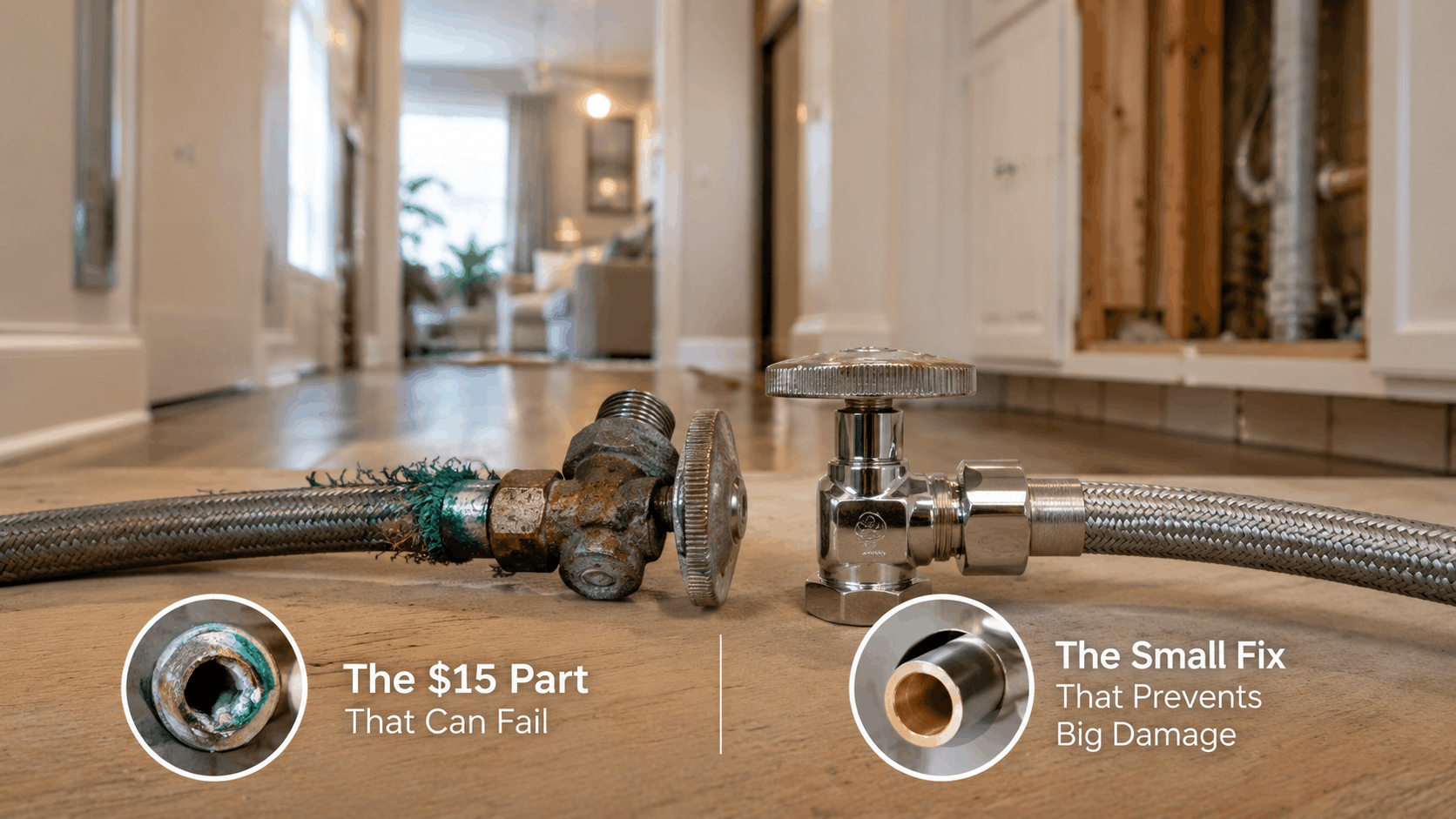
The clearest early warning is anything crusty or damp around the connection points. A ring of white, chalky mineral corrosion signs around a fitting means water has been slowly weeping there and drying out over time.
Even a tiny drip that shows up only now and then is a real signal. Small leaks almost never fix themselves, and they tend to grow as the seal continues to break down.
Green or blue staining on brass or copper points to active corrosion. Rust on any metal part means the fitting is losing strength from the inside out.
If you wipe a fitting dry and it is damp again the next day, that part is telling you it is on the way out. Do not wait for it to prove the point in a bigger way.
A Valve That Won't Turn or Won't Fully Shut Off
Try turning your angle stops off and on a couple times a year. If a valve is stuck and will not budge, or the handle turns but water keeps flowing, the valve is already compromised.
A shutoff failure is dangerous because the whole point of the valve is to give you control in an emergency. If it does not close, you cannot stop a leak at that fixture when you need to most.
Some homeowners force a stuck handle and snap it right off, which turns a small problem into an active leak instantly. If a valve resists, that is the moment to call a plumber, not to muscle it.
Any valve that fails this simple test should be replaced. A working shutoff at every fixture is one of the cheapest forms of protection a home can have.
Bulging, Kinked, or Discolored Supply Hoses
Braided lines hide their rubber core, but they still show warning signs. A bulging hose means the rubber inside is swelling and pushing against the steel mesh, which is a clear sign a burst is coming.
Kinks are another problem. A supply line that was bent sharply during installation has a weak point right at the fold, and that is where a supply line burst often starts.
Rust breaking through the braided mesh, or brown staining on the steel, tells you the metal is corroding. Once the mesh weakens, the rubber core has nothing holding it against the pressure.
Run your fingers along each line during your inspection. If it feels stiff, swollen, or rough where it should be smooth, replace it before it fails.
Water Stains in Cabinets and on Floors
Slow leaks leave a trail. Dark water stains on the cabinet floor, ripples in the particleboard, or a soft spot when you press down all point to water that has been present for a while.
A musty or damp smell when you open the cabinet is another giveaway. That odor usually means moisture has been sitting long enough for mildew to start, even if you cannot see it.
Cabinet damage like a swollen, crumbling cabinet base is often the first thing homeowners actually notice. By that point the leak has usually been going for weeks or months.
Do not just dry it out and move on. A stain means an active leak somewhere above, and the source needs to be found and fixed before it gets worse.
The Real Cost of Ignoring a Failing Valve
The whole argument for fixing these parts early comes down to simple math. A small repair now is nothing compared to the water damage cost of a full flood. Let us look at the real numbers.
When a line lets go and nobody is home, the bills stack up fast across restoration, mold, and lost belongings. Here is how the money actually breaks down:
| Scenario | Typical Cost |
|---|---|
| Replace one angle stop and supply line | $125 - $250 |
| Whole-home valve and line replacement | $600 - $1,500 |
| Emergency water extraction and drying | $2,000 - $6,000 |
| Flooring, drywall, and cabinet repair | $8,000 - $25,000 |
| Mold remediation | $3,000 - $12,000 |
| Major multi-room flood restoration | $30,000 - $50,000+ |
How Fast a Burst Line Floods a Home
A failed half-inch supply line under household pressure can release 200 to 500 gallons of water per hour. To picture that, a standard bathtub holds around 40 gallons, so a burst supply line can fill several bathtubs every hour.
Water does not politely stay in one room. The flooding rate means it spreads across flooring, seeps under baseboards, and drains down into any lower level in a short time.
On a two-story home, an upstairs leak becomes a downstairs ceiling collapse. The water finds every gap in the framing and travels far from where it started.
Over a nine-hour workday, that adds up to thousands of gallons pumped into the structure. This is why an unattended burst is so much worse than one caught in the moment.
Repair Bills for Flooring, Drywall, and Mold
The restoration cost after a flood is where budgets break. Water-damaged hardwood, laminate, and carpet almost always have to come out and be replaced, not just dried. Subfloor often goes with it.
Drywall wicks water upward, so soaked walls have to be cut out, dried, and rebuilt. Cabinets made of particleboard swell and fall apart, and matching existing cabinetry is rarely cheap.
Then comes mold remediation. In our warm climate, mold can start growing within a day or two of a flood. Remediation means sealing off areas, removing contaminated material, and treating the space, which frequently runs several thousand dollars on its own.
Stack flooring, drywall, cabinets, and mold work together and a single burst line easily crosses into five figures of repairs.
Insurance, Deductibles, and Denied Claims
Many homeowners assume insurance will simply cover the whole mess. Sometimes it does, but homeowners insurance comes with catches that surprise people at the worst moment.
A sudden, accidental burst is usually covered, but if the insurer decides the damage came from a leak you knew about and neglected, you can face a claim denial. Those rusty fittings and old stains we mentioned earlier can be used as evidence of neglect.
Even a covered claim leaves you paying the deductible, often $1,000 to $5,000, before coverage kicks in. Repeated water claims can also raise your premium or make coverage harder to keep. The Insurance Information Institute has clear guidance on what standard policies do and do not cover.
Between deductibles, premium hikes, and the risk of denial, insurance is a safety net with real holes in it. Prevention keeps you off the tightrope entirely.
The Cost Comparison That Changes Minds
Put the numbers side by side and the decision makes itself. Replacing a worn valve and line costs a couple hundred dollars. A flood restoration can run $30,000, $40,000, or more.
This cost comparison is why we push so hard on catching problems early. There is no other home repair where such a tiny investment prevents such an enormous loss.
Preventive repair also saves you the things money cannot fully replace: photos, keepsakes, and the weeks of living in a torn-apart house during restoration. Those costs never show up on an invoice.
Spending $200 to avoid a $40,000 flood is the best return on investment in home maintenance. We have never met a homeowner who regretted fixing a valve early.
Need Help in Las Vegas?
Active Plumbing serves Las Vegas and all of Las Vegas Valley.
DIY Versus Hiring a Las Vegas Plumber
Some of this work is genuinely doable for a handy homeowner. Other parts of it are trickier than they look and can go wrong fast. Being honest about the difference saves you money and headaches.
Here is a straight comparison of when DIY plumbing makes sense and when it pays to hire a plumber for professional installation:
| Task | Good DIY Job? | Why |
|---|---|---|
| Swap a supply line on a working valve | Yes | Simple hand-tool job, low risk |
| Replace an angle stop valve | Usually no | Involves fittings, sometimes soldering |
| Fix a seized or leaking old valve | No | High risk of a bigger leak |
| Whole-home valve upgrade | No | Time, tools, and code knowledge needed |
When a Homeowner Can Handle a Supply Line Swap
If your angle stop works and turns off cleanly, swapping the supply line above it is a reasonable DIY supply line project. This is the one part of the system most homeowners can handle safely.
You only need a few basic tools: an adjustable wrench or channel-lock pliers, a towel, and a bucket. Turn off the angle stop, open the faucet to relieve pressure, and unscrew the old line from both ends.
Bring the old line to the store so you match the length and connection sizes exactly. Buy a quality braided stainless line rather than the cheapest one on the rack.
Hand-tighten the new connections, then snug them a bit more with the wrench. Turn the water back on slowly and watch closely for any drip before you call it done.
Why Angle Stops Are Trickier Than They Look
Replacing the angle stop itself is a bigger step. The valve connects to the pipe coming out of your wall, and how it attaches changes the difficulty a lot. A compression fitting valve can sometimes be swapped with wrenches, but doing it right without a slow leak takes practice.
Homes with copper stub-outs may need a soldered connection, and soldering near cabinets and drywall carries fire risk if you are not careful. That alone puts the job in pro territory for most people.
Old copper stub-outs are often corroded or too short, which means the fix turns into more than a simple valve swap. What looked like a 20-minute job becomes a repair you were not prepared for.
If the water to the house has to be shut off at the main and you are cutting pipe, that is the point to call a professional. The cost of a small leak inside the wall is far more than the cost of the service call.
Common Mistakes That Cause Leaks Later
A common DIY error we fix is overtightening. People crank down on fittings thinking tighter is safer, but that cracks plastic nuts and crushes rubber washers, which causes the exact leak they were trying to avoid.
Cross-threading is another frequent problem. Starting a nut at a slight angle strips the threads, and the connection may hold for a few weeks before it slowly starts to weep.
Using mismatched parts causes trouble too. A supply line that does not quite fit the valve, or the wrong connection type forced together, will fail within months even if it looks fine at first.
These are the leaks that show up long after the work is done, often when nobody connects the dots back to the repair. A clean, correct install the first time avoids all of it.
What Active Plumbing Checks During a Service Call
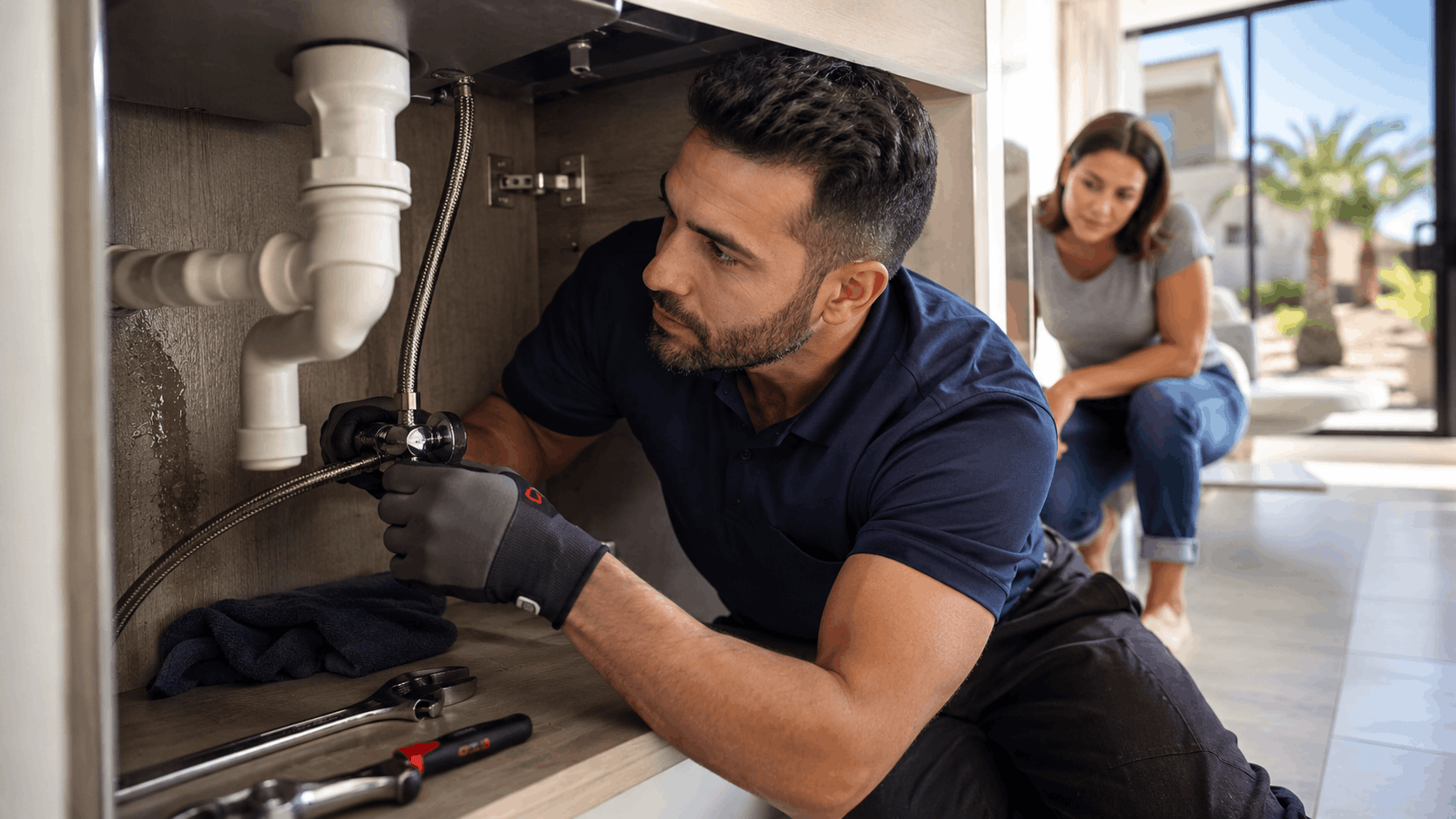
When our team comes out for any fixture work, we do a full plumbing inspection of the valves and lines while we are there. We test every shutoff to make sure it actually closes, because a valve that does not work is a valve that will fail you in an emergency.
We look at the stub-outs, the fittings, and the age and condition of each supply line. If we find corrosion, mineral buildup, or a stuck valve, we tell you exactly what we see and what it will cost to fix.
Our standard recommendation is a quarter-turn upgrade to brass valves. They are more reliable, easier to operate, and far better suited to our hard water than the plastic multi-turn stops so common in valley homes.
We handle these repairs on homes throughout Las Vegas, and we make sure you leave with working shutoffs at every fixture. That is the baseline every home should have.
Choosing the Right Replacement Parts and Plumber
The parts and the person installing them both matter. Good quality valves installed correctly by a licensed plumber will outlast cheap parts by many years. Here is how to make smart choices.
When you shop for parts or a Las Vegas plumbing service, use these criteria:
- Choose brass quarter-turn valves over plastic multi-turn
- Pick braided stainless steel supply lines, not plastic
- Confirm the plumber is licensed and insured in Nevada
- Look for a company that knows local water and code
Brass Quarter-Turn Valves Versus Plastic Multi-Turn
The single best upgrade you can make is switching to a brass valve with a quarter-turn lever. These valves use a solid ball inside instead of a rubber washer, so there is far less to wear out or corrode.
A quarter-turn valve moves from full-on to full-off with a simple lever flip. There is no straining against a stuck handle in an emergency, which matters when water is spraying and seconds count.
Plastic multi-turn valves are cheaper, but they are the ones we replace most often after they seize or leak. In our hard water, that rubber washer design simply does not hold up.
Brass costs a few dollars more per valve. Over the life of the valve, that small difference buys you years of reliability and one less thing to worry about.
Choosing Supply Lines That Last
For hoses, a good stainless steel supply line is the clear winner. The braided steel jacket resists the kinks and abrasion that kill cheaper lines, and it protects the rubber core inside.
Avoid the thin plastic and chrome-plated lines whenever you can. They get brittle in the desert heat and are among a common parts we find failed in local homes.
When choosing a durable hose, check the connection nuts too. Metal nuts hold up better than plastic ones, which crack under pressure or overtightening.
Spending an extra ten dollars per line for quality is one of the easiest decisions in home maintenance. The better hose simply lasts longer against everything our climate throws at it.
Why a Licensed, Local Plumber Matters
Anyone can call themselves a handyman, but a licensed plumber is bonded, insured, and accountable for the work. If something goes wrong, you have real protection instead of an unreachable phone number.
A local pro also knows Las Vegas building code and permit requirements, which matter on larger jobs. You can verify a contractor's standing through the Nevada State Contractors Board before you hire anyone.
Local knowledge goes beyond code. A plumber who works this valley every day understands how our hard water behaves and which parts survive it, so you get advice grounded in real experience.
That experience shows up in the small choices, from the valve type recommended to how a fitting is prepped. Those details are what keep a repair leak-free for years.
Serving Homes Across the Valley
We handle angle stop and supply line work across the entire valley. Our team covers Henderson, North Las Vegas, Summerlin, and Spring Valley, along with the central Las Vegas neighborhoods.
From older bungalows near downtown to newer builds out in the master-planned communities, we have seen how each area's homes age. That range of experience means we know what to look for under your particular sink.
Whether you are in a Whitney Ranch home or a place out near Mountain's Edge, the same hard water is at work. We bring the right brass valves and quality lines to every job.
If you are not sure whether we reach your neighborhood, our service area page lists the communities we cover across the valley.
Need Help in Las Vegas?
Active Plumbing serves Las Vegas and all of Las Vegas Valley.
How to Prevent Angle Stop and Supply Line Failures
Prevention is simple and cheap once you know the routine. A little attention each year keeps you from ever facing that flooded-house scenario. Here is a practical plan any homeowner can follow.
Good leak prevention comes down to regular plumbing maintenance and knowing your water shutoff locations. None of it takes special skills.
A Simple Yearly Under-Sink Inspection
Once a year, open every cabinet with plumbing in it and take a real look. This under-sink inspection takes just a few minutes per fixture but catches most problems early.
Feel around each fitting for dampness, look for white crust or rust, and check the supply lines for bulges or stiffness. Wipe the connections with a paper towel so you can spot any new moisture next time.
During your yearly check, gently test each shutoff valve to confirm it still turns. Do not force a stuck one, but note it so you can have it replaced.
Write the date somewhere so you remember when you last looked. Pairing the check with something memorable, like the start of summer, makes it easy to keep up.
Replace Valves and Lines on a Schedule
Do not wait for parts to fail. Given our hard water, a smart replacement schedule beats crossing your fingers year after year.
We suggest replacing braided supply lines about every 5 to 8 years, and plastic lines sooner. Angle stops that are the plastic multi-turn type should be upgraded to brass at the first sign of stiffness or age.
Proactive replacement is cheap and lets you do the work on your schedule instead of during a 2 a.m. emergency. It is the same logic as changing a smoke detector battery before it dies.
If your home is over 15 years old and the valves have never been touched, plan a whole-home refresh. It resets the clock and removes the oldest, riskiest parts all at once.
Water Softeners and Leak Detection Devices
Since hard water is the root cause here, treating it protects everything downstream. A water softener removes much of the calcium and magnesium that corrode valves and clog fittings, extending the life of every part in the home.
Our water softener installation service is one of the best long-term defenses against the mineral buildup this valley is known for. Softer water also helps your water heater, faucets, and appliances last longer.
A smart leak detector adds a second layer of protection. Whole-home systems can sense abnormal flow and automatically shut off the water, stopping a burst before it floods the house.
Our whole-home leak detection system is exactly what would have saved that Summerlin couple thousands of dollars. It watches the water so you do not have to.
Know Where Your Main Shutoff Is
Every person in your household should know where the main shutoff is before an emergency ever happens. Fumbling to find it while water pours in wastes the exact minutes that matter most.
In most valley homes the main valve is near where the water line enters, often in a garage, an exterior wall, or a below-grade box near the curb. Find it now, on a calm day, not during a crisis.
Practice turning it off so you know it works and know which way to turn it. Knowing how to get the emergency water off can be the difference between a mopped-up mess and a gutted house.
Keep any needed tool, like a curb key, in a spot everyone knows. Seconds count when a line lets go, and a quick shutoff limits the damage dramatically.
Final Thoughts
The angle stop and supply line are the smallest, cheapest parts in your plumbing, yet they cause some of the biggest disasters we see. A $15 valve or hose that fails while you are at work can flood a home to the tune of tens of thousands of dollars.
The fix is simple. Check under your sinks once a year, replace worn parts on a schedule, upgrade to brass quarter-turn valves and stainless lines, and know where your main shutoff is. Our hard water makes this attention more important here than almost anywhere else.
If it has been years since anyone looked at your valves, or you spotted a warning sign in this guide, reach out. Our team at Active Plumbing serves homes across Las Vegas, Henderson, North Las Vegas, and the surrounding communities, and we are glad to inspect your valves and lines before a small part becomes a big problem. Contact us to schedule a visit.
Frequently Asked Questions
- What is an angle stop valve?
- An angle stop valve is the small shutoff valve you see under sinks and behind toilets. It controls water to a single fixture, so you can turn off water to one toilet or sink without shutting down the whole house. It gets its name because it turns the water flow at a 90-degree angle from the wall pipe up to the fixture supply line.
- How much does it cost to replace an angle stop in Las Vegas?
- For a straightforward job, expect about $125 to $250 per fixture, which usually covers both the valve and a new supply line plus labor. Most local plumbers have a service minimum, so replacing several fixtures in one visit lowers the cost per unit. A whole-home replacement of 6 to 12 fixtures often runs between $600 and $1,500 total.
- How long do supply lines last?
- Quality braided stainless steel lines typically last 5 to 10 years, while cheap plastic lines often fail much sooner. In the Las Vegas Valley, hard water and desert heat shorten those lifespans, so we recommend replacing braided lines every 5 to 8 years. If a line is bulging, kinked, stiff, or showing rust, replace it right away regardless of age.
- Can I replace a supply line myself?
- Yes, if your angle stop works and shuts off cleanly, swapping the supply line above it is a reasonable DIY job. You just need pliers, a towel, and a matching quality braided line. Turn off the valve, relieve pressure at the faucet, and swap the hose. If the valve is stuck or leaks, or the job involves the valve itself, call a plumber instead.
- How do I know if my angle stop is going bad?
- Watch for drips or dampness at the fitting, white mineral crust or rust on the valve, and a handle that is stiff, stuck, or leaks when you turn it. A valve that will not fully shut off water is already compromised. Water stains or a warped, musty cabinet base below the valve are also strong signs the part is failing and needs replacement.
- Why does Las Vegas water damage these parts so fast?
- Southern Nevada draws its water from the Colorado River, which is high in dissolved minerals like calcium and magnesium. That hard water leaves scale on valve seats and corrodes brass fittings and hose collars. Combined with desert heat that dries out rubber and pressure swings that stress seals, local conditions wear these parts out years more quickly than in soft-water regions.
- Will homeowners insurance cover a burst supply line?
- A sudden, accidental burst is usually covered by standard homeowners policies, but you still pay your deductible, often $1,000 to $5,000. If the insurer decides the damage came from a leak you knew about and ignored, they may deny the claim. Rusty fittings and old water stains can be treated as evidence of neglect, which is one more reason to fix these parts early.
- Should I replace all my valves at once?
- If your home is older or the valves have never been updated, replacing them all at once usually saves money. You spread the service minimum across every fixture instead of paying it repeatedly over several years. A whole-home replacement also resets the clock on your entire plumbing and removes the oldest, highest-risk parts in one visit.
- How long does a replacement take?
- A single angle stop and supply line swap usually takes about 30 to 60 minutes per fixture, depending on access and the condition of the stub-out. A full whole-home replacement of 6 to 12 fixtures is often a half-day job. Seized valves or corroded copper stub-outs can add time, which is why we inspect the condition before quoting.
- Does Active Plumbing service my area?
- Yes. We serve homes across Las Vegas, Henderson, North Las Vegas, Summerlin, Spring Valley, Enterprise, and the surrounding valley communities. From historic homes near downtown to newer master-planned neighborhoods, our team handles angle stop and supply line work everywhere the same hard water is at play. Check our locations page or contact us to confirm coverage for your specific neighborhood.
Licensed plumbing professionals serving Las Vegas and Las Vegas Valley.
Licensed in Nevada · License #0047021
Last updated on
Why trust Active Plumbing?
Founded in 1991, Active Plumbing is a licensed and insured plumber serving Las Vegas and Las Vegas Valley. All content is reviewed by our licensed technicians.

Need Help in Las Vegas?
Active Plumbing serves Las Vegas and all of Las Vegas Valley.
Related Articles
Emergency Shutoff Valve Replacement Cost in Las Vegas - Main, Angle Stops, and Gate-to-Ball Upgrades
A local guide to emergency shutoff valve replacement cost in Las Vegas, covering main valves, angle stops, and gate-to-ball upgrades with real price ranges.
Sewer Line Replacement Cost in Las Vegas: Trenchless vs Open-Dig Per Foot in Caliche
See real per-foot sewer line replacement costs in Las Vegas for trenchless vs open-dig, and learn how caliche soil affects your quote and which method fits your home.
Whole-House Repipe Cost in Las Vegas by Home Size - 1,500 to 4,000+ Sq Ft Real Ranges
Real whole-house repipe cost ranges in Las Vegas by home size from 1,500 to 4,000+ sq ft, plus pipe materials, permits, timelines, and local factors.