LVVWD vs SNWA: Who's Responsible When Your Vegas Water Pressure Drops
Key Takeaways
- LVVWD delivers water directly to your home and meter, while SNWA manages the regional wholesale supply from Lake Mead.
- The water meter is the dividing line - the utility covers everything up to it, and the homeowner owns everything past it.
- Check with neighbors first: if the whole street lost pressure, the problem is on the utility side and you call LVVWD.
- Normal Las Vegas home water pressure runs 45 to 75 PSI, and a cheap hose-bib gauge tells you where yours stands.
- The service line from the meter to your house, the PRV, and all interior plumbing are the homeowner's responsibility to repair.
- Hard water buildup, failing pressure regulators, and hidden service line leaks are a common causes of weak flow in the valley.
- Older downtown homes with galvanized pipe, higher-elevation Summerlin areas, and growing northwest neighborhoods each face distinct pressure issues.
- A water softener, regular PRV checks, aerator cleaning, and a yearly inspection prevent most future pressure problems.
In This Article
It is 7 a.m. on a July morning in Summerlin. A family is getting ready for work and school, and the shower slows to a sad trickle. The coffee maker fills at half speed. The lawn sprinklers barely sputter. On a day already headed for 108 degrees, weak water flow is the last thing anyone wants to deal with.
When this happens, most homeowners do not know who to call. Is it the water district? Some regional agency they have seen on their bill? Or is the problem hiding inside their own pipes? The two big names in Las Vegas water are LVVWD and SNWA, and they do very different jobs.
This guide breaks it all down. Our team has worked on hundreds of homes from Centennial Hills to Henderson, and we will explain who controls what part of your Las Vegas water supply, how to tell if the problem is on the city side or yours, who pays for repairs, and how to keep pressure strong year-round.
What LVVWD and SNWA Actually Do for Las Vegas Homes?
Two main agencies keep water moving through the valley, and people mix them up all the time. One delivers water straight to your meter. The other manages the regional supply behind the scenes.
Knowing the difference saves you time when something goes wrong. You will know who to call and what they are responsible for. Here is a quick look before we get into the details.
| Agency | Main Role | What They Handle | Do They Touch Your Faucet? |
|---|---|---|---|
| LVVWD | Local water provider | Meters, street mains, billing, line to the meter | Yes - delivers to your home |
| SNWA | Regional wholesale agency | Lake Mead supply, treatment, regional planning | No - works upstream |
The Las Vegas Valley Water District (LVVWD) Explained
The Las Vegas Valley Water District is the agency that brings water right to your property. When you turn on a tap in Spring Valley or Centennial Hills, LVVWD is the reason water comes out. They run the pipes under your street and the line that feeds your meter.
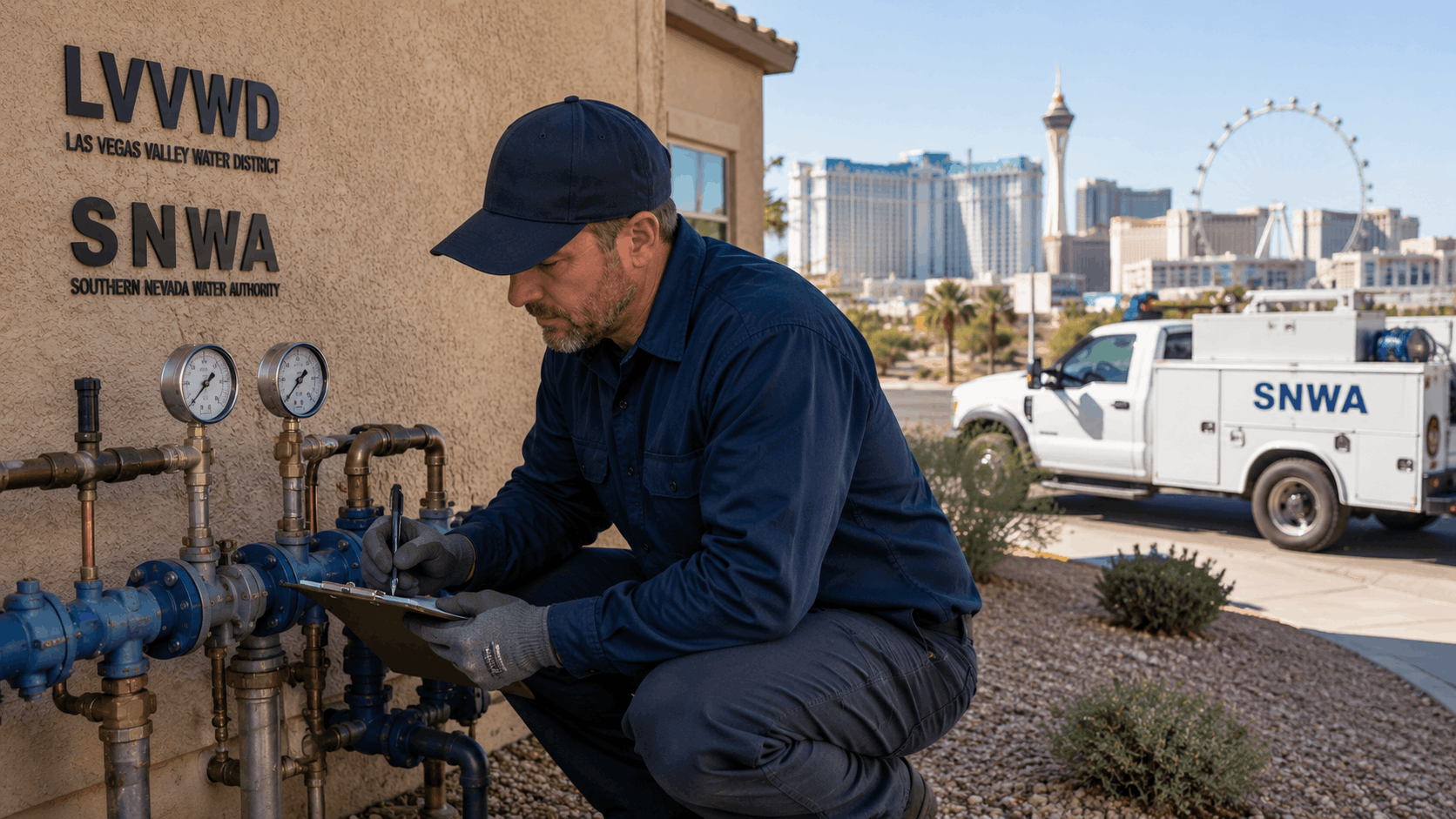
LVVWD also reads your water meter and sends the bill you pay each month. That meter sits at the edge of your property, often near the sidewalk or in a small box in the front yard. Everything on the street side of that meter belongs to the district.
The team at LVVWD maintains thousands of miles of street mains across the valley. When a main cracks along a busy road or a meter fails, they are the ones who roll a truck. They also handle the service line that runs from their main up to your meter.
So if you live near Durango and Flamingo or out in Centennial Hills, your day-to-day water service comes from LVVWD. They are the household name on your bill, and the agency you call when the whole block loses water.
The Southern Nevada Water Authority (SNWA) Explained
The Southern Nevada Water Authority works at a much bigger level. SNWA is a wholesale water agency, which means it manages the regional supply rather than delivering it to your house. You will not call SNWA about a slow shower.
SNWA's job centers on Lake Mead and the Colorado River. They draw raw water from the lake, treat it, and move it toward the local providers like LVVWD. They also plan for drought, manage water storage, and run conservation programs.
Think of SNWA as the supplier behind the supplier. They make sure the valley has enough treated water in the first place. The agencies that touch your meter then take it from there.
Because the region depends so heavily on a single source, SNWA also handles long-term planning as Lake Mead levels shift. That work matters for the whole valley, but it is not who you call when your kitchen faucet drips slow.
How the Two Agencies Work Together
The path water takes to reach your home is a relay. It starts at Lake Mead, where SNWA pulls in raw water through intake systems built into the reservoir. From there, the water heads to treatment plants.
SNWA runs the treatment side. Their facilities clean and disinfect the water so it meets federal drinking standards. This is where the heavy lifting of treatment happens before any of it reaches a neighborhood.
Once the water is treated, it moves into the larger pipelines that feed the local providers. LVVWD takes that treated water and pushes it through its own water distribution system. That network of mains carries it down your street and into your meter.
So the full chain looks like this: Lake Mead to SNWA treatment to LVVWD distribution to your home. Each agency owns its piece of the valley supply, and the handoff between them keeps water flowing across Las Vegas.
Where the Utility Stops and the Homeowner Starts
Here is the line that trips up most homeowners. The water meter is the dividing point. Everything up to and including the meter belongs to the water district. Everything past it belongs to you.
That means the pipe running from the meter to your house is your responsibility. So is the pressure regulator, the interior plumbing, the water heater, and every fixture inside. This is what we call the point of responsibility.
A lot of people assume the utility owns the line all the way to their wall. It does not. Once water crosses that meter, repairs and upkeep fall on the property owner.
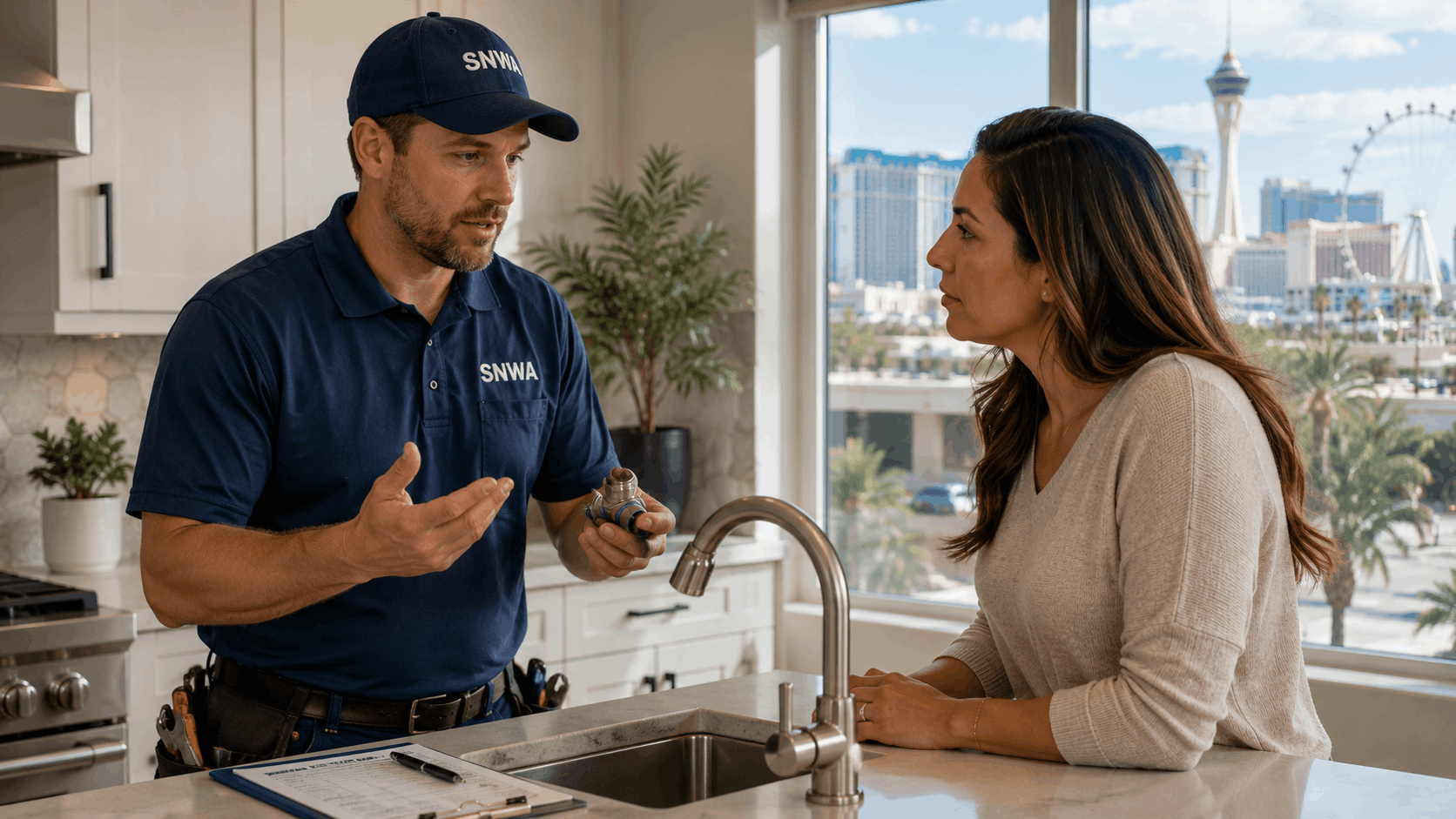
Knowing this saves you frustration and money. If your homeowner plumbing is the source of low pressure, the water district will not fix it for free. That is when a local plumber like our team steps in. You can always reach out through our contact page if you are not sure which side the problem is on.
Get Your Quote
Tell us what's going on and we'll get back to you. We're open 24/7.
Common Reasons Vegas Water Pressure Drops
When homeowners call us about weak water flow, the cause usually falls into a handful of categories. Some are on the city side. Most are on yours. Here are the patterns we see most across Las Vegas plumbing jobs.
- City main breaks or scheduled repair work
- Failing pressure regulators
- Hard water and mineral buildup
- Hidden leaks in the service line
City Main Breaks and Scheduled Repairs
Sometimes the problem really is the city. When LVVWD does repair work on a street main along a corridor like Charleston Boulevard or Rainbow, pressure can drop for a whole block. This is normal and usually temporary.
A water main break can do the same thing without any warning. A cracked main loses water fast, which pulls pressure down for every home connected to it. You might notice it the moment it happens, often with discolored water too.
Scheduled LVVWD repair work is often planned ahead. The district may post notices or send alerts before they shut down a section of pipe. If your pressure drops at the same time as a posted repair, that is your answer.
The giveaway with main issues is that they affect more than just your house. If your neighbors lost pressure too, the problem is on the utility side and there is nothing inside your home to fix.
Failing Pressure Regulators (PRVs)
The pressure regulator, or PRV, is one of the more common culprits we find. This valve sits where the line enters your home and keeps incoming pressure at a safe level. Over time, the internal parts wear out.
When a PRV starts to fail, pressure swings up and down for no clear reason. One day the shower is fine, the next it barely runs. A worn regulator can also let pressure climb too high, which stresses pipes and fixtures.
Older homes near the Henderson border and across Spring Valley often have aging PRVs that are past their service life. These valves typically last 8 to 12 years. If yours is older than that and pressure feels off, the PRV is a prime suspect.
Replacing or adjusting a regulator brings water pressure back into the right range. It is a routine fix for our team, and we handle it as part of our pipe and fixture services all over the valley.
Hard Water Buildup and Mineral Clogs
Las Vegas has some of the hardest water in the country. All those minerals do not just spot your glasses. Over the years, hard water leaves deposits inside your pipes, aerators, and water heater.
That mineral buildup slowly narrows the inside of your plumbing. Less open space means less flow. A pipe that once carried full pressure ends up choked down by scale you cannot see.
The clogs show up first in small openings. Faucet aerators and showerheads get blocked, so flow drops at those points before anything else. Inside a water heater, scale settles on the bottom and restricts the hot side.
If your home has lived through years of valley water without treatment, clogged pipes from minerals are likely part of the story. A water treatment setup slows this buildup and protects your plumbing for the long run.
Hidden Leaks in the Service Line
The line between your meter and your house runs underground, so a leak there can hide for a long time. A service line leak sends water into the soil instead of your faucets. The result is lost pressure and a higher bill.
An underground leak often shows up as a soft or soggy spot in the yard. You might see grass that stays green while the rest goes dry, or a section of soil that never seems to dry out between sprinkler cycles.
Because the leak drains water before it reaches the house, you feel it as water pressure loss at every tap. The harder the line leaks, the weaker your indoor flow gets. A big break can cut pressure dramatically.
Finding these leaks takes the right tools. Our team uses electronic leak detection to pinpoint the spot without digging up the whole yard. That saves time, money, and your landscaping.
Need Help in Las Vegas?
Active Plumbing serves Las Vegas and all of Las Vegas Valley.
Is It the Utility or Your Plumbing? How to Tell
Before you call anyone, you can do a few quick checks to figure out where the problem lives. Learning to diagnose water pressure yourself helps you avoid a wasted service call. Here is the utility vs plumbing rundown.
- Ask your neighbors if they lost pressure too
- Test your pressure with a hose-bib gauge
- Read your meter to check for leaks
- Decide whether to call LVVWD or a plumber
Check With Your Neighbors First
The fastest test costs nothing. Walk next door and ask if their water pressure dropped too. If several homes on your street are affected, the problem points to the utility side.
This works because homes in the same community share a connection to the same main. A utility issue like a break or repair hits everyone on that shared main at once. One home alone rarely sees a utility-caused drop.
If your neighborhood pressure is fine everywhere except your house, the problem is on your property. That narrows things down right away. Now you know to look at your own regulator, pipes, or service line.
This single step saves a lot of guessing. In master-planned areas like Summerlin or Centennial Hills, neighbors usually talk, and a quick group text can confirm whether the whole block is affected.
Test Your Pressure With a Simple Gauge
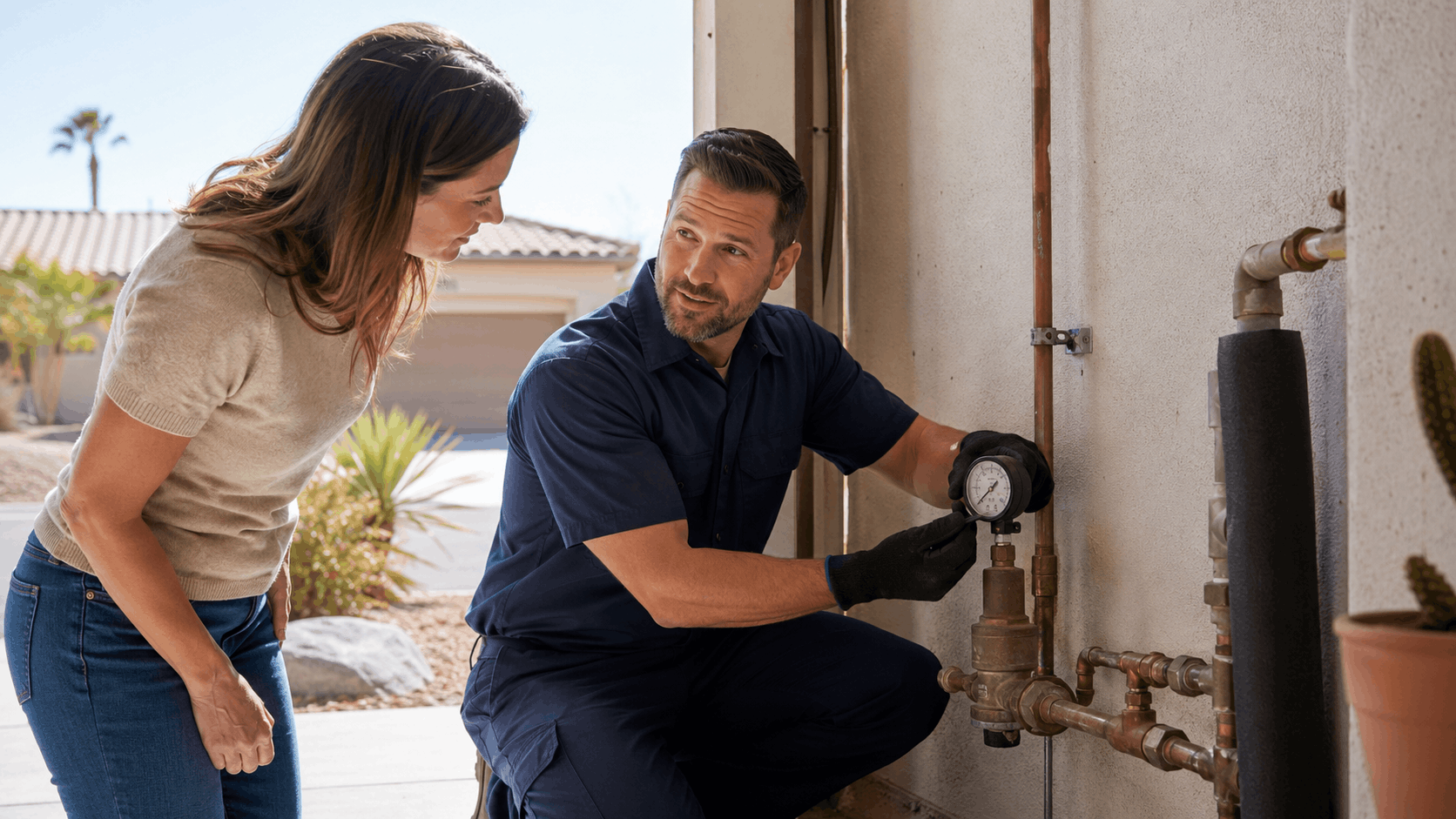
A pressure gauge is a cheap tool that screws onto any outdoor faucet. You can grab one at a hardware store for under fifteen dollars. It tells you exactly what is coming into your home.
To run the test, screw the gauge onto a hose bib and turn the water on full. Make sure no other water is running in the house. The needle will settle on a number, and that is your incoming pressure.
For most valley homes, normal pressure sits between 45 and 75 PSI. A PSI test reading below 40 means low pressure that needs attention. A reading above 80 is too high and can damage your plumbing.
If the gauge shows low pressure, the issue could be your PRV or a leak. If it shows good pressure but your faucets are still weak, the clog is likely inside the house. Either way, the number gives our team a clear starting point.
Reading Your LVVWD Meter for Leaks
Your LVVWD meter can tell you if water is leaking on your side. Start by turning off every faucet, appliance, and irrigation line in and around the home. Nothing should be using water.
Now go find the meter, usually in a box near the sidewalk. Lift the lid and look at the dial or the small leak indicator, often a tiny triangle or star. With all water off, it should be completely still.
If that indicator is moving or the numbers are creeping up, water is flowing somewhere. That is a strong sign of a hidden leak between the meter and your house. This is reliable leak detection you can do yourself in five minutes.
A moving meter with everything off means it is time to call a plumber, not the district. The leak is on your side, so our team would handle the leak detection and repair from there.
When to Call LVVWD vs a Local Plumber
The decision comes down to which side of the meter has the problem. Call LVVWD when the whole street is affected, the water looks discolored, or you suspect a main break. Those are their responsibility.
Also call the district if your meter itself is leaking or damaged, or if the line between their main and your meter has an issue. Anything on the street side of the meter is their water service to fix.
Call a local plumber when only your home has low pressure, when the gauge shows a problem, or when your meter shows a leak with everything off. Those point to your own plumbing.
When you are not sure, our team can help you figure it out fast. We answer questions over the phone and can run a full diagnosis on site. Reach us anytime through our emergency plumbing line if the drop is sudden.
Who Pays for Repairs on Each Side of the Meter
Money is where the meter line really matters. The water district covers its side at no charge. The homeowner covers everything past the meter. Here is how repair responsibility breaks down.
Repairs LVVWD Handles at No Charge
The good news is that the district covers a fair amount. LVVWD repair crews handle the street main, the line from that main up to your meter, and the meter itself. None of that costs you out of pocket.
If a main breaks under Rainbow or Charleston, the district fixes it on their dime. If your meter stops working or starts leaking, they replace it for free. That hardware belongs to them.
This is a true free repair for the homeowner, funded through the rates everyone pays. You do not get a separate bill when LVVWD digs up the street to fix their own pipe. Their responsibility ends at the meter, and so does their cost coverage.
So if your problem sits on the street side, the right move is to report it and let the district handle it. There is no reason to pay a private plumber for work the utility owns.
Repairs That Fall on the Homeowner
Once water crosses the meter, the bill is yours. The biggest item is the service line repair for the pipe running from the meter to your house. If that line leaks or breaks, the property owner pays for it.
The pressure regulator is also your job. PRVs wear out and need replacement on the homeowner's dime. The same goes for every bit of interior plumbing, from the pipes in your walls to the water heater and fixtures.
This is the core of homeowner responsibility. Slab leaks, corroded pipes, clogged lines, and fixture problems all fall to you. The district will not touch anything past the meter.
While that may not sound like fun, it does mean you control the work and the quality. Our team handles these repairs across the valley, and we can walk you through costs before any digging starts. A water heater repair is a common example of an owner-side fix.
The Tricky Spot: Between the Meter and Your House
This is the gray area that catches people off guard. The meter to house line looks like it might belong to the utility since it connects to their meter. It does not. That stretch of pipe is yours.
So if the service line develops an underground leak in your front yard, the repair is on you. Many homeowners assume the district covers it because the leak is near the meter. The dividing point is the meter outlet, not your front wall.
To confirm ownership, remember the simple rule: street side of the meter belongs to LVVWD, house side belongs to you. The pipe heading toward your home from the meter is on the house side.
When this line fails, our team locates the leak and repairs or replaces the section. We can often do a spot repair, but a badly corroded line may need a full replacement to restore pressure for good.
How HOAs in Communities Like Summerlin Factor In
Master-planned communities add one more layer. In areas like Summerlin, some properties share lines or have HOA rules about what runs where. That can shift who pays for certain repairs.
With townhomes and some attached units, a shared service line may serve more than one home. In those cases, the cost of a repair might be split, or the HOA might own a portion of the system. The details live in your HOA documents.
It pays to read your HOA water rules before a problem hits. Some associations cover common-area plumbing while leaving individual unit lines to owners. Knowing the split ahead of time avoids surprise disputes.
When we work in HOA communities, we help homeowners sort out which section is theirs. That clarity keeps the repair moving instead of stalling over who is responsible for the bill.
Need Help in Las Vegas?
Active Plumbing serves Las Vegas and all of Las Vegas Valley.
Neighborhood-Specific Pressure Problems Across the Valley
After years of driving every part of this city, our team sees clear patterns by area. Home age, elevation, and infrastructure all shape water pressure issues in different Las Vegas neighborhoods. Here is what we find where.
| Area | Common Issue | Main Cause |
|---|---|---|
| Downtown / Arts District | Restricted flow | Aging galvanized pipe |
| Summerlin / Lone Mountain | Pressure varies by zone | Higher elevation |
| Centennial Hills / Skye Canyon | Demand strain | New development growth |
| Valley-wide | Summer drops | Peak irrigation demand |
Older Homes Near Downtown and the Arts District
The older neighborhoods near downtown Las Vegas and the Arts District often hide outdated plumbing. Many of these homes were built with galvanized pipe, which was standard decades ago. That metal does not age well.
Galvanized pipe corrodes from the inside out. As it rusts, the buildup narrows the pipe and chokes off flow. A home that had strong pressure when it was new can lose it slowly over the years.
This is classic old plumbing trouble. You may notice rusty water when you first turn on a tap, or flow that has gotten weaker year after year. Both point to corroded galvanized lines.
The lasting fix for these homes is repiping with modern materials. We see this often in the central neighborhoods, and replacing the old pipe brings pressure and water quality back at the same time.
Higher-Elevation Areas Like Summerlin and Lone Mountain
The western foothills sit higher than the valley floor, and elevation changes how pressure behaves. In Summerlin elevation zones and around Lone Mountain, homes can see different pressure depending on where they sit.
Water systems use pressure zone boundaries to manage this. As elevation rises, the district adjusts pressure to keep it within safe limits across the area. Homes near a zone boundary can feel the swings more than others.
A home high on a hillside may get lower incoming pressure than one down the slope. That is physics at work, not a fault in your plumbing. A properly set PRV helps keep things steady inside the home.
If you live in the foothills and pressure feels uneven, the cause may be your zone combined with your regulator. Our team checks both so you get the right fix instead of guessing.
Growing Areas Like Centennial Hills and Skye Canyon
The northwest is booming. New homes keep going up across North Las Vegas, Centennial Hills, and Skye Canyon. All that growth adds demand to the system.
When a lot of new development connects to the same infrastructure, peak demand can stress pressure. Morning rushes and evening irrigation pull hard on the network at the same time. More homes mean more straws in the same cup.
The infrastructure usually catches up as the area matures, but newer residents sometimes feel the squeeze during busy hours. It is most noticeable in the early morning and at sunset when sprinklers run citywide.
If your newer home dips at predictable times, demand timing is often the reason. We can confirm with a pressure test and recommend whether a regulator adjustment or other fix makes sense.
Summer Demand Spikes Across the City
Las Vegas summers push the whole system to its limit. Triple-digit heat means every home is running irrigation to keep landscaping alive. That summer water demand adds up fast across the valley.
Peak irrigation hours hit early in the morning and after sunset, when watering is allowed and most efficient. When thousands of systems run at once, peak usage can pull pressure down for everyone briefly.
This is usually temporary and valley-wide rather than a problem with your home. If your pressure dips only during prime watering windows in July and August, the heat and demand are the likely cause.
Still, summer is when weak indoor flow becomes most annoying. If a slow shower in the heat is driving you crazy, a quick check of your regulator and aerators can recover flow that demand alone does not explain.
How Active Plumbing Diagnoses and Fixes Pressure Drops
When you call us for water pressure repair, we follow a clear process so nothing gets missed. Here is what to expect when our team shows up. As your local Las Vegas plumber, we want you to understand each step.
On-Site Pressure and Flow Testing
Every job starts with measurement, not guessing. We run pressure testing at the hose bib to see what is coming into the home. That tells us whether the incoming PSI is in the normal 45 to 75 range.
Then we check flow at several points inside. A flow test at different faucets shows where the pressure falls off. If it is strong at the meter but weak at a bathroom sink, the restriction is downstream.
This step-by-step diagnosis narrows the problem to a specific cause. We can tell the difference between a failing regulator, a clog, and a leak by where and how the pressure drops. No tearing into walls until we know what is wrong.
By the time testing is done, we have a clear picture. We share the readings with you and explain exactly what they mean before recommending any repair.
Pressure Regulator Replacement and Adjustment
If the test points to the regulator, we handle the PRV replacement or adjustment on the spot when possible. A worn valve gets swapped for a new one rated for valley pressure.
Sometimes the pressure regulator just needs adjustment rather than full replacement. If the valve is still in good shape but set too low or too high, we dial it back into the safe range. That can solve the issue without new parts.
For an aging PRV past its 8 to 12 year life, replacement is the smart repair. A fresh valve restores steady pressure and protects your fixtures from the swings a failing one causes.
We carry common PRV sizes on our trucks, so most regulator jobs wrap up the same day. You get your pressure back without a long wait.
Leak Detection and Service Line Repair
When a hidden leak is the cause, we find it before we dig. Our leak detection tools let us pinpoint an underground leak in the service line without trenching the whole yard. That precision saves your landscaping and your wallet.
Once located, we handle the service line repair based on the condition of the pipe. A single leak in an otherwise sound line gets a spot repair. We open only the area we need and patch it cleanly.
If the line is old and corroded, a spot fix may not last. In that case we recommend replacing the section from the meter to the house so you are not back to leaking in a year.
Either way, we restore the lost pressure and stop the water that was draining into your soil. Your bill drops back to normal and your flow comes back strong.
Repiping for Corroded Older Homes
For older homes with failing galvanized lines, patches only buy time. When the galvanized pipe is corroded throughout, repiping is the better long-term answer. Replacing one section just shifts the weak point.
We assess whether a partial or full whole-home plumbing replacement makes sense. Sometimes only the worst runs need swapping. Other times, the whole system is at the end of its life and full repiping is the right call.
Modern materials like PEX or copper do not corrode the way old galvanized did. Once the new pipe is in, pressure and water quality both improve, and you stop chasing leaks every season.
Repiping is a bigger project, but for the older homes near downtown it often pays for itself in restored flow and fewer emergency calls. We walk you through the scope and timeline before any work begins.
Need Help in Las Vegas?
Active Plumbing serves Las Vegas and all of Las Vegas Valley.
How to Prevent Future Pressure Problems in Your Vegas Home
A little upkeep goes a long way toward avoiding pressure trouble. These steps help you prevent low pressure before it starts. Good plumbing maintenance protects every Las Vegas home from the valley's hard water and heat.
Add a Water Softener to Fight Hard Water
Since Las Vegas water is so hard, softening it is one of the smartest moves you can make. A water softener removes the minerals that cause scale before they ever reach your pipes.
That matters because hard water is the slow killer of flow. Year after year, untreated water leaves deposits that narrow pipes and clog fixtures. A softener stops that cycle at the source.
The payoff is real buildup prevention. Your aerators stay clear, your water heater lasts longer, and your pressure holds steady over time. The whole plumbing system runs cleaner.
We install softeners across the valley and can recommend the right size for your home. Ask us about water softener installation if scale and buildup are a recurring headache.
Inspect Your PRV Every Few Years
The pressure regulator does not last forever, so check it before it fails. A PRV inspection every two to three years catches wear early. Most valves run 8 to 12 years, so a periodic look keeps you ahead of trouble.
A simple gauge reading is part of this maintenance schedule. If pressure starts creeping out of the normal range or swinging around, the regulator is likely aging. Catching it early beats waiting for a failure.
A failing pressure regulator can cause low flow or dangerously high pressure that damages pipes. Neither is fun to discover during a burst-pipe emergency. Routine checks prevent that surprise.
We can fold a PRV check into any service visit. It takes only a few minutes and tells us whether your valve has years of life left or is due for replacement.
Clean Aerators and Fixture Screens
The quickest pressure fix is often the simplest. A faucet aerator is the little screen at the tip of your faucet, and in hard-water areas it clogs with mineral grit fast.
To clean it, unscrew the aerator and rinse out the debris. Soaking it in vinegar dissolves the scale that water alone will not. This bit of fixture cleaning takes five minutes and no tools beyond your hands.
You will often see immediate flow restoration at that faucet. If one tap is weak while the rest are fine, a clogged aerator is the most likely reason. Showerheads clog the same way and clean up the same way.
Doing this a couple times a year keeps your fixtures flowing in our hard-water valley. It is the cheapest pressure maintenance there is.
Schedule a Yearly Plumbing Check
An annual plumbing inspection catches small problems before they grow into pressure-killers. Our team looks over your pipes, regulator, water heater, and fixtures in one visit.
That yearly annual check spots aging valves, early corrosion, and slow leaks while they are still cheap to fix. A small leak found in spring is far easier than a burst line in the heat of August.
This kind of preventive maintenance saves money over time. You replace parts on your schedule instead of during an emergency, and your pressure stays strong year-round.
We offer inspections across the valley and serve communities from Spring Valley to Henderson. One visit a year keeps your system healthy and your water flowing.
Final Thoughts
When your Vegas water pressure drops, knowing who handles what makes the fix much quicker. SNWA manages the regional supply from Lake Mead. LVVWD delivers water to your meter. Everything past that meter is yours.
The meter is the line that decides who pays. Street side belongs to the district at no charge. House side belongs to you, from the service line to the regulator to every fixture inside.
If you are dealing with weak flow and cannot tell which side it is on, our team is ready to help. We test, diagnose, and repair pressure problems across the valley every day. Reach out through our contact page or call to set up a visit, and we will get your water running strong again.
Frequently Asked Questions
- Does LVVWD or SNWA deliver water to my house?
- LVVWD delivers water directly to your home. They run the street mains, read your meter, and handle billing. SNWA is a wholesale agency that manages the regional supply from Lake Mead and the Colorado River, treating the water before it reaches local providers. So for anything happening at your faucet, LVVWD is the agency that serves your house, not SNWA.
- Who do I call when my whole street loses water pressure?
- Call LVVWD first when an entire block or the whole valley loses pressure. A widespread drop usually points to a main break or scheduled repair on the utility side. Ask a neighbor or two to confirm they lost pressure as well. If the drop affects everyone, the district owns the fix, and there is nothing inside your own home that needs repair.
- What is normal water pressure for a Las Vegas home?
- Normal water pressure for most valley homes sits between 45 and 75 PSI. A reading below 40 PSI counts as low and usually points to a failing regulator, a clog, or a leak. A reading above 80 PSI is too high and can stress your pipes and fixtures. A simple hose-bib gauge tells you exactly where your home stands in a couple minutes.
- Is the line between my meter and house my responsibility?
- Yes. The service line running from the meter to your house is the homeowner's responsibility to maintain and repair. The dividing point is the meter, so anything on the house side of it belongs to you. Many people assume the utility covers it because it connects to their meter, but LVVWD's responsibility ends at the meter outlet itself.
- Why is my hot water pressure lower than cold?
- Lower hot water pressure usually means mineral buildup inside your water heater or the hot-side pipes. Las Vegas hard water leaves scale that settles in the tank and restricts the hot lines over time. Since cold water bypasses the heater, it keeps better flow. Flushing the water heater and treating your water helps, and persistent cases may need a professional look at the tank.
- How much does pressure regulator replacement cost in Las Vegas?
- Pressure regulator replacement typically ranges from a few hundred dollars depending on the valve type, where it sits, and how accessible it is. A straightforward swap on an easy-to-reach valve costs less than one buried or tied into complex plumbing. Most jobs finish the same day. We give you a clear price before any work starts so there are no surprises.
- Can hard water really lower my water pressure?
- Yes, hard water lowers pressure over the years. The minerals in Las Vegas water leave scale deposits that build up inside pipes, aerators, and water heaters. As those deposits grow, they narrow the path water can travel, which reduces flow. The clogs show up first in small openings like faucet screens. A water softener slows this buildup and protects your pressure.
- How do I know if I have a hidden water leak?
- Check your meter with every faucet, appliance, and sprinkler turned off. If the leak indicator or numbers keep moving, water is escaping somewhere on your side. A sudden jump in your water bill, a constantly soggy spot in the yard, or unexplained low pressure are other signs. When the meter moves with all water off, call a plumber to locate the leak.
- Does LVVWD charge for fixing the water meter?
- No, LVVWD handles the meter and the line up to it at no cost to the homeowner. The meter belongs to the district, so if it fails, leaks, or needs replacement, they cover the repair. The same goes for the street main and the line running from that main to your meter. Your responsibility begins on the house side of the meter.
- How fast can a plumber fix low water pressure?
- It depends on the cause. Simple fixes like cleaning aerators or adjusting a regulator often take under an hour. A PRV replacement usually wraps up the same day. A service line leak repair can take a day or so. A full repipe for an older home is a multi-day project. Our team gives you a realistic timeframe once we know the cause.
Licensed plumbing professionals serving Las Vegas and Las Vegas Valley.
Licensed in Nevada · License #0047021
Last updated on
Why trust Active Plumbing?
Founded in 1991, Active Plumbing is a licensed and insured plumber serving Las Vegas and Las Vegas Valley. All content is reviewed by our licensed technicians.

Need Help in Las Vegas?
Active Plumbing serves Las Vegas and all of Las Vegas Valley.
Related Articles
Best Drain Cleaning Method for Las Vegas Hard Water Buildup
Las Vegas hard water ranks among the harshest in the US. Learn which drain cleaning methods actually work on mineral scale - and when to call a professional.
Henderson vs Las Vegas Water Pressure: Why Some Neighborhoods Have PRV Issues
Henderson vs Las Vegas water pressure varies by terrain, utility systems, and neighborhood age. Learn why PRV issues hit some areas harder and when to act.
Water Heater Explosions in Las Vegas: How Sediment and Pressure Cause Failures
Learn how Las Vegas hard water sediment and pressure buildup cause water heater failures, the warning signs to watch for, and how to prevent a dangerous burst.