Tankless Water Heater Scale Buildup: Why Vegas Units Fail at 5 Years Without Descaling

Key Takeaways
- Las Vegas tap water runs about 16 grains per gallon, classifying it as very hard and high-risk for tankless scale buildup.
- Calcium and magnesium from Lake Mead crystallize inside the heat exchanger when heated, forming a stubborn scale crust.
- Untreated tankless units in Vegas often fail around the five-year mark instead of lasting the expected 15 to 20 years.
- Warning signs include temperature swings, weak hot water flow, popping or rumbling noises, and rising energy bills.
- Vegas homes should descale every six to twelve months, more often than the national once-a-year recommendation.
- Descaling costs $150 to $300 per visit, far less than the $2,500 to $5,000+ price of replacing a failed unit.
- Water softeners, salt-free conditioners, and inline filters reduce or remove minerals before they reach the heater.
- Documented professional maintenance protects your manufacturer warranty and extends the unit's lifespan dramatically.
In This Article
A homeowner in Summerlin called our team last spring with a familiar story. Her tankless water heater stopped making hot water right around its fifth birthday, and the unit was flashing an error code she had never seen. She assumed she bought a lemon. The real problem was scale buildup from years of untreated Las Vegas hard water.
This pattern shows up across the valley every month. Tankless units that should last 15 to 20 years quit early because nobody flushed the mineral crust out of the heat exchanger. The desert water that comes out of our taps is some of the hardest in the country, and it punishes water heaters that go without maintenance.
Let's talk about why Vegas water causes scale buildup, what that scale does inside the unit, the warning signs to watch for, and how descaling keeps a tankless heater alive. We will also cover water treatment options and the real cost difference between routine flushing and full replacement.
Why Las Vegas Water Is Hard on Tankless Heaters?
The water that reaches homes across the valley carries a heavy load of dissolved minerals. That mineral content is the main reason tankless units here fail sooner than the same models do in cities with softer supplies. A unit installed in Henderson or Spring Valley faces conditions a unit in the Pacific Northwest never will.
Hard water is not a small annoyance in this region. It is a measurable, predictable threat to any appliance that heats water. The numbers below show exactly what local plumbers are dealing with on every service call.
| Water Characteristic | Las Vegas Valley Range | What It Means |
|---|---|---|
| Hardness (grains per gallon) | 16 to 18 gpg | Classified as very hard |
| Hardness (mg/L) | 270 to 310 mg/L | Well above the soft threshold |
| Primary source | Lake Mead / Colorado River | Mineral-rich snowmelt and runoff |
| Main minerals | Calcium, magnesium | Form scale when heated |
How Hard Is the Water From the Las Vegas Valley Water District
The Las Vegas Valley Water District reports household hardness that typically runs between 16 and 18 grains per gallon. That puts our tap water firmly in the very hard category, which is anything above 10.5 grains per gallon. For comparison, many parts of the country sit below 7 grains per gallon.
Most of that water starts in Lake Mead, fed by the Colorado River. As snowmelt travels through rock and soil on its way to the reservoir, it picks up dissolved calcium and magnesium. By the time it reaches a home in Paradise or Winchester, it carries a heavy mineral load.
Translating grains per gallon into real terms helps. At 17 grains per gallon, a household using 300 gallons a day pushes more than five pounds of dissolved minerals through its pipes every week. A large share of that passes directly through the tankless heater.
That constant exposure is why our team treats every Vegas tankless unit as a high-risk candidate for scale. The water chemistry never gives the heat exchanger a break.
Calcium and Magnesium: The Minerals Behind the Scale
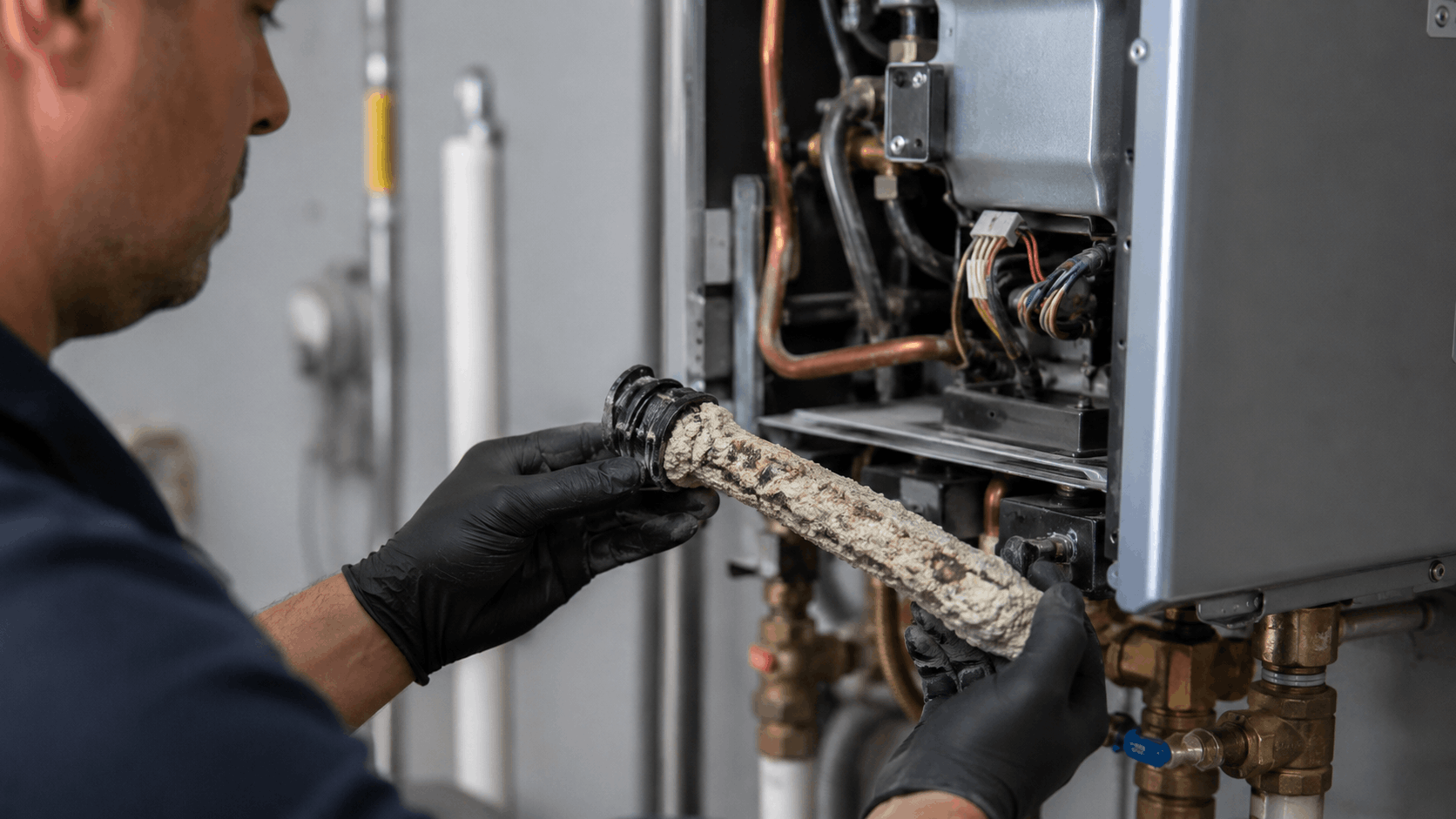
The two minerals doing the damage are calcium and magnesium. When water heats up, dissolved calcium turns into calcium carbonate, the same hard white substance found in limestone. That is the chalky crust that coats the inside of a heat exchanger.
Magnesium behaves the same way under heat. It drops out of solution and bonds to metal surfaces, adding to the rocky layer that forms inside the unit. Together these two minerals build a stubborn deposit that water alone cannot wash away.
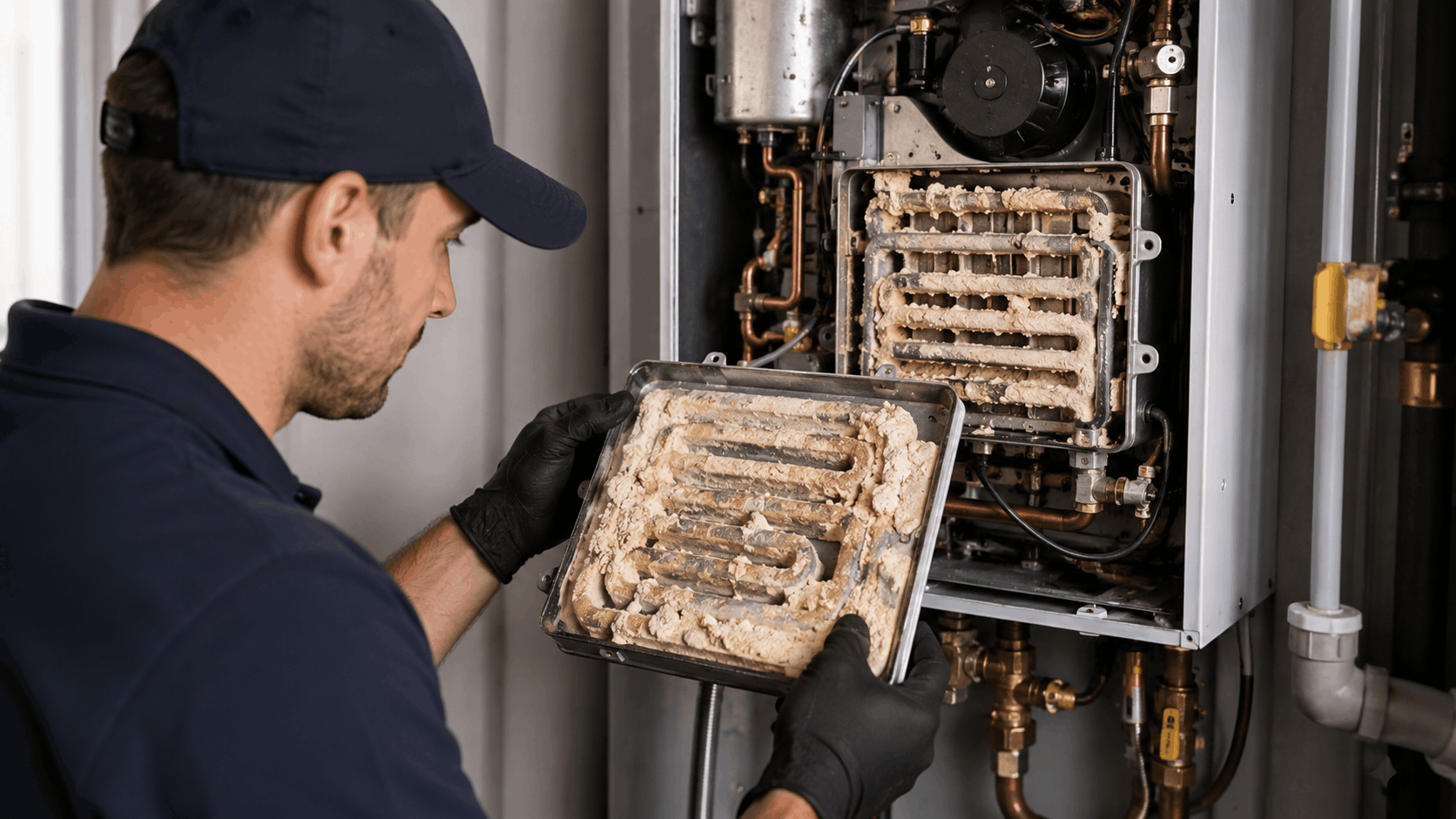
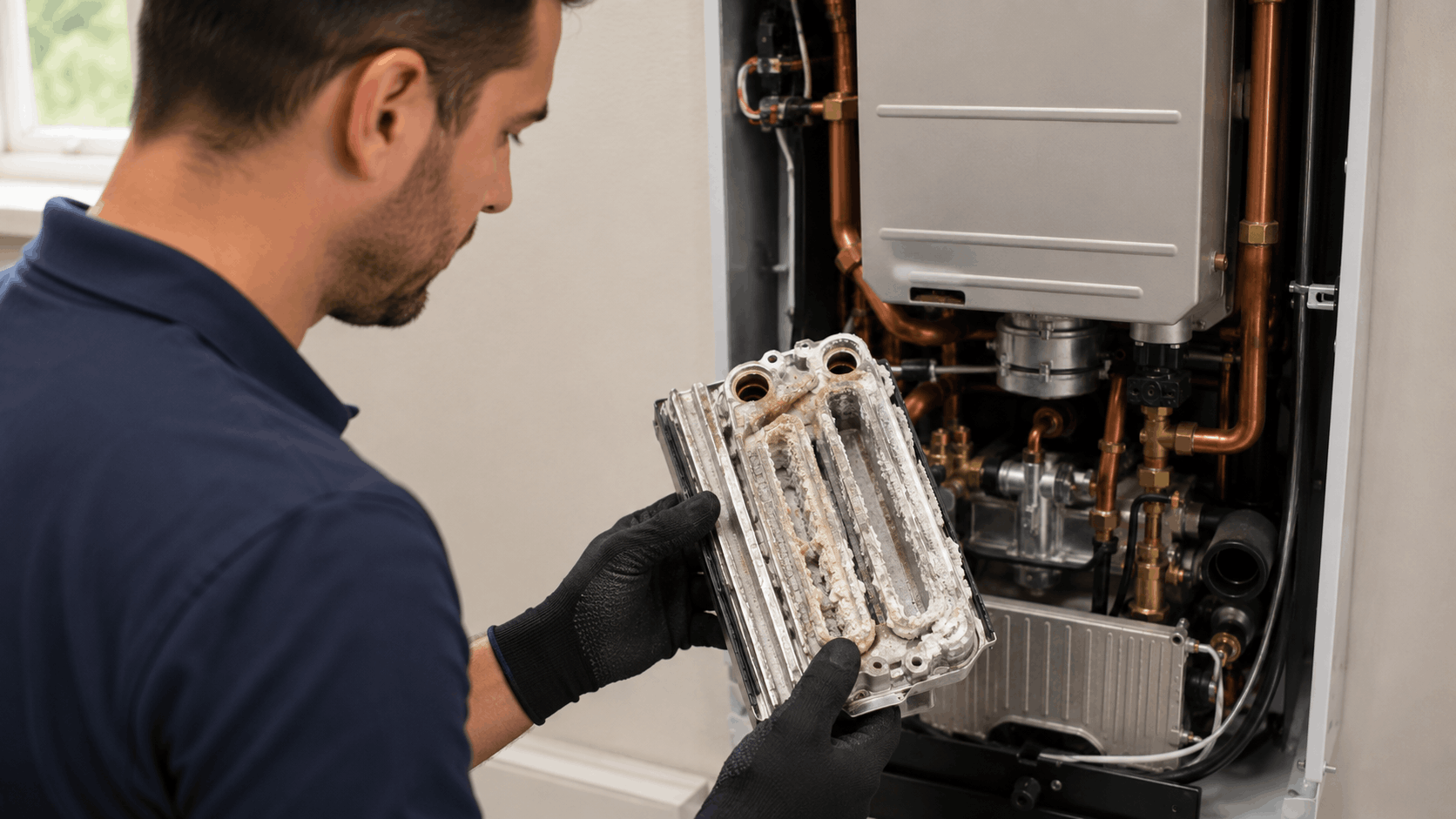
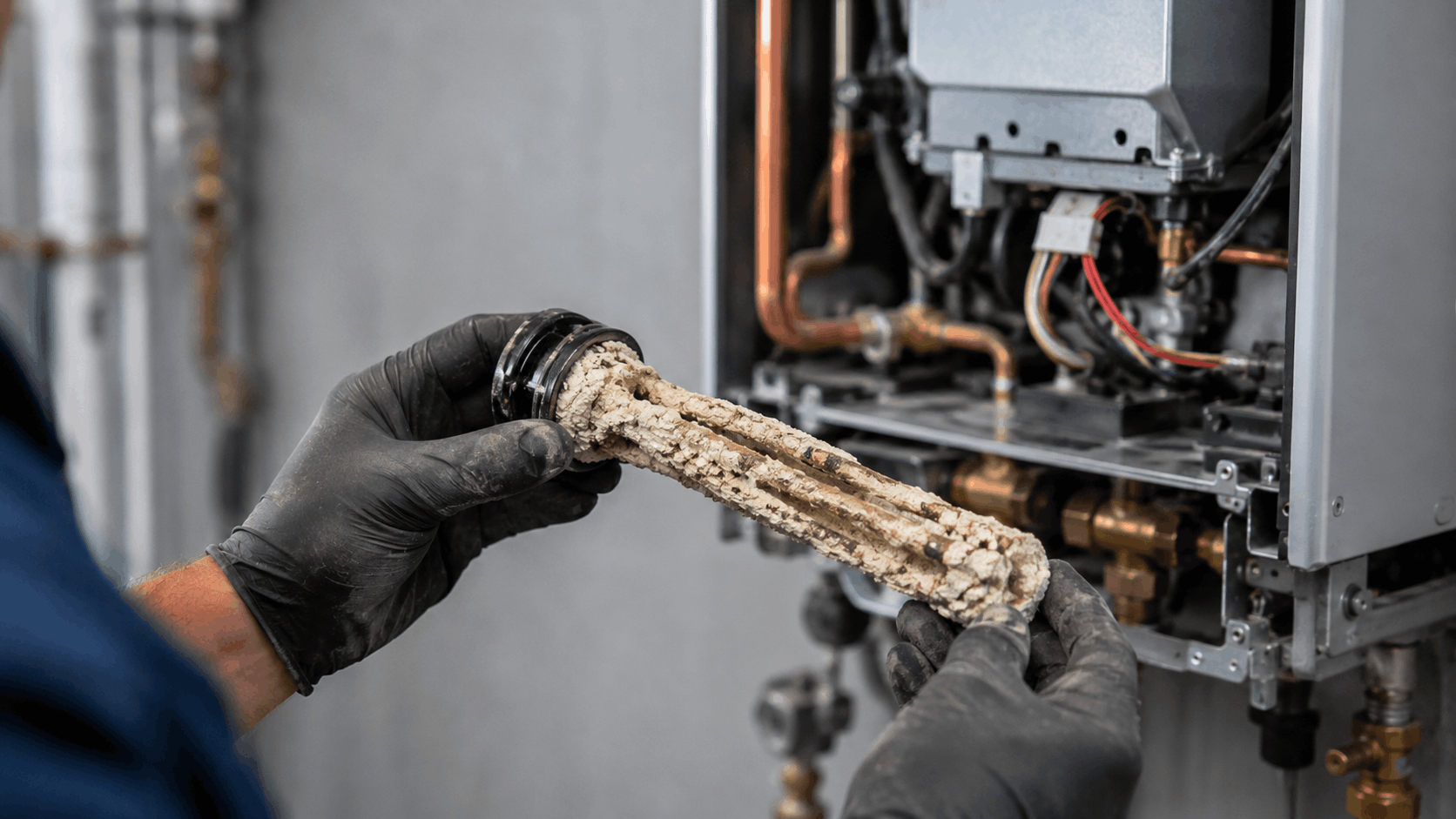
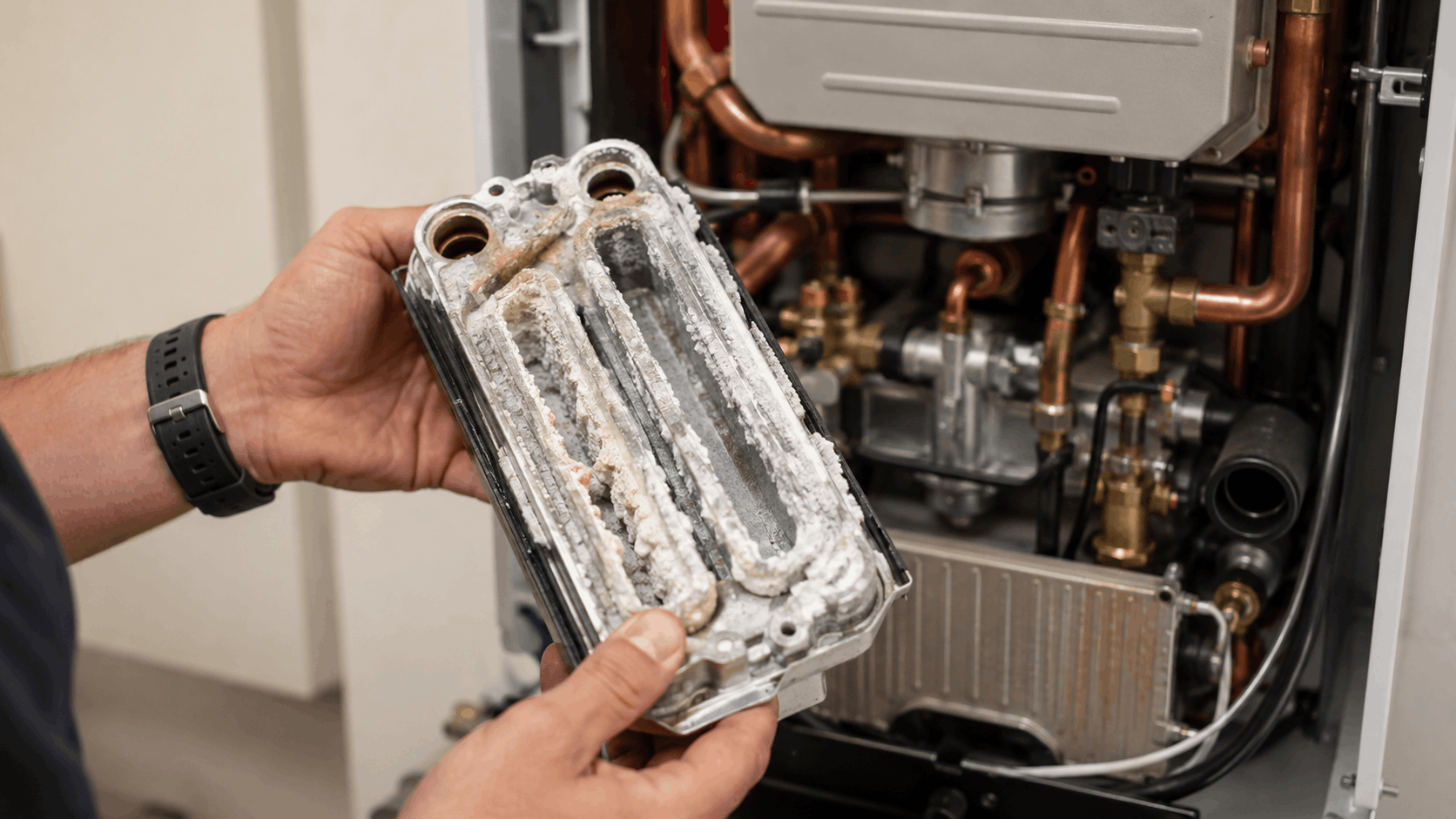
Scale buildup is not a thin film. Over a few years, it can grow into a crust several millimeters thick along the narrow passages of a heat exchanger. That thickness is enough to choke water flow and trap heat where it does damage.
Because Lake Mead water is loaded with both minerals, Vegas homes see this crystallization happen more quickly than almost anywhere else. The chemistry is simply working against the equipment.
Why Desert Neighborhoods Like Summerlin and Henderson See It Worse
Some neighborhoods get hit harder than others, and it comes down to usage and heat. Larger homes in Summerlin and the Henderson foothills often run more bathrooms, bigger irrigation needs, and higher daily water demand. More water moving through the heater means more minerals depositing inside it.
The hot climate adds another layer. During a Vegas summer, incoming water from outdoor and rooftop lines arrives warmer, and the heater still has to push it to the set temperature. Warmer baseline water can speed up mineral release inside the unit.
Newer master-planned communities along the valley edges tend to have high-flow fixtures and recirculation systems. Those features feel great in the shower, but they cycle more water through the heat exchanger, speeding up scale buildup in Summerlin homes and similar areas.
We see the same trend in Henderson and Enterprise. Bigger households on hard water build scale quicker, full stop.
Heat Speeds Up Mineral Deposits
Heat is the trigger that turns dissolved minerals into solid scale. The hotter the water, the sooner calcium and magnesium crystallize and stick to metal. A higher temperature setting on the unit means more aggressive mineral deposits.
Many homeowners set their tankless units to 130 degrees or higher for hotter showers and more quickly dishwashing. That extra heat speeds up the chemical reaction inside the heat exchanger. Dropping the setting to around 120 degrees can slow scale growth without leaving anyone short on hot water.
Constant heating cycles make it worse. Every time someone opens a hot tap, the burner fires and the exchanger heats up, giving minerals another chance to bond to the surface. A busy household triggers this dozens of times a day.
This is why two identical units can age very differently. The one set hotter, in a busier home, on Vegas water will scale up years sooner.
Get Your Quote
Tell us what's going on and we'll get back to you. We're open 24/7.
What Scale Buildup Does Inside Your Tankless Unit
Scale damage happens gradually, then all at once. For the first few years the unit keeps running while a mineral layer quietly thickens inside it. By the time symptoms show, the heat exchanger is often heavily coated.
Here is what that buildup does, step by step, inside a Vegas tankless heater:
- Coats the heat exchanger with an insulating crust that blocks heat transfer
- Narrows internal water passages, choking flow and pressure
- Interferes with sensors, triggering error codes and shutdowns
- Forces the burner to work harder, driving up energy use
- Builds toward total failure, often right around the five-year mark
Clogged Heat Exchanger and Lost Efficiency
The heat exchanger is the part of the unit where water gets heated. Scale coats its metal surfaces like a layer of insulation, blocking heat from reaching the water efficiently. The burner then has to run longer and hotter to hit the same temperature.
That efficiency loss shows up in two places. First, the water takes longer to get hot. Second, the unit burns more gas or pulls more electricity to do the same job it did when it was new.
Even a thin scale layer measurably cuts performance. Industry testing shows that a coating just a fraction of an inch thick can reduce heat transfer efficiency by a noticeable margin, which directly raises energy bills.
Over time the burner runs nearly constant when hot water is in use. That extra workload wears out components more quickly and pushes the unit toward failure. Regular tankless maintenance and descaling keeps the exchanger clean and efficient.
Restricted Water Flow and Weak Hot Water
The water passages inside a tankless unit are narrow by design. Scale buildup makes them narrower, restricting flow the same way cholesterol narrows an artery. The result is weaker hot water at the tap.
Homeowners often notice this first in the shower. The hot side feels weak, or the water turns lukewarm when another fixture runs. That drop in pressure and temperature traces straight back to clogged internal passages.
As scale grows, the unit struggles to maintain steady output. A shower that once held a strong, hot stream starts producing inconsistent temperatures and noticeable low pressure during peak use.
Cold spots in the shower are a classic Vegas symptom. When several homes on the same street report the same lukewarm complaint, scale is almost always the culprit behind the reduced flow at fixtures.
Error Codes and Sensor Problems
Modern tankless units rely on sensors to monitor flow and temperature. Scale interferes with these sensors, especially the flow sensor that tells the unit water is moving. When the sensor reads incorrectly, the unit throws an error code.
Vegas homeowners frequently see codes related to ignition failure, flow detection, or overheating. Different brands use different numbers, but the cause is often the same buildup gumming up the works. A scaled flow sensor can make a working unit think it has no water passing through.
When the unit senses a problem it cannot resolve, it shuts down to protect itself. That mid-shower shutdown is the unit's safety system reacting to scale-related sensor confusion.
Clearing the code without descaling rarely helps for long. The error returns because the underlying mineral problem is still there, which is why a proper flush matters more than a reset.
Why It Often Hits the Five-Year Mark
The five-year failure pattern is no accident. Scale accumulates slowly, and an untreated unit reaches a tipping point right around year five in our water. By then the heat exchanger is coated enough to cause real damage.
Most manufacturers assume the unit gets descaled at least once a year. Skip that maintenance on Vegas water, and the timeline compresses dramatically. The warranty may technically last longer, but the unit fails before then.
A tankless lifespan should stretch 15 to 20 years with care. Without descaling, that drops to roughly five in this region. The hard water cuts the usable life by two thirds or more.
That gap between expected and actual lifespan is exactly why local maintenance matters so much. The equipment is fine. The water is the problem.
Need Help in Las Vegas?
Active Plumbing serves Las Vegas and all of Las Vegas Valley.
Warning Signs Your Vegas Unit Needs Descaling
Scale gives plenty of warning before it kills a unit. Most homeowners just do not connect the symptoms to mineral buildup. Catching these descaling signs early can save the whole heater.
Here are a common tankless symptoms our team hears about, and what each one points to:
| Symptom | What You Notice | Likely Cause |
|---|---|---|
| Temperature swings | Hot then cold in the shower | Scale on heat exchanger |
| Weak flow | Low hot water pressure | Narrowed passages |
| Rumbling noise | Popping or knocking sounds | Scale trapping water |
| Higher bills | Rising gas or electric cost | Lost efficiency |
Fluctuating Water Temperature During Showers
A common complaint is water that swings between hot and cold. People call it the cold water sandwich, where a burst of cold hits in the middle of a hot shower. Scale on the heat exchanger causes these temperature swings.
When mineral buildup blocks heat transfer unevenly, the unit struggles to hold a steady temperature. The result feels like the shower has a mind of its own, jumping warm to cold and back.
This often gets worse when a second fixture runs. The scaled unit cannot keep up with demand, so temperatures fluctuate more when the dishwasher or another shower kicks on.
If the shower temperature has become unpredictable, scale is the first thing to check. It is one of the earliest and clearest warning signs in Vegas homes.
Reduced Hot Water Flow at Faucets
Weak flow at the kitchen or bathroom faucet is another red flag. When the hot side runs noticeably weaker than the cold side, scale inside the unit is usually restricting output. The reduced flow shows up at the faucets fed by the tankless heater.
Homeowners sometimes blame the faucet aerator first. That is worth checking, but if multiple hot taps all run weak, the problem is upstream at the heater. Scale is choking the flow before it ever reaches the fixture.
Filling a bathtub becomes a slow chore when the hot side is restricted. A tub that once filled quickly starts taking much longer, which points to reduced output from a scaled unit.
Tracking which taps are affected helps pinpoint the issue. When every hot fixture in the house is weak, the heater needs attention.
Strange Noises and Rumbling Sounds
A tankless unit should run fairly quietly. When it starts making popping, rumbling, or knocking sounds, scale is usually to blame. Those tankless sounds come from water trapped under or boiling against mineral deposits.
The popping noise happens when superheated water escapes from beneath a scale layer. The rumbling is similar, caused by water bubbling through crusted passages. Neither sound is normal and both signal heavy buildup.
These noises tend to get louder over time as scale thickens. A faint tick can grow into a clear knock that a homeowner hears from another room.
Once a unit is making these sounds regularly, descaling is overdue. The noises mean the buildup has reached a point where it is actively interfering with operation.
Rising Gas or Electric Bills
A scaled unit costs more to run because it burns more energy to make the same hot water. When the heat exchanger is coated, the burner works overtime, and that shows up on the utility bill. A steady climb in gas or electric use with no change in habits often points to efficiency loss.
The increase can be gradual, which is why many homeowners miss it. Comparing this year's bills to last year's during the same season can reveal the trend.
This hidden cost adds up. A unit running 15 to 20 percent less efficiently wastes energy every single day until it gets cleaned. Over a year that waste can total more than a descaling service would have cost.
Watching energy use is a practical way to catch scale early. A rising bill is the unit telling you it is working too hard.
How Descaling Works and How Often Vegas Homes Need It
Descaling is a straightforward maintenance process that dissolves the mineral buildup inside the unit. Done on a regular flush schedule, it keeps a tankless heater running clean for years. Vegas homes need it more often than the national average because of our water.
The process uses an acidic solution circulated through the heat exchanger to break down scale. Here is how it works and how often local homes should have it done.
The Vinegar or Descaling Solution Flush Explained
A descaling flush circulates a mild acid through the unit to dissolve scale. White vinegar works for light buildup, while commercial descaling solution handles heavier deposits. A small circulation pump pushes the solution through the heat exchanger for 45 minutes to an hour.
The acid reacts with the calcium carbonate and magnesium deposits, breaking them down so they can be flushed out. As the solution circulates, it slowly eats away the crust coating the internal passages.
After the flush, the unit gets rinsed with clean water to clear out any leftover solution and loosened mineral debris. The whole process restores flow and heat transfer to near-original performance.
For heavily scaled units, a vinegar flush may not be strong enough. That is when a professional descaling solution and proper tools make the difference, which our water heater service team handles regularly.
How Often to Descale in Las Vegas
National guidance often suggests descaling once a year. In Las Vegas, that is not enough for many homes. With water running about 16 grains per gallon, we recommend a flush every six to twelve months depending on usage.
Smaller households with lower demand can usually get by with an annual flush. Larger homes in places like Summerlin or Henderson with heavy water use often benefit from descaling twice a year. The higher the demand, the sooner scale forms.
Homes without any water treatment scale the fastest. Those units need the most frequent attention to avoid early failure. A home with a softener can sometimes stretch the interval a little longer.
Setting a regular descaling frequency is the single best thing a Vegas homeowner can do for a tankless unit. It is the difference between a five-year unit and a twenty-year unit.
Why Service Valves Make the Job Easier
Isolation valves, also called service valves, are a pair of shutoff valves installed on the hot and cold lines at the unit. They let a technician connect a flush kit and circulate solution without disconnecting any plumbing. They make descaling far more quickly and cheaper.
Without these valves, a flush requires extra labor to access the unit. With them, the whole job takes about an hour. We always recommend having service valves installed if a unit lacks them.
A flush kit connects directly to these valves, isolating the heater from the rest of the home's plumbing. That isolation lets the descaling solution work only on the unit, exactly where it is needed.
For homeowners planning a new install, adding isolation valves up front saves money on every future service. Our tankless installation team includes them as standard practice.
What Our Team Checks During a Service Visit
A descaling visit is also a chance to inspect the whole unit. Beyond the flush, our team runs a maintenance checklist to catch small problems before they grow. That inspection is part of every service call.
We check the burner, ignition, and venting for proper operation. We clean the inlet filter screen, which catches sediment and clogs over time. We also confirm the temperature setting is reasonable for the household and the water.
The team looks for gas line and connection issues, checks for any leaks, and verifies error logs in the unit's memory. Those logs often reveal patterns that point to developing problems.
This full inspection is why a professional visit offers more than a basic flush. Active Plumbing treats every descaling appointment as a complete tune-up for the unit.
Need Help in Las Vegas?
Active Plumbing serves Las Vegas and all of Las Vegas Valley.
DIY Descaling vs Calling a Las Vegas Plumber
Some homeowners want to handle descaling themselves, and a basic flush is within reach for the handy ones. Others prefer to have a pro handle it. Both paths have a place, depending on the unit's condition and the homeowner's comfort level.
Here is an honest look at what DIY descaling covers and when it makes sense to call a Las Vegas plumber instead.
What You Can Handle on Your Own
A homeowner with service valves and a flush kit can perform a basic descaling. The kit includes a bucket, a small pump, and hoses that connect to the isolation valves. Add the descaling solution or white vinegar and the pump circulates it through the unit.
The process is not complicated for light buildup. Shut off the gas or power, close the valves to isolate the unit, connect the hoses, and run the pump for the recommended time. Then rinse and restore the unit to service.
This basic maintenance works best as a regular habit on a unit that gets flushed often. Staying ahead of scale keeps the buildup light enough for a simple home flush to clear it.
For homeowners comfortable with the steps and equipped with the right kit, an annual DIY flush is reasonable. The catch is that it only works if nothing has gone wrong inside the unit.
Mistakes That Damage the Unit
DIY descaling goes wrong in a few common ways. Using the wrong solution, leaving acid in too long, or failing to rinse fully can corrode internal parts. These DIY mistakes can damage the heat exchanger or other components.
Another frequent error is forgetting to isolate the unit properly, which sends solution into the home's plumbing. Some homeowners also skip cleaning the inlet filter, leaving a clog that defeats the whole flush.
Improper maintenance can void the manufacturer warranty in some cases. If a homeowner damages the unit during a flush, that repair comes out of pocket. Documentation of proper service protects against this.
When in doubt, a professional flush avoids these risks entirely. The cost of a service visit is far less than the cost of a damaged heat exchanger.
When Hidden Scale Needs a Pro
A unit that has gone years without descaling often has deep scale that a basic flush cannot clear. Heavy buildup needs stronger solutions, longer circulation, and sometimes partial disassembly. That level of work calls for professional service.
When a unit is already throwing error codes or making loud noises, the buildup has usually reached a point beyond a simple vinegar flush. A pro has the tools and the descaling chemicals to break down stubborn deposits safely.
Deep scale inside a heat exchanger can hide damage that needs assessment. A technician can tell whether the unit is salvageable or whether the scale has caused permanent harm. That judgment call saves money on the wrong repairs.
For any unit showing real symptoms, a professional flush is the safe choice. Our water heater repair team handles the heavy buildup that home kits cannot touch.
How Active Plumbing Serves Vegas Neighborhoods
Our team works across the entire valley, from the older homes near downtown to the newer developments on the edges. We service tankless units in Centennial Hills, Spring Valley, and everywhere in between. Local knowledge of the water in each area helps us recommend the right schedule.
We regularly descale units in Spring Valley, Enterprise, and the Henderson foothills. Each neighborhood has its own usage patterns, and we adjust our recommendations accordingly.
Homes in Centennial Hills and the northwest valley often run high-demand systems that scale quickly. We tailor service intervals to match how hard each household pushes its unit.
Wherever you are in the valley, our Las Vegas service coverage reaches your neighborhood. Scheduling a descaling visit is a quick call away.
Stopping Scale Before It Starts: Water Treatment Options
Descaling treats the symptom. Water treatment treats the cause. Reducing or removing minerals before they reach the heater is the best long-term defense against scale buildup.
Several options exist, from whole-home softeners to inline filters. Each has strengths, and the right choice depends on the household.
Whole-Home Water Softeners
A whole-home water softener removes hardness minerals through ion exchange. The system swaps calcium and magnesium for sodium, so the water reaching every fixture is soft. That soft water dramatically slows scale formation in the tankless unit.
Softeners protect more than the heater. They extend the life of faucets, dishwashers, washing machines, and the whole plumbing system. The benefit reaches every appliance that touches water.
A softener does require maintenance of its own, mainly refilling the salt that regenerates the system. For most Vegas homes, that small upkeep is worth the protection it provides.
For homeowners tired of fighting hard water everywhere, a softener is the most complete fix. Our water softener installation team sizes systems to match each home.
Salt-Free Scale Conditioners
Salt-free conditioners take a different approach. Instead of removing minerals, they use template assisted crystallization to change how minerals behave. The process turns dissolved calcium into tiny crystals that stay suspended in the water rather than sticking to surfaces.
Because the minerals never bond to the heat exchanger, scale buildup drops sharply. The water is not technically softened, but it is conditioned to be far less damaging to appliances.
These systems use no salt and require very little maintenance. For homeowners who want to avoid adding sodium or dealing with salt refills, a salt-free conditioner is an appealing option.
The tradeoff is that conditioned water still feels hard and does not lather like softened water. Still, for scale prevention alone, our salt-free conditioning systems do the job well.
Pre-Filters and Dedicated Inline Filters
An inline filter installed right before the tankless unit catches sediment and some minerals before they enter the heater. A dedicated pre-filter adds a layer of protection specifically for the appliance most at risk from scale.
Sediment filters trap sand, grit, and particles common in Vegas water. Keeping that debris out of the unit protects the inlet screen and the internal passages from clogging.
Some inline filters include scale-reducing media that limits mineral deposits as water passes through. These work well as a supplement to a softener or conditioner, or as a starting point for homes without other treatment.
For a targeted, lower-cost defense, an inline filter is a smart addition. It guards the heater directly without treating the whole house.
Picking the Right Setup for Your Home
Choosing the right water treatment comes down to household size and water use. A large family in a Summerlin home with multiple bathrooms benefits most from a full softener. A smaller household might do fine with a conditioner or inline filter.
Sizing matters. An undersized system cannot keep up with peak demand, while an oversized one wastes money. Matching the system to actual daily water use gives the best protection and value.
Budget and maintenance preferences also factor in. Some homeowners want the complete softness of an ion-exchange system, while others prefer the low upkeep of a salt-free conditioner.
Our team helps homeowners weigh these options based on their specific home and water habits. The full range of water treatment solutions covers every household size and need.
Need Help in Las Vegas?
Active Plumbing serves Las Vegas and all of Las Vegas Valley.
Cost of Descaling vs Replacing a Failed Tankless Unit
The math on maintenance is simple once the numbers are clear. Routine descaling costs a fraction of what a replacement does. Skipping it to save money usually costs far more in the end.
Here is how the real costs compare for Vegas homeowners:
| Service | Typical Cost Range | Frequency |
|---|---|---|
| Professional descaling | $150 to $300 | 1 to 2 times per year |
| New tankless unit + install | $2,500 to $5,000+ | Once every 5 to 20 years |
| Service valve installation | $150 to $400 | One time |
| Annual maintenance over 15 years | $2,250 to $4,500 | Spread over lifespan |
What Routine Descaling Typically Costs
Professional descaling in the valley generally runs $150 to $300 per visit. The price depends on the unit, the severity of the buildup, and whether service valves are already installed. A unit with valves costs less to flush because the job goes more quickly.
That cost covers the flush, the inspection, and the inlet filter cleaning. For one or two visits a year, the annual maintenance investment is modest compared to the value it protects.
Homes without service valves pay a bit more for the added labor. Installing those valves once lowers the cost of every future flush.
Spread over a year, descaling costs less than many homeowners spend on streaming subscriptions. It is one of the cheapest ways to protect a major appliance.
The Price Tag of a New Tankless Heater
A new tankless heater plus installation typically runs $2,500 to $5,000 or more. The replacement cost depends on the unit's capacity, brand, and any plumbing or gas line work needed. High-demand homes with larger units land at the upper end.
That price reflects the unit itself, professional installation, permits, and any required upgrades. Replacing a failed unit often surfaces other needs, like a gas line upsize or new venting.
Compared to a few hundred dollars for descaling, replacement is a major expense. A unit that fails at five years instead of twenty effectively triples or quadruples the lifetime cost of hot water.
Avoiding premature replacement is the whole point of maintenance. The savings are obvious once the numbers sit side by side.
How Maintenance Extends Unit Life
Regular descaling can stretch a tankless unit well past 15 to 20 years. Keeping the heat exchanger clean prevents the damage that kills units early. That extended life is the long-term payoff of consistent care.
A well-maintained unit runs efficiently the whole time, saving on energy bills year after year. The combination of longer lifespan and lower operating cost makes maintenance pay for itself many times over.
The contrast is stark. An untreated unit on Vegas water might last five years, while a maintained one on the same water lasts three to four times longer. The only difference is the descaling schedule.
For homeowners who want maximum value from their investment, routine care is the proven path. The long-term savings far outweigh the service cost.
Protecting Your Manufacturer Warranty
Most tankless manufacturers require regular descaling to keep the warranty valid. If a unit fails and there is no record of maintenance, the manufacturer can deny the claim. Documentation matters when something goes wrong.
Professional service visits create a paper trail that proves the unit was cared for. Those records support a warranty claim if a covered part fails within the coverage period.
Manufacturer requirements vary, but annual descaling is a common minimum. On Vegas water, meeting that requirement also happens to be good practice regardless of the warranty.
Keeping service records is simple insurance. A few documented flushes can protect thousands of dollars in warranty coverage.
Final Thoughts
Vegas hard water is tough on tankless heaters, but the solution is straightforward. Regular descaling clears the scale that would otherwise kill a unit around year five. With consistent maintenance, a tankless heater can deliver hot water for 15 to 20 years.
Watch for the warning signs - temperature swings, weak flow, strange noises, and rising bills. Pair routine flushing with the right water treatment, and the scale problem largely disappears. The cost of care is a fraction of the cost of replacement.
Our team services tankless units across the valley, from Summerlin to Henderson to Spring Valley. If your unit is showing symptoms or simply due for a flush, contact Active Plumbing to schedule a descaling and inspection. A quick call now can save a costly replacement later.
Frequently Asked Questions
- How often should a tankless water heater be descaled in Las Vegas?
- Because Las Vegas water runs about 16 grains per gallon, we recommend descaling every six to twelve months. Smaller households can usually flush once a year, while larger homes with heavy water use benefit from twice-yearly service. That is more often than the national average of once a year, and our hard water is the reason. Homes without any water treatment need the most frequent attention.
- Can hard water really make my unit fail in five years?
- Yes, and we see it regularly across the valley. Without descaling, scale builds up inside the heat exchanger until the unit can no longer function, often right around the five-year mark. The same model that should last 15 to 20 years fails early purely because of mineral buildup. Skipping maintenance on Vegas water cuts a tankless unit's life by two thirds or more.
- What does scale buildup look like inside a tankless heater?
- Scale appears as a chalky white or grayish crust coating the metal surfaces of the heat exchanger. It is calcium carbonate, the same hard mineral found in limestone, mixed with magnesium deposits. Over a few years it can grow several millimeters thick, narrowing water passages and blocking heat transfer. The crust is hard and stubborn, which is why an acid flush is needed to dissolve it.
- How much does professional descaling cost in the valley?
- Professional descaling in the Las Vegas area typically runs $150 to $300 per visit. The price depends on your unit, how much buildup is present, and whether service valves are already installed. Units with isolation valves cost less because the flush goes more quickly. That cost usually includes the flush, an inspection, and cleaning the inlet filter screen.
- Can I descale my tankless unit myself?
- A handy homeowner with service valves and a flush kit can perform a basic descaling using vinegar or a descaling solution. This works well for light buildup on a unit that gets flushed regularly. However, deep scale, error codes, or strange noises mean the buildup is beyond a simple home flush. In those cases a professional has the stronger solutions and tools to clear it safely.
- Will a water softener stop scale buildup completely?
- A water softener dramatically reduces scale by removing the calcium and magnesium that cause it. It protects the heater and the whole plumbing system. However, no system is perfect, and some homes still benefit from a dedicated inline filter for extra protection. Even with a softener, occasional descaling keeps the unit in top shape. The softener slows scale, while filters and flushing finish the job.
- Does descaling void or protect my warranty?
- Regular descaling protects your warranty. Most manufacturers require documented maintenance to honor a warranty claim, and skipping it can void coverage. Professional service visits create records that prove the unit was maintained. If a covered part fails, those documented flushes support your claim. Improper DIY descaling that damages the unit, on the other hand, can void coverage, so keep good records either way.
- What are the first signs my heater needs descaling?
- The earliest signs are temperature swings in the shower, often called the cold water sandwich, and weak hot water flow at faucets. You might also notice the unit taking longer to heat or producing lukewarm water during peak use. Strange popping or rumbling noises and a steady rise in energy bills are also red flags. Catching these symptoms early lets a simple flush solve the problem before damage sets in.
- How long does a descaling service take?
- A typical descaling service takes about one to one and a half hours. The flush itself runs 45 minutes to an hour as the solution circulates through the heat exchanger. The rest of the time covers setup, rinsing, cleaning the inlet filter, and a full inspection of the unit. Units with service valves go quicker, while heavily scaled units may need extra time to fully clear.
- Does Active Plumbing service my Las Vegas neighborhood?
- Our team serves the entire valley, including Summerlin, Henderson, Spring Valley, Enterprise, Paradise, Centennial Hills, and North Las Vegas. We descale and inspect tankless units across every neighborhood and adjust service schedules to match local water use. Wherever you are in the Las Vegas area, we can reach you. Call or contact Active Plumbing to schedule a descaling visit or a water treatment consultation.
Licensed plumbing professionals serving Las Vegas and Las Vegas Valley.
Licensed in Nevada · License #0047021
Last updated on
Why trust Active Plumbing?
Founded in 1991, Active Plumbing is a licensed and insured plumber serving Las Vegas and Las Vegas Valley. All content is reviewed by our licensed technicians.

Need Help in Las Vegas?
Active Plumbing serves Las Vegas and all of Las Vegas Valley.
Related Articles
How to Prevent Water Heater Failure in Las Vegas (Hard Water Maintenance Plan)
Learn how Las Vegas hard water wears out water heaters sooner and follow our maintenance plan to extend your unit's lifespan years.
Tankless Water Heater Maintenance in Las Vegas: Why Hard Water Makes It Critical
Las Vegas hard water from Lake Mead builds scale fast inside tankless heaters. Learn the warning signs, real maintenance steps, and how often valley homes need service.
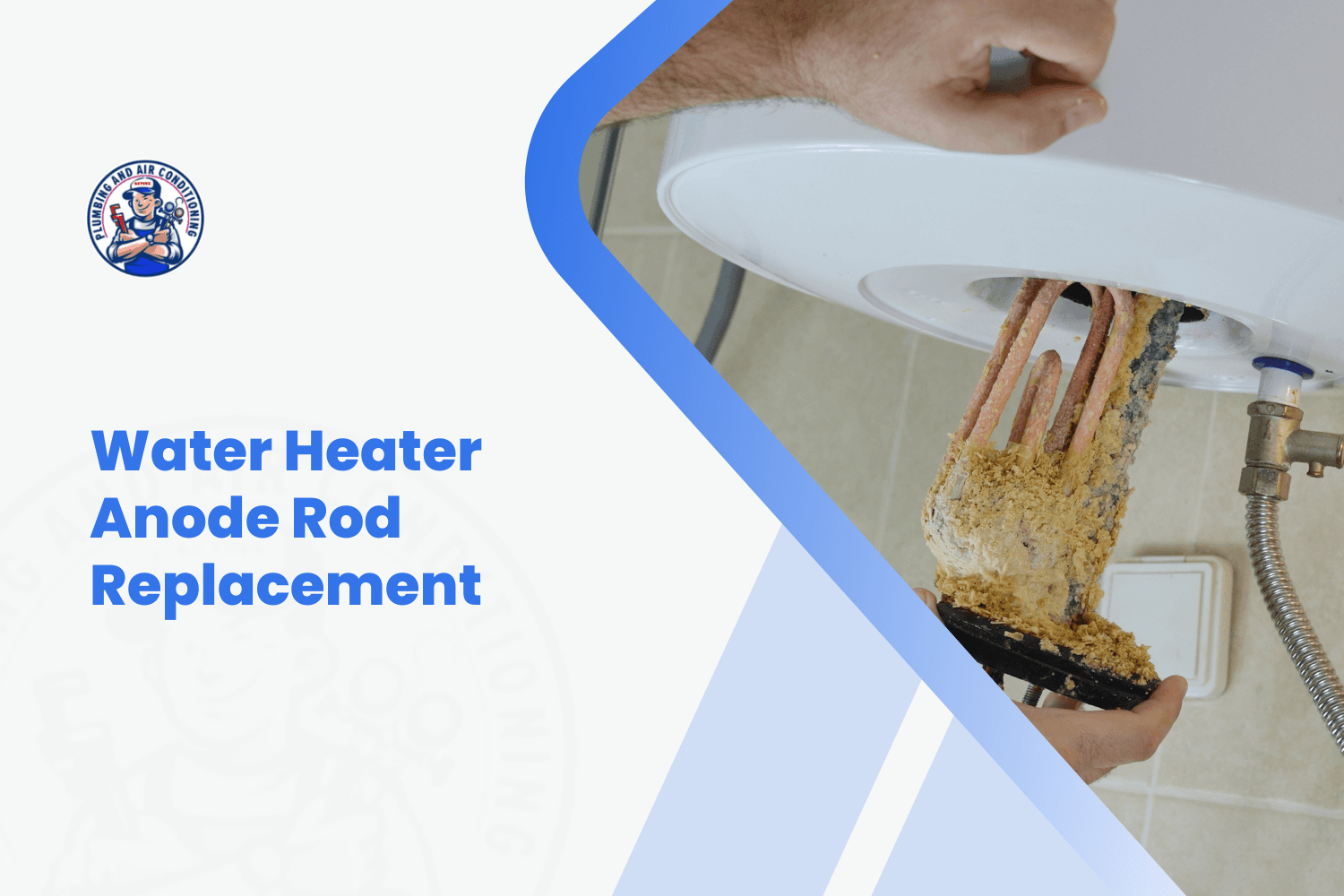
Water Heater Anode Rod Replacement: Why Vegas Hard Water Eats Them in 18 Months
Las Vegas hard water destroys anode rods in 18 months instead of years. Learn the warning signs, replacement costs, and how to protect your water heater long term.