PEX-A vs PEX-B in Las Vegas Heat: Which Pipe Holds Up Better
Key Takeaways
- PEX-A and PEX-B both meet ASTM F876 and carry the same basic pressure and temperature ratings; the differences are in flexibility, kink recovery, fittings, and how forgiving each is in hard conditions.
- PEX-A's shape memory and cold expansion fittings leave fewer flow restrictions, which is why it is usually recommended for whole-house repipes.
- Southern Nevada water is disinfected with chlorine, not chloramine; chlorinated hot water slowly oxidizes PEX, which is why pipe is rated for chlorine resistance.
- Attic-routed hot water lines face the harshest conditions, so routing, insulation, and protection from sunlight matter as much as the pipe type.
- Many valley homes from about 1995 to 2007 have Kitec, orange and blue composite pipe with brass fittings that can restrict flow before they leak, not PEX.
- Polybutylene from about 1978 to 1995 becomes brittle over time, and the old class settlements have closed, so replacement is the only lasting fix.
- Southern Nevada uses the 2024 Uniform Plumbing Code with local amendments; a repipe needs a permit from the building department for your address and a pressure test before walls close.
- Discoloration, a chalky surface, stiffness, reduced flow, and unexplained water bill increases are signs to have the system inspected.
In This Article
If your Las Vegas home was built or repiped in the last twenty-five years, there is a good chance its water lines are PEX, the flexible plastic tubing that replaced copper in most new construction. What most homeowners do not know is that PEX comes in different types, and the type in your walls and attic affects how it copes with desert heat, the valley's chlorinated water, and decades of daily use.
This guide explains the real differences between PEX-A and PEX-B, what actually goes wrong with plastic supply lines in Las Vegas homes, how to tell PEX apart from older problem pipe like Kitec and polybutylene, what the local code requires, and how to decide whether a repair or a full repipe makes sense. Whether you live in Summerlin, Henderson, or North Las Vegas, the same principles apply.
What Are PEX-A and PEX-B and Why Does the Difference Matter Here
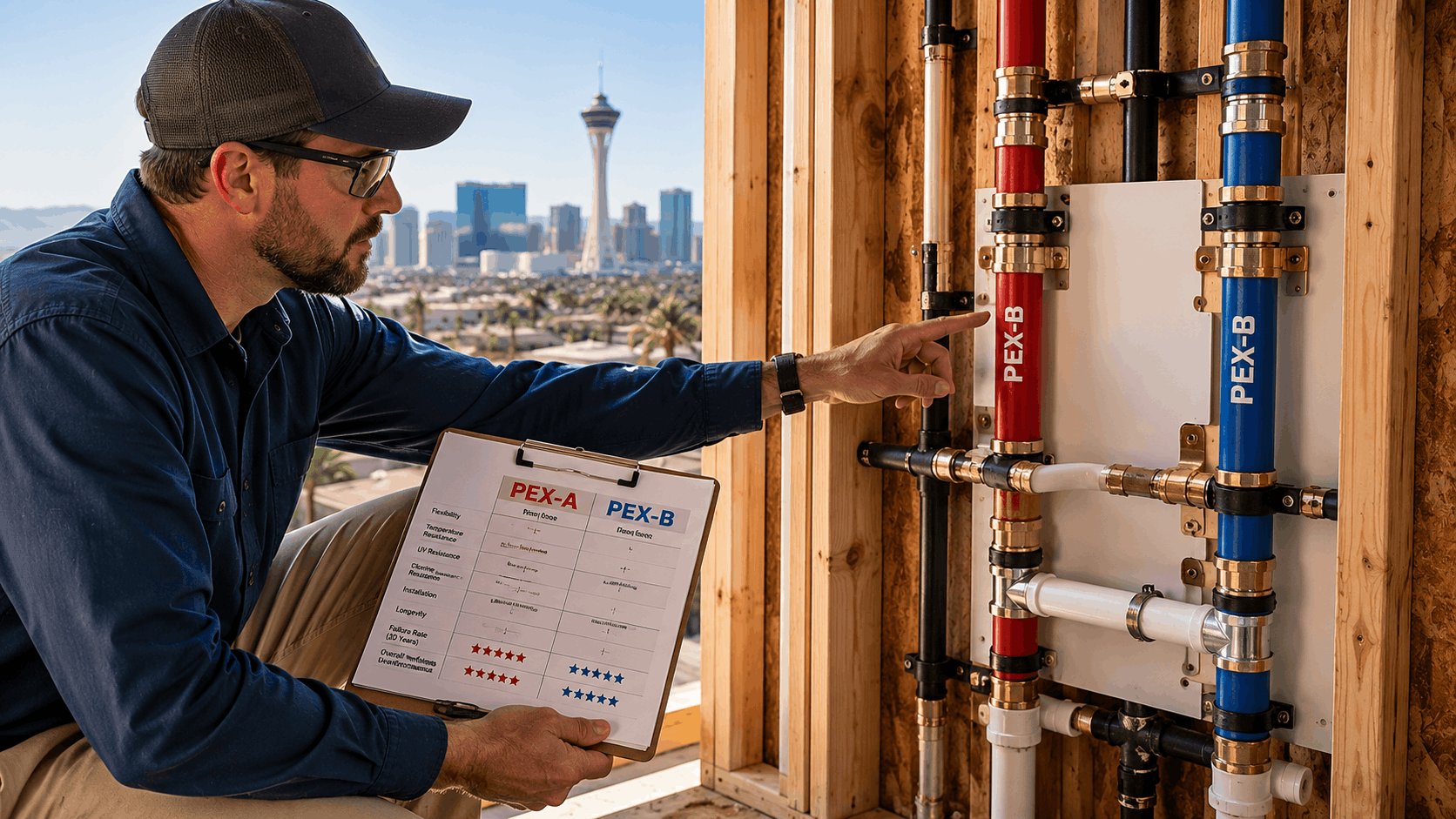
PEX stands for cross-linked polyethylene. Cross-linking bonds the plastic's molecular chains together, which is what lets PEX handle hot water and pressure that ordinary polyethylene could not. The letter after PEX describes how the cross-linking is done, not a quality grade, and all three types sold for drinking water in the United States are made to the same standard, ASTM F876.
That standard means PEX-A and PEX-B carry the same basic pressure and temperature ratings, commonly 180°F at 100 psi and 200°F at 80 psi. The differences show up in how the pipe behaves when it is bent, kinked, frozen, joined, and aged, and those differences matter more in a climate as hard on plumbing as ours.
| Feature | PEX-A | PEX-B |
|---|---|---|
| How it is cross-linked | Peroxide (Engel) method, during extrusion | Silane method, after extrusion using moisture |
| Flexibility | Very flexible, easy to route | Stiffer, holds coil memory |
| Kink repair | Kinks can usually be restored with heat | Kinked sections are cut out and replaced |
| Usual fitting system | Cold expansion fittings (ASTM F1960) | Crimp or clamp rings over insert fittings (ASTM F1807, F2098) |
| Flow at fittings | Fitting sits inside expanded pipe, so less restriction | Insert fitting narrows the opening |
| Material cost | Higher per foot | Lower per foot |
| Chlorine resistance | Rated by the manufacturer and marked on the pipe | Rated by the manufacturer and marked on the pipe |
How PEX-A Is Made and What That Means for Flexibility
PEX-A is cross-linked while it is being extruded, using peroxide and heat. The result is a very flexible tube with strong shape memory. If PEX-A is kinked during installation, it can usually be restored with a heat gun, and it recovers well after expanding.
That shape memory is also what makes PEX-A expansion fittings work. The installer stretches the pipe end, slides in the fitting, and the pipe shrinks back down to grip it. It also makes PEX-A the most forgiving option when water in a line freezes during one of the valley's occasional hard cold snaps, although no pipe should be left exposed to freezing temperatures on purpose.
How PEX-B Is Made and Where It Differs
PEX-B is extruded first and cross-linked afterward, usually by curing it with moisture. It is cheaper to make, which is why it is widely used in tract construction, and it is a code-approved material that performs well when it is installed and protected properly.
PEX-B is stiffer than PEX-A and does not recover from kinks the same way, so damaged sections have to be cut out. It is usually joined with crimp or clamp rings over insert fittings, which narrow the opening slightly and add a mechanical joint at every connection. In a long run with many fittings, that difference adds up.
Why Las Vegas Water Chemistry Matters
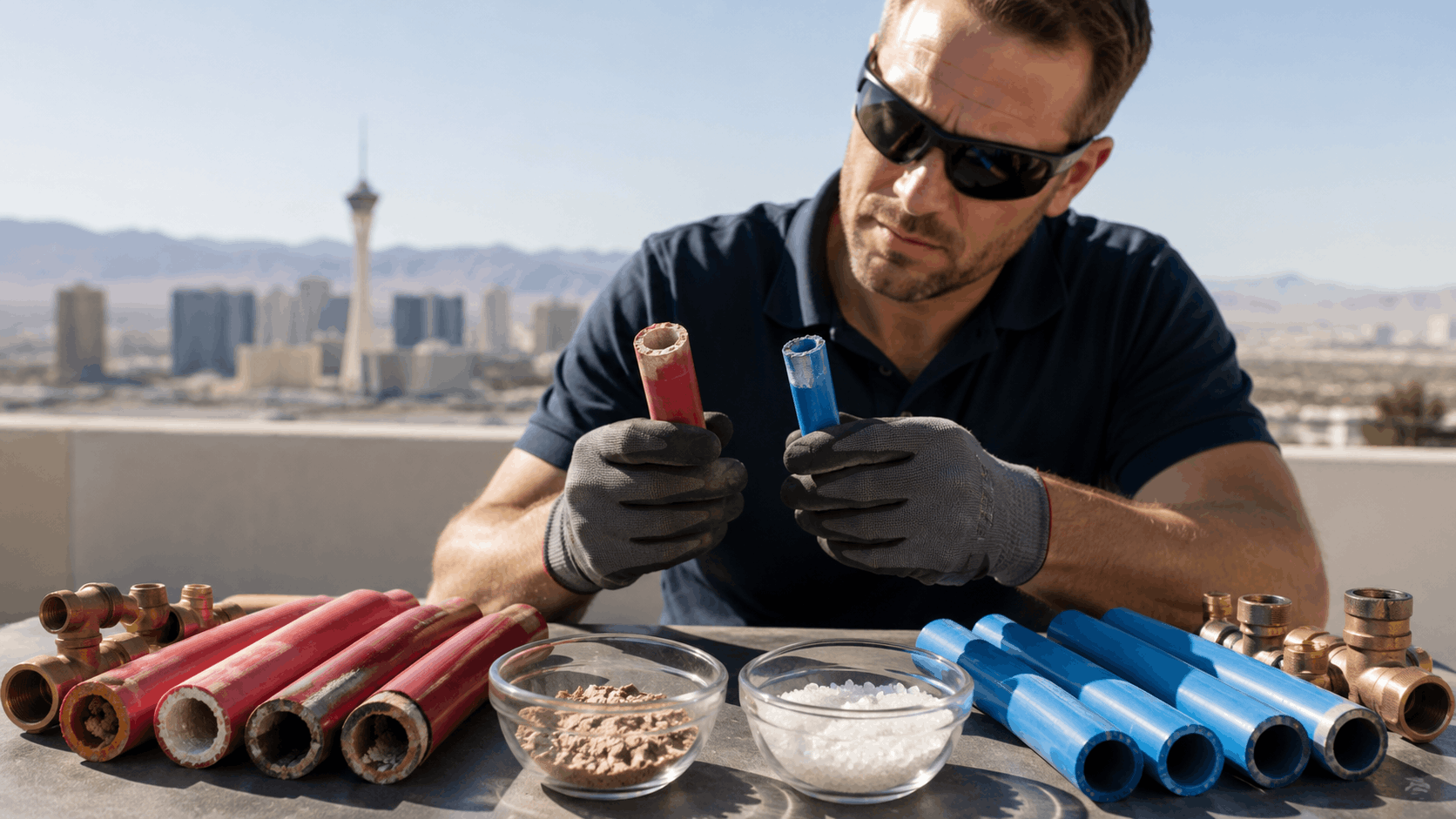
Most valley homes are served with Colorado River water from Lake Mead. The Southern Nevada Water Authority disinfects it with ozone at its treatment plants and adds chlorine as the water leaves them, so a chlorine residual stays in the water all the way to your fixtures. Over years, chlorinated hot water slowly oxidizes polyethylene from the inside, which is exactly why PEX is tested for chlorine resistance and why that rating is printed on the pipe.
The water is also very hard, about 280 parts per million or 16 grains per gallon. Hardness does not attack PEX itself, but scale builds up at fittings, valves, and water heater connections. Some homeowners add whole house water filtration to reduce chlorine taste and odor, and softening to reduce scale, as an extra layer of protection for new plumbing.
Get Your Quote
Tell us what's going on and we'll get back to you. We're open 24/7.
What Actually Goes Wrong With PEX in Las Vegas Homes
PEX is a durable material, and most failures come down to how and where it was installed rather than the pipe type alone. When plastic supply lines fail in valley homes, the causes usually fall into a handful of categories.
- Heat exposure in unconditioned attics, especially on hot water lines
- Sunlight exposure during storage or installation, which the pipe is not designed to tolerate
- Fitting failures, including crimp rings and brass fittings affected by water chemistry
- Poor installation, such as kinks, tight bends, or lines rubbing on framing
- Older non-PEX plastics like Kitec and polybutylene, which are often mistaken for PEX
Heat in Unconditioned Attics
Many single-story homes in the valley run their supply lines through the attic, where summer temperatures climb far above anything a living space sees. PEX temperature ratings describe the water inside the pipe at a given pressure, not the air around it, so a hot water line sitting in a very hot attic spends its summers much closer to its limits than the rating suggests.
Heat speeds up the slow oxidation that ages all polyethylene. Lines that are buried under attic insulation, routed low, or run through walls instead of the open attic live an easier life. When we repipe, routing and insulation are as important as the choice of pipe.
Sunlight and UV Exposure
PEX is not designed for sunlight. Manufacturers limit how long it can be exposed to UV light before installation, and exposed outdoor runs must be covered. Pipe left in the sun on a job site, or sections exposed near roof penetrations or outdoor equipment, can age much more quickly than the rest of the system.
Fittings, Brass, and Crimp Rings
Fittings are a common leak point in any plastic system. Crimp and clamp rings are mechanical joints, and repeated heating and cooling on hot water lines puts them under stress. Brass fittings can also suffer dezincification, where zinc leaches out of the brass and weakens it, which is why dezincification-resistant brass is now the norm for good installations.
Kitec Is Not PEX
A lot of pipe that homeowners call PEX in valley homes is actually Kitec, a composite pipe with an aluminum layer between plastic layers. It was installed in many Las Vegas homes from about 1995 to 2007, is usually orange for hot and blue for cold, and is marked Kitec, IPEX, or PlumbBetter. Its brass fittings are prone to dezincification, and a telling early sign is reduced flow before any leak appears. If your home was built in that era, check the printing on the pipe before assuming it is PEX.
Polybutylene in Older Homes
Homes plumbed from about 1978 to 1995 may have polybutylene, a gray (sometimes black) plastic supply pipe that becomes brittle when it reacts with oxidants in treated water. The class settlements that once covered it have closed, so an owner who finds polybutylene today has no compensation route, and replacement is the only long-term fix.
Need Help in Las Vegas?
Active Plumbing serves Las Vegas and all of Las Vegas Valley.
How 115-Degree Summers Affect PEX Pipe at the Molecular Level
PEX ages through oxidation. Oxygen, helped by heat and by the chlorine residual in treated water, slowly breaks the polymer chains that give the pipe its strength and flexibility. As those chains break, the material becomes stiffer, loses its elasticity, and eventually cracks. The process is gradual and cumulative, and heat is what speeds it up.
Manufacturers add stabilizers to slow oxidation, and the chlorine-resistance testing required for drinking water PEX is designed around it. That is why two things matter so much in Las Vegas: using pipe with an appropriate chlorine-resistance rating for hot water, and keeping hot lines out of the worst heat wherever the layout allows.
The Temperature Ratings on the Box vs Real Attic Conditions
The ratings stamped on PEX, such as 180°F at 100 psi, apply to the water inside the pipe at that pressure. They do not account for a pipe sitting for years in hot, still attic air while also carrying hot water. In practice, attic-routed hot water lines face the toughest conditions in the house, and they are where we focus first when inspecting an older system.
Why Dry Desert Conditions Make Brittleness Easier to Miss
Aged plastic pipe often looks fine from a distance. The warning signs are subtle: fading or discoloration, a chalky surface, and stiffness when the pipe is flexed. Because attics are rarely visited, many homeowners never see these signs until a leak appears on a ceiling.
Cost Comparison - PEX-A vs PEX-B for a Typical Las Vegas Repipe
PEX-A tubing costs more per foot than PEX-B, and the expansion tools are more expensive. On the other side of the ledger, expansion fittings go on quickly and leave a full-flow connection, so the labor difference can narrow the gap. For most homes, the material choice is a modest part of the total cost of a repipe, which is driven mainly by the size of the home, the number of fixtures, access, and drywall repair.
The bigger financial question is usually water damage. A slow leak in an attic or wall can ruin drywall, insulation, and flooring long before anyone notices, and the repair bill for that damage can dwarf the difference in pipe cost. That is why we look at the whole system, not just the price per foot.
What Drives the Price of a Repipe
- Home size and the number of bathrooms, kitchens, and fixtures
- Single-story attic routing versus two-story wall routing
- Access through attics, walls, and ceilings, and the amount of drywall repair
- Permits and inspection from the building department
- Choice of pipe and fitting system
Protecting the Investment
Good routing, proper support, insulation on attic runs, and a working pressure regulator all extend the life of a new system. For homeowners who want an extra safety net, a whole home leak detection system can shut off the water automatically when it detects a leak.
What Active Plumbing Recommends for New Installations
For whole-house repipes, we generally recommend PEX-A with expansion fittings, routed to keep hot lines out of the worst attic heat. It is flexible, forgiving, and its fittings leave fewer restrictions in long runs. For short, accessible connections, the pipe type matters much less than a clean, properly supported installation. Every recommendation starts with an inspection of your actual system, and we give you a written estimate before any work begins.
Signs Your PEX Pipes Are Starting to Fail
Plastic pipe rarely fails without warning, but the warnings are easy to miss. Knowing what to look for gives you a chance to act before a small problem becomes a flooded room.
Visible Warning Signs in Your Attic
- Color change from the original red, blue, or white toward a faded tan or yellow-brown
- A rough, chalky, or powdery surface instead of a smooth, waxy one
- Stiffness or cracking when a section is gently flexed
- Staining, corrosion, or white crust around fittings and manifolds
- Orange and blue pipe marked Kitec or IPEX, which is not PEX and needs its own assessment
Homeowners in older neighborhoods such as Whitney Ranch and Spring Valley should look at accessible lines at least once a year.
Water Pressure Drops and Discolored Water
Flow problems often show up before a leak does. Reduced flow at several fixtures can point to restricted fittings, and it is a classic early sign in Kitec systems. Discolored water or debris in aerator screens can come from supply lines or from the water heater, so it is worth having the supply side checked before replacing equipment.
When to Call for a Professional Inspection
Call right away if you see water stains on ceilings or walls, notice a water bill that rises for no reason, or hear water running when every fixture is off. Our electronic leak detection service can pinpoint hidden leaks without opening walls at random, and our emergency plumbing team responds when water is already coming through.
Need Help in Las Vegas?
Active Plumbing serves Las Vegas and all of Las Vegas Valley.
Local Building Code and PEX Regulations in Southern Nevada
Nevada has no statewide plumbing code. The Las Vegas Valley's jurisdictions adopted the 2024 Uniform Plumbing Code with the Southern Nevada Amendments, effective January 1, 2026 in North Las Vegas, January 2 in Henderson, January 5 in the City of Las Vegas, and January 11 in unincorporated Clark County. Both PEX-A and PEX-B are approved materials when they are listed and installed according to that code.
Permits, Pressure Tests, and Inspection
A whole-house repipe needs a plumbing permit from the building department for your address: Clark County for unincorporated areas such as Spring Valley, Paradise, and Enterprise, or the City of Las Vegas, Henderson, or North Las Vegas inside those cities. The new system is pressure tested and inspected before walls and ceilings are closed. Active Plumbing handles the permit and schedules the inspection, and all work is performed under Nevada State Contractors Board license #0047021.
HOA Considerations
Many valley homes sit in master-planned communities with association rules. A repipe is interior work, but access panels, exterior penetrations, or work in common areas can need association approval, so it is worth checking your community's rules before the project starts.
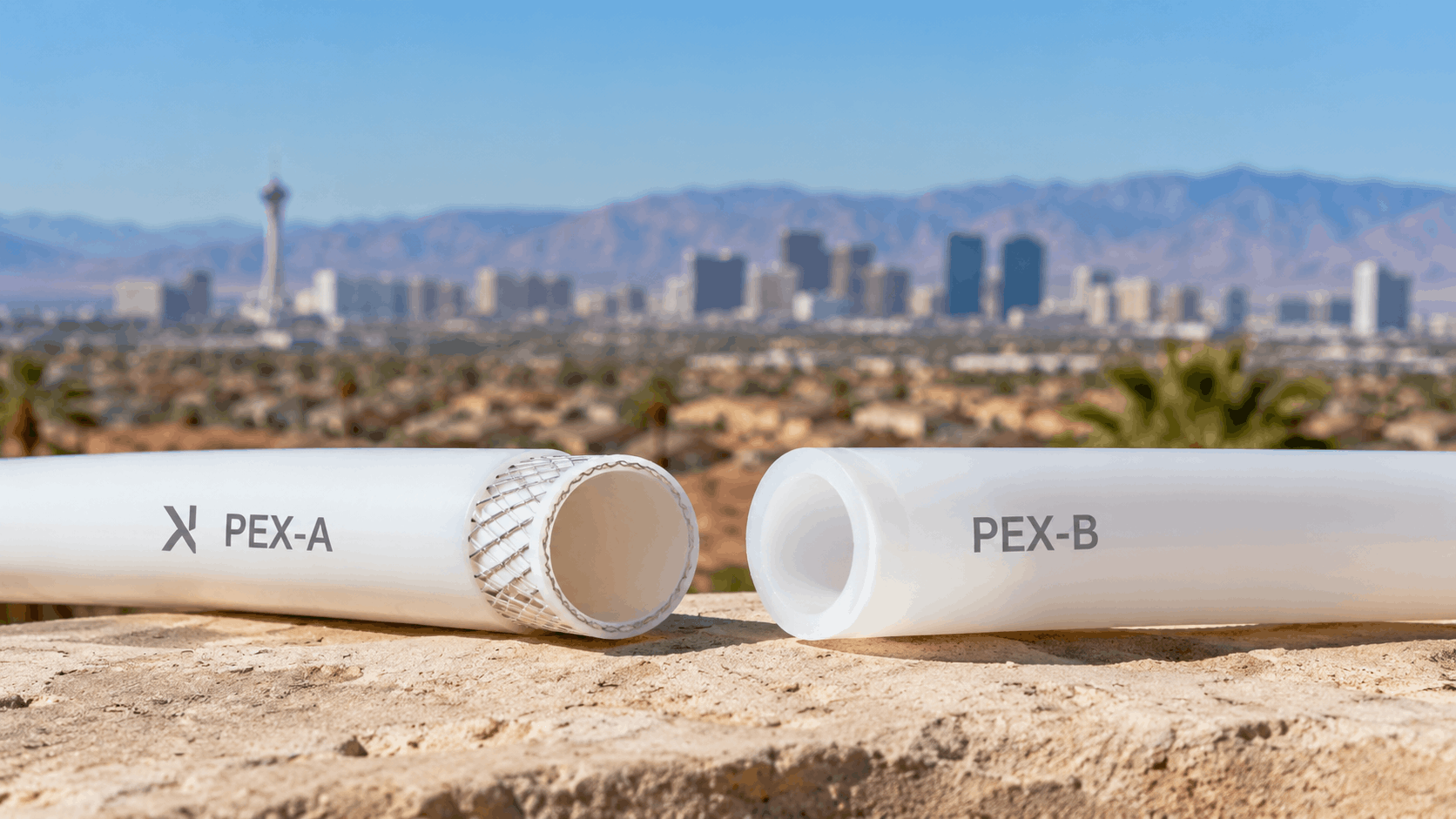
PEX-A vs PEX-B Fitting Systems and How They Hold Up
In any PEX system, fittings deserve as much attention as the pipe. The fitting system usually follows the pipe type, and each ages differently.
Expansion Fittings on PEX-A
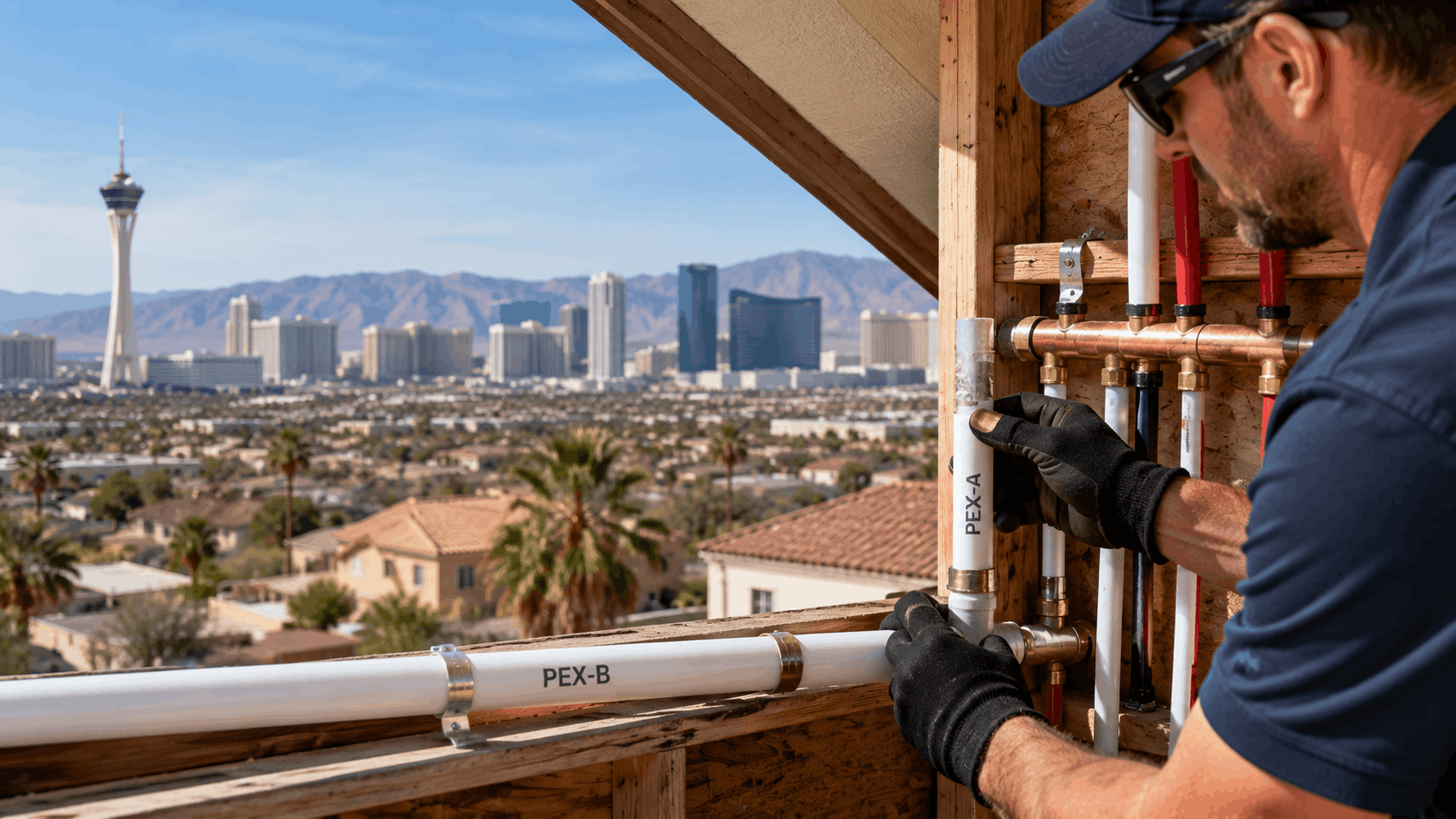
Cold expansion fittings (ASTM F1960) rely on PEX-A's shape memory. The pipe end is expanded, the fitting goes in, and the pipe contracts to form the seal. Because the fitting sits inside the expanded pipe, the connection leaves a larger opening than an insert fitting, which helps in long runs from the water heater to distant bathrooms, especially when paired with a recirculation pump installation.
Crimp and Clamp Rings on PEX-B
PEX-B is usually joined with copper crimp rings (ASTM F1807) or stainless clamp rings (ASTM F2098) over an insert fitting. Done correctly with a calibrated tool, these joints are reliable, but a poorly made crimp, a worn tool, or years of heating and cooling can lead to weeping connections. Manifolds and the lines near the water heater see the most stress. A drip that starts at an attic manifold can travel along framing before it shows up, which is where professional leak detection equipment saves time and drywall.
Need Help in Las Vegas?
Active Plumbing serves Las Vegas and all of Las Vegas Valley.
Should You Repipe Your Las Vegas Home with PEX-A
Not every home needs a repipe. The decision depends on what pipe you have, how old it is, where it runs, and whether it has already started to fail.
Homes That Should Move to the Front of the Line
- Homes with polybutylene supply lines, usually plumbed between about 1978 and 1995
- Homes with Kitec, common in construction from about 1995 to 2007, especially with reduced flow or corroded fittings
- Homes that have had more than one leak in the supply system
- Attic-routed plastic lines that are discolored, chalky, or stiff
- Copper systems with repeated pinhole leaks from hard water and high velocity
What a Typical Repipe Looks Like
- Inspection and planning - we identify the pipe type, map the system, and plan routing and access points
- Permit - we pull the permit from the building department for your address
- Installation - new lines are run, fittings made, and fixtures reconnected, usually with water off for part of each day
- Pressure test and inspection - the system is tested and inspected before access points are closed
- Drywall repair and cleanup - access points are patched and the home is left ready for paint
Most single-story homes take one to two days of plumbing work, and larger or two-story homes can take longer. We confirm the timeline during the estimate visit.
Getting a Repipe Estimate From Active Plumbing
Active Plumbing is a fourth-generation, family-owned Las Vegas plumbing company. We inspect your existing pipe, explain what we find, and give a written estimate covering materials, labor, permits, and drywall repair. We serve the whole valley, from Elkhorn in North Las Vegas to Las Vegas and Henderson. Reach us through our contact page to schedule a visit, and read more about our team.
Final Thoughts
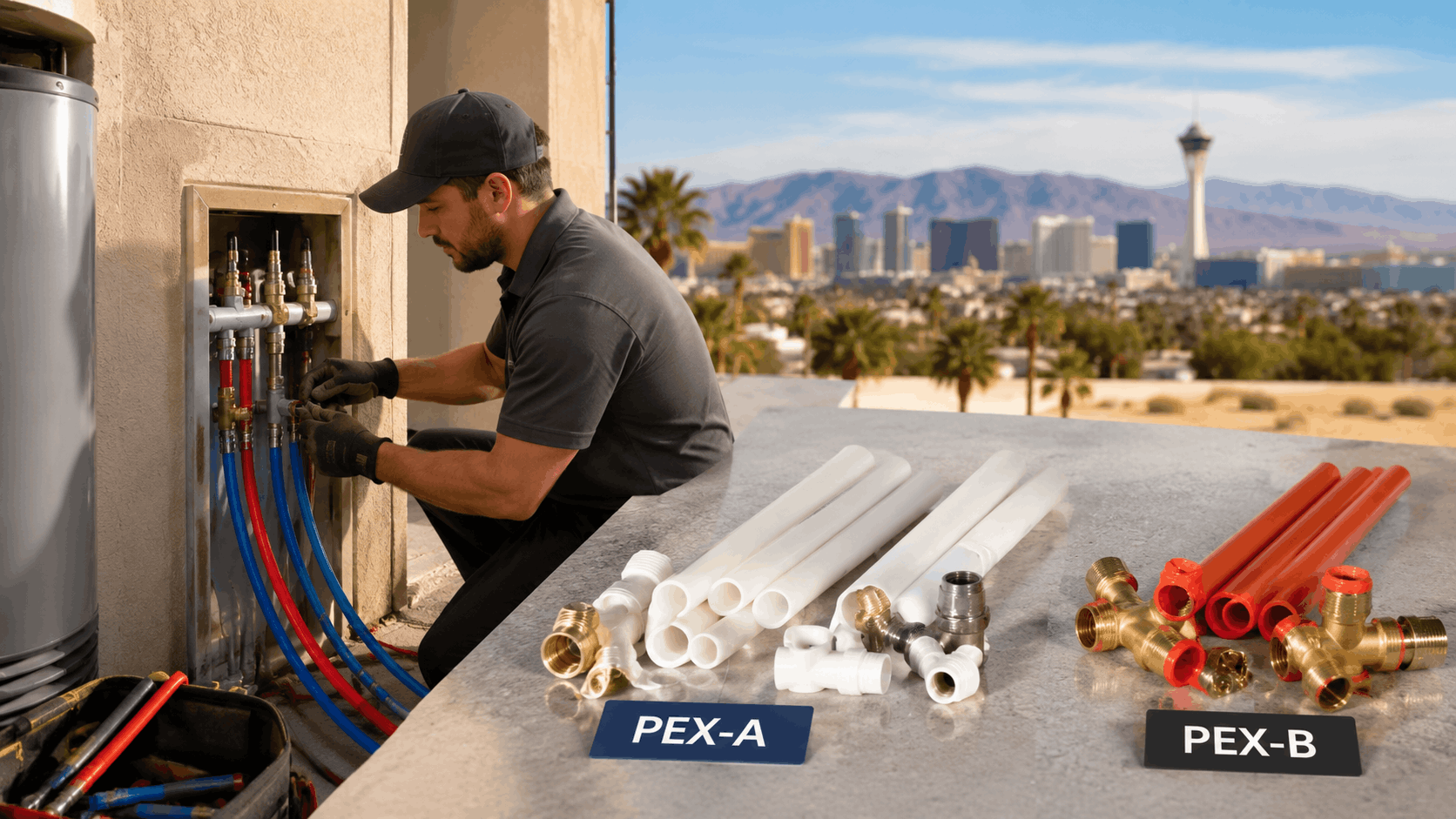
PEX-A and PEX-B are both code-approved and both can serve a Las Vegas home well. PEX-A's flexibility, shape memory, and expansion fittings make it the more forgiving choice for a whole-house repipe, while installation quality, routing away from attic heat, and protection from sunlight matter just as much as the letter on the pipe. Just as important is knowing what you actually have, because many valley homes have Kitec or polybutylene rather than PEX.
If you are not sure what is in your walls, or you have started to see stains, stiffness, or reduced flow, a professional inspection is the right first step. Active Plumbing can tell you what you have, how it is holding up, and whether a repair or a repipe makes more sense.
Frequently Asked Questions
- Is PEX-A better than PEX-B in Las Vegas?
- Both meet the same ASTM F876 standard and carry the same basic pressure and temperature ratings. PEX-A is more flexible, recovers from kinks, and uses expansion fittings with fewer flow restrictions, which is why we generally recommend it for whole-house repipes. A well-installed PEX-B system protected from heat and sunlight can also perform well.
- Does Las Vegas water damage PEX pipes?
- Southern Nevada water is disinfected with chlorine, not chloramine. Over time, chlorinated hot water slowly oxidizes polyethylene from the inside, which is why drinking water PEX is tested for chlorine resistance and the rating is printed on the pipe. Heat speeds the process up, so hot water lines in attics face the toughest conditions.
- How can I tell if my home has PEX-A, PEX-B, or Kitec?
- Read the printing on the pipe near the water heater, under a sink, or in the attic. PEX is marked with the manufacturer, size, ASTM F876, and usually the type. Pipe color does not tell you the type. Orange and blue pipe marked Kitec, IPEX, or PlumbBetter is Kitec, a composite pipe, not PEX.
- Should I worry about PEX pipes in my attic during summer?
- Attic-routed hot water lines face the harshest conditions in the house. Check accessible lines once a year for discoloration, a chalky surface, or stiffness, and consider insulating exposed runs. If you see warning signs or your home has already had a leak, have the system inspected.
- Is Kitec the same as PEX?
- No. Kitec has an aluminum layer between plastic layers and was installed in many valley homes from about 1995 to 2007. Its brass fittings are prone to dezincification, which can restrict flow before a leak appears. Kitec should be assessed on its own terms, and replacement is often the recommendation.
- Does a repipe need a permit in Las Vegas?
- Yes. A whole-house repipe needs a plumbing permit from the building department for your address, and the work is pressure tested and inspected before walls are closed. Active Plumbing pulls the permit and coordinates the inspection.
- Can Active Plumbing replace just part of my system?
- Yes, and sometimes a targeted repair is the right call, especially for a single failure in an otherwise healthy system. If the pipe is aged, brittle, Kitec, or polybutylene, the rest of the system has faced the same conditions, and a full repipe is usually the better long-term value. We explain the options after inspecting.
- How long does a repipe take?
- Most single-story homes take one to two days of plumbing work, with larger or two-story homes taking longer, plus time for inspection and drywall repair. We confirm the schedule during the estimate.
Licensed plumbing professionals serving Las Vegas and Las Vegas Valley.
Licensed in Nevada · License #0047021
Last updated on
Why trust Active Plumbing?
Founded in 1991, Active Plumbing is a licensed and insured plumber serving Las Vegas and Las Vegas Valley. All content is reviewed by our licensed technicians.

Need Help in Las Vegas?
Active Plumbing serves Las Vegas and all of Las Vegas Valley.
Related Articles
Las Vegas Hard Water by ZIP Code: What SNWA Data Actually Shows
See actual SNWA water hardness data by Las Vegas ZIP code. Learn your neighborhood's GPG level and what it means for your plumbing, appliances, and home.

How to Prevent Water Heater Failure in Las Vegas (Hard Water Maintenance Plan)
Learn how Las Vegas hard water wears out water heaters sooner and follow our maintenance plan to extend your unit's lifespan years.

Why Las Vegas Homes Built Before 1990 Need a Full Plumbing Inspection
Las Vegas homes built before 1990 face unique plumbing challenges from aging materials, desert conditions, and outdated construction practices that can lead to catastrophic failures.