Point-of-Use vs Whole-Home Hot Water for Las Vegas Casitas and ADUs
Key Takeaways
- Point-of-use heaters sit right at the fixture and deliver near-instant hot water, ideal for single-fixture casitas and pool houses.
- Whole-home extensions run insulated lines from a central heater and suit busy rental ADUs, but cost more and add wait time over long runs.
- Distance is the deciding factor - once a casita sits past 40 to 50 feet from the main house, point-of-use usually wins.
- Las Vegas hard water from the LVVWD builds scale fast, so plan on a softener or scale filter plus annual flushing for either system.
- Point-of-use installs run roughly $500 to $2,400 and take a day; central line extensions run $3,000 to $9,000+ over two to four days.
- Clark County and the City of Las Vegas require permits and inspections for ADU water heaters, which also protects resale value.
- A recirculation pump can cut long wait times for homeowners who still prefer a central system feeding a distant casita.
- Active Plumbing does on-site assessments across Summerlin, Henderson, Green Valley, and the wider valley to match the right system to each property.
In This Article
A homeowner in Summerlin finishes framing out a backyard casita, picks the tile, hangs the vanity, and then hits the question nobody warned them about. How does hot water actually get out there? The main house heater sits in a garage on the far side of the lot, and the new unit sits 50 feet away past a pool and a retaining wall.
That single question splits into two very different projects. One option puts a small heater right inside the casita. The other runs hot water lines from the existing system out to the detached structure. Both work, but the right pick depends on lot size, water conditions, and how the space gets used.
What Point-of-Use and Whole-Home Hot Water Really Mean?
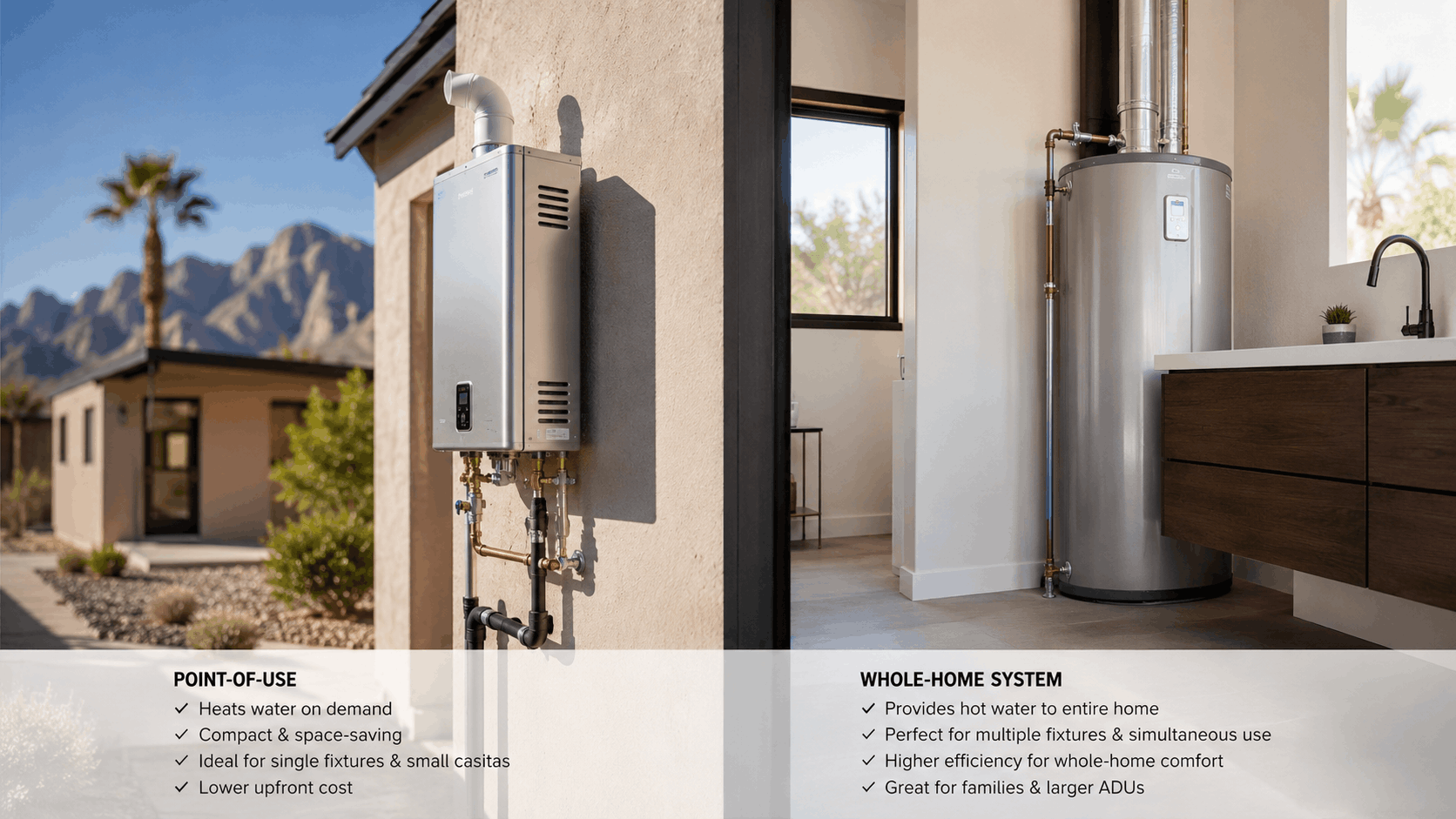
Before comparing costs and wait times, it helps to understand the two basic approaches in plain terms. Both deliver hot water to an accessory dwelling unit, but they take opposite paths to get there. One heats water where you use it. The other pipes it in from somewhere else.
Here is a quick side-by-side look at how a point-of-use water heater stacks up against a whole-home water heater for ADU hot water.
| Feature | Point-of-Use | Whole-Home Extension |
|---|---|---|
| Location | Inside or beside the casita | Main house or shared central unit |
| Wait time | Nearly instant | Longer with distance |
| Install scope | Small, often one day | Trenching and line runs |
| Best for | Single fixture, pool house | High-use rental ADU |
| Upfront cost | Lower | Higher |
How a Point-of-Use System Works
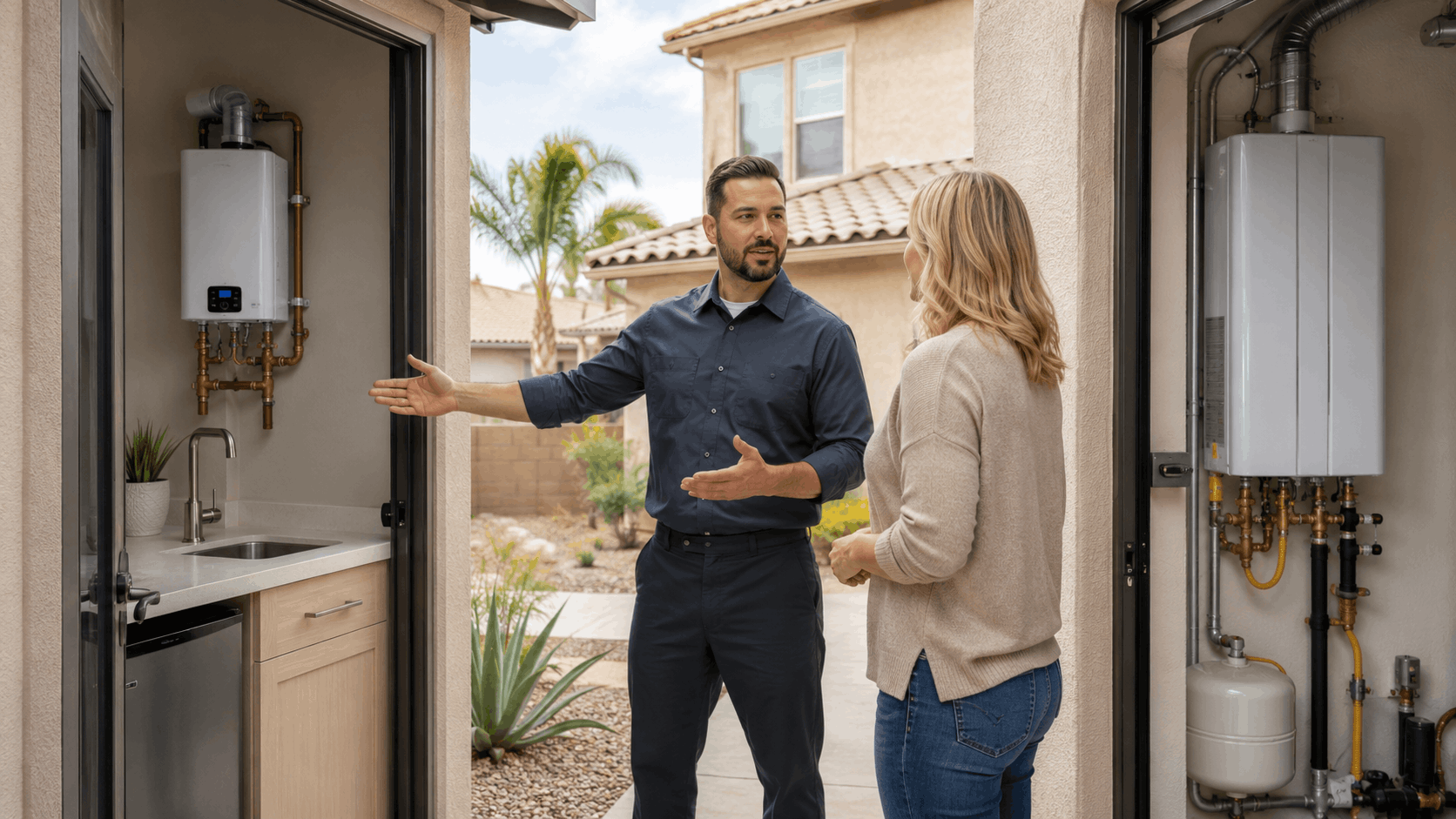
A point-of-use system means the heater lives right where the water gets used. Instead of piping hot water across the yard, a small unit sits inside the casita, under a sink, or in a nearby closet. When someone turns on the tap, the unit heats water on the spot.
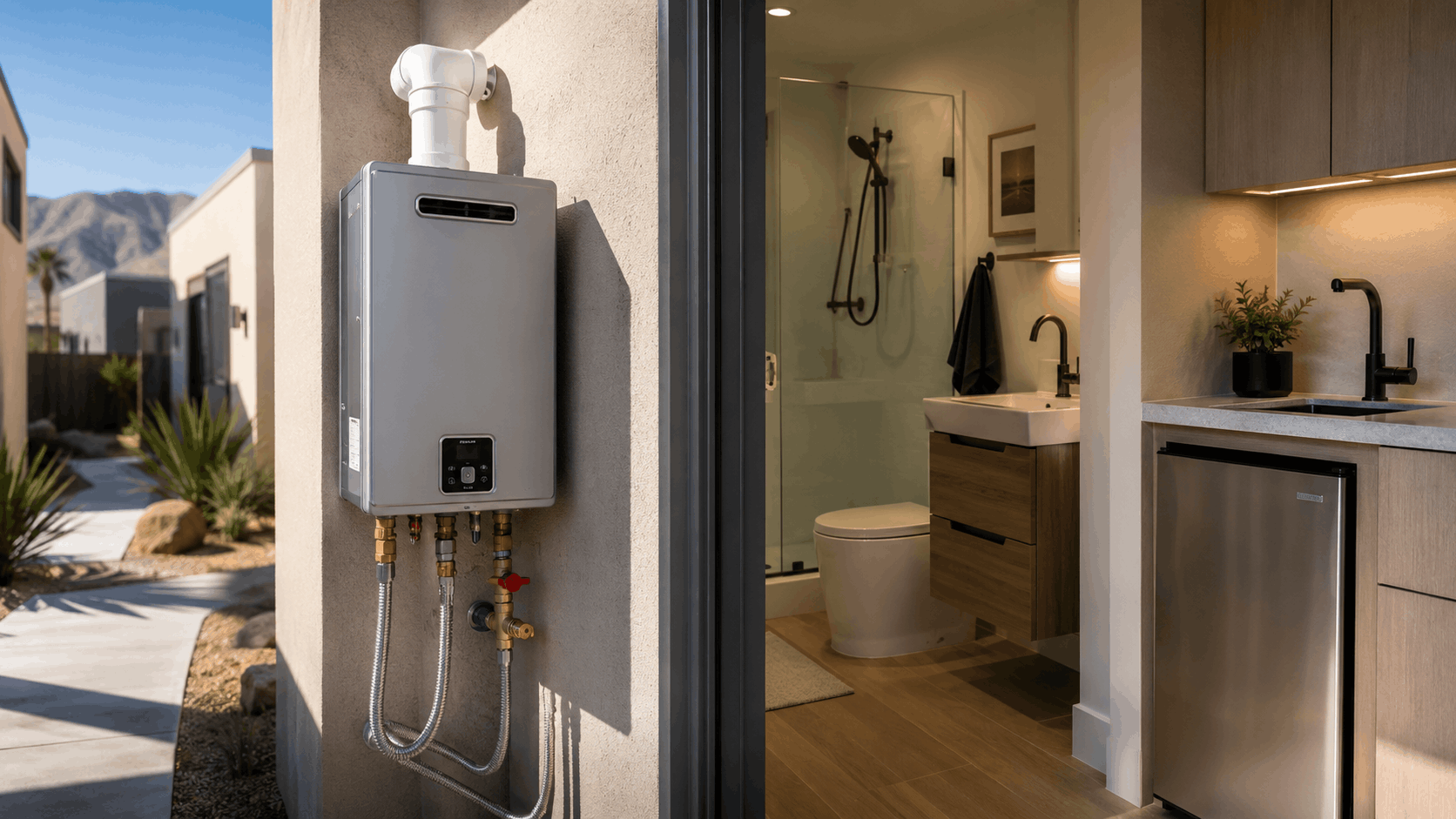
Most point-of-use tankless units are compact, about the size of a small suitcase mounted on a wall. They heat water as it flows through, so there is no tank sitting around losing heat. That works well for a casita that only gets used part of the time.
The other choice is a mini-tank heater, which holds two to ten gallons. These plug into a standard outlet and keep a small reserve of hot water ready. For a single bathroom sink or a bar sink in a pool house, a mini-tank is often all a space needs.
Both types skip the long pipe run entirely. That is the main appeal. The water does not have to travel far, so it arrives hot fast and very little gets wasted down the drain.
How a Whole-Home System Feeds a Casita
The whole-home approach uses one central water heater to serve the main house and the detached unit together. Hot water lines run from the main system out to the casita, usually buried underground across the yard. The existing heater does all the work.
Sometimes the main heater has enough capacity to handle the extra demand. Other times it needs upsizing, especially if the casita adds a shower, a washer, and a kitchen sink. A 40-gallon tank that barely covers a three-bedroom house will struggle with an extra full bathroom.
Running new hot water lines means trenching a path, laying insulated pipe, and tying into the existing plumbing. Insulation matters here because desert soil swings hot and cold, and bare pipe loses heat fast. Our water heater services team sizes the central unit before any digging starts.
This setup keeps everything on one system. There is only one heater to maintain and one gas or electric hookup to worry about. The tradeoff shows up in wait times and install cost, which we cover below.
Why the Choice Matters More for Detached Units
For a bedroom addition attached to the house, this decision barely matters. The new fixture sits a few feet from existing lines, so extending the current system is simple and cheap. A detached ADU changes the math completely.
Distance is the whole problem. A casita 40, 60, or 80 feet from the main house needs a long pipe run, and every foot of that run adds cost and heat loss. Water sitting in a long line cools off between uses, so the first several seconds at the tap come out cold.
Pipe run distance also affects how much water gets wasted. A homeowner waiting 45 seconds for hot water at a far casita pours gallons down the drain every single day. Over a year, that adds up on both the water bill and the sewer charge.
Because of this, a detached structure often favors a local heater that a bedroom addition would not. The farther the unit sits from the main house, the stronger the case for point-of-use. Lot size ends up driving the decision more than any other single factor.
Get Your Quote
Tell us what's going on and we'll get back to you. We're open 24/7.
Las Vegas Conditions That Affect Your Decision
Hot water choices in the valley are not the same as they would be in a coastal city. Our Las Vegas hard water, big desert lots, and wide temperature swings all push homeowners in specific directions. Desert climate plumbing has its own rules.
Here is how the local conditions we deal with every week shape the point-of-use versus whole-home question.
Hard Water From the Las Vegas Valley Water District
Water from the LVVWD runs hard across the whole valley. It carries a heavy load of calcium and magnesium picked up from the Colorado River and local wells. Those minerals do not stay in the water, they settle out as scale.
Hard water scale builds up inside any heater, tank or tankless. Inside a tank it coats the bottom and the element. Inside a tankless unit it lines the heat exchanger, which chokes flow and drops efficiency over time. Both systems feel this, but small point-of-use units clog more quickly because their passages are narrow.
Areas like Henderson and Green Valley see some of the toughest LVVWD water quality readings in the region. A heater that might last a decade in soft-water country often shows scale trouble here in three or four years without treatment. That is why we bring up softeners and scale filters on nearly every install.
Whether a homeowner picks point-of-use or central, planning for scale is part of the job. Skipping it just means an early replacement and a warranty voided by mineral damage.
Long Pipe Runs on Larger Desert Lots
Summerlin and the northwest are full of larger lots where the house sits well back from the property line. A casita in the far corner of one of those yards can sit 60 feet or more from the main heater. That is a long trip for hot water.
Long pipe runs waste hot water twice. First, the water in the line cools between uses and comes out cold. Second, the person at the tap runs it until it turns hot, dumping the cooled water down the drain. On a big lot, that happens at every backyard casita fixture, every day.
We see this a lot on properties around The Trails and the newer developments in the northwest valley. Homeowners love the space, but the distance works against a central hot water system. For a backyard casita on a half-acre lot, point-of-use often makes far more sense.
If a homeowner still wants a central system on a big lot, insulation and a recirculation pump become part of the plan. Without those, the wait times get frustrating fast.
Seasonal Temperature Swings and Groundwater
Incoming water temperature changes with the seasons here more than people expect. In summer, water coming into the house can be warm from sitting in hot ground and rooftop lines. In winter, that same supply drops cold, sometimes into the 50s.
Winter plumbing puts more strain on any heater. A tankless unit has to raise the water temperature further in January than in July, so its flow rate drops on cold mornings. A small point-of-use tankless sized for summer may sputter in the coldest weeks if it was picked too small.
Summer brings the opposite issue in garages and utility closets. A tank heater sitting in a 110-degree garage works less to hold temperature, but its surroundings shorten its life. Point-of-use units mounted inside a climate-controlled casita avoid that heat exposure entirely.
We size units for the coldest incoming water of the year, not the average. That keeps a shower hot in December, not just in June. Getting that number right is one of the more common mistakes we fix on other companies' installs.
Older Homes Near Downtown and the Historic Westside
Older neighborhoods near downtown Las Vegas and the historic Westside come with aging pipe systems. Homes in areas like the Scotch 80s were built decades ago, and their original galvanized or older copper lines have thinned with time.
Adding a new run to an ADU often exposes what is already there. When our crew opens a wall or ties into an old main, we sometimes find corroded pipe that will not hold a new load. That turns a simple line extension into a partial repipe.
Older home plumbing also tends to run at lower pressure because scale and corrosion have narrowed the pipes. Feeding a new casita off a weakened main can leave both structures short on flow. In those homes, a self-contained point-of-use unit sidesteps the old plumbing altogether.
We always recommend a quick inspection of the existing lines before committing to a central extension in these areas. It is cheaper to know upfront than to discover bad pipe mid-project.
Need Help in Las Vegas?
Active Plumbing serves Las Vegas and all of Las Vegas Valley.
Cost Comparison for Casita and ADU Hot Water
Budget usually decides this one. The water heater cost is only part of the picture, since ADU plumbing cost also includes labor, trenching, and long-term running expenses. Here are real ranges to plan around.
The table below shows a rough install price comparison for both approaches in the Las Vegas market.
| Item | Point-of-Use | Whole-Home Extension |
|---|---|---|
| Equipment | $200 - $1,500 | $0 - $2,500 (if upsizing) |
| Install labor | $300 - $900 | $1,500 - $5,000 |
| Trenching / lines | None | $1,000 - $4,000 |
| Typical total | $500 - $2,400 | $3,000 - $9,000+ |
Upfront Install Costs for Point-of-Use Units
A mini-tank heater runs cheap on equipment, often $200 to $500 for the unit itself. These plug into a standard 120-volt outlet if one is nearby, which keeps electrical work minimal. For a single bar sink or bathroom sink, this is the lowest-cost path by far.
A point-of-use tankless unit costs more, usually $500 to $1,500 depending on size and whether it is gas or electric. Electric tankless models for a full shower may need a dedicated 240-volt circuit and a panel upgrade, which adds a few hundred dollars. The point-of-use price still stays well below a full central extension.
Gas point-of-use units bring their own costs. They need a gas line and proper venting, so if no gas is present at the casita, the gas line installation becomes the biggest single expense. On an all-electric ADU, that removes gas from the conversation.
Most tankless install cost for a small unit lands in the one-day labor range, roughly $300 to $900. That keeps the whole project manageable for a small casita.
Cost of Extending a Whole-Home System
Extending a central system is where numbers climb. Trenching cost alone can run $1,000 to $4,000 depending on how far the casita sits and what the crew has to dig through. Concrete patios, pool decks, and rock all slow the work and raise the bill.
The line extension itself needs insulated pipe rated for burial, plus fittings and tie-ins at both ends. Proper insulation is not optional in the desert, since bare line loses too much heat across a long run. Skimping here just creates the cold-water problem the homeowner was trying to avoid.
If the existing heater cannot handle the added load, upsizing the main unit adds $1,500 to $2,500 on top of everything. A 40-gallon tank feeding a house plus a full rental ADU often needs to jump to 50 or 75 gallons, or switch to a whole-home tankless.
All in, a central extension for a detached casita commonly lands between $3,000 and $9,000. Distance and existing conditions push it higher.
Monthly Energy and Water Waste Costs
Running costs favor point-of-use in most casita situations. A tankless unit only fires when someone opens a tap, so it wastes no energy holding water hot in an empty guest space. A central tank keeps heating water around the clock whether the casita is used or not.
Water waste is the hidden monthly cost with long central runs. A homeowner running the tap 40 seconds every time they want hot water in a far casita can waste hundreds of gallons a month. That shows up on both the water and sewer portions of the LVVWD bill.
On-demand heating at the fixture cuts that waste to almost nothing. Hot water arrives in a second or two, so very little goes down the drain waiting. For a lightly used pool house, the energy cost difference over a year is real money.
The exception is a heavily used rental ADU. High daily volume can make a central tank more efficient per gallon than a small unit cycling constantly.
Long-Term Maintenance and Replacement
Hard water shortens water heater lifespan across the valley, so maintenance matters more here than in most cities. A tankless unit needs flushing maintenance once a year to clear scale from the heat exchanger. Skip it, and efficiency drops while the warranty risk rises.
Small mini-tank units are cheap to replace but do not last as long, often five to eight years on hard water. A quality point-of-use tankless can push past a decade with regular tankless maintenance and descaling. That yearly service pays for itself in extended life.
Central tanks feeding a casita face the same scale problem plus the wear of longer daily run times. Sediment settles in the tank bottom and needs periodic flushing. A softener or scale filter cuts this buildup dramatically on either system.
Planning maintenance from day one keeps both approaches running longer. It is far cheaper than an early replacement caused by mineral damage.
Performance and Hot Water Wait Times
Daily comfort comes down to two things. How fast does hot water arrive, and does it run out mid-shower? Hot water wait time and water pressure decide whether guests are happy or annoyed. On-demand hot water changes the whole experience.
Here is how each option performs in the real casitas we service.
Instant Hot Water at the Fixture
A point-of-use unit sits within a few feet of the sink or shower it serves. Because the water travels almost no distance, instant hot water arrives in a second or two. There is no waiting and no cold slug to run out first.
This point-of-use delivery is the biggest daily comfort win. A guest steps into the casita shower and hot water is there right away. Nobody stands around with a hand under the faucet counting seconds.
For a homeowner used to a slow far bathroom in the main house, the difference feels dramatic. The heater is right there, so the plumbing physics work in their favor. Short pipe, fast heat, minimal waste.
This is why point-of-use shines in casitas that see occasional use. The unit does not have to keep a distant tank of water hot for a space that sits empty most of the week.
The Long Wait Problem With Central Systems
Central systems fight physics on a detached casita. When the heater sits 40 or more feet away, hot water has to push all the cooled water out of the line first. That creates a cold-water delay of 30 to 60 seconds at the tap.
There is also the cold water sandwich problem. A guest gets hot water, shuts off briefly, then turns it back on and hits a burst of cold that was sitting in the line. It is a common complaint we hear about far casitas fed from the main house.
The longer the run, the worse the central system wait gets. On a big Summerlin lot, that delay can feel endless first thing on a cold morning. It also drives the water waste we mentioned earlier.
None of this is a flaw in the heater. It is simple distance. That is exactly why we push homeowners to weigh the pipe run before committing to a central feed.
Handling Multiple Fixtures and Guests
A rental casita with a full bathroom and a kitchenette changes the demand picture. If a guest runs the shower while the sink is going, a small point-of-use unit may not keep up. Flow rate has limits.
For multiple fixtures used at once, sizing gets critical. A single small tankless might handle one shower fine but stumble when a second fixture opens. That is when a larger dedicated unit or a properly sized central feed wins.
We look at how many people will use the space and whether fixtures run at the same time. A one-guest casita is very different from a two-bedroom rental ADU with a washer. The heavier the use, the more capacity the system needs.
Getting this wrong leads to angry reviews from renters who ran out of hot water. Sizing for peak demand, not average, keeps guests comfortable.
Recirculation Options for Whole-Home Setups
A homeowner who still wants a central system has a fix for the wait. A recirculation pump keeps hot water moving through a loop so it stays warm at the far fixture. When someone opens the tap, hot water is already close by.
A hot water loop cuts the cold-water delay from a minute down to a few seconds. It solves the biggest downside of a central feed to a distant casita. Our recirculation pump installation is a common add-on for these setups.
The tradeoff is a little extra energy to run the pump and keep the loop warm. Timers and smart controls reduce that by only running during hours the casita is used. That keeps waste in check while preserving the fast delivery.
For a full rental ADU on a central system, recirculation is usually worth it. It gives guests the near-instant hot water they expect without a separate heater.
Need Help in Las Vegas?
Active Plumbing serves Las Vegas and all of Las Vegas Valley.
Permits, Codes, and Clark County Rules for ADUs
Skipping permits is how a casita project turns into a resale headache. A Clark County permit and a proper plumbing inspection protect both the work and the home value. ADU code has specific rules on water heaters.
Here is what homeowners need to know before scheduling any install.
Clark County and City of Las Vegas ADU Rules
Local ADU regulations govern where a water heater can go and how the unit gets metered. Both the Clark County Building Department and the City of Las Vegas have adopted rules on accessory dwelling units in recent years. The details vary by jurisdiction, so the address matters.
Some rules affect whether the casita can have its own separate metering or must share the main house service. That can influence a landlord deciding between point-of-use and central. A homeowner can review current guidance through the Clark County Building and Fire Prevention department.
Placement rules also cover clearances around a water heater and venting for gas units. A point-of-use gas heater on an exterior wall has to meet setback and vent-termination requirements. We handle the permit paperwork so the install matches current code.
Pulling the right permit up front avoids a stop-work order later. It also means the finished work is on record when the home sells.
Gas Versus Electric Hookup Requirements
The gas-or-electric decision often comes down to what the property already has. A gas point-of-use unit needs a gas line permit, proper venting, and combustion air. If no gas runs to the casita, adding it can dominate the budget.
Electric units skip venting but lean hard on the electrical panel. A whole-home electric tankless can pull a large load, sometimes needing a panel upgrade or a new subpanel at the casita. That is a common surprise on older homes with a full main panel.
Our team checks the existing gas and electric capacity before recommending a heater type. Sometimes a gas line rerouting or upsizing makes a gas unit practical when it first looked impossible. Other times electric is clearly the cleaner path.
Matching the heater to the available hookups keeps the install simple and code-compliant. Fighting the existing infrastructure just raises the cost.
Inspections and What Passes the First Time
A plumbing inspection checks that the install meets code before it gets covered up. Inspectors look at connections, venting, seismic strapping, pressure relief valve routing, and clearances. A clean install passes the first time and avoids a costly second visit.
For gas units, the inspector confirms the gas line is sized right and pressure-tested. For electric, they verify the circuit and panel work. Getting permit sign-off means the work is documented and legal.
That documentation matters at resale. A buyer's inspector will flag an unpermitted water heater in an ADU, which can stall or kill a sale. Permitted work protects the home value and gives the buyer confidence.
We build every install to pass on the first inspection. That is quicker for the homeowner and keeps the project on schedule.
HOA Considerations in Communities Like Summerlin and Anthem
HOA rules add another layer in planned communities. Summerlin HOA guidelines and the associations in Anthem often restrict visible exterior equipment and vent placement. A gas point-of-use unit venting through an exterior wall may need to face a hidden side yard.
Some HOAs require approval before any exterior plumbing or venting changes. That can affect where a point-of-use or central unit gets placed on the structure. Checking with the association early prevents a fine or a forced relocation.
We have worked across many Summerlin neighborhoods and know how strict some of the villages are about visible equipment. Planning placement around those rules saves a headache. It also keeps the casita looking clean from the street.
The rules vary community to community, so a quick review of the CC&Rs is worth the time. We help homeowners plan an install that keeps both the HOA and the inspector happy.
Choosing the Right Option for Your Property
The right pick depends on the casita, not a one-size answer. To choose a water heater for casita hot water, a homeowner should look at fixture count, use level, and distance. Good ADU planning starts with those three questions.
Here is how the decision usually breaks down.
Best Fit for a Single-Fixture Casita or Pool House
A pool house with just a sink, or a casita with one bathroom, almost always favors point-of-use. A single fixture does not justify trenching a line across the yard. A small local unit handles the job for a fraction of the cost.
Pool house plumbing is a classic point-of-use case. The space sits far from the main heater and gets used occasionally, so a central feed would waste both water and energy. A mini-tank or small tankless right at the fixture delivers hot water fast.
For a single fixture, sizing is simple and the install is quick. There is no panel drama and often no gas line to run. The homeowner gets reliable hot water without a big project.
This is a common recommendation we make for small detached spaces. It is cheaper, quicker, and better matched to light use.
Best Fit for a Full Rental ADU
A full rental ADU with a shower, a full bathroom, and a laundry hookup is a different animal. Heavy daily use by tenants demands steady capacity that a tiny unit may not provide. This is where a dedicated full-size unit or a properly sized central feed earns its cost.
A rental ADU needs to handle back-to-back showers and a running washer without going cold. A single small point-of-use unit can stumble under that load. A larger dedicated tankless installed at the casita, or a recirculated central system, keeps guests happy.
Reliability protects rental income. A tenant who runs out of hot water leaves a bad review or a maintenance call. Sizing the system for real tenant demand avoids both.
For a busy rental, we lean toward a dedicated full unit at the casita or a central feed with recirculation. The higher upfront cost pays back in fewer complaints.
When Distance From the Main House Decides It
Distance from the main house is often the deciding factor. As a rough rule of thumb, once the pipe run passes 40 to 50 feet, running a central line stops making sense for most casitas. The waste and delay outweigh the convenience of one system.
Under 20 feet, extending the central system is usually easy and worth it. Between 20 and 50 feet, it depends on use level and whether recirculation is worth adding. Past 50 feet, a local point-of-use unit almost always wins on cost and comfort.
On the big lots common in Summerlin and the northwest, that distance line gets crossed fast. A backyard casita 70 feet out is a clear point-of-use candidate. We measure the actual run before making the call.
The pipe run number cuts through the guesswork. Once we know the distance and the use level, the answer is usually obvious.
How Active Plumbing Helps You Decide On-Site
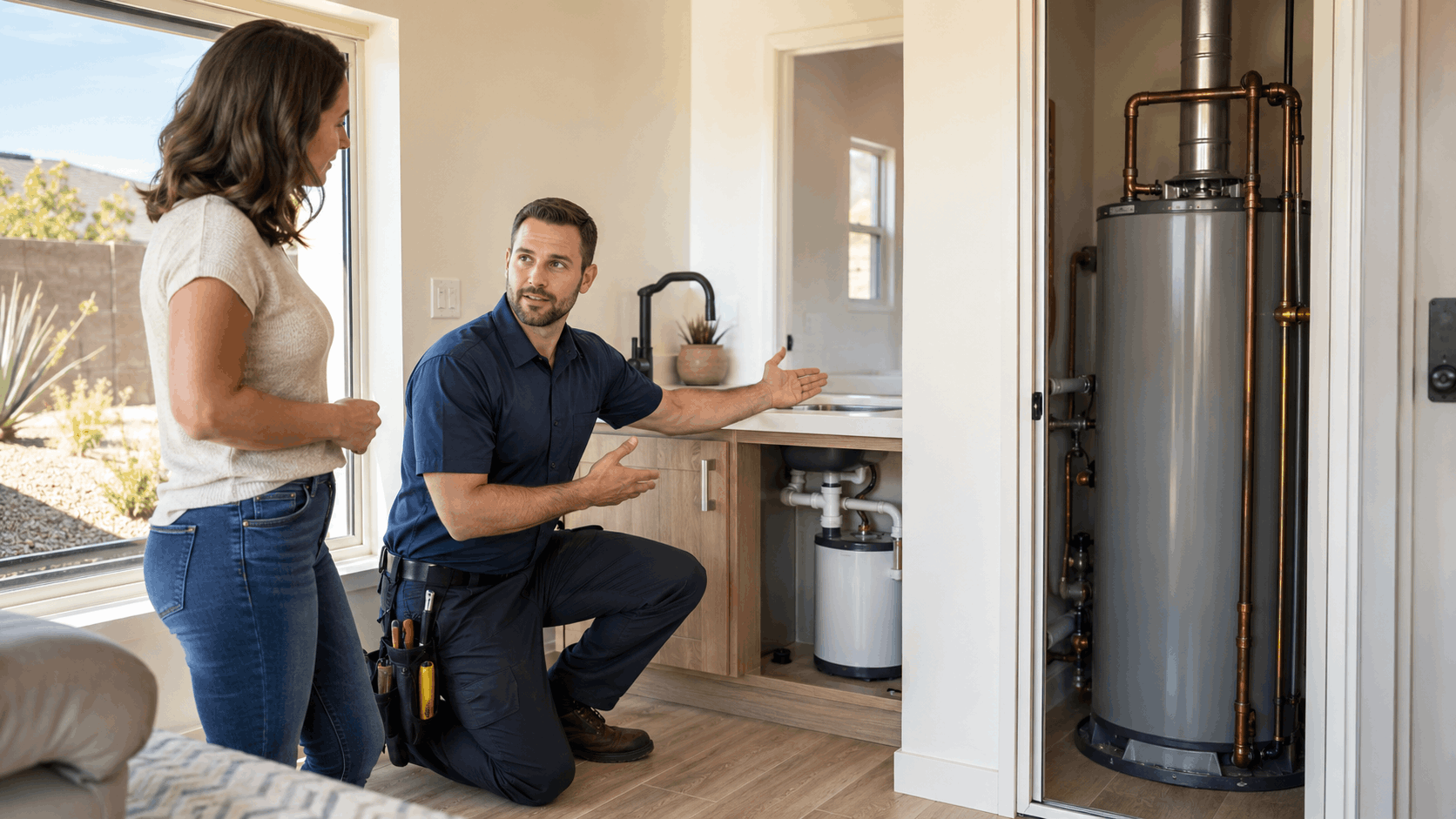
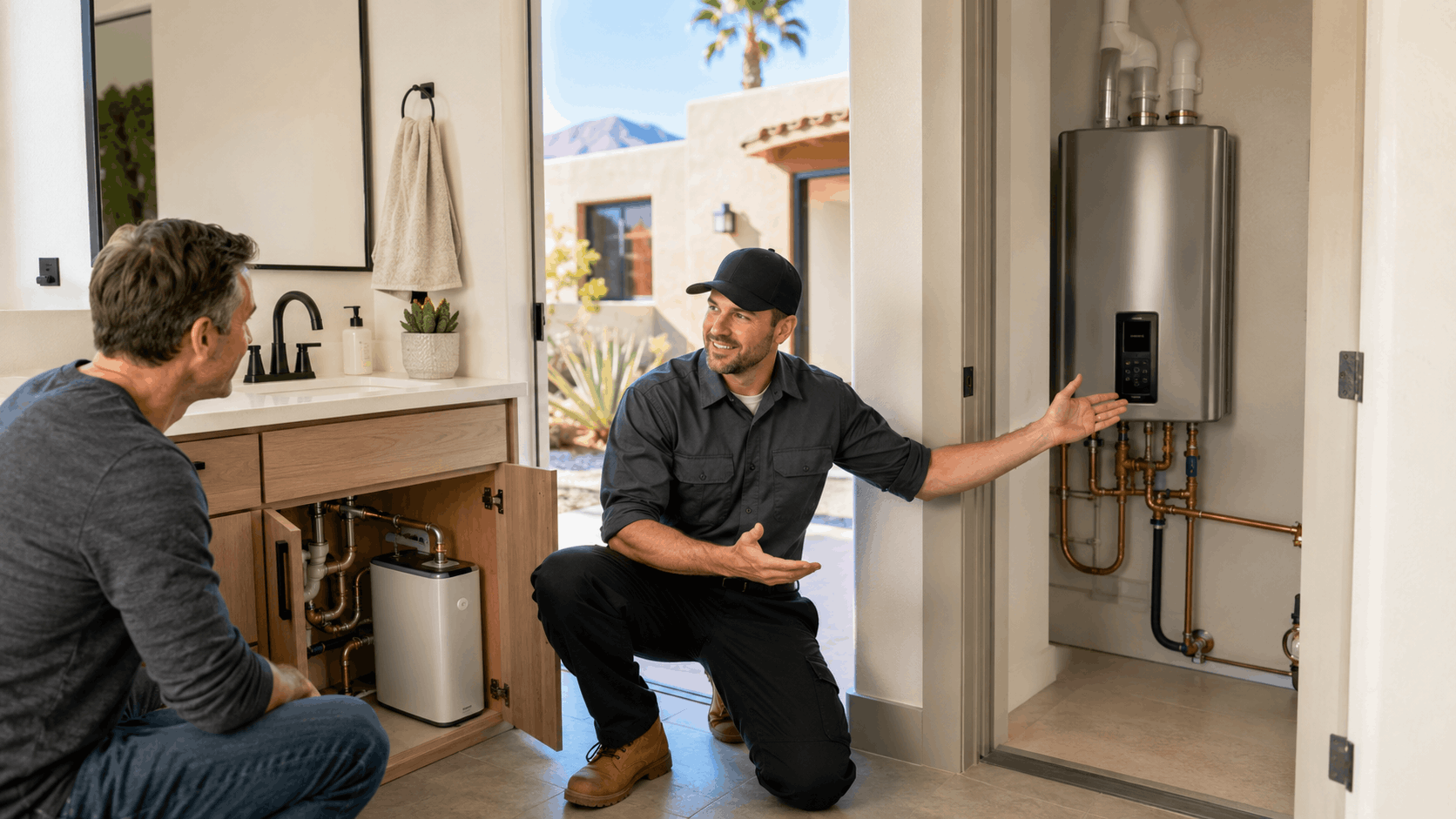
Every property is different, so Active Plumbing does an on-site assessment before recommending anything. Our team measures the pipe run, checks the existing heater capacity, and looks at the gas and electric setup. That real-world look beats any online calculator.
We walk the yard, note the trenching obstacles, and inspect the current lines for age and condition. In older neighborhoods, that inspection can change the whole plan. We would rather find a problem before digging than after.
We also factor in how the space will be used, since a guest suite and a rental need different systems. That conversation shapes the recommendation as much as the measurements. You can reach out to our team to schedule a visit.
The goal is a system that fits the casita, the budget, and the lot. An honest on-site assessment gets there more quickly than guessing.
Need Help in Las Vegas?
Active Plumbing serves Las Vegas and all of Las Vegas Valley.
Installation Process and What to Expect
Knowing the timeline up front removes the surprise. A water heater installation for a casita can be a one-day job or a multi-day plumbing project depending on the approach. Here is what each install timeline looks like.
Timeline for a Point-of-Use Install
A point-of-use setup is usually a one-day install. The crew mounts the unit near the fixture, connects the water lines, and wires the electrical or ties in the gas. For a simple mini-tank on an existing outlet, it can be done in a few hours.
Prep is minimal. The main thing we confirm ahead of time is that the right power or gas is available at the location. If a dedicated circuit or a gas stub needs to be added, that gets scheduled first.
A larger point-of-use tankless takes a bit longer because of the electrical or venting work. Even then, most installs wrap the same day. The homeowner has hot water at the casita by evening.
This fast turnaround is a big part of why point-of-use appeals to homeowners finishing a casita. There is little disruption and no trench across the yard.
Timeline for Extending Whole-Home Lines
Extending a central system is a multi-day project. The trenching timeline alone can take a day or more, especially through concrete or rock. Digging the path, laying insulated pipe, and backfilling all take time.
After the line install, the crew ties into the main system and pressure-tests everything. If the main heater needs upsizing, that gets swapped during the same window. Then the inspection has to happen before the trench closes fully.
Weather and soil conditions affect the schedule. Hard caliche soil, common in parts of the valley, slows digging considerably. We give a realistic window once we see the yard.
Most central extensions run two to four days start to finish. It is a bigger commitment than point-of-use, which is worth weighing against the benefits for the specific casita.
Protecting Your Equipment From Hard Water
No matter which system a homeowner picks, hard water protection extends its life. A water softener removes the minerals that cause scale, protecting both the casita heater and the main house plumbing. A whole-home softener is the strongest option.
For homeowners who prefer not to add salt, a scale filter or a salt-free conditioner reduces buildup with less maintenance. Our water softener installation team sizes the right treatment for the household. It pays back in longer heater life and better flow.
Scale protection matters most on tankless units, where a clogged heat exchanger kills efficiency fast. Even with a softener, an annual flush keeps a tankless running like new. Treatment plus maintenance is the winning combination in the valley.
We build this into the plan on every install. Ignoring hard water here just means paying for a new heater years too soon.
Service Areas Across the Valley
Our crew works across the whole Las Vegas service area. From Centennial Hills and Aliante in the north down to the southwest valley, we cover the neighborhoods where casitas and ADUs are going up fast. Distance from our shop does not change the quality of the work.
We handle plenty of Henderson plumbing jobs in Green Valley and Whitney Ranch, where hard water makes treatment part of nearly every install. Those areas see some of the toughest scale in the region. We plan for it every time.
We also serve Summerlin, Spring Valley, Paradise, Winchester, and the older core neighborhoods near downtown. Each area has its own quirks, from big lots to aging pipe. You can see the full list of areas we serve across the valley.
Wherever the casita sits, we bring the same local knowledge to the job. That experience shows up in a system that fits the property.
Final Thoughts
The choice between point-of-use and whole-home hot water comes down to distance, use level, and budget. A small pool house or single-fixture casita almost always does best with a point-of-use unit close to the tap. A busy rental ADU with a full bathroom and laundry may justify a central feed with recirculation or a dedicated full-size unit.
Local factors tip the scale here more than anywhere else. Hard water from the LVVWD, big desert lots, and older pipe in downtown neighborhoods all shape the right answer. Getting the sizing and the treatment right the first time saves real money over the life of the system.
Frequently Asked Questions
- Is a point-of-use water heater enough for a full ADU bathroom?
- It can be, if the unit is sized for the demand. A properly sized point-of-use tankless handles a single shower and sink used one at a time without trouble. Problems show up when a shower and another fixture run at once, which strains a small unit. For a light-use guest casita, one unit works fine. For a busy rental, a larger dedicated unit is the safer pick.
- How much does it cost to add hot water to a casita in Las Vegas?
- A point-of-use install typically runs $500 to $2,400 total, depending on the unit and any electrical or gas work. Extending the whole-home system to a detached casita usually lands between $3,000 and $9,000 or more, driven by trenching distance and whether the main heater needs upsizing. The pipe run length and existing hookups move these numbers the most. An on-site look gives an exact figure.
- Do I need a permit to install a water heater in my ADU?
- Yes. Both Clark County and the City of Las Vegas require a permit for water heater installation and any new gas or plumbing lines. A permitted install gets inspected, which confirms the work meets code and protects your home value at resale. Unpermitted work often gets flagged during a sale. Our team pulls the permits and handles the inspection as part of the job.
- Why does my casita take so long to get hot water?
- The usual cause is a long pipe run from the main house heater. Water sitting in that line cools between uses, so you run the tap until the cooled water clears and hot water arrives. On a big lot that wait can hit 30 to 60 seconds. A recirculation pump or a point-of-use unit at the casita fixes the delay.
- Will hard water in Las Vegas ruin a small tankless unit?
- Hard water will shorten its life if you ignore it. LVVWD water leaves scale inside the heat exchanger, which chokes flow and drops efficiency. An annual flush clears that buildup, and a water softener or scale filter cuts it dramatically at the source. With regular descaling and treatment, a quality tankless unit lasts well over a decade even on valley water.
- Gas or electric point-of-use heater - which is better?
- It depends on what the casita already has. If gas is present, a gas unit heats high flow well but needs venting and a gas line permit. If the space is all-electric, an electric unit avoids venting but may need a dedicated 240-volt circuit or a panel upgrade. We check the existing hookups and match the heater to whichever path is cleaner and cheaper for that property.
- Can I use my main house water heater to feed a detached casita?
- Sometimes. It works when the casita is close, the demand is low, and the main heater has spare capacity. It strains the system when the run is long, the main tank is already sized tight for the house, or the casita adds a full bathroom and laundry. In those cases we recommend upsizing the main unit or installing a dedicated heater at the casita.
- How long does installation take?
- A point-of-use install is usually a one-day job, sometimes just a few hours for a simple mini-tank on an existing outlet. Extending whole-home lines to a detached casita takes two to four days, since it involves trenching, laying insulated pipe, tying in, and passing inspection. Hard caliche soil or concrete decks can add time. We give a realistic window after seeing the yard.
- Does adding an ADU water heater increase home value?
- A permitted, working hot water setup supports both resale and rental value. Buyers and appraisers view a functional, code-compliant ADU as usable living space, which adds worth. Unpermitted plumbing does the opposite and can complicate a sale. A properly installed and documented water heater helps the casita count as real, rentable square footage.
- Which option is better for a rental unit I plan to lease?
- For a rental, reliability matters most. A dedicated full-size unit at the casita or a central feed with a recirculation pump handles heavy tenant use and back-to-back showers without going cold. A tiny point-of-use unit can fall short and generate complaints. Size the system for peak demand, not average, and you avoid the maintenance calls that eat into rental income. Choosing between point-of-use and whole-home hot water does not have to be a guess. Our team measures the pipe run, checks your existing system, and factors in the hard water every valley home deals with. Whether you have a small pool house in Green Valley or a full rental ADU in Summerlin, we match the system to your property and budget. Call Active Plumbing today to schedule an on-site consultation and get a clear recommendation for your casita.
Licensed plumbing professionals serving Las Vegas and Las Vegas Valley.
Licensed in Nevada · License #0047021
Last updated on
Why trust Active Plumbing?
Founded in 1991, Active Plumbing is a licensed and insured plumber serving Las Vegas and Las Vegas Valley. All content is reviewed by our licensed technicians.

Need Help in Las Vegas?
Active Plumbing serves Las Vegas and all of Las Vegas Valley.
Related Articles
Best Water Heater Option for Las Vegas Homes: Tank vs Tankless
Compare tank vs tankless water heaters for Las Vegas homes. Costs, hard water effects, lifespan, permits, and which option fits your neighborhood best.
Tankless Water Heater Installation Cost in Las Vegas: Gas Line Upsizing, Venting, and Permit Line Items
A clear breakdown of tankless water heater installation cost in Las Vegas, including gas line upsizing, venting, permits, and hard water factors for valley homes.
Tankless Water Heater Installation Cost Vegas: 3-Bedroom vs 5-Bedroom Pricing
Compare tankless water heater installation costs in Las Vegas for 3-bedroom vs 5-bedroom homes, with pricing ranges, sizing tips, local factors, and Clark County permit details.