Clark County Water Heater Permit Requirements: What Inspectors Flag in Garage Installs
Key Takeaways
- Clark County requires a permit for every water heater replacement and new install, not just relocations.
- Standard water heater permits run about $40 to $100 and are often issued the same day online.
- Gas water heaters need the ignition source raised 18 inches off the garage floor unless the unit is FVIR-rated.
- A common inspection failures are improper seismic strapping and T&P valve discharge pipe errors.
- Gas units need a shutoff, sediment trap, venting, and combustion air, while electric units need a dedicated circuit, disconnect, and bonding.
- Older homes near downtown often have outdated venting and undersized gas lines, while newer builds struggle with tight garages and combustion air.
- HOA communities like Summerlin and Cadence can add rules on top of county code.
- A licensed plumber like Active Plumbing pulls the permit, installs to code, and meets the inspector to help homeowners pass the first time.
In This Article
A homeowner near Summerlin called our team last spring after failing his garage water heater inspection. Everything looked fine to him. New tank, hot water flowing, no leaks. The inspector failed him over one detail: the temperature and pressure relief discharge pipe ended about a foot off the floor instead of the required six inches. One small line on the report meant a reschedule, a second inspection, and another week without a signed-off install.
Stories like that happen across the valley every week. A garage water heater swap seems simple, but Clark County has specific rules, and inspectors check them closely. Miss one and you fail, even if the water is hot and the tank is sitting perfectly level.

Why Clark County Requires a Permit for Water Heater Replacement?
Swapping a water heater is not a no-permit job in Clark County. A lot of homeowners assume that pulling an old tank and setting a new one is like changing a faucet. It is not. The county treats a water heater as a fixed appliance tied to gas, water, venting, and sometimes electrical systems.
The county tracks these installs because a water heater carries real risk. Gas units burn fuel and vent exhaust. Both gas and electric tanks store hot pressurized water. A bad install can cause a fire, a scald, or a flood. The permit gives the county a record and a chance to check the work against the current Las Vegas plumbing code.
| Job Type | Permit Needed? | Why |
|---|---|---|
| Like-for-like tank replacement | Yes | New appliance connected to gas, water, and venting |
| New water heater install | Yes | New connections and code review required |
| Relocating the water heater | Yes | New venting, gas, and clearance checks |
| Minor repair (thermostat, valve) | Usually no | No change to the appliance or connections |
What the Clark County Building Department Expects
The Clark County Building Department handles water heater permits through its plumbing division. They review the install against adopted code editions, which in our area are based on the Uniform Plumbing Code and the local amendments the county adds on top. Those amendments matter because they shape garage-specific rules.
When someone applies for a plumbing permit, the department expects the work to match code before an inspector ever shows up. That means correct venting, proper clearances, seismic strapping, and a compliant relief valve setup. The permit is not just a receipt. It is the county saying they will send someone to verify the job.
The department also expects the person doing the work to be qualified. Licensed contractors pull permits under their license number. Homeowners can pull an owner-builder permit for their own residence, but the county still holds the finished work to the same standard. There is no easier code for a DIY tank.
Our team works with the Clark County Building Department almost daily, so we know how each inspector reads the code. That familiarity is a big part of why we schedule and meet the inspection ourselves on water heater service jobs across the valley.
When a Permit Is Legally Required
A permit is required any time the water heater itself is replaced or newly installed. This trips up a lot of homeowners who think only a relocation triggers paperwork. If the old tank comes out and a new one goes in, that is a replacement, and a permit applies.
The line between a repair and a replacement is where confusion starts. Swapping a failed thermostat, a heating element, or an anode rod counts as a repair and generally needs no permit. Pulling the whole appliance and setting a new one is a replacement, and the water heater install needs a permit every time.
The same rule holds for tankless conversions. Moving from a tank to a tankless unit is a new install with new venting and gas sizing, so it always needs a permit. Our tankless water heater installation jobs always run through the county the same way a tank swap does.
When in doubt, treat any full appliance change as permit work. The cost of a permit is small compared to the trouble of unpermitted work surfacing later.
Risks of Skipping the Permit
Skipping the permit feels like a shortcut until the day it costs money. A common place unpermitted work shows up is a home resale. Buyers order inspections, and a water heater with no permit record raises a red flag that can stall or kill a deal.
Insurance is the other pain point. If an unpermitted water heater fails and floods a garage or starts a fire, the insurer can deny the claim. They point to the missing permit and the code violation as grounds to walk away. That leaves the homeowner covering damage out of pocket.
Then there are the county fines. Clark County can require a retroactive permit, charge added fees, and force the homeowner to expose finished work for inspection. In some cases the tank has to come back out to prove the connections were done right. That is far more expensive than doing it correctly the first time.
Get Your Quote
Tell us what's going on and we'll get back to you. We're open 24/7.
How to Pull a Water Heater Permit in Las Vegas
Pulling a permit is not the mystery a lot of people think. Clark County has made most of the process something you can start from your kitchen table. The steps are practical, and the timeline for a standard garage install is short.
Here is the general path to pull a permit for a Las Vegas water heater:
- Confirm the job is a replacement or new install (it almost always needs a permit)
- Gather the property details, including parcel number and address
- Submit the permit application online or in person
- Pay the permit fee
- Complete the install to current code
- Schedule the inspection
- Meet the inspector and pass or address any corrections
Applying Online vs. In Person
The Clark County online permit portal is the fastest route for most homeowners and contractors. A simple water heater permit is often available as an over-the-counter or express type, which means no plan review and quick issuance. You fill out the application, pay, and print the permit the same day in many cases.
Applying in person still has a place. The county building office near the Grant Sawyer building downtown lets you talk to a plans examiner if your job has a wrinkle, like a relocation or a fuel change. Older homes with odd existing conditions sometimes benefit from that face-to-face conversation.
For a straightforward tank-for-tank swap, the online permit through the Clark County portal is usually all you need. You can review current permit information and code adoptions on the Clark County Building and Fire Prevention site before you start.
Most homeowners who call us just want the work done right without a trip downtown. That is where handing the permit to a licensed plumber saves a morning.
Permit Costs and Processing Times
A standard water heater permit in the valley usually runs somewhere in the range of about $40 to $100, depending on the current county fee schedule and any minor add-ons. A basic like-for-like replacement sits at the low end. Jobs that add gas or electrical work can push the fee higher.
Processing time for a simple garage install is fast. An over-the-counter permit is often issued the same day online. The bigger variable is the inspection window, not the permit itself.
Inspection scheduling typically lands within a day or two of the request, and the inspector arrives during an assigned window. From application to a passed inspection, a clean job can wrap up inside a week. Delays usually come from failed inspections, not the paperwork.
Budgeting a little extra for a second inspection is smart if the install is a DIY effort. A single flagged item means a reschedule, and that added visit can carry its own fee.
Why a Licensed Plumber Simplifies the Process
A licensed plumber removes almost all the guesswork. When our team at Active Plumbing takes a job, we pull the permit under our contractor license, install the unit to current code, and schedule the inspection for the customer. The homeowner does not have to touch the county portal.
The bigger value is the code knowledge. We already know the 18-inch rule, the strapping requirement, and the T&P discharge details before we set the tank. That means the install is built to pass, not built to fail and get corrected.
We also meet the inspector on site. If a question comes up, we answer it in person and handle any small correction on the spot instead of scheduling a whole new visit. That is a big part of why our customers rarely deal with a second trip.
For homeowners who want the permit, the code-compliant install, and the inspection all handled under one roof, using a licensed contractor is the cleaner path. It keeps the record clean for resale and insurance too.
Need Help in Las Vegas?
Active Plumbing serves Las Vegas and all of Las Vegas Valley.
Garage Install Rules Unique to Clark County Homes
Most water heaters in the valley live in the garage. That is how builders laid out homes from the mid-century blocks near downtown to the newest master-planned communities. Because the tank sits in a space that also holds cars, fuel, and stored chemicals, the garage carries its own set of installation rules.
These rules focus on one thing: keeping a fuel-burning appliance safe in a room full of ignition risks. Here is a quick view of the main garage requirements for a gas water heater.
| Rule | Requirement | Purpose |
|---|---|---|
| Ignition source elevation | Ignition source 18 inches above floor | Keep flames above heavier gas vapors |
| Vehicle protection | Bollard or barrier when in path of a car | Prevent impact damage to the tank |
| Combustion air | Adequate air openings for gas units | Safe burning and proper venting |
| Seismic strapping | Two straps, upper and lower thirds | Keep tank secure and stable |
The 18-Inch Ignition Source Rule
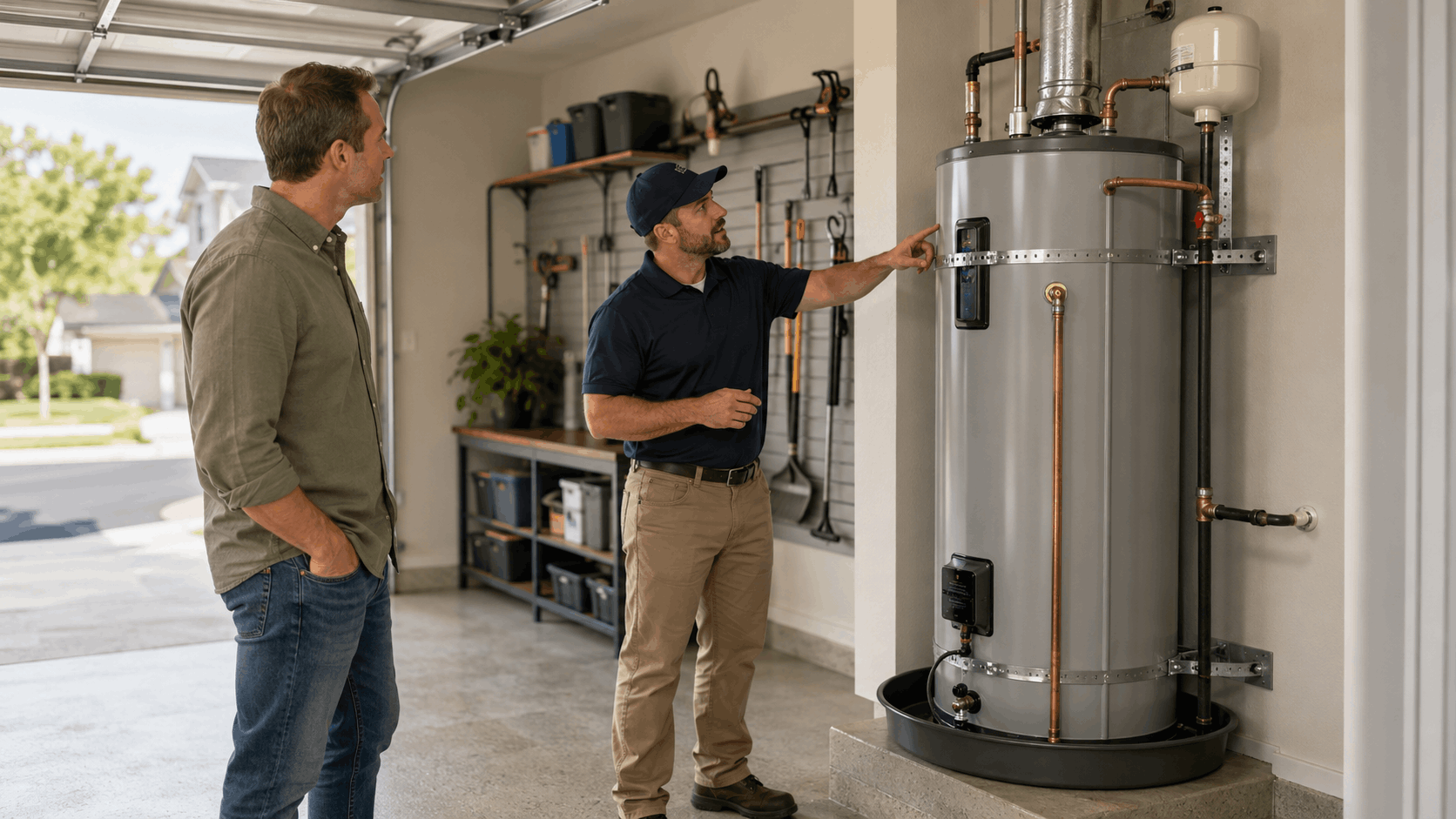
The classic garage rule raises the ignition source of a gas water heater 18 inches off the floor. The reason is simple physics. Gasoline and other flammable vapors are heavier than air and pool near the ground, so a pilot light or burner sitting low can ignite them.
For years that meant setting the tank on a raised platform so the burner cleared 18 inches. Inspectors still expect this on older-style units. A tank sitting flat on the garage slab with a standing pilot is a fast fail.
Newer FVIR units, which stands for flammable vapor ignition resistant, change the picture. These water heaters are built with a sealed combustion design and a flame arrestor that resists igniting vapors. Many manufacturers list them for floor installation in a garage, but the local reading of code still matters.
Because interpretation varies, we confirm the unit rating and the current county stance before we set the tank. When there is any doubt, elevating the unit is the safe call that clears inspection every time.
Vehicle Impact Protection
If the water heater sits where a car could hit it, the county wants impact protection. That usually means a steel bollard or a barrier that blocks a vehicle from striking the tank. A gas tank knocked loose is a gas leak and a fire risk, which is why this rule exists.
The judgment call is whether the tank sits in the vehicle path. A water heater tucked in a corner behind a wall may not need a barrier. One standing near the open garage floor where a car parks almost always does.
Inspectors look at the real layout of the garage, not a diagram. We have seen installs fail because a tank looked exposed even though the homeowner never parked near it. The barrier has to satisfy the inspector on site.
When we install in a garage across areas like Charleston Heights or newer valley builds, we assess the parking path first and add protection where it is needed so the placement passes.
Combustion Air and Ventilation
A gas water heater needs air to burn fuel cleanly and vent exhaust. In an enclosed garage, that air has to come from somewhere. Code sets minimum openings so the appliance gets enough combustion air.
This is a growing issue in tighter newer homes near Skye Canyon and Inspirada. Modern construction seals up better than older homes, which is great for cooling bills but limits natural air flow. A gas unit crammed into a small sealed closet-style garage space can starve for air.
Signs of a combustion air problem include sooting, a pilot that keeps going out, and backdrafting exhaust. An inspector who sees a tight enclosure with no proper air openings will flag it. The fix may involve louvered vents or ducted air.
For homes where combustion air is a real limit, an electric unit or a properly vented tankless setup sometimes makes more sense. Our gas line team evaluates the space before recommending the right unit for that garage.
What Inspectors Flag Most Often in Garage Installs
After hundreds of garage installs across the valley, the failure list gets pretty predictable. Inspectors are consistent about a handful of items. Knowing them ahead of time is the difference between a first-visit pass and a reschedule.
These are the code violations we see flagged most on garage water heaters.
Missing or Improper Seismic Strapping
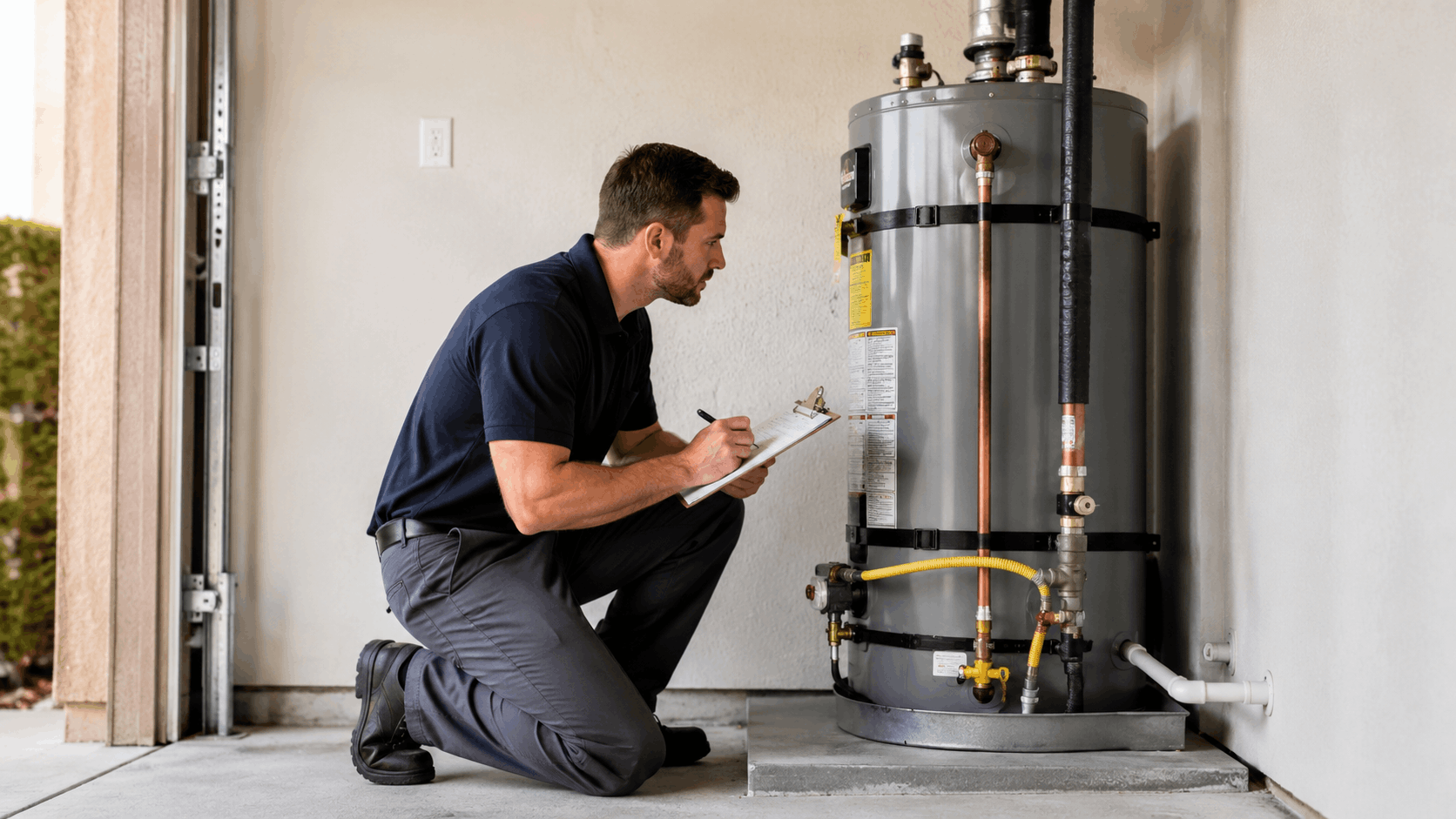
Southern Nevada sits in a seismic zone, so tank water heaters need seismic strapping. Code calls for two straps, one in the upper third of the tank and one in the lower third. A single strap or no strap is an automatic fail.
A common mistake is loose strapping. A strap that hangs slack or is barely tightened does not hold the tank in an earthquake, and inspectors check the tension. The straps also need to anchor into solid framing or masonry, not just drywall.
Another flag is strap placement. Straps set too close together, or one placed over the controls, gets rejected. The upper and lower thirds rule exists so the tank cannot pivot or tip.
We use proper metal strapping anchored to studs on every install. It is a small detail that fails a lot of DIY jobs, and it is one of the first things an inspector reaches for.
T&P Valve and Discharge Pipe Errors
The temperature and pressure relief valve, or T&P valve, is a safety device that releases pressure if the tank overheats. Its discharge pipe routing is one of the most flagged items in the whole install. The homeowner near Summerlin from the opening failed on exactly this.
The discharge pipe has to run down and terminate close to the floor, usually within about six inches. Terminating too high creates a scald risk if the valve blows. Ending the pipe at eye level or capping it are both quick fails.
Material matters too. The discharge line must be an approved material rated for hot water, cannot be reduced in size, and cannot have a valve or a threaded end cap. Any of those turns a working valve into a hazard.
We route the discharge full-size, downhill, to an approved termination every time. It is a cheap part of the job that catches an outsized share of failed inspections.
Improper Venting and Flue Connections
Gas water heaters vent exhaust through a flue, and bad venting is dangerous because it can push carbon monoxide back into the home. Inspectors take flue and vent connector issues seriously. Backdrafting is one of the biggest safety concerns in a garage install.
Common flags include wrong flue slope, where the connector does not rise properly toward the vent, and disconnected or loose vent sections. The connector needs a continuous upward slope so exhaust rises and exits.
Single-wall vent connector issues also fail. Using the wrong pipe, running it too close to combustibles, or missing clearances all get caught. Older homes near downtown sometimes have vents that never met current code in the first place.
We inspect the full vent path on every gas install and correct slope, clearance, and connection problems before the inspector arrives. A clean vent is both a code item and a real safety matter for the family.
Drip Pans and Drain Line Problems
A drip pan catches leaks so a failing tank does not flood the space below it. In a garage on grade, a pan is not always required, but when the installation sits where a leak would cause damage, the inspector expects one with a drain to the exterior.
A common flag is a missing drain. A pan with no drain line just fills up and overflows, which defeats the purpose. The pan needs a drain that carries water to an approved point, often outside the garage.
Older homes near Charleston Heights often lack any pan or drain provision because the original install predates the requirement. When we replace those units, we add the pan and drain so the new install meets current code.
We also check the drain slope and termination so water actually leaves the pan. A pan that drains uphill or into a dead end is as bad as no pan at all. Getting this right protects the garage and the inspection at the same time.
Need Help in Las Vegas?
Active Plumbing serves Las Vegas and all of Las Vegas Valley.
Gas vs. Electric Garage Installs in the Valley
Many Las Vegas garages have gas lines run by Southwest Gas, so gas tanks are common across the valley. Electric units are also plentiful, especially in homes without a gas run to the garage. The code requirements split in important ways between the two.
Here is how the main requirements compare.
| Requirement | Gas Unit | Electric Unit |
|---|---|---|
| Fuel connection | Gas line, shutoff, sediment trap | Dedicated electrical circuit |
| Venting | Flue and combustion air required | No combustion venting needed |
| 18-inch elevation | Applies unless FVIR-rated | Not required for ignition |
| Disconnect | Gas shutoff valve | Electrical disconnect |
Gas Line and Shutoff Requirements
A gas water heater needs a proper gas shutoff valve within reach of the appliance. Inspectors want to see a shutoff placed so it can be reached quickly in an emergency, not buried behind the tank.
A sediment trap, sometimes called a drip leg, is another checked item. It is a short section of pipe that catches debris before it reaches the burner controls. Missing the sediment trap is a common flag on gas installs.
Flexible connectors are allowed but have rules. They must be the correct type and length, and they cannot pass through walls. An old, kinked, or oversized connector gets rejected.
Our gas safety inspection and connection work covers the shutoff, sediment trap, and connector so the gas side passes cleanly. Gas mistakes are not just code issues, they are leak risks.
Electrical Requirements for Electric Units
Electric water heaters in NV Energy-served homes need a dedicated circuit sized for the unit. Sharing a circuit with other loads is a fail and a fire risk. The wiring gauge and breaker have to match the heater rating.
A disconnect is required so the unit can be shut off safely for service. Depending on placement and sight lines, that can be a dedicated disconnect switch or a properly located breaker. Inspectors check that the disconnect is accessible.
Bonding and grounding also get reviewed. The tank and the water piping need proper bonding to keep the system safe from electrical faults. Loose or missing bonding is a flag.
Electric conversions often mean bringing an electrician in to run the circuit before the tank is set. We coordinate that side so the electrical is ready and inspectable when the heater goes in.
Switching Fuel Types During Replacement
Converting from gas to electric, or the reverse, adds steps to the permit. A gas to electric swap means capping the gas line safely and running a new dedicated circuit. An electric to gas swap means running gas, adding venting, and handling combustion air.
Both directions change the scope enough that the permit covers more than a simple tank swap. The county wants to see the abandoned fuel source handled correctly. A capped gas line, for example, has to be done to code, not just plugged.
Fuel conversions are where homeowners most often need a licensed contractor. The work crosses plumbing, gas, and electrical trades, and each part is inspected. Our team handles the gas line changes and coordinates the electrical when the fuel type changes.
We always talk through the long-term cost and the garage limits before recommending a conversion. Sometimes staying with the existing fuel is the simpler and cheaper path.
Older vs. Newer Las Vegas Homes and Common Problems
Home age shapes the inspection more than most homeowners expect. The valley has everything from 1950s bungalows near downtown to brand-new builds in outlying communities. Each era brings its own set of garage water heater challenges.
Here is a general breakdown by home age.
| Home Era | Common Issue | Typical Fix |
|---|---|---|
| Older (mid-century) | Outdated venting, undersized gas line | Vent correction, gas line upsizing |
| Newer (master-planned) | Tight garage, combustion air limits | Added air openings, unit choice |
| Any age | Missing pan or strapping | Add pan, drain, and two straps |
Issues in Older Homes Near Downtown and Huntridge
Mid-century homes near downtown and Huntridge often have venting that never met current code. The flue may be undersized, poorly sloped, or run through spaces that no longer meet clearance rules. Replacing the tank exposes these problems.
Undersized gas lines are another frequent find. Older homes were built for smaller appliance loads, and a modern water heater may need more gas than the existing line delivers. That can mean upsizing the line to the unit.
The garages themselves sometimes fall short of current safety layout. Some were converted or finished in ways that complicate combustion air and clearances. An inspector reads the current condition, not the original permit from decades ago.
When we work in these older neighborhoods, we plan for vent and gas line corrections up front. It keeps the job from stalling when the inspector finds a legacy issue behind the tank.
Tight Garages in Newer Builds Like Cadence and Mountain's Edge
Newer master-planned communities like Cadence and Mountain's Edge have their own headache: tight, sealed garages. Modern homes are built efficient, which limits natural air flow to a gas appliance. Combustion air becomes the sticking point.
Clearance is the other issue. Builders sometimes place the water heater in a small alcove or closet-style bay with just enough room for the original unit. A replacement tank of a slightly different size can crowd the required clearances.
These garages also tend to have the tank near the parking area, which brings the vehicle barrier rule into play. A tight layout can make both air and impact protection tricky at once.
We measure the space and check air openings before ordering the unit for newer homes. In some cases an electric or tankless option solves a combustion air problem that a standard gas tank cannot.
HOA Rules That Overlap With County Code
Communities like Summerlin and Inspirada layer HOA rules on top of county code. The county cares about safety and function. The HOA may care about exterior appearance, screening, and when work can happen.
Most water heater work is inside the garage, so HOA appearance rules rarely block it. But conversions or reroutes that touch an exterior wall, add a vent, or run new gas can trigger HOA review. Scheduling rules and contractor access hours also apply in some gated communities.
We handle installs across Summerlin and other HOA neighborhoods regularly, so we know when a community will want notice. Ignoring the HOA can mean a fine even when the county work is perfect.
The safe move is to confirm both sets of rules before the job. County code and HOA rules do not cancel each other out. A compliant install satisfies both.
Need Help in Las Vegas?
Active Plumbing serves Las Vegas and all of Las Vegas Valley.
How to Prepare Your Garage Install to Pass the First Time
Passing the first time comes down to preparation. Most failures we see were avoidable with a short checklist and a little planning. A failed inspection costs a reschedule and often a return fee, so getting it right the first visit pays off.
Here is how to set up a garage water heater to pass.
Pre-Inspection Checklist for Garage Water Heaters
Start with the basics that inspectors check first. Confirm the ignition source elevation for gas units, verify two seismic straps in the upper and lower thirds, and check the T&P discharge pipe runs full-size to within about six inches of the floor.
Then look at the surroundings. Confirm the drip pan and drain line are in place where required, check combustion air openings for gas units, and make sure the required clearances around the tank are clear of storage and boxes.
For gas units, verify the shutoff is reachable, the sediment trap is installed, and the vent connector slopes upward with proper clearance. For electric units, confirm the dedicated circuit, disconnect, and bonding.
Walk the checklist as if you were the inspector. Every flagged item on this list traces back to a rule that exists for safety, so treating the checklist seriously protects the home as much as the paperwork.
Scheduling the Inspection Around Las Vegas Weather
Las Vegas summer heat is a real factor in inspection scheduling. Garages routinely climb well past 100 degrees in July and August, and an inspection window in the afternoon means working in an oven of a garage. That heat also stresses anyone accessing tight spaces around the tank.
Booking a morning inspection window in summer keeps the garage cooler and the access easier. It also reduces the chance a rushed check misses a detail that could have been fixed on site.
Weather rarely cancels an inspection here since we get so few storm days, but extreme heat can slow everything down. Coordinating the install and the inspection close together avoids leaving an incomplete job sitting in a hot garage.
We time our installs and inspection requests around the daily heat when possible. Small scheduling choices keep the process smooth in the middle of a valley summer.
Why Active Plumbing Handles the Whole Process
The simplest way to pass the first time is to let a licensed team handle the whole process. At Active Plumbing, we pull the permit, install the unit to current Clark County code, and meet the inspector so the homeowner never has to guess.
Our crews build the install to the checklist above from the start. The elevation, strapping, T&P discharge, pan, venting, and gas or electrical connections are all done to pass, not corrected after a failure.
Because we work across the valley every week, we know each area's quirks. Older venting near Huntridge, tight garages in Mountain's Edge, and HOA notice in Summerlin are all things we plan around before we start.
Homeowners get a clean permit record, a code install, and a passed inspection without the trips downtown or the reschedules. That clean record also protects them at resale and with their insurer down the road.
Final Thoughts
A garage water heater swap in Clark County is real permit work, not a quick weekend project. The county requires a permit for every replacement and new install, and inspectors check a consistent list of items. Strapping, T&P discharge, venting, elevation, and clearances are where most jobs fail.
Home age and neighborhood shape the challenge too, from old venting near downtown to tight combustion air in newer communities. Knowing the rules ahead of time is what separates a first-visit pass from a costly reschedule.
If you want the permit, the code-compliant install, and the inspection handled for you, our team is ready to help. Contact Active Plumbing for a consultation on your garage water heater and let us handle the process from start to signed-off inspection.

Frequently Asked Questions
- Do I really need a permit to replace a water heater in Clark County?
- Yes. Clark County requires a permit for any water heater replacement or new install, not just relocations. The county treats the tank as a fixed appliance tied to gas, water, venting, and sometimes electrical systems. The permit gives the county a record and a chance to inspect the work against current code. A minor repair like a thermostat swap usually does not need one, but a full appliance change always does.
- How much does a water heater permit cost in Las Vegas?
- A standard water heater permit in the valley usually runs about $40 to $100, depending on the current county fee schedule. A basic like-for-like replacement sits at the low end. Jobs that add gas line or electrical work can push the fee higher. The permit itself is often issued the same day online, so the cost and the wait are both small compared to the trouble of unpermitted work showing up later.
- Why does my gas water heater need to be 18 inches off the garage floor?
- Flammable vapors like gasoline are heavier than air and pool near the floor. Raising the ignition source 18 inches keeps a pilot light or burner above those vapors, which reduces the risk of a fire in the garage. Newer FVIR units are built with sealed combustion and flame arrestors that resist igniting vapors, and many are listed for floor installation. Local code reading still varies, so we confirm the unit rating before setting it.
- What is a common reason a garage install fails inspection?
- The two common flags are seismic strapping and T&P valve discharge errors. Southern Nevada requires two straps in the upper and lower thirds of the tank, and loose or single straps fail. The T&P discharge pipe must run full-size, downhill, to within about six inches of the floor, and terminating too high or using the wrong material fails. Both are cheap to do right but catch an outsized share of failed inspections.
- Can I pull the permit myself as a homeowner?
- Yes. Clark County allows an owner-builder permit for work on your own residence. The catch is that the finished work is held to the same code as a licensed contractor's, with no easier standard for DIY. If you miss the strapping, venting, or T&P rules, you fail and reschedule. Many homeowners find that using a licensed plumber, who pulls the permit and meets the inspector, is cleaner and avoids repeat visits.
- How long does the permit and inspection process take?
- For a straightforward garage swap, an over-the-counter permit is often issued the same day online. Inspection scheduling usually lands within a day or two of the request. A clean job can go from application to passed inspection inside a week. The main cause of delay is a failed inspection, which forces a reschedule and sometimes a return fee, so building the install to code the first time keeps the timeline short.
- Do I need vehicle impact protection for my garage water heater?
- You need it when the tank sits where a car could hit it. That usually means a steel bollard or barrier that blocks a vehicle from striking the appliance. A gas tank knocked loose becomes a gas leak and fire risk, which is why the rule exists. A tank tucked in a corner behind a wall may not need one. The inspector judges the real garage layout and parking path on site, not a diagram.
- What happens if unpermitted work is found when I sell my home?
- Unpermitted work often surfaces during a buyer's inspection and can stall or kill the sale. The county may require a retroactive permit, added fees, and exposing finished work for inspection, and sometimes the tank has to come back out to prove the connections. Insurance can also deny a claim tied to unpermitted work if the heater fails. Correcting it after the fact costs far more than doing it right the first time.
- Does my HOA in Summerlin or Cadence have extra rules?
- Sometimes, yes. County code covers safety and function, while an HOA may add rules on exterior appearance, screening, and work hours. Most water heater work is inside the garage, so appearance rules rarely block it. But conversions or reroutes that touch an exterior wall, add a vent, or run new gas can trigger HOA review. Confirm both sets of rules before starting, since a compliant install has to satisfy the county and the HOA.
- Can Active Plumbing handle the permit and inspection for me?
- Yes. Our team pulls the permit under our contractor license, installs the unit to current Clark County code, and meets the inspector on site across the valley. We build every install to pass the first time, covering elevation, strapping, T&P discharge, pan, venting, and gas or electrical connections. Homeowners get a clean permit record and a passed inspection without trips downtown or reschedules. Contact us to schedule your garage water heater install.
Licensed plumbing professionals serving Las Vegas and Las Vegas Valley.
Licensed in Nevada · License #0047021
Last updated on
Why trust Active Plumbing?
Founded in 1991, Active Plumbing is a licensed and insured plumber serving Las Vegas and Las Vegas Valley. All content is reviewed by our licensed technicians.

Need Help in Las Vegas?
Active Plumbing serves Las Vegas and all of Las Vegas Valley.
Related Articles
Clark County Plumbing Permit Requirements: Which Repairs Need One
A clear guide to Clark County plumbing permit requirements, covering which repairs need a permit, which do not, gray areas, and how the local process works.

Tankless Water Heater Installation Cost in Las Vegas: Gas Line Upsizing, Venting, and Permit Line Items
A clear breakdown of tankless water heater installation cost in Las Vegas, including gas line upsizing, venting, permits, and hard water factors for valley homes.
Water Heater Replacement Same Day Las Vegas: Stock and Install Timelines
Learn how same-day water heater replacement works in Las Vegas, from local stock and realistic install timelines to permits, neighborhood factors, and prep tips.