How-To Guides
Water Heater Replacement in a The Hills Home Off Hillpointe Road
Key Takeaways
- The Hills was built from the early 1990s, so most homes off Hillpointe Road are already on their second or third water heater.
- Very hard valley water at 280 ppm (about 16 grains per gallon) builds scale that makes a never-flushed tank work harder and fail earlier than its rated life.
- Water heater replacement is permitted work; The Hills sits in the City of Las Vegas at ZIP 89134, but the correct permit counter is confirmed per address since Summerlin crosses jurisdictions.
- The 2024 Uniform Plumbing Code with Southern Nevada Amendments (effective in Las Vegas January 5, 2026) sets drain pan, relief valve discharge and material rules for a replacement.
- Tankless units need water treatment and regular descaling because scale attacks the narrow heat exchanger, and larger homes need gas sized for the whole appliance load.
- Copper in the earlier Hills phases is reaching the age where pinhole leaks begin, so a constantly running heater can point to an under-slab leak.
- Flushing, a working pressure regulator, a sound expansion tank and whole-house softening all extend the life of a new heater in this water.
- Active Plumbing is family-run since 1991, licensed NSCB #0047021, arrives in 30 to 60 minutes, and gives a written price before work starts.
In This Article
It usually starts with a cold shower on a weekday morning, or a quiet puddle spreading out from the base of the tank in the garage. A homeowner in The Hills near Hillpointe Road reaches for the hot water and gets nothing but a lukewarm trickle. When they go looking, they find a unit that has already been replaced once or twice since the house went up in the early 1990s.
If that sounds familiar, there is a reason. The Hills is one of the oldest parts of Summerlin, and the original water heaters that came with these homes are long gone. The water in this valley is very hard, and over three decades it has gone to work on tank after tank.
Why Water Heaters in The Hills Are Already on Their Second or Third Unit?
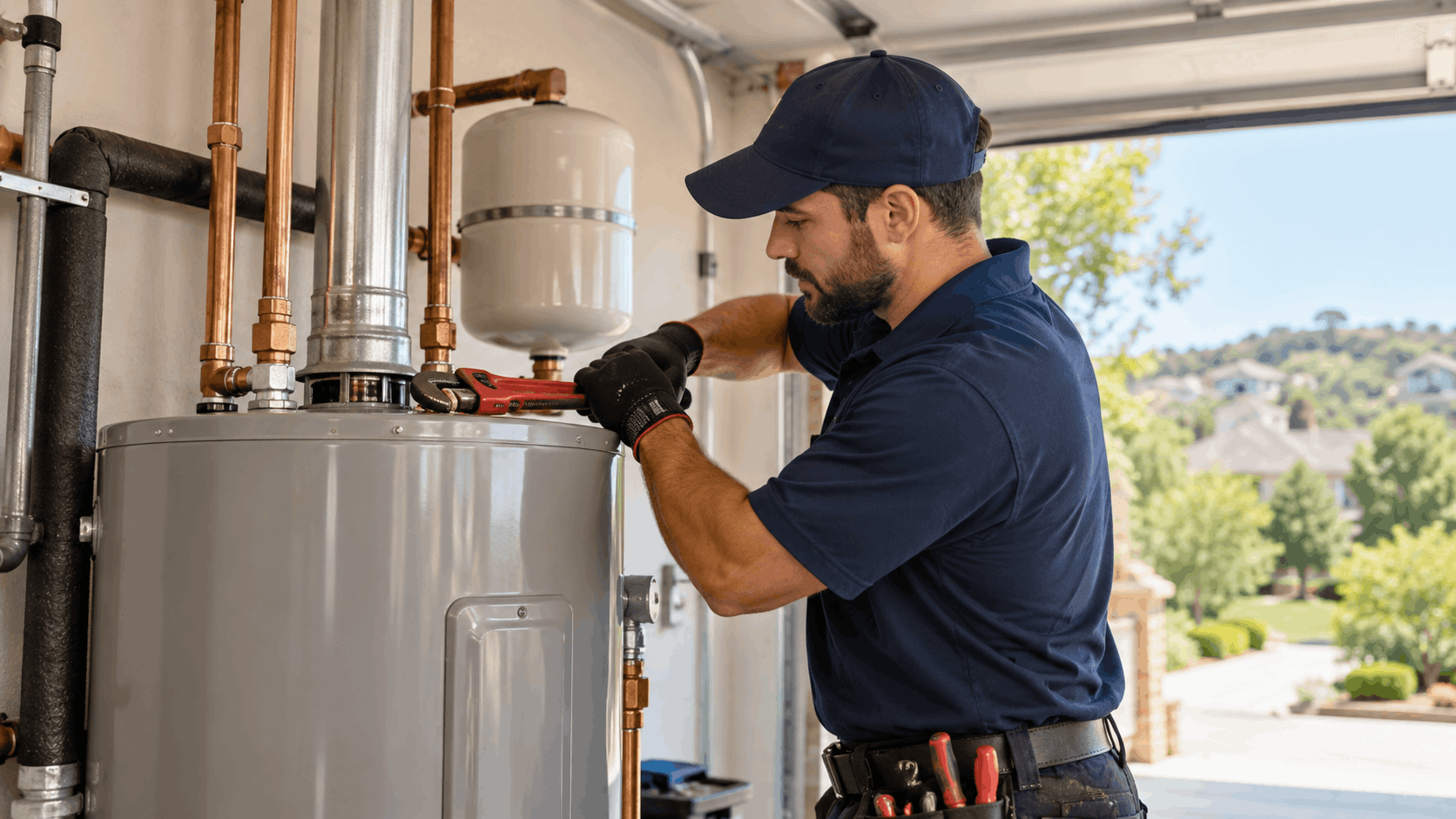
Walk down any street off Hillpointe Road and the houses are around thirty to thirty-five years old. A standard tank heater simply does not last that long, so almost every home here is on a replacement already. Many are on their third. The pattern is so consistent that when we get a call from this village, we expect to find a unit that is not original and a water chemistry story behind it.
The Build Era and What It Means for Equipment
The Hills was developed from the early 1990s on the eastern side of Summerlin, around the golf corridors. That makes it the second-oldest part of the community after Sun City, which puts it in a different category from newer villages like The Paseos or Summerlin West. These are older homes with older systems, and the equipment inside them has already been through a full lifecycle or two.
Every home here is built slab-on-grade, which matters for the plumbing in ways we will come back to. For now, the point is simple: a house this age has outlived its original water heater by a wide margin. A tank heater installed in the early build years would have reached the end of its service life long ago.
So when the current unit fails, it is not a surprise or a defect. It is the normal arc of equipment in a home that has been lived in for three decades. The question is never whether it will need replacing, only when, and whether the replacement is set up to last.
Understanding that arc helps a homeowner plan instead of panic. A heater that is more than ten or twelve years old in this valley is on borrowed time, and knowing that lets you budget and choose rather than scramble during a cold shower.
Very Hard Water and the Early-Failure Pattern
The Southern Nevada Water Authority reports the valley's water hardness at 280 parts per million, which works out to about 16 grains per gallon. That figure is categorized as very hard. It is the single biggest reason water heaters in The Hills fail earlier than their rated life.
Hard water carries dissolved calcium and magnesium. Inside a water heater, heat drives those minerals out of solution, and they settle as scale on the heating elements and across the bottom of the tank. On a gas unit, that layer of scale sits between the burner flame and the water, so the burner has to run longer to heat the same amount of water.
A tank that is never flushed collects more scale every year. It works harder, runs hotter at the bottom, and fails earlier than its rated life. The sediment can also start to trap steam pockets under the hardpan of scale, which is where the popping and rumbling noises come from.
This is the mechanism behind the second-and-third-unit pattern we see across the village. It is not bad luck. It is predictable chemistry working on a tank for years, and it explains why treatment and flushing matter so much once the new heater goes in.
Signs Your Heater Is Due in a Hills Home
Homeowners rarely describe the problem in plumbing terms. They tell us the hot water runs out faster than it used to, or that it comes out rusty or cloudy. Both of those point to a tank that has corroded inside or filled with sediment, which is scale and age working together.
Popping or rumbling sounds are another common complaint. That noise is water trying to bubble up through a thick layer of scale on the tank bottom. A dripping relief valve is also worth attention, though as we will explain later, that is frequently a thermal expansion tank problem rather than a faulty valve itself.
Then there are the visible signs. Moisture or rust around the base of the tank, or a small puddle on the garage floor, usually means the tank wall has given up. An unexplained rise in the water bill can mean the heater is running more than it should, which is its own warning worth checking out.
Any one of these is a reason to have the unit looked at. Taken together on a thirty-year-old home, they usually mean the heater is near the end. Our water heater services team can confirm whether a repair makes sense or whether replacement is the better value.
Get Your Quote
Tell us what's going on and we'll get back to you fast.
Confirming Who Governs Your Address Before Any Permitted Work
Before anyone quotes permitted work in Summerlin, the correct permit counter has to be settled for the exact address. Summerlin spans both the City of Las Vegas and unincorporated Clark County, and the boundary does not follow village names. That trips up plenty of homeowners who assume one rule covers the whole community.
The Hills, 89134, and the City of Las Vegas
The Hills is a Summerlin village in the City of Las Vegas, at ZIP code 89134. Hillpointe Road runs through its center, with Hills Center Drive and Pinewood Hills Drive branching off it. The Hills Park sits at 9100 Hillpointe Road, and William Lummis Elementary and Ernest A. Becker Middle are both inside the village.
Because Summerlin crosses jurisdictions, we still confirm the building department for the specific address before quoting. The village sitting in the City of Las Vegas is the starting point, not the final word, since the boundary between city and county does not track village lines cleanly.
Telling a homeowner which department governs their property is a small step, but it is the right first move on any permitted job. It avoids a situation where work is quoted against the wrong code counter and has to be sorted out later. We handle plumbing across Summerlin and know how to pin the jurisdiction down quickly.
Getting this right up front saves time and avoids delays when the inspection comes. It is also a clear signal that the person quoting the work actually knows the area rather than treating the whole valley as one big permit office.
Why a Permit Matters on a Water Heater Swap
Replacing a water heater is permitted work. The city or county with jurisdiction over the address decides the permit, and the position is confirmed for that address rather than stated as one valley-wide rule. For a Hills home, that means checking with the correct building department before the job begins.
A permit brings an inspection, and the inspection is there to confirm the install meets current code. That protects the homeowner. A properly permitted and inspected heater is one less headache if the home is ever sold or if an insurance claim ever hinges on whether the work was done to code.
Permit fees and the details of which code edition applies change over time, so those are confirmed with the jurisdiction rather than quoted from memory. What stays constant is the principle: the work is permitted, and the permit follows the address.
Work requiring a permit also has to be performed by an appropriately licensed contractor. A homeowner is entitled to ask for a license number and verify it, which is a reasonable thing to do in a market with a real unlicensed-trade problem.
HOA and Summerlin Design Review for Visible Equipment
Summerlin is governed by a master association with village sub-associations under Nevada Revised Statutes Chapter 116, and Summerlin design review is active. For most water heater replacements, this does not come into play at all, because the unit sits inside a garage or a closet where nothing is visible from the street.
Where it does matter is visible equipment. An exterior tankless unit, a water heater enclosure, a treatment system or any equipment on a street-facing elevation can require design review approval. Interior work does not. If your replacement involves anything mounted outside or visible from the common areas, that approval path needs checking before the job is scheduled.
It is worth understanding that association approval and a building permit are two separate tracks. Clearing one does not clear the other. On a change that touches both, two sets of documents can apply to a single piece of equipment, and both need to be squared away.
For a straightforward swap of an interior tank, none of this slows the job down. We raise it only when the plan puts equipment somewhere the association can see it, so there are no surprises later.
Who Authorizes the Work in a Gated or Rental Property
The Hills is predominantly owner-occupied, including long-tenured original owners, but it also has a share of rentals, managed properties and second homes in the gated enclaves. That mix means the person standing in the house is not always the person who authorizes the repair or pays for it.
In a gated enclave, contractor access is arranged in advance through the homeowner rather than sorted out at the gate. We set that up before the visit so the technician is not left waiting outside. It is a simple coordination step that keeps the appointment on track.
For a rental or a managed property, the call often comes from a tenant, but the landlord or property manager is the one who signs off on the work and the cost. Establishing who authorizes and who pays belongs in the very first call, before any diagnostic or quote.
A second home or seasonally occupied house raises its own point. A heater problem, or worse a hidden leak, can run a long time before anyone notices in a house that sits empty for stretches. That is a reason to think about a shut-off check and to act promptly once a problem shows up.
Need Help in Las Vegas?
Active Plumbing serves Las Vegas and all of Las Vegas Valley.
What the 2024 Code Changes Mean for Your Replacement
Southern Nevada adopted the 2024 Uniform Plumbing Code with the Southern Nevada Amendments, replacing the 2018 editions. In the City of Las Vegas, the 2024 code took effect on January 5, 2026. A handful of those amendments bear directly on a water heater swap in a Hills home, so a replacement done now is held to these rules.
| Code item | What the 2024 amendment requires |
|---|---|
| Drain pan | Required where a leak would cause damage, at least 1-1/2 inches deep, with a drain not less than 3/4 inch to a visible approved location |
| Relief valve discharge | No discharge into the pan; approved materials include galvanized steel, hard-drawn copper, CPVC, PP, flexible corrugated connectors or listed drain tube to the exterior |
| Water closets | Max 1.28 gallons per flush (relevant to wider plumbing work in the home) |
| Showerheads | Max 2.0 gpm at 80 psi under WaterSense rules |
Drain Pan Requirements Where a Leak Would Cause Damage
The amendments require a water heater drain pan where a leak would cause damage, such as an attic installation or a floor-ceiling assembly. The pan has to be at least 1-1/2 inches deep, with a drain not less than 3/4 inch running to a visible approved location.
This matters most in homes where the heater sits above finished space. If a tank gives up in an attic or on an upper floor without a pan and a drain, the water has nowhere to go but down into drywall, insulation and flooring. The pan and its drain line turn a potential ceiling collapse into a visible drip you can catch early.
In many Hills garages the heater sits on the slab, where the pan rule may read differently than it does for an attic unit. The point of the drain going to a visible location is that someone actually sees the water and acts before it does damage. A drain that dumps somewhere hidden defeats the whole purpose.
Readily accessible tankless and point-of-use heaters are treated as exceptions under the amendment. Where a pan is required, though, it is part of a code-compliant install now, not an optional add-on, and we size and route it to meet the rule for the specific setup.
Relief Valve Discharge and Approved Materials
Every tank water heater has a temperature and pressure relief valve. If pressure or temperature climbs too high, that valve opens and discharges water to protect the tank from bursting. The 2024 amendments are specific about how that discharge is routed and what it is built from.
Inside a building, the relief valve drain can be galvanized steel, hard-drawn copper piping and fittings, CPVC, PP, flexible corrugated connectors or a listed drain tube running to the exterior, unless the listing prevents it. The amendment also allows air gap options, such as discharge through an air gap to a secondary washer port, a floor sink, a mop sink or a funneled floor drain.
One rule stands out: no relief valve may discharge into the drain pan. The pan is there to catch a tank leak, not to receive hot discharge water from the relief valve. Routing the relief line into the pan is a mistake we sometimes find on older or non-permitted installs, and the 2024 code does not permit it.
When we replace a heater, we check that the relief valve line meets these material and routing rules. On an older unit the discharge pipe may be the wrong material or run to the wrong place, so bringing it into line is part of a proper replacement.
Thermal Expansion and the Expansion Tank
Thermal expansion is what happens when water heats up and expands inside a closed system. If there is nowhere for that extra volume to go, pressure climbs. A thermal expansion tank gives the system a cushion to absorb that pressure, and on many homes with a pressure regulator or check valve it is doing real work.
The trouble is that expansion tanks fail silently and are routinely missed. When one fails, it loses its air charge and stops absorbing pressure. The first symptom is often a relief valve that keeps dripping, because the valve is now releasing the pressure the dead expansion tank should have handled.
That is why a dripping relief valve is frequently an expansion tank problem rather than a faulty valve. Swapping the valve without checking the expansion tank just treats the symptom, and the drip comes right back. A proper diagnosis looks at the whole closed system, not only the part that is visibly leaking.
A water heater replacement is the natural moment to check or add an expansion tank. The system is already open, the pressure is being verified, and a sound expansion tank protects the new heater from the pressure cycling that wears tanks out early.
Tank vs Tankless in a Thirty-Year-Old Hills Home
When a heater fails, the first question most owners ask is whether to replace like-for-like or switch to tankless. Both choices have a direct relationship with the valley's very hard water, and that relationship shapes the honest answer more than any brochure feature does.
| Option | Best suited to | Hard water impact |
|---|---|---|
| Standard tank | A straightforward like-for-like swap in most Hills homes | Needs flushing on a schedule or it fails earlier than its rated life |
| Tankless | Homes wanting continuous hot water and space savings | Scale attacks the narrow heat exchanger; needs treatment and regular descaling |
| Heat pump / electric | Homes set up for electric service | Running costs relate to NV Energy; still benefits from treatment |
Standard Tank Replacement
For many Hills homes, a like-for-like tank swap is the simplest path. The existing connections, venting and location are already set up for a tank, so the replacement drops into a known footprint. It is predictable work with a predictable result.
A tank heater stores and heats a set volume of water, ready when you need it. That suits households with a clear peak demand, like back-to-back morning showers, and it keeps the install straightforward. Our tank water heater installation work covers this across the village.
The one thing a new tank asks for in this valley is flushing. In 280 ppm water, a tank left unflushed works harder and fails earlier than its rated life, because scale builds on the bottom and the elements. Flushing on a schedule clears that sediment before it hardens into a layer the burner has to fight through.
So the honest framing for a tank is this: the install is easy, and the maintenance is what keeps it going. Skip the flushing and you repeat the early-failure pattern that put you on your current replacement in the first place.
Tankless and the Narrow Heat Exchanger
Tankless heaters appeal because they heat water on demand and do not store a tankful that eventually corrodes. In this valley, though, there is a catch worth knowing before you commit. Scale accelerates failure in tankless units, because the heat exchanger is a narrow passage where minerals collect fast.
Inside a tankless unit, water flows through tight channels that get hot quickly. Very hard water leaves scale in those channels, and because they are narrow, even a thin layer restricts flow and heat transfer. That means a tankless heater in Las Vegas needs treatment on the incoming water and regular descaling service to live out its life.
That is not a reason to rule tankless out. It is a reason to go in with eyes open. A tankless unit paired with softening or scale reduction and a maintenance schedule can serve a Hills home well. One installed on untreated hard water with no servicing is asking for an early failure.
We offer tankless maintenance and descaling precisely because this water makes that service necessary rather than optional. If you want tankless, plan for the upkeep that keeps the heat exchanger clear.
Gas Sizing for the Whole Load
Larger Hills homes often have more than one gas appliance. A pool heater, a spa, an outdoor kitchen and a water heater can all draw gas, sometimes at the same time. The gas line has to be sized for the whole load, not just for the appliance being installed.
The common mistake is sizing a line to a single appliance and ignoring everything else on the system. When several appliances run together, an undersized line cannot deliver enough gas, and the result shows up as an appliance that underperforms rather than as an obvious fault. A tankless heater that cannot reach full output, for example, may be starved for gas rather than broken.
Getting this right means calculating total demand across every appliance and confirming the supply line and meter can feed it. That is a measured, technical step, and it is why gas sizing belongs in the conversation when a larger home upgrades to a high-demand heater.
All gas line work, pressure testing and coordination relate to Southwest Gas, the natural gas provider for the valley. Our gas line services handle sizing and testing so a new heater actually gets the fuel it was built to use.
Electric and Heat Pump Considerations
Some homes are set up for an electric or heat pump water heater instead of gas. A heat pump water heater moves heat rather than generating it with a burner, which can lower running costs. Those running costs relate to NV Energy, the electricity provider for the valley.
A point worth being clear about on incentives: the federal Energy Efficient Home Improvement Credit under Section 25C applied only to equipment placed in service by December 31, 2025. The One Big Beautiful Bill Act ended it, so it is not available for 2026 installs. Anyone planning a heat pump water heater this year should not count on that federal credit.
Utility and manufacturer rebates may still exist, but these programs change often. Rather than quote a figure that may be out of date, we point homeowners to check the current program directly before assuming a rebate applies.
Whichever route you take, the hard water story does not change. An electric or heat pump unit still benefits from treatment and sensible maintenance, because scale does not care what heats the water.

How Very Hard Water Protects or Shortens Your New Heater
The same 280 ppm water that killed the last unit goes to work on the new one from the first day it holds water. Whether the replacement reaches its rated life or fails early comes down to treatment and flushing. This is the part of the job that keeps a new heater alive in The Hills.
What Scale Does Inside a Hills Water Heater
Scale is the crust that very hard water leaves behind. Inside a water heater, calcium and magnesium drop out of the hot water and build up on the heating elements and across the tank bottom. That buildup shortens heater life in a direct, physical way.
On the tank bottom, scale forms an insulating layer between the burner and the water. The burner runs longer to push heat through it, which overheats the steel and stresses the tank. On an electric unit, scale coats the elements and makes them work harder and burn out sooner.
This is the exact pattern that explains a home already on its second or third unit. Each tank collected scale, worked harder, and gave up earlier than its rating promised. The chemistry was the same every time, which is why the result was the same every time.
Knowing what scale does inside the tank is what makes the case for treatment concrete. It is not a vague worry about water quality. It is a measurable buildup doing measurable damage, and it is the reason a new heater needs a plan the moment it goes in.
Flushing on a Schedule
Regular flushing is the standard response to hard water in this valley, and it extends equipment life rather than being optional. A flush drains the sediment and loose scale out of the tank before it hardens into a layer the burner has to fight through.
A tank that is never flushed keeps every bit of sediment it ever collects. That sediment builds year over year, the tank works harder, and it fails earlier than its rated life. Flushing on a schedule breaks that cycle by keeping the tank bottom relatively clear.
How often depends on the unit and the household, but the principle holds: in 280 ppm water, flushing is maintenance a heater actually needs, not a luxury. Skipping it is how a brand-new tank ends up repeating the story of the old one.
We fold flushing into regular service so a new heater gets the upkeep this water demands. It is a small, routine job that pays off in years of service life you would otherwise lose to sediment.
Whole-House Softeners and Scale-Reduction Systems
Flushing handles the heater. A whole-house softener or scale-reduction system handles the water before it ever reaches the heater, and it protects a lot more than one appliance. These systems are the standard response to very hard water, and in this valley they extend equipment life rather than being optional luxuries.
A softener removes the calcium and magnesium that form scale, so the new heater, the fixtures, the recirculation system and the appliances all see softer water. In a Hills home where the owner has already paid for newer fixtures and equipment, treating the water protects that investment, not just the heater.
A scale-reduction system takes a different approach, conditioning the minerals so they are less likely to deposit as hard scale. Either way, the goal is the same: cut the scale load the whole house has to deal with. Our water softener installation and broader water treatment options cover both paths.
One local note on placement: a visible exterior treatment system can require Summerlin design review approval. If the softener or conditioner ends up somewhere the association can see it, that approval path needs checking before it goes in.
Need Help in Las Vegas?
Active Plumbing serves Las Vegas and all of Las Vegas Valley.
The Cheap Parts Worth Replacing at the Same Time
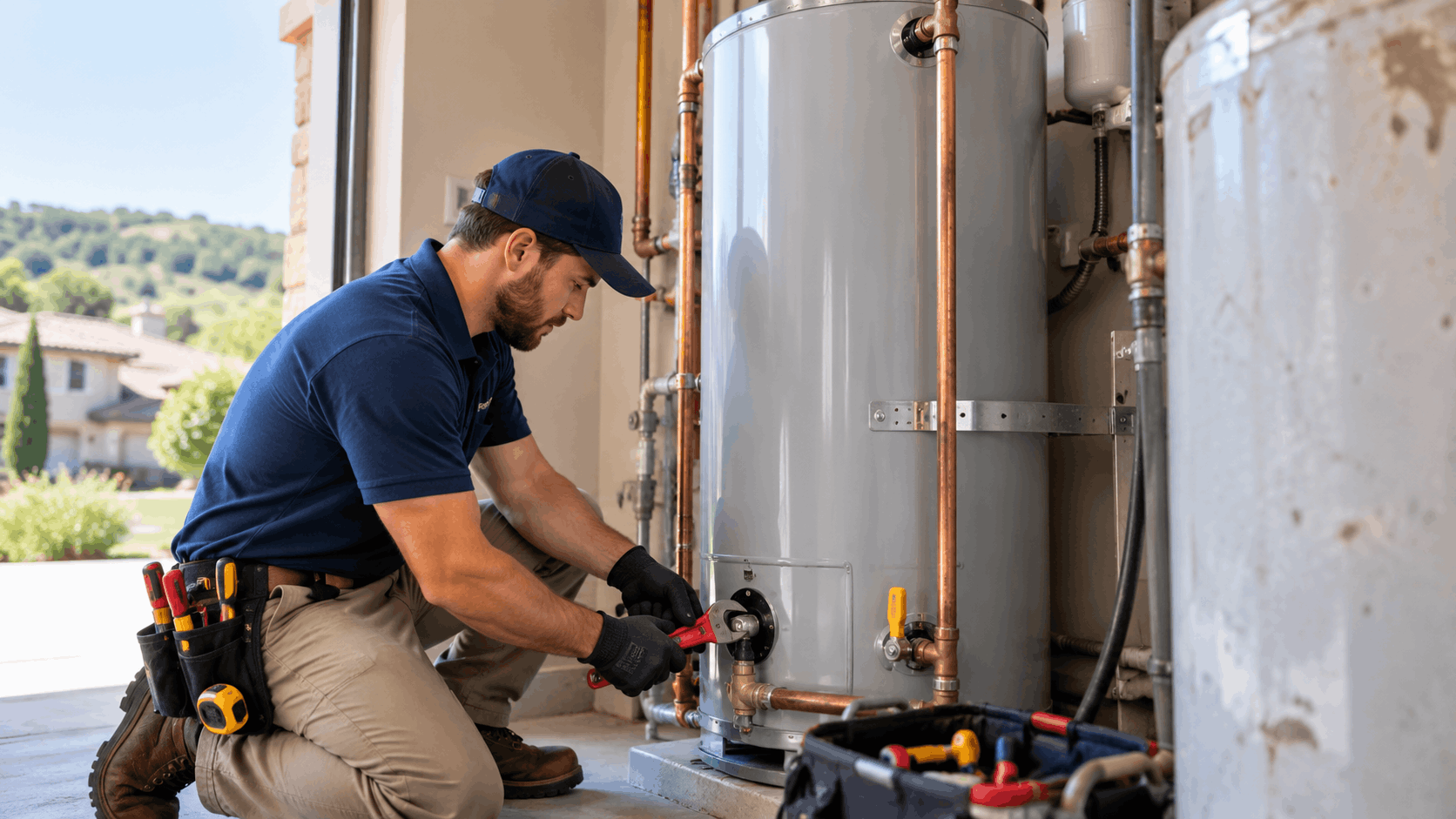
In a thirty-year-old Hills home, several small components around the water heater are well past their service life. Dealing with them during the replacement saves a second visit and keeps a new heater from sitting on worn, original connections that are ready to fail.
Pressure Regulator and Incoming Pressure
A pressure regulator, or PRV, controls the water pressure coming into the house. Over thirty years it wears out, and it can fail in two directions. It can creep high, quietly stressing everything downstream, or it can drop and produce the low-pressure complaint the owner actually notices.
High pressure is the dangerous one because it hides. The home feels fine, but every fixture, valve and the new heater is carrying more strain than it should. That strain is exactly the kind of thing that shortens the life of equipment you just paid to install.
Because of that, a two-minute incoming pressure check belongs on every call. It is quick, it is cheap, and it tells us whether the PRV is doing its job. Finding high pressure during a heater replacement means we can correct it before it goes to work on the new tank.
If the regulator has failed, replacing it alongside the heater protects the whole system. It is one of those small parts that is easy to overlook and expensive to ignore, because the damage shows up everywhere downstream.
Connectors, Angle Stops and Supply Lines
Angle stops, connectors and fill valves that are still original at thirty years are past sensible service life. These are the small shut-off valves and flexible lines at the heater and throughout the house, and they wear and corrode just like everything else.
In a home where copper is starting to leak, these are the cheap items worth handling at the same time as the heater. The technician is already on site with the water off, so swapping a brittle angle stop or an old connector costs little compared to a return visit when one fails later.
An old angle stop that will not fully close is a common nuisance. When it comes time to work on a fixture, a seized shut-off turns a small job into a bigger one. Replacing it during the heater visit clears that problem before it bites.
This is the logic of dealing with the cheap parts together: the access is already there, the water is already off, and the labor is already paid for. Our pipe and fixture services cover these alongside a heater swap.
Washing Machine Hoses and Other Original Fittings
Washing machine hoses that are original at thirty years are well past sensible service life. A burst washer hose is one of the more common causes of indoor water damage, and in a three-decade-old home those rubber hoses have had plenty of time to harden and crack.
Because the technician is already in the home for the heater, addressing hoses and other original fittings during the same visit makes sense. It avoids a separate call later and it removes a known risk while someone is already there with the tools out.
The same thinking applies to other original fittings around the laundry and utility areas. Thirty-year-old supply lines, shut-offs and connectors are all candidates. None of them are expensive on their own, and all of them are cheaper to handle together than one at a time.
This is preventive work in the plainest sense. You are not fixing something that has failed, you are replacing something that is going to fail, during a visit that is already happening. That is the kind of maintenance that keeps a home out of the emergency-call category.
Copper Age and the Slab Leak Risk Around the Heater
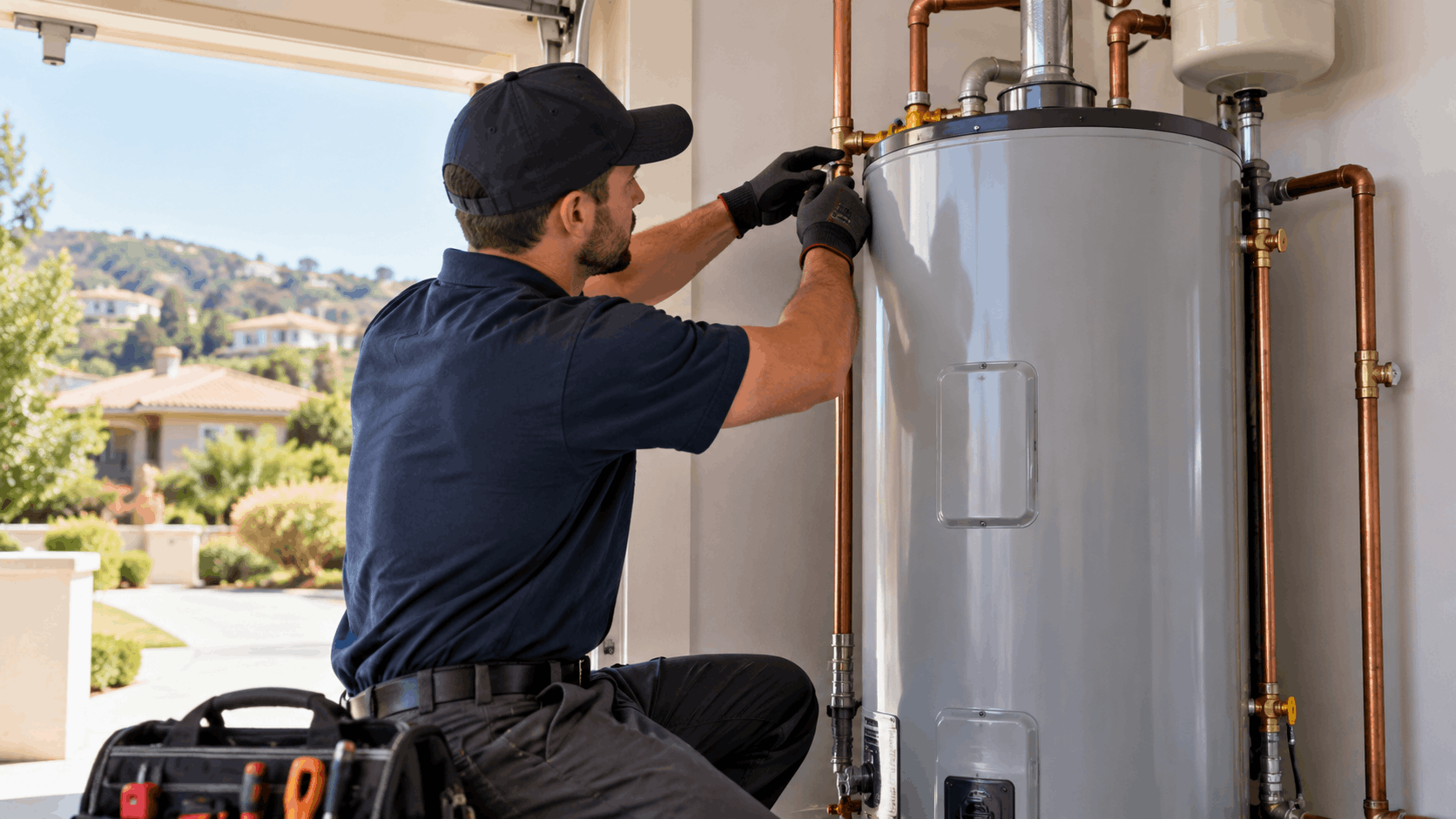
The earlier phases of The Hills were plumbed in copper, and that copper is now reaching the age where pinhole leaks begin. A water heater running more than it should can be the first sign of a hidden leak, which makes a replacement a good moment to check the system as a whole.
When a Running Heater Points to a Hidden Leak
One of the usual first signs of an under-slab leak is a water heater or pump running more than it should. If hot water is escaping from a hidden line, the heater keeps firing to replace it, so it runs far more than the household use would explain.
Other early signs include a recurring warm spot on the floor and an unexplained rise in water usage. A warm spot points to a hot line leaking under the slab, since the escaping hot water heats the concrete above it. Rising usage with no change in habits means water is going somewhere you cannot see.
These signs tie directly to copper of this age on the hot and under-slab runs. The heater is often the loudest clue because it reacts to a hot-water loss immediately. When a replacement call comes in and the old heater was running constantly, we look past the tank for a possible leak.
Catching this during a heater replacement can save a lot. Installing a new heater onto a system with an active slab leak just means the new unit runs hard from day one, so finding the leak first protects the investment.
Why Copper of This Age Starts to Leak
Copper is a durable material, but it does not last forever. In the earlier Hills phases, copper supply lines are reaching the point where pinhole leaks begin, particularly on hot lines and on under-slab runs where the pipe is harder to reach and works in tougher conditions.
Pinhole leaks form when the pipe wall corrodes through from the inside at a tiny point. Hot lines tend to go first because heat accelerates the process. Once a home has had one pinhole leak, it will usually have more, because the same pipe of the same age runs throughout the house.
That pattern is what makes The Hills the Summerlin village where slab leak work is a genuine category rather than a rare event. In the newer villages, an under-slab failure is almost always construction-related. Here, it is copper reaching its age, which is a different conversation entirely.
For an owner weighing a spot repair against a partial or whole repipe, the honest thing to say is that one pinhole leak usually signals more to come. A repipe conversation in this village is about copper reaching its age, not about a defective material. Our whole house repipe work exists for exactly this stage of a home's life.
Detection, Spot Repair or Reroute
An under-slab leak is not accessible, so the first step is always detection. We locate the leak without tearing up the whole floor, using equipment built to pinpoint where the line is failing. Our electronic leak detection is made for exactly this.
Once the leak is found, the choice is between breaking the slab for a spot repair or rerouting the line. Breaking the slab means cutting through the concrete floor to reach and fix the pipe, then patching everything back. A reroute abandons the failing section and runs a new line, often overhead or through walls, bypassing the slab entirely.
In a finished home with stone or hardwood floors, rerouting is frequently the better value. Breaking a slab under expensive flooring means replacing that flooring too, and matching thirty-year-old stone or hardwood is rarely clean or cheap. A reroute avoids disturbing the finished surface.
Which path makes sense depends on where the leak sits, the flooring above it, and whether the copper elsewhere is close behind. If one pinhole leak is likely the first of several, a partial or whole repipe may beat chasing leaks one at a time. We lay out the real options so a homeowner can choose with the full picture.
Need Help in Las Vegas?
Active Plumbing serves Las Vegas and all of Las Vegas Valley.
How Active Plumbing Handles a Water Heater Replacement in The Hills
Here is how a replacement actually runs, from the first phone call to the finished install, so a Hills homeowner knows what to expect before anyone arrives. The process is built around getting the details right up front, so the install goes smoothly and meets code.
The First Call and the Diagnostic
The first call does more than book a slot. It establishes who authorizes the work and who pays, which matters in a village with rentals, managed homes and gated enclaves. It also confirms the correct jurisdiction for the address, since Summerlin crosses between the City of Las Vegas and unincorporated Clark County.
From there we set up the diagnostic. That includes a two-minute incoming pressure check, because pressure problems affect both the old heater and the new one. Checking it early tells us whether a worn pressure regulator is part of the story.
Technicians arrive in 30 to 60 minutes anywhere in the Las Vegas Valley, so a Hills home off Hillpointe Road is well inside that window. A prompt arrival matters most when there is water on the floor and a tank that has let go.
The diagnostic is where we confirm whether the heater needs replacing, whether an expansion tank or regulator needs attention, and whether a running heater might point to a hidden leak. That full look is what keeps a replacement from becoming a repeat call.
A Written Price Before Work Starts
Before any work begins, the customer gets a written price. You see what the job costs before a wrench turns, so there is no guesswork about the bill once the work is done. This is how we operate on a water heater replacement.
A written price means the scope is agreed up front. If the diagnostic turns up something else worth handling at the same time, like a worn angle stop or a failed expansion tank, that gets discussed and priced before it is done, not added silently afterward.
This approach fits the way these jobs tend to go in a thirty-year-old home. There are often small parts around the heater worth addressing together, and putting them in writing first lets the homeowner decide what to include with full information.
The written price is a straightforward business practice, and it is there to give a clear answer to the question every homeowner has: what is this going to cost. You get that answer before the work starts.
Licensed, Local and Family-Run Since 1991
Active Plumbing is a fourth-generation family business that has served the Las Vegas Valley since 1991. Some of our owners are US military veterans. We work these neighborhoods every week and know how The Hills and the rest of Summerlin are built.
We hold Nevada plumbing license NSCB #0047021, which a homeowner can verify free at nvcontractorsboard.com, where classification, status, bond and workers compensation are all public record. Licensing applies to permitted work, and an owner is entitled to check it.
That verification step matters in a market with a real unlicensed-trade problem. Asking for a license number and confirming it is a reasonable thing to do, and we are glad to be checked. Contractor licensing in Nevada is handled statewide by the Nevada State Contractors Board.
Being local and family-run since 1991 means we have seen the full arc of these homes, from original copper to the second and third generation of equipment inside them. That is the experience we bring to a replacement off Hillpointe Road.
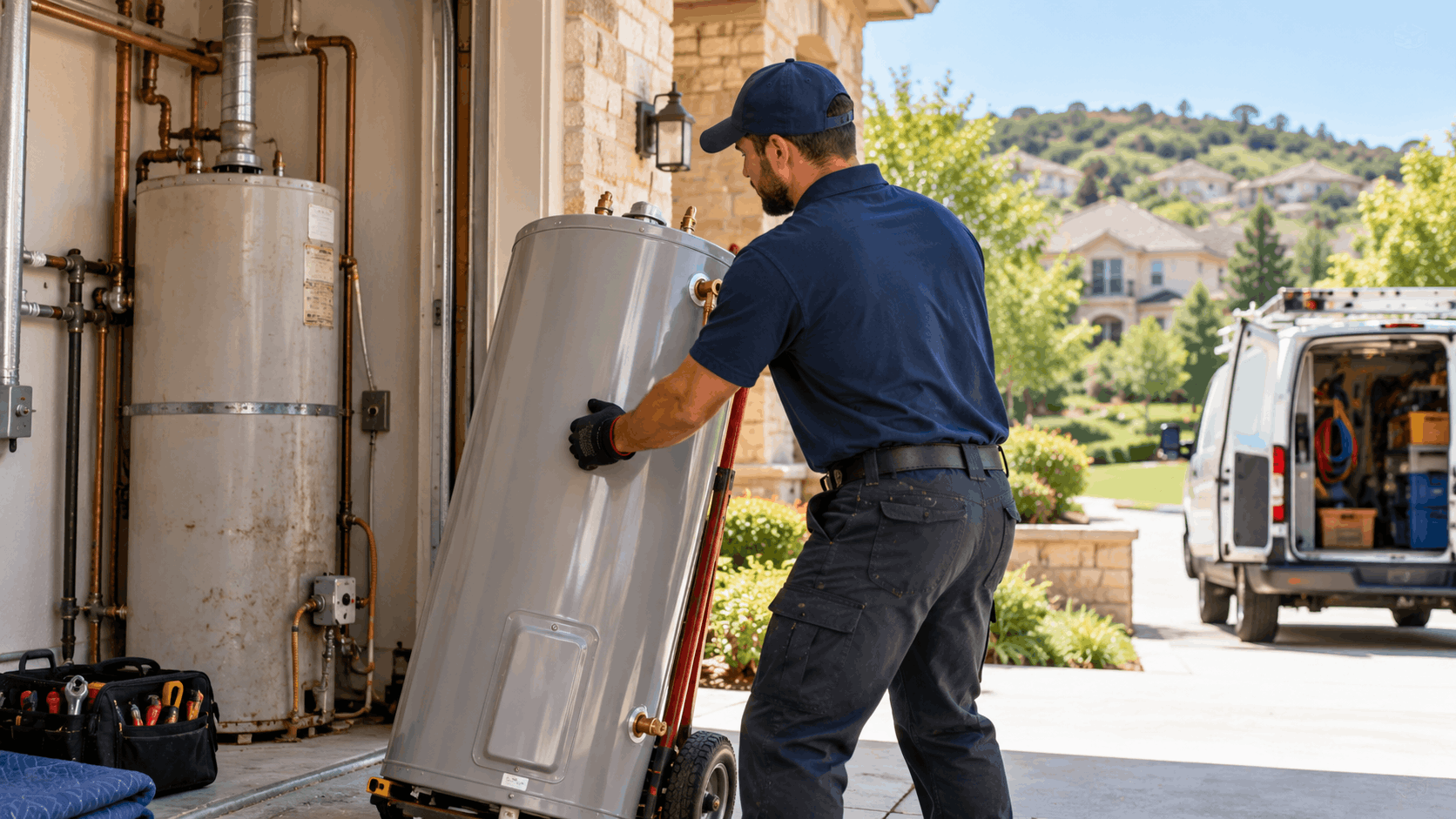
Ready to Replace Your Water Heater in The Hills?
If your heater is on its second or third life off Hillpointe Road and showing its age, call Active Plumbing at (702) 438-3357. We confirm the jurisdiction for your address, run a full diagnostic with a pressure check, and give you a written price before any work starts.
A technician can reach a Hills home in 30 to 60 minutes anywhere in the valley, so whether you have a cold shower or a puddle under the tank, help is close. Reach out through our contact page to get started.
Frequently Asked Questions
- How long does a water heater last in The Hills?
- Very hard water at 280 ppm, about 16 grains per gallon, shortens heater life in this valley. A tank that is never flushed collects scale on its bottom and elements, works harder, and fails earlier than its rated life. That is why many Hills homes, now thirty to thirty-five years old, are already on a second or third unit. Flushing on a schedule is what gets a new heater closer to its full service life.
- Do I need a permit to replace a water heater in The Hills?
- Yes. Water heater replacement is permitted work in Southern Nevada. The Hills is a Summerlin village in the City of Las Vegas at ZIP 89134, but because Summerlin crosses jurisdictions and the boundary does not follow village names, the correct permit counter is confirmed for your specific address before the job is quoted. The permit brings an inspection that confirms the install meets current code, which protects you down the road.
- Should I switch to tankless in a thirty-year-old Hills home?
- Tankless is a real option, but go in knowing the trade-off. Scale accelerates failure in a tankless unit because its heat exchanger is a narrow passage where minerals collect fast. In this valley a tankless heater needs water treatment and regular descaling service to live its full life. Weigh it against a standard tank based on your hot water demand, your home's gas or electric setup, and your willingness to keep up the maintenance it requires.
- Why does my relief valve keep dripping?
- A dripping relief valve is frequently a thermal expansion tank problem rather than a faulty valve. Expansion tanks fail silently and are routinely missed. When one loses its air charge, it stops absorbing the pressure that builds as water heats, so the relief valve starts releasing that pressure as a drip. Replacing the valve alone usually does not fix it. The expansion tank needs checking, which is why a replacement is a good moment to address it.
- Does the 2024 code require a drain pan under my new heater?
- Under the 2024 code with Southern Nevada Amendments, a drain pan is required where a leak would cause damage, such as an attic or a floor-ceiling assembly. The pan must be at least 1-1/2 inches deep with a drain not less than 3/4 inch running to a visible approved location. No relief valve may discharge into the pan. Readily accessible tankless and point-of-use heaters are treated as exceptions. We size and route the pan to meet the rule for your setup.
- My new heater runs constantly. Could it be a slab leak?
- It could be. A water heater or pump running more than it should is a usual first sign of an under-slab leak, alongside a recurring warm spot on the floor or an unexplained rise in usage. Copper in the earlier Hills phases is reaching the age where pinhole leaks begin, especially on hot and under-slab runs. The next step is detection to locate the leak without tearing up the whole floor, then a decision between a spot repair and a reroute.
- Do I need HOA approval to replace my water heater?
- Interior work does not need Summerlin design review approval. Where approval can be required is visible exterior equipment, such as an outdoor enclosure, an exterior tankless unit, a treatment system, or anything on a street-facing elevation. Association approval and a building permit are separate tracks under Nevada Revised Statutes Chapter 116, so clearing one does not clear the other. For a standard interior tank swap, none of this slows the job down.
- Is the federal tax credit still available for a heat pump water heater?
- No. The federal Energy Efficient Home Improvement Credit under Section 25C applied only to equipment placed in service by December 31, 2025. The One Big Beautiful Bill Act ended it, so it is not available for 2026 installs. Utility or manufacturer rebates may still exist, but these programs change often, so check the current program directly before assuming a rebate applies to your heat pump water heater.
- What should I check to protect my new water heater?
- Four things extend the life of a new heater in very hard water. Regular flushing clears sediment before it hardens on the tank bottom. A working pressure regulator keeps downstream pressure in a safe range. A sound expansion tank absorbs the pressure that builds as water heats. And whole-house softening or scale reduction cuts the scale load reaching the heater and the rest of your fixtures. Together they protect the unit you just paid to install.
- Who supplies gas and electricity for my water heater in The Hills?
- Natural gas in the Las Vegas Valley is supplied by Southwest Gas, and electricity is supplied by NV Energy. So gas line work, gas pressure testing and gas coordination for a gas water heater relate to Southwest Gas. The running costs of an electric or heat pump water heater, and any electric bill spike from a hidden hot-water leak, relate to NV Energy. Matching the right utility to the right issue keeps troubleshooting on track.
A
Licensed plumbing professionals serving Las Vegas and Las Vegas Valley.
Licensed in Nevada · License #0047021
Last updated on
Why trust Active Plumbing?
Founded in 1991, Active Plumbing is a licensed and insured plumber serving Las Vegas and Las Vegas Valley. All content is reviewed by our licensed technicians.

Need Help in Las Vegas?
Active Plumbing serves Las Vegas and all of Las Vegas Valley.
Related Articles
How-To Guides
Water Heater Replacement in Centennial Hills: Two-Story Recirculation and Sizing
A local guide to water heater replacement in Centennial Hills two-story homes, covering sizing, recirculation, tank vs tankless, permits, and real cost ranges.

Cost Guides
Water Heater Replacement Cost in Sun City Summerlin for Late 1980s and 1990s Homes
What water heater replacement really costs in Sun City Summerlin homes from 1989 to the 1990s, shaped by unit type, the 2024 code, hard water, and City of Las Vegas permits.
How-To Guides
Water Heater Replacement Same Day Las Vegas: Stock and Install Timelines
Learn how same-day water heater replacement works in Las Vegas, from local stock and realistic install timelines to permits, neighborhood factors, and prep tips.