Cost Guides
Water Heater Replacement Cost in Sun City Summerlin for Late 1980s and 1990s Homes

Key Takeaways
- Replacement cost depends on unit type and size, whether the old install meets the 2024 code, how the heater is reached, and any fittings past their service life.
- The valley's very hard water at 280 ppm or about 16 grains per gallon deposits scale that makes an unflushed tank work harder and fail earlier than its rated life.
- Sun City Summerlin sits inside City of Las Vegas limits, so a water heater permit comes from the City of Las Vegas, not Clark County; confirm the position for the exact address.
- A dripping relief valve on a fairly new heater is usually a failed expansion tank, not a faulty valve, so pressure and the expansion tank belong in the replacement.
- Tankless units need regular descaling in this hard water because the heat exchanger is a narrow passage, and an exterior unit can require community association approval.
- The federal 25C tax credit for heat pump water heaters ended for equipment placed in service after December 31, 2025, so it cannot be counted on for a current install.
- Verify any plumber's Nevada State Contractors Board license free at nvcontractorsboard.com and insist on a written price; no legitimate plumber needs a doorstep decision.
- In older single-occupant households, replacing a seized thirty-five-year-old main shut-off with one that operates easily is a small job with outsized protective value.
In This Article
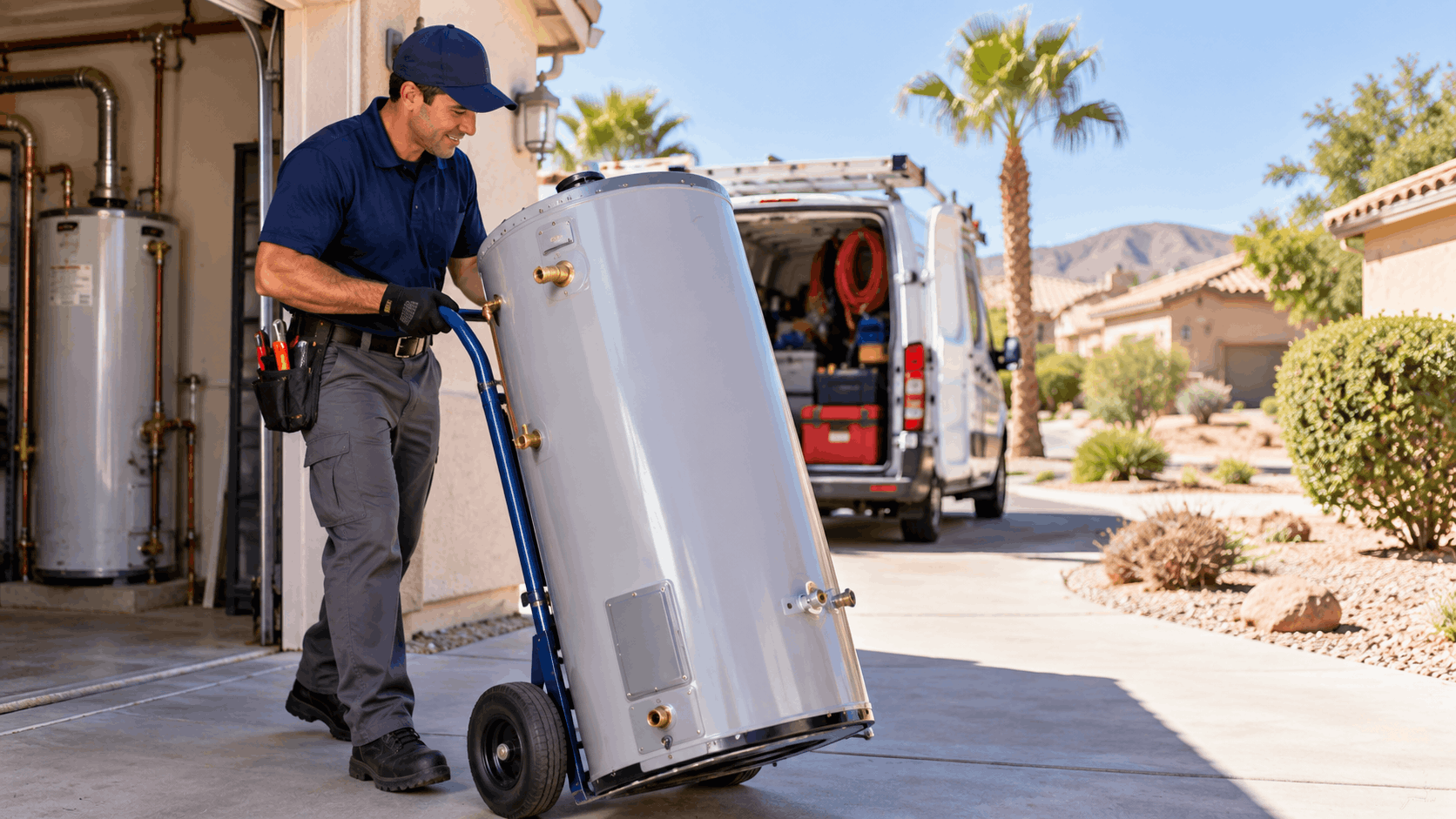
Drive the loop along Del Webb Boulevard and you are passing homes that are now thirty-five years old at their earliest phases. Del Webb started building Sun City Summerlin in 1989, and in a house that age the water heater in the garage is rarely the original. Most homes here are on their second or third unit, and the ones that fail early and repeatedly are almost always the ones that never got flushed in the valley's very hard water.
So when a resident asks what a replacement costs, the honest answer is that it depends on three things: the type of unit going in, whether the old install still meets current code, and how easy the heater is to reach. A straight like-for-like swap on an accessible garage tank is a different job from one where a drain pan and discharge routing have to be added to satisfy the 2024 code, or where the unit sits in a tight closet.
Why Water Heaters Fail Early in Sun City Summerlin Homes?
Water heater failure in these Del Webb homes usually comes down to two forces working together: the chemistry of the water coming into the house and the age of everything around the tank. Sun City Summerlin is served with Colorado River water from Lake Mead treated by the Southern Nevada Water Authority, and that water is very hard. Combine hard water with equipment and fittings that have been in place for decades and you get a predictable pattern of early failure.
The table below sums up the main failure drivers we see across this community and what each one does to a tank.
| Failure Driver | What It Does | Where We See It in Sun City Summerlin |
|---|---|---|
| Very hard water (280 ppm) | Scale builds on elements and the tank bottom, so the heater works harder | Every home in the valley, worse on tanks never flushed |
| Age of original equipment | Tanks reach and pass their rated life; internal corrosion sets in | 1989 phases where owners are on a second or third unit |
| Missed expansion tank | Pressure has nowhere to go, so the relief valve drips | Silent failures behind a fairly new heater |
| Garage or attic heat | Higher incoming water temperature stresses the tank and fittings | Slab-on-grade homes with builder-placed garage heaters |
Very Hard Water and What Scale Does to a Tank
The Southern Nevada Water Authority reports the valley's water at 280 parts per million as calcium carbonate, which works out to about 16 grains per gallon. That figure puts it firmly in the very hard category, and it is the single biggest reason water heaters here do not reach their rated life. Every gallon that passes through the tank carries dissolved calcium and magnesium with it.
When water is heated, those minerals drop out of solution and settle. On an electric unit the scale coats the heating elements and forces them to run hotter to push the same heat through. On a gas unit the scale collects as a hard crust on the bottom of the tank, right where the burner is trying to transfer heat upward.
That crust acts like an insulating blanket in the worst possible place. The burner runs longer, the steel above it gets hotter than it should, and the tank ages faster from the inside. An unflushed tank in 16-grain water works harder than the manufacturer ever assumed and fails earlier than its rated life as a result.
This is why we treat regular flushing as core maintenance in the valley rather than an optional extra. A tank that gets sediment cleared out on a schedule has a real chance of reaching its rated life. One that never gets touched builds a mineral bed that quietly shortens everything.
Thirty-Five Years of Age on the Original Equipment
The earliest Sun City Summerlin phases date to 1989, which makes this the oldest part of Summerlin by a clear margin. Newer Summerlin villages came along in the 2000s and 2010s, but here the original fittings and equipment have genuinely aged out. A water heater simply does not last thirty-five years, so the one in the garage today is almost never the one the builder installed.
Most homes here are on their second or third unit. That matters because each replacement was only as good as the water chemistry and maintenance it lived with. A tank that was swapped in fifteen years ago and never flushed has been marinating in scale the whole time it has been in service.
We also see original supporting parts that outlived the heaters they served. The angle stops, supply connectors and shut-off valve feeding the heater may still be the ones from an earlier decade, quietly corroding while the tank itself got changed. When one of those original fittings finally lets go, it can flood a garage on a slab-on-grade home in minutes.
The pattern in this community is aging equipment stacked on aging equipment. Understanding which phase a home sits in helps us anticipate what is likely behind the wall, but we always confirm what is actually there on site before we quote.
Missed Parts That Kill the New Heater Too
A common call in this community is a resident with a relatively new water heater whose relief valve keeps dripping. The instinct is to assume the valve is faulty. More often the real culprit is a thermal expansion tank that has failed silently or was never there in the first place.
Here is the mechanism. When water heats it expands, and in a closed system that pressure has nowhere to go. An expansion tank gives it a cushion. When that cushion fails, pressure climbs until the relief valve opens to protect the tank, and it shows up as a slow drip that no amount of valve replacement will cure.
The pressure regulator on the home is the other part that gets overlooked. Regulators wear out over decades and either creep high or drop off. A regulator creeping high pushes system pressure past where it should sit, which stresses the new heater, the fixtures and every connector in the house. A two-minute incoming pressure check catches this before it does damage.
These parts belong in the replacement, not in a return visit after the new heater starts dripping. Installing a fresh tank onto a dead expansion tank and a drifting regulator sets the customer up for the same problem on a brand new unit. We check pressure and the expansion tank on every water heater visit so the new install starts on a healthy system.
Garage and Attic Heat in the Northwest Valley
Summer heat in the northwest valley raises the temperature of water coming into the house and stresses any equipment sitting in a hot garage. A garage-located tank is already dealing with warmer incoming water, and the ambient heat around it does the tank no favors either. That is the reality of how the original builder set up most of these slab-on-grade homes.
Where the heater sits changes what a modern replacement needs. On a slab-on-grade home a garage install is the easiest case, but the drain pan and discharge routing still have to meet current code. In an attic or a floor-ceiling assembly, a leak would cause real damage, so the pan and drain requirements become non-negotiable.
The original 1990s install often skipped some of what today's code expects, because the code has moved on. A replacement now has to account for a pan of the right depth, a drain of the right size run to a visible approved location, and relief valve discharge routed properly rather than dumped into the pan.
We look at the location first because it drives both the labor and the code work. A tank tucked into a tight closet or up in an attic is more work to remove and set than one standing free in a garage, and that shows up honestly in the written price rather than as a surprise on the day.
Get Your Quote
Tell us what's going on and we'll get back to you fast.
What Drives the Replacement Cost Up or Down
Two houses across the street from each other on Del Webb Boulevard can get different water heater quotes, and there is a real reason for that every time. Cost is not one number for the whole community. It is built from the unit going in, the code work the old install needs, how the heater is reached, and the permit for the address.
Understanding those factors ahead of time helps a resident read a quote and know what they are paying for. It also makes it obvious when a quote is missing something it should include, which is a useful filter against a bare-minimum swap.
Tank Type, Size, and Fuel Source
The type of unit is the largest single lever on cost. A standard gas tank is usually the lowest upfront cost and the most familiar to replace. An electric tank sits in a similar range on equipment but depends on the existing electrical setup. A heat pump water heater costs more upfront and needs the right space and air around it to run. A tankless unit carries the highest equipment cost and the most involved install labor.
Size matters too. A larger household or a home with several bathrooms needs more capacity, and jumping up a size can change venting, gas sizing or electrical needs. Getting the size right avoids paying for capacity that is never used or running short during heavy use.
Fuel source shapes both the install and who to call about running it. Natural gas in the valley is supplied by Southwest Gas, so anything touching the gas supply relates to them. Electricity is supplied by NV Energy, which is who a running-cost question about an electric or heat pump unit points to. Our water heater services cover each of these unit types, and we match the recommendation to the home rather than to a default.
None of this means the most expensive option is the right one. For many homes in this community a well-installed, properly flushed gas tank is the sensible answer, and we say so when it is.
Bringing an Old Install Up to Current Code
Southern Nevada adopted the 2024 Uniform Plumbing Code with Southern Nevada Amendments in July 2025, replacing the 2018 editions. The City of Las Vegas effective date was January 5, 2026. A water heater going in now follows the current amendments, and a 1990s install often does not meet them, which is where added cost comes from on some jobs.
The amendments require a drain pan where a leak would cause damage, such as an attic or a floor-ceiling assembly. The pan has to be at least 1-1/2 inches deep, with a drain not less than 3/4 inch running to a visible approved location. Relief valve discharge is not allowed into the pan, with an exception for readily accessible tankless and point-of-use heaters.
Relief valve discharge inside a building can be run in galvanized steel, hard-drawn copper, CPVC, PP, listed flexible corrugated connectors or a listed drain tube to the exterior, unless the listing prevents it. An air gap to an approved location is also allowed. A 1990s heater may have none of this set up the way current code expects.
When we quote a replacement in a thirty-five-year-old home, we account for bringing the install current rather than reconnecting to whatever was there. That protects the home and it means the permit inspection passes without a second trip. Confirm the exact code position for your address with the City of Las Vegas, since editions and amendments do get updated.
Access, Location, and Golf Course Lots
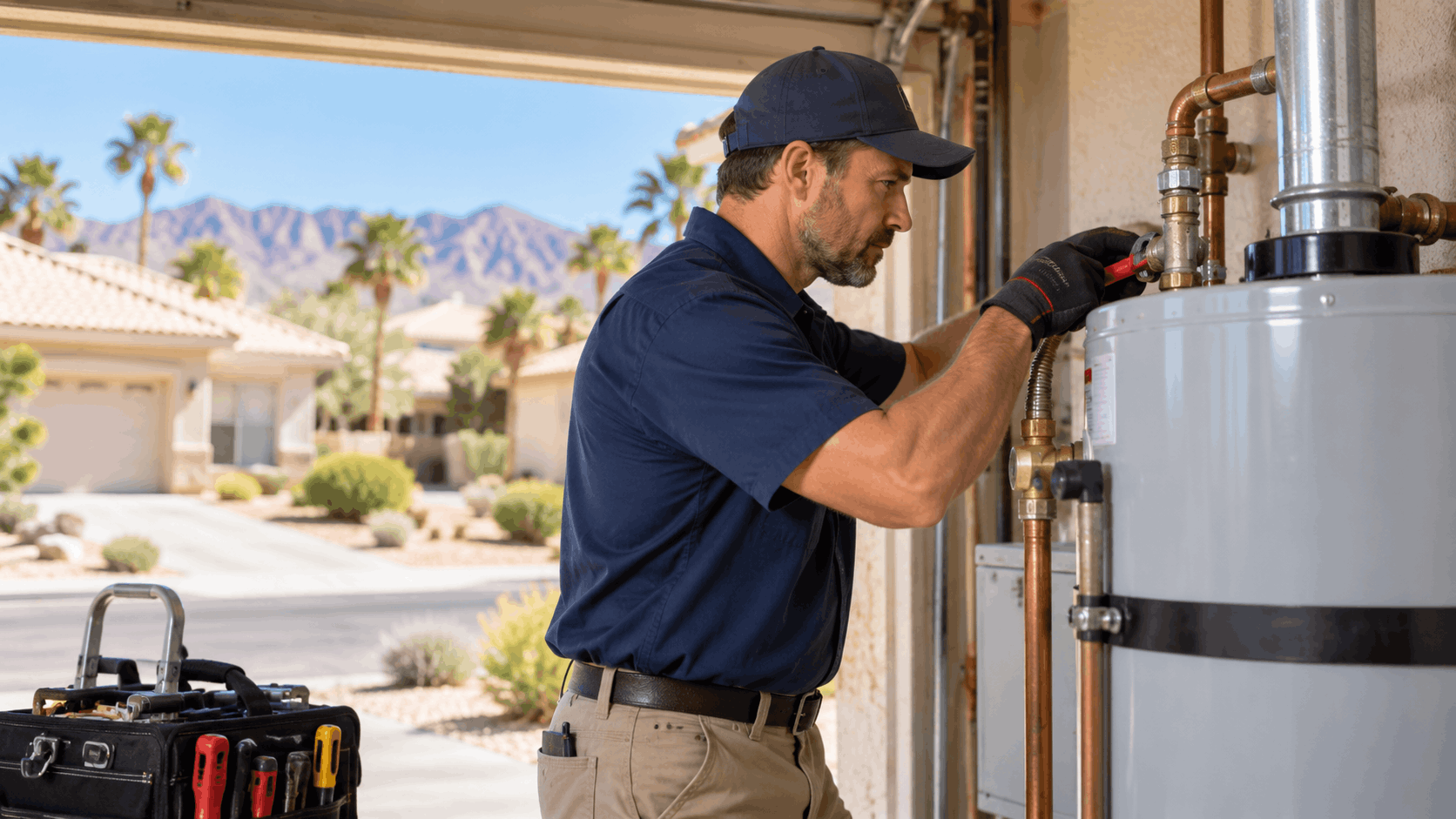
How the heater is reached changes the labor more than most people expect. A tank standing free in a garage is straightforward. A unit wedged into a tight interior closet takes longer to disconnect and maneuver. An attic install adds real time, because the old tank has to come down and the new one has to go up, and the pan and drain work is mandatory up there.
Location also decides how much protection the surrounding home needs during the swap. Carrying a full or partially drained tank through finished living space calls for floor protection and careful handling, which we build into the job rather than rushing.
Many Sun City Summerlin lots have golf course frontage along Golf Summerlin's three courses, Palm Valley at 9201 Del Webb Boulevard, Highland Falls at 10201 Sun City Boulevard and Eagle Crest at 2203 Thomas W. Ryan Boulevard. Those lots add irrigation and yard line considerations to the property's overall plumbing picture, and while that is separate from the heater itself, it can come up when we are already on site looking at the whole system.
We look at access first because it sets a realistic time and price. A resident deserves to know whether their heater is an easy garage swap or an attic job before the truck arrives, not after.
Permits and the Right Building Department
Sun City Summerlin sits inside City of Las Vegas limits, bounded by the 215 Beltway on the north, Lake Mead Boulevard on the south, North Rampart Boulevard on the east and Summerlin Parkway on the west. That means the permit counter for a water heater here is the City of Las Vegas, not Clark County, even though the community is part of greater Summerlin, which spans both.
A water heater swap usually needs a permit, and the permit brings an inspection that confirms the install meets current code. That is a protection for the homeowner, not a hurdle, because it means the pan, discharge and connections were done right.
Confirming the department for the exact address avoids wasted trips. Because Summerlin crosses the city line into unincorporated Clark County in places, going to the wrong counter costs time. For Sun City Summerlin specifically the answer is the City of Las Vegas, but we still verify the position for each address before quoting permitted work.
If you want the broader picture of how we work across the city, our Las Vegas service area page lays out how permit jurisdiction is handled address by address. The rule is simple: match the authority to the property.
Need Help in Las Vegas?
Active Plumbing serves Las Vegas and all of Las Vegas Valley.
Tank vs Tankless vs Heat Pump for This Community
For a resident on a fixed income, the water heater choice is a real budget decision, and the valley's water chemistry belongs at the front of it. There is no single right answer for the whole community, but there is a right answer for each home once you weigh upfront cost, running cost and maintenance in 16-grain water.
The table below compares the three main options honestly for homes in this community.
| Option | Upfront Cost | Maintenance in Hard Water | Best Fit Here |
|---|---|---|---|
| Gas or electric tank | Lowest | Regular flushing to reach rated life | Most homes, familiar and simple to replace |
| Tankless | Highest | Regular descaling of the heat exchanger | Homes committed to the maintenance schedule |
| Heat pump | Higher | Similar to tank, plus space and air needs | Electric homes with the right install space |
Standard Gas or Electric Tank
A standard tank, gas or electric, is the lowest upfront cost and the most familiar to replace. Parts are common, the install is well understood, and a like-for-like swap on an accessible unit is a clean job. For a lot of homes in this community it is the sensible choice.
The thing that makes or breaks a tank here is flushing. In 16-grain water a tank left alone builds a scale bed that shortens its life, so regular flushing is what gets it to the rated life the manufacturer promises. We consider this the single most useful habit a tank owner in the valley can adopt.
Electric tanks depend on the home's existing wiring and the condition of the elements, which scale in hard water. Gas tanks depend on the burner and the sediment sitting above it. Both benefit from the same maintenance discipline, and both are straightforward for us to service and replace.
Our tank water heater installation service covers sizing, code-compliant pan and discharge work, and replacing the tired fittings around the unit so the new tank starts on a sound setup.
Tankless and the Hard Water Reality
Tankless units are attractive for their compact size and endless hot water, but hard water is the honest catch. Scale accelerates failure in tankless units because the heat exchanger is a narrow passage, exactly the kind of tight bore that mineral buildup clogs fastest. What is a slow nuisance in a big tank becomes a real problem in a narrow exchanger.
That means a tankless unit here carries not just a higher upfront cost but an ongoing descaling commitment. Regular descaling keeps the heat exchanger clear and protects the investment. Skip it in 16-grain water and the very feature that makes tankless efficient is the feature that fails first.
Placement matters too. An exterior tankless unit on a street-facing elevation can require community association approval under the architectural standards, so that has to be planned rather than assumed. Interior installs generally avoid that review, but each case is worth confirming.
If a household is committed to the maintenance, tankless can work well here. We keep it running with our tankless maintenance and descaling service, which is the difference between a tankless unit that lasts and one that clogs early.
Heat Pump Water Heaters and Running Costs
Heat pump water heaters are an electric option that pull heat from the surrounding air, which can make them cheaper to run than a standard electric tank. Running cost relates to NV Energy, since they supply electricity in the valley. They need the right space and air around them to work, so the install location matters.
One point residents should hear plainly: the federal Energy Efficient Home Improvement Credit under Section 25C applied only to equipment placed in service by December 31, 2025. That credit has ended, so it must not be counted on for a current install. Any household budgeting around it for a 2026 heater needs to set that expectation aside.
Utility and manufacturer rebates may still exist and change often, so the current program is the place to confirm what is available now. We do not quote a rebate we cannot verify, and we point residents to the live program rather than a figure that may have lapsed.
For an electric home with the right install space, a heat pump unit is worth weighing. For a gas home it usually means more change than the running-cost saving justifies, and we say so rather than pushing the pricier option.
Cheap Before Expensive on a Fixed Income
For a resident stretching a budget, the honest order is cheap before expensive. Flush the heater. Clean the aerators and shower heads where scale reduces flow. Check the incoming pressure and the regulator. These are low-cost steps that address the hard-water symptoms directly.
Treatment comes into the picture when a heater has already failed early once, because that is the sign the water chemistry is winning. A whole-house softener or scale reduction system reduces the maintenance burden across the home, not just at the heater, and in this valley it extends equipment life rather than being a luxury.
We lay this out plainly so a household can decide with the numbers in front of them. There is no reason to sell a softener to someone whose heater just needs its first proper flush, and no reason to keep replacing early-failing heaters without addressing the water feeding them.
When treatment does make sense, our water softener installation reduces the scale load on every fixture and appliance in the house. That is the point where spending more upfront starts saving money on the back end.
Protecting Older Homeowners From Water Heater Scams
Older homeowners are targeted more often by unlicensed operators and high-pressure upselling, and a 55-and-over community like Sun City Summerlin is exactly the kind of neighborhood those operators look for. The counter to that is not fear, it is a few concrete habits that put a resident in control of the decision.
None of these steps is complicated, and all of them are a resident's right. A legitimate plumber welcomes them. An operator running a scam does not.
Ask for the License Number and Verify It
Plumbing work in Nevada is licensed by the Nevada State Contractors Board. A resident is entitled to ask any plumber for a license number before agreeing to work, and to verify it. This is a normal request, not an insult, and any real contractor expects it.
Verification is free and public at nvcontractorsboard.com. There you can check the classification, status, bond and workers compensation for the license. Classification tells you the contractor is licensed for the plumbing work in question, and status tells you the license is active and in good standing.
The unlicensed trade is a genuine problem in this valley, which is why verification matters more here than a homeowner might assume. A low doorstep price from someone who cannot produce a verifiable license number is not a bargain, it is a risk to the home and to the resident.
Active Plumbing holds Nevada license #0047021, and that number can be checked at nvcontractorsboard.com like any other. We would rather a resident verify us than take our word for it.
A Written Price Before Any Work Starts
A written, itemized quote is worth far more than a verbal price given on the doorstep. It can be read at leisure, set beside another quote, and discussed with family before anything is decided. In this community, where family members often help a parent with these decisions, that written document is the difference between a considered choice and a pressured one.
An itemized quote also shows what is actually included. A resident can see whether the pan, discharge routing, permit and fitting replacement are in the price or missing from it. That transparency makes it obvious when a suspiciously cheap number is cheap because it leaves out the code work.
No legitimate plumber needs a decision made on the spot. High-pressure tactics that demand a yes before the person leaves the driveway are a warning sign, not a courtesy. The work will still be available tomorrow, and a real business knows that.
We give the written price before any work starts, so the household has time to read it and talk it over. That pace suits the way decisions actually get made in a home where a resident may want to involve family.
Why This Community Talks
Sun City Summerlin is unusually well networked. Residents talk to each other constantly through clubs and the recreation centers, and word travels fast. The four association centers, Mountain Shadows at 9107 Del Webb Boulevard, Sun Shadows at 8700 Del Webb Boulevard, Desert Vista at 10360 Sun City Boulevard and Pinnacle at 2215 Thomas W. Ryan Boulevard, are gathering points where reputations get made and broken.
A contractor who does right by one household gets referred across the neighborhood. That referral network is powerful precisely because these neighbors trust each other's experience more than any advertisement.
The reverse is just as true. A contractor who cuts corners or pressures a resident gets talked about just as fast, and in a tight community that reputation sticks. We work here knowing that every job either earns a referral or costs one.
That is a good discipline for a plumber to work under. It rewards clear explanation, kept schedules and honest pricing, which happen to be exactly what this community values.
Association Rules and Access in Sun City Summerlin
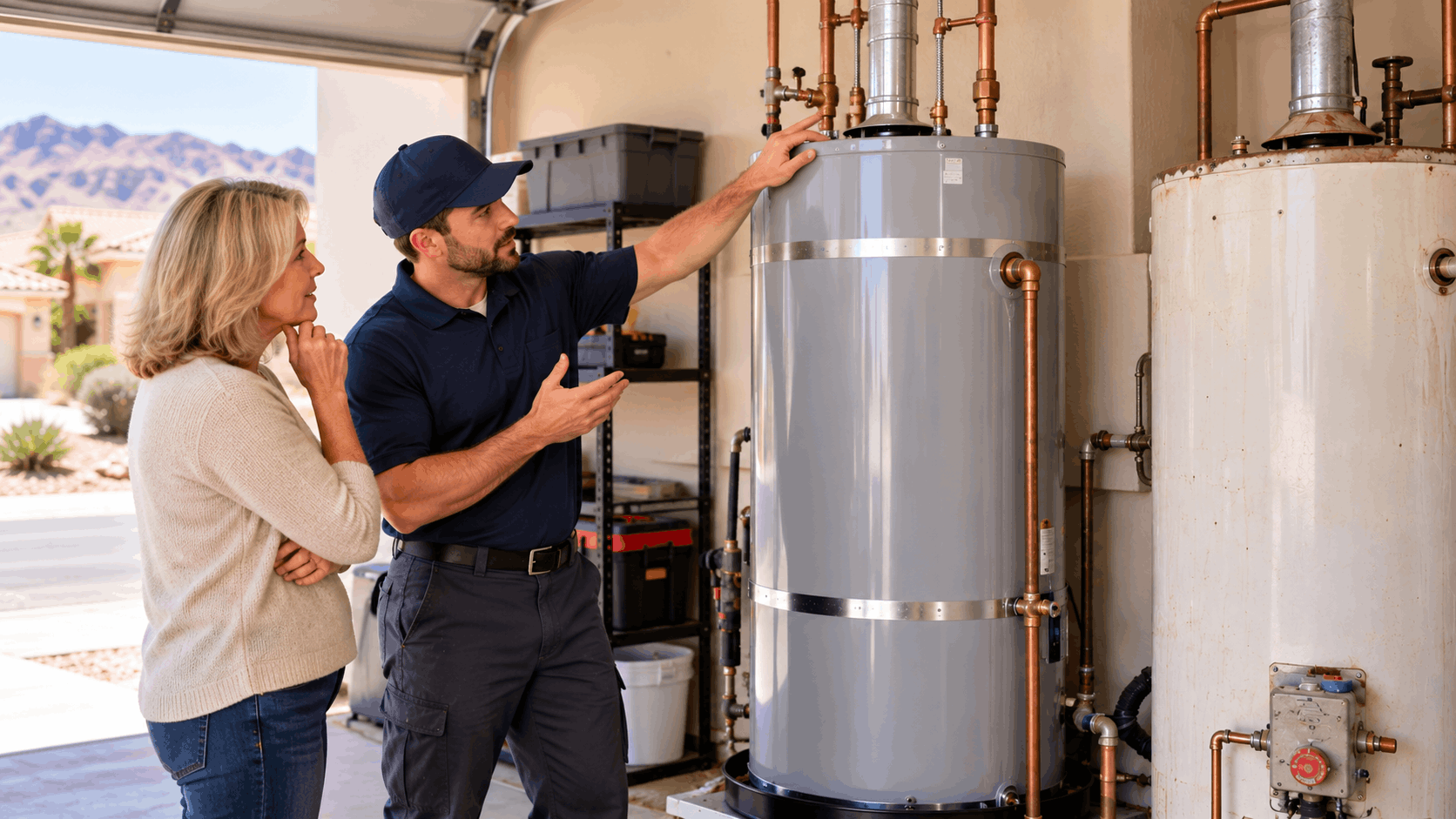
The community association shapes some water heater projects, particularly anything visible from the street. Interior work generally does not touch the association at all, but an exterior unit on a street-facing elevation can. Knowing which track applies keeps a project moving.
The association and the building permit are separate systems. One does not stand in for the other, so a project that needs both has to satisfy both.
When Association Approval Applies
The community association governs under Nevada Revised Statutes Chapter 116, with architectural standards covering exterior appearance. That means anything that changes what the home looks like from outside can require architectural review, while work hidden inside the house does not.
For a water heater, this matters when the unit or its venting ends up on a street-facing elevation. An exterior tankless unit is the classic example. Mounted where it can be seen from the street, it falls under the exterior appearance standards and can require approval before installation.
A standard tank swapped out inside the garage, by contrast, usually raises no architectural question because nothing about the home's exterior changes. The distinction is visibility and exterior appearance, not the type of unit itself.
We flag anything that might trigger review early, so a resident is not surprised partway through. It is far easier to plan for approval before the unit is ordered than to discover the issue after.
Two Separate Tracks: Association and Permit
Association approval and a City of Las Vegas building permit are two separate tracks. Where both apply, a resident should plan for both rather than assuming one covers the other. The association reviews exterior appearance; the city reviews code compliance and inspects the install. Neither one replaces the other.
Timing is worth thinking about. If a project needs architectural approval, that runs on the association's schedule, while the permit runs on the city's. Starting the approval side early keeps the two from stacking up and delaying the work.
The association office is at Mountain Shadows, 9107 Del Webb Boulevard, and current timelines and requirements should be confirmed there. We do not state a review timeline as fixed, because it can change, and the office is the authority on where things stand.
For most water heater replacements in this community, interior work means only the permit track applies. But when an exterior element is involved, planning both tracks from the start saves weeks.
Working Inside an Age-Restricted Community
An age-restricted community changes how a job is run, not just what gets fixed. Residents are 55 and over, many considerably older, and a scheduled appointment is often something a resident has arranged their whole day around. A kept schedule is not a nice-to-have here, it is basic respect.
Identification, tidiness and protecting floors are noticed and talked about in this neighborhood. Carrying a heater in and out means covering finished floors and cleaning up fully afterward. These things register with residents and with the family members who often check in on how a visit went.
Clear explanation matters more than technical shorthand. A resident deserves to understand what is being done and why, in plain language, without being talked down to. That is how trust gets built on a first visit in this community.
The community loop along Del Webb Boulevard and Sun City Boulevard, with Thomas W. Ryan Boulevard carrying the rest of the internal traffic, is familiar ground for our team. Knowing the layout means we arrive on time and find the address without the delays that frustrate a resident waiting on a scheduled visit.
Need Help in Las Vegas?
Active Plumbing serves Las Vegas and all of Las Vegas Valley.
What a Proper Replacement Includes
In a thirty-five-year-old home, a done-right water heater replacement is more than pulling one tank and setting another. A bare-minimum swap reconnects to whatever was there and calls it finished. A thorough job checks the system feeding the heater and brings the install current. Knowing the difference helps a resident read a quote.
Here is what a proper replacement covers in a home of this age.
Checking the Expansion Tank and Pressure
A two-minute incoming pressure check belongs on every visit. Pressure that has crept high from a worn regulator stresses the new heater and every fixture in the house. Catching it at replacement time means the new tank goes in on a system that is actually healthy, not one quietly pushing too much pressure.
The thermal expansion tank is routinely missed, and that oversight causes repeat problems. If the expansion tank is dead or absent, the new heater's relief valve will drip just like the old one did, and the resident ends up calling back about a brand new unit.
Verifying both during the replacement, rather than after a repeat leak, is what separates a complete job from a partial one. It costs a few minutes at install and saves a return trip and a frustrated homeowner.
We treat the pressure check and expansion tank as part of the replacement, not as an upsell tacked on later. They are how the new heater gets a fair chance at its rated life.
Replacing the Tired Fittings Around It
Angle stops, supply connectors and the shut-off feeding the heater that are still original at thirty-plus years are well past sensible service life. They have been corroding in hard water the whole time, and they are the parts most likely to fail right after a new tank goes in.
There is a real irony to skipping them. A homeowner pays for a new heater, and a week later an original supply connector that was left in place gives way and floods the garage. The new tank is fine; the tired fitting next to it was the weak point all along.
Replacing these during the job is cheap insurance against a leak on the new install. While the water is off and the connections are open anyway, swapping worn stops and connectors adds little time and removes a real risk.
Our pipe and fixture services cover this kind of fitting replacement, and we build it into a water heater job in an older home rather than treating it as a separate call later.
Drain Pan and Discharge Done to Code
Under current amendments a drain pan is required where a leak would cause damage, such as an attic or a floor-ceiling assembly. The pan has to be at least 1-1/2 inches deep, with a drain not less than 3/4 inch running to a visible approved location. That visible location matters, because it is what tells a resident there is a problem before water spreads.
Relief valve discharge does not go into the pan. It has to be routed to an approved location in an approved material, whether that is galvanized steel, hard-drawn copper, CPVC, PP, a listed flexible corrugated connector, or a listed drain tube to the exterior. An air gap to a floor sink, mop sink or funneled floor drain is also allowed.
A proper install routes the relief valve where it belongs and sets a pan that meets the depth and drain requirements. A 1990s install may have skipped some of this because the code was different then, so a replacement is the moment to bring it current.
Doing this to code is not optional busywork. It is what protects the home from a slow leak turning into damage, and it is what the permit inspection confirms.
Finding and Testing the Main Shut-Off
In a one- or two-person older household, a water heater failure or a leak is a situation, not just an inconvenience. That makes the main shut-off valve genuinely important. A thirty-five-year-old shut-off that has never been turned frequently will not close when it is finally needed, and a resident may not have the strength to force it.
We find and test the main shut-off as part of a replacement, because knowing it works is worth more than assuming it does. A valve that turns freely and closes fully is the difference between stopping a leak in seconds and watching a garage flood while help is called.
Replacing a seized main shut-off with one that operates easily is a small job with disproportionate value in this community. For a resident living alone, an easy-to-operate valve is real peace of protection, not a luxury.
It is the kind of practical, protective work that fits this audience. A few minutes spent confirming the shut-off closes is a few minutes that can save a home from water damage down the line.
Aging in Place and Related Upgrades
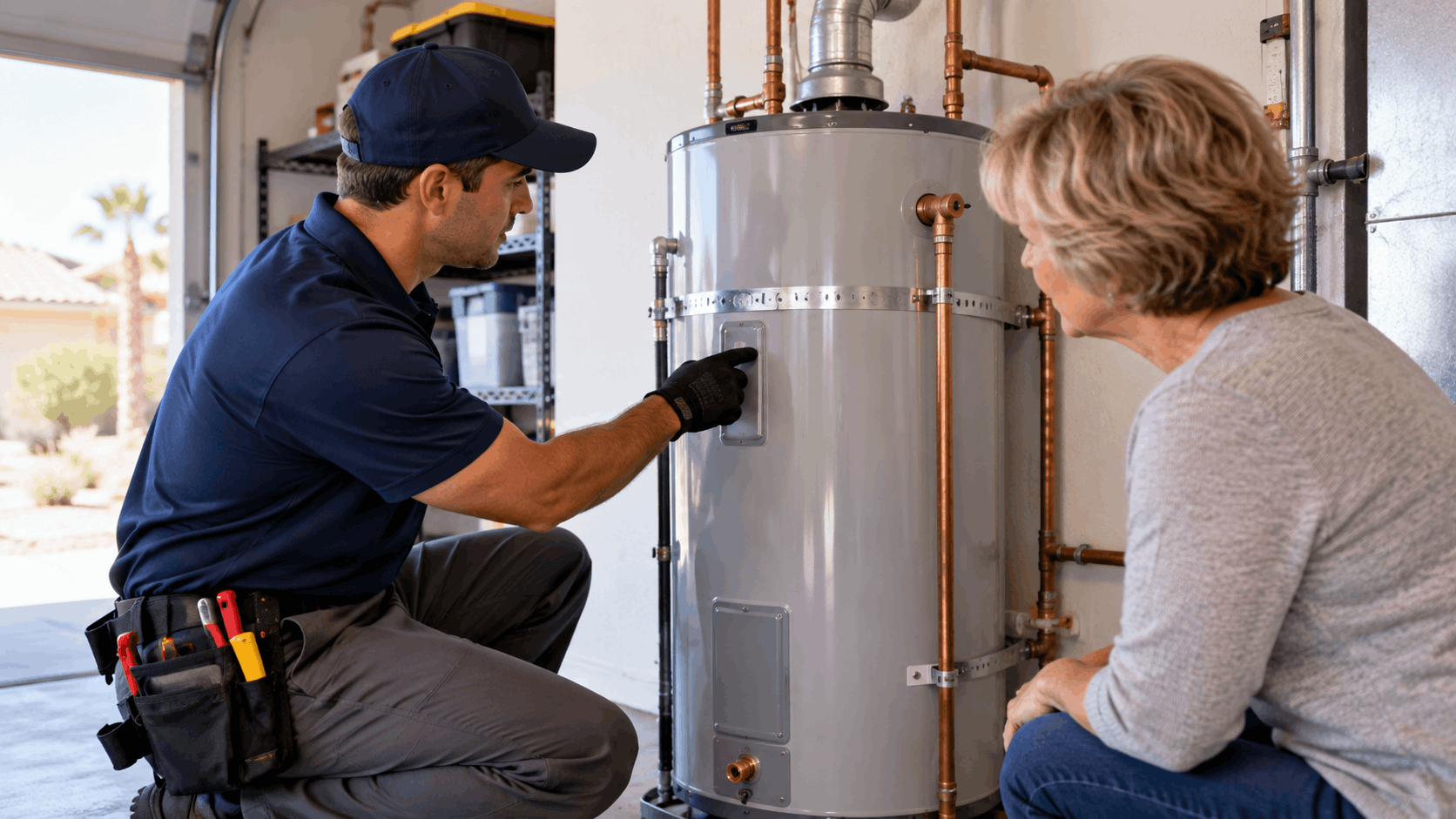
A water heater visit is a natural moment to scope accessibility work that a resident or their family has been thinking about. In this community, aging in place is genuine, ongoing work rather than a niche request, and several upgrades tie directly to how hot water is delivered.
Families researching on a parent's behalf are a real audience for this, so it is worth knowing what can be scoped alongside a heater swap.
Anti-Scald and Thermostatic Mixing
Anti-scald protection matters where a resident is at risk of burns, which is a real concern as people age and reaction times slow. A thermostatic mixing valve holds the water delivered to fixtures at a safe temperature even when the incoming hot water is set higher for storage efficiency.
This ties directly to how a new heater is set up. A tank can be kept at a temperature that discourages bacteria growth while a mixing valve tempers what reaches the tap, giving both safety and performance. The two decisions are best made together at replacement.
For an older resident, a scald from water that is suddenly too hot is a serious injury. Building anti-scald protection into the hot water system removes that risk quietly, without the resident having to think about it every time they turn on a tap.
We discuss this as part of a heater replacement when it fits the household, because the install is the ideal moment to set the delivery temperature and mixing up correctly.
Easy-Reach Shut-Offs and Lever Handles
Easy-reach shut-off valves make a real difference for someone who cannot bend or reach the way they once could. A valve placed and sized so it can be operated without a struggle turns an emergency into something a resident can actually handle themselves.
Lever handles and single-lever mixers are the other common request. Arthritic hands struggle with round knobs that have to be gripped and twisted. A lever moves with a push, which is far easier on stiff or weak hands.
These are practical add-ons during a plumbing visit rather than separate projects. While a plumber is already working on the water heater or fixtures, swapping in lever handles or repositioning a shut-off is efficient and cost-effective.
Our fixture installation and repair service covers these accessibility upgrades, and they are worth scoping while we are already on site.
Bigger Projects to Plan For
Some accessibility work is a larger project worth planning around a heater swap. Walk-in shower conversions that replace a tub remove a high step that becomes a hazard with age. This is significant plumbing work, and coordinating it with other visits makes sense.
Comfort-height toilets are easier to sit down on and stand up from, which matters a great deal to residents with limited mobility. Swapping a standard toilet for a comfort-height model is a manageable job that improves daily life noticeably.
Grab bar installation, where plumbing is involved or where secure anchoring interacts with wet walls, is another common request. Done right, a grab bar is a solid, dependable support rather than a loose fitting that gives way when it is needed most.
Families researching on a parent's behalf should know these can be scoped alongside a heater replacement. Planning them together means fewer separate visits and a home that supports aging in place as a whole rather than one fixture at a time.
Need Help in Las Vegas?
Active Plumbing serves Las Vegas and all of Las Vegas Valley.
How Active Plumbing Handles a Water Heater Replacement
Residents want to know what to expect from the first call to the finished job. Our process is built around clear information upfront and a clean, code-compliant install, which suits the way decisions get made in this community.
Here is how a replacement runs with our team.
Diagnostic and Written Price First
Every replacement starts with an on-site diagnostic. We look at the heater, its location and access, and the system feeding it. That includes the two-minute incoming pressure check and a look at the expansion tank, because those decide whether the new heater will start on a sound system.
From that, we give a written itemized price before any work starts. The household can read it, set it beside another quote, and discuss it with family. Nothing gets decided on the spot, because a considered decision is a better one.
The written price shows what is included, from the unit and the code-required pan and discharge to the fittings we recommend replacing. There are no surprises added partway through, because the price reflects the actual scope from the start.
That pace and transparency matter more here than almost anywhere, given how many decisions in this community involve family. A written quote is a document a family can work with, not a number that vanishes when the plumber leaves.
Licensed, Local, and Verifiable
Active Plumbing holds Nevada license #0047021 and has worked the valley since 1991. That is more than three decades of jobs across Las Vegas and its neighborhoods, including the northwest valley where Sun City Summerlin sits.
The license is verifiable free at nvcontractorsboard.com, where a resident can check classification, status, bond and workers compensation. We encourage that check rather than asking anyone to take our word for it.
Being local means we know the jurisdiction lines, the code amendments, and the way this specific community expects work to be done. That knowledge shows up in a job that passes inspection the first time and respects the household it is done in.
You can read more about our background and coverage on our about page. The short version is a licensed, verifiable, long-established local business rather than an out-of-town operator passing through.
Response Window and Follow-Through
For emergencies, our response window is 30 to 60 minutes, which matters when a heater fails or a leak starts in a household of one or two older residents. A failing water heater is a situation that needs someone moving quickly.
A kept schedule matters here because a resident may have arranged their day around the appointment. We treat the scheduled time as a commitment, not a rough estimate, out of respect for how this community plans.
Our team protects floors during the work and cleans up fully afterward, because tidiness is noticed and talked about in this neighborhood. The home should be left better than we found it, minus the failing heater.
For emergencies at any hour, our emergency plumbing service covers the northwest valley, and our full range of water heater services covers the replacement itself from diagnostic through inspection.
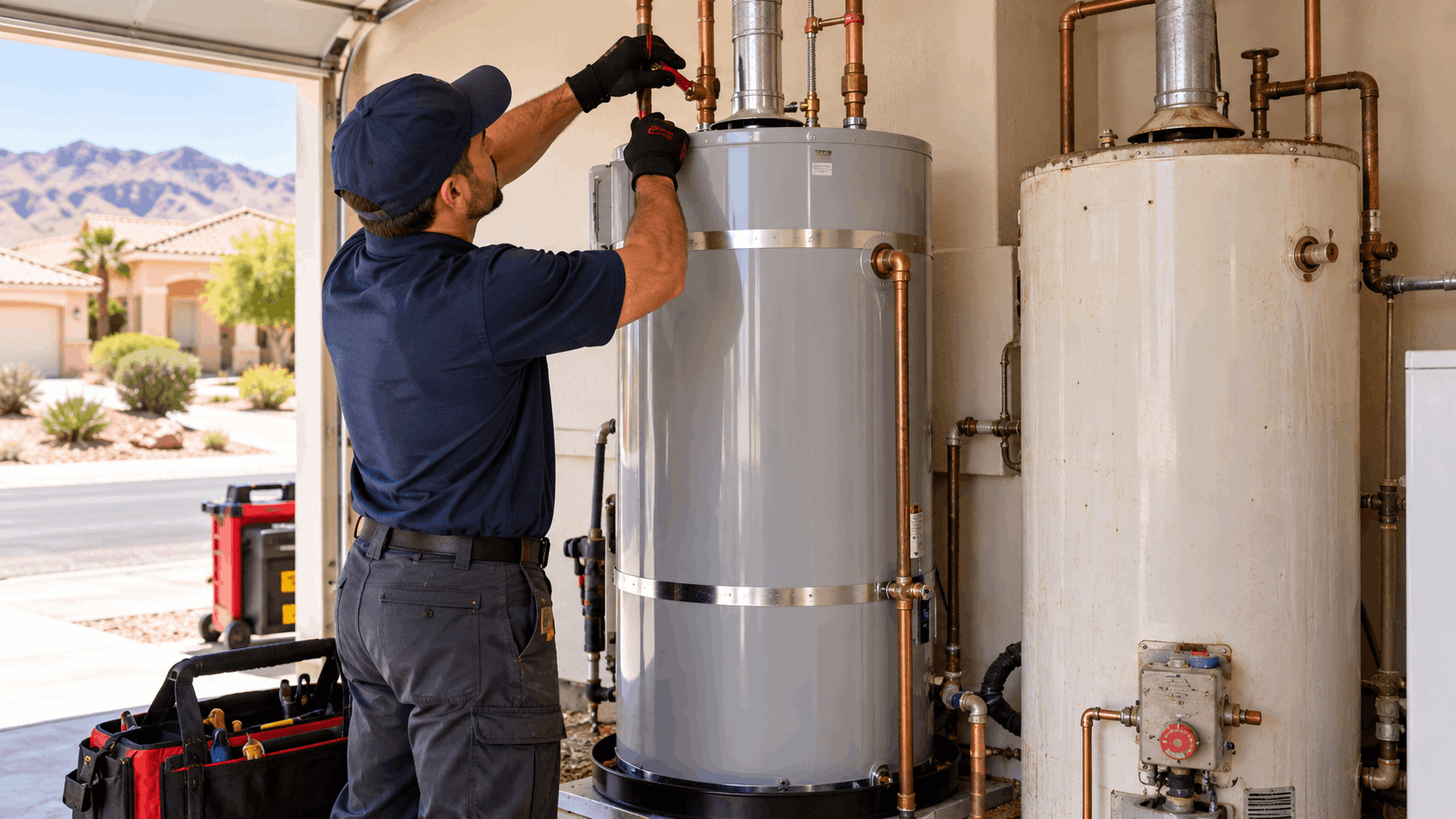
Getting Your Replacement Done Right in Sun City Summerlin
A water heater replacement in a home built from 1989 is shaped by three things: the unit going in, whether the old install meets the 2024 code with its pan and discharge rules, and how the heater is reached. Layered onto that is the valley's 16-grain water, which shortens the life of any tank that is not flushed, and the tired fittings that have been corroding around the heater for decades.
The way we handle it is straightforward. An on-site diagnostic that includes the incoming pressure check and the expansion tank, a written itemized price given before any work starts so the household can read it and talk it over with family, and a code-compliant install confirmed by the City of Las Vegas permit inspection. For emergencies, our response window is 30 to 60 minutes, and we keep the scheduled time because a resident here has planned their day around it.
If your heater is on its last legs, or you want it checked before it fails, call Active Plumbing. We are licensed under Nevada #0047021, verifiable at nvcontractorsboard.com, and we have worked the northwest valley since 1991. Contact our team to schedule a diagnostic and get a written price for your address.
Frequently Asked Questions
- How much does it cost to replace a water heater in Sun City Summerlin?
- Cost depends on the unit type and size, whether the old install meets current code, how easy the heater is to reach, and any fittings past their service life. A garage tank swap is different from an attic install needing a pan and discharge routing. We give a written itemized price after an on-site look rather than quoting blind, so the household knows exactly what is included before deciding.
- Do I need a permit to replace a water heater here?
- A water heater swap usually requires a permit, which brings an inspection confirming the install meets current code. Because Sun City Summerlin sits inside City of Las Vegas limits, the permit comes from the City of Las Vegas, not Clark County. We confirm the position for the exact address before quoting permitted work, since going to the wrong counter costs time and the boundary is not obvious from the street.
- Why do water heaters fail so fast in Las Vegas?
- The valley's water is very hard, at 280 parts per million or about 16 grains per gallon. That water deposits scale on the heating elements and the bottom of the tank every time it heats. The scale acts like an insulating layer, so the burner or elements work harder. A tank left unflushed works harder than it was designed to and fails earlier than its rated life as a result.
- Is tankless worth it with our hard water?
- Tankless can work, but hard water is the catch. Scale accelerates failure in tankless units because the heat exchanger is a narrow passage that mineral buildup clogs fast. A tankless unit here needs regular descaling to stay reliable, which is an ongoing commitment. An exterior tankless unit on a street-facing elevation may also need community association approval under the architectural standards, so placement has to be planned.
- Why is my relief valve dripping on a fairly new heater?
- A dripping relief valve is frequently an expansion tank problem rather than a faulty valve. When water heats it expands, and if the expansion tank has failed or is missing, that pressure has nowhere to go, so the relief valve opens and drips. Pressure should be checked too, since a worn regulator can creep high. Replacing the valve alone rarely fixes it if the real cause is the expansion tank or pressure.
- Can I still get a tax credit for a heat pump water heater?
- The federal 25C credit applied only to equipment placed in service by December 31, 2025, and it has ended, so it must not be counted on for a current install. A household budgeting around it for a 2026 heater needs to set that aside. Utility or manufacturer rebates may still exist and change often, so any current rebate should be confirmed with the live program before it is factored into the cost.
- How long does a replacement take?
- A straightforward like-for-like swap on an accessible garage tank is often same-day. Bringing an old 1990s install up to current code, adding a drain pan and routing relief valve discharge, or working in a tight closet or attic all add time. Replacing tired fittings and testing the main shut-off adds a little more. We confirm the schedule when the on-site diagnostic is done, rather than promising a time before seeing the job.
- Does my community association need to approve it?
- Interior work does not require association approval. But anything visible on a street-facing elevation, such as an exterior tankless unit, can require review under the community's architectural standards, which fall under Nevada Revised Statutes Chapter 116. That approval runs separate from the City of Las Vegas building permit, so where both apply, plan for both. Confirm current requirements and timelines with the association office at Mountain Shadows on Del Webb Boulevard.
- Should I replace the shut-off valve and connectors at the same time?
- Yes, in a thirty-five-year-old home this is worth doing. Angle stops, supply connectors and a main shut-off still original at thirty-plus years are past sensible service life and have been corroding in hard water. Replacing them during the job prevents a leak on the new install and gives a main shut-off that actually closes in an emergency, which matters a great deal in a one- or two-person older household.
- How do I know a plumber is licensed and not a scam?
- A resident is entitled to ask for a Nevada State Contractors Board license number and verify it. Checking status, classification, bond and workers compensation is free at nvcontractorsboard.com. No legitimate plumber needs a decision made on the doorstep, so high-pressure tactics demanding an immediate yes are a warning sign. A written price you can read and discuss with family, from a verifiable license holder, is what a real business offers.
A
Licensed plumbing professionals serving Las Vegas and Las Vegas Valley.
Licensed in Nevada · License #0047021
Last updated on
Why trust Active Plumbing?
Founded in 1991, Active Plumbing is a licensed and insured plumber serving Las Vegas and Las Vegas Valley. All content is reviewed by our licensed technicians.

Need Help in Las Vegas?
Active Plumbing serves Las Vegas and all of Las Vegas Valley.
Related Articles

Cost Guides
Tankless Water Heater Installation Cost in Las Vegas: Gas Line Upsizing, Venting, and Permit Line Items
A clear breakdown of tankless water heater installation cost in Las Vegas, including gas line upsizing, venting, permits, and hard water factors for valley homes.
Cost Guides
How Much Does Water Heater Replacement Cost in Las Vegas?
Water heater replacement cost in Las Vegas depends on tank vs tankless, size, and permits. Vegas hard water shortens tank life. Here's what to expect and how to get a fair quote.
Cost Guides
Water Heater Replacement in Summerlin - HOA Rules, Garage Installs, and Same-Day Service
A local guide to water heater replacement in Summerlin covering HOA rules, garage install codes, Clark County permits, tank vs tankless, honest costs, and same-day service.