Water Heater Replacement in Summerlin - HOA Rules, Garage Installs, and Same-Day Service
Key Takeaways
- Brown water, base puddles, popping sounds, and rising NV Energy bills signal a tank nearing failure and often mean replacement over repair.
- Summerlin HOAs affect gate access, work hours, venting appearance, and parking, so notify your community early to avoid delays.
- Garage gas units must sit 18 inches off the floor and include seismic straps, a drain pan, and proper combustion air to pass inspection.
- Tank units fit smaller homes and cost less, while tankless suits larger households with endless hot water and longer lifespan.
- Most Clark County water heater replacements require a permit and inspection, and closed systems need an expansion tank.
- Standard tank replacement runs about $1,200 to $2,500, while tankless installs range from $3,000 to $6,000 depending on gas and venting work.
- Stocked trucks and west-side routing along the 215 Beltway make same-day replacement possible across Summerlin villages.
- Las Vegas hard water shortens the life of any heater, so softening, flushing, or descaling protects the investment.
In This Article
A homeowner near The Vistas woke up last week to a cold shower and the sound of dripping water in the garage. The tank had rusted through overnight, leaving a shallow pool of brown water spreading toward a row of storage boxes. By the time the family noticed, the bottom of the tank had already given out.
Scenarios like this play out across Summerlin more often than most people expect. Water heaters do not usually fail all at once. They give warning signs for months before the tank quits, and Las Vegas hard water speeds up the damage.
Signs a Summerlin Home Needs a New Water Heater
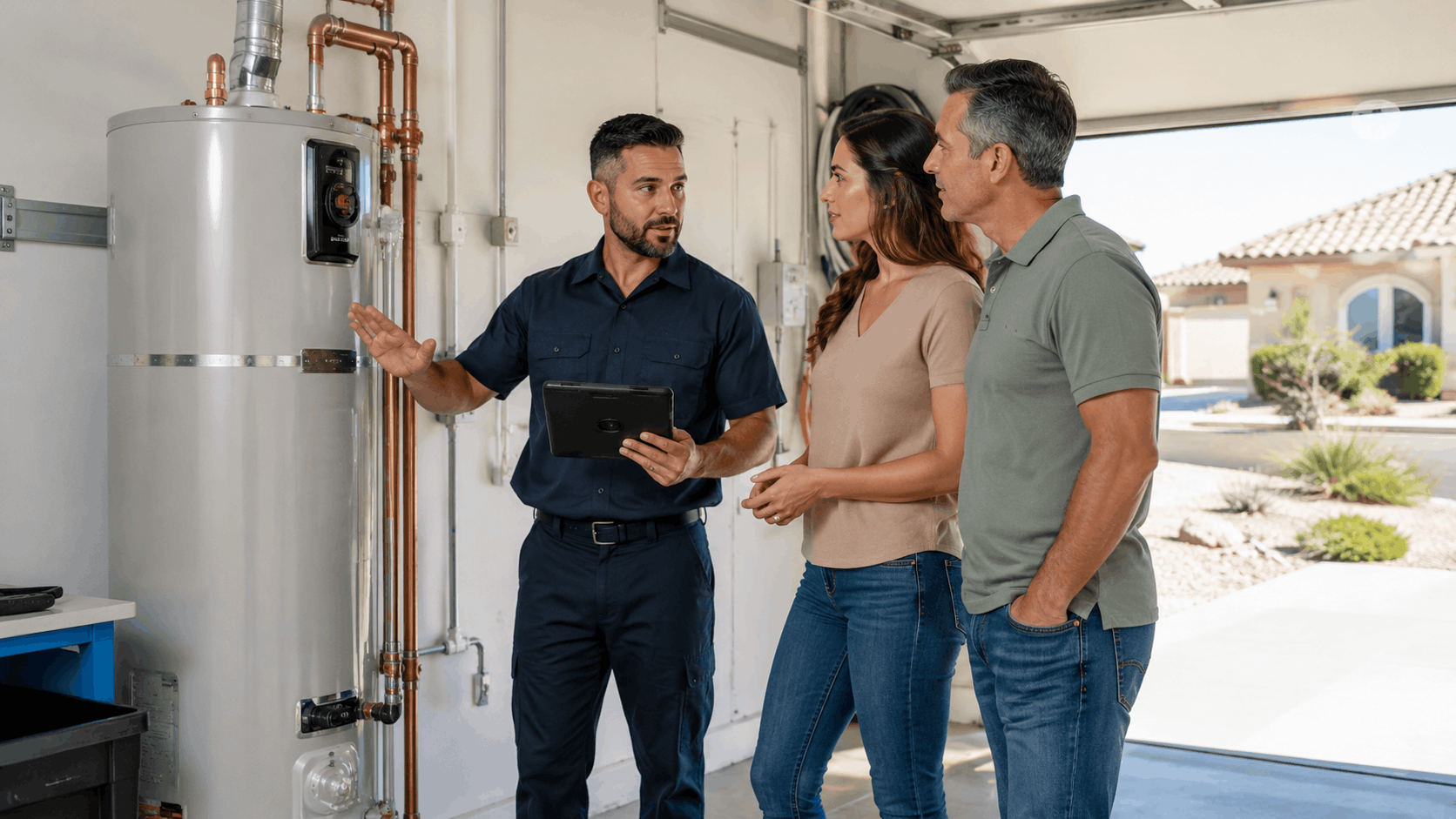
Most people call us hoping for a quick fix, and sometimes that is the right answer. A bad thermocouple or a failed heating element can be repaired for far less than a full replacement. But once a tank starts failing from the inside, no repair will save it.
The trick is spotting the difference early, before a small leak turns into garage flooding. Here is how we tell a repair from a full water heater replacement during a service call in Summerlin.
| Sign of Failure | Likely Fix |
|---|---|
| Brown or rusty hot water | Anode rod or full replacement |
| Water pooling at the base | Replacement |
| Popping or rumbling sounds | Flush or replacement |
| No hot water, pilot issues | Repair |
| Rising energy bills | Replacement for efficiency |
Rusty Water and Age of the Tank
Tank age tells us a lot before we even look at the unit. A standard water heater lasts 8 to 12 years in Las Vegas, and many fail on the shorter end because of our mineral-heavy water. If the label shows a build date older than a decade, replacement is usually the smarter money.
Rusty water at the tap is one of the clearest warnings. When brown or reddish water comes out of the hot side but the cold side runs clear, the corrosion is inside the tank itself. That means the steel lining has started to break down and the tank is on borrowed time.
The anode rod is the part meant to rust first and protect the tank. Once it is used up, the tank walls become the next target. We can sometimes buy a few years by swapping the anode rod early, but by the time water turns brown, the damage has usually spread too far.
Homeowners in older Summerlin villages often have tanks pushing past that 12-year mark without knowing it. If nobody remembers the last replacement, the unit is likely older than you think.
Pooling Water and Corrosion Around the Base
A puddle around the bottom of the tank is the sign we take most seriously. In garages across communities like The Ridges, we see thin rings of water that homeowners assume are condensation. More often it is a slow water heater leak from a cracked tank.
Corrosion at the base rarely reverses itself. Once the steel starts to rust through, the pressure inside keeps pushing water out through the weak spot. Tightening a fitting will not fix a tank that is rotting from the inside.
Garage flooding is the real danger here. A tank holds 40 to 50 gallons, and when the bottom lets go, all of it ends up on the floor at once. Stored boxes, drywall, and anything on the ground gets soaked in short order.
If you spot rust flaking off the base or water that keeps coming back after you wipe it up, shut the water off and call us. Our emergency plumbing team handles these before they turn into a bigger cleanup.
Popping Sounds and Slow Recovery
That popping or rumbling sound coming from the tank is sediment buildup. Las Vegas hard water leaves behind calcium and mineral deposits that settle on the bottom of the tank. When the burner heats that layer, trapped water bubbles up through it and makes the popping noise.
Over time the sediment forms a thick crust that acts like insulation between the flame and the water. The burner has to run longer to heat the same amount of water, which wears the tank out more quickly.
Slow hot water recovery is the other clue. If the shower runs cold halfway through and takes forever to warm back up, sediment is likely the cause. A tank that used to recover in 20 minutes might now take twice as long.
A flush can help a newer tank, but on older units the buildup is often too hardened to clear. At that point replacement makes more sense than fighting the sediment year after year.
Rising Energy Bills From NV Energy
A jump in the monthly NV Energy bill without a change in habits often points back to the water heater. As sediment builds and parts age, the unit works harder to do the same job. That extra runtime shows up in dollars.
Water heating is one of the largest energy uses in a home, second only to heating and cooling. An old, sediment-filled tank can lose a real chunk of its efficiency compared to when it was new. According to the U.S. Department of Energy, water heating accounts for around 18 percent of a typical home energy bill.
Newer units meet stricter efficiency standards and recover more quickly with less energy. Homeowners often see their bills settle back down after a replacement, especially when swapping a 12-year-old tank.
If your bill keeps climbing and the tank is old, the two are usually connected. We can check the unit and tell you honestly whether efficiency loss is driving the cost.
Get Your Quote
Tell us what's going on and we'll get back to you. We're open 24/7.
HOA Rules That Affect Water Heater Work in Summerlin
Summerlin runs on strong HOA governance, and that shapes more of a water heater job than most homeowners realize. Community rules can affect when we work, how we access the property, and what equipment is allowed to show. Knowing the rules ahead of time keeps the project moving.
These community guidelines vary by village, but a few patterns show up again and again. Here is how the common Summerlin HOA water heater rules break down.
| HOA Factor | What It Affects |
|---|---|
| Gate and contractor check-in | Crew arrival time |
| Exterior venting limits | Tankless placement |
| Quiet hours | Work scheduling |
| Parking rules | Truck access |
| Advance notice | Project approval |
How the Summerlin Community Association Handles Contractor Access
Many Summerlin villages sit behind guarded gates, and that changes how our crew reaches your door. In gated communities like The Paseos, contractors often have to check in at a guard station and show they are expected. If the homeowner has not cleared us in advance, the crew can lose time waiting at the gate.
The Summerlin Community Association and individual village boards set their own access rules. Some require the homeowner to call ahead and add the contractor to a visitor list for the day. Others need a name and company on file before the gate opens.
Approved work hours matter too. Many guarded villages limit contractor access to daytime windows, usually starting around 7 or 8 in the morning. That affects how early we can begin a same-day install.
The fix is simple. When you schedule, let your gate or HOA know we are coming, and give them our company name so the crew rolls straight through.
Exterior Venting and Visible Equipment Restrictions
Some Summerlin HOAs care a great deal about how the home looks from the street. Venting rules can limit where a flue exits the wall or roof, and a few communities restrict visible tankless units mounted on exterior walls. The goal is keeping the neighborhood appearance consistent.
This matters most for tankless installs. A tankless water heater vents differently than a tank, and if the natural spot faces the street, the HOA may push back. We work around this by routing venting to less visible sides or keeping the unit inside the garage.
For standard tank swaps, exterior equipment rules rarely come into play since the tank stays in the garage. The venting usually follows the existing path, which the HOA already accepts.
When a job needs any visible change, HOA approval comes first. We help homeowners figure out early whether their plan touches an appearance rule so there are no surprises mid-project.
Noise and Scheduling Windows for Neighborhoods
Quiet hours are a real thing in denser parts of Summerlin. Neighborhoods near Downtown Summerlin, with homes packed close together, often have rules about noise before a certain morning hour and after early evening. A water heater install is not loud, but hauling equipment and running tools can carry.
Parking rules add another layer. Some streets and driveways limit where a service truck can sit, and a few HOAs frown on trucks blocking narrow lanes. This affects how quickly we can unload the old tank and bring in the new one.
For same-day work, scheduling around these windows is part of the plan. We aim to arrive within the approved hours and stage the truck where it will not draw a complaint.
None of this slows a job much once we know the rules. A quick heads-up about your neighborhood's quiet hours and parking limits lets us schedule the visit to fit them cleanly.
Getting HOA Sign-Off Without Delays
The biggest cause of HOA delays is waiting until the last minute. Most standard tank replacements in the garage need no formal approval at all, since nothing visible changes. The trouble starts when a job involves new venting or exterior equipment.
For those cases, notify your HOA as soon as you decide to move forward. A short email describing the work and where equipment will sit is usually enough to start the review. Ask what documentation they want so nothing bounces back.
Keep any approval in writing. If the board signs off by email, save it. That record protects you later if a neighbor or future buyer questions the work.
Our team can provide the details an HOA typically asks for, like the unit type and install location. Handling this paperwork early keeps a replacement from getting held up over avoidable steps. You can reach out to our office and we will walk you through what your village usually requires.
Need Help in Las Vegas?
Active Plumbing serves Las Vegas and all of Las Vegas Valley.
Garage Water Heater Installs in Summerlin Homes
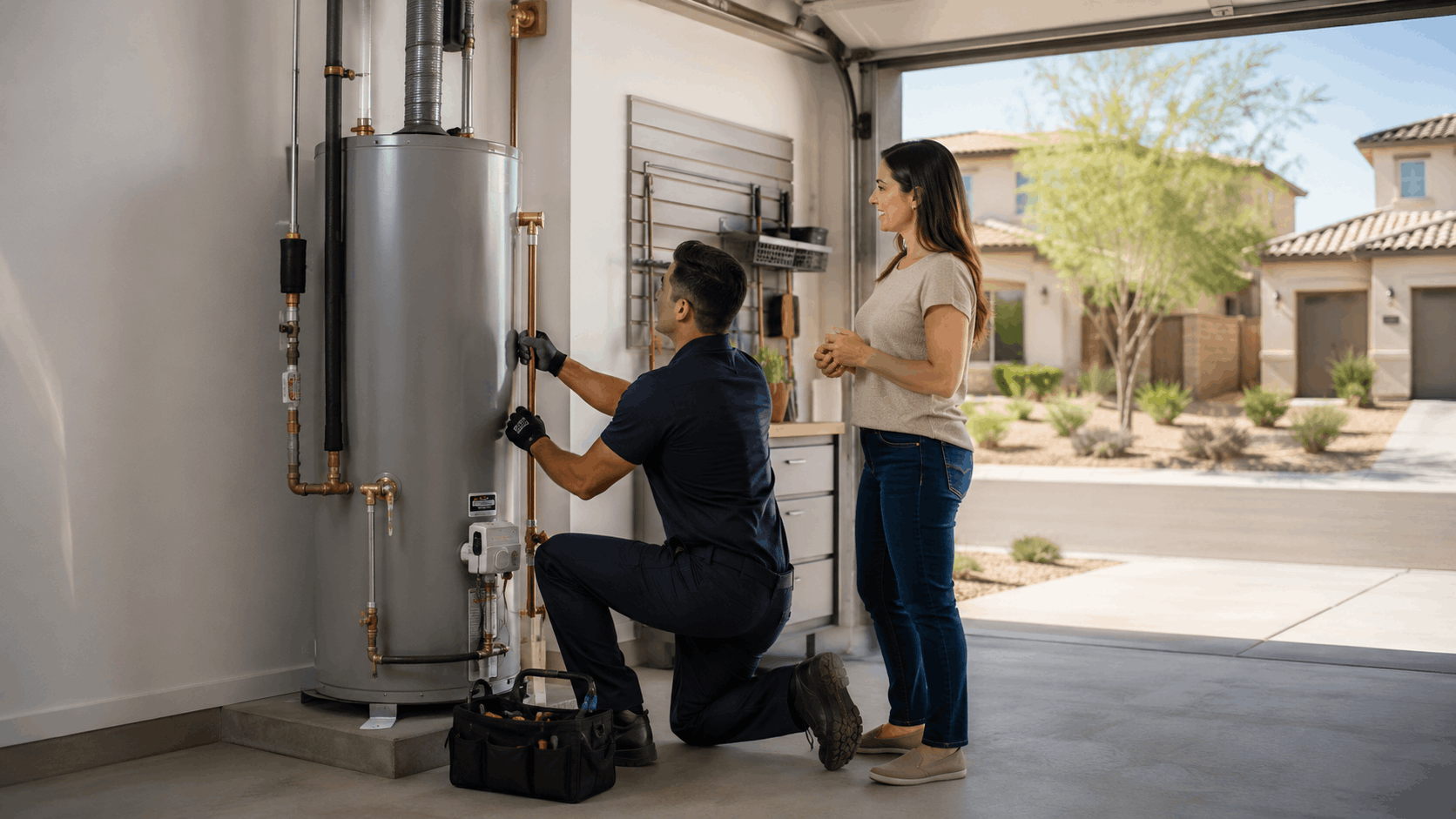
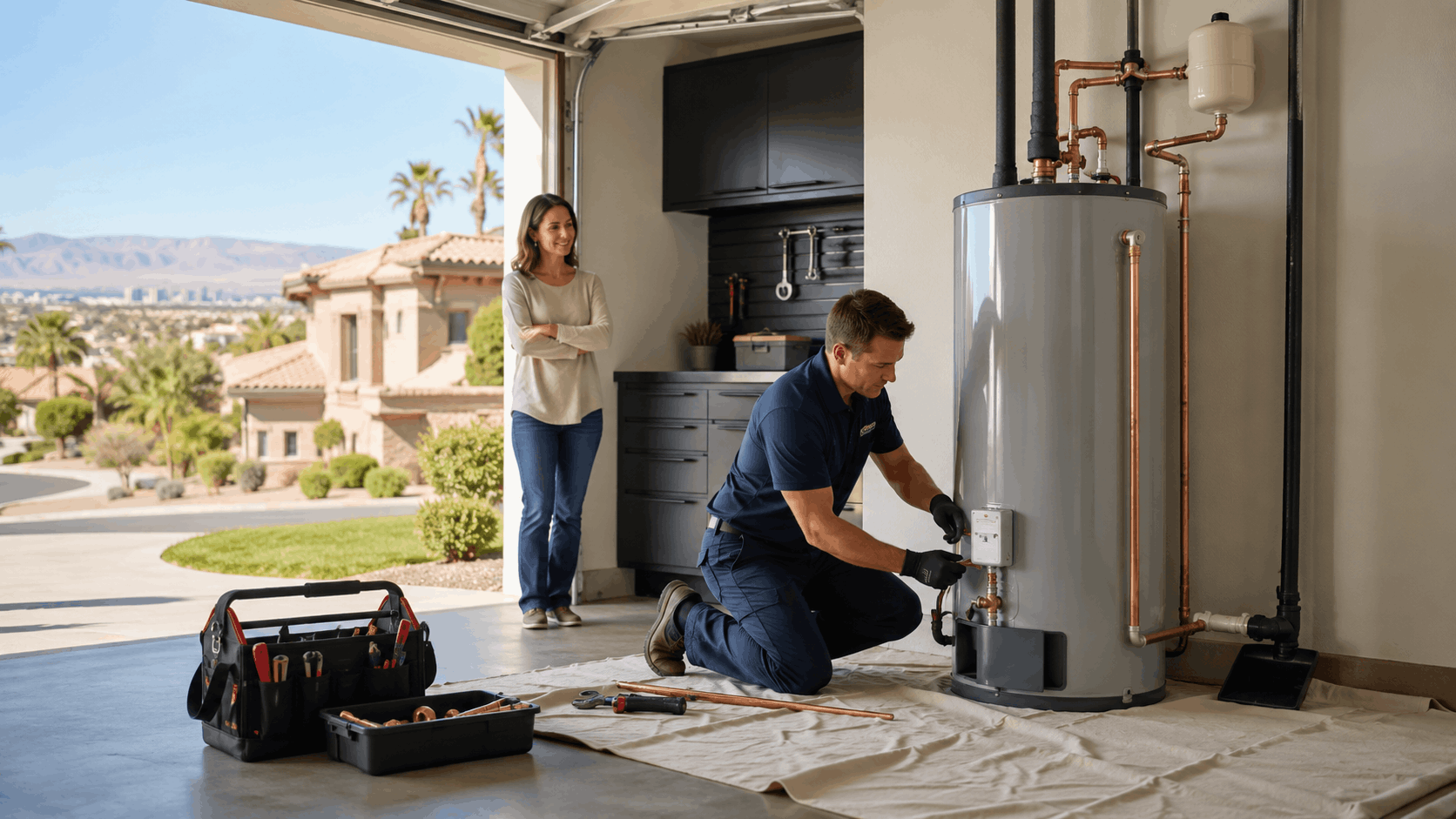
Almost every Summerlin home keeps its water heater in the garage. That location comes with its own set of code and safety details, especially for gas units. Getting these right protects the home and passes inspection the first time.
Here are the main things that apply to a garage install in Summerlin homes.
| Requirement | Why It Matters |
|---|---|
| 18-inch elevation (gas) | Keeps flame above fuel vapors |
| Seismic strapping | Holds tank in place |
| Protective bollard | Shields tank from vehicles |
| Drain pan | Catches future leaks |
| Combustion air supply | Safe gas operation |
The 18-Inch Elevation Rule for Gas Units
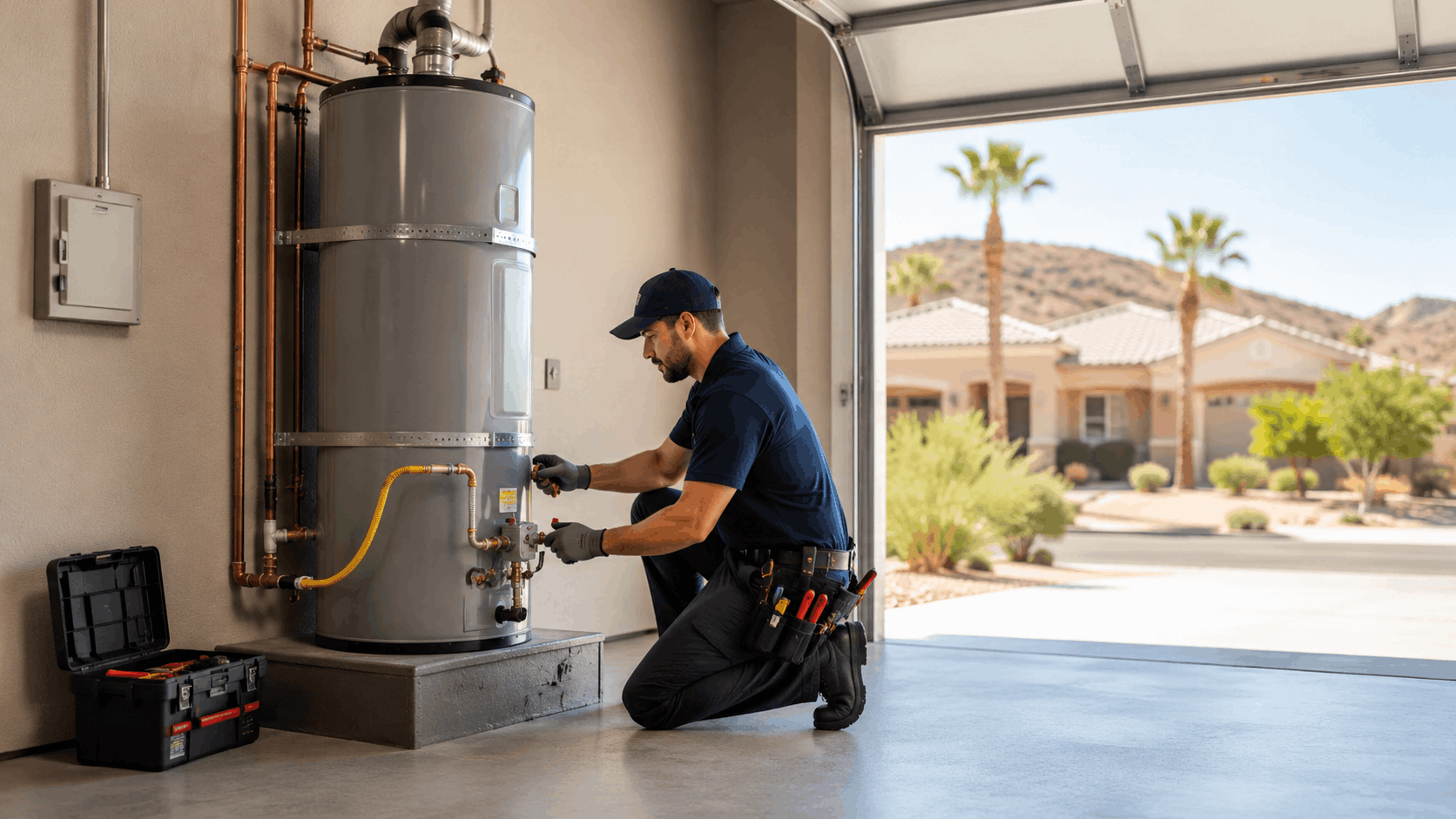
Gas water heaters in a garage must sit with the ignition source at least 18 inches above the floor. This is a long-standing code rule, and inspectors check for it every time. The reason is safety, not appearance.
Gasoline and other fuel vapors are heavier than air, so they collect near the floor. If a spilled can of gas gives off fumes, those fumes stay low. Raising the burner keeps the flame away from where vapors gather.
We meet this by setting the unit on a code-approved platform or stand. The height gets measured to the pilot or burner, not the base of the tank, so the platform has to be sized correctly.
Older Summerlin homes sometimes have tanks sitting right on the slab from a past install that skipped this step. When we replace one of those, we bring it up to current code as part of the job.
Seismic Strapping and Vehicle Protection Posts
Nevada sits in an area where seismic strapping is required on water heaters. Two straps, one in the upper third and one in the lower third of the tank, hold it against the wall. This keeps the tank from tipping and tearing loose the gas or water lines during a shake.
Strapping is quick, but it has to be anchored into solid framing, not just drywall. Inspectors look for straps that are tight and properly fastened.
The other garage safety concern is the family car. In tight Summerlin garages, a tank sitting near the parking spot is one bad pull-in away from a dented tank or a broken line. A bollard, which is a short steel post set in front of the unit, blocks the bumper before it reaches the tank.
Not every install needs a bollard, but where the tank sits in the path of a vehicle, we recommend one. It is cheap protection against an expensive accident.
Drain Pans and Overflow Routing
A drain pan under the tank is one of the simplest forms of leak protection. It sits beneath the unit and catches drips or a slow leak before they reach the garage floor. For a home with finished storage or drywall nearby, this matters a lot.
The pan needs a drain line routed to a safe spot, usually to a floor drain or outside. Without routing, the pan just fills up and overflows once it reaches the top. Proper overflow routing carries the water away instead of letting it pool.
We see plenty of Summerlin garages where a past leak stained the drywall or ruined boxes stored next to the tank. A pan would have caught most of that.
Pairing the pan with a leak sensor adds another layer. A whole-home leak detection system can alert you the moment water shows up, long before it spreads.
Combustion Air and Ventilation in Enclosed Garages
A gas water heater needs a steady supply of combustion air to burn cleanly. The flame consumes oxygen, and if the space is too sealed, the burner cannot get enough. This is a real concern in newer sealed garages around The Vistas that were built tight for efficiency.
Code requires either open vents to bring in outside air or enough room volume to supply the burner. When a garage is small and tightly closed, we add high and low vents so fresh air can reach the unit.
Poor combustion air causes more than weak heating. It can lead to incomplete burning and carbon monoxide, which is a serious gas safety issue. Proper ventilation keeps that from happening.
Whenever we install a gas unit, we check that the space provides enough air. If a newer sealed garage falls short, we correct the ventilation as part of the work rather than leave a hidden hazard.
Tank vs Tankless for Summerlin Households
The tank vs tankless question comes up on almost every replacement call. The right answer depends on family size, garage space, and how the home is set up for gas or electric. Both are solid water heater options when matched to the household.
Here is a quick comparison of the two before we break down the details.
| Feature | Tank | Tankless |
|---|---|---|
| Upfront cost | Lower | Higher |
| Hot water supply | Limited by tank size | Endless |
| Space used | Floor space | Wall mounted |
| Lifespan | 8 to 12 years | 15 to 20 years |
Standard Tank Units and Who They Fit
A standard tank water heater is the simple, proven choice for many Summerlin homes. Most homes run a 40 gallon or 50 gallon unit, which covers the hot water needs of a typical family. The upfront cost is lower than tankless, which appeals to a lot of homeowners.
The biggest advantage is the swap itself. When a home already has a tank in the garage with the right connections, replacing it with another tank is quick and clean. No new gas lines, no new venting, just a like-for-like install.
A 40 gallon tank suits smaller households, while a 50 gallon fits families that run laundry, dishes, and showers close together. Picking the right size prevents cold showers during busy mornings.
For homeowners who want the lowest cost and a fast install in their existing garage spot, the tank is hard to beat. Our water heater services team handles these swaps daily across Summerlin.
Tankless Systems and Endless Hot Water
A tankless water heater heats water on demand instead of storing it. That means endless hot water, since there is no tank to run empty. For larger homes in The Ridges with multiple bathrooms, this can be the difference between fighting over hot water and never running out.
The space saving is another draw. A tankless unit mounts on the garage wall and frees up the floor where a bulky tank used to sit. In tight garages, that reclaimed space is welcome.
Tankless units also last longer, often 15 to 20 years compared to a tank's 8 to 12. The tradeoff is a higher upfront cost and sometimes gas line or venting upgrades.
For homeowners weighing the switch, we walk through the setup and cost during a visit. Our tankless water heater installation service covers the full conversion from planning to testing.
Hard Water and Its Effect on Both Types
Las Vegas hard water is tough on every water heater, tank or tankless. The minerals in our water settle out as scale, and that buildup shortens the life of any unit. Neither type escapes it.
On a tank, hard water leaves sediment on the bottom. On a tankless, scale coats the heat exchanger and can choke the flow if it is not cleaned. Tankless units in particular need regular descaling to keep running well.
A whole-home water softener is the best long-term defense. Softening the water before it reaches the heater cuts scale dramatically and can add years of life. Many homeowners pair a new heater with a water softener installation for that reason.
For tankless owners who skip softening, routine tankless maintenance and descaling keeps the heat exchanger clear. Either way, treating our hard water protects the investment.
Gas vs Electric Choices in Newer Builds
The gas water heater versus electric water heater choice often comes down to what is already run to the garage. Most Summerlin villages have gas lines to the water heater location, which makes a gas unit the natural pick. Switching fuel types adds cost.
Gas units heat water more quickly and usually cost less to run, given local energy prices. That makes them the common choice across older and newer Summerlin builds alike.
Electric units make sense in homes without a gas line to the garage or where a homeowner wants to avoid combustion entirely. They install simpler with no venting, but recovery is slower.
When a home needs a new or upsized gas line for a tankless conversion, our gas line rerouting and upsizing team handles that so the unit gets the fuel volume it needs.
Need Help in Las Vegas?
Active Plumbing serves Las Vegas and all of Las Vegas Valley.
Permits and Code Requirements in Clark County
Permits catch a lot of homeowners off guard. A water heater swap feels like a simple job, but Clark County treats it as a permitted replacement with an inspection. Skipping the permit can cause real problems down the road.
Here is what the permit and code process looks like locally:
- Most replacements require a permit, even like-for-like swaps
- Expansion tanks are often needed on closed systems
- Inspections check venting, straps, and connections
- Our team pulls the permit and schedules the inspection
When a Permit Is Required for a Replacement
In Clark County, most water heater replacements need a permit, even when swapping the same size unit for the same fuel type. A like-for-like replacement still counts as work on a gas or plumbing system, and the county wants it inspected.
The Clark County Building Department sets these rules and issues the permits. A licensed plumber pulls the permit as part of the job, so homeowners rarely deal with the county directly.
Skipping the permit tends to backfire at resale. When a home sells, unpermitted work can show up during inspection or title research and stall the deal. Buyers and their agents notice water heaters with no record.
Pulling the permit also means the install gets checked by a county inspector, which protects the homeowner. It is a small step that avoids a big headache later.
Expansion Tanks and Pressure Regulation
Many Summerlin homes have a closed-loop plumbing system because of a check valve or pressure reducing valve on the main line. In a closed system, water has nowhere to expand when the heater warms it up. That pressure has to go somewhere.
An expansion tank gives that pressure a place to cushion. Without one, thermal expansion can stress the tank, the valves, and the fixtures. Code requires an expansion tank on closed systems for this reason.
The pressure reducing valve, or PRV, keeps incoming water pressure at a safe level. When we replace a heater, we check the PRV and water pressure to make sure the whole system is in range.
If a home lacks an expansion tank and the system is closed, we add one during the replacement. It is a common code upgrade on older Summerlin installs.
The Inspection Process and What Inspectors Check
After the install, a county inspector visits to confirm the work meets code. This step is quick when the job is done right the first time. Inspectors have a set list they run through.
They check the venting on gas units to make sure exhaust routes safely out of the garage. They confirm the seismic straps are anchored and tight. They look at the water and gas connections for proper fittings and no leaks.
Inspectors also verify the 18-inch elevation on gas units and check for an expansion tank where the system needs one. The drain pan and its routing come under review as well.
Because we build every install to these code compliance points from the start, the inspection is usually a formality. There are no surprises when the work was done to the standard the inspector expects.
How Active Plumbing Handles the Paperwork
We handle the permit process so homeowners never sit in a county line. When we schedule a replacement, pulling the permit is part of the job, not an extra errand for you.
Our team files the permit, does the install to code, and then coordinates the inspection scheduling with the county. You get a finished job with the paperwork closed out properly.
This matters most when a home later sells. A permitted, inspected water heater shows up clean in the records and never becomes a sticking point in a sale.
Handling the permit and inspection is a standard part of every replacement we do. It keeps the work legitimate and saves the homeowner the hassle of dealing with the building department alone.
Same-Day Water Heater Service Across Summerlin
When a tank fails, most people want hot water back the same day, not next week. Fast response comes down to two things: where the crews are and what the trucks carry. We built our routing and stock around getting Summerlin homes back to normal quickly.
Here is how same-day water heater replacement works across Summerlin:
- Crews route from the west side for quick Summerlin access
- Trucks stock common tank sizes for immediate install
- We guide homeowners through emergency shutoff by phone
- Same-day visits cover removal, install, cleanup, and testing
How Fast Response Works From the West Side
Getting to Summerlin quickly depends on the roads, and our crews know them well. The 215 Beltway wraps the west side and feeds directly into most Summerlin villages. From West Charleston, a crew can reach neighborhoods from Summerlin West to The Vistas in a short drive.
We position crews to cover this side of the valley during the day. That means when a call comes in from a village off Town Center or Far Hills, someone is usually close.
Response time drops when the driving route is short and familiar. Our teams work these streets daily, so they are not fighting traffic patterns they do not know.
We serve the full Summerlin area, and homeowners can see coverage for their Summerlin West neighborhood and nearby villages when they need us fast.
Stocked Trucks and Common Unit Sizes
A same-day install only works if the right unit is on the truck. We stock the popular tank sizes, mainly 40 and 50 gallon gas and electric models, because those cover most Summerlin homes. When the tank matches the home's setup, the crew installs it on the spot.
Carrying stock cuts out the wait for a supply run. There is no gap where the homeowner sits without hot water while someone drives across town for a part.
For a standard swap, having the unit ready is what turns a two-day job into a two-hour one. The crew removes the old tank and sets the new one in the same visit.
Tankless and specialty units may need ordering, but for the everyday tank failure, the stocked truck gets hot water flowing again fast.
Emergency Shutoff Steps Before the Team Arrives
When a tank starts leaking, a few quick steps limit the water damage before we arrive. First, shut off the water supply to the tank using the valve on the cold line at the top. Turning it clockwise stops fresh water from feeding the leak.
Next, cut the energy source. For a gas water heater, turn the gas control knob to the off position, or use the gas shutoff. For an electric unit, switch off the breaker that feeds the heater.
Never leave a gas or electric heater running dry, since that can damage components or create a hazard. Cutting the fuel or power protects the unit and the home.
Call us right after you shut things down, and we will walk you through anything you are unsure about while a crew heads your way.
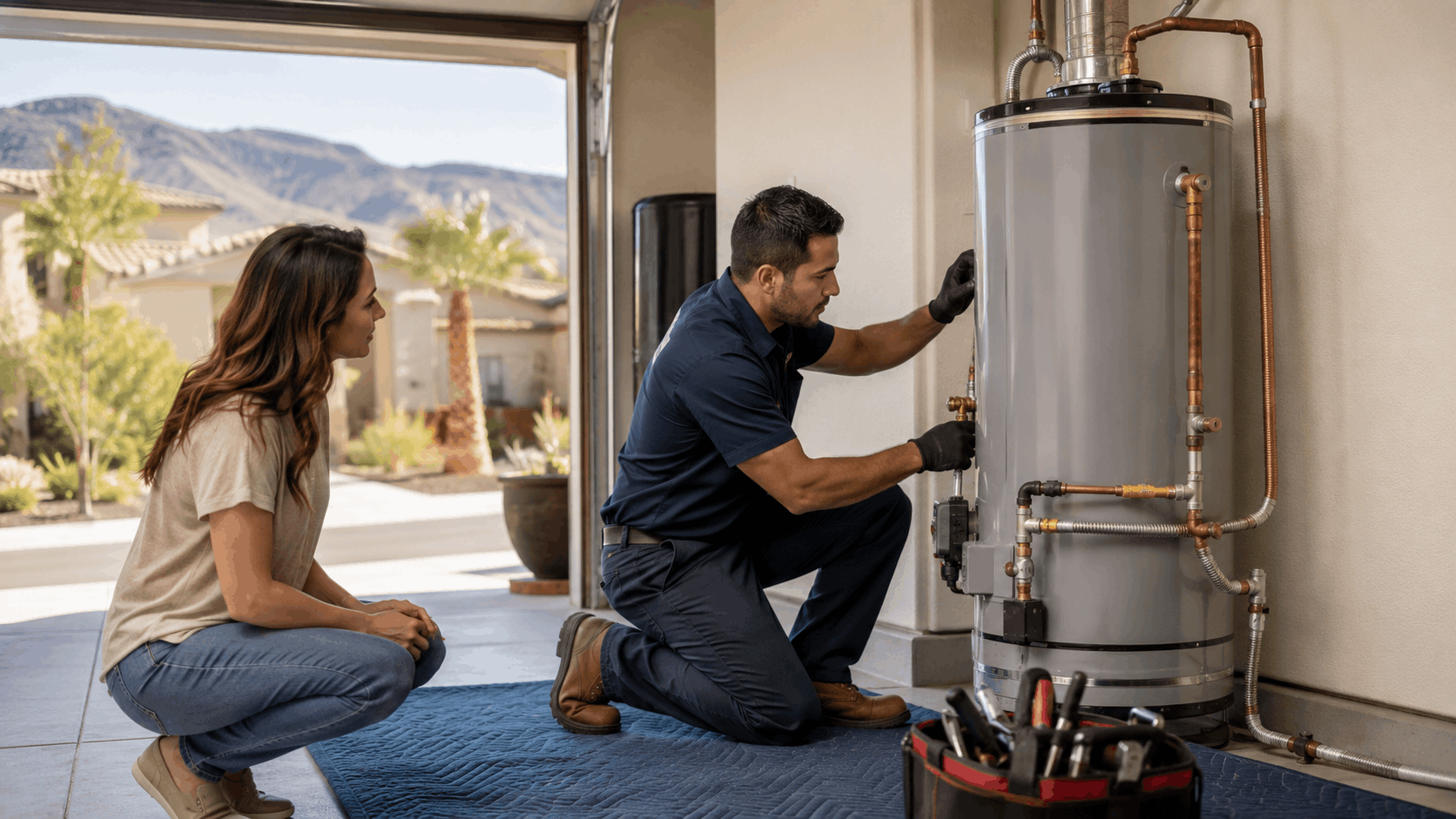
What a Same-Day Visit Includes
A same-day install covers the whole job from start to finish. The crew drains and removes the old tank, hauling it away so you are not left with it in the garage. Removal and disposal are part of the service.
Then they set the new unit, bring it up to code with straps and elevation, and connect the water and gas or electric lines. Any needed code upgrades, like an expansion tank or drain pan, get added during the install.
Cleanup follows so the garage is left dry and tidy. We do not leave water or old parts behind.
Finally, the crew tests the unit, checks for leaks, and confirms hot water is flowing before they pack up. You get a working heater and a clean space the same day.
Need Help in Las Vegas?
Active Plumbing serves Las Vegas and all of Las Vegas Valley.
Water Heater Replacement Costs in Summerlin
Cost is the first question most homeowners ask, and honest ranges help with budgeting. The final water heater cost depends on the unit type, code upgrades, and whether any lines need work. Here are realistic replacement price ranges in Summerlin.
| Type of Job | Typical Range |
|---|---|
| Standard tank replacement | $1,200 - $2,500 |
| Tankless install | $3,000 - $6,000 |
| Expansion tank add-on | $150 - $350 |
| Code upgrades (straps, pan) | $100 - $400 |
Typical Price Ranges for Tank Units
A standard tank replacement in Summerlin usually runs between $1,200 and $2,500 installed. That range covers the unit, labor, and disposal of the old tank. The spread depends on tank size, fuel type, and the brand of the unit.
A basic 40 gallon gas swap sits toward the lower end when the connections are already in place. A larger 50 gallon or a higher-efficiency model moves the price up.
Labor is a real part of the cost, since a proper install includes strapping, elevation, and connections done to code. Disposal of the old tank is included in a full replacement.
For a like-for-like swap in an existing garage spot, most homeowners land in the middle of that range. Our team gives a firm quote before any work begins.
What Drives Tankless Install Pricing Higher
Tankless cost runs higher, often $3,000 to $6,000, and for good reasons. The unit itself costs more than a tank, and the install is more involved. Several factors push the price up.
Gas line upsizing is a common one. A tankless unit burns more gas at once than a tank, so the existing gas line often needs to be larger to feed it. That upgrade adds labor and material.
Venting is another factor. Tankless units require their own venting, which means new vent runs when converting from a tank. Mounting the unit on the wall and reworking the plumbing also add to the job.
The higher upfront cost buys a longer lifespan and endless hot water, which many larger households find worth it over time.
Extra Costs From Code Upgrades
Older Summerlin homes sometimes need code upgrades to meet current standards during a replacement. These are not upsells, they are requirements the inspector will check. Knowing about them upfront keeps the budget honest.
An expansion tank, if the system is closed and lacks one, runs about $150 to $350 installed. Seismic straps and a drain pan add a smaller amount, usually in the $100 to $400 range together depending on the setup.
If the old unit sat on the slab without proper elevation, a stand or platform for the gas unit is another small add. These items bring the install to code.
We flag any needed upgrades in the quote so the price you see reflects the finished, code-compliant job. There are no surprise line items after the work is done.
Warranties and Long-Term Value
Warranty length affects the true cost over the life of the unit. Standard tanks often carry a 6 to 12 year warranty, while tankless units run longer. A longer warranty usually signals a better-built unit.
The bigger factor in long-term value is hard water maintenance. Our Las Vegas water shortens the life of any heater, so a unit that gets flushed or descaled and runs on softened water lasts closer to its full rated life.
Skipping maintenance can cut years off a tank, which raises the real cost per year of service. Spending a little on upkeep protects the larger investment.
When we quote a replacement, we cover the warranty and the maintenance that keeps it valid. That way the number reflects value over years, not just the day of install.
Final Thoughts
A failing water heater in Summerlin rarely gives no warning. Brown water, puddles, popping sounds, and climbing NV Energy bills all point to a unit near the end. Catching those signs early keeps a small problem from becoming garage flooding.
Between HOA rules, garage codes, Clark County permits, and the tank versus tankless choice, there is a lot to get right. Handling those details correctly means an install that passes inspection and lasts through our hard water.
When a tank fails, our stocked trucks and west-side routing let us handle same-day replacement across Summerlin. Reach out to our team and we will get your hot water back and the job done to code.
Frequently Asked Questions
- How long does a water heater replacement take in Summerlin?
- A standard tank swap usually takes 2 to 4 hours from removal to testing when the connections are already in place. That covers draining the old unit, setting the new one, code upgrades like strapping, and confirming hot water flows. Tankless installs take longer, often most of a day, because they may need gas line upsizing and new venting. Our stocked trucks help keep tank jobs on the shorter end.
- Do I need HOA approval to replace my water heater?
- For a standard tank swap in the garage, most Summerlin HOAs need no formal approval since nothing visible changes. Approval comes into play when the work involves new exterior venting or a visible tankless unit on an outside wall. In those cases, notify your HOA early and get sign-off in writing. We can provide the unit and install details most boards ask for during review.
- Why does my gas water heater need to be raised in the garage?
- Code requires the ignition source on a garage gas water heater to sit at least 18 inches above the floor. Fuel vapors like gasoline are heavier than air and settle low to the ground. Raising the burner keeps the flame away from where those vapors collect, lowering the risk of ignition. We set gas units on a code-approved platform to meet this rule and pass inspection.
- Is a permit required to replace a water heater in Clark County?
- Yes, most replacements in Clark County require a permit, even a like-for-like swap of the same size and fuel type. The county treats it as work on a gas or plumbing system that needs inspection. A licensed plumber pulls the permit and schedules the inspection as part of the job. Skipping it can cause trouble at resale when unpermitted work shows up during a home sale.
- How much does a water heater replacement cost in Summerlin?
- A standard tank replacement typically runs $1,200 to $2,500 installed, including the unit, labor, and disposal. Tankless installs range higher, often $3,000 to $6,000, because of gas line upsizing, venting, and mounting. Older homes may need code upgrades like an expansion tank or drain pan, which add a modest amount. We provide a written quote before any work starts so there are no surprises.
- Should I choose tank or tankless for my Summerlin home?
- Tank units fit smaller households and homeowners who want a lower cost and a fast, simple swap in the existing garage spot. Tankless suits larger homes with multiple bathrooms, offering endless hot water and freeing up floor space on the garage wall. Tankless costs more upfront but lasts longer. We look at your family size, hot water use, and garage setup to recommend the right fit.
- How does Las Vegas hard water affect my water heater?
- Our hard water leaves calcium and mineral deposits that settle as sediment in a tank or scale on a tankless heat exchanger. That buildup makes the unit work harder, causes popping sounds, slows hot water recovery, and shortens the unit's life. A water softener greatly reduces scale, and regular flushing or descaling keeps things clear. Treating the water protects the heater and extends how long it lasts.
- Can you really do same-day water heater service?
- Yes, for most standard tank failures we can replace the unit the same day. Our trucks stock common 40 and 50 gallon gas and electric models, so there is no wait for a supply run. Crews route from the west side along the 215 Beltway to reach Summerlin villages quickly. Tankless and specialty units may need ordering, but everyday tank swaps happen fast.
- What should I do the moment my water heater starts leaking?
- Shut off the water supply first by turning the valve on the cold line at the top of the tank clockwise. Then cut the energy source, turning a gas unit's control knob to off or flipping the electric breaker. This stops the leak from growing and protects the unit. Move any stored items away from the water and call us so a crew can head over.
- How long should a new water heater last in Las Vegas?
- A standard tank lasts about 8 to 12 years here, though our hard water pushes many toward the shorter end. Tankless units run longer, often 15 to 20 years. The biggest factor is maintenance, since a unit on softened water that gets flushed or descaled reaches closer to its full rated life. Skipping upkeep can cut years off any heater in Las Vegas.
Licensed plumbing professionals serving Las Vegas and Las Vegas Valley.
Licensed in Nevada · License #0047021
Last updated on
Why trust Active Plumbing?
Founded in 1991, Active Plumbing is a licensed and insured plumber serving Las Vegas and Las Vegas Valley. All content is reviewed by our licensed technicians.

Need Help in Las Vegas?
Active Plumbing serves Las Vegas and all of Las Vegas Valley.
Related Articles
Clark County Water Heater Permit Requirements: What Inspectors Flag in Garage Installs
Clark County requires a permit for garage water heater installs. Learn the rules, the top inspector flags, and how to pass the first time in Las Vegas.
Garage Water Heater Code in Clark County: 18-Inch Stands, Drain Pans, and Seismic Straps
Clark County garage water heaters need 18-inch stands, drain pans, and seismic straps. Learn the code rules, permit process, and how Active Plumbing keeps Las Vegas installs compliant.
Water Heater Replacement Same Day Las Vegas: Stock and Install Timelines
Learn how same-day water heater replacement works in Las Vegas, from local stock and realistic install timelines to permits, neighborhood factors, and prep tips.