Water Heater Replacement Same Day Las Vegas: Stock and Install Timelines
Key Takeaways
- A like-for-like tank swap with a stocked unit can often be replaced the same day in 2 to 4 hours.
- Tankless conversions, gas line upgrades, and special-order sizes typically push the job to the next day or beyond.
- Keeping 40, 50, and 75 gallon tank and tankless models in local stock is what makes same-day service realistic across the valley.
- Las Vegas hard water from the Valley Water District shortens tank life to around 8 to 10 years and adds sediment cleanup time.
- Most full water heater replacements require a Clark County permit, which the team files and handles without delaying hot water.
- Homeowners can speed up the install by shutting off water and power, clearing a path, and noting the unit's model and capacity.
- Neighborhood factors like older Huntridge closets, Summerlin HOA rules, and newer southwest builds affect install speed.
- A leaking tank or rusty hot water usually means replacement, while element or thermostat issues may only need a repair.
In This Article
It is 6 a.m. in Summerlin, and a homeowner steps into what should be a warm shower. Instead, they get a blast of icy water. Across the valley in Henderson, another family walks into their garage to find a puddle spreading from the base of a 10-year-old tank. These are the calls our team gets nearly every day, and they almost always come with the same question: can this be fixed today?
The short answer is often yes. A failed water heater does not have to mean days without hot water. With the right stock on the truck, a clear path to the unit, and a standard setup, a same-day swap is well within reach for most homes in Las Vegas.
This guide walks through what same-day replacement actually involves, how we keep popular models in stock, and the real install timelines from the first phone call to hot water flowing again. We also cover neighborhood quirks, permits in Clark County, and the steps homeowners can take before our crew rolls up. Our goal is to give honest expectations, not sales talk.
What Same-Day Water Heater Replacement Actually Means in Las Vegas?
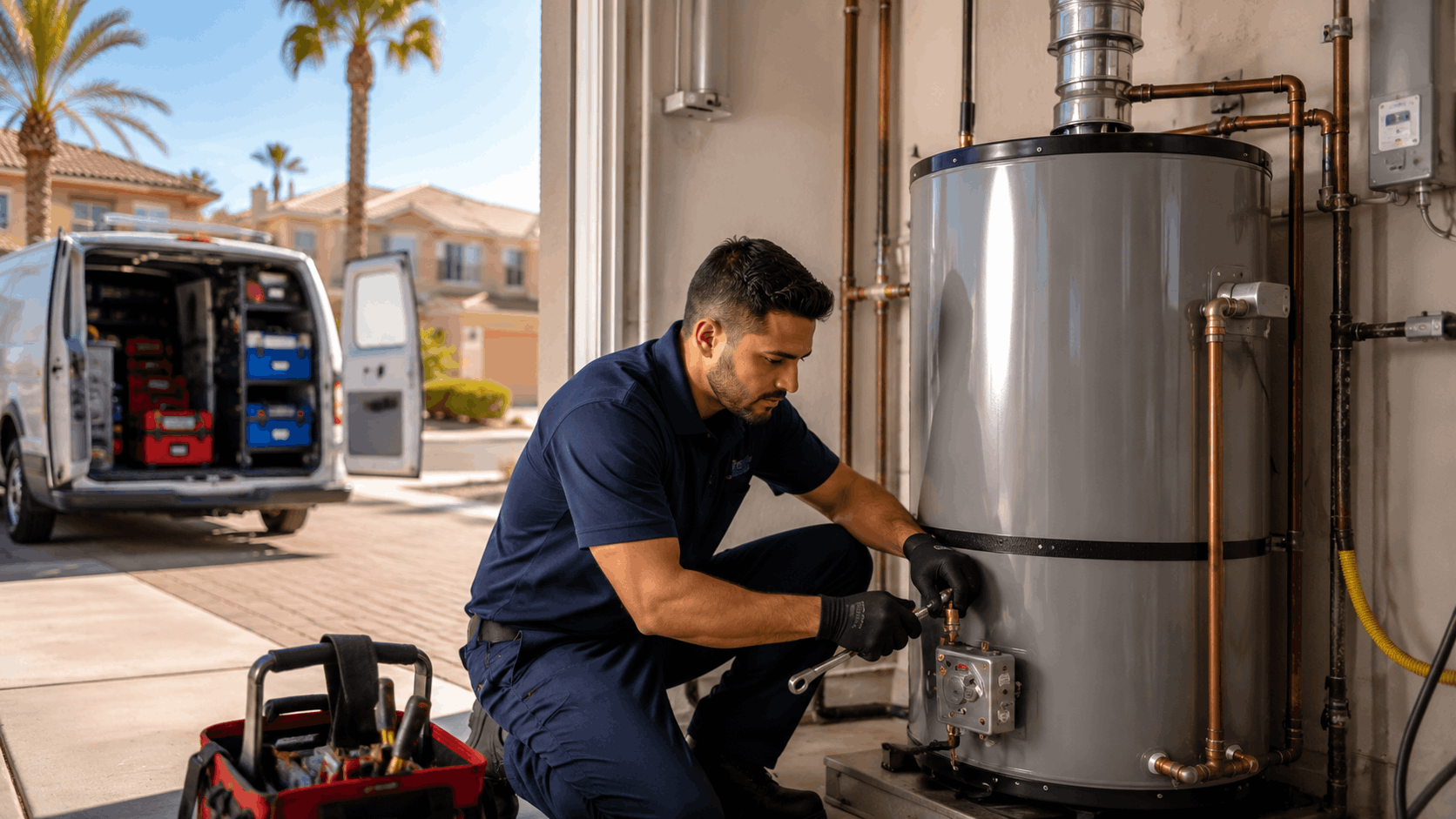
Same-day water heater replacement means a crew arrives, removes the old unit, and installs a working replacement before the day ends. For a standard swap, that is realistic across most of the valley. The catch is that not every job qualifies, and being honest about that up front saves everyone time.
The install timeline depends on three things: whether we stock your unit, whether the connections match, and how far we have to drive. Las Vegas plumbing setups vary a lot between a 1960s Huntridge bungalow and a 2020 build in Mountain's Edge. A same-day water heater replacement works best when nothing forces a code upgrade or special order.
| Scenario | Same-Day Possible? | Typical Timeframe |
|---|---|---|
| Like-for-like tank swap, stocked unit | Yes | 2-4 hours |
| Tank to tankless conversion | Rarely | 1-2 days |
| Special-order tank size (75+ gallon) | Sometimes | Same day to 2 days |
| Gas line upgrade required | No | 1-3 days |
| Permit-required install with inspection | Often next day | 1-2 days |
The Difference Between Same-Day and Emergency Service
A scheduled replacement and an after-hours emergency call are two different things. A scheduled same-day swap means we have an open window during normal business hours and the right unit ready to go. The homeowner gets a planned visit, a clear quote, and a clean install without rush fees stacking up.
An emergency plumber call is for the moments when water is actively flooding a garage or a gas smell fills a closet at midnight. Those visits focus on stopping the damage first, like shutting off the supply or capping a line. The full replacement may still happen the next morning once stores reopen and the situation is stable.
Cost reflects the difference. A scheduled replacement carries standard labor and parts pricing, while after-hours emergency work adds a premium for the off-hours response. If a homeowner can safely shut things down overnight, booking a morning slot usually saves money. Our emergency plumbing team can talk through which path makes sense.
The good news is that many calls labeled emergencies turn into clean same-day jobs. Once the unit is isolated and no active flooding remains, the replacement becomes a routine swap. We help homeowners figure out which bucket their situation falls into right over the phone.
When a Same-Day Swap Is Realistic
A like-for-like replacement is the bread and butter of same-day work. That means swapping a 40 gallon gas tank for another 40 gallon gas tank, using the same water lines, gas connection, and vent. When the new unit matches the old footprint, the crew spends time installing, not re-engineering.
A standard install also assumes the connections are in decent shape. Functioning shutoff valves, accessible gas or electric supply, and a clear drain pan all keep the job moving. Most homes built in the last 25 years across Spring Valley, Enterprise, and Henderson fit this profile well.
Drive time plays a role too. A morning call from Summerlin or Paradise gives us plenty of runway to source the unit and finish before evening. The earlier the call comes in, the more breathing room everyone has.
When all of these line up, our team can often have hot water restored within a few hours of arriving. The homeowner barely loses half a day. That is the ideal version of a same-day water heater replacement.
When It Cannot Happen Same Day
Some jobs simply cannot wrap in one day, and pretending otherwise sets up a bad experience. A gas line upgrade is a common roadblock. If the existing line is undersized for a new high-output unit, that line has to be reworked, which our gas line upsizing team handles separately.
Permit delays also push timelines. When a job needs a Clark County permit and inspection, the inspector's schedule controls part of the calendar. We can often install same day and schedule the inspection right after, but that depends on the work involved.
Special-order tank sizes create waits as well. A 75 gallon unit or a specific commercial model may not sit on the shelf. If it has to be ordered, the realistic window stretches to the next day or two.
Tankless conversions belong in this group too. Switching from a tank to a tankless system involves new venting and often gas work, which rarely finishes in a single afternoon. Setting honest expectations early keeps homeowners from waiting around for something that was never going to happen that day.
Get Your Quote
Tell us what's going on and we'll get back to you. We're open 24/7.
How Active Plumbing Keeps Water Heaters in Stock Across the Valley
Speed comes down to inventory. A plumber with empty trucks has to chase parts before the work even starts. Our approach keeps common tank and tankless models in local stock so the team can move directly from the call to the install.
We track which units fail most often in each part of the valley. A 50 gallon gas tank covers a huge share of homes from North Las Vegas to Whitney, so we keep plenty on hand. That local inventory is what makes same-day promises real instead of hopeful.
| Unit Type | Typical Stock Status | Best Fit |
|---|---|---|
| 40 gallon gas/electric | In stock | 1-3 person homes, condos |
| 50 gallon gas/electric | In stock | 3-5 person homes |
| 75 gallon gas | Limited / quick order | Large households |
| Popular tankless models | In stock | High-demand, space-saving homes |
| Specialty / commercial | Order required | Businesses, custom setups |
Common Tank Sizes We Carry
The 40 gallon and 50 gallon units do most of the heavy lifting in Las Vegas homes. A 40 gallon tank suits smaller households, condos, and many Huntridge-area bungalows where closet space is tight. It heats enough water for a couple of bathrooms without taking up extra room.
The 50 gallon gas water heater is our most-requested size. It fits the typical three to five person household found across Summerlin, Henderson, and the southwest valley. Families running back-to-back showers and a dishwasher tend to land here.
For larger homes, we keep 75 gallon options available, though those see less stock turnover. These suit big households or homes with soaking tubs and multiple simultaneous demands. When a 75 gallon is not on the truck, it is usually a quick local pickup rather than a long wait.
Keeping these three sizes ready in both gas and electric covers the vast majority of replacement calls. That is the practical reason we can show up and finish the same day so often. Explore our full range of water heater services for details on each option.
Tankless Units and Lead Times
Tankless water heaters keep growing in popularity, especially in newer southwest builds where homeowners want endless hot water and reclaimed garage space. We stock several of a common residential tankless models so a straightforward replacement can move quickly. When a like-for-like tankless swap is on the table, the lead time stays short.
Some tankless installs do require an order, though. A specific output rating, a recirculation-ready model, or a commercial unit may not be on the shelf. In those cases, the lead time usually runs a day or two rather than weeks, since suppliers in the valley keep good stock.
Converting from a tank to tankless adds more than just the unit. New venting, gas line sizing, and condensate handling all factor in. Our tankless installation team walks homeowners through what their specific home needs.
For homeowners already running tankless, we also handle upkeep. Hard water builds scale inside these units fast, so regular descaling keeps performance steady and extends the lifespan considerably.
Matching the Right Unit to Your Home
Water heater sizing is not guesswork. Before driving out, our team asks about household size, number of bathrooms, and how many people typically shower in the morning rush. A family of five in a two-story Enterprise home has very different household demand than a retired couple in a Paradise condo.
We also look at peak usage. A home with a large soaking tub, a high-flow shower head, and a washing machine running at once needs more capacity or a tankless setup that keeps up. Undersizing leads to cold showers, while oversizing wastes energy heating water nobody uses.
Existing connections shape the choice as well. If a home already has a gas line and venting set up for a 50 gallon tank, matching that simplifies the install dramatically. Trying to force a different fuel type or size adds hours and sometimes a permit.
By gathering this information during the first call, the crew arrives with the correct unit ready to install. That preparation is what separates a smooth half-day job from a frustrating series of supply runs.
Why Local Stock Beats Big-Box Pickup
Grabbing a water heater off the shelf at a big-box store seems cheaper at first glance. The trouble starts after the purchase. The homeowner still has to size it correctly, haul it home, disconnect the old unit, and either install it or find someone who can on short notice.
A stocked plumber handles the whole chain. We confirm the right size, bring the unit, perform a professional install to code, and haul away the old tank. There is no second trip, no guessing about fittings, and no leftover unit cluttering the garage.
Code compliance matters too. A box-store unit installed without proper venting, an expansion tank, or seismic strapping can fail an inspection and create safety risks. Our installs meet Clark County requirements from the start.
The math often favors professional install once the hidden costs of DIY add up. Time off work, rental tools, potential leaks, and disposal fees stack quickly. A same-day pro install removes all of that friction in one visit.

Need Help in Las Vegas?
Active Plumbing serves Las Vegas and all of Las Vegas Valley.
Realistic Install Timelines From Call to Hot Water
Homeowners want a clear picture of what to expect. The journey from the first phone call to hot water restored follows a fairly predictable path. Knowing the typical service window helps families plan their day around the work.
An install timeline depends on the type of job, but most standard swaps follow the same rhythm. The phone call confirms details, the crew arrives within a service window, and the swap happens in a few hours. Here is how each stage actually plays out.
The First Call and Phone Diagnosis
Everything starts with a quick phone diagnosis. Our team asks targeted questions to confirm a same-day visit makes sense. What size is the current unit, is it gas or electric, and is it leaking right now? These answers tell us which unit to load before leaving.
We also ask about the location. A garage install in a North Las Vegas home is different from a tight closet in an older central neighborhood. Knowing the access situation helps the crew bring the right tools and plan the route.
The service call also covers safety. If the unit is actively leaking or a gas smell is present, we walk the homeowner through shutting things off immediately. That protects the home while the crew is en route.
By the end of the call, the homeowner has a quote range, a service window, and clear next steps. Good information up front is what makes the rest of the day go smoothly. You can reach our team through the contact page anytime.
Standard Tank Replacement Time
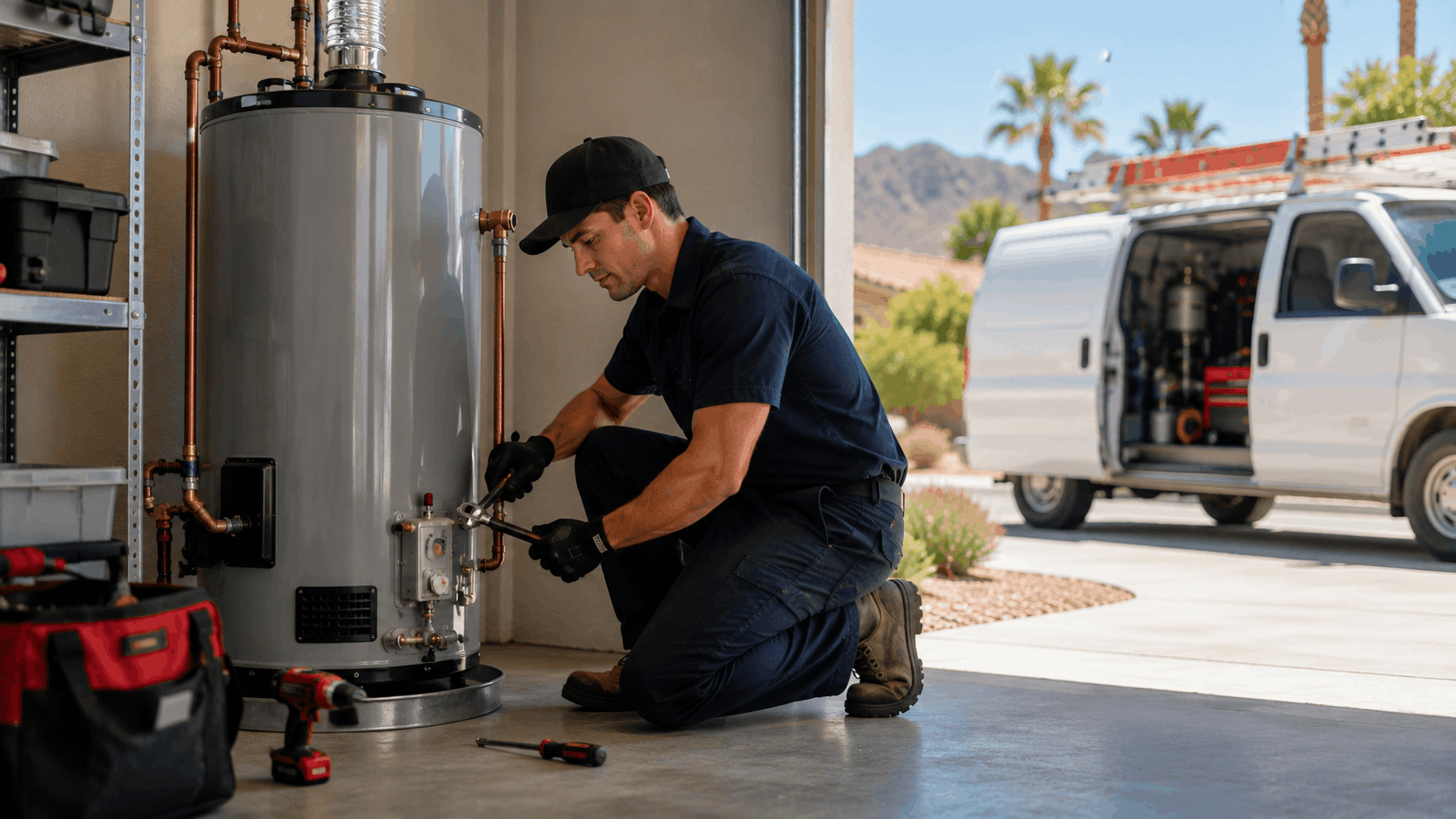
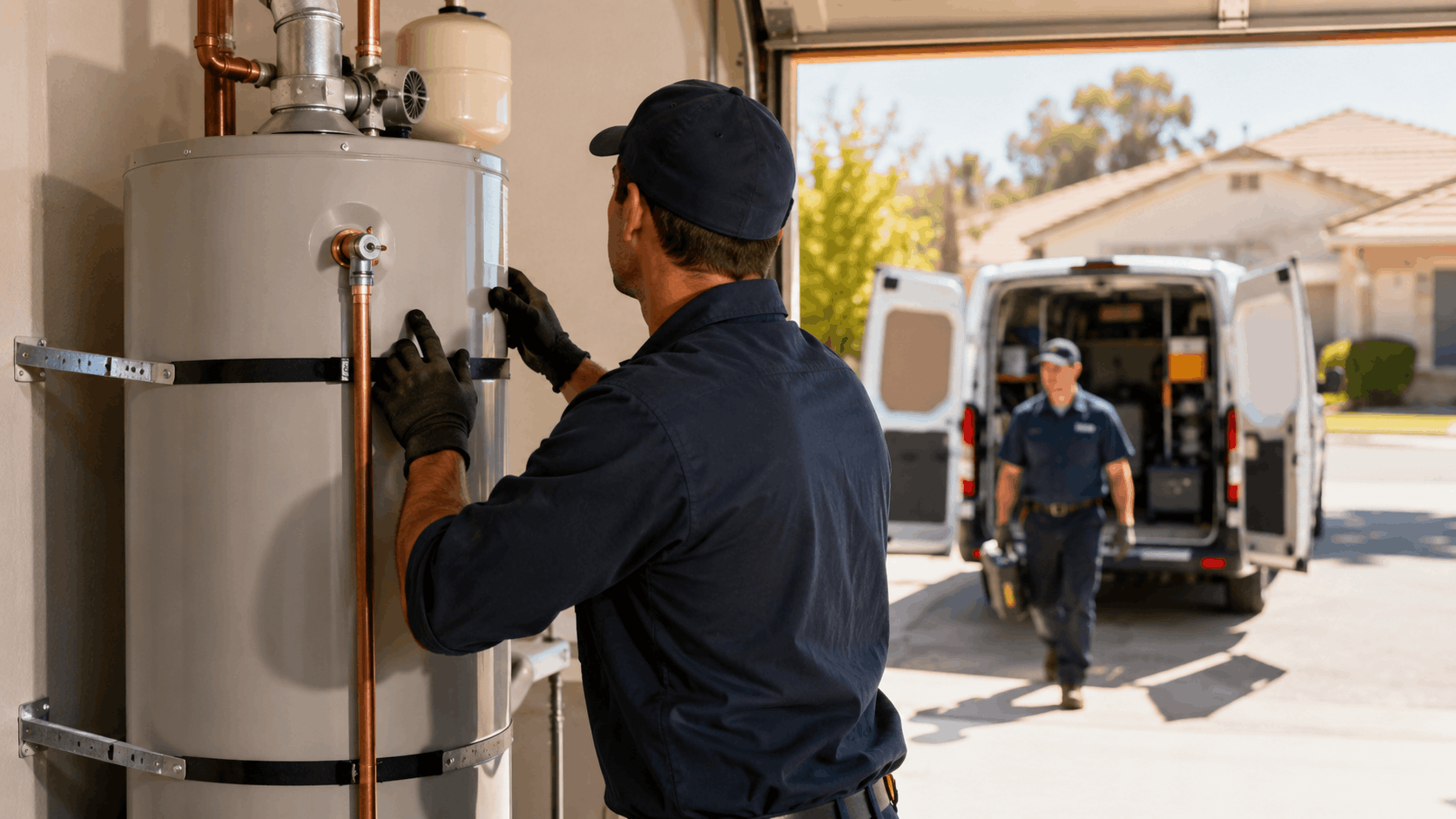
A straightforward tank swap usually takes 2 to 4 hours from start to finish. That includes draining the old unit, disconnecting it, setting the new tank, reconnecting water and gas or electric, and testing for leaks. The tank replacement time stays predictable when connections are in good shape.
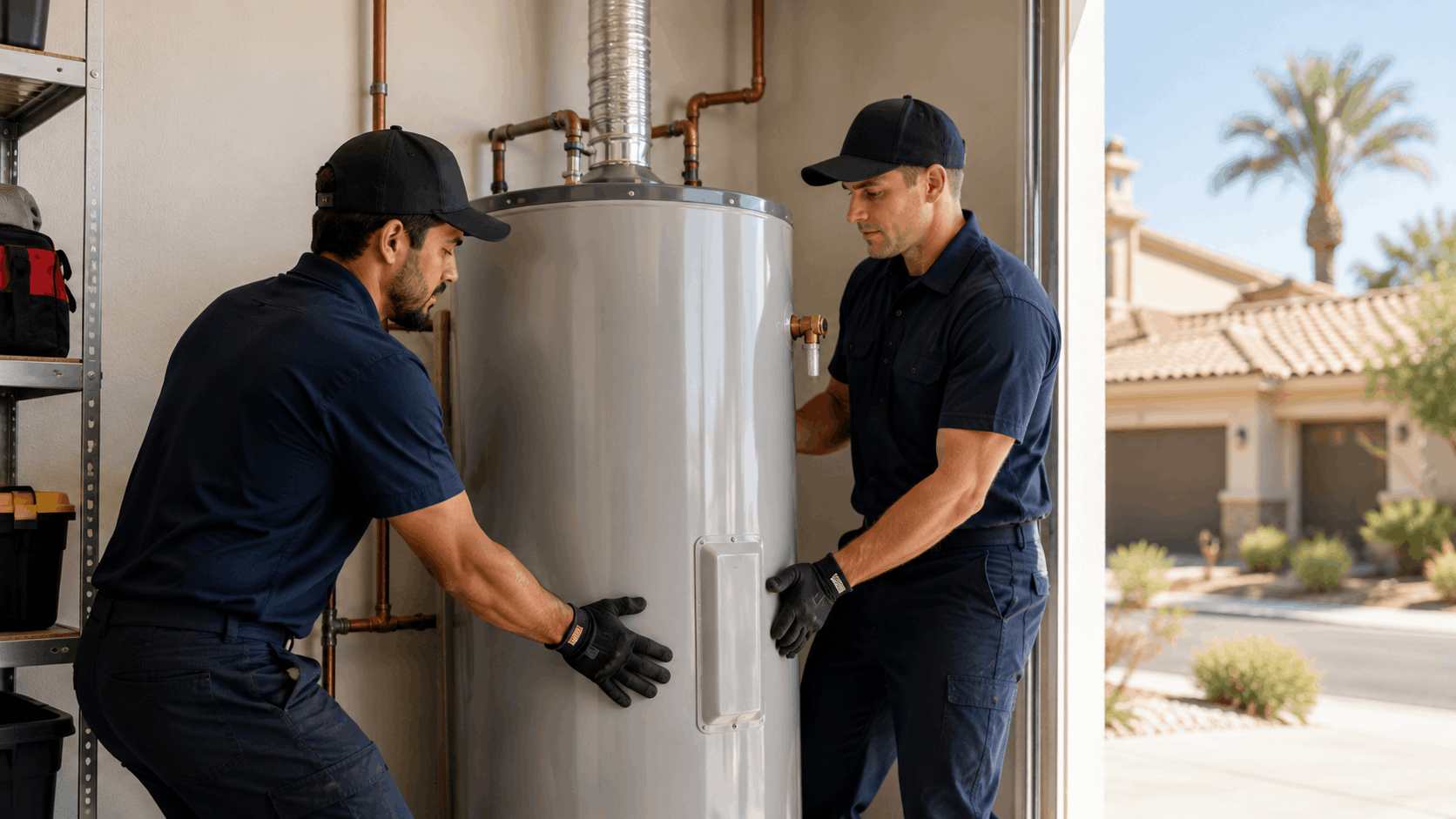
The first hour goes to draining and removing the old tank. A 50 gallon unit full of water and sediment is heavy, so this step takes patience. Hard water sediment can slow the drain, which we will cover later.
Setting and connecting the new unit takes the next chunk of time. The crew levels the tank, attaches supply lines, fits an expansion tank if required, and connects venting. Then comes the fill and the first heat cycle.
Install duration varies with small details. A clean garage install with new valves goes fast, while a tight closet with corroded fittings adds time. Most homeowners have hot water again the same afternoon.
Tankless Conversion Timeframes
A tankless conversion is a different animal. Switching from a tank to a tankless unit often takes a full day or more. The reason is the extra work beyond just mounting the new heater.
Venting is the big one. Tankless units need their own venting path, which may mean cutting through a wall or roof and routing new pipe. This is careful work that cannot be rushed without risking a code failure.
Gas demand is the other factor. Tankless heaters draw more gas at once than a tank, so the existing line frequently needs upsizing. That ties into our gas line services and adds time to the project.
Many homeowners pair a conversion with a recirculation pump for instant hot water at distant fixtures. That extra component is worth the longer timeline for the comfort it adds. We set clear expectations so nobody expects a tankless conversion to finish in two hours.
What Slows a Job Down
Even a simple swap can hit surprises. A corroded valve is a common one. When the old shutoff is seized or crumbling, the crew has to replace it before the new unit goes in, which adds time and parts.
Tight spaces create another slowdown. Older homes near downtown often tuck water heaters into cramped closets with barely enough room to maneuver a tank. Wrestling a unit through a narrow hallway takes longer than a roomy garage install.
Code upgrades can also extend the job. If the existing setup lacks a drip pan, expansion tank, or proper seismic strapping, those must be added to pass inspection. We bring these parts standard so a code requirement does not send us back to the shop.
Sediment buildup from hard water rounds out the list. A tank packed with mineral deposits drains slowly and sometimes clogs the drain valve entirely. Clearing that takes patience but keeps the new install clean and the work area dry.
Neighborhood Factors That Affect Replacement Speed
Las Vegas is not one uniform city. Each neighborhood brings its own quirks that affect how fast a local install goes. Years of driving these streets have taught us what to expect in different areas.
Drive time, home age, and HOA rules all factor into the schedule. A job in Henderson plays out differently than one in central Las Vegas. Here is what we have learned across the valley.
Older Homes Near Downtown and the Huntridge Area
The Huntridge neighborhood and other central areas hold some of the city's oldest homes. Many were built in the 1940s and 1950s with original plumbing that has seen decades of hard water. That aged plumbing often surprises homeowners when it comes time to replace a heater.
Undersized closets are common in these homes. Water heaters were tucked into tight spaces that meet older codes but barely fit modern units. Getting an old tank out and a new one in can take careful maneuvering.
Corroded shutoffs and galvanized pipe show up frequently too. When the supply lines crumble at the touch, the crew replaces them as part of the job. We come prepared for this so an older home does not derail the timeline.
Despite these challenges, we complete most Huntridge-area swaps the same day. Knowing the area means we arrive expecting the quirks rather than scrambling when we find them. That local experience keeps central installs on track.
HOA Communities in Summerlin and Henderson
Summerlin and Green Valley communities often come with HOA rules that affect access and timing. Some associations have guidelines about contractor hours, parking, and where work vehicles can sit. We work within those rules to keep installs smooth.
Garage placement is typical in these newer master-planned areas. That is good news for access, since a garage install is usually more quickly than a cramped interior closet. The crew can stage tools and move the old unit out easily.
A Henderson HOA may also have specific requirements about water heater venting or exterior changes. For a standard same-size swap, this rarely causes issues. For conversions that need new venting, we factor in any approval steps.
Communities like Whitney Ranch and the gated areas of Summerlin generally have predictable setups. Once inside, the install moves at a steady pace. Knowing the gate and parking situation ahead of time saves everyone hassle.
Newer Builds in the Southwest and North Las Vegas
Newer developments tend to be the fastest installs. Homes near Mountain's Edge, Inspirada, and the growing southwest corridor were built with standard setups and modern connections. That consistency makes a swap quick and clean.
North Las Vegas neighborhoods like Aliante and Elkhorn share this advantage. The plumbing meets current code, the shutoffs work, and the garage placement gives plenty of room. There are fewer surprises hiding behind the walls.
These homes usually already have expansion tanks and proper drip pans installed. That means fewer code upgrades during the swap, which keeps the job short. A morning call in these areas often means hot water by early afternoon.
The main variable in newer builds is simply unit size and fuel type. Once those are confirmed on the phone, the install itself rarely throws curveballs. These are the jobs that hit the lower end of our timeline ranges.
Hard Water Damage Across the Valley
Hard water is the single biggest enemy of water heaters in this region. The Las Vegas Valley Water District delivers some of the hardest water in the country, loaded with calcium and magnesium. Those minerals settle inside tanks as sediment over time.
That sediment shortens tank life across the entire valley. A heater that might last 12 years elsewhere often fails at 8 to 10 years here. The buildup also makes the unit work harder, raising energy use before it quits entirely.
During a replacement, sediment adds cleanup time. A heavily scaled tank drains slowly and may clog its drain valve. The crew clears the deposits and inspects the area before setting the new unit.
Many homeowners pair a new heater with a water softener or salt-free conditioning to protect their investment. Treating the water cuts future sediment and stretches the life of the new tank. It is one of the best moves a Las Vegas homeowner can make.
Need Help in Las Vegas?
Active Plumbing serves Las Vegas and all of Las Vegas Valley.
Hot Water Heater Replacement: Choosing the Right Path for Your Home
The first choice is whether to replace like for like or change the type of heater. A tank-for-tank swap of similar size and fuel is the simplest path and is often finished in one visit. Tank water heater installation typically runs $800 to $1,500 in the Las Vegas Valley. Moving to tankless frees garage or closet space and removes the risk of a tank letting go, but a gas tankless unit needs far more fuel at full output, so the gas line and meter often need upsizing. Tankless water heater installation typically runs $1,500 to $3,500, with a pre-filter adding $150 to $300 where hard water calls for one. These are typical ranges, not quotes.
Size the heater to your peak demand, such as back-to-back showers with the dishwasher running, rather than just counting bedrooms. Then factor in the valley's water at about 280 parts per million, roughly 16 grains per gallon. Tanks collect sediment and tankless heat exchangers collect scale, so plan for flushing or descaling either way. Heat pump models run on NV Energy power, and the federal Section 25C credit ended for equipment placed in service after December 31, 2025.
Any path should include a drain pan where a leak would cause damage, a properly drained relief valve, an expansion tank on closed systems, and a permit through the building department for your address. Active Plumbing gives a written price before work starts. Call (702) 438-3357.
Signs You Need a Replacement, Not a Repair
Not every water heater problem calls for a full replacement. Sometimes a repair is the smarter, cheaper fix. The trick is knowing which situations justify a same-day swap versus a service call.
The decision usually comes down to age, leaks, and how the unit behaves. Some warning signs point clearly toward replacement. Here is how to read them.
| Symptom | Likely Outcome | Why |
|---|---|---|
| Unit over 8-10 years old | Replace | Past typical lifespan in hard water |
| Water pooling at base | Replace | Tank corrosion, not repairable |
| Rusty hot water | Replace or inspect | Internal tank rust |
| Pilot or element failure | Often repair | Replaceable parts |
| Loud rumbling, lukewarm water | Depends on age | Sediment buildup, possible flush |
Age of the Unit
Age is the first thing to check. A typical tank water heater lasts around 8 to 12 years, but Las Vegas hard water trims that down. Many local units start failing closer to the 8 to 10 year mark.
Once a unit passes that window, repairs rarely make sense. Pouring money into a tank that is already corroding inside often buys only a few more months. The smarter move is usually a clean replacement.
The unit age is easy to find on the data label. The serial number encodes the manufacture date, and our team can decode it quickly. If the heater predates the homeowner moving in, it may be older than they think.
For a unit right at the edge, we give an honest read. If the tank looks solid and the issue is a cheap part, repair wins. If corrosion is setting in, replacement saves money long term.
Rusty Water and Tank Leaks
Rusty hot water is a red flag. When the hot side runs brown or orange but the cold runs clear, the rust is coming from inside the tank. That internal corrosion cannot be reversed with a repair.
A tank leak is even more decisive. Water pooling around the base of the unit almost always means the tank itself has failed. The steel has rusted through, and no patch fixes a corroded tank.
A small puddle today can become a flooded garage tomorrow. Once a tank starts weeping, the failure tends to speed up fast. This is the classic scenario for a same-day replacement before real damage occurs.
If a homeowner spots water at the base, shutting off the supply is the immediate step. Then a quick call gets our crew out with a replacement unit. Our water heater repair team can also confirm whether a leak is fixable or terminal.
Strange Noises and Inconsistent Heat
A water heater that pops and rumbles is talking to you. Those sounds usually come from sediment buildup at the bottom of the tank. Water gets trapped under the mineral layer and boils, creating the noise.
That same sediment causes inconsistent heat. The buildup insulates the burner from the water, so the unit struggles to keep up. Lukewarm showers and a heater that runs constantly point to this problem.
A rumbling noise on a newer unit might be solved with a flush. Clearing the sediment can restore performance if caught early. On older units, the buildup is often too far gone to reverse.
If the noises come with age and rusty water, replacement is the practical answer. The sediment has been working on the tank for years. A fresh unit paired with water treatment prevents the cycle from repeating.
Permits, Code, and Inspections in Clark County
Permits sound intimidating, but they are a routine part of doing the job right. Clark County has clear rules about water heater work, and our team handles the paperwork. Knowing how this fits the timeline keeps homeowners informed.
The permitting process exists for safety. Proper venting, gas connections, and overflow protection prevent fires, leaks, and carbon monoxide risks. Here is how it works locally.
When a Permit Is Required
Most water heater replacements in Clark County require a permit. Even a simple like-for-like swap technically falls under the plumbing code because it involves gas, water, and venting. A licensed plumber pulls the permit as part of the service.
Some minor repairs do not need a permit, like replacing a heating element or a thermostat. But any time the tank itself is replaced, the work is permitted. This protects the homeowner and ensures the install meets standards.
The Clark County Building Department oversees these permits. You can review local requirements through the Clark County Building and Fire Prevention resources. We handle the filing so homeowners do not have to.
Pulling the proper water heater permit also protects resale value. An unpermitted install can cause problems during a home sale inspection. Doing it by the book the first time avoids those headaches.
Code Requirements for Las Vegas Installs
Several code items apply to a proper install. An expansion tank is often required to handle pressure changes in closed plumbing systems. Without it, pressure spikes can stress the tank and valves.
Seismic strapping secures the unit so it cannot tip or shift. A drip pan with a drain line catches leaks before they damage flooring or walls. These small components matter for both safety and passing inspection.
Venting code is strict for gas units. Proper venting carries combustion gases safely outside, and any deviation creates a carbon monoxide risk. The U.S. Department of Energy offers solid background on water heater safety and efficiency for homeowners who want to read more.
Our crews carry these parts standard. That means a missing expansion tank or pan does not stop the job. We build the install to code from the start so the inspection is a formality.
How Permitting Affects Your Timeline
Permitting does not have to slow things down much. For most replacements, we can install the unit the same day and schedule the inspection right after. The homeowner gets hot water immediately while the paperwork follows.
The inspection itself happens after the install is complete. Inspectors check the connections, venting, and required safety components. Because our work meets code, these inspections typically pass without issue.
Inspection scheduling is the one variable outside our control. The county sets the inspector's calendar, so the visit may land a day or two later. That does not affect the homeowner's hot water in the meantime.
We manage the entire permit timeline so the homeowner is not chasing the county. From filing to the final sign-off, our team handles communication. The goal is a smooth process that never drags out the wait for hot water.
Need Help in Las Vegas?
Active Plumbing serves Las Vegas and all of Las Vegas Valley.
What to Do Before the Plumber Arrives
A little prep before the crew shows up makes the install more quickly. None of these steps are complicated, and they help the job go smoothly. Here is what homeowners can do while waiting.
These actions protect the home and save the crew time. A few minutes of prep can shave real time off the visit. Walk through these before the truck arrives.
Shut Off the Water and Power
If the unit is leaking, shutting off the water supply is the first move. There is usually a cold water shutoff valve on the pipe entering the top of the heater. Turning it clockwise stops more water from entering the tank.
For a gas water heater, turn the gas valve to the off position. The control knob on the front of the unit usually has an off setting. This stops the burner safely while you wait.
For an electric unit, switch off the breaker that powers the heater. Running an electric element without water can damage it, so cutting power is the safe choice. The breaker is usually labeled in the main panel.
If a homeowner is unsure or smells gas, leaving the area and calling immediately is the safer path. Our 24/7 emergency team walks people through these steps over the phone. Safety comes before everything else.
Clear a Path to the Unit
Access makes a real difference in install speed. Moving boxes, storage bins, and clutter away from the heater gives the crew room to work. A clear path also protects belongings from getting bumped during the swap.
In a garage install, clearing a lane from the door to the unit lets the team roll equipment in and the old tank out. Those tanks are heavy and awkward, so an open route matters. A few minutes of tidying speeds things up.
For closet installs, clearing the area outside the closet door helps too. The crew needs space to set tools and stage the new unit. Tight central-valley homes especially benefit from this.
Garage access also includes making sure the crew can reach the space. If the garage is the only path, having it accessible on arrival saves a wait. Small things like this keep the install on the fast end of the timeline.
Note the Model and Capacity
Finding the unit's model number and capacity helps us confirm the right replacement before driving out. The data label sits on the side of the tank. It lists the brand, model, capacity, and fuel type.
The capacity label shows the gallon size, usually 40, 50, or 75. The fuel type tells us gas or electric. Snapping a photo of this label and sharing it during the call removes any guesswork.
This information lets our team load the matching unit from local stock. When the crew arrives with the exact right heater, the install starts immediately. There is no need for a second trip to swap units.
If the label is faded or unreadable, that is fine. Our team can identify the unit by its dimensions and connections on arrival. But a clear photo up front makes the whole process smoother.
Final Thoughts
A failed water heater is a stressful surprise, but it does not have to ruin the day. For most homes across the valley, a same-day water heater replacement is a realistic outcome when the unit is stocked and the setup is standard. Honest expectations, local inventory, and a clear timeline are what make it work.
From the older closets of Huntridge to the newer garages of Mountain's Edge, our team knows what each neighborhood brings. We keep popular tank and tankless models ready, handle Clark County permits, and haul away the old unit. The goal is simple: get hot water flowing again with as little disruption as possible.
If a cold shower or a leaking tank has you searching for help, our team is ready to talk it through. Call Active Plumbing or reach out through our contact page for a fast quote and an honest timeline. We serve homeowners across Las Vegas, Henderson, North Las Vegas, and the surrounding communities every day.
Frequently Asked Questions
- Can a water heater really be replaced the same day in Las Vegas?
- Yes, for most standard jobs. A like-for-like swap using a stocked unit with working connections can finish the same day, usually within a few hours of arrival. Same-day works best when no gas line upgrade, special-order size, or major code change is involved. Calling early in the day gives the most flexibility. Tankless conversions and permit-heavy jobs typically need more time.
- How much does same-day water heater replacement cost?
- Cost depends on the unit type, size, and any required upgrades. A standard tank replacement generally falls into a mid-range price covering the unit, labor, and haul-away. Tankless installs cost more because they involve venting and often gas work. After-hours emergency calls add a premium. Hard water sediment cleanup or replacing corroded valves can also affect the final number. We provide a clear quote over the phone before any work begins.
- How long does a standard tank install take?
- A straightforward tank swap usually takes 2 to 4 hours. That covers draining and removing the old unit, setting the new tank, reconnecting water and gas or electric, fitting any required parts, and testing. Clean garage installs with good valves land on the shorter end. Tight closets, corroded fittings, or heavy sediment buildup push toward the longer side. Most homeowners have hot water back the same afternoon.
- Do I need a permit to replace my water heater in Clark County?
- Most full replacements require a Clark County permit because the work involves gas, water, and venting. Minor repairs like swapping a heating element usually do not. Our licensed team pulls the permit and handles the paperwork as part of the service. We often install the same day and schedule the inspection right after, so the permit process never leaves a home without hot water while it is sorted out.
- What size water heater do I need for my home?
- It comes down to household size and water usage. A 40 gallon unit fits one to three people or a condo, while a 50 gallon suits most three to five person homes. Larger households with soaking tubs or multiple simultaneous showers may need 75 gallons or a tankless system. Our team asks about your bathrooms, family size, and peak usage during the call to match the right capacity before arriving.
- Should I switch from a tank to tankless?
- Tankless units offer endless hot water and free up space, which appeals to many southwest valley homeowners. The tradeoffs are a higher upfront cost and a longer install, often a full day, because of new venting and possible gas line upsizing. They also benefit from regular descaling in hard water. For families wanting efficiency and space savings, the conversion is worth it. We help weigh the pros and timeline for your home.
- Why does Las Vegas hard water shorten water heater life?
- Las Vegas Valley Water District delivers very hard water full of calcium and magnesium. Those minerals settle as sediment at the bottom of the tank over time. The buildup makes the unit work harder, lowers efficiency, and speeds up corrosion. As a result, many local heaters fail around 8 to 10 years instead of lasting longer. Pairing a new unit with a water softener or conditioner helps protect it and extend its life.
- Do you haul away my old water heater?
- Yes, removal and disposal of the old unit are part of our replacement service. The crew drains, disconnects, and carries out the old heater, then handles proper disposal. Homeowners do not have to deal with a heavy, water-filled tank or figure out where to take it. This is one of the main advantages of a professional install over a big-box pickup where the old unit becomes your problem.
- What areas of Las Vegas do you serve for same-day work?
- We cover the full valley for same-day and next-day replacements. That includes Summerlin, Henderson, North Las Vegas, Spring Valley, Enterprise, Paradise, Whitney, Sunrise Manor, and Winchester. From central Huntridge homes to newer builds near Mountain's Edge and Aliante, our trucks reach every corner. Drive time and stock availability shape the exact window, so an early call gives the best chance at same-day service across these areas.
- What should I do if my water heater is leaking right now?
- Shut off the cold water supply valve at the top of the tank first. For a gas unit, turn the gas control to off; for electric, flip the breaker. Move belongings away from the water and avoid the area if you smell gas. Then call our team right away. Our 24/7 emergency line can guide you through the steps and dispatch a crew to stop the damage and replace the unit fast.
Licensed plumbing professionals serving Las Vegas and Las Vegas Valley.
Licensed in Nevada · License #0047021
Last updated on
Why trust Active Plumbing?
Founded in 1991, Active Plumbing is a licensed and insured plumber serving Las Vegas and Las Vegas Valley. All content is reviewed by our licensed technicians.

Need Help in Las Vegas?
Active Plumbing serves Las Vegas and all of Las Vegas Valley.
Related Articles
Tankless Water Heater Maintenance in Las Vegas: Why Hard Water Makes It Critical
Las Vegas hard water from Lake Mead builds scale fast inside tankless heaters. Learn the warning signs, real maintenance steps, and how often valley homes need service.
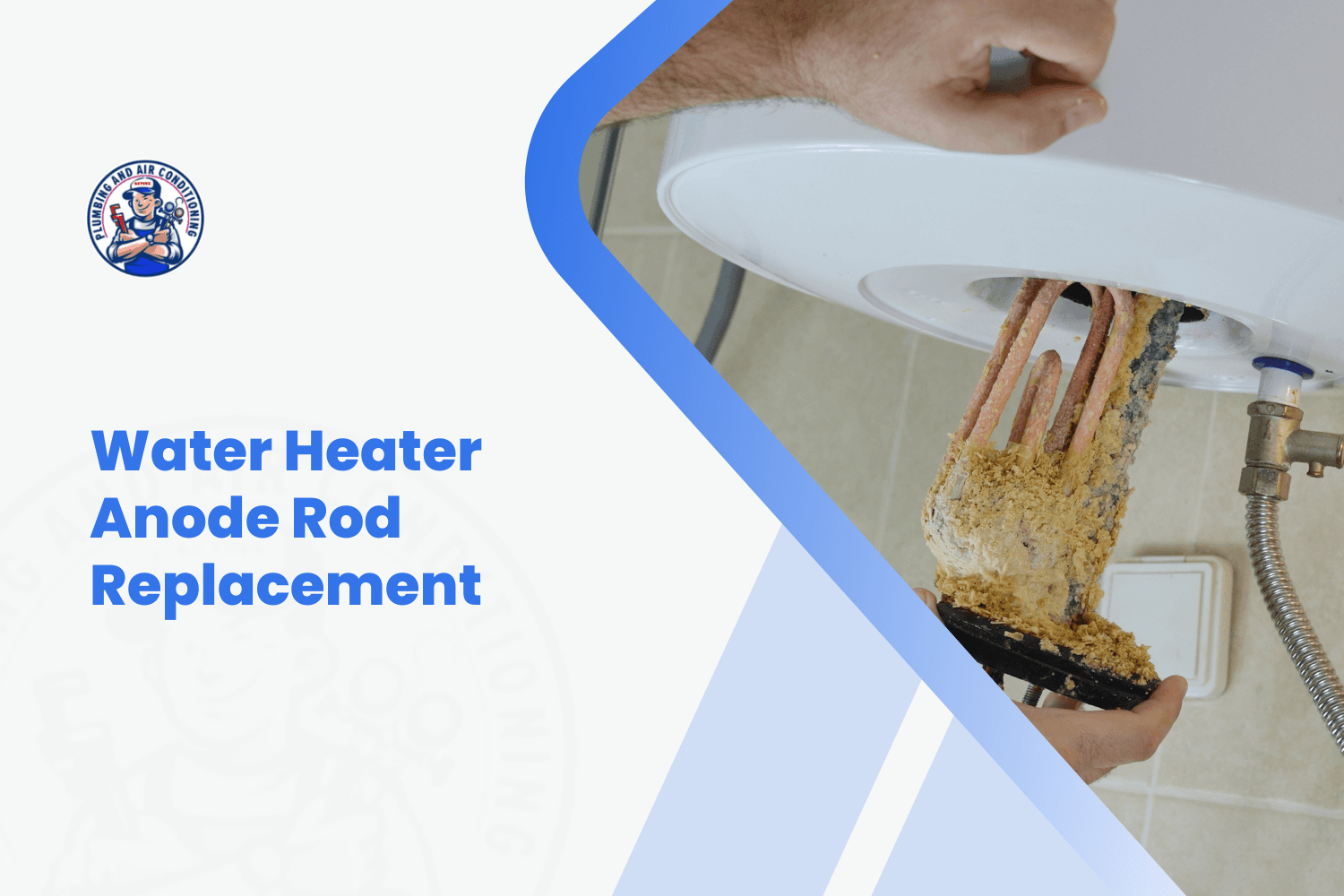
Water Heater Anode Rod Replacement: Why Vegas Hard Water Eats Them in 18 Months
Las Vegas hard water destroys anode rods in 18 months instead of years. Learn the warning signs, replacement costs, and how to protect your water heater long term.
How Much Does Water Heater Replacement Cost in Las Vegas?
Water heater replacement cost in Las Vegas depends on tank vs tankless, size, and permits. Vegas hard water shortens tank life. Here's what to expect and how to get a fair quote.