40 vs 50-Gallon Water Heater Cost in Las Vegas: Real Installed Prices and When the Bigger Tank Pays Off
Key Takeaways
- A 50-gallon water heater usually costs only $200 to $400 more installed than a 40-gallon in Las Vegas, so size for need, not price.
- Couples and empty nesters do well with 40 gallons, while families of four or more and homes with soaking tubs benefit from 50 gallons.
- First hour rating and recovery rate matter as much as raw tank size, and gas units recover more quickly than electric.
- The extra ten gallons adds only about $2 to $4 per month; fuel type and UEF efficiency affect your bill far more.
- Las Vegas hard water causes sediment buildup, so annual flushing and a water softener are the best ways to extend tank life.
- Water heater replacements require a permit in Clark County and the City of Las Vegas, plus items like expansion tanks and strapping to pass code.
- Older homes near Charleston Boulevard and east Las Vegas often need extra code upgrades during a swap.
- Active Plumbing offers in-home sizing, a written price before work starts, 24/7 emergency replacement, and financing across the valley.
In This Article
It usually happens on a busy weekday morning in Summerlin. Dad finishes his shower, one kid rinses off after soccer practice, and by the time the last person steps in, the water runs cold. That family called us frustrated, wondering if their tank was broken. It was not broken at all. It was simply too small for how they actually used hot water.
This is one of the more common calls our team gets across the Las Vegas Valley. Homeowners are stuck choosing between a 40 and a 50-gallon water heater, and the sticker prices online never match what they end up paying. Labor, permits, and local water conditions all change the final number.
Real Installed Prices for 40 and 50-Gallon Water Heaters in Las Vegas
Manufacturer sticker prices tell you almost nothing about what you will really spend. The true water heater installed cost includes the tank, labor, permits, disposal of the old unit, and any code items your home needs. Las Vegas plumbing prices also reflect our hard water and older housing stock.
Below is an honest look at what homeowners across the valley actually pay for a 40 vs 50 gallon replacement. These ranges reflect standard swaps, not complex jobs that need rerouting or major upgrades.
| Tank Size & Fuel | Unit Only | Typical Installed Price |
|---|---|---|
| 40-Gallon Electric | $500 - $750 | $1,200 - $1,900 |
| 40-Gallon Gas | $600 - $900 | $1,500 - $2,300 |
| 50-Gallon Electric | $600 - $900 | $1,400 - $2,200 |
| 50-Gallon Gas | $750 - $1,100 | $1,700 - $2,700 |
40-Gallon Installed Price Range
For most standard homes, a 40 gallon cost lands between $1,200 and $2,300 fully installed. The gap comes down to fuel type. An electric unit sits at the lower end, while a gas model runs higher because of venting and gas connections.
When we look at gas vs electric here, electric tanks are cheaper to install but often cost more to run in the valley. Gas units cost more up front but heat quicker, which matters for families who take back-to-back showers. Both are common in Las Vegas homes.
That installed number includes the tank, standard labor, basic connections, and haul-away of the old unit in most cases. What it does not always include are code upgrades or an expansion tank, which we cover further down. A clean swap in a garage with modern connections stays near the bottom of the range.
If your current tank sits in a tight closet or has outdated fittings, expect to move toward the top of that range. Our team gives a written quote after seeing the space so there are no surprises. You can review our water heater services to see what a standard install covers.
50-Gallon Installed Price Range
Here is the part that surprises people. The 50 gallon cost is usually only $200 to $400 more than the same fuel type in 40 gallons. Many homeowners expect the price difference to be huge, but the tank itself is the only real change.
A 50-gallon gas unit installed typically runs $1,700 to $2,700, while electric lands around $1,400 to $2,200. The labor is nearly identical since the connections, venting, and permit work are the same. You are mostly paying for the extra steel and water capacity.
Because the price difference is so small, we often tell families the choice should come down to need, not cost. Ten extra gallons rarely breaks the budget on a replacement. That is why sizing correctly matters more than chasing the cheapest tank.
The exception is when the larger tank does not fit the existing space. If we have to modify a closet or reroute a vent, the gap grows. We will flag that during the visit before any work starts.
What Drives the Price Difference
Several installation factors move the final number more than tank size does. Fuel type is the biggest one, since gas involves venting and gas line work that electric does not. A dead gas vent or corroded gas line can add real cost.
Brand and warranty length also matter. A tank with a 6-year warranty costs less than a 10 or 12-year model, but the longer warranty often makes sense given our hard water. We usually steer valley homeowners toward the longer warranty for that reason.
Your existing plumbing setup plays a large part too. Homes with modern flex connectors and a nearby drain install quickly and cheaply. Older properties with rigid copper, no drain pan, or undersized gas lines take more labor.
Location inside the home adds cost as well. A garage install is simple, while an attic or interior closet takes longer and may need extra safety features. All of these push the price up or down independent of whether you pick 40 or 50 gallons.
Hidden Costs Homeowners Miss
A common surprise is the expansion tank. Clark County code often requires one on a closed plumbing system, and it protects your new heater from pressure damage. That part and labor usually add $150 to $350.
Permit fees are another item people forget. A water heater replacement in Las Vegas needs a permit, and skipping it can cause problems when you sell the home. Reputable installers build this into the quote rather than hiding it.
Code upgrades catch older homes off guard. If your current setup lacks a drip pan, proper venting, or seismic strapping, those must be brought up to code during the swap. This is common in homes built before the 1990s.
Finally, there is old tank haul-away and disposal. A rusted 50-gallon unit full of sediment is heavy and messy to remove. Our flat quotes include disposal so you are not left with the old tank in your garage.
Get Your Quote
Tell us what's going on and we'll get back to you. We're open 24/7.
How Household Size Decides Which Tank Fits
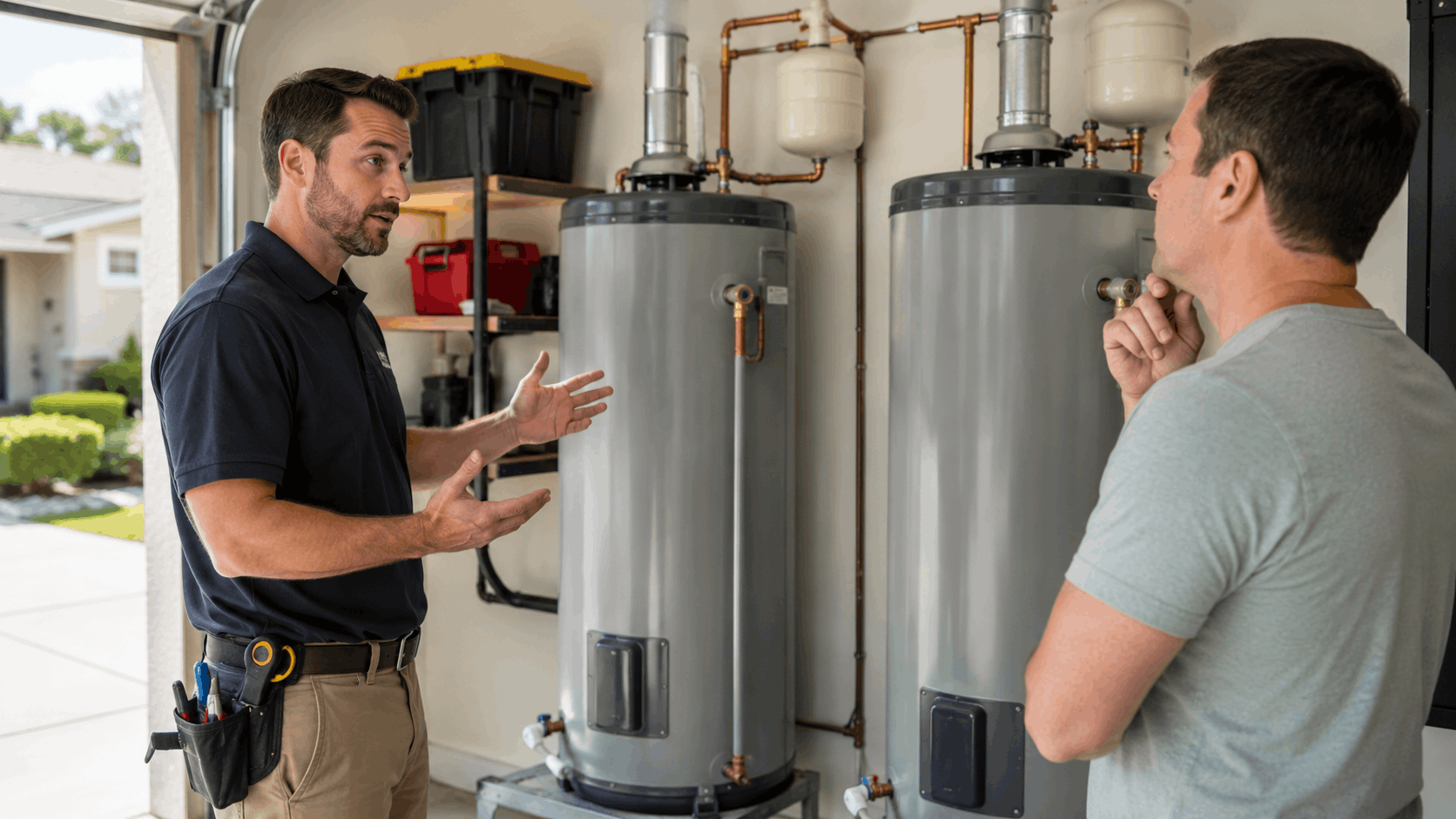
The right tank size depends on how many people live in your home and how they use hot water. Two people who shower at different times have very different hot water demand than a family of five getting ready at once. Tank sizing is really about peak usage, not just headcount.
Here is a simple guide we use when talking with homeowners across the valley about matching household size to tank capacity.
| Household | Typical Use | Recommended Size |
|---|---|---|
| 1 - 2 people | Staggered showers, light use | 40 gallons |
| 2 - 3 people | Some overlap, one bath | 40 - 50 gallons |
| 4 people | Morning rush, laundry | 50 gallons |
| 5+ people | Back-to-back showers, tubs | 50 gallons or larger |
Small Households and Couples
For one or two people, a 40-gallon tank is usually plenty. Couples who shower at different times almost never run out, even with a dishwasher or laundry running. In most cases, 40 gallon is enough for this group without a second thought.
We see this a lot in smaller homes and townhomes around Spring Valley and Paradise. A single person or couple simply does not draw enough hot water at once to justify the larger tank. The extra ten gallons would sit heated but unused most of the day.
The main exception is a couple with a large soaking tub who both bathe in the evening. A deep tub can drain a 40-gallon tank fast. If that describes your routine, it is worth talking through before you decide.
For everyone else in this group, staying with 40 gallons saves a little money up front and slightly lowers standby energy loss. There is rarely a reason for couples to upsize unless plans are changing.
Families of Four or More
A family of four changes the math quickly. Picture the morning showers stacking up before school and work, all within about an hour. That is exactly when a 40-gallon tank runs dry and someone gets the cold rinse.
A 50-gallon unit gives that extra buffer for overlapping use. When two showers, a load of laundry, and the kitchen sink all pull hot water in the same window, the larger tank keeps up better. This is a common upsizing reason we see.
Homes in family neighborhoods like Summerlin West and Centennial Hills fit this pattern well. Busy mornings and multiple bathrooms add up fast. The small price bump for 50 gallons pays off every single day for these households.
If your family is four people but everyone showers at different times, a 40-gallon tank with a strong recovery rate can still work. It really comes down to whether your usage clusters together or spreads out.
Homes With High Hot Water Demand
Some homes have high demand no matter the headcount. A large master bathroom with a soaking tub, a rain shower head, or dual shower heads pulls serious volume. These features are common in Summerlin and Southern Highlands custom homes.
A soaking tub alone can hold 40 to 80 gallons of water. Filling one from a 40-gallon tank leaves nothing for anyone else. For homes like these, a 50-gallon tank is often the minimum starting point.
Back-to-back use patterns also drive demand up. Guests, teenagers, or a home gym with a shower all add to the peak load. When several fixtures run in sequence, capacity and recovery both matter.
For the highest-demand homes, we sometimes suggest looking at a tankless water heater installation instead. Tankless units deliver endless hot water for long soaks and multiple showers, though the upfront cost is higher.
First Hour Rating vs Tank Size
Raw gallons are only half the story. The first hour rating tells you how much hot water a heater can deliver in the first hour of heavy use, combining tank size with recovery rate. Two 40-gallon tanks can perform very differently based on this number.
Recovery rate is how fast the unit reheats incoming cold water. Gas heaters usually recover more quickly than electric, which is why a 40-gallon gas unit can sometimes outperform a 50-gallon electric during a busy morning. This catches many buyers off guard.
When we size a tank, we look at the first hour rating against your peak usage, not just the label. A family with a strong first hour rating can often do more with less capacity. This is where honest sizing saves money.
Checking the yellow EnergyGuide label helps here. It lists the first hour rating right on the tank. The U.S. Department of Energy also has clear guidance on using this number to size correctly.

Need Help in Las Vegas?
Active Plumbing serves Las Vegas and all of Las Vegas Valley.
When the Bigger Tank Actually Pays Off
The question is not whether a bigger tank is nice to have. It is whether the upgrade earns its keep in your specific home. Sometimes the 50-gallon is clearly worth it, and other times it is money sitting idle in your garage.
Since the price difference is small, the real return on investment comes from how often you would actually use the extra capacity. Here is how we help homeowners decide whether upsizing makes sense.
Growing Families and Future Plans
If you are planning kids soon or expect the household to grow, sizing up now is smart. Replacing a water heater is a job you only want to do once per decade. Buying the 50-gallon today avoids a second install when the family expands.
The same goes for homeowners who host guests often. A finished guest room or in-law suite means extra showers on weekends and holidays. Future proofing with ten more gallons costs little compared to redoing the work later.
We see this a lot with younger families buying their first home in areas like Mountains Edge and Aliante. They plan to stay and grow into the house. Sizing for where the family is heading, not just where it is now, saves hassle.
Since labor is nearly the same for both sizes, the growing family almost always comes out ahead choosing 50 gallons up front. The marginal cost is far lower than a full replacement in three years.
When 40 Gallons Is the Smarter Buy
For empty nesters, the 40-gallon tank is usually the better value. Once the kids move out, hot water demand drops sharply. Paying to heat fifty gallons for two people wastes energy every day.
Small condos and townhomes near Downtown and the Arts District also do well with a smaller tank. Space is tight, demand is modest, and a 40-gallon unit fits both the closet and the lifestyle. The smaller tank keeps monthly bills a touch lower too.
Single professionals and older couples rarely draw enough at once to notice a difference. For them, the extra capacity would sit heated and untouched. The money is better kept in your pocket.
We would rather right-size your tank than sell you more than you need. If a 40-gallon unit fits your life, that is exactly what we will recommend. Honest sizing is how we keep customers for the long run.
Cost of Running Out vs Cost of Bigger Tank
Think about what running out of hot water actually costs you. A cold shower on a work morning, a half-finished bath for a toddler, or waiting an hour to reheat the tank. Those frustrations add up fast in a busy household.
Now weigh that against the cost comparison of upsizing. Spending $200 to $400 more once, spread across a ten-year tank life, is pennies per day. For a family that runs out often, the bigger tank pays for itself in comfort alone.
Constant reheating also stresses the unit. A tank that empties and refills all day works harder and can wear out sooner. Right-sizing reduces that strain and can stretch the tank's life.
For a couple that never runs out, though, the bigger tank buys nothing but extra standby loss. That is why the answer always comes back to your real usage, not a general rule.
Resale Value in Las Vegas Neighborhoods
A right-sized water heater helps at sale time in family-heavy areas. Buyers touring a four-bedroom home in Green Valley or Centennial Hills expect enough hot water for a full household. A 40-gallon tank in a big family home can raise questions during inspection.
Matching the tank to the home size signals the property was cared for properly. Real estate agents in Henderson and North Las Vegas often note the water heater age and size in listings. A recent, correctly sized unit is a quiet selling point.
On the flip side, an oversized tank in a small condo does not add much resale value. Buyers of smaller homes are not looking for extra capacity. The right size for the home is what matters, not simply the biggest.
If you are prepping to sell, we can advise whether your current setup fits buyer expectations for your neighborhood. Sometimes a properly permitted replacement smooths the whole sale.
Energy Costs and Monthly Bills for Each Size
Tank size affects your NV Energy and Southwest Gas bills, but usually less than people think. The difference between 40 and 50 gallons is real, yet small. Fuel type and efficiency rating move your monthly bill far more than ten extra gallons.
Here are realistic monthly operating estimates for the valley so you can plan around them.
| Setup | 40-Gallon Monthly | 50-Gallon Monthly |
|---|---|---|
| Gas (Southwest Gas) | $18 - $28 | $20 - $32 |
| Electric (NV Energy) | $32 - $48 | $35 - $52 |
Gas vs Electric Operating Costs
In the Las Vegas Valley, a gas water heater almost always costs less to run than electric. Southwest Gas rates make natural gas the cheaper fuel for heating water in most homes. A gas unit often runs $15 to $25 less per month than a comparable electric one.
An electric water heater is simpler and cheaper to install, but NV Energy rates add up over the years. For a family that uses a lot of hot water, the monthly gap is noticeable. Over a ten-year life, gas can save a meaningful amount.
That said, not every home has a gas line to the water heater location. Adding one changes the equation. If your home is already plumbed for gas, that fuel usually wins on operating cost.
Our team can check whether your current gas line is sized correctly for a new unit. Sometimes a gas line rerouting or upsizing is needed to feed a larger or higher-output heater safely.
How the Extra 10 Gallons Affects Your Bill
The extra ten gallons adds only a small amount to your bill. The main difference is standby loss, which is the heat that escapes while the tank sits full and waiting. A 50-gallon tank has slightly more surface area, so it loses a bit more.
In practice, that difference is usually $2 to $4 per month. Modern tanks are well insulated, which keeps standby loss low on both sizes. The energy use gap between the two is not a reason to size down if you need the capacity.
What raises your bill far more is how often you reheat a tank that keeps running empty. An undersized 40-gallon tank working overtime can cost more than a right-sized 50-gallon unit. Comfort and efficiency often line up when the size is correct.
So the extra ten gallons is cheap to own on a monthly basis. The insulation quality and fuel type matter much more to your bill than the capacity choice.
Energy Factor and Efficiency Ratings
Every modern water heater carries a UEF rating, which stands for Uniform Energy Factor. In plain terms, a higher UEF number means the unit turns more of its fuel into usable hot water and wastes less. It is the best single number for comparing efficiency.
A tank with a UEF of 0.70 costs less to run than one at 0.58, even at the same size. Over ten years, that difference adds up on your bills. We point valley homeowners toward the higher efficiency models when the budget allows.
Efficiency matters more in our climate because water heaters run year-round here. There is no long winter break from hot water demand. A more efficient unit pays back a little every month all year.
You can compare UEF ratings on the EnergyGuide label or through ENERGY STAR. We are happy to explain the numbers on any model you are considering.
Rebates and Incentives for Efficient Units
Efficient units often qualify for rebates that lower the real cost of an upgrade. NV Energy and Southwest Gas have run incentive programs for high-efficiency water heaters in the past. These change over time, so it pays to check current offers.
Federal tax credits for heat pump and high-efficiency models ended for equipment installed after December 31, 2025, so utility and manufacturer rebates are now the main incentives. These incentives can knock a few hundred dollars off the total. Combined with a longer warranty, they make the efficient choice easier.
We keep track of which rebates are active for valley homeowners. When we quote a job, we let you know if a model qualifies for savings. That way the extra efficiency does not cost as much as the sticker suggests.
Always confirm eligibility before assuming a rebate applies, since programs update their terms. Our team helps sort out the paperwork so the incentive actually lands in your pocket.
Need Help in Las Vegas?
Active Plumbing serves Las Vegas and all of Las Vegas Valley.
How Las Vegas Water Conditions Affect Your Choice
Las Vegas has some of the hardest water in the country. That hard water shapes how long any tank lasts and how you should maintain it. It affects sizing and long-term cost more than most homeowners realize.
The minerals in our local water settle inside the tank over time. Knowing how that works helps you protect the investment no matter which size you pick.
Hard Water and Sediment Buildup
Water from the Las Vegas Valley Water District carries heavy dissolved minerals, mostly calcium and magnesium. As the tank heats that water, the minerals drop out and settle as sediment on the bottom. Over the years, that layer builds up thick.
Sediment forces the heater to work harder because it insulates the burner or element from the water. That means higher bills and more wear. It is the single biggest reason water heaters fail early in this valley.
You may hear popping or rumbling from the tank as sediment traps steam bubbles underneath. That sound is a clear sign buildup is getting serious. Left alone, it shortens tank life and drops your hot water capacity.
This is why the same tank that lasts 12 years in a soft-water city might last 8 here. Our hard water is the deciding factor in long-term cost, regardless of size.
Why Bigger Tanks Can Hide Sediment Longer
A 50-gallon tank has more room before mineral buildup eats into usable capacity. As sediment fills the bottom, it steals gallons from the working volume. A larger tank simply has more cushion before you notice a drop.
Some homeowners prefer the 50-gallon for this reason. It buys a little more time between the first signs of buildup and a real loss of hot water. The extra tank capacity acts as a buffer against our water.
This is not a reason on its own to size up, but it is a real benefit in our valley. Paired with a legitimate need for more hot water, it makes the bigger tank even more sensible. The larger unit ages a bit more gracefully here.
Still, no tank is immune to sediment. Even a 50-gallon unit needs regular care to reach its full lifespan in Las Vegas.
Flushing and Maintenance in Local Homes
Because of our hard water, we recommend flushing the tank at least once a year. Homes with especially heavy use or no softener may benefit from twice yearly. Flushing clears the loose sediment before it hardens.
The process drains the tank and rinses out the mineral debris at the bottom. It takes under an hour and can add years to the unit's life. Skipping it is the fastest way to lose your investment early.
Many valley homeowners never flush their tank until it fails. We would rather set you up on a schedule that keeps the heater healthy. Regular flushing also keeps efficiency up so your bills stay reasonable.
If your tank has never been flushed and sounds like a coffee pot, have it checked. Our water heater repair team can flush it and inspect for early wear at the same time.
Water Softeners and Tank Life
A water softener is the best defense against hard water for either tank size. It removes the calcium and magnesium before they reach your heater. That slows sediment buildup dramatically and stretches the tank's life.
In neighborhoods like Aliante and Elkhorn, we see softened homes get several extra years from their water heaters. The softener protects not just the tank but faucets, fixtures, and appliances too. It is one of the better long-term investments for a valley home.
Beyond the heater, softer water feels better and leaves less scale on glass and tile. Many homeowners notice the difference right away. The whole plumbing system benefits from reduced mineral load.
If you are already replacing a tank, it is a natural time to consider a softener. Our water softener installation team can pair the two so your new heater starts life protected.
Space, Permits, and Code Rules in Las Vegas
The practical fit and the legal side both matter when swapping tank sizes. A 50-gallon tank is physically larger, and Las Vegas has clear permit and code rules for replacements. Knowing these ahead of time avoids delays and failed inspections.
Here is a quick reference for the common code and space items we check on every job.
| Requirement | Applies To | Notes |
|---|---|---|
| Permit | All replacements | Required by Clark County / City |
| Expansion tank | Closed systems | Often required by code |
| Drip pan | Interior installs | Protects against leaks |
| Strapping | Both sizes | Secures the tank |
| Proper venting | Gas units | Safety requirement |
Garage and Closet Clearance
A 50-gallon tank is both taller and wider than a 40-gallon unit. The difference is often a few inches in each direction, which sounds minor. In a tight utility closet, though, those inches decide whether the tank fits at all.
Older Las Vegas homes frequently have closets built for the smaller size. Swapping up to 50 gallons may mean the door will not close or the venting no longer lines up. We measure the space carefully before recommending the larger tank.
Garage installs give more room to work with, so upsizing there is usually simple. Most homes in newer areas like Summerlin and Mountains Edge have garage water heaters with plenty of clearance. That makes the bigger tank an easy fit.
If your unit sits in a cramped interior closet, we will confirm the 50-gallon fits before quoting it. Sometimes staying with 40 gallons is the only practical option without remodeling.
Permits and Inspections
A water heater replacement in Las Vegas needs a permit, whether you are in Clark County or the City of Las Vegas. The permit ensures the work meets current code and passes inspection. It also protects you when you sell the home.
Some homeowners try to skip the permit to save time, but that can backfire. An unpermitted heater can flag during a home sale or insurance claim. A failed inspection later costs far more than doing it right the first time.
A licensed installer pulls the permit and handles the inspection for you. That is part of what you pay for with professional installation. We build the permit fee into our quote so it is never a surprise.
The inspection confirms venting, connections, and safety features are correct. Passing it gives you documented proof the job was done to code. That paperwork has real value down the road.
Seismic and Strapping Requirements
Both tank sizes must be strapped to the wall to hold the unit steady. This applies to gas and electric alike. Proper strapping keeps the tank secure and connections intact over the years.
Interior installs also need a drip pan with a drain line. If the tank ever leaks, the pan catches the water and routes it away from your floors. This protects finished spaces from water damage.
Gas units carry venting rules on top of that. The vent must be sized and routed correctly to carry combustion gases safely outside. A larger gas tank sometimes needs the venting checked to match its output.
These items apply regardless of whether you choose 40 or 50 gallons. We handle strapping, the drip pan, and venting as standard parts of a code-compliant install.
Older Homes Near Downtown and East Las Vegas
Homes near Charleston Boulevard and the older east-side neighborhoods often need extra work to pass code. These properties were built when standards were different. Bringing them up to current code is a normal part of the job here.
Common upgrades include adding a drip pan, updating the venting, or installing an expansion tank. Older gas lines may also need attention to feed a modern unit safely. We flag all of this during the initial visit.
Homes in Sunrise Manor and around the Arts District sometimes have rigid copper connections that take longer to swap. That extra labor shows up in the quote. We explain each item so you understand what you are paying for.
None of this should scare you off a replacement. It simply means an older home may cost a bit more than a newer one. Knowing that up front keeps the process smooth.
Need Help in Las Vegas?
Active Plumbing serves Las Vegas and all of Las Vegas Valley.
How Active Plumbing Helps You Pick and Install the Right Tank
Our goal is to put the right size in your home, not the most expensive one. Active Plumbing has handled water heater installation across the valley for years, from Henderson to North Las Vegas. That experience means we size tanks based on real usage, not a sales quota.
Here is how our team as your local Las Vegas plumber approaches every water heater job.
In-Home Sizing Assessment
Before we recommend a size, we come out for an in-home visit. We look at how many people live there, how the household uses hot water, and what fuel type is available. That sizing assessment is the foundation of a good recommendation.
We also check the space, the existing connections, and the current venting. Measuring the closet or garage spot tells us whether a 50-gallon unit even fits. Seeing the home in person prevents surprises on install day.
During the visit we listen to your actual complaints. If you keep running out during morning showers, that tells us more than any chart. Real usage guides the size we suggest.
By the end of the assessment, you get a clear recommendation with the reasoning behind it. No pressure to size up, no guessing. Just the right tank for how you live.
A Written Price Before Work Starts
Our quotes include the tank, labor, permit, disposal, and any code items your home needs. That written price before work starts means you know the cost before we begin. No add-ons appear halfway through the job.
We give a written price so you know the cost before we start. If the home needs an expansion tank or venting work, we tell you during the quote, not after. Honest pricing is how we keep valley customers coming back.
Hidden fees are the biggest complaint people have about plumbers. We built our process to remove them. What you see on the quote covers the whole job.
If anything unexpected does come up mid-job, we stop and explain before doing extra work. You stay in control of the cost the whole way through.
Same-Day and Emergency Replacement
A leaking or dead water heater cannot wait. Our team offers same-day and emergency replacement across the valley, from Henderson to North Las Vegas. When your tank fails, we move fast to get hot water back.
A burst or leaking tank can also cause water damage in the garage or closet. Quick response limits that damage. Our emergency plumbing crews carry common tank sizes so we can often replace the same day.
We cover the whole metro area, so wherever you are in the valley, help is close. No one should go days without hot water waiting on a part. We keep the common sizes stocked for exactly this reason.
If you wake up to a cold shower and a puddle under the tank, call us right away. Fast action saves both your water heater and your floors.
Maintenance Plans for the Long Haul
Installing the tank is just the start. Our maintenance plan includes annual flushing and inspection to fight our hard water. That regular care is what protects the new tank and helps it reach its full lifespan.
During each visit we flush the sediment, check the anode rod, and inspect connections. Catching small issues early prevents big failures later. Tank protection is far cheaper than an early replacement.
For homes with softeners, we make sure the whole system is working together. A softener plus yearly flushing gives your heater the best odds in this valley. The combination adds real years to the unit.
We remind you when service is due so it does not slip your mind. Set it and forget it, and your water heater keeps running strong. That is the goal with every install we do.
Final Thoughts
Choosing between a 40 and 50-gallon water heater comes down to your household, not the sticker price. Since the installed cost gap is usually only $200 to $400, the smart move is sizing for how you actually use hot water. Families of four or homes with soaking tubs lean toward 50 gallons, while couples and empty nesters do great with 40.
Our hard water shapes the long-term picture too, which is why proper sizing, yearly flushing, and a softener all matter here in the valley. Get those right and either size will serve you well for years.
If you are ready to replace a tank or just want honest advice on the right size, reach out to Active Plumbing. Our team will assess your home, give you flat-rate pricing, and install the correct unit without upselling. Contact us or call today to schedule your consultation.
Frequently Asked Questions
- How much more does a 50-gallon water heater cost than a 40-gallon in Las Vegas?
- The installed price difference is usually only $200 to $400 for the same fuel type. The tank itself costs a bit more, but labor, permits, and disposal are nearly identical. That small gap is why we tell homeowners to pick based on need rather than price. Ten extra gallons rarely stretches the budget on a replacement.
- Is a 40-gallon water heater enough for a family of four?
- It can work if everyone showers at different times and the unit has a strong recovery rate. If your family showers back-to-back during a morning rush, a 40-gallon tank often runs out. In that case, 50 gallons gives the buffer you need. Gas models with fast recovery help a 40-gallon tank stretch further for four people.
- Will a bigger tank raise my energy bill much?
- Not by much at all. The extra ten gallons adds only about $2 to $4 per month in standby loss on a modern, well-insulated tank. Fuel type and the UEF efficiency rating affect your bill far more than capacity. A right-sized tank that stops running empty can even cost less to run than an overworked small one.
- Can I swap a 40-gallon tank for a 50-gallon in the same spot?
- Usually yes in a garage, since there is plenty of clearance. A 50-gallon tank is taller and wider, so tight interior closets in older homes may not fit it. We measure the space and check the venting and connections before recommending the swap. If it does not fit, we explain your options during the visit.
- Do I need a permit to replace my water heater in Las Vegas?
- Yes. Both Clark County and the City of Las Vegas require a permit for water heater replacement. The permit ensures the work meets code and passes inspection, which protects you at sale time. A licensed installer pulls the permit and handles the inspection. We build the fee into our upfront quote so there is no surprise.
- How long does a water heater last with Las Vegas hard water?
- Expect around 8 to 12 years, shorter than in soft-water areas because of sediment buildup. Annual flushing and a water softener can push a tank toward the higher end of that range. Skipping maintenance often means failure closer to the 6 to 8 year mark. Regular care is the biggest factor in how long your unit lasts here.
- Should I choose gas or electric for my new tank?
- If your home already has a gas line to the heater, gas usually wins. It costs less to run with Southwest Gas rates and heats water more quickly for busy families. Electric is cheaper to install but costs more monthly on NV Energy. We check your existing setup and usage to recommend the better fuel for your home.
- How long does installation take?
- A standard same-spot replacement typically takes 2 to 4 hours. Jobs that need code upgrades, an expansion tank, or venting work take a bit longer. Emergency replacements move as fast as possible since we stock common sizes. We give you a clear time estimate when we quote the job so you can plan your day.
- Is a tankless unit a better value than a 50-gallon tank?
- It depends on demand and budget. Tankless units deliver endless hot water and last longer, which suits high-demand homes with soaking tubs or many bathrooms. The upfront cost is higher, though, and they need descaling in our hard water. For average families, a right-sized tank is often the better value up front.
- What size do most Las Vegas homes end up choosing?
- Across the valley, the 50-gallon tank is a common choice for single-family homes. Most neighborhoods here have families with multiple bathrooms and busy mornings. Condos and smaller homes near Downtown often stay with 40 gallons. The right answer always comes down to your household, which is why we assess each home individually.
Licensed plumbing professionals serving Las Vegas and Las Vegas Valley.
Licensed in Nevada · License #0047021
Last updated on
Why trust Active Plumbing?
Founded in 1991, Active Plumbing is a licensed and insured plumber serving Las Vegas and Las Vegas Valley. All content is reviewed by our licensed technicians.

Need Help in Las Vegas?
Active Plumbing serves Las Vegas and all of Las Vegas Valley.
Related Articles
Gas vs Electric Water Heaters in Las Vegas: NV Energy Rates vs Southwest Gas, Real Monthly Numbers
Compare gas vs electric water heaters in Las Vegas with real monthly numbers, NV Energy rates vs Southwest Gas rates, install costs, and which fuel fits your home.
Tankless Water Heater Installation Cost in Las Vegas: Gas Line Upsizing, Venting, and Permit Line Items
A clear breakdown of tankless water heater installation cost in Las Vegas, including gas line upsizing, venting, permits, and hard water factors for valley homes.

Tankless Water Heater Installation Cost Vegas: 3-Bedroom vs 5-Bedroom Pricing
Compare tankless water heater installation costs in Las Vegas for 3-bedroom vs 5-bedroom homes, with pricing ranges, sizing tips, local factors, and Clark County permit details.