Gas vs Electric Water Heaters in Las Vegas: NV Energy Rates vs Southwest Gas, Real Monthly Numbers
Key Takeaways
- Gas water heaters usually cost less to run in Las Vegas, from about $18/month less for small homes to over $45/month less for large families.
- An average family pays roughly $16-$25/month for gas water heating versus $45-$60/month for electric on NV Energy rates.
- Electric units install cheaper and simpler with no venting, making them a strong fit for small households and homes with no gas line.
- Clark County requires a permit and inspection for water heater replacement, including seismic strapping and an expansion tank.
- Fuel conversions add $500-$2,000+ and only pay off for larger families switching to gas, so run the break-even math first.
- The valley's hard water builds sediment that shortens tank life; yearly flushing and a water softener extend it.
- Gas units keep making hot water during a power outage while electric units do not, which matters during summer grid strain.
- Total install cost runs about $1,200-$2,500 for tank units and $3,000-$5,000 for tankless in the valley.
In This Article
A Summerlin family called our team last August after their water heater died mid-heat wave. The tank was 12 years old, rusted at the base, and leaking onto the garage floor. Standing there in the 108-degree heat, they asked the question we hear all the time: should they replace it with the same gas unit, or switch to electric?
It is a fair question, and the answer is not the same for every home in the valley. Gas and electric water heaters each have real strengths, and the monthly cost depends on whether you pay Southwest Gas for therms or NV Energy for kilowatt-hours. Those two utilities bill very differently, and the gap adds up over a year.
How Gas and Electric Water Heaters Actually Work
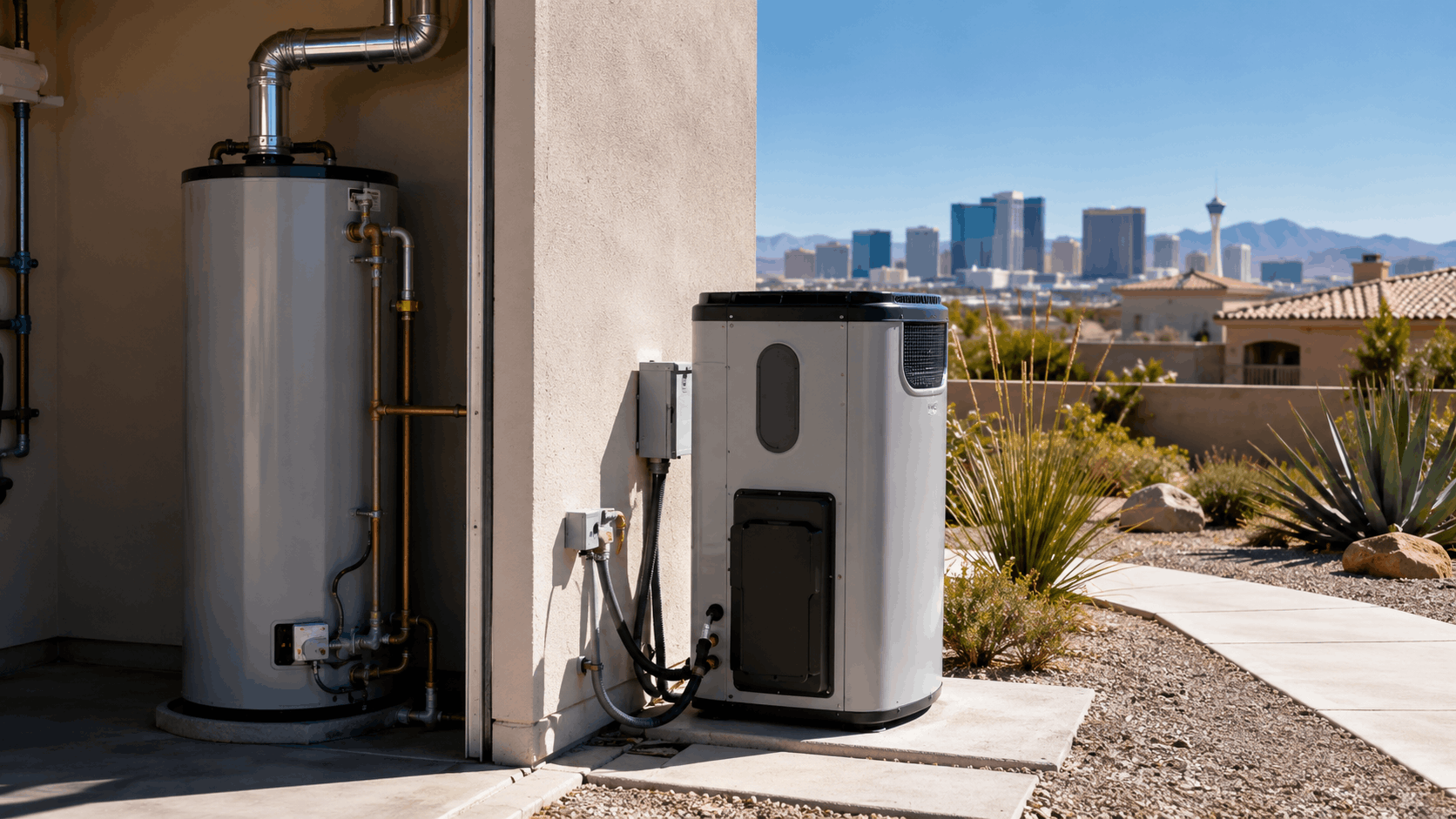
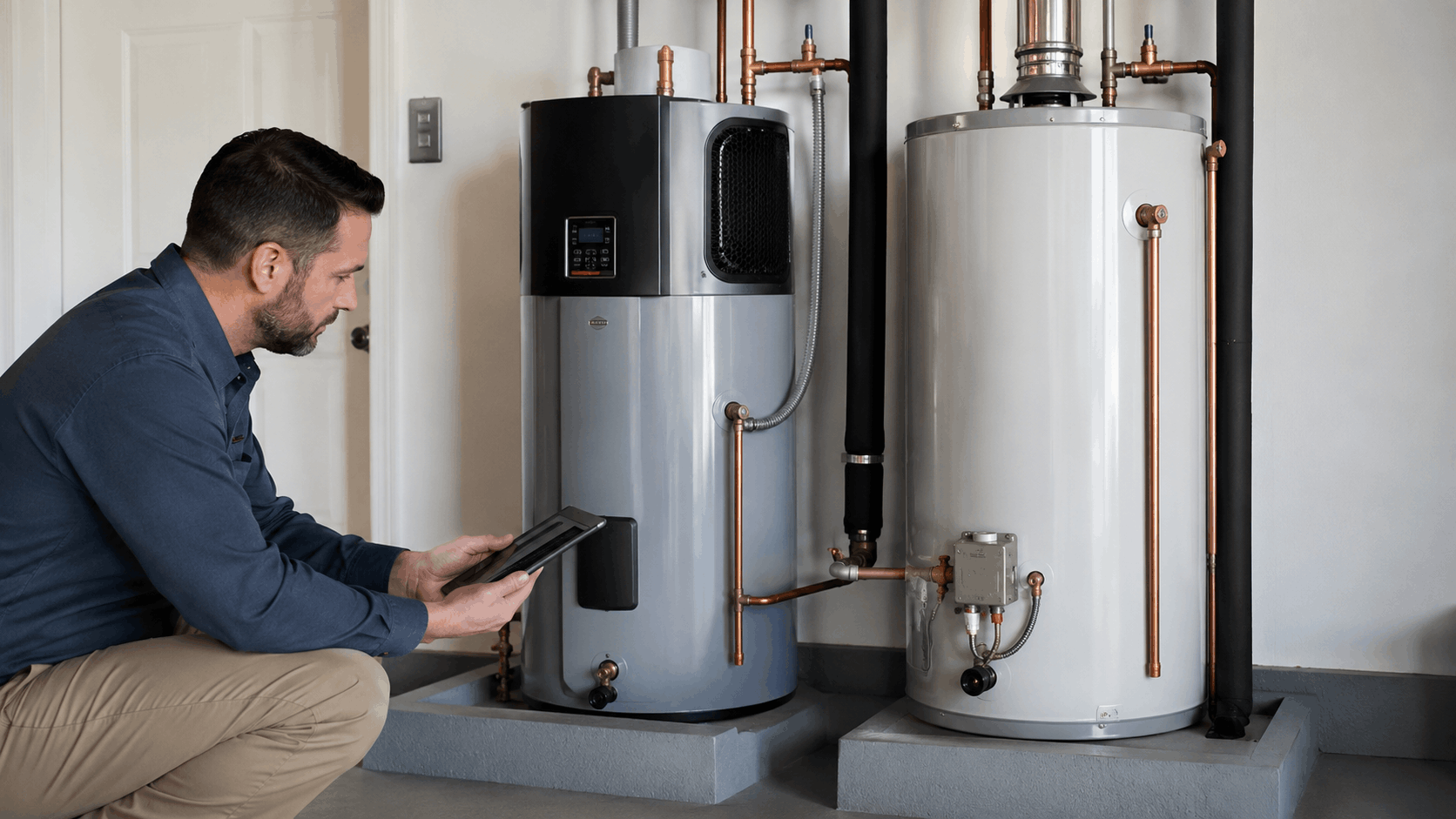
Before looking at dollars, it helps to know what you are choosing between. Both types store hot water in a tank and both keep it warm until you turn on a faucet. The difference is how they make the heat and what they need to run.
A gas water heater burns natural gas under the tank. An electric water heater heats water with metal elements inside the tank. That single difference changes the install, the recovery rate, and the monthly bill.
| Feature | Gas Water Heater | Electric Water Heater |
|---|---|---|
| Heat source | Natural gas burner | Heating elements |
| Utility | Southwest Gas | NV Energy |
| Recovery speed | Quicker | Slower |
| Needs venting | Yes | No |
| Power outage | Still works (standing pilot) | Stops working |
| Monthly running cost | Usually lower | Usually higher |
Gas Water Heaters and the Southwest Gas Connection
A gas water heater uses a natural gas burner mounted under the storage tank. When the water cools below the set temperature, the burner fires and heats the water from below. It is a simple, proven design that has warmed homes across the valley for decades.
To run, a gas unit needs two things: a gas line feeding it fuel and venting to carry combustion gases out of the home. The venting usually runs up through the roof or out a sidewall, depending on whether the unit is atmospheric or power-vented. Both parts have to meet code, which is why we handle them carefully on every job.
The good news for most local homeowners is that homes already on the Southwest Gas network usually have the hookup in place. If your current water heater is gas, replacing it with another gas unit is straightforward. Homes near Charleston Boulevard and older Henderson neighborhoods were often built with gas service already run to the garage or utility closet.
When a home does need gas work, our team handles gas line installation and connections to code. That matters because a bad gas connection is a safety hazard, not just a plumbing problem.
Electric Water Heaters and NV Energy Power
An electric water heater uses one or two heating elements inside the tank, much like the coils in an electric kettle. When water cools, the elements switch on and warm it back up. There is no flame and no combustion, so the design is simpler in some ways.
These units run on power from NV Energy and need a dedicated 240-volt circuit. That is double the voltage of a standard wall outlet, so the home needs the right breaker and wiring in the panel. Newer homes almost always have this ready if they were built for electric heating.
The upside of electric is a simpler install. With no burner, there is no venting to run, which means no roof penetration or sidewall vent. That saves labor and opens up placement options in closets or interior walls where a gas vent would be hard to route.
The tradeoff shows up on the monthly bill. Electric heating elements draw a lot of power, and NV Energy rates in the summer make that draw more expensive than the equivalent gas heat. We will get to the exact numbers shortly.
Recovery Speed and Hot Water Supply
Recovery rate is how fast a water heater reheats a full tank after you use the hot water. This is where gas pulls ahead. A gas burner delivers more heat energy per hour, so a gas tank refills with hot water more quickly than an electric one of the same size.
The first-hour rating tells you how much hot water a unit can deliver in the first hour of heavy use. Gas units typically post higher first-hour ratings because of that more quickly recovery time. For a family running back-to-back showers, that difference is noticeable.
This matters most for larger households in areas like Henderson, Centennial Hills, and the newer parts of North Las Vegas. A four or five person home burns through hot water fast on busy mornings. A gas unit keeps up better, while an electric tank of the same size may run cool during peak demand.
Smaller households feel this far less. A couple in a condo rarely drains the tank, so slower electric recovery is not a problem for their hot water supply. Household size is one of the first things our team asks about when sizing a replacement.
Tank vs Tankless in Both Fuel Types
Both gas and electric come in tank and tankless versions. A tank water heater stores 40 to 75 gallons of hot water and keeps it warm all day. A tankless unit heats water on demand as it flows through, with no storage tank at all.
Gas tankless units are popular in the valley because they deliver strong flow and endless hot water for larger families. Electric tankless exists too, but it demands a heavy electrical service that many older homes cannot support without a panel upgrade.
Tankless changes the cost picture in both directions. The unit and install cost more upfront, but running costs drop because there is no standby heat loss from a stored tank. Our team installs and services these through our tankless water heater installation service.
For most homeowners weighing gas vs electric, the storage tank version is still the starting point. It costs less upfront and fits the existing space. We cover tankless tradeoffs more in the FAQ below.
Get Your Quote
Tell us what's going on and we'll get back to you. We're open 24/7.
NV Energy Electric Rates Explained for Homeowners
To figure the real cost of an electric water heater, you have to know how NV Energy bills you. Electric usage is measured in kilowatt-hours, and each kWh has a price. On top of that, there is a fixed charge just for being connected.
Las Vegas homes see NV Energy rates that shift with the seasons. The summer rate is higher than the winter rate, and the desert summer means those higher rates hit for months. That seasonal swing is a big part of the electric cost story.
| NV Energy Charge | Typical Range |
|---|---|
| Residential rate (per kWh) | $0.11 - $0.16 |
| Summer rate (per kWh) | Up to about $0.16 |
| Winter rate (per kWh) | Around $0.11 - $0.12 |
| Basic service charge | Roughly $12 - $18/month |
Understanding the Residential kWh Charge
The per kWh charge is the heart of your electric bill. Most Las Vegas homes pay somewhere between 11 and 16 cents per kilowatt-hour on the NV Energy residential rate, depending on the season and usage tier. That is the number that decides how much your water heater costs to run.
On top of the usage charge, NV Energy adds a basic service charge each month. This fixed fee covers the cost of keeping you connected to the grid, whether you use a little power or a lot. It usually lands in the $12 to $18 range for residential accounts.
Your water heater is only one of many things drawing power, so it shares the bill with your AC, fridge, and everything else. Isolating the water heater portion takes a little math, which we walk through below. The point is that every kWh the elements burn shows up at that residential rate.
Rates change over time as NV Energy files adjustments, so treat these figures as current ranges rather than fixed forever. Checking your own bill gives you the exact rate your household pays. You can review current rate schedules on the NV Energy website.
Summer vs Winter Rate Swings
NV Energy uses seasonal rates, and the split matters a lot in the valley. The summer rate runs higher, and summer here stretches from roughly May through September. That is nearly half the year at the more expensive price.
During a brutal Las Vegas summer, your incoming water is already warmer, so the water heater works a little less. But the higher summer electric rate can cancel out that savings, keeping your bill steady or higher. The rate increase outweighs the smaller heating load for many homes.
The winter rate drops back down, easing the per-kWh cost. But winter also means colder incoming water, so the elements run longer to heat it. The two effects partly offset each other across the year.
The takeaway is that electric water heating never gets a true off-season in Las Vegas. Either the rate is high or the workload is high. Gas therm prices swing too, but the pattern plays out differently, as we cover next.
What an Electric Water Heater Adds to a Monthly Bill
Here is the number homeowners want. A standard 50-gallon electric water heater in an average local household uses roughly 350 to 450 kWh per month. That covers normal showers, dishes, and laundry for a typical family.
At an average blended NV Energy rate of about 13 cents per kWh, that energy usage works out to roughly $45 to $60 a month just for heating water. In peak summer months at the higher summer electric rate, the top of that range can push past $65.
Households that use less hot water land at the low end, while heavy users climb higher. A home with teenagers taking long showers will run the elements far more than a quiet two-person household. Usage habits drive the monthly electric cost as much as the rate does.
These figures are for a tank unit. A heat pump water heater, which uses electricity far more efficiently, can cut that cost by more than half. We touch on heat pump options later since they change the electric math significantly.
Need Help in Las Vegas?
Active Plumbing serves Las Vegas and all of Las Vegas Valley.
Southwest Gas Rates Explained for Homeowners
Gas bills work on a different unit called a therm. One therm is a set amount of heat energy, and Southwest Gas charges a price per therm plus a fixed monthly fee. Translating therms into water heating cost is the goal here.
Southwest Gas rates in Las Vegas tend to make gas the cheaper fuel for heating water. The per-therm price delivers a lot of heat for the money compared to what the same heat costs in electricity. That is the core reason gas usually wins on monthly running cost.
Understanding the Therm Charge and Basic Fee
The per therm price is what you pay for the actual gas you burn. Southwest Gas residential customers in the valley typically pay somewhere around $0.80 to $1.20 per therm, including the commodity rate and delivery charges. Prices move with the natural gas market, so this range shifts over time.
Like NV Energy, Southwest Gas also charges a basic service charge every month. This fixed fee is usually in the $12 to $15 range and covers your connection to the gas system. You pay it even in months when you barely use any gas.
The commodity rate is the portion tied to the market price of natural gas itself. When wholesale gas prices rise, this part of your bill rises with it. Southwest Gas passes those costs through, which is why winter bills can jump.
For a water heater, gas is often the only gas appliance running in summer if you have an electric or heat pump AC. That makes the water heater the main driver of your warm-weather gas bill. You can find current tariff information on the Southwest Gas website.
How Gas Prices Shift Through the Year
Gas price changes follow the market and the season. Winter demand across the country pushes natural gas prices up, since millions of homes fire their furnaces at once. That national demand ripples into local Southwest Gas rates.
In Las Vegas, most homes do not lean hard on gas heat the way northern states do. Still, the seasonal gas cost rises somewhat in winter because the commodity rate climbs and incoming water is colder. Your water heater works a bit harder in January than in July.
Summer is usually the calm season for gas bills here. Demand nationwide eases, prices soften, and your water heater has an easier job with warmer incoming water. Many homeowners see their lowest gas bills from June through August.
Because gas prices track the market, a cold winter nationally can spike your bill even if local weather is mild. It is worth watching your therm rate on the bill each season. The swings are real but generally smaller in dollar terms than the electric summer premium.
What a Gas Water Heater Adds to a Monthly Bill
A standard 40 to 50-gallon gas water heater in a typical Las Vegas home uses roughly 15 to 22 therms per month. That covers everyday hot water for a normal family with regular showers, dishwashing, and laundry.
At around $1.00 per therm, that gas water heater usage translates to roughly $15 to $25 a month. Even at the higher end of the therm range and heavy use, most homes stay under $30 for water heating alone. That is the monthly gas cost most families see.
Compare that to the $45 to $60 an electric tank costs, and the gap is clear. Gas simply delivers heat cheaper per unit given current Southwest Gas rates versus NV Energy rates. The therms per month a family burns cost far less than the equivalent kWh.
Standby loss matters here too. A tank keeps water warm around the clock, so some gas burns just to hold temperature. A gas tankless unit skips that standby loss, which trims the monthly cost further for homes that go tankless.
Real Monthly Numbers: Gas vs Electric Side by Side
Now for the head-to-head that most homeowners came to see. These are real monthly operating cost ranges based on Southwest Gas and NV Energy rates for common household sizes in the valley. Your exact numbers vary with habits and rates, but the gap between fuels stays consistent.
| Household Size | Gas (monthly) | Electric (monthly) | Monthly Gap |
|---|---|---|---|
| 1-2 people | $10 - $16 | $28 - $40 | ~$18 - $24 |
| 3-4 people | $16 - $25 | $45 - $60 | ~$29 - $35 |
| 5+ people | $25 - $38 | $65 - $90 | ~$40 - $52 |
Small Household: One to Two People
A couple in a condo near the Arts District uses very little hot water. Two short showers, a few loads of dishes, and some laundry add up to low usage overall. Their water heater rarely drains the full tank.
On gas, that small household cost usually runs about $10 to $16 a month. On electric, the same usage costs roughly $28 to $40, since even light use burns kilowatt-hours at the higher effective rate. The dollar gap is smaller here simply because total use is low.
For a smaller Henderson home or a downtown condo, the monthly savings from gas might be $18 to $24. That is real money, but not dramatic. At this usage level, other factors like install cost and existing hookups often weigh more than the running cost gap.
This is why small households sometimes stick with electric if that is what the home already has. The monthly premium is modest, and avoiding a fuel conversion saves the upfront expense. We help these homeowners weigh whether the switch is worth it.
Average Family: Three to Four People
A typical family in Summerlin or Spring Valley uses a lot more hot water. Morning showers stack up, the dishwasher runs daily, and laundry piles grow fast. This is a common household size we serve.
Their family water usage on gas lands around $16 to $25 a month. On electric, the average monthly cost jumps to roughly $45 to $60. That is where the fuel choice starts to matter in a way you feel on the bill.
For a four-person home, the monthly gap of $29 to $35 adds up to real yearly savings with gas. Over the life of the unit, that difference funds a lot of other household expenses. Families in Summerlin and Spring Valley often ask us to confirm these numbers before choosing.
Recovery speed also favors this household. A gas unit refills quicker, so the last person to shower still gets hot water. That practical benefit pairs with the lower running cost to make gas attractive for busy families.
Large Household: Five or More People
Larger homes in communities like Inspirada or Mountains Edge push their water heaters hard. Five or more people means near-constant hot water demand, especially on school mornings. High usage is the norm rather than the exception.
At this level, gas costs about $25 to $38 a month while electric climbs to $65 to $90. The large home cost gap widens to $40 or more per month. This is the household where fuel choice makes the biggest financial difference.
Heavy hot water demand also strains an electric tank's slower recovery. A big family can run an electric unit cold and wait for it to catch up. A gas unit keeps pace better, which is why many large homes favor gas or a gas tankless setup.
For homes this size, we often recommend looking at a larger tank or a tankless system. The upfront cost is higher, but the monthly savings and endless hot water pay off for a full house. Our team runs the exact numbers for each home before advising.
Annual Cost Difference Over Time
One month tells part of the story, but the annual cost tells the rest. For an average family, the roughly $30 monthly gap between gas and electric adds up to around $360 a year. Over a 10-year unit lifespan, that is close to $3,600 in long-term savings from gas.
Larger households see an even bigger annual cost gap. A $45 monthly difference works out to about $540 a year, or over $5,000 across the life of the water heater. Those numbers can easily cover the cost of the unit itself.
Small households save less over time, maybe $250 or so a year. That still adds up, but it may not justify a costly fuel conversion on its own. The cost over time has to be weighed against what it takes to switch fuels.
These annual figures assume current rates hold. If NV Energy summer rates rise more quickly than gas prices, the gap widens further in gas's favor. If gas prices spike in a cold winter, the gap narrows for that period.
Need Help in Las Vegas?
Active Plumbing serves Las Vegas and all of Las Vegas Valley.
Upfront and Installation Costs in Las Vegas
Operating cost is only half the story. The upfront cost of the equipment and installation differs between gas and electric, and that changes the total picture. Here are the local price ranges our team sees across the valley.
Equipment Price Differences
A comparable gas unit usually costs a bit more than an electric one at the store. A standard 50-gallon electric tank runs roughly $400 to $700 for the unit, while a similar gas tank runs about $500 to $900. The gas burner and venting hardware add to the unit price.
Reputable water heater brands like Rheem, Bradford White, and A.O. Smith make both fuel types, and quality varies by model line. Higher efficiency models cost more upfront but use less fuel over time. We help homeowners match the model to their budget and usage.
Tankless units of either fuel cost more than tanks, often $1,000 to $2,000 for the equipment alone. The higher equipment cost is offset over years by lower running costs and no tank to replace. Whether that math works depends on how long you plan to stay in the home.
Our team stocks and installs trusted brands and handles warranty registration on every job. Choosing the right unit is not just about the sticker price. It is about matching capacity, efficiency, and fuel type to how your household actually lives.
Adding a Gas Line or Electrical Circuit
If a home lacks the right hookup, that adds cost. Switching an electric home to gas means running a new gas line to the water heater location, which our team prices based on distance and access. This is common in older properties near downtown or the east side that were wired for electric.
Going the other way, converting a gas home to electric means adding a 240-volt circuit and possibly upgrading the electrical panel. An electrical upgrade can run several hundred to over a thousand dollars depending on panel capacity. Older panels near Charleston Heights sometimes need this work.
A gas line install typically adds $500 to $2,000 to the project depending on how far the line must travel and whether walls must be opened. Our team handles gas line rerouting and upsizing when a home needs more capacity. We always pull the right permits for this work.
The conversion cost is why fuel switching does not always pay off. If the monthly savings take 15 years to cover the conversion, staying with the current fuel often makes more sense. We run that break-even math for every homeowner considering a switch.
Permits and Clark County Code Requirements
Replacing a water heater in Clark County requires a permit. This is not optional, and skipping it can cause problems when you sell the home or file an insurance claim. A permitted install protects you and confirms the work meets code.
Clark County code requirements include items like seismic strapping to secure the tank, a proper temperature and pressure relief valve, and an expansion tank on closed systems. Gas units also need correct venting and combustion air. Electric units need proper circuit protection.
The inspection confirms the install is safe and code-compliant. An inspector checks the connections, venting, strapping, and clearances. Our team schedules and passes these inspections as part of the job, so homeowners do not have to manage that process.
Doing this right the first time avoids costly redos. We have seen homeowners try a self-install only to fail inspection and pay us to fix it. Pulling the Clark County permit and meeting code from the start saves money and headaches.
Venting and Space Considerations
Gas units need proper venting, and that affects install cost and placement. An atmospheric gas heater vents through a flue up the roof, while a power-vented model can vent out a sidewall. The venting cost depends on the run and the type.
Placement matters a lot. A garage install is common in the valley and usually simple for both fuel types. A closet or interior placement is easier for electric since there is no vent to route, while gas in a tight closet needs careful clearance requirements met.
Combustion air is another gas consideration. A gas burner needs enough air to burn safely, so the space cannot be sealed too tightly. Our team checks clearances and air supply on every gas install to keep it safe and code-compliant.
Electric units win on flexibility here. With no venting, they fit in more spots and cost less to place in an interior location. For homes without an easy vent path, that placement freedom is a point in electric's favor. We factor all of this into the install quote.
Local Factors That Affect Your Choice
The gas vs electric math is not just about utility rates. Las Vegas water and local home conditions shift the decision in ways national guides miss. Here is what actually matters in the valley.
Hard Water and Tank Lifespan in the Valley
The valley's hard water is one of the hardest in the country. It carries heavy minerals that settle as sediment in the bottom of any water heater tank. That mineral buildup shortens tank lifespan no matter which fuel you choose.
Hard water hits gas and electric a little differently. In a gas unit, sediment settles over the burner area and makes the burner work harder to push heat through the mineral layer, which can lead to popping sounds and lost efficiency. In an electric unit, hard water sediment coats the lower heating element and can cause it to burn out early.
Either way, sediment is the enemy of a long-lasting tank. Flushing the tank once a year removes buildup and extends its life. Our team offers this service and often pairs it with a water softener recommendation to cut mineral load at the source.
Many homeowners add a water softener to protect not just the water heater but all the plumbing and fixtures. Softer water means less scale, longer equipment life, and lower repair costs. In a hard water valley, that investment pays back across the whole home.
Older Homes vs New Builds
Older homes near Charleston Boulevard often have gas service already run, since gas was the standard when they were built. For these homes, staying with gas is usually the path of least cost and effort. The existing hookups are already there.
Newer builds in Skye Canyon or Cadence vary. Some are all-electric by design, especially as builders lean toward electric heat pump systems. In those homes, the 240-volt circuit is ready and adding gas would mean new line work.
Older home plumbing sometimes needs updates beyond the water heater itself. Corroded shutoff valves, undersized gas lines, or aging pipe can surface during a replacement. Our team checks these during the job so nothing gets missed. Homes in Charleston Heights commonly show their age this way.
New construction usually makes the fuel choice easy by matching whatever the builder installed. Fighting that setup with a conversion rarely pays off in a newer home. We advise most new-build owners to work with the fuel they already have.
HOA and Community Rules
Some HOA communities have rules that touch the fuel decision. Exterior venting or a sidewall vent may face restrictions in neighborhoods with tight design standards. That can steer a home toward electric, which needs no exterior vent.
Community requirements sometimes govern where equipment can go and how visible any exterior change can be. A power-vented gas unit that vents through a side wall might need HOA approval. Checking these rules before the install avoids conflict later.
In master-planned areas like Summerlin and parts of Henderson, HOA rules can be strict about anything visible from the street. Our team knows how these communities operate and plans installs to fit within them. We keep the work clean and compliant.
If exterior venting is off the table, electric or a carefully placed power-vent gas unit becomes the workable option. We help homeowners find the setup that satisfies both the code and the HOA. That local knowledge saves time and rework.
Power Reliability and Backup Concerns
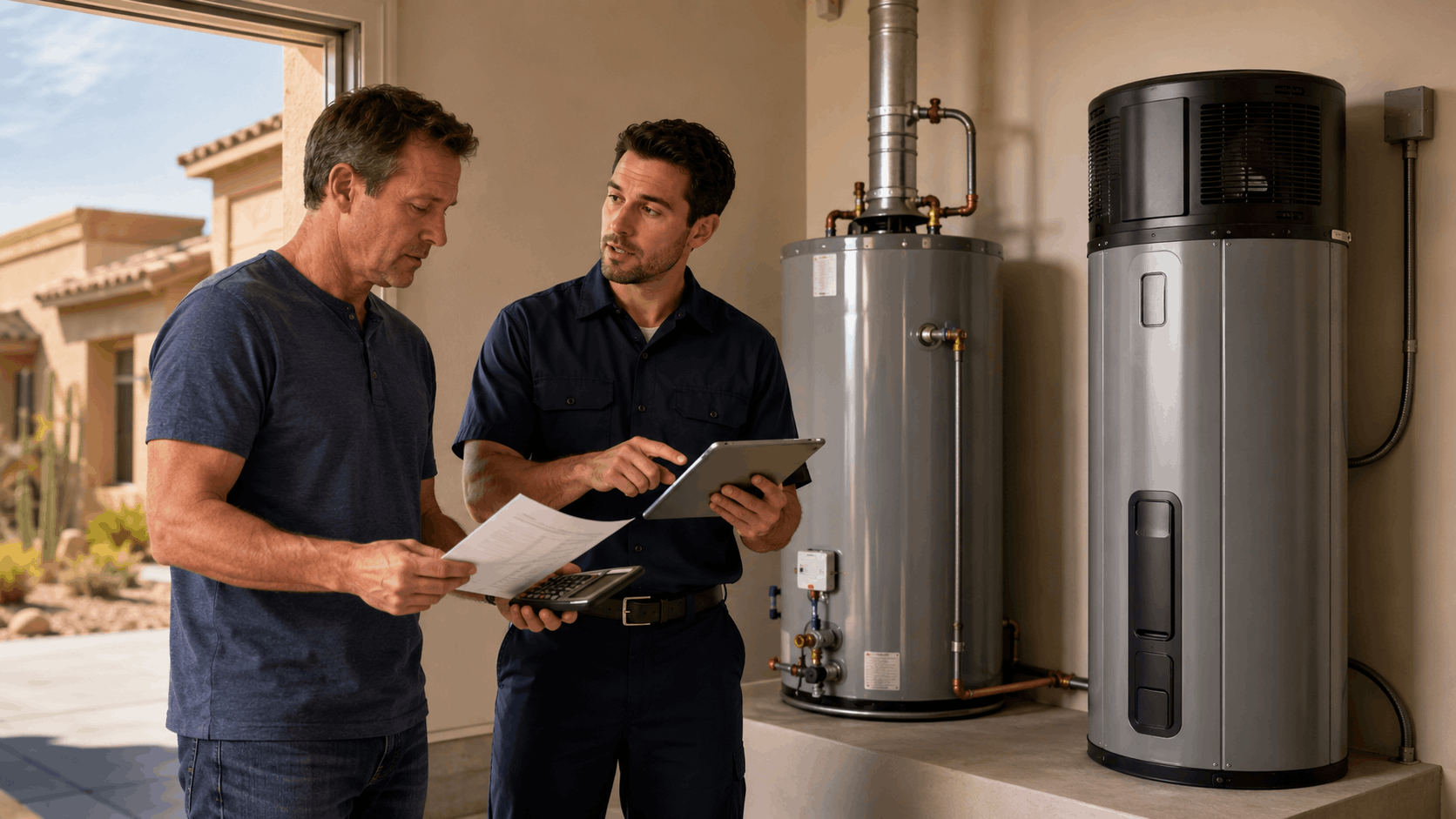
Here is a gas advantage that matters in the desert. A standard gas water heater with a standing pilot keeps making hot water during a power outage. An electric unit stops the moment the power drops.
Summer grid reliability is a real concern when temperatures hit 115 and demand peaks. Rolling strain or a local outage can cut power for hours. During those events, a gas home still has hot showers while an electric home goes cold.
For homes that value backup hot water, gas offers quiet insurance. Power-vented gas units do need electricity for the vent fan, so a fully passive standing-pilot model is the true outage-proof choice. We explain these differences when a homeowner asks about reliability.
This factor rarely decides the whole choice on its own, but it tips close calls. For a household that lost power during a past summer event, the backup capability is worth something real. It is one more point in the gas column for many valley homes.
Need Help in Las Vegas?
Active Plumbing serves Las Vegas and all of Las Vegas Valley.
Which Type Is Right for Your Home
There is no single best water heater for every home. The right gas or electric choice depends on your household size, existing hookups, and priorities. Here are clear scenarios for each.
When Gas Makes the Most Sense
Gas benefits show up strongest in larger families with existing gas service. If your home already has a gas line to the water heater and you have four or more people, gas is usually the clear winner. Lower monthly cost and more quickly recovery both favor it.
A large family burns a lot of hot water, and gas heats it cheaply and quickly. The $40-plus monthly savings for a big household adds up fast over the years. That savings often outweighs the slightly higher equipment cost.
Homes with an existing gas line avoid conversion costs entirely, making gas the easy pick. Replacing a gas unit with another gas unit is a clean swap for our team. There is no panel upgrade or new line to run.
Gas also gives you hot water during outages, which some valley homeowners value after a summer grid scare. For a busy household that already has gas service, the case for gas is strong on nearly every measure. We confirm the specifics for each home.
When Electric Is the Smarter Pick
Electric benefits win in a few clear cases. A home with no gas line is the obvious one, since adding gas would cost far more than the monthly savings return. If your home is all-electric, staying electric avoids a pricey conversion.
Small households also lean electric-friendly. A couple that uses little hot water pays only a modest monthly premium, so the higher running cost barely registers. Avoiding conversion cost matters more than the small monthly gap.
Homeowners interested in a heat pump water heater should look hard at electric. A heat pump unit runs on electricity but uses it several times more efficiently than standard elements, cutting running cost below even gas in many cases. It needs the right space and a 240-volt circuit.
Electric also installs cleanly in interior spots with no venting, which suits condos and tight layouts. For homes near the central Las Vegas area with limited vent options, electric solves the placement problem. We size and install these to match the household.
Switching From One Fuel Type to Another
Fuel conversion is a bigger project than a simple swap. Going gas to electric needs a new 240-volt circuit and possibly a panel upgrade. Going electric to gas needs a new gas line and venting. Both add real switching cost.
The payback period is the deciding factor. If converting costs $2,000 and saves $30 a month, it takes over five years just to break even. For a small household saving less, the payback can stretch past the life of the unit.
Conversion usually pays off only in specific cases. A large family switching electric to gas may recover the cost in a few years thanks to big monthly savings. A small household rarely comes out ahead on a switch.
Our team runs the exact break-even math before any homeowner commits to a conversion. We would rather tell you to keep your current fuel than sell you a switch that never pays back. That honest math is part of how we work.
How Active Plumbing Helps Homeowners Decide
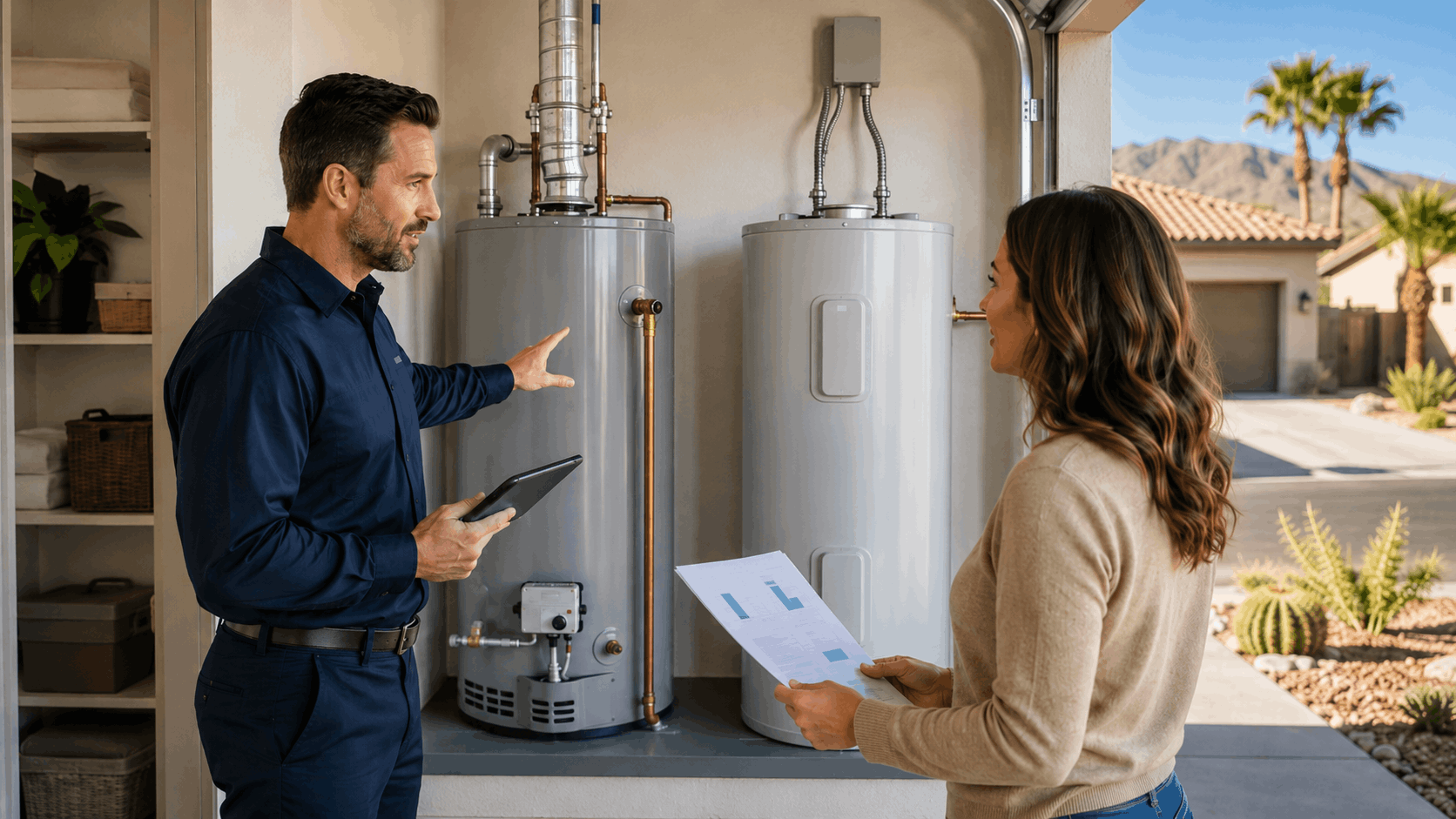
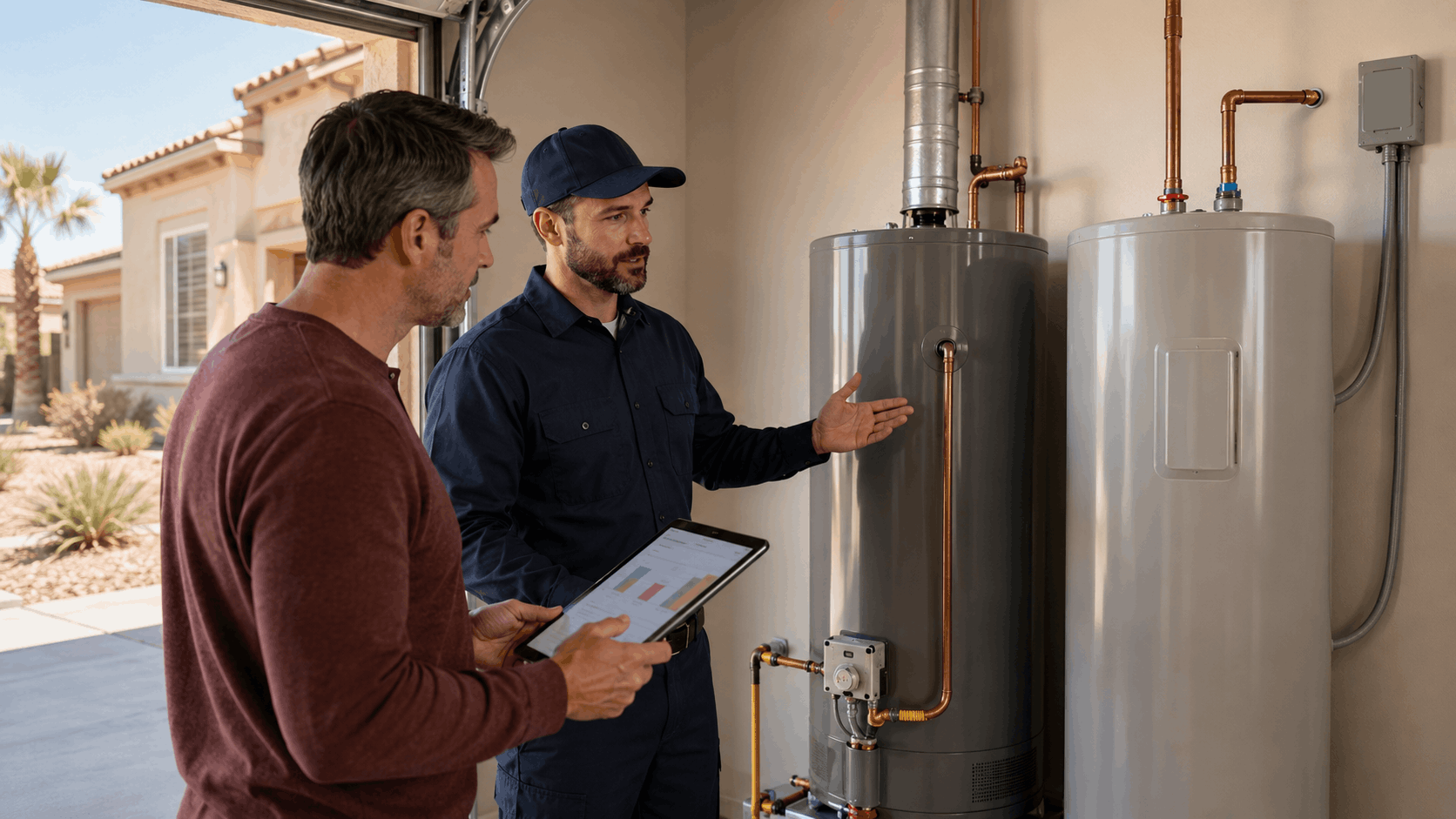
Our team starts with an on-site assessment of your home. We check your existing hookups, your household size, your space, and your current utility rates. That gives us the real inputs to run your numbers, not generic estimates.
From there we lay out the honest tradeoffs. We show what gas costs versus electric for your specific household, what the install involves, and where the break-even lands if a switch is on the table. No pressure, just the facts for your home.
As a local plumber that works every corner of the valley, we know the neighborhoods, the code, and the water conditions. That local knowledge means our recommendation fits your actual situation. We have done hundreds of water heater installs across the valley.
When you are ready, we handle the full water heater install including permits, code items, and inspection. From assessment to final inspection, our team manages the whole job. That is how we help homeowners get the right unit the first time.
Final Thoughts
For most Las Vegas homes, gas costs less per month to run given Southwest Gas therm rates versus NV Energy kWh rates. The gap ranges from about $18 a month for small households to over $45 for large families. Over the life of a unit, that is real money.
But the monthly bill is not the only factor. Existing hookups, install cost, home age, HOA rules, and hard water all shape the right choice. A home with no gas line or a small household may do better staying electric.
The smart move is to run your own numbers before you buy. Our team offers an on-site assessment to check your home, compare gas and electric for your household, and recommend the right unit and install. Call Active Plumbing or reach out to our team to schedule your consultation today.
Frequently Asked Questions
- Is gas or electric cheaper to run in Las Vegas?
- Gas is usually cheaper to run in the valley. A gas water heater typically costs $15 to $25 a month for an average family, while an electric tank runs $45 to $60. The gap comes from Southwest Gas therm rates delivering cheaper heat than NV Energy kilowatt-hours, especially during the high summer electric rate. Larger households see an even bigger monthly savings with gas.
- How much does it cost to install a water heater in Las Vegas?
- A standard tank water heater install typically runs $1,200 to $2,500 in the valley, including the unit, labor, permit, and code items. Electric installs sit at the lower end since there is no venting. Tankless units cost more, often $3,000 to $5,000 installed. Adding a gas line or upgrading an electrical panel for a fuel conversion increases the total, which is why we assess each home first.
- How long do water heaters last with our hard water?
- Most tank water heaters last 8 to 12 years, but the valley's hard water can shorten that. Heavy minerals settle as sediment and stress the tank, cutting life closer to 8 to 10 years without maintenance. Flushing the tank once a year and adding a water softener both extend lifespan. Tankless units last longer, around 15 to 20 years, but need regular descaling in hard water.
- Do I need a permit to replace my water heater in Clark County?
- Yes, Clark County requires a permit to replace a water heater. The permit covers an inspection that checks connections, venting, seismic strapping, the relief valve, and expansion tank where required. Skipping the permit can cause issues when selling your home or filing an insurance claim. Our team pulls the permit and passes the inspection as part of every install, so you do not have to manage it.
- Can I switch from electric to gas or gas to electric?
- Yes, but a fuel conversion adds cost. Switching electric to gas needs a new gas line and venting. Switching gas to electric needs a 240-volt circuit and sometimes a panel upgrade. Conversions add $500 to $2,000 or more depending on the work. It pays off mainly for large families switching to gas. Our team runs the break-even math before recommending any switch.
- Will a gas water heater work during a power outage?
- A standard gas water heater with a standing pilot keeps making hot water during a power outage, since it needs no electricity to run the burner. An electric unit stops entirely when the power drops. Note that power-vented gas models do need electricity for the vent fan, so a fully passive standing-pilot model is the true outage-proof choice. This backup matters during summer grid strain.
- Are tankless water heaters worth it in Las Vegas?
- Tankless units offer endless hot water and lower running costs since there is no standby heat loss. They cost more upfront and last longer, around 15 to 20 years. The main local catch is hard water, which scales the heat exchanger and requires yearly descaling to protect the unit. For larger families or long-term homeowners, a tankless setup often pays off when paired with water treatment.
- What size water heater does my home need?
- Sizing depends on household size and bathroom count. A one to two person home usually does fine with a 40-gallon tank. Three to four people typically need 50 gallons, and five or more need 65 to 75 gallons or a tankless unit. Gas units of a given size deliver more hot water per hour than electric, so households with heavy demand often size up on electric. We size each home to its real usage.
- How can I lower my water heating bill?
- Several steps help. Set the thermostat to 120 degrees, which is safe and cuts standby cost. Flush the tank yearly to remove sediment that hurts efficiency. Insulate exposed hot water pipes and, on older units, add a tank blanket. Fix dripping hot water faucets fast. A recirculation pump can reduce waste for larger homes. Our team can install and service these upgrades.
- How do I know if my water heater needs replacing?
- Watch for warning signs. Rusty or discolored hot water points to a corroding tank. Popping or rumbling noises mean sediment buildup. Water pooling around the base signals a leak that usually means replacement. A unit over 10 years old is living on borrowed time in our hard water. If you notice any of these, our team can inspect it and advise whether repair or replacement makes sense.
Licensed plumbing professionals serving Las Vegas and Las Vegas Valley.
Licensed in Nevada · License #0047021
Last updated on
Why trust Active Plumbing?
Founded in 1991, Active Plumbing is a licensed and insured plumber serving Las Vegas and Las Vegas Valley. All content is reviewed by our licensed technicians.

Need Help in Las Vegas?
Active Plumbing serves Las Vegas and all of Las Vegas Valley.
Related Articles
Best Water Heater Option for Las Vegas Homes: Tank vs Tankless
Compare tank vs tankless water heaters for Las Vegas homes. Costs, hard water effects, lifespan, permits, and which option fits your neighborhood best.
Tankless Water Heater Installation Cost in Las Vegas: Gas Line Upsizing, Venting, and Permit Line Items
A clear breakdown of tankless water heater installation cost in Las Vegas, including gas line upsizing, venting, permits, and hard water factors for valley homes.

Tankless Water Heater Installation Cost Vegas: 3-Bedroom vs 5-Bedroom Pricing
Compare tankless water heater installation costs in Las Vegas for 3-bedroom vs 5-bedroom homes, with pricing ranges, sizing tips, local factors, and Clark County permit details.