Cost Guides
Trenchless Pipe Bursting vs Pipe Lining vs Open Trench in Las Vegas Caliche Soil
Key Takeaways
- Caliche is a cement-like hardpan soil that makes valley sewer digging slower and more expensive than in other cities.
- Pipe bursting replaces a full line with new HDPE through two small pits, but tight caliche can resist the fractured pipe.
- CIPP lining rebuilds a sound pipe from the inside with almost no digging, making it the least invasive option.
- Open trench is still best for collapsed pipes, slope corrections, and shallow lines despite the heavy yard damage.
- Lining usually costs least and finishes fastest, while open trench runs longest and hardest in hardpan.
- A camera inspection is the starting point for matching the repair method to the actual pipe damage.
- Sewer replacement needs a local permit and utility locates, which a licensed plumber handles.
- HOA rules and finished yards often steer valley homeowners toward trenchless methods over a full dig.
In This Article
A homeowner in Summerlin called us last spring after sewage started backing up into a downstairs shower. The line had cracked several feet down, right in the middle of hard caliche that a shovel could barely scratch. She wanted to know her options, and fast, because the smell was spreading through the house.
That call is a familiar one across the valley. Broken sewer lines happen everywhere, but the ground under Las Vegas homes makes the repair a different animal than it would be in a city with soft topsoil. The three main methods - trenchless pipe bursting, pipe lining, and old-fashioned open trench digging - each behave differently once caliche enters the picture.
Why Las Vegas Caliche Soil Changes Everything for Pipe Repair?
Most sewer repair advice online was written for cities with dark, loose dirt. That advice falls apart the second a crew hits caliche. The hard desert soil under our feet shapes the cost, the timeline, and even which repair methods are possible.
- Caliche resists both hand digging and machine excavation.
- It can trap old pipes so tightly that fracturing them becomes harder.
- Older neighborhoods layer aging pipe problems on top of tough soil.
What Caliche Is and Where It Shows Up Around the Valley
Caliche is a natural cement made of calcium carbonate that binds sand and gravel into a rock-like layer. It forms over thousands of years as minerals leach down and harden below the surface. In parts of the valley the hardpan layer sits just a foot or two under the yard, while in others it runs several feet deep.
Homeowners in Henderson and North Las Vegas run into it constantly. We have hit thick caliche shelves in Aliante, along the older streets near Historic North Las Vegas, and out toward the higher ground in Summerlin. The calcium carbonate content varies block to block, so two neighbors can have very different digging conditions.
The color usually gives it away. Caliche shows up as a pale white or tan band that looks almost like poured concrete when a trench wall is cut clean. Once a crew sees that band, they know the job just got slower and more physical.
Because the hardpan layer is so uneven, guessing depth from the surface rarely works. A camera scope and probe tell the real story before anyone commits to a method or a price.
How Hard Soil Affects Digging Time and Cost
Soft soil lets a mini excavator scoop a trench in an hour or two. Caliche can turn that same trench into a half-day fight. Crews often switch from standard buckets to jackhammers, rock saws, or hydraulic breakers just to break through the hardpan.
That extra effort shows up directly in the excavation cost. More labor hours, heavier equipment, and slower progress all push the total higher than the same repair would run in a softer market. A dig that costs a set amount in a city with loamy soil can run noticeably more here for the exact same length of pipe.
Digging difficulty also raises the odds of surprises. Hidden caliche shelves can force a crew to stop, reposition, and attack the layer from a new angle. Each of those adjustments adds time to the clock.
This is a big reason trenchless methods appeal to so many valley homeowners. When digging is this expensive, cutting the amount of open excavation often saves real money even when the trenchless equipment itself carries a premium.
Older Homes and Aging Sewer Lines Near Downtown and the Historic Districts
Around downtown and the older pockets of the city, sewer lines were often laid decades ago. Homes in areas like the John S. Park district frequently still have original clay pipe or cast iron sewer line running out to the main. Both materials have a shelf life, and many are long past it.
Clay pipe cracks and shifts at the joints, which invites roots and lets soil work its way in. Cast iron corrodes from the inside until the pipe wall thins and flakes. When either of those aging materials sits inside tight caliche, small failures turn into full backups faster than owners expect.
The soil and the pipe age feed off each other. Caliche holds pipes rigidly in place, so ground movement and settling put stress right at the weak joints. We see this pattern often in the older cores of the valley, where the housing stock predates modern PVC.
For these homes, the repair choice depends heavily on how much of the original line is still sound. A camera inspection separates a pipe that can be lined from one that needs full replacement.
Why Local Experience Matters When Choosing a Method
A crew that works valley soil every day reads a job differently than a contractor passing through. Local plumbers know which streets sit on shallow hardpan and which neighborhoods hide deep caliche shelves. That soil experience shapes an accurate bid instead of a guess.
An out-of-town outfit might quote a fast trenchless job, then hit a caliche wall that stalls the work and blows the timeline. We have been called in to finish jobs that stalled exactly that way. Knowing the ground ahead of time prevents those ugly surprises.
Local knowledge also covers permits, utility layouts, and HOA quirks that change from one community to the next. A plumber who files paperwork through the local building department regularly moves faster than one learning the system on the fly.
When a homeowner interviews a company for a sewer line repair or replacement, asking about local caliche experience is a smart first filter. The answer tells you whether the bid is grounded in reality.
Get Your Quote
Tell us what's going on and we'll get back to you fast.
Pipe Bursting Explained for Las Vegas Homeowners
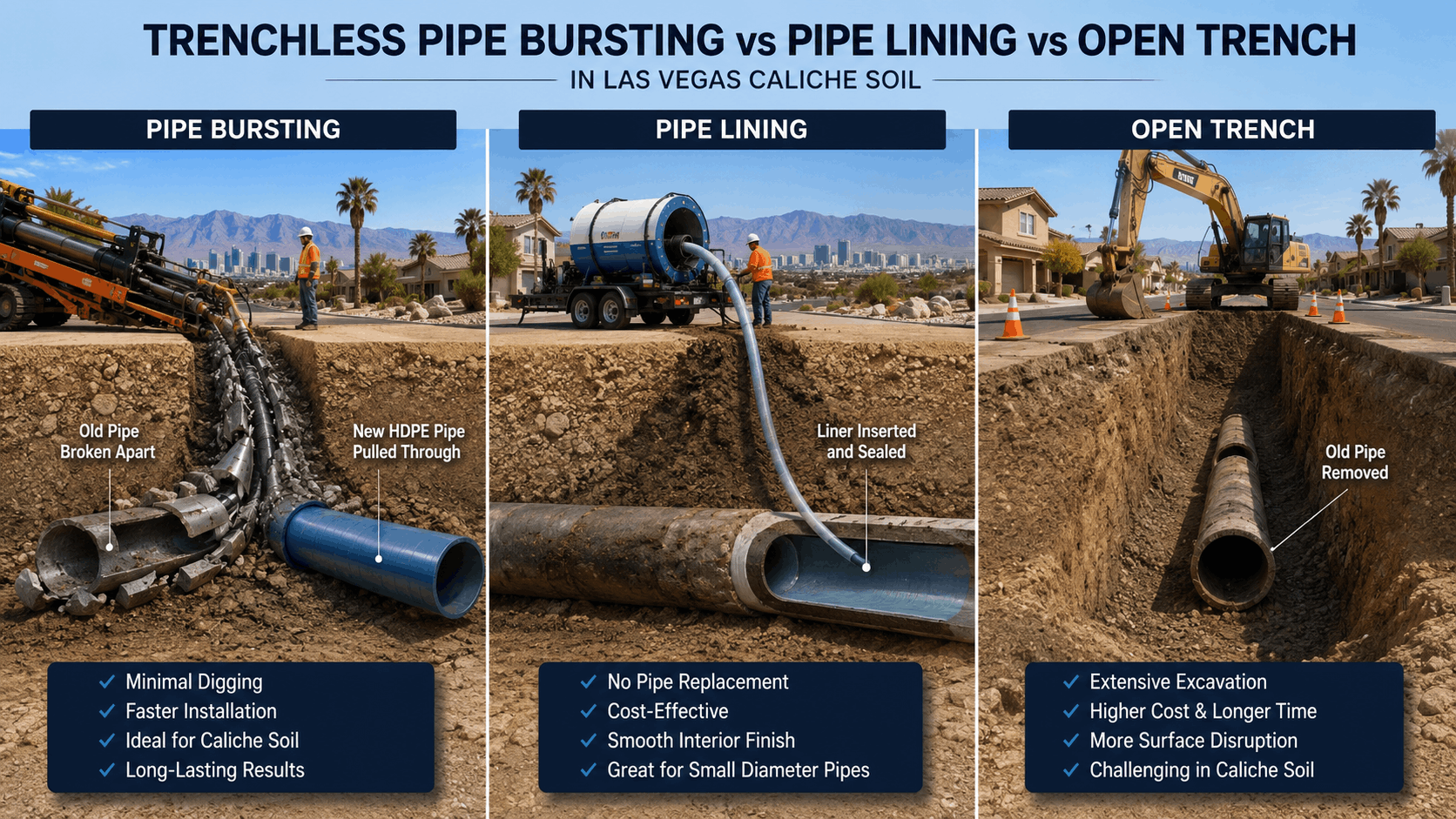
Pipe bursting is one of two trenchless sewer replacement methods that let a crew replace a line without digging the whole thing up. For valley homes with expensive caliche digging, it can be a smart choice. Here is how it actually works.
- It replaces the old pipe with brand new material.
- It needs only two small pits instead of a long trench.
- It works best when the surrounding soil can give a little.
How the Bursting Head Breaks the Old Pipe
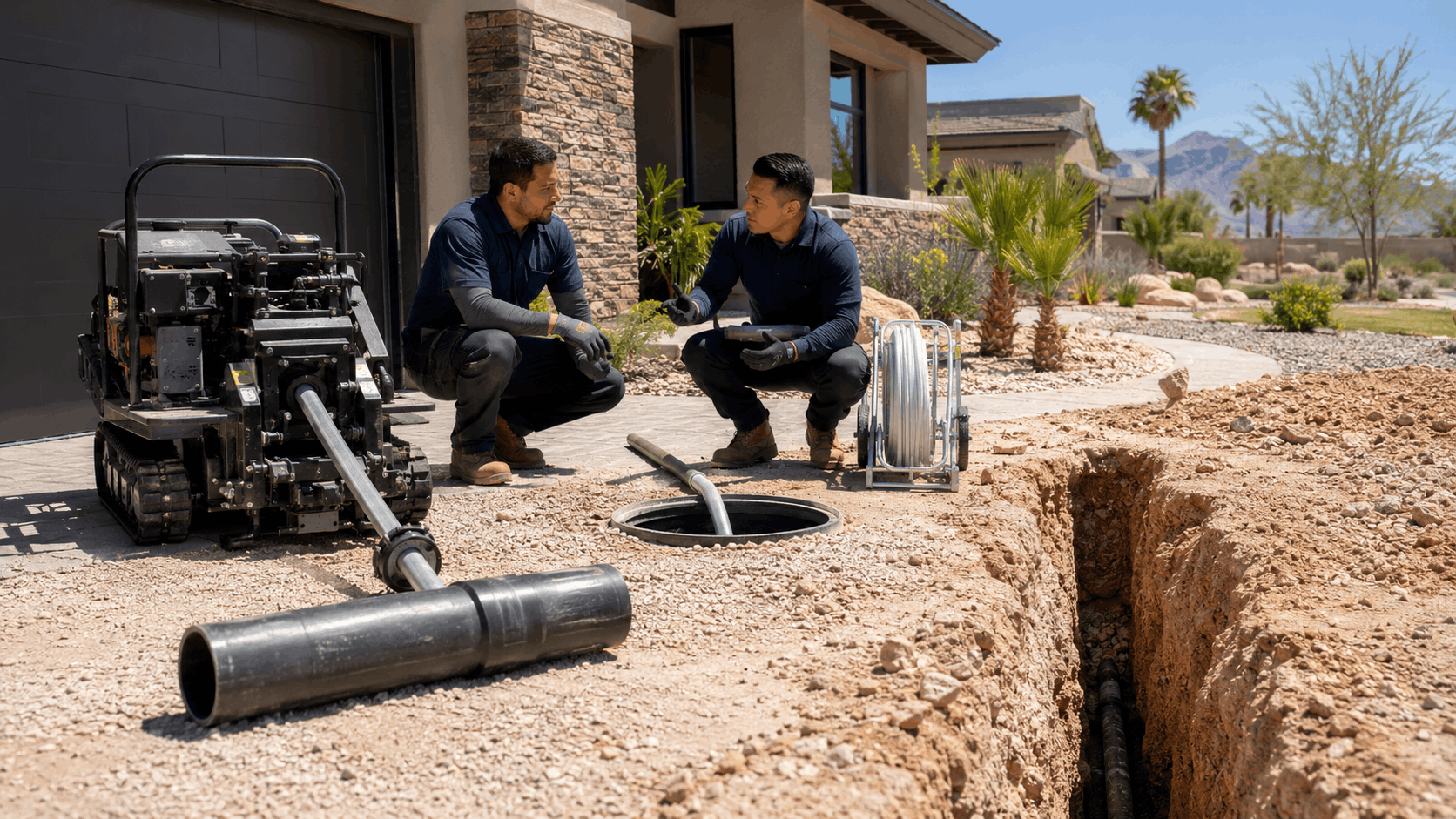
Pipe bursting pulls a cone-shaped bursting head through the existing sewer line. The head is wider than the old pipe, so it fractures the original material outward as it travels. A cable or rod hooked to a hydraulic machine drags it from the exit pit back toward the entry point.
Behind that head, a new HDPE pipe follows in the same path. HDPE is a tough, flexible plastic that fuses at the joints into one continuous line with no weak seams. By the time the head reaches the far pit, the old broken pipe is gone and a fresh line sits in its place.
The beauty of the method is that it uses the old pipe as a guide. There is no need to dig along the whole route to find and follow the line. The machine and the path do that work underground.
Because the new pipe is seamless HDPE, it resists root intrusion and shifting far better than the clay or cast iron it replaces. That durability is a big part of why the method holds up in our soil.
When Bursting Works Well in Caliche and When It Struggles
Bursting depends on soil displacement. When the head fractures the old pipe, the broken pieces and the larger new pipe need somewhere to go. Softer ground absorbs that expansion easily.
Tight caliche can resist that push. When the hardpan wraps the pipe like concrete, the fractured shards have nowhere to move, and the machine has to fight for every foot. In the worst cases the head stalls, which is where trenchless limits show up in our market.
That does not mean bursting is off the table in caliche. Much depends on how deep and how continuous the hardpan runs along the line. A crew that scopes the route and tests the soil can often tell whether bursting will pull cleanly or bog down.
When the soil cooperates, bursting is one of the cleanest ways to replace a full sewer line here. When it does not, an honest plumber will steer the homeowner toward lining or an open trench instead of forcing a bad fit.
Access Pits and Yard Impact
Bursting needs two access pits, one at each end of the pipe run. Usually one sits near the house cleanout and the other near the property line or the street connection. Everything between those pits stays undisturbed underground.
For homeowners with finished yards, that matters a great deal. A driveway, a mature tree, or a stone patio in the middle of the run can stay in place while the work happens beneath it. In communities like Aliante, where landscaping represents a real investment, that protection saves thousands in restoration.
The pits themselves still require digging, and in caliche even a small pit takes effort. But two compact holes beat a trench running the full length of the yard. The math usually favors the smaller footprint.
We plan pit placement carefully to dodge sprinkler lines, hardscape, and utilities. Good planning up front keeps the landscaping protection promise from turning into a cleanup headache later.
Typical Cost and Timeline for Pipe Bursting Here
Pipe bursting cost in the valley usually runs somewhere between 6,000 and 15,000 dollars for a standard residential run, depending on length, depth, and soil. Caliche pushes those numbers toward the upper end because the pits and the pull both take more work. The exact figure comes down to the specific site.
The project timeline is often shorter than an open trench job. Many single-family replacements wrap in one to two days once permits and locates are done. That speed comes from skipping the long trench.
Access, cleanout condition, and connection points all move the price. A line that runs under a driveway and out to a deep main will cost more than a short, shallow run. A scope and estimate nail down the real number.
Compared to a full dig in hardpan, bursting frequently comes out ahead on both cost and disruption. That combination is why it has grown popular across valley neighborhoods.
Need Help in Las Vegas?
Active Plumbing serves Las Vegas and all of Las Vegas Valley.
Pipe Lining (CIPP) and How It Holds Up in the Desert
Pipe lining, known in the trade as CIPP or cured-in-place pipe, rebuilds a sewer from the inside without replacing it. Instead of pulling in new pipe, it creates a fresh wall within the old one. For the right pipe, it is the least invasive option available.
How the Resin Liner Creates a New Pipe Inside the Old One
The process starts with a flexible resin liner soaked in epoxy. A crew inserts that soft liner into the cleaned sewer pipe through an existing access point. Once it is in position, they inflate it so the resin presses tight against the old pipe wall.
Then the liner cures. Heat, hot water, steam, or UV light hardens the resin into a rigid new pipe formed inside the host. When it sets, the epoxy coating becomes a smooth, jointless surface that water flows through cleanly.
Because the finished liner has no joints, roots lose the cracks and gaps they normally exploit. The interior is also slick, which helps flow and cuts down on future clogs. The result is essentially a pipe within a pipe.
Cleaning matters here. The host pipe has to be hydro jetted clean first so the resin bonds properly. We often run a hydro jetting service before lining to clear roots and buildup.
Best Situations for Lining in Las Vegas Homes
Lining shines when a pipe has cracks or root intrusion but the overall structure is still sound. If the pipe holds its shape and alignment, the liner can renew it without a single shovel of caliche moved. That is a huge win in our soil.
Mid-age homes near Green Valley and similar Henderson neighborhoods are common candidates. Their sewer lines are old enough to leak or take on roots, yet often intact enough to accept a liner. The pipe just needs a new inner wall, not a full replacement.
Lining also suits situations where digging would wreck valuable hardscape or landscaping. If the line runs under a pool deck or a finished patio, going through the inside avoids tearing all of it out. The savings on restoration alone can justify the method.
The deciding factor is always the host pipe condition. A camera inspection confirms whether structural pipe damage stays within the range a liner can handle. When it does, lining is often the smartest move.
Where Lining Falls Short
Lining cannot fix a collapsed pipe. If a section has caved in, there is no continuous host wall for the liner to press against, so the resin has nothing to form to. Those pipes need bursting or a dig.
A severe pipe belly is another dealbreaker. When a line sags into a low spot that holds water, lining it just preserves that same belly with a new surface. The sag stays, and so do the recurring backups.
Heavy misalignment causes similar trouble. If joints have shifted so far that the pipe no longer lines up, the liner can wrinkle or fail to seat correctly. In those cases the geometry has to be corrected, which lining cannot do.
An honest inspection sorts these cases out before any money changes hands. When a pipe fails the test, we say so and point toward the method that actually fits.
Lining Cost, Curing Time, and Yard Disruption
Lining cost in the valley typically runs from 4,000 to 12,000 dollars, driven by pipe length, diameter, and access. It often lands below a comparable dig because there is little to no excavation. The savings grow when caliche would have made trenching expensive.
Cure time depends on the resin and the curing method. Many residential liners set within a few hours, and the whole job often finishes in a single day. That quick turnaround limits how long a household is without normal drain use.
The biggest selling point is how little the yard changes. With work happening through existing access points, landscaping, driveways, and patios usually stay untouched. There is no trench scar to repair afterward.
For homeowners who spent real money on their outdoor space, that untouched yard is often worth as much as the plumbing fix itself. It is one of the strongest reasons lining stays popular here.
Open Trench Repair: The Traditional Dig
Open trench repair is the classic method - dig down to the pipe, replace it, and fill the hole back in. Trenchless options grab headlines, but traditional sewer repair still earns its place in plenty of valley jobs. Sometimes a dig is simply the right answer.
How Full Excavation Works Step by Step
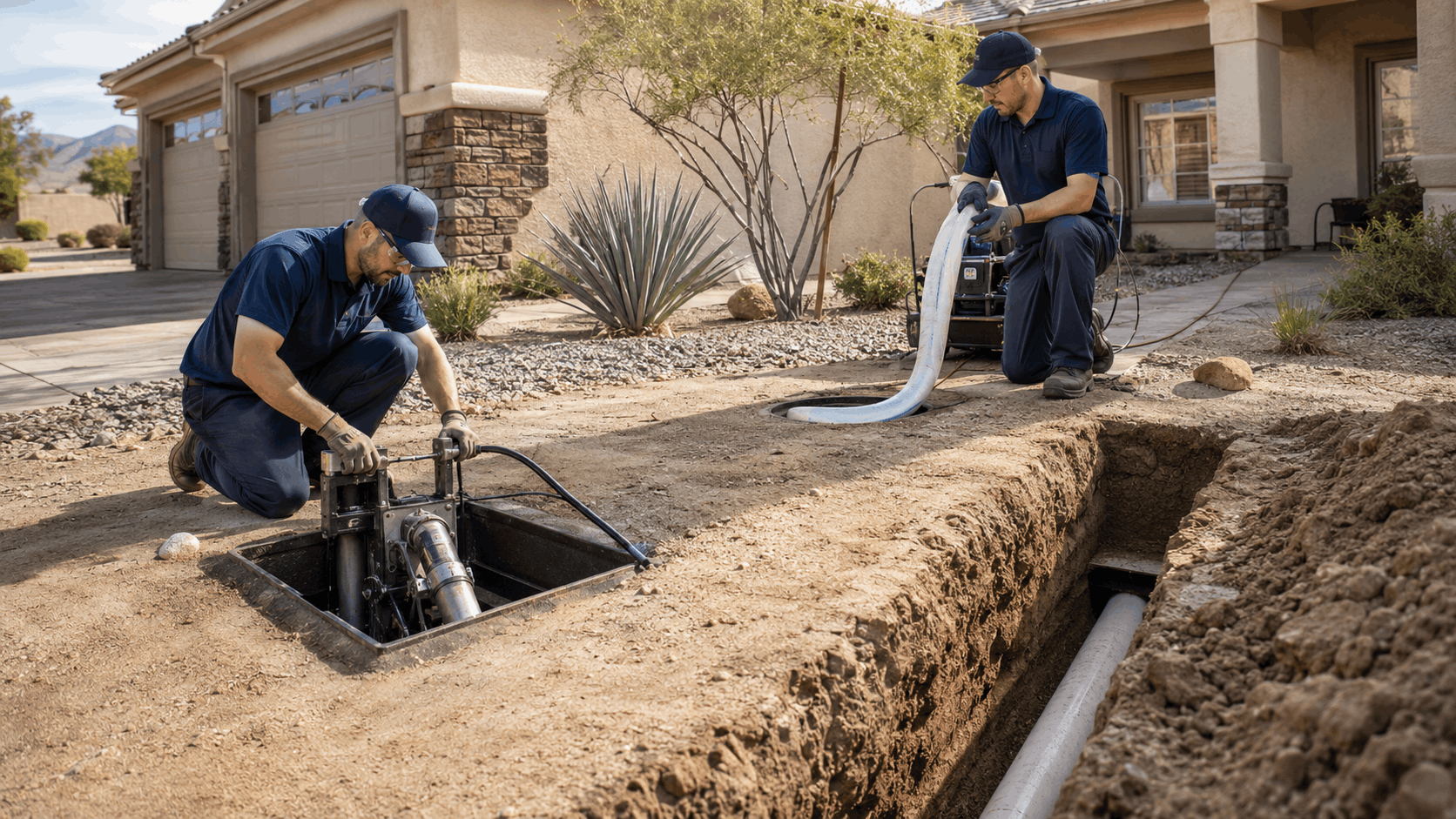
The job starts by locating the exact path and depth of the line, usually with a camera and a locator. Once the route is marked, the crew opens a trench along it, cutting through caliche with breakers or a rock saw where needed. The trench has to be wide and deep enough to work in safely.
With the pipe exposed, the old material comes out. Crews remove the failed clay, cast iron, or worn PVC and set the new pipe at the correct slope. Getting that slope right is one of the main advantages of a full dig.
After the new pipe passes inspection, the backfill goes in. Soil gets replaced in layers and compacted so the ground does not settle later. Sloppy backfill leads to sinkholes and dips, so this step deserves care.
Finally the surface gets restored as close to original as possible. In caliche country the trench digging is the slow part, but the method is straightforward and proven.
When Open Trench Is the Right Call in Caliche
Some problems leave no trenchless option. A fully collapsed line with no host pipe to work with usually means a dig. When the pipe is gone, there is nothing to burst through or line against.
Slope correction is another case for open trench. If a pipe has the wrong grade or a deep belly, the only real fix is exposing it and resetting the pitch. No liner or bursting head repairs a slope problem.
Shallow pipes can also favor a dig. When a line sits close to the surface, digging is quick and cheap enough that trenchless equipment offers little advantage. In those cases the traditional pipe replacement wins on simple economics.
Major reroutes and new connections lean toward open trench too. When the layout itself has to change, having the pipe fully exposed makes the work cleaner and easier to verify.
Dealing With Hardscape, Driveways, and HOA Rules
The hard part of a dig is often what sits on top of the pipe. Concrete driveways, stamped patios, and decorative rock all have to come up, then go back down. Hardscape restoration can cost as much as the plumbing itself in some yards.
HOA communities add another layer. Neighborhoods like Anthem and Southern Highlands have rules about landscaping, approved materials, and how quickly a torn-up yard must be restored. HOA approval may be required before the first shovel drops.
We plan digs around these realities. Knowing an HOA wants matching pavers or a specific rock color up front prevents a second round of work later. Coordinating with the association early keeps the project on schedule.
For homeowners in tight HOA neighborhoods, this is often where trenchless looks more attractive. Less surface disruption means fewer restoration headaches and fewer approvals to chase.
Cost, Cleanup, and Recovery Time
Open trench cost varies widely with depth, length, and what sits above the pipe. A simple shallow run might land around 5,000 dollars, while a deep line under a concrete driveway in hard caliche can climb well past 15,000. The surface restoration often drives the difference more than the pipe.
Cleanup takes real effort after a dig. Excavated caliche is heavy and bulky, and hauling it off adds to the labor. A tidy site at the end is part of doing the job right.
Recovery time depends on the restoration. Fresh concrete needs days to cure, and new landscaping takes a season to fill back in. The plumbing may be fixed in a couple of days while the yard takes weeks to look normal again.
When a dig is truly the right method, that recovery is just part of the deal. The upside is a fully replaced line set at perfect slope with everything visible and verified.
Side-by-Side Comparison: Bursting vs Lining vs Open Trench
Seeing the three methods next to each other makes the trade-offs clear. Each sewer repair option wins on some factors and loses on others. Here is a straight method comparison across what homeowners ask about most.
| Factor | Pipe Bursting | Pipe Lining (CIPP) | Open Trench |
|---|---|---|---|
| Typical cost | 6,000 - 15,000 | 4,000 - 12,000 | 5,000 - 15,000+ |
| Yard damage | Low (two pits) | Very low | High (full trench) |
| Lifespan | 50+ years (HDPE) | 40-50 years (CIPP) | 50+ years (PVC) |
| Typical job length | 1-2 days | 1 day | 2-5+ days |
| Fixes collapsed pipe | Yes | No | Yes |
| Fixes slope/belly | No | No | Yes |
Cost Comparison in the Las Vegas Market
On raw price, lining often comes in lowest because it moves almost no soil. Bursting sits in the middle, and open trench can run highest once caliche and surface restoration are counted. Those ranges shift with every specific job.
The repair cost comparison changes fast based on what sits above the pipe. A dig under bare dirt is cheap, while the same dig under a concrete driveway climbs quickly. Trenchless methods sidestep most of that surface cost.
Price factors also include depth, length, and how much caliche the crew must break through. A deep line in thick hardpan raises every method, but it punishes open trench the most. That is why the dig is not always the budget option people assume.
The only way to compare fairly is a real estimate on the actual line. General ranges guide expectations, but the pipe and the yard set the true number.
Yard and Property Damage Compared
For property damage, lining is the gentlest. Work runs through existing access points, so landscaping impact is close to nothing. Most homeowners barely see evidence a repair happened.
Bursting comes next with its two small pits. The middle of the run stays intact, so driveways, trees, and patios along the path survive. Only the pit areas need restoration.
Open trench sits at the far end of the scale. A full trench tears through whatever lies on the surface, from grass to concrete. That heavy disruption is the main reason homeowners look at trenchless first.
For yards with real money invested in hardscape or mature plants, the ranking is clear. Lining and bursting protect the landscape in ways a dig cannot.
Lifespan and Durability of Each Method
All three methods produce a long-lasting pipe when done well. New HDPE from bursting commonly carries a rated pipe lifespan of 50 years or more. Its fused joints resist roots and ground movement.
CIPP liners generally last 40 to 50 years. The cured resin forms a durable, jointless wall that stands up to normal sewer use. As long as the host pipe was a good candidate, the liner performs for decades.
New PVC set in an open trench also runs 50 years or beyond. With proper slope and solid backfill, a freshly dug line is as reliable as it gets. The durability comes from correct installation as much as material.
In practice, the durability gap between the three is small. The bigger decision is which method fits the pipe and the yard, not which lasts a few years longer on paper.
Speed: How Long Each Job Takes
Lining is usually the fastest, often finishing in a single day. With little digging, the schedule depends mostly on cure time. Homeowners get their drains back quickly.
Bursting typically runs one to two days. The pits and the pull take time, but skipping the trench keeps things moving. Job duration climbs if the pull fights heavy caliche.
Open trench is the slowest, and caliche makes it slower still. Breaking hardpan, setting slope, backfilling, and restoring the surface can stretch a job to a week or more. Repair speed is where the dig loses the most ground.
When time off normal water use matters, trenchless has a clear edge. The dig wins on capability but costs the most days.
Need Help in Las Vegas?
Active Plumbing serves Las Vegas and all of Las Vegas Valley.
How to Choose the Right Method for Your Home
Choosing a sewer repair method is not about picking the trendiest option. It comes down to your pipe condition, your budget, your yard, and your location. This decision guide helps narrow it down step by step.
Start With a Camera Inspection
Every good decision starts with a camera inspection. A plumber runs a sewer scope through the line to see cracks, roots, bellies, and collapses on video. Without that footage, any method recommendation is a guess.
The camera shows the pipe material and its real condition foot by foot. It reveals whether the structure can hold a liner or needs full replacement. It also pinpoints trouble spots so the crew knows exactly where the problem lives.
We treat the scope as the foundation of the estimate. A sewer camera inspection turns a mystery into a clear picture. From there the right method usually becomes obvious.
Skipping this step is how homeowners end up with the wrong fix. Paying for a proper inspection up front saves money on the back end.
Match the Method to Your Pipe Damage
The pipe damage type points straight to the method match. Cracks and root intrusion in a structurally sound pipe usually call for lining. The pipe just needs a fresh inner wall.
A pipe that is broken along its length but still surrounded by workable soil often suits bursting. The old line gets replaced entirely with new HDPE. That handles widespread damage without a full dig.
Collapses, severe bellies, and bad slope send the job toward open trench. Those problems need the pipe physically exposed and reset. No liner or bursting head corrects geometry.
Most homes fall cleanly into one of these buckets once the camera footage is in. The trick is matching the tool to the actual damage rather than a preference.
Factor in Your Yard, Driveway, and Neighborhood
Your yard layout can override the technical choice. In older Spring Valley lots with mature trees and established landscaping, trenchless methods protect decades of growth. Digging a trench there means losing plants that cannot be replaced overnight.
A new concrete driveway changes the math too. Tearing up fresh concrete and re-pouring it adds serious cost, so avoiding the trench under it often pays off. Lining or bursting can save that surface entirely.
Neighborhood and HOA rules also weigh in. Some communities make surface restoration slow and expensive, which tips the scale toward less invasive methods. Knowing the local rules shapes the smart choice.
We walk the yard with homeowners before recommending anything. The best method on paper is not always the best method for that specific property.
Permits and Water District Requirements
Sewer work almost always needs a permit. Local building departments require one for line replacement, and inspections confirm the work meets code. A licensed plumber pulls the sewer permit as part of the job.
Coordination with area utilities matters as well. Underground locates protect gas, water, and electric lines before any digging starts. Skipping locates risks striking a utility, which is dangerous and expensive.
Requirements shift a bit between jurisdictions across the valley. What the Las Vegas building department wants can differ from Henderson or North Las Vegas. A local crew knows which office handles which address.
We handle the permit filing and inspections so homeowners do not have to. Getting the paperwork right keeps the repair legal and protects the home at resale.
How Active Plumbing Handles Sewer Repair in the Valley
Every home and every line is a little different, so our approach starts with looking before recommending. Here is how our team runs a sewer repair from the first visit to the final cleanup across the valley.
- We scope every line before quoting a method.
- We bring equipment built for hard caliche.
- We clean up and stand behind the work.
The Inspection and Estimate Process
We start with a sewer inspection using a camera to see the pipe from the inside. That footage shows exactly what is wrong and where. It removes the guesswork that leads to wrong-sized bids.
We also read the soil conditions along the line, since caliche depth changes the plan. Testing the ground tells us whether bursting will pull clean or whether a dig makes more sense. That check keeps our estimates honest.
Then we lay out the options with clear pricing so the homeowner can compare. We explain the trade-offs of each method for that specific line rather than pushing one product. A free estimate gives real numbers to decide with.
No repair moves forward until the homeowner understands the choice. Clear information up front leads to fewer surprises later.
Equipment Built for Caliche
Working valley soil takes the right excavation equipment. We run rock saws, hydraulic breakers, and heavy buckets sized for cutting through hardpan. Standard dirt-moving gear simply stalls in caliche.
For trenchless jobs we bring the proper trenchless equipment, including bursting rigs and lining setups. Matching the machine to the soil is how a trenchless job finishes on time instead of bogging down. Underpowered gear is how out-of-town crews get stuck.
We also carry the cleaning tools that lining and bursting require. Hydro jetting clears the host pipe so a liner bonds or a new line pulls smoothly. Prep work with the right equipment sets up a clean result.
Having caliche-ready tools on the truck means fewer delays. The job keeps moving even when the ground fights back.
Neighborhoods and Areas the Team Serves
Our service area covers the whole valley. We work sewer lines across Summerlin, Henderson, and North Las Vegas regularly. Each area has its own soil and pipe-age quirks we know well.
We also serve Spring Valley, Enterprise, Paradise, Sunrise Manor, and Whitney, along with the many smaller communities inside them. From newer builds in Mountains Edge to older lines near Historic North Las Vegas, we have dug and lined across the map. That range of Las Vegas neighborhoods gives us a feel for local conditions block by block.
Knowing the ground under a given neighborhood speeds up the whole job. We show up with a good idea of what the soil holds before the first cut.
Whether the home sits on shallow hardpan or a deep caliche shelf, we have likely worked nearby. That familiarity is baked into every estimate we give.
Warranty and Cleanup After the Job
A repair is not done until the site is clean. We haul off excavated caliche, remove debris, and restore the surface as close to original as the method allows. Site cleanup is part of the price, not an extra.
We back the work with a warranty so homeowners have recourse if something goes wrong. Standing behind a repair matters when the pipe is buried out of sight. The warranty terms come in writing with the job.
For open trench work we coordinate hardscape and landscaping restoration too. Concrete and rock go back in a way that meets HOA standards where they apply. Leaving a torn-up yard is not how we finish.
Our goal is a repaired line and a property that looks cared for. Both matter, and both are part of the job.
Need Help in Las Vegas?
Active Plumbing serves Las Vegas and all of Las Vegas Valley.
Final Thoughts
Sewer repair in the valley is not one-size-fits-all, and caliche is the reason. Pipe bursting, lining, and open trench each solve real problems, and the right pick depends on your pipe condition, your yard, and your budget. A camera inspection turns that choice from a guess into a clear decision.
If a sewer line is backing up or you suspect a break under hard soil, our team can scope the line and lay out honest options. Reach out to Active Plumbing for an inspection and estimate, and we will help you choose the method that fits your home and the ground beneath it.
Frequently Asked Questions
Is trenchless repair possible in Las Vegas caliche soil?
Yes, both pipe bursting and lining work in caliche, though conditions matter. Lining works whenever the host pipe is structurally sound, since it needs almost no soil movement. Bursting depends on how tight and deep the hardpan runs, because the fractured pipe needs somewhere to displace. A camera scope and soil check tell us which trenchless method will pull cleanly on a specific line before any work begins.
How much does pipe bursting cost in Las Vegas?
Pipe bursting for a standard residential line usually runs between 6,000 and 15,000 dollars in the valley. Length, depth, and caliche thickness all push the number, and thick hardpan tends to raise it toward the top of the range. Access points and how the line ties into the main also matter. A camera inspection and site estimate give the real figure rather than a broad guess.
How long does pipe lining last?
A properly installed CIPP liner generally lasts 40 to 50 years. The cured resin forms a smooth, jointless wall that resists roots and normal sewer wear for decades. Lifespan depends on the host pipe being a good candidate and on clean prep work before curing. When the pipe qualifies and the install is done right, a liner performs on par with a fully replaced line for a very long time.
Which method causes the least damage to my yard?
Pipe lining is the least invasive by far. It works through existing access points, so landscaping, driveways, and patios usually stay completely untouched. Pipe bursting comes second, needing only two small pits while the run between them stays undisturbed. Open trench causes the most damage since it tears through whatever sits above the pipe. For a finished yard, lining protects your investment best.
Do I need a permit for sewer line replacement?
Yes, sewer line replacement requires a permit from the local building department, and the work gets inspected to confirm it meets code. A licensed plumber pulls that permit and coordinates the required utility locates before digging. Requirements vary a bit between Las Vegas, Henderson, and North Las Vegas. We handle the permit filing and inspections as part of the job so homeowners do not have to chase paperwork.
Can pipe lining fix a fully collapsed pipe?
No, lining needs a mostly intact host pipe to form against. When a section has fully collapsed, there is no continuous wall for the liner to press into, so the resin has nothing to shape to. Collapsed lines call for pipe bursting or an open trench replacement instead. A camera inspection confirms whether the pipe still holds enough structure for a liner or whether replacement is the only real option.
How long does each type of repair take to finish?
Pipe lining often finishes in a single day, since curing is the main wait. Pipe bursting typically takes one to two days once permits and locates clear. Open trench runs longest, usually two to five days or more, and caliche stretches that further because breaking hardpan is slow. Surface restoration like concrete curing can add extra days on the dig option even after the plumbing itself is done.
Will my HOA affect which repair method I can use?
It can. Many valley HOAs, including communities like Anthem and Southern Highlands, have rules about landscaping, approved materials, and how fast a torn-up yard must be restored. Those rules make open trench restoration slower and pricier, which often tips homeowners toward less invasive lining or bursting. We coordinate with associations early and match hardscape materials to their standards so the finished job passes review without a second round of work.
How do I know if my sewer line needs replacement or just cleaning?
Repeated backups, slow drains across the whole house, gurgling sounds, and sewage odors often point to a real line problem rather than a one-off clog. A single clog usually clears with cleaning, while structural cracks, roots, or bellies keep coming back no matter how often you snake it. A drain and sewer inspection with a camera settles it by showing whether the pipe needs repair or just a cleaning.
Does homeowners insurance cover sewer line repair?
Standard homeowners policies often exclude sewer line repair caused by age, roots, or normal wear. Many carriers offer a service line add-on that covers the buried pipe from the house to the main, and that rider can be worth the small yearly cost. Coverage varies by policy, so checking with your insurer before a problem hits is smart. We can document the issue for a claim when a covered event applies.
Frequently Asked Questions
- Is trenchless repair possible in Las Vegas caliche soil?
- Yes, both pipe bursting and lining work in caliche, though conditions matter. Lining works whenever the host pipe is structurally sound, since it needs almost no soil movement. Bursting depends on how tight and deep the hardpan runs, because the fractured pipe needs somewhere to displace. A camera scope and soil check tell us which trenchless method will pull cleanly on a specific line before any work begins.
- How much does pipe bursting cost in Las Vegas?
- Pipe bursting for a standard residential line usually runs between 6,000 and 15,000 dollars in the valley. Length, depth, and caliche thickness all push the number, and thick hardpan tends to raise it toward the top of the range. Access points and how the line ties into the main also matter. A camera inspection and site estimate give the real figure rather than a broad guess.
- How long does pipe lining last?
- A properly installed CIPP liner generally lasts 40 to 50 years. The cured resin forms a smooth, jointless wall that resists roots and normal sewer wear for decades. Lifespan depends on the host pipe being a good candidate and on clean prep work before curing. When the pipe qualifies and the install is done right, a liner performs on par with a fully replaced line for a very long time.
- Which method causes the least damage to my yard?
- Pipe lining is the least invasive by far. It works through existing access points, so landscaping, driveways, and patios usually stay completely untouched. Pipe bursting comes second, needing only two small pits while the run between them stays undisturbed. Open trench causes the most damage since it tears through whatever sits above the pipe. For a finished yard, lining protects your investment best.
- Do I need a permit for sewer line replacement?
- Yes, sewer line replacement requires a permit from the local building department, and the work gets inspected to confirm it meets code. A licensed plumber pulls that permit and coordinates the required utility locates before digging. Requirements vary a bit between Las Vegas, Henderson, and North Las Vegas. We handle the permit filing and inspections as part of the job so homeowners do not have to chase paperwork.
- Can pipe lining fix a fully collapsed pipe?
- No, lining needs a mostly intact host pipe to form against. When a section has fully collapsed, there is no continuous wall for the liner to press into, so the resin has nothing to shape to. Collapsed lines call for pipe bursting or an open trench replacement instead. A camera inspection confirms whether the pipe still holds enough structure for a liner or whether replacement is the only real option.
- How long does each type of repair take to finish?
- Pipe lining often finishes in a single day, since curing is the main wait. Pipe bursting typically takes one to two days once permits and locates clear. Open trench runs longest, usually two to five days or more, and caliche stretches that further because breaking hardpan is slow. Surface restoration like concrete curing can add extra days on the dig option even after the plumbing itself is done.
- Will my HOA affect which repair method I can use?
- It can. Many valley HOAs, including communities like Anthem and Southern Highlands, have rules about landscaping, approved materials, and how fast a torn-up yard must be restored. Those rules make open trench restoration slower and pricier, which often tips homeowners toward less invasive lining or bursting. We coordinate with associations early and match hardscape materials to their standards so the finished job passes review without a second round of work.
- How do I know if my sewer line needs replacement or just cleaning?
- Repeated backups, slow drains across the whole house, gurgling sounds, and sewage odors often point to a real line problem rather than a one-off clog. A single clog usually clears with cleaning, while structural cracks, roots, or bellies keep coming back no matter how often you snake it. A drain and sewer inspection with a camera settles it by showing whether the pipe needs repair or just a cleaning.
- Does homeowners insurance cover sewer line repair?
- Standard homeowners policies often exclude sewer line repair caused by age, roots, or normal wear. Many carriers offer a service line add-on that covers the buried pipe from the house to the main, and that rider can be worth the small yearly cost. Coverage varies by policy, so checking with your insurer before a problem hits is smart. We can document the issue for a claim when a covered event applies.
A
Licensed plumbing professionals serving Las Vegas and Las Vegas Valley.
Licensed in Nevada · License #0047021
Last updated on
Why trust Active Plumbing?
Founded in 1991, Active Plumbing is a licensed and insured plumber serving Las Vegas and Las Vegas Valley. All content is reviewed by our licensed technicians.

Need Help in Las Vegas?
Active Plumbing serves Las Vegas and all of Las Vegas Valley.
Related Articles
Cost Guides
Sewer Line Replacement Cost in Las Vegas: Trenchless vs Open-Dig Per Foot in Caliche
See real per-foot sewer line replacement costs in Las Vegas for trenchless vs open-dig, and learn how caliche soil affects your quote and which method fits your home.
Cost Guides
Whole-House Repipe Cost in Las Vegas by Home Size - 1,500 to 4,000+ Sq Ft Real Ranges
Real whole-house repipe cost ranges in Las Vegas by home size from 1,500 to 4,000+ sq ft, plus pipe materials, permits, timelines, and local factors.
Cost Guides
Whole House Repipe Cost in Las Vegas by Square Footage
A local guide to whole house repipe cost in Las Vegas by square footage, plus how pipe material, home age, and permits shape the final price.