Why Las Vegas Closed Plumbing Systems Need Expansion Tanks: Thermal Expansion Physics
Key Takeaways
- Most modern Las Vegas homes are closed systems due to PRVs, check valves, and backflow preventers that seal off the city main.
- Heated water expands about 2 percent, creating roughly one extra gallon per cycle that has nowhere to go in a sealed system.
- Trapped expansion can spike pressure past 150 psi, causing dripping relief valves, banging pipes, and worn-out fixtures.
- An expansion tank uses an air bladder to cushion pressure, and its air charge must match your home's water pressure to work.
- High desert pressure zones and hard water make valley homes more prone to expansion damage, especially in higher-elevation areas.
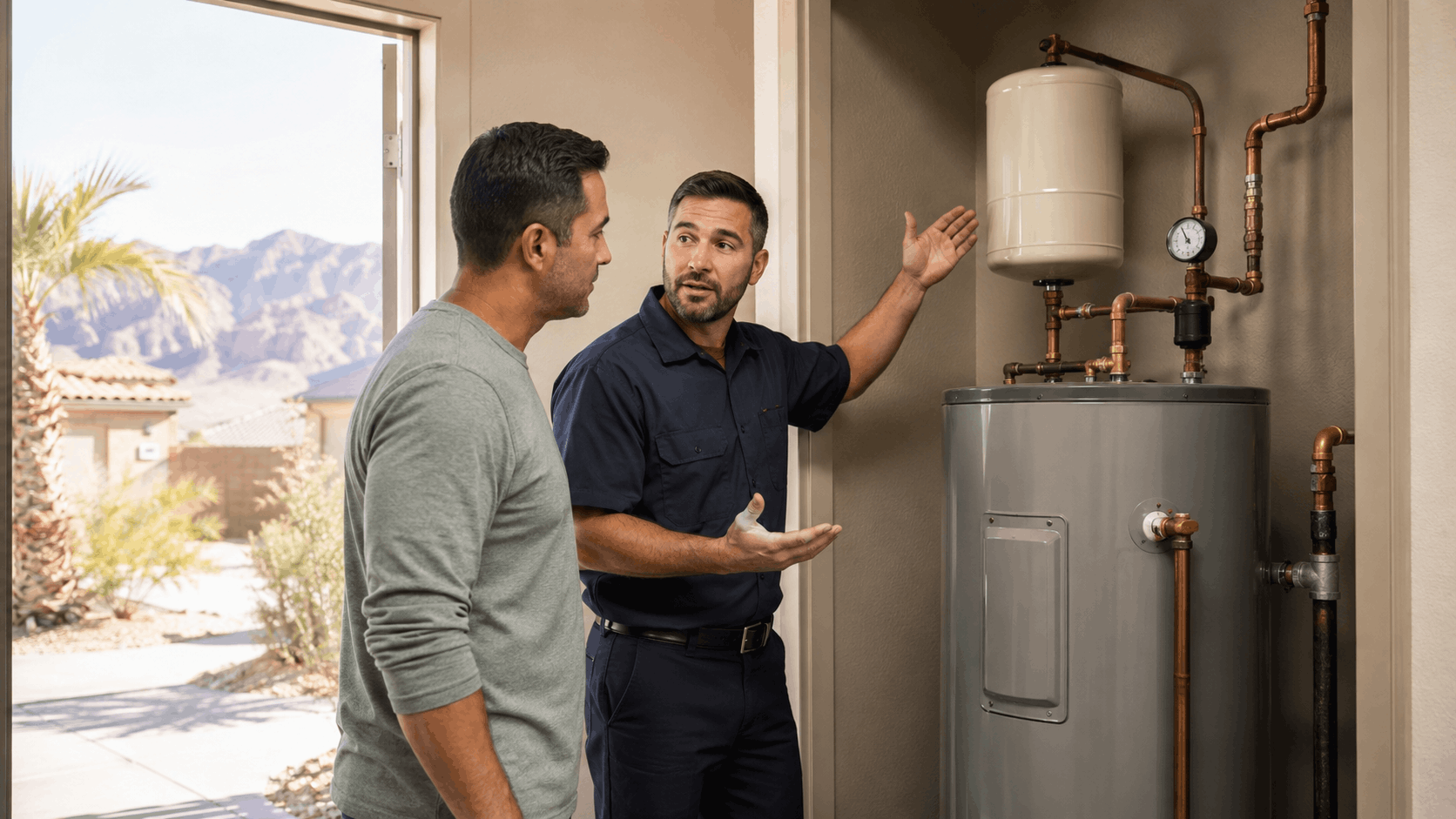
- Clark County code typically requires an expansion tank when installing or replacing a water heater on a closed system, plus a permit.
- A yearly tap test or tire gauge check reveals a failed bladder, and tanks generally last 5 to 10 years in hard water.
- Active Plumbing installs, tests, and maintains expansion tanks across Summerlin, Henderson, and the whole valley with same-area response.
In This Article
A homeowner off Town Center Drive near Summerlin called us last summer with a strange complaint. Every night around 10 p.m., right after the family finished showers and dishes, the pipes in the wall started banging like someone was knocking to get in. A few weeks later she noticed water dripping from a small copper pipe on the side of her water heater in the garage. Two problems, one root cause: thermal expansion inside a closed plumbing system.
This is one of the more common issues we see across the valley, from Green Valley in Henderson to Centennial Hills up north. Heated water expands, and when it has nowhere to go, pressure builds until something gives. The fix is usually a small, inexpensive part called an expansion tank.
What a Closed Plumbing System Actually Is?
A closed plumbing system is one where water cannot flow backward out of the house and into the city supply. Once water enters through the meter, a valve seals it in. That sounds harmless, but it changes the physics of everything downstream of that valve.
Most newer homes in Las Vegas fall into this category because of the devices installed at the meter. A check valve or a backflow preventer allows water to move in one direction only. That protects the public water supply from contamination, which is a good thing, but it also traps expanding hot water inside your pipes.
| System Type | Water Flow Direction | Expansion Handling | Expansion Tank Needed? |
|---|---|---|---|
| Open system | Can flow back to city main | Extra volume pushes back into the main | Usually no |
| Closed system | One direction only (sealed) | No relief path, pressure builds | Yes |
Closed vs. Open Systems Explained
In an open plumbing system, there is no one-way valve between your house and the street. When water in the tank heats up and expands, that small amount of extra volume simply pushes back into the city water main. The municipal system is huge, so it absorbs the change without anyone noticing a thing.
A closed system works differently. A one-way device at the meter stops any water from leaving the home. So when your water heater fires up and the water inside expands, there is no escape route back to the street.
That trapped expansion has to go somewhere. In a sealed system it turns directly into rising pressure against your pipes, fixtures, and the water heater tank itself. The bigger the temperature swing, the bigger the pressure jump.
This is why an issue that never bothered older open-system homes has become common in newer construction. The same physics applies everywhere, but only closed systems feel the consequences.
Why Las Vegas Water District Requirements Create Closed Systems
The Las Vegas Valley Water District and other local providers install meters and backflow devices that protect the drinking water supply. These devices keep water from your home from ever siphoning back into the public lines during a pressure drop. It is a smart public health measure that also creates a sealed environment inside each home.
Many homes also have a pressure reducing valve installed near the meter. This valve knocks down the high incoming street pressure to a safer level for household plumbing. The catch is that a PRV also acts as a one-way barrier in most designs.
Between backflow preventers, check valves, and pressure reducing valves, the vast majority of homes built or re-plumbed in the last two decades are closed. Neighborhoods like Aliante, Mountain's Edge, and much of Summerlin were built during this era. If a home has any of these devices, expansion has nowhere to go.
Our team runs into this constantly during water heater service calls across the valley. The device that protects the city supply is the same device that makes an expansion tank necessary.
How to Tell If Your Home Has a Closed System
The quickest check is at your water meter, usually near the front of the property in a below-grade box. Look for a bell-shaped or dome-topped brass valve on the main line coming into the house. That is often a pressure reducing valve, and its presence almost always means the system is closed.
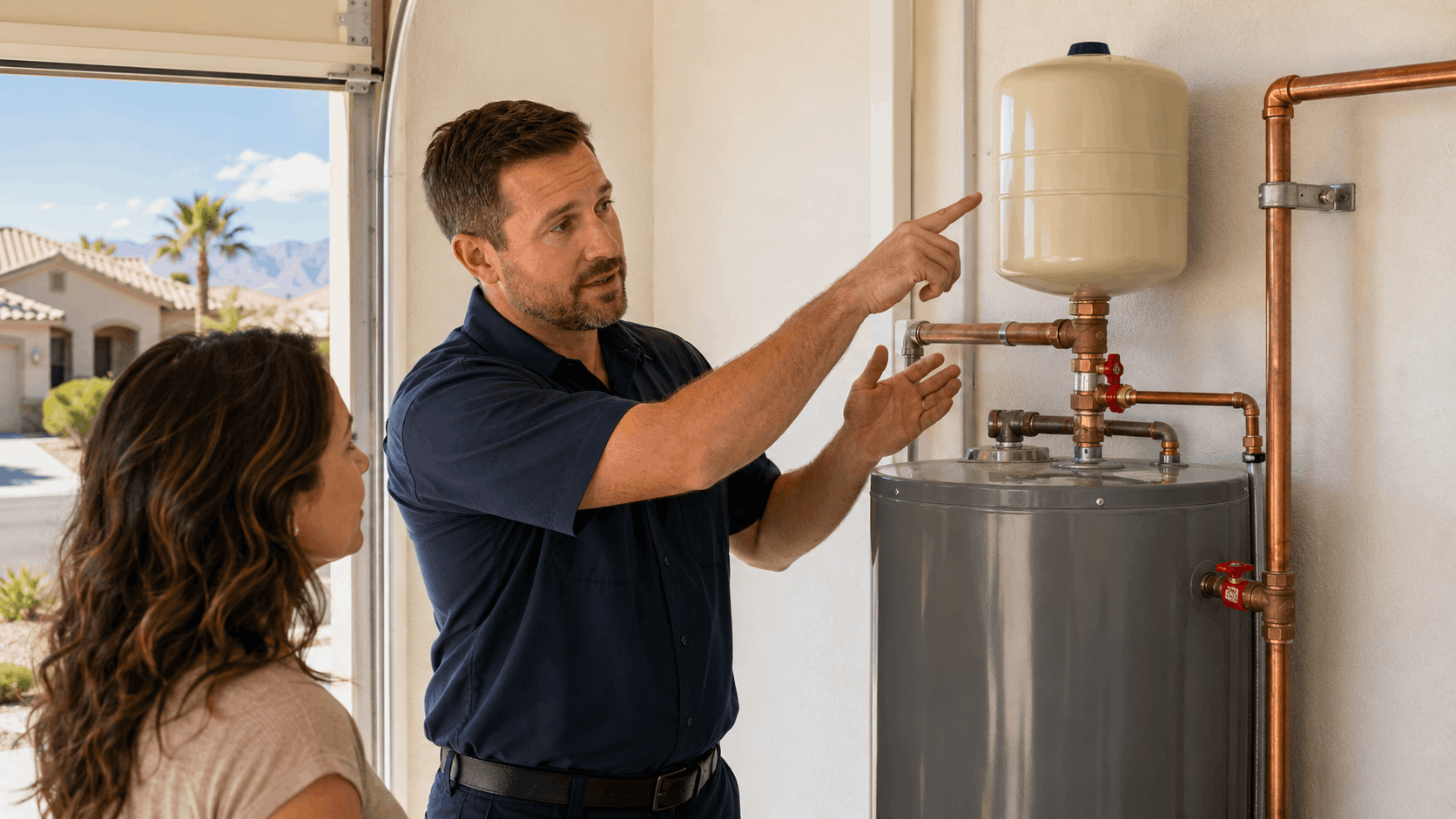
Next, look at the cold water pipe feeding your water heater in the garage or utility closet. A check valve may be installed there, or you may already see an expansion tank mounted above the line. If there is a valve but no tank, that is a red flag.
You can also watch your pressure. If a pressure gauge attached to a hose bib climbs well above normal after the water heater runs, that rising number confirms trapped expansion. Homes without a closed system hold steady instead.
If any of this feels uncertain, we are happy to inspect it during a visit. A two-minute look at the meter and heater usually tells us everything we need to know.
Get Your Quote
Tell us what's going on and we'll get back to you. We're open 24/7.
The Physics of Thermal Expansion in Water Heaters
Water is nearly impossible to compress, which is the whole reason this problem exists. When you heat it, it expands, and since it cannot be squeezed back down, that expansion turns into force. Inside a water heater, this happens every single time the burner or element kicks on.
The numbers are small but the effect is not. A standard tank can produce dozens of extra gallons of expansion over a day, and in a sealed system that translates into sharp water pressure spikes. Understanding thermal expansion in plain terms makes the fix obvious.
| Water Temperature | Approx. Volume Change (per 40 gal) | Pressure Effect in Closed System |
|---|---|---|
| Cold inlet (~55°F) | Baseline | Normal (50-70 psi) |
| Warm (~120°F) | +0.5 gallon | Noticeable rise |
| Hot (~140°F) | +0.8 gallon | Can exceed 100 psi |
| High (~150°F+) | +1 gallon or more | Can exceed 150 psi |
Why Heated Water Takes Up More Space
When water heats up, its molecules move more quickly and spread apart, so the same amount of water takes up more room. From a cold inlet temperature to a typical tank setting, water expands roughly 2 percent by volume. That does not sound like much until you apply it to a full tank.
Consider a 50-gallon water heater. A 2 percent water expansion means about one full gallon of extra heated water volume is created every heating cycle. That gallon has to fit somewhere inside a system that is already completely full.
In an open system, that gallon drifts back toward the street and disappears. In a closed system, it stays put. Since the pipes and tank are rigid and the water cannot compress, the only thing that changes is the pressure.
This cycle repeats many times a day as the heater maintains temperature. Each cycle adds another push of expansion against a system with no give.
How Pressure Spikes When Water Has Nowhere to Go
In a sealed system, that extra gallon of expanded water has no relief path, so the internal pressure climbs fast. A home that normally sits at 60 psi can spike well past 100 psi during a heating cycle. In extreme cases we have measured readings above 150 psi in valley garages.
Most household plumbing is rated for around 80 psi of continuous pressure. A pressure spike that blows past that number stresses every joint, valve, and appliance in the house. The temperature and pressure relief valve on the water heater is designed to open at 150 psi as a last-ditch safety measure.
When that relief valve starts weeping or discharging, it is not broken. It is doing its job because the pressure genuinely got that high. The valve is telling you the expansion has nowhere to go.
Left unchecked, these repeated spikes wear parts out early and can cause sudden failures. A slow toilet fill valve leak or a pinhole in a supply line often traces back to years of pressure pounding.
The Role of Water Heater Temperature Settings
The hotter you set the tank, the more the water expands and the harder the pressure climbs. Many Las Vegas homes run their water heater temperature around 120°F, which is a good balance of comfort and safety. Push the thermostat setting up to 140°F or higher and the expansion grows with it.
Higher settings are sometimes used to fight bacteria or to serve large families, but they magnify the expansion problem. Every extra degree means a bit more volume change per cycle. On a closed system, that means bigger and more frequent pressure spikes.
We often see homeowners crank the temperature up during winter, then wonder why the relief valve starts dripping. The two are directly connected. The colder incoming water plus a hotter setting equals a wider temperature swing and more expansion.
Dialing the setting back to 120°F helps a little, but it does not solve the core issue. An expansion tank is what actually absorbs the change regardless of the setting.
Need Help in Las Vegas?
Active Plumbing serves Las Vegas and all of Las Vegas Valley.
What an Expansion Tank Does and How It Works
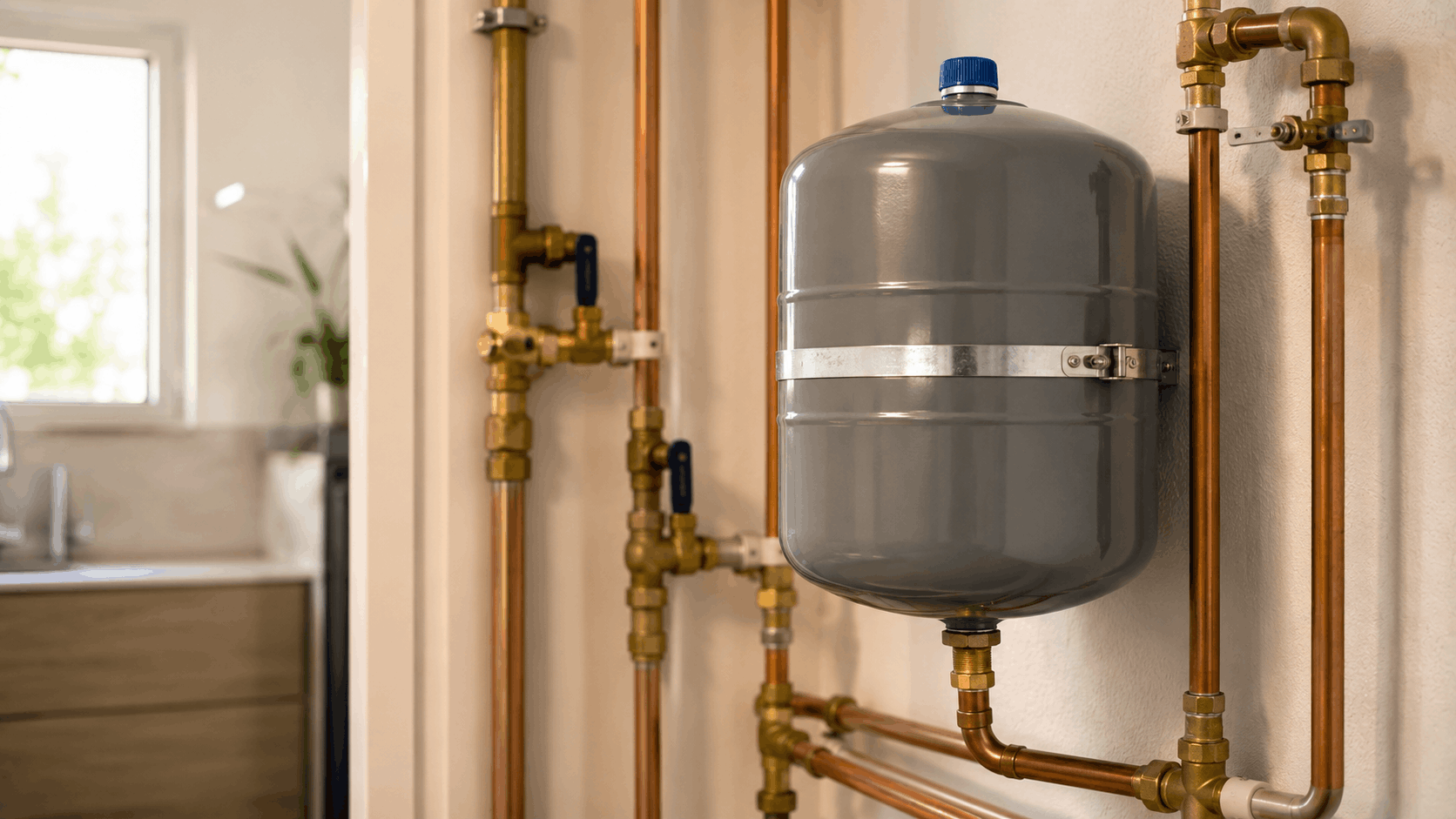
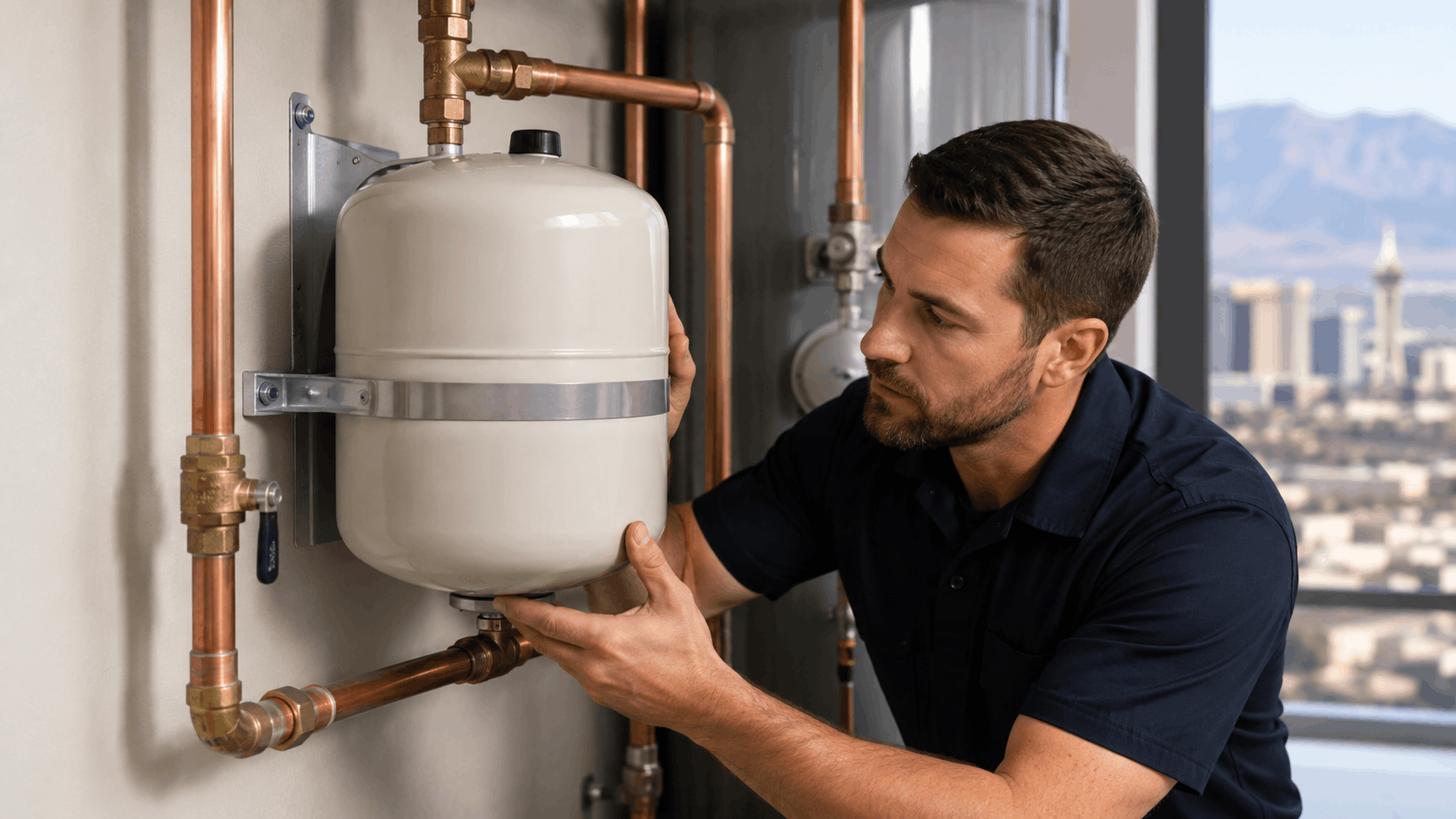
An expansion tank is a small steel tank, usually the size of a basketball or a bit larger, that gives expanding water a place to go. It mounts near the water heater and quietly absorbs the pressure every time the tank heats up. Most homeowners never even notice it working.
Inside is a rubber bladder that separates water from a cushion of air pressure. When expansion pushes extra water into the tank, the air compresses to make room. When demand draws water back out, the air pushes it right back into the system.
The Air Bladder and How It Absorbs Pressure
The air bladder is the heart of the tank. It is a flexible rubber diaphragm that splits the tank into two chambers, one for water and one for compressed air. Air can be squeezed, which is exactly what water cannot do.
When your water heater creates that extra gallon of expanded water, it flows into the tank and presses against the bladder. The air on the other side compresses like a spring, providing pressure absorption for the whole system. Instead of a spike to 150 psi, the pressure barely moves.
As soon as someone opens a tap or the system cools, the compressed air pushes the water back out. The bladder returns to its resting position, ready for the next cycle. This happens automatically, dozens of times a day, with no moving motor or power needed.
Over years of use, that rubber bladder eventually wears out. When it fails, the tank fills with water and stops cushioning anything, which is why testing matters.
Where the Tank Gets Installed
The standard tank installation location is on the cold water line feeding the water heater, usually within a few feet of the tank. Mounting it there lets it catch the expansion right at the source before pressure spreads through the house. In most valley garages, it sits just above or beside the heater.
Placement on the cold side rather than the hot side matters for the tank's lifespan. The cold line runs at a lower temperature, which is easier on the rubber bladder over time. Installing it on the hot side shortens the tank's life considerably.
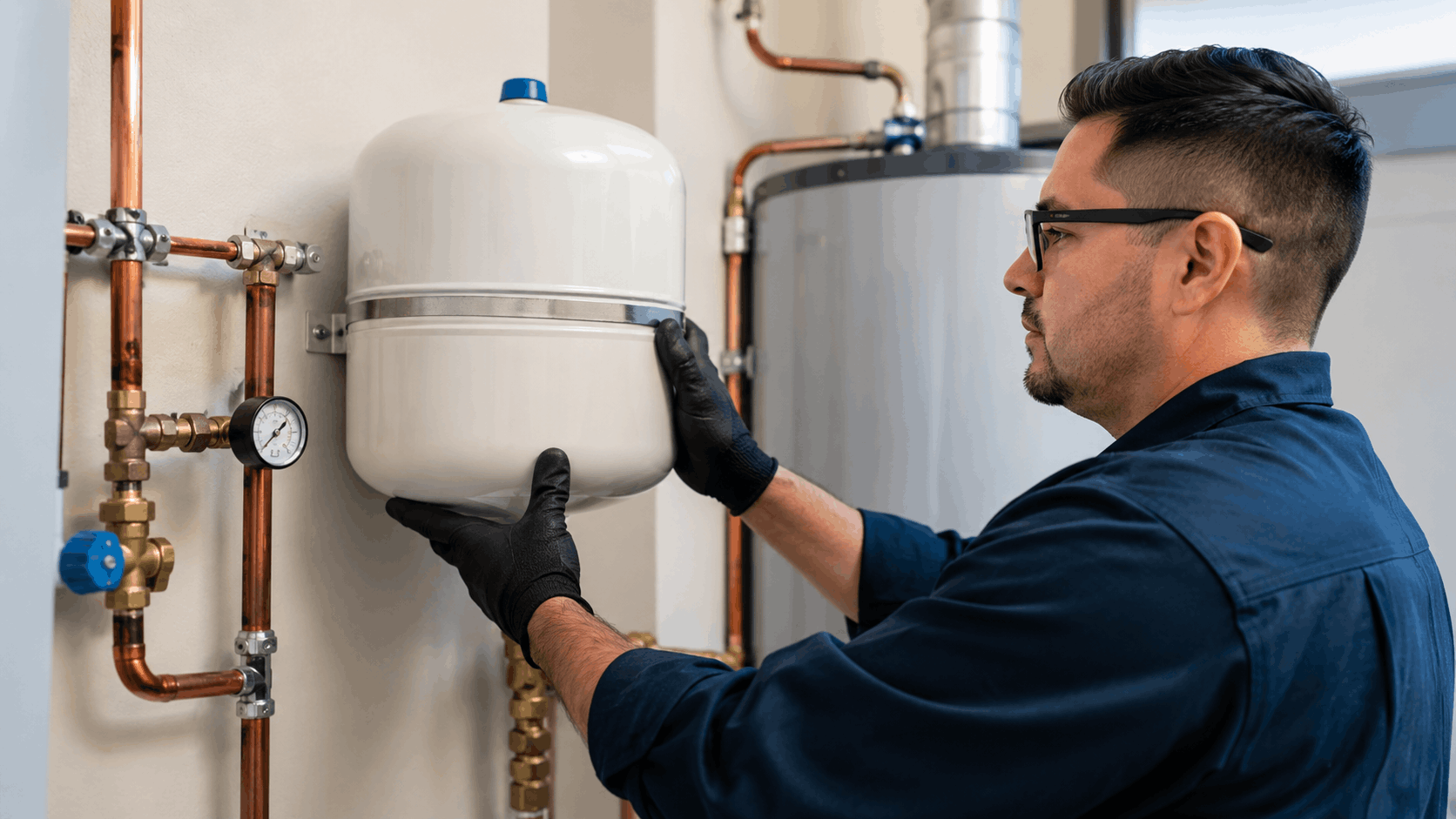
The tank should be supported properly, not left hanging by the pipe alone. A full expansion tank is heavy, and its weight can stress the plumbing joint if it is not braced. We use a mounting bracket or strap on every install.
Orientation also plays a part. Many tanks are designed to hang with the connection pointing down, and we follow the maker's spec to keep the bladder working correctly.
Matching Tank Size to Your Home
Proper expansion tank sizing depends on two things: your water heater capacity and your incoming water pressure. A standard 40 or 50-gallon tank pairs with a common 2-gallon expansion tank in most homes. Larger tanks or higher pressures may call for a bigger unit.
Getting the size right is not guesswork. A tank that is too small will not hold enough expansion volume and pressure will still climb. A tank that is far oversized costs more and takes up space it does not need.
For the big 75 or 80-gallon heaters we see in larger Summerlin and Henderson homes, a bigger expansion tank is often required. Commercial-style setups need even more. We size each one based on the actual heater and measured pressure at the home.
If you install a new heater with more capacity, the old expansion tank may no longer be big enough. That is a detail some homeowners miss during an upgrade.
Setting the Correct Air Charge
Every expansion tank ships with a factory air charge, but it almost never matches your home out of the box. The pre-charge pressure inside the air side must equal your home's static water pressure for the tank to work right. If the two do not match, the tank cannot absorb expansion properly.
Here is why it matters. If the pre-charge is too low, the bladder sits partly compressed at all times and has less room to catch expansion. If it is too high, water never enters the tank and it does nothing at all.
We measure the home's pressure first, then set the air charge with a pump or bleed valve before the tank ever sees water. A tank charged to 60 psi on a 60 psi system does its job perfectly. This step is skipped in a lot of quick, unlicensed installs.
Getting this right is the difference between a tank that lasts and one that fails or does nothing. It only takes a few minutes when done correctly.
Warning Signs of Thermal Expansion Damage in Las Vegas Homes
Most homeowners do not think about expansion until something goes wrong. The good news is that thermal expansion damage gives clear warning signs before major failure. Catching them early saves you from a flooded garage or a ruined water heater.
Our high desert conditions make these signs show up more often here. High incoming pressure and hard water combine to stress an already sealed system. Below are the symptoms we hear about most from valley callers.
| Warning Sign | What It Means | Urgency |
|---|---|---|
| Dripping relief valve | Pressure exceeded safe limit | High |
| Banging pipes after hot water use | Pressure surge / water hammer | Medium |
| Running toilets or fixture leaks | Pressure wearing out fill valves | Medium |
| Short water heater life | Repeated pressure stress on tank | Long-term |
Dripping or Discharging Temperature and Pressure Relief Valve
The first clue most people notice is water near the water heater. The T&P valve is a safety device that opens when pressure or temperature climbs too high. When you see relief valve discharge dripping onto the garage floor, expansion is usually the cause.
Many homeowners assume the valve is defective and replace it. The new valve then drips too, because the actual problem is the pressure, not the part. The valve is simply doing what it was built to do.
We get these calls from all over, including older homes near Charleston Heights where original systems were converted to closed setups. A dripping T&P valve should never be capped or ignored. That valve is the last safety barrier against a dangerous tank.
If yours is discharging, adding an expansion tank almost always stops it. Our team confirms the pressure reading first, then installs the right tank to solve it.
Banging or Knocking Pipes After Hot Water Use
That knocking in the walls after a shower or a dishwasher cycle is a classic sign. Pressure surges send a shock through the pipes, and you hear it as banging or hammering. Some people call it water hammer, and expansion can trigger a similar effect.
The pipe noise often shows up at night when the house is quiet and the water heater cycles on. Families near the Vistas in Summerlin have described it as someone tapping inside the wall. It is unsettling but the cause is mechanical, not mysterious.
When pressure has nowhere to go, every valve closing or opening sends a bigger jolt through rigid pipes. Over time that shock loosens fittings and strains joints. An expansion tank softens these surges by giving the pressure a cushion.
If the banging lines up with hot water use, expansion is a strong suspect. We diagnose it by watching pressure during a heating cycle.
Shortened Water Heater Life and Fixture Leaks
Constant pressure spikes wear out the water heater from the inside. The tank flexes with every cycle, and that fatigue shortens its water heater lifespan by years. A heater that should last 10 to 12 years might fail in six or seven.
The damage does not stop at the heater. Repeated high pressure causes fixture wear on faucets, toilet fill valves, and appliance connections. That mystery running toilet or the faucet that started dripping may trace back to expansion.
We see this pattern in homes across Green Valley and Spring Valley, where original fixtures wear out sooner than they should. Owners replace part after part without addressing the pressure behind it. That gets expensive over time.
An expansion tank protects the whole system, not just the heater. It is one of the cheapest ways to extend the life of everything downstream.
Need Help in Las Vegas?
Active Plumbing serves Las Vegas and all of Las Vegas Valley.
Why High Water Pressure Makes Las Vegas Homes More at Risk
Las Vegas sits in a high desert basin with dramatic elevation changes across the valley. To push water uphill to homes at higher spots, the system runs at high pressure. That means many homes see strong incoming pressure before it ever reaches the meter.
Combine high water pressure with a sealed system and expansion becomes a real problem. Good water pressure regulation is part of protecting your home. This is one reason Las Vegas plumbing so often includes both a PRV and an expansion tank.
Elevation and Pressure Zones Across the Valley
The valley floor drops from the west near Summerlin down toward the east and the Las Vegas Wash. Water providers divide the area into pressure zones to serve homes at different elevation levels. Homes up against the mountains often get very high incoming pressure.
Summerlin and the western foothills sit at higher elevation, while parts of Henderson and North Las Vegas sit lower. Each zone is engineered so even the highest homes get adequate flow. The result is that lower homes can receive pressure well above what plumbing prefers.
We have measured street pressure over 100 psi in several valley neighborhoods. That is far more than household fixtures should handle without regulation. It also makes any trapped expansion worse because the baseline is already high.
Knowing which zone a home sits in helps us predict pressure issues before we even test. Local experience matters here, and our team knows these zones well.
How Pressure Reducing Valves Interact With Expansion
A pressure reducing valve lowers that high street pressure to a safe 50 to 70 psi range for the house. It is a great fix for high-pressure zones, but it introduces a side effect. A PRV acts as a one-way barrier, which seals the system closed.
Once the PRV is in place, expansion can no longer push back to the street. That means the moment you install a PRV, an expansion tank shifts from optional to required. The two devices work as a pair.
This is where a lot of confusion happens. A homeowner installs a PRV to fix high pressure, then starts seeing a dripping relief valve because expansion is now trapped. Both problems have to be solved together.
Whenever we install or service a PRV, we check for an expansion tank as part of the job. Skipping the tank just trades one problem for another.
Hard Water and Its Effect on System Components
Las Vegas water is famously hard, loaded with calcium and other minerals. That hard water leaves scale on everything it touches, including valves, tank bladders, and heater parts. Under constant pressure stress, that mineral buildup speeds up wear.
Scale can clog a PRV so it stops regulating correctly. It can also coat the inside of a water heater and reduce its efficiency. On an expansion tank, mineral deposits can shorten the life of the bladder and the connection point.
Many valley homeowners add a water softener to slow this down. A water softener installation protects the heater, the expansion tank, and every fixture in the house. It is a smart pairing in our hard-water region.
When we service an expansion tank in an older home, scale is often part of the story. Softer water helps every component last longer under pressure.
Code Requirements and Permits for Expansion Tanks in Las Vegas
Expansion tanks are not just a good idea here, they are often required by code. The plumbing code that governs the valley calls for thermal expansion control on closed systems. That usually means an expansion tank permit comes into play with water heater work.
Clark County handles permitting and inspection for most of the area. Following the process protects you during home sales and warranty claims. Here is how it works locally.
| Situation | Expansion Tank Required? | Permit Typically Needed? |
|---|---|---|
| New water heater on closed system | Yes | Yes |
| Water heater replacement | Yes if system is closed | Yes |
| New PRV installation | Yes | Often |
| Open system, no valves | Not required | Depends on work |
When Code Requires an Expansion Tank
A common trigger is a water heater replacement on a closed system. When we pull the old heater and install a new one, code requires that thermal expansion be controlled. That means adding an expansion tank if one is not already present and working.
The code requirement exists because uncontrolled expansion is a genuine safety hazard. A tank that repeatedly overpressures can, in rare cases, fail catastrophically. The relief valve and expansion tank together prevent that.
Installing a new PRV also triggers the requirement, since it closes the system. Any work that seals the plumbing brings the expansion rule into play. Inspectors look for the tank specifically during these jobs.
This is why a proper heater install costs a bit more than a bare tank swap. The expansion tank and permit are part of doing it to code.
Clark County Building Department and Permits
The Clark County Building Department requires a plumbing permit for water heater and expansion tank work in most of the valley. The permit ensures the job meets current code and gets inspected. Licensed plumbers pull these permits as part of the service.
The process is straightforward when a pro handles it. We file the permit, do the work to spec, and schedule the inspection. The inspector confirms the tank, the connections, and the relief valve are all correct.
Cities within the valley, like Henderson and North Las Vegas, may have their own building departments with similar rules. Wherever the home sits, permitting keeps the work legal and documented. That paperwork matters more than people expect.
You can review permit information through the Clark County Building and Fire Prevention resources. Our team manages the whole process so you do not have to.
How Skipping Compliance Affects Home Sales and Insurance
Missing an expansion tank can bite you when you least expect it. During a home inspection for a sale, a licensed inspector will flag a closed system with no expansion control. That can hold up the deal or force a last-minute repair.
Buyers and their agents increasingly ask about this item. A flagged safety issue gives them leverage to negotiate or walk. Handling it in advance keeps the sale smooth.
Insurance and warranty claims are the other risk. If a water heater fails from uncontrolled pressure and there was no required expansion tank, the manufacturer may deny the warranty. Some insurers scrutinize the same detail after a water damage claim.
Doing it right the first time protects your investment on both fronts. A permitted, code-compliant install gives you documentation to back it up.
Need Help in Las Vegas?
Active Plumbing serves Las Vegas and all of Las Vegas Valley.
Installation, Maintenance, and What Active Plumbing Provides
Adding an expansion tank is a quick job for our team, usually done in under an hour. The value comes from doing it correctly, with the right size, the right charge, and a permit when needed. Here is how Active Plumbing handles it and keeps it working over the years.
We serve homeowners across the entire valley, and expansion tank installation is one of our routine calls. Regular plumbing maintenance keeps the tank doing its job long after install day.
What a Professional Install Involves
A professional installation starts with shutting off the cold water supply and relieving pressure in the line. We drain enough of the system to work safely on the cold water pipe near the heater. Then we cut in a tee fitting where the tank will connect.
Before the tank ever touches water, we measure the home's static pressure. We set the tank's air charge to match through careful pressure matching, so it cushions expansion correctly. This step is what separates a lasting install from a failed one.
Next we mount the tank with proper support, thread it in, and check every joint for leaks. We restore water, run the heater through a cycle, and confirm the pressure stays stable. If a permit applies, we handle the filing and inspection.
The whole visit usually takes 45 minutes to an hour on a standard home. You get a tank that is sized, charged, and mounted to code.
How to Check Your Expansion Tank Yourself
You can do a quick tank test at home in a couple of minutes. Start with the tap test: tap the top and bottom of the tank with your knuckles. The top should sound hollow with air, and the bottom should sound solid with water.
If the whole tank sounds solid, the bladder has likely failed and the tank filled with water. That means it is no longer cushioning anything. A failed tank should be replaced rather than repaired.
You can also do a tire gauge check on the air valve at the top, which looks just like a tire valve. With the water pressure relieved, the reading should match your home's water pressure. If it reads zero or spits water, the bladder is gone.
Doing this once a year catches problems early. If you are unsure of the reading, our team is glad to verify it during any visit.
Service Across Summerlin, Henderson, and the Valley
Our crews cover the whole valley with same-area response. From Summerlin and Centennial Hills in the northwest to Green Valley in Henderson, we know these neighborhoods and their plumbing quirks. Being a true local plumber means shorter drive times and more quickly help.
We work on homes in Green Valley, Spring Valley, Enterprise, Paradise, and up into North Las Vegas. Each area has its own pressure zone and water history that shapes what we find. That local knowledge helps us diagnose more quickly.
If a relief valve is discharging at midnight, our emergency plumbing team can respond around the clock. Pressure problems do not wait for business hours. Neither do we.
Wherever you are in the valley, help is close by. We treat every home like it is on our own street.
Pairing Tank Service With Water Heater Checkups
The smart move is to inspect the expansion tank whenever the water heater gets serviced. Since they work together, checking both at once saves a separate trip. Our water heater repair and maintenance visits include a tank check.
During annual water heater service, we flush the tank, check the anode rod, and test the relief valve. Adding the expansion tank to that annual inspection takes only a few extra minutes. We verify the air charge and tap-test the bladder while we are there.
Catching a failing bladder during a routine visit beats discovering it after a leak. It also keeps the heater warranty protected. Bundling the two is simply more efficient.
For homes with tankless units, we also check whether an expansion tank is needed during tankless maintenance and descaling. Every setup gets the right treatment.
Final Thoughts
Thermal expansion is basic physics, but in a closed Las Vegas home it becomes a real threat to your plumbing. Heated water expands, a sealed system traps it, and pressure climbs until something leaks, bangs, or breaks. An expansion tank solves it by giving that pressure a soft place to land.
With our high desert pressure, hard water, and widespread PRV use, most valley homes fall squarely into the closed-system category. If your relief valve drips or your pipes bang after showers, expansion is the likely cause. The fix is inexpensive and often required by code.
Our team installs, tests, and maintains expansion tanks across the valley every week. Contact Active Plumbing to schedule an inspection or install, and protect your water heater and your home before the next pressure spike.
Frequently Asked Questions
- Does every Las Vegas home need an expansion tank?
- Not every home, but most modern ones do. Any house with a closed system, meaning it has a pressure reducing valve, check valve, or backflow preventer, almost always needs an expansion tank. That covers the vast majority of homes built or re-plumbed in the last two decades across the valley. Older open systems without these valves may not need one, but they are increasingly rare here.
- How much does an expansion tank cost to install in Las Vegas?
- For a typical residential install, most homeowners pay somewhere in the range of $150 to $400 including parts and labor. The tank itself is inexpensive, so most of the cost is the professional install, air-charge setup, and any permit. Larger homes with 75 or 80-gallon heaters need bigger tanks, which nudges the price up. We give a firm quote after checking your heater and pressure.
- How long does an expansion tank last?
- A quality expansion tank usually lasts 5 to 10 years. The rubber bladder inside is the part that wears out, and it fails gradually with each pressure cycle. Our hard Las Vegas water and high pressure tend to shorten that lifespan toward the lower end. A yearly tap test or gauge check catches a failing bladder before it causes trouble.
- What happens if I do not have an expansion tank?
- On a closed system, trapped expansion drives pressure up sharply every heating cycle. You will likely see a dripping relief valve, banging pipes, and running toilets over time. The constant pressure stress also shortens your water heater's life and wears out faucets and fill valves more quickly. In rare cases, extreme pressure can cause a dangerous tank failure.
- Where should the expansion tank be installed?
- It goes on the cold water supply line feeding the water heater, usually within a few feet of the tank. The cold side runs cooler, which is easier on the rubber bladder and extends its life. The tank should be supported with a bracket or strap rather than hanging on the pipe alone. Proper orientation per the maker's spec keeps the bladder working correctly.
- How do I know if my expansion tank has failed?
- Use the tap test. Knock on the top and bottom of the tank with your knuckles. The top should sound hollow and airy while the bottom sounds solid with water. If the entire tank sounds full and solid, the bladder has failed and water has flooded the air side. A tire gauge on the air valve confirms it if the reading is zero or spits water.
- Can I install an expansion tank myself?
- We recommend using a licensed plumber. The tank must be sized to your heater, charged to match your home's exact pressure, and installed to code. Water heater and PRV work usually requires a Clark County permit and inspection. A wrong air charge means the tank does nothing, and a botched install can leak or void your warranty. A pro handles all of it correctly.
- Does an expansion tank fix water hammer?
- Partly, but they are two different problems. Thermal expansion is a slow pressure buildup from heated water, and an expansion tank absorbs it. True water hammer is a sudden shock when a valve closes fast, best fixed with a water hammer arrestor. An expansion tank can soften some pressure surges, but persistent banging from fast-closing valves may need a dedicated arrestor too.
- What size expansion tank do I need?
- Size depends on your water heater capacity and your incoming water pressure. Most standard 40 to 50-gallon heaters pair with a 2-gallon expansion tank. Larger 75 or 80-gallon units in bigger Summerlin and Henderson homes need a bigger tank. We measure your actual pressure and match the tank to your heater rather than guessing, so it holds the full expansion volume.
- Do tankless water heaters need expansion tanks?
- Most tankless units do not, because they heat water on demand and do not store a large volume that expands. That said, some closed setups with a recirculation loop or a small buffer tank still benefit from one. Local code and your specific configuration decide it. We check each tankless install to confirm whether an expansion tank is needed for your home.
Licensed plumbing professionals serving Las Vegas and Las Vegas Valley.
Licensed in Nevada · License #0047021
Last updated on
Why trust Active Plumbing?
Founded in 1991, Active Plumbing is a licensed and insured plumber serving Las Vegas and Las Vegas Valley. All content is reviewed by our licensed technicians.

Need Help in Las Vegas?
Active Plumbing serves Las Vegas and all of Las Vegas Valley.
Related Articles
Clark County Plumbing Permit Requirements: Which Repairs Need One
A clear guide to Clark County plumbing permit requirements, covering which repairs need a permit, which do not, gray areas, and how the local process works.
Sediment Tank Flush: Why Vegas Water Heaters Need It Every 18 Months
Las Vegas hard water causes rapid sediment buildup in water heaters. Learn why an 18-month flush schedule protects your tank, saves energy costs, and prevents expensive failures in the desert.
Why Las Vegas Homes Built Before 1990 Need a Full Plumbing Inspection
Las Vegas homes built before 1990 face unique plumbing challenges from aging materials, desert conditions, and outdated construction practices that can lead to catastrophic failures.