Why Las Vegas Water Heaters Fail in July: 115° Garages, Thermal Stress, and Demand Spikes
Key Takeaways
- Valley garages hit 110 to 120 degrees in July, cooking the tank, wiring, and control board and cutting years off the unit's lifespan.
- Thermal stress from constant heating cycles fatigues the steel and welds, and cold refill water hitting a hot tank speeds up cracking.
- Las Vegas water runs about 16 grains per gallon from Lake Mead, so scale builds fast and wears out the anode rod and tank lining.
- Summer demand from guests and heavy use overloads aging units right when garage heat and thermal stress are worst.
- Watch for rusty water, popping noises, pooling water, and short hot water as early warning signs of failure.
- Annual flushing, anode checks, and an expansion tank prevent most July breakdowns and extend tank life.
- A water softener and smart features like a powered anode and glass-lined tank help units survive desert conditions.
- Active Plumbing offers same-day water heater service and replacement across Summerlin, Henderson, Green Valley, and the whole Valley.
In This Article
It usually happens on the hottest Saturday of the month. A family in Summerlin has relatives visiting from out of state, the kids have been in and out of the pool all day, and everyone lines up for showers before dinner. Then the third person turns the handle and gets a blast of cold water. The water heater picked the worst possible moment to quit.
We see this story play out every July across the Valley, from Green Valley in Henderson to the older streets near Charleston Heights. It is almost never one single problem. Instead, a hot garage, constant heating and cooling cycles, some of the hardest water in the country, and a spike in summer demand all pile on at the same time.
How 115° Garages Push Water Heaters to the Edge
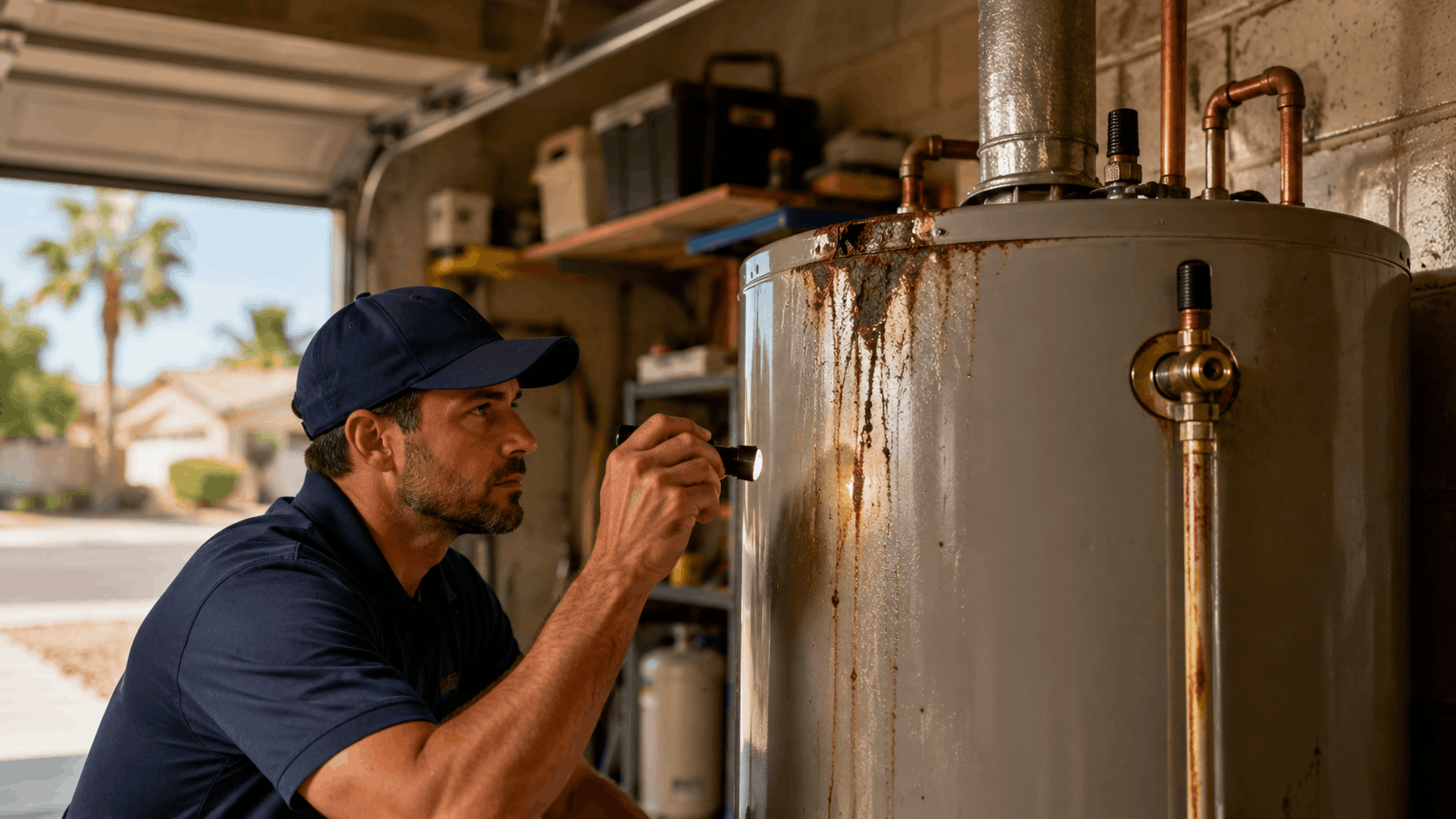
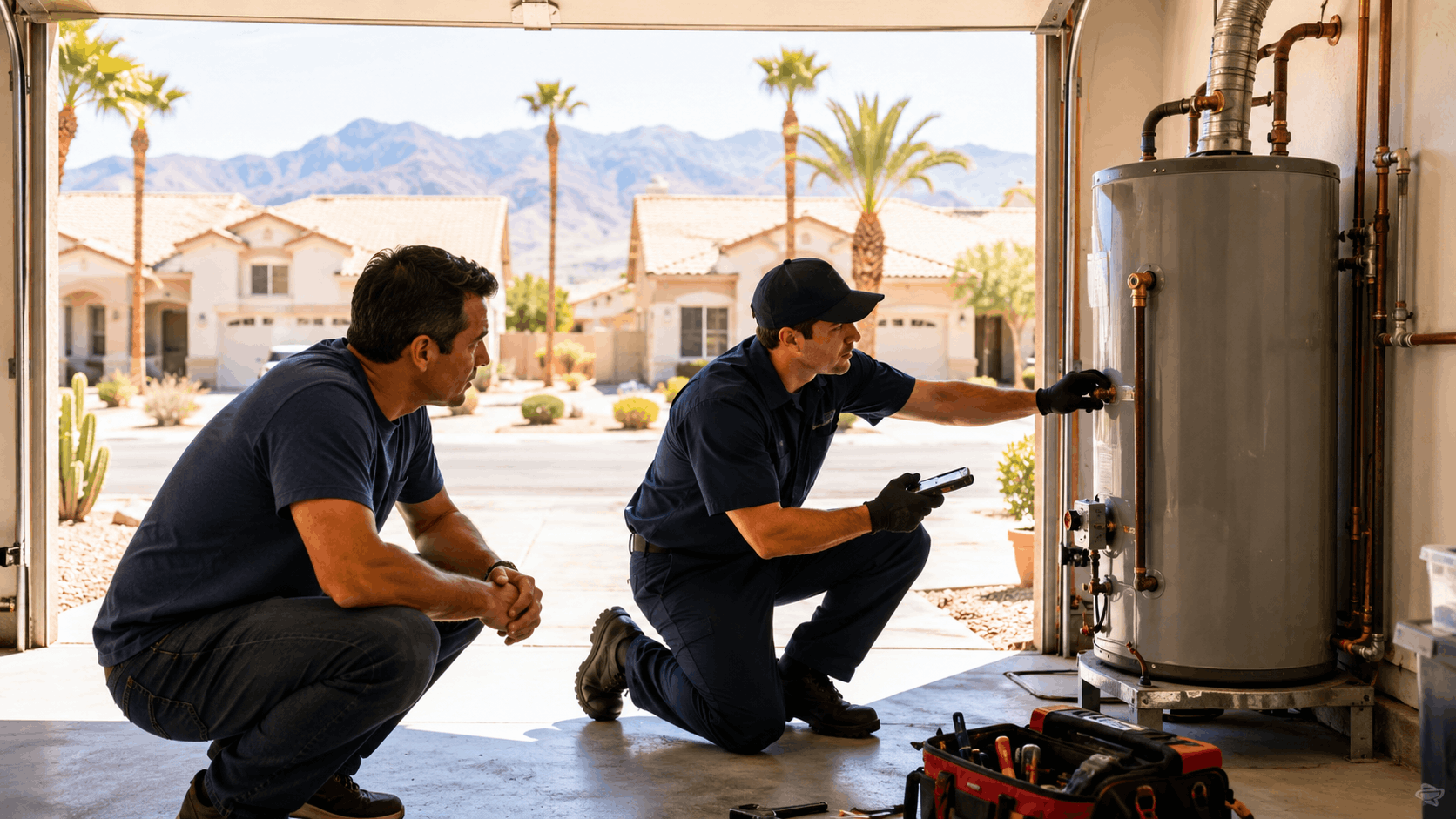
Most water heaters in the Valley do not live in a cool basement. They sit in the garage, which by mid-July turns into an oven. That ambient heat is one of the biggest reasons local units die years before their rated lifespan.
A water heater rated for 12 years in a mild climate might only reach 8 or 9 here. The heat never gives the parts a break, and every component ages sooner because of it. Here is how the numbers line up.
| Garage Temperature | Effect on Water Heater | Estimated Lifespan Impact |
|---|---|---|
| 75-85°F | Normal wear, parts age at expected rate | Full rated life |
| 95-105°F | Gaskets and boards run warm, mild stress | Loses 1-2 years |
| 110-120°F | Constant heat load, electronics degrade fast | Loses 2-4 years |
Why Valley Garages Hit 115 Degrees or Higher
Attached garages in neighborhoods like Spring Valley and Enterprise are basically heat traps. They share a wall with the house, sit under an uninsulated roof, and bake in direct sun for hours. By 3 p.m., the concrete floor and drywall have soaked up so much heat that the space stays hot long after sundown.
A south-facing or west-facing garage door makes it worse. That big metal panel absorbs afternoon sun and radiates it straight inside. Homes built in the late 1990s and early 2000s across Enterprise often have zero garage insulation, so there is nothing slowing the heat down.
We have measured garage temperatures over 118 degrees on July afternoons in the Valley. The National Weather Service Las Vegas office regularly logs outside highs near 110, and enclosed garages run hotter than the air outside. Your water heater sits in that heat all day, every day, for months.
That constant exposure is why the same unit that lasts 15 years in a coastal town struggles here. The Las Vegas heat simply never lets up during the summer stretch.
What Extreme Ambient Heat Does to the Tank and Wiring
High ambient temperature is rough on the parts you cannot see. Rubber gaskets and seals dry out and lose their flexibility, which leads to slow drips around fittings. Once a gasket hardens and cracks, small leaks start showing up at the connections.
The electronic control board is even more sensitive. Modern gas and electric units rely on circuit boards that are rated for a certain temperature range. When the garage sits at 115 degrees for weeks, those boards run hot, and heat is the number one enemy of electronics.
Wiring insulation also takes a beating. The plastic coating on internal wires gets brittle in extreme heat, and brittle insulation can crack or short out. We have opened up failed units where the wiring looked baked, with the sheathing cracking off at the touch.
All of this adds up to breakdowns that have nothing to do with the water itself. The heat alone is enough to knock out the brains and connections of a perfectly good tank.
How Heat Reduces Cooling and Efficiency
Water heaters need to shed a little heat to their surroundings to work right. In a cool room, that happens naturally. In a 115 degree garage, the unit has nowhere to dump excess heat, so it stays hotter than it should.
That efficiency loss means the burner or heating element works longer to hit the set temperature. Longer run times translate to more energy use and a higher bill during the exact months your power costs are already climbing from the AC.
Overheating also stresses the safety systems. The temperature and pressure relief valve may weep or open more often when the whole unit is running warmer than designed. Every extra cycle wears the parts a bit more.
So the hot garage creates a loop. The heat makes the unit work harder, working harder makes it run hotter, and running hotter speeds up the wear that leads to failure.
Signs a Garage Water Heater Is Struggling in Summer
Your unit usually gives you clues before it quits. A popping or crackling noise while it heats is one of the first warning signs, and it points to sediment cooking on the bottom of the tank. That sound tends to get louder as summer goes on.
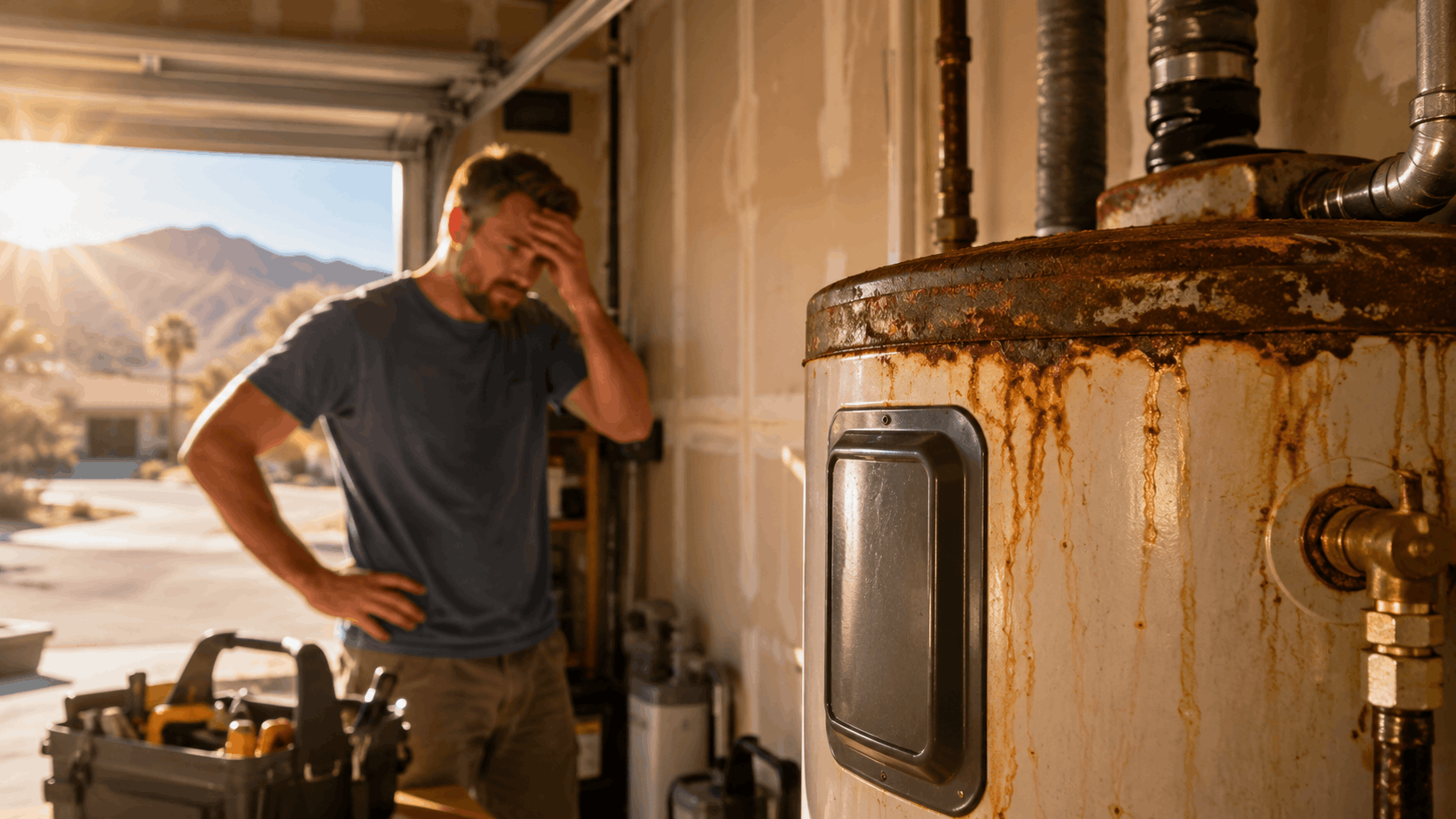
Discolored water is another red flag. If your hot water comes out rusty, cloudy, or has a metallic smell, corrosion may already be at work inside the tank. Cold water usually stays clear, so the problem is on the hot side.
Watch your utility bill too. A hotter-than-normal bill during a stretch where your habits have not changed can mean the unit is running longer to keep up. Combine a high bill with strange noises and you have a tank worth inspecting.
Our team offers water heater service across the Valley to catch these signs early. A quick check in June often prevents a July disaster.
Get Your Quote
Tell us what's going on and we'll get back to you. We're open 24/7.
Thermal Stress: The Silent Killer of Local Water Heaters
Thermal stress is the damage that happens when metal heats up, expands, then cools and contracts, over and over. It is quiet, invisible, and it slowly weakens the tank until something gives. July conditions in the Valley make it worse than almost anywhere.
Here is why our summers are so hard on tanks:
- Incoming water swings widely in temperature
- Garages stay hot around the clock
- Heavy summer use means more heating cycles
- Hard water sediment traps heat and creates hot spots
What Thermal Stress Actually Means
Every time your water heater fires up, the steel tank and its welds expand as they warm. When the water cools, the metal shrinks back. That back-and-forth movement is small, but it happens thousands of times a year.
Over time, this metal fatigue weakens the steel the same way bending a paperclip back and forth eventually snaps it. The heating cycles put the most strain on the welds and seams, which are the natural weak points of any tank.
The glass lining inside the tank suffers too. It expands and contracts at a slightly different rate than the steel around it, so repeated cycles can cause tiny cracks in that protective layer. Once the lining cracks, the steel underneath is exposed to water and corrosion.
None of this happens overnight. It builds slowly until the day the tank finally leaks, usually during a period of heavy use like a July heat wave.
Why Cold City Water Meeting a Hot Tank Speeds Cracking
The water coming into your home from the Las Vegas Valley Water District can be much cooler than the water sitting in your tank. When you draw a lot of hot water, a rush of cooler water hits the superheated tank all at once.
That sudden temperature swing forces the metal to contract quickly while other parts are still hot. Uneven expansion like this creates internal stress that speeds up cracking at the welds and lining.
In July, this effect gets amplified. Your family is using more hot water, so cold refill water floods the tank more often, and the garage is baking the outside of the tank the whole time. The metal never settles into a stable temperature.
We often find failed tanks with cracks that trace right back to years of these temperature swings. It is one of the more common reasons older units finally split during peak summer.
Sediment Buildup That Makes Thermal Stress Worse
Hard water leaves mineral sediment on the bottom of the tank. That layer of calcium and grit acts like a blanket over the burner or lower heating element, trapping heat right against the steel.
Trapped heat creates hot spots. Instead of the tank warming evenly, one area gets far hotter than the rest, which puts intense localized stress on the steel and the glass lining above it.
Those hot spots are where cracks and leaks tend to start. The steel gets pushed and pulled harder in that one spot, and the glass lining is more likely to fail there first.
This is why sediment removal matters so much in the Valley. Flushing the tank clears that insulating layer and lets the heat spread out the way it should, cutting down on thermal stress.
How the Expansion Tank Protects Against Pressure Damage
When water heats up, it expands and needs somewhere to go. In a closed system, which most modern Valley homes have because of check valves and pressure regulators, that expanding water has nowhere to escape and pressure spikes fast.
A properly sized expansion tank gives that extra water a cushion. It absorbs the pressure spike so your tank, valves, and pipes are not slammed every time the burner fires.
Without one, the pressure surges stress every joint and the tank itself. You may hear the relief valve dripping, or notice fittings that keep coming loose. Those are signs the system has nowhere to put the extra pressure.
Our team checks for a working expansion tank on every water heater visit. Adding or replacing one is a small job that protects the whole system from pressure damage, especially during heavy summer use.
Need Help in Las Vegas?
Active Plumbing serves Las Vegas and all of Las Vegas Valley.
Summer Demand Spikes and Why They Overload Your Unit
July is when hot water demand jumps in most homes. Houseguests arrive, kids are home all day, and busy households run showers, laundry, and dishes on top of each other. That demand spike hits right when the garage heat and thermal stress are already at their worst.
An aging unit that limped through the mild months often cannot handle the sudden overload. The extra work is the final push that sends it over the edge.
How Guests and Vacations Change Hot Water Use
A normal household in Green Valley might run three or four showers a day. Add summer visitors and that number can double or triple almost overnight. Suddenly the tank is being drained and refilled far more than it was designed for on an average day.
Summer routines pile on too. Beach towels and pool clothes mean more laundry loads, and houseguests mean more dishes and longer showers. The daily hot water demand climbs in every direction at once.
Homes in areas like Aliante see this every year when family drives in for the holidays or long summer visits. A tank sized for two people struggles to serve six.
The unit does not know guests are temporary. It just keeps trying to keep up, running longer and harder than it has in months.
Why Recovery Time Slows in Extreme Heat
Recovery time is how long it takes the tank to reheat a full load of water after you use it. In a cool space, a healthy unit recovers on schedule. In a 115 degree garage, everything slows down.
Sediment buildup makes recovery worse by insulating the burner from the water. So the tank that is already fighting garage heat now also has to push through a layer of minerals to warm the water.
The result is longer waits between hot showers. When six people need to shower back to back, a slow recovery time means the last two get cold water even though the tank technically has capacity.
Families often blame the tank size, but slow recovery from heat and sediment is usually the real culprit. A flush and a check-up frequently restores normal recovery.
The Combined Load That Breaks Older Units
Here is where it all stacks up. The garage heat is cooking the electronics, thermal stress has weakened the welds, sediment is trapping heat, and now summer demand is doubling the workload. Any one of these is manageable. All four together break units.
This combined load is why so many failures cluster in July. A tank that is 8 to 12 years old has already used up most of its life, and this pileup is the failure point that finishes it.
We tell customers that an aging unit rarely dies in the mild months. It waits until the exact moment when everything is working against it, which is the peak of summer.
If your unit is past 8 years and showing any warning signs, summer is the riskiest time to gamble on it lasting one more season.
How to Spread Out Usage During Heat Waves
You can ease the load with a few simple habits during a heat wave. Stagger showers so the tank has time to recover between them instead of draining it all at once in the morning.
Run laundry and the dishwasher at night. That spreads the heating cycles out and keeps the tank from being hammered during peak morning and evening use.
Lower the thermostat slightly if you have it set high. A setting around 120 degrees is safe, reduces scald risk, and cuts the strain on the unit during hot months. It also saves energy.
These usage tips will not fix a failing tank, but they buy time and reduce the chance of a cold-shower surprise while you arrange service or a replacement.
The Hard Water Factor Across the Las Vegas Valley
Las Vegas has some of the hardest water in the country, and that mineral content teams up with heat to wreck water heaters more quickly than almost anywhere. Scale buildup is a constant battle in the Valley.
Understanding where the minerals come from helps explain why local tanks wear out so quickly.
Why Valley Water Is So High in Minerals
Most of our water comes from the Colorado River by way of Lake Mead. That source is naturally loaded with dissolved calcium and magnesium, the two minerals that make water hard.
According to the Las Vegas Valley Water District, local water hardness commonly runs around 16 grains per gallon or higher. That is well into the very hard range on any scale.
Every gallon that flows into your water heater carries those minerals with it. Over months and years, they settle out and build up inside the tank and on the heating surfaces.
This is not a problem you can wish away. It comes with living in the desert Southwest and drawing water from Lake Mead.
How Scale Buildup Speeds up in Hot Tanks
Heat speeds up scale formation. When hard water gets hot, the calcium and magnesium drop out of solution more quickly and stick to the tank bottom and the heating element or burner area.
That scale layer acts like insulation. It sits between the heat source and the water, so the burner or element has to work harder and longer to warm the water on the other side.
The harder the unit works, the hotter it runs, and the sooner new scale forms. It becomes a cycle that keeps feeding itself and dragging down efficiency.
On electric units, scale coats the heating element until it burns out early. On gas units, it thickens on the tank bottom and worsens the hot spots we mentioned earlier.
The Toll on the Anode Rod and Tank Lining
Every tank has a sacrificial anode rod, a metal rod that corrodes on purpose so the tank walls do not. In mineral-heavy Valley water, that anode rod wears out much more quickly than the manufacturer expects.
Once the anode is used up, corrosion turns on the tank lining and steel. From that point, rust spreads quickly, and the tank is on a countdown to a leak.
Many homeowners never know the anode rod exists, let alone that it needs checking. We frequently pull rods that are completely eaten away in units only 5 or 6 years old.
Replacing a worn anode rod is cheap compared to a new water heater. Checking it regularly is one of the best ways to stretch the life of a tank in hard water.
Whether a Water Softener Helps Extend Lifespan
A water softener or salt-free conditioner removes or neutralizes the minerals before they reach your tank. That means far less scale, slower anode wear, and a lot less sediment on the bottom.
In our experience, homes with a working softener get noticeably more life out of their water heaters. It also protects faucets, dishwashers, and the whole plumbing system from scale.
We install both traditional softeners and salt-free water conditioning systems depending on what fits the home. Each approach cuts down on scale in a different way.
If you plan to keep a home in the Valley for years, a water softener installation often pays for itself in longer appliance life and fewer repairs.
Need Help in Las Vegas?
Active Plumbing serves Las Vegas and all of Las Vegas Valley.
Warning Signs of Water Heater Failure Before It Happens
Most July failures give clues weeks ahead of time. If you know what to watch for, you can act before you lose hot water in the middle of a heat wave.
Here is a quick reference for a common warning signs and what they usually mean.
| Warning Sign | Likely Cause | How Urgent |
|---|---|---|
| Rusty or cloudy hot water | Internal corrosion or failing anode | Schedule service soon |
| Popping or rumbling noise | Heavy sediment buildup | Flush recommended |
| Water pooling at the base | Leak or failing tank seam | Call right away |
| Temperature swings | Capacity loss or bad thermostat | Inspect this week |
Rusty or Cloudy Hot Water
When your hot water turns rusty, brown, or cloudy, it usually means corrosion is happening inside the tank. The steel is rusting, and bits of that rust come out in the water.
The tell is that only the hot water looks off while the cold stays clear. That points the finger straight at the water heater rather than your main line.
Discoloration often means the anode rod is used up and the tank walls are now corroding. Once the steel starts rusting, a leak is not far behind.
If you see rusty hot water, do not wait. Have it checked before the corrosion turns into a full tank failure.
Popping, Rumbling, or Banging Sounds
Those popping and rumbling noises come from sediment on the tank bottom. Water gets trapped under the mineral layer, turns to steam, and pushes through with a pop or bang.
The louder and more frequent the noise, the more sediment has built up. A heavy layer means the tank is running less efficiently and heating unevenly.
Steam pockets forming under sediment also add stress to the steel and glass lining. It is the sound of your tank working way too hard.
A flush can quiet a noisy tank if you catch it early. Left alone, the buildup keeps growing until efficiency and lifespan both suffer.
Water Pooling Around the Base
Any water around the bottom of the unit deserves immediate attention. A small puddle often means a slow leak from a fitting, valve, or worse, a crack in the tank seam.
Tank seam leaks do not heal. Once the welded seam or the tank body starts leaking, replacement is the only real fix, and the leak will grow.
Check for moisture, mineral crust, or rust streaks at the base during your summer inspections. Catching a slow leak early can save your garage floor and belongings from a bigger flood.
If you find pooling water, shut off the water supply to the heater and call for help. Our emergency plumbing team handles these calls across the Valley.
Fluctuating Temperatures and Short Hot Water
When showers start warm then go cold fast, the unit is losing capacity. Sediment, a failing element, or a bad thermostat can all cause this.
Temperature that jumps from hot to lukewarm to hot again usually points to a thermostat or dip tube problem. The tank cannot hold a steady output anymore.
Short hot water supply is one of the more common complaints we hear in July. Often the tank is fine on size but crippled by sediment and heat.
If your hot water runs out more quickly than it used to, have the unit checked. It is telling you it is near the end of its useful life.
How Active Plumbing Keeps Valley Water Heaters Alive in Summer
Our team works on water heaters all over the Valley, so we know exactly what July does to them. Most of what we do is aimed at preventing failures before they leave a family without hot water.
Here is how we help homeowners get through the hot months.
Annual Flushing to Clear Sediment
A yearly tank flush is the single best maintenance step in hard water country. We drain the tank and clear out the mineral sediment that has settled on the bottom.
Removing that sediment restores efficiency, quiets the popping noises, and lowers the thermal stress from hot spots. The burner or element can heat the water evenly again.
We recommend flushing every year in the Valley because our water lays down scale so fast. Homes without a softener may even benefit from more frequent service.
A flush takes under an hour and can add years to the tank. It is the cheapest insurance against a July breakdown.
Anode Rod and Component Inspections
During a summer tune-up, we pull and inspect the anode rod. If it is worn down, we replace it so the tank walls stay protected from corrosion.
We also test the thermostat to confirm it holds the right temperature. A thermostat that drifts causes both wasted energy and inconsistent hot water.
The temperature and pressure relief valve gets a check too, along with the other valves and connections. A stuck relief valve is a safety issue we never skip.
These small checks catch problems while they are cheap fixes. Our water heater repair team handles worn parts before they turn into full failures.
Same-Day Replacement Across the Valley
Sometimes a tank is simply done, and a family needs hot water back fast. We offer same-day replacement across the Valley, from Summerlin out to Henderson.
When a unit fails during a heat wave, we know it is a real emergency for a household with guests. We stock common sizes and models so we can swap a failed tank quickly.
Whether you are near Summerlin or in Green Valley in Henderson, our trucks cover the whole metro area. We aim to have you back in hot water the same day when possible.
Fast service in July is not a luxury here. With garage heat and heavy demand, a dead tank needs handling right away.
Tankless and High-Recovery Upgrade Options
For homes that keep running out of hot water, we offer tankless and high-recovery upgrades. These handle summer demand and garage heat far better than an old standard tank.
A tankless unit heats water on demand, so there is no full tank sitting in the hot garage baking all day. It also delivers endless hot water for back-to-back showers with guests.
High-recovery tank models reheat quicker, which solves the slow-recovery problem in a hot garage. We help homeowners weigh which option fits their home and budget.
Our tankless water heater installation service is popular with families who host a lot in summer. It removes the tank failure risk entirely.
Need Help in Las Vegas?
Active Plumbing serves Las Vegas and all of Las Vegas Valley.
Choosing a Water Heater Built for Las Vegas Conditions
Not every water heater handles Valley heat and hard water the same. Picking the right replacement for desert conditions saves you money and headaches down the road.
Here is what to think about before you buy.
Tank Versus Tankless in a Hot Garage
A standard tank keeps 40 to 50 gallons of water hot at all times, which means it fights the garage heat around the clock. In a 115 degree space, that constant battle wears it down more quickly.
Tankless units only fire when you open a hot tap. They do not store water, so garage heat has far less to work against, and they take up much less wall space.
The tradeoff is upfront cost and, for gas tankless, sometimes a gas line upgrade. For many Valley homes the longer life and lower failure risk make it worth it.
Smaller homes or tighter budgets may still do well with a quality high-recovery tank. We help each customer compare the two honestly for their situation.
Sizing the Unit for Summer Peak Demand
The biggest sizing mistake is planning for an average day instead of your busiest one. In the Valley, your peak day is a July weekend with guests and pool towels piling up.
Size the unit for that peak so nobody runs out during a heat wave. For a tank, that might mean stepping up a size, or looking at first-hour rating rather than just gallons.
For tankless, sizing is about flow rate and how many fixtures run at once. We calculate the peak demand for your household and match a unit to it.
Getting capacity right upfront means you never deal with cold showers when the house is full. It is worth the few extra minutes of planning.
Features That Fight Heat and Hard Water
Some features matter more in the desert. A quality glass-lined tank resists corrosion better, and a powered anode rod protects far longer than a standard sacrificial rod in hard water.
Better insulation on the tank keeps the stored water more stable against garage heat swings. That reduces both energy use and thermal stress.
Look for units with easy-access drain valves too, since you will be flushing them yearly here. A model built for maintenance saves you money over its life.
We steer customers toward models that hold up in our conditions rather than the cheapest box-store option. The right features pay off across a hot-climate lifespan.
Placement and Ventilation Tips for the Garage
Where and how the unit sits affects how hard it works. Keeping the water heater away from a south-facing wall or a spot in direct afternoon sun lowers its heat load.
Good airflow around the unit helps it shed heat. A little clearance and cross-ventilation in the garage make a real difference in July.
Some homeowners add a garage vent or a small exhaust fan to move hot air out. Even simple ventilation can drop the ambient temperature several degrees.
During installation, our team picks the smartest placement for airflow and future service access. Small choices at install time add years to the unit.
Final Thoughts
July failures are rarely random. Garage heat over 115 degrees, thermal stress from constant heating cycles, some of the hardest water in the country, and a summer demand spike all hit your water heater at once.
The good news is that most of this is preventable. An annual flush, an anode check, an expansion tank, and maybe a water softener can add years to your unit and keep the hot water flowing when your house is full of guests.
If your water heater is showing warning signs or is past 8 years old, do not wait for it to quit on the hottest day of the year. Contact Active Plumbing for a summer inspection or same-day service anywhere from Summerlin to Henderson. Our team knows Valley water heaters, and we are ready to help before July catches you off guard.
Frequently Asked Questions
- Why do water heaters fail more often in July in Las Vegas?
- July stacks four problems on your unit at once. The garage hits 115 degrees or more, thermal stress from constant heating cycles weakens the tank, hard water sediment traps heat, and summer demand from guests and heavy use spikes. Any single issue is manageable, but all four hitting together at the peak of summer is what pushes older water heaters past their breaking point.
- How hot does a Las Vegas garage really get in summer?
- An attached, uninsulated garage in the Valley commonly reaches 110 to 120 degrees on July afternoons. The garage door absorbs direct sun, the concrete and drywall soak up heat all day, and the space stays hot well into the evening. We have measured over 118 degrees inside Valley garages, and your water heater sits in that heat for months straight.
- How long should a water heater last in the Valley?
- A standard tank is often rated for 10 to 12 years, but Las Vegas conditions cut that short. Between the extreme garage heat and hard water scale, most local tanks realistically last 8 to 12 years, and many fail closer to 8 without maintenance. Regular flushing and anode checks can help you reach the higher end of that range.
- Can flushing my water heater prevent a summer breakdown?
- Yes, annual flushing is one of the best ways to avoid a July failure. Flushing removes the mineral sediment that builds up on the tank bottom, which restores efficiency, quiets popping noises, and reduces the hot spots that cause thermal stress. In hard water country like ours, a yearly flush can add real years to a tank and cut breakdown risk sharply.
- Is a tankless water heater better for Las Vegas heat?
- Tankless units handle Valley heat well because they do not store hot water in a baking garage all day. They heat on demand, take up less space, and deliver endless hot water for back-to-back summer showers. The tradeoffs are higher upfront cost and a need for descaling in hard water, but for busy homes the longer life and lower failure risk often make tankless worth it.
- What does thermal stress do to my water heater?
- Thermal stress is damage from metal expanding and contracting through thousands of heating cycles. Over time it fatigues the steel and the welds inside the tank, much like bending a wire until it snaps. Cold refill water hitting a superheated tank makes the swings worse. Eventually cracks form at the welds or lining, and the tank leaks, usually during heavy summer use.
- How much does water heater replacement cost in Las Vegas?
- Costs vary by unit type, size, and any needed upgrades. A standard tank replacement in the Valley generally runs in the range of roughly $1,200 to $2,500 installed, while a tankless install often falls between $3,000 and $5,500 depending on gas line and venting needs. We provide a clear quote after seeing your setup so there are no surprises.
- Should I install a water softener to protect my water heater?
- A softener or conditioner is one of the smartest moves for a Valley home. Our water runs around 16 grains per gallon or higher, and that scale builds up fast inside tanks. A softener reduces scale, slows anode wear, and cuts sediment, which adds years to the water heater and protects your whole plumbing system and appliances at the same time.
- What should I do if my water heater fails during a heat wave?
- First, shut off the water supply to the heater, and for electric units switch off the breaker or for gas turn the control to pilot. If water is pooling, move belongings clear of the leak. Then call for help. Our team offers same-day replacement across the Valley in summer, so reach out right away and we will get your hot water restored as fast as possible.
- Does Active Plumbing service my neighborhood?
- Yes, our team covers the entire Las Vegas Valley. We regularly work in Summerlin, Henderson, Green Valley, Spring Valley, Enterprise, North Las Vegas, Paradise, Whitney, and the older neighborhoods near Charleston Heights. Whether you need a summer tune-up, a flush, or a same-day replacement, we can reach your home quickly no matter which part of the Valley you live in.
Licensed plumbing professionals serving Las Vegas and Las Vegas Valley.
Licensed in Nevada · License #0047021
Last updated on
Why trust Active Plumbing?
Founded in 1991, Active Plumbing is a licensed and insured plumber serving Las Vegas and Las Vegas Valley. All content is reviewed by our licensed technicians.

Need Help in Las Vegas?
Active Plumbing serves Las Vegas and all of Las Vegas Valley.
Related Articles
Sediment Tank Flush: Why Vegas Water Heaters Need It Every 18 Months
Las Vegas hard water causes rapid sediment buildup in water heaters. Learn why an 18-month flush schedule protects your tank, saves energy costs, and prevents expensive failures in the desert.
7 Signs Your Las Vegas Water Heater Is About to Fail - Sediment, Rust, Recovery Time, Age
Learn the 7 warning signs your Las Vegas water heater is failing, from sediment and rust to slow recovery and old age, plus how hard water speeds up wear.

Tankless Water Heater Scale Buildup: Why Vegas Units Fail at 5 Years Without Descaling
Las Vegas hard water causes scale buildup that fails tankless units at five years. Learn the warning signs, descaling schedule, and treatment options to protect yours.