Slab Leak Reroute in a Southern Highlands Home Off St Rose Parkway

Key Takeaways
- A slab leak is a failure in a supply line under the concrete floor, hidden from view and hard to reach on these slab-on-grade homes.
- Very hard valley water at 280 ppm, about 16 grains per gallon, scales and narrows original supply lines over the twenty-plus years these homes have stood.
- Early signs are running water with no fixture on, a warm spot on the floor, and an unexplained water bill, which matters most for seasonally occupied estates.
- Detection comes first so the leak is pinpointed before any floor is opened, and it decides whether a reroute or a slab break makes sense.
- In finished estates with stone or hardwood, rerouting the line above the slab usually beats breaking concrete and protects expensive floors.
- Southern Highlands is unincorporated Enterprise, so permits run through the Clark County Department of Building and Fire Prevention, separate from any HOA approval.
- Typical valley ranges are slab leak detection $150 to $300, slab leak repair $500 to $3,000, and a whole-house repipe $4,000 to $15,000 if the system argues for it.
- Active Plumbing locates the leak, gives a written price before work starts, arrives in 30 to 60 minutes, and holds Nevada license NSCB #0047021.
In This Article
A homeowner in Southern Highlands near St. Rose Parkway sits down one evening and hears water running when every faucet is off. The next morning, a patch of tile near the hallway feels warm underfoot, and nobody turned on a thing. That quiet sound and that warm spot are two of the clearest early signs of a slab leak, a failure in a water line that runs under the concrete floor these homes are built on.
In a community that climbs the slopes below the Spring Mountains, this problem has a local flavor. The build era, the slab-on-grade foundations, the very hard water, and the way pressure changes with elevation all feed into why supply lines under the floor give out here. The good news is that opening the slab is rarely the only option, and in a finished home it is usually not the smart one.

What a Slab Leak Is and Why It Happens in Southern Highlands?
Southern Highlands grew from the late 1990s on the flatter ground and rose onto the higher lots as custom estates. Almost every home here, from production tract housing to guard-gated estates, sits on a concrete slab. That single fact shapes how a slab leak behaves and how it gets fixed.
A slab leak is not a dramatic burst most of the time. It is a slow failure in a pipe you cannot see, cast into or running beneath the floor. The reasons it happens here line up with the local build era, the foundation type, and the water chemistry.
| Factor | What It Means in Southern Highlands |
|---|---|
| Build era | Homes from the late 1990s through the 2000s with original supply lines and connectors |
| Foundation | Slab-on-grade across the community, so under-slab lines are not reachable without opening the floor |
| Water hardness | 280 ppm, about 16 grains per gallon, very hard, which scales and narrows lines over years |
| Pressure | Varies by elevation, high on lower streets, lower on higher lots |
What a Slab Leak Actually Is
A slab leak is a failure in a pressurized water supply line that runs under or inside the concrete floor of the home. Because the pipe sits below the slab, water escapes into the ground or wicks up through the concrete instead of dripping somewhere you can see and mop up. That is what makes it different from a leak at a faucet, a toilet, or an angle stop, where the water shows itself right away.
The distinction matters because the fix is completely different. A visible fixture leak is reached in minutes by shutting off a supply valve and swapping a part. An under-slab supply line failure is hidden beneath a finished floor, so the first job is figuring out exactly where it is before anyone touches concrete.
Owners sometimes assume any mystery water is a slab leak when it is really a supply line inside a wall or a drip behind a cabinet. A real slab leak sits in the water path cast into or under the concrete floor, on the pressurized side of the system. Separating the two early saves a lot of wasted digging.
Both hot and cold lines can run under the slab, though a hot-water slab leak tends to announce itself with a warm floor. The pipe keeps leaking under pressure as long as the water is on, which is why an untreated slab leak quietly runs up a bill and can undermine flooring over time.
Why These Homes Sit on a Slab
Most of the valley, including the production tract and semi-custom homes built in Southern Highlands from the late 1990s, is slab-on-grade construction. The home is poured on a concrete pad rather than built over a crawl space or a basement. It is a practical way to build on valley ground, and it is the standard across the southwest valley.
The trade-off shows up the day a line under that slab fails. With no crawl space to drop into, the pipe is encased in concrete or buried beneath it, so an under-slab failure is a distinct category of work that cannot be reached without opening the floor. You cannot simply pull a panel and look at it.
In this community the build era compounds things. A production tract home here is twenty to twenty-five years old, running on its original supply lines, angle stops, and connectors. Those components have been under constant pressure and very hard water for two decades, which is exactly when original materials start to give.
Because the slab seals everything in, the choice when a line fails is always between going through the concrete or going around it. That single reality drives the whole repair conversation in Southern Highlands, and it is why detection comes before any decision.
How Very Hard Water Wears Supply Lines
The Southern Nevada Water Authority reports the valley's water at 280 parts per million, or about 16 grains per gallon, which is categorized as very hard. That is not a minor detail here. It is the single biggest driver of plumbing wear across the valley, and Southern Highlands sees it in every home regardless of price tier.
Very hard water deposits calcium and magnesium scale throughout a system. Inside supply lines, that scale narrows the bore over years, roughening the interior and giving corrosion a foothold. On a line already two decades old under a slab, that slow internal wear is part of why a pinhole or a seam eventually opens.
Many homes of this era were plumbed with a stubbed softener loop in the garage, ready for a whole-house softener that an owner may never have connected. A home running on that untreated loop is sending very hard water through every line and appliance, year after year, with nothing taking the minerals out first.
Whole-house treatment protects an expensive system in the estates and extends equipment life in the tract housing. It will not undo wear already in the ground, but connecting a softener on that waiting loop slows what scale does to the remaining lines. Our team can look at that loop during any water treatment visit and tell an owner whether it was ever hooked up.
Elevation, Pressure and the Lines Below the Floor
Southern Highlands climbs, and homes at different elevations on the same water system do not see the same pressure. On the lower streets, incoming pressure can run high, which quietly stresses fixtures, appliances, connectors, and the supply lines themselves. On the higher lots, pressure can be lower than an owner expects, especially at upstairs fixtures in a two-story house.
High incoming pressure is the part that matters for a slab leak. Pressure the owner never notices puts constant extra load on every joint and connector in the system, including the lines under the floor. Over twenty years, that added stress is one more reason an original under-slab line eventually fails.
That is why the pressure regulator is the first component to check in this community rather than an afterthought. A regulator that has crept high is doing damage nobody has noticed. Checking incoming pressure takes about two minutes and explains more complaints in Southern Highlands than anything else in the southwest valley.
Where a house sits high on the system and pressure is low, the honest answer is sometimes a pressure-boosting arrangement rather than replacing fixtures that work fine. Either way, confirming the regulator setting during a slab leak visit protects the new line once the reroute is done.
Get Your Quote
Tell us what's going on and we'll get back to you. We're open 24/7.
Signs You Have a Slab Leak, Not Something Simpler
Owners near St. Rose Parkway usually describe the same handful of clues when they call. Knowing which signs point to a slab leak and which point to something simpler saves time and keeps a small fixture problem from being treated like a major repair.
The three that come up most are a running-water sound, a warm spot on the floor, and a water bill that jumped for no clear reason. Here is how they stack up against the easier culprits.
| Sign | Points Toward |
|---|---|
| Running water with no fixture on | Slab leak or a running toilet, worth locating |
| Warm spot on the floor | Hot-water slab leak |
| Unexplained high water bill | Slab leak or a hidden irrigation leak |
| Wet spot outside, low pressure at hose bibb | Irrigation or exterior line, not the slab |
| Drip under a sink or behind a toilet | Fixture leak, not the slab |
The Sounds and Warm Spots Owners Notice First
The first thing most owners notice is the sound of running water when nothing is on. It is a faint hiss or rush, sometimes a hum that carries through the tile, loudest at night when the house is quiet. That sound is water escaping a pressurized line under the slab.
The second common clue is a warm patch on the floor. When the leak is on a hot-water line, heat radiates up through the concrete and the finished floor above it. An owner walks across a tile hallway and feels a spot that is noticeably warmer than the floor around it, with no sunlight to explain it.
Both signs are worth taking seriously even when nothing looks wet. A slab leak can run for a long time before water finds its way up through grout lines or along a baseboard. By the time staining or buckling shows, the leak has usually been going for a while.
If an owner hears that running water or feels that warm spot, the right move is to have it located, not to guess. The sound and the warmth tell you something is wrong, but only detection tells you where, and that decides everything that follows.
An Unexplained Water Bill
A slow under-slab leak often shows up on the water bill before anything is visible in the house. Water keeps escaping the line as long as the system is pressurized, so even a small leak adds up on the meter month after month. A bill that climbs with no change in how the household uses water is a real warning sign.
This matters even more for the second homes and seasonally occupied estates in the gated enclaves. In a home that sits empty for weeks, a leak can run the whole time with nobody there to hear it or feel the warm floor. The first anyone learns of it is the bill, or worse, the damage.
For an unoccupied or seasonally occupied home, a simple shut-off check is worth its weight. Knowing where the main shut-off is and closing it when the house is empty stops a slow leak from running for weeks. It is the cheapest insurance a part-time resident has against a hidden slab leak.
If a bill jumps and the house checks out dry inside, the leak may be under the slab or out on the irrigation lines. Either way, the number on the bill is often the first hard evidence, and it is a good reason to get the system looked at.
What Looks Like a Slab Leak but Is Not
Plenty of problems mimic a slab leak and cost far less to fix. The most common is a simple fixture leak: a worn angle stop, a failing supply line to a toilet, or a drip under a sink. These show water where you can see it, and they are reached without touching the slab at all. Our pipe and fixture services handle those directly.
On the larger lots, an irrigation leak on the long exterior runs is a frequent false alarm. Extensive private landscape means long buried lines where a leak can run unseen and drive up the bill, looking just like a slab leak from inside the house. The clue is a wet or unusually green patch in the yard, or low pressure at an outdoor hose bibb.
A dropped pressure regulator produces a complaint that has nothing to do with the slab at all. When a regulator fails low, fixtures run weak and an owner may assume something is wrong deep in the system. Checking incoming pressure clears that up fast and points the repair in the right direction.
This is exactly why a good diagnosis rules things out before anyone commits to opening concrete. Confirming whether the water is escaping under the slab, out at the irrigation, or at a fixture is the whole point of detection, and it keeps an owner from paying for the wrong repair.

Need Help in Las Vegas?
Active Plumbing serves Las Vegas and all of Las Vegas Valley.
Finding the Leak: Detection Before Any Work
Under a finished floor, you do not open concrete and hope. The leak gets located first, precisely, so the floor is only disturbed where it has to be. Detection is the step that turns a guess into a plan, and on these homes it decides whether the answer is a reroute or a slab break.
Our slab leak detection and repair work starts with finding the exact spot, then talking through the options with the owner.
Electronic and Acoustic Detection
Acoustic detection uses sensitive listening equipment to hear water escaping a pressurized line through the concrete. A leak under pressure makes a distinct sound as it forces its way out, and trained equipment picks that up where the human ear cannot. By comparing the sound at different points on the floor, the leak narrows to a small area.
Line tracing maps where the pipe actually runs under the slab. Knowing the route of the line, not just a general area, means the opening in the floor can be small and placed right over the failure. That is the difference between a tidy repair and tearing up a whole room.
Our team pairs these methods during electronic leak detection so the leak is pinpointed before any concrete is touched. The goal is simple: find the exact spot, confirm it, and only then decide how to fix it.
Guesswork is expensive on a slab home. Every square foot of floor opened is concrete to break, backfill to replace, and flooring to restore. Accurate detection keeps that footprint as small as the job allows, which protects both the home and the budget.
Pinpointing Under Tile, Stone or Hardwood
Finished estate floors raise the stakes considerably. A leak under stone tile, natural stone, or hardwood means any opening involves materials that are hard to match and expensive to restore. On those floors, a few inches of accuracy is the difference between a clean repair and a visible patch.
Stone and hardwood also tend to appear in the semi-custom homes and custom estates, where owners expect protected finishes and kept appointments. The pressure to get the location exactly right is highest precisely where the floors are most valuable. That is why detection on these properties is done carefully and confirmed before anyone commits.
Accurate location on a finished floor often tips the decision away from opening the slab at all. When the team can see that reaching the leak would mean cutting through expensive stone or wood, rerouting the line above the slab frequently becomes the better path. Detection is what reveals that trade-off clearly.
On these homes, the value of precise pinpointing is not just a smaller hole. It is the information that lets an owner choose between a slab break and a reroute with their eyes open, knowing exactly what each one would mean for their floors.
Why Detection Decides Repair or Reroute
Once the leak is located, the owner faces a real choice: break the slab to spot-repair the failed section, or reroute the line above the slab so the water path no longer passes under the concrete. The detection result is what makes that choice an informed one rather than a coin flip.
A single, accessible leak in a spot that is easy to reach may point toward a spot repair. If the failure sits under a closet or a utility area rather than under polished stone, opening the slab there can make sense. Detection tells you where the leak is and what is on top of it.
If the leak sits under a finished living area, or if the line's age suggests more failures are coming, rerouting usually wins. Detection that shows a difficult location or hints at a tired system steers the conversation toward abandoning that run rather than patching it.
Either way, the owner gets to decide with facts in hand. Knowing the exact location, the floor above it, and the condition of the system turns a stressful unknown into a straightforward decision between a spot repair and a reroute.
Reroute vs Breaking the Slab
This is the real decision for a Southern Highlands home. In a finished house, rerouting the line often wins because it leaves the floors alone, but there are honest cases where breaking the slab or repiping the whole house makes more sense. Here is how the two compare.
| Approach | When It Fits | Main Trade-off |
|---|---|---|
| Reroute above slab | Finished floors, leak under a living area, more failures likely | New line runs through walls or overhead, some drywall work |
| Break the slab | Single accessible leak, easy-to-reach location | Concrete demolition and floor restoration |
| Whole-house repipe | Aging system with repeat failures | Larger project, replaces the system at once |
What a Reroute Actually Involves
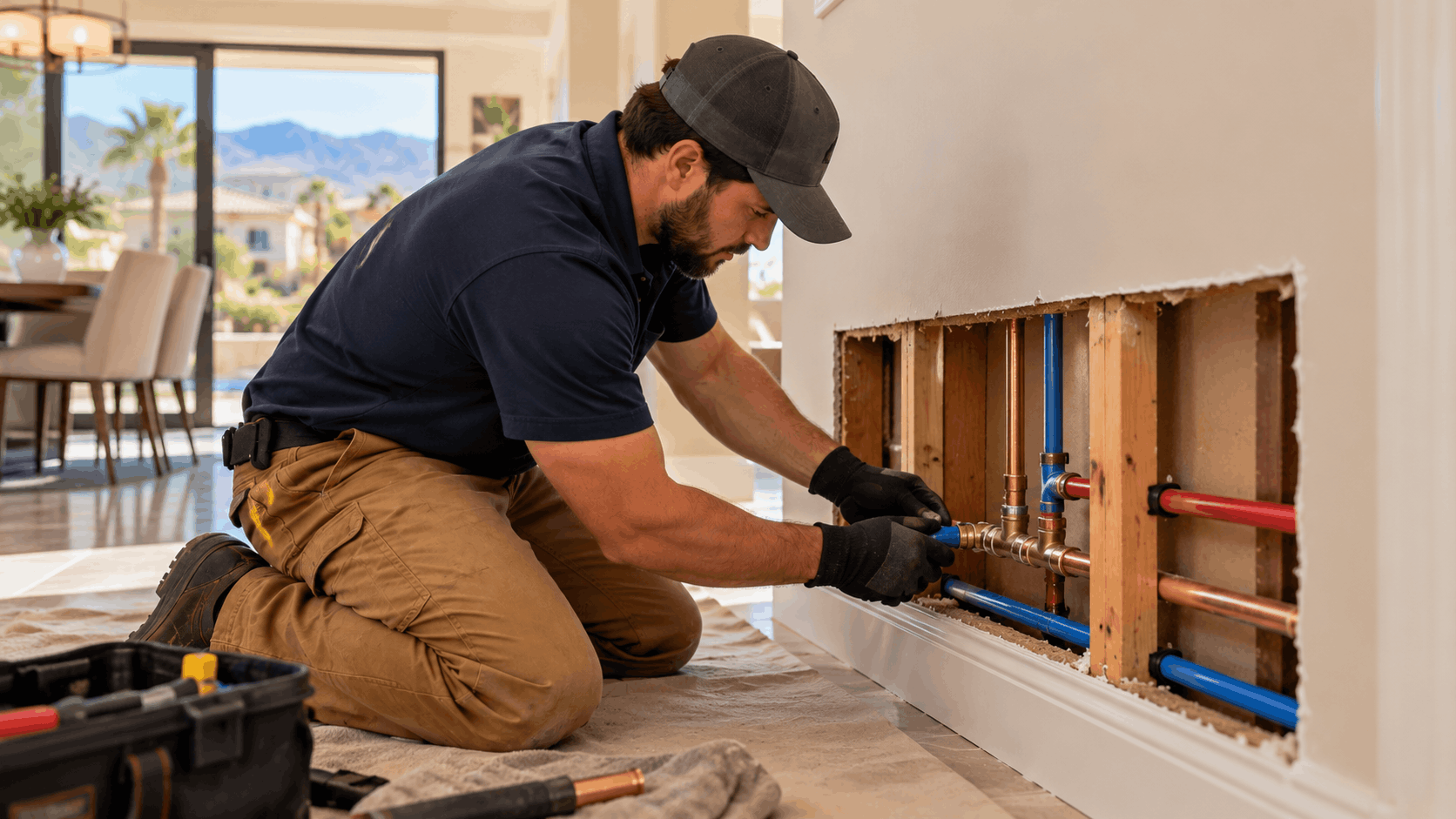
A reroute abandons the failed under-slab section and runs a new line through the walls, attic, or overhead instead. The old pipe is left in place but taken out of service, and water travels a new path that never passes under the concrete. Once the new line is connected and tested, the leak under the slab no longer matters because no water flows there.
Running the new line overhead through the attic is common on single-story and two-story homes alike, dropping down inside walls to reach the fixtures. The work involves some drywall opening to route the pipe and tie it in, which is patched and finished afterward. It is interior work, which has a bearing on association approval as well.
The appeal is that the concrete floor stays whole. Rather than breaking through a slab and whatever finish sits on top of it, the plumber works through walls and the attic, which are far easier to open and close. For a finished home, that is a major advantage.
A reroute also solves the problem at the source for that line. The failed run is retired for good, so the specific leak cannot recur. Where very hard water and age have worn a line thin, abandoning it rather than patching it is often the cleaner long-term answer.
Why Rerouting Often Wins in a Finished Estate
In a finished estate with stone or hardwood floors, rerouting usually beats breaking the slab because it avoids tearing up protected finishes. Natural stone and hardwood are hard to match, costly to replace, and central to how these homes look. Cutting into them to reach one leak is a heavy price when a reroute leaves them untouched.
Estate owners in the guard-gated enclaves expect protected finishes, kept appointments, and a written price. A reroute fits that expectation because the disruption stays in walls and the attic rather than in the middle of a living room floor. The home's finished surfaces come through the job intact.
The math usually favors the reroute once you count floor restoration. Breaking a slab under stone means demolition, the repair itself, backfill, new concrete, and then matching and relaying the finish on top. A reroute trades all of that for some drywall work, which is quicker and cheaper to make right.
None of this means a reroute is automatic. It means that in a finished estate, the balance tips toward it often enough that it is the first option worth pricing. Detection confirms whether the leak's location truly makes a slab break the painful route it usually is on these floors.
When a Slab Break or Full Repipe Makes More Sense
There are honest cases where opening the slab is the right call. A single, accessible leak in an easy-to-reach spot, under a closet or a garage rather than finished living space, can be spot-repaired through the concrete at reasonable cost. If the location is forgiving, a slab break is a legitimate choice.
An aging system changes the calculation entirely. The tract homes here are twenty to twenty-five years old with original connectors and supply lines that have all seen the same two decades of very hard water and pressure. When one line fails, the others are the same age and the same material.
In that situation, a whole-house repipe answers more than one failure at once. Rather than chasing leaks one at a time as each original line gives out, a whole-house repipe replaces the supply system and resets the clock. For a home already showing its age, that can be the more sensible spend.
The right answer depends on the specific home, the leak's location, and the condition of the rest of the system. Detection and a look at the home's age give an owner the facts to weigh a spot repair against a reroute against a full repipe.
Three Kinds of Southern Highlands Home, Three Scopes
Southern Highlands spans production tract housing on the flatter ground, semi-custom homes, and guard-gated custom estates on the higher lots. The reroute scope changes completely across those three, which is why establishing the home type on the first call decides the job.
A production tract home has a straightforward system: one water heater, an expansion tank, a regulator, original angle stops and connectors. A reroute here is a contained job on a single, understandable layout, usually a single hot or cold line taken overhead and dropped back down to the fixtures it serves.
A semi-custom home adds size, often a second heater, and frequently recirculation. More square footage means longer runs and more fixtures to account for, and a recirculation loop adds piping that has to be understood before a line is rerouted. The scope grows with the footprint.
A custom estate in a gated enclave is a different proposition again: multiple heaters, long hot-water runs with recirculation running continuously, and an extensive footprint. A reroute on one of these can touch long overhead runs and tie into a recirculation system, so scope and price reflect the size and complexity of the home.
Permits, Associations and Access Near St. Rose Parkway
A slab leak reroute near St. Rose Parkway runs on two separate tracks that an owner has to deal with. One is the county permit. The other is association approval, and in the gated enclaves, there is also the matter of getting the crew through the gate. These run in parallel, not as one process.
Clark County Handles Permits Here
Southern Highlands is in unincorporated Enterprise, a township of Clark County rather than part of the City of Las Vegas. That means permits, plan check, and inspections run through the Clark County Department of Building and Fire Prevention, not a city counter. Even though residents often say they live in Las Vegas, the address is a county address.
This trips up owners who assume the city handles everything in the valley. It does not. Enterprise, like Paradise, Spring Valley, and Summerlin South, is unincorporated county, so the county building department is the authority for permitted plumbing work at these addresses.
The applicable code is the Southern Nevada Amendments to the Uniform Plumbing Code as codified by the county. Those amendments are not code unless the jurisdiction adopts them, and the county is the one that has done so here, which is why the permit path runs through the county.
Because the permit position depends on the specific job and address, an owner should have it confirmed for their property rather than assuming. Our team identifies the correct department for the address at the outset so the permitting side is handled through Clark County from the start. You can see the Enterprise service area for more on how we work this part of the valley.
Master and Sub-Association Approval
The community is governed by a master association with sub-associations beneath it, all under Nevada Revised Statutes Chapter 116. Architectural standards cover exterior appearance, so the approval question turns on whether the work shows on the outside of the home.
For a slab leak reroute, most of the work is interior: lines run through walls and the attic, which generally does not need architectural approval. Interior plumbing changes that no one sees from the street usually fall outside what the standards govern. That keeps a typical reroute clear of the approval track.
The exception is anything on a street-facing elevation. If part of the solution touches a visible exterior wall, an outdoor unit, or the front face of the home, it can require approval, and two sets of documents may apply where both the master and sub-association have a say. Review can add time to the schedule.
Because the rules sit with the associations, an owner should confirm with the master or sub-association whether their specific change needs sign-off. Association approval and a county permit are separate tracks, and where both apply, they run alongside each other rather than one replacing the other.
Getting Into the Guard-Gated Enclaves
The guard-gated enclaves add one more step: contractor access is authorized in advance through the homeowner, not arranged at the gate on the day. A crew cannot simply show up and talk its way in. The owner clears the visit ahead of time so the gate has the crew on the list.
Some associations keep vendor or insurance records for contractors working inside the gates. Where that applies, having the right paperwork on file smooths entry and avoids a delay at the guard house. It is part of doing work in these communities properly.
The practical fix is simple: confirm access when the appointment is booked. When an owner schedules the visit, we sort out how the crew gets through the gate at the same time, so the day of the work is not spent waiting at the entrance.
For a homeowner near St. Rose Parkway in one of these enclaves, mentioning the gate when calling saves everyone time. It lets the appointment, the permit, and the gate access all line up before the crew heads out.
Need Help in Las Vegas?
Active Plumbing serves Las Vegas and all of Las Vegas Valley.
Caliche, Slope and Exterior Lines on These Lots
When a reroute or a leak involves the yard, the ground conditions on these lots come into play. Caliche and graded slopes change what the exterior work costs and how long it takes. They do not cause pipe to fail on their own, but they shape the job wherever it goes outside.
What Caliche Does to Excavation
Caliche is a cemented calcium-carbonate hardpan common across the valley, including under Southern Highlands. It is hard, abrasive ground that makes exterior trenching slower and more expensive than digging in softer soil. Where a trench has to go through caliche, the work simply takes longer and costs more.
On the higher lots in this community, rock is a real factor in what a trench costs. The slopes below the Spring Mountains put harder ground and rock in play, so an exterior line run on an estate lot can mean more effort per foot than the same run on flatter ground.
Caliche is abrasive and it can abrade buried pipe where a line runs through it, which is one more reason exterior lines deserve proper bedding. What it does not do is shift, swell, or crack pipe on its own. It is hard ground to dig, not a force that moves lines around.
For an owner, the takeaway is practical: any part of a reroute that goes outside and into caliche is slower and dearer to excavate than interior work, and on a higher lot, that difference is larger. It belongs in an honest discussion of what exterior work will cost.
Graded Slopes and Settlement
The community sits on graded slopes, which means exterior lines run across cut and fill ground. When a hillside is graded into buildable lots, some areas are cut down and others are built up with fill, and lines routed across that ground sit on a mix of native and placed soil.
Poorly compacted backfill settles under a pipe over time. Over two decades, that settling can pull yard and irrigation lines out of grade, creating low spots and stress points where there were none when the home was new. The ground movement here is a settlement issue, not the caliche moving.
This is the honest mechanism behind a lot of exterior line trouble on these lots. It is not that the soil swells and cracks the pipe. It is that fill settles beneath a line and drags it out of position, which over years can stress a joint or create a low belly in a run.
When a reroute or repair touches exterior lines on a graded lot, good bedding and proper backfill matter. Setting the new line on well-compacted support reduces the chance that future settlement does the same thing again to the replacement.
Long Irrigation Runs on the Larger Lots
Extensive private landscape on the larger lots means long irrigation runs, often buried across a big yard. A leak on one of those runs can go unnoticed for weeks because it is underground and out of sight, showing up first as an unexplained water bill rather than anything visible.
That is why exterior leak detection is a genuine part of the picture here, not an add-on. When a bill jumps and the house checks out dry inside, the leak may well be out on the irrigation lines, and finding it takes the same careful location work as a slab leak.
For second homes and seasonally occupied estates, the risk is larger still. An irrigation leak can run the entire time the owner is away, quietly adding to the bill and wasting water with nobody there to notice the damp patch in the yard.
Our team treats exterior and interior detection as one job when the symptoms point outside. Ruling the irrigation in or out early keeps an owner from assuming a slab leak when the real culprit is a long buried line in the landscape.

What a Slab Leak Reroute Costs in Southern Highlands
Price is the first thing most owners want to know, so here are the typical ranges for the Las Vegas Valley up front. These are typical market ranges for the area, not a quote and not a fixed price. The actual price for a specific job depends on that job and is given in writing before work begins.
| Job | Typical Range |
|---|---|
| Slab leak detection | $150 to $300 |
| Electronic leak detection | $150 to $350 |
| Slab leak repair | $500 to $3,000 |
| Whole-house repipe | $4,000 to $15,000 |
Typical Ranges for Detection and Repair
Finding the leak comes first, and detection has its own typical ranges. Slab leak detection runs $150 to $300, and electronic leak detection runs $150 to $350 for the valley. That is the cost of locating the failure precisely before any floor or concrete is touched.
Slab leak repair itself runs $500 to $3,000 as a typical range. That spread reflects how much the specific job varies, from a straightforward spot repair at the low end to a more involved reroute at the higher end. Where a leak sits and what is above it move the number within that band.
These are typical Las Vegas Valley ranges, presented so an owner knows the ballpark, not a price for any one home. A production tract home with a simple layout and an estate with long runs and finished floors can land in very different places inside the same range.
The detection cost is money well spent because it keeps the repair focused. Knowing the exact location before opening anything means the repair work is targeted, which protects both the home and the budget on a slab home.
When a Reroute Points Toward a Repipe
Sometimes the smart answer is bigger than a single reroute. When an aging system argues for a whole-house approach, a whole-house repipe runs $4,000 to $15,000 for the valley. That is the repipe job, replacing the supply system, not a single-line reroute.
This comes up with the twenty to twenty-five year old tract homes here, where one failed line often means the others are the same age and material. Rather than rerouting lines one at a time as each original run gives out, a repipe handles the whole system at once.
The wider range on a repipe reflects home size and layout. A compact single-story tract home sits lower in the band, while a larger semi-custom or estate home with more fixtures and longer runs sits higher. It is a larger project than a reroute, and the price shows that.
Whether a repipe makes sense is a judgment call based on the home's age and condition. For a home showing repeat failures, spending once to reset the supply system can beat paying for reroute after reroute as the original lines continue to fail.
What Changes the Price on These Homes
Several things move the final figure on a Southern Highlands reroute. Home type is the biggest: a production tract home, a semi-custom home with a second heater and recirculation, and a custom estate with multiple heaters and long hot-water runs are three different scopes with three different costs.
Finished floor materials factor in because they tip the choice toward rerouting. Stone and hardwood are expensive to open and restore, which is why a reroute often makes financial sense on an estate even though it routes a new line through walls and the attic. The floor you are protecting shapes the approach and the price.
Exterior caliche excavation adds cost wherever the work goes outside. Trenching through cemented hardpan, especially on the higher lots where rock is a factor, is slower and dearer than interior work. Any exterior portion of a reroute carries that extra effort.
Finally, the number of heaters and recirculation runs in an estate drives scope. A continuously running recirculation loop across a long footprint adds piping to understand and tie into, which is part of why estate work lands higher in the ranges. Every one of these figures is given in writing before work starts.
Need Help in Las Vegas?
Active Plumbing serves Las Vegas and all of Las Vegas Valley.
How Active Plumbing Handles a Slab Leak Reroute
A slab leak reroute follows a clear order at Active Plumbing: find the leak first, give the owner a written price before any work starts, then do the job with the right people and the right paperwork. Here is how that runs on these homes.
Detection and a Written Price Before Work Starts
The team locates the leak before anything else. Using acoustic and electronic detection, the exact spot under the slab is pinpointed so the owner knows precisely where the failure is and what is above it. Nothing gets opened on a guess.
Once the leak is located and the options are clear, the customer gets a written price before work starts. That means an owner sees the scope and the figure, whether it is a spot repair, a reroute, or a larger repipe, before anyone opens a floor or a wall.
This order matters most on a slab home with finished floors. Knowing the location and the price up front lets an owner choose between breaking the slab and rerouting the line with full information, not partway through the job when the floor is already open.
A written price is a business practice, not a guarantee, and the final figure reflects the specific home. For a reroute near St. Rose Parkway, it gives the owner a clear number before committing, which is exactly what estate owners here expect.
Response and Reaching Southern Highlands
Technicians arrive in 30 to 60 minutes anywhere in the Las Vegas Valley, which covers Southern Highlands and the St. Rose Parkway corridor. A slab leak keeps running under pressure until the water is addressed, so a quick arrival limits how long it goes.
For the guard-gated enclaves, access is arranged with the homeowner when the appointment is booked. The crew gets cleared through the gate ahead of time rather than negotiating entry on the day, so the response window is not eaten up waiting at the guard house.
If a leak is actively running and damaging floors, our emergency plumbing team can respond within that same window. Shutting the water and locating the leak quickly is the first priority before the reroute decision is made.
Owners who mention their gate and their exact street when they call help the whole visit line up. The appointment, the gate clearance, and the county permit path all get set before the crew heads out toward Southern Highlands.
Licensed, Local and Verified
Active Plumbing is a fourth-generation family business that has served the Las Vegas Valley since 1991. It holds Nevada license NSCB #0047021, which anyone can verify free at nvcontractorsboard.com, where the classification, status, bond, and workers compensation are all public record.
Permitted work is done by the appropriately licensed contractor, which matters in a market with a real unlicensed trade problem. A customer is entitled to ask for a license number and to check it with the board, and ours is there to verify.
Being local means knowing that a Southern Highlands address is unincorporated Enterprise, that permits run through Clark County, and that the gated enclaves need access arranged in advance. That knowledge keeps a reroute moving instead of stalling on the wrong permit counter or a locked gate.
You can learn more about our work across the valley on our Las Vegas service area page, our slab leak detection and repair service, or by checking the Nevada State Contractors Board at nvcontractorsboard.com.

Protecting Your Floors and Your System
A slab leak near St. Rose Parkway does not have to mean tearing up your stone or hardwood. Call Active Plumbing at (702) 438-3357 and we will locate the leak first, then give you a written price before any work starts, so you can choose a reroute or a slab break with the facts in front of you.
Frequently Asked Questions
- How do I know if I have a slab leak?
- The common signs are running water you can hear with no fixture on, a warm spot on the floor from a hot-water line, and an unexplained jump in your water bill. Any one of these is worth taking seriously, especially together. Do not assume it is the slab, though, since a running toilet or an irrigation leak can look the same. The right move is to have the leak located before committing to a repair.
- Is rerouting better than breaking the slab?
- In a finished Southern Highlands home with stone or hardwood floors, rerouting often wins because it avoids tearing up protected finishes that are costly to match and replace. The new line runs through walls and the attic instead of under the concrete. A slab break can still make sense for a single, accessible leak in an easy spot like a closet or garage. Detection on your specific home tells you which path fits.
- How much does a slab leak reroute cost here?
- Typical valley ranges are slab leak detection $150 to $300 and slab leak repair $500 to $3,000. If an aging system argues for replacing everything at once, a whole-house repipe runs $4,000 to $15,000. These are typical area ranges, not a quote. Your actual price depends on the home type, the floor materials, any exterior caliche digging, and the number of heaters and recirculation runs, and it is given to you in writing before work starts.
- Do I need a permit for a reroute in Southern Highlands?
- Southern Highlands is in unincorporated Enterprise, so permits, plan check, and inspections go through the Clark County Department of Building and Fire Prevention, not the City of Las Vegas. Even though you may say you live in Las Vegas, the address is a county address. The permit position depends on the specific job, so it should be confirmed for your property. Our team identifies the correct department and handles the permitting side from the start.
- Does my HOA need to approve the work?
- Interior reroute work, which runs lines through walls and the attic, generally does not need architectural approval because nothing shows on the outside. Anything on a street-facing elevation can require approval, since the community's standards cover exterior appearance. Southern Highlands runs under a master association with sub-associations under NRS Chapter 116, so two sets of documents may apply. Confirm with the master or sub-association whether your specific change needs sign-off before scheduling.
- Why do slab leaks happen in homes this age?
- Homes here were built from the late 1990s through the 2000s, slab-on-grade, on their original supply lines. Very hard valley water at 280 ppm, about 16 grains per gallon, deposits scale that narrows and roughens those lines over two decades. High incoming pressure on the lower streets adds constant stress the owner never notices. Together, age, water chemistry, and pressure wear original under-slab lines until a pinhole or seam finally opens.
- Can a leak under the slab raise my water bill?
- Yes. A slow under-slab leak keeps losing water as long as the system is pressurized, so it shows up as a higher bill before anything is visible in the house. This is a bigger risk for second homes and seasonally occupied estates in the gated enclaves, where a leak can run for weeks with nobody there to hear it. A shut-off check when the house is empty is cheap protection against that.
- Will you work in a guard-gated enclave?
- Yes. Access to the guard-gated enclaves is authorized in advance through the homeowner rather than arranged at the gate on the day. Some associations keep vendor or insurance records for contractors working inside, so having the right paperwork on file helps. The simplest approach is to confirm access when you book the appointment, so the crew is cleared at the gate and the visit is not spent waiting at the entrance.
- How long does a slab leak reroute take?
- It depends on the home type and whether any exterior caliche excavation is involved. A production tract home with a simple layout is a more contained job than a custom estate with long hot-water runs and recirculation. Trenching through hard caliche on a higher lot adds time as well. Detection comes first, so you see the full scope and a written price before work begins, which is the best guide to how long your job will run.
- Should I check my pressure regulator too?
- Yes, it is worth checking during a reroute. Because Southern Highlands climbs, incoming pressure varies by elevation, running high on the lower streets and lower on the higher lots. A regulator that has crept high puts constant stress on the whole system, including the new line you just installed. Checking incoming pressure takes a couple of minutes and can explain a complaint that has nothing to do with the slab, so it belongs in any reroute visit.
Licensed plumbing professionals serving Las Vegas and Las Vegas Valley.
Licensed in Nevada · License #0047021
Last updated on
Why trust Active Plumbing?
Founded in 1991, Active Plumbing is a licensed and insured plumber serving Las Vegas and Las Vegas Valley. All content is reviewed by our licensed technicians.

Need Help in Las Vegas?
Active Plumbing serves Las Vegas and all of Las Vegas Valley.
Related Articles
Which Plumbing Work Needs HOA and Design Review Approval in Southern Highlands
Interior plumbing in Southern Highlands rarely needs HOA approval, but visible or street-facing changes usually do. Here is the full breakdown, plus county permits and costs.

Can You Fix a Slab Leak in a Summerlin Home Without Tearing Up the Floor?
Many Summerlin slab leaks can be fixed without tearing up the floor using rerouting, lining or a small access opening. Here is how detection, pipe material and cost decide the method.

Water Heater Replacement Cost in Southern Highlands for Tract Homes and Custom Estates
Water heater replacement cost in Southern Highlands ranges from $800 to $1,500 for a tank and $1,500 to $3,500 for tankless. See what moves the price across tract homes and custom estates.